Archive of Guided Walks/Events for 2025

Every year I keep a list of my guided walks, and tours on my blog the ‘Almanac of the Past’. Here are the walks I have so far done in 2025.

Here is my ‘Almost Complete List of Guided Walks, Study Tours, Lectures’

Ring in the New Year Virtual Guided Walk
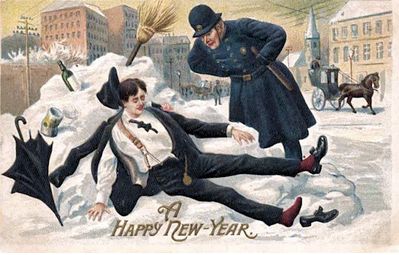
Old New Year Card

Monday 1st January 2025 7.00 pm
On this Virtual Walk we look at how London has celebrated the New Year over the past 2000 years.

The New Year has been a time of review, renewal, and anticipation of the future from time immemorial. The Ancient Britons saw the Solstice as a symbol of a promise of renewal as the Sun was reborn. As the weather turns to bleak mid winter, a festival or reflection and renewal cheers everyone up. This idea of renewal was followed by the Romans, and presided over by a two headed God called Janus who looked both backwards and forwards. Dickens Christmas Carol was based on redemption and his second great Christmas Book ‘The Chimes’ on the renewal that the New Year encouraged.

We look at London’s past to see where and how the New Year was celebrated. We also explore the different New Years we use and their associated Calendars – the Pagan year, the Christian year, the Roman year, the Jewish year, the Financial year, the Academic year and we reveal how these began. We look at folk traditions, Medieval Christmas Festivals, Boy Bishops, Distaff Sunday and Plough Monday, and other Winter Festival and New Year London traditions and folklore.

At the end, we use ancient methods to divine what is in store for us in 2023.

The virtual walk finds interesting and historic places in the City of London to link to our stories of Past New Year’s Days. We begin, virtually, at the Barbican Underground and continue to the Museum of London, the Roman Fort; Noble Street, Goldsmiths Hall, Foster Lane, St Pauls, Doctors Commons, St. Nicholas Colechurch and on towards the River Thames.

The Civil War, Restoration and the Great Fire of London Virtual Tour
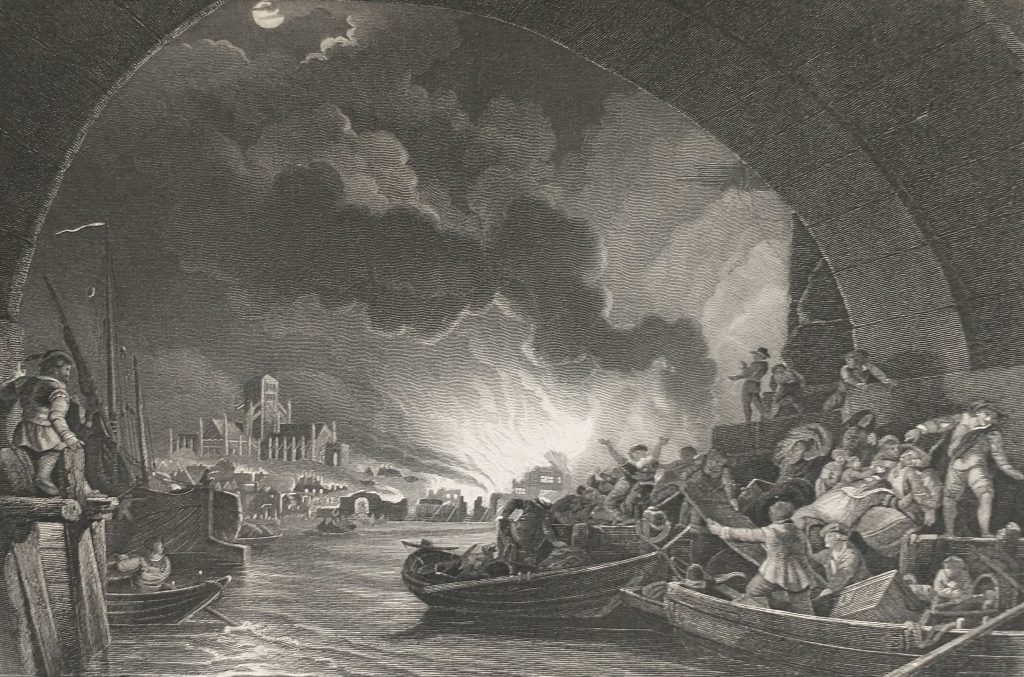
The Great Fire of London looking towards StPauls Cathedral from an old print


7:30pm Fri 30th January 2025


January 30th is the Anniversary of the execution of Charles I and to commemorate it we explore the events and the aftermath of the Civil War in London.

Along with the Norman Conquest of 1066 and winning the World Cup in 1966 the Great Fire in 1666 are the only dates the British can remember!

And we remember the Great Fire because it destroyed one of the great medieval Cities in an epic conflagration that shocked the world.

But it wasn’t just the Great Fire that made the 17th Century an epic period in English History. There was a Civil War, beheading of the King, a Republic, a peaceful Restoration of the Monarch, the last great plague outbreak in the UK, the Glorious Revolution and the Great Wind.

The Virtual Walk puts the Great Fire in the context of the time – Civil War, anti-catholicism, plague, and the commercial development of London.
The walk brings to life 17th Century London. It starts with the events that lead up to the Civil War concentrating on Westminster and ends with a vivid recreation of the drama of the Fire as experienced by eye-witnesses. Route includes: Westminster, Fish Street Hill, Pudding Lane, Monument, Royal Exchange, Guildhall, Cheapside, St Pauls, Amen Corner, Newgate Street, Smithfield.


Roman London – Literary & Archaeology Walk

11.30 am Sun 9th Feb 2025 Monument Underground Station

also on 11.30am Sun 27th Apr 25 but starting from Moorgate
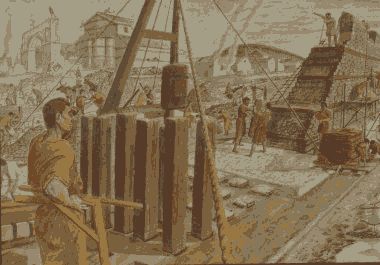
Roman Riverside Wall being built
London Roman Riverside Wall o


This is a walking tour features the amazing archaeological discoveries of Roman London, and looks at life in the provincial Roman capital of Londinium.

This is a walking tour that features the amazing archaeological discoveries of Roman London, and looks at life in the provincial Roman capital of Londinium.

Our Guides will be Publius Ovidius Naso and Marcus Valerius Martialis who will be helped by Kevin Flude, former Museum of London Archaeologist, Museum Curator and Lecturer.

We disembark at the Roman Waterfront by the Roman Bridge, and then explore the lives of the citizens as we walk up to the site of the Roman Town Hall, and discuss Roman politics. We proceed through the streets of Roman London, with its vivid and cosmopolitan street life via the Temple of Mithras to finish with Bread and Circus at the Roman Amphitheatre.

Zinger Read: Talk about a high-quality one-two punch. This walk investigates the groundbreaking archaeological discoveries of Roman London. And then it reconstructs life in a provincial Roman capital using archaeological and literary sources. Discoveries – insights – like flashes of lightning in a cloud. We begin at the site of the Roman bridge. We might be decent young Roman citizens in togas, having this and that bit of
explained to us as we make our way towards the Roman Town Hall. From there we head to the site of the excavation called ‘the Pompeii of the North.’ Followed by the Temple of Mithras. We finish with a walk along the Roman High Street in order to end at the site of the Roman Amphitheatre. So, yes, welcome to London as it was 2,000, 1,900, 1,800, 1,700 and 1,600 years ago. And, yes, the walk’s guided by a real expert, the distinguished emeritus Museum of London archaeologist Kevin Flude. That means you’ll see things other people don’t get to see, delve into London via fissures that aren’t visible, let alone accessible, to non-specialists.

REVIEWS
“Kevin, I just wanted to drop you a quick email to thank you ever so much for your archaeological tours of London! I am so thrilled to have stumbled upon your tours! I look forward to them more than you can imagine! They’re the best 2 hours of my week! 🙂 Best, Sue

Jane Austen’s London Anniversary Guided Walk
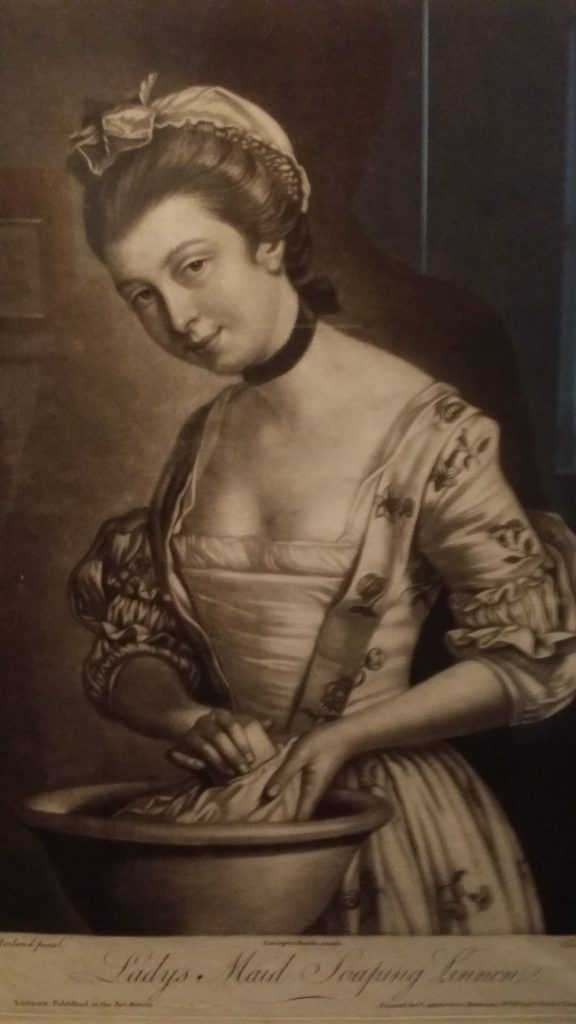
Georgian female engraving

2.30 pm Sunday 9th Feb 2025

Green Park underground station, Green Park exit, by the fountain To book

Also
9 February 2025Sunday2.30 pm4.30 pm
8 March 2025Saturday2.30 pm4.30 pm
6 April 2025Sunday11.30 am1.30 pm

2025 is the 250th Anniversary of Jane Austen’s Birth in Steventon, Hampshire. We celebrate her fictional and real life visits to Mayfair, the centre of the London section of Sense & Sensibility and where Jane came to visit her brother

“It is a truth universally acknowledged, that a Jane Austen devotee in possession of the good fortune of a couple of free hours today must be in want of this walk.”

People associate Jane Austen and her characters with a rural setting. But London is central to both Jane Austen’s real life and her literary life. So, this tour will explore Jane’s connections with London and give the background to Sense and Sensibility, a good part of which is based in this very area. We begin with the place Jane’s coach would arrive from Hampshire, and then walk the streets haunted by Willougby; past shops visited by the Palmers, the Ferrars; visit the location of Jane Austen’s brother’s bank and see the publisher of Jane’s Books. The area around Old Bond Street was the home of the Regency elite and many buildings and a surprising number of the shops remain as they were in Jane Austen’s day.


Jane Austen’s ‘A Picture of London’ in 1809 Virtual Walk
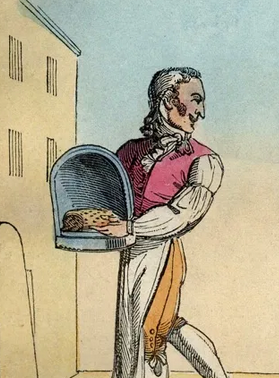
sam_syntax-cries-of-london-1820s_gentle-author_03-hot-plum-pudding-seller


7.30 27th January 2025

With the help of a contemporary Guide Book, Jane Austen’s letters, and works we explore London in 1809.

‘The Picture of London for 1809 Being a CORRECT GUIDE to all the Curiosities, Amusements, Exhibitions, Public Establishments, and Remarkable Objects in and near London.’

This Guide Book to London might have been on Henry Austen’s shelf when his sister, Jane, came to visit him in London. But it enables us to tour the London that Jane Austen knew in some detail. We will look at the Curiosities as well as the shopping, residential, theatres areas as well as the Port, the Parks and the Palaces.

The guided walk is a thank you to Alix Gronau, who, having been to one of my lectures in 1994, wanted the book to come to me. I have had the book restored and am using it to explore London in 1809.

Jane Austen’s London Anniversary Walk

Jane Austen’s London Anniversary Walk 2.30 pm Sunday 9th February 25 To book


A Virtual Tour of Jane Austen’s Bath
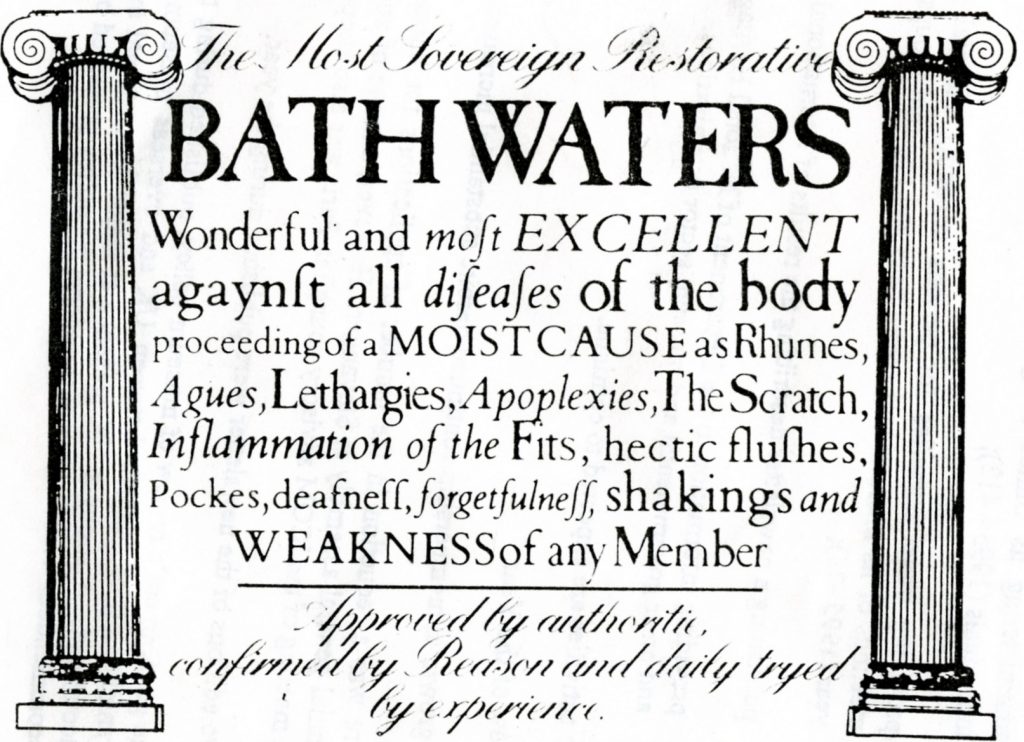
Poster for the most socereign restorative Bath Water

7.30pm 10th February 2025


Tudor London – The City of Wolf Hall 11.30am Sat 22nd Feb 25


Myths, Legends, Archaeology and the Origins of London
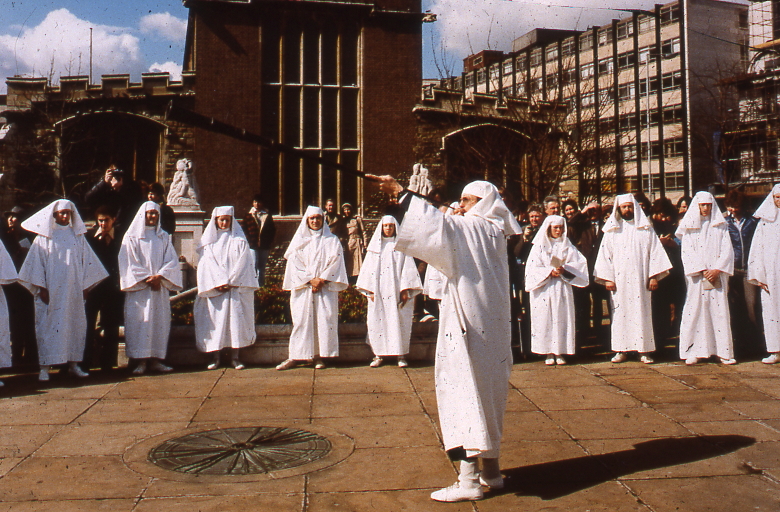
Druids at All Hallows, by the Tower

2.30pm Sat 22nd February 2025 Tower Hill Underground

The walk tells the stories of our changing ideas about the origins of London during the Prehistoric, Roman and Saxon periods.

The walk is led by Kevin Flude, a former archaeologist at the Museum of London, who has an interest both in myths, legends and London’s Archaeology.

The walk will tell the story of the legendary origins of London which record that it was founded in the Bronze Age by an exiled Trojan and was called New Troy, which became corrupted to Trinovantum. This name was recorded in the words of Julius Caesar; and, then, according to Legend, the town was renamed after King Ludd and called Lud’s Dun. Antiquarians and Archaeologists have taken centuries to demolish this idea, and became convinced London was founded by the Romans. Recently, dramatic evidence of a Bronze Age presence in London was found.

When the Roman system broke down in 410 AD, historical records were almost non-existent, until the Venerable Bede recorded the building of St Pauls Cathedral in 604 AD. The two hundred year gap, has another rich selection of legends. which the paucity of archaeological remains struggles to debunk.

The walk will explore these stories and compare the myths and legends with Archaeological discoveries.

The route starts at Tower Hill, then down to the River at Billingsgate, London Bridge, and into the centre of Roman London.

Roman London – Literary & Archaeology Walk 11.30am Sat Mar 8th 25
Jane Austen’s London Anniversary Walk 2.30pm Sat 8th Mar 25

The Decline And Fall Of Roman London Walk 11.30 Sat 22nd March 2025
London. 1066 and All That Walk Sat 2.30pm 22nd March 2025

Jane Austen’s London Anniversary Walk 11.30am Sun 6th Apr 25


Chaucer’s Medieval London Guided Walk 2:30pm Sun 6th Apr 25

and

Chaucer’s London To Canterbury Virtual Pilgrimage 7.30pm Friday 18th April 25 To book
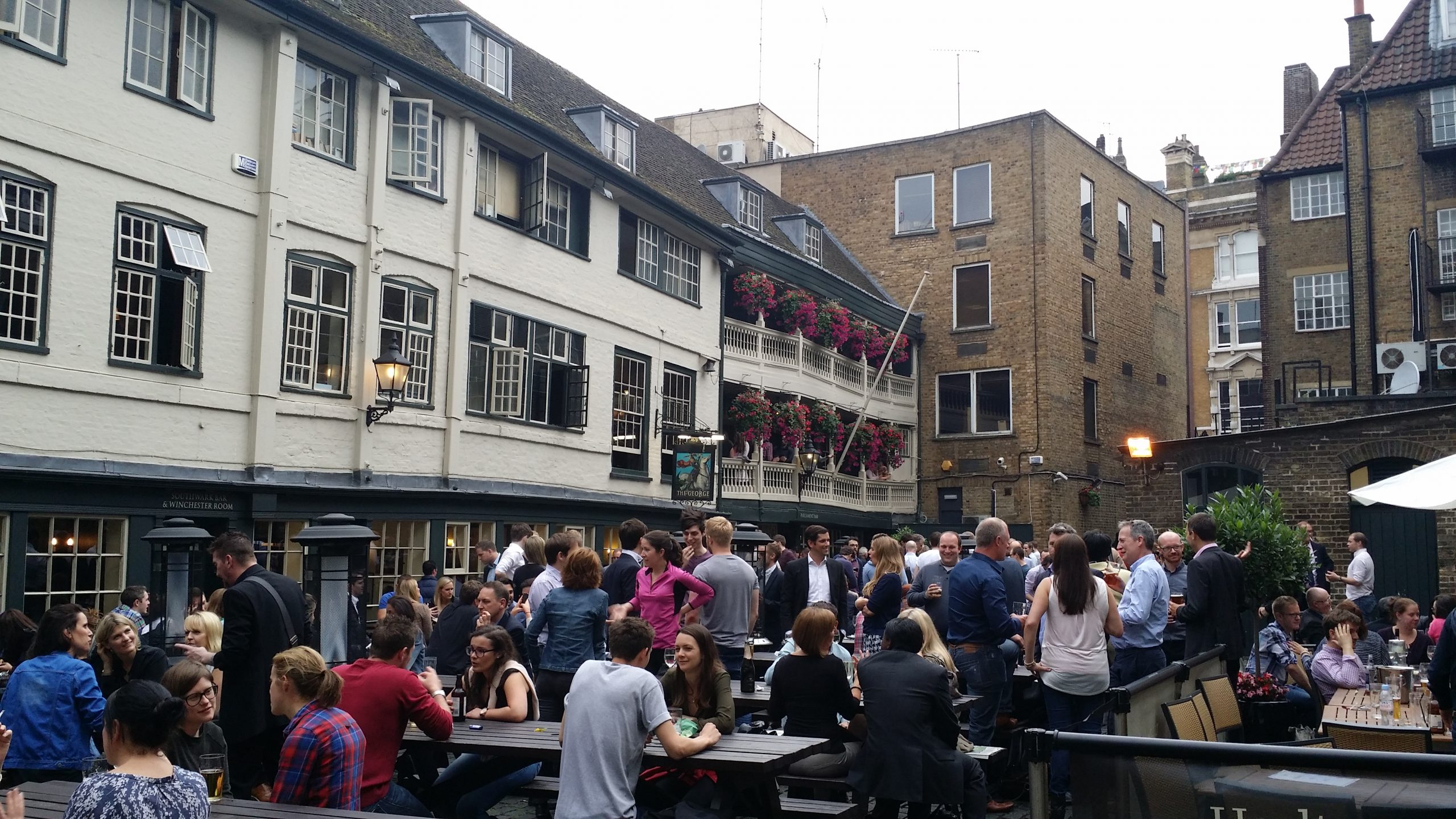

George Inn,Southwark


A Walk around Medieval London following in the footsteps of its resident medieval poet – Geoffrey Chaucer

One of the spectators at the Peasants Revolt was Geoffrey Chaucer, born in the Vintry area of London, who rose to be a diplomat, a Courtier and London’s Customs Officer. He lived with his wife in the Chamber above the Gate in the City Wall at Aldgate. His poetry shows a rugged, joyous medieval England including many scenes reflecting life in London. His stories document the ending of the feudal system, growing dissatisfaction with the corruption in the Church, and shows the robust independence with which the English led their lives.

His work helped change the fashion from poetry in French or Latin to acceptance of the English language as suitable literary language. This was helped by the growth of literacy in London as its Merchants and Guildsmen became increasingly successful. In 1422, for example, the Brewers decided to keep their records in English ‘as there are many of our craft who have the knowledge of reading and writing in the English idiom.’

Chaucer and other poets such as Langland give a vivid portrait of Medieval London which was dynamic, successful but also torn by crisis such as the Lollard challenge to Catholic hegemony, and the Peasants who revolted against oppression as the ruling classes struggled to resist the increased independence of the working people following the Black Death.

A walk which explores London in the Middle Ages, We begin at Aldgate, and follow Chaucer from his home to his place of work at the Customs House, and then to St Thomas Chapel on London Bridge, and across the River to where the Canterbury Tales start – at the Tabard Inn.

This is a London Walks event by Kevin Flude

Roman London – Literary & Archaeology Walk 11.30am Sun 27th Apr 25
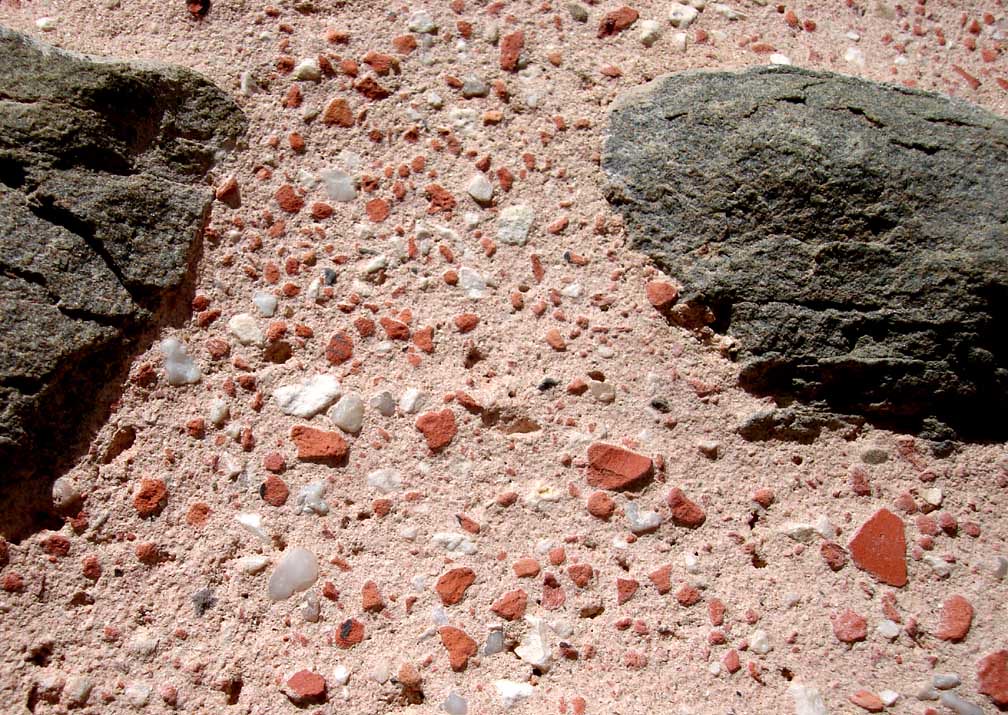
Roman layer opus signinum,


Tudor London – The City of Wolf Hall 3:00pm Sun 27th Apr 25
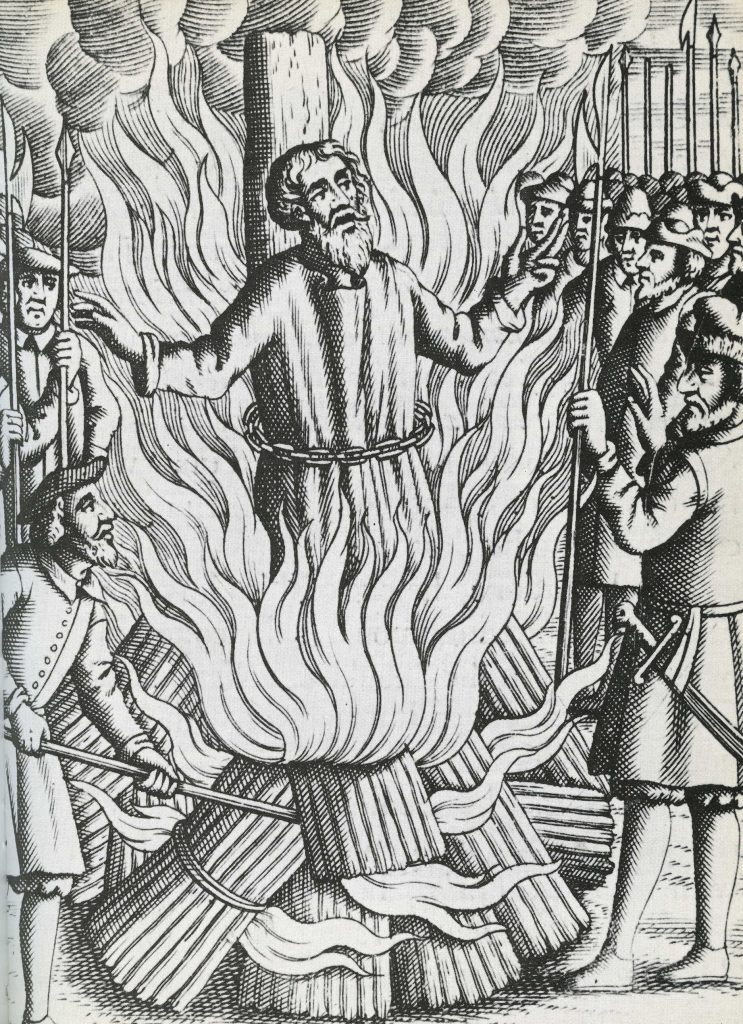
Thomas Bilney martyred in Smithfield. Black and white engraving
Thomas Bilney martyred in Smithfield.


The Walk creates a portrait of London in the early 16th Century, with particular emphasis on the life and times of Thomas Cromwell and Thomas More during the Anne Boleyn years.


More and Cromwell had much in common, both lawyers, commoners, who rose to be Lord Chancellor to Henry VIII, and ended their careers on the block at Tower Hill.

The walk starts with an exploration of Smithfield – site of the stake where heretics were burnt alive and of St Bartholomew’s Monastery – given to Richard Rich after his decisive role in the downfall of Thomas More. We continue to St Paul where Martin Luther’s books were burnt, and later, where Puritans preached against dancing round the Maypole.

We walk along the main markets streets of London, to Thomas More’s birthplace, and to the site of More’s and Cromwell’s townhouses before, if time allows, finishing at the site of the Scaffold where More and Cromwell met their ends, overlooking where Anne Boleyn was incarcerated in the Tower of London

To Book:
https://www.walks.com/our-walks/tudor-london-the-city-of-wolf-hall/

A Boy From Haggerston before the War. 6pm 1st May 2025 Shoreditch Library.


Myths, Legends, Archaeology and the Origins of London 11.30am Sun 25th May 25 To book


The Decline And Fall Of Roman London Walk 3pm Sun May 25 To book

The Peasants Revolt Anniversary Guided Walk
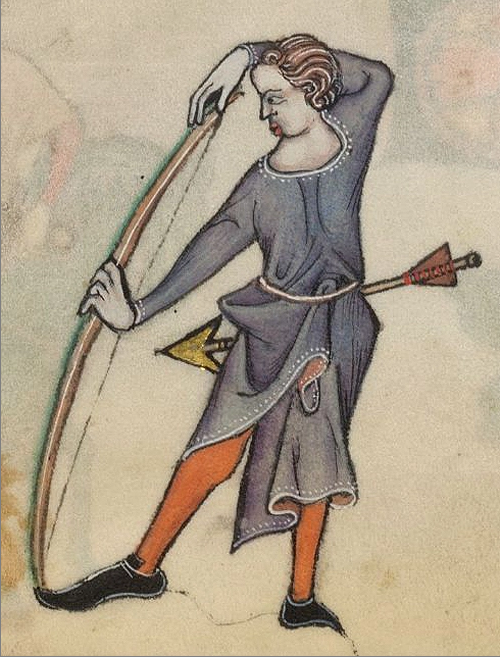
Medieval drawing of an archer

6.30pm Wed 11th June 2025 Aldgate Underground To book

An Anniversary Walk tracking the progress of the Peasants as they take control of London in June of 1381

Short read: The Summer of Blood

Long read: The Peasants’ Revolt. The greatest popular rising in English history. This is the anniversary walk. The London Walk that heads back to 1381, back to the Peasants’ Revolt. You want a metaphor, think stations of the cross. This is the stations of the Peasants’ Revolt walk. We go over the ground, literally and metaphorically. Where it took place. Why it took place. Why it took place at these places. What happened. The walk is guided by the distinguished Museum of London Archaeologist
His expertise means you’ll see the invisible. And understand the inscrutable.

On the anniversary of the Peasants Revolt we reconstruct the events that shook the medieval world. In June 1381, following the introduction of the iniquitous Poll Tax, England’s government nearly fell, shaken to the core by a revolt led by working men. This dramatic tour follows the events of the Revolt as the Peasants move through London in June 1381.

We met up with the Peasants at Aldgate, force our way into the City. We march on the Tower of London as the King makes concessions by ending serfdom, at Mile End. But the leaders take the mighty Tower of London and behead the leaders of Richard’s government. Attacks follow on the lawyers in the Temple, the Prior at St. John’s of Jerusalem, Flemish Londoners, and on Lambeth and Savoy Palaces.

The climax of the Revolt comes at Smithfield where a small Royal party confront the 30,000 peasants.

Tudor London – The City of Wolf Hall 11.30am 13th July 2025 To Book
Jane Austen’s London Anniversary Walk 3pm Sunday 13th July 25 To book
Roman London – Literary & Archaeology Walk 11.30 am Sat 2nd Aug 2025 ToBook
Chaucer’s Medieval London Guided Walk 2:30pm Sat 2nd Aug 2025 To Book
Myths, Legends, Archaeology and the Origins of London 11.00am Sat 16th Aug25 to Book
Roman London – Literary & Archaeology Walk 6:30pm Wed 24th Sept 2025 To book
The Archaeology of London Walk 6.30pm Fri 3rd October 2025 To Book
Chaucer’s Medieval London Guided Walk 11:30pm Sat 4th Oct 25 To book
The Decline And Fall Of Roman London Walk 11.30pm Sat 8th Nov 25 To book
Jane Austen’s London Anniversary Walk 2.00pm Sat 23rd Nov25 To book
Rebirth of Saxon London 23rd Nov 25
Roman London – Literary & Archaeology Walk sat 11am 6th Dec 2025 To book
Cromwell’s and More’s Tudor London Walk 2pm 7th Dec25 To book
Jane Austen’s London Anniversary Walk 2.30pm Sun 14 Dec25 To book
Christmas With Jane Austen Virtual London Tour 7.30pmTues 16 Dec25 To book
The London Equinox and Solstice Walk 11:30pm Sun 21st Dec 25To book
The London Winter Solstice Virtual Tour 7.30pm Sun 21 Dec 25 To book

Previous Years Archives

Here are previous archive of guided walks and events

Archive of Events/Walks 2024
Archive of events/Walks 2023
Archive of Events/Walks 2022
Archive of Recent Walks (2021)
Archive of Resent Walks (2019-2020)
Winter Solstice, December 21st

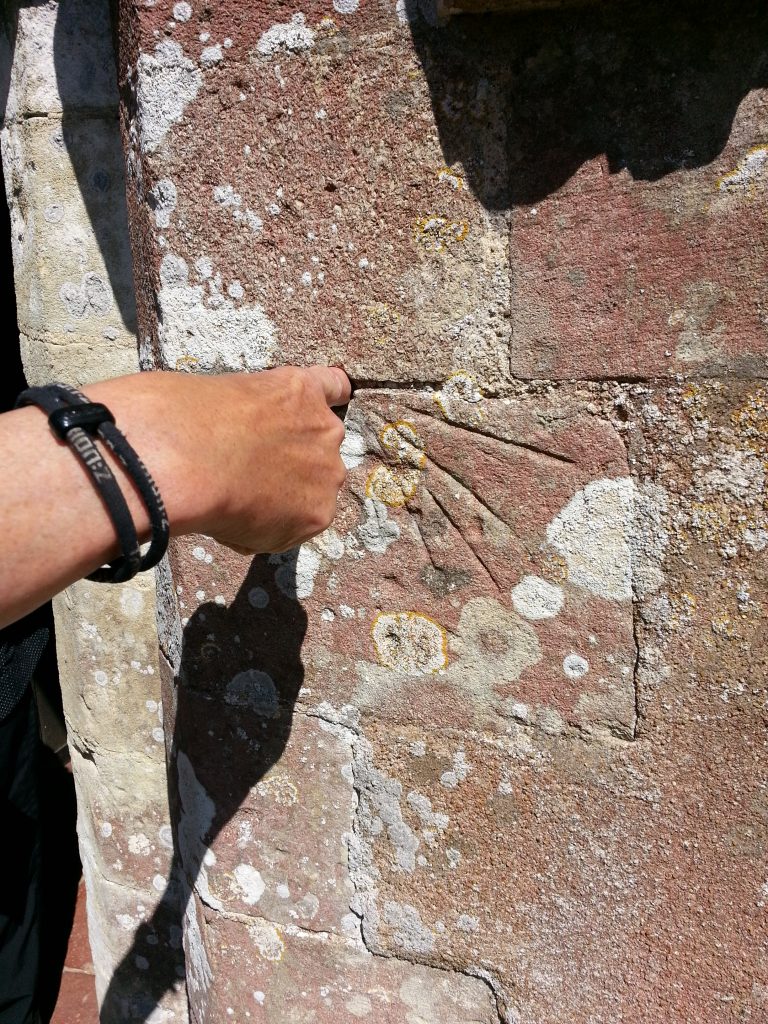
Mass Clock Steventon Church Hampshire

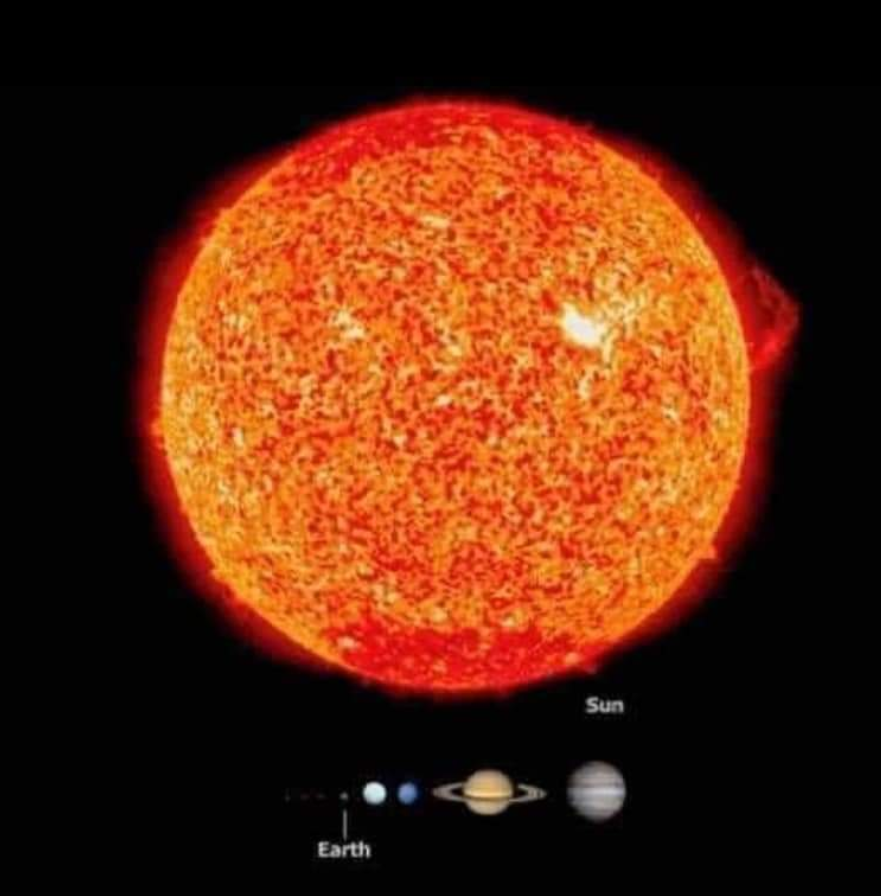
The Winter Solstice this year is: Sunday, December 21, at 3.03pm GMT in the UK. according to the Royal Museums Greenwich. Today, the Sun is at its lowest midday height of the year.  This morning was the most southerly rising of the Sun this year. If the southward diminishing of the Sun everyday were to continue, life will be extinguished on earth. The world would have no light and no heat. So, societies all round the world, made a point of honouring their Sun Gods and Goddesses on this day.

And so on this day, or so it was thought, our Deities renew their promises as the Sun begins its rebirth. It begins to rise further north each day, the Sun at noon is higher, and it sets further north. So the days are longer, brighter, eventually warmer. Thank God(s)!

For some, it’s just the turn in the cycle of life. For others, it’s the death of the old Sun and the birth of a brand-new Sun.  The Egyptians believed that the sun was reborn every day as a dung beetle.

Symbolically, the winter solstice is an ending as well as a beginning. It is a turning point and a promise by the Deity that the world will continue. It will turn, the wheel will turn. Warmth and growth will return. Buds already growing in the earth will break out and bring new growth.

The Winter Solstice – time for a party!

Culturally, it’s a time to have a party before the weather gets really cold. It is a time to evaluate your life; look back at the lessons from the last year. A time to begin, like the Sun, a new and hopefully better cycle.

Note. So if the Sun is at its shortest and weakest, why isn’t it the coldest time of the year? That is because the earth and particularly the oceans retain the heat of the Sun, and so the coldest time is at the end of January.

For a discussion, on the Solstice and the Parthenon Marbles look at my post:

First published on Dec 21st 2021, revised and republished on Dec 22nd 2023, Dec 21st 2024,2025

Grecian Winter – Hesiod’s Works & Days December 15th

Abney Park cemetary in winter
Abney Park cemetery in winter photo by Harriet Salsibury

Hesiod is a contemporary of Homer, and therefore one of the first European poets, writing about 700BC. One of the first commentators on Greek life, thought, religion, mythology, farming and time keeping. Hesiod’s Works & Days ‘ is his Farmers Almanac and therefore long overdue an appearance on my Almanac of the Past.

Hesiod’s poems also introduce the idea of the epoch. Past glorious epochs of Gold and Bronze with a further descent to his own epoch which was of the base metal age of Iron. His so-called Myth of Five Ages, starts with a Golden Age, in which Humans don’t need to work. Followed by a Silver Age where they live to one hundred years, but live a life of strife. The Bronze Age follows which is an even tougher age as the bronze armoured men are thoroughly violent. The Age of Heroes follows which is the age of the Trojan War. There follows the Iron Age which is Hesiod’s age a time of toil and misery!

.In the 19th Century, European antiquarians, imbued with a humanist belief in Progress, developed the idea of Stone, Bronze and Iron Ages, an almost direct opposite of Hesiod’s, downhill-all-the-way to the present day idea.

Hesiod also brings in early references to Prometheus and Pandora, two of the great myths of the flaws of humanity.

Hesiod and Winter

This is what he says of Winter. It is from a translation by Christopher Kelk, available to download here (I have added line breaks after full stops, just for ease of reading.)

Excerpt from Hesiod’s Works & Days

…. you should make
A detour during winter when the cold
Keeps men from work, for then a busy man
May serve his house. Let hardship not take hold,
Nor helplessness, through cruel winter’s span,
Nor rub your swollen foot with scrawny hand.

An idle man will often, while in vain
He hopes, lacking a living from his land,
Consider crime. A needy man will gain
Nothing from hope while sitting in the street
And gossiping, no livelihood in sight.

Say to your slaves in the midsummer heat:
“There won’t always be summer, shining bright –
Build barns.” Lenaion’s evil days, which gall
The oxen, guard yourself against. Beware
Of hoar-frosts, too, which bring distress to all
When the North Wind blows, which blasts upon the air
In horse-rich Thrace and rouses the broad sea,
Making the earth and woods resound with wails.

He falls on many a lofty-leafed oak-tree
And on thick pines along the mountain-vales
And fecund earth, the vast woods bellowing.
The wild beasts, tails between their legs, all shake.

Although their shaggy hair is covering
Their hides, yet still the cold will always make
Their way straight through the hairiest beast.

Straight through
An ox’s hide the North Wind blows and drills
Through long-haired goats. His strength, though, cannot do
Great harm to sheep who keep away all chills
With ample fleece. He makes old men stoop low
But soft-skinned maids he never will go through –
They stay indoors, who as yet do not know
Gold Aphrodite’s work, a comfort to
Their darling mothers, and their tender skin
They wash and smear with oil in winter’s space
And slumber in a bedroom far within
The house, when in his cold and dreadful place
The Boneless gnaws his foot (the sun won’t show
Him pastures but rotate around the land
Of black men and for all the Greeks is slow
To brighten).

That’s the time the hornèd and
The unhorned beasts of the wood flee to the brush,
Teeth all a-chatter, with one thought in mind –
To find some thick-packed shelter, p’raps a bush
Or hollow rock. Like one with head inclined
Towards the ground, spine shattered, with a stick
To hold him up, they wander as they try
To circumvent the snow.

As I ordain,
Shelter your body, too, when snow is nigh –
A fleecy coat and, reaching to the floor,
A tunic. Both the warp and woof must you
Entwine but of the woof there must be more
Than of the warp. Don this, for, if you do,
Your hair stays still, not shaking everywhere.

Be stoutly shod with ox-hide boots which you
Must line with felt. In winter have a care
To sew two young kids’ hides to the sinew
Of an ox to keep the downpour from your back,
A knit cap for your head to keep your ears
From getting wet.

It’s freezing at the crack
Of dawn, which from the starry sky appears
When Boreas drops down: then is there spread
A fruitful mist upon the land which falls
Upon the blessed fields and which is fed
By endless rivers, raised on high by squalls.

Sometimes it rains at evening, then again,
When the thickly-compressed clouds are animated
By Thracian Boreas, it blows hard. Then
It is the time, having anticipated
All this, to finish and go home lest you
Should be enwrapped by some dark cloud, heaven-sent,
Your flesh all wet, your clothing drenched right through.

This is the harshest month, both violent
And harsh to beast and man – so you have need
To be alert. Give to your men more fare
Than usual but halve your oxen’s feed.
The helpful nights are long, and so take care.

Keep at this till the year’s end when the days
And nights are equal and a diverse crop

Keep at this till the year’s end when the days
And nights are equal and a diverse crop
Springs from our mother earth and winter’s phase
Is two months old and from pure Ocean’s top
Arcturus rises, shining, at twilight.

Hesiod’s Works and Days: Translation Christopher Kelk
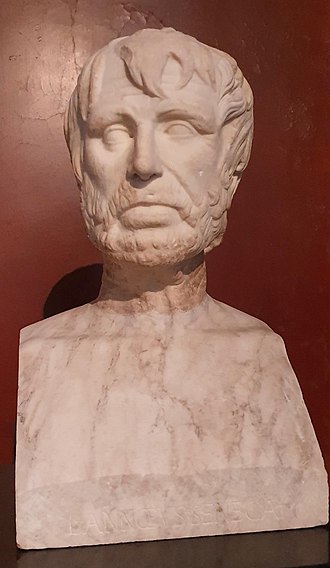
Roman Bust of Hesiod (Wikipedia photo by Yair Hakla) Neues Museum

Acturus is not seen in winter, and in the Northern Hemisphere its rising (50 days after the winter solstice) and has always been associated with the advent of spring.

Boreas was the winged God of the North wind, which bore down from the cold Mountains of Thrace (north of Macedonia). One of his daughters, Khione, was the Goddess of Snow. Lenaion was associated with January one of the festivals of Dionysus, and a theatrical season in Athens particularly for comedy.

To see more of Hesiod see my post hesiod-and-a-grecian-spring/

First published 15th December 2022, republished December 2023, 2024,2025

December and Kalendar of Shepherds December 1st

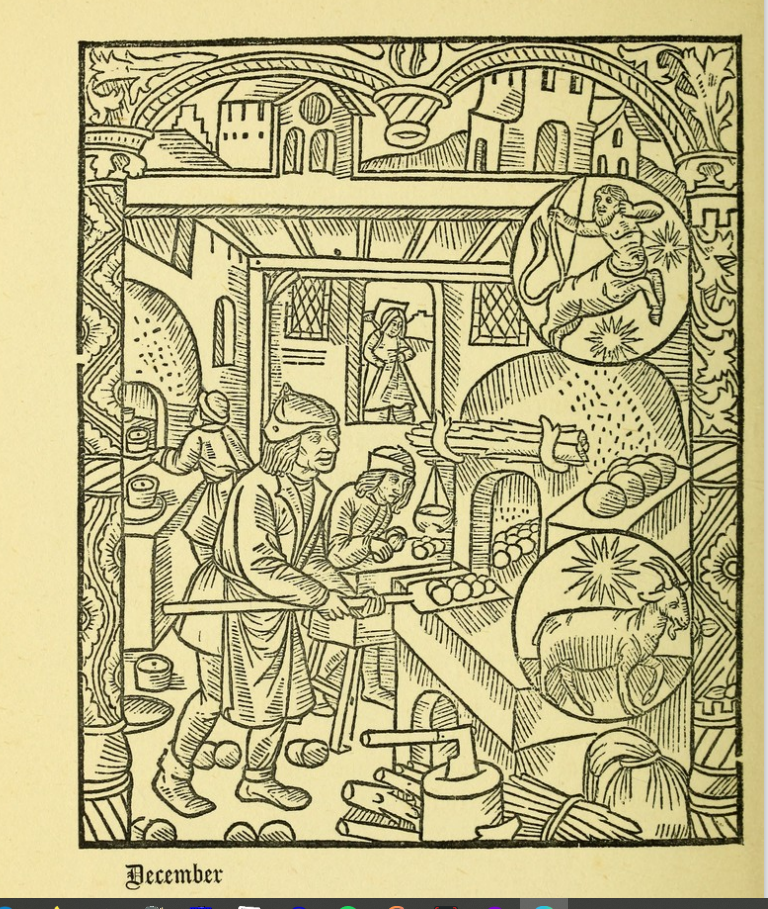
French 15th Century December and the ‘Kalendar of Shepherds’

December comes from the Latin for ten – meaning the tenth month. Of course, it is the twelfth month because the Romans added a couple of extra months especially to confuse us. For a discussion on this, look at an early blog post which explains the Roman Calendar.

In Anglo-Saxon it is ærra gēola which means the month before Yule. In Gaelic it is An Dùbhlachd – the Dark Days which is part of An Geamhrachd, meaning the winter. The word comes from an early Celtic term for cold, from an ‘ancient linguistic source for ‘stiff and rigid’’, which describes the hard frosty earth. (see here for a description of the Gaelic Year). In Welsh, Rhafgyr, the month of preparation (for the shortest day).

For the Christian Church, it’s the period preparing for the arrival of the Messiah into the World. (see my post on Advent Sunday which this year was yesterday November 30th).

For a closer look at the month, I’m turning to the 15th Century Kalendar of Shepherds. Its illustration (see above) for December shows an indoor scene, and is full of warmth as the bakers bake pies and cakes for Christmas. Firewood has been collected, and the Goodwife is bringing something in from the Garden. The stars signs are Sagittarius and Capricorn.

The Sparrow and the Warm Hall

The Venerable Bede has an interesting story (reported in ‘Winters in the World’ by Eleanor Parker) in which a Pagan, contemplating converting to Christianity, talks about a sparrow flying into a warm, convivial Great Hall, from the bitter cold winter landscape. The sparrow enjoys this warmth, but flies straight out, back into the cold Darkness. Human life, says the Pagan, is like this: a brief period in the light, warm hall, preceded and followed by cold, unknown darkness. If Christianity, he advises, can offer some certainty as to what happens in this darkness, then it’s worth considering.

This contrast between the warm inside and the cold exterior is mirrored in Neve’s Almanack of 1633 who sums up December thus:

This month, keep thy body and head from cold: let thy kitchen be thine Apothecary; warm clothing thy nurse; merry company thy keepers, and good hospitality, thine Exercise.

Quoted in ‘the Perpetual Almanack of Folklore’ by Charles Kightly

December in the ‘Kalendar of Shepherds’

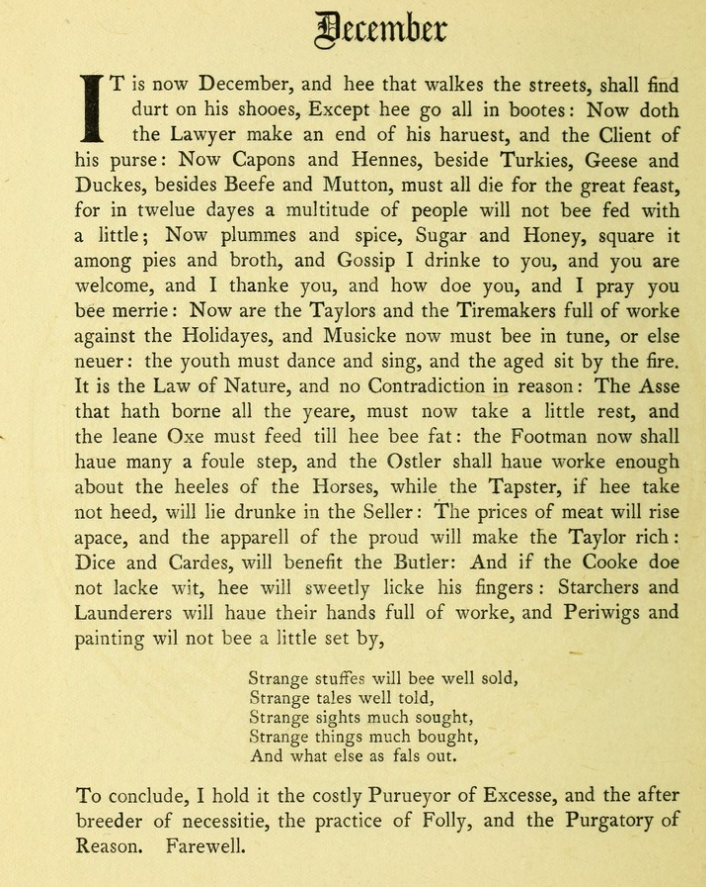
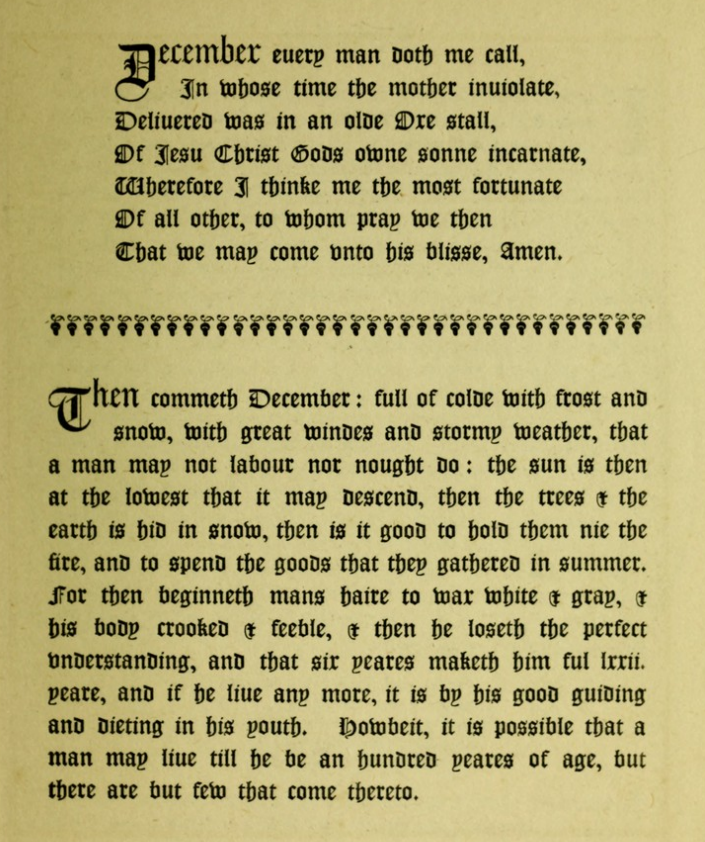
The Kalendar of Shepherds text below gives a vivid description of December weather. Dating from 1626 it gives a detailed look at the excesses of Christmas, which people are on holiday, and who is still working hard. But it concludes it is a costly month.

Nicholas Breton’s ‘Fantasticks of 1626 – December from the Kalendar of Shepherds

Six Dozen Years – a Lifespan

The other section of the Kalendar then elaborates on the last six years of a man’s life, with hair going white, body ‘crooked and feeble’. (from 66 to 72). The conceit here is that there are twelve months of the year, and a man’s lot of ‘Six score years and ten’ is allocated six years to each month. So December is not just about the 12th Month of the Year but also the last six years of a person’s allotted span. The piece allows the option of living beyond 72, ‘and if he lives any more, it is by his good guiding and dieting in his youth.’ Good advice, as we now know. But living to 100 is open to but few.

Kalendar of Shepherds

Interesting from my point of view as I have reached the end of my life span as suggested by the Calendar, and my father is 98 and approaching his hundred!

About the Kalendar of Shepherds.

The Kalendar was printed in 1493 in Paris and provided ‘Devices for the 12 Months.’ The version I’m using is a modern (1908) reconstruction of it. It uses wood cuts from the original 15th Century version and adds various texts from 16th and 17th Century sources. (Couplets by Tusser ‘Five Hundred Parts of Good Husbandrie 1599. Text descriptions of the month from Nicholas Breton’s ‘Fantasticks of 1626.) This provides an interesting view of what was going on in the countryside every month.

For more on the Kalendar look at my post here.

The original Kalendar can be read here: https://wellcomecollection.org/works/f4824s6t

To see the full Kalendar, go here:

On This Day

1981 – Launch of the BBC Micro

1990 The UK was rejoined to Europe for the first time for 8000 years, when the Channel Tunnellers breached the final wall of rock. French and British workers exchanged flags and shook hands. The Tunnel was opened to traffic in 1994 more than 10 years after work started and 200 years since Napoleon proposed the idea. Read what ICE has to say about the (ICE – Institute of Civil Engineers!).

Britain was connected to the Continent until about 6,100BC, the North Sea, the Channel, and the Irish Sea were all dry (or marshy lands). Water levels were rising and ice melting. the Storegga Slides in Norway saw huge cliffs of ice slipped into the sea. This caused a tsunami over 30ft high and penetrating 25 miles inland. Read the BBC here.

Since then, Britain has been an Island. Archaeologists have been exploring the flooded area which is known as Dogger Land, after the Dogger Bank. (for more on Dogger Land.)

First Published in 2024, republished 2025

Harvest Moon October 7th

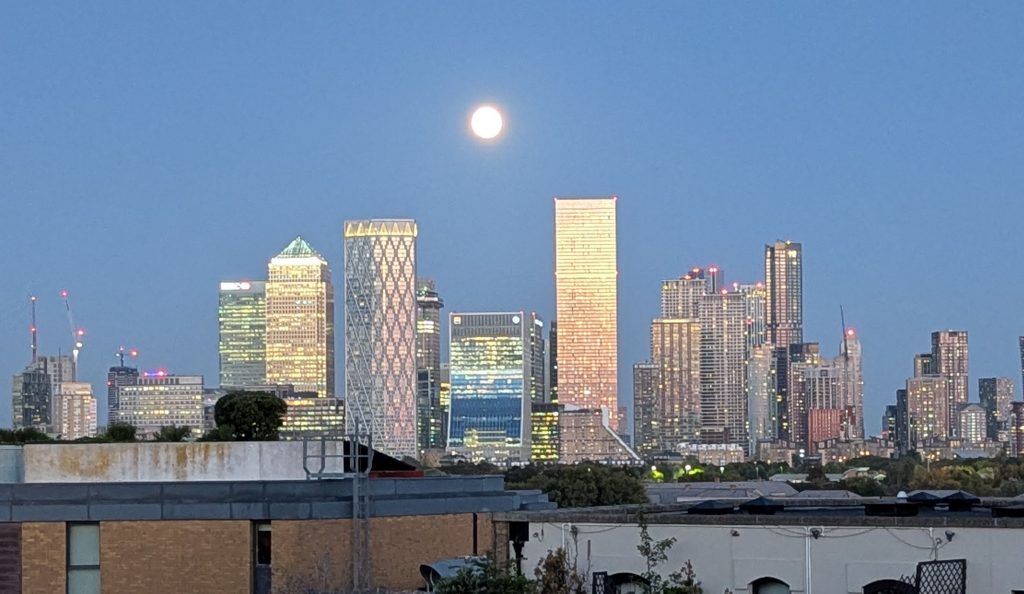
Harvest Moon (Oct 6th 25) over Canary Wharf from Wapping. (Photo K Flude).

The Harvest supermoon will rise at 6.20pm, today on October 7th 2025. It looked pretty full last night from my vantage point in a penthouse flat in Wapping. A supermoon is a full moon that occurs when the distance between the Earth and the Moon are at their minimum. So it is bigger and brighter and even more magical.

This one is known as the Harvest Moon or the Hunter’s moon for fairly obvious reasons.

It is definitely the time to play my favourite song.

To find out about the Moon Goddess Selena see my post on the Oak Moon in December and also here.

First Posting on October 7th, 2025

James Sadler & other Balloon Ascents October 4th 1784

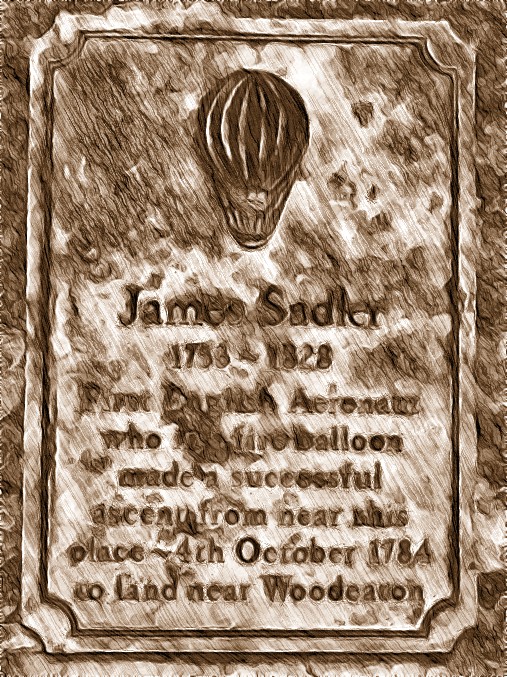
Sketch of plaque to James Sadler, Balloonist. On wall of Deadman’s Walk, Merton College, the Meadows in Oxford

On February 9th, 1784 James Sadler launched an unmanned Hot Air Balloon, from what is now St Hilda’s College. The Balloon travelled all the way to Kent, 79 miles away. James Sadler was the son of a cook, but worked at the Ashmolean Museum, in Oxford. The launch place is an area of green which is bounded to the North by Merton College. To the South by the Meadows. To the West by Christ Church, and to the East the Oxford Botanical Garden, the first in Britain. Also a lovely place.

Later the same year, he hazarded his own life for the first Hot-air Balloon ascent by an Englishman. On the morning of October 4th, he lit the stove in the Balloon basket to create the hot air. He rose an estimated 3600 ft. On board he had a barometer and a thermometer. He used the Barometer to estimate height. The thermometer was not very useful because of the heat of the stove.

He reported that his elevated position caused no inconvenience, except that it was colder than on the ground. A wind drove him towards a wood as he put out the stove. He had ‘recourse to the Oars’ which he exercised with great Success’. I think the oars were used to poke the air out of the balloon to help his descent. He landed safely 6 miles away in Woodeaton.

Further Flights by Sadler

On the 17th November he ascended in a Hydrogen Balloon, which was also successful. He made further ascents, including one at Mermaid Theatre in Hackney. He survived into his 70s and died in 1828. Sadly, one of his sons died in a ballooning accident in 1824.

Note on the Hackney Balloon Ascent

I found no reference to the Mermaid Theatre in Hackney. But there was a Mermaid Tavern in Mare Street, originally just north of St Augustine’s Church. It was then rebuilt on the other side of the road in the 1740s. And this is where the Hackney flight ascended from.

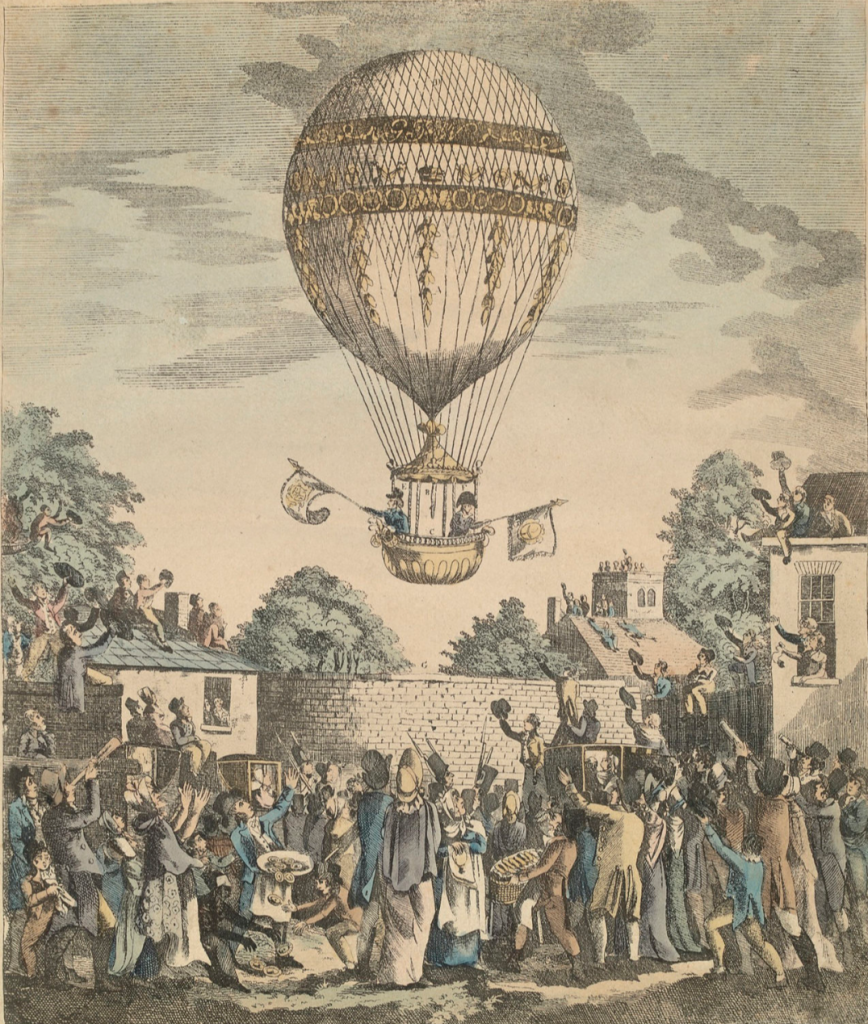
‘View of Balloon of Mr Sadler’s ascending with him and Captain Paget of the Royal Navy from the Gardens of the Mermaid Theatre’ source Facebook post.

Flights but not by the English!

When it comes to ‘firsts’, there is a lot of jiggery-pokery as to who really has the precedence. The actual first balloon ascent was on November 21st, 1783 by de Rozier and d’Arlandes. Their hot-air balloon was designed by the Montgolfier Brothers.

The first ascent in England was Vincent Lunardi. His flight was a couple of weeks before Sadler’s on September 15th. But then he was from Tuscany. It took off from the Honourable Artillery Company grounds at Moorfields in London.

So Sadler wasn’t the first, but was the first Englishman to ascend in a hot-air balloon. But my antennae is twitched by the use of the term ‘Englishman’. Because, since 1707, and the Act of Union, England was now in the Kingdom: ‘The United Kingdom of Great Britain’. Something was wrong. So yes, I discovered that the British (and Scottish) first ascent was by James Tytler. This took place from Edinburgh on August 25th 1784. To see more on Tytler who was an Apothecary and the editor of the Second Edition of the Encyclopedia Brittania go here:

To read about Zeppelin attacks on Britain see my post here.

On This Day

1226 – Death of St Francis

First published in October 2025

First & Last Coal-fired Power Stations September 30th 2024

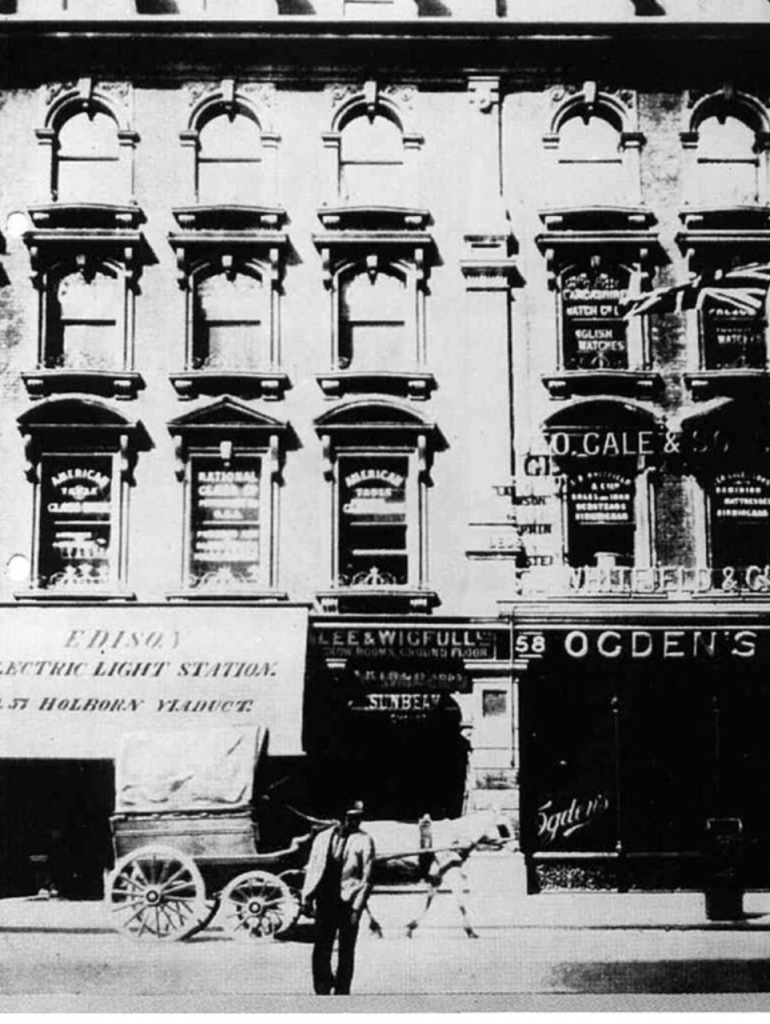
Holborn Edison Electric Light Station First & Last Coal-fired Power Stations

On this day, last year, Britain’s last coal-powered power station generated its final watt of electricity.  Ratcliffe-on-Stour’s closure means Britain is the first country to meet its target of phasing out coal.

The Nottingham power station opened in 1968, and once employed over 3000 people.

For more details follow this link https://www.theguardian.com/business/2024/sep/30/end-of-an-era-as-britains-last-coal-fired-power-plant-shuts-down

Edison Electric Light Station

The first coal-fired power station in Britain was at Holborn Viaduct in London, opened as the Edison Electric Light Station on 12th January 1882.

The power was generated by a steam engine powered by coal.  The electricity powered incandescent electric carbon-filament lights which lit up 986 lights to illuminate the road from Holborn Viaduct to St Martin’s-le-Grande.  The light bulb was invented 3 years previously. 

The number of lights was soon increased to 3,000. But the Station made a loss and was closed down 2 years later. The lights converted to gas.  Sadly, the building was destroyed in the Blitz.

Shoreditch Electric Light Station

A couple of miles to the East, in 1895, the Shoreditch Electric Light Station was established.   It used waste to produce electricity and steam for the local public baths.  The generating and combustion chambers, now houses a Circus School which my children attended.

It was officially opened by Lord Kelvin, the famous physicist in 1897. The Consulting Engineer was Edward Manville who came up with a scheme for a ‘dust destructor’. This comprised: an electricity generating station; a public bath heated by the waste heat from the generator; a library and museum.  It cost 200,000 pounds.  In 1899, in nearby Nile Street, the Shoreditch Vestry Council set up the first municipal housing scheme powered by electricity.

This level of enterprise by a local council seems like a fantasy of a distant past but also, given the sustainability of the project, unbelievably modern.

The motto on the side of the Power Station was ‘Light and Power from Dust’. The scheme was run by the local vestry council which adopted the motto ‘More Light, More Power’. This was also adopted by the new municipal Borough of Shoreditch when it was formed as part of the new London County Council.  The Power Station was renamed as the rather wonderful: Shoreditch Borough Refuse Destructor and Generating Station and adorned with the motto: PULVERE LUX ET VIS ‘Out of the dust, light and power’.

The story of the dust destructor and the generating station is told in some detail here and well worth a read.

First Written 2024 and updated in 2025

Beware the Surfeits of Autumn September 23rd

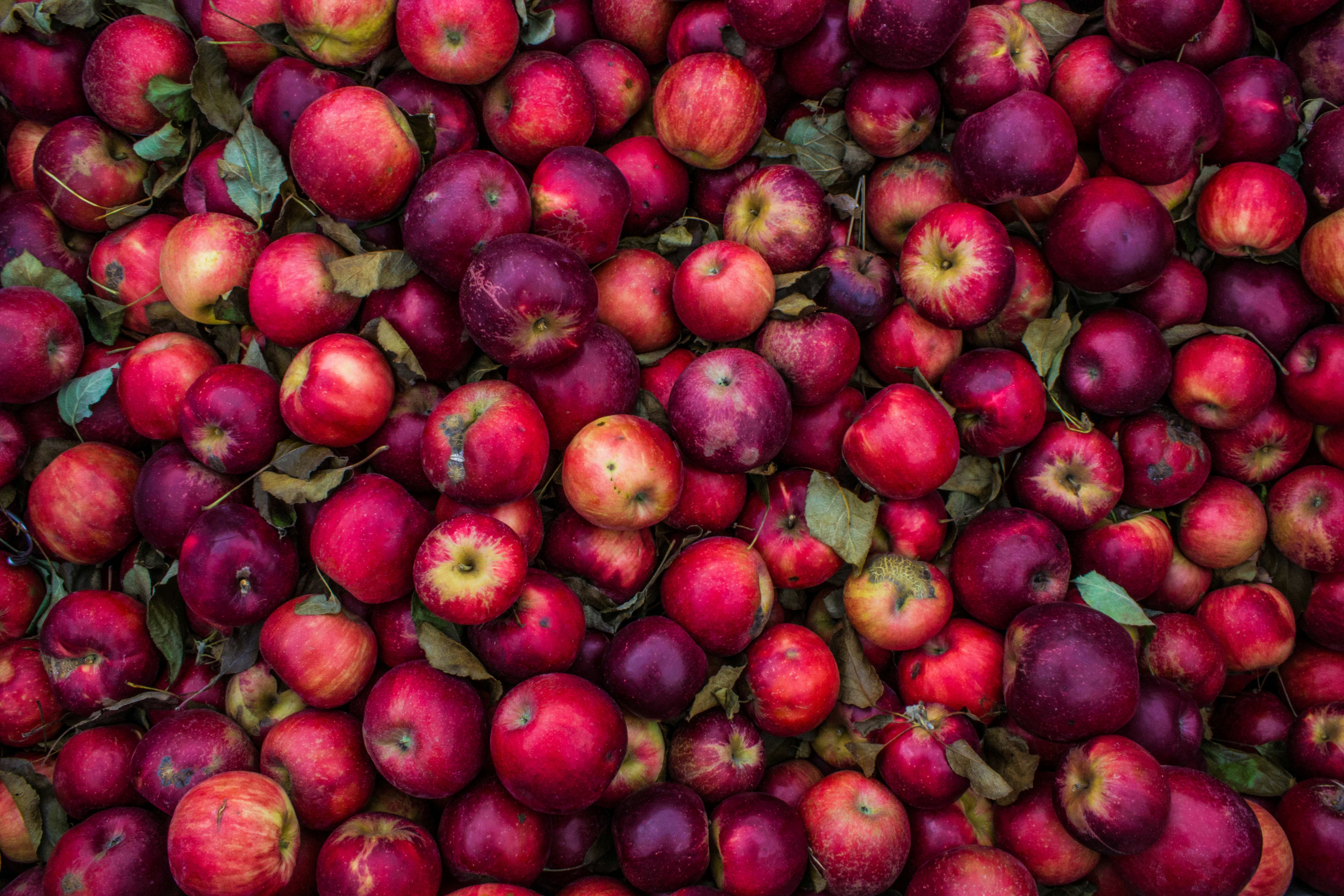
Apples. Unsplash photo by Sydney Rae
A Surfeit of Apples. Unsplash photo by Sydney Rae

So, it may be a surprise that the Autumn is the time of plenty. I think, townies like me, would assume spring or summer. But in Autumn, not only is the Harvest in, but nuts and fruits are ripening and ready to pick. As we go deeper into Autumn, the livestock is culled to a level that can be sustained through the harsh winter. And so a lot of meat is also available. Truly a time of ‘mellow fruitfulness’.

A Surfeit of Autumn Peaches or Lamphreys

Anything with the word ‘surfeit’ in it must begin with the wonderful comic history of Britain called:1066 and All That: A Memorable History of England, Comprising All the Parts You Can Remember, Including 103 Good Things, 5 Bad Kings and 2 Genuine Dates

Here we find that King Henry I died of a ‘surfeit’ of lamphreys’, which he indulged in against his Doctors’ advice. This was in November,. While his Great Grandson, King John:

finally demonstrated his utter incompetence by losing the Crown and all his clothes in the wash and then dying of a surfeit of peaches and no cider; thus his awful reign came to an end.’

He is a fine example of a ‘Bad King’. He died on the night of October 18th — 19th. So another King to leave this mortal coil by the means of an autumnal surfeit. Other accounts say his ale was poisoned or the surfeit was of plums. But he did have dysentery shortly before he died.

If you haven’t already it got it you probably, at this point, need to buy my book ‘Divorced, Beheaded, Died’. This is the best selling book about the Kings and Queens of England, told in bite sized chunks. It is always on sale at the British Museum.

‘No surfeit so evil as the surfeit of eating naughty bread’

Andrew Boorde in ‘Dietary of Health’ 1547 says that Wheat Bread makes you fat, particularly when made from new wheat. He says’Evil Bakers’ will add half of Barley. This is no good, nor is bread made from beans or peas. He continues:

hot bread is unwholesome to any man, for it doth lie in the stomach like a sponge: yet the smell of new bread is comfortable to the head and the heart. Old or stale bread doth dry up the blood or natural moisture in man, and doth engender ill humours; and is evil and tardy of digestion: wherefore is no surfeit so evil as a surfeit of eating naughty bread.

Lavendar Caps

Now is the time to protect your head with Lavendar as winter approaches, or so says William Turner’s Herbal of 1568:

I judge that the flowers of lavender, quilted into a cap and daily worn, are good for all diseases of the head, that come of a cold cause, and that they comfort the brain very well, namely if it have any distemperature that cometh of moistness.

If you remember, I wrote about Turner’s medical education in Ferrara in Italy in June. You can read it here.

Apples and Pears & No Cider

The fate of King John (above) shows the danger of running out of cider. But the apple trees are now groaning with Apples and Pears. So production can begin. I have been at my Father’s House picking up all the pears that drop every night. We have been cutting them up and putting them in the freezer, making purée and crumbles. Also, giving them to anyone who enters the house. But still not able to keep up with the Pears! Lots of Apples too, infact a bumper crop, many more than in any previous year. Earlier there was a host of plums from which I made my very first plum jam. I am looking forward to making a batch of Quince Jam, for the third year running.

Storing a Surfeit of Apples

Picking up windfall is problematic, as it was thought they would soften and bruise much easier than those picked from the trees. They would also contaminate other apples if laid with them. So it is best to pick apples before they are completely ripe. Then you can use Gervase Markham’s apple storage advice, which I wrote about in January and you can see here:

But:

A Surfeit of unripe fruit is a danger:

Green fruits make sickness to abound
Use good advice to keep thee sound
Give not thy lusts what they do crave
Lest thou unawares step in to thy grave.

Ranger’s Almanack 1627

If you do succumb, you need a medicine of nettle-seeds and honey.

A Surfeit of Filberts

As a caution to persons at this season, when nuts are so very abundant, we state that the sudden death of Mr Nunn of Cley, Norfolk is generally attributed to eating a great quantity of filberts and drinking pork wine therewith.’

York Current, September 1794

I do hope you have found this post fruitful and not too nutty. Please consult a doctor if you are having head or brain issues. The Lavender in your Peaky Blinders Cap may not do the trick

Acknowledgement

Again, I am very dependent on fruity tales from Charles Kightly’s A Perpetual Almanac of Folklore. It is worth buying as it also has many pretty pictures.

John Goodricke and the Variable Star. September 17th 1764

John Goodricke and the Variable Star

Newton

What I really admire are people who, through their sheer brain power, can change our views of the world.  The first example that comes to mind is Newton’s insight that if the universe were infinite, the night sky would not be dark as everywhere there would be tiny pinpricks of starlight.  So, we don’t live in a infinite universe. Another one is Einstein’s thought experiment that proves that time is relative. But see below for a description of that.  But, now to John Goodricke and the Variable Star. (for Newton and the Maypole see my post here).

Goodricke

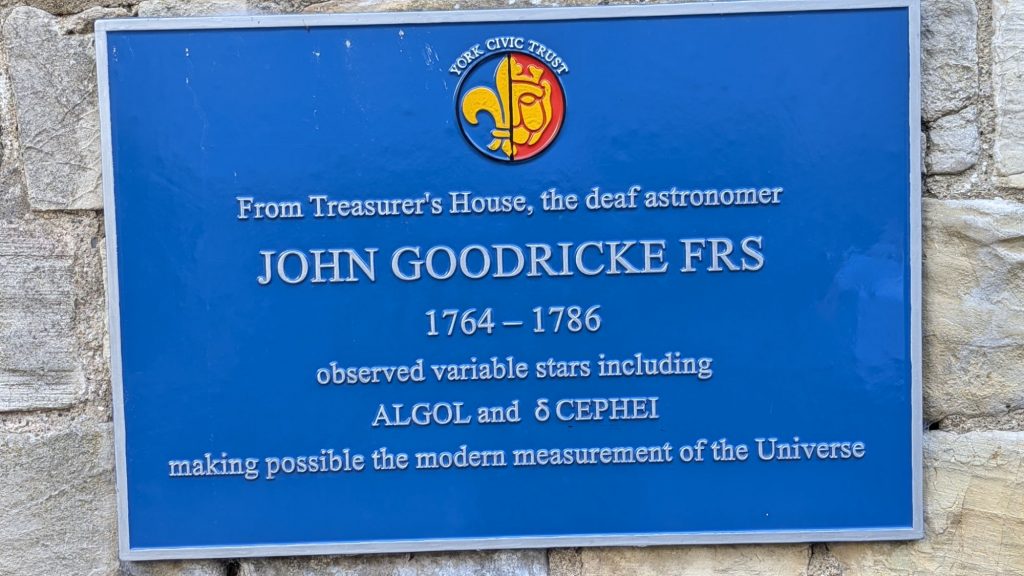
Last year in York, near the Minster, I saw the blue sign above. I thought, what on earth are ‘variable stars’?  Behind me, I heard two women say something like. ‘Here it is,”variable stars”‘.  I turned around and asked them what was a variable star?

‘Donno’ they said, ‘we’ve ‘just doing this escape room walk around York.’  They showed me a booklet they had received on the internet,. This is what I would call a treasure trail. Sadly, they showed no interest in finding out what a variable star is!

Aristotle and ancient philosophers held that the universe was unchanging and eternal. The first breach in that theory was the identification in 1638 of star Omicron Ceti. Johannes Holwarda discovered that the star pulsed on an 11-month cycle.  This and the discovery, of supernovae (first observed in 1572), proved that the ‘The starry sky was not eternally invariable’. But there was, as yet, no explanation for the phenomena.

John Goodricke was educated at Thomas Braidwood‘s Academy, school for deaf pupils in Edinburgh, and Warrington Academy. He returned to live with his parents, who rented an apartment at the Treasurer’s Hall. This is near the Minister in York. He used a friend’s personal observatory to look for variable stars. He found two of the first 10, and was the first to propose a solution. This was that two stars orbited each other causing eclipses between them and the observer. Thus creating a variation in the light emitted. To be able to extrapolate from a simple observation, and provide an explanation which necessitates a complete rethink about the nature of the universe seems, to me, to be awesome.

Einstein’s Thought Experiment

Back to Einstein, his thought experiment was something like this:

A train is travelling through a station. There is an observer on the train towards the front, another on the platform as the train goes through. There are two simultaneous lighting strikes at either end of the train. The observer on the platform sees the strikes as simultaneous. Why? Because she is in the middle between the two lighting strikes and light travels at the same speed. The observer on the train who is near the front of the train will see the lighting strike at the front of the train before the light from the strike at the back of the train can reach him. It has further to go.

This means that time is not a constant, it is relative to the observer. And yet, we think of time as a constant, something that remorselessly ticks forward and which we cannot alter. But it isn’t.

For a better explanation, see https://en.m.wikipedia.org/wiki/Relativity_of_simultaneity

First written 2024, revised 2025

World Wide Web goes World Wide August 23rd 1991

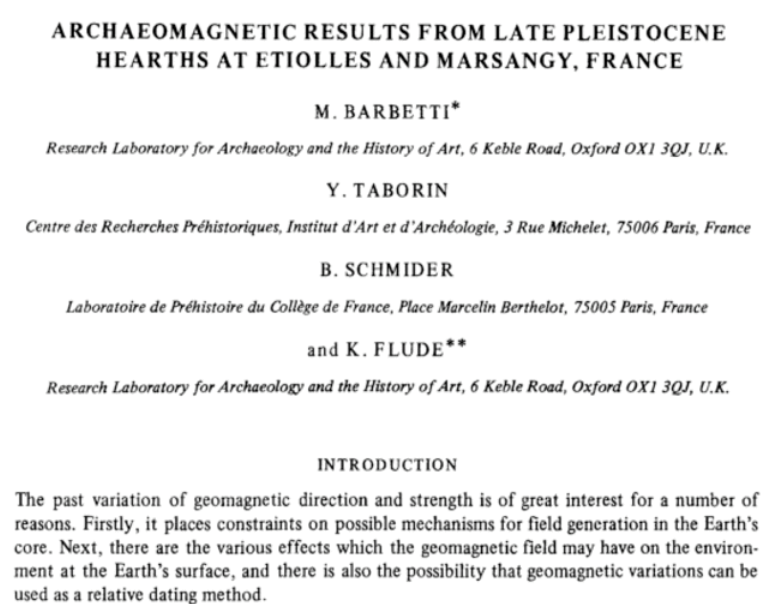
Title Page of publication Published 1 February 1980
Archaeometry

Today is the day that the World Wide Web was first introduced to the world. I was working as a freelancer helping set up computer systems for the Freud Museum, in London. The Freud Museum was funded by an American organisation who wanted to support the history of Freud and Psychoanalysis. They were early adopters of email, and one of the staff, Tony Clayton, I think, introduced me to this new thing called the World Wide Web. How soon it changed our lives!

So, this post is the first in an occasional series on my role in digital heritage. 

My use of computers began in 1975/6 when I worked in the Research Laboratory for Archaeology and the History of Art, Keble College, Oxford University. I was a Research Assistant working with Mike Barbetti. He was a Research Fellow from Australia and an expert on the science of the earth’s magnetic field, and a pioneer in archaeomagnetism.

So what was it all about? In short, the Magnetic Pole does not always point due north. From time to time,  it wanders around and sometimes reverses completely, pointing south. Also, the intensity of the magnetic field changes with time. Mike was interested in the science behind these reversals but also interested in the archaeological by-products of the findings.

We were using archaeology to get well dated samples to plot accurately magnetic fluctuations through time. It was hoped the changes in direction or intensity of the magnetic field would allow archaeological sites to be dated. Secondly, we could use the readings to determine whether clay deposits had been heated or not.  The iron particles in clay would, when heated, align to the contemporary magnetic field.  Mike had collected samples from Africa including the famous Olduvai Gorge, and we contributed to the discussions on the first use of fire by the genus homo.

It turned out that dating applications were severally limited, as it proved difficult to create an effective reference curve. But sporadically, a use for archaeomagnetism crops up in the literature.

Mike was kind enough to include me as joint author on 3 papers which were accepted by Nature and which remain my most cited papers.

When I thanked him, saying how kind it was for him to include me.  He made a point of telling me I had every right to have my name on the papers as I not only did a lot of the work, but I contributed ideas to the study. He taught me a lesson that you should always be generous acknowledging contributions.

The specimens he brought back, were encased in plaster of Paris, I went to a shed in the garden of the terrace house that was the Research Lab. There I cut them up with a saw.  We then measured the intensity and direction of the magnetic field in the samples.  The results were processed by a computer program written by Mike. I prepared the experimental results on magnetic cards and uploaded them for a data run on the main frame computer at the Oxford University Computer Centre. The Computers were the size of a house, but there was a Unix minicomputer in the basement of our lab. There was always mistakes on the first run and then you reran the programme with edit cards at the front which were coded to do things like: ‘change 127 on the first card to 172’.  The corrected results were rerun the next day. Seems very primitive and slow now but then it was cutting-edge technology.

After a couple of years, I began my career as a field archaeologist. Having seen how powerful computers could be, I decided, in the late 1970’s, that Archaeology needed computers. So I set out to find out how to use them for myself and where they might come in useful.  This took me on an exciting journey of exploration which began with signing up for a Part-time PhD at Birkbeck College in Computer Applications in Archaeology, while I continued working at the Museum of London as an archaeologist. The study consisted of creating a database structure to hold archaeological field records, and to link this to digitised copies of context plans. I was hoping to show that we could interrogate the data, asking questions like ‘Draw a site plan of all contexts which have pottery dating to the Flavian period’. This would, perhaps, speed up the post excavation work, and enable a more sophisticated analysis of data.

To be continued.