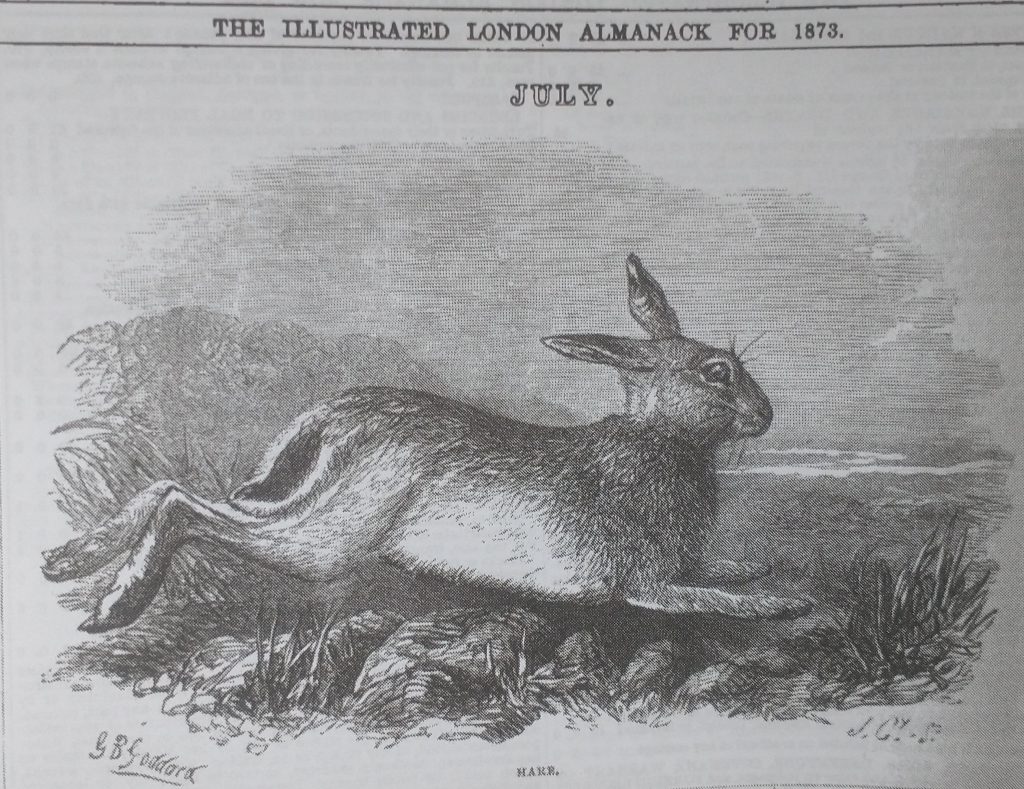
The expression ‘Mad as a March Hare’ comes from the displays of hare boxing that takes place as the Hare mating season begins. And no, it’s not the male March Hare fighting in the spirit of romantic rivalry. It is the female hares fighting off unwanted attention from the males. Hares are solitary creatures, and the mating season is, perhaps, particularly difficult for them. The Country File website has more on the subject. www.countryfile.com
Not only March Hares but March Kittens too
There are also March Kittens and March Chickens. Edward Topsell in his ‘History of Four-footed Beasts‘ 1607 says the best Kittens to keep are those born in March. ‘The Closet of Sir Kenelm Digby Opened‘ 1669 says:
‘Keep a black cock hatched in March as a protection against evil spirits: his crowing terrifies them.’
He also gives a recipe for Cock Ale:
Eight gallons of Ale, a boiled March Cock, four pounds of stoned Raisins, half a pound of dates, nutmegs, mace. Beat the ingredients in a mortar, add to two quarts of Sherry. Add to the ale. Stop it in a container for 6 or 7 days. Bottle it, drink after a month.
Very weird. I challenge my readers to try it and let me know how it goes?
Was the March Hare Sacred?
But it’s not only March Hares because the hare itself was a sacred animal. It was sacred to Aphrodite because of their prodigious ability to have offspring:
‘For you know, I imagine, what is said of the hare, that it possesses the gift of Aphrodite to an unusual degree. At any rate it is said of the female that while she suckles the young she has borne, she bears another litter to share the same milk; forthwith she conceives again, nor is there any time at all when she is not carrying young.’
Classical Texts Library. Philostratus the Elder, ‘Imagines’ Book 1.1-15 c 3rd Century AD. Translated by Arthur Fairbanks.
Divine Celtic & Neolithic Hares
Research reported by Exeter University suggests that hares were worshipped in pre-Roman Britain. Julius Caesar wrote:
“The Britons consider it contrary to divine law to eat the hare, the chicken, or the goose.”
‘The Battle for Gaul’ Translation by Wiseman, Anne, Wiseman, T. P. Published by Penguin Random House, 1980 ISBN 10: 0701125047 (TP Wiseman was my professor for Classical Studies at Leicester University).
Hares are thought to be the original Easter Bunny. But finding good evidence before Germany in the early modern period is difficult. There is a tradition that witches can be scared away at Easter. Exactly, how this works is not at all clear to me. But it has been said that witches could take on the form of a hare. So eating Hare Pie at Easter helps rid the land of the witches.
Jugged Hares
You could have a jugged hare. Jugging is cooking a whole animal in a container over water. Follow this link for a recipe for jugged wild hare. Remember, you are not allowed to shot or trap them on a Sunday or on Christmas Day! For a discussion of hares and folklore, click here:
Hare’s Feet Totems
A jointed hare’s foot was considered very lucky and a remedy against gout, stomach pains and insomnia. (The Perpetual Almanack of Folklore by Charles Kightly, which I have used several times in this piece.) You can buy one on eBay. (Don’t click the links, it’s not an advert but a picture of an advert). I remember friends having rabbit feet which they carried around with them for luck. The foot would often be on a key rings.
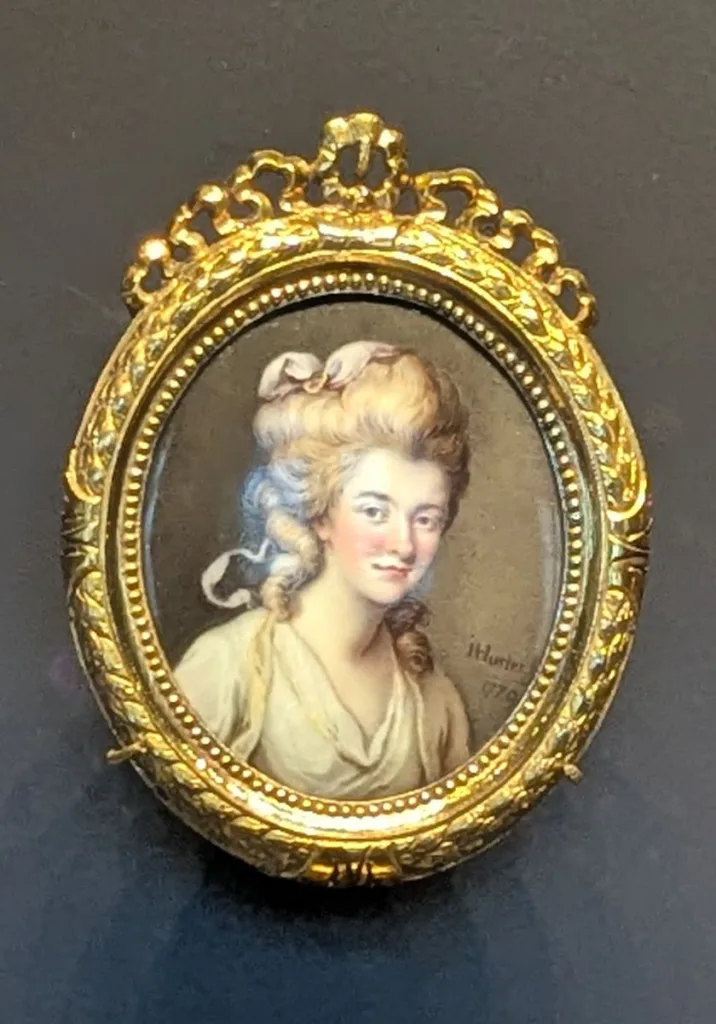
Georgiana, Duchess of Devonshire (Johann Heinrich Hurter after Angelica Kaufman). Photo by K Flude of the miniature at the Victoria and Albert Museum
The Gilbert Collection has been re-displayed in the V&A in London. It has just opened, and is one of the most opulent displays you could hope to see! But, I loved this miniature of Georgiana. She was one of the richest women in Britain, a compulsive gambler, and a powerful political force for the Whig Party. And despite the Georgian Hairstyle the artist has contrived to make a very down to earth portrait. I can imagine bumping into her at the local Overground Station! She became better known after the bio graphy by Amanda Foreman, followed by the Film starring Keira Knightly. The Museum label says the portrait is ‘after Angelica Kaufman’. But I cannot find a Kaufman of Georgiana, that has this charming informality.
I have just heard news that the Arts Council wants to charge overseas visitors to visit our wonderful free national Museums, while allowing British Citizens free entry. Now, there are lots of arguments to be made about it, particularly in a time where money is in short supply. But, one result will be longer waits to get into Museums and Galleries. I am not sure how we Brits, are going to be asked to prove our nationality. If they have to inspect our Electricity Bills, Drivers Licenses, Passports, Library Cards, or Bank Statements, expect chaos.
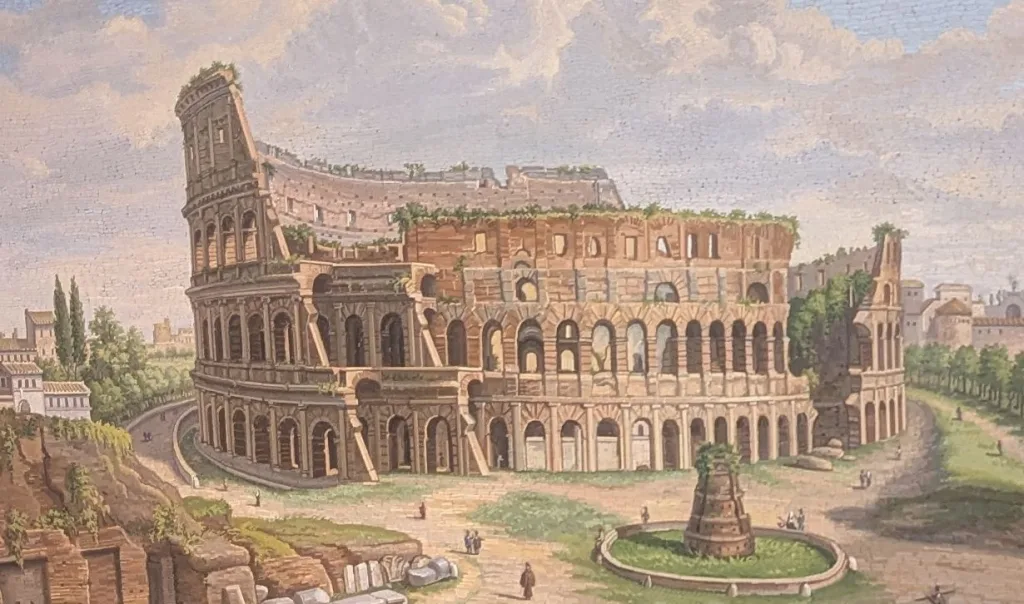
One more object from the Collection is made of minature mosaics, and the V&A has several, But I have chosen this fabulous image of the Colosseum in Rome:
Colosseum by Domenico Moglia c1851
First published March 28th 2023, revised 2024, 2025. 2026 Object of the Day added and post revised 2026
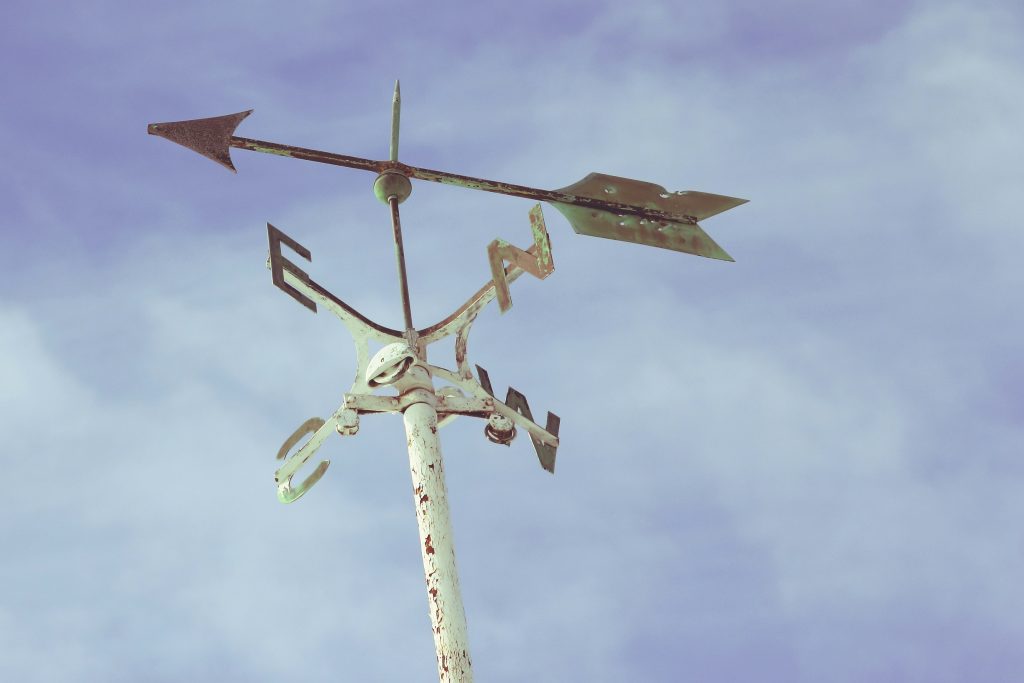
The day after the Equinox we look at the cardinal points of the compass:
“chief, pivotal,” early 14c., from Latin cardinalis “principal, chief, essential,” (online etymological dictionary).
The Importance of South
On its annual cycle, the Sun is always on the move. At the Equinox the Sun now rises due East, and sets due West. It then rises every day further towards the north and sets further to the South until the Solstice. The Solstices mark the extreme Northerly and Southerly rising and settings. Dawn and Dusk vary accordingly.
So, the only real fixed point in the Sun’s entire journey (as seen from Earth) is Noon. Every day of the year, every day of our lives, the Sun is at the highest point at Noon. And this is the definition of South. But the Sun never strays into the North. So the North is the polar opposite of the South- cold, remote, more mysterious.
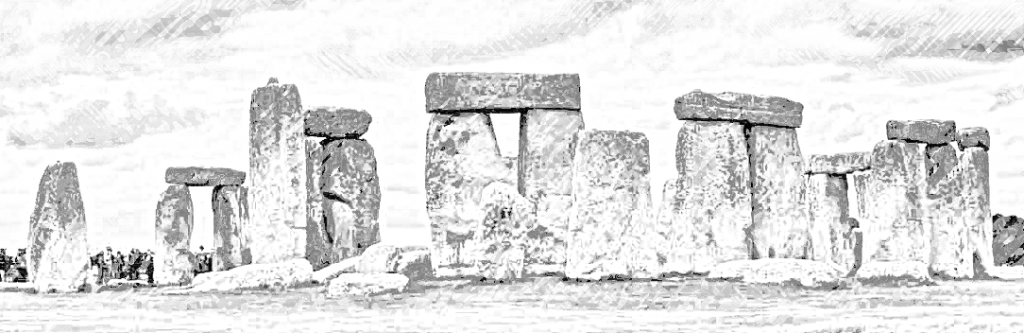
To my mind, it makes, of the Cardinal Points, the South very special. At Stonehenge, there are two exits. The biggest is aligned to the Midsummer Sunrise and Midwinter Sunset axis. But there is a smaller second entrance and this aligned due South. There is also a uniquely small standing stone in the main circle of Sarsens, which is aligned to the South. (Although we don’t know if this stone is original). However, there was some sort of corridor heading South through the mysterious wooden phase which precedent the stone Stonehenge. So, we can be sure South was important at Stonehenge.
Sketch of Stonehenge showing the smallest Sarsen stone near the Southern Entrance
Noon, derives from ‘nona hora’ in Latin and is ‘one of the seven fixed prayer times in traditional Christian denominations.’ (Wikipedia)
The Predominance of the North?
And yet, North, has come to be the principal of the cardinal points. It is shown on virtually all modern maps. It is the direction that people of my generation and hemisphere think of as being ‘up’.
The Google generation sees things differently. There are countless tourist maps on walls or plinths where North is no longer at the top. Up is shown as being the way you are facing. Users have to fight with Google Maps to put North at the top of the map. My children mock me when I say ‘Out of the Tube station, turn up the High street northwards.’ Their view of maps is completely contextual. They do not see any reason to know where the cardinal points are. I point out that the Tube probably has two exits on either side of the road. So, it doesn’t work to say ‘turn left out of the tube’.
There may also be an element of sexual difference, with men more likely to have a cardinal point view while women navigate more by landmarks. ‘Walk past the M&S, turn left to the Park and straight on’. One paper says: ‘during spatial navigation, women typically navigate an environment using a landmark strategy, whereas men typically use an orientation strategy.’
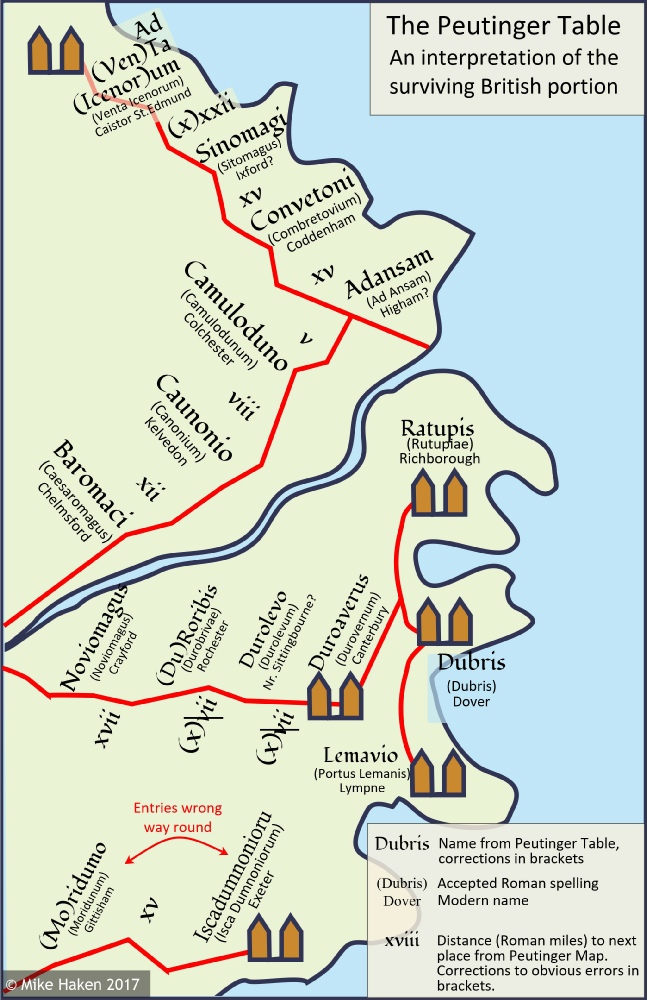
Although I see this decline of the north as being part of the Decline of the West. I also ‘things were better in my day’. But in fact it is simply returning to the way maps were produced in the past. Here is an example below, which has East at the top.
Representation of a Roman Map with the top being roughly East.
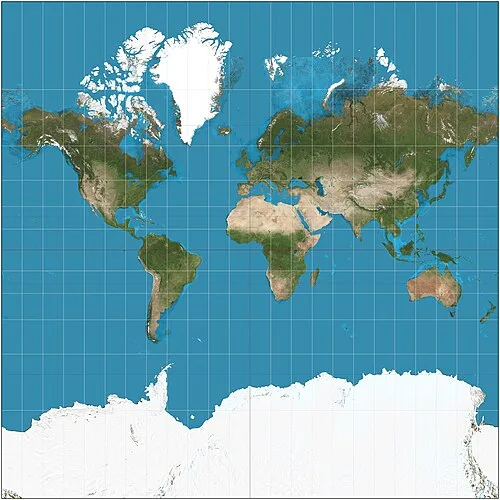
I have since looked further on this subject of North and Maps, particularly finding my answers on this web site: why-is-north-up-on-maps. It tells me that the earliest map the Turin Papyrus, has South at the top. This is probably because the Nile was the fount of all things in Egypt so it is in pride of place at the top of the Map. Other maps tend to have East at the top. The thinking is that the North was cold and who would want to go there?, The West was where the Sun went down, so the Sunrise direction should be at the Top. Often Jerusalem was in the middle with the East at the top. To this day, we talk about orienting ourselves, which means literally means finding your direction eastwards. But the 16th Century things flipped, and North became the top of the map. Was this because the Age of Exploration depended on the North Star? Maybe not because it was used for navigation for a long time before the 16th Century. Was it because of the use of the compass which pointed North? Perhaps not because the compass was first used in the 10th Century. The answer seems to be that Flemish geographer and mapmaker Gerardus Mercator in 1569 put North on top of the map. His projection became the most used map, and everyone started to follow suit.
Mercator projection of the world between 85°S and 85°N. Note the size comparison of Greenland and Africa, and the massive inflation of Antarctica’s landmass. CC BY-SA 3.0
The Magnetic Poles
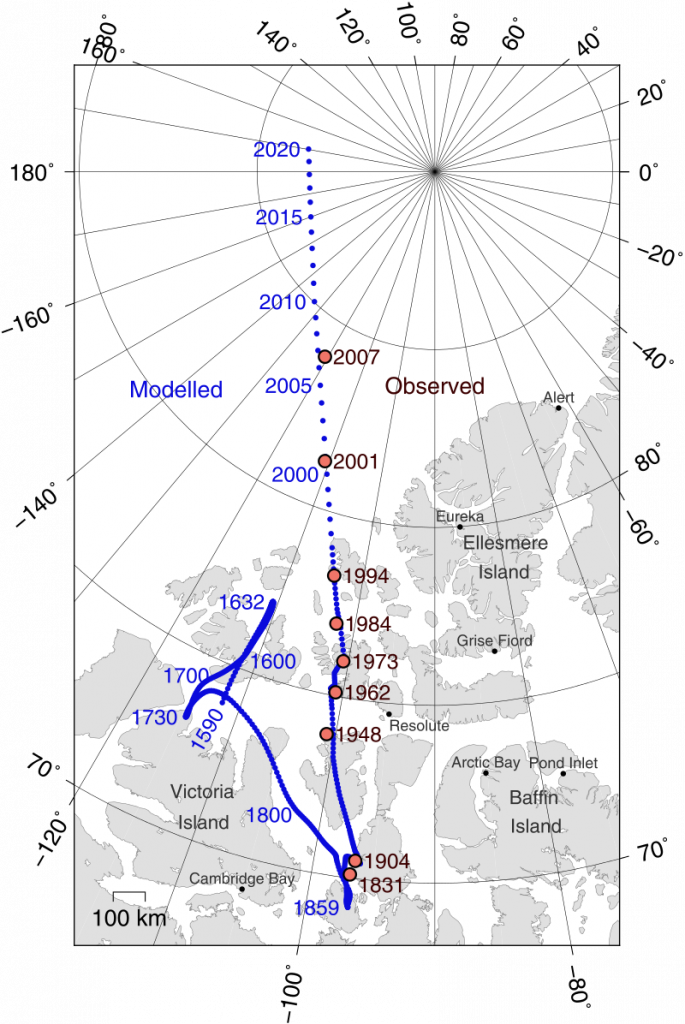
Of course, there is another version of the cardinal points: the magnetic cardinal points. The magnetic North wanders over time. It does not necessarily coincide with geographic north. In recent times they are close enough. But in the past there have been huge variations. Occasionally, the earth has had geomagnetic reversals when the North Pole has pointed in different directions, including south. The last one was 780,000 years ago. On average, they take place very roughly every 500,000 years.
The magnetic pole is caused by the molten iron in the earth’s core and mantle, which creates a dipole. Fluctuations in the dynamo flow of the molten iron cause occasional reverses. The science is very complicated and, even now, not entirely understood. Is it a random consequence of flow dynamics? Or do external events, like sinking continents, or meteor strikes cause the reversal?
Since the first use of compasses for navigation in the 11th/12th Centuries, the magnetic pole hasn’t wandered enough to be of concern to navigation. It has wondered a few hundred miles over the last 500 years. Now, it is speeding up, from 9km a year to 52km (since 1970). This Wikipedia page is pretty good at an explanation.
My Job Tracking the Cardinal Points
My first proper job after university was as a technician then research assistant at Oxford University studying these phenomena. I say ‘proper’ because when I left University, I became an itinerant archaeologist. This led me to digs in Switzerland, Northampton, East Anglia and Nottingham. Then, I got the job at the Research Laboratory for Archaeology and the History of Art, at Keble College, Oxford.
I worked for Dr. Mike Barbetti who was an expert on the wanderings of the Magnetic Pole. His interest was firstly in the pure science of the subject. But he was keen to explore the applied uses in Archaeology as well. So, after being appointed as a Research Fellow at Oxford, he set up an epic journey from his native Australia to Oxford. It went via some of the iconic sites of Palaeolithic Archaeology, including Olduvai Gorge, Tanzania. The site of excavations by Mary and Louis Leakey.
To plot the movements of the magnetic north, scientists needed dated samples. Early human sites provided dated sites over a long time span. Also, archaeomagnetism, as the discipline became known, offered the possibility of dating sites. Another application was to determine whether deposits were fired or not. One of the sites Mike sampled was a candidate for the first evidence of fire in human existence.
Cutting up Samples
As I said, Mike’s interest was discovering how the magnetic field of the earth changed over time. And, more importantly, what was the mechanism. He shipped back to Oxford samples of soil cast in Plaster of Paris. My job was to cut the samples up. I cut them up with an electric saw in a shed in the backyard of the Laboratory. Then we measured the direction and intensity of the magnetic field in the samples.
Soil contains particles of iron, and they align randomly. So a sample of soil has a low magnetic intensity and a random direction of magnetic field. But once heated up, the iron particles align to the current direction of the magnetic pole. Its intensity is proportional to the intensity of the Earth’s magnetic field. These measurements provide a method of plotting the changes of the magnetic field over time. And from these data, models can be constructed explaining how the iron in the earth’s core worked as a giant magnet.
Once we had built a reference curve for the movements and intensity of the magnetic pole over time, we hoped to develop another dating method. Other methods such as radio carbon, thermoluminescence, and tree ring dating, were being developed at the Research Laboratory in Oxford at the same time.
My part in Digital Heritage Part 1
Having got the results, I took them to the Oxford University Computer Centre. There, I typed them up onto machine-readable cards. Added a copy on cards of our computer programme written in Fortran, and gave them to the Computing Staff. The program and data were run through the Centre’s mainframe computer. (probably an IBM or ICL computer, the size of a house!) 24 hours later, I received a print-out to proofread.
I located mistakes, ran an editing run of punched cards, essentially instructing the computer: ‘on card two replace 2.5 with 2.6, and run the programme again’. I would pick up the results 24 hours later. It seems extraordinarily primitive now, but then it was an enormous saving of time.
And that, patient reader, was my early contribution to Digital Heritage and pure science. Mike published many articles of which I was joint author of three articles, two in the prestigious Science Journal Nature. And it is annoying that my citations in the groves of academia are still dominated by articles I co-wrote in the late 1970s/80s!
Mike’s work was important in the development of the study of the earth’s magnetic field. However, the use of archaeomagnetism has never risen above strictly limited. Occasionally, in specific circumstances, it can be useful. But those circumstances tend to be times when no other methods have worked. Most often, it is used in attempting to date kilns.
These are the papers:
Barbetti. M and K. Flude, ‘Palaeomagnetic Field Strengths from Sediments baked by Lava flows of the Chaine des Puys, France.’ Nature, Vol. 278 No 5700. 1979
Barbetti M., Y. Taborin, B. Schmider and K. Flude ‘Archaeomagnetic Results from Late Pleistocene Hearths at Etoilles and Marsangy, France’. Archaeometry 22. 1980
More on my contribution to Digital Heritage in posts to come.
OnThis Day
630 – Emperor Heraclius returns the True Cross, one of the holiest Christian relics, to Jerusalem. (see my post on the True Cross and Roodmas)
1152 – Annulment of the marriage of King Louis VII of France and Queen Eleanor of Aquitaine. She went on to marry Henry II of England which makes this one of the most amazing events of the medieval period. The transfer of lands from French control to English control as a result was huge. She eventually was imprisoned by her new husband for supporting their children’s rebellion.
1556 – Former archbishop of Canterbury Thomas Cranmer executed for heresy in Oxford. He had recanted, but recanted his recantation when he discovered there were still going to burn him. By rights, he should have been reprieved, but Queen Mary was determined to make an example of the man who help Henry VIII and Thomas Cromwell make England a Protestant state. The fire was on Broad Street, and he is said to have thrust his arm that signed the recantation into the fire, calling it ‘that unworthy hand.’
1829 – Duel Day is celebrated at Kings College when the Duke of Wellington fought a duel against George Finch-Hatton, 10th Earl of Winchilsea, because of disagreement about Roman Catholic Emancipation. The duel took place in an asparagus fields which would later become Battersea Fields. Wellington shot first and either missed or deliberately shot wide, and Winchilsea aimed high. He then apologised to Wellington. For more details see www.kcl.ac.uk/duel-day.
First written March 2023, revised 21st March 2024, Revised and Mercator added 2026
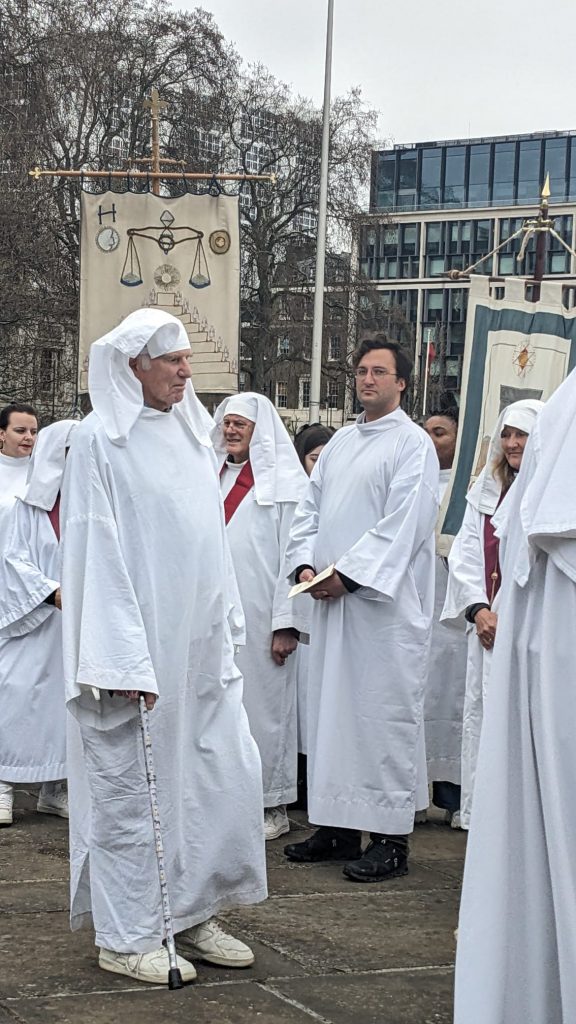
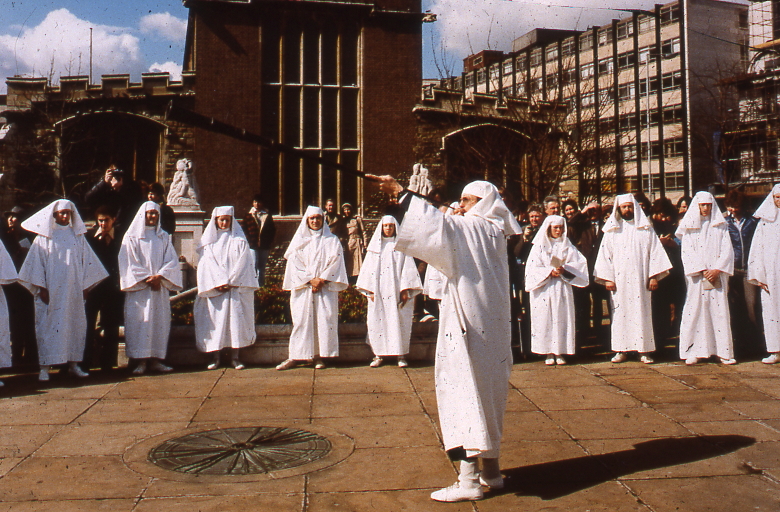
Video by Heike Herbert of Druids at the Spring Equinox at Tower Hill, London
New content will be found at the bottom in the ‘On This Day section.’ So, Spring has sprung, not only meteorologically speaking but also astronomically. We are 20 days into the meteorological Spring which started on 1 March (see my post here.) Today, we are starting the astronomical or solar Spring.
The 20th of March is the Spring Equinox, or Vernal Equinox, midway between the Winter Solstice and the Summer Solstice. The sun has been rising further north each day since December 21st. Today it rises due East, and sets due West. The day and night are roughly equal in length (although by no means exactly). At 14:45 today, the Sun is directly overhead at the Equator.
The term vernal comes from the Latin for Spring, and today is the Primavera, the first day of Spring. The Anglo-Saxons originally used the word lencthen (Lent) for Spring. But later adopted the idea of the ‘springing’ of the year when the plants bud. In Middle English, the word Spring is also used for sunrise, the waxing of the moon and the rising tides. These are called spring tides. But also for the sprouting of the beard and the first appearance of pubic hair! Happy Spring Time!
Printemps
Up to the 15th Century, the English also used the French term ‘prime-temps’ in the sense of ‘first times’. This follows the idea that the year is young, while Winter represents old age. As we shall see, on March 25th, there was also a belief that the world was created in Spring at the Equinox. Jesus was also conceived at this point of the annual cycle. (see my post /march-25th-the-beginning-of-the-universe-as-we-know-it-birthday-of-adam-lilith-eve-conception-of-jesus-start-of-the-year)
Zodiacally, if that is a word, Spring is Aries (brave and impulsive); Taurus (sensual and stubborn), and Gemini (dynamic and talented).
Druids at Tower Hill
Druids at the Spring Equinox Tower Hill London, Photo by Heike Herbert
The Druids have a ceremony at Tower Hill every year on the Spring Equinox. When I last attended I remember the druid costumes were often made with nylon sheets, and their footware was mostly tennis shoes. I see from the photos the nylon has at least been replaced with cotton, and the plimsolls with trainers. Not quite sure what that pair of black trainers are doing in the picture!
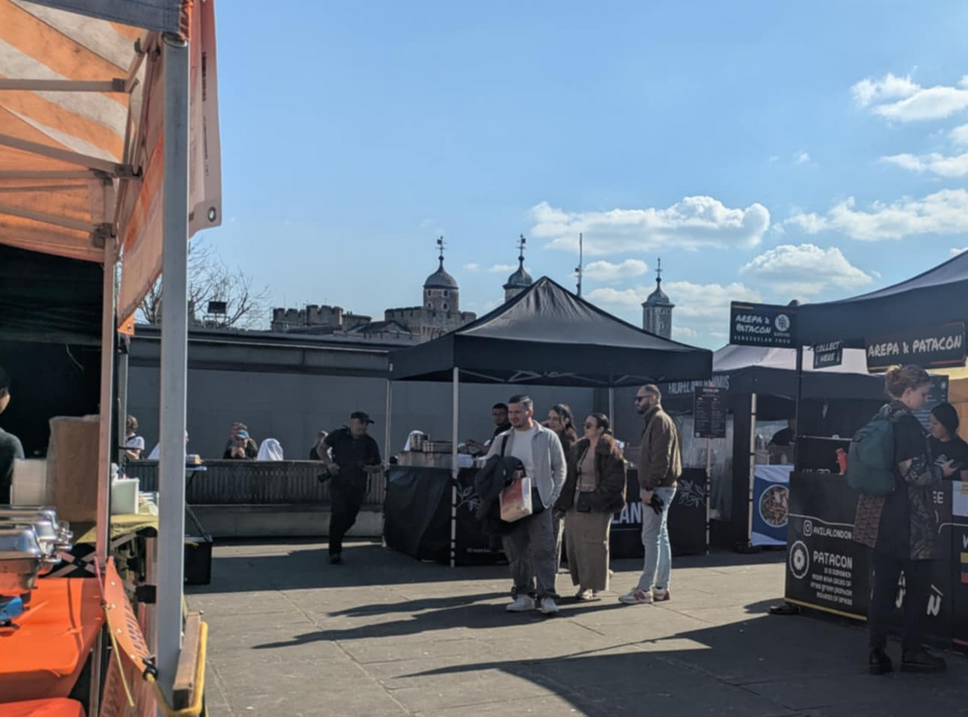
As my photos are getting long in the teeth, I have used photos by Heike Herbert. She attends most years. The ones above from 3 years ago. In 2025, she reported that the atmosphere has been affected by a street food market,. This restricted the space for the Druid Circle. The food stalls are there every Thursday, so it only impacts the Druid assembly once every 7 years! In 2026 the Druids meet at Tower Hill at 12 noon.
Tower Hill, Spring Equinox, 2025 and street food, Photo by Heike Herbert
Modern Druids
I say modern druids because there is no convincing evidence that the modern fellowships of Druids can trace their origins back to prehistory. Druidry was reinvented in the 18th Century — for example, the Ancient Order of Druids was formed in 1781. They were set up as societies in the tradition of the Freemasons. They held to belief in the fundamental importance of nature. However, one group, the British Circle of the Universal Bond, claim descent from a group persecuted by the Bishop of Oxford in 1166. Look at their website for more details and for an idea of their beliefs.
Prehistoric Spring Equinox
When did the Equinox first had importance for human society? The answer is, probably, at least as long as we have been reasoning creatures. On January 14th, I draw attention to a recent discovery by an amateur ‘citizen scientist’. He suggested there was evidence in Cave Painting for the use of a Palaeolithic Calendar. Follow this link to see the post.
Stonehenge and the Sun
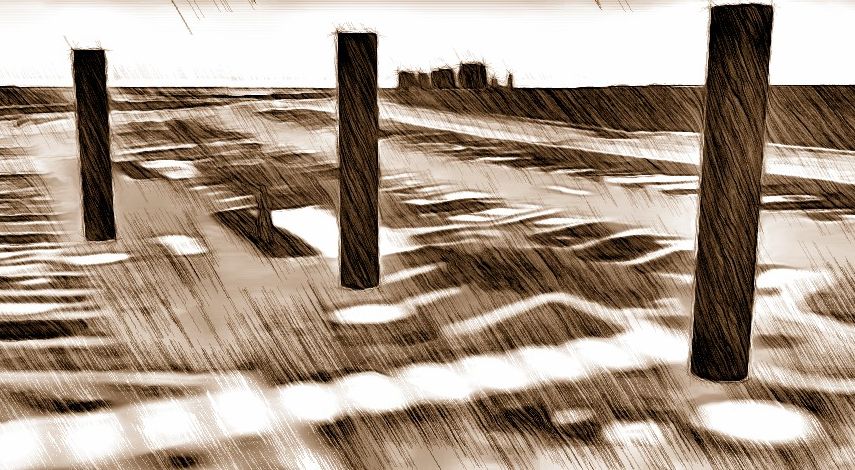
At Stonehenge, in the old Car Park, they found three huge Pine post-holes in a line. Dating evidence shows they were erected in the Mesolithic period, thousand of years before Stonehenge. They align to the direction of the Mid-Summer Sunrise and Mid-Winter Sunset (NNE/SSW). If, and it’s a big if, you were sighting from Stonehenge itself, which was built some 5000 years in the future.
Imaginary reconstruction of the Carpark Postholes
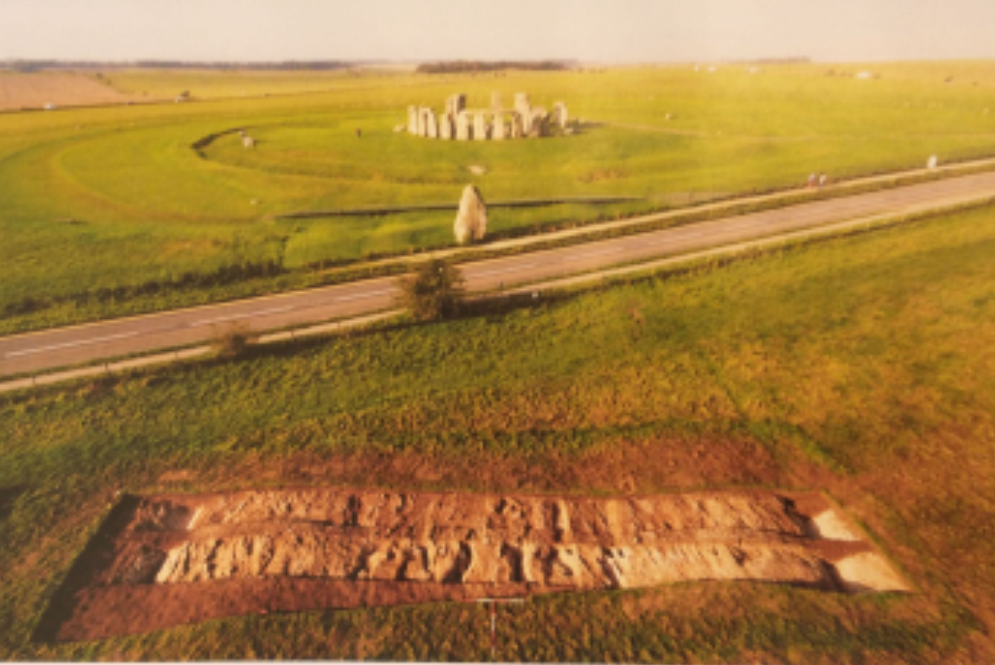
It is a bit of a stretch using two pieces of evidence so far apart in time. But recent excavations have revealed that there are natural periglacial striations in the soft chalk bedrock at Stonehenge. These lines point to the Solstices. They not only predate Stonehenge but also the three post holes. The striations may well have been visible from the time they were created when the glaciers melted.
Around 12,000 years ago (date from my memory so approximate), the climate changed and the glaciers melted. This left a lot of water rushing around the landscape. At Stonehenge, it gouged out striations in the chalk. By chance, or as ordered by the Gods/Goddesses/Divine Nature, the striations pointed to the Solstice Axis. Richard Jacques excavations in the Stonehenge area revealed that the aurochs came to the Stonehenge area for grazing and water. Aurochs are huge wild cows with enough meat on them to feed 200 people. So, the solar axis is near a place where the Gods/Goddesses/Divine Nature provided super-abundance in the guise of herds of Aurochs.
Foreground shows the periglacial striations aligned on the Solstice. Source Current Archaeology?
Burial Mounds aligned to the Equinox
That the major movements of the Sun were of interest to Neolithic and Bronze Age society is confirmed by the alignment of many megalithic monuments dating from 3,600 BC onwards, including, of course, Stonehenge. All around the UK are long barrows and other burial mounds, many of which are indeed sited/sited E-W to the Equinoxes. Many are fairly approximate. But at Loughcrew, County Meath in Ireland the Vernal Equinox shines right into the burial chamber. The sun’s light shines onto a stone marked by stone carvings. Similar alignments exist at Knowth and Dowth in the Boyne Valley. More about Loughcrew in my post here)
Harmony & the Spring Equinox.
The Equinox also has another role, which is to be the anchor of the cardinal points. The world is orientated to North, South, East, West. The Equinox is a time when there is a harmony, a balance in the universe. Therefore, it is a fortunate, a lucky time, a time to fall in love or undertake notable undertakings. But, in the Christian world marriage traditionally had to wait a little longer, until after the commemoration of the death of the Messiah,
On This Day
Today, is The International Day of Happiness. This was set up by the UN on 28 June 2012. This year’s theme:
‘explores the relationship between social media and happiness, highlighting thepotential challenges for our wellbeing as well as ways we can all use tech for good.‘
Go to the web site for more information. But these are the three steps they suggest: (I’ve cut and pasted them from the site)
Step 1: Choose
Be mindful of if, when and how much you are on social media.
Pause and ask yourself, “What do I really want to do right now?” Keep a list of analogue activities you can do instead, like playing music, drawing, gardening or going outside for a walk.
Set a timer so scrolling is a short snack rather than a wormhole.
Give your mind space to think, keep the bedroom phone free, try a ‘digital sabbath’.
Step 2: Connect
Don’t let scrolling be a substitute for real connection.
Phone a friend for a chat, or send some voice notes, instead of scrolling.
Make plans offline, get excited about your next adventure with loved ones.
Use social media to connect with supportive friends and communities that are meaningful to you.
Step 3: Curate
Personalise your experience to support your wellbeing.
Share and amplify uplifting stories, messages and ideas, be aware of misinformation.
Be kind in the comments, it matters more than you think.
If you have found this useful, spread the word and encourage others to do the same. Use the hashtag #InternationalDayOfHappiness.
The World Happiness Report
This is published annually by the Wellbeing Research Centre at the University of Oxford. More details here. Finland is top for the 9th year in a row. US is 23rd, UK is 29th. These are the top 25 happy countries:
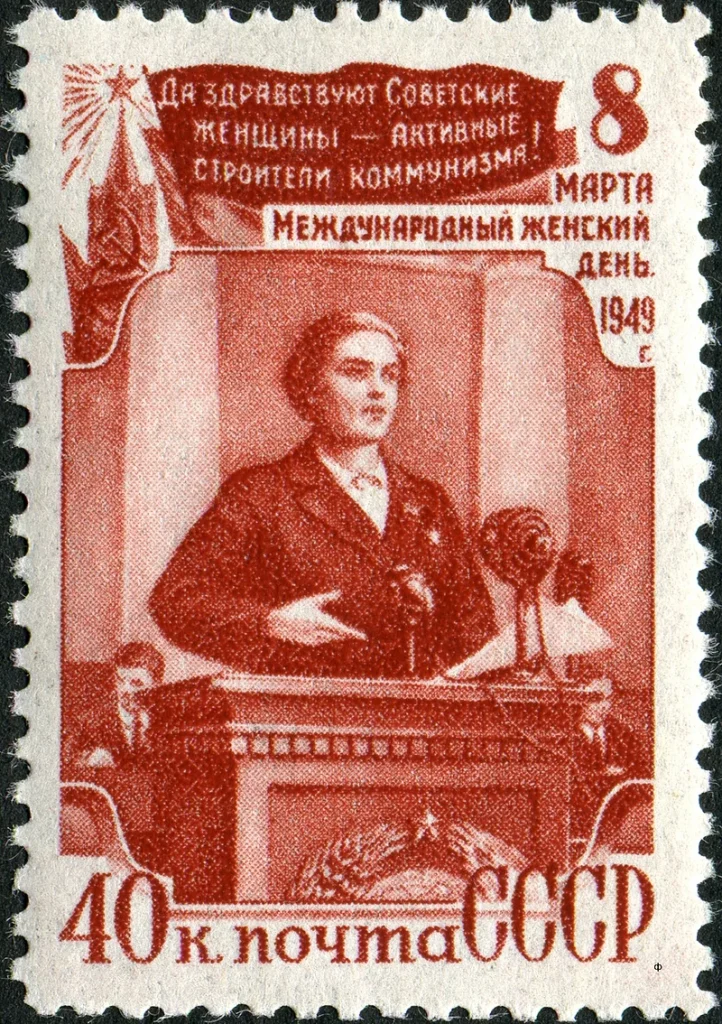
The Soviet Union 1949 CPA 1368 stamp (International Women’s Day, March 8. (Wikipedia)
Today, is International Women’s Day. It began, as an idea within Socialist organisations in 1909/1910. Following the February Revolution in Russia and women gaining the vote, March 8th was chosen as the day to celebrate. The wider feminist movement adopted it in the 1960s followed by the UN in 1977. Since when, it has been a day to celebrate women’s achievements and campaigns worldwide.
Harper’s Road burial
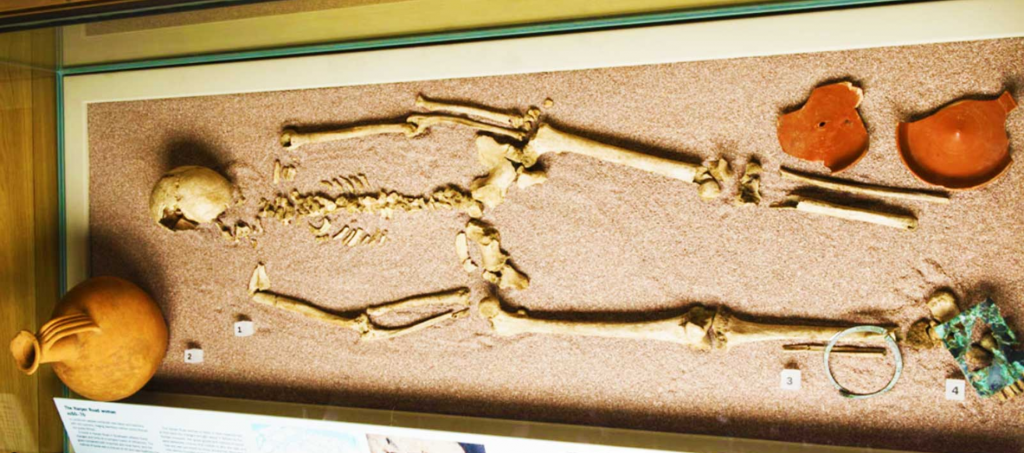
The Harper Road Burial Southwark (museum of London web site)
Another important historic female was found in an excavations at the Harper’s Road. . I was reminded about it by reading Dominic Perring’s new book ‘London in the Roman World.’ He uses it to establish that Southwark was a place where people lived both before and after the Roman Conquest in 43AD. The burial was found in the 1970s’ and dated to 50 – 70 AD (Roman Invasion of Britain was in 43 AD). Recent scientific analysis has shown that the burial was of a woman (21 – 38 years of age). She had brown eyes and black hair and was brought up in Britain. Her grave goods indicate she was wealthy. She had both imported Roman pottery but also typically British Iron Age objects. The combination shows some adaption between her native culture and the new Roman ways.
Her British objects included a bronze necklace (a torc possibly of Catevalaunian or Trinovantian origin) and a mirror. Dr Rebecca Redfern & Michael Marshall on the Museum of London’s website make a case for her being a:
‘Powerful women in late Iron Age London’.
Mirrors of Power?
They make a case for the mirror being
‘used by women for divination and magic, and were a source of knowledge that only women could command. Being able to use and read the mirror meant that the woman was highly regarded by her community.’
Iron age burials are often found either with a sword or a mirror and the thinking is that the mirror reflects an equivalent status to a sword. I think we can say that the finds do reflect someone of standing, but as to the use of the mirror that must be speculation. Divination using a mirror is called ‘scrying’ and the British Museum has John Dee’s scrying apparatus from the 16th Century. You can buy scrying mirrors on etsy. https://www.etsy.com/uk/market/scrying_mirror. But to make a case that Mirrors were not just utilitarian and prestige objects but also in use for supernatural/religious purposes is surely just speculation?
Melanie Giles & Jody Joy in ‘Mirrors in the British Iron Age: performance, revelation and power published in 2007 (and available to read here) concludes:
‘Iron Age mirrors, whether made of iron or bronze were beautiful, powerful, and potentially terrifying or dangerous objects. They were used in the preparation and presentation of the body and prestigious displays, but may also have been associated with powers of augury and insight into the past, or access to ancestral or spiritual worlds.’
Women in the Age of Iron
The evidence we have for iron communities is for a powerful role for women in contrast to the Romans. The Romans dismissed women when they wrote that Boudicca was ‘uncommonly intelligent for a women’. In fact, she nearly forced the Romans to abandon their conquest of Britain. We also know that Queen Cartimandua of the Brigantes had executive power in the North of Britain. The Britons also worshipped the three Mother Goddesses, which focussed on the value of woman as maidens, mothers, and grand-mothers.
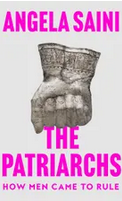
A book to order for International Women’s Day is ‘Patriarchs’ in which Angela Saini investigates when the Patriarchy took over. I heard her talk about it and it seems an excellent introduction.
Tudor London – The City of Wolf Hall 3pm 4th July 2026 To Book Jane Austen’s London Walk 2:30pm Sun 5th July 2026 To book London. 1066 and All That Walk 11.30am Sun 12th July 26 Tobook Bloody, Flaming, Poxy London 3pm Sun 12th July 26 To book Myths, Legends, Archaeology, and the Origins of London 3pm Sat 1 Aug 2026 Tower Hill Underground To book The Decline And Fall Of Roman London Walk 11:15am 2nd Aug 26 To book Jane Austen’s London Walk 2:30pm Sun 2nd Aug 26 To book Chaucer’s Medieval London Guided Walk 11.00am Sat 5th Sept 2026 To book Jane Austen’s London Walk 2:30pm Sun 5th Sept 2026 To book Jane Austen’s London Walk 2:30pm Sat 24th Oct 2026 To book
For a complete list of my guided walks for London Walks in 2026 look here
Monday 1st January 2025 7.00 pm On this Virtual Walk we look at how London has celebrated the New Year over the past 2000 years.
The New Year has been a time of review, renewal, and anticipation of the future from time immemorial. The Ancient Britons saw the Solstice as a symbol of a promise of renewal as the Sun was reborn. As the weather turns to bleak mid winter, a festival or reflection and renewal cheers everyone up. This idea of renewal was followed by the Romans, and presided over by a two headed God called Janus who looked both backwards and forwards. Dickens Christmas Carol was based on redemption and his second great Christmas Book ‘The Chimes’ on the renewal that the New Year encouraged.
We look at London’s past to see where and how the New Year was celebrated. We also explore the different New Years we use and their associated Calendars – the Pagan year, the Christian year, the Roman year, the Jewish year, the Financial year, the Academic year and we reveal how these began. We look at folk traditions, Medieval Christmas Festivals, Boy Bishops, Distaff Sunday and Plough Monday, and other Winter Festival and New Year London traditions and folklore.
At the end, we use ancient methods to divine what is in store for us in 2023.
The virtual walk finds interesting and historic places in the City of London to link to our stories of Past New Year’s Days. We begin, virtually, at the Barbican Underground and continue to the Museum of London, the Roman Fort; Noble Street, Goldsmiths Hall, Foster Lane, St Pauls, Doctors Commons, St. Nicholas Colechurch and on towards the River Thames.
The Civil War, Restoration and the Great Fire of London Virtual Tour
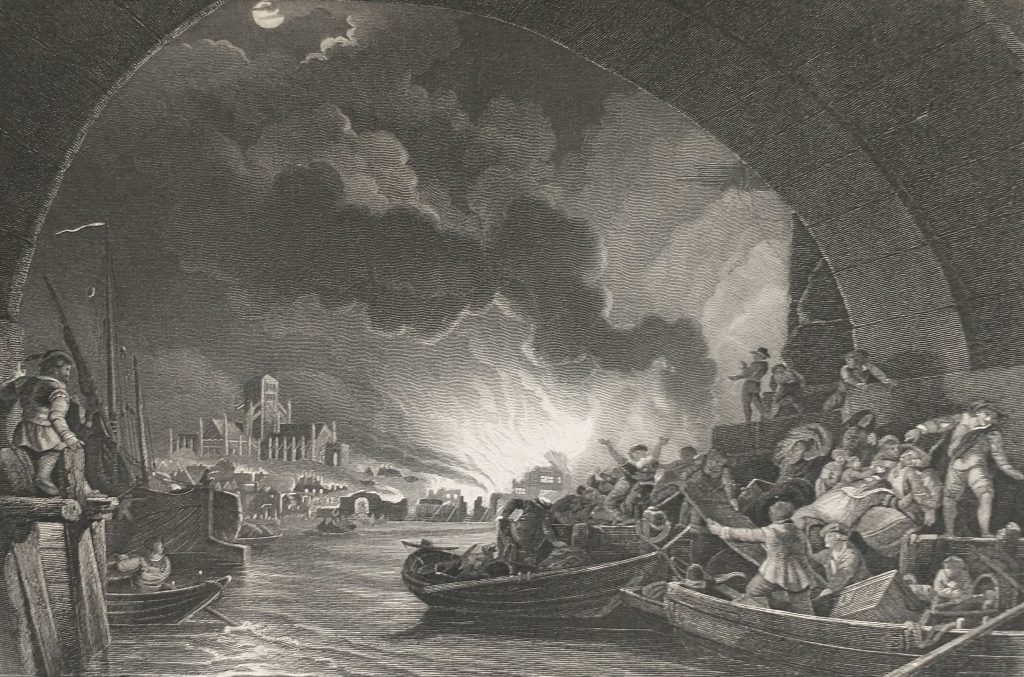
The Great Fire of London looking towards StPauls Cathedral from an old print
7:30pm Fri 30th January 2025
January 30th is the Anniversary of the execution of Charles I and to commemorate it we explore the events and the aftermath of the Civil War in London.
Along with the Norman Conquest of 1066 and winning the World Cup in 1966 the Great Fire in 1666 are the only dates the British can remember!
And we remember the Great Fire because it destroyed one of the great medieval Cities in an epic conflagration that shocked the world.
But it wasn’t just the Great Fire that made the 17th Century an epic period in English History. There was a Civil War, beheading of the King, a Republic, a peaceful Restoration of the Monarch, the last great plague outbreak in the UK, the Glorious Revolution and the Great Wind.
The Virtual Walk puts the Great Fire in the context of the time – Civil War, anti-catholicism, plague, and the commercial development of London. The walk brings to life 17th Century London. It starts with the events that lead up to the Civil War concentrating on Westminster and ends with a vivid recreation of the drama of the Fire as experienced by eye-witnesses. Route includes: Westminster, Fish Street Hill, Pudding Lane, Monument, Royal Exchange, Guildhall, Cheapside, St Pauls, Amen Corner, Newgate Street, Smithfield.
Roman London – Literary & Archaeology Walk
11.30 am Sun 9th Feb 2025 Monument Underground Station
also on 11.30am Sun 27th Apr 25 but starting from Moorgate
London Roman Riverside Wall o
This is a walking tour features the amazing archaeological discoveries of Roman London, and looks at life in the provincial Roman capital of Londinium.
This is a walking tour that features the amazing archaeological discoveries of Roman London, and looks at life in the provincial Roman capital of Londinium.
Our Guides will be Publius Ovidius Naso and Marcus Valerius Martialis who will be helped by Kevin Flude, former Museum of London Archaeologist, Museum Curator and Lecturer.
We disembark at the Roman Waterfront by the Roman Bridge, and then explore the lives of the citizens as we walk up to the site of the Roman Town Hall, and discuss Roman politics. We proceed through the streets of Roman London, with its vivid and cosmopolitan street life via the Temple of Mithras to finish with Bread and Circus at the Roman Amphitheatre.
Zinger Read: Talk about a high-quality one-two punch. This walk investigates the groundbreaking archaeological discoveries of Roman London. And then it reconstructs life in a provincial Roman capital using archaeological and literary sources. Discoveries – insights – like flashes of lightning in a cloud. We begin at the site of the Roman bridge. We might be decent young Roman citizens in togas, having this and that bit of explained to us as we make our way towards the Roman Town Hall. From there we head to the site of the excavation called ‘the Pompeii of the North.’ Followed by the Temple of Mithras. We finish with a walk along the Roman High Street in order to end at the site of the Roman Amphitheatre. So, yes, welcome to London as it was 2,000, 1,900, 1,800, 1,700 and 1,600 years ago. And, yes, the walk’s guided by a real expert, the distinguished emeritus Museum of London archaeologist Kevin Flude. That means you’ll see things other people don’t get to see, delve into London via fissures that aren’t visible, let alone accessible, to non-specialists.
REVIEWS “Kevin, I just wanted to drop you a quick email to thank you ever so much for your archaeological tours of London! I am so thrilled to have stumbled upon your tours! I look forward to them more than you can imagine! They’re the best 2 hours of my week! 🙂 Best, Sue
Jane Austen’s London Anniversary Guided Walk
2.30 pm Sunday 9th Feb 2025
Green Park underground station, Green Park exit, by the fountain To book
Also
9 February 2025
Sunday
2.30 pm
4.30 pm
8 March 2025
Saturday
2.30 pm
4.30 pm
6 April 2025
Sunday
11.30 am
1.30 pm
2025 is the 250th Anniversary of Jane Austen’s Birth in Steventon, Hampshire. We celebrate her fictional and real life visits to Mayfair, the centre of the London section of Sense & Sensibility and where Jane came to visit her brother
“It is a truth universally acknowledged, that a Jane Austen devotee in possession of the good fortune of a couple of free hours today must be in want of this walk.”
People associate Jane Austen and her characters with a rural setting. But London is central to both Jane Austen’s real life and her literary life. So, this tour will explore Jane’s connections with London and give the background to Sense and Sensibility, a good part of which is based in this very area. We begin with the place Jane’s coach would arrive from Hampshire, and then walk the streets haunted by Willougby; past shops visited by the Palmers, the Ferrars; visit the location of Jane Austen’s brother’s bank and see the publisher of Jane’s Books. The area around Old Bond Street was the home of the Regency elite and many buildings and a surprising number of the shops remain as they were in Jane Austen’s day.
Jane Austen’s ‘A Picture of London’ in 1809 Virtual Walk
With the help of a contemporary Guide Book, Jane Austen’s letters, and works we explore London in 1809.
‘The Picture of London for 1809 Being a CORRECT GUIDE to all the Curiosities, Amusements, Exhibitions, Public Establishments, and Remarkable Objects in and near London.’
This Guide Book to London might have been on Henry Austen’s shelf when his sister, Jane, came to visit him in London. But it enables us to tour the London that Jane Austen knew in some detail. We will look at the Curiosities as well as the shopping, residential, theatres areas as well as the Port, the Parks and the Palaces.
The guided walk is a thank you to Alix Gronau, who, having been to one of my lectures in 1994, wanted the book to come to me. I have had the book restored and am using it to explore London in 1809.
Jane Austen’s London Anniversary Walk
Jane Austen’s London Anniversary Walk 2.30 pm Sunday 9th February 25 To book
A Virtual Tour of Jane Austen’s Bath
7.30pm 10th February 2025
Tudor London – The City of Wolf Hall 11.30am Sat 22nd Feb 25
Myths, Legends, Archaeology and the Origins of London
Druids at All Hallows, by the Tower
2.30pm Sat 22nd February 2025 Tower Hill Underground
The walk tells the stories of our changing ideas about the origins of London during the Prehistoric, Roman and Saxon periods.
The walk is led by Kevin Flude, a former archaeologist at the Museum of London, who has an interest both in myths, legends and London’s Archaeology.
The walk will tell the story of the legendary origins of London which record that it was founded in the Bronze Age by an exiled Trojan and was called New Troy, which became corrupted to Trinovantum. This name was recorded in the words of Julius Caesar; and, then, according to Legend, the town was renamed after King Ludd and called Lud’s Dun. Antiquarians and Archaeologists have taken centuries to demolish this idea, and became convinced London was founded by the Romans. Recently, dramatic evidence of a Bronze Age presence in London was found.
When the Roman system broke down in 410 AD, historical records were almost non-existent, until the Venerable Bede recorded the building of St Pauls Cathedral in 604 AD. The two hundred year gap, has another rich selection of legends. which the paucity of archaeological remains struggles to debunk.
The walk will explore these stories and compare the myths and legends with Archaeological discoveries.
The route starts at Tower Hill, then down to the River at Billingsgate, London Bridge, and into the centre of Roman London.
Roman London – Literary & Archaeology Walk 11.30am Sat Mar 8th 25 Jane Austen’s London Anniversary Walk 2.30pm Sat 8th Mar 25
The Decline And Fall Of Roman London Walk 11.30 Sat 22nd March 2025 London. 1066 and All That Walk Sat 2.30pm 22nd March 2025
Jane Austen’s London Anniversary Walk 11.30am Sun 6th Apr 25
Chaucer’s Medieval London Guided Walk 2:30pm Sun 6th Apr 25
and
Chaucer’s London To Canterbury Virtual Pilgrimage 7.30pm Friday 18th April 25 To book
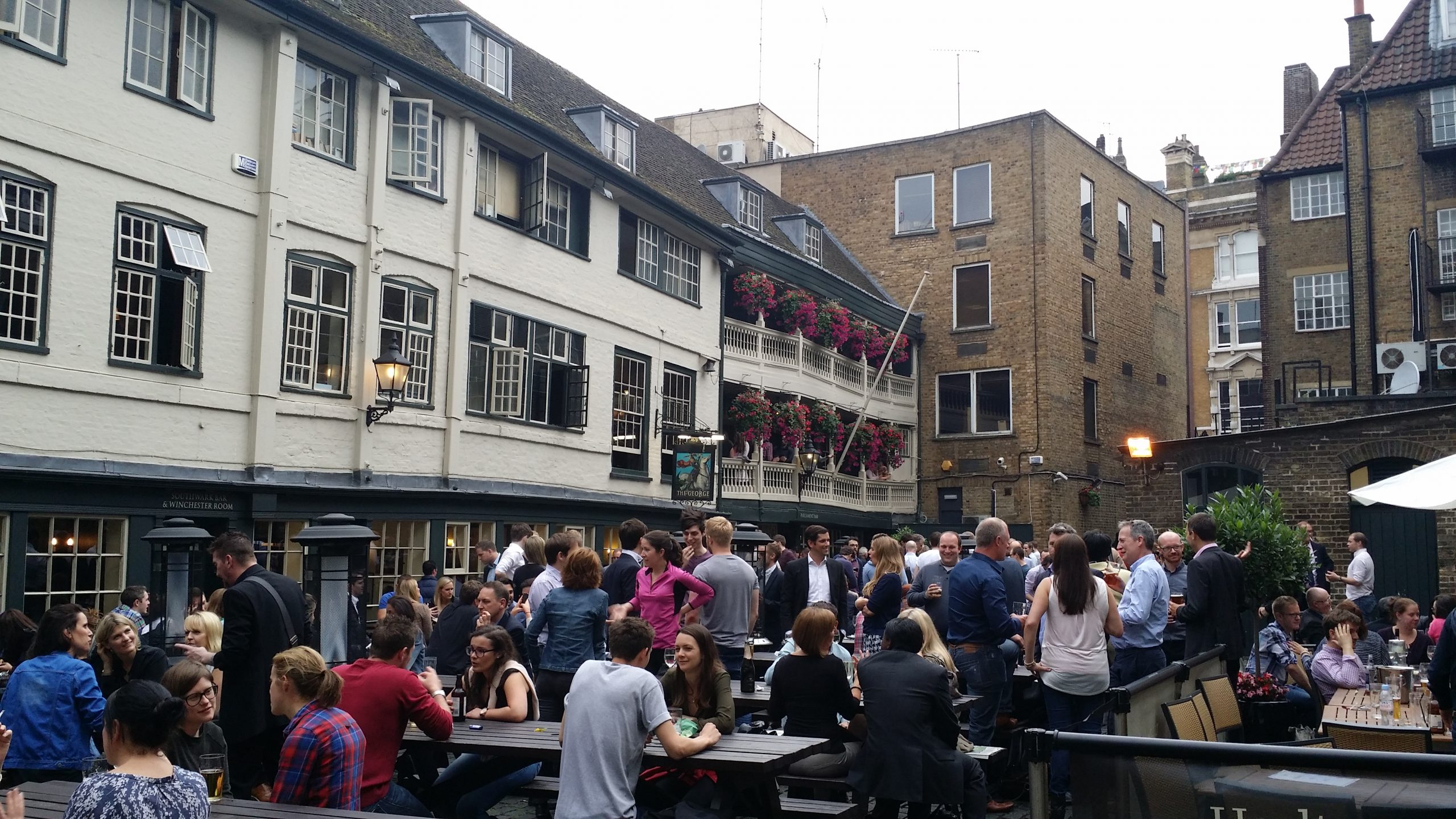
George Inn,Southwark
A Walk around Medieval London following in the footsteps of its resident medieval poet – Geoffrey Chaucer
One of the spectators at the Peasants Revolt was Geoffrey Chaucer, born in the Vintry area of London, who rose to be a diplomat, a Courtier and London’s Customs Officer. He lived with his wife in the Chamber above the Gate in the City Wall at Aldgate. His poetry shows a rugged, joyous medieval England including many scenes reflecting life in London. His stories document the ending of the feudal system, growing dissatisfaction with the corruption in the Church, and shows the robust independence with which the English led their lives.
His work helped change the fashion from poetry in French or Latin to acceptance of the English language as suitable literary language. This was helped by the growth of literacy in London as its Merchants and Guildsmen became increasingly successful. In 1422, for example, the Brewers decided to keep their records in English ‘as there are many of our craft who have the knowledge of reading and writing in the English idiom.’
Chaucer and other poets such as Langland give a vivid portrait of Medieval London which was dynamic, successful but also torn by crisis such as the Lollard challenge to Catholic hegemony, and the Peasants who revolted against oppression as the ruling classes struggled to resist the increased independence of the working people following the Black Death.
A walk which explores London in the Middle Ages, We begin at Aldgate, and follow Chaucer from his home to his place of work at the Customs House, and then to St Thomas Chapel on London Bridge, and across the River to where the Canterbury Tales start – at the Tabard Inn.
This is a London Walks event by Kevin Flude
Roman London – Literary & Archaeology Walk 11.30am Sun 27th Apr 25
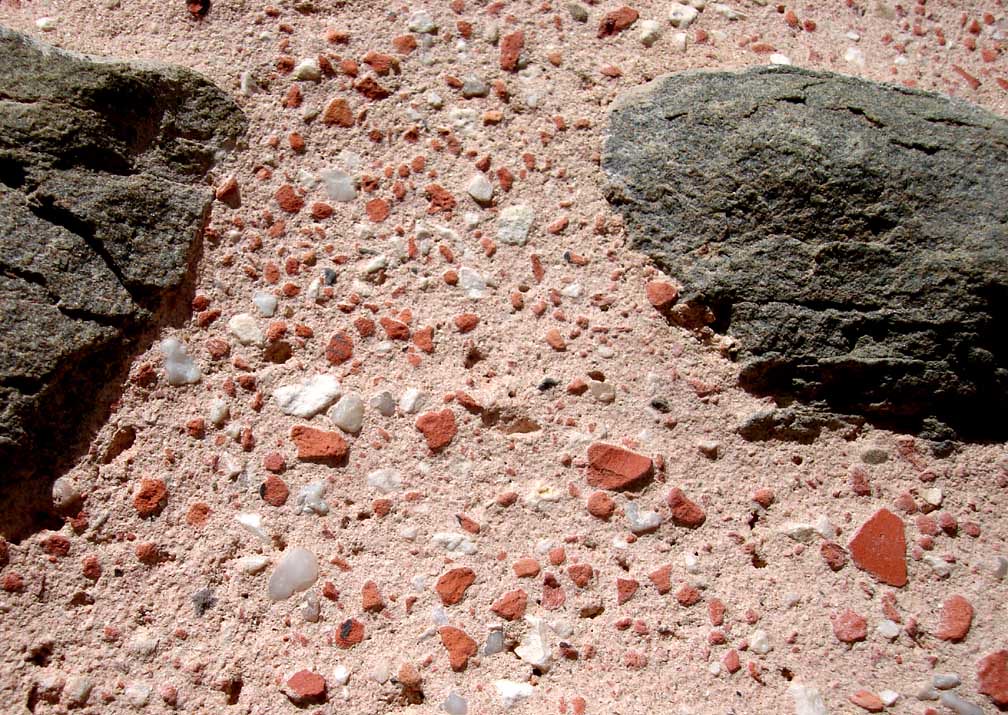
Roman layer opus signinum,
Tudor London – The City of Wolf Hall 3:00pm Sun 27th Apr 25
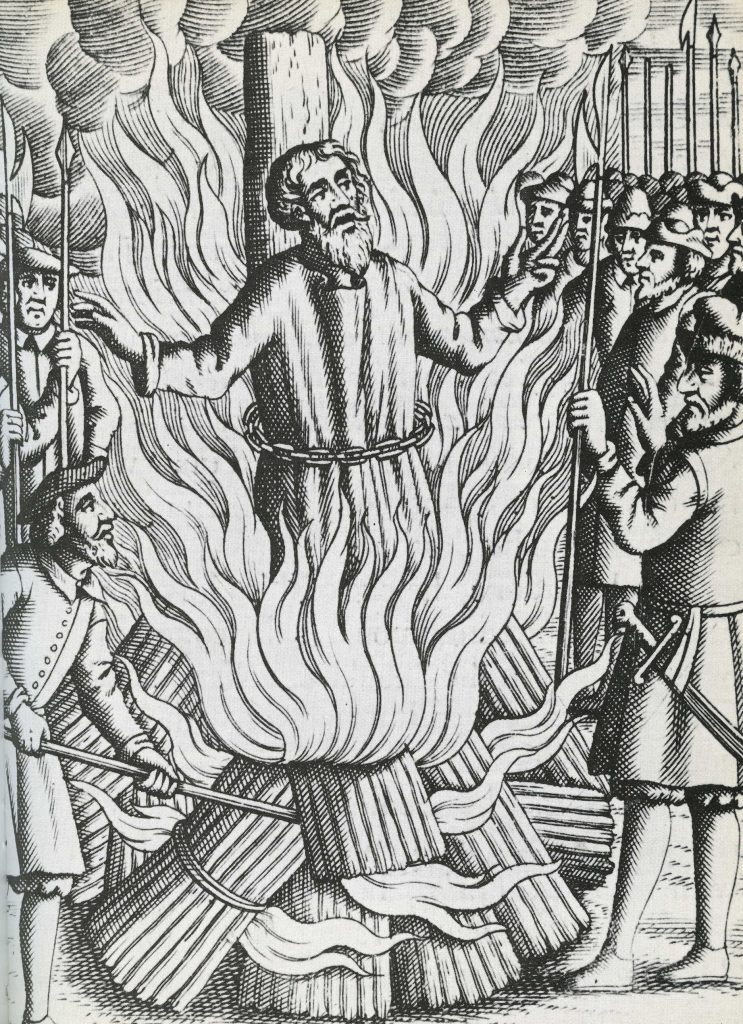
Thomas Bilney martyred in Smithfield.
The Walk creates a portrait of London in the early 16th Century, with particular emphasis on the life and times of Thomas Cromwell and Thomas More during the Anne Boleyn years.
More and Cromwell had much in common, both lawyers, commoners, who rose to be Lord Chancellor to Henry VIII, and ended their careers on the block at Tower Hill.
The walk starts with an exploration of Smithfield – site of the stake where heretics were burnt alive and of St Bartholomew’s Monastery – given to Richard Rich after his decisive role in the downfall of Thomas More. We continue to St Paul where Martin Luther’s books were burnt, and later, where Puritans preached against dancing round the Maypole.
We walk along the main markets streets of London, to Thomas More’s birthplace, and to the site of More’s and Cromwell’s townhouses before, if time allows, finishing at the site of the Scaffold where More and Cromwell met their ends, overlooking where Anne Boleyn was incarcerated in the Tower of London
To Book: https://www.walks.com/our-walks/tudor-london-the-city-of-wolf-hall/
A Boy From Haggerston before the War. 6pm 1st May 2025 Shoreditch Library.
Myths, Legends, Archaeology and the Origins of London 11.30am Sun 25th May 25 To book
The Decline And Fall Of Roman London Walk 3pm Sun May 25 To book
The Peasants Revolt Anniversary Guided Walk
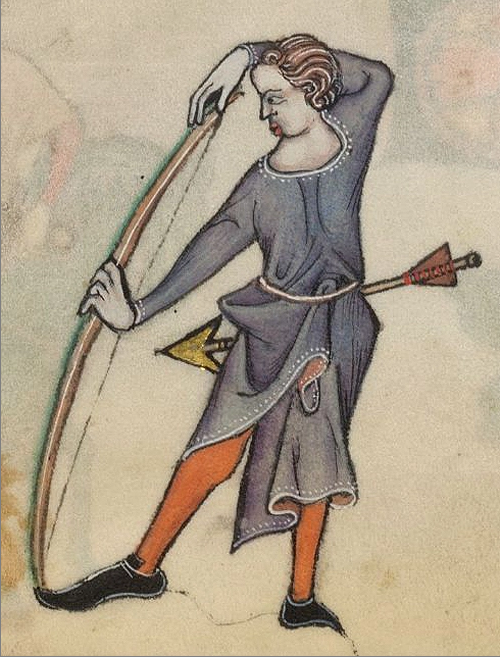
Medieval drawing of an archer
6.30pm Wed 11th June 2025 Aldgate Underground To book
An Anniversary Walk tracking the progress of the Peasants as they take control of London in June of 1381
Short read: The Summer of Blood
Long read: The Peasants’ Revolt. The greatest popular rising in English history. This is the anniversary walk. The London Walk that heads back to 1381, back to the Peasants’ Revolt. You want a metaphor, think stations of the cross. This is the stations of the Peasants’ Revolt walk. We go over the ground, literally and metaphorically. Where it took place. Why it took place. Why it took place at these places. What happened. The walk is guided by the distinguished Museum of London Archaeologist His expertise means you’ll see the invisible. And understand the inscrutable.
On the anniversary of the Peasants Revolt we reconstruct the events that shook the medieval world. In June 1381, following the introduction of the iniquitous Poll Tax, England’s government nearly fell, shaken to the core by a revolt led by working men. This dramatic tour follows the events of the Revolt as the Peasants move through London in June 1381.
We met up with the Peasants at Aldgate, force our way into the City. We march on the Tower of London as the King makes concessions by ending serfdom, at Mile End. But the leaders take the mighty Tower of London and behead the leaders of Richard’s government. Attacks follow on the lawyers in the Temple, the Prior at St. John’s of Jerusalem, Flemish Londoners, and on Lambeth and Savoy Palaces.
The climax of the Revolt comes at Smithfield where a small Royal party confront the 30,000 peasants.
Tudor London – The City of Wolf Hall 11.30am 13th July 2025 To Book Jane Austen’s London Anniversary Walk 3pm Sunday 13th July 25 To book Roman London – Literary & Archaeology Walk 11.30 am Sat 2nd Aug 2025 ToBook Chaucer’s Medieval London Guided Walk 2:30pm Sat 2nd Aug 2025 To Book Myths, Legends, Archaeology and the Origins of London 11.00am Sat 16th Aug25 to Book Roman London – Literary & Archaeology Walk 6:30pm Wed 24th Sept 2025 To book The Archaeology of London Walk 6.30pm Fri 3rd October 2025 To Book Chaucer’s Medieval London Guided Walk 11:30pm Sat 4th Oct 25 To book The Decline And Fall Of Roman London Walk 11.30pm Sat 8th Nov 25 To book Jane Austen’s London Anniversary Walk 2.00pm Sat 23rd Nov25 To book Rebirth of Saxon London 23rd Nov 25 Roman London – Literary & Archaeology Walk sat 11am 6th Dec 2025 To book Cromwell’s and More’s Tudor London Walk 2pm 7th Dec25 To book Jane Austen’s London Anniversary Walk 2.30pm Sun 14 Dec25 To book Christmas With Jane Austen Virtual London Tour 7.30pmTues 16 Dec25 To book The London Equinox and Solstice Walk 11:30pm Sun 21st Dec 25To book The London Winter Solstice Virtual Tour 7.30pm Sun 21 Dec 25 To book
Previous Years Archives
Here are previous archive of guided walks and events
The First Day of Christmas, my true love sent to me a Partridge in a Pear Tree
Nebra Sun disc. Photo from Stonehenge Exhibition British Museum (photo Kevin Flude) The Disc shows the Sun, the Moon, the Pleides, and illustrates the Summer and Winter Solstice movements of the Sun.
On the 25th December were born Jesus, Mithras, Attis, Saturn, Apollo, and the Invincible Sun.
The Sun Gods have quite a complicated interrelationship. Zeus, and Apollo are both also considered to be Sun Gods. Apollo is particularly interrelated to Helios, the Greek God who drives the Chariot that carries the Sun across the skies every day. The Romans had a God called Sol who some say was a deity but who declined to be of minor importance. Then Sol was championed by the transexual Emperor Elagabalas. Aurelian revived the cult in 274 AD. Sol Invictus was the focus of Constantine the Great. Sol has been suggested as a response of the Romans to a trend towards monotheism in the later Roman period. Sol for Constantine was a gateway God to Christianity.
It is also notable that early worship of Jesus is full of solar metaphors, Jesus being, for example, the light of the world. Churches are also virtually all orientated East West, aligned with the rising and setting suns. The Altar is always at the East End, and effigies on tombs face the rising sun.
First Christmas?
The first recorded Christmas Day is in AD336. It was in an almanac that lists Roman Holidays, officials and martyrs. The entry for December 25th says: ‘natus Christus in Betleem Judeae’. For more early Christian Dates have a look here.
Celtic Sun Gods?
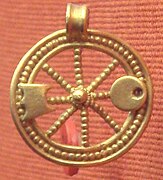
The Golden Wheel from Haute Marne in France, (Public Domain, Wikipedia)
Did the Celts have a sun-god? Belenos is a contender, but linguists are proposing his name does not come from words meaning bright but from strong. The God Lugh’s name is suggested to mean ‘shining’ but his attributes are more of a warrior than a sun god. Taranis is probably the best candidate, but he is more of a sky or thunder god than specifically a sun god. However, his symbol is a 8 spoked wheel is said to be symbolic of the Sun. It also represents the division of the year by the 4 quarterly sun festivals (Winter Solstice, Spring Equinox, Summer Solstice and Autumn Equinox) and the 4 cross-quarter festivals, (Samhain or Halloween, Imbolc or Candlemas, Beltane or May Day, Lughnasa or Harvest Festival).
December 25th is a few days after our reckoning of the Solstice. But, as we have previously seen, Christians believed the world was created on the Spring Equinox, and humans on the 4th day, so Adam was created on March 25th. Mary conceived on the same day, and therefore Jesus, after a perfect labour was born 9 Months later on December 25th. (See my post on March 25th and the Creation)
Christmas Cake
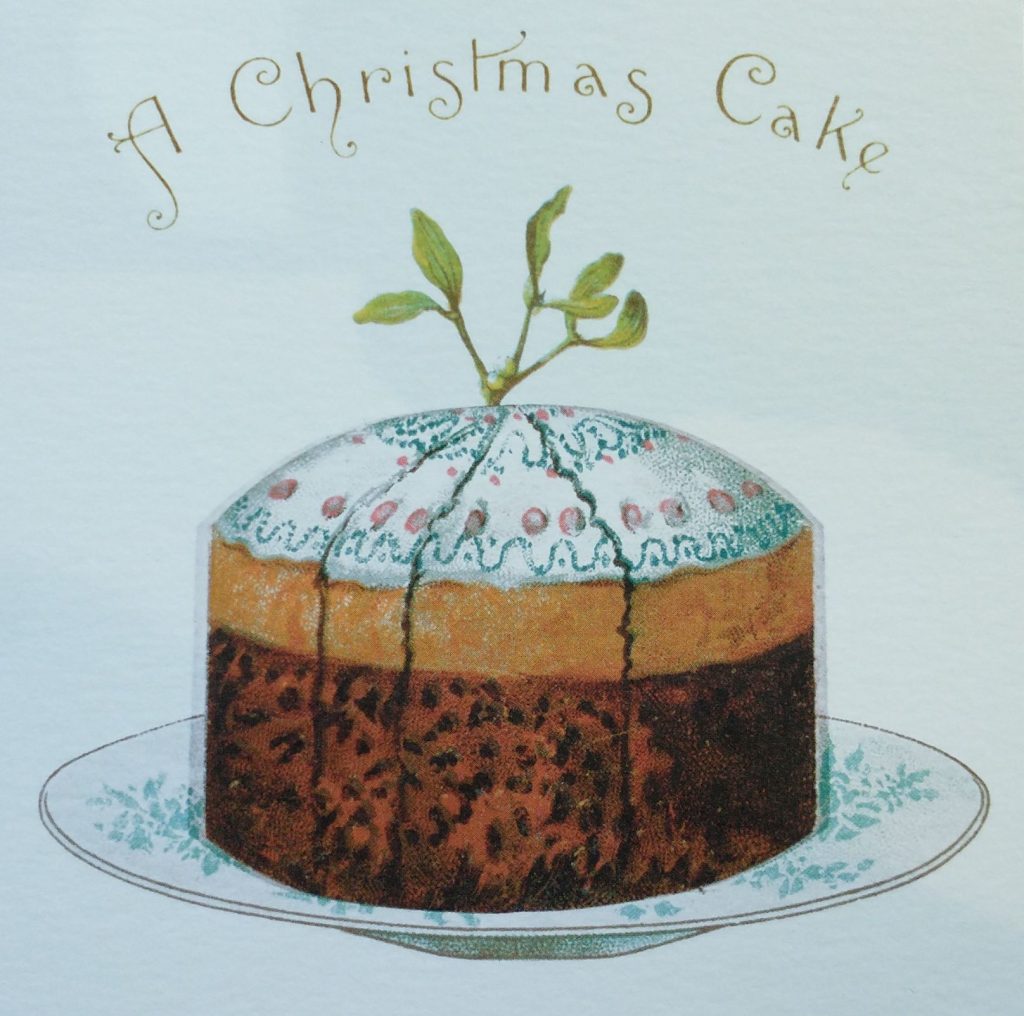
Today, you might be tucking into a Christmas Cake (originally eaten on Twelfth Night). Now, I know many Americans have a bizarre belief that fruit cake is the cake of the devil. Something you receive as a gift and give away to someone else, as most Americans hate it. More fool them for missing out on one of the delights of the Christmas period, that and cold turkey sandwiches. Christmas Cake is made on stir up Sunday, the last Sunday in November, to let the ingredients develop their flavour. They are then covered with marzipan and decorative icing.
19th Century Christmas Cake, generally now the icing continues down the side of the cake.
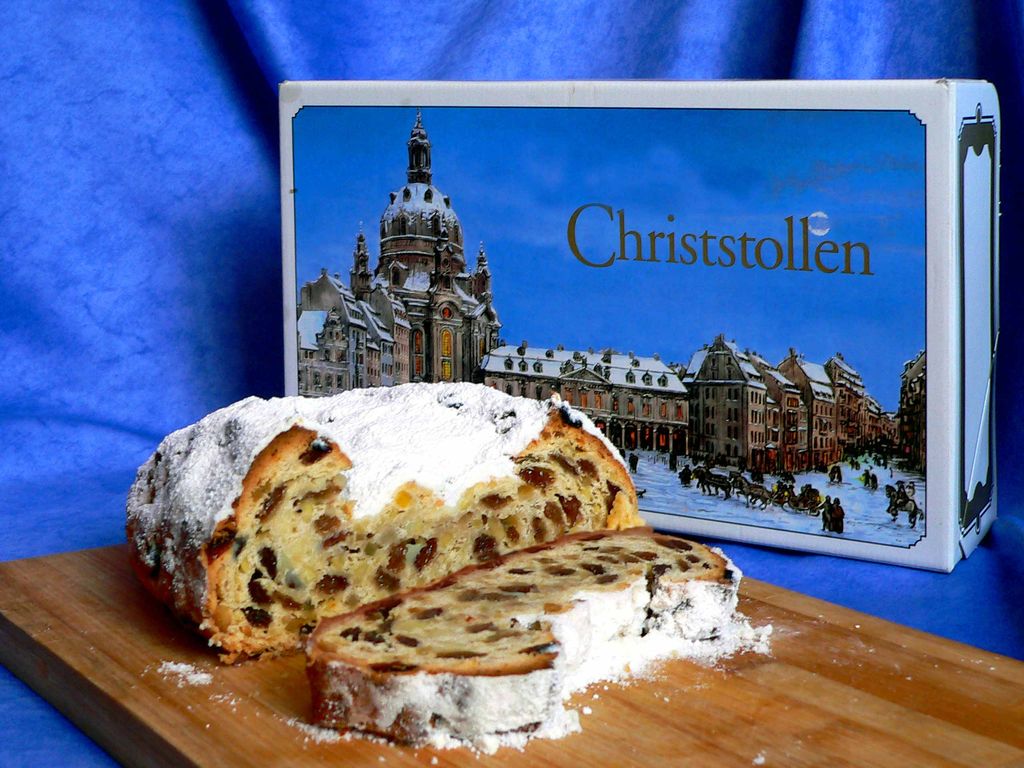
In Germany, they also eat a fruit bread called Stollen or Weihnachtsstollen. The tradition is said to have been started in the 15th Century, when the Pope gave dispensation to allow the use of butter in the fasting period of Advent. Previously, the Germans had to use oil to replace the banned butter, but they could only make oil from turnips, so eventually the Pope allowed the use of butter, with which they made bread with added dried fruits.
Stollen By Gürgi – Own work, Public Domain, https://commons.wikimedia.org/w/index.php?curid=3720379
In Italy, they eat Panettone, a fruit bread/cake. It is a sourdough, and a cross between a brioche and a cake. It often comes in a beautiful decorative tin, and is delicious. The centre of panettone production is Milan. Last year was the 200th Anniversary of Milan’s famous Marchesi 1824 which makes artisanal Panettone. It used ‘fine ingredients such as six-crown sultan as, naturally candied fruit, Bourbon vanilla from Madagascar, Italian honey and eggs from free-range hens, blended in a slow-rising dough with the exclusive use of Marchesi 1824 sourdough starter‘. Thank you, Mara from Milan, for the heads-up.
Screen shot from website – does not click through to sales!
Which is best? The only way to find out is to eat several slices of each. America, you don’t know what you are missing.
For stir up sunday see the second half of this post of mine.
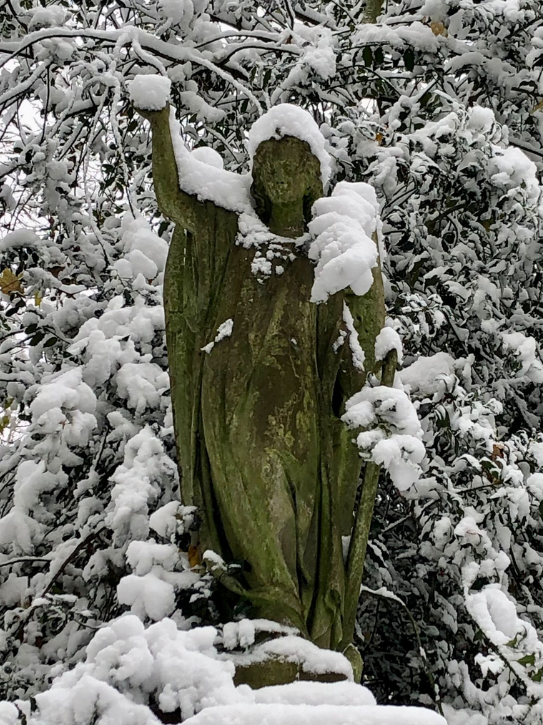
Abney Park cemetery in winter photo by Harriet Salsibury
Hesiod is a contemporary of Homer, and therefore one of the first European poets, writing about 700BC. One of the first commentators on Greek life, thought, religion, mythology, farming and time keeping. Hesiod’s Works & Days ‘ is his Farmers Almanac and therefore long overdue an appearance on my Almanac of the Past.
Hesiod’s poems also introduce the idea of the epoch. Past glorious epochs of Gold and Bronze with a further descent to his own epoch which was of the base metal age of Iron. His so-called Myth of Five Ages, starts with a Golden Age, in which Humans don’t need to work. Followed by a Silver Age where they live to one hundred years, but live a life of strife. The Bronze Age follows which is an even tougher age as the bronze armoured men are thoroughly violent. The Age of Heroes follows which is the age of the Trojan War. There follows the Iron Age which is Hesiod’s age a time of toil and misery!
.In the 19th Century, European antiquarians, imbued with a humanist belief in Progress, developed the idea of Stone, Bronze and Iron Ages, an almost direct opposite of Hesiod’s, downhill-all-the-way to the present day idea.
Hesiod also brings in early references to Prometheus and Pandora, two of the great myths of the flaws of humanity.
Hesiod and Winter
This is what he says of Winter. It is from a translation by Christopher Kelk, available to download here (I have added line breaks after full stops, just for ease of reading.)
Excerpt from Hesiod’s Works & Days
…. you should make A detour during winter when the cold Keeps men from work, for then a busy man May serve his house. Let hardship not take hold, Nor helplessness, through cruel winter’s span, Nor rub your swollen foot with scrawny hand.
An idle man will often, while in vain He hopes, lacking a living from his land, Consider crime. A needy man will gain Nothing from hope while sitting in the street And gossiping, no livelihood in sight.
Say to your slaves in the midsummer heat: “There won’t always be summer, shining bright – Build barns.” Lenaion’s evil days, which gall The oxen, guard yourself against. Beware Of hoar-frosts, too, which bring distress to all When the North Wind blows, which blasts upon the air In horse-rich Thrace and rouses the broad sea, Making the earth and woods resound with wails.
He falls on many a lofty-leafed oak-tree And on thick pines along the mountain-vales And fecund earth, the vast woods bellowing. The wild beasts, tails between their legs, all shake.
Although their shaggy hair is covering Their hides, yet still the cold will always make Their way straight through the hairiest beast.
Straight through An ox’s hide the North Wind blows and drills Through long-haired goats. His strength, though, cannot do Great harm to sheep who keep away all chills With ample fleece. He makes old men stoop low But soft-skinned maids he never will go through – They stay indoors, who as yet do not know Gold Aphrodite’s work, a comfort to Their darling mothers, and their tender skin They wash and smear with oil in winter’s space And slumber in a bedroom far within The house, when in his cold and dreadful place The Boneless gnaws his foot (the sun won’t show Him pastures but rotate around the land Of black men and for all the Greeks is slow To brighten).
That’s the time the hornèd and The unhorned beasts of the wood flee to the brush, Teeth all a-chatter, with one thought in mind – To find some thick-packed shelter, p’raps a bush Or hollow rock. Like one with head inclined Towards the ground, spine shattered, with a stick To hold him up, they wander as they try To circumvent the snow.
As I ordain, Shelter your body, too, when snow is nigh – A fleecy coat and, reaching to the floor, A tunic. Both the warp and woof must you Entwine but of the woof there must be more Than of the warp. Don this, for, if you do, Your hair stays still, not shaking everywhere.
Be stoutly shod with ox-hide boots which you Must line with felt. In winter have a care To sew two young kids’ hides to the sinew Of an ox to keep the downpour from your back, A knit cap for your head to keep your ears From getting wet.
It’s freezing at the crack Of dawn, which from the starry sky appears When Boreas drops down: then is there spread A fruitful mist upon the land which falls Upon the blessed fields and which is fed By endless rivers, raised on high by squalls.
Sometimes it rains at evening, then again, When the thickly-compressed clouds are animated By Thracian Boreas, it blows hard. Then It is the time, having anticipated All this, to finish and go home lest you Should be enwrapped by some dark cloud, heaven-sent, Your flesh all wet, your clothing drenched right through.
This is the harshest month, both violent And harsh to beast and man – so you have need To be alert. Give to your men more fare Than usual but halve your oxen’s feed. The helpful nights are long, and so take care.
Keep at this till the year’s end when the days And nights are equal and a diverse crop
Keep at this till the year’s end when the days And nights are equal and a diverse crop Springs from our mother earth and winter’s phase Is two months old and from pure Ocean’s top Arcturus rises, shining, at twilight.
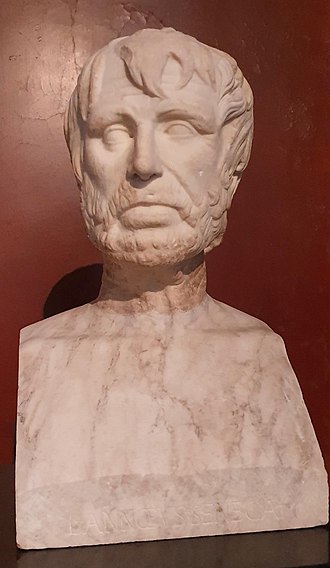
Roman Bust of Hesiod (Wikipedia photo by Yair Hakla) Neues Museum
Acturus is not seen in winter, and in the Northern Hemisphere its rising (50 days after the winter solstice) and has always been associated with the advent of spring.
Boreas was the winged God of the North wind, which bore down from the cold Mountains of Thrace (north of Macedonia). One of his daughters, Khione, was the Goddess of Snow. Lenaion was associated with January one of the festivals of Dionysus, and a theatrical season in Athens particularly for comedy.
Robins brought water to relieve tormented souls in Hell and, so, got their breasts scorched; their breasts were stained with Jesus’ blood; they fanned, with their wings, the flames of a fire to keep baby Jesus warm and got scorched. All these associations with Jesus make their association with Christmas and Christmas cards perfect sense.
They are the Celtic Oak King of the New Sun. The Wren is the bird of the Old Sun. The Robin is the son of the Wren. The Robin kills his father. So the New Sun takes over from the Old Sun at the Winter Solstice. And the Robin takes over from the Wren.
The blood of the father Wren stains the Robin’s breast. In Celtic Folklore, Robins are said to shelter in Holly trees. Robins appear when loved ones are near. If a Robin comes into your house, a death will follow.
Perhaps this gives a context for Shakespeare’s mention of a robin (a ruddock he called it) which he grants the power of censure. In the play Cymberline, Innogen has been found dead, and amidst the floral tributes mentioned is the following (cors is corpse):
the ruddock would with charitable bill (Oh bill sore shaming those rich-left-heirs, that let their Father’s lie without a Monument) – bring thee all this; Yea, and furr’d Mosse besides. When Flowres are none To winter-ground thy cors
(Cymbeline, Act 4 scene 2)
Robin’s Habits
They are one of the few birds to be seen all year round, and they sing all year too. But they have different songs for autumn and spring. Robins sing from concealed spaces in trees or bushes. They are the first to sing in the morning, the last to stop at night, and can be triggered by street lights turning on. A Robin can sing all the notes on the scale and can sing for half an hour without repeating a melody.
They eat worms, seeds, fruits, insects and other invertebrates. Robins are aggressively territorial, and are our favourite birds. (RSPB)
On this Day
1554 – ‘the same day at after-noon was a bear bitten on the Bank side, and broke loose and in running away he caught a serving man by the calf of the leg, and bit a great piece away and after by the ‘hokyl-bone’ within 3 days after he died.’
Henry Machyn’s Diary quoted in ‘A London Year’ complied by Travis Elborough & Nick Rennison.
Hokyl-bone might be the holbourne stream inn what we now call holborn. Or it might be another name for the tarsus bone, the heel bone. But it doesn’t really make sense if it’s a bone. But the bear dying 3 days later by the steam makes some sort of sense.
Written December 9th 2024, revised and the Bank side incident with the Bear added 2025
Roman Mosaic from Lullingstone Villa, Kent representing winter
This is the second day of Winter. Winter is hiems in Latin; Gaeaf in Welsh. Geimhreadh in Old Irish; Wintar in Anglo-Saxon. The Anglo-Saxons counted years by winters, so a child might be said to be 4 winters old.
Winter, meteorologically speaking, is described in the Northern Hemisphere as being December, January, and February, which is, of course, a convention rather than a fact. There is nothing about December 1st that makes it more ‘wintery’ than November 30th or December 2nd. Astronomically, winter starts with the Winter Solstice when the sun is at its lowest and so stretches from around December 21st to the Equinox around March 21st.
Logically, the solstice, when the Sun is at its weakest, should be the coldest day, and a midpoint of winter rather than the beginning of it. With 6 weeks of winter on either side of it. This is roughly what the Celtic year does, winter starts at dusk on 31st October (Halloween/Samhain) and continues to the evening of 31st January (Candlemas/Imbolc). So a Celtic Winter is November, December, and January.
As far as the Sun goes, this is logically correct. In fact, because of the presence of the oceans (and to a lesser extent) the earth, the coldest time is not the Solstice when the Sun is at its weakest. But a few weeks later in January. Heat is retained by oceans (and the landmass), and so the coldest (and the warmest) periods are offset. Therefore, January 13th is probably the coldest day, not December 21st.
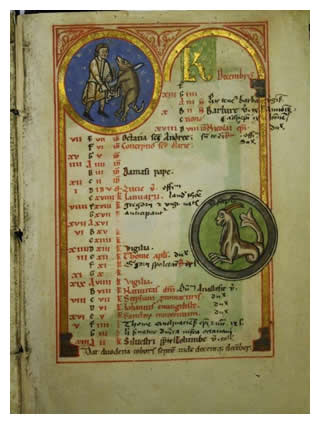
Medieval Liturgical Calendar for December. Note the image at the top which suggests this is the month for hunting bears.
My Own Winter
My personal calendar suggests that winter begins on November 5th because this is the day I generally notice how cold it has suddenly become. The house smart meter also identifies the week of November 4th being the day when the heating bill goes through the roof. However, this was not true this year, where in the London area we had a warm spell.
A final thought about Winter. Isn’t it strange that a small change in the axis of the planet should create such opposites? Cold and little growth, then hot and an explosion of flowers. Opposites just with a little tilt of the Globe towards the Sun. This, in the vastness of space, with unimaginably cold and unbelievable hot places and spaces. These make tiny the little difference between Summer and Winter seem insignificant. And yet to us, they are opposites and central facts to our existence as a species. In places, temperature ‘extremes’ make it hard to survive in. Some think this is because God made the Universe just for us. But, just think, we are completely adapted to our lives on our very own, blue planet.
A Roman View of Winter
Ovid, the great Roman poet wrote this poem on his exile from Rome to Tomis, on the Black Sea in what is now Romania. We don’t know why he was exiled, but he felt it bitterly. And winter is used to effect to show his pain.
Winter in Tomis
Harsh lands lie before him As he struggles to keep his wit Malicious thoughts infecting- Crippling the morale of his spirit Shattered visions of the fallen begin to transpire.. An awful nostalgia consumes him. A crooked smile forms..exalting the dead
So began the fall of a mastermind.
Realizing as his mind falls to pieces They are but catalysts – parts of a puzzle to a different plan As the images surfaced, his virtue descends Living amongst those barbarians Though a fierce complication Their tact was that of a wounded creature And they were overrun
“I remain in exile My bones grow weak like the sun Descending into the trees To end this daily affliction As winter shows its pallid face And the earth veiled with marbled frost Forsaken – this gradual madness consumes my mind Perdition in Tomis
Undead armies of Tomis Commanded only by the presence of my absense Brought to life by the death of myself Risen to ease this torment Sacrilege; The second chance to formulate a reason The relapse crucifixion forthwith to go into effect Casting him away; instead insuring their demise.
I remain in exile My bones grow weak like the sun Descending into the trees To end this daily affliction As winter shows its pallid face And the earth veiled with marbled frost Forsaken – this gradual madness consumes my mind Perdition in Tomis
Each day passing now I beg for some remorse Desperately grasping at what I feel to be my last bit of life But unlike the cycle of the attic I feel as though there is no recourse I’ve withered to nothing.”
“Save me from drowning, and death will be a blessing.” Hope for his designed tomb “Rescue my weary spirit from annihilation If one already lost may be un-lost”
Ovid abandoned writing his almanac poem because of his exile, so it never got beyond the Summer. To read about this see my post here or search for Ovid from the menu.
On this day
1859 – John Brown was hanged, following his raid on Harpers Ferry, violently opposing slavery.
1954 – Joseph McCarthy was formally censured by the Senate for the methods used in his anti-communist campaigns.
Published in 2024, and revised adding Ovid in 2025