The Raven – the Palladium of Britain
Corvus corax is hatching. An early nesting bird, the Raven is the biggest of the Corvids. They were pushed to the west and north by farmers and game keepers but are making a comeback. Ravens are finding towns convenient for their scavenging habits. So they, again, cover most of the UK except the eastern areas. The Raven is one of the Palladiums of Britain.
A Palladium is something that keeps a city or country safe, They are named after a wooden statue of Pallas Athene, which protected Troy. Perceiving this, Odysseus and Diomedes stole the Palladium from Troy shortly before the Trojan Horse episode. Troy fell and the palladium went to Italy (I’m guessing with Diomedes who is said to have founded several cities in Italy). It ended up in Rome.
The Romans claimed to be descendants of Trojan exiles led by Aeneas. So it was back with its rightful owners. It protected Rome until it was transferred to the new Roman capital at Constantinople. It then disappeared, presumably allowing the Ottoman Turks to conquer the City of Caesar? To read of London Stone as a Palladium see my post here.
The Raven, Aneirin & Arthur
The Ravens habits (it is said they know where the battlefields are before they are fought) and their black plumage have made them harbingers of death. In poetry, Ravens glut on blood like the warriors whose emblem they are. Here is a very famous quotation from Y Gododdin, a medieval poem but thought to derive from a poem by the great poet Aneirin from the 7th Century.
‘He glutted black ravens on the rampart of the stronghold, though he was no Arthur.’
This is one of the much argued-about references to King Arthur in the ‘Was he a real person’ trope. The point being, it doesn’t make sense to mention Arthur if King Arthur wasn’t a real person. The story at the Tower of London is that the Ravens kept in the Tower, with clipped wings, keep Britain safe from Invasion. (But see below).
Bran’s Head – the original Palladium of Britain?
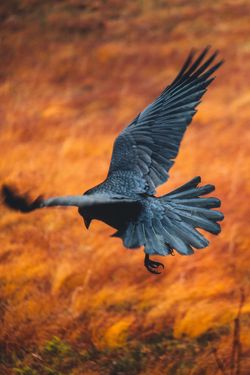
The Raven was also the symbol of the God-King Bran. Bran was one of the legendary Kings of Britain. His sister, Branwen, was married to the King of Ireland. To cut a long story short, Branwen was exiled by her Irish husband to the scullery. She trained a starling to smuggle a message to her brother, to tell of her abuse.
So Bran took an army over the Irish Sea to restore her to her rightful state. But the ships were becalmed. Mighty Bran blew the boats across the sea – he was that much a hero. Bran was mortality wounded in the fighting that followed. This was a problem because he had previously given away his cauldron of immortality. He gave it to the Irish King in recompense for the insults given to the Irish by Bran’s brother, who hated anyone not British.
Bran’s Head Returns to London
So, the dying Bran, told his companions to cut off his own head and take it back to the White Hill in London. His head was as good a companion on the way back as it was on the way out, and the journey home took 90 years.
At last, they got to London, where Bran told his men to bury his head on the White Hill. As long as it stays here, he said, Britain would be safe from foreign invasion. The White Hill is said to be Tower Hill with its summit at Trinity Gardens, although Primrose Hill is sometimes offered as an alternative.
This was one of the Three Fortunate Concealments and is found in ‘the Triads of the Island of Britain.’ The Triads are from medieval manuscripts which preserve fragments of folklore, mythology and history. They are grouped in groups of three.
Arthur and Bran’s Head
But many years later, King Arthur saw no need for anybody or anything other than himself to protect the realm. So he had the head dug up. Calamity followed in the shapes of Sir Lancelot and Mordred which led to the end of the golden age of Camelot and conquest of Britain by the Saxons. This was one of the Three Unfortunate Disclosures.
If we want a rational explanation for the story, there is evidence that Celtic cultures venerated the skull, and palladiums play a part in Celtic Tales.
So what was Arthur doing destroying the palladium that kept Britain safe? Vanity is the answer the story gives. But, perhaps, it’s a memory of Christian rites taking over from pagan rituals? God, Arthur might have thought, would prefer to protect his people himself rather than Christians having to rely on a pagan cult object.
Ravens in the Tower of London
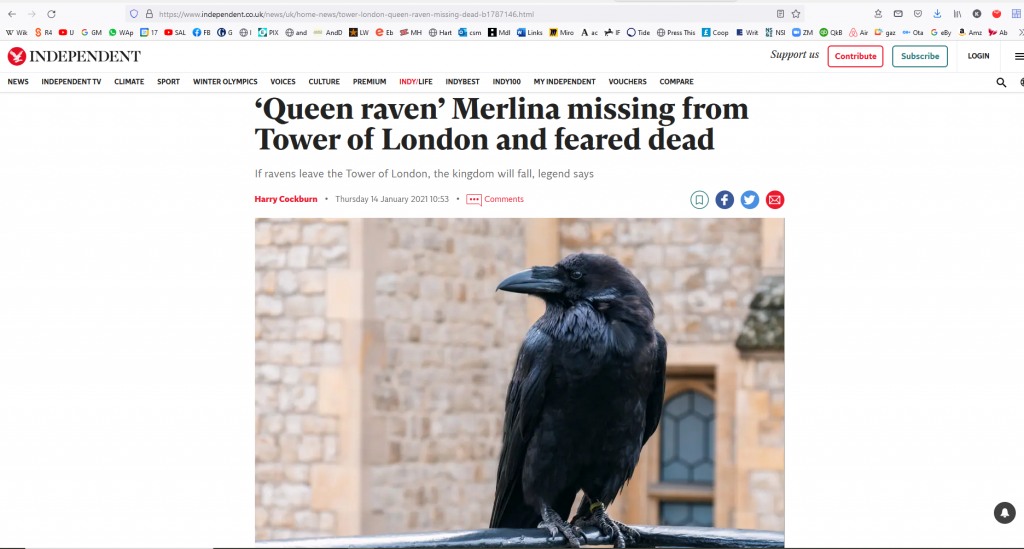
The story of Bran’s head is inevitably linked to the Ravens in the Tower who, it is still said, keep us safe from invasion. As you can see from the photo at the top we still get in a tizz when one goes missing.
Sadly, and I am probably sadder about this than most, the link between the Tower, Bran, and the Ravens cannot be substantiated. Geoffrey Parnell, who is a friend of mine, told me that while working at the Tower of London he searched the records assiduously for the story of the ravens. He found no evidence of the Raven myth & the Tower before the 19th Century, and concluded that it was most likely a Victorian invention. IanVisits has a 2025 story about the Ravens, and also concurs that the Ravens are a recent myth.
The Welsh Triads give a total of two palladiums for Britain, a couple of nationalistic fighting dragons.
Three Fortunate Concealments of the Island of Britain
The Head of Bran the Blessed, son of Llyr, which was concealed in the White Hill in London, with its face towards France. And as long as it was in the position in which it was put there, no Saxon Oppression would ever come to this Island;
The second Fortunate Concealment: the Dragons in Dinas Emrys, which llud son of Beli concealed;
And the third: the Bones of Gwerthefyr the Blessed, in the Chief Ports of this Island. And as long as they remained in that concealment, no Saxon Oppression would ever come to this Island.
All good but then came:
The Three Unfortunate Disclosures:
And there were the Three Unfortunate Disclosures when these were disclosed.
And Gwrtheyrn the Thin disclosed the bones of Gwerthefyr the Blessed for the love of a woman: that was Ronnwen the pagan woman;
And it was he who disclosed the Dragons;
And Arthur disclosed the head of Bran the Blessed from the White Hill, because it did not seem right to him that this Island should be defended by the strength of anyone, but by his own.
Gwrtheyrn is Vortigen, the leader of the Britons after the fall of the Roman Empire in Britain, one or two leaders before Arthur. Vortigern, which means something like strong leader in Welsh was a real person in so far as he, unlike Arthur, is mentioned by Gildas a near contemporary source.
The story of the dragons is supposedly from the pre-Roman Iron Age. Every May Day, the Dragons made a terrible noise, causing miscarriages and other misfortunes. So, King Ludd, whom legends says gave his name to London (Ludd’s Dun or Ludd’s walled City), drugged the dragons. He had them buried in a cavern at Dinas Emrys in Eryri (Snowdonia). The Red Dragon represented the Britons (also called the Welsh) and White Dragons the Saxons.
Vortigern, Merlin and Vortimer
Hundreds of years later, (five hundred?) after the Romans had come and gone. Vortigern was trying to build a castle in Eryri at Dinas Emrys. But the walls keep falling down. ‘You need the blood of a boy born not of man’, his necromancers say. They find a boy called Ambrosius aka Merlin whose mother had lain with an incubus. Merlin accused the necromancers of ignorance and explains the wall collapse is caused by two dragons. They find the cavern and let the dragons go. The walls now stand undisturbed. But the Welsh Red Dragon and the Saxon White Dragon can not now be at peace, and the Britons are defeated by the Saxons.
Vortigern betrayed his own people for the lust of Rowena the daughter of Hengist, the Saxon. Hengist was given the province of Kent as his reward, and thus began the Anglo-Saxon take over.
Vortigern’s son is Gwerthefyr (or Vortimer). He was a better man than his dad and fought to keep the Saxons out. After Vortimer’s death his bones were buried at the chief ports on the South Coast. Here they acted as a palladian and they kept the country safe. But they were moved to Billingsgate, in London and put in a Tower. The loss of the palladium allowed the Saxons to land safely on the Kent coast and consolidate their increasing hold over Britain and turning it into England.
Birds in Love
Here is a lovely little medieval poem. It was found in 1931 in the end leaf of a manuscript where someone had been testing their goose quill and scribbled these three lines:
All the birds have begun their nests
Except for me and you
What are we waiting for now?
This is from Dr Florence H.R.Scott’s lovely medieval substack here:
Wet Weather
Why it is so wet in the UK at the moment (February 18th)? The answer seems to be that there is a block of cold weather over the States that is moving the Jet Stream south, bringing lots of wet weather. But there is also another block of cold weather over Scandinavia. This means that the low pressures being driven by the Jet Stream, have no where to go and are stopping and dumping their rain all over the UK.
To hear the Observer’s explanation listen here.
On This Day
3102 BC – the death of Krishna starts Kali Yuga, the fourth and final yuga of Hinduism.
1478 – George, Duke of Clarence, traitor to his Brother, Edward IV, was executed in private at the Tower of London. It is said he was drowned in a vat of Malmsey Wine.
1678 – First Part of Pilgrim’s Progress by John Bunyan published.
1991 – The IRA plant bombs at Paddington station and Victoria station in London. The IRA gave warnings, and the Victoria bomb went off at 4.20am and caused no casualties. At or just before 7am, the IRA warned that all London Stations were to be bombed in 45 minutes time. The Authorities were slow to clear the stations and at Paddington a bomb went off at 7:40am. 1 person was killed and 38 people were injured. 11 days earlier, the IRA attacked Downing St with a mortar bomb attack.
Written on February 21 revised in February 18th 23, 24, 25, Birds in Love, Wet Weather and On This Day added in 2026