Thank you very much to my subscriber for alerting me to St Kevin’s Day, which is my Saint’s Day. I was aware of St Kev and that the name meant ‘of noble birth’ but that was the extent of my knowledge.
But a little research on Wikipedia while on the train to visit my Dad, revealed that Kev lived to the grand old age of 120, born in 498 and died in 628. As my Dad is 98 and still going strong, maybe he and St Kevin will inspire my longevity?
Briefly, St Kevin met the great St. Columba; had a poemwritten about him by the marvelous Seamus Heaney (https://poetryarchive.org/poem/st-kevin-and-blackbird/); a song by the Dubliners; several mentions by James Joyce and a long-distance path, the St Kevin’s Way, part of the Camino de Santiago network, named after him. And St Kev can help us understand the weather for the rest of June :
‘The weather on St Kevin’s Day will last all month‘.
So that means, sadly. rain for the rest of June. At least in Edinburgh where I currently am.
Live recording of Dubliners’ Song about St Kevin
Coemgen, as he is known in Irish, was a hermit, living in a cave-like ledge above a lake. His piety attracted followers and a monastic settlement. He was known for his ascetic life and love for nature. So, a role model for all us Kevins?
His hagiography was written very late, so little of it can be confirmed. But, like other saintly hermits, he is associated with being tempted by women or the devil disguised as a woman. (St. Anthony the Great, St. Benedict of Nursia, Saint Chrysanthus, St. Vitus, St. Bernard of Clairvaux, St. Hilary etc.) Unfortunately, rather than just resisting his temptress, Coemgen is said to have drowned her. Not so good!
On the other hand, my sister sent me this photo of a souvenir from a shop in Northumberland.
That’s more like it! And oh so true! Clearly we, handsome, clever, positive, analytical Kevins have a lot going for us, despite the name.
For more on the Temptations of Hermits read this article:
Nechita, Andrea.“Offering Body, Pleasure, and Wealth: The Visual Representation of Women Tempting Saints (Fifteenth and Sixteenth Century).”Annual of Medieval Studies at CEU, 20 (2014): 96-112.
On This Day
1726 – Birth of James Hutton – Father of Geology. Today is his tercentenary. An observant farmer (but much more) he realised that ‘”a vast proportion of the present rocks are composed of materials afforded by the destruction of bodies, animal, vegetable and mineral, of more ancient formation” (John Playfair). For example, Sandstone is on hills, and erodes to sand which is taken down river to the delta where it is laid down in the sluggish water. Time changes it into Sandstone, which uplifted into hills, starts the cycle again. He realised that this process must take millions of years, and thought it was part of a never-ending cycle. Both showing that the Creation myth in the Bible was metaphorical at best. At Edinburgh, where he was born, he spotted a layer of Dolerite which once must have been molten and which had forced its way into an earlier strata of sedimentary Rocks. This was Salisbury Crags which takes its place as one of those places key to the development of modern science. For more on the Centenary look here.
First written in 2023. revised June 2024, 2025, On This Day added 2026
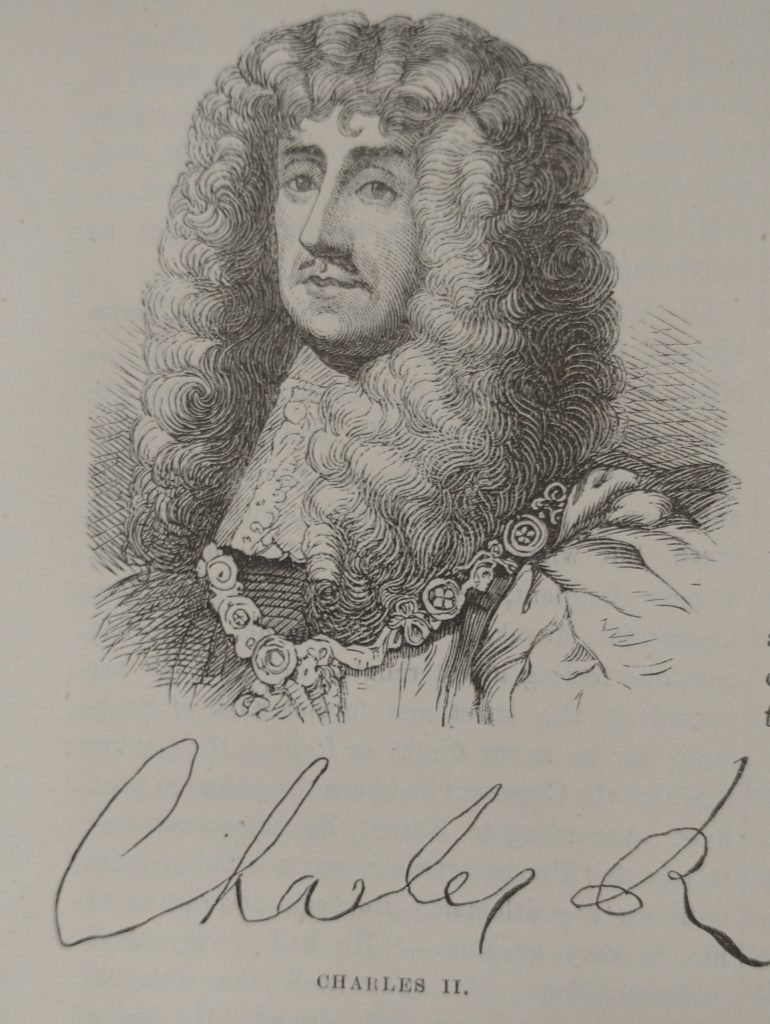
Today is both Oak Apple Day and Garland Day. Oak Apple Day was set up by Parliament in 1660 as “An Act for a Perpetual Anniversary of Thanksgiving”. They were celebrating the restoration of Charles II to the throne in May of 1660. It was abolished in 1859, but a few places continue to celebrate the day.
The Oak was chosen partly as a symbol of England but particularly because Charles II hid in an Oak Tree while escaping from Cromwell’s Parliamentary Army. Charles II attempt to restore the Monarchy ended with his defeat at the Battle of Worcester (September 3rd 1651). This was Cromwell’s Lucky Day as he also won the Battle of Dunbar on September 3rd (1650). (For more on these two battles see my post: https://chr.org.uk/anddidthosefeet/oliver-cromwell-and-his-lucky-day-september-3rd/) The Oak Tree was near Boscobel House in Shropshire which was on the route of his epic journey to the South Coast and the safety of France.
People wore oak apples (or shick-shacks) which are a type of ‘plant-gall‘. . If Oak Apples are not available, people used sprigs of Oak leaves instead.
The text of the Parliamentary Bill said:
That in all succeeding ages, the 29th of May be celebrated in every parish Church and Chapel in England and the Dominions thereof, by rendering thanks to God for the Kings (Charles II’s) restoration to actual possession and exercise of his legal authority over his subjects’
Church Services for the Restoration; for the preservation from the Gunpowder Plot and the death of Charles the First were kept until the year 1859.
The oak apples are a type of ‘plant-gall‘. This is an abnormal growth from a point of irritation on a plant. The irritation normally comes from the larvae of an insect. Oak Galls on leaves are called Oak Apples. But they can also form on the shoots, where they check and distort growth.
Oak galls are full of gallic or tannic acid. They were very useful in tanning and dyeing. Medically, they were used against dysentery, diarrhoea and cholera, using a tincture. By injection they were used against gonorrhoea and leucorrhoea.
You might like to look at my posts on the Civil War period:
Screenshot from https://www.castleton-garland.com/ showing the Garland King (possibly representing Charles II hiding in an Oak tree)
The Castleton Garland Day is a procession led by a man dressed in a big bell shaped Floral Garland. Research cannot trace it back further than the later 18th or early 19th Century. But it may have developed from the rush bearing ceremonies, where a procession led by Morris Men went to the Church to renew the strewing herbs on the floor of the Church which once were of beaten earth. Strewing herbs were sweet smelling or insect repellent, and added insulation to the floor. Strewing herbs included: Lavender, Camomile, Meadowsweet, Thyme, Oregano, Rue, Rosemary and Tansy. In historic properties, visitors are often told that the word ‘threshold’ stems from the wooden timber that held the thresh or strewing herbs in place. However, etymologists suggests the thresh comes from an old English word to trample.
Abbotsbury in Dorset has its own Garland Day on May 13th. It consists of making and blessing Garlands in the Church and taking them either to Boats, or to the War Memorial.
First Published 2025, and revised 202 with the Addition of Oak Galls, and Castleton Garland Day
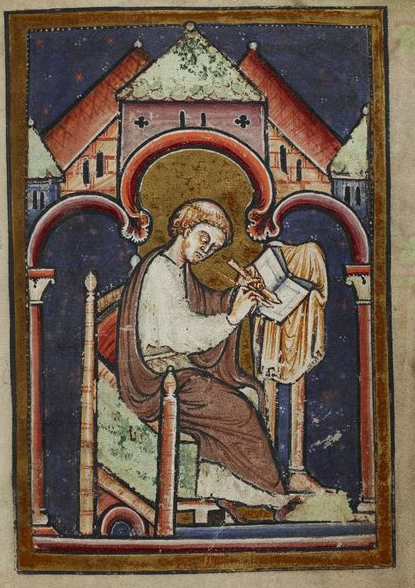
A Scribe – possibly the Venerable Bede. Late 12th Century from Lives of St Cuthbert.
He died on the evening of what we would call the 25th. In ancient times, the Day changed at dusk. So for his contemporaries, he died on 26th May. But, as he shares his day with St Augustine, some celebrate the Venerable Bede on May 27th!
Called the Father of English History, the Venerable Bede was an excellent historian. He set the tone and standard for many centuries of English Historiography. Mostly remembered for the ‘Ecclesiastical History of the English People’. This provides the most trusted account of the events of the Post Roman, Migration, and Anglo-Saxon periods. But he also wrote on time and bible commentaries. (see below). He is said to be the only Medieval Englishman, other than Chaucer to be read by every generation.
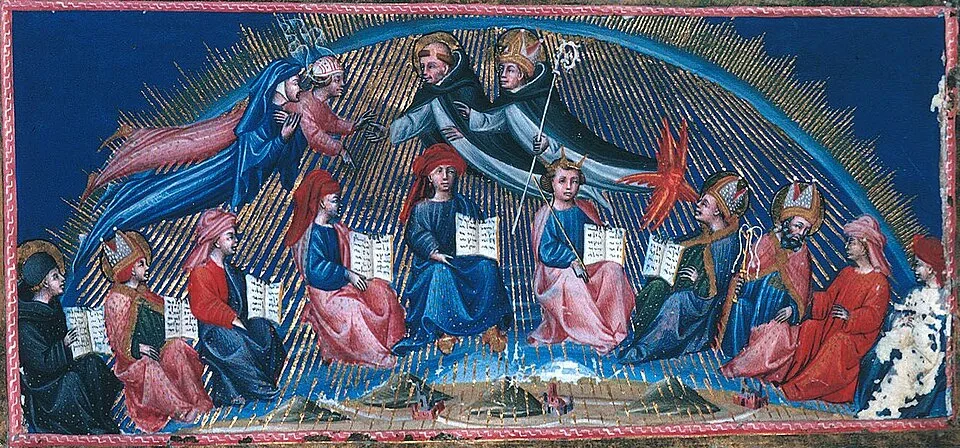
Dante’s Bede
So well regarded is he that he is the only Englishman mentioned in Dante’s Paradiso. (I have just discovered that there is another Englishman mentioned. But he is the murderer Guy de Montfort, who fled after the battle of Evesham. He then murdered his cousin in a church, and is in hell according to Dante.)
Bede is in Heaven and in the fourth sphere of Prudence. This is the Sun. Dante and Beatrice are surrounded by bright sparks which are the souls of 12 men. These the wise, who illuminate the earth intellectually.
Dante and Beatrice meet twelve wise men in the Sphere of the Sun (miniature by Giovanni di Paolo), Canto 10. (Public Doman via Wikipedia). Pictured are: Thomas Aquinas, Albertus Magnus, Gratian, Peter Lombard, King Solomon, Dionysius the Areopagite, Orosius, Boethius, Isidore of Seville, Bede, Richard of Saint Victor, Siger of Brabant.
‘Next, see the glowing breath of Isidore of Seville flame out, of Bede, and Richard of SaintVictor, who in contemplation exceeded Man. The one from whom your glance returns to me, is the light of a spirit, who, of profound thought, seemed to himself to reach death too slowly: it is the eternal light of Sigier, who, lecturing in the Rue du Fouarre, syllogised truths that brought him hatred.’
He is Venerable. But not only in the general sense of being wise, old and respected, but also in the technical Catholic sense:
‘ a title given to a deceased person who has attained a certain degree of sanctity but has not been fully beatified or canonized.‘ (Oxford Languages)
In 1899, the Catholic Church honoured him with the title of Doctor of the Church. This title is given to someone holy who has contributed to the theology of the Church.
He is considered by some to be the best historian in olden times, only equalled by Herodotus (said Thomas Carlyle). Thucydides surely says I! (Note: Herodotus is known as the ‘Father of History’ for his storytelling and breadth of the scope of his attention. While Thucydides didn’t tell tales, he concentrated on empirical evidence and so is known as the Father of Scientific History).
A Good Historian?
Bede is so good because he checked his sources and had access to a wide range of books. He even had a line to the Vatican so he could check his facts with Vatican records. This in the 8th Century! The Venerable Bede is the polar opposite of Geoffrey of Monmouth, (writing in the 12th Century). If Bede mentions a person or an event then they are accepted as part of the story of the English. By contrast, if Geoffrey of Monmouth mentions a person or event, without further corroboration, then historians tend to consider it a story, myth or simply made up by Geoffrey.
But, the truth is not so straightforward. Bede is not without his biases. Nor were his sources always reliable. And he is not above accepting myth, legends and miracles as fact. Geoffrey also has access to some, probably, oral traditions. So that some (but which?) of his many tales of the Kings of Britain may hold considerable historical information.
Bede’s Influence on English History
Bede followed Gildas (A British Monk writing in the 6th Century) in wondering why God allowed the native Christian Britons to be defeated by the foreign Pagan English. Gildas assumed God was punishing the Britons because of the evil deeds of their so-called Christian Kings. Bede extends this to argue that God is punishing the Britons for not trying to convert the English to Christianity. God knows that the English, when converted, will be much better Christians than the Britons seems to be Bede’s understanding.
This starts a histographical trend for the English to think of themselves as the chosen people. By contrast, the Britons (Welsh, Scots and Irish) are feckless Barbarians (they thought). Bede concentrates on the English. Countless generations of Historians have either left out the Britons, or demeaned them in their histories of England and indeed of Britain.
For example, most histories of Kings, deal only with England. They either begin with William the Conqueror or Alfred the Great and omit any British, Welsh, Scots or Irish Kings. Except, of course, for my book on the Kings and Queens of Britain. This starts with the largely legendary Kings of Britain, and includes some Welsh and Scottish Kings. To buy it, you will find details of it here.
So Bede is a great historian without whom we would have an even less clear idea about what happened in the centuries following the Roman Period. He also, contributed to an Anglo centric view of history. He was writing in Northumberland at the Monastery of Jarrow. So is more sympathetic to Northumbria than to Wessex, Mercia, and the British Kingdoms.
Bede’s Books
He wrote over 60 books. One was about the theological science of computus. In particular, the dating of Easter. The British Church had one method, the Catholic Church another. This contributed to a series of confrontations between the 2 Churches. And was only finally resolved at the Synod of Whitby in the favour of the Catholic Church.
Bede was instrumental in making Dionysius Exiguus idea of dating from the birth of Christ as the standard system. He also thought the Catholic calculation that Jesus was born 5000 years ago was wrong. He used the Bible to calculate the more ‘correct’ date was was 3952 BC. Archbishop Ussher in the 17th Century took Bede’s calculation and improved it and suggested the proper date was 4004 BC.
For more about Dionysius Exiguus and the division of time, see my post here.
First Written on May 26th 2025, revised and Dante expanded 2026
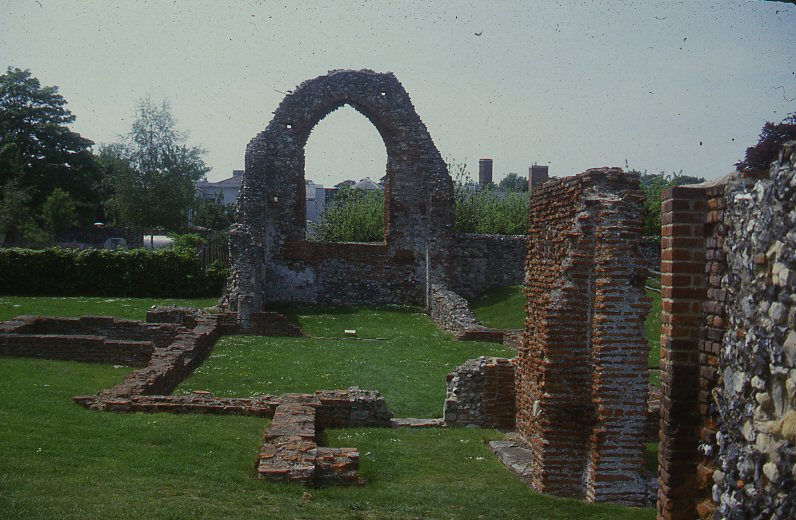
Ruins of St Pancras, Canterbury Photo: K Flude (note the reused Roman Bricks.)
St Pancras and the Ice Saints
It has been unusual cold in the last few days. You can blame this on the St Pancras and the Ice Saints. These are saints with feast days from May 11th to May 14th. They are: St. Mamertus, St. Pancras, and St. Servatius (and in some countries, Saint Boniface of Tarsus – Wikipedia). They represent a medieval belief that there was often a cold snap in early May. So the idea of the Ice Saints was probably to help persuade farmers to delay sowing until later in May. But modern statistics disprove this, but it is true that a late frost can cause havoc with crops.
St Pancras in Rome
He was a 14 year old who refused to give up his Christian Faith during the persecution of Christians by the Emperor Diocletian. He was beheaded on the Via Aurelia, in Rome, traditionally, on 12 May 303 AD. His body was buried in the Catacombs, but his head is kept in a reliquary in the Church of Saint Pancras in Rome.
Pancras means ‘all-powerful’ in Greek. His youth makes him the Patron Saint of children, but he is also the patron saint of jobs and health. He is ‘invoked’ against cramps, false witnesses, headaches, and perjury.
St Pancras in Canterbury
Pope Gregory is said to have given St Augustine relics from St Pancras when his mission came to Kent in 597AD. They built a church dedicated to St Pancras in Canterbury. The ruins still survive in the grounds of what is now St Augustine’s, Canterbury (see picture at top of this post).
St Pancras in London
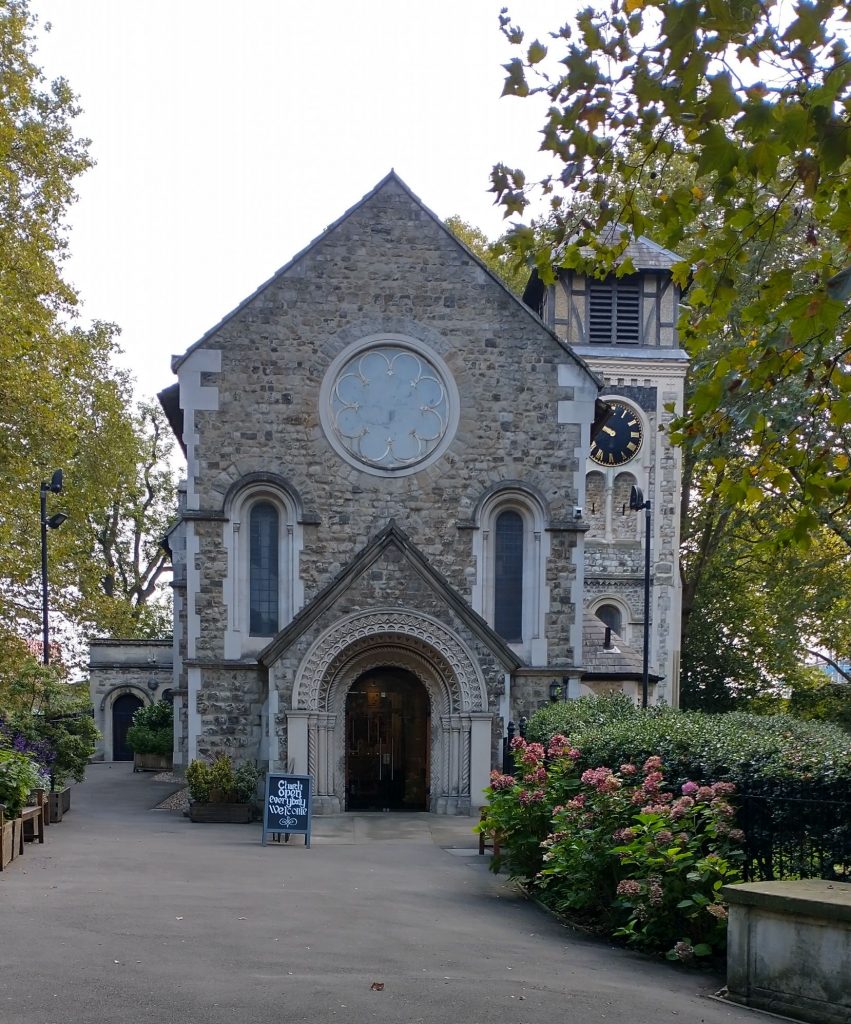
St Pancras, Old Church, London (Photo: Kevin Flude)
This story is partly responsible for the claims that St Pancras Old Church, in Camden (pictured above) is a very old foundation. It is claimed there was a late Roman place of worship here. But there is very little solid evidence for this. It is also argued that, if it isn’t late Roman, then it dates to just after 604AD. This is when St Mellitus, sent by St Augustine, established St Pauls Cathedral. It is suggested that Mellitus also founded St Pancras Church. St Pancras’ Church was a Prebend of St Pauls Cathedral (a Prebend provides the stipend (pay) to support a Canon of a Cathedral). But this is not evidence it was established as early as the Cathedral was, and there really isn’t any other credible evidence for a 604 date.
When the Church was restored, the architects said it was mostly Tudor work with traces of Norman architecture. However, it was reported that a Roman tile or two were reused in the fabric. This is about the only evidence, but it helps keep the legend going.
If you read the Wikipedia page, you will see evidence of two strands to the contributions. One is playing down the legends of its early foundation. The other trying to keep hold of its place as among the ‘earliest sites of Christian worship’. Read the wikipedia page here: https://en.wikipedia.org/wiki/St_Pancras_Old_Church to make up your own mind.
It is a lovely Church, on an impressive site, with links to Thomas Hardy, and Sir John Soane whose tomb is the design inspiration for the iconic Red Telephone Box.
As Patron Saint of Headaches, St Pancras Day is a good day to make worms come out of your head. Or so say the Fairfax Household Book of the 17th/18th Century as quoted in Charles Kightly’s ‘The Perpetual Almanac’:
‘To make a worm come out of the head. Take, in May, the marrow of a bull or cow, and put it warm into the ear, and the worm will come forth for sweetness of the marrow.’
Generally,willow bark was used for headaches. We know this would have worked as the bark contains salicin, which is converted by the body into salicylic acid. This is a precursor to aspirin (acetylsalicylic acid). But it is not as effective.
On This Day
113 – Trajan’s Column is finished in Rome. Reliefs sculptures on the Column celebrate his victory over the Dacians. There is a copy made of plaster on display at the V&A. The sculptures provide a prime document on the Roman army.
1593 – London playwright Thomas Kyd is arrested and tortured. He lived with Christopher Marlowe. In the search of their rooms, it was claimed they found evidence of atheism and blasphemous documents, including the claim that Jesus was homosexual. Kyd claimed the documents were Marlowe’s. Marlowe was awaiting news of whether he was going to prosecuted, when he was murdered in a tavern in Deptford, possibly by Government agents.
First Published in 2024, revised 2025 OnThis day added in 2026
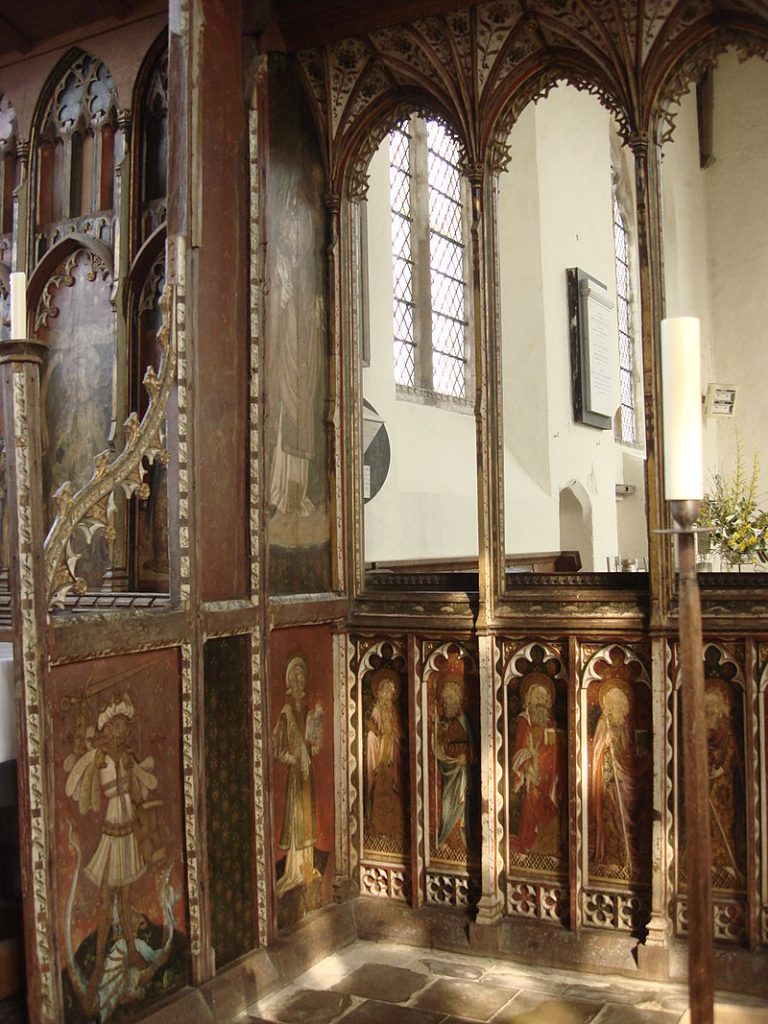
Rodmas – Rood screen in St. Helen’s church, Ranworth, Norfolk by Maria CC BY-SA 3.0
Rood is another word for the Cross. Parish Churches used to have a Rood Screen separating the holy Choir from the more secular Nave. This screen was topped with a statue of the Crucified Jesus nailed to a Rood. So, Roodmas, is the festival of the Holy Cross. Roodmas is celebrated on May 3rd and September 14th, although the Church of England aligned has itself with the Catholic Church’s main celebration on September 14th.
See my post on September 14th here for more on the True Cross.
Object of the Week
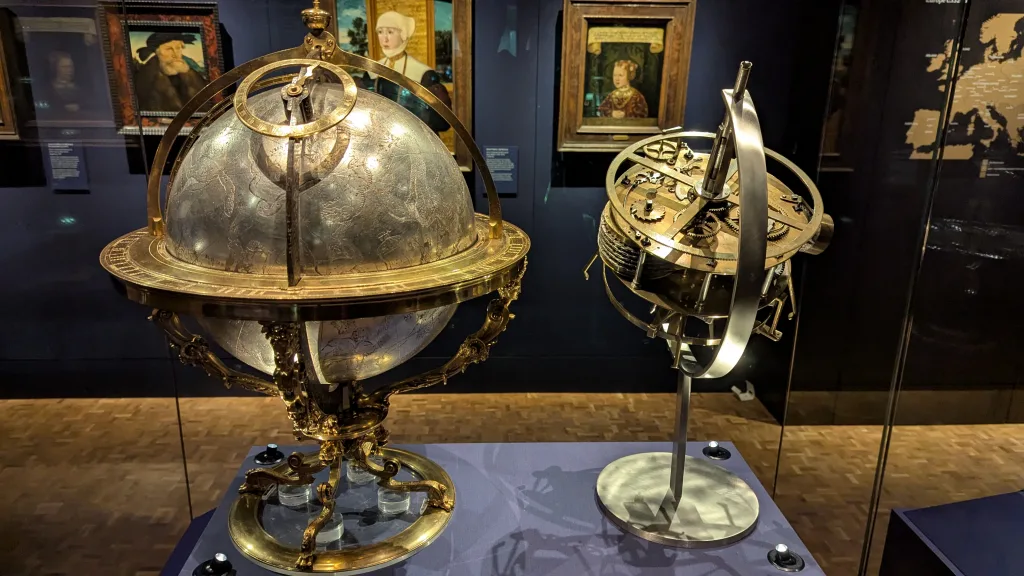
Mechanical Celestrial Globe, 1575 (Holburne Museum Bath) Photo K Flude
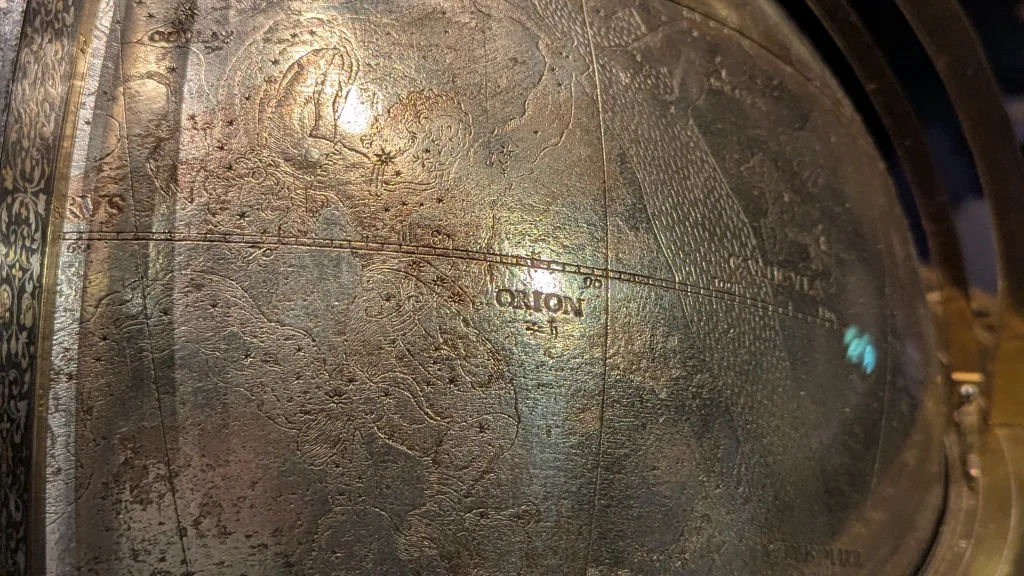
I spent a couple of days in Bath and revisited the Holburne Museum. Here I saw this amazing object from the 16th Century. The Globe is a model of the universe, and built to show the movement of the constellations, but it also tells the time and date. So the user can see when a constellation appears above the horizon and where it will be in real time. The mechanics are designed to be seen from inside the Globe, so reading it from the outside requires a mental adjustment to the mirror image of the stella sphere. It also show a pre-Copernican view as the stars were imagined as if on the inside of a huge sphere circulating around the earth. For more information please read the label below.
Museum Label for Celestial Globe.Close up of the surface of the Globe showing Orion. Photo K Flude
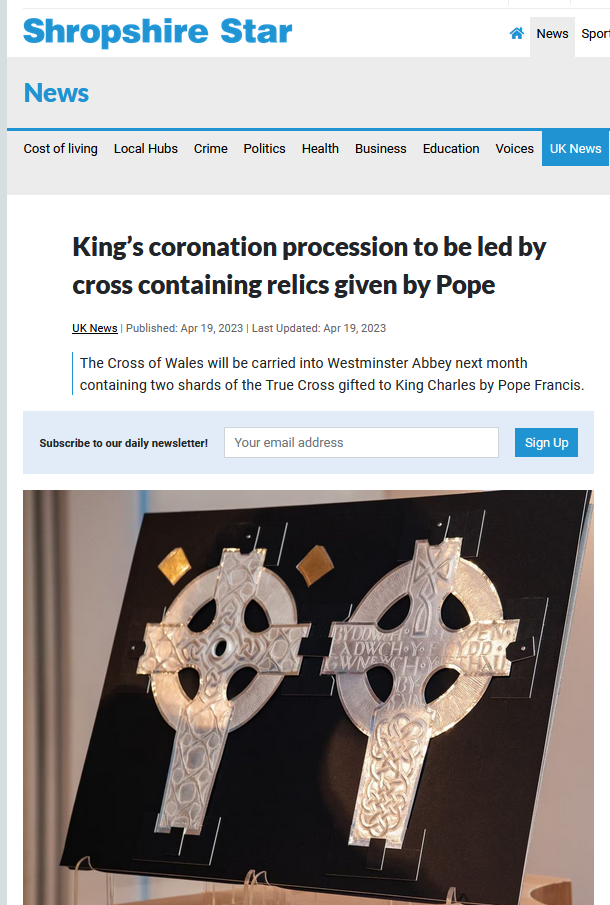
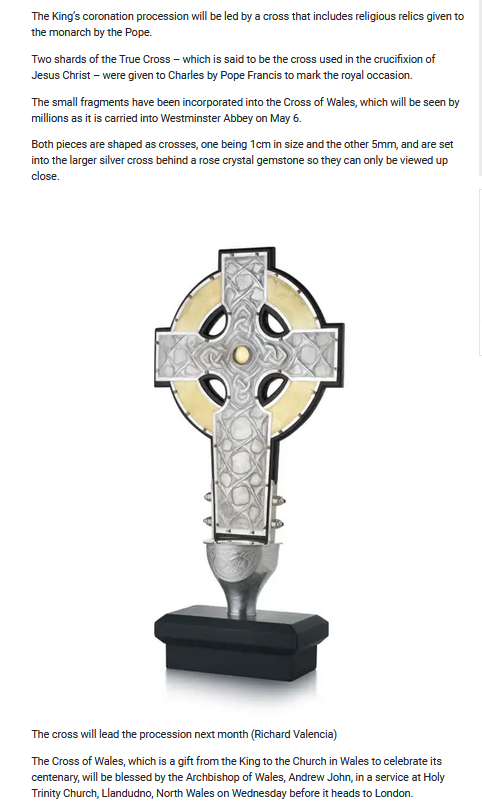
The Shropshire News reported that two pieces of the True Cross were given to Charles III by the Pope for the Coronation. They were installed into a cross called the Welsh Cross. This was part of the Coronation Procession. The King gave the Cross (I assume with the pieces of the Holy Cross) to the Church in Wales. Let the Shropshire News tell the story:
It is a clear reminder that we are subjects not citizens and news, as a nation, we still set store by superstitions.
The Duke of Buckingham and the True Cross
The Duke of Buckingham had a piece of the True Cross in his collection, which he kept at York House in the early 17th Century. How he got it, I don’t know. But I think he must have acquired it in the aftermath of the destruction of the Reformation. John Tradescant, who looked after the Duke’s collection until Buckingham was murdered, had a piece of the True Cross. Tradecant created Britain’s first Museum, Tradescant’s Ark. Again, I suspect (without any evidence) that he got the fragment from Buckingham. Was he gifted it? Did he acquire it after the murder? Or shiver off a timber fragment hoping no one would notice?
First Written on May 3rd 2023, revised 2024, 2025, Object of the Day added 2026
The Stinking Idol : An Imagined Scene at the Maypole at St Andrew Undershaft
This post is about the end of the Maypole in London but first:
On This Day
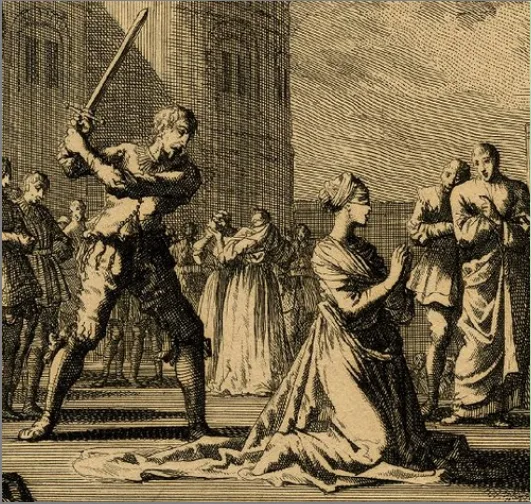
Old Print of the French Executioner dispatching Anne Boleyn with a sword rather than an axe.
1536 – Anne Boleyn arrested on ‘charges of adultery, incest, treason and witchcraft.’ But, Claire Ridgway in her post here and her book, show that she was never accused of witchcraft in court. The stories of extra fingers, and teats, are all later Catholic propaganda aimed at weakening Elizabeth’s claims to the throne. She was accused of adultery. Five men were executed for sleeping with her: her brother George Boleyn, (Lord Rochford); Sir Henry Norris, groom of the stool; courtier Sir Francis Weston; courtier William Brereton, and musician Mark Smeaton. Incest with her brother (one possible explanation of the incest is the idea that she desperately needed a baby and if she needed a surrogate then her brother was safest as the child would have a family resemblance to her and not rouse any suspicions from Henry of adultery. The other explanation is that Anne never commited incest!). Treason, well sleeping with someone other than the King risked imperilling the blood line of the Royal Family. It also gave a motive for killing the king.
A new portrait has been claimed to be of Anne Boleyn, the only one to have been done in her lifetime. But it has been revealed by AI, and some art historians are not convinced. Follow this link to see for your self.
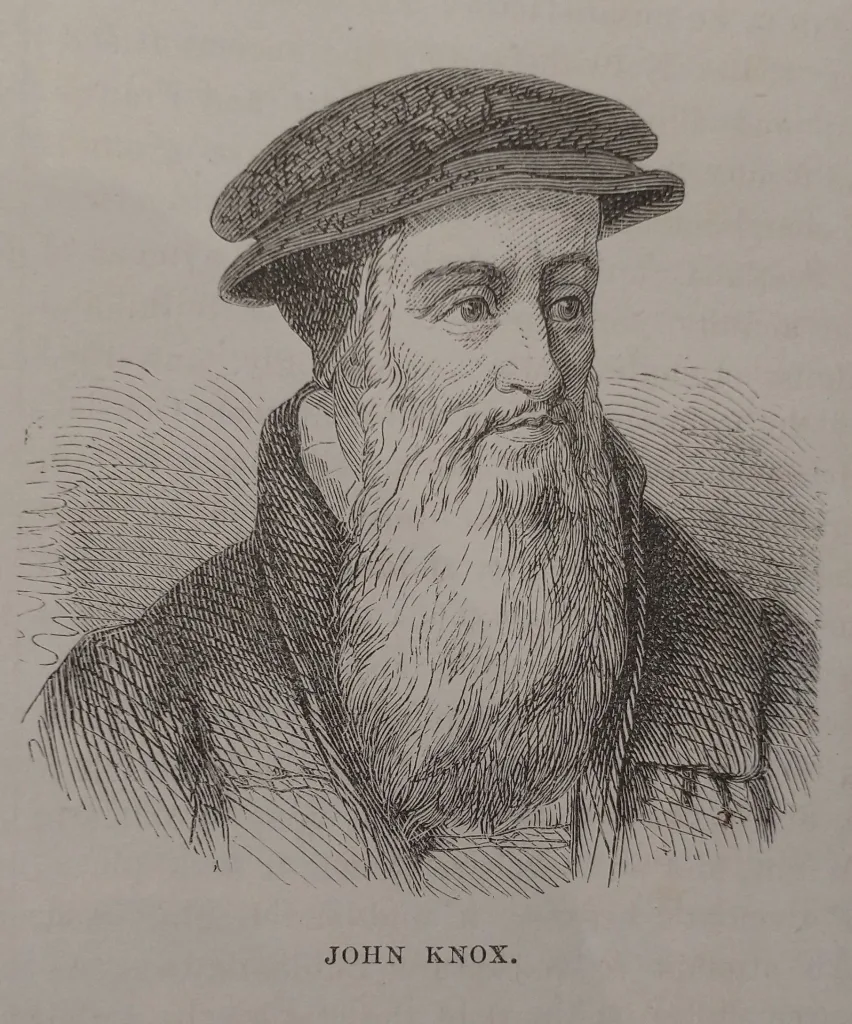
1559 – John Knox returns from exile to Scotland to lead the Scottish Reformation.
1568 – Mary, Queen of Scots, escapes from Lochleven Castle. You could blame John Knox for the hostility Mary faced as a Catholic governing a country rapidly turning Presbyterian.
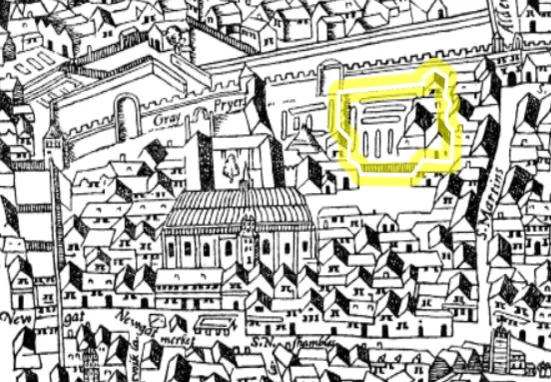
1611 – The King James Version of the Bible is published by printer Robert Barker. His printshop was at Northumberland House, Aldersgate Street, in the City of London. (as far as I can see no one else seems to know where the printing was done.)
Northumberland House marked in yellow nearAldersgate. The Map of Early Modern London, Edition 7.0, edited by Janelle Jenstad, U of Victoria, 05 May 2022, mapoflondon.uvic.ca/edition/7.0/NORT2.htm. INP.
The Printer then went on to create the worst possible error in publishing history by omitting the word NOT in the 6th or 7th Commandment, ‘Thou Shalt Commit Adultery’. This edition became known as the Wicked Bible. Barker & Howard are still in the publishing industry and have offices in the East End of London.
The King James Bible introduced many phrases into the English language, including:
The apple of his eye The four horsemen of the apocalypse Baptism of fire Chariots of Fire O death, where is thy sting? Like a thief in the night Weighed in the balance and found wanting
1670 – King Charles II of England granted a charter to the Hudson’s Bay Company. In 1917 my 17 year old Grandfather sailed to the Hudson bay as an able seaman for the Hudson’s Bay Company.
1982 – The British nuclear submarine HMS Conqueror sunk the Argentine cruiser ARA General Belgrano. It was controversial as the Belgrano was outside the Exclusion zone, and said to be sailing away from the conflict. 323 Argentine sailors were killed. The event, arguably, changed Mrs Thatcher political fortunes.
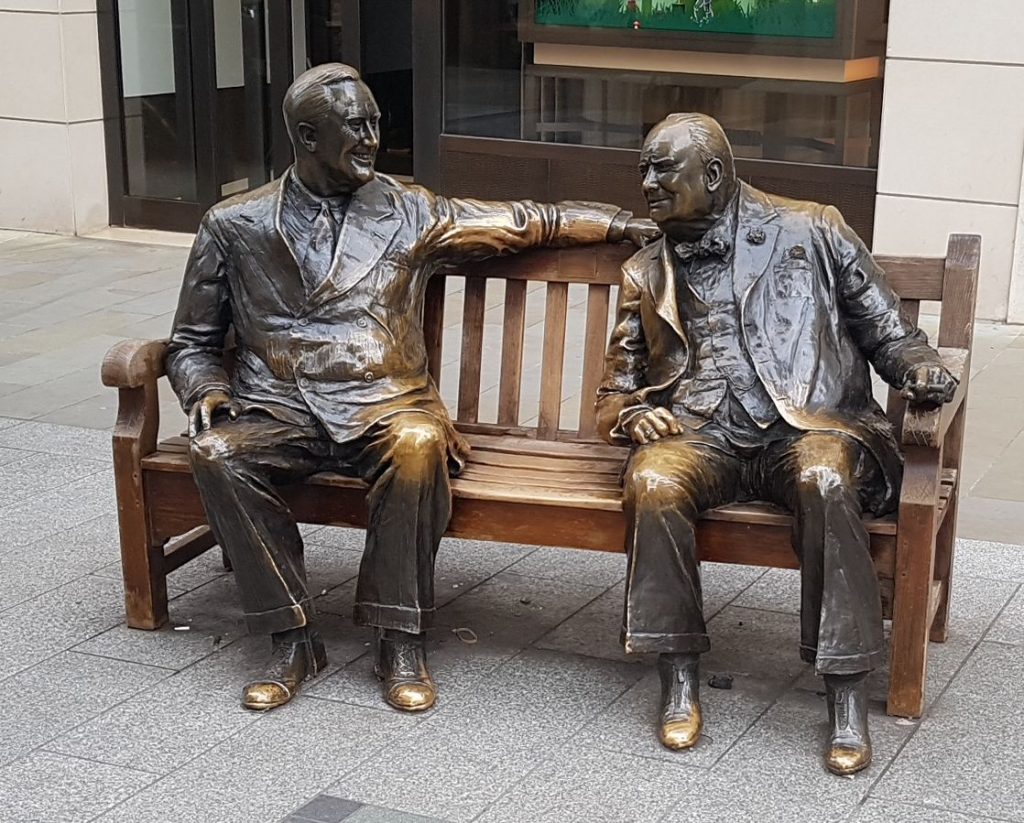
1995 – Allies Statue unveiled. The Statue of Churchill and Roosevelt set up to commemorate 50 years of peace. 30 years later, how we wonder what Churchill and Roosevelt would say about the current state of NATO? https://www.iwm.org.uk/memorials/item/memorial/11351
‘Allies’ Roosevelt and Churchill by by Lawrence Holofcener, unveiled on May 2nd 1995 by Princess Margaret and Lord Snowdon
The Maypole or rather ‘This Stinking Idoll’
Philip Stubbes, wrote a vitriolic attack on pagan practices in his ‘Anatomy of Abuses in 1583’. He fired a broadside at the tradition of dancing around the Maypole. He said they had: ‘as Superintendent and Lord ouer their pastimes and sportes: namely, Sathan Prince of Hell‘ as they erected ‘this stinking Idoll’. By which he meant the Maypole. Stubbes suggested that of the maids who went out to the woods on May Eve, less than one-third returned ‘undefiled‘.
Evil May Day Riots
The Maypole was stored at St Andrew Cornhill, which became known as St Andrew Undershaft. In 1517, it was attacked during the ‘Evil May Day riots’. The main focus of the riot was foreign workers. The Under Sheriff of the time, Thomas More, tried to quell it, meeting the rioters at the corner of Cheapside and St Martin’s Legrande. But 5,000 troops commanded by the Duke of Northfolk was necessary to regain control of the City. 300 rioters were arrested. One hanged, drawn and quartered, 13 hanged and nearly 300 pardoned after the intercession of Woseley and/or Katherine of Aragon (depending on which historian you read). The shaft was returned to its place under the eves of the houses in Shaft Alley. But apparently banned from being raised again.
1549 May Day Riots
However in 1549, the curate of nearby St Katharine Cree Church made an inflammatory speech. This incited a Puritan mob, who cut the shaft into pieces and burnt it. I always imagine the Curate’s sermons to be along the same lines as Phillip Stubbes attack on the Maypole.
Maypole: this Stinking Idol, Rather
Here is a longer description of the May Day Celebrations by Stubbes.
‘But their chiefest iewel they bring from thence is the Maie-poale, which they bring home with great veneration, as thus: They haue twentie, or fourtie yoake of Oxen, euery Oxe hauing a sweete Nosegaie of flowers tyed on the tip of his homes, and these Oxen drawe home this Maie-poale (this stinking ldoll rather) which is couered all ouer with Flowers and Hearbes, bound round about with strings from the top to the bottome, and sometimes painted with variable collours, with two or three hundred men, women and children following it, with great deuotion.
And thus being rearedvp, with handkerchiefes and flagges streaming on the top, they strawe the ground round about, bind green boughes about it, set vp Summer Haules, Bowers, and Arbours hard by it. And then fa! they to banquet and feast, to leape and daunce about it, as the a Heathen people did, at the dedication of their ldolles, whereof this is a perfect patteme, or rather the thing it selfe. I haue heard it crediblie reported (and that viua voce) by men of great grauity, credite, and reputation, that of fourtie, threescore, or a hundred Maides, going to the wood ouemight, there haue scarcely the third part of them returned home againe vndefiled.‘
The unraised pole seems to have survived until the beginning of the Civil War, (1644) when it was destroyed. But at the Restoration of Charles II a new and huge Maypole was ordered. It was joyously erected 134 ft high (41 metres) in the Strand. This one was danced around till 1713 when it was replaced. The original was sold to one Isaac Newton. He used it to support the biggest telescope in Europe, which was erected in Wanstead by a friend.
And that, my friends, is how you get from Superstition to Science in one easy story.
Old Print of Isaac Newton
Postscript.
I have always told people that the sermon leading to the destruction of the Shaft in 1549 was made at St Paul. I cannot remember where I read this. The suggestion that the Maypole in Cornhill was not used after 1517 seems strange. Why then would an unused maypole rouse a crowd to riot in 1549? Of the sources I have at hand, the London Encyclopedia mentions the riot of 1517 in its entry on St Andrew Undershaft but doesn’t elaborate more. ‘Layers of London‘ says ‘It was last raised in 1517 when ensuing riots led to the celebration being banned.’ which is definitive sounding. But is it? I wonder if it was banned for a year or two, then allowed again, and finally stopped in 1549?
Walpurgis Nacht is the eve of the Feast of St Walpurga. On May 1st 870AD, St. Walpurga remains were ‘translated’ to Eichstätt. St Walpurgis Day is her feast day. Walpurga’s brother St Williibald had set up Eichstätt as the Diocesan centre of this part of Bavaria. Walpurga and her two brothers, Willibald and Winibald were Anglo-Saxon Saints who helped convert Germany to Christianity in the 8th Century. But, I wrote about the Saint and her brothers in on my page on St. Walpurga.
The Celtic Day began at Dusk, so May Day and the Feast of St Walpurga begins on 30th April. The Christian Church took over many local traditions and adapted them to the calendar of the Church. So a Saint’s Day, is preceded by an Eve. For example, All Hallows’ Day and Halloween, and May Day and May Eve.
Eve of Beltane
The evening of April 30th is also the beginning of Beltane. Beltane is one of the principal Celtic Festivals, dedicated to the God Belinus. It is a Celtic Fire Ceremony and the traditional beginning of Summer. It is 6 months before Halloween, (see my post of Halloween here.) Walpurgis Nacht is also halfway between the Spring equinox and the Summer solstice. So, a very important day in the Celtic Calendar. (see my post on May Day).
In Sweden it is known as Valborg and as Čarodejnice in the Czech Republic.
A day of Uncanny Weirdness?
As May Day was an uncanny period dedicated to Pagan Deities, Walpurgis Nacht became a time when all the weird things are alive in the world. In response, the Christian Church associated a saint to the day to be a focus for defeating witchcraft. So, it is a popular tradition for this Night to see the burning of an effigy of a witch on a bonfire.
Tomb of St Erconwald, destroyed by the Great Fire of London. By Wenceslaus Hollar – Artwork from University of Toronto Wenceslaus Hollar Digital CollectionScanned by University of TorontoHigh-resolution version extracted using custom tool by User:Dcoetzee, Public Domain, https://commons.wikimedia.org/w/index.php?curid=6235771
It is also the Feast Day of St Erconwald. He was a Royal Prince but no one can agree of which Saxon Kingdom. He became one of the most famous Bishops of London (675 and 693). Chertsey Abbey and Barking Abbey were founded by the Saint. His sisterwhich his sister, St Ethelburga, became Abbess of Barking. Not only that, but he was known as the light of London and was responsible for rebuilding St Pauls Cathedral. And helping to complete the conversion of the Kingdom of Essex.
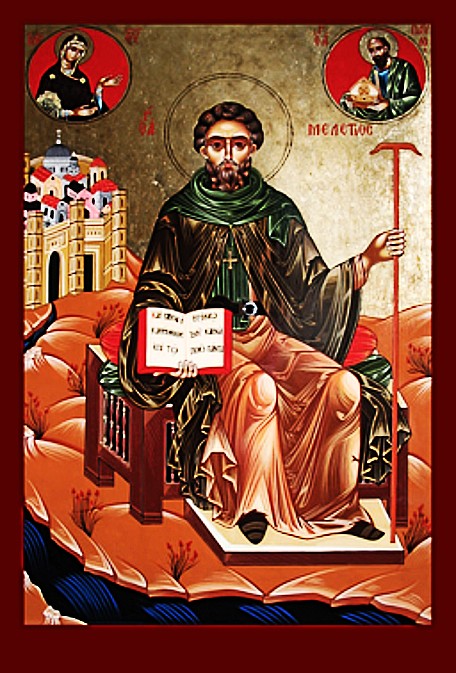
St Mellitus (Source: from saint-mellitus-of-canterbury-died-624
St Mellitus was the first Bishop of London (AD604) and the third Archbishop of Canterbury. But was he really? No, he was the first Bishop of London of the English Church. There were many before him. We know there were bishops of London from Britannia during the Roman period. And, according to John Stow, London’s first history. there were also post-Roman bishops. That line of Bishops ended, in 584 AD, when the 14th Bishop, Theanus, fled London. He headed for Wales to escape the Anglo-Saxon threat. However, even Stow was uncertain whether the list was genuine.
In 314 a Church Council or Synod was called at Arles, in France. Amongst those attending were three bishops from Britain, (and a Deacon and a presbyter) :
Adelfius “de civitate Colonia Londenensium” – that is, from the “colonia of the people of London”.
(Wikipedia)
The fact that two came from London suggests to some a mistake. Adelfus, perhaps, was either from Lincoln or Colchester which were Colonies. The Synod was called by the Emperor Constantine. Amongst its acts were to order that Easter should be held at the same time throughout the Empire. (See also my post on the Synod of Whitby which fixed the date of Easter in Britain as late as 684). They also banned Races, and Amphitheatre Games. and excommunicated all actors and charioteers. But it gives us our first certain facts about the origins of Christianity in Britain.
The Augustinian Mission and Mellitus
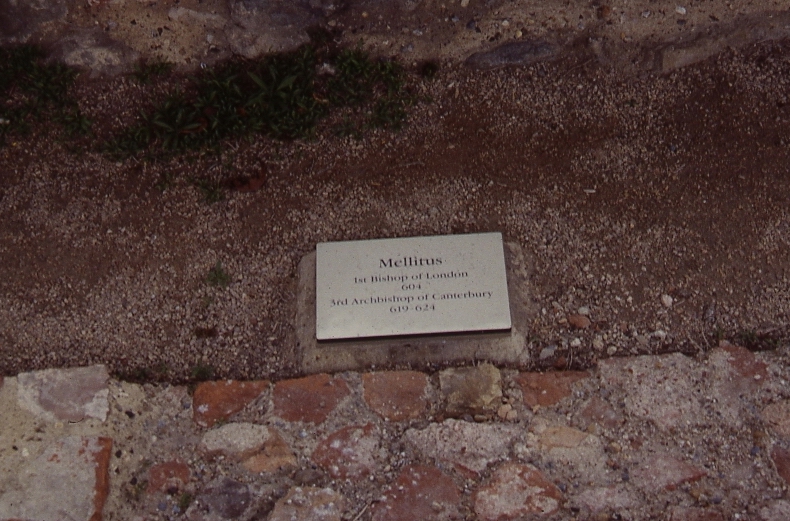
St Mellitus Burial Place, St Augustine’s Abbey, Canterbury. Photo K. Flude
In 597, the Augustinian Mission came to Kent. Mellitus was sent by Pope Gregory to join St Augustine’s mission in 601AD,. He was then sent to London to set up St Pauls and become its bishop (604). London was under the control of the Kingdom of Essex in those days. The King was Saberht, who was the nephew of St Ethelred, King of Kent. Saberht accepted Christianity but when he died. His heirs reverted to paganism and kicked Mellitus out. Mellitus went into exile in Gaul but came back to become the third Archbishop of Canterbury. He was buried in St Augustine’s Abbey in Canterbury. He is known as St Mellitus of Canterbury. St Mellitus had gout so is the go-to Saint for sufferers of gout.
London reverted to paganism until 654AD when St Cedd became its next Bishop.
1925 – McVitie’s Chocolate Digestive was created. There were made in Stockport and in Harlesden, London. I have moored my narrowboat outside the factory and been kept awake by the churning of chocolate in vast vats. News stories suggest that the Digestive was meant to be eaten with the chocolate on the bottom side. This is one of the most ridiculous things I have heard! But apparently it helps the chocolate get to your taste buds that bit quicker. But judge for yourself and read this page for the facts. And this one for more on the history of the Chocolate Digestive.
William Shakespeare by Martin Droeshout from the 1st Folio
By tradition, Shakespeare was born on St George’s Day April 23rd 1564. He died on the same day in 1616 at age 52. Cervantes died on the same day.
Shakespeare’s death date is given by the burial register at the Holy Trinity Church, Stratford on Avon where he was buried. His baptismal record also survives at the same church and is on April 26th 1564. So, we don’t actually know when he was born, but christening were held soon after birth for fear of the high infant mortality rates, so 23rd April has been assigned to be Shakespeare’s birthday.
Taken to the chamber
Anne Shakespeare would have ‘taken to her chamber’ about four weeks before the due date. The windows or shutters were fastened, as fresh air was thought to be bad for the birthing process. Female friends and relatives came to visit; the room would be decorated with fine carpets, hangings, silver plates and fine ornaments. It was held that external events could influence the birth, any shocks or horrors might cause deformities and anomalies, so a calm lying-in room was clearly a good idea.
When labour began, female friends, relatives, and the midwife were called to help out. A caudle of spiced wine or beer was given to the mother to strengthen her through the process. Today, the maternal mortality rate is 7 per 100,000. An estimate for the 16th Century is 1500 per 100,000. So most women would have heard of or attended the birth of a women who had died during or following children birth. There were also no forceps. So if a baby were stuck and could not be manually manipulated out, then the only way forward was to get a surgeon to use hooks to dismember the baby. This was the only way to save the life of the mother. Doctors were not normally in attendance, but could be called in emergency,
Swaddling
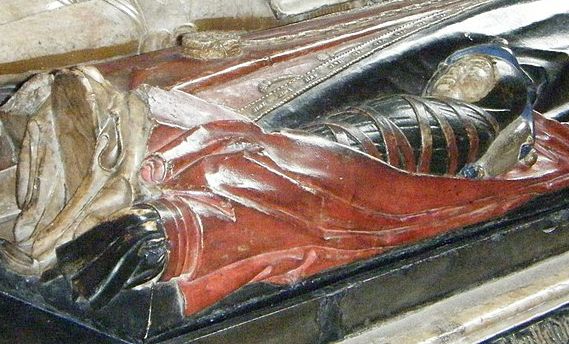
Detail of tomb of Alexander Denton and his first wife Anne Willison, and her baby dressed in swaddling clothes Photo Wikipedia Hugh Llewelyn
Immediately after washing, the baby was swaddled. The swaddling was often very tight and could affect the baby’s growth. Also, it might have affected the learning process. The free movemenb of hands and feet are now considered important in the early learning process. Swaddling lasted eight to nine months, and only went out of fashion after Jean Jacques Rousseau wrote against the practice.
Christening & Registration
Puerperal fever killed many women even after successful childbirth, for example Queen Jane Seymour who died after 5 days. During these dangerous early days, the mother was kept in a dark room. Perhaps three days after birth, friends were invited to celebrate ‘upsitting’ when the mother was no longer confined to bed. This is when christening would take place. Edward VI was christened to a huge audience in the chapel at Hampton Court three days after his birth.
Licensed midwives could baptise newborn babies provided they used the correct wording and informed the Church. This allowed the registration of the birth to be properly reported. Thomas Cromwell was responsible for the law in 1538 which insisted on a parish register to record weddings, christenings, and funerals. The law was reaffirmed by Queen Elizabeth in 1558. Registers had to be stored in a locked chest in the Church. In 1597, the records had to be on parchment not paper. In 1603 the chest had to have three locks! Since writing this I have realised the significance of the three locks. In St Eadburga’s Church in Broadway in there is a locked box for alms, and it has three locks too. This was so that it could only be opened when all 3 Church Wardens were present.
If the christening were in the church, the mother might not be there as she was expected to stay in her chamber for another week or so. A week or a few weeks later, the mother would be ‘churched.’ This was a thanks-giving ceremony. Puritans did not like the idea as it might be confused with a purification ceremony.
Breastfeeding
Breastfeeding would last a year or so but, buty high status women choose to use a wet-nurse. They went to some effort to find a suitable wet nurse. It was believed that the quality of the breast milk was important for the babies’ development both physically and temperamentally. Poor children who lost their mothers were unlikely to survive. For without breast milk, the baby would be fed pap – bread soaked in cow’s milk.
1016 – Edmund Ironside succeeded his father Æthelred the Unready as King of England. Unfortunately, Edmund dies soon after dividing England with Danish King Cnut. Subsequently, Cnut takes over the entire country.
1661 – King Charles II crowned in Westminster Abbey. Read my post on John Evelyn’s reaction to the restoration of Monarchy after the the Commonwealth period of Republican Government.
1942 – World War II: German bombers hit Exeter, in what became known as the Baedeker Raids. They were in retaliation for the success of the British bombing of Lübeck, and of Rostock. In the following days the Luftwaffe bombed Bath, Norwich and York. A German official said they would bomb every building with three stars in the Baedeker Tourist Guide. Hitler said the English were: ‘beings with whom you can only talk after you have first knocked out their teeth‘
First published in 2023 and republished in April 2024. On This day added 2026
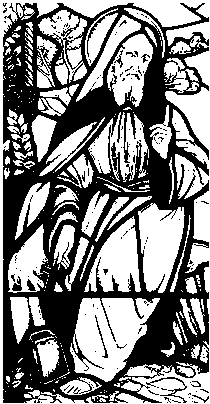
Drawing of a Stained glass window depicting Saint Beuno. D A R C 12345 – Own work
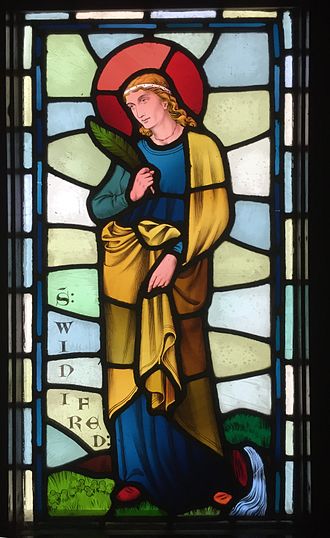
Today is St Beuno’s Day. St Beuno is also known as St Bono. He was an 8th Century Welsh Abbot of some power. The grandson of a prince of Powys in Wales who was descended from Vortigern. (see my post on Vortigern here.) Vortigern was a predecessor to King Arthur. Beuno was educated in Bangor Monastery, one of the foremost Celtic monasteries in Wales. During his ministry he restored 7 dead people to life including St Winifred (or Winefred).
Winifred & St Beuno
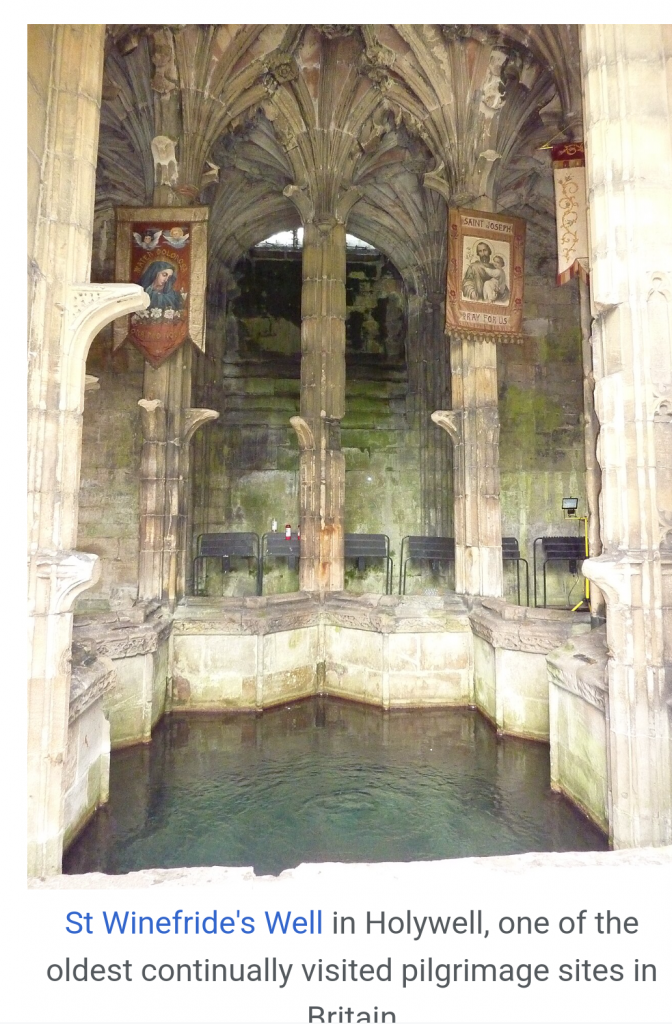
St Winifred’s Holywell, from Facebook.
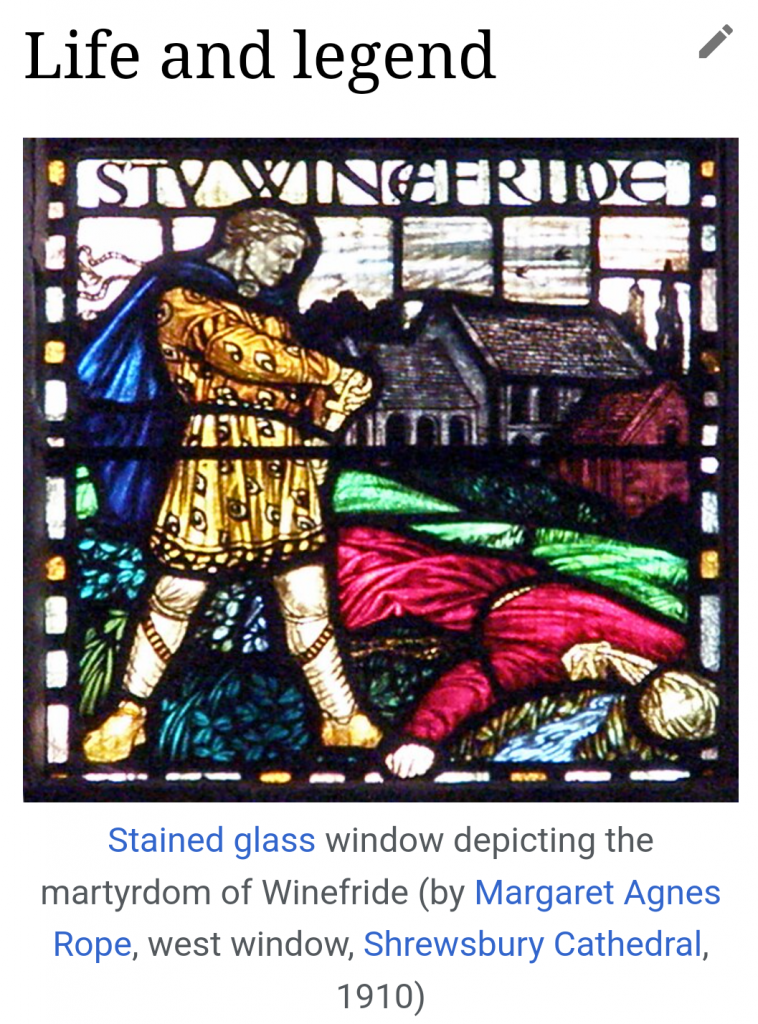
She was Beuno’s niece, a virgin who refused the advances of a certain Caradog. Furious at her taking vows, Caradog tried to seduce her, but she refused. So, he chopped her head off.
Where her head landed a spring sprung amd became a holy spring. The spot, in Flintshire is still called Holywell. It has been described as the Lourdes of Wales and one of my tours go past it . This is how I heard about St Beuno.
Anyway, the story goes that Beuno put his niece’s head back on her shoulders and restored her to life. How he did that, is a mystery.
From Facebook
She lived a full life with a brilliant Church career. Of course, she is the patron of those who have suffered unwanted advances (but believe me there are many other candidates for that particular honour amongst the female Saints! Have a look at my post on St Agatha for another example of male sexual abuse).
Medieval Powys, & Neglected Parts of the Female Anatomy
I drafted this in January 2025, when I came across a reference to St Beuno in a fabulous exhibition at the British Library. The show was called ‘Medieval Women – In their own Words’.
On display amongst the many wonderful manuscripts and books of the 11th – 15th Century was a Welsh poem. The author was Gwerful Mechain (1460–1502), the only female medieval Welsh poet with a surviving and a substantial body of work. She is known for her erotic poetry, in which she praised the vulva among other things.
What is extraordinary is that I should, by complete chance, be publishing this the day after posting about the statue of the erect Minotaur! So, you can see how even-handed I am? Erect penises one day, love poem to the Vagina the next!
Here it is in full, in a modern translation:
To the Vagina by Gwerful Mechain
Every poet, drunken fool Thinks he’s just the king of cool, (Every one is such a boor, He makes me sick, I’m so demure), He always declaims fruitless praise Of all the girls in his male gaze. He’s at it all day long, by God, Omitting the best bit, silly sod: He praises the hair, gown of fine love, And all the girl’s bits up above, Even lower down he praises merrily The eyes which glance so sexily; Daring more, he extols the lovely shape Of the soft breasts which leave him all agape, And the beauty’s arms, bright drape, Even her perfect hands do not escape. Then with his finest magic Before night falls, it’s tragic, He pays homage to God’s might, An empty eulogy: it’s not quite right: For he’s left the girl’s middle unpraised, That place where children are upraised, The warm bright quim he does not sing, That tender, plump, pulsating broken ring, That’s the place I love, the place I bless, The hidden quim below the dress. You female body, you’re strong and fair, A faultless, fleshy court plumed with hair. I proclaim that the quim is fine, Circle of broad-edged lips divine, It’s a valley, longer than a spoon or hand, A cwm to hold a penis strong and grand; A vagina there by the swelling bum, Two lines of red to song must come. And the churchmen all, the radiant saints, When they get the chance, have no restraints, They never fail their chance to steal, By Saint Beuno, to give it a good feel. So I hope you feel well and truly told off, All you proud male poets, you dare not scoff, Let songs to the quim grow and thrive Find their due reward and survive. For it is silky soft, the sultan of an ode, A little seam, a curtain on a hole bestowed, Neat flaps in a place of meeting, The sour grove, circle of greeting, Superb forest, faultless gift to squeeze, Fur for a fine pair of balls, tender frieze, A girl’s thick glade, it is full of love, Lovely bush, blessed be it by God above.