5th of Lide St Piran’s Day March 5th

Lide 5th is St Piran’s Day. Photo of St Piran’s Oratory at Trézilidé, Finistère (wikipedia) By Kieffer92 – Own work, CC BY-SA 4.0,

March is named after the Roman War God Mars, whose Month it was. But in England it had, until recent times, a dialect name which survived in the South west of England. This was ‘Lide’.

Lide was still used in the 17th Century, and then survived into the 19th Century only in Cornwall.  The Cornish named the first Friday in March ‘Friday in Lide’. They had a proverb.

Ducks won’t lay till they’ve drunk Lide water’.

Daffodils were called Lide-lillies. Eleanor Parker, who is a Lecturer in Medieval Literature at Brasenose College, Oxford, wrote an interesting article in History Today. She called March the loudest month of the year. The early English names for March were Hlyda or Lide monath meaning stormy or loud month. Other names include Hraed monath (rugged month) and Lentmonath (month of lent).

The ‘loudness’ comes from the March winds, which were noisy – as described in this rhyme. (thanks to Millie Thom for the rhyme and all things March. )

March brings breezes loud and shrill,
Stirs the dancing daffodil.

Sara Coleridge (1802–1852), “The Months,” Pretty Lessons In Verse, For Good Children; With Some Lessons in Latin, In Easy Rhyme, 1834

There are many references to the changeable weather in March. Sometimes lovely spring days, and at others raging storms, and frosts. Parker quotes a proverb which says that March comes in:

like a lion and goes out like a lamb’.

In 2026, the 5th of Lide has been a beautiful spring like day, with, over the last few days a outburst of Hawthorn and Plum blossom.

St Piran

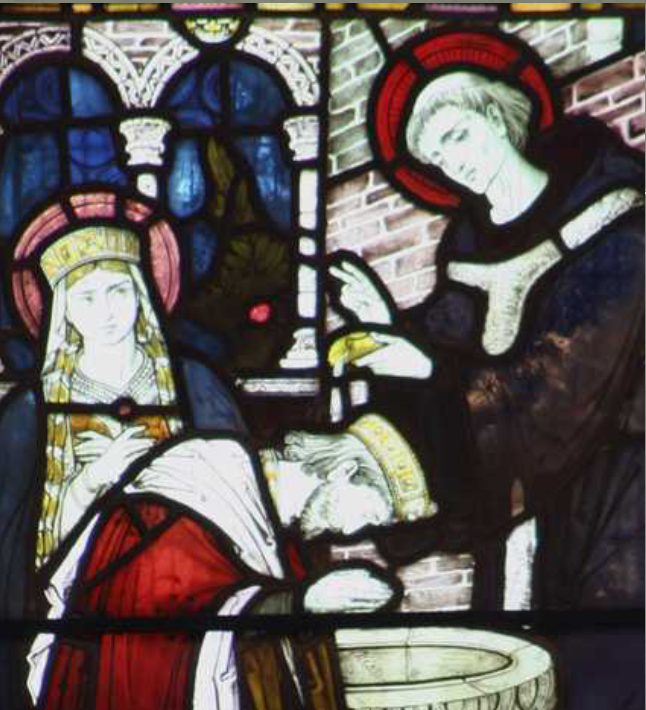
Lide 5th was a holiday for Miners, probably because it was St Piran’s Day. Very little is clear about St Piran. But he is thought to have been an Irish Missionary who founded an Abbey in Cornwall in the 5th Century. His legend says he was tied to a millstone by the Irish, who rolled the stone over a cliff. The sea was stormy, but calmed as soon as he fell into it. He floated on his stone to Perranzabuloe in Cornwall. Here he landed and got his first converts: a badger, a fox, and a bear. Then, he founded the Abbey of Llanpirran.

He is said to have reintroduced smelting to Cornwall, hence his attribution as patron Saint of Miners. Piran was martyred by Theodoric or Tador, King of Cornwall in 480. His bones scattered in reliquaries in the South West and in Brittany. He is the patron saint of Cornwall, so the week before the 5th of March is known as Pirrantide. And there are events and parades to commemorate him. People dress in black white and gold, carrying daffodils and walk across the dunes to St Piran’s Cross.

Screenshot from the Cornish Guide showing St Piran’s Cross. https://www.cornwalls.co.uk/history/sites/st_pirrans_cross.htm

For more about March look at my post https://www.chr.org.uk/anddidthosefeet/march-1st-the-month-of-new-life

On This Day

1702 – Queen Anne becomes Queen – the last of the Stuarts. She had 18 pregnancies. The eldest survived to 11 and then died. Of the other 17, 8 miscarried, 5 were stillborn. 4 were born alive but died soon after. She had poor health, gout and drank a lot, but she might well have had an autoimmune deficiency and her body rejected the offspring. The fact that the eldest was the only one to survive might suggest rhesus disease, which can now be cured with an antidote.

1836 – The Alamo in Texas fell to Mexican General Santa Anna after a 13-day siege.

1936 – The Spitfire makes its maiden test flight. By 1947 over 20,000 had been made and it had been in continuous production throughout the war, unlike most other aircraft.

1946 – Churchill makes his”Sinews of Peace” Speech in which he coins the phrase ‘Iron Curtain. President Trueman invited the unemployed Statesman to Fulton Missouri to make the speech. In 1961, the proposal was made to commemorate the speech by reconstructing the blitzed City Christopher Wren Church, St Mary Aldermanbury in Fulton, Missouri. The Church was shipped to the States, rebuilt and rededicated on the 7 May 1969.

First published in 2024, rewritten March 2025 Revised, On This Day added 2026.

Dung, Time to Manure your Garden March 4th

Hen’s Dung. Image by Anja from Pixabay

John Worlidge knew all about dung. And it is all spread out in his ‘Worlidge Systema Agriculurae’ of 1697 brought to my attention by Charles Kightly’s Perpetual Almanac.

Worlidge tells us that although it used not be esteemed, but Hens and Pigeons’s Dung is the best if mixed with common earth or sand, and let to rot. He says:

Pigeons or Hens dung is incomparable, one Load is worth ten Load of other Dung, and therefore it’s usually sown on Wheat (or Barly) that lieth afar off, and not easily to be helped; it’s extraordinary likewise on a Hop-garden.

… It’s generally little set by, because our Fore-fathers did not make any great matter of it, and because they understand not the strength and power of it; for when they take it out of the houses it’s of a very hot nature, and must needs injure some things, if laid thereon; but if it be mixed well with common Earth, Sand, or such-like, and let lie till it rot well together, you will finde it a very rich Manure, and of value to answer a great part of your Poultreys expence.

I have known a Quince-tree whereon Poultrey always pearched, that by reason of the Rain washing to its Roots the salt and fatness of the Dung, did bear yearly an incredible number of very excellent Quinces.

To read the Systems see https://quod.lib.umich.edu. For more on Worlidge wisdom see my post on Hawthorn.

Before we turn to the sweet Quincwe I’ve found a poem about dung:

Dilbert Dung Beetles Delicacy

Mr. Camel is fascinated by his friend Dilbert Dung Beetle’s diet.
He thinks eating up excrement, feces and manure is a riot.
It is tasty! Delicious! You should try a salty elephant pie!
Dilbert Dung Beetle says. You would love it if you gave it a try!

Mr. Camel watches Dilbert dig in, gulping down gobs of the stuff.
He thinks it must have a weird smell, but Dilbert can’t get enough.
You might sample a tiny bit Dilbert says, it is delicious you see!
Mr. Camel shakes his head and says “Sorry, it does not appeal to me.”

© Caren Krutsinger

All things Quince

I made quince jam this winter for the third year running from my Father’s Tree. Likely to be the last year as he is 98 and has just gone into a lovely home. It’s very easy to make (although very hard to cut up the fruit) and delicious because it is not too sweet. Here is a recipe (not necessarily the one I used}. Indeed, my most successful year was when I didn’t use a recipe, just boiled the fruit with sugar to taste. Beginner’s Luck, I expect.

Quince is mentioned once in Shakespeare, when the Nurse says the pastry makers are calling for Quince and Dates. (Here is a recipe for Tudor Quince Pie) And of course, the mechanicals theatre director is Peter Quince the Carpenter. But the most famous reference is in the Owl and the Pussycat by Edward Lear.

They dined on mince, and slices of quince
Which they ate with a runcible spoon;
And hand in hand, on the edge of the sand,
They danced by the light of the moon.

Quinces are native to the Caspian Seas, and Wikipedia says spread to England when planted at the Tower of London at the order of Edward I. Quinces were sacred to Aphrodite. and taste great with Cheese (dulce de membrillo) if you are in Span. The Balkans have an aqua vita called rakija. Quince is considered old-fashioned and not grown very much in gardens in the UK.

First published on March 4th, 2026

The Feast Day of St Winnold March 3rd

Portrait of Saint Guénolé (St Winnold) after a bust in silver on a reliquary from the Church Saint-Guénolé in Locquénolé.Public Domain Abgrall Jean-Marie (1846-1926) – Bibliothèque nationale de France

Here is a weather poem in which St Winnold appears

First comes David, then comes Chad.
And comes Winnold, roaring like mad.
White or black.
Or old house thack.

St David’s Day was March 1st. St Chad, the 2nd. St Winnold’s Day is the third of March. Winnold is his English name, and Winneral, or Winwaloe or Guénolé his Celtic names.

The poem suggests that snow, rain or wind is going to come on these three days. When the wind roars, it will threaten the thatch of houses. If the storms do not come in the first 3 days, then they will come on the last three days of March, which were called ‘the Borrowing Days’. Or so it is said.

St Winnold was around 50 years (460 – 3 March 532) after the end of Roman Britain. His family was from Cornwall. He was the son of a Prince Fragan of Dumnonia, and St Gwen the Three-Breasted, His mother’s Feast day is October 3rd. She is a Saint of fertility, because of God’s Gift of an extra breast. They moved to Brittany to escape a British Plague. Their son grew up to be holy and was the founder and first abbot of Landévennec Abbey (the Monastery of Winwaloe). It is south of Brest.

Winwaloe became what is known as a ‘phallic saint’ because he was associated with fertility. Wikipedia says this came about because of confusion about the origin of his name:

his name was thought to derive from gignere (French engendrer, “to beget”)’

St Winnold’s Breton name is Guénolé. How this etymology works is not clear to me! But surely, he as likely to have got a reputation for helping people with fertility problems from his mother? Supplicants would make a wax phallus to persuade the Saint to help them conceive. There are several churches/ chapels dedicated to him in Wales, and a Priory in East Anglia.

You might like to read my post about St Blaise Day & The Tadpole Revels February 3rd, or on St Chad.

On This Day

March 3rd 1847 Alexander Graham Bell was born. He was born in Edinburgh, and lived Scotland, in London, Canada and the US.

First written August 2024, republished MArch 2026

Walk of Socialists 28th February 1887

Victorian lampoon on Socialist Values 'Yes Gentlemen, these is my principles, no King, no Lords, No Parsons, No Police, No Taxes, No Transportation,  no No'thing.'
Victorian lampoon on Socialist Values ‘Yes Gentlemen, these is my principles, no King, no Lords, No Parsons, No Police, No Taxes, No Transportation, no No’thing.’

Walk of Socialists at St. Paul’s February 28th & London Socialism 1887

My French friend went yesterday to St. Paul’s and saw a large procession of socialists. It is a strange move of the socialists to visit all the Churches. The Archdeacon of London preached to them from: “the rich and poor meet together, and the Lord is the maker of them all.” A noble sermon, they behaved fairly well.

Helen G. McKenney, Diary, 1887 (source: A London Year. Compiled by Travis Eldborough and Nick Bennison)

The quotation is from the Bible, Proverbs 22, where it sits with a number of other wise sayings. Perhaps, number 16:

One who oppresses the poor to increase his wealth and one who gives gifts to the rich—both come to poverty

is most likely to stir a Socialist. I imagine the Archdeacon was also making a point that the Lord made the Rich and the Poor. So there is nothing wrong with being Rich, as long as you are generous to the Poor. Equally, nothing wrong with being Poor.

Bloody Sunday

It’s rather lovely to imagine the Walk of Socialists walking around Wren’s masterpieces in the City of London. However, later in 1887, things turned much worse. The Social Democratic Federation and the Irish National League organised a march against Unemployment and the Irish Coercion Acts. Among the 10 to 30 thousand citizens present were William Morris, Annie Besant , George Bernard Shaw and Eleanor Marx.

The Police had been trying to prevent the ever-increasing use of Trafalgar Square and Hyde Park as protest venues. So, on November 13th, Bloody Sunday, the Police Commissioner, Charles Warren, ordered a massive police presence. He backed this up with 400 Soldiers. He aimed to prevent the entry to Hyde Park. Warren was acting as a caretaker until a new Commissioner was in place. He had already resigned following criticism of the failure to find Jack the Ripper. By the end of the day there were 2 people dead, 100 seriously injured, and 45 arrests, as well as 75 accusations of police brutality. On the other hand there were many police casualties.

Engraving from The Graphic (published 19 November 1887). Wikipedia describes it as ‘depicting a policeman being clubbed by a demonstrator as he wrests a banner from “a Socialist woman leader, one Mrs. Taylor”, while other people are covering their heads to protect themselves from raised police batons.’ Pubic Domain

Progressive Politics

Before the Foundation of the Labour Party, progressive politics were in the lukewarm hands of the Liberal Party. This Party developed from the Restoration period Whig Party. Although, the Liberal Party had a radical wing, it had a reluctance to put forward working-class candidates. In the early 19th Century, much of the agitation was led by a movement called the Chartists. But as their goals became adopted by the main two parties, progressive politics was led by various reform, radical, socialist, marxist and anarchic groups.

I have not been able to find out who led the 1887 Walk of Socialists around the City Churches. However, William Morris’ presence suggests the Socialist League? In 1885, the Socialist League was an offshoot of the Social Democratic Federation. But it was not a harmonious group. Its most famous members were William Morris, and Eleanor Marx. It included Fabians, Christian Socialists and Anarchists. By 1887 it was split ideologically into three main factions, Anarchists, parliamentary orientated Socialists, and anti-parliamentary Socialists. William Morris was the editor of their newspaper, ‘the Commonweal’ but he was sacked and replaced by Frank Kitz as the Anarchists took over the organisation.

So, without going into a long history of Socialism in London, what happened was that the Socialist groups made very little impact until the Independent Labour Party was set up in Bradford 1893. And in 1900, Keir Hardie, who was already an independent MP in Parliament, set up the Labour Representation Committee in 1900. This was soon renamed the Labour Party. The Independent Labour Party joined, and Labour began to take over control of the working-class vote. It fought for this with the Liberal Party. The Liberal vote, declined after WW1 and Labour was able to secure minority Governments. After World War 2 the Labour Party replaced the Liberals as one of the two Political Parties which could win a majority in Parliament.

London ‘Soviets’

London was one of the places where the Party experimented with left wing policies. The East End areas of Poplar, Limehouse and Bermondsey were particularly important. Alfred and Ada Salter were ‘typical’ activists. She became the first female Mayor of a London Borough. She was Returning Officer when her husband was elected MP for Bermondsey. His medical practice gave free medical care for poor people. From this they established a free medical clinic, that was a forerunner to the formation of the National Health Service. The London Councils also led the way in promoting mass council housing and Trade Union reform.

Here is a part of a letter from Alfred to Ada:

Oh, the cruel wickedness of our society today! To thrust down these people by means of low wages and chronic unemployment into hopeless despair, and then leave them in that condition with no organised or conscious effort to rehabilitate them. What can we do?”

“You and I feel we have the same mission in life… we are living and working for the same goal- to make the world, and in particular, this corner of the world, happier and holier for our joint lives.”

Taken from this excellent blog post of Dr Alfred Salter.

Fenner Brockway said that in his youth Salter was a “Settlement firebrand – militant Republican, militant Socialist, militant Agnostic, militant Teetotaller, militant Pacifist.” Alfred converted Ada to Socialism and she converted Alfred to Christianity. They became Quakers.

Statues of Alfred Salter (sitting down) Ada Salter (behind his walking stick) and their only daughter Joyce (leaning against the River wall) who died aged 8 of Scarlet Fever. Garden near the Angel Pub, Rotherhithe. Photo K Flude

Life-long Labour voter

My Grandma, who was born in Hoxton in 1902, voted for Labour all her life. I’m pretty sure it was out of class loyalty because I always thought her opinions were more traditional than progressive. But she would never dream of voting anything other than Labour. For more on Hoxton and revolution, you may want to see my post on Hoxton and the Gunpowder plot.

Tomorrow isn’t the 29th but if it were you would want to see my post on leap year and the Roman Calendar – February 29th.

On This Day

1931 – Oswald Moseley formed the New Party which became the British Union of Fascists. He was a promising and economically radical MP for the Labour Party but resigned in frustration with their reluctance to adopt his policies. And his egotism, led him to the dark side.

1975 – An underground train ran into the end wall having failed to stop at the Moorgate terminus. 43 people died and 74 were injured. An inquiry concluded, in the absence of any faults in the train, that it was a driver’s error.

First Published in February 2024, republished in 2025 The Salters & On This Day added February 2026

John Evelyn Died February 27th 1706

Portrait of John Evelyn holding a book
Portrait of John Evelyn by Godfrey Kneller 1687 (Wikipedia)

John Evelyn is, with Pepys and Wren, one of the great figures of 17th Century London.  Unlike Pepys, he was an avowed Royalist who hated Oliver Cromwell and all he stood for.  He went into exile with his King and gives a great description of Paris (see below). 

Like Pepys, John Evelyn was a diarist and a writer. And they, like Wren, were alumni of the Royal Society, one of the great scientific societies. John Evelyn was a founding fellow. It was innovative in that it employed an experimenter. This was Robert Hooke – one of the great early Scientists, who also worked with Wren rebuilding London after the Great Fire. The Royal Society encouraged scientists to experiment, write up their observations, and submit their theories for peer review. This is the foundation of modern Science, and a bedrock of the Enlightenment.

Frontispiece of ‘the History of the Royal-Society of London by Thomas Sprat. John Evelyn was a founder member

Evelyn the Writer.

John Evelyn has a place in my history because, in the 1980’s I worked. with Paul Herbert, on a project to create an interactive history of London. It was financed by Warner Brothers, and in cooperation with the short-lived ‘BBC Interactive TV Unit’. One part of it was a Literary Tour of London. The first half of this Tour is the basis for my book ‘In Their Own Words’ (To buy click here ) And this is where I came across John Evelyn using several of the quotations on this page.

Evelyn was a prolific traveller and a polymath. He wrote on the need to improve London’s architecture and air in Fumifugium (or The Inconveniencie of the Aer and Smoak of London Dissipated). Here is an extract from his Furmifugium.

That this Glorious and Antient City, which from Wood might be rendred Brick, and (like another Rome) from Brick made Stone and Marble; which commands the Proud Ocean to the Indies, and reaches to the farthest Antipo­des, should wrap her stately head in Clowds of Smoake and Sulphur, so full of Stink and Dark­nesse, I deplore with just Indignation.

That the Buildings should be compos’d of such a Congestion of mishapen and extravagant Houses; That the Streets should be so narrow and incommodious in the very Center, and busiest places of Intercourse: That there should be so ill and uneasie a form of Paving under foot, so troublesome and malicious a disposure of the Spouts and Gutters overhead, are particulars worthy of Reproof and Reforma­tion; because it is hereby rendred a Labyrinth in its principal passages, and a continual Wet-day after the Storm is over.

And he was an expert on trees. Author of: Sylva, or A Discourse of Forest-Trees (1664). He lived at Sayes Court in Depford near Greenwich, which he ill-advisedly rented to Peter the Great of Russia. Letting to Peter was a lot-like inviting a 1960s Rock Band to trash your mansion.

John Evelyn the Exile

Here is a taste of Evelyn’s time as an Exile. It is a short extract from a long entry on the splendid Palaces in and around Paris.

27th February, 1644. Accompanied with some English gentlemen, we took horse to see St. Germains-en-Laye, a stately country house of the King, some five leagues from Paris. By the way, we alighted at St. Cloud, where, on an eminence near the river, the Archbishop of Paris has a garden, for the house is not very considerable, rarely watered and furnished with fountains, statues,[and groves; the walks are very fair; the fountain of Laocoon is in a large square pool, throwing the water near forty feet high, and having about it a multitude of statues and basins, and is a surprising object. But nothing is more esteemed than the cascade falling from the great steps into the lowest and longest walk from the Mount Parnassus, which consists of a grotto, or shell-house, on the summit of the hill, wherein are divers waterworks and contrivances to wet the spectators; this is covered with a fair cupola, the walls painted with the Muses, and statues placed thick about it, whereof some are antique and good. In the upper walks are two perspectives, seeming to enlarge the alleys, and in this garden are many other ingenious contrivances.

John Evelyn’s Diary from https://www.gutenberg.org/

John Evelyn and the Restoration of Charles II

This was Evelyn’s reaction when Charles II was restored to the throne in 1660,

May 29th 1660:

This day came in his Majestie Charles the 2d to London after a sad, and long exile… this was also his birthday, and with a Triumph of above 20,000 horse and foote, brandishing their swords and shouting with unexpressable joy; the wayes strawed with flowers, the bells ringing, the streets hung with Tapisry, fountains running with wine: ‘

‘The mayor, Aldermen, all the companies in their liveries, chaines of gold, banners, Lords and nobles, cloth of Silver, gold and velvet every body clad in, the windows and balconies all set with Ladys, Trumpetes, Musik, and myriads of people … All this without one drop of bloud …it was the Lords doing…

For Evelyn’s opinion of Cromwell have a look at this post of mine: january-28th-31st-charles-i-martyrdom-get-back/

On This Day

1661 – ‘Ash Wednesday. Preached before the King the Bishop of London (Dr. Sheldon) on Matthew xviii. 25, concerning charity and forgiveness.

John Evelyn’s Diary Dr Sheldon, the Bishop of London mentioned above, went on to become Archbishop of Canterbury. He was a friend of Wren’s Father, and commissioned Wren to build the Sheldonian Theatre, in Oxford.

1782 – OK! Let’s give up! The House of Commons votes against continuing the war with Revolutionary America.

1900 – The Labour Party is founded. And today, the UK woke up to a by-election in a safe Labour seat won by the Greens (40%) with Reform 2nd (29%) and the Labour Party third (26%) Conservatives fourth (2%). So, clearly a progressive vote determined to beat Reform, Labour won about 50% of the vote last time, so a disaster for them. Not a success for Reform, and bad result for the Conservatives.

1933 – Reichstag burns down. Hitler uses it to suspend Civil Liberties, and attack the German Communist Party which was falsely blamed for the fire.

First Published 2024, republished 2025, Making Lardy Cake moved to Fat Thursday and On This Day added 2026

Spring Chickens 26th February

Spring Chickens appear in Cheap and Good Husbandry by Gervaise Markham London 1664

Of Setting Hens (and Spring Chickens)

Gervase Markham wrote a heap of farming and horticulture books in the 17th Century. In ‘Cheap and Good Husbandry’ he wrote about ‘Spring Chickens’. Spring Chickens are essentially March Chickens, March Hares and even March Cats are all special. Markham starts by suggesting this is the time to impregnate them for birth in March:

The best time to set Hens to have the best, largest, and most kindly Chickens;, is in February, in the increase of the Moon, so that they may hatch or disclose her Chickens; in the increase of the next new Moon, being in March; for one brood of March Chickens; is worth three broods of any other: You may set Hens from March; till October, and have good Chickens;, but not after by any means, for the Winter is a great enemy to their breeding….

To see more of ‘Cheap and Good Husbandry follow this link.

To read about March Hares, and more on March Chickens, look at my post: https://www.chr.org.uk/anddidthosefeet/march-28th-as-mad-as-a-march-hare/

The expression comes from the 17th Century when Spring/March Chickens were more profitable than old chickens that had gone through the winter. Commonly, it is used in the negative, as in ‘Kevin ain’t no spring chicken.’

Egyptian Book of the Dead goes on display at the Brooklyn Museum

After three years of conservation, the world’s most complete gilded Book of the Dead goes on display at the Brooklyn Museum. Have a look at their post here. The Book of the Dead was prepared to accompany the deceased on their journey in the afterlife. It is full of spells, prayers and incantations. There was no one fixed format, but some are incredibly complex and beautiful. My own feeling is that they confirm my opinion that the Egyptian way of death is totally OCD. There is so much an Egyptian has to do to get a good afterlife. Not only embalming but having models of food, slaves, boats, mummies of dead cats, anything you want to have. It feels like they must have been terrified of death.

A scene from the Papyrus of Ani (British Museum) It shows the heart being weighed on the scale of Maat against the feather of truth. Doing the weighing is the jackal-headed Anubis The ibis-headed Thoth records the result. Behind Toth is Ammit part crocodile, lion, and hippopotamus. The facsimiles were produced by E. A. Wallis Budge; original artist unknown. Public Domain

One of the issues is that the deceased had to have their heart weighed against the feather of Truth (belonging to the Goddess of Truth, balance, law, morality, and justice, Maat) . If it was found deficient, the deceased would be eaten by Ammit who has the head of a crocodile, the shoulders of a lion, and the legs of a hippo.

Wikipedia has a tremendous scan of the facsimile of the Papyrus of Ani, it is a 78ft long scroll and wonderful to look at To see it click on the first picture and zoom in and look left and right! https://en.wikipedia.org/wiki/Papyrus_of_Ani.

Another section of the Papyrus of Ani https://en.wikipedia.org/wiki/Papyrus_of_Ani.

The story of its acquisition is also gob-smacking. Budge acquired in it Luxor in 1888. The Egyptian Police came to investigate the house of the illegal dealers. Budge distracted the police while his people tunnelled into the house from the rear, and retrieved ‘his’purchases. He took them to the British Museum and was paid a gratuity of £150 for them!

On this day

 First £1 note,1797 Bank of England Museum source Joy_of_Museums Public Domain cc by sa 4.0
First £1 note of the Bank of England Museum 1797
Source Joy_of_Museums Public Domain (CC by sa 4.0)

February 26th 1797 First Pound Note:

The Bank of England issued it’s first ever one pound note (although some sources say March 1797). The Bank had been issuing paper notes since the late 17th Century, but this was the first £1 note. They still had to be signed by hand and allocated to a specific person. The hand signed white paper notes were withdrawn in 1820, and the pound note was, finally, withdrawn in 1988. The £1 in 1797 was worth the equivalent of £157.46 today, so quite a big note! (see here for the calculator.)

1815 – Bonaparte escapes from exile on the island of Elba. War begins all over again.

1995 – Barings Bank collapses after a rogue securities broker Nick Leeson loses $1.4 billion by speculating on futures contracts. Barings is the UK’s oldest investment banking institute,

Pound note first published 2024, Spring Chicken added February 26th 2025 Egyptian book of the Dead added February 26th 2026

St. Walburga and St. Ethelbert of Kent’s Day February 25th

engraving of St Walburga
St. Walburga
(public domain)

Today is the Feast day of two significant Saints, St. Walpurga and St. Ethelbert.

St. Walpurga

St. Walpurga was a nun at Wimborne in Dorset.  She, and her brothers St Willibald and St Winebald, accompanied their uncle, St Boniface of Crediton (in Devon) on his mission to convert the Germans to Christianity. They all became leading figures in the new German Church. Willibald set up the Monastery at Heidenheim, which was a duel monastery housing both Monks and Nuns. His sister, St Walpurga, became Abbess of the Monastery in 761. She died on 25 February 777 or 779 (the records are unclear),

In 870, St. Walpurga remains were ‘translated’ to Eichstätt, which St Willibald had set up as the Diocesan centre of this part of Bavaria. The date of the transfer was the night of April 30th/May 1st. This was her feast day. But the Church moved it to February 25th, to commemorate her death. However, May Eve is now ‘notorious’ as Walpurgis Night. This is the night of May Eve when witches are abroad up to all sorts of mischief, May Day being one of the main pagan festival days. Her body was placed in a rock-cut niche and her bones started exuding an oil called Walpurgis Oil which was said to have medical properties. She was also involved in a miracle of a boat saved in a storm-tossed sea.

For these reasons, Walpurgis is the Saint for battling pests, rabies, whooping cough, storms and sailors. She is also associated with witchcraft but not because of any actual association with it. Her remains were moved again in 1035 when she was enshrined at the Benedictine Abbey of St. Walburga which was named after her.

Walpurgis Nacht

Terrible things happen on Walpurgis Night in Dracula by Bram Stoker. So, the night has now become a trope for Heavy Metal Bands, doyens of horror stories and the Satanic. For more on this read my piece on Walpurgis Nacht.

Coincidently, I was reading about the fuss made about a Heavy Metal Band, called a Plague of Angels, playing in the glorious York Minster. A member of the band tried to calm down the controversy, saying people should just chill out. But other group members used to be in a band called ‘The Cradle of Filth’. Among their claims for Heavy Metal Fame is that they wore the most controversial t-shirt in heavy metal history. This has a visual of a nun in a compromising position and a slogan saying ‘Jesus is a ……..’ (add your favourite swear word here). All very silly. But it struck a cord with me, as I have a scene in my novel (unpublished) which is based on extreme forms of Heavy Metal Bands. I thought I might have gone over the top, but this story reassures me that extreme Metal can be extremely offensive!

To read more read the Guardian page. To publish my novel, email me!

St. Ethelbert.

Ethelbert is responsible for welcoming the Augustinian Mission to the Angles sent by the Pope, St Gregory. This re-established Christianity in Eastern Britain, and set up the Anglican Church or the Church of England as it became known.

I tell this story in this post.

On This Day

1308 – Edward II crowned King of England. His reign ended disastrously, with his Queen having an affair with Lord Mortimer and Edward losing control of the country (and Scotland). He was forced to abdicate, and died/was murdered/killed with red-hot pokers/or escaped to live a life as a hermit on the continent. Choose your favourite or read my History of the Kings and Queens of Britain.

1507 – Queen Elizabeth I excommunicated by Pope Pius and declared usurper of the throne, leading to the Spanish Armada and various plots against her life. (my post on Queen Elizabeth’s nicknames is here)

1836 – The Colt Revolver awarded a United States patent. Previously, he had obtained a UK Patent. It created the classic ‘Western’ Revolver’, much later called the Colt 45. It was a revolving-breech loading, folding trigger hand gun.

1939 – The first Anderson shelter built in a garden in Islington, London. They were named after the Home Secretary, and were dug in a trench with soil piled over the corrugated iron domed roof. Inside were bunks for the occupants to sleep in. They were 6 ft high, 4.5 ft wide, and 6.5 ft long. 2.5 million were built. The next shelter was the Morrison Shelter named after Herbert Morrison, who succeeded Anderson as Home Secretary. The Morrison Shelter was like a massive table that would protect the shelterers if the house collapsed above it. It allowed the family to sleep inside. London also had public shelters made of brick in many streets, or used cellars and brick arches as shelters. A small proportion of the population preferred to sleep in the Underground. Many stayed in their beds, unless planes were directly overhead. Photos from ‘The British People at War’ published during the war.

1956 – Nikita Khrushchev denounces Stalin.

First Written February 2024, revised February 2025. On This Day added in 2026

Gregorian Calendar & Coltsfoot & Smoking & Cholera February 24th

Gregorian Calendar, Lunario Novo, Secondo la Nuova Riforma della Correttione del l’Anno Riformato da N.S. Gregorio XIII,[k] printed in Rome by Vincenzo Accolti in 1582, one of the first printed editions of the new calendar

On February 24th 1582 – Pope Gregory XIII published the papal bull Inter gravissimas. This announced amendments to the Julian Calendar created by Julius Caesar and created the Gregorian Calender. Caesar had realigned the Roman Calendar with the Solar Year, creating a ‘Year of Confusion’. The year was 445 days long but it resynced the days to their proper season.

The Julian Calendar

The Julian Calendar used leap years to align the Calendar Year with the Solar Year. But the earth does not cycle the Sun in 365.25 days. This is an overestimate of 1 day every century. So, since the time of Caesar, the year had got 10 days out of kilter. Gregory chopped those 10 days out of the Calendar. The 4th of October 1582, was to be followed by the 15th October 1582. This might seem simple, but imagine you are receiving your salary for October, and you find it 10 days short? Or you have a month to pay your debt and find it called in 10 days early? So the Pope ordered that these 10 missing days shouldn’t be used in calculating financial matters.

Computus

One of the main reasons for the reform was the ‘Computus’. This was the method of calculating Easter. Easter was a festival that followed the movements of the Moon but was synced into the Vernal Equinox. (The timing of Easter is the first full moon after the Vernal Equinox.). So the chopping of 10 days meant that the vernal equinox was set back to its proper place on March 21st. Arguments over the correct calculations of Easter had, in the 7th Century been a major stumbling block in uniting the Celtic Church in Britain with the Roman Catholic Church. (See my post on Easter here).

But this still left the drift caused by Caesar’s faulty leap year system. Gregory’s reforms stopped future drift by fine-tuning the leap years. From 1582 there would not be a leap year in those centurial years which were not divisible by 400. So 2000 was a leap year, but 2100 is not. This skips ‘three Julian leap days in every 400 years, giving an average year of 365.2425 mean solar days long.’ (Wikipedia). This keeps us aligned, although there is still a small error.

If you enjoy this sort of calendrical detail, you will love ‘The Calendar’ by David Ewing Duncan.

British Exceptionalism

Of course, Britain refused to join a Catholic innovation for nearly 200 years. But, religious prejudice at last gave way to reason, when we adopted the Gregorian Calendar in 1752. In the process, we lost 11 days, much to the horror of the London mob, who rioted against their loss.

Greece was the last European state to join in 1923. Japan joined in 1873, China in 1912, and Saudi Arabia in 2016. Ethiopia, Iran, Afghanistan, and Nepal keep distinct calendrical traditions. (see seasia.co for more details.) Strictly, we are using the Gregorian amendment to the Julian Calendar because it has all the elements of the Julian Calendar except a couple of adjustments.

See my post on the Julian Calendar here and my post on the year of confusion. For more on the Calendar (New Style) Act 1750 look here

Coltsfoot and Smoking

Photo of Coltsfoot by Andreas Trepte Wikipedia

Coltsfoot is a daisy-like plant which is flowering about now. Gerard’s Herbal of 1633 suggests that the ‘fumes of the dried leaves taken through a funnel’ is good for those with coughs and shortness of breath. He suggests that it is smoked like tobacco and it ‘mightly prevaileth.’

This idea, Mrs Grieves says in her herbal (1931), is endorsed by ‘Dioscorides, Galen, Pliny, and Boyle’. And Coltsfoot is ‘nature’s best herb for the lungs’. (This is historic information re herbs and NOT current medical advice, as Coltsfoot can be very dangerous!).

engraving of a man smoking
Lobspruch deß edlen hochberühmten Krauts Petum oder Taback Nuremberg, 1658 New York Public Library Public Domain
Detail from Lobspruch deß edlen hochberühmten Krauts Petum oder Taback Nuremberg, 1658 New York Public Library Public Domain

My grandson and parents found a 19th Century pipe bowl, much like the one pictured here, by the Thames where there were many fragments of clay pipe. For more on 17th Century smoking, have a look here.

On This Day

In Rome February 24th was the day of the 4 yearly leap day. The way they did it was to have two days called February 24th! It was the sixth day before the Calendars (March 1). This practice gradually got replaced by adding a new day, February 29th, at the end of the Month. In England, February 29th starts appearing in the 15th Century. But Wikipedia tells me:

the proceedings of the House of Commons of England continued to use the old system until the middle of the sixteenth century. It was not until passage of the Calendar (New Style) Act 1750 that 29 February was formally recognised in British law.’

See my page on the Leap Year here.

1809 – The famous Drury Lane Theatre burnt to the ground.

It is said that the owner and playwright Richard Brinsley Sheridan replied to someone who was surprised to see him sitting quietly having a drink while his theatre burnt down: “A man may surely be allowed to take a glass of wine by his own fireside?” londonist.com

1832 – Cholera in London

The news of the Cholera being in London has been received abroad. According to the feelings of the different nations towards England, France, who wish to court us has ordered a quarantine in her ports of three days; Holland, who feels aggrieved by our conduct at the conference, one of 40 days. The fog so thick in London that the illuminations for the Queen’s Birthday were not visible.

24th February 1832 Thomas Raikes, Diary 1832 (from ‘A London Year’ Compiled by Travis Elborough and Nick Bennison, 2013,

This was the second Cholera Pandemic, but the first to reach the UK. The second landed in Sunderland in October 1831. Cholera killed over 6,000 in London. It was called the Asiatic Cholera based on its origin. The Cholera came more virulently in subsequent decades. It was thought to be spread by a miasma in the air. But, John Snow proved it was caused by polluted water, but I will tell that story in another post.

I think the Conference mentioned above was the London Conference of May 1832, which aimed to establish a Kingdom of Greece with King. It was set up by Foreign Secretary Lord Palmerston without discussion with the Greeks and ended up giving them a Bavarian King. King Otto. Otto was forced from the throne in a revolution in 1862, and replaced by a Danish King, from whom Prince Philip, Duke of Edinburgh was descended.

1920 –The Conservative MP, Nancy Astor becomes the first woman to speak in the House of Commons. Constance Markievicz was the first woman elected as an MP in 1918, but she was a member of Siin Fein and did not take her seat.

First published in February 2024, republished in 2025, The Gregorian Calendar added in 2026, and On This Day also added. And Retitled too.

Stanley Green, the Protein Man of Oxford Street February 22nd

Stanley Green, the Protein Man, in Oxford Street, London, 1977 CC by 4.0 Deed

I was failing to find anything of significance to post when I came across a London Walks post about Stanley Green. Green was born on February 22nd in 1915. Most people who lived in London at the time, knew of him. He was always to be seen patrolling Oxford Street and other Central London Streets with his placard. He mounted a one-man campaign against too much protein. He thought it was a factor in promoting Lust. Lust was a bad thing. He campaigned, religiously, from 1969 to 1993, when he died.

Whether you agree with his views or not it is doesn’t diminish the impact an ordinary person had on an entire City. For more about him, including a podcast, have a look at the London Walks page here:

This post is dedicated to those people who are prepared to give up their normal lives to campaign for something they really believe in. If move of us did, the world would be a better but perhaps more eccentric world.

Mr Stop Brexit

Steve Bray, also known as Stop Brexit Man. (Wikipedia CC0)

Another one man campaigner, Mr Stop Brexit, Steve Bray, was to be seen outside Parliament, most days in the run up to Brexit. He perfected photobombing techniques, appearing in the background of interviews of prominent Brexit campaigners, or was heard over his megaphone. He is from Splott in Wales, and said he lost all his friends because they supported Brexit. He continues to campaign.

In the vidoe below, you can see him upstaging one of the people who ruined this country, the dreadful Jacob Rees-Mogg

I must admit, I briefly considered dedicating my life to going to events Jacob Rees-Mogg attended, shouting ‘Brexit Opportunities!’ and collapsing in ironic laughter.

For my long view of Brexit see my post https://www.chr.org.uk/anddidthosefeet/brexit-day-31st-january-31-2021/

Stature unfurled for one man anti-war campaigner Brian Haw

https://www.ianvisits.co.uk/articles/statue-of-peace-campaigner-brian-haw-unveiled-near-parliament-20-years-after-parliament-tried-to-silence-him-79793/?utm_source=newsletter&utm_medium=email

On This Day

On this day contains items I come across. But more often from looking at Chambers Book of Days, or Wikipedia’s page for the date (today February 22nd). Occasionally I use the Perpetual Almanac of Folklore by Charles Kightley, or other almanacs, and random websites.

Sadly, i cannot find very much that interests me to day!

In Ancient Rome, today, was the Caristia, the day of family peace and household accord, dedicated to Concordia. The previous days have been dedicated to the dead. Today is for the living family members. Ovid seems pleased to return to the living but makes it clear the day is best enjoyed without the really annoying members of the family!

Ovid writes of the day as follows:

Book II: February 22
The next day has its name, Caristia from our dear ‘cari’
(kin),
When a throng of relations gathers to the family gods.
It ís surely pleasant to turn our faces to the living,
Once away from our relatives who have perished,
And after so many lost, to see those of our blood
Who remain, and count the degrees of kinship.
Let the innocent come: let the impious brother be far,
Far from here, and the mother harsh to her children,
He whose father ís too long-lived, who weighs his
mother’s years,
The cruel mother-in-law who crushes the daughter-in-law
she hates.
Be absent Tantalides, Atreus, Thyestes: and Medea,
Jason’s wife:
Ino who gave parched seeds to the farmers:
And Procne, her sister, Philomela, and Tereus cruel to
both,
And whoever has gathered wealth by wickedness.
Virtuous ones, burn incense to the gods of the family,
(Gentle Concord is said to be there on this day above all)
And offer food, so the robed Lares may feed from the dish
Granted to them as a mark of esteem, that pleases them.
Then when moist night invites us to calm slumber,
Fill the wine-cup full, for the prayer, and say:
Health, health to you, worthy Caesar, Father of the
Country!
And let there be pleasant speech at the pouring of wine.

From A S Kline’s translation of Fasti which can be found here.

For more on Concordia read my post here.

First published in 2024, republished in 2025, 2026

Feralia – the Roman Festival of the Dead February 21st

To illustrate rainwear in the Roman period and to illustrate winter showing Philu from Cirencester
Tombstone of Philus from Cirencester (Corinium Dobunnorum) showing his rain cloak

Feralia & Parentalia

Feralia is the last day of Parentalia a 9-Day Festival for the spirits of the Dead. It is described in some detail by the Roman Poet, Ovid, in his Almanac of the year called the ‘Fasti’. Here, he describes how to honour a parent:

And the grave must be honoured. Appease your father’s
Spirits, and bring little gifts to the tombs you built.
Their shades ask little, piety they prefer to costly
Offerings: no greedy deities haunt the Stygian depths.
A tile wreathed round with garlands offered is enough,
A scattering of meal, and a few grains of salt,
And bread soaked in wine, and loose violets:
Set them on a brick left in the middle of the path.
Not that I veto larger gifts, but these please the shades:
Add prayers and proper words to the fixed fires.

There is much more Ovid says about Feralia, and you can read it for free, in translation by A. S. Kline (which I used above, at www.poetryintranslation.com)

For more about Parentalia look at my earlier post about the February festivals of the Romans.

Roman Cemeteries in London

In London, archaeologists have found many Roman cemeteries around the City of London. The Romans forbade burial inside the City limits. So, the dead were buried alongside the main roads out of the City Gates. Aldgate towards Colchester, Bishopsgate to the North. Ludgate along Fleet Street to the West. Newgate to Holborn and the North West. From London Bridge to Southwark and the South. These are the places that parents would be remembered at Feralia.

Map of Roman Cemetaries from Museum of London exhibition on the Roman Dead
Map of Roman Cemeteries from the Museum of London exhibition on the Roman Dead, showing the River Thames and River Fleet. Holborn is to the left, marked ‘Western Cemetery’.

Roman Burials

Roman Mortaria

Various rites have been observed. Both inhumation and cremation were practised. I remember excavating a Roman mortaria with a hole in the bottom with the ashes of the dead in it. These large bowls were used as a mortar for grinding foodstuffs. The bottom was deliberated gritted, but they often wore through, and sometimes were reused to hold cremation ashes. I like to imagine, granny being buried in her favourite cooking vessel (or maybe a grandad who baked?).

Many bodies were covered in chalk, perhaps to help preserve the body. A surprising number of bodies are found with the head by the knees. The large number of cases fuels speculation that this was a burial rite, of whom only a percentage were beheaded as a punishment. In York, near Micklegate archaeologists found a large number of beheaded graves in a cemetery thought to be of gladiators. Other graves shown signs of a funeral pyre.

Author’s photograph of a skeleton displayed at the Roman Dead Exhibition, Museum of London, She was between 26 and 35 years old, who lived a hard life, and possibly had anaemia. Her head was severed either: before and causing death, or shortly after death, and placed between her legs as shown.

Procurator Classicianus.

The rich and powerful were remembered with huge monuments, prominently sited along the main roads. The most famous are the burial stones found at Tower Hill of the Procurator Classicianus. What makes this special is that he is mentioned in Roman accounts of the Boudiccan Revolt of AD 60-61. He suggested to Nero that the Province would only be saved if the revenge against the British was de-escalated. Nero wisely withdrew the vengeful Roman Governor Suetonius Paulinus and replaced him with someone ready to conciliate. The Romans held the province successfully for 350 years or so more.

Reconstruction drawing of two stones found while building Tower Hill Underground Station. They read, something like, ‘To the Spirits of the Dear Departed Fabius Alpini Classicianius, Procurator of the Province of Britannia.Julia, Indi (his wife) Daughter of Pacata of the Indiana voting tribe. Had This Set up.
Sketch of a stone Eagle found in 2013 at an excavation at the Minories just outside the eastern side of the Roman Wall in the City of London.

A beautiful carved eagle which adorned a tombstone was found in the Cemetery in Tower Hamlets. Recently, a very grand mausoleum was excavated in Southwark. To find out more, have a look at the BBC website here:

Funerary Bed in Holborn

Finally, a couple of years ago an excavation ran by MOLA discovered a ‘funerary bed’ just outside Newgate in Holborn. It was on the banks of the River Fleet, a tributary to the River Thames. The fluvial location meant that there were extraordinary levels of preservation, which included this bed. It was dismantled and buried in the grave. It may have been a bed used as a grave good, perhaps for use in the hereafter. Or it might have been the bed upon which the deceased was carried to the funeral. (Or both?)

sketch of Roman 'Funerary' Bed found dismantled in Holborn, London
Reconstruction of a Roman ‘Funerary’ Bed found dismantled in Holborn, London (Sketch from a MOLA reconstruction drawing)

They found other grave goods. These included an olive oil lamp decorated with an image of a gladiator; jet and amber beads and a glass phial.

Sketch of Roman burial goods from Holborn 2024
Sketch of Roman burial goods from Holborn, London

For more look at www.mola.org.uk/discoveries

On This Day

1804 – Richard Trevithick‘s steam locomotive is put on wheels at the Pen-y-Darren Ironworks in Wales. and shows its capability for pulling heavy loads. Unfortunately, the Engine weighs so much it breaks the rails, so the wheels are taken off.

Toad, Frogs & Newts Migration – as the weather warms up a little, later in February is when the amphibians wake up from hibernation, and begin their annual migration to their home pond for spawning. They may walk/hop/slither up to 2 kilometres. The kind people at www,froglife.org coordinate Toad Patrols to help toads across the roads that have sprung up along their traditional migration paths.

In the Garden – prune deciduous shrubs such as Buddleia and Spiraea. Sow seeds indoors. Order lots of compost.

First Published in February 2024, revised 2025, On this Day added 2026