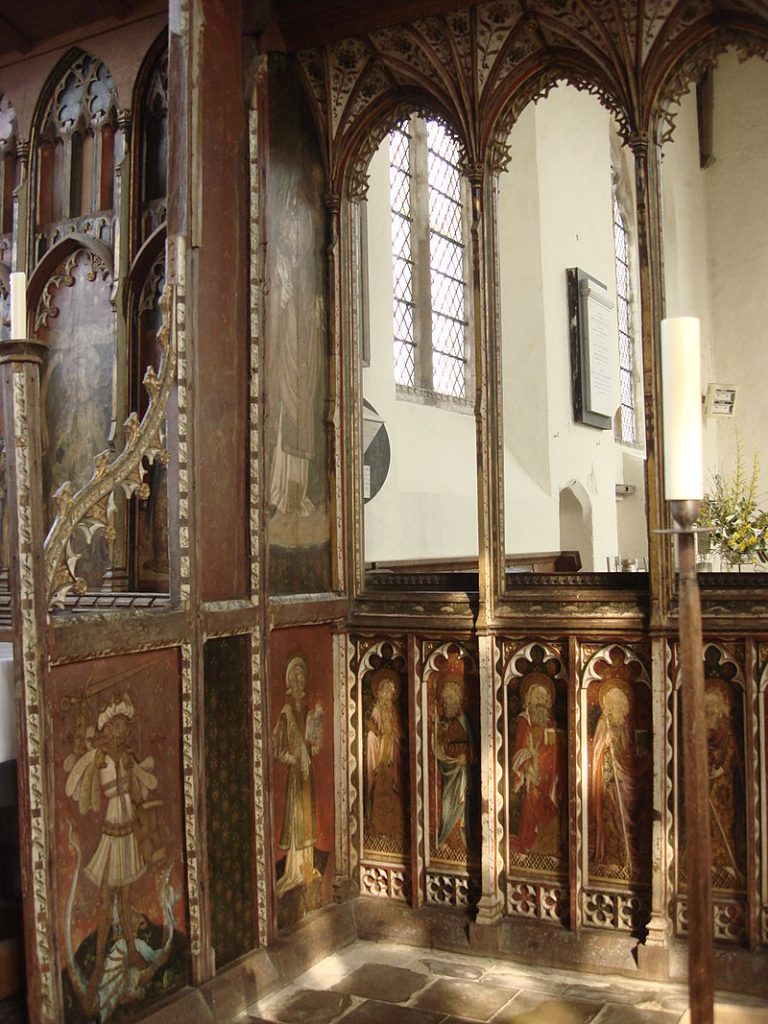
Rodmas – Rood screen in St. Helen’s church, Ranworth, Norfolk by Maria CC BY-SA 3.0
Rood is another word for the Cross. Parish Churches used to have a Rood Screen separating the holy Choir from the more secular Nave. This screen was topped with a statue of the Crucified Jesus nailed to a Rood. So, Roodmas, is the festival of the Holy Cross. Roodmas is celebrated on May 3rd and September 14th, although the Church of England aligned has itself with the Catholic Church’s main celebration on September 14th.
See my post on September 14th here for more on the True Cross.
Object of the Week
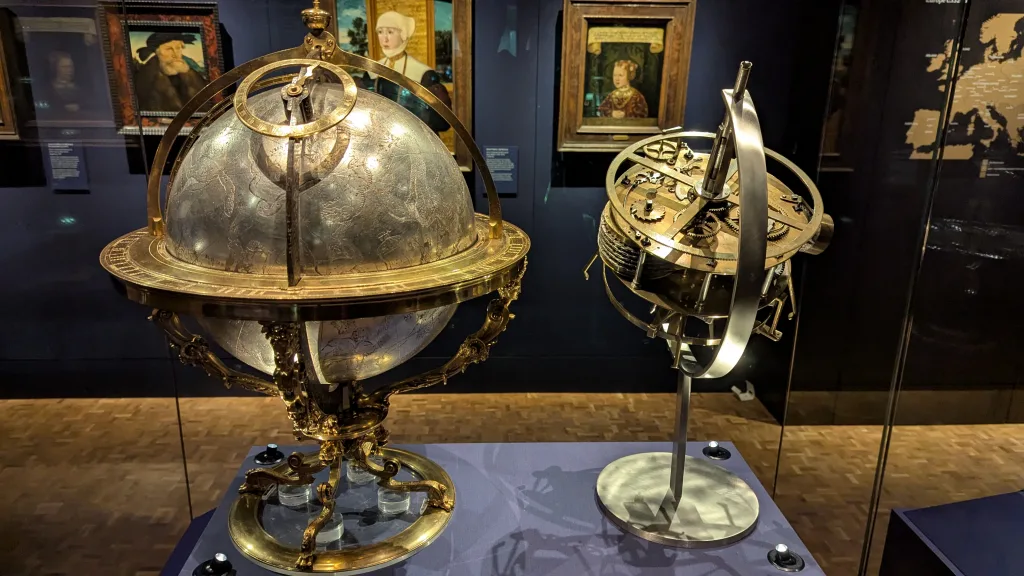
Mechanical Celestrial Globe, 1575 (Holburne Museum Bath) Photo K Flude
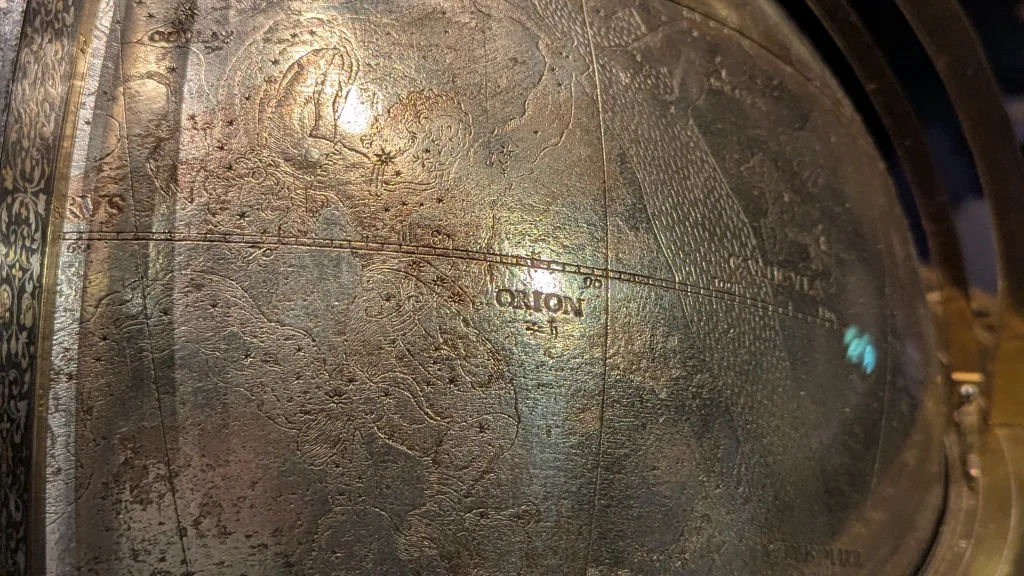
I spent a couple of days in Bath and revisited the Holburne Museum. Here I saw this amazing object from the 16th Century. The Globe is a model of the universe, and built to show the movement of the constellations, but it also tells the time and date. So the user can see when a constellation appears above the horizon and where it will be in real time. The mechanics are designed to be seen from inside the Globe, so reading it from the outside requires a mental adjustment to the mirror image of the stella sphere. It also show a pre-Copernican view as the stars were imagined as if on the inside of a huge sphere circulating around the earth. For more information please read the label below.
Museum Label for Celestial Globe.Close up of the surface of the Globe showing Orion. Photo K Flude
The Shropshire News reported that two pieces of the True Cross were given to Charles III by the Pope for the Coronation. They were installed into a cross called the Welsh Cross. This was part of the Coronation Procession. The King gave the Cross (I assume with the pieces of the Holy Cross) to the Church in Wales. Let the Shropshire News tell the story:
It is a clear reminder that we are subjects not citizens and news, as a nation, we still set store by superstitions.
The Duke of Buckingham and the True Cross
The Duke of Buckingham had a piece of the True Cross in his collection, which he kept at York House in the early 17th Century. How he got it, I don’t know. But I think he must have acquired it in the aftermath of the destruction of the Reformation. John Tradescant, who looked after the Duke’s collection until Buckingham was murdered, had a piece of the True Cross. Tradecant created Britain’s first Museum, Tradescant’s Ark. Again, I suspect (without any evidence) that he got the fragment from Buckingham. Was he gifted it? Did he acquire it after the murder? Or shiver off a timber fragment hoping no one would notice?
First Written on May 3rd 2023, revised 2024, 2025, Object of the Day added 2026
Flora (Floralia festival named after her) on a gold aureus of 43–39 BC Wikipedia photot by АНО Международный нумизматический клуб
On the 28th of April began the Floralia. It continued to the Kalends (15th) of May. According to Ovid in the ‘Fasti’ Book IV, the Romans celebrated Flora, the Goddess of Spring. The Floralia celebrated flowering, blossoming, budding, planting and fertility.
Flora was one of the 15 Roman Deities offered a state-financed Priest. Her home in Rome, was on the lower slopes of the Aventine Hill near the Circus Maximus.
The Circus Maximus is the large long arena in the middle of Rome. Model Musee Arte et Histoire, Brussels, photo K Flude
Celebrations began with theatrical performances, at the end of which the audience were pelted with beans and lupins. Then there were competitive games, and spectacles. The latter, in the reign of Galba, including a tight-rope walking animal. A monkey you might guess but no, it was a tight-rope walking elephant!
The Year of the Four Emperors
Incidentally, Galba only survived for 7 months as Emperor. A little longer than our Liz Truss’s 44 days. But then she was not murdered by a rampaging mob at the end of her reign. It was the year known to history as the year of the 4 Emperors. (great description by Tacitus here).
Spectacles and Battles
Juvenal records that prostitutes were included in the celebration of Floralia by dancing naked, and fighting in mock gladiatorial battles. There is a raging debate about the existence of female gladiators. A burial in Southwark has been said to be one such. To hear what Natalie Haynes has to say on the subject look here🙂
Fauns, Satyrs, Goats and Hares
Hares and goats were released as part of the ceremonies. These animals were both considered to be very fertile and have a ‘salacious’ reputation! (Satyrs or Fawns were, famously, obsessed with sex and were half man half goat. A man can still be referred to, normally behind his back, as an ‘old goat’). Fauns were Roman, Satyrs Greek. The one half man half goat, the other half man half horse. It all got a little mixed up and fauns became very similar to satyrs.
1792 – France invaded the Spanish Netherlands to begin the French Revolutionary Wars which begin a period of near continuous European War until the defeat of Buonaparte in 1815.
1945 – Mussolini and mistress are shot by the Italian Resistance.
1967 – Muhammed Ali refuses his induction into the US Army on moral grounds. ‘I ain’t got no quarrel with them Viet Cong’. He said.
Written in 2023 revised April 2024, 2025, On This Day 2026
Bluebells, on average, bloom on April 9th, but can be seen through April and into May. Past their prime in London currently, although still thriving in my north-facing back garden. The Londonist has a great website on where to see them in London. And for the rest of the country, see the National Trust’s Bluebell walk page.
Hyacinthus
Our wild hyacinth is officially called Hyacinthoides non-scripta. Mrs Grieve, in her ‘Modern Herbal’ gives this charming account of the Linnean name:
‘Linnaeus first called it Hyacinthus, tradition associating the flower with the Hyacinth of the Ancients, the flower of grief and mourning. Hyacinthus was a charming youth whom both Apollo and Zephyrus loved, but Hyacinthus preferred the Sun-God to the God of the West Wind, who sought to be revenged, and one day when Apollo was playing quoits with the youth, a quoit (blown by Zephyrus out of its proper course) killed Hyacinthus. Apollo, stricken with grief, raised from his blood a purple flower, on which the letters Ai, Ai were traced, so that his cry of woe might for evermore have existence upon earth. As our native variety of Hyacinth had no trace of these mystic letters our older botanists called it Hyacinthus nonscriptus, or ‘not written on.”
Avoid the Spanish
The Spanish variety is causing havoc in some places. It is more robust and can interbreed with ours and endangers our beautiful bluebell walks. Native bluebells are therefore a protected species. We are not allowed to pick them, nor even tread on them.
Old Medical and Practical Uses of Bluebells
It was used as a diuretic and is styptic (Contracting the tissues or blood vessels; stopping blood flow). The bulbs are poisonous in the fresh state. But were used as a starch, much used when stiffs ruffs needed starching. Its gummy qualities led it to be used as a bookbinders gum, and to set feathers upon an arrow.
St Alphage. Church Tower on right, City Wall to left. Photo K Flude
I first came across St Alphage when I was working at the Museum of London. The Museum was built on the High Walk at London Wall. The raised Courbusian Walkway looked down on a ruin of a Gothic Church Tower, almost destroyed during the Blitz. This was St Alphage, a Church dedicated to the Saxon Archbishop of Canterbury. (Alphage is also spelt Alphege or Alfege or Ælfheah.)
On the other side of the Walkway was the old graveyard of the Church. This preserved one of the very best sections of the old London Wall. Special because on one side its full height was displayed. On the other, the only crenelated bit of the City Wall survived. And the only surviving part of the Wall dating to the War of the Roses.
St Alphage Roman and Medieval WallThe Crennelated Red Brick Section dates to 1477, during the War of the RosesSt Alphage Wall explained on an information plaque.
In the 1980s fellow Museum of London Archaeologist, Paul Herbert and I set up a Guided Walks company (Citisights of London). Our walks started from outside the Museum of London, and so St Alphage formed a big part of our success. It led to Guided Walks and tours being a big part of my life. So, St Alphage, thank you!
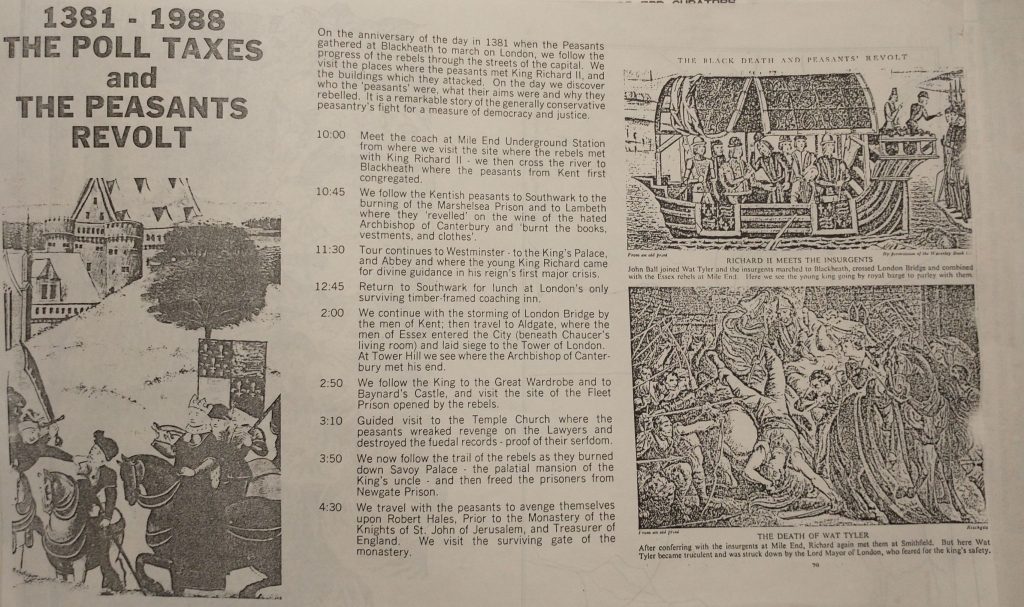
A Citisights Day Tour the Peasants Revolt (1980s)
St Alphage, Elsyng Spittle and St Mary
The Church was previously a monastic settlement called Elsyng Spittle (aka St Mary within Cripplegate). The Augustinian Canons looked after 100 blind men. It was refounded by Williain Elsing, and dissolved by Henry VIII in 1536. The Church was kept for a Parish Church. But the Puritans were not keen on dedications to St Mary. So, they renamed it after a London based Christian Martyr.
It remained a Parish Church until damaged in an air raid in World War One. (possibly on 8th September 1916 in a Zeppelin Raid – but I am speculating). The Church was partly demolished in 1923, leaving the Tower. The lower part of the Medieval Tower survived bombing in the Blitz. At 12.15 am on 25th Aug 1940, the first bombs on the City of London fell nearby in Fore Street. But the tower was hit in 1940. It was listed Grade 1 in 1950. Kept by the rebuilding of London Wall, and the Barbican area. Then substantially benefitting from a remodelling of the area in an excellent scheme of 2022.
St Ælfheah of Canterbury and Greenwich
StAlfege Greewich – Doyle own work Wikipedia CC BY-SA 4.0
St Ælfheah was captured during a Viking attack on Canterbury. The Viking hoard relocated to Greenwich where they tried to negotiate a fat ransom for him. He was one of the richest men in the Kingdom. This is what the Anglo Saxon Chronicle says:
.. the raiding-army became much stirred up against the bishop because he did not want to offer them any money, and forbade that anything might be granted in return for him. Also they were very drunk, because there was wine brought from the south. Then they seized the bishop, led him to their “hustings” on the Saturday in the octave of Easter, and then pelted him there with bones and the heads of cattle; and one of them struck him on the head with the butt of an axe, so that with the blow he sank down and his holy blood fell on the earth, and sent forth his holy soul to God’s kingdom.
St Alfege Greenwich, which is now a lovely Hawksmoor Church is said to be on the site of St Ælfheah‘s death. Thorkell the Tall tried to save the Archbishop, but failed and subsequently changed sides and joined the English King. Thrum, who was converted by Alphage, ended his agony by hitting him on the head with the butt of an axe. This seems like a strangely Viking form of mercy!
St Alphage’s body was taken to St Pauls Cathedral where it became venerated and brought income to St Pauls. His remains were removed in suspicious and violent circumstances by soldiers of King Cnut who translated the Saint’s bones to Greenwich. It is suggested King Cnut was punishing London for their opposition to him.
The Minotaur by Michael Ayrton
Also, part of the experience of visiting St Alphage from the High Walk was the statue of the Minotaur. I first came across this phallic Bull in Postman’s Park and am very fond of him. Then it disappeared and reappeared on the High Walk. Now it is on the ground level near the garden of St Alphage.
I understand that Michael Ayrton wanted to make a point about the destruction of London. He felt that the developers were more destructive than the Luftwaffe. They were like a Bull in a China Shop! So he created this statue of a very vigorous Bull (represented by the Minotaur). It is a very unusual work of art in that it sports a fully erect penis. Art History is full of naked women, but the erect male organ has largely not been seen to be a fit subject for art. For more about Ayrton follow this link.
The Minotaur in its present positionThe Minotaur on the High Walk
On This Day
1775 – Battles of Lexington and Concorde begin the American Revolutionary War.
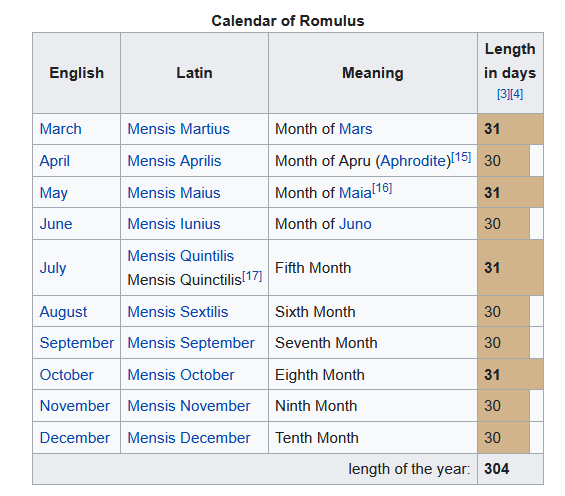
Roman Months, and April the Month of Love – Table from Wikipedia
April was Aphrodite’s month. The goddess of love and beauty. Hence, the month of love. It is also National Couple Appreciation Month! (‘National Couple Appreciation Month was founded in 2010 by Blissful Escapes to, in the words of the company, “encourage couples to do something special to re-enforce and celebrate their relationship.”’ Quote taken from this site.). But first, the new section of:
On This Day
1738 –George Frideric Handel’s Serse, has its premiere performance in London, England. From 1723 Handel lived in a House at 23, Brook Street which is in Mayfair. The House became a museum. Jimi Hendrix lived next door. And so now it is the Handel Hendrix House.
1755 – Samuel Johnson published his famous ‘A Dictionary of the English Language’.
He had a team of clerks in his attic in Bolt Court. They wrote down his definitions and illustrations of their use. He was often quite naughty in including funny, rude or idiosyncratic definitions. For example, a lexicographer was ‘A writer of dictionaries. A harmless drudge.’ A Second Marriage was: ‘ A triumph of hope over experience.’ Oats. ”A grain which in England is generally given to horses, but in Scotland supports the people.’ The innovation of his dictionary was that the definitions came with copious illustrations of a word’s use from well-known authors. While researching he borrowed books from friends. When he eventually returned them they were marked with lots of underlining and annotation in the margins.
Dr Johnstone’s House in Bolt Court, Fleet Street, Photo K FludeStatue of Dr Johnstone, in Fleet Street Photo K FludeDr Johnstone’s famous Cat Photo K flude
1912 – Titanic sinks at 2:20 a.m. This was 2 hours and 40 minutes after she hit the iceberg. 1514 people were lost of 2,224.
1923 – Insulin becomes generally available for use by people with diabetes. Its development involved decades of work over 2 continents, but it was extracted by a team from the University of Toronto in 1921.
1945 – Bergen-Belsen concentration camp is liberated. The Imperial War Museum writes: ‘Thousands of bodies lay unburied around the camp and some 60,000 starving and mortally ill people were packed together without food, water or basic sanitation. Many were suffering from typhus, dysentery and starvation.… Nearly 14,000 died after the liberation.’
1989 – 97 Liverpool fans packed into the Hillsborough Stadium, were crushed to death watching the FA Cup Semi-final. 766 were injured. The Police tried to cover up the events, and the press blamed the Liverpool fans, particularly Rupert Murdoch’s the Sun.
Roman Months
I have spoken about the Roman Calendar in previous posts. Today, I’m concentrating on the Months. The Romans wrote about a ‘legendary’ calendar, set up by Romulus when he founded Rome. It consisted of 10 months of 30 and 31 days followed by a winter period not divided into months. This allowed them to extend the year so that it fitted into the Celestial cycle. The year began in March, suitable names were given to March, April, May and June.
Having given names to June the Romans gave up and the next 6 months were given numbers from 5th month to 10th month as in the diagram above. The Calendar was not well regulated and the months eventually began to lose their integration with the seasons, and needed reform.
Photo by Manasvita S on Unsplash
The Calendar was reformed several times. January and February were added by the legendary Numa Pompilius about 713 BC replacing the monthless winter period. But, Julius Caesar undertook the major reform in 46BC. This was the so-called ‘Year of Confusion’. This first year was 445 days long. This is how far out of sync the Calendar had got. The Julian Calendar realigned the calendar to the seasons.
The Year began on January 1st, with 365 days, 12 months and a 4 year leap year cycle. This held sway until the 16th Century when a further reform was ordered by Pope Gregory as the year is not exactly 365.25 days long. It was not adopted in the UK until 1752 when we lost 11 days to align ourselves with Europe.
This year, Good Friday is on Friday 3rd of April, and the day we eat Hot Cross Buns. The Hot Cross Bun is a simpler sort of bun than the Chelsea Bun, which was the bun to have at Easter in London in the 18th Century.
Hot Cross Buns Good Friday Traditions
There seem to be all sorts of dubious traditions around the origins of the Hot Cross Bun. It has been suggested that the Greeks knew how to put a cross on a bun. Also, that the Anglo-Saxons celebrated the Goddess Eostre with the crossed bun. It is suggested that the cross represents, not the cross, but the four quarters of the moon, the four seasons and the Wheel of the Year. But there is very little evidence for Eostre other than the Venerable Bede’s mentioning her name. Bede says:
‘‘Eosturmonath has a name which is now translated ‘Paschal month’, and which was once called after a goddess of [the English people] named Eostre, in whose honour feasts were celebrated in that month’ (quoted from florencehrs.substack.com/p/eostre-pagan-fertility-goddess)
So nothing is known about Eostra herself nor her rituals and customs. So her association with Hot Cross Buns cannot be known. However, the cross, and the association with Easter, makes the bun powerful, so there are many superstitions on record. A piece of an Easter Hot Cross Bun given to the sick may promote a cure. It was said that a bun cooked and served at Easter will not go off for a year. This might help explain the traditions that hanging them up on a string or ribbon is a good thing. One hung in a kitchen prevents fire. On a ship prevents sinking. In East London, the Widow’s Son Pub in East London has an old bun. This remembers a sailor-son who never returned to eat it on Good Friday.
Making and Eating Hot Cross Buns
The technology of putting a cross on a Bun requires nothing more complicated than a flour and water paste so it might well be an ancient tradition. A more impressive cross can be made with shortcrust pastry. The bun itself is simply flour, milk, butter, egg, salt, spices and mixed fruit. Here is a recipe from the BBC www.bbcgoodfood.com
In my opinion, they need to be purchased from a shop. Home-made Hot Cross Bun might be better but would be strangely disappointing. It’s normally eaten toasted and buttered although I prefer the soft doughy untoasted and unbuttered bun. But then I can get carried away and eat the entire pack of four.
‘RRRRRare Chelsea Buns’ as Jonathan Swift called them in a letter to Stella in 1711.
Fragrant as honey and sweeter in taste As flaky and white as if baked by the light As the flesh of an infant soft, doughy and slight.
The buns were made from eggs, butter, sugar, lemon and spices. The tradition was that, on Good Friday, 18th and 19th Century Londoners would go to Chelsea to buy Chelsea Buns. Thousands of people would turn up at the Five Fields. These stretched from Belgravia to what is now Royal Hospital Street. There were swings, drinking booths, nine pins and ‘vicious events that disgraced the metropolis’. The Bun House was on Jew’s Row as Royal Hospital Street was then called. As several King Georges visited the Bun House it became known as the Royal Chelsea Bun House. It was run by the Hands family. They were said to sell 50,000 Buns on the day. Stromboli tea garden was nearby.
Chelsea Cabinets of Curiosity
Inside the Chelsea Bun House was a collection of curiosities. Chelsea became known for its collection of curiosities in the 18th Century. Of course, there was the great Hans Sloane’s collection which was the founding collection of the British Museum. And then there was Don Saltero’s which was a coffee house that had curiosities on the wall. The Bun House displayed clocks, curiosities, models, paintings, and statues on display to attract a discerning Public.
Find me a Chelsea Bun! (Or make one yourself!)
Me. I love a Chelsea Bun above all buns, But can you get them any more? The British Library Cafe was the last place I found that sold them. And that was 7 years ago. I did Chelsea Buns on sale in the Empire Cafe in Newbury but apart from that nada. Their place has been taken first by Danish Pastries and more recently the ubiquitous Cinnamon Bun. If you see any Chelsea Buns on sale please let me know.
Chelsea Buns, middle top row, next to the white cakesEmpire Cafe baking in Newbury since 1874
There is a tradition of Skipping on Good Friday. I can’t say I ever saw it – in my school skipping was a perennial activity, mostly enjoyed by the girls, but the boys would sometimes be intrigued enough to join in.
The Moon rules the months: this month’s span ends With the worship of the Moon on the Aventine Hill.
Fasti by Ovid
Cycle of the Moon, sketched from photo.
The Aventine Hill is one of the seven hills of Rome, named after a mythical King Aventinus. It is the hill where Hercules pastured his cattle. They were stolen by Cacus. According to Virgil in his Aeneid, the monstrous Cacus lived in a cave on a rocky slope near the River Tiber. Cacus was the son of Vulcan, the artificer God. He was, also, a fire breathing Giant who eat human flesh and stuck their skulls on the door of his house. When Hercules wrestled with him, Hercules hugged him so tight Cacus’ eyes popped out of his head.
The worship of Minerva also took place on the Hill. You can take a Google Earth fly past if you follow this link – also some nice photos.
The Aventine Hill & Romulus
Aventine Hill in a detail of the ‘Panorama of Rome From the Janiculum Hill’ in miniature mosaics by Antonio Tesca 1800-25 , Gilbert Collection V&A Photo K Flude. You can see the Walls of Rome in the Background. The Tiber runs across the middle but is not clearly visible.
The Hill is famous in the mythology of Rome because it is associated with Romulus. He and his twin Brother Remus, were born to the vestal virgin, Rhea Silvia, in the pre-Roman City of Alba Longa, not far away. Rhea was the daughter of former King Numitor. Her uncle, killed Rhea’s brother and forced her to be a vestal Virgin. Thus ensuring Numitor’s line died out.
But, in her sacred grove she was put to sleep by Somnus dripping a sleeping draft into her eyes and then raped by the God Mars. This was a terrible breaking of the taboo for Vestal Virgins. Rhea gave birth to the twin boys. They had to be hidden from the wrath of their Granduncle.
The Palatine & the Lupercal
The Seven Hills of Room (Facebook)
The boys were saved by the River God Tiberinus and then by being suckled by a Wolf in a cave called the Lupercal, which is at the foot of the Palatine Hill in Rome. A ‘grotto’ under Augustus’ Palace on the Palatine, has been claimed as the original Lupercal, but it is disputed. (see www.digitalaugustanrome.org/records/lupercal/.
When the boys grew up, they helped their Grandfather (Numitor) reclaim the throne of Alba Longa. The boys, being the children of the War God, were obviously excellent at the art of war. Then they decided to found their own City, but they could not decide upon which hill to build it or whom to name it after (accounts vary!). Remus favoured the Aventine, Romulus the Palatine (some accounts say vice versa).
So they decided to let the Gods decide. Remus claimed to have won when he saw a flight of 6 auspicious birds. Romulus saw 12 and declared himself the winner. And Rome was named in his honour. It was on his choice of Hill – the Palatine Hill. The Aventine hill was, originally, outside the City boundary.
The two quarrelled. Remus was killed. This story was first written down in the Third Century BC. The traditional foundation date of Rome is 753BC. These mythical foundation stories continue are retold and celebrated. In Britain, we largely ignore our creation myths. Despite our legendary Founder, King Brutus, being a relative of Romulus and Remus.
The ‘Panorama of Rome From the Janiculum Hill’ in miniature mosaics by Antonio Tesca 1800-25 , Gilbert Collection V&A Photo K Flude. It took 20 years to make.
You didn’t think I’d leave you with just a detail of the superb map did you? And to see a much better photo of it look at the V&A’s photo. It is part of the Gilbert Collection which I introduced in this post.
First written in 2023 and revised March 30th 2024, 2025, Object of the Day added 2026
The expression ‘Mad as a March Hare’ comes from the displays of hare boxing that takes place as the Hare mating season begins. And no, it’s not the male March Hare fighting in the spirit of romantic rivalry. It is the female hares fighting off unwanted attention from the males. Hares are solitary creatures, and the mating season is, perhaps, particularly difficult for them. The Country File website has more on the subject. www.countryfile.com
Not only March Hares but March Kittens too
There are also March Kittens and March Chickens. Edward Topsell in his ‘History of Four-footed Beasts‘ 1607 says the best Kittens to keep are those born in March. ‘The Closet of Sir Kenelm Digby Opened‘ 1669 says:
‘Keep a black cock hatched in March as a protection against evil spirits: his crowing terrifies them.’
He also gives a recipe for Cock Ale:
Eight gallons of Ale, a boiled March Cock, four pounds of stoned Raisins, half a pound of dates, nutmegs, mace. Beat the ingredients in a mortar, add to two quarts of Sherry. Add to the ale. Stop it in a container for 6 or 7 days. Bottle it, drink after a month.
Very weird. I challenge my readers to try it and let me know how it goes?
Was the March Hare Sacred?
But it’s not only March Hares because the hare itself was a sacred animal. It was sacred to Aphrodite because of their prodigious ability to have offspring:
‘For you know, I imagine, what is said of the hare, that it possesses the gift of Aphrodite to an unusual degree. At any rate it is said of the female that while she suckles the young she has borne, she bears another litter to share the same milk; forthwith she conceives again, nor is there any time at all when she is not carrying young.’
Classical Texts Library. Philostratus the Elder, ‘Imagines’ Book 1.1-15 c 3rd Century AD. Translated by Arthur Fairbanks.
Divine Celtic & Neolithic Hares
Research reported by Exeter University suggests that hares were worshipped in pre-Roman Britain. Julius Caesar wrote:
“The Britons consider it contrary to divine law to eat the hare, the chicken, or the goose.”
‘The Battle for Gaul’ Translation by Wiseman, Anne, Wiseman, T. P. Published by Penguin Random House, 1980 ISBN 10: 0701125047 (TP Wiseman was my professor for Classical Studies at Leicester University).
Hares are thought to be the original Easter Bunny. But finding good evidence before Germany in the early modern period is difficult. There is a tradition that witches can be scared away at Easter. Exactly, how this works is not at all clear to me. But it has been said that witches could take on the form of a hare. So eating Hare Pie at Easter helps rid the land of the witches.
Jugged Hares
You could have a jugged hare. Jugging is cooking a whole animal in a container over water. Follow this link for a recipe for jugged wild hare. Remember, you are not allowed to shot or trap them on a Sunday or on Christmas Day! For a discussion of hares and folklore, click here:
Hare’s Feet Totems
A jointed hare’s foot was considered very lucky and a remedy against gout, stomach pains and insomnia. (The Perpetual Almanack of Folklore by Charles Kightly, which I have used several times in this piece.) You can buy one on eBay. (Don’t click the links, it’s not an advert but a picture of an advert). I remember friends having rabbit feet which they carried around with them for luck. The foot would often be on a key rings.
Georgiana, Duchess of Devonshire (Johann Heinrich Hurter after Angelica Kaufman). Photo by K Flude of the miniature at the Victoria and Albert Museum
The Gilbert Collection has been re-displayed in the V&A in London. It has just opened, and is one of the most opulent displays you could hope to see! But, I loved this miniature of Georgiana. She was one of the richest women in Britain, a compulsive gambler, and a powerful political force for the Whig Party. And despite the Georgian Hairstyle the artist has contrived to make a very down to earth portrait. I can imagine bumping into her at the local Overground Station! She became better known after the bio graphy by Amanda Foreman, followed by the Film starring Keira Knightly. The Museum label says the portrait is ‘after Angelica Kaufman’. But I cannot find a Kaufman of Georgiana, that has this charming informality.
I have just heard news that the Arts Council wants to charge overseas visitors to visit our wonderful free national Museums, while allowing British Citizens free entry. Now, there are lots of arguments to be made about it, particularly in a time where money is in short supply. But, one result will be longer waits to get into Museums and Galleries. I am not sure how we Brits, are going to be asked to prove our nationality. If they have to inspect our Electricity Bills, Drivers Licenses, Passports, Library Cards, or Bank Statements, expect chaos.
One more object from the Collection is made of minature mosaics, and the V&A has several, But I have chosen this fabulous image of the Colosseum in Rome:
Colosseum by Domenico Moglia c1851
First published March 28th 2023, revised 2024, 2025. 2026 Object of the Day added and post revised 2026
Study for Lady Lilith, by Rossetti. 1866, in red chalk. Now in the Tel Aviv Museum of Art (Wikipedia) Lilith born at The Beginning of the Universe
This is now my most popular post. March 25th is the Annunciation—the day that the Archangel Gabriel tells Mary she is pregnant. (to see some very fine paintings of this meeting, look at my other March 25th post march-25th-feast-of-the-annunciation/). When I first wrote this post I was discovering how it all fitted together as I wrote. So I’m leaving it the way it was, proof reading and clarifying if necessary, but keeping the thrill of the discovery of the the significance of March 25th as the day that saw the Beginning of the Universe.
March 25th is also the anniversary of the birth of Adam and Eve (and Lilith); the death of Jesus Christ; the anniversary of the Immolation of Isaac; the Parting of the Red Sea; the Fall of Lucifer; and, (until 1752 in the UK) the beginning of the Year.
Of course, it isn’t. Or to put it another way, no one can, or ever could, prove any of these dates except 1752. So what they speak to is the way the Church saw the world as logically structured by God. Christian thinking about the year, the world, the universe, creation, developed over many years and took influences from many cultures. It is also very complicated to work out the sequence, so I’m going to summarise what I know (or at least what I think I know).
Happy Birthday, Dear Jesus.
Christians chose Christmas Day as the Birthday of Jesus, probably partly because it was a prominent birthday already shared with several Gods. Particularly, Attis, Mithras, Saturn and the Unconquered Sun. It was approximately at Solstice, the beginning of the Solar Year, and close to one of the main festivals of the Roman World, the Saturnalia. So it made it easier for new converts who could retain elements of their festivals after conversion.
December 25th might have been selected by the pagan religions because it is the time when the Sun begins to rise further north each day. The days stop shortening and start lengthening, light increases with the promise of warmer weather and budding plants. It was considered a rebirth of the Sun.
Solstice Anniversaries
So, Jesus was born on/or around the Solstice, so he must have been conceived approx. 9 months earlier. This is approximately at the Spring Equinox.
Ah, you are thinking! But today isn’t the equinox. It’s a few days after the equinox. Surely, God doesn’t do approximately?
I have always thought that the 4 or 5 days difference between the Solstice, the Equinox and the Christian festivals was down to the fact that the Calendars were not well coordinated with the actual movements of the Sun (because the Sun does not circle the earth in 365 days, or in 365 and a quarter days, but 365 days, 6 hours, 9 minutes. Unless corrected for this means dates slip from their proper place in the Solar Year. It also makes lunar Calendars difficult to align with the Sun cycles, and vice versa.
But when I first wrote this a sudden revelation dawned upon me which will be revealed in the next few paragraphs.
So, God sends his Son to save the human race. God is a logical being, so she would send her Son at an appropriate time? If Jesus is born at or near the Solstice, which is an appropriate time for the Son of the Creator, then conception 9 months earlier, March 25th, is near the Equinox. This is the beginning of Spring. For many people, Spring is a new beginning, for example, the Anglo-Saxons saw Winter as the death of the year, and Spring as the young Year. It all makes sense.
The Creation
So to the Creation. God, having a free choice, would have created the world at the beginning of Spring. In fact, if you think about it, God creates everything necessary for life at the creation in 6 days. As soon as it has all been created and put together, it is bound to immediately spring into new life. The first season must, therefore, be Spring? Right? So March 25th?
This gives a nice symmetry with Jesus’s Life. Conceived on March 25th, born December 25th, and died 30–40 years later, according to the Church, at Easter, on March 25th. (the only other famous person I know, born and died on the same day is William Shakespeare).
Easter
Easter, when Jesus is martyred, isn’t March 25th I hear you saying. But remember, Easter is a lunar festival, so its date varies each year. In fact the next time is 2035. Births and deaths, on the other hand, are fixed to the Solar Calendar. Therefore, the Church chooses March 25th as the most appropriate day to pin the death of Jesus, on the anniversary of his conception and the anniversary of the creation of the Earth. I am guessing that this is also the preferred date for the Day of Judgement.
It is also the Birthday of Adam, and his first wife Lilith (or so some say), and Eve. More about Lilith below. I hope this is all making sense?
Why was Adam born on March 25th?
I had thought this date was just one of the parallels that the Church liked, Jesus and Adam born on the same day. But, I have just worked out why Adam is born on March 25th, and why these dates are not the Equinox, March 20th/21 but March 25th, which has been bugging me.
Let’s go back to the beginning of Creation as described in Genesis. It has the following sequence of Seven Days, beginning with the Equinox March 20th. I have added dates to the 6/7 day sequence of Creation:
Day 1: Light – March 20th
Day 2: Atmosphere / Firmament – March 21st
Day 3: Dry ground & plants – March 22nd
Day 4: Sun, moon & stars – March 23rd
Day 5: Birds & sea creatures – March 24th
Day 6: Land animals & Adam, Lilith and Eve – March 25th
So there you have it! Adam, Eve (and Lilith) were created on Day 6 with the Land Animals – March 25th. Jesus conceived, also on this date, and so 9 months later is born on December 25th. It all makes sense, and aligns the Jesus’s Life, the Christian year fully with the Solar Year and the Creation!
And that, dear Reader, is the very first time anyone has been able to explain to me why Christmas is not at the Solstice, and why the Annunciation was not at the Equinox. Maybe you all know this, but it is very exciting to work this out for myself. And believe me, I have done a lot of reading about calendars and not spotted an explanation.
When was the Creation?
The Anno Munda‘s is a Jewish Calendar which begins counting from a year before the Creation – the Year of Emptiness. This was 5500 years plus 2026 years ago so 7526 Before the Present. And it was supposed to have ended in 600AD, 6000 years after the Creation. So, they got that wrong.
Dionysius Exiguus replaced the Anno Mundo year with the AD/BC system in the 6th Century AD). This became popular when the Venerable Bede used it in his writings in the 8th Century.
Beginnings of the year
The Celts chose October 31st, Julius Caesar chose January 1st, other cultures have other dates, and the Spring Equinox is another choice sometimes made. The Church and Dionysius Exiguus choose March 25th, although secular society also recognised the claims of January 1st. Britain kept to March 25th until 1752 when we adopted the Gregorian Calendar. But people like Samuel Pepys celebrated New Year’s Eve on 31st December. So January 1st was the secular New Year, but the Christian year number did not change until March 25th. So King Charles I thought his head was being cut off on January 30th 1648; while history books will tell you it was cut off on January 30th 1649. Same day, same head, different reckonings.
January 1st, the New Moon and New Year
December 31st/January 1st is essentially a Solstice New Year Festival. And I have, previously, used the difficulty of keeping calendars as to why these days has slipped out of alignment with the Solstice. But, today I realised that it is as likely that the reason is the Solar/Lunar nature of our time keeping. The year, and its festivals, is largely arranged around the Solar Cycle. But our weekly and monthly cycles are orginally derived from the Moon.
The first of a month, was called the Kalends by the Romans, the Nones the half moon, and the Ides signified the New Moon. The kalends of January is then, originally, the First New Moon after the Winter Solstice. So, January 1st is not a slightly misdated Solstice Festival it is a Festival celebrating the first New Moon of the New Year! Sorry, to seem excited but this is the first time I have realised this.
Over time societies give up trying to sync the lunar and solar calendars. Roman and Christian cultures gave up and fixed the moon months, completely abandoning any attempt to keep the months to the actual lunar cycle. This is our current system, in which only Easter and festivals that depend on Easter remain true to the movements of the moon festival, much to our perennial confusion.
Maybe you all know this, but it’s put many things into perspective for me!
Lilith
The April 2023 Issue of ‘History Today’ had a short piece called ‘The Liberation of Lilith’ which suggests that the story of Lilith, a figure from Jewish Folklore, is first attested in a Medieval satirical text called ‘The Alphabet of Ben Sira’. The story goes that Lilith is created from the same clay as Adam. Adam then demands she lies below him during sex. She refuses, saying that they are both made from the same stuff and, therefore, equal. Adam refuses to accept this, and so Lilith leaves the Garden of Eden. So the story goes.
The story of Lilith, Sarah Clegg suggests, is one of a series of similar stories found around Europe and Asia. And Clegg assumes that it is gradually modified to make Lilith a demon who will kill babies unless the names of three angels are spoken out loud.
The story survived as a charm to keep babies safe, and perhaps to remind people of equality among the sexes. But this causes problems for, OK, let’s call them out, the Patriarchy. Lilith cannot be equal to Adam so she is made into a monster, not made from the same clay as Adam but from the scum and waste left over from Adam’s creation. I imagine the story then went on to propose that God creates Eve from Adam’s rib, and so she is created from Adam, and is, therefore, not equal, but subservient to him, although not as bad as Lilith. Lilith is now a significant figure in feminist folklore circles.
Attached to the watercolour of Lilith by Rossetti (at the top of the page), was a label with a verse from Goethe‘s Faust as translated by Shelley. (Wikipedia)
“Beware of her fair hair, for she excells All women in the magic of her locks, And when she twines them round a young man’s neck she will not ever set him free again.”
The model is Fanny Cornforth, Rossetti’s mistress. He painted another version a few years later, but the model in that is Alexa Wilding. His models are arguably more interesting than the man himself and include: Elizabeth Siddall, Jane Morris and Fanny Cornforth. Christina Rossetti, his poet sister, modelled for Rossetti’s painting, Ecce Ancilla Domini which you can see here.
For more on the Annunciation, look at my other March 25th post here.
I think I might have enough material to begin my own Cult.
Beware the Ides of March – With Apologies.Image from Facebook
Beware the Ides of March
SOOTHSAYER: Caesar! CAESAR: Ha! Who calls? CASCA: Bid every noise be still; peace yet again! CAESAR: Who is it in the press that calls on me? I hear a tongue shriller than all the music Cry ‘ Caesar!’ Speak. Caesar is turned to hear. SOOTHSAYER: Beware the ides of March. CAESAR: What man is that? BRUTUS: A soothsayer bids you beware the ides of March. CAESAR: Set him before me; let me see his face. CASSIUS: Fellow, come from the throng; look upon Caesar. CAESAR: What sayst thou to me now? Speak once again. SOOTHSAYER: Beware the Ides of March. CAESAR: He is a dreamer. Let us leave him. Pass.
Julius Caesar by William Shakespeare
Julius Caesar and the Ides of March, 44 BC
The Ides of March is the 15th of March. The day Julius Caesar didn’t take the warning that might have saved his life. You might suggest he got what was coming to the first populist Dictator. But any study of Roman History will find many precursors to Caesar in Roman and Greek History. Among populists, I rank Caesar with Napoleon a Dictators who was, personally, an intelligent, rational man. They, in some ways, ruled ‘wisely’ but were nonetheless willing to sacrifice millions of people for their own personal ambition.
Warning from history – Assassination is not the Answer!
Today, the world is faced with the populists who are geniuses only in their own minds. I know, we as humans, might think, if only X would drop dead, how much better it would be? Brutus, being an honourable man, took action upon his thought. But, as often is the case, what seemed the ‘right thing’ to do, turned out to be a disaster. The plotters were trying to save the Roman Republic, but the murder destroyed the Republic.
So, still those assassinary thoughts, read this article in ‘History Today’ about the impact of Julius Caesar’s murder. Do everything you can but use democratic means to defeat egotists to whom truth means nothing. In my opinion this is the major problem for humanity, it seems we do not know how to stop homicidal maniacs (like Hitler) causing war without needing to fight a war to stop them. We do not have a method of peaceful mass rebellion. Perhaps Gandhi came closest but then he was working against a system that was not a dictatorship. (I mentioned Gandhi in ‘On This Day’ on my post here.
Ides of March
Now, what the heck are or indeed is the Ides of March?
A Roman month was divided into three, first the Kalends, then the Nones and finally the Ides. These three days were the important days of the month. The Kalends is the 1st of the Month. The Nones the 7th of the Month, And the Ides the Fifteenth. It is said to go back to the early days of Rome and a lunar calendar. The Kalends being the first tiny sliver of a crescent moon a couple of days after the New Moon. The Nones the first quarter of the Moon and the Ides was the full moon. To me, as a way of dividing a month it is very lopsided. The cycle of the moon is 29 days not 15. So the tripartite division divides up the first half of the month, and leave the second half undivided.
Debts were supposed to be paid on the Kalends and that is where we get our word calendar from. These public calendars were called Fasti. This is the name of Ovid’s great Almanac Poem, the Fasti, which I often quote from.
Kalendar
This is a very bad photograph of a drawing by Herbert E Duncan Jr of a 1st Century Calendar
How was it used? When talking about a day in the future month you might say I’ll meet you on the 5th day before the Kalends. I’ve never really understood this system, despite a few attempts, until I saw this drawing of a Roman Calendar. You’ll have to read this closely.
The first column, on the left, with the letters from D to H then A – H. This is a recurring cycle of 8 market days, running in tandem with Kalends, Nones etc.. This gives an 8 day week.
Now reading across the top line in capitals: DKMARTNP. So the D is the 4 day of the 8 day ‘market week’. The second column begins with the Letter K for Kalends, then MART for March. So it’s the Kalends of March. Then NP which means this day is a day for public festivals.
Back to the second column. Below the K for Kalends, the days are counted down to the upcoming Nones. So the next one after Kalends is VI, meaning the 6th day before the March Nones. Then V, IIII, III. There is no II because PR means the day before Nones. Below and to the right of the PR are the letters NON which is, as you might hope, is short for Nones.
In the second column below this is the number VIII which means the next day is the 8th day before the Ides of March. The fragment of stone from which this drawing comes does not continue down to the Ides, unfortunately.
Complicated, huh? It gets worse. The third column has a series of letters in it: F C C C NP NON F C C. We already know that the NON is short for Nones, The F means it’s a fastus, a permissible day when legal action can be taken. (the plural of Fastus is Fasti.) The C means Ccomitialis which on fasti days the Roman people could hold assemblies. (see my post for more on the curiae).
Market and Public Days
We have already seen that NP marks days for public festivals. An N would mean days when political and judicial actions were prohibited, although there is not one here. The small unreadable text to the right is information, I believe, about holidays and historic events to be marked in the calendar. This is, in fact, a Roman Stone Almanac.
This confusing system survived Caesar’s major calendrical reforms. He transformed the Roman calendar, which was rotten at the core. He re-aligned with an almost accurate calculation of the time the Sun takes to circle the earth. (or the other way around!) This is known as the Julian Calendar.
But the Kalends, Nones, and Ides he left intact and it survived until Constantine the Great got rid of them. They were replaced with the familiar 4 fold division of the month. So, for the first time, you could work 24/7.
493 – Odoacer, the first barbarian King of Italy after the fall of the Western Roman Empire, was slain by Theodoric the Great, king of the Ostrogoths, while the two kings were feasting together. Odoacer was a mercenary General for the Romans, but seized the Throne from the child Emperor Romulus Augustulus, who ruled for only 10 months. Theodoric took over and ruled an Empire centred on Italy from 496 to 526. Both Kings followed the Arian version of Christianity, although generally did not persecute the Catholic Tradition.
Theodoric was, more powerful than the later Roman Emperors and had good relations with the Roman Senate, which continued in operation. Later in his rule, that relationship broke down. This lead to Theodoric arresting Boethius for treason. While awaiting execution, Boethius wrote ‘On The Consolation of Philosophy’. Often called the last great literary work of the Western Roman Empire. Amongst many translations into English are those by King Alfred the Great, Geoffrey Chaucer and Queen Elizabeth I. Boethius was executed in 523
1493 – Christopher Columbus arrived in Castille, back from the journey that changed the world. He made landfall in the Bahamas on 12th October 1492, ending what became known as the pre-Columbian Age (aka pre-contact era). The voyage began the era of exploration that turned the world into a global entity, but also bringing in its wake horrific genocide of indigenous peoples.
1877 – First Cricket Test Match between England and Australia, held at Melbourne which the Aussies won by 45 runs.
1909 – Selfridge’s opened on Oxford Street
1927 – The first Oxford v Cambridge Women’s Boat Race took place in Oxford on the Isis. The Isis is what posh folk call the River Thames as it flows passed the University Town. In Latin the Thames is called the Tamesis. And a conceit grew up at the University that the River was called the Isis until it was joined by the River Thame at Dorchester, where the conjoined river was called the Tamesis.
The Boat Race was won by Oxford. Strangely, the boats did not row at the same time. On the first leg they were judged by the style of their rowing, and on the second by the speed. The judges could not agree on the style scores, so in the end the decision was given to Oxford on account of being the faster of the two boats.