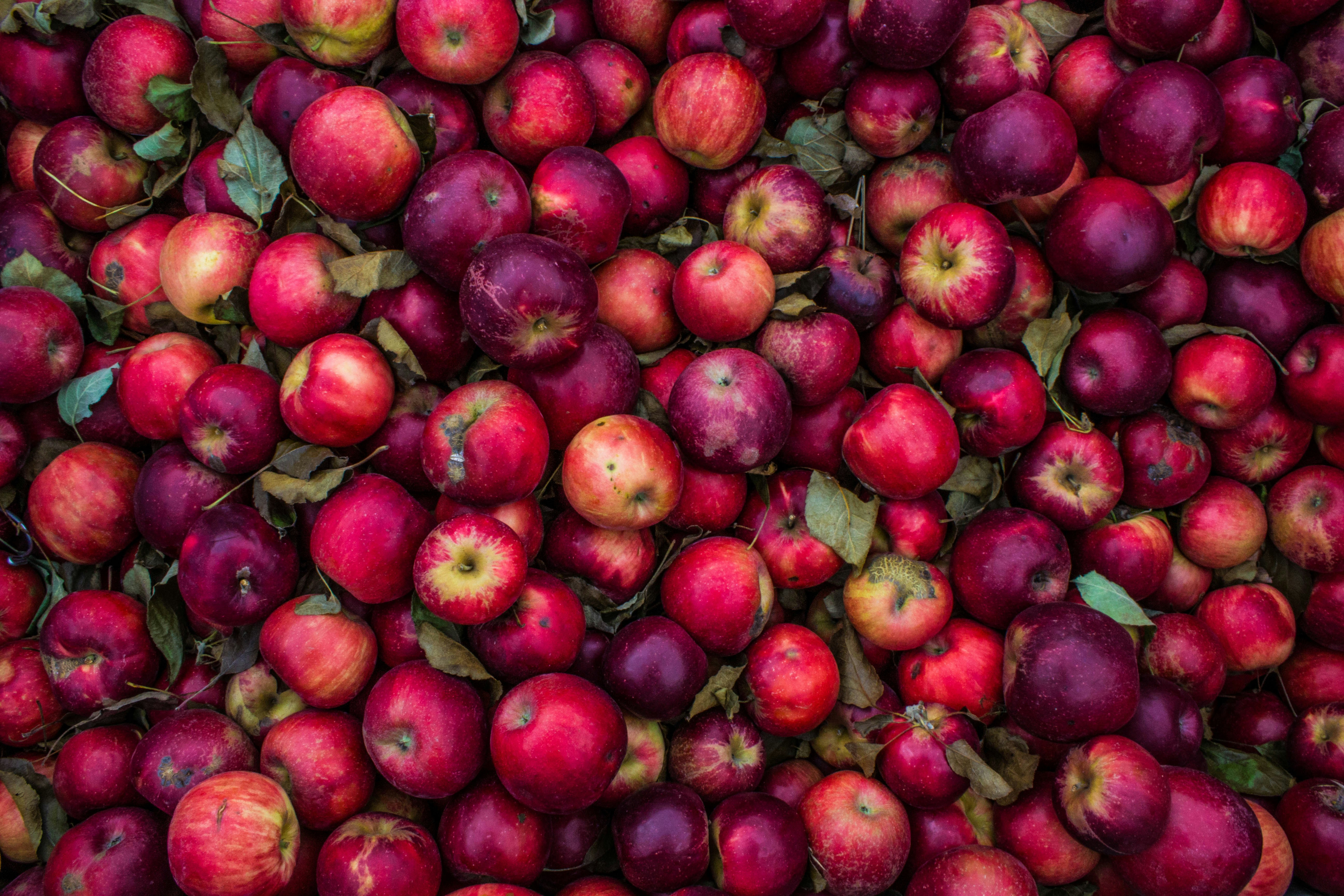
Frankin was a Devon brewer who was put out of business by Cider makers. So he sold his soul to the Devil in exchange for 3 days of frost from May 21st. He hoped the cold would destroy the apple blossom and ruin the Cider Crop.
In fact, today is warm and sunny. It seems to me to be the day to cast my clouts out. (see my post clouts and casting here.) We started with very nice May weather, and then it went wintery. But we have had a few warm days now and I have just put all my winter and spring coats and wolly socks away. But I haven’t yet got the short-sleeved shirts out of underbed storage. Frankin’s legend is another warning about cold weather in May . We have also heard about the Ice saints such as St Pancras who are supposed to bring icy weather to mid May.
Cold Sheep
Sheep farmers are also warned to beware cold weather in May:
‘Shear your sheep in May You’ll shear them all away.’
The poor sheep will die in thunder and lighting:
‘Thunder in May Frightens the Summer Away‘
Green Jean and Marrying in May
Marrying in May is also supposedly unlucky (and I did see a bare shouldered bride regretting her dress choice on a cold day in Stratford-upon-Avon!).
‘Married in May and kirked in green Both Bridge and Bridgroom won’t long be seen O’ Marriage in May Bairns die in decay’
This was recorded in 1892. Green is an unlucky colour in Scotland for wedding dresses, and there are a number of ghostly Green Ladies in Scottish Castles such as Wemsyss. Here she is called ‘Green Jean’. She is beautiful, tall, slim lady with a long dress of green who swishes as she glides bu startled observers.
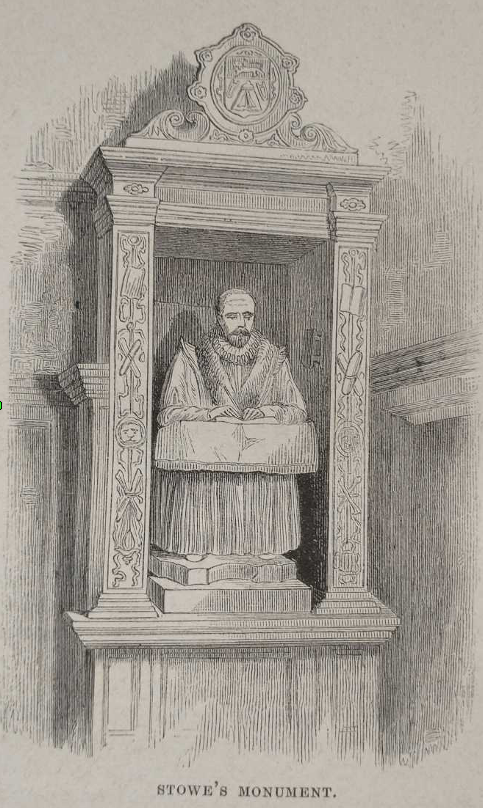
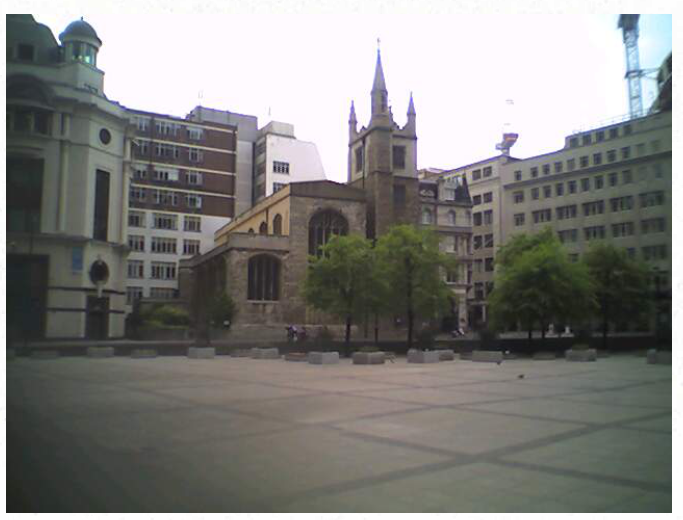
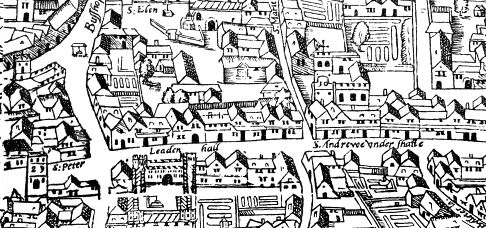
On the corner of Leadenhall Street and St Mary Axe in the City of London is one of the very few medieval Churches that survived the Great Fire of London is 1666. It was sheltered by the firebreak that was the Leadenhall, a big market building made of stone. This is where the great London historian John Stow is buried. His Survey of London is one of the best sources for Medieval and Tudor London. Every three years, there is a commemorative service and his quill is changed. Last year it was on the 22nd April. The next is due in 2027, date yet to be announced. The Lord Mayor attends, and it is organised by Stow’s Guild – the Merchant Taylors.
John Stow records that his father returned to his home at Austin Friars one day to find his house had been moved. He had no warning, nor payment for the loss of land. He had the misfortune to live adjourning the property of Thomas Cromwell. This is what Stow wrote:
‘My father had a garden there, and a house standing close to his south pale; this house they loosed from the ground, and bare upon rollers into my father’s garden twenty-two feet, ere my father heard thereof; no warning was given him, nor other answer, when he spake to the surveyors of that work, but that their master Sir Thomas commanded them so to do; no man durst go to argue the matter, but each man lost his land, and my father paid his whole rent, which was 6s. 6d. the year, for that half which was left. Thus much of mine own knowledge have I thought good to note, that the sudden rising of some men causeth them to forget themselves.’
St Andrew Undershaft
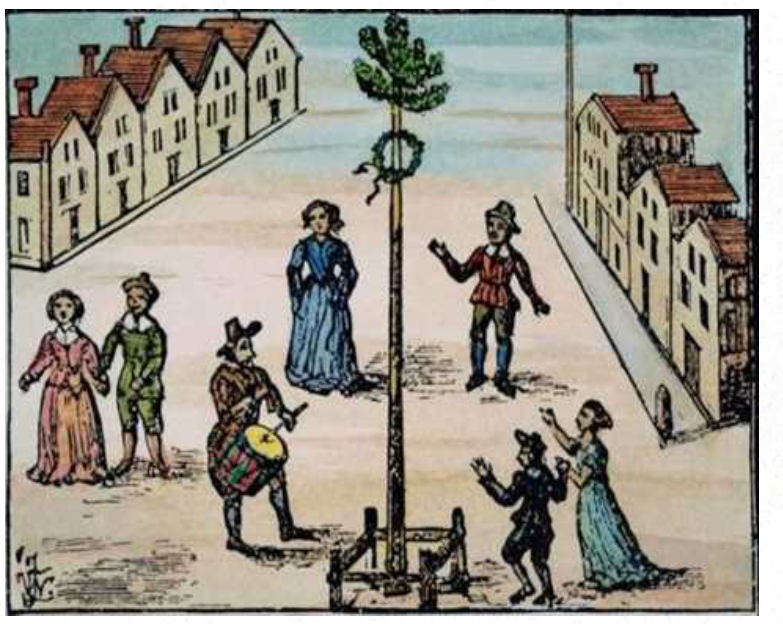
The Church is London’s Maypole Church as it was here the Maypole or the shaft was stored under the eves of the Church. Hence, St Andrew’s sobriquet of ‘Undershaft’. The May Day riot of 1517 put an end to the dancing around the Maypole but the pole itself survived until 1547. Then, in a Puritan riot, the ‘stynking idol’ was destroyed. (see my May Day blog post here for more more details.)
There is also a plaque to Hans Holbein, but no one knows for sure where he is buried. He died in London in 1543, possibly of plague. The present church was built in 1532, but it is first recorded in the 12th Century.
Today is Earth Day. It was set up in 1970. For more information click here.
2016 – On Earth Day the landmark Paris Agreement was signed by 123 countries including the United States, the United Kingdom, and China. The USA is the World’s the second largest emitter. They withdrew from the agreement in 2020, rejoined in 2021, and withdrew again in 2026. Iran has signed it but not ratified it.
First Published on 30th November 2022, Revised 2023, moved to April in 2024, and revised 2025, On This Day added 2026
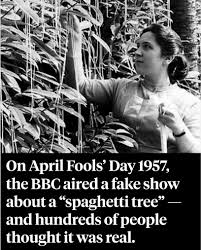
The Famous Spaghetti Tree April Fool’s Joke (from facebook)
First Reference to April Fools Day
The first unambiguous British reference to April Fools Day is by diarist John Aubrey’s “Fooles holy day” in 1686 – although he might have been referring to Germany.
‘We observe it on ye first of April… And so it is kept in Germany everywhere.’ For more details read hoaxes.org.
Chaucer and April Fools Day
But there is a possible earlier reference in Chaucer in the Nun’s Priest’s Tale. This I find quite compelling but most Chaucer scholars don’t. This is the text:
When that the monthe in which the world bigan That highte March, whan God first maked man, Was complet, and passed were also Syn March bigan thritty dayes and two
So, if you have been keeping up with me, you will know that the first lines are referring to March 25th. This was the day Adam and Eve were created. The day when the Church started the New Year and the year number moved one on. This was a major Church festival, usually followed by a week of holiness. The Roman New Year, January 1st, ended with a light-hearted festival called Saturnalia, and it is suggested that April 1st was, similarly, a day of release after the festival of the official Church ceremony of the New Year.
Chaucer’s last line says ‘Since March began thirty-two days have passed.’ A foolish person would not realise this is a reference to April 1st. Hence, this suggests a Fool’s Day already existed. Some scholars think that Chaucer was referring to May 2nd, counting the 32 days not from the beginning of March but from the end of March. I think they look at the second and third lines which read ‘That high March…. was complete’ and so add the 32 days to the end of March. Foolish in my opinion and not reading what actually Chaucer wrote which is ‘Since March began….’
Hunting the Gowk
Generally, in Britain, we play a prank and say ‘April Fool’ with great delight. But we are not allowed to continue beyond midday. The Scots used to call it ‘Hunting the Gowk’ and the main prank was to give someone a letter to deliver, and the person who opened the letter would read:
“Dinna laugh, dinna smile. Hunt the gowk another mile” and send the fool onto another leg of his or her’s fool’s errand. In Ireland the letter would read ‘send the fool further’.
April Fools Day and Spaghetti Growing on Trees
I nearly always forget to honour April Fool’s Day (or April Fish Day as the French call it). But in Britain, somewhere in our newspaper or TV station there is an April Fools Joke slipped in. The most remembered is the BBC piece showing film of Italian Farmers picking spaghetti from trees.
2026 – Introduction of Coffee to England 200 years earlier than previously thought!
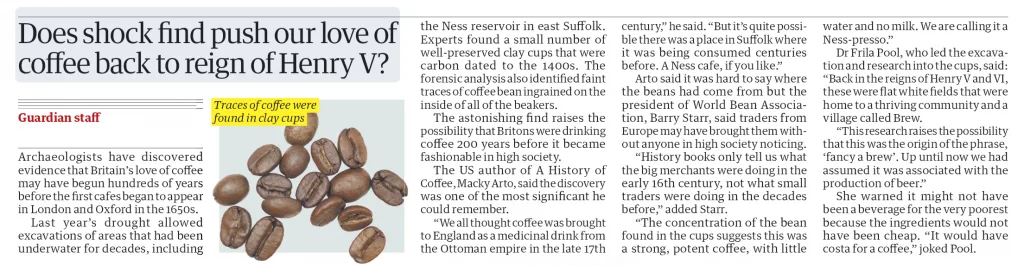
I have had a quick look at the Guardian for their 2026 April Fools Day Story and I think it is this one:
Guardian April Fools Joke for 2026
The clues are the expert is called Macky Arto. The find was in Ness, allowing them to say ‘Ness Cafe’, and ‘Ness-presso’, and the use of a pun ‘It would have costa for a coffee.’ The final confirmation is this sentence: ‘Back in the reigns of Henry V and VI, these were flat white fields …. and a village called Brew.’ Allowing the journalist to make up an origin for the expression ‘Fancy a Brew?’ it goes on to say.
2025 – Coffee Cups as Haut Courture?
Guardian April Fools Day Joke article or the world gone mad?
‘Meghan Markle was criticised after it was revealed that when you put her lifestyle brand name – American Riviera Orchard – into the What3words location service, it points to a statue of Oliver Cromwell, who famously had a King Charles executed‘
2023 – “Megxit: Call of Duke-y”
In 2023, Harry and Megan proved irresistible and the Guardian reported that:
‘The Sun published a piece announcing the launch of Prince Harry and Meghan’s new video game “Megxit: Call of Duke-y” in which the royal couple try to reach California while dodging obstacles, including rival royals and the media, along the way.‘
This post is about April Fools Day. But it is also the anniversary of the formation of the RAF.
On This Day
1854 – Hard Times by Charles Dickens Serialised in Household Words. A recent study of Victorian Grave yards in Yorkshire highlights the grim reality for young children. For the article see: https://core.ac.uk/reader/220156990
1918 – Near the end of World War 1 the Royal Flying Corps (RFC) and the Royal Naval Air Service were merged to create the Royal Air Force (RAF). It was the world’s biggest air force, and went on to secure Britain from invasion by Hitler.
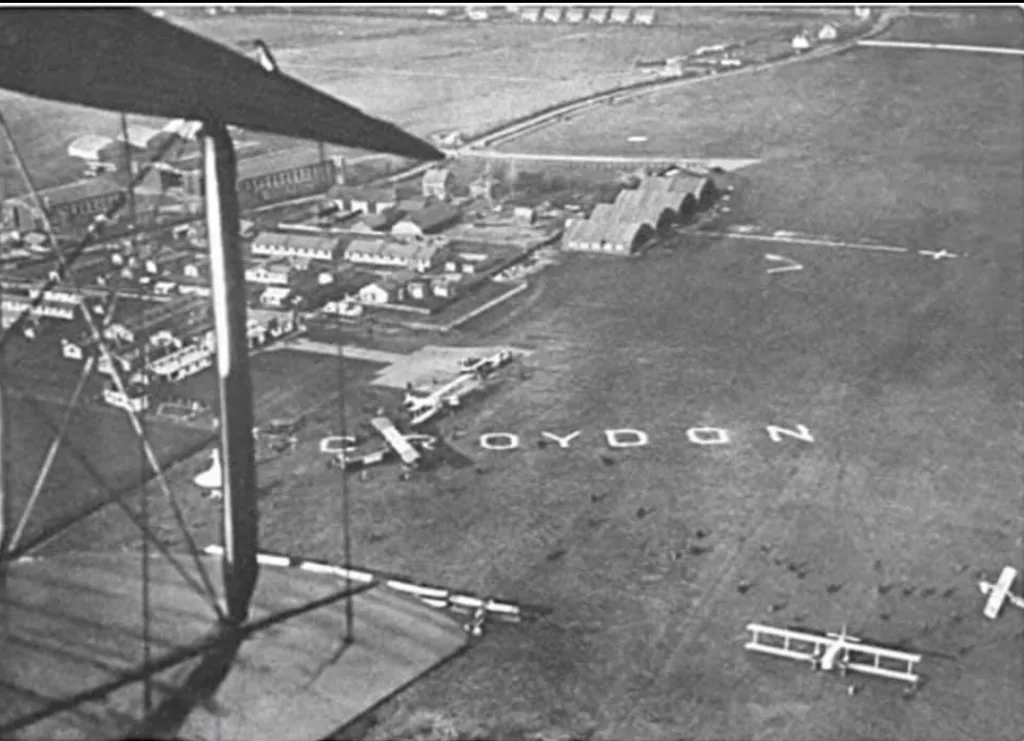
Croydon RFC/RAF base for anti-Zeppelin Raids in WW1 and one of the world’s first international airports.
RAF Rigger, Benjamin Flude
My Grandfather was in the RAF as a fitter. My father tells some of his story in his autobiography ‘A Boy from Haggerston’:
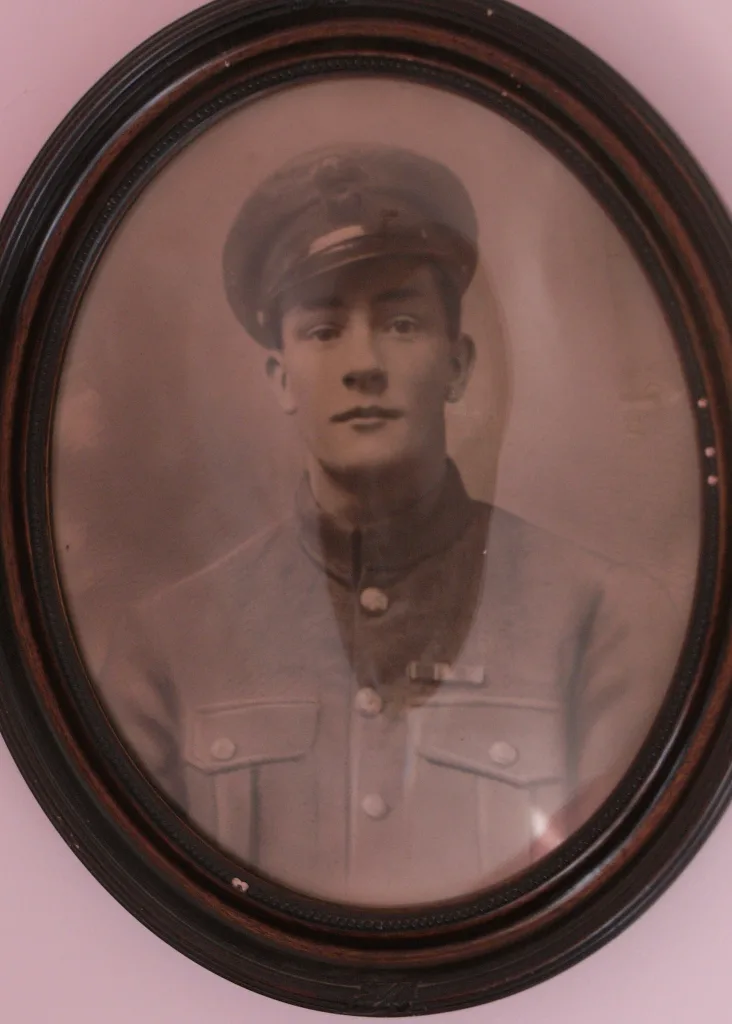
Benjamin Flude in RFC Uniform. My father, Ben Flude remembers a small model biplane hanging from the portrait.
‘I was 9 months old when he died, and he was just 28 years old. Everyone seemed to like him, and as a child, he was always my hero. In my imagination, I promoted him to being a brilliant and brave Ace RAF Pilot. But he was, in fact, a mechanic rather than a pilot in World War I. Following the war, he worked with Imperial Airways in Purley, Croydon. I don’t know the exact details and so have to piece the story together from the little information I have at my disposal.
My friend, Roy, tells me that the badge on his uniform in the oval picture is of the Royal Flying Corp. (RFC). But they were disbanded in 1916/17, and replaced by the RAF thereafter. As my dad was born in 1900, he must have joined up to fight in the war while underage at 16 or 17 as a volunteer. ‘
How a London lad became a Rigger for the RFC we don’t know, but the Fludes at that time were all employed as umbrella or walking stick makers in the East End of London. I think it is a case of transferable skills. WWI aeroplanes were made of wood, metal wire and fabric, which is precisely what an umbrella is made of.
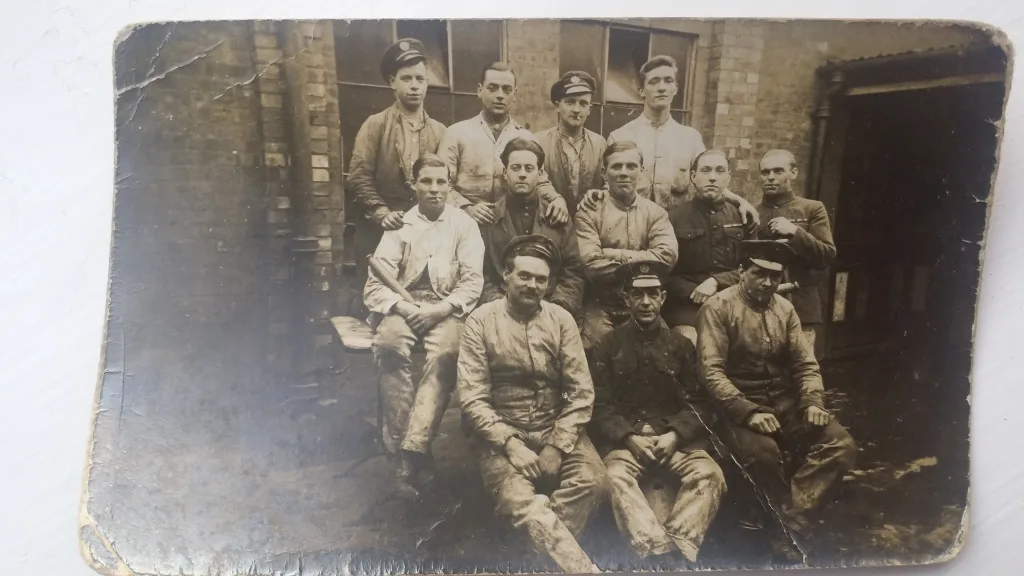
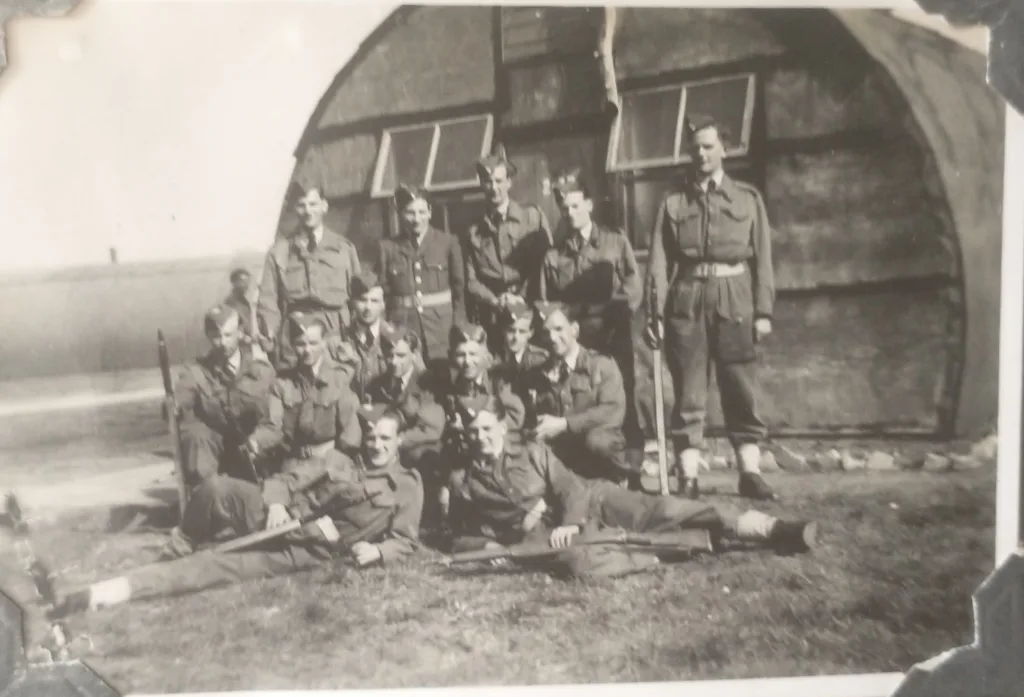
RAF/RFC mecanics c 1917 . My grandfather is the handsome man standing tall in the back row extreme right
RAF Mechanic Ben Flude
My father went on to serve in the RAF during his national service: He writes:
Ben Flude RAF Metfield. (dad is lying down at the bottom right. he is now 98)
‘Early in 1946 I received my call-up papers for the RAF. I was to report to the Recruitment Centre at Padgate in Lancashire. This is where I received my uniform after a medical examination, and then there were a number of intelligence/aptitude tests when they decided what trade I would join. I tried to get Air Crew and while there were no vacancies, I did have a wide group of trade offers open to me. The group that I was interested in was aircraft maintenance and repair, following in my Dad’s footsteps.’
‘However, before I could start, I had to do my basic training. This was designed to get you fit, and we did plenty of square-bashing or parade drills. For this, they sent me to Metfield in Suffolk, which had only very recently been made available to the RAF by the American Army Air Force. In fact, it was so recent a hand-over that whilst on picket duty, a coach rolled up packed with girls who were so disappointed by the lack of Americans that they got straight back on and returned to Ipswich! The motto of ‘overpaid, oversexed, over here’ certainly applied to these Americans in Suffolk.’
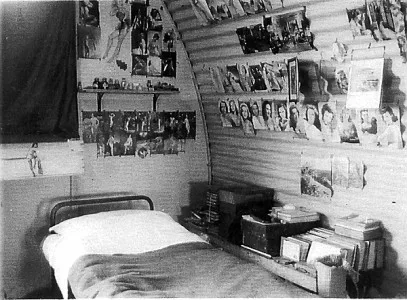
‘We found out that Metfield had been a US Army Air Force Base, where two squadrons of Flying Fortresses operated from. In all the Nissen Huts, those with the semicircular roofs, the ceilings were completely covered with pin-up pictures. My bed was just feet away from the huge Crocodile Stove, round which every evening we all clustered – as it was warm.‘
Interior of Nissan Hut 1944, Lasham
Dad specialised in the recovery of instruments from crashed planes, and was complimented by Air Chief Marshal Hugh Caswall Tremenheere Dowding, 1st Baron Dowding, GCB, GCVO, CMG on his ability to fix an instrument he had never seen before.
First published March 25th 4004 BC and republished yearly on every April Fool’s Day. The section on the meaning of April moved to my post on April 2025. On This Day added in 2026
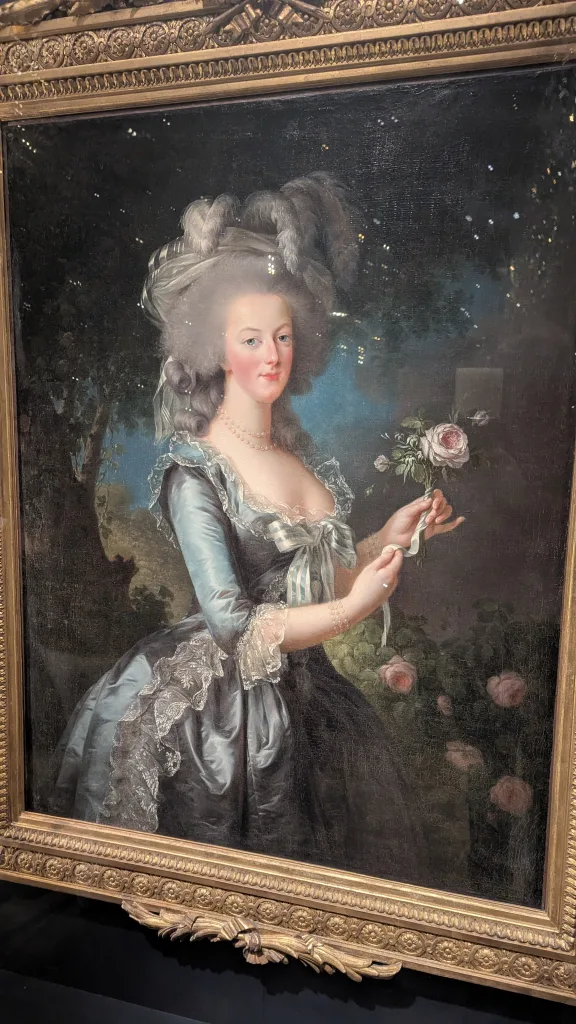
Marie Antoinette was about 28 when this portrait was made, She was about 10 years from her death by guillotine. The painting featured in the V&A’s exhibition about the Queen of France which has just finished. It was not my favourite V&A block-buster exhibition. I think mainly because I came out not knowing very much more about Marie, than when I went it. But I had seen countless extravagant dresses. Yes, she commissioned a lot of dresses, and as patron and model influenced French fashion. And, yes, she wasn’t the air-head of the ‘let them eat cake’ version of history. But I’m not much the wiser.
I’m more interested in the painter, Élisabeth Vigée Le Brun. This is what Wikipedia says about her:
‘She enjoyed the patronage of European aristocrats, actors, and writers, and was elected to art academies in ten cities. Some famous contemporary artists, such as Joshua Reynolds, viewed her as one of the greatest portraitists of her time, comparing her with the old Dutch masters.’
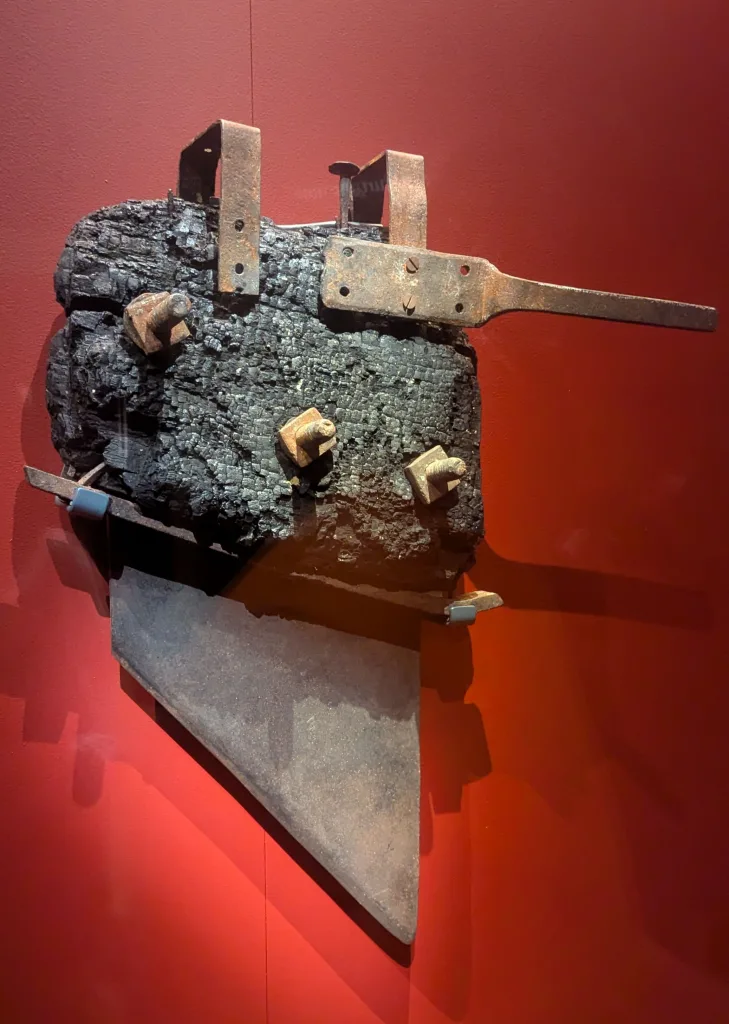
And I have never heard of her, I’m fairly sure nor have you! You might like to see my post on 17th female painter Mary Beale. My original shortlist for Object of the Day were these two items from the Exhibition:
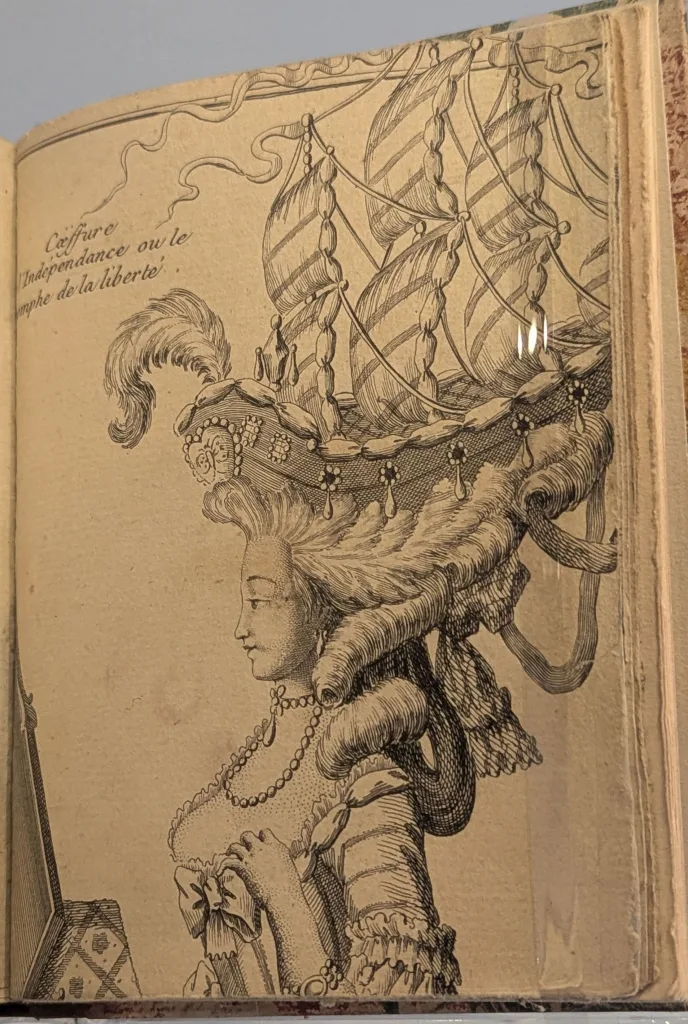
Guilotine blade from the French Revolution, purchased by the sons of Madame Tussaud as the blade that killed Marie Antoinette. Photo Kevin FludeSketch of the Triumph of Liberty Hairdress, associated with Marie Antoinette. It is her most famous headress. Created to celebrate the victory of the French over the British Navy in the American War of Independence.
Both these objects did no favours to the Queen’s neck! And lastly, those a few of those dresses:
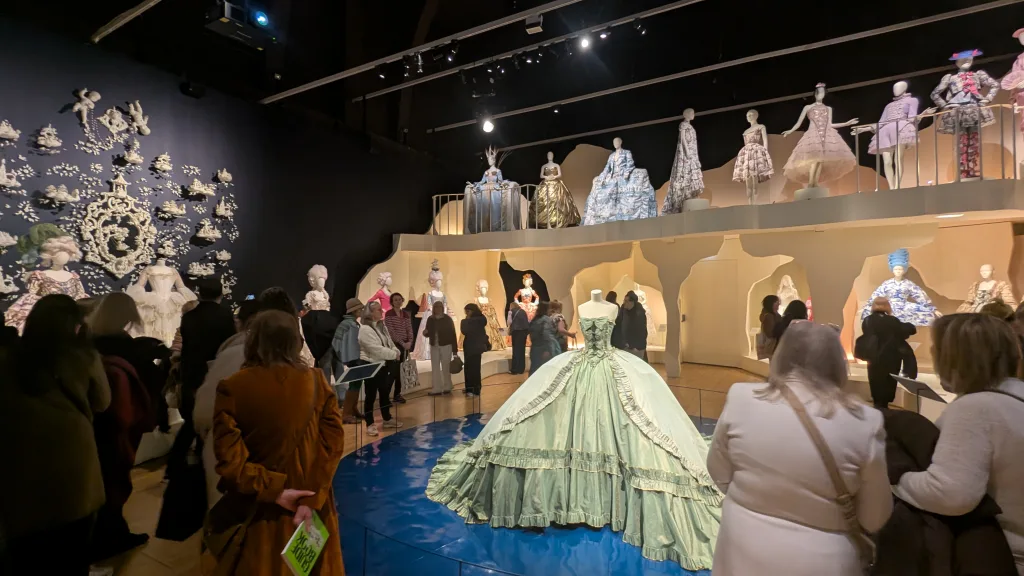
Centre piece of the V&A exhibition on Marie Antoinette, photo K Flude.
The Stormy Borrowing Days of March
Sir Walter Scott recorded that ‘the last three days of March are called the borrowing days; for as they are remarked to be unusually stormy, it is feigned that March has borrowed them from April to extend his sphere of his rougher sway.’
There are various traditions and poems that record the borrowing days, and this is in the Scotch dialect:
March borrowed from April Three Days, and they were ill: The first was frost, the second was snaw, The third was cauld as ever’t could blaw.
The Borrowing Days in Spain
There is a Spanish story which explains this a little more. A shepherd asked March to calm the winds to suit his flock of sheep, in return for a lamb. March compiled but, then, the Shepherd refused to hand over the lamb. So, March borrowed three days from April and made them fierce and stormy. Versions of this tale are known from Staffordshire, North England and Scotland. (Source ‘Weather Law’ by Richard Inwards 1994 (first published 1893).
Warm days at the end of March or the beginning of April bring the Blackthorns into bloom. This can be followed by a cold snap which is known as a ‘Blackthorn Winter.’
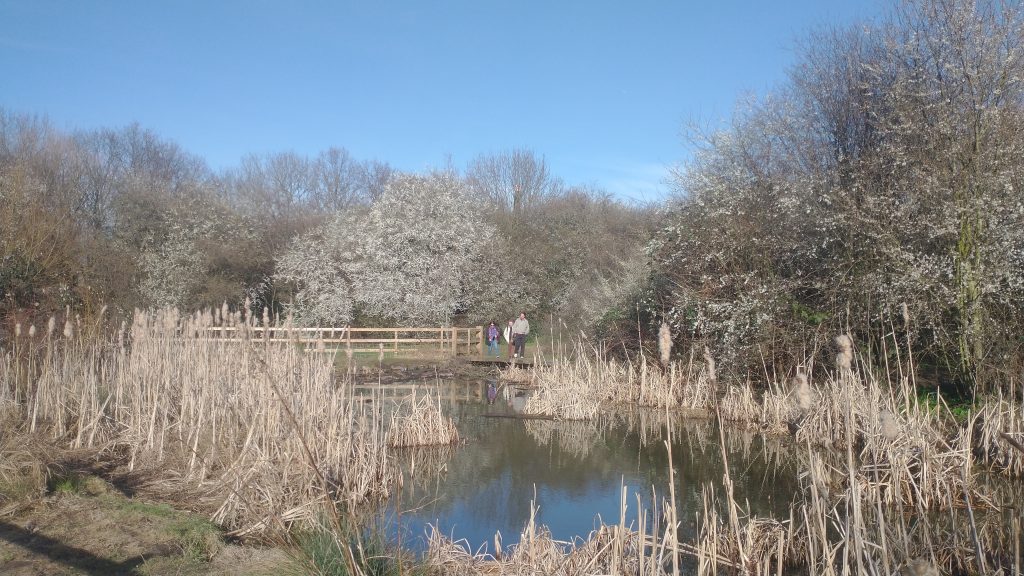
February 2023 in Haggerston Park, London showing early blossom (Blackthorn?) Photo K Flude
For more on blossom and Haggerston Park follow my link to haggerston-park/
On This Day.
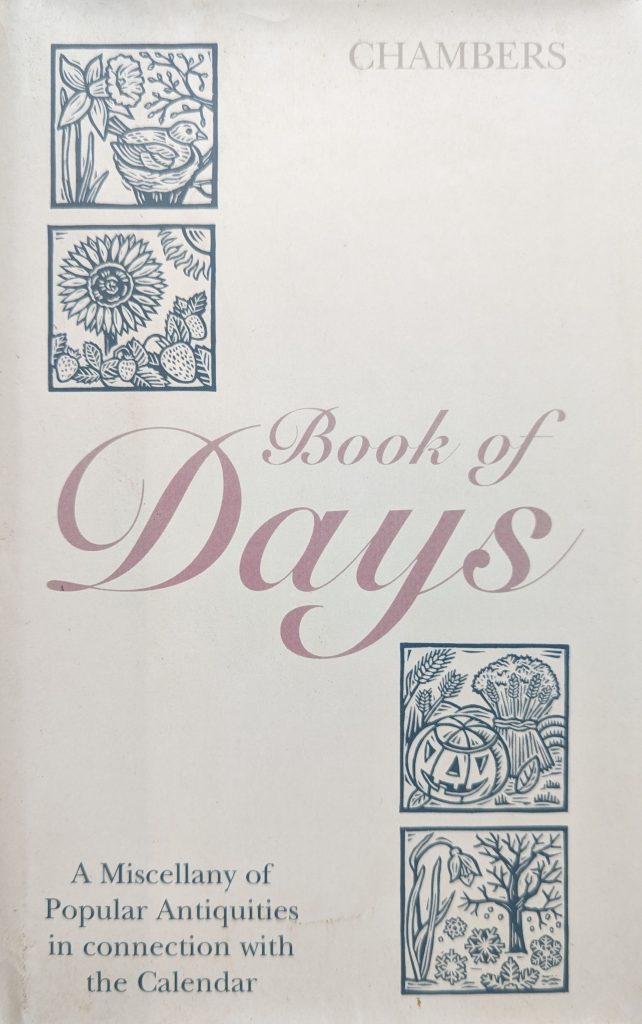
Photo of cover of Chambers Book of Days
2024– I purchased the Chamber’s Book of Days, updated from the original 1864 publication, and began adding occasional ‘On This Day’ epilogues to my posts.
1461– The Battle of Towton, England’s bloodiest battle, in which Edward IV defeated the Lancastrian forces of Queen Margaret, thus securing the throne for the Yorkists. Margaret, her husband, Henry VI, and son, fled to Scotland.
1871 – Official Opening of the Royal Albert Hall
1912 – Captain Scott’slast entry in his diary.
‘We shall stick it out to the end, but we are getting weaker, of course, and the end cannot be far, It seems a pity, but I do not think I can write more.’
The Celtic Year showing Imbolc, the new Irish Bank Holiday
I just came across this which I published last in 2023. I should have republished it last weekend. But here it is. The Irish created a brand new Bank Holiday for St Bridget. The first one was Monday 6th February 2023. It followed a public holiday given in 2022 for Health Workers in March. The timing of the Bank Holiday is explained by the Irish Post:
St Brigid’s Day itself falls on February 1 each year but going forward the Imbolc/St Brigid’s Day public holiday will fall on the first Monday in February, unless February 1st falls on a Friday.
This means that Ireland now has a public holiday on the 4 Celtic festivals of Samain (Halloween), Imbolc (St Bridget’s Day), Beltane (May Day) and Lughnasa (Lammas Day). These festivals are quarter-days, which mean they fall halfway between the Solstices and Equinoxes.
The Independent wrote that ‘then-Tánaiste, Leo Varadkar, said‘ ….“This will be the first Irish public holiday named after a woman.” He also is quoted as saying:
“It marks the half-way point between the winter solstice and the equinox, the beginning of spring and the Celtic New Year.”
Extra Bank Holidays in the UK?
There are occasional calls for a new Bank Holiday in the UK. It’s often a Conservative MP calling for a National Day for the British. More often than not they suggest Trafalgar Day 21st October would be a suitable date. This commemorates the great Naval battle in 1805 in which Nelson was fatally wounded. It has several virtues in their eyes. Firstly, it is a day that confirmed Britain’s mastery of the Seas , an ideal day for celebrating patriotism. Secondly, it is the school half-term, and gives a much-needed day off between summer and Christmas. Thirdly, they can propose the day should be taken from the May Day Bank holiday. This coincides with the International Worker’s Day, which is obviously ‘a bad thing’.
Here is an example: the MP for Portsmouth MP’s supported a call for Trafalgar Day here: . The report says: ‘there are currently no bank holidays in the UK which celebrate battles or war victories’. (Portsmouth News 2016).
This, I think, leaves the rest of us thinking: ‘What planet do these people live on?’ Yes, Trafalgar Day would have been a great day for a Bank Holiday, if this were 1839. Maybe even 1939. But now Trafalgar is just not on any ordinary person’s radar. We don’t think so very much about the Napoleonic War or Nelson. Nor do we often sing ‘Heart of Oaks, are our Men’ any more. In short, it is a reminder how distant from the rest of us some MPs are. By contrast, how progressive Ireland seems.
Productivity
The Trade Union Congress proposed the need for more bank holidays. We only have the usual eight annual bank holidays for workers in England and Wales. Scotland has nine or ten; the average for the EU is ‘12.3 bank holidays a year. Finland and Romania get 15, while workers in Japan have 16 public holidays in total’.
A radio programme ‘The Bottom Line’ compared productivity in Britain and France. It revealed that Britain is now 20% less productive than France, (10% worse since Brexit). And how do we make up that productivity deficit? Yes, indeed, by working longer hours for lower wages. It appears that the French high tax, high workers’ protection regime, means they have to find ways of getting more out of their workers in their working hours. While we can just hire and fire, and are happy to make people work in a more inefficient way. Strange isn’t we are told that the French economy is a victim of socialism. Turns out Socialism is more productive.
This was 5 years after his death. It is now celebrated around the world, making clear the importance of Robert Burns. Burns himself would have been astonished at the spread of Burn’s Night. He was modest about his attainments, saying, in his introduction to the Commonplace Book:
‘As he was but little indebted to scholastic education, and bred at a plough-tail, his performance must be strongly tinctured with his unpolished rustic way of life. ‘
Fair fa’ your honest, sonsie face, Great Chieftain o’ the Puddin-race! Aboon them a’ ye tak your place, Painch, tripe, or thairm: Weel are ye wordy of a grace As lang ‘s my arm.
The groaning trencher there ye fill, Your hurdies like a distant hill, Your pin wad help to mend a mill In time o’ need, While thro’ your pores the dews distil Like amber bead.
His knife see Rustic-labour dight, An’ cut ye up wi’ ready slight, Trenching your gushing entrails bright, Like onie ditch; And then, O what a glorious sight, Warm-reekin, rich!
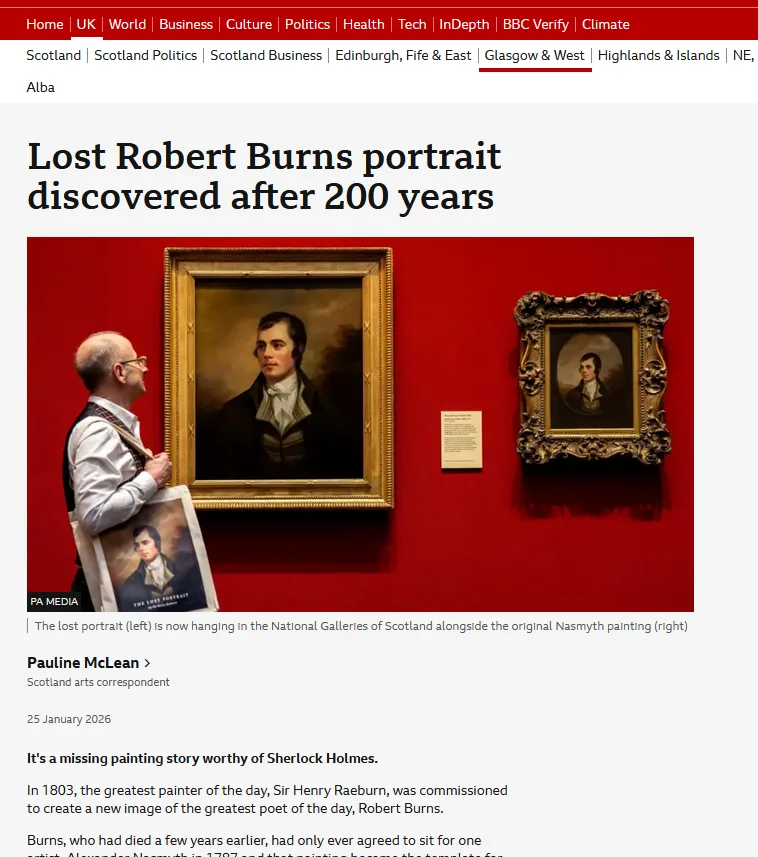
Recently, a long lost portrait of Burns turned up and it provides an image of the poet as a young man. The story is interesting and worth reading here:
Screenshot of BBC web page on the lost portrait of Robert Burns.
The Writer’s Museum
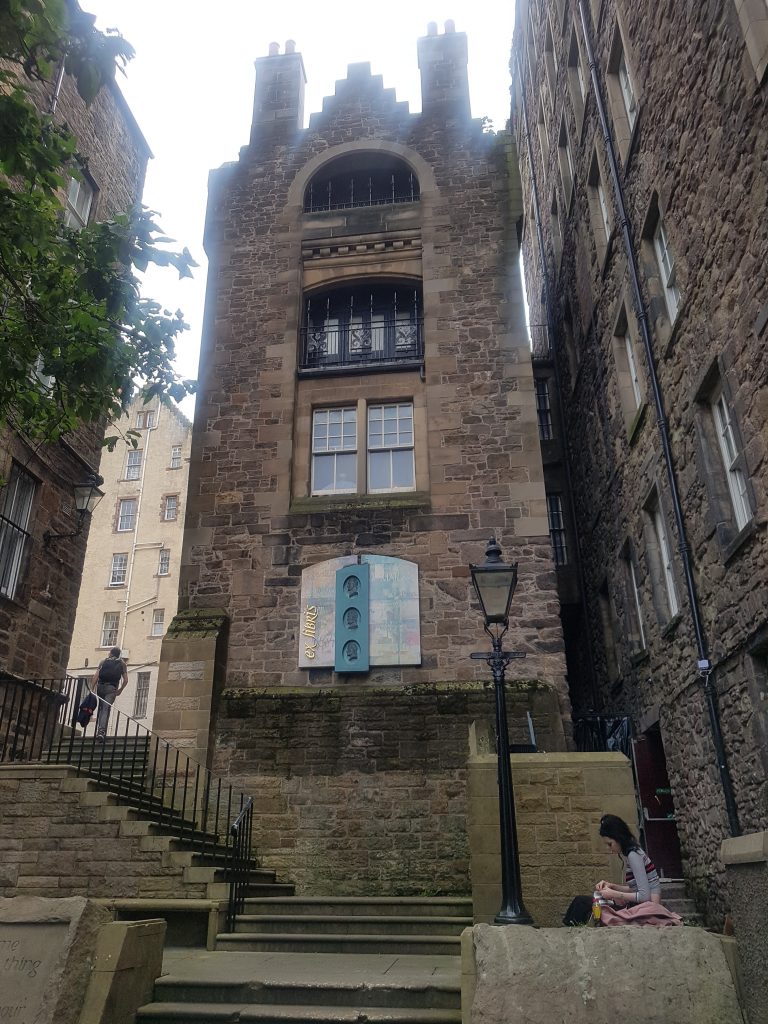
Writers’ Museum photo K. Flude
Often bypassed by the tourists on a visit to the wonderful City of Edinburgh is the Writer’s Museum. It is in one of those remarkable Tower houses which seem unique to the High Street in Edinburgh. Inside, it gives a great introduction to the great writers of Scotland.
‘Is it not strange’ wrote philosopher David Hume in 1757 ‘that a time when we have lost our Princes, our Parliament, Independent Government …..that we shou’d really be the people most distinguish’d for literature in Europe?’ (source: Museum display panel)
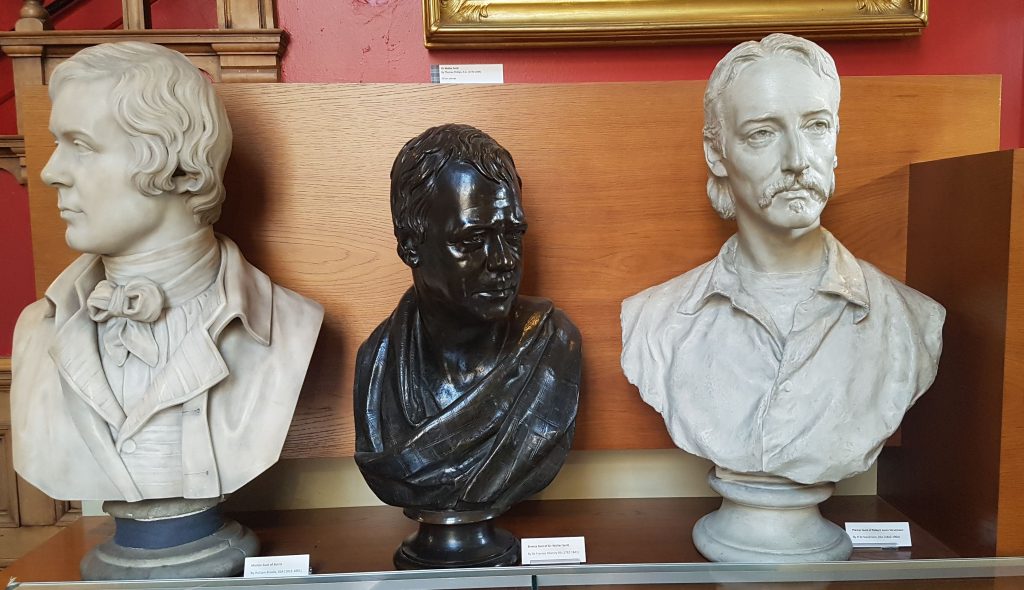
Edinburgh Writer’s Museum Burns, Scott, Stevenson.
A Visual for Burn’s Night ‘Window in the Writer’s Museum, Edinburgh’ Photo by K Flude
1784 – The death in Edinburgh of Alexander Webster, a writer and church minister who is best remembered for the country’s first census. The first UK census was in 1801.
1817 – The Scotsman newspaper publishes its first edition in Edinburgh.
2012 – First Minister Alex Salmond launches a consultation on the SNP Government’s proposals for a referendum on Scottish independence. on the question “Should Scotland be an independent country?”. The voters answered “No” 55.3% and 44.7% voting in favour. (for more on Scottish Independence, see my post here.)
Gervase Markham was born in 1568, in Nottinghamshire, and was a prolific writer. Today, prompted by the Perpetual Almanac by Charles Kightly, I am looking through Markham’s eyes at Apples. Apples were an important source of joy as well as nutrition through a cold winter, as fresh produce became unavailable.
Markham wrote detailed books for use by the householders, the Husbands and the Housewives. And with the coming of frost, the survival of food in your food store might depend upon reading Markham’s books. When the frosts hit, as they are now doing in the UK, you had to look after your store of apples. They were an important sweet food source over the winter.
For the women, he wrote the English Housewife, published in 1615. Here is his recipe for Apple Tart.
For the Housewife How to Make Apple-tart
Take apples and peel them and slice them thin from the core into a pan with white wine, good store of sugar, cinnamon and rosewater, and so boil it all shall it be thick. Then cool it and strain it, and beat it very well together with a spoon, and then put it into your coffin or crust and bake it. It carrieth with the colour red.
Gervais Markham, the English Housewife 1683 version (quoted by Charles Kightly).
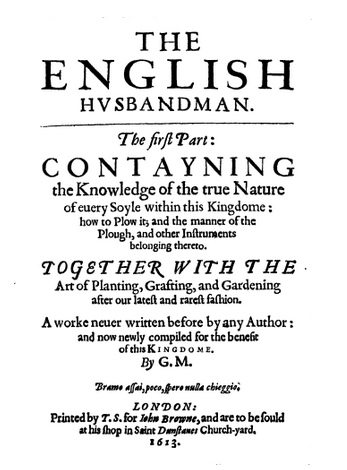
For the men, he wrote the English Husbandsman, published in 1613 and ‘Printed by T. S. for Iohn Browne, and are to be sould at his shop in Saint Dunstanes Church-yard.’ This is the St Dunstan’s in Fleet Street, I think (near Sweeney Todds, the Barbers.) The book is available on Project Gutenberg (Gervase Markham the English Husbandman. Project Gutenberg).
So to the frost – Markham ends his extensive piece on the best way to store apples as follows:
To keepe Fruit in frost. If the frost be very extreame, and you feare the indangering your fruit, it is good to couer them somewhat thicke with fine hay, or else to lay them couered all ouer either in Barley-chaffe, or dry Salte: as for the laying them in chests of Iuniper, or Cipresse, it is but a toy, and not worth the practise: if you hang Apples in nettes within the ayre of the fire it will kéepe them long, but they will be dry and withered, and will loose their best rellish.
I remember my Grandmother would store her excess apples from the tree, wrapped in paper and stored in cupboards in the pantry or outbuilding. They were often wrinkled but always delicious, and I think were Russets, which remain my favourite apple.
At the bottom of the piece, I include the rest of Markham’s advice for storing apples. To summarise it: Don’t store them near the ground. Place them on shelves ordered by variety based on which variety lasts longest. So at the back will be the long-lived species such as Russets and Pippins, to eat as spring approaches. The front the ones you need to eat now such as the ‘Costard, Pome-water, Quéene-Apple‘ varieties.
Marocco, Pocahontas and the Rhino – performing at the Bell Savage
Markham wrote many books, including one on the famous performing horse Marocco. He starred in shows at the Bell Savage, just outside Ludgate in the City of London. The horse would whinny in triumph with the naming of an English King. But snort with derision with the naming of a Pope. He could also count and add up. He was rumoured to have been burnt at the stake as a witch in Edinburgh. But this does not appear to be true. Also, appearing at the Bell Savage in the 17th Century was a Rhinoceros, other prodigies and Pocahontas.
How to Keep Apples extended version
For a more modern text on what to do with excess apples from your tree, have a look here. However, do read on to get an insight into life and the varieties of Apples that were eaten in the 17th Century.
The place where you shall lay your fruit must neither be too open, nor too close, yet rather close then open, it must by no meanes be low vpon the ground, nor in any place of moistnesse: for moisture bréedes fustinesse, and such naughty smells easily enter into the fruit, and taint the rellish thereof, yet if you haue no other place but some low cellar to lay your fruit in, then you shall raise shelues round about, the nearest not within two foote of the ground, and lay your Apples thereupon, hauing them first lyned, either with swéet Rye-straw, Wheate-straw, or dry ferne: as these vndermost roomes are not the best, so are the vppermost, if they be vnséeld, the worst of all other, because both the sunne, winde, and weather, peircing through the tiles, doth annoy and hurt the fruit: the best roome then is a well séeld chamber, whose windowes may be shut and made close at pleasure, euer obseruing with straw to defend the fruit from any moist stone wall, or dusty mudde wall, both which are dangerous annoyances.
The seperating of Fruit. Now for the seperating of your fruit, you shall lay those nearest hand, which are first to be spent, as those which will last but till Alhallontide, as the Cisling, Wibourne, and such like, by themselues: those which will last till Christmas, as the Costard, Pome-water, Quéene-Apple, and such like: those which will last till Candlemas, as the Pome-de-roy, Goose-Apple, and such like, and those which will last all the yéere, as the Pippin, Duzin, Russetting, Peare-maine, and such like, euery one in his seuerall place, & in such order that you may passe from bed to bed to clense or cast forth those which be rotten or putrefied at your pleasure, which with all diligence you must doe, because those which are tainted will soone poyson the other, and therefore it is necessary as soone as you sée any of them tainted, not onely to cull them out, but also to looke vpon all the rest, and deuide them into thrée parts, laying the soundest by themselues, those which are least tainted by themselues, and those which are most tainted by themselues, and so to vse them all to your best benefit.
Turning your Fruit
Now for the turning of your longest lasting fruit, you shall know that about the latter end of December is the best time to beginne, if you haue both got and kept them in such sort as is before sayd, and not mixt fruit of more earely ripening amongst them: the second time you shall turne them, shall be about the end of February, and so consequently once euery month, till Penticost, for as the yéere time increaseth in heate so fruit growes more apt to rot: after Whitsontide you shall turne them once euery fortnight, alwayes in your turning making your heapes thinner and thinner; but if the weather be frosty then stirre not your fruit at all, neither when the thaw is, for then the fruit being moist may by no meanes be touched: also in wet weather fruit will be a little dankish, so that then it must be forborne also, and therefore when any such moistnesse hapneth, it is good to open your windowes and let the ayre dry your fruit before it be turned: you may open your windowe any time of the yéere in open weather, as long as the sunne is vpon the skye, but not after, except in March onely, at what time the ayre and winde is so sharpe that it tainteth and riuelleth all sorts of fruits whatsoeuer.
1799 – Income Tax introduced for the first time by Prime MinisterWilliam Pitt the Younger at the rate of two shillings to the pound. This novel tax was used to pay for the war against Napolean.
1806 – Huge numbers attend Funeral and internment in St Pauls of Horatio Nelson, Killed at the Battle of Trafalgar.
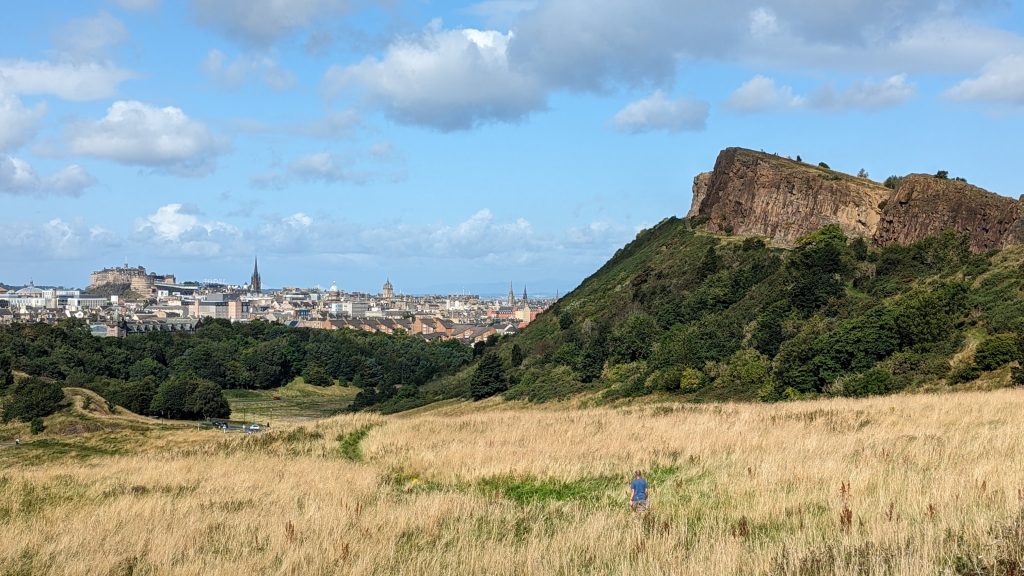
Edinburgh from Arthur’s Seat. Castle to the left, St Giles the ’rounded’ spire in the middle, and Salisbury Crags to the right
Strange Case of Dr Jekyll and Mr Hyde by Robert Louis Stevenson
This is my select booklist for Edinburgh, one of my favourite towns. Strangely, heading it up is a book based in London, and written in Bournemouth. However, Stephenson’s Strange Case of Dr Jekyll and Mr Hyde is a very Edinburgh book but published in London on January 9th 1886.
What makes it fit for an Edinburgh booklist? Firstly, Edinburgh is the best place for a science-based Gothic Horror Novella. A City made for Ghost Tours, but with a scientific legacy arguably second to none. One of the inspirations for the book was the story of Deacon Brodie. He was a cabinetmaker who rose to be Deacon (president) of the craft of cabinetmaking. Therefore, he had wealthy clients and was impeccably respectable. When he went to his clients houses, or made them locked cabinets, he would copy the locks using wax moulds. Then he and his team would rob the house. He hid a cache of keys underneath Salisbury Crags which you can see above.
To cut a long story short, he made an attempt on robbing the Excise Office in Canongate, Edinburgh, on March 5th 1788. The heist failed, one of the robbers turned King’s Evidence. So Brodie fled to one of his mistresses in London, then to the Continent. But he was relentlessly pursued and captured in Amsterdam. He was brought back to face trial, found guilty, and hanged on a new scaffold, which he may just have had a part in designing.
Stevenson had cabinets made by William Brodie and as a young man produced a play about him. He was intrigued by the idea of a wealthy man having a dual life. The idea itself, seems obvious but the expression a ‘Jekyll and Hyde’ character is still often used to describe someone with two opposing sides to their characters. The idea of duality provides many ways to look at the book. Edinburgh itself was a duality. There was the old, filthy, higgledy-piggledy Old Town on top of the Volcanic Ridge, with the spacious New Town in the Valley below, with modern wealthy houses providing healthy homes for the rich. The idea of Two Cities, of the rich and the poor; the good and the evil; rationality and sensuality; hetero and homosexual fits well with Victorian Britain, but perhaps best into Victorian Edinburgh, the City of Burke and Hare. These famous Edinburgh serial killers were working for one of Europe’s greatest medical centres, where debate about Darwinism, and the powers of the brain were hotly debated in a City with a strong Presbyterian background.
In Bournemouth, Stevenson befriended the former Reverend Walter Jekyll, younger brother of gardener Gertrude Jekyll. He was probably homosexual and the author borrowed the name for the rational part of Jekyll and Hyde. At a time when to be gay was a crime, most gay people had to live a Jekyll and Hyde existence. In fact, Sodomy was a capital offence in Scotland until the year after the publication of the ‘Strange Case of Dr. Jekyll and Mr. Hyde.
Strangely, in a book list I would encourage you to watch the 1920 silent film starring John Barrymore to enjoy its ghastly atmosphere. You can watch it for free on YouTube here.
Ian Rankin’s Rebus
Ian Rankin is a typographical author of the highest rank. Every story brings Edinburgh, its people and its history to life. And yet set in a very readable crime fiction envelope. The Rebus I chose was ‘Set in Darkness‘ because it has the Scottish Parliament at its heart. It begins with a body found in Queensbury House, which is being preserved and incorporated into the new Scottish Parliament buildings. Please read my post on the book (link below).
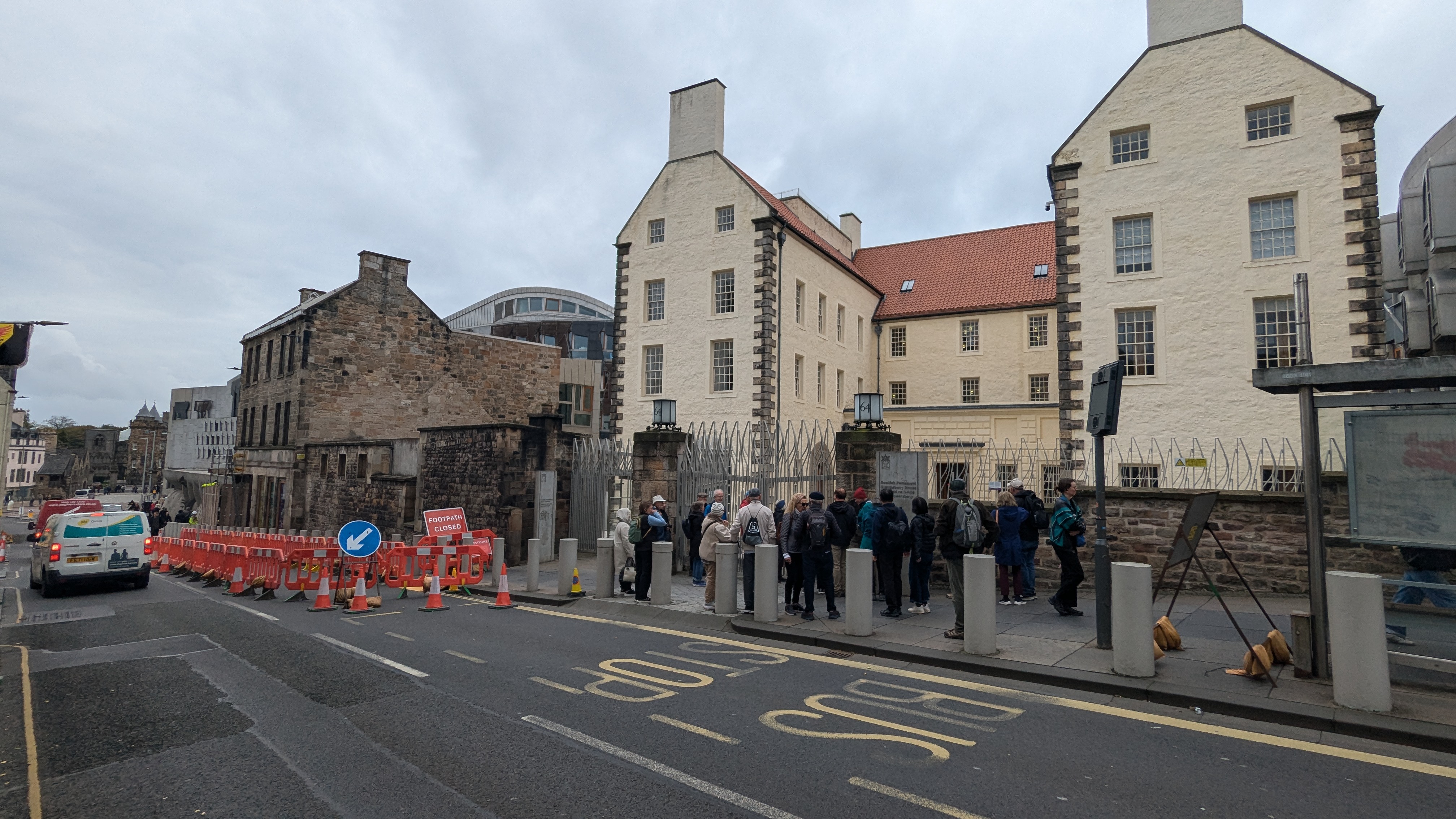
Queensberry House to the right, with the Scottish Parliament in the background. Royal Mile, Cannongate in the foreground. (Photo: K. Flude)
Recently published is ‘Edinburgh a New History’ by Alistair Moffat. This is an excellent summary of Edinburgh’s History. He has written a large number of books about Scotland. I particularly liked ‘Reivers‘ which is a great book about the border raiders, both North English and Scottish who raided the borderlands between Edinburgh and York during the 13th to the 17th Centuries. They inspired the young Walter Scott, who collected Reivers ballads before inventing the Historical Novel.
As to Walter Scot, our Blue Badge Guide for Edinburgh, considers his long descriptive passages unreadable. But I’m not so convinced, having read Ivanhoe and Rob Roy as a boy. But if I were to recommend a Walter Scot, it would be Heart of Midlothian as it is set in Edinburgh and deals with crime, poverty, urban riots and other manifestations of life in Edinburgh in the 18th Century.
Midlothian is the country around Edinburgh, named after the legendary Celtic King Loth. The Heart of Midlothian, is Edinburgh or more precisely, a heart marked out in the cobbles. It is located outside of St Giles, on the Royal Mile, where the Tollboth (townhall and prison) and execution site for the City used to be. To this day, Edinburghers (or more correctly, Dunediners) are supposed to spit on the heart for good luck.
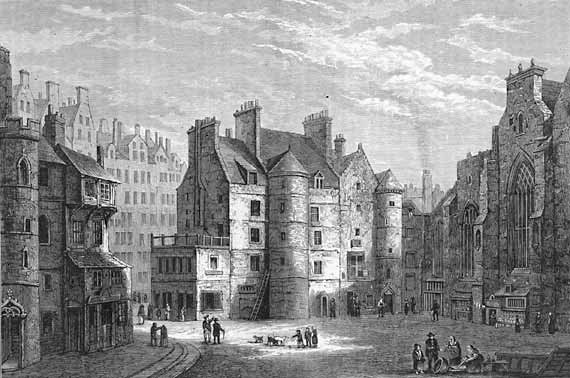
Old Print of the Tollbooth with St Giles to the right of the print.
It is hard to exaggerate the importance of Walter Scot. Byron said he had read his books 50 times, and never travelled without them. Goethe said ‘he was a genius who does not have an equal.’ Pushkin said his influence was ‘felt in every province of the literature of his age. Balzac described him as ‘one of the noblest geniuses of modern times’. Jane Austen and Dickens loved his books. The point is he invented the Historical Novel, and for the first time, as Carlyle wrote, he showed that history was made by people ‘with colour in their checks and passion in their stomachs.’ The only other person I can think of who was held in such universal regard was Tolstoy. There is also sense in which Scott invented our modern idea of Scotland, with its kilts and bagpipes.
The Scottish Enlightenment
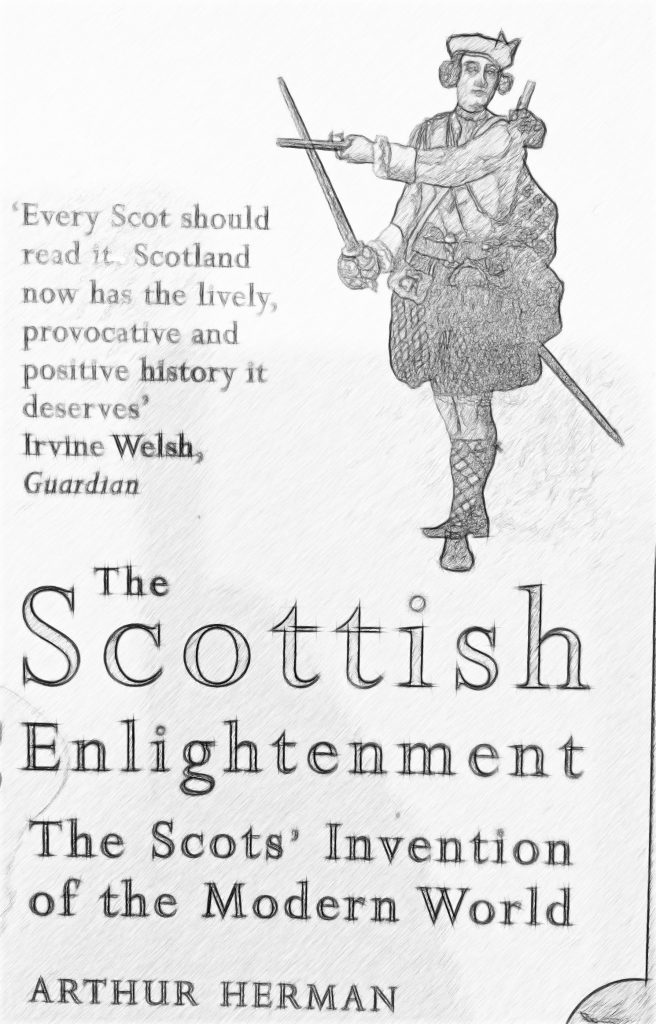
A walk through the centre of Edinburgh has so many statues of people who made the modern world it is astonishing. So you should read: ‘The Scottish Enlightenment – the Scots Invention of the modern world‘ by Arthur Herman.
Burke and Hare: The True Story Behind the Infamous Edinburgh Murderers by Owen Dudley-Edwards
The story of Burke and Hare is well known, but it shows how important Edinburgh was as a medical centre in the early 19th Century. Bodies were shipped to Edinburgh from the London docks, such was the demand for bodies for anatomy teaching. Arthur Conan Doyle got his medical training here from a man called Joseph Bell, whose logical mind was the model for Sherlock Holmes.
The Prime of Miss Jean Brodie
My last choice is Murial Spark’s The Prime of Miss Jean Brodie set in a school in Edinburgh where the teacher singles out 6 of her pupils for special education. She wants to give them a cultured outlook in life which includes her own fascistic views. Made into a wonderful film starring Maggie Smith, but also a great book. It also, in a strange way, reinforces the huge legacy of the Scottish Education system. It is said that the Reformation brought to the Scots the idea that everyone should be educated enough to read the Bible in their own language. But it seems to me the Scots had a particular understanding of the importance of Education before the Reformation. St Andrews University was founded in 1410, Glasgow in 1410, Aberdeen in 1495 and Edinburgh in 1510.
Of course, you should read some poetry by Burns, and I would begin with Tam O’Shanter the story of Tam, Maggie his horse and Nannie, the witch with the short skirt (Cutty Sark). The version above (see link) is read over a comic novel of the poem. But if you prefer the words, this is the one I read for my groups where I ruin the Scots dialect, and disgrace myself, but oh how I enjoy it! www.poetryfoundation.org tam-o-shanter
Thursday 1st January 2026 7.30pm . On this Virtual Walk we look at how London has celebrated the New Year over the past 2000 years.
The New Year has been a time of renewal and anticipation of the future from time immemorial. The Ancient Britons saw the Solstice as a symbol of a promise of renewal as the Sun was reborn. As the weather turns to bleak mid-winter, a festival or reflection and renewal cheers everyone up. This idea of renewal was followed by the Romans, and presided over by a two headed God called Janus. Janus looked both backwards and forwards. Dickens Christmas Carol was based on redemption. His second great Christmas Book ‘The Chimes’ on the renewal that the New Year encouraged.
We look at London’s past to see where and how the New Year was celebrated. Why did different societies have different New Years we use? How were their calendars arranged – the Pagan year, the Christian year, the Roman year, the Jewish year, the Financial year, the Academic year. We look at folk traditions and New Year London customs. Medieval Christmas Festivals, Boy Bishops, Lords of Misrule, Distaff Sunday and Plough Monday, and other Winter Festivals
At the end, we use ancient methods to divine what is in store for us in 2026..
The virtual walk finds interesting and historic places in the City of London to link to our stories of Past New Year’s Days. We begin, virtually, at Barbican Underground. Continue to the Museum of London, the Roman Fort; Noble Street, Goldsmiths Hall, Foster Lane, St Pauls, Doctors Commons, St. Nicholas Colechurch and on towards the River Thames.
On the seventh day of Christmas My true love sent to me: 7 Swans a Swimming; 6 Geese a Laying; 5 Golden Rings; 4 Calling Birds; 3 French Hens; 2 Turtle Doves and a Partridge in a Pear Tree
First Footing on New Year’s Eve
The first person to set foot into your house needs to be a ‘Tall, well-made man’. Dark-haired men are preferred to fair-haired, but he must not be dressed in black, nor be from the ‘professions’ (those people who can counter-sign your passport). He must not carry a knife, but he must bring gifts, particularly a loaf of bread, a bottle of whisky, a piece of coal or wood, and a silver coin. Silence is to welcome him to the house until he puts the coal on the fire, pours a glass of the whisky and greets the family.
He will bring in the luck through the front door on the stroke of midnight; the bread symbolising that you will be well-fed, the fuel that you will be warm and safe, the whisky that you will have fun and the coin will bring prosperity. Your first-footer will take the old year and its bad-luck out of the back door when he leaves.
An Irish tradition is that you should open your front door at Midnight to let the old year out and the New Year in. Perhaps, open the back door to let the old year out and the front door to let the New Year in.
Burn the Calendar First wind in nine Times round with red Wool and thread
Cast into the flames And say:
Burn, burn, burn Old Day Book, Burn! Old year’s troubles Never Return Ka!
Clean the house And do the first footing With silver, bread and a piece of coal or charchoal
Old Rhyme
Hogmanay – Holy Month or New Morning
Is the Scottish name for New Year’s Eve. There is no certain explanation of the word. But it has been suggested it comes from the Ancient Greek for Holy Month (or from the Anglo-Saxon for Holy Month). Or the Gaelic word for Oat Cakes or from the Middle French word for mistletoe (aguillanneuf = meaning “to the mistletoe be the new year”). Perhaps, it is named from the great giant Gogmagog. Or from Norse, or Scots. or any number of other possibilities. See Wikipedia for more guesses.
Hogmanay was celebrated all the way down to Richmond in North Yorkshire. (Remember that Northumbria used to control North Britain up to and including Edinburgh, and sometimes into Fife. ) The vividness of the Scottish Celebration, may simply stem from the Scottish temperament. But it is often proposed that it stems from a Presbyterian tradition in Lowland Scotland, which disapproved of the superstition that was Christmas. So all that Christmas Joy was transferred to the New Year Celebrations.
Wassail in the Orchard
On New Year’s Eve, wassailers went to the oldest tree in the apple orchard. There they poured a liberal dose of wassail over the roots of the tree. Then they pulled down the branches to dip the end of the branches in the punch. They decorated the tree, and then drank the cider based wassail themselves.
We wish you a merry Christmas, a Happy New Year A pocket full of money, and a cellar full of beer A good fat pig to last you all the year Please to give us a New Year’s Gift. (Radnorshire song)
For more on Wassail, see the bottom half of my post here.
New Year Weather Prophecy
The weather today will be reflected on the 7th month, according to Gervase Markham. First Day of the 12 Days of Christmas prefigures the weather in January and the 12th Day that in the following December. So we are going to have a cool, sunny winter, and a sunny June, July, August, by the looks of the weather forecast.
Or as a Scottish Rhyme has it (quoted in the Perpetual Almanac)
If New Year’s Eve night-wind blow south That betokens warmth and growth If west, much milk, and fish in the sea If North, much cold and storms will be If east, the tress will bear much fruit. If north-east, flee it, man and brute,
The wind is currently varying between West and West North West. So it would seem we are in for a year of much milk and fish in the sea, with the occasional cold storm? .
New Year Reflections
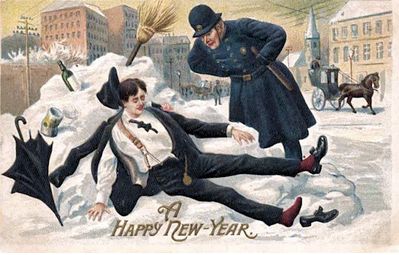
Victorian New Year’s Card
This is a day of preparation, and perhaps of anxiety. Have we got an invitation from anyone tonight? Is anyone going to come to our party? Can I take another blow-out feast, a belly full of alcohol and a very late night? I’ve just lost my Christmas weight, and you want me to come for a big feast?
My first memories of New Year’s Eve were spent with the parents watching some inexplicable variety show hosted in Scotland. Google has helped me remember that it was the ‘White Heather Club’ hosted by Andy Stewart. Up to 10 million people watched this between 1960 and 1968. I never understood the pleasure of it. To my rebellious teenage soul, it seemed a symbol of an old-fashioned world that was passing and irrelevant.
More recently, if not spent at a party, New Year’s Eve is often spent with Jools’ Annual Hootenanny, which is a music show masquerading as a live New Year’s Eve party. It features really excellent bands and singers. It is, however, recorded earlier in December (15th, 20th are dates I have seen) and hence a New Year’s fake. Here is a 2007 excerpt staring Madness’s ‘House of Fun’. The fun of this is to spot the stars grooving along to the music.
New Year’s Preparation
New Year’s Day needs a lot of preparation. Folklore suggests that this should include finishing off any unfinished work or projects, as a task carried forward is ill-omened. Your accounts for the year should be reconciled. As Charles Dickens suggests in the Chimes, his second Christmas Book, your moral account should also be addressed. So you can come into the New Year with a clean slate, good conscience and plans for a better new year. And don’t we all require that for 2025!