In England, we have a saving ‘never cast a clout while May is out’. There are two explanations, one is that you should not put your coat away until the end of May. Once it snowed in June, so it is good advice.
But it can also mean keep a coat at hand while the May flowers (Hawthorn) are still out. Not much difference between the two meanings of the saying, but if it’s hawthorn’s May flower that are the arbitrator of when coats go away, then that will normally be earlier in May. Here is the entire saying:
Button to Chin, till May be in
Cast not a clout till may be out
For more on the Folklore of Hawthorn -see my post here.
Mayfair
Mayfair is one of the world’s great shopping centres. Or, to put it another way, a shopping centre which rich people from all over the world like to shop in. I’ve not bought anything in any of the Mayfair shops, despite visiting many times on my Jane Austen Walks. (Ok the odd sandwich and bar of chocolate excepted.)
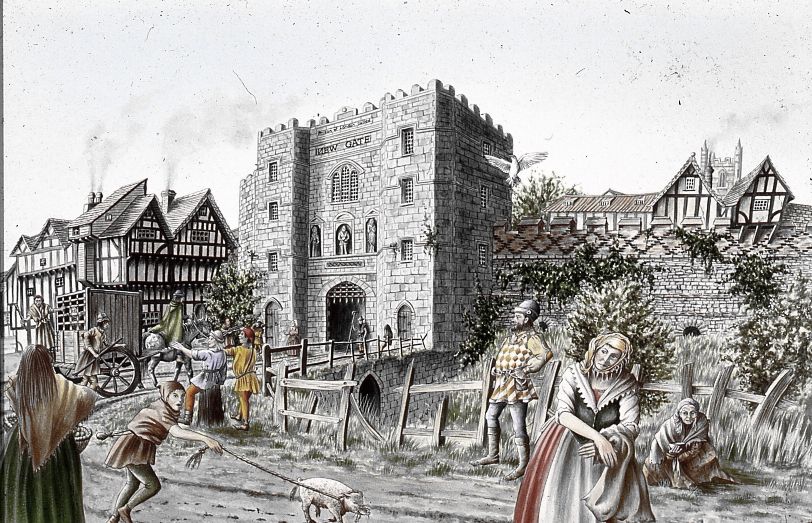
But it gets its name from London’s May Fair which took place in the area in the medieval period. It began as a fundraising event for St James Hospital. It was a hospital for young women with leprosy, until Henry VIII had it dissolved.
London historian John Stow says the
‘hospital of St. James, consisting of two hides of land, with the appurtenances, in the parish of St. Margaret in Westminster, and founded by the citizens of London, before the time of any man’s memory, for fourteen sisters, maidens, that were leprous, living chastely and honestly in divine service.’
But the first documented date is 1267, when the Augustinian monastic settlement was limited to 8 brothers and 16 sisters. In 1290 King Edward 1st granted an 7 day annual fair to help fund the hospital. It took place on the eve of St James the Less’s Feast Day. So it started on May 2nd and went on to May 8th. But later on, it became so successful that it lasted 14 days. John Stow talks of a great procession on May 8th:
‘…on the 8th of May, a great muster was made by the citizens at the Mile’s end, all in bright harness, with coats of white silk, or cloth and chains of gold, in three great battles, to the number of fifteen thousand, which passed through London to Westminster, and so through the Sanctuary, and round about the park of St. James, and returned home through Oldborne.‘
John Stow at Project Gutenberg
Rowdiness & Debauchery
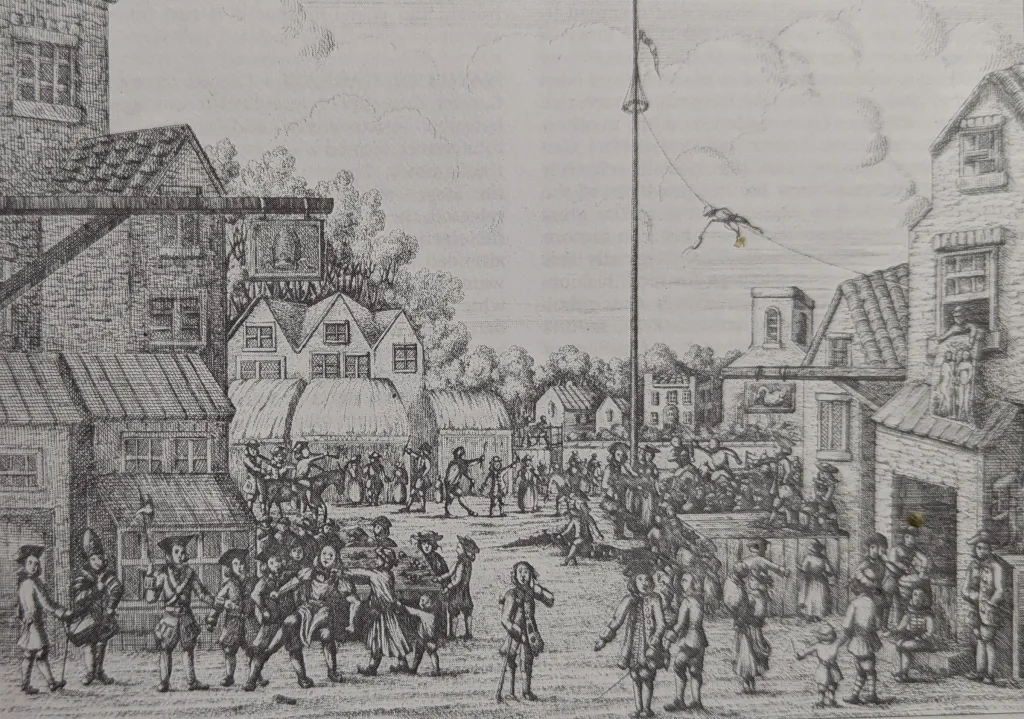
But by the 16th Century the fair itself had become a rowdy event. There were sideshows, open air performances, gambling, drunkenness, brawls, prostitutions and all the fun of the fair. They tried to close it in 1664, but it survived. In 1688 Royal permission was given for a cattle market at Brookfield near Curzon Street. This revived the fair. At the Mayfair there:
‘were booths housing puppeteers, jugglers, prize-fighters, acrobats, dancers, fire-eaters, wild animals, freaks, and all kinds of shows and sights persuading people to part with their money.’
Quote from article on the Mayfair below. Please read for an excellent description of 18th Century fun to be had at the fair. The fair finally came to an end in 1764. The area changed from being fields outside of London, to a hot area of real estate. This soon housed the great and the good of 18th Century England. One of them was the Earl of Coventry and he used his influence to stop such rowdiness in his posh neighbourhood.
First published May 8th “026
Discover more from And Did Those Feet
Subscribe to get the latest posts sent to your email.