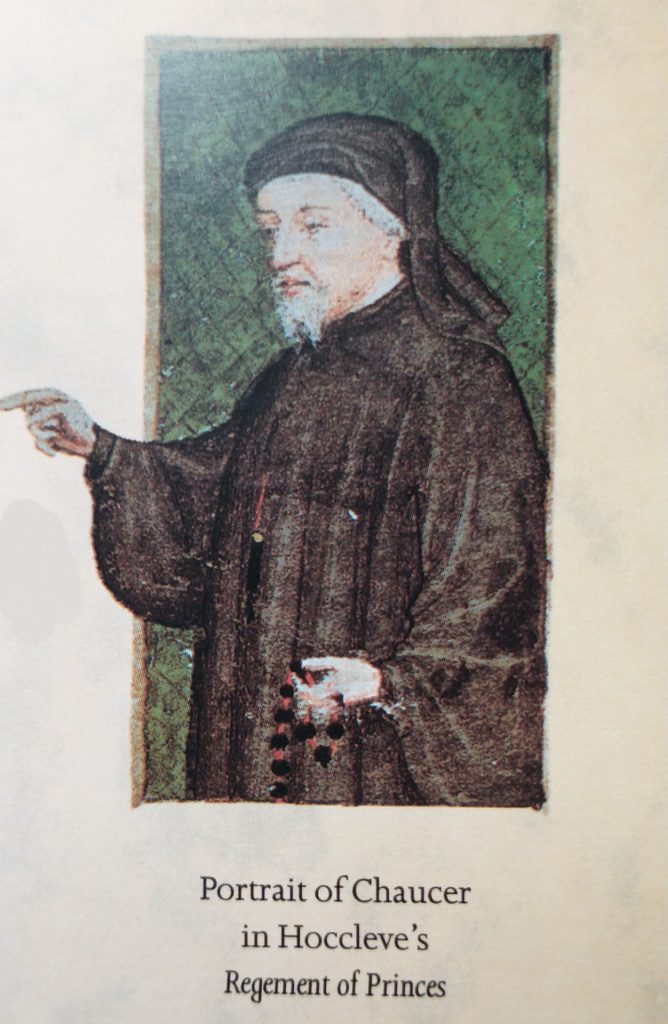
For many years, there has been a cloud over Geoffrey Chaucer’s name. On May 4, 1380, Close Rolls of the English Chancery reveals that Chaucer was released from “all manner of actions related to my raptus”. (“omnimodas acciones, tam de raptu meo”). The case involved Geoffrey Chaucer and Cecily Chaumpaigne, the daughter of a London baker.
Raptus can mean rape or kidnapping. We know he was not charged for the offence. But the original records suggest he was accused of it and possibly paid his way out of difficulty.
I attended a lecture 2 years ago relating recently discoveries by Euan Roger and Sebastian Sobecki. It shone light on the long misunderstood case, and cleared Chaucer of rape or kidnapping. The scholars were investigating medieval records, which academic opinion thought not worth pursuing.
Geoffrey Chaucer and Cecily Chaumpaigne
But in the papers they discovered that Chaucer and Cecily Chaumpaigne were on the same side in the legal dispute. Rather than being a case of Chaucer mistreating Champaigne, they were jointly accused of Raptus by her former employer, Thomas Staundon,
Taking the long view, the accusation came ultimately from the shortage of labour following the Black Death of 1348. It killed over one third of the population of the UK. With the loss of life, the ruling classes found they were having to pay higher wages to labourers, and goods. So, having control of Parliament, they passed legislation called the Statute of Labourers. This insisted that people should work at the same pay rate and conditions as before the Black Death. Labourers had to swear to keep to the old conditions, and drastic consequences, including imprisonment, awaited those who transgressed. It was one of the major causes of the Peasants Revolt of 1381. The legislation was still in use 30 years later.
So, it would seem that Cecily left her employer, Staundon, to work for Geoffrey Chaucer. Presumably at a more realistic higher pay rate. Her former employer pressed charges against her and Chaucer for breaking the financial rules and poaching a worker.
This is a very crude summary of a fascinating piece of historical detective work. To find out more, read The Chaucer Review Volume 57, Number 4, 2022 Penn State University Press. Or follow this link https://muse.jhu.edu/pub/2/article/867751
For my post of Chaucer and St Valentine’s Day follow this link.
For my post on peasants-revolt-june-13th-1381
May 4th Be With You!

This is based on the flimsy premise/play on words that ‘May the 4th be with you’ is similar to ‘May the Force be with you’. The origins of the idea are explained in detail here.
In the UK Census of 2011, 390,127 self-declared themselves as Jedi under the question about religion. However, ten years later, the number declined to a mere 1,600. The cause appears to be a call from the Humanists that it was important to record the large number of people who were of ‘No religion’. A jokey identification as Jedi Knight weakened the argument. Sad?
To find out the sort of thing that goes down well on Happy Star Wars day, look at this website: https://www.starwars.com/news/happy-star-wars-day
First published 2024, revised 2025, revised and May the Fourth be with you moved from its own page to here 2026
Discover more from And Did Those Feet
Subscribe to get the latest posts sent to your email.