Thank you very much to my subscriber for alerting me to St Kevin’s Day, which is my Saint’s Day. I was aware of St Kev and that the name meant ‘of noble birth’ but that was the extent of my knowledge.
But a little research on Wikipedia while on the train to visit my Dad, revealed that Kev lived to the grand old age of 120, born in 498 and died in 628. As my Dad is 98 and still going strong, maybe he and St Kevin will inspire my longevity?
Briefly, St Kevin met the great St. Columba; had a poemwritten about him by the marvelous Seamus Heaney (https://poetryarchive.org/poem/st-kevin-and-blackbird/); a song by the Dubliners; several mentions by James Joyce and a long-distance path, the St Kevin’s Way, part of the Camino de Santiago network, named after him. And St Kev can help us understand the weather for the rest of June :
‘The weather on St Kevin’s Day will last all month‘.
So that means, sadly. rain for the rest of June. At least in Edinburgh where I currently am.
Live recording of Dubliners’ Song about St Kevin
Coemgen, as he is known in Irish, was a hermit, living in a cave-like ledge above a lake. His piety attracted followers and a monastic settlement. He was known for his ascetic life and love for nature. So, a role model for all us Kevins?
His hagiography was written very late, so little of it can be confirmed. But, like other saintly hermits, he is associated with being tempted by women or the devil disguised as a woman. (St. Anthony the Great, St. Benedict of Nursia, Saint Chrysanthus, St. Vitus, St. Bernard of Clairvaux, St. Hilary etc.) Unfortunately, rather than just resisting his temptress, Coemgen is said to have drowned her. Not so good!
On the other hand, my sister sent me this photo of a souvenir from a shop in Northumberland.
That’s more like it! And oh so true! Clearly we, handsome, clever, positive, analytical Kevins have a lot going for us, despite the name.
For more on the Temptations of Hermits read this article:
Nechita, Andrea.“Offering Body, Pleasure, and Wealth: The Visual Representation of Women Tempting Saints (Fifteenth and Sixteenth Century).”Annual of Medieval Studies at CEU, 20 (2014): 96-112.
On This Day
1726 – Birth of James Hutton – Father of Geology. Today is his tercentenary. An observant farmer (but much more) he realised that ‘”a vast proportion of the present rocks are composed of materials afforded by the destruction of bodies, animal, vegetable and mineral, of more ancient formation” (John Playfair). For example, Sandstone is on hills, and erodes to sand which is taken down river to the delta where it is laid down in the sluggish water. Time changes it into Sandstone, which uplifted into hills, starts the cycle again. He realised that this process must take millions of years, and thought it was part of a never-ending cycle. Both showing that the Creation myth in the Bible was metaphorical at best. At Edinburgh, where he was born, he spotted a layer of Dolerite which once must have been molten and which had forced its way into an earlier strata of sedimentary Rocks. This was Salisbury Crags which takes its place as one of those places key to the development of modern science. For more on the Centenary look here.
First written in 2023. revised June 2024, 2025, On This Day added 2026
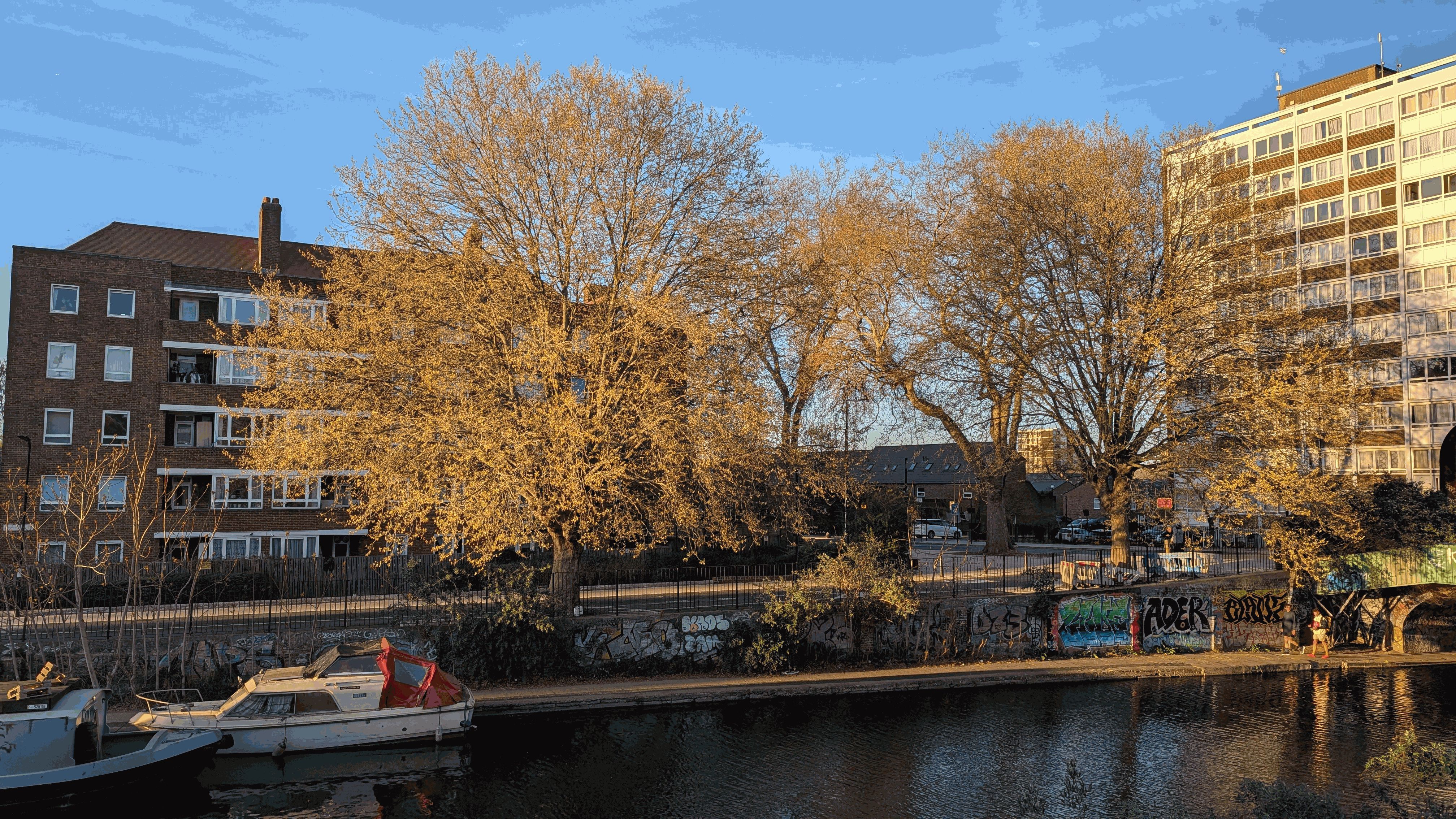
Regent’s Canal, London in the Month of April. Photo K Flude
The name of the Month of April comes from Latin. From Aperilis from aperio meaning ‘to open’. This is the month when the Earth opens up, the blossoms bloom, buds budding, the flowers flowering.
In Anglo-Saxon times, the Venerable Bede mentioned that they called the month Eostremonath. But there really is no other evidence for the Goddess Eostre. But it is from her that we get our word ‘Easter’. In Gaelic it’s the Cuckoo’s month ‘Ceitein na h-oinsich’. In Welsh it is Ebrill which comes from the Latin.
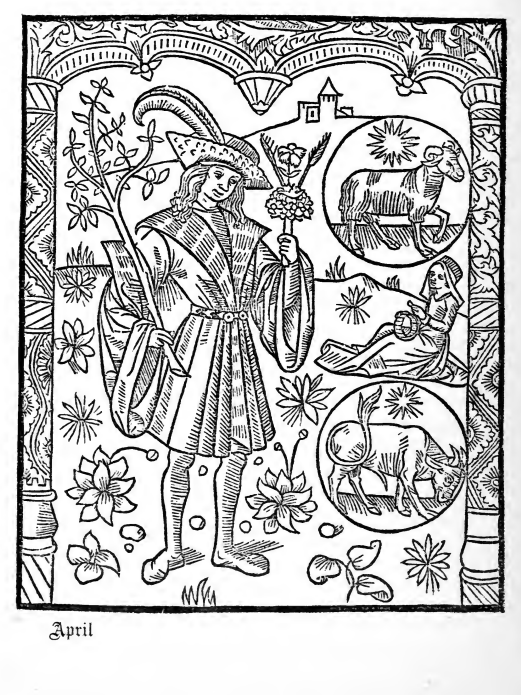
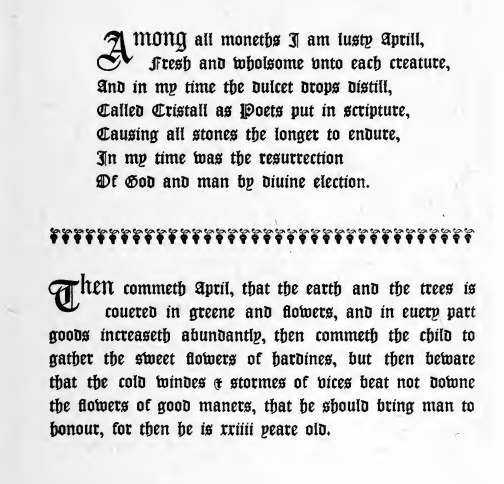
Title Page of the Kalendar of Shepherds for the Month of April
The image from the medieval Kalendar of Shepherds shows all the beautiful flowers blooming. The central figure is a rich man bearing bows of tree and flowers. Behind him is a female sitting on the grass embroidering. Love is in the air, and a castle on the hill. The star signs of the month are shown in the roundels.
Aries sign of the ZodiacTaurus sign of the zodiac
Star Signs as Greek Deities
Astrological signs and their associated Dieties.
I can’t remember where I found this illustration nor its justification. But, is it strange that the Greek God Ares is not the patron of the Star sign Aries? Of course, Ares/Mars has March named after him. Ares is a fire sign, its colour is red, and ruled by the planet Mars.
Aries is no ordinary Ram, he has wings and is called Chrysomallos. Ino the step-mother of Phrixus and Helle, wife of the King of Boeotia, hated her step-children, and plotted their death. But they were rescued by the flying Ram which had a Golden Fleece. Unfortunately, Helles fell off and drowned in what became known as the Hellespont, Phrixus came to safety in Colchis, and in an act of terrible piety, sacrificed the poor lamb to Zeus as a “Thank You”! The fleece was later taken by Jason and the Argonauts. (So, now we know why Zeus is the patron God of Aries!)
Hestia is the Goddess of the Heath. In other words, she is the Goddess of all those wonderful things that are encompassed by the word ‘Home’. (You’ll find more on Hestia in my reflections-on-the-solstice/)
The Month of April in the Kalendar of Shepherds
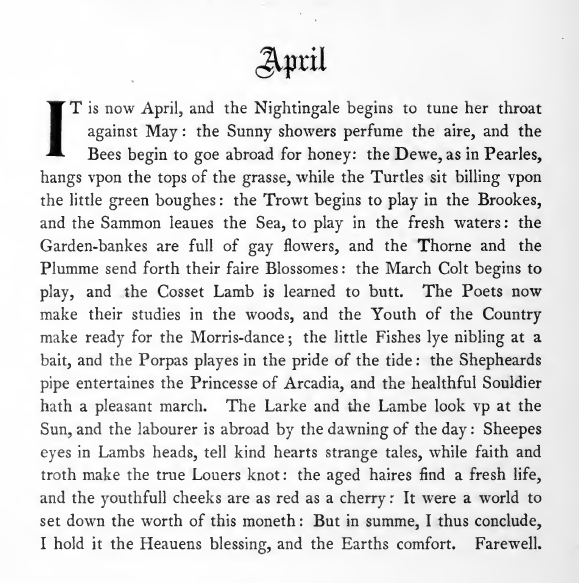
The Kalendar of Shepherds as usual gives a lyrical insight into the countryside in the month of April:
Kalendar of Shepherds description of nature and farming in April
It continues with a poem. Beneath the poem is text which describes what happens to the child in the fourth set of 6 years. January represents a child’s life from 0 – 6, February 6 – 12. So April represents the ages 18 – 24 – the spring time of Man. But also a time when the struggle between vice and virtue in the young mind.
For more about the Kalendar of Shepherds read my post.
First written on 7th April 2025, (some content was moved from its original April Fools Day post home). Revised and section on Aries added 2026
The Famous Spaghetti Tree April Fool’s Joke (from facebook)
First Reference to April Fools Day
The first unambiguous British reference to April Fools Day is by diarist John Aubrey’s “Fooles holy day” in 1686 – although he might have been referring to Germany.
‘We observe it on ye first of April… And so it is kept in Germany everywhere.’ For more details read hoaxes.org.
Chaucer and April Fools Day
But there is a possible earlier reference in Chaucer in the Nun’s Priest’s Tale. This I find quite compelling but most Chaucer scholars don’t. This is the text:
When that the monthe in which the world bigan That highte March, whan God first maked man, Was complet, and passed were also Syn March bigan thritty dayes and two
So, if you have been keeping up with me, you will know that the first lines are referring to March 25th. This was the day Adam and Eve were created. The day when the Church started the New Year and the year number moved one on. This was a major Church festival, usually followed by a week of holiness. The Roman New Year, January 1st, ended with a light-hearted festival called Saturnalia, and it is suggested that April 1st was, similarly, a day of release after the festival of the official Church ceremony of the New Year.
Chaucer’s last line says ‘Since March began thirty-two days have passed.’ A foolish person would not realise this is a reference to April 1st. Hence, this suggests a Fool’s Day already existed. Some scholars think that Chaucer was referring to May 2nd, counting the 32 days not from the beginning of March but from the end of March. I think they look at the second and third lines which read ‘That high March…. was complete’ and so add the 32 days to the end of March. Foolish in my opinion and not reading what actually Chaucer wrote which is ‘Since March began….’
Hunting the Gowk
Generally, in Britain, we play a prank and say ‘April Fool’ with great delight. But we are not allowed to continue beyond midday. The Scots used to call it ‘Hunting the Gowk’ and the main prank was to give someone a letter to deliver, and the person who opened the letter would read:
“Dinna laugh, dinna smile. Hunt the gowk another mile” and send the fool onto another leg of his or her’s fool’s errand. In Ireland the letter would read ‘send the fool further’.
April Fools Day and Spaghetti Growing on Trees
I nearly always forget to honour April Fool’s Day (or April Fish Day as the French call it). But in Britain, somewhere in our newspaper or TV station there is an April Fools Joke slipped in. The most remembered is the BBC piece showing film of Italian Farmers picking spaghetti from trees.
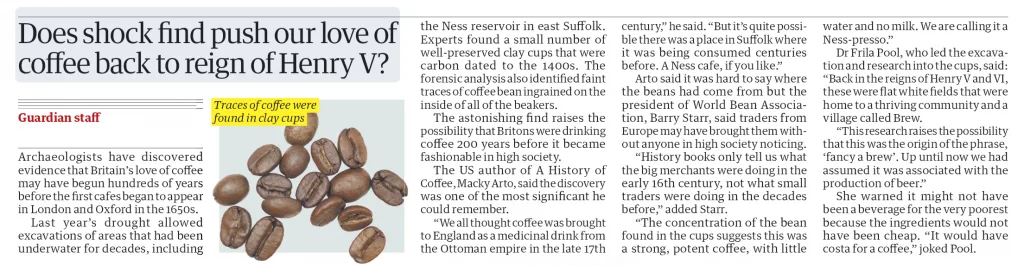
2026 – Introduction of Coffee to England 200 years earlier than previously thought!
I have had a quick look at the Guardian for their 2026 April Fools Day Story and I think it is this one:
Guardian April Fools Joke for 2026
The clues are the expert is called Macky Arto. The find was in Ness, allowing them to say ‘Ness Cafe’, and ‘Ness-presso’, and the use of a pun ‘It would have costa for a coffee.’ The final confirmation is this sentence: ‘Back in the reigns of Henry V and VI, these were flat white fields …. and a village called Brew.’ Allowing the journalist to make up an origin for the expression ‘Fancy a Brew?’ it goes on to say.
2025 – Coffee Cups as Haut Courture?
Guardian April Fools Day Joke article or the world gone mad?
‘Meghan Markle was criticised after it was revealed that when you put her lifestyle brand name – American Riviera Orchard – into the What3words location service, it points to a statue of Oliver Cromwell, who famously had a King Charles executed‘
2023 – “Megxit: Call of Duke-y”
In 2023, Harry and Megan proved irresistible and the Guardian reported that:
‘The Sun published a piece announcing the launch of Prince Harry and Meghan’s new video game “Megxit: Call of Duke-y” in which the royal couple try to reach California while dodging obstacles, including rival royals and the media, along the way.‘
This post is about April Fools Day. But it is also the anniversary of the formation of the RAF.
On This Day
1854 – Hard Times by Charles Dickens Serialised in Household Words. A recent study of Victorian Grave yards in Yorkshire highlights the grim reality for young children. For the article see: https://core.ac.uk/reader/220156990
1918 – Near the end of World War 1 the Royal Flying Corps (RFC) and the Royal Naval Air Service were merged to create the Royal Air Force (RAF). It was the world’s biggest air force, and went on to secure Britain from invasion by Hitler.
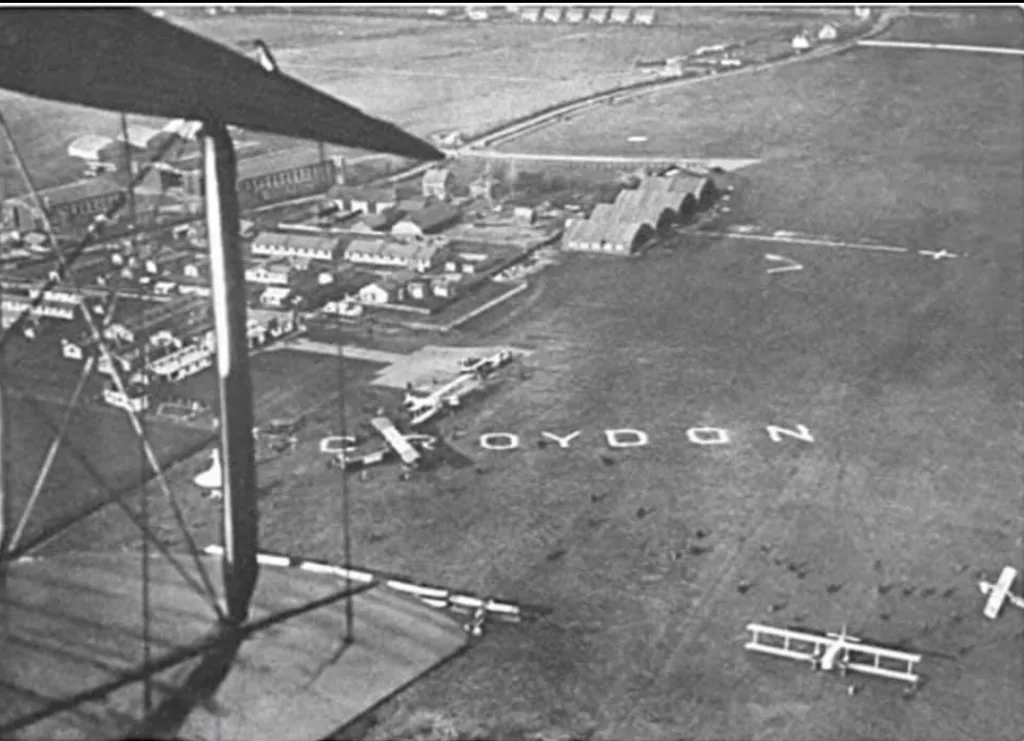
Croydon RFC/RAF base for anti-Zeppelin Raids in WW1 and one of the world’s first international airports.
RAF Rigger, Benjamin Flude
My Grandfather was in the RAF as a fitter. My father tells some of his story in his autobiography ‘A Boy from Haggerston’:
Benjamin Flude in RFC Uniform. My father, Ben Flude remembers a small model biplane hanging from the portrait.
‘I was 9 months old when he died, and he was just 28 years old. Everyone seemed to like him, and as a child, he was always my hero. In my imagination, I promoted him to being a brilliant and brave Ace RAF Pilot. But he was, in fact, a mechanic rather than a pilot in World War I. Following the war, he worked with Imperial Airways in Purley, Croydon. I don’t know the exact details and so have to piece the story together from the little information I have at my disposal.
My friend, Roy, tells me that the badge on his uniform in the oval picture is of the Royal Flying Corp. (RFC). But they were disbanded in 1916/17, and replaced by the RAF thereafter. As my dad was born in 1900, he must have joined up to fight in the war while underage at 16 or 17 as a volunteer. ‘
How a London lad became a Rigger for the RFC we don’t know, but the Fludes at that time were all employed as umbrella or walking stick makers in the East End of London. I think it is a case of transferable skills. WWI aeroplanes were made of wood, metal wire and fabric, which is precisely what an umbrella is made of.
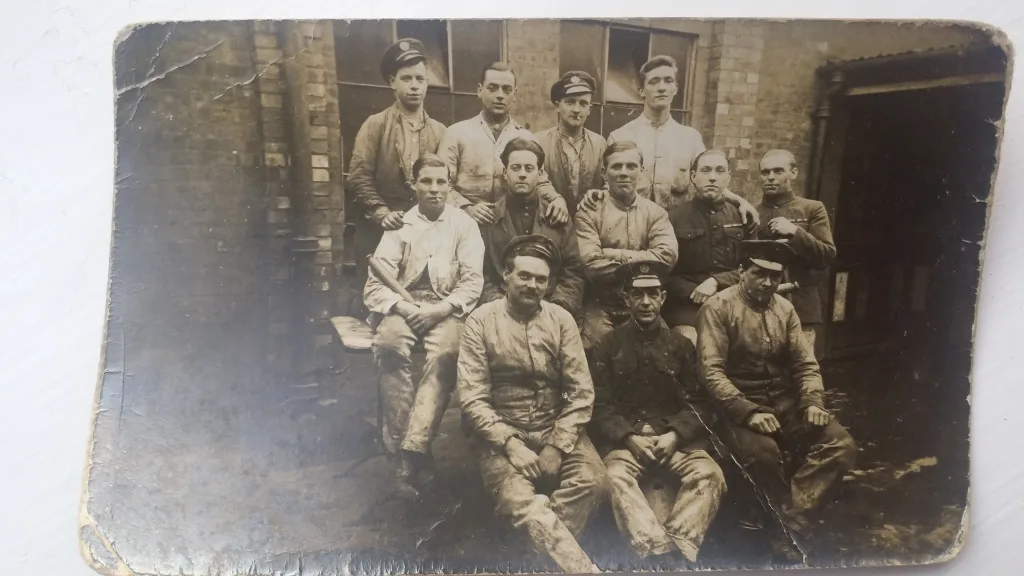
RAF/RFC mecanics c 1917 . My grandfather is the handsome man standing tall in the back row extreme right
RAF Mechanic Ben Flude
My father went on to serve in the RAF during his national service: He writes:
Ben Flude RAF Metfield. (dad is lying down at the bottom right. he is now 98)
‘Early in 1946 I received my call-up papers for the RAF. I was to report to the Recruitment Centre at Padgate in Lancashire. This is where I received my uniform after a medical examination, and then there were a number of intelligence/aptitude tests when they decided what trade I would join. I tried to get Air Crew and while there were no vacancies, I did have a wide group of trade offers open to me. The group that I was interested in was aircraft maintenance and repair, following in my Dad’s footsteps.’
‘However, before I could start, I had to do my basic training. This was designed to get you fit, and we did plenty of square-bashing or parade drills. For this, they sent me to Metfield in Suffolk, which had only very recently been made available to the RAF by the American Army Air Force. In fact, it was so recent a hand-over that whilst on picket duty, a coach rolled up packed with girls who were so disappointed by the lack of Americans that they got straight back on and returned to Ipswich! The motto of ‘overpaid, oversexed, over here’ certainly applied to these Americans in Suffolk.’
‘We found out that Metfield had been a US Army Air Force Base, where two squadrons of Flying Fortresses operated from. In all the Nissen Huts, those with the semicircular roofs, the ceilings were completely covered with pin-up pictures. My bed was just feet away from the huge Crocodile Stove, round which every evening we all clustered – as it was warm.‘
Interior of Nissan Hut 1944, Lasham
Dad specialised in the recovery of instruments from crashed planes, and was complimented by Air Chief Marshal Hugh Caswall Tremenheere Dowding, 1st Baron Dowding, GCB, GCVO, CMG on his ability to fix an instrument he had never seen before.
First published March 25th 4004 BC and republished yearly on every April Fool’s Day. The section on the meaning of April moved to my post on April 2025. On This Day added in 2026
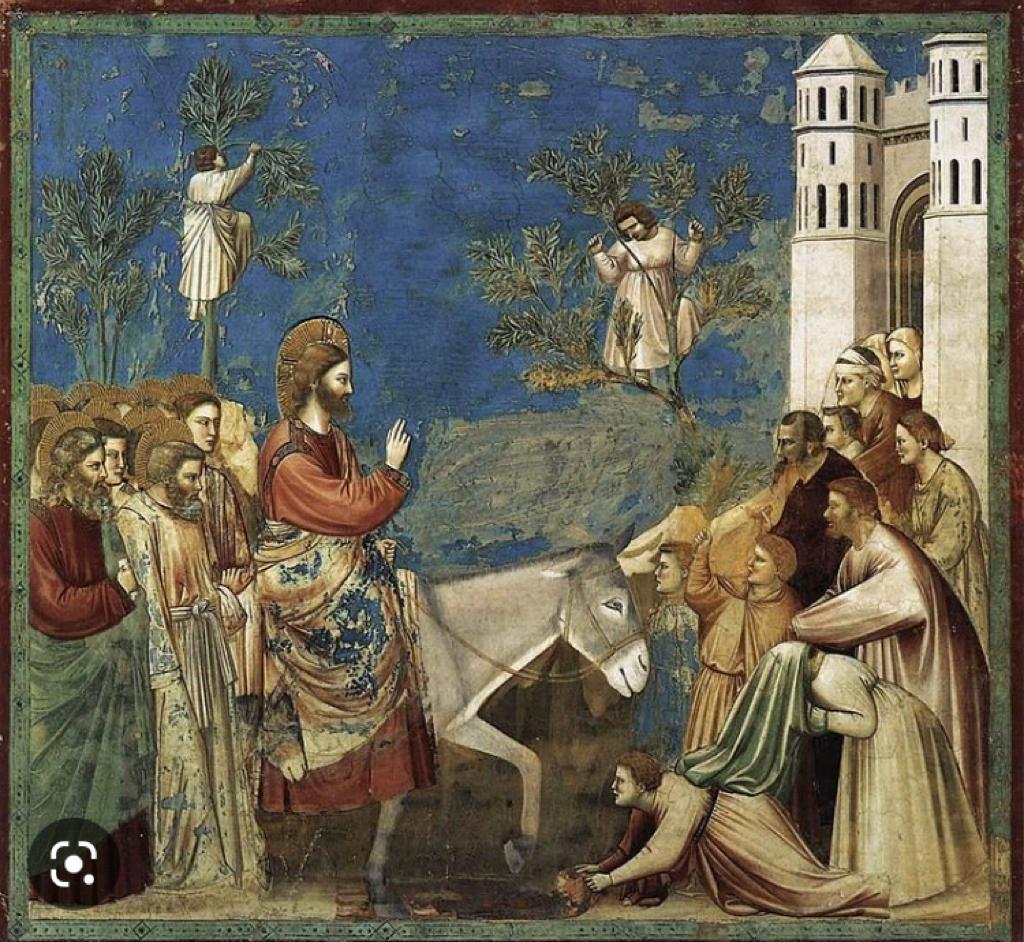
Palm Sunday (Yew Sunda) by Giotto. Entry into Jerusalem from the Cappella degli Scrovegni in Padova (sent to me by Lucia Granatella)
Yew Sunday (Domhnach an Iúir in Irish) is the medieval name for Palm Sunday. This is the day that Jesus entered Jerusalem in triumph on a donkey, with palm leaves being laid in front of him. It has always been very curious to me, this triumph preceded such heavy and heartbreaking tragedy. It is the Sunday before the Betrayal, which leads to the Crucifixion on Good Friday and the Resurrection on Sunday. A busy week for the Church.
I got a little insight into the powers of the procession when on a Field trip to Nice with Students from Central Saint Martins College. We set the Students the task of creating an ‘art intervention’. They came up with the idea of a Procession to the Mayor. It was extraordinary how deploying a few placards, saucepans as drums, and some chanting could create an instant event,. It made people smile and join in, even if clueless about the cause!!
Palms
Palm Sunday can be celebrated by making crosses out of palms, or with processions bearing palm branches or eating special cakes. There is always room in any ritual for cake). But in the North, where do you get your Palms from? So, it was often substituted by Box, or Olive or Willow and particularly, in Britain and Ireland, by Yew. Yew is evergreen and is so long-lived as to be a symbol of everlasting life. (I wrote more about the Yew here). See also my post on Ash Wednesday.
Giotto Bondone
Giotto was a Florentine painter of the 14th Century of whom Giorgio Vasari, in his essential guide to the artists of the Renaissance, ‘The Lives of the Artists‘ said of the 10 year old:
One day Cimabue, going on business from Florence to Vespignano, found Giotto, while his sheep were feeding, drawing a sheep from nature upon a smooth and solid rock with a pointed stone, having never learnt from any one but nature. Cimabue, marvelling at him, stopped and asked him if he would go and be with him. And the boy answered that if his father were content he would gladly go. Then Cimabue asked Bondone for him, and he gave him up to him, and was content that he should take him to Florence.
There in a little time, by the aid of nature and the teaching of Cimabue, the boy not only equalled his master, but freed himself from the rude manner of the Greeks, and brought back to life the true art of painting, introducing the drawing from nature of living persons, which had not been practised for two hundred years; or at least if some had tried it, they had not succeeded very happily.
Written in 1550.
Giotto & The Development of Perspective
If you look at the painting, above. you will see, even the faces of the people are rounded and, and at least somewhat, individual. The crowd scene, particularly, to the right, has some depth. The people further away seem to recede from the viewer. This contrasts with the Byzantine style of paintings, where figures either float or seem to stand on or support themselves on each other’s shoulders. The Gate into Jerusalem has been rendered by an arist who has seen something that he believes has the key to realistic scenes. One day it will be rediscovered, and named single-point perspective.
Yes, Giotto doesn’t know the secret but he is working to find out what the trick is. The people in the trees are also in the distance. These are the giant strides that Vasari is referring to in the quotation above. Realistic people, in spaces with depth. The donkey is quite sweet too! Cimabue, Giotto’s Master was particularly good at painting Crucifix scenes.
For more on early attempts at creating perspective, see my post on Duccio and the Annunciation here.
Digital tour of the Cappella degli Scrovegni
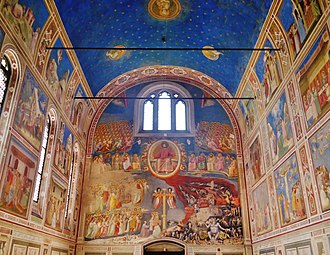
The Cappella degli Scrovegni in Padova is a World Heritage Site decorated by Giotto and his team. They covered all the walls and ceiling with frescos. Depicting the Life of Jesus, the Life of Mary, and the Last Judgement.
Giotto, The Last Judgement. Cappella degli Scrovegni, In Padova. Wikipedia
Here is a real Digital Heritage treat – a 360 Degree tour of the Chapel! Follow the link below. If it seems to be taking a long time to load press the information button. Once pressed will allow the panorama to load immediately.
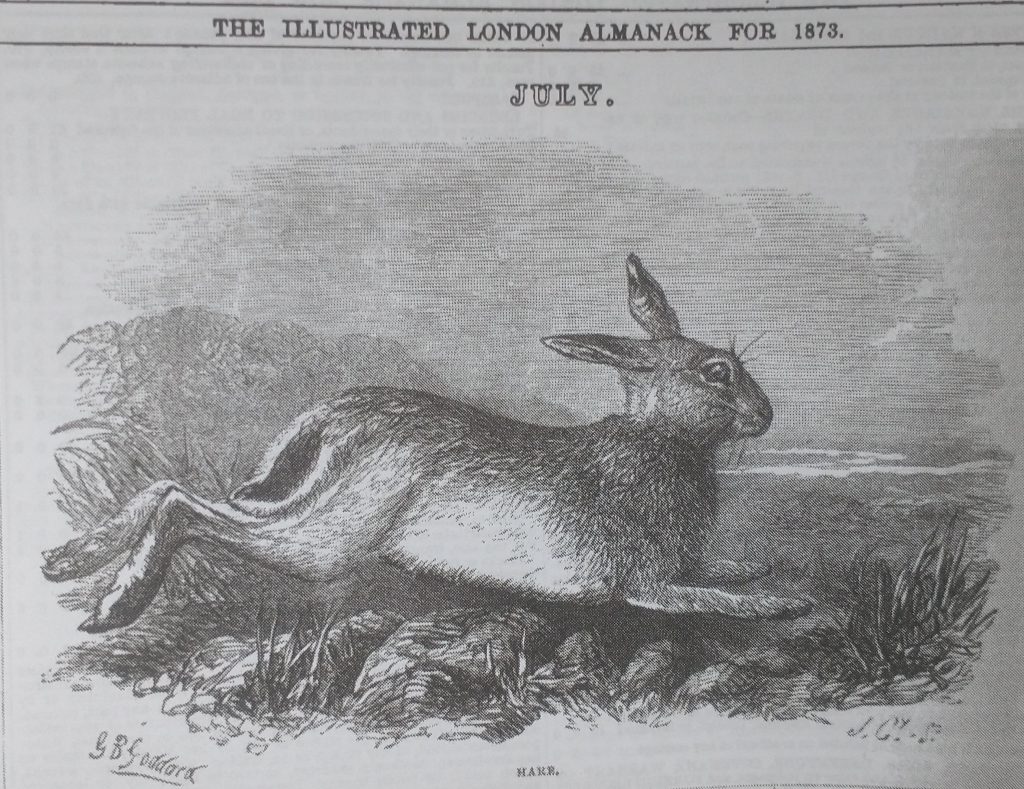
The expression ‘Mad as a March Hare’ comes from the displays of hare boxing that takes place as the Hare mating season begins. And no, it’s not the male March Hare fighting in the spirit of romantic rivalry. It is the female hares fighting off unwanted attention from the males. Hares are solitary creatures, and the mating season is, perhaps, particularly difficult for them. The Country File website has more on the subject. www.countryfile.com
Not only March Hares but March Kittens too
There are also March Kittens and March Chickens. Edward Topsell in his ‘History of Four-footed Beasts‘ 1607 says the best Kittens to keep are those born in March. ‘The Closet of Sir Kenelm Digby Opened‘ 1669 says:
‘Keep a black cock hatched in March as a protection against evil spirits: his crowing terrifies them.’
He also gives a recipe for Cock Ale:
Eight gallons of Ale, a boiled March Cock, four pounds of stoned Raisins, half a pound of dates, nutmegs, mace. Beat the ingredients in a mortar, add to two quarts of Sherry. Add to the ale. Stop it in a container for 6 or 7 days. Bottle it, drink after a month.
Very weird. I challenge my readers to try it and let me know how it goes?
Was the March Hare Sacred?
But it’s not only March Hares because the hare itself was a sacred animal. It was sacred to Aphrodite because of their prodigious ability to have offspring:
‘For you know, I imagine, what is said of the hare, that it possesses the gift of Aphrodite to an unusual degree. At any rate it is said of the female that while she suckles the young she has borne, she bears another litter to share the same milk; forthwith she conceives again, nor is there any time at all when she is not carrying young.’
Classical Texts Library. Philostratus the Elder, ‘Imagines’ Book 1.1-15 c 3rd Century AD. Translated by Arthur Fairbanks.
Divine Celtic & Neolithic Hares
Research reported by Exeter University suggests that hares were worshipped in pre-Roman Britain. Julius Caesar wrote:
“The Britons consider it contrary to divine law to eat the hare, the chicken, or the goose.”
‘The Battle for Gaul’ Translation by Wiseman, Anne, Wiseman, T. P. Published by Penguin Random House, 1980 ISBN 10: 0701125047 (TP Wiseman was my professor for Classical Studies at Leicester University).
Hares are thought to be the original Easter Bunny. But finding good evidence before Germany in the early modern period is difficult. There is a tradition that witches can be scared away at Easter. Exactly, how this works is not at all clear to me. But it has been said that witches could take on the form of a hare. So eating Hare Pie at Easter helps rid the land of the witches.
Jugged Hares
You could have a jugged hare. Jugging is cooking a whole animal in a container over water. Follow this link for a recipe for jugged wild hare. Remember, you are not allowed to shot or trap them on a Sunday or on Christmas Day! For a discussion of hares and folklore, click here:
Hare’s Feet Totems
A jointed hare’s foot was considered very lucky and a remedy against gout, stomach pains and insomnia. (The Perpetual Almanack of Folklore by Charles Kightly, which I have used several times in this piece.) You can buy one on eBay. (Don’t click the links, it’s not an advert but a picture of an advert). I remember friends having rabbit feet which they carried around with them for luck. The foot would often be on a key rings.
Georgiana, Duchess of Devonshire (Johann Heinrich Hurter after Angelica Kaufman). Photo by K Flude of the miniature at the Victoria and Albert Museum
The Gilbert Collection has been re-displayed in the V&A in London. It has just opened, and is one of the most opulent displays you could hope to see! But, I loved this miniature of Georgiana. She was one of the richest women in Britain, a compulsive gambler, and a powerful political force for the Whig Party. And despite the Georgian Hairstyle the artist has contrived to make a very down to earth portrait. I can imagine bumping into her at the local Overground Station! She became better known after the bio graphy by Amanda Foreman, followed by the Film starring Keira Knightly. The Museum label says the portrait is ‘after Angelica Kaufman’. But I cannot find a Kaufman of Georgiana, that has this charming informality.
I have just heard news that the Arts Council wants to charge overseas visitors to visit our wonderful free national Museums, while allowing British Citizens free entry. Now, there are lots of arguments to be made about it, particularly in a time where money is in short supply. But, one result will be longer waits to get into Museums and Galleries. I am not sure how we Brits, are going to be asked to prove our nationality. If they have to inspect our Electricity Bills, Drivers Licenses, Passports, Library Cards, or Bank Statements, expect chaos.
One more object from the Collection is made of minature mosaics, and the V&A has several, But I have chosen this fabulous image of the Colosseum in Rome:
Colosseum by Domenico Moglia c1851
First published March 28th 2023, revised 2024, 2025. 2026 Object of the Day added and post revised 2026
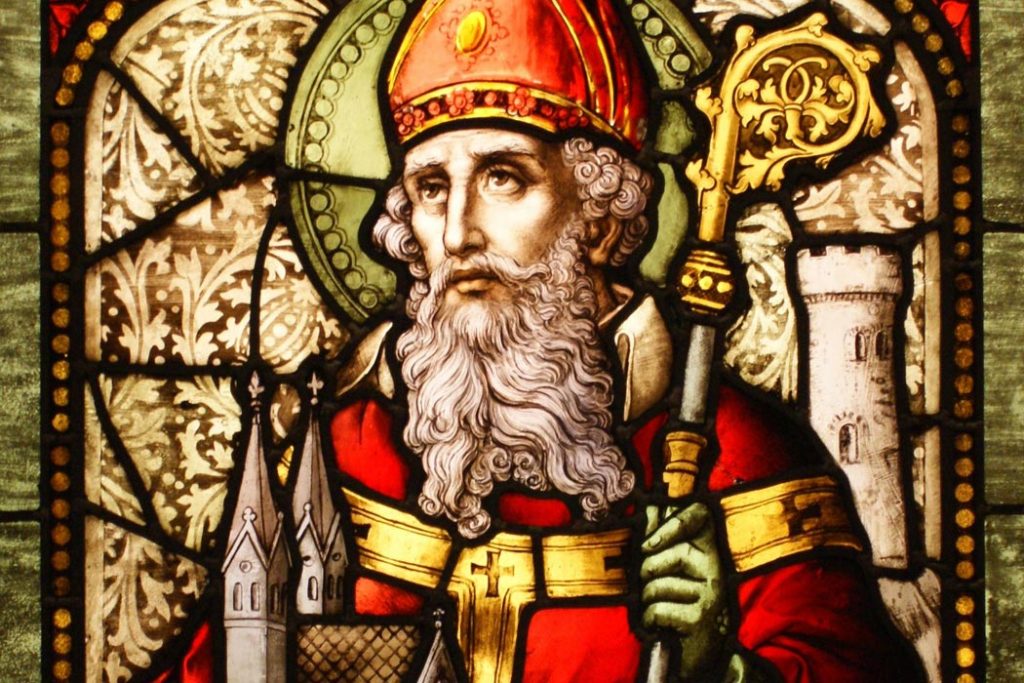
Stained Glass window depicting St Patrick (source of image, lost in the mists of time!)
St Patrick
St. Patrick has a very interesting autobiography (Confession), because it is one of the only personal reminisces of life in post-Roman Britain. He wrote in the form of a letter. In it, he explains that he was captured by Irish pirates while living in a Romano-British Town. His father we discover was a Decurion and a Deacon which suggests elements of Roman political organisation continued. No one knows the dates of St Patrick’s life, but he lived in the 5th Century. The use of Roman titles suggests, to some, an earlier rather than a later date. Perhaps in the early 400s. Unless, of course, you want to propose that Roman life continued later into the 5th Century than the first few decades. (which, increasingly, people are proposing.)
The town he lived in was called Bannavem Taburniae. Many places have been proposed for it. The closest linguistically is Bannaventa in Northamptonshire, but this seems a very unlikely place for Irish raiders to land, being about as far away from the sea as it is possible to get in Britain!
Nicholas Fuentes
Scholars have suggested South Wales and the Scottish borders most commonly. But my favourite suggestion, but about as unlikely as Northampton, is Battersea in London. This suggestion was made in the pages of the London Archaeologist by then editor Nicolas Fuentes.
Fuentes was one of a pioneering group of archaeologists when Rescue Archaeology first began a campaign to record the archaeology being destroyed by massive redevelopment of town centres in the 1970s.
He changed his name from the anglicised Nicholas Farrant back to its original Fuentes. He then wrote a magnificent series of papers, in London Archaeologist, which located St. Patrick in Battersea; St Alban’s execution in London and all 12 battles of King Arthur around Greater London.
St Albans Martyrdom in London
All were well argued, but as a set they do raise an eyebrow, being unsupported by any clear evidence. And, as far as I know, without much scholarly support. The one I really like is locating St Alban’s Martyrdom in London rather than in St Albans. It reminds everyone that the first reference to St Alban, which is by Gildas in the 6th Century, places the execution of the Saint firmly in London. It also makes sense of the story that Alban, keen for martyrdom, gets God to part the River so he can go quickly to the execution spot. The bridge it was said was full of people going to see the execution.
In Gildas’s case, the execution is in London, probably at the Amphitheatre, up a hill from the the mighty Thames. So God parted the Thames for Alban. Anglo-Saxon historian, the Venerable Bede places St Alban’s death firmly in St Albans, but the river that God needs to part there- the River Ver, is a piddle. Alban could have crossed it easily, hardly requiring even Wellington boots! Not much of a miracle compared with parting the Thames. The likely site of execution in both cases would have been the Amphitheatre, rather than the side of the hill where the St Albans execution site is located. But Gildas did mention the hill, which makes sense in the case of London and not in St Albans, as it is outside of the Roman City. away from the amphitheatre.
To my, unscholarly mind, when we worship people we tend to venerate them, at their birthplace and death place. So to me, it makes sense that St Alban’s main shrine was at Verulamium where he was born (now known as St Albans) and London where he died.
St Germanus
There is some supporting evidence from the hagiography of St Germanus of Auxerre. This tells us that Germanus came to an amphitheatre for a religious debate about 15 years after the end of the Roman occupation of Britain. After the debate, he went to a nearby shrine dedicated to St Alban. Unfortunately, the writer of the memoir is not really interested in post-Roman Britain, so does not tell us whether it was in London or St Albans. But there is an early church dedicated to St Alban just by the Roman Amphitheatre in London. For more on St Germanus follow this link to my post.
However, archaeology does not reveal any evidence early enough to support the idea that the Church is that early. Fuentes, argued that London as the Capital was likely to have been the place where capital punishments were carried out, particularly in the case of a Roman Citizen like Alban. I must note that in placing any credibility to Fuentes theory, I am standing largely alone.
Stained glass window of St Patrick and St Germanus
The Twelve London Battles of King Arthur
I’m not so convinced by the 12 Battles of King Arthur were fought in the London Area. They are more likely to have been spread throughout Britannia. But the place name evidence is never going to be identify most of the locations.
St Patrick From Battersea?
So, to the point – St Patrick in Battersea? The evidence, as I remember it, is really only place name evidence. the suggestion that Battersea was derived from: Badrices īeg, ‘Badric’s Island’ and later Old English: Patrisey (Wikipedia), So, Patrick’s Island. The word ‘sea’ is used in that sense along the River Thames. For example in Chelsea, Thorney, Putney derived from ey which is short for eyot (island). Also spelt ait.’
St Patrick lived as a teenage slave for 6 years, then escaped from captivity in Ireland and returned home. Trained as a priest, in perhaps Auxerre (home to St. Germanus who is another crucial witness to post Roman Britain. (See my post here.) and returned to Ireland to begin the conversion to Christianity. He is the Patron Saint of Ireland, with St. Brigitte and St. Colomba.
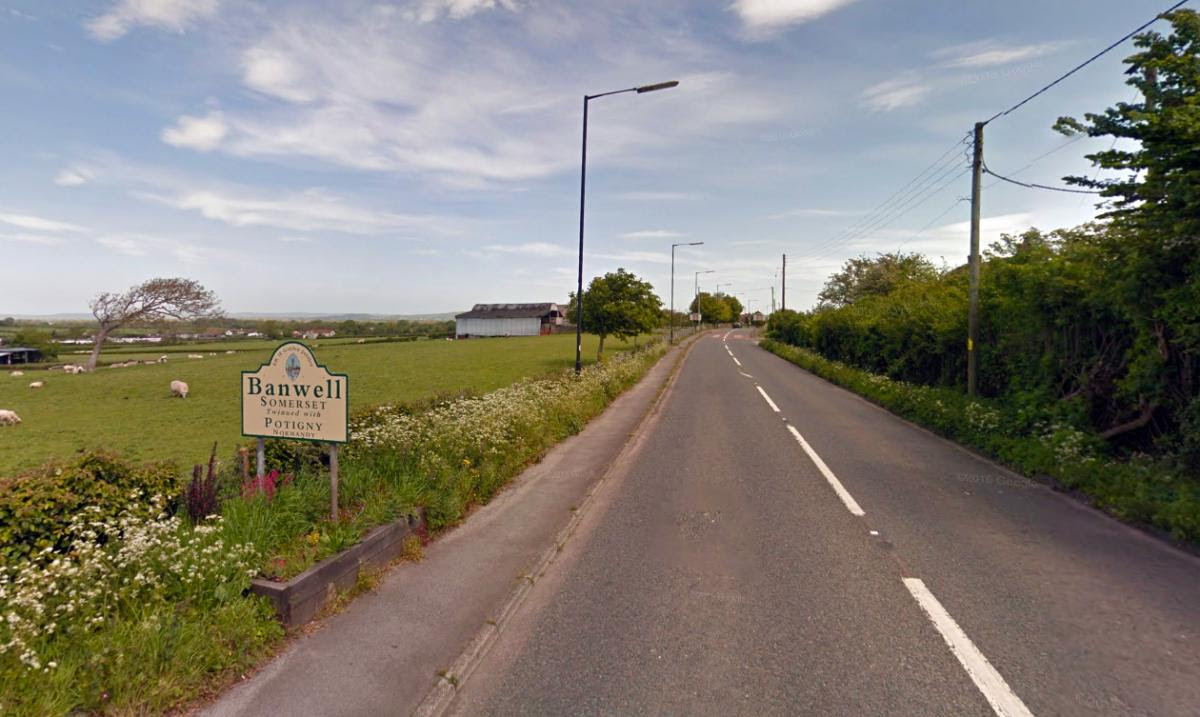
St Patrick from Banwell?
Another candidate for Bannavem Taburniae’ comes from Andrew Breeze FSA. I read about this in Salon IFA, the newsletter of the Society of Antiquaries. Also you can read more about it in this History First article. Breeze has revived a theory that the Saint comes from the West Country, and that the ‘Bannavem Taburniae’ is Banwell, near Weston-super-Mare in North Somerset. He suggests that ‘Bannaventa was a Latinisation of a Brittonic name that included banna, for a bend’, crook or peak. Venta is a well known word for an area of local administration or marketplace. For example, Venta Bulgarum, was the name for Winchester in the Roman period.) . He suggests that these ‘elements, as well as the Berniae element of ‘Taburniae’, can be found in the name Banwell, itself a compound name of the Brittonic ‘Banna’ and the Old English wylle, both meaning pool, or in the names of surrounding villages.’ I’m sure Fuentes did something similar for Battersea.
Image credit: Looking south from Winthill, near Banwell, Somerset, Colin S Pearson; Banwell in Somerset, Google Street View
What Banwell has over the London theory is that it is more likely to have been subject to Irish Raiders than London. But, for me, it is just another theory based on placename evidence that might or might not be true. I have read any number of Archaeology books where arguments about placenames are deployed to add some solidity to some theory about King Arthur, or a tale from Geoffrey of Monmouth. I therefore distrust them all. They essentially create circular arguments.
St Gertrude’s Day
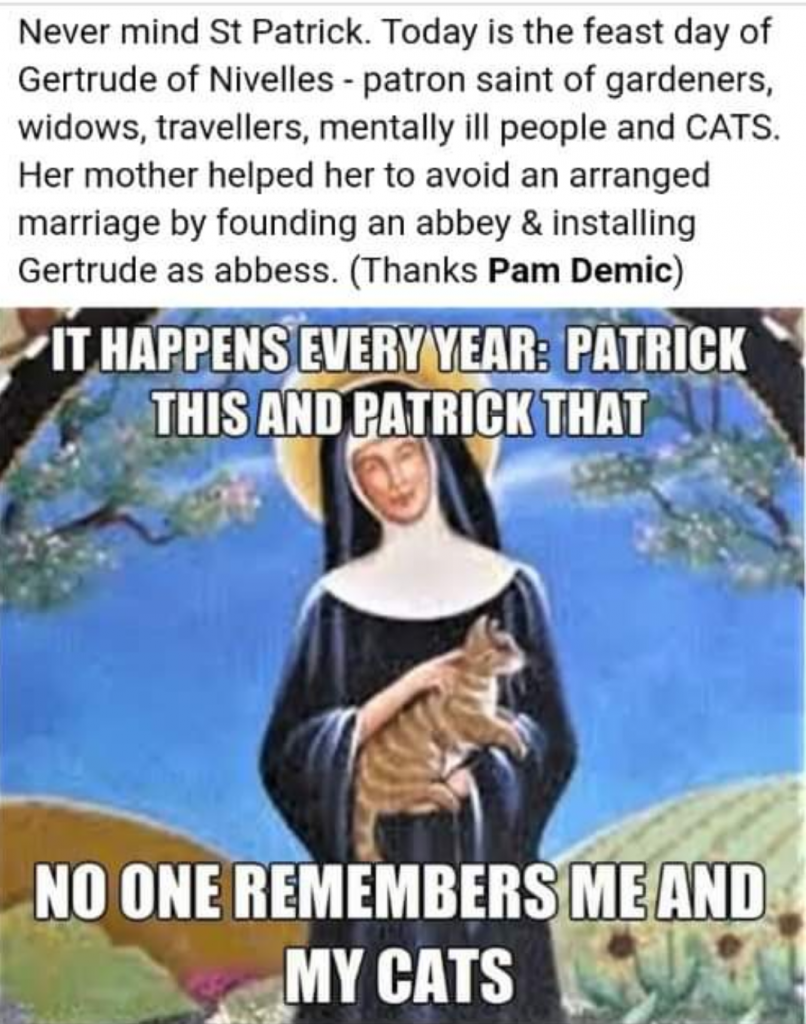
And least we forget, today is also St Gertrude’s Day, patron saint of Cats.
Facebook post, posted by a friend, and about St Gertude patron saint of cats.
On This Day
45 BC – Julius Caesar consolidated his power by defeating his main rival Pompey the Younger, and allies, at the the Battle of Munda. He went on to establish his Dictatorship, which led to his assassination on March 15th (see my post on the Ides of March)
1845 – The Rubber Band patented by Stephen Perry of St Johns Wood, London, for Messers Perry and Co,. Rubber Manufacturers of London.
Specification of the Patent granted to Stephen Perry, of Woodland’s-place, St. John’s-wood, in the County of Middlesex, Gentleman, and Thomas Barnabas Daft, of Birmingham, Manufacturer, for Improvements in Springs to be applied to Girths, Belts, and Bandages, and Improvements in the Manufacture of Elastic Bands. —Sealed March 17, 1845.
1861 – The Kingdom of Italy proclaimed with Victor Emmanuel as King. The unification of Italy was the culmination of the Risorgimento, led by Garibaldi, Cavour, Mazzini and Victor Emmanuel. It survived until 18 June 1946 when Italy became a Republic.
1951 – First Appearance of Dennis the Menace in the boy’s Comic the Beano. Published in Dundee, by DC Thomson. I read the Beano as a boy, along with the Robin, the Eagle, Topper, the Dandy, The Hotspur, and Whizzer and Chips. What made Dennis great was that he was a bad boy and didn’t get any better. Always at war with the ‘Softies’ – basically well-educated boys. And made us laugh with his antics. For more comic nostalgia read: nostalgiacentral.com/pop-culture/books-comics/british-comics-of-the-50s-60s-and-70s/
Dennis the Menace By DC Thomson – The Beano 3671, Fair use, https://en.wikipedia.org/w/index.php?curid=38472209
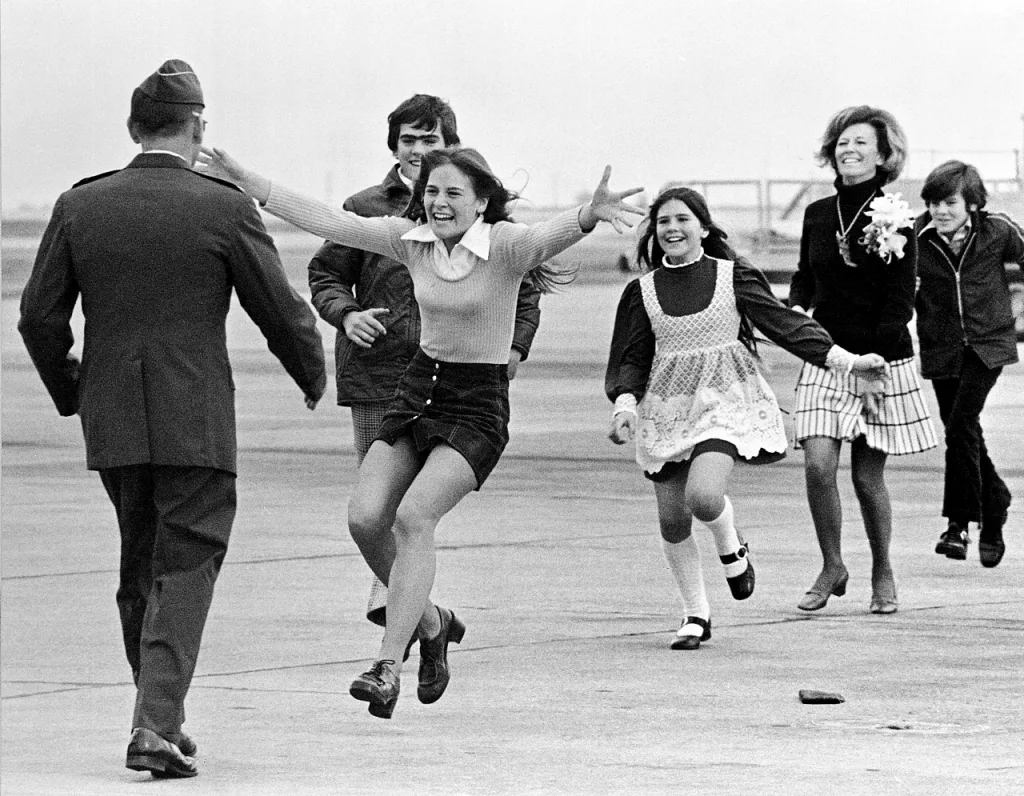
1973 – The Pulitzer Prize–winning photograph Burst of Joy is taken and symbolised the end of the US involvement in the Vietnam War
‘Burst of Joy’ By Slava “Sal” Veder”, Associated Press – https://www.columbiatribune.com/picture-gallery/news/2020/03/17/today-in-history-march-17/67299331007/, Public Domain, https://commons.wikimedia.org/w/index.php?curid=153972466
First Published in 2024, republished in 2025, On This Day augmented 2026
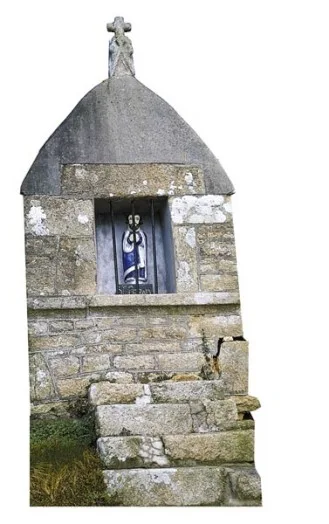
Lide 5th is St Piran’s Day. Photo of St Piran’s Oratory at Trézilidé, Finistère (wikipedia) By Kieffer92 – Own work, CC BY-SA 4.0,
March is named after the Roman War God Mars, whose Month it was. But in England it had, until recent times, a dialect name which survived in the South west of England. This was ‘Lide’.
Lide was still used in the 17th Century, and then survived into the 19th Century only in Cornwall. The Cornish named the first Friday in March ‘Friday in Lide’. They had a proverb.
‘Ducks won’t lay till they’ve drunk Lide water’.
Daffodils were called Lide-lillies. Eleanor Parker, who is a Lecturer in Medieval Literature at Brasenose College, Oxford, wrote an interesting article in History Today. She called March the loudest month of the year. The early English names for March were Hlyda or Lide monath meaning stormy or loud month. Other names include Hraed monath (rugged month) and Lentmonath (month of lent).
March brings breezes loud and shrill, Stirs the dancing daffodil.
Sara Coleridge (1802–1852), “The Months,” Pretty Lessons In Verse, For Good Children; With Some Lessons in Latin, In Easy Rhyme, 1834
There are many references to the changeable weather in March. Sometimes lovely spring days, and at others raging storms, and frosts. Parker quotes a proverb which says that March comes in:
‘like a lion and goes out like a lamb’.
In 2026, the 5th of Lide has been a beautiful spring like day, with, over the last few days a outburst of Hawthorn and Plum blossom.
St Piran
Lide 5th was a holiday for Miners, probably because it was St Piran’s Day. Very little is clear about St Piran. But he is thought to have been an Irish Missionary who founded an Abbey in Cornwall in the 5th Century. His legend says he was tied to a millstone by the Irish, who rolled the stone over a cliff. The sea was stormy, but calmed as soon as he fell into it. He floated on his stone to Perranzabuloe in Cornwall. Here he landed and got his first converts: a badger, a fox, and a bear. Then, he founded the Abbey of Llanpirran.
He is said to have reintroduced smelting to Cornwall, hence his attribution as patron Saint of Miners. Piran was martyred by Theodoric or Tador, King of Cornwall in 480. His bones scattered in reliquaries in the South West and in Brittany. He is the patron saint of Cornwall, so the week before the 5th of March is known as Pirrantide. And there are events and parades to commemorate him. People dress in black white and gold, carrying daffodils and walk across the dunes to St Piran’s Cross.
1702 – Queen Anne becomes Queen – the last of the Stuarts. She had 18 pregnancies. The eldest survived to 11 and then died. Of the other 17, 8 miscarried, 5 were stillborn. 4 were born alive but died soon after. She had poor health, gout and drank a lot, but she might well have had an autoimmune deficiency and her body rejected the offspring. The fact that the eldest was the only one to survive might suggest rhesus disease, which can now be prevented with an injection of a medication called anti-D immunoglobulin. The problem occurs when a woman with RhD negative blood is exposed to RhD positive blood and develops an immune response to it. The first child is not affected, subsequent ones risk miscarriage.
1936 – The Spitfire makes its maiden test flight. By 1947 over 20,000 had been made and it had been in continuous production throughout the war, unlike most other aircraft.
1946 – Churchill makes his”Sinews of Peace” Speech in which he coins the phrase ‘Iron Curtain. President Trueman invited the unemployed Statesman to Fulton Missouri to make the speech. In 1961, the proposal was made to commemorate the speech by reconstructing the blitzed City Christopher Wren Church, St Mary Aldermanbury in Fulton, Missouri. The Church was shipped to the States, rebuilt and rededicated on the 7 May 1969.
First published in 2024, rewritten March 2025 Revised, On This Day added 2026.
The Celtic Year showing Imbolc, the new Irish Bank Holiday
I just came across this which I published last in 2023. I should have republished it last weekend. But here it is. The Irish created a brand new Bank Holiday for St Bridget. The first one was Monday 6th February 2023. It followed a public holiday given in 2022 for Health Workers in March. The timing of the Bank Holiday is explained by the Irish Post:
St Brigid’s Day itself falls on February 1 each year but going forward the Imbolc/St Brigid’s Day public holiday will fall on the first Monday in February, unless February 1st falls on a Friday.
This means that Ireland now has a public holiday on the 4 Celtic festivals of Samain (Halloween), Imbolc (St Bridget’s Day), Beltane (May Day) and Lughnasa (Lammas Day). These festivals are quarter-days, which mean they fall halfway between the Solstices and Equinoxes.
The Independent wrote that ‘then-Tánaiste, Leo Varadkar, said‘ ….“This will be the first Irish public holiday named after a woman.” He also is quoted as saying:
“It marks the half-way point between the winter solstice and the equinox, the beginning of spring and the Celtic New Year.”
Extra Bank Holidays in the UK?
There are occasional calls for a new Bank Holiday in the UK. It’s often a Conservative MP calling for a National Day for the British. More often than not they suggest Trafalgar Day 21st October would be a suitable date. This commemorates the great Naval battle in 1805 in which Nelson was fatally wounded. It has several virtues in their eyes. Firstly, it is a day that confirmed Britain’s mastery of the Seas , an ideal day for celebrating patriotism. Secondly, it is the school half-term, and gives a much-needed day off between summer and Christmas. Thirdly, they can propose the day should be taken from the May Day Bank holiday. This coincides with the International Worker’s Day, which is obviously ‘a bad thing’.
Here is an example: the MP for Portsmouth MP’s supported a call for Trafalgar Day here: . The report says: ‘there are currently no bank holidays in the UK which celebrate battles or war victories’. (Portsmouth News 2016).
This, I think, leaves the rest of us thinking: ‘What planet do these people live on?’ Yes, Trafalgar Day would have been a great day for a Bank Holiday, if this were 1839. Maybe even 1939. But now Trafalgar is just not on any ordinary person’s radar. We don’t think so very much about the Napoleonic War or Nelson. Nor do we often sing ‘Heart of Oaks, are our Men’ any more. In short, it is a reminder how distant from the rest of us some MPs are. By contrast, how progressive Ireland seems.
Productivity
The Trade Union Congress proposed the need for more bank holidays. We only have the usual eight annual bank holidays for workers in England and Wales. Scotland has nine or ten; the average for the EU is ‘12.3 bank holidays a year. Finland and Romania get 15, while workers in Japan have 16 public holidays in total’.
A radio programme ‘The Bottom Line’ compared productivity in Britain and France. It revealed that Britain is now 20% less productive than France, (10% worse since Brexit). And how do we make up that productivity deficit? Yes, indeed, by working longer hours for lower wages. It appears that the French high tax, high workers’ protection regime, means they have to find ways of getting more out of their workers in their working hours. While we can just hire and fire, and are happy to make people work in a more inefficient way. Strange isn’t we are told that the French economy is a victim of socialism. Turns out Socialism is more productive.
Monday’s child is fair of face, Tuesday’s child is full of grace. Wednesday’s child is full of woe, Thursday’s child has far to go. Friday’s child is loving and giving, Saturday’s child works hard for a living. And the child born on the Sabbath day Is bonny and blithe, good and gay.
Fortune-telling poems are a big part of folklore. It says something about the power of the rhyme that people can believe a random rhyme can shape someone’s whole life. Interesting that there are many versions of this rhyme. I chose one that had an optimistic Thursday. Two year’s ago, my second Grandson was born, on a Thursday, just like me. And I’ve still got far to go.
Tinker Tailor
The Tinker Tailor rhyme is another example of a fortune-telling rhyme. This is the extended version, I found on wikipedia.
When shall I marry? This year, next year, sometime, never.
What will my husband be? Tinker, tailor, soldier, sailor, rich-man, poor-man, beggar-man, thief.
What will I be? Lady, baby, gypsy, queen.
What shall I wear? Silk, satin, cotton, rags
How shall I get it? Given, borrowed, bought, stolen.
How shall I get to church? Coach, carriage, wheelbarrow, cart.
Where shall I live? Big house, little house, pig-sty, barn.
One person recites the power verse by verse. The subject of the fortune-telling does something like counting petals on a flower, counts bounces of a ball, or gives a number between one and four. The outcome determines the future.
Today, is St Budoc’s Feast Day. However, it’s held on the 9th if you are in Brittany. Boduc is a Celtic name which either means “saved from the waters” or more likely ‘Victory’ or ‘Victorious’.
This etymology is shared by Queen Boudicca. Budoc lived in the 5th Century, after the Fall of Roman Britain. His mother was a Princess whose evil step-mother (or mother-in-law), persuaded her son that she was unfaithful. The Prince ordered the pregnant Princess to be thrown into the sea in a wooden cask. They floated around for 5 months, until Budoc was born. (Saved by the intercession of St Bride?). So, they landed safely in Cornwall, and afterwards went to Ireland. (Or they landed in Ireland.)
Eventually, Budoc’s dad realised his wife was faithful. So he came to rescue his wife. Sadly, they soon both died. (Or the wife survived). Budoc became a monk, and then a famous Bishop in late 5th Century Brittany at Doll. St Budoc is worshipped in several place: Pembroke, Cornwall, Devon, Brittany, and Oxford. But we have very little reliable evidence about him.
Monday’s Child published in 2023. St Budoc added in 2024, Revised 2025.
Roman Mosaic from Lullingstone Villa, Kent representing winter
This is the second day of Winter. Winter is hiems in Latin; Gaeaf in Welsh. Geimhreadh in Old Irish; Wintar in Anglo-Saxon. The Anglo-Saxons counted years by winters, so a child might be said to be 4 winters old.
Winter, meteorologically speaking, is described in the Northern Hemisphere as being December, January, and February, which is, of course, a convention rather than a fact. There is nothing about December 1st that makes it more ‘wintery’ than November 30th or December 2nd. Astronomically, winter starts with the Winter Solstice when the sun is at its lowest and so stretches from around December 21st to the Equinox around March 21st.
Logically, the solstice, when the Sun is at its weakest, should be the coldest day, and a midpoint of winter rather than the beginning of it. With 6 weeks of winter on either side of it. This is roughly what the Celtic year does, winter starts at dusk on 31st October (Halloween/Samhain) and continues to the evening of 31st January (Candlemas/Imbolc). So a Celtic Winter is November, December, and January.
As far as the Sun goes, this is logically correct. In fact, because of the presence of the oceans (and to a lesser extent) the earth, the coldest time is not the Solstice when the Sun is at its weakest. But a few weeks later in January. Heat is retained by oceans (and the landmass), and so the coldest (and the warmest) periods are offset. Therefore, January 13th is probably the coldest day, not December 21st.
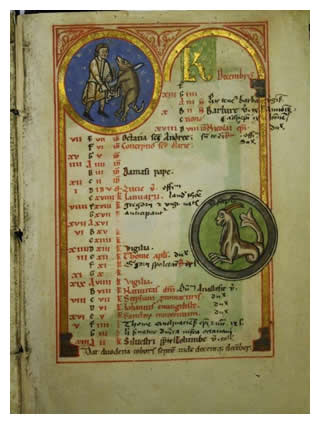
Medieval Liturgical Calendar for December. Note the image at the top which suggests this is the month for hunting bears.
My Own Winter
My personal calendar suggests that winter begins on November 5th because this is the day I generally notice how cold it has suddenly become. The house smart meter also identifies the week of November 4th being the day when the heating bill goes through the roof. However, this was not true this year, where in the London area we had a warm spell.
A final thought about Winter. Isn’t it strange that a small change in the axis of the planet should create such opposites? Cold and little growth, then hot and an explosion of flowers. Opposites just with a little tilt of the Globe towards the Sun. This, in the vastness of space, with unimaginably cold and unbelievable hot places and spaces. These make tiny the little difference between Summer and Winter seem insignificant. And yet to us, they are opposites and central facts to our existence as a species. In places, temperature ‘extremes’ make it hard to survive in. Some think this is because God made the Universe just for us. But, just think, we are completely adapted to our lives on our very own, blue planet.
A Roman View of Winter
Ovid, the great Roman poet wrote this poem on his exile from Rome to Tomis, on the Black Sea in what is now Romania. We don’t know why he was exiled, but he felt it bitterly. And winter is used to effect to show his pain.
Winter in Tomis
Harsh lands lie before him As he struggles to keep his wit Malicious thoughts infecting- Crippling the morale of his spirit Shattered visions of the fallen begin to transpire.. An awful nostalgia consumes him. A crooked smile forms..exalting the dead
So began the fall of a mastermind.
Realizing as his mind falls to pieces They are but catalysts – parts of a puzzle to a different plan As the images surfaced, his virtue descends Living amongst those barbarians Though a fierce complication Their tact was that of a wounded creature And they were overrun
“I remain in exile My bones grow weak like the sun Descending into the trees To end this daily affliction As winter shows its pallid face And the earth veiled with marbled frost Forsaken – this gradual madness consumes my mind Perdition in Tomis
Undead armies of Tomis Commanded only by the presence of my absense Brought to life by the death of myself Risen to ease this torment Sacrilege; The second chance to formulate a reason The relapse crucifixion forthwith to go into effect Casting him away; instead insuring their demise.
I remain in exile My bones grow weak like the sun Descending into the trees To end this daily affliction As winter shows its pallid face And the earth veiled with marbled frost Forsaken – this gradual madness consumes my mind Perdition in Tomis
Each day passing now I beg for some remorse Desperately grasping at what I feel to be my last bit of life But unlike the cycle of the attic I feel as though there is no recourse I’ve withered to nothing.”
“Save me from drowning, and death will be a blessing.” Hope for his designed tomb “Rescue my weary spirit from annihilation If one already lost may be un-lost”
Ovid abandoned writing his almanac poem because of his exile, so it never got beyond the Summer. To read about this see my post here or search for Ovid from the menu.
On this day
1859 – John Brown was hanged, following his raid on Harpers Ferry, violently opposing slavery.
1954 – Joseph McCarthy was formally censured by the Senate for the methods used in his anti-communist campaigns.
Published in 2024, and revised adding Ovid in 2025