Walpurgis Nacht is the eve of the Feast of St Walpurga. On May 1st 870AD, St. Walpurga remains were ‘translated’ to Eichstätt. St Walpurgis Day is her feast day. Walpurga’s brother St Williibald had set up Eichstätt as the Diocesan centre of this part of Bavaria. Walpurga and her two brothers, Willibald and Winibald were Anglo-Saxon Saints who helped convert Germany to Christianity in the 8th Century. But, I wrote about the Saint and her brothers in on my page on St. Walpurga.
The Celtic Day began at Dusk, so May Day and the Feast of St Walpurga begins on 30th April. The Christian Church took over many local traditions and adapted them to the calendar of the Church. So a Saint’s Day, is preceded by an Eve. For example, All Hallows’ Day and Halloween, and May Day and May Eve.
Eve of Beltane
The evening of April 30th is also the beginning of Beltane. Beltane is one of the principal Celtic Festivals, dedicated to the God Belinus. It is a Celtic Fire Ceremony and the traditional beginning of Summer. It is 6 months before Halloween, (see my post of Halloween here.) Walpurgis Nacht is also halfway between the Spring equinox and the Summer solstice. So, a very important day in the Celtic Calendar. (see my post on May Day).
In Sweden it is known as Valborg and as Čarodejnice in the Czech Republic.
A day of Uncanny Weirdness?
As May Day was an uncanny period dedicated to Pagan Deities, Walpurgis Nacht became a time when all the weird things are alive in the world. In response, the Christian Church associated a saint to the day to be a focus for defeating witchcraft. So, it is a popular tradition for this Night to see the burning of an effigy of a witch on a bonfire.
Tomb of St Erconwald, destroyed by the Great Fire of London. By Wenceslaus Hollar – Artwork from University of Toronto Wenceslaus Hollar Digital CollectionScanned by University of TorontoHigh-resolution version extracted using custom tool by User:Dcoetzee, Public Domain, https://commons.wikimedia.org/w/index.php?curid=6235771
It is also the Feast Day of St Erconwald. He was a Royal Prince but no one can agree of which Saxon Kingdom. He became one of the most famous Bishops of London (675 and 693). Chertsey Abbey and Barking Abbey were founded by the Saint. His sisterwhich his sister, St Ethelburga, became Abbess of Barking. Not only that, but he was known as the light of London and was responsible for rebuilding St Pauls Cathedral. And helping to complete the conversion of the Kingdom of Essex.
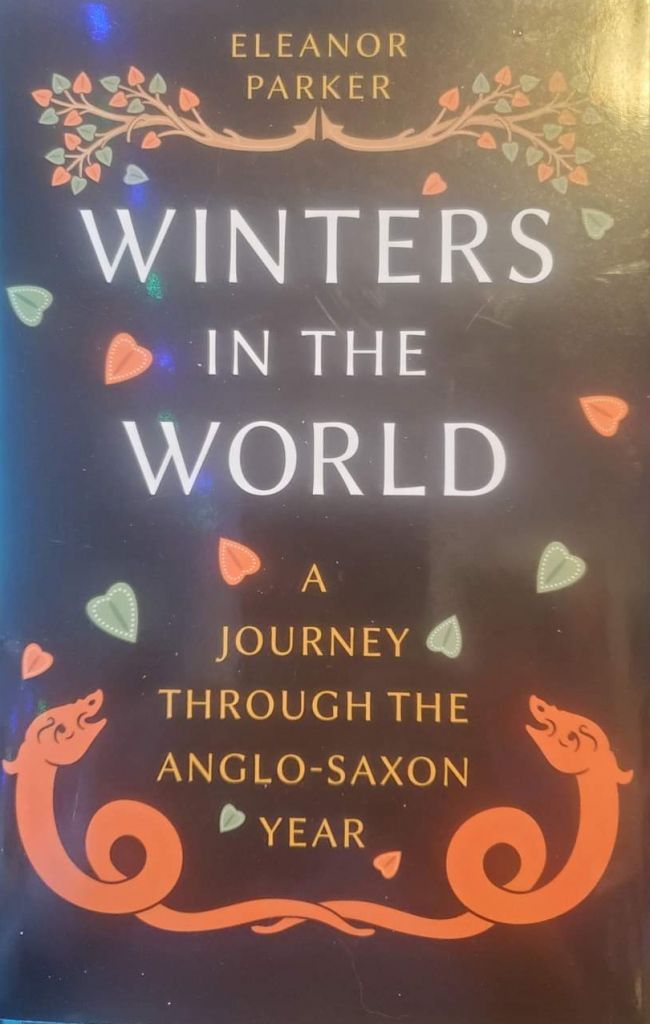
Winter’s End in ‘Winters in the World’ by Eleanor Parker
Eleanor Parker’s book, on the Anglo-Saxon Year, is a wonderful book. It has a poetry about it, that also provides an insight into how Anglo-Saxon thought the world works. For a non-Old-English speaker, it, also, really gives some understanding of the language. It reveals that for the Anglo-Saxons, Winter’s End was on the 7th February. We are now in the season of ‘lencten’. This probably comes from ‘lenghtening days’ or Spring as we call it. The word eventually got absorbed into the Christian calendar, giving us the name of the fasting season, which is ‘Lent’.
So Winter began, for the Anglo-Saxon, on 7th October and ended on the 7th February. January was called ‘Gēola‘ the month of Yule. February ‘Sol-mōnaþ‘ which is Mud month. The Venerable Bede in the 8th Century calls this the:
‘month of cakes which they offered to their gods in that month’.
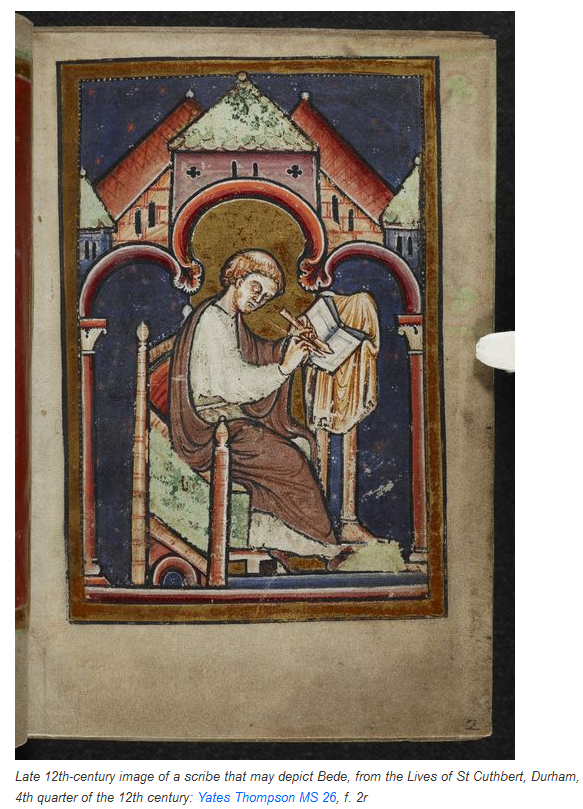
Thought to be the Venerable Bede, the first historian of the English
Bede tells us that before conversion to Christianity, the Anglo-Saxons had two seasons – Winter and Summer. Winter began on the first full moon of October, which they called Winterfylleth. The summer was called ‘sumor’ or ‘gear’ which developed into our word ‘year’. As in: ‘he was a boy of 10 summers.’
Roman, Celtic and Saxon Winter’s End
There is some sense in Winter’s End on February 7th. Lambs are being born; buds and shoot are appearing on branches and poking up from the cold earth. So, their winter is essentially, the time when nothing is growing, while ours is more aligned to the coldest period.
The Roman author Marcus Terentius Varro divided the Roman Year into 8 phrases and his Winter/Spring divide is also on 7th February. This is when, in Italy, the west winds began to blow warmer weather. So farmers ‘purged’ the fields, readying them for planting. They would be cleared of old growth and debris. Then blessed, weeded, pruned with particular attention given to preparing the grain fields, the vineyards, olive trees and fruit trees.
The Celtic year began at Halloween, and the spring begins with Imbolc, a week earlier than the Saxon on the 1st of February.
Anglo-Saxon Winter
In the section on Winter, Eleanor Parker gives a poetic description of winter. What seems particularly interesting about it is that the harshness of winter is often paired with descriptions of the ruins of Roman Civilisation. So, the despair of winter, the barren soil, the fight for survival is made more melancholic by the comparison to failed civilisation. Nature battering away at the useless ruins, and the destruction of people’s dreams.
Here, is a flavour of the juxtaposition of the bleakness of winter and the sadness of lost society. It is from ‘The Wanderer’ an alliterative poem from the Exeter Book, dating from the late 10th century. I have presumed to change a couple of words to make it a little more accessible.
Who’s wise must see how ghostly it has been when the world and its things stand wasted — like you find, here and there, in this middle space now — there walls totter, wailed around by winds, gnashed by frost, the buildings snow-lapt. The winehalls molder, their Lord lies washed clean of joys, his people all perished, proud by the wall. War ravaged a bunch ferried along the forth-way, others a raptor ravished over lofty seas, this one the hoary wolf broke in its banes, the last a brother graveled in the ground, tears as war-mask.
“That’s the way it goes— the Shaper mills middle-earth to waste until they stand empty, the giants’ work and ancient, drained of the dreams and joys of its dwellers.”
As I read this, I wonder if it is a tradition that began in the cold of Scandinavia? England, at least Southern England, can often have mild, rather than ferocious winters?
However, there is also an idea about the circularity of life and the interconnectedness of everything. There are 4 Seasons, 4 Ages of Man, and the cycle was from childhood to old age, from Spring to Winter. We start young, and become vigorous, and then we decline and eventually die. And so does the world of the Anglo-Saxons. The world of Adam was young, restored to vigour by the coming of Jesus. Now the World was in its old age awaiting the Apocalypse, before the Day of Judgement. So Winter was connected with Old Age and Death.
Bede’s Metaphor for Winter
Parker recounts a beautiful image of Bede’s. The King of Northumberland is thinking of taking his wife’s religion. He, therefore, invites the Christian evangelist, Paulinus to his court. Inclined to convert. He asks the opinion of one of his pagan advisers, who answers to the effect.
‘We are in the Great Hall, gathered warm with friends and family around the roaring fire, with Winter raging outside. A sparrow comes in from a hole in the end wall, flies through the warm of the Hall, and flies out through the other side. Such is life. The Hall is this world, we are the Sparrow, and as pagans we have no idea what happens before we enter the Hall, nor what happens after we leave. How much better it is to embrace a religion that can give us certainty as to what happens when we leave the hall.’
Lovely image, although, the pagan adviser does seem to have made his mind up to try Christianity? . What I like about it is that it echoes feelings I have. We as a species worry about what happens after death. It seems to many so final, to others unknowable. But I think ‘I don’t worry about what happened before I was born, so why should I worry about what happens after I die?’ It’s the same state of non-being. It gives me some comfort that I’m going back where I came from.
1812 – Dickens born in Portsmouth. His father was the son of a Butler and a clerk in the Royal Navy Pay Board. He has much in common with Mr Micawber. His mother, Elizabeth Dickens was a source for the character of Mrs Nickleby. Dickens told a friend that his mother came to him exasperated by the stupidity of Mrs Nickelby. Dickens said words to the effect: ‘Little did she know that Mrs Nickleby was based on her’. Here is a section of Nicholas Nickleby that makes the point.
Nicholas Nickelby From Chapter 1
‘Mr Nickleby looked about him for the means of repairing his capital, now sadly reduced by this increase in his family, and the expenses of their education.
`Speculate with it,’ said Mrs Nickleby.
`Spec—u—late, my dear?’ said Mr Nickleby, as though in doubt.
`Why not?’ asked Mrs Nickleby.
`Because, my dear, if we should lose it,’ rejoined Mr Nickleby, who was a slow and time-taking speaker, `if we should lose it, we shall no longer be able to live, my dear.’
`Fiddle,’ said Mrs Nickleby.
`I am not altogether sure of that, my dear,’ said Mr Nickleby.
`There’s Nicholas,’ pursued the lady, `quite a young man—it’s time he was in the way of doing something for himself; and Kate too, poor girl, without a penny in the world. Think of your brother! Would he be what he is, if he hadn’t speculated?’
`That’s true,’ replied Mr Nickleby. `Very good, my dear. Yes. I will speculate, my dear.’
Speculation is a round game; the players see little or nothing of their cards at first starting; gains may be great—and so may losses. The run of luck went against Mr Nickleby. A mania prevailed, a bubble burst, four stock-brokers took villa residences at Florence, four hundred nobodies were ruined, and among them Mr Nickleby.’
Mr Nickleby ends up dead having falling 202 ft from the top of the Monument. In 1810 Elizabeth’s father, Chief Conductor of Monies in the Navy Pay Office was found guilty of embezzling £5,689 3s 3d.
St Lucy, by Francesco del Cossa (c. 1430 – c. 1477) (Wikipedia User:Postdlf)
I reposted my two posts on St Lucy, and the follow-up email on eye-care, on the appropriate days. But the email to subscribers was not sent. So here it is again. The name Lucy is from the same Latin origin (Lucidus) as lucent, lux, and lucid. It means to be bright, to shine or be clear. It is similar to the Ancient Greek λευκός (leukós, “white, blank, light, bright, clear”. Luke has the same origins (bright one, bringer of light and light of the sacred flame) and is very appropriate for the most literate of the evangelists.
St Lucy of Syracuse
St Lucy is from Syracuse in Sicily. She was a victim of the Diocletian Persecution of Christians in the early 4th Century. She is an authentic early martyr. But details of her story cannot be relied upon as true. She was a virgin, denounced as a Christian by her rejected suitor. Then, miraculously saved from serving in a brothel.; destruction by fire, but did not escape having her eyes gouged out. Finally, her throat was cut with a sword.
Her connection to light (and the eye gouging) makes her the protectress against eye disease. So she is depicted holding two eyes as you can see in the picture at the top of the page. Other symbols include a palm branch which represents martyrdom and victory over evil. Other symbols are lamp, dagger, sword or two oxen.
She appears in Dante’s Divine Comedy, as the messenger to Beatrice whose job is to get Virgil to help Dante explore Heaven, Hell and Heaven.
St. Aldhelm (died in 709) puts St Lucy in the list of the main venerated saints of the early English Church, confirmed by the Venerable Bede (died in 735). Her festival was an important celebration one in England. It was views ‘as a holy day of the second rank in which no work but tillage or the like was allowed’.
Dimming of the Light
This year is a glorious sunny St Lucy’s Day. But, the afternoons soon dim. So, at this time of the year, we are in need of a festival with bright lights to cheer us up! And St Lucy’s Day is the beginning of the winter festival that culminates with the Solstice, where the old sun dies, and the new one is born. December the 13th was the Solstice until Pope Gregory reformed the Calendar in the 16th Century, as nine days were lopped off the year of transition.
Sankta Lucia in Sweden
The festival of Sankta Lucia is particularly popular in Sweden, where December 13th is thought to be the darkest night. In recent years, the Swedish community in the UK has had a service to Lucia in St Pauls. But the last couple of years has been in Westminster Cathedral. This year on the 5th December. And a Santa Lucia Carol Concert on 12 December at St Paul’s. But every year it has either been and gone or sold out by the time I get around to thinking of going!
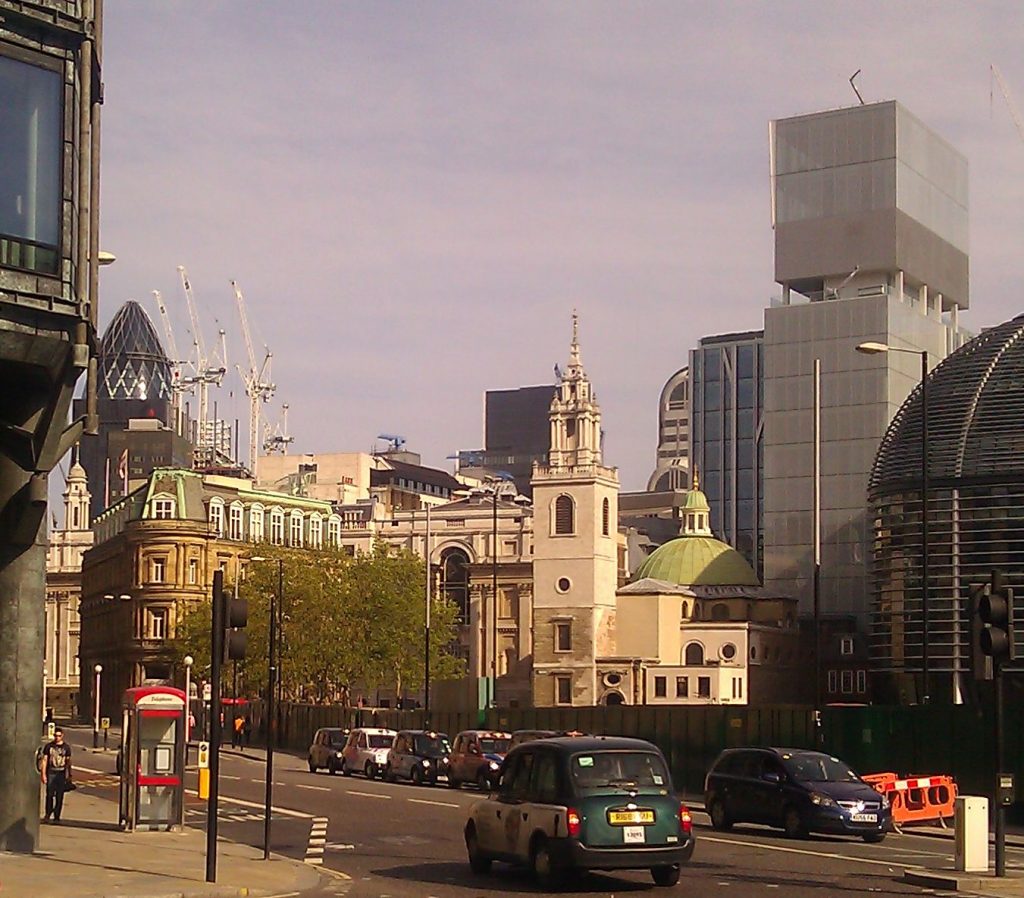
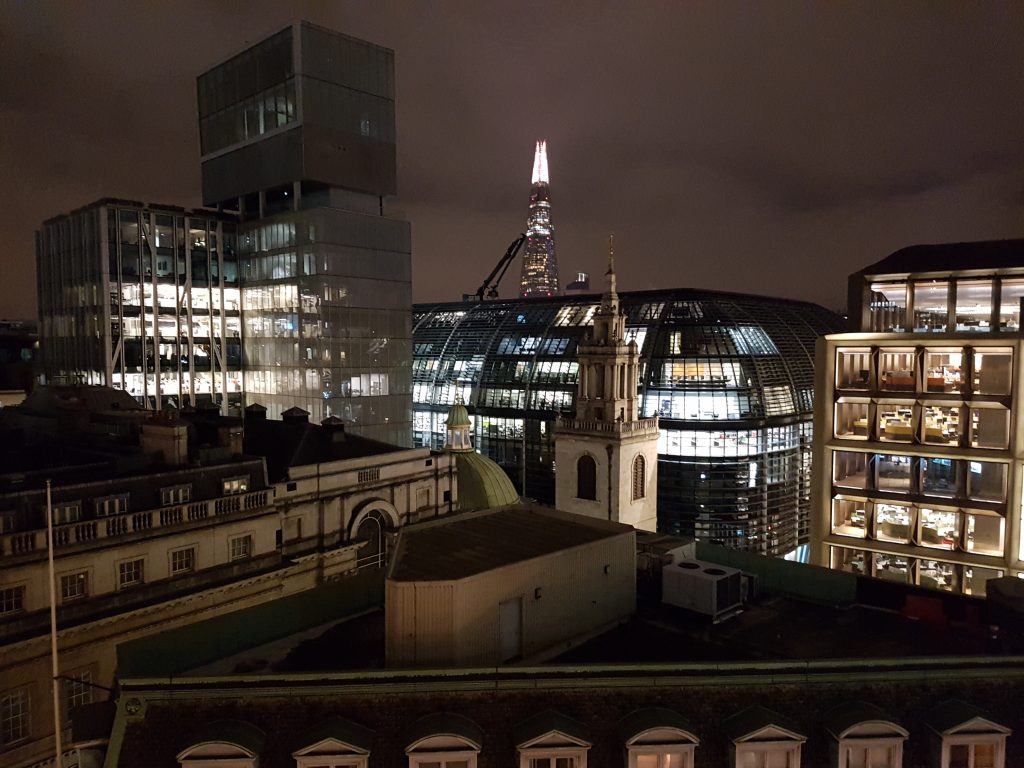
St Stephens Church by Christopher Wren (Photo K Flude) a rare view during building work.
I found out about Sankta Lucia from a Swedish choir who hired me to do a tour of the City of London some years ago. We went into Christopher Wren’s marvellous St Stephen’s Church. Under the magnificent Dome, the choir fancied the acoustics and spontaneously sang. I recorded a snatch of it, which you can hear below
Swedish Choir singing in St Stephen’s London St Stephens Church in the middle foreground of the photo. (Photo K Flude)
You can watch the Sankta Lucia service in Westminster Cathedral below:
The Importance of Light
Recent medical research has shown the importance of light, not only to our mental health but to our sleep health. Work places need to have a decent light level with ‘blue light’ as a component of the lighting. It is also an excellent idea to help your circadian rhymes by going for a morning walk, or morning sun bathing, even on cloudy days. This will help you sleep better. And so St Lucy remains relevant as an inspiration
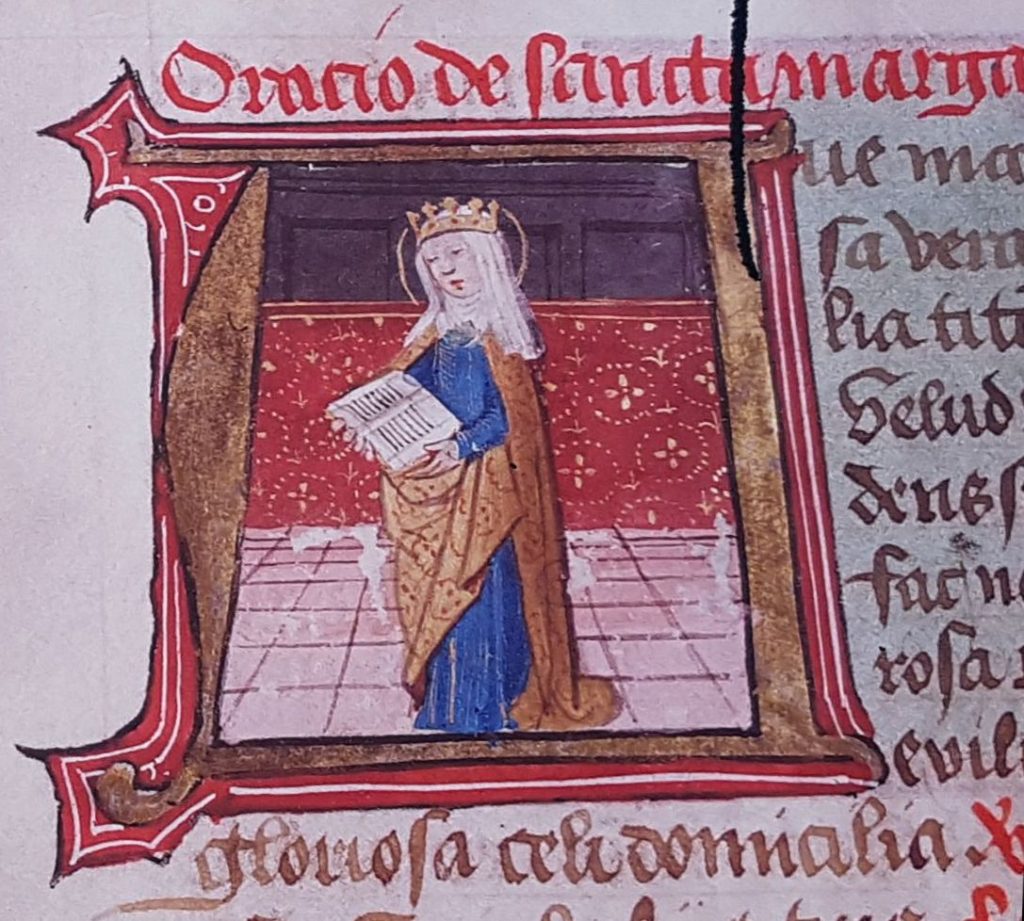
St Margaret should be better known in England because of her important rule in the bloodline of the English Monarchy. Her story is also of interest as it intertwines with the events of 1066 and of Macbeth.
She was the granddaughter of King Edmund Ironside. He was the last English King before the Danish Kings took over. He died after a peace treaty dividing England into an English and a Danish half.
This is what a draft of the text for my book on the Kings of Britain says about him:
Margaret’s Grandfather – King Edmund II 1016
Edmund was born in around 988AD and nicknamed Ironside. He was a formidable warrior who spent his short life fighting the Danes. In 1016, he was crowned in St Pauls Cathedral. Although he was defeated in battle by King Canute, the son of King Swein of Denmark, Edmund’s prowess won him a peace treaty in which England was divided between the two Kings. Unfortunately, Edmund died unexpectedly and Canute inherited the Kingdom. Edmund was buried in Glastonbury Abbey.
To buy ‘Divorced, Beheaded, Died – the history of the Kings of Britain in Bite-size Chunks’. click here.
Edmund’s wife Edith and her 2 children were exiled to Sweden and then, somehow, got to Hungary. Edmund’s eldest son was called Edward the Exile and was married to Agatha. Margaret was their third child. In 1056 Edward the Confessor invited the family back to England and soon made Margaret’s father the heir to the throne. Unfortunately, he died in 1057. He was buried in St Paul’s Cathedral.
Margaret’s Brother – Edgar the Atheling
The rest, as they say, is history. Edward the Exile’s son, Edgar the Atheling was only 6 or 7 and the throne was disputed between William of Normandy, Harald Hadarada of Norway, and Harold Godwinson.
In short, Margaret’s brother Edgar the Atheling was briefly chosen as King after the death of Harold. He was then forced to cede the throne to William the Conqueror. William was crowned King in December 1066.
Margaret’s brother Edgar the Atheling had an extraordinary life, living into his 70s. He continued to fight against the Norman rule of England, mostly from Scotland. Eventually, he reconciled with the Norman dynasty but was involved in any number of disputes, rebellions and dynastic fights.
Margaret’s Husband
Margaret was forced to flee and went to Scotland. In 1070, Margaret married the Scottish King Malcolm III ( Mael Column Mac Donnchada). Malcolm was the son of King Duncan (murdered by Macbeth – see my book Divorced, Beheaded, Died for a short biography!). In 1040, Malcolm fled to England, but returned with English help to defeat Macbeth at Dunsinane. (see my post on Macbeth and Equivocation of Phrophecy). After his first wife’s death he married the deeply pious Margaret. Their court was very influenced by Saxon and Norman ways. She helped aligned the Church more closely with the rest of Christendom, and brought up her children piously.
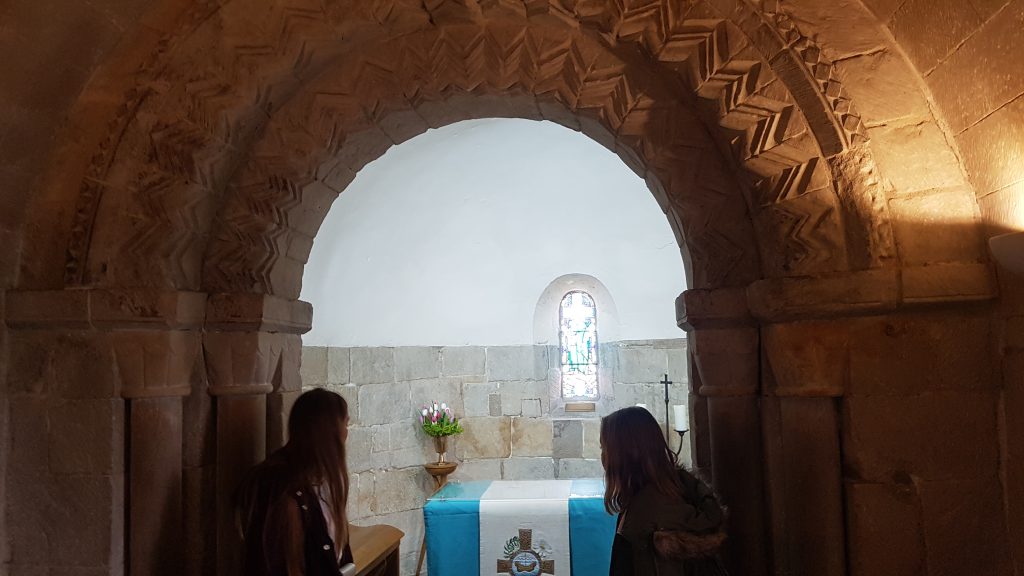
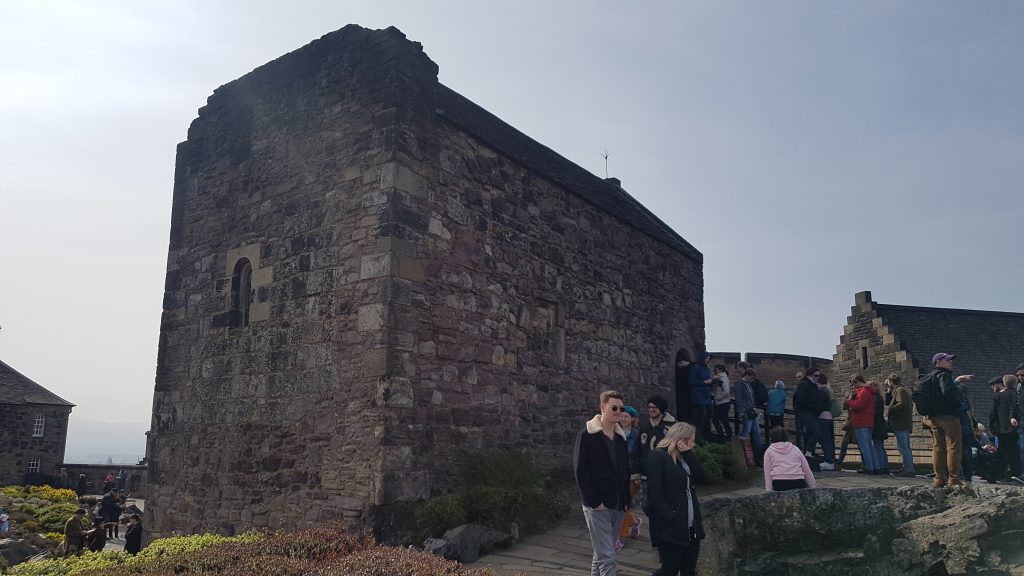
St Margaret’s Chapel at Edinburgh Castle. Built by her son King David. (Photos by the author)
Margaret’s Son – David
The Royal couple had 6 sons and two daughters. Her son David became one of the most influential Kings of Scotland. He introduced Norman ideas of feudalism, and created Boroughs to strengthen the Scottish economy. He also encouraged ‘modern’ forms of monasticism, encouraging the Cistercians to come to Scotland. By these means, he hoped to turn Scotland a Feudal society with a thriving market economy based on towns and monasteries.
Margaret – the Moderniser?
So, in many ways, Margaret had an influential role in ‘modernising’ the Scottish Monarchy from its Gaelic clan-based structure to a more European style that was ruled from the Lowlands and spoke the Scots version of English, rather than the Gaelic version of the Celtic branch of languages.
She died on 16th November 1093 AD and is ‘particularly noted’ for concern for orphans and poor people. There is an annual procession to her altar, followed by Evensong at Durham Cathedral on the following day. She was buried at Dunfermline following the violent death of her husband. The Abbey has recently celebrated the 950th anniversary of Queen Margaret consecrating the site.
Margaret’s Daughter
Margaret’s daughter, Matilda, married the son of William the Conqueror, King Henry I. This marriage was important for the Normans because it added a strong dose of English Royal blood to the French Norman Royal line. Their daughter was the formidable Empress Matilda, designated heir to the throne of England and founder of the Plantagenet line of English Kings. She was an uncrowned monarch of England and mother of Henry II. She was never crowned because of the disruption caused by the usurpation of the throne by King Stephen.
To read my posts on the events of 1066:
You can read what happened, in my detail, in my posts on the three battles that decided England’s fate in 1066.
Foul privies are now to be cleansed and fide, let night be appointed such baggage to hide: Which buried in garden,in trenches alowe, shall make very many things better to growe.
The chimney all sootie should now be made cleene, for feare of mischances, too oftentimes seene: Old chimney and sootie, if fier once take, by burning and breaking, soone mischeefe will make.
Five Hundred Points of Good Husbandry. 1573 by Thomas Tusser