Bluebells, on average, bloom on April 9th, but can be seen through April and into May. Past their prime in London currently, although still thriving in my north-facing back garden. The Londonist has a great website on where to see them in London. And for the rest of the country, see the National Trust’s Bluebell walk page.
Hyacinthus
Our wild hyacinth is officially called Hyacinthoides non-scripta. Mrs Grieve, in her ‘Modern Herbal’ gives this charming account of the Linnean name:
‘Linnaeus first called it Hyacinthus, tradition associating the flower with the Hyacinth of the Ancients, the flower of grief and mourning. Hyacinthus was a charming youth whom both Apollo and Zephyrus loved, but Hyacinthus preferred the Sun-God to the God of the West Wind, who sought to be revenged, and one day when Apollo was playing quoits with the youth, a quoit (blown by Zephyrus out of its proper course) killed Hyacinthus. Apollo, stricken with grief, raised from his blood a purple flower, on which the letters Ai, Ai were traced, so that his cry of woe might for evermore have existence upon earth. As our native variety of Hyacinth had no trace of these mystic letters our older botanists called it Hyacinthus nonscriptus, or ‘not written on.”
Avoid the Spanish
The Spanish variety is causing havoc in some places. It is more robust and can interbreed with ours and endangers our beautiful bluebell walks. Native bluebells are therefore a protected species. We are not allowed to pick them, nor even tread on them.
Old Medical and Practical Uses of Bluebells
It was used as a diuretic and is styptic (Contracting the tissues or blood vessels; stopping blood flow). The bulbs are poisonous in the fresh state. But were used as a starch, much used when stiffs ruffs needed starching. Its gummy qualities led it to be used as a bookbinders gum, and to set feathers upon an arrow.
This year, Good Friday is on Friday 3rd of April, and the day we eat Hot Cross Buns. The Hot Cross Bun is a simpler sort of bun than the Chelsea Bun, which was the bun to have at Easter in London in the 18th Century.
Hot Cross Buns Good Friday Traditions
There seem to be all sorts of dubious traditions around the origins of the Hot Cross Bun. It has been suggested that the Greeks knew how to put a cross on a bun. Also, that the Anglo-Saxons celebrated the Goddess Eostre with the crossed bun. It is suggested that the cross represents, not the cross, but the four quarters of the moon, the four seasons and the Wheel of the Year. But there is very little evidence for Eostre other than the Venerable Bede’s mentioning her name. Bede says:
‘‘Eosturmonath has a name which is now translated ‘Paschal month’, and which was once called after a goddess of [the English people] named Eostre, in whose honour feasts were celebrated in that month’ (quoted from florencehrs.substack.com/p/eostre-pagan-fertility-goddess)
So nothing is known about Eostra herself nor her rituals and customs. So her association with Hot Cross Buns cannot be known. However, the cross, and the association with Easter, makes the bun powerful, so there are many superstitions on record. A piece of an Easter Hot Cross Bun given to the sick may promote a cure. It was said that a bun cooked and served at Easter will not go off for a year. This might help explain the traditions that hanging them up on a string or ribbon is a good thing. One hung in a kitchen prevents fire. On a ship prevents sinking. In East London, the Widow’s Son Pub in East London has an old bun. This remembers a sailor-son who never returned to eat it on Good Friday.
Making and Eating Hot Cross Buns
The technology of putting a cross on a Bun requires nothing more complicated than a flour and water paste so it might well be an ancient tradition. A more impressive cross can be made with shortcrust pastry. The bun itself is simply flour, milk, butter, egg, salt, spices and mixed fruit. Here is a recipe from the BBC www.bbcgoodfood.com
In my opinion, they need to be purchased from a shop. Home-made Hot Cross Bun might be better but would be strangely disappointing. It’s normally eaten toasted and buttered although I prefer the soft doughy untoasted and unbuttered bun. But then I can get carried away and eat the entire pack of four.
‘RRRRRare Chelsea Buns’ as Jonathan Swift called them in a letter to Stella in 1711.
Fragrant as honey and sweeter in taste As flaky and white as if baked by the light As the flesh of an infant soft, doughy and slight.
The buns were made from eggs, butter, sugar, lemon and spices. The tradition was that, on Good Friday, 18th and 19th Century Londoners would go to Chelsea to buy Chelsea Buns. Thousands of people would turn up at the Five Fields. These stretched from Belgravia to what is now Royal Hospital Street. There were swings, drinking booths, nine pins and ‘vicious events that disgraced the metropolis’. The Bun House was on Jew’s Row as Royal Hospital Street was then called. As several King Georges visited the Bun House it became known as the Royal Chelsea Bun House. It was run by the Hands family. They were said to sell 50,000 Buns on the day. Stromboli tea garden was nearby.
Chelsea Cabinets of Curiosity
Inside the Chelsea Bun House was a collection of curiosities. Chelsea became known for its collection of curiosities in the 18th Century. Of course, there was the great Hans Sloane’s collection which was the founding collection of the British Museum. And then there was Don Saltero’s which was a coffee house that had curiosities on the wall. The Bun House displayed clocks, curiosities, models, paintings, and statues on display to attract a discerning Public.
Find me a Chelsea Bun! (Or make one yourself!)
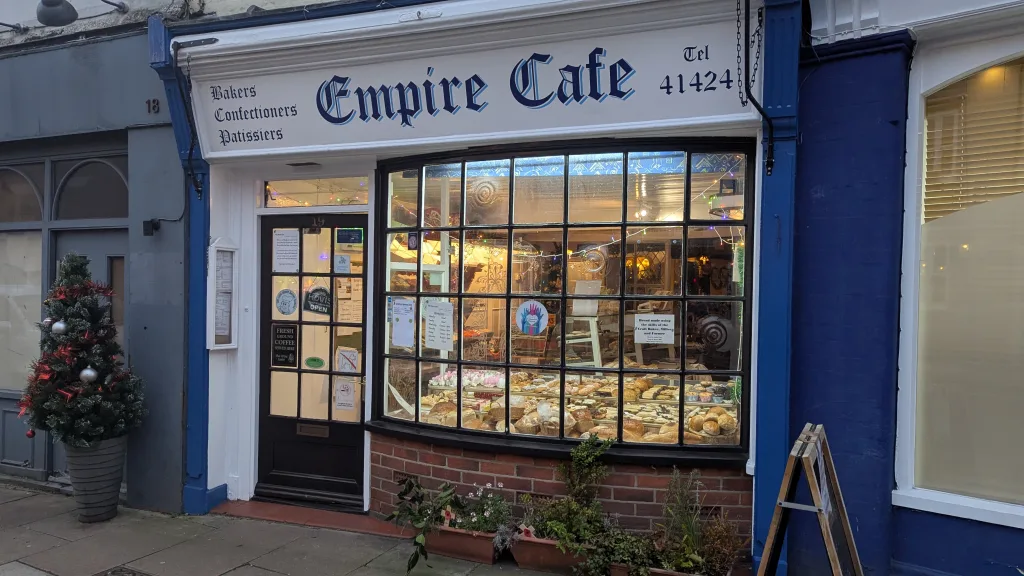
Me. I love a Chelsea Bun above all buns, But can you get them any more? The British Library Cafe was the last place I found that sold them. And that was 7 years ago. I did Chelsea Buns on sale in the Empire Cafe in Newbury but apart from that nada. Their place has been taken first by Danish Pastries and more recently the ubiquitous Cinnamon Bun. If you see any Chelsea Buns on sale please let me know.
Chelsea Buns, middle top row, next to the white cakesEmpire Cafe baking in Newbury since 1874
There is a tradition of Skipping on Good Friday. I can’t say I ever saw it – in my school skipping was a perennial activity, mostly enjoyed by the girls, but the boys would sometimes be intrigued enough to join in.
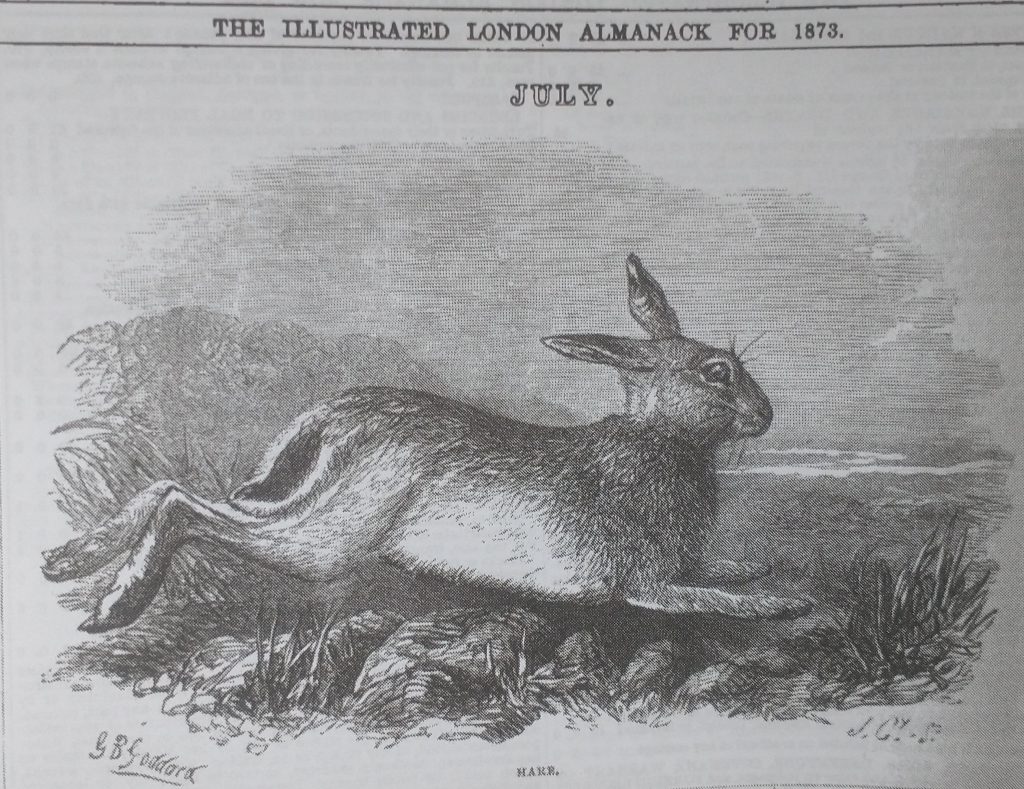
The expression ‘Mad as a March Hare’ comes from the displays of hare boxing that takes place as the Hare mating season begins. And no, it’s not the male March Hare fighting in the spirit of romantic rivalry. It is the female hares fighting off unwanted attention from the males. Hares are solitary creatures, and the mating season is, perhaps, particularly difficult for them. The Country File website has more on the subject. www.countryfile.com
Not only March Hares but March Kittens too
There are also March Kittens and March Chickens. Edward Topsell in his ‘History of Four-footed Beasts‘ 1607 says the best Kittens to keep are those born in March. ‘The Closet of Sir Kenelm Digby Opened‘ 1669 says:
‘Keep a black cock hatched in March as a protection against evil spirits: his crowing terrifies them.’
He also gives a recipe for Cock Ale:
Eight gallons of Ale, a boiled March Cock, four pounds of stoned Raisins, half a pound of dates, nutmegs, mace. Beat the ingredients in a mortar, add to two quarts of Sherry. Add to the ale. Stop it in a container for 6 or 7 days. Bottle it, drink after a month.
Very weird. I challenge my readers to try it and let me know how it goes?
Was the March Hare Sacred?
But it’s not only March Hares because the hare itself was a sacred animal. It was sacred to Aphrodite because of their prodigious ability to have offspring:
‘For you know, I imagine, what is said of the hare, that it possesses the gift of Aphrodite to an unusual degree. At any rate it is said of the female that while she suckles the young she has borne, she bears another litter to share the same milk; forthwith she conceives again, nor is there any time at all when she is not carrying young.’
Classical Texts Library. Philostratus the Elder, ‘Imagines’ Book 1.1-15 c 3rd Century AD. Translated by Arthur Fairbanks.
Divine Celtic & Neolithic Hares
Research reported by Exeter University suggests that hares were worshipped in pre-Roman Britain. Julius Caesar wrote:
“The Britons consider it contrary to divine law to eat the hare, the chicken, or the goose.”
‘The Battle for Gaul’ Translation by Wiseman, Anne, Wiseman, T. P. Published by Penguin Random House, 1980 ISBN 10: 0701125047 (TP Wiseman was my professor for Classical Studies at Leicester University).
Hares are thought to be the original Easter Bunny. But finding good evidence before Germany in the early modern period is difficult. There is a tradition that witches can be scared away at Easter. Exactly, how this works is not at all clear to me. But it has been said that witches could take on the form of a hare. So eating Hare Pie at Easter helps rid the land of the witches.
Jugged Hares
You could have a jugged hare. Jugging is cooking a whole animal in a container over water. Follow this link for a recipe for jugged wild hare. Remember, you are not allowed to shot or trap them on a Sunday or on Christmas Day! For a discussion of hares and folklore, click here:
Hare’s Feet Totems
A jointed hare’s foot was considered very lucky and a remedy against gout, stomach pains and insomnia. (The Perpetual Almanack of Folklore by Charles Kightly, which I have used several times in this piece.) You can buy one on eBay. (Don’t click the links, it’s not an advert but a picture of an advert). I remember friends having rabbit feet which they carried around with them for luck. The foot would often be on a key rings.
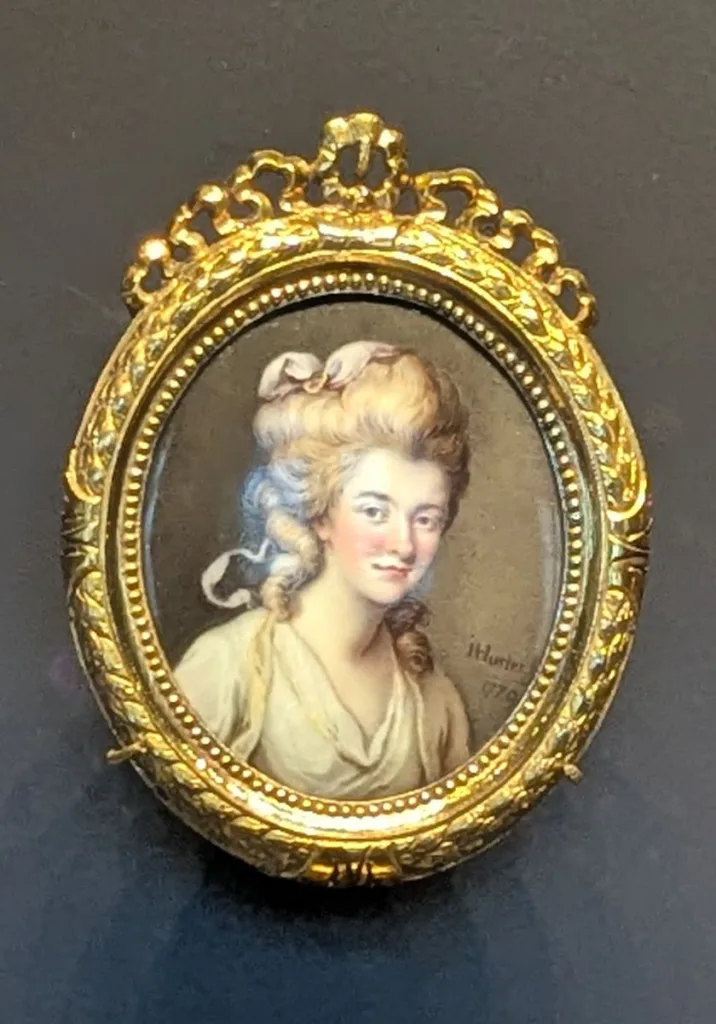
Georgiana, Duchess of Devonshire (Johann Heinrich Hurter after Angelica Kaufman). Photo by K Flude of the miniature at the Victoria and Albert Museum
The Gilbert Collection has been re-displayed in the V&A in London. It has just opened, and is one of the most opulent displays you could hope to see! But, I loved this miniature of Georgiana. She was one of the richest women in Britain, a compulsive gambler, and a powerful political force for the Whig Party. And despite the Georgian Hairstyle the artist has contrived to make a very down to earth portrait. I can imagine bumping into her at the local Overground Station! She became better known after the bio graphy by Amanda Foreman, followed by the Film starring Keira Knightly. The Museum label says the portrait is ‘after Angelica Kaufman’. But I cannot find a Kaufman of Georgiana, that has this charming informality.
I have just heard news that the Arts Council wants to charge overseas visitors to visit our wonderful free national Museums, while allowing British Citizens free entry. Now, there are lots of arguments to be made about it, particularly in a time where money is in short supply. But, one result will be longer waits to get into Museums and Galleries. I am not sure how we Brits, are going to be asked to prove our nationality. If they have to inspect our Electricity Bills, Drivers Licenses, Passports, Library Cards, or Bank Statements, expect chaos.
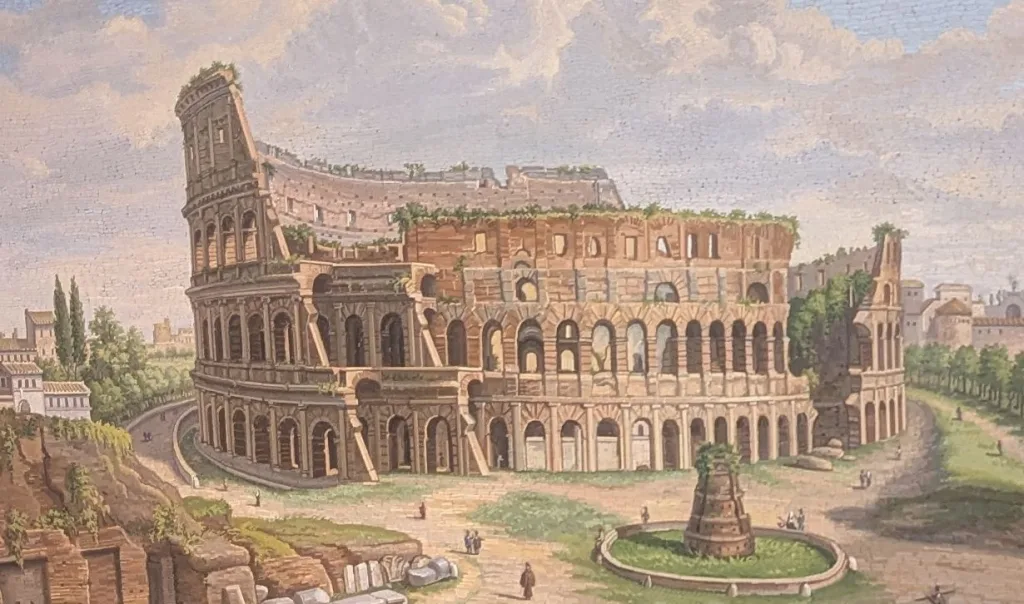
One more object from the Collection is made of minature mosaics, and the V&A has several, But I have chosen this fabulous image of the Colosseum in Rome:
Colosseum by Domenico Moglia c1851
First published March 28th 2023, revised 2024, 2025. 2026 Object of the Day added and post revised 2026
Study for Lady Lilith, by Rossetti. 1866, in red chalk. Now in the Tel Aviv Museum of Art (Wikipedia) Lilith born at The Beginning of the Universe
This is now my most popular post. March 25th is the Annunciation—the day that the Archangel Gabriel tells Mary she is pregnant. (to see some very fine paintings of this meeting, look at my other March 25th post march-25th-feast-of-the-annunciation/). When I first wrote this post I was discovering how it all fitted together as I wrote. So I’m leaving it the way it was, proof reading and clarifying if necessary, but keeping the thrill of the discovery of the the significance of March 25th as the day that saw the Beginning of the Universe.
March 25th is also the anniversary of the birth of Adam and Eve (and Lilith); the death of Jesus Christ; the anniversary of the Immolation of Isaac; the Parting of the Red Sea; the Fall of Lucifer; and, (until 1752 in the UK) the beginning of the Year.
Of course, it isn’t. Or to put it another way, no one can, or ever could, prove any of these dates except 1752. So what they speak to is the way the Church saw the world as logically structured by God. Christian thinking about the year, the world, the universe, creation, developed over many years and took influences from many cultures. It is also very complicated to work out the sequence, so I’m going to summarise what I know (or at least what I think I know).
Happy Birthday, Dear Jesus.
Christians chose Christmas Day as the Birthday of Jesus, probably partly because it was a prominent birthday already shared with several Gods. Particularly, Attis, Mithras, Saturn and the Unconquered Sun. It was approximately at Solstice, the beginning of the Solar Year, and close to one of the main festivals of the Roman World, the Saturnalia. So it made it easier for new converts who could retain elements of their festivals after conversion.
December 25th might have been selected by the pagan religions because it is the time when the Sun begins to rise further north each day. The days stop shortening and start lengthening, light increases with the promise of warmer weather and budding plants. It was considered a rebirth of the Sun.
Solstice Anniversaries
So, Jesus was born on/or around the Solstice, so he must have been conceived approx. 9 months earlier. This is approximately at the Spring Equinox.
Ah, you are thinking! But today isn’t the equinox. It’s a few days after the equinox. Surely, God doesn’t do approximately?
I have always thought that the 4 or 5 days difference between the Solstice, the Equinox and the Christian festivals was down to the fact that the Calendars were not well coordinated with the actual movements of the Sun (because the Sun does not circle the earth in 365 days, or in 365 and a quarter days, but 365 days, 6 hours, 9 minutes. Unless corrected for this means dates slip from their proper place in the Solar Year. It also makes lunar Calendars difficult to align with the Sun cycles, and vice versa.
But when I first wrote this a sudden revelation dawned upon me which will be revealed in the next few paragraphs.
So, God sends his Son to save the human race. God is a logical being, so she would send her Son at an appropriate time? If Jesus is born at or near the Solstice, which is an appropriate time for the Son of the Creator, then conception 9 months earlier, March 25th, is near the Equinox. This is the beginning of Spring. For many people, Spring is a new beginning, for example, the Anglo-Saxons saw Winter as the death of the year, and Spring as the young Year. It all makes sense.
The Creation
So to the Creation. God, having a free choice, would have created the world at the beginning of Spring. In fact, if you think about it, God creates everything necessary for life at the creation in 6 days. As soon as it has all been created and put together, it is bound to immediately spring into new life. The first season must, therefore, be Spring? Right? So March 25th?
This gives a nice symmetry with Jesus’s Life. Conceived on March 25th, born December 25th, and died 30–40 years later, according to the Church, at Easter, on March 25th. (the only other famous person I know, born and died on the same day is William Shakespeare).
Easter
Easter, when Jesus is martyred, isn’t March 25th I hear you saying. But remember, Easter is a lunar festival, so its date varies each year. In fact the next time is 2035. Births and deaths, on the other hand, are fixed to the Solar Calendar. Therefore, the Church chooses March 25th as the most appropriate day to pin the death of Jesus, on the anniversary of his conception and the anniversary of the creation of the Earth. I am guessing that this is also the preferred date for the Day of Judgement.
It is also the Birthday of Adam, and his first wife Lilith (or so some say), and Eve. More about Lilith below. I hope this is all making sense?
Why was Adam born on March 25th?
I had thought this date was just one of the parallels that the Church liked, Jesus and Adam born on the same day. But, I have just worked out why Adam is born on March 25th, and why these dates are not the Equinox, March 20th/21 but March 25th, which has been bugging me.
Let’s go back to the beginning of Creation as described in Genesis. It has the following sequence of Seven Days, beginning with the Equinox March 20th. I have added dates to the 6/7 day sequence of Creation:
Day 1: Light – March 20th
Day 2: Atmosphere / Firmament – March 21st
Day 3: Dry ground & plants – March 22nd
Day 4: Sun, moon & stars – March 23rd
Day 5: Birds & sea creatures – March 24th
Day 6: Land animals & Adam, Lilith and Eve – March 25th
So there you have it! Adam, Eve (and Lilith) were created on Day 6 with the Land Animals – March 25th. Jesus conceived, also on this date, and so 9 months later is born on December 25th. It all makes sense, and aligns the Jesus’s Life, the Christian year fully with the Solar Year and the Creation!
And that, dear Reader, is the very first time anyone has been able to explain to me why Christmas is not at the Solstice, and why the Annunciation was not at the Equinox. Maybe you all know this, but it is very exciting to work this out for myself. And believe me, I have done a lot of reading about calendars and not spotted an explanation.
When was the Creation?
The Anno Munda‘s is a Jewish Calendar which begins counting from a year before the Creation – the Year of Emptiness. This was 5500 years plus 2026 years ago so 7526 Before the Present. And it was supposed to have ended in 600AD, 6000 years after the Creation. So, they got that wrong.
Dionysius Exiguus replaced the Anno Mundo year with the AD/BC system in the 6th Century AD). This became popular when the Venerable Bede used it in his writings in the 8th Century.
Beginnings of the year
The Celts chose October 31st, Julius Caesar chose January 1st, other cultures have other dates, and the Spring Equinox is another choice sometimes made. The Church and Dionysius Exiguus choose March 25th, although secular society also recognised the claims of January 1st. Britain kept to March 25th until 1752 when we adopted the Gregorian Calendar. But people like Samuel Pepys celebrated New Year’s Eve on 31st December. So January 1st was the secular New Year, but the Christian year number did not change until March 25th. So King Charles I thought his head was being cut off on January 30th 1648; while history books will tell you it was cut off on January 30th 1649. Same day, same head, different reckonings.
January 1st, the New Moon and New Year
December 31st/January 1st is essentially a Solstice New Year Festival. And I have, previously, used the difficulty of keeping calendars as to why these days has slipped out of alignment with the Solstice. But, today I realised that it is as likely that the reason is the Solar/Lunar nature of our time keeping. The year, and its festivals, is largely arranged around the Solar Cycle. But our weekly and monthly cycles are orginally derived from the Moon.
The first of a month, was called the Kalends by the Romans, the Nones the half moon, and the Ides signified the New Moon. The kalends of January is then, originally, the First New Moon after the Winter Solstice. So, January 1st is not a slightly misdated Solstice Festival it is a Festival celebrating the first New Moon of the New Year! Sorry, to seem excited but this is the first time I have realised this.
Over time societies give up trying to sync the lunar and solar calendars. Roman and Christian cultures gave up and fixed the moon months, completely abandoning any attempt to keep the months to the actual lunar cycle. This is our current system, in which only Easter and festivals that depend on Easter remain true to the movements of the moon festival, much to our perennial confusion.
Maybe you all know this, but it’s put many things into perspective for me!
Lilith
The April 2023 Issue of ‘History Today’ had a short piece called ‘The Liberation of Lilith’ which suggests that the story of Lilith, a figure from Jewish Folklore, is first attested in a Medieval satirical text called ‘The Alphabet of Ben Sira’. The story goes that Lilith is created from the same clay as Adam. Adam then demands she lies below him during sex. She refuses, saying that they are both made from the same stuff and, therefore, equal. Adam refuses to accept this, and so Lilith leaves the Garden of Eden. So the story goes.
The story of Lilith, Sarah Clegg suggests, is one of a series of similar stories found around Europe and Asia. And Clegg assumes that it is gradually modified to make Lilith a demon who will kill babies unless the names of three angels are spoken out loud.
The story survived as a charm to keep babies safe, and perhaps to remind people of equality among the sexes. But this causes problems for, OK, let’s call them out, the Patriarchy. Lilith cannot be equal to Adam so she is made into a monster, not made from the same clay as Adam but from the scum and waste left over from Adam’s creation. I imagine the story then went on to propose that God creates Eve from Adam’s rib, and so she is created from Adam, and is, therefore, not equal, but subservient to him, although not as bad as Lilith. Lilith is now a significant figure in feminist folklore circles.
Attached to the watercolour of Lilith by Rossetti (at the top of the page), was a label with a verse from Goethe‘s Faust as translated by Shelley. (Wikipedia)
“Beware of her fair hair, for she excells All women in the magic of her locks, And when she twines them round a young man’s neck she will not ever set him free again.”
The model is Fanny Cornforth, Rossetti’s mistress. He painted another version a few years later, but the model in that is Alexa Wilding. His models are arguably more interesting than the man himself and include: Elizabeth Siddall, Jane Morris and Fanny Cornforth. Christina Rossetti, his poet sister, modelled for Rossetti’s painting, Ecce Ancilla Domini which you can see here.
For more on the Annunciation, look at my other March 25th post here.
I think I might have enough material to begin my own Cult.
The store cupboards are getting denuded of the fruits, nuts, preserves, pickles, salted and dried foods saved from the summer and autumnal abundance. Of course, this is alleviated by the reduced consumption of the Lenten fast. (I’m continuing my lenten practice of giving up, giving up things for Lent). But nettles are budding. I take a regular cup of nettle tea. Normally, provided by the excellent Cowan’s tea emporium in the Covered Market in Oxford. But I’m running out and not due to visit Oxford for a month or so. So Charles Kightley in his Perpetual Almanac tells me that young stinging nettles are appearing and this is the time to collect own young, juicy nettles.
Here is a video about collecting them.
YouTube Video on making Nettle Tea
Nettle Beer
Or better still, change up the tea for a nettle beer:
Take a gallon measure of freshly gathered young nettles washed well dried and well packed down. Boil them in a gallon of water for at least a quarter of an hour. Then strain them, press them and put the juice in an earthenware pot with a pound of brown sugar and the juice and grated skin of a lemon. Stir well, and before it grows cool put in an ounce of yeast dissolved in some of the liquid. Cover with a cloth and leave in a warm place for four or five days and strain again and bottle it, stopping the bottles well. It’ll be ready after a week, but better if left longer.
Nettle Beer was brewed for old people against ‘gouty and rheumatic pains’.
Nettle: Detecting Virgins
A more sinister use is provided by William Coles who gives a method of detecting virginity.
‘Nettle tops are usually boiled in pottage in the Springtime, to consume the Phlegmatic superfluities in the body of man, that the coldness and moistness of the winter have left behind. And it is said that if the juice of the roots of nettles be mixed with ale and beer, and given to one that suspected to have lost her maidenhood, if it remain with her, she is a maid, But if she’s spews forth, she is not.‘
William Cole’s Adam in Eden 1657.
Flagellation with Nettles?
William Camden reported that Roman soldiers used nettles to heat up their legs in the cold of a British winter. (from Mrs Greaves’ ‘A Modern Herbal). Perhaps, I should have sent that idea to PM Keir Starmer? He might have suggested the method to Senior Citizens to alleviate the loss of their Winter Fuel Allowance? (which he has now restored). Flogging with nettles was a cure for rheumatism and the loss of muscle power in the early modern period. Nettles were also added to horse feed to make their coats shine. It was used as a hair tonic for humans.
Nettle Fabrics
The 18th century poet Thomas Campbell is quoted on the virtues of nettles:
“I have slept in nettle sheets, and I have dined off a nettle tablecloth. The young and tender nettle is an excellent potherb. The stalks of the old nettle are as good as flax for making cloth. I have heard my mother say that she thought nettle cloth more durable than any other linen.”
In 2012, a Danish Bronze Age Burial was found to be dressed in a shroud made of Nettle. Strangely, the nettle was not local, perhaps being made in Austria where other objects in the rich burial came from. However, the person was thought to be Scandinavian. For more have a look at this article on www.nbcnews.com.
In the Irong Age, also in Denmark, Huldremose Woman was found buried in a bog. She had a severed arm and was buried in elaborate sheep and goat skin clothes, but underneath:
‘she wore a white inner garment made from plant fibres that reached from the shoulders to below the knees. The type of plant fiber is unclear but other evidence from the time period suggests that it could have been made of nettle.’
Greaves tells us that the German and Austrians had a shortage of cotton during the blockade of World War 1. They turned to nettles to replace cotton production believing it to be the only effective substitute. It was also substituted for sugar, starch, protein, paper and ethyl alcohol.
YouTube Video on making fabric from nettles
Nettle Pudding
Pepys ate Nettle Pudding in February 1661 and pronounced it ‘very good’. Here is more on Nettles in history AND a recipe for Nettle Pudding! I can see I’m going to have to get out there and carefully pick myself some nettles! ( For Folklore of Nettles look here).
Remember, none of the above is necessarily good advice as far as medicine is concerned. For smoking herbs see my post coltsfoot-smoking-cholera
March Weather
In the early modern almanacs there is much weather and horticultural advice to be had (Weather Lore. Richard Inwards).
‘March damp and warm Will do farmer much harm‘
or
‘In March much snow to plants and trees much woe‘
On This Day
March 10th is St Kessog Day. He is associated with Luss on Loch Lomond, and was Robert the Bruce’s rallying cry. St Kessog and Scotland!
241 BC – The Battle of the Aegates in which the Carthaginian fleet is sunk, and the First Punic War ends. Carthage was destroyed in the Third Punic War in 146BC. Rebuilt as a Roman City 100 years later.
1629 – Parliament is dissolved by Charles I. This was followed by a Royal dictatorship which lasted 11 years, and then led to Civil War.
1906 – Bakerloo Line Opened. The name originated from the Baker Street and Waterloo Railway. It goes from Harrow &Wealdstone in the NW to Elephant & Castle in the South East, via the Central London section which goes from Bakers Street to Waterloo, Sherlock Holmes didn’t use the Tube very much (see this post here for those times he did). There is a proposed extension from Elephant & Castle to Lewisham.
1969 – James Earl Ray sentenced to 99 years in jail for murdering Martin Luther King. While Ray was a segrationalist and a supporter of George Wallace, he maintained he was set up as the scapegoat. He died in prison in 1998.
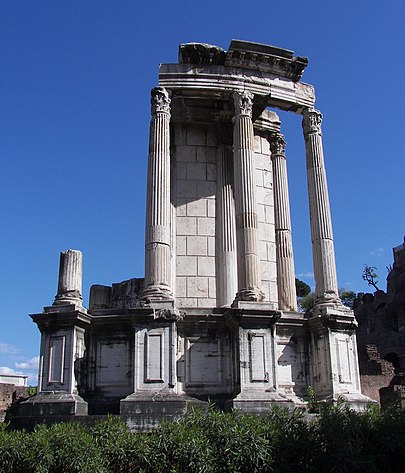
For March 6th, Ovid in his Almanac Poem called ‘Fasti’ (Book III: March 6) tells the story of Vesta. She is Hestria, in Greece and is depicted on the Parthenon Marbles, standing near Zeus and Athene. She was the Goddess of the Hearth, of the fire that keeps families warm, and fed. Vesta had 6 Virgins as her Priestesses. They had to remain 30 years, from before puberty, as a virgin. The punishment for breaking their vows was to be buried alive. Any partners in sin were beaten to death. At the end of their term they could marry, retire, or renew their vows. That suggests they would be late 30s, early 40s before they could be released
The Vestal Virgins tended Vesta’s hearth. It was not supposed to go out as it had, in theory, come from Troy with Aeneas. Vesta’s Temple also housed the Palladium. This was a wooden status of Pallas Athene, that kept Troy, then Rome free from invasion. Odysseus and Diomedes had stolen it just before the Trojan Horse episode ended the 10-year-long Trojan War. (To read more about palladiums, look at my post here.)
The Temple of Vesta was in Rome’s Forum, and it was a circular temple or a Tholos. Next to the Sacred Shrine at Bath was a circular Tholos, which may have been dedicated also to Vesta.
Ovid & Vesta
Here is what Ovid says in his March 6th entry:
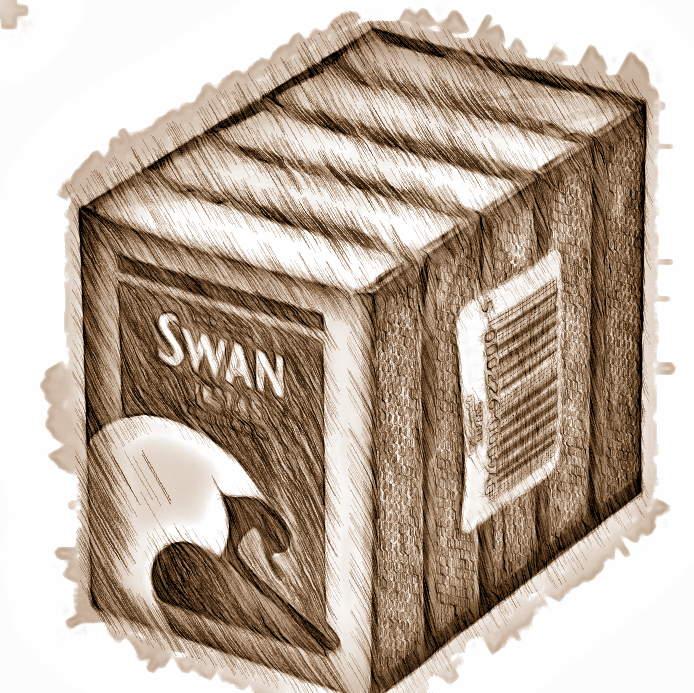
Sketch of Swan Vesta Matches
When the sixth sun climbs Olympus’ slopes from ocean, And takes his way through the sky behind winged horses, All you who worship at the shrine of chaste Vesta, Give thanks to her, and offer incense on the Trojan hearth. To the countless titles Caesar chose to earn, The honour of the High Priesthood was added. Caesar’s eternal godhead protects the eternal fire, You may see the pledges of empire conjoined. Gods of ancient Troy, worthiest prize for that Aeneas Who carried you, your burden saving him from the enemy, A priest of Aeneas’ line touches your divine kindred: Vesta in turn guard the life of your kin! You fires, burn on, nursed by his sacred hand: Live undying, our leader, and your flames, I pray.
Caesar is Julius Caesar. Aeneas was the last Trojan who survived the end of Troy. He came to Italy, founded a Kingdom (Latium) in which his descendant, Romulus, would found Rome. This is told in Virgil’s Aeneid.
Rhea Silvia the Vestal Virgin
At the beginning of Book 3 of Fasti. Ovid tells us the story of Rome’s foundation, and how Mars took Silvia the Vestal while she slept. She was descended from Aeneas. She later gave birth to Romulus and Remus. The betrayal displeased the Goddess Vesta. The holy fires went out, the altar shook and the eyes of Vesta’s statue shut. Venus was more forgiving. The children survived. But Silvia eventually drowned in the Tiber. (For more on the foundation of Rome see my post here)
Foundation Calendars
The new City chose Mars, the Roman God of War, father of their founder – as its patron God. He suited the Romans with their destiny to rule the world. So March was named after Mars, and 1st March was the beginning of the Roman year. (At least in Rome’s early days as I discussed in my post on March 1st). Ovid in the ‘Fasti’ makes the point, through Romulus’s voice, and explains something about the various Calendars run by different tribes/Cities:
‘And the founder of the eternal City said: ‘Arbiter of War, from whose blood I am thought to spring, (And to confirm that belief I shall give many proofs), I name the first month of the Roman year after you: The first month shall be called by my father’s name.’ The promise was kept: he called the month after his father. This piety is said to have pleased the god. And earlier, Mars was worshipped above all the gods:
A warlike people gave him their enthusiasm. Athens worshipped Pallas: Minoan Crete, Diana: Hypsipyleís island of Lemnos worshipped Vulcan: Juno was worshipped by Sparta and Pelopsí Mycenae, Pine-crowned Faunus by Maenalian Arcadia: Mars, who directs the sword, was revered by Latium: Arms gave a fierce people possessions and glory. If you have time examine various calendars. And you’ll find a month there named after Mars. It was third in the Alban, fifth in the Faliscan calendar, Sixth among your people, Hernican lands. The position’s the same in the Arician and Alban, And Tusculum’s whose walls Telegonus made. It’s fifth among the Laurentes, tenth for the tough Aequians,
First after the third the folk of Cures place it, And the Pelignian soldiers agree with their Sabine Ancestors: both make him the god of the fourth month. In order to take precedence over all these, at least, Romulus gave the first month to the father of his race. Nor did the ancients have as many Kalends as us: Their year was shorter than ours by two months.
The Sabine Women
This section mentions the Sabines, these were a neighbouring tribe. The Romans were short of women, so they kidnapped the Sabine Women. This became known as the Rape of the Sabine Women. People argue whether they were raped or kidnapped. Romulus worked to convince the women that it was done out of necessity for Rome’s future. The Women, or some of them, certainly tried to escape. Many became pregnant. The Sabine Army approached and entered Rome determined to free them and enact revenge on their neighbours. Ovid tells the story of Hersilia, Romulus’s wife trying to persuade the women to stay. The poem then returns to Mars’ viewpoint, and ends with a beautiful description of spring in March.
The battle prepares, but choose which side you will pray for: Your husbands on this side, your fathers are on that. The question is whether you choose to be widows or fatherless: I will give you dutiful and bold advice. She gave counsel: they obeyed and loosened their hair, And clothed their bodies in gloomy funeral dress. The ranks already stood to arms, preparing to die, The trumpets were about to sound the battle signal, When the ravished women stood between husband and father, Holding their infants, dear pledges of love, to their breasts. When, with streaming hair, they reached the centre of the field,
They knelt on the ground, their grandchildren, as if they understood, With sweet cries, stretching out their little arms to their grandfathers: Those who could, called to their grandfather, seen for the first time, And those who could barely speak yet, were encouraged to try. The arms and passions of the warriors fall: dropping their swords Fathers and sons-in-law grasp each other’s hands, They embrace the women, praising them, and the grandfather Bears his grandchild on his shield: a sweeter use for it.
Hence the Sabine mothers acquired the duty, no light one, To celebrate the first day, my Kalends. Either because they ended that war, by their tears, In boldly facing the naked blades, Or because Ilia happily became a mother through me, Mothers justly observe the rites on my day. Then winter, coated in frost, at last withdraws, And the snows vanish, melted by warm suns: Leaves, once lost to the cold, appear on the trees, And the moist bud swells in the tender shoot: And fertile grasses, long concealed, find out Hidden paths to lift themselves to the air.
Now the field’s fruitful, now ís the time for cattle breeding, Now the bird on the bough prepares a nest and home: It’s right that Roman mothers observe that fruitful season, Since in childbirth they both struggle and pray. Add that, where the Roman king kept watch, On the hill that now has the name of Esquiline, A temple was founded, as I recall, on this day, By the Roman women in honour of Juno. But why do I linger, and burden your thoughts with reasons? The answer you seek is plainly before your eyes. My mother, Juno, loves brides: crowds of mothers worship me: Such a virtuous reason above all befits her and me.í Bring the goddess flowers: the goddess loves flowering plants: Garland your heads with fresh flowers,
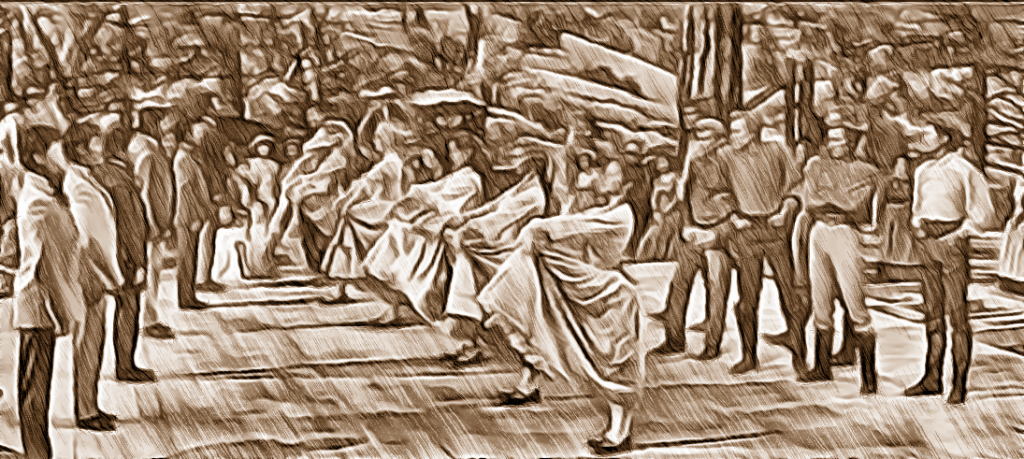
Sketch of scene from ‘Seven Brides for Seven Brothers’
My children’s favourite film in childhood was ‘Seven Brides for ‘Seven Brothers’. It was loosely based on the Rape of the Sabine Women, and very Hollywood.
On This Day
12 BC – Augustus named Pontifex Maximus, which is essentially ‘Chief Priest’ which is a bit like King Henry VIII being the Supreme Head of the Church of England.
1836 – The Alamo in Texas fell to Mexican General Santa Anna after a 13-day siege. (apologising to Texas for posting this yesterday on the wrong day)
1957 – Ghana becomes an Independent State, the first of the UK’s colonies in Sub-Saharan Africa to be independent. Ghana consists of four separate colonial territories: Gold Coast, Ashanti, the Northern Territories, and British Togoland. Ghana remained within the Commonwealth of Nations. Kwame Nkrumah was the first President. It ranks 7th (out of 54 African states) for good governance on the Ibrahim Index of African Governance (IIAG).
First published in 2024, republished in 2025. On This Day added 2026
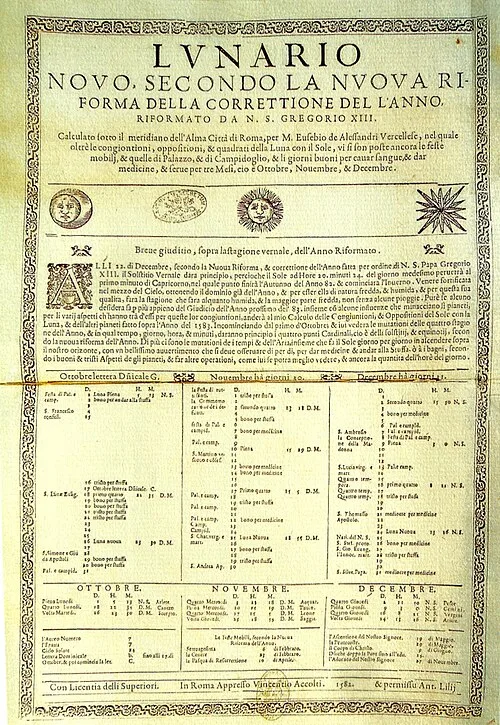
Gregorian Calendar, Lunario Novo, Secondo la Nuova Riforma della Correttione del l’Anno Riformato da N.S. Gregorio XIII,[k] printed in Rome by Vincenzo Accolti in 1582, one of the first printed editions of the new calendar
On February 24th 1582 – Pope Gregory XIII published the papal bull Inter gravissimas. This announced amendments to the Julian Calendar created by Julius Caesar and created the Gregorian Calender. Caesar had realigned the Roman Calendar with the Solar Year, creating a ‘Year of Confusion’. The year was 445 days long but it resynced the days to their proper season.
The Julian Calendar
The Julian Calendar used leap years to align the Calendar Year with the Solar Year. But the earth does not cycle the Sun in 365.25 days. This is an overestimate of 1 day every century. So, since the time of Caesar, the year had got 10 days out of kilter. Gregory chopped those 10 days out of the Calendar. The 4th of October 1582, was to be followed by the 15th October 1582. This might seem simple, but imagine you are receiving your salary for October, and you find it 10 days short? Or you have a month to pay your debt and find it called in 10 days early? So the Pope ordered that these 10 missing days shouldn’t be used in calculating financial matters.
Computus
One of the main reasons for the reform was the ‘Computus’. This was the method of calculating Easter. Easter was a festival that followed the movements of the Moon but was synced into the Vernal Equinox. (The timing of Easter is the first full moon after the Vernal Equinox.). So the chopping of 10 days meant that the vernal equinox was set back to its proper place on March 21st. Arguments over the correct calculations of Easter had, in the 7th Century been a major stumbling block in uniting the Celtic Church in Britain with the Roman Catholic Church. (See my post on Easter here).
But this still left the drift caused by Caesar’s faulty leap year system. Gregory’s reforms stopped future drift by fine-tuning the leap years. From 1582 there would not be a leap year in those centurial years which were not divisible by 400. So 2000 was a leap year, but 2100 is not. This skips ‘three Julian leap days in every 400 years, giving an average year of 365.2425 mean solar days long.’ (Wikipedia). This keeps us aligned, although there is still a small error.
If you enjoy this sort of calendrical detail, you will love ‘The Calendar’ by David Ewing Duncan.
British Exceptionalism
Of course, Britain refused to join a Catholic innovation for nearly 200 years. But, religious prejudice at last gave way to reason, when we adopted the Gregorian Calendar in 1752. In the process, we lost 11 days, much to the horror of the London mob, who rioted against their loss.
Greece was the last European state to join in 1923. Japan joined in 1873, China in 1912, and Saudi Arabia in 2016. Ethiopia, Iran, Afghanistan, and Nepal keep distinct calendrical traditions. (see seasia.co for more details.) Strictly, we are using the Gregorian amendment to the Julian Calendar because it has all the elements of the Julian Calendar except a couple of adjustments.
Coltsfoot is a daisy-like plant which is flowering about now. Gerard’s Herbal of 1633 suggests that the ‘fumes of the dried leaves taken through a funnel’ is good for those with coughs and shortness of breath. He suggests that it is smoked like tobacco and it ‘mightly prevaileth.’
This idea, Mrs Grieves says in her herbal (1931), is endorsed by ‘Dioscorides, Galen, Pliny, and Boyle’. And Coltsfoot is ‘nature’s best herb for the lungs’. (This is historic information re herbs and NOT current medical advice, as Coltsfoot can be very dangerous!).
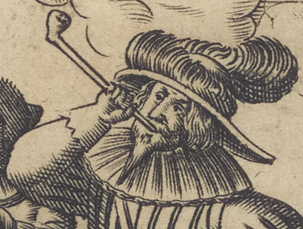
Detail from Lobspruch deß edlen hochberühmten Krauts Petum oder Taback Nuremberg, 1658 New York Public Library Public Domain
My grandson and parents found a 19th Century pipe bowl, much like the one pictured here, by the Thames where there were many fragments of clay pipe. For more on 17th Century smoking, have a look here.
On This Day
In Rome February 24th was the day of the 4 yearly leap day. The way they did it was to have two days called February 24th! It was the sixth day before the Calendars (March 1). This practice gradually got replaced by adding a new day, February 29th, at the end of the Month. In England, February 29th starts appearing in the 15th Century. But Wikipedia tells me:
‘the proceedings of the House of Commons of England continued to use the old system until the middle of the sixteenth century. It was not until passage of the Calendar (New Style) Act 1750 that 29 February was formally recognised in British law.’
It is said that the owner and playwright Richard Brinsley Sheridan replied to someone who was surprised to see him sitting quietly having a drink while his theatre burnt down: “A man may surely be allowed to take a glass of wine by his own fireside?” londonist.com
1832 – Cholera in London
‘The news of the Cholera being in London has been received abroad. According to the feelings of the different nations towards England, France, who wish to court us has ordered a quarantine in her ports of three days; Holland, who feels aggrieved by our conduct at the conference, one of 40 days. The fog so thick in London that the illuminations for the Queen’s Birthday were not visible. ‘
24th February 1832 Thomas Raikes, Diary 1832 (from ‘A London Year’ Compiled by Travis Elborough and Nick Bennison, 2013,
This was the second Cholera Pandemic, but the first to reach the UK. The second landed in Sunderland in October 1831. Cholera killed over 6,000 in London. It was called the Asiatic Cholera based on its origin. The Cholera came more virulently in subsequent decades. It was thought to be spread by a miasma in the air. But, John Snow proved it was caused by polluted water, but I will tell that story in another post.
I think the Conference mentioned above was the London Conference of May 1832, which aimed to establish a Kingdom of Greece with King. It was set up by Foreign Secretary Lord Palmerston without discussion with the Greeks and ended up giving them a Bavarian King. King Otto. Otto was forced from the throne in a revolution in 1862, and replaced by a Danish King, from whom Prince Philip, Duke of Edinburgh was descended.
1920 –The Conservative MP, Nancy Astor becomes the first woman to speak in the House of Commons. Constance Markievicz was the first woman elected as an MP in 1918, but she was a member of Siin Fein and did not take her seat.
First published in February 2024, republished in 2025, The Gregorian Calendar added in 2026, and On This Day also added. And Retitled too.
Photo Mohammad Amiri from unsplash. Notice the crimson stigma and styles, called threads, Crocus is one of the characters in Ovid’s Metamorphoses
The story of Crocus and Smilax is in Ovid’s Metamorphoses. The book tells the story of myths which involve the metamorphosis of a person to a flower, or to a constellation, or to an echo or some supernatural change in being. This poem is one of the most famous in the world, written in about 6 AD. It influenced Dante, Bocaccio, Chaucer, Shakespeare, Keats, Bernard Shaw, and me. Seamus Heaney and Ted Hughes have translated modern versions of some of the tales.
The mechanicals in ‘The Midsummers Night Dream’ perform Ovid’s story of Pyramus and Thisbe, Titian painted Diana and Actaeon. Shaw wrote about Pygmalion, and we all know the story of Arachne. She claimed to be better than Athene at weaving. And then was turned into a spider.
The poem is about love, beauty, change, arrogance and is largely an Arcadian/rural poem. This is a contrast to Ovid’s ‘Art of Love’ which I use for illustrations of life in a Roman town. The stories are all about metamorphoses, mostly changes happening because of love. But it is also an epic as it tells the classical story of the universe from creation to Julius Caesar.
Ovid’s Metamorphoses and the Crocus
‘Crocus and his beloved Smilax were changed into tiny flowers.’ Ovid tell us, but chooses to give us no more details. So we have to look elsewhere. There are various versions. In the first, Crocus is a handsome mortal youth, beloved of the God Hermes (Mercury). They are playing with a discus which hits Crocus on the head and kills him. Hermes, distraught, turns the youth into a beautiful flower. Three drops of his blood form the stigma of the flower. In another version, Crocus and the nymph Smilax, fall in love. And are rewarded by immortality as a flower. One tale has Smilax turned into the Bindweed.
Morning Glory or Field Bindweed photo Leslie Saunders unsplash
Ovid’s Metamorphoses and Bindweed
It turns out that Smilax means ‘bindweed’ in Latin. Bindweed is from the Convolvulus family, and I have grown one very successfully in a pot for many years. But they have long roots. According to the RHS ‘Bindweed‘ refers to two similar trumpet-flowered weeds. Both of which twine around other plant stems, smothering them in the process. They are difficult to remove. This, could suggest that Smilax is either punished for spurning Crocus, or that she smothered him with love. Medically, Mrs Grieve’s Modern Herbal says all the bindweeds have strong purgative virtues, perhaps another insight into Smilax’s psychology?
The Metamorphosis of Data and the correct use of the plural
Apparently, in the UK some say crocuses and others use the correct Latin plural, croci. On an earlier version of this post I used the incorrect plural crocii.
On the subject of Roman plurals, the Financial Times editorial department made an earth-shattering decision, a couple of years ago. They updated their style guide to make the plural word data (datum is the singular form) metamorphise into the singular form.
So it is now wrong to say ‘data are’ but right to say ‘data is’. For example, it was correct to say: ‘the data are showing us that 63% of British speakers use crocuses as the plural’ but now, it is better to write ‘the data is showing us that 37% of British people prefer the correct Latin form of croci’.
Violets and Crocuses
Violets and crocuses are coming out. They often come out for St Valentine’s Day, and so obviously associated with Love. White croci usually represented truth, innocence, and purity. The purple variety imply success, pride and dignity. The yellow type is joy.’ according to www.icysedgwick.com/, which gives a fairly comprehensive look at the Crocus.
Crocus & Saffron
The autumn-flowering perennial plant Crocus sativus, is the one whose stigma gives us saffron. Roman civilisation spread the plants around Europe. They used it for medicine, as a dye, and a perfume. It was much sought after as a protection against the plague, and extensively grown in the UK. Saffron Walden was a particularly important production area in the 16th and 17th Centuries.
Saffron in London
Snowdrop, Crocus, Violet and Silver Birch circle in Haggerston Park. (Photo Kevin Flude, 2022)
The Bishop of Ely grew Saffrom in his beautiful Gardens just outside of the City of London. The area remembered by the London street name: Saffron Hill. It is home to the fictional Scrooge. This area became the London home of Christopher Hatton, the favourite of Queen Elizabeth 1. His garden was on the west bank of the River Fleet, in London EC1, in the area now known as Hatton Garden. (For more on Christopher Hatton see my post on nicknames Queen Elizabeth I gave to her favourites).
I found out more about Saffron from listening to BBC Radio 4’s Gardener’s Question time and James Wong.
Croydon (on the outskirts of London) means Crocus Valley. A place where Saffron was grown. The Saffron crops in Britain failed eventually because of the cost of harvesting, and it became cheaper to import it. So, we now import it from Spain, Iran, and India amongst other places. But it is being reintroduced in Norfolk, Suffolk, Kent, and Sussex. These are – the hot and dry counties. The plant enjoys a South-facing aspect. But it needs protection from squirrels and sparrows who love it. To grow it, look at this post from the Garden Doctor.
Saffron Photo by Vera De on Unsplash
Violets
Viola odorata CC BY-SA 2.5 Wikipedia
The Celts used Violets as cosmetics; the Athenians to moderate anger; the Iranians for insomnia, and are loved by all because of their beauty and fragrance. They have been symbols of death for the young, and used as garlands, nosegays posies, which Gerard says are ‘delightful’.
For more on Ovid, use the search facility (click on menu) or read my post here.
On This Day
197 – The Battle of Lugdunum sees the victory of Septimius Severus over Clodius Albinus reputedly the bloodiest battle between Roman armies. The previous emperor Pertinax died in 193 during the Year of the Five Emperors. Three main contenders emerged Severus who was African, Niger was from Central Italy, Albinus was the Governor of Britain.
1800 – Napoleon proclaims himself First Consul making him the dictator of France.
1846 – The Republic of Texas officially transfers power to the State of Texas government and becomes part of the United States.
1878 – Thomas Edison patents the phonograph.
1945 – Battle of Iwo Jima began with the landing of 30,000 US troops.
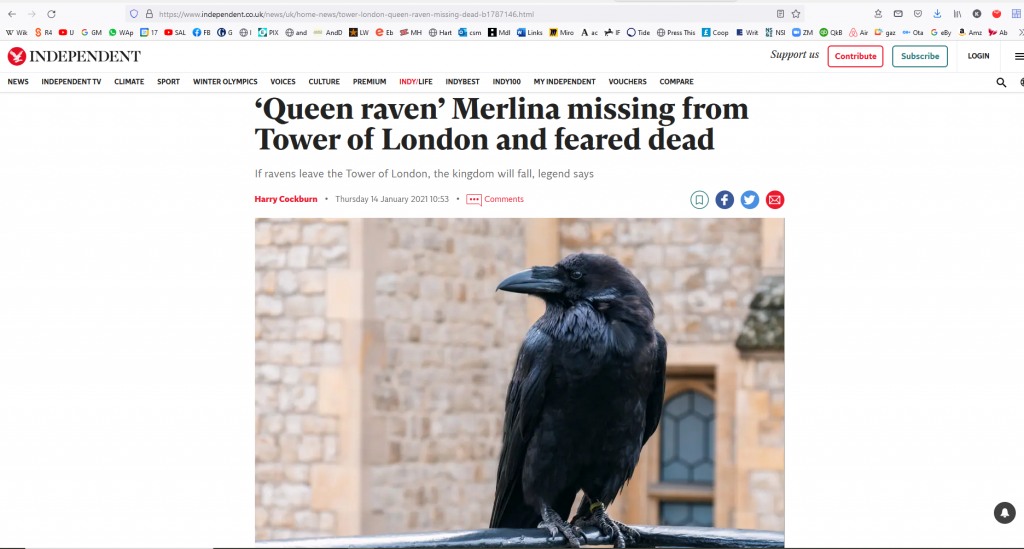
The Independent January 2021 The Raven the Palladium of Britain
The Raven – the Palladium of Britain
Corvus corax is hatching. An early nesting bird, the Raven is the biggest of the Corvids. They were pushed to the west and north by farmers and game keepers but are making a comeback. Ravens are finding towns convenient for their scavenging habits. So they, again, cover most of the UK except the eastern areas. The Raven is one of the Palladiums of Britain.
A Palladium is something that keeps a city or country safe, They are named after a wooden statue of Pallas Athene, which protected Troy. Perceiving this, Odysseus and Diomedes stole the Palladium from Troy shortly before the Trojan Horse episode. Troy fell and the palladium went to Italy (I’m guessing with Diomedes who is said to have founded several cities in Italy). It ended up in Rome.
The Romans claimed to be descendants of Trojan exiles led by Aeneas. So it was back with its rightful owners. It protected Rome until it was transferred to the new Roman capital at Constantinople. It then disappeared, presumably allowing the Ottoman Turks to conquer the City of Caesar? To read of London Stone as a Palladium see my post here.
The Ravens habits (it is said they know where the battlefields are before they are fought) and their black plumage have made them harbingers of death. In poetry, Ravens glut on blood like the warriors whose emblem they are. Here is a very famous quotation from Y Gododdin, a medieval poem but thought to derive from a poem by the great poet Aneirin from the 7th Century.
‘He glutted black ravens on the rampart of the stronghold, though he was no Arthur.’
This is one of the much argued-about references to King Arthur in the ‘Was he a real person’ trope. The point being, it doesn’t make sense to mention Arthur if King Arthur wasn’t a real person. The story at the Tower of London is that the Ravens kept in the Tower, with clipped wings, keep Britain safe from Invasion. (But see below).
Bran’s Head – the original Palladium of Britain?
By Sonny Mauricio from Unsplash
The Raven was also the symbol of the God-King Bran. Bran was one of the legendary Kings of Britain. His sister, Branwen, was married to the King of Ireland. To cut a long story short, Branwen was exiled by her Irish husband to the scullery. She trained a starling to smuggle a message to her brother, to tell of her abuse.
So Bran took an army over the Irish Sea to restore her to her rightful state. But the ships were becalmed. Mighty Bran blew the boats across the sea – he was that much a hero. Bran was mortality wounded in the fighting that followed. This was a problem because he had previously given away his cauldron of immortality. He gave it to the Irish King in recompense for the insults given to the Irish by Bran’s brother, who hated anyone not British.
Bran’s Head Returns to London
So, the dying Bran, told his companions to cut off his own head and take it back to the White Hill in London. His head was as good a companion on the way back as it was on the way out, and the journey home took 90 years.
At last, they got to London, where Bran told his men to bury his head on the White Hill. As long as it stays here, he said, Britain would be safe from foreign invasion. The White Hill is said to be Tower Hill with its summit at Trinity Gardens, although Primrose Hill is sometimes offered as an alternative.
This was one of the Three Fortunate Concealments and is found in ‘the Triads of the Island of Britain.’ The Triads are from medieval manuscripts which preserve fragments of folklore, mythology and history. They are grouped in groups of three.
Arthur and Bran’s Head
But many years later, King Arthur saw no need for anybody or anything other than himself to protect the realm. So he had the head dug up. Calamity followed in the shapes of Sir Lancelot and Mordred which led to the end of the golden age of Camelot and conquest of Britain by the Saxons. This was one of the Three Unfortunate Disclosures.
If we want a rational explanation for the story, there is evidence that Celtic cultures venerated the skull, and palladiums play a part in Celtic Tales.
So what was Arthur doing destroying the palladium that kept Britain safe? Vanity is the answer the story gives. But, perhaps, it’s a memory of Christian rites taking over from pagan rituals? God, Arthur might have thought, would prefer to protect his people himself rather than Christians having to rely on a pagan cult object.
Ravens in the Tower of London
The story of Bran’s head is inevitably linked to the Ravens in the Tower who, it is still said, keep us safe from invasion. As you can see from the photo at the top we still get in a tizz when one goes missing.
Sadly, and I am probably sadder about this than most, the link between the Tower, Bran, and the Ravens cannot be substantiated. Geoffrey Parnell, who is a friend of mine, told me that while working at the Tower of London he searched the records assiduously for the story of the ravens. He found no evidence of the Raven myth & the Tower before the 19th Century, and concluded that it was most likely a Victorian invention. IanVisits has a 2025 story about the Ravens, and also concurs that the Ravens are a recent myth.
The Welsh Triads give a total of two palladiums for Britain, a couple of nationalistic fighting dragons.
The Head of Bran the Blessed, son of Llyr, which was concealed in the White Hill in London, with its face towards France. And as long as it was in the position in which it was put there, no Saxon Oppression would ever come to this Island; The second Fortunate Concealment: the Dragons in Dinas Emrys, which llud son of Beli concealed; And the third: the Bones of Gwerthefyr the Blessed, in the Chief Ports of this Island. And as long as they remained in that concealment, no Saxon Oppression would ever come to this Island.
All good but then came:
The Three Unfortunate Disclosures:
And there were the Three Unfortunate Disclosures when these were disclosed. And Gwrtheyrn the Thin disclosed the bones of Gwerthefyr the Blessed for the love of a woman: that was Ronnwen the pagan woman; And it was he who disclosed the Dragons; And Arthur disclosed the head of Bran the Blessed from the White Hill, because it did not seem right to him that this Island should be defended by the strength of anyone, but by his own.
Gwrtheyrn is Vortigen, the leader of the Britons after the fall of the Roman Empire in Britain, one or two leaders before Arthur. Vortigern, which means something like strong leader in Welsh was a real person in so far as he, unlike Arthur, is mentioned by Gildas a near contemporary source.
The story of the dragons is supposedly from the pre-Roman Iron Age. Every May Day, the Dragons made a terrible noise, causing miscarriages and other misfortunes. So, King Ludd, whom legends says gave his name to London (Ludd’s Dun or Ludd’s walled City), drugged the dragons. He had them buried in a cavern at Dinas Emrys in Eryri (Snowdonia). The Red Dragon represented the Britons (also called the Welsh) and White Dragons the Saxons.
Vortigern, Merlin and Vortimer
Hundreds of years later, (five hundred?) after the Romans had come and gone. Vortigern was trying to build a castle in Eryri at Dinas Emrys. But the walls keep falling down. ‘You need the blood of a boy born not of man’, his necromancers say. They find a boy called Ambrosius aka Merlin whose mother had lain with an incubus. Merlin accused the necromancers of ignorance and explains the wall collapse is caused by two dragons. They find the cavern and let the dragons go. The walls now stand undisturbed. But the Welsh Red Dragon and the Saxon White Dragon can not now be at peace, and the Britons are defeated by the Saxons.
Vortigern betrayed his own people for the lust of Rowena the daughter of Hengist, the Saxon. Hengist was given the province of Kent as his reward, and thus began the Anglo-Saxon take over.
Vortigern’s son is Gwerthefyr (or Vortimer). He was a better man than his dad and fought to keep the Saxons out. After Vortimer’s death his bones were buried at the chief ports on the South Coast. Here they acted as a palladian and they kept the country safe. But they were moved to Billingsgate, in London and put in a Tower. The loss of the palladium allowed the Saxons to land safely on the Kent coast and consolidate their increasing hold over Britain and turning it into England.
Birds in Love
Here is a lovely little medieval poem. It was found in 1931 in the end leaf of a manuscript where someone had been testing their goose quill and scribbled these three lines:
Why it is so wet in the UK at the moment (February 18th)? The answer seems to be that there is a block of cold weather over the States that is moving the Jet Stream south, bringing lots of wet weather. But there is also another block of cold weather over Scandinavia. This means that the low pressures being driven by the Jet Stream, have no where to go and are stopping and dumping their rain all over the UK.
3102 BC – the death of Krishna starts Kali Yuga, the fourth and final yuga of Hinduism.
1478 – George, Duke of Clarence, traitor to his Brother, Edward IV, was executed in private at the Tower of London. It is said he was drowned in a vat of Malmsey Wine.
1678 – First Part of Pilgrim’s Progress by John Bunyan published.
1991 – The IRA plant bombs at Paddington station and Victoria station in London. The IRA gave warnings, and the Victoria bomb went off at 4.20am and caused no casualties. At or just before 7am, the IRA warned that all London Stations were to be bombed in 45 minutes time. The Authorities were slow to clear the stations and at Paddington a bomb went off at 7:40am. 1 person was killed and 38 people were injured. 11 days earlier, the IRA attacked Downing St with a mortar bomb attack.
Written on February 21 revised in February 18th 23, 24, 25, Birds in Love, Wet Weather and On This Day added in 2026
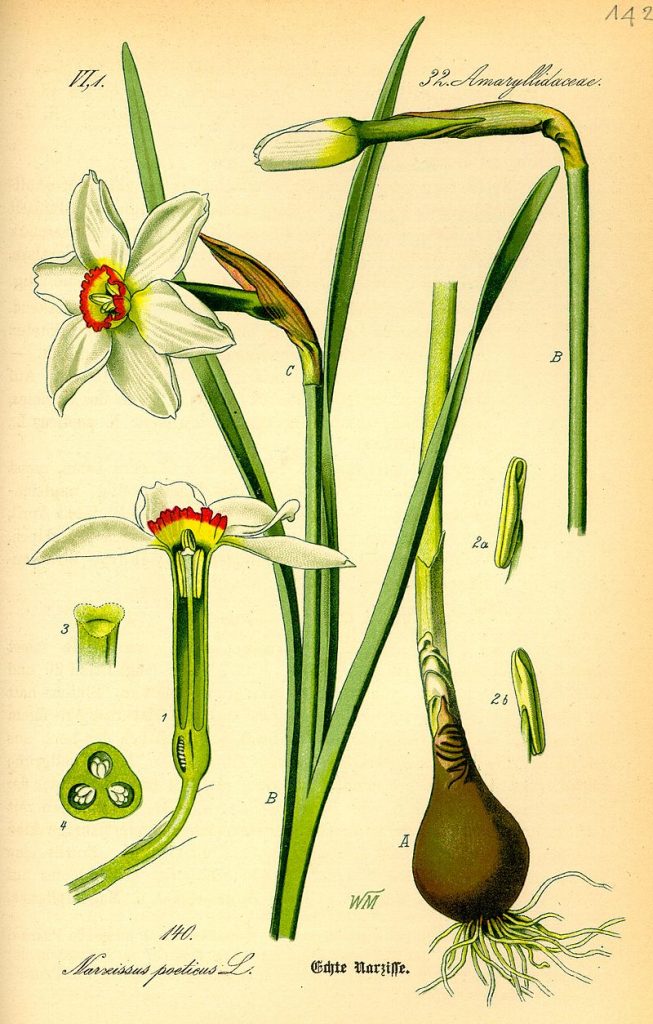
Daffodils & Narcissus. In 2023, I saw my first Daffodil in Hackney in a Council Estate on 12 January. My first daffodil in 2024 was outside my first floor window in early February. On February 11th, 2025, I saw the shoots of Daffodils in my garden but nothing blooming. However, there were daffodils on another Council Estate. In 2026, my first daffodil came out in early January. And the Estates and Parks around have been showing daffodils since late January. They bring such joy and hope for the return of the Sun.
12 Jan 2023. Hackney, London, the first Daffodil.
Narcissus the Flower
Their formal name is Narcissus. The Roman natural historian, Pliny tells us that the plant was:
‘named Narcissus from narkē not from the fabulous boy.’
Narkē is the Greek word from which we derive the word narcotic. It is a reference to the narcotic properties of the narcissus. An extract of the bulb applied to open wounds produced numbness of the whole nervous system and paralysis of the heart. The flowers are also slightly poisonous. So, they were used as an emetic. They brought on vomiting when it was felt necessary that the stomach be emptied. It was used to treat hysteria and epilepsy. They treated children with bronchial catarrh or epidemic dysentery. Among Arabian doctors, it was used to cure baldness and as an aphrodisiac. (Source: A Modern Herbal by Mrs M Grieve.) Please remember these are not recommendations for use medicinally, but are historic uses and may be dangerous.
The Fabulous Boy
The fabulous boy, mentioned by Pliny, was Narcissus. He, according to the Roman Poet Ovid, met the nymph Echo, and she fell in love with the beautiful boy. He spurned her, and she faded until all that remained of her was her voice – the echo we hear.
Nemesis, the Goddess of Revenge (the one with the fiery sword) decided on revenge upon the handsome boy. She lured the thirsty youth to a fountain, where, in the pool around the fountain, he saw an image of a breathtakingly handsome boy. He fell instantly in love with such beauty. But it was an image of himself. Realising he would never meet anyone as fabulous as himself, he faded from life. He eventually metamorphised into a white and yellow flower, which was named after him.
Nemesis, with her fiery sword, from the painting on the Staircase at Hampton Court by Antonio Verrio, Photo K Flude
Daffodils & Shakespeare
Daffodils are mentioned in a list of Spring Flowers by Shakespeare in the pastoral play The Winter’s Tale:
(Please note that as you read Shakespeare’s words below that Prosperpina is the wife of Pluto, the God of the Underworld, Dis, is another name for him, Cytherea is the Goddess of Beauty and Love. Phoebus is the Sun God. And the Spring Flowers are Daffodils, violets, primroses, oxlips (primula), Crown Imperial (Fritillaria imperialis), Lilies, flower-De-luce (Iris)
Perdita to Camillo
Out, alas! You’d be so lean that blasts of January Would blow you through and through. (To Florizel) I would I had some flowers o’th’ spring, that might Become your time of day – (to the Shepherdesses) That wear upon your virgin branches yet Your maidenheads growing. O Proserpina, For the flowers now that, frighted, thou let’st fall From Dis’s waggon! Daffodils, That come before the swallow dares, and take The winds of March with beauty; violets, dim, But sweeter than the lids of Juno’s eyes Or Cytherea’s breath; pale primroses, That die unmarried ere they can behold Bright Phoebus in his strength – a malady Most incident to maids; bold oxlips and The crown imperial; lilies of all kinds, The flower-de-luce being one: O, these I lack To make you garlands of, and my sweet friend To strew him o’er and o’er!
WT IV.iv.110.2
The reference to Daffodils suggests that for Shakespeare they are around to withstand the March Winds before the Swallows arrive in April. With selective breeding, early flowering species have been developed. Now February and even January are within the scope of the glorious bulb. (here is a post on winter flowering varieties). For my post on Shakespeare & Winter see here.
Once a noisy Nymph, (who never held her tongue when others spoke, who never spoke till others had begun) mocking Echo, spied him as he drove, in his delusive nets, some timid stags.—For Echo was a Nymph, in olden time,—and, more than vapid sound,—possessed a form: and she was then deprived the use of speech, except to babble and repeat the words, once spoken, over and over. Juno confused her silly tongue, because she often held that glorious goddess with her endless tales, till many a hapless Nymph, from Jove’s embrace, had made escape adown a mountain.
But for this, the goddess might have caught them. Thus the glorious Juno, when she knew her guile; “Your tongue, so freely wagged at my expense, shall be of little use; your endless voice, much shorter than your tongue.” At once the Nymph was stricken as the goddess had decreed;—and, ever since, she only mocks the sounds of others’ voices, or, perchance, returns their final words.
One day, when she observed Narcissus wandering in the pathless woods, she loved him and she followed him, with soft and stealthy tread.—The more she followed him the hotter did she burn, as when the flame flares upward from the sulphur on the torch. Oh, how she longed to make her passion known! To plead in soft entreaty! to implore his love! But now, till others have begun, a mute of Nature she must be. She cannot choose but wait the moment when his voice may give to her an answer. Presently the youth, by chance divided from his trusted friends, cries loudly, “Who is here?” and Echo, “Here!” Replies. Amazed, he casts his eyes around, and calls with louder voice, “Come here!” “Come here!” She calls the youth who calls.—He turns to see who calls him and, beholding naught exclaims, “Avoid me not!” “Avoid me not!” returns. He tries again, again, and is deceived by this alternate voice, and calls aloud; “Oh let us come together!” Echo cries, “Oh let us come together!” Never sound seemed sweeter to the Nymph, and from the woods she hastens in accordance with her words, and strives to wind her arms around his neck.
He flies from her and as he leaves her says, “Take off your hands! you shall not fold your arms around me. Better death than such a one should ever caress me!” Naught she answers save, “Caress me!” Thus rejected she lies hid in the deep woods, hiding her blushing face with the green leaves; and ever after lives concealed in lonely caverns in the hills. But her great love increases with neglect; her miserable body wastes away, wakeful with sorrows; leanness shrivels up her skin, and all her lovely features melt, as if dissolved upon the wafting winds—nothing remains except her bones and voice—her voice continues, in the wilderness; her bones have turned to stone. She lies concealed in the wild woods, nor is she ever seen on lonely mountain range; for, though we hear her calling in the hills, ’tis but a voice, a voice that lives, that lives among the hills.
Thus he deceived the Nymph and many more, sprung from the mountains or the sparkling waves; and thus he slighted many an amorous youth.—and therefore, some one whom he once despised, lifting his hands to Heaven, implored the Gods, “If he should love deny him what he loves!” and as the prayer was uttered it was heard by Nemesis, who granted her assent.
There was a fountain silver-clear and bright, which neither shepherds nor the wild she-goats, that range the hills, nor any cattle’s mouth had touched—its waters were unsullied—birds disturbed it not; nor animals, nor boughs that fall so often from the trees. Around sweet grasses nourished by the stream grew; trees that shaded from the sun let balmy airs temper its waters. Here Narcissus, tired of hunting and the heated noon, lay down, attracted by the peaceful solitudes and by the glassy spring.
There as he stooped to quench his thirst another thirst increased. While he is drinking he beholds himself reflected in the mirrored pool—and loves; loves an imagined body which contains no substance, for he deems the mirrored shade a thing of life to love. He cannot move, for so he marvels at himself, and lies with countenance unchanged, as if indeed a statue carved of Parian marble. Long, supine upon the bank, his gaze is fixed on his own eyes, twin stars; his fingers shaped as Bacchus might desire, his flowing hair as glorious as Apollo’s, and his cheeks youthful and smooth; his ivory neck, his mouth dreaming in sweetness, his complexion fair and blushing as the rose in snow-drift white. All that is lovely in himself he loves, and in his witless way he wants himself:—he who approves is equally approved; he seeks, is sought, he burns and he is burnt.
And how he kisses the deceitful fount; and how he thrusts his arms to catch the neck that’s pictured in the middle of the stream! Yet never may he wreathe his arms around that image of himself. He knows not what he there beholds, but what he sees inflames his longing, and the error that deceives allures his eyes. But why, O foolish boy, so vainly catching at this flitting form? The cheat that you are seeking has no place. Avert your gaze and you will lose your love, for this that holds your eyes is nothing save the image of yourself reflected back to you. It comes and waits with you; it has no life; it will depart if you will only go.
Nor food nor rest can draw him thence—outstretched upon the overshadowed green, his eyes fixed on the mirrored image never may know their longings satisfied, and by their sight he is himself undone. Raising himself a moment, he extends his arms around, and, beckoning to the murmuring forest; “Oh, ye aisled wood was ever man in love more fatally than I? Your silent paths have sheltered many a one whose love was told, and ye have heard their voices. Ages vast have rolled away since your forgotten birth, but who is he through all those weary years that ever pined away as I?
Alas, this fatal image wins my love, as I behold it. But I cannot press my arms around the form I see, the form that gives me joy. What strange mistake has intervened betwixt us and our love? It grieves me more that neither lands nor seas nor mountains, no, nor walls with closed gates deny our loves, but only a little water keeps us far asunder. Surely he desires my love and my embraces, for as oft I strive to kiss him, bending to the limpid stream my lips, so often does he hold his face fondly to me, and vainly struggles up. It seems that I could touch him. ‘Tis a strange delusion that is keeping us apart. Whoever thou art, Come up! Deceive me not! Oh, whither when I fain pursue art thou? Ah, surely I am young and fair, the Nymphs have loved me; and when I behold thy smiles I cannot tell thee what sweet hopes arise. When I extend my loving arms to thee thine also are extended me—thy smiles return my own.
When I was weeping, I have seen thy tears, and every sign I make thou cost return; and often thy sweet lips have seemed to move, that, peradventure words, which I have never heard, thou hast returned. No more my shade deceives me, I perceive ‘Tis I in thee—I love myself—the flame arises in my breast and burns my heart—what shall I do? Shall I at once implore? Or should I linger till my love is sought? What is it I implore? The thing that I desire is mine—abundance makes me poor. Oh, I am tortured by a strange desire unknown to me before, for I would fain put off this mortal form; which only means I wish the object of my love away. Grief saps my strength, the sands of life are run, and in my early youth am I cut off; but death is not my bane—it ends my woe.—I would not death for this that is my love, as two united in a single soul would die as one.”
He spoke; and crazed with love, returned to view the same face in the pool; and as he grieved his tears disturbed the stream, and ripples on the surface, glassy clear, defaced his mirrored form. And thus the youth, when he beheld that lovely shadow go; “Ah whither cost thou fly? Oh, I entreat thee leave me not. Alas, thou cruel boy thus to forsake thy lover. Stay with me that I may see thy lovely form, for though I may not touch thee I shall feed my eyes and soothe my wretched pains.” And while he spoke he rent his garment from the upper edge, and beating on his naked breast, all white as marble, every stroke produced a tint as lovely as the apple streaked with red, or as the glowing grape when purple bloom touches the ripening clusters.
When as glass again the rippling waters smoothed, and when such beauty in the stream the youth observed, no more could he endure. As in the flame the yellow wax, or as the hoar-frost melts in early morning ‘neath the genial sun; so did he pine away, by love consumed, and slowly wasted by a hidden flame. No vermeil bloom now mingled in the white of his complexion fair; no strength has he, no vigor, nor the comeliness that wrought for love so long: alas, that handsome form by Echo fondly loved may please no more.
But when she saw him in his hapless plight, though angry at his scorn, she only grieved. As often as the love-lore boy complained, “Alas!” “Alas!” her echoing voice returned; and as he struck his hands against his arms, she ever answered with her echoing sounds. And as he gazed upon the mirrored pool he said at last, “Ah, youth beloved in vain!” “In vain, in vain!” the spot returned his words; and when he breathed a sad “farewell!” “Farewell!” sighed Echo too. He laid his wearied head, and rested on the verdant grass; and those bright eyes, which had so loved to gaze, entranced, on their own master’s beauty, sad Night closed. And now although among the nether shades his sad sprite roams, he ever loves to gaze on his reflection in the Stygian wave. His Naiad sisters mourned, and having clipped their shining tresses laid them on his corpse: and all the Dryads mourned: and Echo made lament anew. And these would have upraised his funeral pyre, and waved the flaming torch, and made his bier; but as they turned their eyes where he had been, alas he was not there! And in his body’s place a sweet flower grew, golden and white, the white around the gold.
Elbridge signed a bill which created a voting district packed with voters for the Democratric-Republican Party. It was said to be shaped like a salamander, and so by joining his name to the last part of salamander the name gerrymandering was created. Gerry was Vice-President under Madison. Please, could someone tell me how gerrymandering is at all compatible with Democracy and the Constitution of the United States? And why it is tolerated in so brazen a fashion?
1826 – University College London was founded.
It was originally called London University. Until this time, England only had Oxford and Cambridge as Universities. In order to attend or teach, the candidates had to belong to the Church of England. ‘No Catholics, No Jews, no Hindus’. But UCL was created to be open to all faiths. This alarmed conservatives so much that they founded King’s College in London as a counterweight. This created a collegiate University of London, which now has 17 constituent colleges. Imperial College left the federation to become a separate University in 2007. It now brands itself as ‘A world-leading university. 2nd in the world, 1st in the UK and Europe’. Here is a promo for the 200th Anniversary of UCL. I’m proud to have been an honorary lecturer for a few years.
1945 – Yalta Conference agrees to set up the United Nations to help prevent future World Wars.
1975 – Mrs Thatcher defeats Ted Heath to become leader of the Conservative Party.
First published in February 2023, revise and republished in February 2024, 2025, 2026