Magnolia and Cherry blossom in Weymouth Terrace Haggerston London. Photo K Flude
It might already have peaked in London, but there are lots of lovely magnolias still flowering. This year, last week was very hot and plant experts feared it would lead to a brief spring. However, the shirt-sleeve warmth was soon followed by a cold spell, dropping in some places to 0 degrees C. This may have saved the situation and prolonged the spring flowering.
Magnolias, Earnest ‘Chinese’ Wilson, said were the most esteemed of all flowers. He introduced new species from the Himalayas. Magnolias are among the oldest flowers and have their origins in the Cretaceous period. They evolved 100 million years ago before the evolution of bees. So they are pollinated by beetles, which is one reason for the size of the flowers.
The first magnolias to come to Britain were from America. John Banister sent Magnolia Virginiana to Henry Compton Bishop of London, who was also highly involved in the colony in Virginia. Compton sent Banister out as a missionary, but both loved flowers. Banister wrote the first flora of N. America which was included in John Ray‘s Historia Plantarum. Sadly, he was accidently shot while exploring.
Magnolias were named after the French botanist Pierre Magnol (1638-1715) ‘Professor of Botany and Director of the Royal Botanic Garden of Montpellier’. Magnol invented the idea of plant families, which Linnaeus developed.
Herbal uses
Mrs Grieve’s ‘A Modern Herbal’ suggests Magnolia was used for rheumatism and malaria. A warm infusion was thought to be laxative, sudorific (induces ‘sweating so that the sweat runs down the body in rills!’), If cold. If warm was antiperiodic (useful against diseases like malaria which keep coming back) and mildly tonic.
Where to see Magnolias
In London, they can be seen everywhere but Google suggests:
Kensington (Phillimore Gardens, The Boltons), Chelsea (Carlyle Square), and Notting Hill (Lancaster Road). And of course Kensington Gardens and Kew Gardens. My favourites ones are in the roads around my house, often in the most unprepossessing of places.
Magnolias and Camelias in Albion Square, Haggerston,. London. Photo by K Flude
But it is a delight to go to Hidecote the National Trust Property in Mickleton just off the edge of the Cotswolds. In April, it has spectacular magnolias. Unfortunately, I don’t have any good photos except this one which shows all the magnolia petals on the ground!
Hdcote in Magnolia time. Photo K Flude
Ernest ‘Chinese’ Wilson 1876 – 1930
Prunus Serrula, (aka Tibetan Cherry) brought to England by Ernest Wilson. My favourite tree because of its bark which feels like copper. Photo K Flude
He was born in Chipping Camden where there is a lovely memorial garden which contains my favourite tree, and many plants he introduced. He brought back over 2000 species into the West of which 60 are named after him. One of his expeditions took place during the Boxer revolution. So he adopted a native disguise and risked execution.
At 16, he was apprenticed at the Birmingham Botanical Gardens. Then he worked at the Royal Botanic Gardens, Kew. His next adventure was to be hired as the Chinese plant collector with James Veitch & Sons (originally based in Chelsea). He eventually moved to America, where he became keeper of the Arnold Arboretum in Boston. Unfortunately, he and his wife died in a car accident in 1930.
1116 (or 1117) – St Magnus the Martyr Executed. He was executed because of dynastic disputes amongst Vikings in the Orkneys. Magnus lived a pious life refusing, for example, to fight in the Battle of Menai Straits in Wales, and various miracles took place after his death. He is remembered by the Church of St Magnus at the foot of London Bridge in London. But that was, before the 18th Century, thought to be dedicated one or other of the other many St Magnus’s (6). The Church is by Christopher Wren, and very high Church Protestant. On the occasion I visited on his feast day I felt like I was in a Roman Temple.
Sketch from an old print. Francis Drake being knighted by Queen Elizabeth I. In fact, the Queen delegated the dubbing to a French Diplomat
The Queen’s half share in the profits of the Golden Hind’s circumnavigation of the world, amounted to more than her normal annual income. So it is no wonder she knighted the Captain, Sir Francis Drake. The ceremony took place in the dock in what is now South East London at Deptford.
The Spanish were furious that a Pirate should be so honoured. The Queen may have given a French man the honour of dubbing Sir Francis. She did this, perhaps to encourage the French to support the English against the Spanish?
The annual Royal Income for King Charles III is £86.3 million. This is paid in the Sovereign’s Grant. It gives you an idea of Drake’s booty. But I imagine she had a greater share of the nation’s wealth than Charles, as she was the Government not just a honorific cutter of ribbons.
Francis Drake. Hero or Bloodthirsty Pirate?
Francis Drake was one of the British heroes I read about as a child. I had a thick book with stories about people King Alfred the Great, Hereward the Wake, Robin Hood, Drake, Charles II, Bonny Prince Charlie, Flora MacDonald, Florence Nightingale, David Livingstone etc. Some of them horrifically Imperialist and racist!
Drake is remembered for being the first English person to sail around the world. And his exploits in ‘singeing the beard of the King of Spain’ on his piratical raids on the Spanish Main.
In the books I read, the Spanish were the bad guys, and we were on the side of the Angels. Drake was one of the swash-buckling heroes who turned Britain from a not very important country on the edge of Europe, to one of the World’s Great Powers.
Portrait of Francis Drake with Drake Jewel given to him by Queen Elizabeth I
On the other hand, he was also a pioneer of the Slave Trade, was involved in atrocities in Ireland and in the Spanish Territories. He summarily executed one of his crew in dubious circumstances. Perhaps more significantly, his contemporaries did not entirely trust him.
Francis Drake and the Spanish Armada
As the Spanish Armada sailed along the southern coast of England, the English Navy sniped at the heels of the Spanish ships. Drake was tasked with leading the nighttime harrying of the Armada up the Channel. The idea was to stop them landing and to drive them away and into the hostile waters of the North Sea. Drake in the Revenge was leading the pursuit, and the other ships were told to follow. He was to keep a single lantern alight in the stern of his ship. But the Lantern went out, and the British pursuit was disrupted.
The next morning, Drake comes back having captured the Spanish galleon Nuestra Señora del Rosario, flagship of Admiral Pedro de Valdés. The ship contained the gold to pay the Spanish Armada, which Drake seized. Was this a fortuitous accident which rebounded to Drake’s considerable financial advantage or something more deliberate?
In the end, the lantern incident did not stop the British forcing the Spanish to flee around the North of Scotland. On this perilous voyage only about 60 of their ships returned to Spain out of about 130. And Britain was saved from the Spanish Armada.
Nuestra Señora del Rosario and Agatha Christie
I used to lead an Agatha Christie program which included a visit to Torre Abbey in Devon. And it was here that the Spanish ship’s crew were imprisoned after Francis Drake took the ship.
The Abbey was a Premonstratensian Abbey. Its tithe barn was used to hold the prisoners of war from the ship of whom there were 397.
The Spanish Barn, Torre Abbey. Photo 2012 Kevin Flude
Sir John Gilbert, who was Sheriff of Devon at the time, used 160 Spanish Prisoners of War to develop his estate above the River Dart. The Estate is in a magnificent position, overlooking the drowned valley of the Dart. It is now enjoyed by those millions of visitors to what became the summer home of Agatha Christie (Greenway). The Poison Garden in the Garden of the Abbey is themed around poisons used in Agatha Christie’s books.
View of the River Dart from Greenway, photo KFludeView of Greenway from the River Dart. Photo KFlude
The Golden Hind & Deptford
Queen Elizabeth I decided that the Golden Hind should be permanently docked in Deptford. So the ship was placed in a ‘dry’ dock filled with soil. The ship decayed and by 1660 nothing much was left.
I remember as a young archaeologist that some of our team took time out to work with Peter Marsden. He is one of the great experts in Naval archaeology, and he led a search to find Drake’s ship. There was a huge fanfare in the London newspapers. ‘Find the Hind’ I think must have been the hopeful Headlines. But, rather embarrassingly, given the build up, they failed to find anything of significance.
Further exploratory excavations took place in 2012, with no greater success.
Panorama biew of the Spanish Army from an old history book
Golden Hind souvenirs
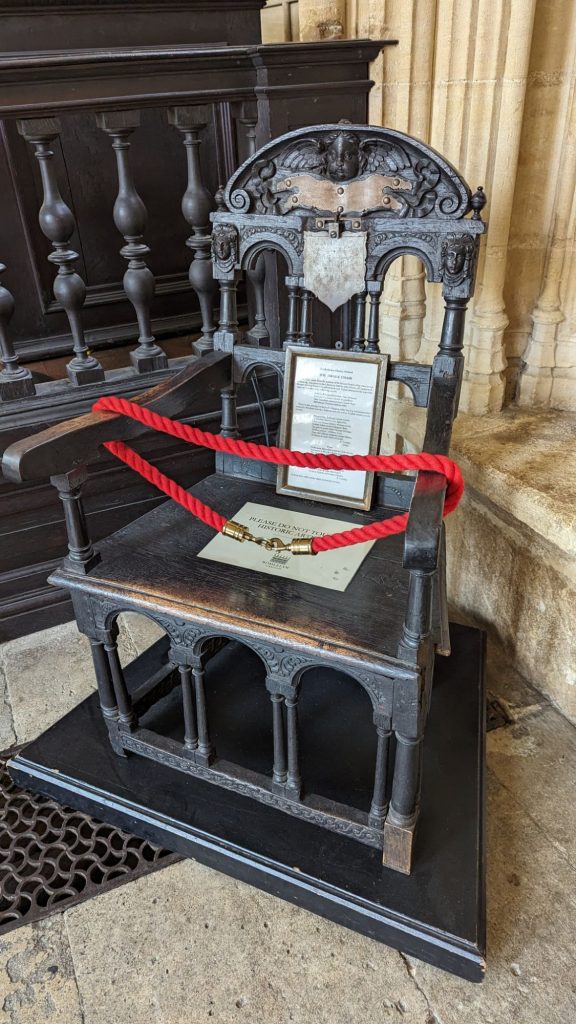
Chair made from timbers of the Golden Hind in the Dinity Hall, Oxford, photo K Flude
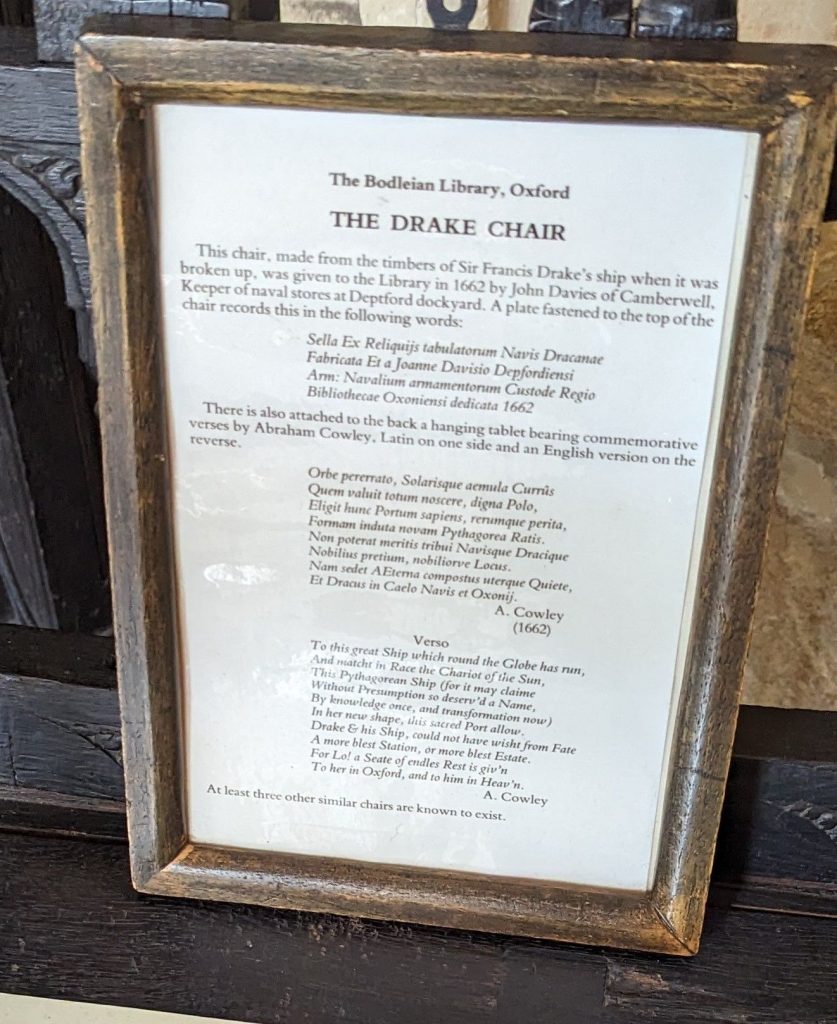
The Keeper of the Naval Stores at Deptford made chairs from the ruins of Drake’s ship, and one of them is on display at the Divinity Hall, Oxford.
Information panel on the Chair made from the ruins of the Golden Hind, photo K Flude
Sir Francis Drake and Middle Temple Hall
In London, Sir Francis Drake visited Middle Temple Hall, off of Fleet St regularly. A table (called the cupboard) is reputedly made from the hatch cover of the Golden Hind. This is where the newly qualified barristers stood to have their registration entered into the Inn’s books. Sadly, it did not survive the bombing of 1941.
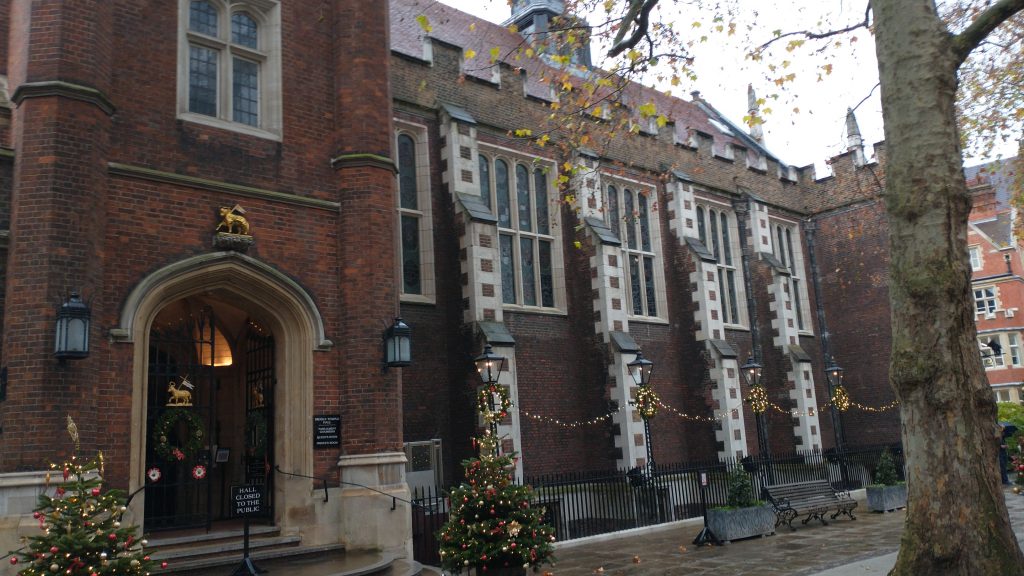
Middle Temple Hall. Photo K Flude 2021
The lantern which hung in the entrance Hall allegedly came from the ship’s poop deck (so not the one he failed to keep lit!). Other famous mariners associated with the Middle Temple include Sir Martin Frobisher and Sir Walter Raleigh. Shakespeare’s company performed Twelfth Night in the Middle Temple Hall
The Romans celebrated the Great Mother, the Cybele in the festival of the Megalesia. To celebrate bringing a meteorite of Cybele to her temple in Rome in 204BC. Celebrated by the Games of the Great Mother
1660 – Declaration of Breda by King Charles II promises a general pardon to all royalists and opponents of the monarchy for crimes committed during the English Civil War. Excluded were the Regicides who signed Charles I’s death warrant.
1814 – Napoleon abdicated and on April 11 ordered into exile in Elbe.
1949 Twelve nations sign the North Atlantic Treaty creating NATO. They were the Western Union – ( France, UK, Belgium, Netherlands, and Luxembourg) and the United States, Canada, Portugal, Italy, Norway, Denmark, and Iceland
1968 – Martin Luther King Jr. assassinated by James Earl Ray in Memphis, Tennessee
First published 2024, revised 2025, On This Day added 2026
The Famous Spaghetti Tree April Fool’s Joke (from facebook)
First Reference to April Fools Day
The first unambiguous British reference to April Fools Day is by diarist John Aubrey’s “Fooles holy day” in 1686 – although he might have been referring to Germany.
‘We observe it on ye first of April… And so it is kept in Germany everywhere.’ For more details read hoaxes.org.
Chaucer and April Fools Day
But there is a possible earlier reference in Chaucer in the Nun’s Priest’s Tale. This I find quite compelling but most Chaucer scholars don’t. This is the text:
When that the monthe in which the world bigan That highte March, whan God first maked man, Was complet, and passed were also Syn March bigan thritty dayes and two
So, if you have been keeping up with me, you will know that the first lines are referring to March 25th. This was the day Adam and Eve were created. The day when the Church started the New Year and the year number moved one on. This was a major Church festival, usually followed by a week of holiness. The Roman New Year, January 1st, ended with a light-hearted festival called Saturnalia, and it is suggested that April 1st was, similarly, a day of release after the festival of the official Church ceremony of the New Year.
Chaucer’s last line says ‘Since March began thirty-two days have passed.’ A foolish person would not realise this is a reference to April 1st. Hence, this suggests a Fool’s Day already existed. Some scholars think that Chaucer was referring to May 2nd, counting the 32 days not from the beginning of March but from the end of March. I think they look at the second and third lines which read ‘That high March…. was complete’ and so add the 32 days to the end of March. Foolish in my opinion and not reading what actually Chaucer wrote which is ‘Since March began….’
Hunting the Gowk
Generally, in Britain, we play a prank and say ‘April Fool’ with great delight. But we are not allowed to continue beyond midday. The Scots used to call it ‘Hunting the Gowk’ and the main prank was to give someone a letter to deliver, and the person who opened the letter would read:
“Dinna laugh, dinna smile. Hunt the gowk another mile” and send the fool onto another leg of his or her’s fool’s errand. In Ireland the letter would read ‘send the fool further’.
April Fools Day and Spaghetti Growing on Trees
I nearly always forget to honour April Fool’s Day (or April Fish Day as the French call it). But in Britain, somewhere in our newspaper or TV station there is an April Fools Joke slipped in. The most remembered is the BBC piece showing film of Italian Farmers picking spaghetti from trees.
2026 – Introduction of Coffee to England 200 years earlier than previously thought!
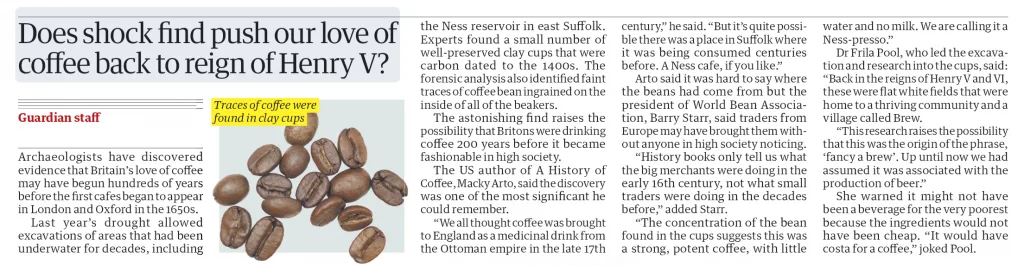
I have had a quick look at the Guardian for their 2026 April Fools Day Story and I think it is this one:
Guardian April Fools Joke for 2026
The clues are the expert is called Macky Arto. The find was in Ness, allowing them to say ‘Ness Cafe’, and ‘Ness-presso’, and the use of a pun ‘It would have costa for a coffee.’ The final confirmation is this sentence: ‘Back in the reigns of Henry V and VI, these were flat white fields …. and a village called Brew.’ Allowing the journalist to make up an origin for the expression ‘Fancy a Brew?’ it goes on to say.
2025 – Coffee Cups as Haut Courture?
Guardian April Fools Day Joke article or the world gone mad?
‘Meghan Markle was criticised after it was revealed that when you put her lifestyle brand name – American Riviera Orchard – into the What3words location service, it points to a statue of Oliver Cromwell, who famously had a King Charles executed‘
2023 – “Megxit: Call of Duke-y”
In 2023, Harry and Megan proved irresistible and the Guardian reported that:
‘The Sun published a piece announcing the launch of Prince Harry and Meghan’s new video game “Megxit: Call of Duke-y” in which the royal couple try to reach California while dodging obstacles, including rival royals and the media, along the way.‘
This post is about April Fools Day. But it is also the anniversary of the formation of the RAF.
On This Day
1854 – Hard Times by Charles Dickens Serialised in Household Words. A recent study of Victorian Grave yards in Yorkshire highlights the grim reality for young children. For the article see: https://core.ac.uk/reader/220156990
1918 – Near the end of World War 1 the Royal Flying Corps (RFC) and the Royal Naval Air Service were merged to create the Royal Air Force (RAF). It was the world’s biggest air force, and went on to secure Britain from invasion by Hitler.
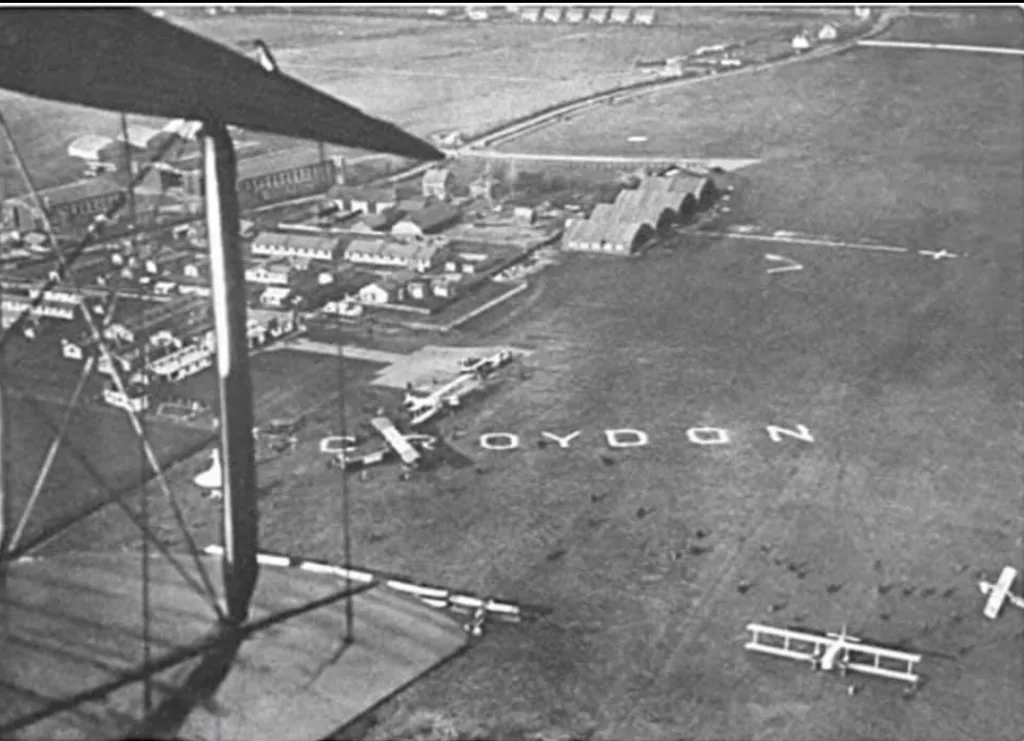
Croydon RFC/RAF base for anti-Zeppelin Raids in WW1 and one of the world’s first international airports.
RAF Rigger, Benjamin Flude
My Grandfather was in the RAF as a fitter. My father tells some of his story in his autobiography ‘A Boy from Haggerston’:
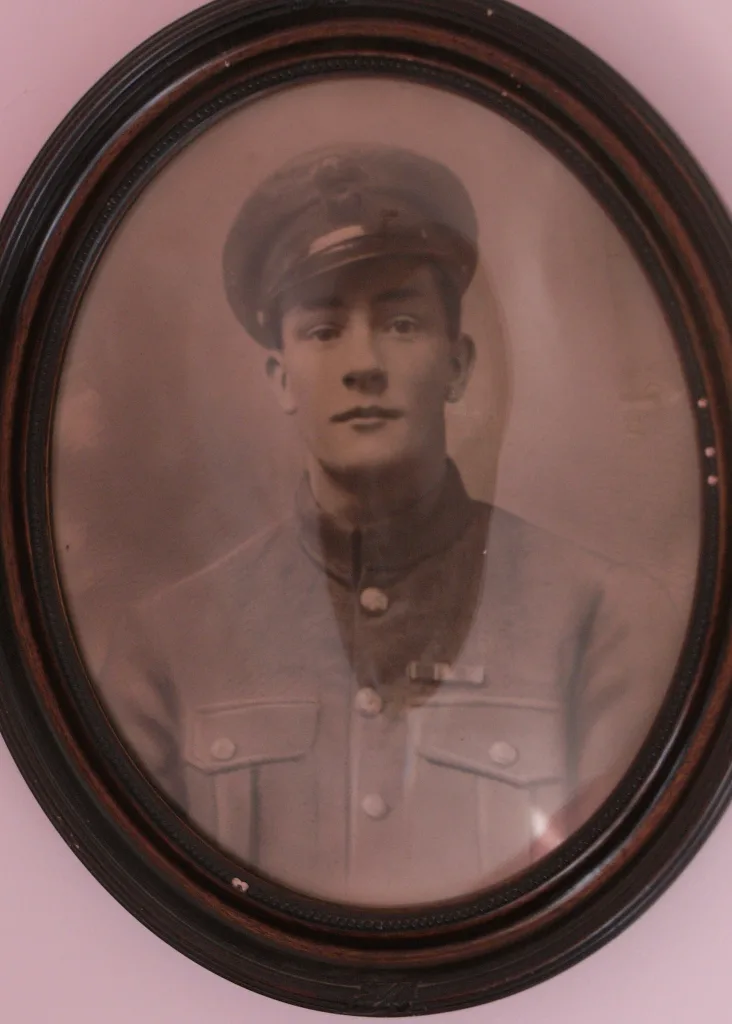
Benjamin Flude in RFC Uniform. My father, Ben Flude remembers a small model biplane hanging from the portrait.
‘I was 9 months old when he died, and he was just 28 years old. Everyone seemed to like him, and as a child, he was always my hero. In my imagination, I promoted him to being a brilliant and brave Ace RAF Pilot. But he was, in fact, a mechanic rather than a pilot in World War I. Following the war, he worked with Imperial Airways in Purley, Croydon. I don’t know the exact details and so have to piece the story together from the little information I have at my disposal.
My friend, Roy, tells me that the badge on his uniform in the oval picture is of the Royal Flying Corp. (RFC). But they were disbanded in 1916/17, and replaced by the RAF thereafter. As my dad was born in 1900, he must have joined up to fight in the war while underage at 16 or 17 as a volunteer. ‘
How a London lad became a Rigger for the RFC we don’t know, but the Fludes at that time were all employed as umbrella or walking stick makers in the East End of London. I think it is a case of transferable skills. WWI aeroplanes were made of wood, metal wire and fabric, which is precisely what an umbrella is made of.
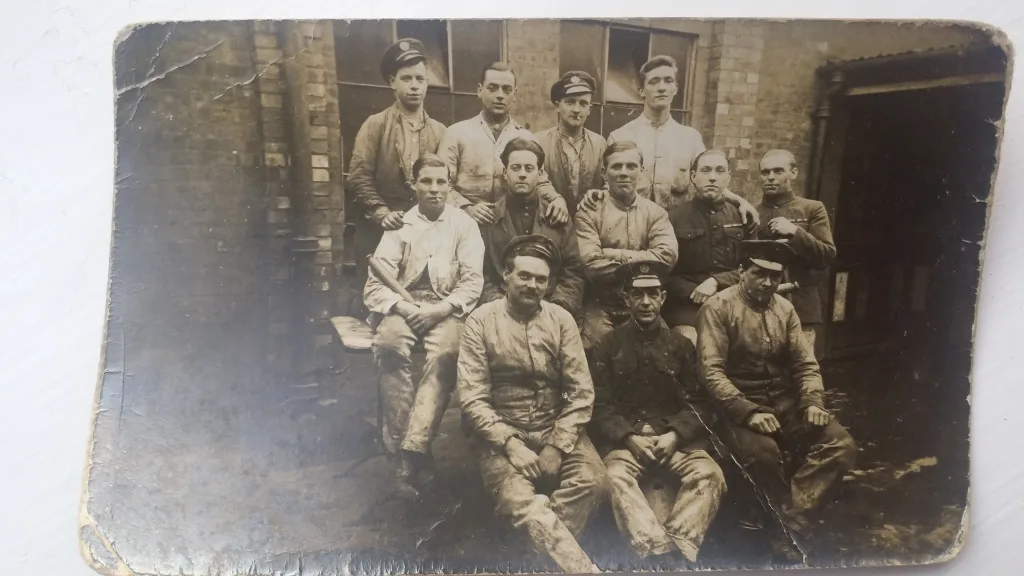
RAF/RFC mecanics c 1917 . My grandfather is the handsome man standing tall in the back row extreme right
RAF Mechanic Ben Flude
My father went on to serve in the RAF during his national service: He writes:
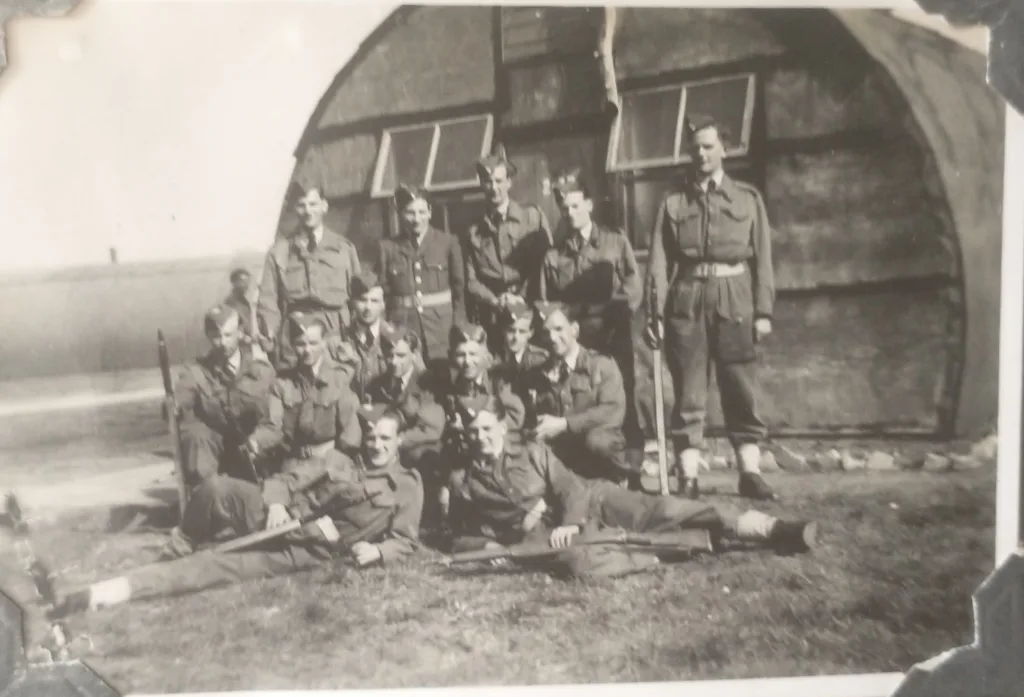
Ben Flude RAF Metfield. (dad is lying down at the bottom right. he is now 98)
‘Early in 1946 I received my call-up papers for the RAF. I was to report to the Recruitment Centre at Padgate in Lancashire. This is where I received my uniform after a medical examination, and then there were a number of intelligence/aptitude tests when they decided what trade I would join. I tried to get Air Crew and while there were no vacancies, I did have a wide group of trade offers open to me. The group that I was interested in was aircraft maintenance and repair, following in my Dad’s footsteps.’
‘However, before I could start, I had to do my basic training. This was designed to get you fit, and we did plenty of square-bashing or parade drills. For this, they sent me to Metfield in Suffolk, which had only very recently been made available to the RAF by the American Army Air Force. In fact, it was so recent a hand-over that whilst on picket duty, a coach rolled up packed with girls who were so disappointed by the lack of Americans that they got straight back on and returned to Ipswich! The motto of ‘overpaid, oversexed, over here’ certainly applied to these Americans in Suffolk.’
‘We found out that Metfield had been a US Army Air Force Base, where two squadrons of Flying Fortresses operated from. In all the Nissen Huts, those with the semicircular roofs, the ceilings were completely covered with pin-up pictures. My bed was just feet away from the huge Crocodile Stove, round which every evening we all clustered – as it was warm.‘
Interior of Nissan Hut 1944, Lasham
Dad specialised in the recovery of instruments from crashed planes, and was complimented by Air Chief Marshal Hugh Caswall Tremenheere Dowding, 1st Baron Dowding, GCB, GCVO, CMG on his ability to fix an instrument he had never seen before.
First published March 25th 4004 BC and republished yearly on every April Fool’s Day. The section on the meaning of April moved to my post on April 2025. On This Day added in 2026
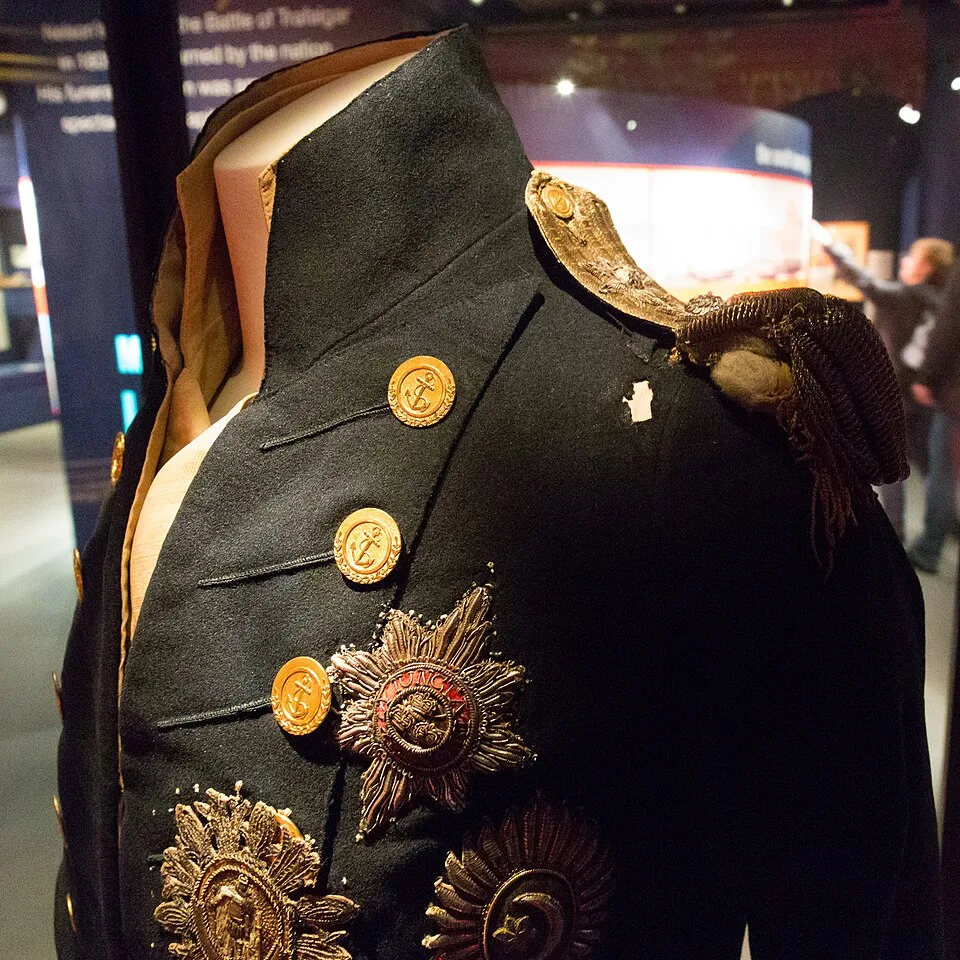
Uniform worn by Nelson at the Battle of Trafalgar (1805), his final engagement, showing the musket ball hole; now displayed at the National Maritime Museum, Greenwich By Morio – Own work, CC BY-SA 3.0,
Virginia Woolf In Greenwich
‘Where shall I spend the day? decided on Greenwich, arrived there at 1; lunched, everything fell out pat; smoked a cigarette on the pier promenade, saw the ships swinging up, one, two, three, out of the haze; adored it all; yes, even the lavatory keepers little dog; saw the grey Wren buildings fronting the river, & then another great ship, grey and orange; with a woman walking on deck; & then to the hospital; first to the museum, where I saw John Franklin’s pen and spoons (a spoon asks a good deal of imagination to consecrate it) – I played with my mind watching what it would do, and behold if I didn’t burst into tears over the coat Nelson wore at Trafalgar with the medal which he hid with his hand when they carried him down, dying, lest the sailors might see it was him.
There was too, his little fuzzy pigtail of golden greyish hair tied in black, & his long white stockings, one much stained, & his white breeches with the gold buckles, & his stock – all of which I suppose they must have undone & taken off as he lay dying. Kiss me Hardy, &c – Anchor, anchor, – I read it all when I came in, & could swear I was there on the Victory – So the charm worked in that case. Then it was raining a little, but I went into the Park, which is all prominence and radiating paths, then back on top of a Bus & so to tea. ‘
Virginia. Woolf, Diary, 1926, quoted from ‘A London Year’ Compiled by Travis Ellborough & Nick Bennison
Greenwich
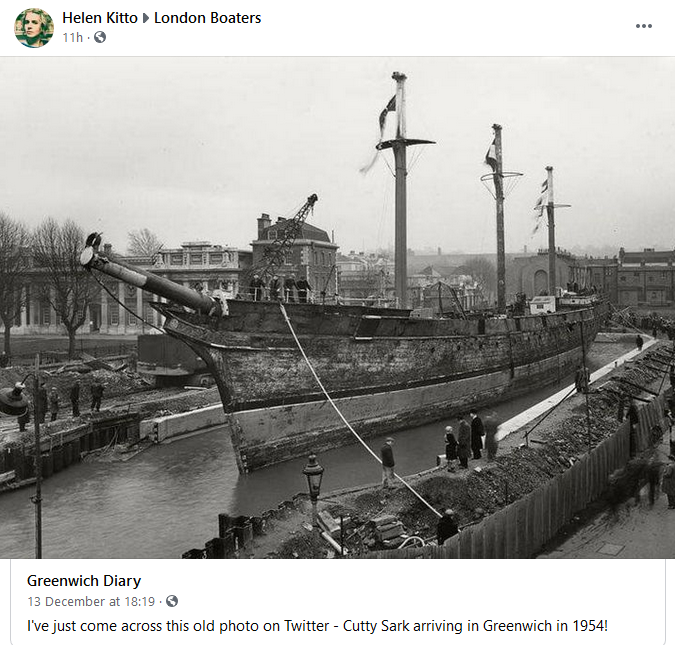
It’s a lovely description of her day out. I think it is like most of our excursions to Greenwich, except she didn’t go to the Market, nor stop in one of the historic pubs, nor go the Royal Observatory. Cutty Sark was not there until 1954. The Museum she mentions is not the National Maritime Museum as that was not opened till 1937, although the idea dates from the year after Woolf’s visit. So, the Museum is a precursor. Nelson’s funeral was preceded by a lying-in-state for three days at the Royal Hospital for Seamen at Greenwich, (which is the Hospital Viriginia Woolf mentions). He was buried in St Pauls on 9 January 1806 , with his body taken by boat from Greenwich to St Pauls. So, there was a local Museum with maritime content in it. I assume associated with the Royal Hospital.
I hate to think what my, unforgiving, on-line grammar editor will make of those long sentences with so many sub-clauses! It is a problem for me as the tool rates the writing on various criteria and refuses to give you a green tick when you have long sentences, not enough headings, paragraphs too short or long, passive writing, etc. etc. And an on-line automated, probably AI assisted tool is not going to let it through just because it is by Virginia Woolf.
Cutty Sark
The Cutty Sark was one of the fastest Tea Clipper Ships. It was built in Dumbarton, Scotland in 1869. And is resting as a Tourist Attraction in Greenwich. She gets her name from Tam O’Shanter, one of Robert Burns’ greatest poems. written in 1791. The story of the name is told by the Figurehead.
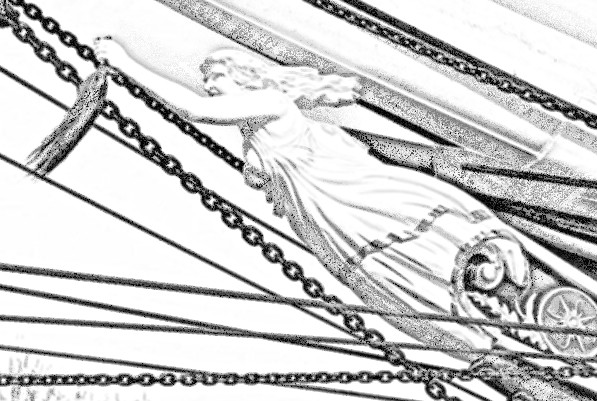
Figureheads on the prow of ships are very often of a semi naked women with her torso breasting the water. The young witch, Nannie Dee, in Tam O’Shanter is identified as the one who is very ‘Vauntie’ and with a short shift that she wore as a child and so is now short and revealing. The poem names this garment as her ‘Cutty Sark. Sark is her shift. Cutty is dialect for short. The Cutty Sark’s figurehead shows Nannie in her shift holding the tail of Tam’s horse.
Tam O’Shanter
Her cutty sark, o’ Paisley harn, That while a lassie she had worn, In longitude tho’ sorely scanty, It was her best, and she was vauntie.— Ah! little kend thy reverend grannie, That sark she coft for her wee Nannie, Wi’ twa pund Scots, (’twas a’ her riches), Wad ever grac’d a dance of witches!
The story is that the drunken Tam on his steady horse Maggie is travelling home when he seems a devilish dance taking place in a graveyard, presided over by the devil himself. Tam is so excited when he sees the young beautiful witch that he bellows his approval and all of a sudden the merriment ends, and in deadly silence the witches turn on Tam and race to catch him.
Tam tint his reason a’ thegither, And roars out, ‘Weel done, Cutty-sark!’ And in an instant all was dark: And scarcely had he Maggie rallied. When out the hellish legion sallied.
As bees bizz out wi’ angry fyke, When plundering herds assail their byke; As open pussie’s mortal foes, When, pop! she starts before their nose; As eager runs the market-crowd, When ‘Catch the thief!’ resounds aloud; So Maggie runs, the witches follow, Wi’ mony an eldritch skreech and hollow.
Maggie
Tam and his horse have to get across a brook before the witches because the witches cannot cross the water. The witches must get him before the bridge over the brook or face burning at the stake. All depends on Maggie (Meg). The young witch in the Cutty Sark is catching up as they approach the bridge. Maggie makes a magnificent leap, the witch makes a despairing grab and only can reach Maggie’s tail but Tam and his horse make it to safety leaving the witch the tail.
Cutty Sark Figurehead
Ah, Tam! Ah, Tam! thou’ll get thy fairin! In hell they’ll roast thee like a herrin! In vain thy Kate awaits thy comin! Kate soon will be a woefu’ woman! Now, do thy speedy utmost, Meg, And win the key-stane of the brig; There at them thou thy tail may toss, A running stream they dare na cross. But ere the key-stane she could make, The fient a tail she had to shake! For Nannie, far before the rest, Hard upon noble Maggie prest, And flew at Tam wi’ furious ettle; But little wist she Maggie’s mettle— Ae spring brought off her master hale, But left behind her ain gray tail: The carlin claught her by the rump, And left poor Maggie scarce a stump.
Now, follow the link below and read the whole poem but read it out loud, standing up and with gusto. Don’t worry about the pronunciation, just enjoy it.
1802 – Treaty of Amiens brought peace between Revolutionary France and Britain. A Soho factory was lit up with gas lighting to celebrate, But it only lasted a year. Then began the Napoleonic Wars, which continued to 1815.
First Published on March 27th. 2026. Cutty Sark content transferred in from 2022.
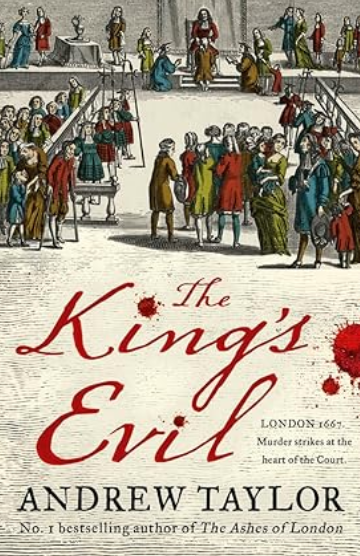
Fascinating read about the King’s Evil by Andrew Taylor
Aries & Noses
We have just entered Aries. Now according to astrology, Aries is associated with health issues of the face. This, according to ‘Skin and Astrology Signs‘ is because of the “level of heat in their bodies”. So Arians tend to have problems such as “flushing, heat rashes, skin eruptions, and rosacea”. They suggest using chilled cucumber for the eyes and forehead, and using beauty products with soothing aloe vera in them. ‘Touching’ by the King could also cure certain nose conditions, particularly if caused by ‘The King’s Evil’.
Charles Kightly, in his Perpetual Almanac enjoins us to ‘Observe the features of the face which are ruled by Aries and seek cures for ills of the nose’.
The first example, Kightly gives, is from The Shepherd’s Prognostication of 1729 which explains how to understand people by studying their noses:
Nose round with a sharpness at the end signifies one to be wavering of mind; the nose wholly crooked, to be sure unshamefaced and unstable; crooked like an eagle’s beak, to be bold. The nose flat, to be lecherous and hasty in wrath; the nostrils large, to be ireful.’
A Fungous Nose & the King’s Evil
The second rather revolting tale is from John Aubrey.
Arise Evans had a fungous Nose and said, it was revealed to him, that the King’s hand would cure him. At the first coming of Charles II into St James Park he kissed the king’s hand and rubbed his nose with it: which disturbed the king, but cured him.
Now, on the subject of revolting nose conditions, I have just been reading a review of a book ‘Civility and the Theatre in Early Modern England’. The author, Indira Ghose, is studying early self-help books of manners and conduct, and how they influence or appear in contemporary plays. One such manual by Giovanni Della Casa has the following advice:
‘when thou hast blowne thy nose, use not to open thy handkerchief, to glare uppon thy snot, as if thou hadst pearles and Rubies fallen from thy braynes’.
Galateo: The Rules of Polite Behaviour published in Venice in 1558. It was translated into French (1562), English (1576), Latin (1580), Spanish (1585), and German (1587), (Wikipedia). Galateo translates as etiquette.
There is no need to thank me for passing on such good advice! I bet “Miss Manners” Judith Martin didn’t pass this particular gem on, but Wikipedia claims that modern books of manners are influenced by Galateo.
Scofula and the King’s Touch
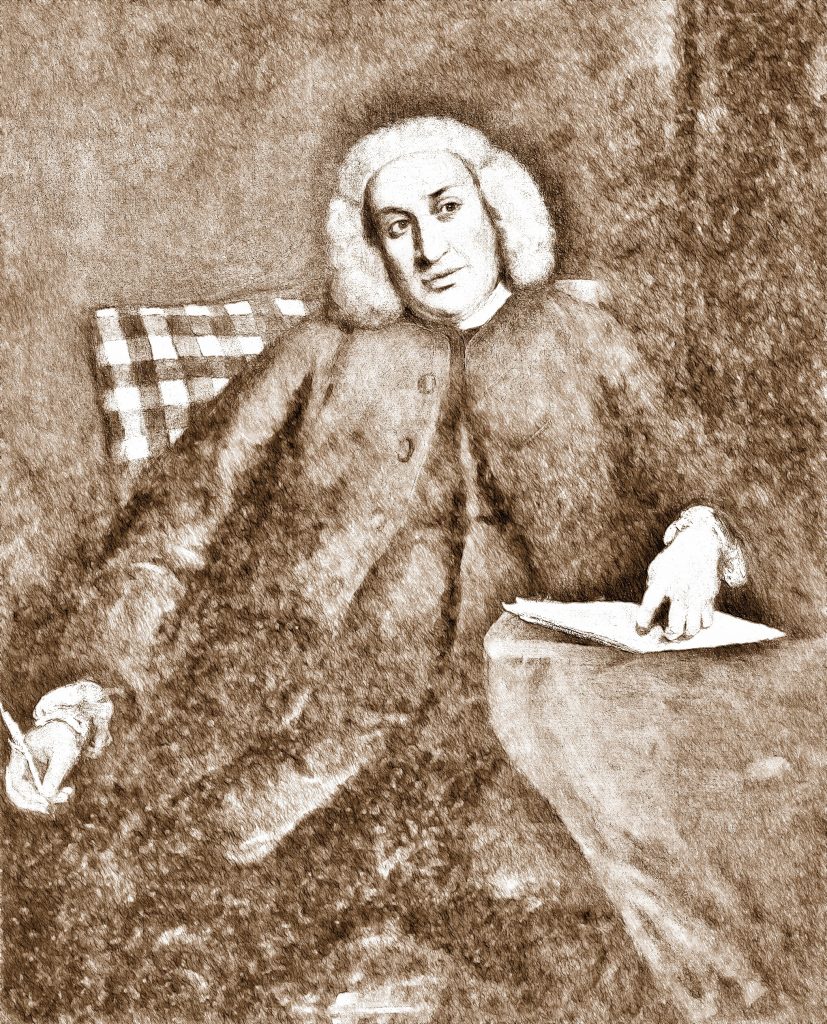
Sketch of Dr Johnson from a portrait.
People believed that Scrofula, could be cured by touching the Monarch. Tuberculous cervical lymphadenitis was, thus, known as the King’s Evil. So, the King or Queen would make herself, very reluctantly, available for his sick public to touch her. Dr Samuel Johnson suffered from Scofula and received the “royal touch” from Queen Anne on 30 March 1712 at St James’s Palace. He was given a ribbon, which he wore around his neck for the rest of his life (with a coin strung on it, I think see below). But it did not cure the disease, and he had to have an operation.
The Touching took place in the winter, between Michaelmas and Easter, when cold weather provoked the disease. The lucky few, who were allowed the Touch, would be touched or stroked by the King or Queen on the face or neck. Then a special gold coin, touched by the Monarch, was put around their neck. Readings from the bible and prayer finished the ceremony. Before Queen Elizabeth I, the Touch was said to cure many diseases such as Rheumatism, convulsions, fever and blindness, but after it was reserved for Scrofula.
Who Started touching for the King’s Evil?
It was only the French and the English who believed the King’s touch could cure people. The French claimed it began with Philip 1 in the 11th Century. The English claimed Edward the Confessor as the first. But this was denied by the French who claimed that the French King of England, Henry 1 introduced it to the English. The practice lasted until George 1 who resolutely refused to have anything to do with it.
For more on the King’s Evil have a look at this blogpost. Or read the book pictured at the top of the post.
On This Day
1312 – The Knights Templars are abolished by Pope Clement. King Philip of France had a massive debt owed to the Templars, following his war with England. He chose to avoid payment by accusing the Templars of impious acts, and homosexuality. Evidence was collected by torture and thus unreliable.
1622 – Jamestown massacre: 347 English settlers killed by Powhatan People of Tsenacommacah. This is estimated as a third of the colony’s population, during the Second Anglo-Powhatan War. Powhatan (Chief Wahunsunacawh) was the father of Pocahontas (aka Amonute, or Matoaka and Rebecca Rolfe). But it was Powhatan’s son, Opechancanough, who was in charge during the massacre. They were of the Algonquian peoples.
1888 – The English Football League was founded at Anderton’s Hotel, Fleet Street. Representatives from Aston Villa, Blackburn Rovers, Bolton Wanderers, Preston North End and West Bromwich Albion met. They discussed other teams that might join. Another meeting was called at the Royal Hotel in Manchester on 17 April 1888 to establish the league. The 12 founding members were: Accrington, Aston Villa, Blackburn Rovers, Bolton Wanderers, Burnley, Derby County, Everton, Notts County, Preston, Stoke City, West Bromwich Albion, Wolverhampton Wanderers. None from London. In season 1894–95 Woolwich Arsenal joined the 2nd Division of the Football League as the first London Team. For more information see: the-football-league-conceived-in-fleet-street-born-in-manchester/
First published in 2024, revised in 2025, Etiquette and On This Day added 2026
Lide 5th is St Piran’s Day. Photo of St Piran’s Oratory at Trézilidé, Finistère (wikipedia) By Kieffer92 – Own work, CC BY-SA 4.0,
March is named after the Roman War God Mars, whose Month it was. But in England it had, until recent times, a dialect name which survived in the South west of England. This was ‘Lide’.
Lide was still used in the 17th Century, and then survived into the 19th Century only in Cornwall. The Cornish named the first Friday in March ‘Friday in Lide’. They had a proverb.
‘Ducks won’t lay till they’ve drunk Lide water’.
Daffodils were called Lide-lillies. Eleanor Parker, who is a Lecturer in Medieval Literature at Brasenose College, Oxford, wrote an interesting article in History Today. She called March the loudest month of the year. The early English names for March were Hlyda or Lide monath meaning stormy or loud month. Other names include Hraed monath (rugged month) and Lentmonath (month of lent).
March brings breezes loud and shrill, Stirs the dancing daffodil.
Sara Coleridge (1802–1852), “The Months,” Pretty Lessons In Verse, For Good Children; With Some Lessons in Latin, In Easy Rhyme, 1834
There are many references to the changeable weather in March. Sometimes lovely spring days, and at others raging storms, and frosts. Parker quotes a proverb which says that March comes in:
‘like a lion and goes out like a lamb’.
In 2026, the 5th of Lide has been a beautiful spring like day, with, over the last few days a outburst of Hawthorn and Plum blossom.
St Piran
Lide 5th was a holiday for Miners, probably because it was St Piran’s Day. Very little is clear about St Piran. But he is thought to have been an Irish Missionary who founded an Abbey in Cornwall in the 5th Century. His legend says he was tied to a millstone by the Irish, who rolled the stone over a cliff. The sea was stormy, but calmed as soon as he fell into it. He floated on his stone to Perranzabuloe in Cornwall. Here he landed and got his first converts: a badger, a fox, and a bear. Then, he founded the Abbey of Llanpirran.
He is said to have reintroduced smelting to Cornwall, hence his attribution as patron Saint of Miners. Piran was martyred by Theodoric or Tador, King of Cornwall in 480. His bones scattered in reliquaries in the South West and in Brittany. He is the patron saint of Cornwall, so the week before the 5th of March is known as Pirrantide. And there are events and parades to commemorate him. People dress in black white and gold, carrying daffodils and walk across the dunes to St Piran’s Cross.
1702 – Queen Anne becomes Queen – the last of the Stuarts. She had 18 pregnancies. The eldest survived to 11 and then died. Of the other 17, 8 miscarried, 5 were stillborn. 4 were born alive but died soon after. She had poor health, gout and drank a lot, but she might well have had an autoimmune deficiency and her body rejected the offspring. The fact that the eldest was the only one to survive might suggest rhesus disease, which can now be prevented with an injection of a medication called anti-D immunoglobulin. The problem occurs when a woman with RhD negative blood is exposed to RhD positive blood and develops an immune response to it. The first child is not affected, subsequent ones risk miscarriage.
1936 – The Spitfire makes its maiden test flight. By 1947 over 20,000 had been made and it had been in continuous production throughout the war, unlike most other aircraft.
1946 – Churchill makes his”Sinews of Peace” Speech in which he coins the phrase ‘Iron Curtain. President Trueman invited the unemployed Statesman to Fulton Missouri to make the speech. In 1961, the proposal was made to commemorate the speech by reconstructing the blitzed City Christopher Wren Church, St Mary Aldermanbury in Fulton, Missouri. The Church was shipped to the States, rebuilt and rededicated on the 7 May 1969.
First published in 2024, rewritten March 2025 Revised, On This Day added 2026.
Portrait of Saint Guénolé (St Winnold) after a bust in silver on a reliquary from the Church Saint-Guénolé in Locquénolé.Public Domain Abgrall Jean-Marie (1846-1926) – Bibliothèque nationale de France
Here is a weather poem in which St Winnold appears
First comes David, then comes Chad. And comes Winnold, roaring like mad. White or black. Or old house thack.
St David’s Day was March 1st. St Chad, the 2nd. St Winnold’s Day is the third of March. Winnold is his English name, and Winneral, or Winwaloe or Guénolé his Celtic names.
The poem suggests that snow, rain or wind is going to come on these three days. When the wind roars, it will threaten the thatch of houses. If the storms do not come in the first 3 days, then they will come on the last three days of March, which were called ‘the Borrowing Days’. Or so it is said.
St Winnold was around 50 years (460 – 3 March 532) after the end of Roman Britain. His family was from Cornwall. He was the son of a Prince Fragan of Dumnonia, and St Gwen the Three-Breasted, His mother’s Feast day is October 3rd. She is a Saint of fertility, because of God’s Gift of an extra breast. They moved to Brittany to escape a British Plague. Their son grew up to be holy and was the founder and first abbot of Landévennec Abbey (the Monastery of Winwaloe). It is south of Brest.
Winwaloe became what is known as a ‘phallic saint’ because he was associated with fertility. Wikipedia says this came about because of confusion about the origin of his name:
‘his name was thought to derive from gignere (French engendrer, “to beget”)’
St Winnold’s Breton name is Guénolé. How this etymology works is not clear to me! But surely, he as likely to have got a reputation for helping people with fertility problems from his mother? Supplicants would make a wax phallus to persuade the Saint to help them conceive. There are several churches/ chapels dedicated to him in Wales, and a Priory in East Anglia.
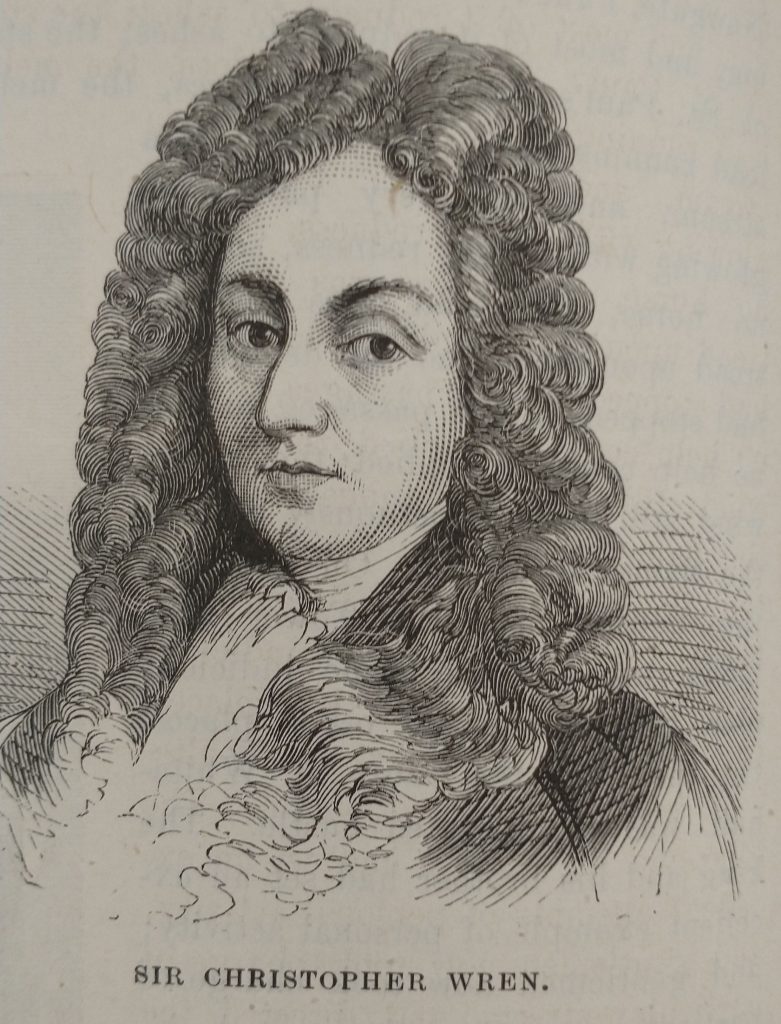
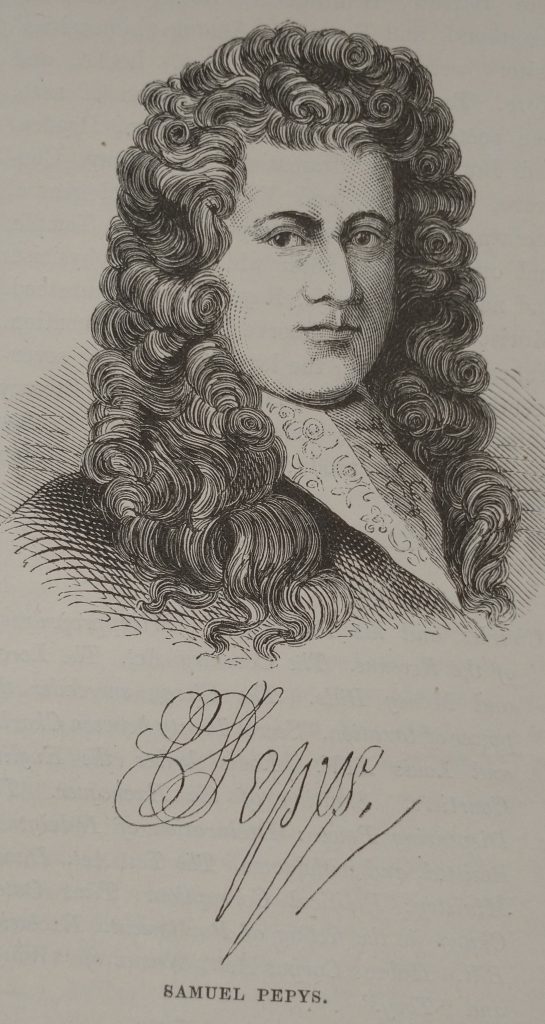
John Evelyn is, with Pepys and Wren, one of the great figures of 17th Century London. Unlike Pepys, he was an avowed Royalist who hated Oliver Cromwell and all he stood for. He went into exile with his King and gives a great description of Paris (see below).
Like Pepys, John Evelyn was a diarist and a writer. And they, like Wren, were alumni of the Royal Society, one of the great scientific societies. John Evelyn was a founding fellow. It was innovative in that it employed an experimenter. This was Robert Hooke – one of the great early Scientists, who also worked with Wren rebuilding London after the Great Fire. The Royal Society encouraged scientists to experiment, write up their observations, and submit their theories for peer review. This is the foundation of modern Science, and a bedrock of the Enlightenment.
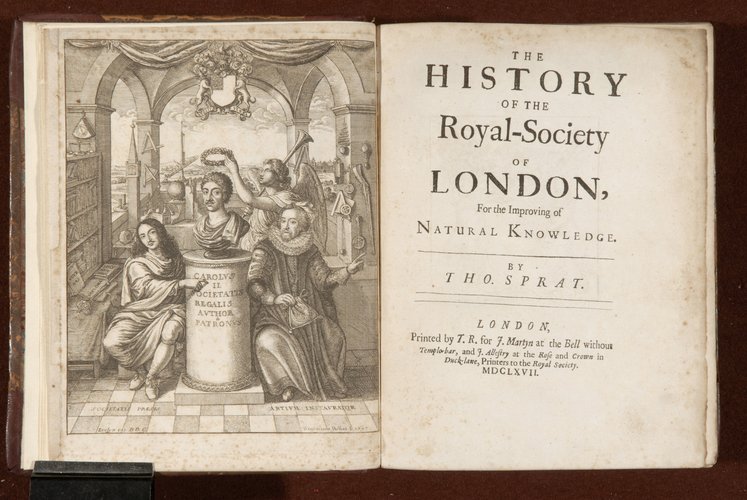
Frontispiece of ‘the History of the Royal-Society of London by Thomas Sprat. John Evelyn was a founder member
Evelyn the Writer.
John Evelyn has a place in my history because, in the 1980’s I worked. with Paul Herbert, on a project to create an interactive history of London. It was financed by Warner Brothers, and in cooperation with the short-lived ‘BBC Interactive TV Unit’. One part of it was a Literary Tour of London. The first half of this Tour is the basis for my book ‘In Their Own Words’ (To buy click here ) And this is where I came across John Evelyn using several of the quotations on this page.
Evelyn was a prolific traveller and a polymath. He wrote on the need to improve London’s architecture and air in Fumifugium (or The Inconveniencie of the Aer and Smoak of London Dissipated). Here is an extract from his Furmifugium.
‘That this Glorious and Antient City, which from Wood might be rendred Brick, and (like another Rome) from Brick made Stone and Marble; which commands the Proud Ocean to the Indies, and reaches to the farthest Antipodes, should wrap her stately head in Clowds of Smoake and Sulphur, so full of Stink and Darknesse, I deplore with just Indignation.
That the Buildings should be compos’d of such a Congestion of mishapen and extravagant Houses; That the Streets should be so narrow and incommodious in the very Center, and busiest places of Intercourse: That there should be so ill and uneasie a form of Paving under foot, so troublesome and malicious a disposure of the Spouts and Gutters overhead, are particulars worthy of Reproof and Reformation; because it is hereby rendred a Labyrinth in its principal passages, and a continual Wet-day after the Storm is over. ‘
And he was an expert on trees. Author of: Sylva, or A Discourse of Forest-Trees (1664). He lived at Sayes Court in Depford near Greenwich, which he ill-advisedly rented to Peter the Great of Russia. Letting to Peter was a lot-like inviting a 1960s Rock Band to trash your mansion.
John Evelyn the Exile
Here is a taste of Evelyn’s time as an Exile. It is a short extract from a long entry on the splendid Palaces in and around Paris.
27th February, 1644. Accompanied with some English gentlemen, we took horse to see St. Germains-en-Laye, a stately country house of the King, some five leagues from Paris. By the way, we alighted at St. Cloud, where, on an eminence near the river, the Archbishop of Paris has a garden, for the house is not very considerable, rarely watered and furnished with fountains, statues,[and groves; the walks are very fair; the fountain of Laocoon is in a large square pool, throwing the water near forty feet high, and having about it a multitude of statues and basins, and is a surprising object. But nothing is more esteemed than the cascade falling from the great steps into the lowest and longest walk from the Mount Parnassus, which consists of a grotto, or shell-house, on the summit of the hill, wherein are divers waterworks and contrivances to wet the spectators; this is covered with a fair cupola, the walls painted with the Muses, and statues placed thick about it, whereof some are antique and good. In the upper walks are two perspectives, seeming to enlarge the alleys, and in this garden are many other ingenious contrivances.
This was Evelyn’s reaction when Charles II was restored to the throne in 1660,
May 29th 1660:
This day came in his Majestie Charles the 2d to London after a sad, and long exile… this was also his birthday, and with a Triumph of above 20,000 horse and foote, brandishing their swords and shouting with unexpressable joy; the wayes strawed with flowers, the bells ringing, the streets hung with Tapisry, fountains running with wine: ‘
‘The mayor, Aldermen, all the companies in their liveries, chaines of gold, banners, Lords and nobles, cloth of Silver, gold and velvet every body clad in, the windows and balconies all set with Ladys, Trumpetes, Musik, and myriads of people … All this without one drop of bloud …it was the Lords doing…
1661 – ‘Ash Wednesday. Preached before the King the Bishop of London (Dr. Sheldon) on Matthew xviii. 25, concerning charity and forgiveness.‘
John Evelyn’s Diary Dr Sheldon, the Bishop of London mentioned above, went on to become Archbishop of Canterbury. He was a friend of Wren’s Father, and commissioned Wren to build the Sheldonian Theatre, in Oxford.
1782 – OK! Let’s give up! The House of Commons votes against continuing the war with Revolutionary America.
1900 – The Labour Party is founded. And today, the UK woke up to a by-election in a safe Labour seat won by the Greens (40%) with Reform 2nd (29%) and the Labour Party third (26%) Conservatives fourth (2%). So, clearly a progressive vote determined to beat Reform, Labour won about 50% of the vote last time, so a disaster for them. Not a success for Reform, and bad result for the Conservatives.
1933 – Reichstag burns down. Hitler uses it to suspend Civil Liberties, and attack the German Communist Party which was falsely blamed for the fire.
First Published 2024, republished 2025, Making Lardy Cake moved to Fat Thursday and On This Day added 2026
Ash Wednesday this year is early and on 18th February. It is the First Day of Lent, the solemn time which runs up to Easter, and is symbolic of Jesus’ 40 days in the wilderness.
In Anglo Saxon the name for the season of Spring was ‘lencthen’. It is thought to derive from the idea of the lengthening days. Days do suddenly seem to have got longer. These are the official times for the evening:
Sunset: 17:21
Dusk (Civil twilight ends) : 17:55
Nightfall (Nautical twilight ends) :18:34
Full Darkness starts (Astronomical twilight ends) : 19:13
So strictly, Lent means Spring. The Romance languages use the term which derives from the Latin ‘Quadragesima’ which means the 40 days of Fast. Spanish (Cuaresma), French (Carême), and Italian Quaresima). For Germans, it is the fasting time: fastenzeit. In England, Lent became a specialised word for the fast period. And Spring took over as the name of the season.
A time of fasting? Time for reflection? Maybe once upon a time. When I was young, it was 40 days when you were supposed to give something up. Smoking, or drinking, or chocolate. An idea taken up by a new generation, as, for example, Dry January? A time of reflection? No, never did that.
Dust to Dust and Stardust
Ash Wednesday is named after the ashes smeared on the heads of worshippers to remind us that we are dust. I’ve never seen this done either. My footballing Vicar friend Andrew missed our Wednesday Game so that he could mark foreheads with ash crosses. The ashes were traditionally made from palms used for Palm Sunday decorations, which is indeed what Andrew did. Look here to see my post on Palm Sunday.
On the subject of dust, here are some spiritual lyrics by Joni Mitchell. Something profound in the true idea that we are all stardust.
We are stardust We are golden And we’ve got to get ourselves Back to the garden
Woodstock by Joni Mitchell
40 Days
We all know that there are 40 days in Lent, except there are not. It’s 46 this year. This was pointed out by Tim Harford who presents a BBC radio programme called ‘More or Less’. It is a programe about statistics, or more widely about Fact Checking statistics in the news. Last year he discussed the 40 days. One answer proposed was to take away Sunday. But, my mathematics tells me this still leaves 42. The answer Tim Harford came up with is that 40 days just means a long time.
It is the length of time of Lent, but also:
The duration of the Great Flood The time Moses was on Mt Sinai The time the Israelites spy on Canaan Goliath trails Saul Elijah Walks Jesus is tempted n the Desert The time from Resurrection to Ascension
In other words, a long time to be doing any one thing. As Hartford says, it’s like our word ‘umpteenth’. As in ‘Kevin this is the umpteenth time I’ve told you to tidy your bedroom’. That’s what my mother said to me as she threw my clothes out of the window.
This year, February 17th is Shrove Tuesday, the end of the Carnival. Etymology-on line says the origins of the term Carnival are:
1540s, “time of merrymaking before Lent,” from French carnaval, from Italian carnevale “Shrove Tuesday,” from older Italian forms such as Milanese *carnelevale, Old Pisan carnelevare “to remove meat,” literally “raising flesh,” from Latin caro “flesh” (originally “a piece of flesh,” from PIE root *sker- (1) “to cut”) + levare “lighten, raise, remove” (from PIE root *legwh- “not heavy, having little weight”).
Folk etymology has it from Medieval Latin carne vale ” ‘flesh, farewell!’ ” Attested from 1590s in the figurative sense of “feasting or revelry in general.” The meaning “a circus or amusement fair” is attested by 1926 in American English.Related entries & more
Pancake Day is another name for Shrove Tuesday. It is the day we eat up all our surplus food. Then on Ash Wednesday we must begin our lenten fast and turn our mind to repentance. Pancake Day, in the UK, is celebrated with a simple pancake with lemon and sugar. Here is a recipe from the BBC. On the other hand, Shrove Tuesday can be a day of excess before the 40 days of restraint. Shrovetide was normally three days from the Sunday before Lent to Ash Wednesday, the beginning of Lent. (Here is my post on Ash Wednesday).
Mardi Gras
In France, it’s called Mardi Gras which means Fatty Tuesday, in Italy Martedi Grasso. In New Orleans it stretches from Twelfth Night to Shrove Tuesday. But as we saw, in my post on Fat or Lardy Thursday‘ the Carnival period was more normally a week. In most other places it is one to three days. In Anglo-Saxon times there was ‘Cheese Week’, ‘Butter Week’, ‘Cheesefare Sunday’ and ‘Collop Monday’, preceding Ash Wednesday.
Shrove Tuesday the Day to be Shriven
Shrove Tuesday is the day we should be ‘shriven’ which means to make confession. The Church has been leading up to Easter since Advent – before Christmas. (See more on Advent Sunday here). Easter is the date of the conception and, also, the date of the execution and apotheosis of Jesus Christ. So the pious should confess their sins, then undertake their lenten fast before entering the Holy Week purged and sin-free.
In the Anglo-Saxon Church, there was a custom called ‘locking the Alleluia.’ The Church stopped using the word Alleluia from 70 days before Easter. Alleluia represented the return from exile in Babylon. So, with the approach of the death of Christ it was not felt appropriate to be celebratory.
The sombre nature of this block of time was highlighted by Ælfric of Eynsham (c. 955 – c. 1010).
Now a pure and holy time draws near, in which we should atone for our neglect. Every Christian, therefore, should come to his confession and confess his hidden sins, and make amends according to the guidance of his teachers; and let everyone encourage each other to do good by good example.
Ælfric, Catholic Homilies Text Ed. Peter Clemoes quoted in ‘Winters in the World’ Eleanor Parker
Time for Football!
Shrove Tuesday was the traditional time for football games, in the days before football had any rules to speak of. It was a wild game. Teams tried to get a bladder from one end of town to the other, or one side of a field to the other. In Chester, the Shrove Tuesday football game was held on the Roodee island. It was so rowdy that the Mayor created the Chester Races specifically to provide a more sedate alterative to the violence of the ‘beautiful game.’
Here is a youtube video of Shrovetide Football at Royal Asbourne in Derbyshire. You will notice it seems chaotic but if you look at the participants directed the action you can see how involved they are in it.
Royal Asbourne Shrove Tueday Football
In London, Henry Fitzstephen wrote about Shrove Tuesday Games in London in the late 12th Century:
‘Every year also at Shrove Tuesday, that we may begin with children’s sport, seeing we all have been children, the school boys do bring cocks of the game to their master, and all the forenoon they delight themselves in cockfighting. After dinner all the youths go into the fields to play at the ball. The scholars of every school have their ball, or baston in their hands. The ancient and wealthy men of the City come forth on horseback to see the sport of the young men and to take part of the pleasure in beholding their agility.’
Fitzstephen was the first biographer of Thomas Becket.
Pancake Race
The City of London has an annual pancake race at the Guildhall Yard. It is an inter-livery company competition. The Livery Companies also known as medieval Guilds, have to run across the Guildhall while holding a frying pan and pancake. There is a zone marked out where they have to toss the pancake. Here is a youtube video of the 2023 race.
Pancake Day/Shrove Tuesday Pancake Race
First published on February 21st, 2023 republished on February 13th 2024, and March 4th 2025, February 17th 2026