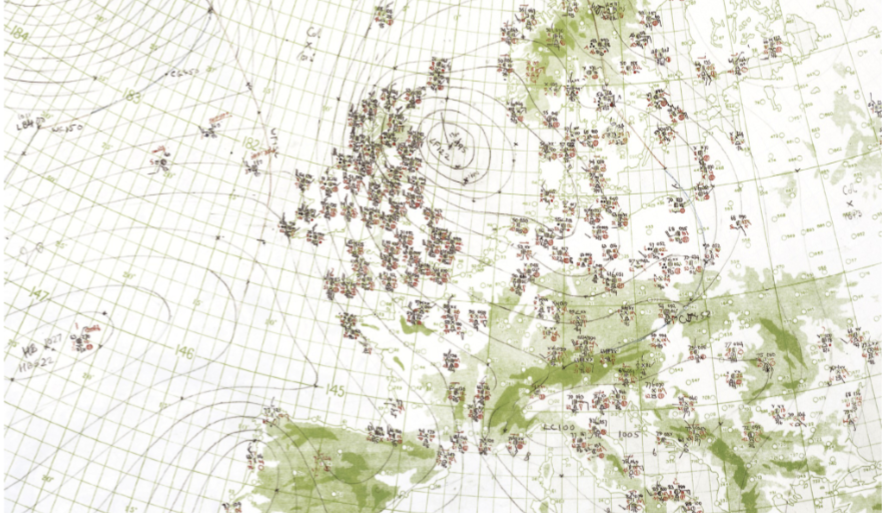
North Atlantic chart of weather for June 6th 1944. D Day. Showing occupied Europe with observations obtained from the enigma machine
In 2014 or thereabouts I went to a play by David Haig which was based on the true story of a weather forecaster’s role in D Day. James Stagg’s advice was that the weather on June 5th, the intended day, was too volatile. He suggested the 6th June 1944 instead.
The play was called Pressure and was great because it really conveyed the enormity of the decision that Ike, Churchill and others had to make. To go ahead in bad weather risked enormous casualties and the failure of the Landings. To postpone, might mean Hitler discovered the location of the invasions and might lead to disaster.
Major characters portrayed in the play included Ike and his driver, Kay Summersby with whom he was very close. Also depicted was an American forecaster who disagreed with the British meteorologist James Stagg. How much of the play was for dramatic effect and how much is true, I’m not entirely sure but it is a fascinating D Day story.
The maps were hand drawn and partially based on intercepted data decoded by the enigma machine. Stagg recommended postponing the landings one day from the 5th to the 6th of June, when it was hoped the ideal combination of calm seas, low water at first light and a full moon would occur.
This post sprang from something that my grandson said to in the middle of the park. He was curious as to why I was concerned that the park toilets were out of action. He told me I could, like him, just pull down my trousers and wee, right here, right then, up against the tree in the park. My attempt at explanation drew a perplexed, ‘What?’ ‘What?’ is his new word. After an explanation, his next word is invariable another ‘What?’.Hopefully the relevance of this will become apparent.
May and June are the most prolific months for dandelions, which used to be known as ‘piss-a-beds’. They are diuretic and were often eaten, and so might well have consequences for the young trainee child.
John Hollybush in his 1561 ‘The Homish Apothecary’ says:
‘When a young body does piss in his bed either oft or seldom: if ye will help him take the bladder of a goat and dry it to powder, and get him to drink with wine, or else take the beans or hinder fallings of a goat, and give him of the powder in his meat morning and evening, a quarter ounce at every time.’
(quoted in ‘The Perpetual Almanac by Charles Kightley)
Hinder fallings are what falls out of the hind-quarters of a goat. I’m not sure even an indulgent Grandparent is allowed to give droppings and wine to the little ones. Nor can I find any mention of goat products in modern medical recommendations. So I won’t be recommending this as a practical aid.
Medically, dandelions were very well regarded. Mrs Grieve’s ‘Modern Herbal’ reports that it are diuretic and a general stimulant to the system but particularly the urinary system. They were good for liver and kidney complaints; gall-stones; and piles. They were considered excellent to eat and drink. Particularly, dandelion sandwiches using young leaves, with salt, pepper, and lemon juice. They were also taken in salads, teas, and beers.
We used to blow the seeds from the dandelion seed head saying ‘She loves me. She loves me not’ at each blow, until the truth was revealed.
First written in June 2023, revised june 2024,2025. Rewritten 2025
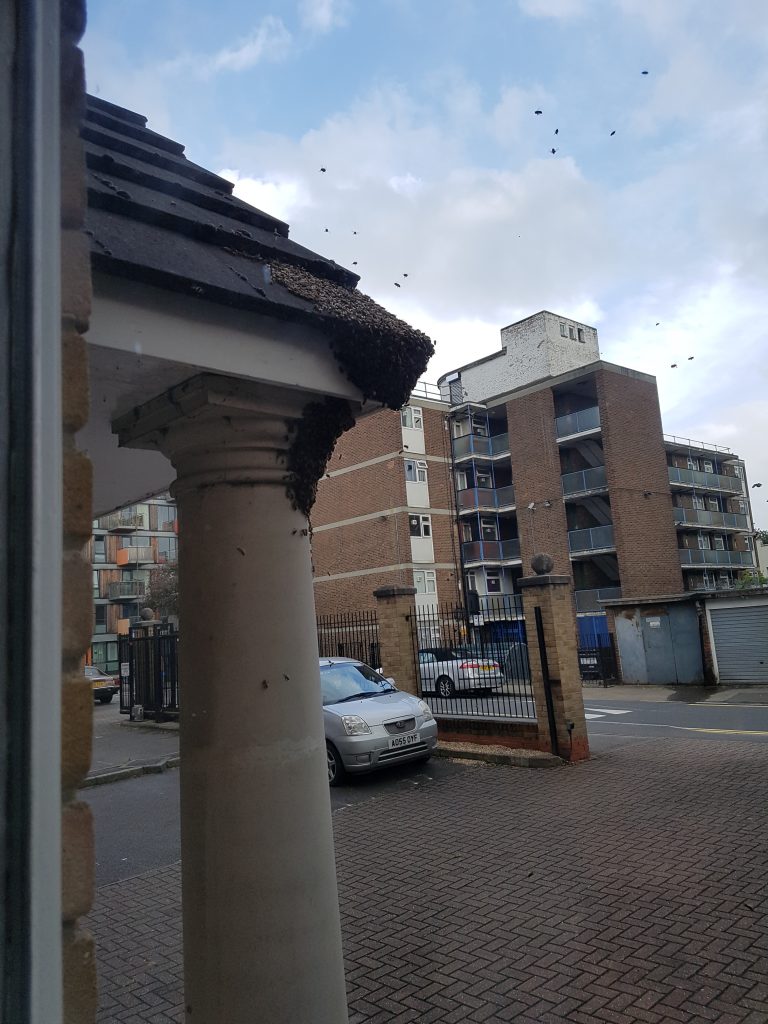
Swarm of Bees, Hackney (Photo Kevin Flude 30th May 2018). The Swarm is at the top of the Column and on the edge of the porch roof.
In 2018, on 30th May, I was perturbed to find a swarm of Bees hanging outside my front door. Frightened of leaving my house, I rang a local beekeeper, who came to take possession of the Bees and take them to a new home. By the time he came, they had moved 20 yards to a Buddleia bush.
Swarm of Bees, having moved 20 yards to a second perch, being ‘rescued’ by a bee keeper. You can see the swarm above his head.
A Swarm of Bees in May
‘Five Hundred Points of Good Husbandry’ published 1573, suggests we should:
‘Take heed to thy Bees, that are ready to swarm, the loss thereof now, is a crown’s worth of harm.’ The loss was particularly hard in May or June as the country verse tells us:
A swarm in May Is worth a load of hay A swarm in June Is worth a silver spoon A swarm in July Is not worth a fly.‘
According to Hillman’s ‘Tusser Redivus’ of 1710, swarming in May produces particularly good honey. He advises following the bees to retrieve them:
‘You are entitled by custom to follow them over anyone’s land and claim them … but only so long as you ‘ting-tang’ as you go, by beating some metal utensil – the sound whereof is also said to make your bees stop.’
Much of the above is quoted from The Perpetual Almanac of Folklore by Charles Kightly.
Queen Bee
Bees swarm when a new Queen Bee takes a proportion of the worker bees to form a new colony. They will latch unto a branch or a shrub, even a car’s wing mirror. Then sending worker bees out searching for a suitable new home, such as a hollow tree. There may be hundreds or even thousands in the new colony. This may be very alarming, as I found, as I could not go out without walking through a cloud of bees. But, at this point, they will not be aggressive as they do not have a hive to protect. Look here for more information on swarming.
Sweet, Long Distance Flyers
An average hive will produce 25 lbs of honey, and the bees will fly 1,375,000 miles to produce it. This is like flying 55 times around the world (according to the British beekeepers Association (and my maths)) https://www.bbka.org.uk/honey
Helping Bees
Bees are still having a hard time as their habitats are diminishing and threats increasing. In July, DEFRA hosts ‘Bees Needs Week’ which aims to increase public awareness of the importance of pollinators.
They suggest we can help by these 5 simple actions
Grow more nectar rich flowers, shrubs and trees. Using window or balcony boxes are good options if you don’t have a garden.
Let patches of garden and land grow wild.
Cut grass less often.
Do not disturb insect nests and hibernation spots.
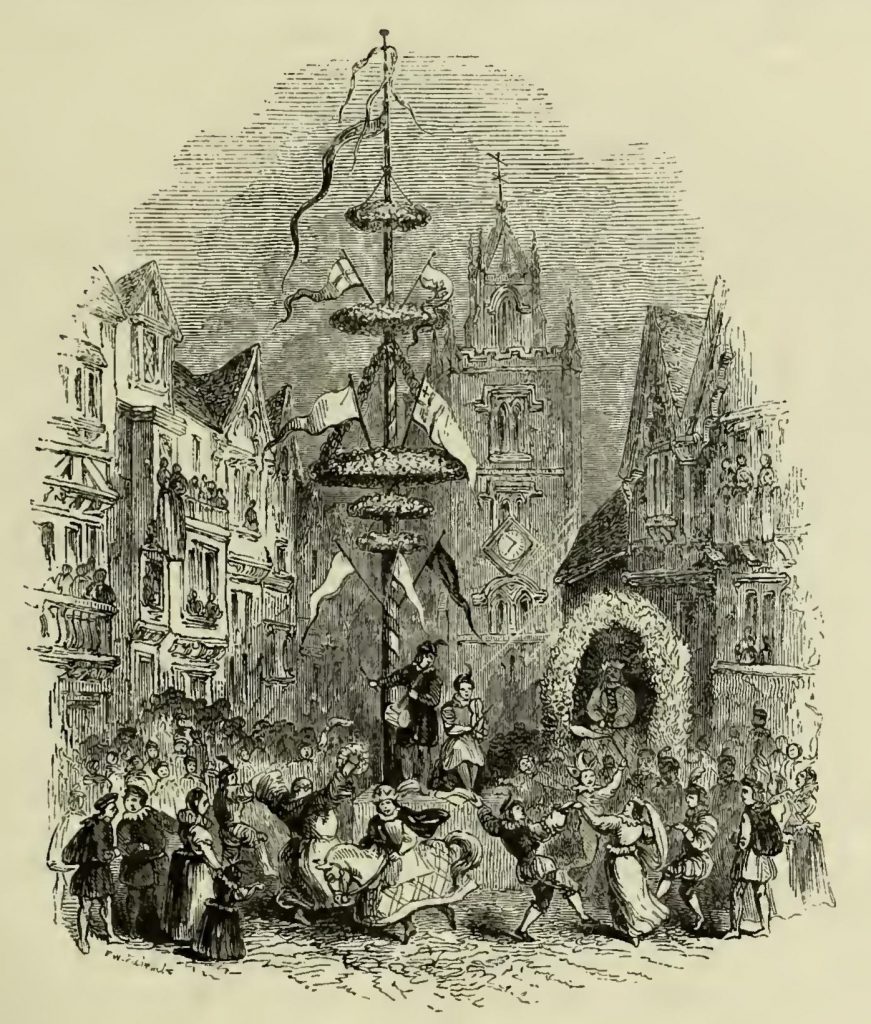
The Stinking Idol : An Imagined Scene at the Maypole at St Andrew Undershaft
Philip Stubbes, wrote a vitriolic attack on pagan practices in his ‘Anatomy of Abuses in 1583’. He fired a broadside at the tradition of dancing around the Maypole. He said they had: ‘as Superintendent and Lord ouer their pastimes and sportes: namely, Sathan Prince of Hell‘ as they erected ‘this stinking Idoll’. By which he meant the Maypole. Stubbes suggested that of the maids that went out to the woods on May Eve less than one-third returned ‘undefiled‘.
Evil May Day Riots
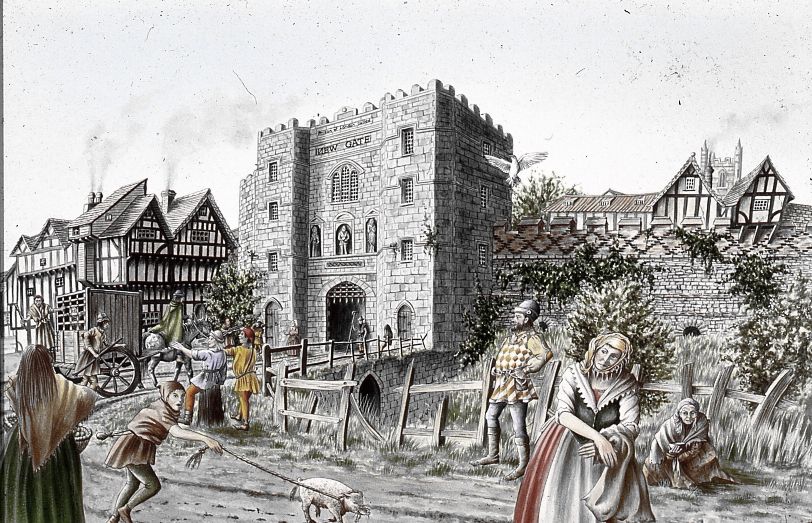
The Maypole was stored at St Andrew Cornhill, which became known as St Andrew Undershaft. In 1517, it was attacked during the ‘Evil May Day riots’. The main focus of the riot was foreign workers. The Under Sheriff of the time, Thomas More, tried to quell it. But 5,000 troops commanded by the Duke of Northfolk was necessary to regain control of the City. 300 rioters were arrested. One hanged, drawn and quartered, 13 hanged and nearly 300 pardoned after the intercession of Woseley and/or Katherine of Aragon. The shaft was returned to its place under the eves of the houses in Shaft Alley. But apparently banned from being raised again.
1549 May Day Riots
But in 1549, the curate of nearby St Katharine Cree Church made an inflammatory speech. This incited a Puritan mob who cut the shaft into pieces and burnt it. I always imagine the Curate’s sermons to be along the same lines as Phillip Stubbes attack on the Maypole.
Maypole: this Stinking Idol, Rather
Here is a longer description of the May Day Celebrations by Stubbes.
‘But their chiefest iewel they bring from thence is the Maie-poale, which they bring home with great veneration, as thus: They haue twentie, or fourtie yoake of Oxen, euery Oxe hauing a sweete Nosegaie of flowers tyed on the tip of his homes, and these Oxen drawe home this Maie-poale (this stinking ldoll rather) which is couered all ouer with Flowers and Hearbes, bound round about with strings from the top to the bottome, and sometimes painted with variable collours, with two or three hundred men, women and children following it, with great deuotion.
And thus being rearedvp, with handkerchiefes and flagges streaming on the top, they strawe the ground round about, bind green boughes about it, set vp Summer Haules, Bowers, and Arbours hard by it. And then fa! they to banquet and feast, to leape and daunce about it, as the a Heathen people did, at the dedication of their ldolles, whereof this is a perfect patteme, or rather the thing it selfe. I haue heard it crediblie reported (and that viua voce) by men of great grauity, credite, and reputation, that of fourtie, threescore, or a hundred Maides, going to the wood ouemight, there haue scarcely the third part of them returned home againe vndefiled.‘
The unraised pole seems to have survived until the beginning of the Civil War, (1644) when it was destroyed. But at the Restoration of Charles II a new and huge Maypole was ordered. It was joyously erected 134 ft high (41 metres) in the Strand. This one was danced around till 1713 when it was replaced. The original was sold to one Isaac Newton. He used it to support the biggest telescope in Europe which was erected in Wanstead by a friend.
And that, my friends, is how you get from Superstition to Science in one easy story.
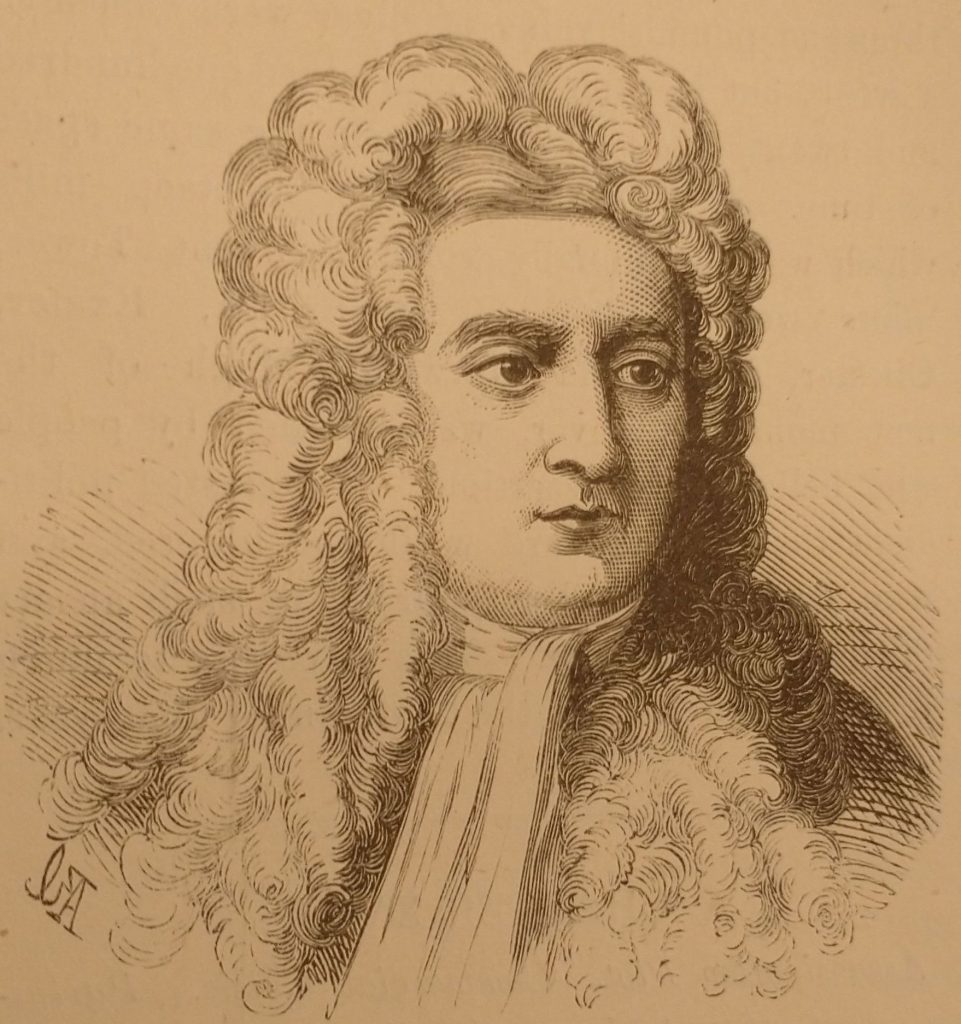
Old Print of Isaac Newton
Postscript.
I have always told people that the sermon leading to the destruction of the Shaft in 1549 was made at St Paul. I cannot remember where I read this. The suggestion that the Maypole in Cornhill was not used after 1517 seems strange. Why then would an unused maypole rouse a crowd to riot in 1549? Of the sources I have at hand, the London Encyclopedia mentions the riot of 1517 in its entry on St Andrew Undershaft but doesn’t elaborate more. ‘Layers of London‘ says ‘It was last raised in 1517 when ensuing riots led to the celebration being banned.’ which is definitive sounding. But is it? I wonder if it was banned for a year or two, then allowed again, and finally stopped in 1549?
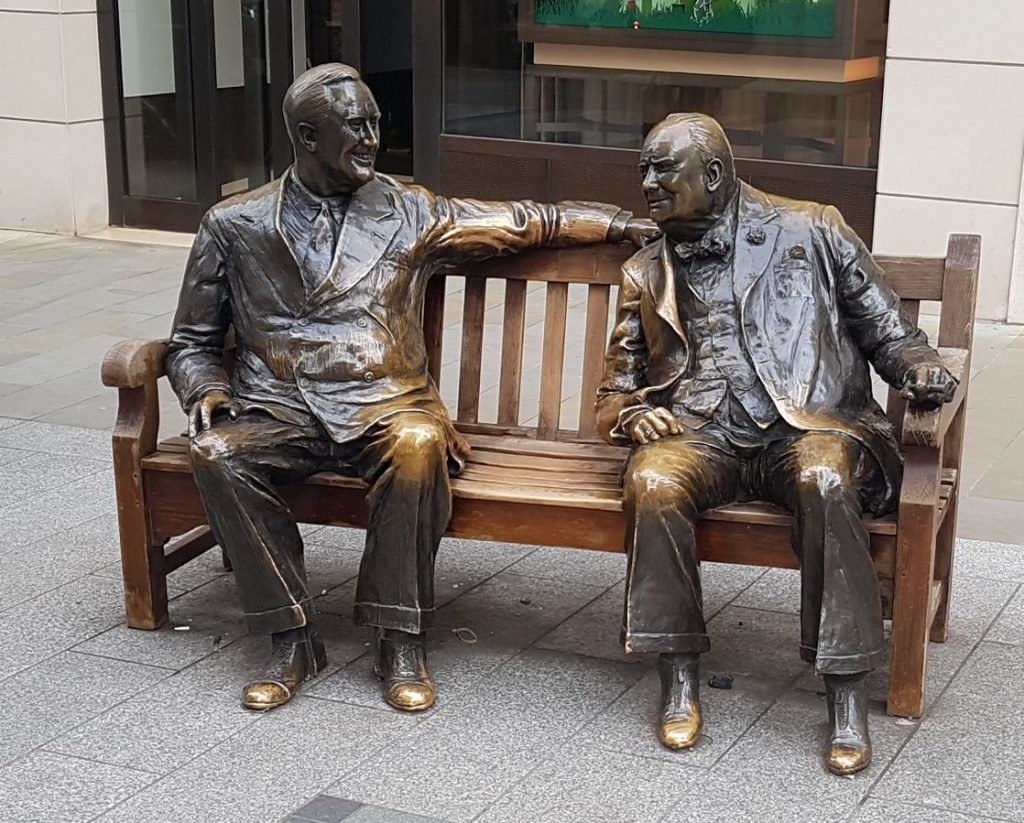
‘Allies’ Roosevelt and Churchill by by Lawrence Holofcener, unveiled on May 2nd 1995 by Princess Margaret and Lord Snowdon
1995 Allies Statue Statue of Churchill and Roosevelt set up to commemorate 50 years of peace. 30 years later what is the state of the Allies relationship? Topical or what? https://www.iwm.org.uk/memorials/item/memorial/11351
First written in 2023 and revised on May 2nd 2024 and 2025.
There are plenty of people who believe that eclipses can be predicted by Stonehenge. And it certainly can be used that way, but this doesn’t mean it was. A series of stones, and posts in concentric circles with sight lines to innumerable features on the horizon offers many ways of making calculations which combined with observations over a long period COULD predict, predictable celestial phenomena. Doesn’t mean they were. So it is very difficult to say what they were capable of, and only the most obvious alignments can be certainly confirmed.
This Washington Post article below suggests the Loughcrew Cairns near Dublin were built about the time of a total eclipse, and that one of the stones with complicated carvings on may show a lunar eclipse. If you look at the sketch of the stone above, you will see the biggest circle, near the middle, may represent the moon, and it obscures the circle behind it which may represent the sun. Read this for the details: https://www.washingtonpost.com/news/wonk/wp/2017/08/18/this-5000-year-old-stone-carving-may-be-the-worlds-first-drawing-of-an-eclipse/
What is striking is how can they say it was built around the time of a total eclipse and make that seem significant because there is no way archaeological dating is accurate enough to give any idea whether it was built for a particular day. Also, there are many more circles and objects on the large stone, and to pick two out to prove what you want it to prove, is not proof. We are left with the intriguing possibility, but it is no more than that.
I am finishing my post on September, and using the Kalendar of Shepherds. As you may have noticed, I often use the Kalendar of Shepherds to provide an insight into how the seasons were seen in the past. Mostly, I use it for the posts at the beginning of each month. I have created this page as a placeholder to put information on the Kalendar for anyone who is eager to explore it more or to make use of it. Each month I will link to it, so I do not have to repeat the basic information about the Kalendar. Much of this text was contained in the December post, and I have used this month as my example. Tomorrow, you will get the September version.
About the Kalendar of Shepherds.
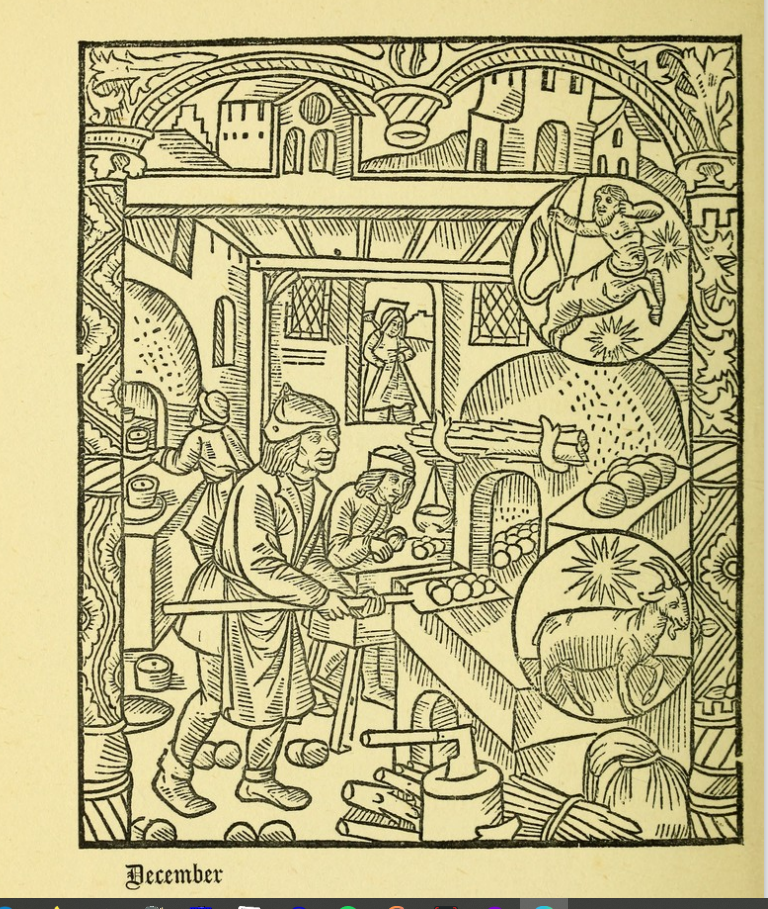
The Kalendar was printed in 1493 in Paris and provided ‘Devices for the 12 Months.’ The version I’m using is a modern (1908) reconstruction of it. It uses wood cuts from the original 15th Century version and adds various texts from 16th and 17th Century sources. (Couplets by Tusser ‘Five Hundred Parts of Good Husbandrie 1599. Text descriptions of the month from Nicholas Breton’s ‘Fantasticks of 1626.) This provides an interesting view of what was going on in the countryside every month.
The Kalendar of Shepherds has an illustration for each month (December above) which shows typical activities for the time of year, and has inserts to identify the astrological signs of the month. So, in December they are baking and collecting firewood. The star signs are Sagittarius (November 22 – December 21) and Capricorn(December 22 – January 19).
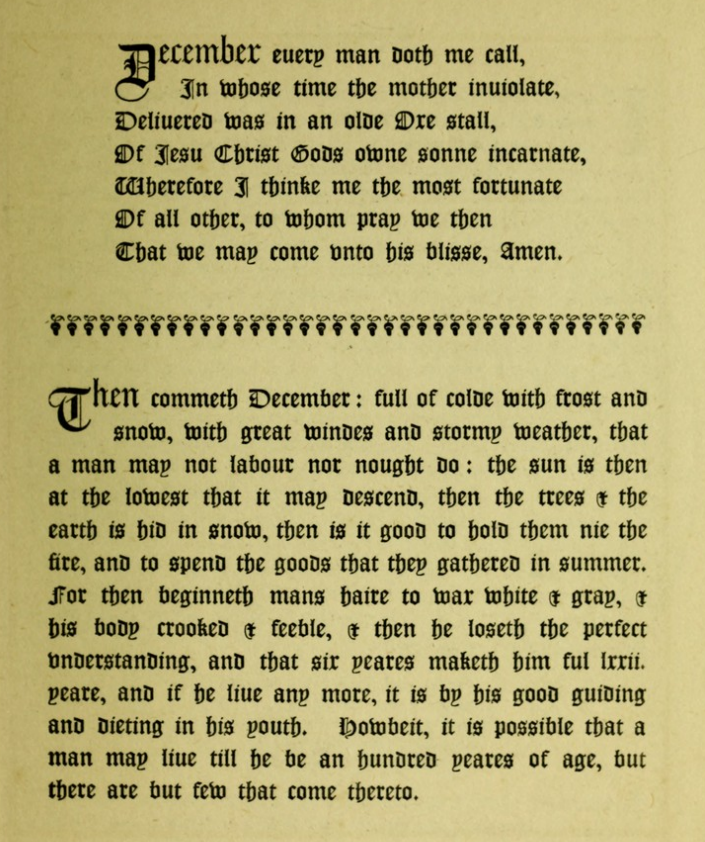
The text below gives a vivid description of December weather and then elaborates on the last six years of a man’s life, with hair going white, body ‘crooked and feeble’. The conceit here is that there are twelve months of the year, and a man’s lot of ‘Six score years and ten’ is allocated six years to each month. So December is not just about the 12th months of the Year but also the last six years of a person’s allotted span. The piece allows the option of living beyond 72, ‘and if he lives any more, it is by his good guiding and dieting in his youth.’ Good advice, as we now know. But living to 100 is open to but few.
Kalendar of Shepherds
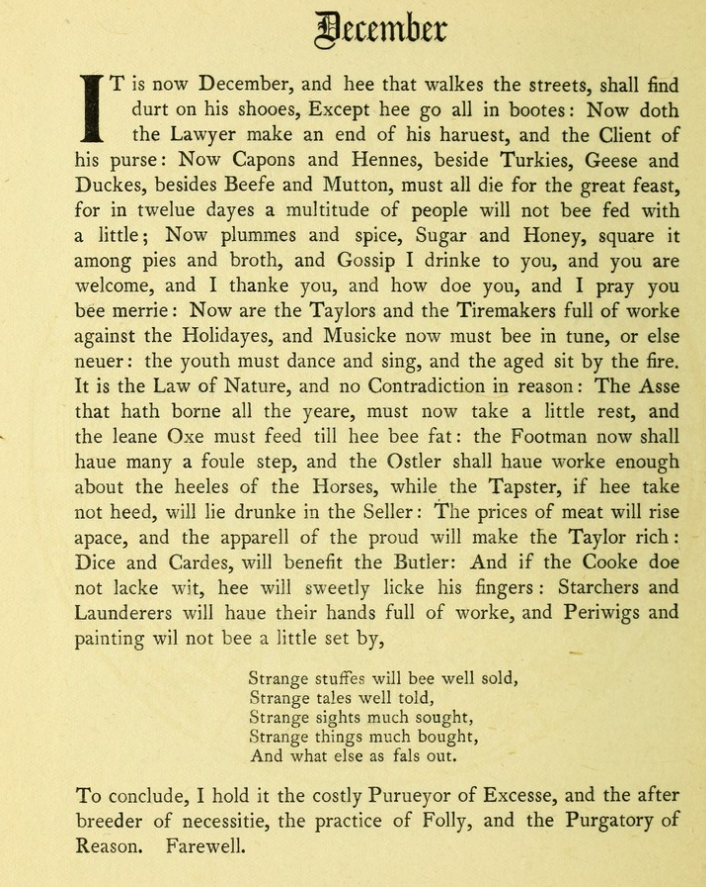
The longer description of December (shown below) is by Breton (1626) and gives a detailed look at the excesses of Christmas, who is on holiday, and who working particularly hard. But it concludes it is a costly month.
I’ve been taking groups around Britain from London to Edinburgh and have fallen behind on my postings.
So, I am going to post a few posts today to put them on my Almanac of the Past. They will be brief, and will be worked up for a re-publication in greater length next year.
Archaeological Discoveries at Elverton St. Westminster
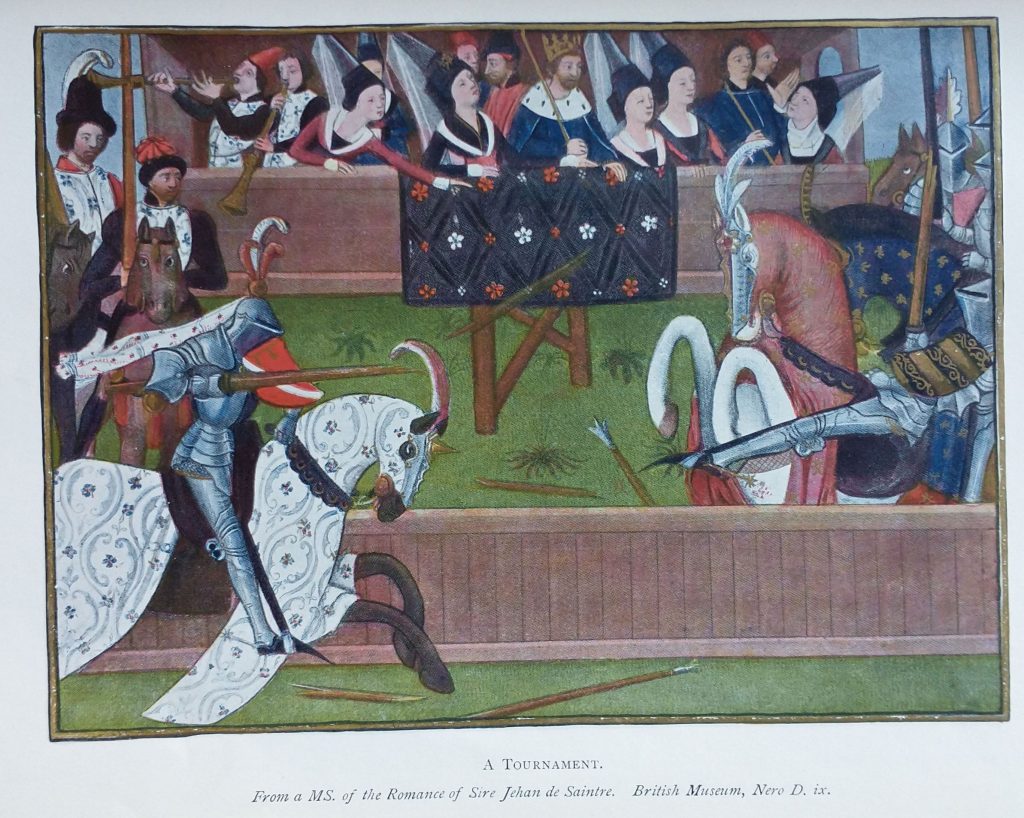
Near the site of the medieval jousting arena in Westminster, London at Elverton St, archaeologists, nearly 30 years ago, excavated a Cemetery which contained the remains of horses. The University of Exeter has recently revealed the results of their analysis of the horses’ bones. The 15 animals studied were found to be above average in height, and marked by a life where they had been worked hard. Analysis of their teeth suggested they came from as far afield as Scandinavia, the Alps, Spain, and Italy.
Three of the animals are the largest found in England at the time. The findings suggest they might be from a Royal Stud farm, providing war, jousting or hunting animals for the elite.
Dust jacket of fifth reprint of first edition, copyright 1973. Publisher Blond & Briggs. Jacket design by Andrew Sinc (wikipeidia)
It was, probably, mid 70s when I came across this book and, I think I can say, it had a lasting effect on my opinions. The book is about many things, but what it did for me was introduce sustainable development and the beauty of small scale innovation. Schumacher believed that resources were limited, that pollution represents an ever-increasing danger to society, and that appropriate scale innovation offered the best hope to create a fairer world.
He helped set up ‘the Intermediate Technology Development Group’, but found a better title in ‘Small is Beautiful’ for his book outlining his philosophy. ITDG became Practical Action, which is a charity that works around the world finding innovative solutions to real world problems.
To see Schumacher’s legacy have a look at the Practical Action web site or follow this link to see what it is doing, for example, in promoting ‘regenerative agriculture.’
I donate regularly, and maybe you might enjoy reading positive stories of human ingenuity in action around the world.
Replica of the Stone of Destiny at Scone Palace, Photo Kevin Flude
A study of the Stone of Destiny, the Stone of Scone, the Coronation Stone, has revealed new information. Firstly, it has some markings which look like three X’s and something like a V – perhaps Roman Numerals or more likely, crosses.
The Stone also revealed traces of copper alloy showing that a metal object had been attached to the Stone for a considerable time. The most obvious suggestion would be a relic associated with a Saint, and a Bell is one possibility.
Traces of gypsum suggested someone sometime made a plaster copy of the stone. No one knows when or why, and it has not been found.
Historic Environment, Scotland has released this fascinating 3-D scan of the stone for the public to view – it is annotated too.
You can read more at the links below, and thank you to Jean Kelly of the Britarch mailing list for alerting me to this.
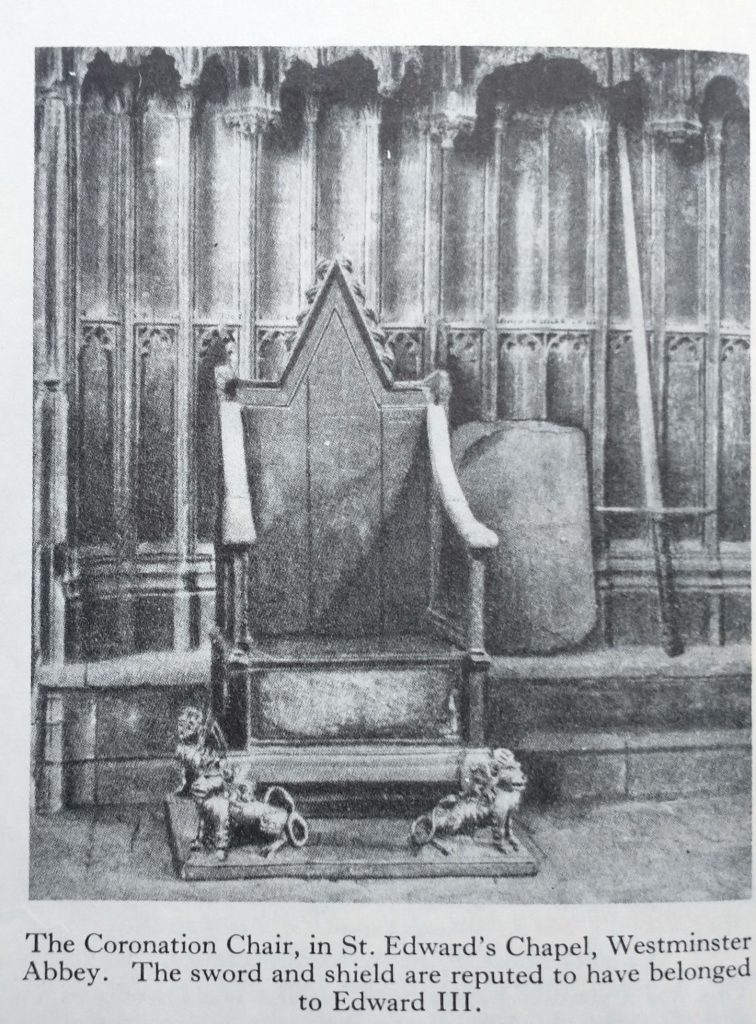
The Stone has been moved from its permanent home at Edinburgh Castle for the first time since 1996, to be placed under the Coronation Chair for Charles’s May 6 Coronation at Westminster Abbey.
Coronation Chair, with Stone of Scone under the seat.
The Stone was kept at Scone before it was stolen by Edward 1 of England, who placed it under the Coronation Chair, at Westminster, to sanctify English Kings and to make the point that he was the overlord of the Scottish. In the 1950’s Scottish students stole it back, hid it for a few weeks and then left it at Arbroath Abbey. They did this because the so-called Declaration of Arbroath (1320) is a letter to the Pope asking for his endorsement of Scotland’s claim to be independent of England. The Pope agreed.
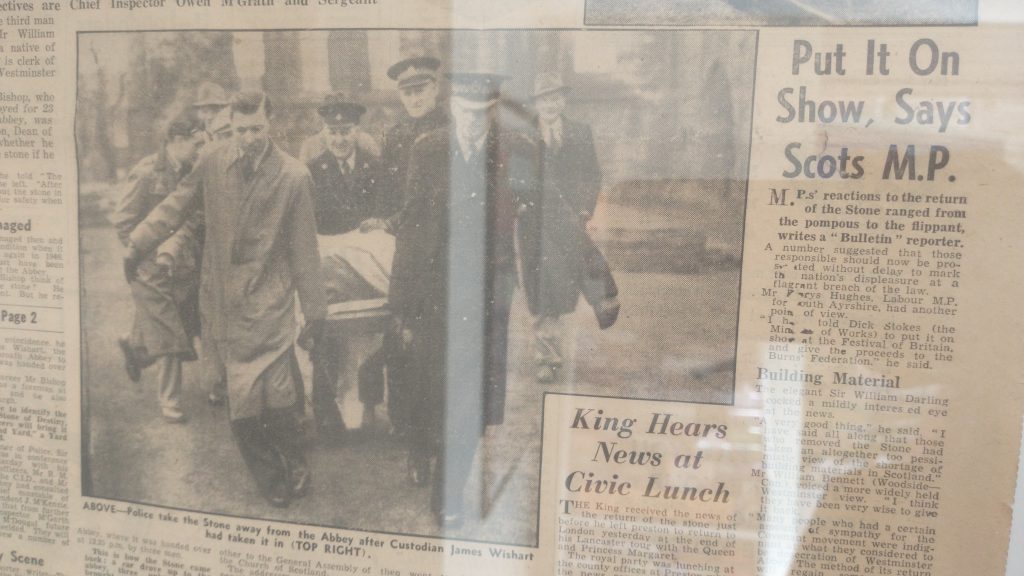
The Stone was recovered from Arbroath taken back to Westminster. The Labour Party under Tony Blair, granted Scotland back their own Parliament and as a symbol of their regained independence, the Stone of Destiny was taken back to Scotland.
Newspaper cutting showing the Stone being taken from Arbroath Abbey
To my mind it should be in Scone, which is where Macbeth and most other Scottish Kings were crowned, but perhaps they thought it should be in the Capital and in the safety of the Castle. At Scone, the Stone was placed on a mound of earth which was said to be made up of the dust from the feet of those attending Coronations symbolising the consent of all of Scotland for the new King.
Spring is time for a tansy, so time to bring out again the many stories behind this awesome plant. The tansy not flowers display a classical Fibonacci spiral, which is two counter-rotating logarithmic spirals.
Mrs Grieve in her Modern Herbal repeats the belief that their name derives from the Greek word for immortality ‘Athanaton’. This might be because they grow so well that in some areas they are proscribed they are so prolific. But Tansy was supposed to have been given to Ganymede by Zeus to make him immortal. And, they were used for preserving dead bodies from corruption. So, Tansy was placed in coffins and winding sheets and tansy wreaths placed with the dead.
Its toxicity means that it repels many insects, particularly, flies and ants, and so it was used as a medieval and early modern strewing herb. And yet there are other insects that love Tansy – it seems to have a dark side and a light side.
It was collected in August (along with meadowsweet or elder leaves) and strewn on the floors of houses (and the ‘thresh’ was held in by the threshold). But it was also placed between mattresses to keep away bugs. People rubbed meat with Tansy to keep flies off. It is now used as a natural protection for crops from insects to reduce the amount of artificial pesticides.
It was an important medical and culinary herb, said to be a substitute for nutmeg and cinnamon, and the leaves, shredded, as a flavouring for puddings and omelettes. At Easter ball games a Tansy Cake was the reward for the winners. It was symbolic of the bitter herbs eaten by the Israelites at Passover. Tansy was thought to be a very wholesome ingredient to eat after the sparsity of Lent and Winter, and voiding the body of the worms caused by eating too many fish. It was used for expelling worms from the stomachs of children.
Interestingly it contains thujone, which is also in Wormwood, the other main herb for expelling intestinal worms. Thujone can cause convulsions, liver and brain damage if too much is taken.
In the 14th Century it was used for treating wounds. It was thought to be useful both to induce abortions but also to help women conceive and to prevent miscarriages. Culpepper and Gerard suggests the root was a cure for gout.
Take three pints of Cream, fourteen New-laid-eggs (seven whites put away) one pint of juyce of Spinage, six or seven spoonfuls of juyce of Tansy, a Nutmeg (or two) sliced small, half a pound of Sugar, and a little Salt. Beat all these well together, then fryit in a pan with no more Butter then is necessary. When it is enough, serve it up with juyce of Orange or slices of Limon upon it.
Sir Kenelm Digby was a Catholic and a natural philosopher of some reputation. After his death an employee published his cookery book. His father was executed after the Gunpowder Plot, and he supported Charles 1st but found a way to work with Oliver Cromwell.
He made a great success of his idea of the ‘powder of sympathy’ – 29 editions of his book on the subject were sold. He found the powder in France and it was made with precise ‘astrological’ techniques. The most famous example of a suggested application for the powder was to win the competition for a method of working out longitude (in the 18th Century). Basically, a working method meant knowing the time, normally noon, in two different places. This allowed a triangle to be created between the two points and the Sun which allowed the distance between the two places to be discovered by triangulation. Clocks were not accurate enough (yet) to help so Digby’s famous powder of sympathy was suggested.
This is the method:
A wounded dog would be taken on board a ship, and a bandage from the wound would be left in London. At noon in London it would be sprinkled with the powder of sympathy. The dog on the ship would, perforce, yelp when the powder was administered on the bandage in London and so the Captain would know when it was noon in London! Digby was long dead when the application for the prize money was made and rejected.
‘Longitude’ by Dava Sobel tells the story of the discovery of a clock-based method of calculating longitude.