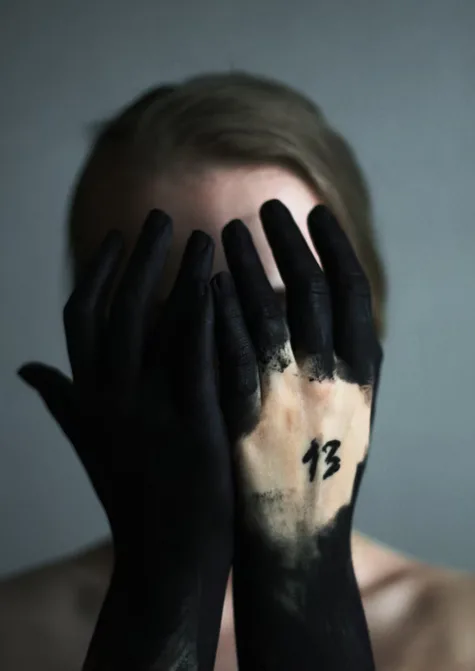
Photo by Polina M on Unsplash illustrating Friday the Thirteenth
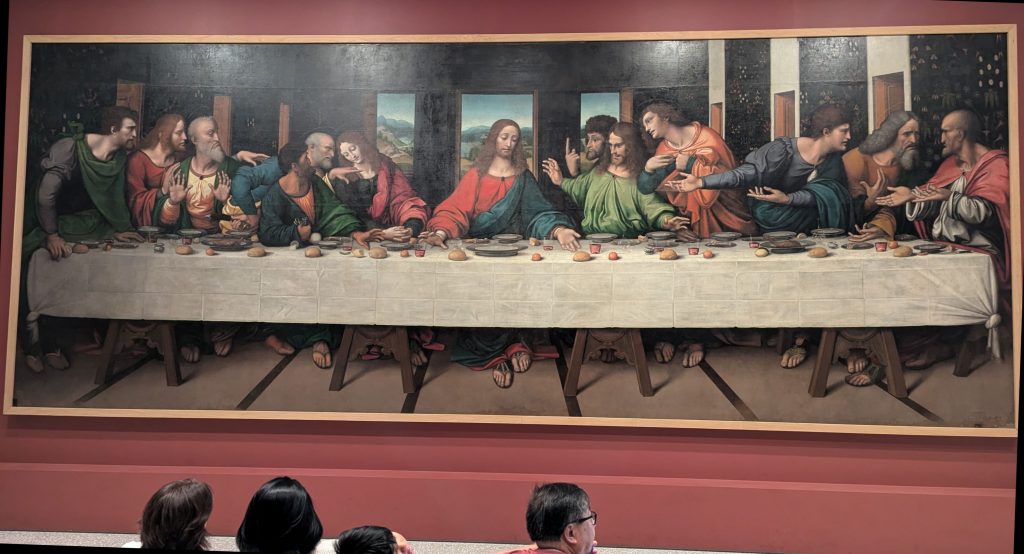
On the other hand, ‘Thank God It’s Friday!’. In fact, the belief that Friday the Thirteenth is a very bad luck days is not that old. Researchers can only trace it back to the 19th Century in France. Have a look at this BBC site for details. However, 13 has long been an ill-omened number. Judas Iscariot was the 13th to arrive at the Last Supper, And that didn’t turn out well. 13 was an unlucky day for the Romans too.
Copy of the Last Supper at the Royal Academy showing 13 participlants
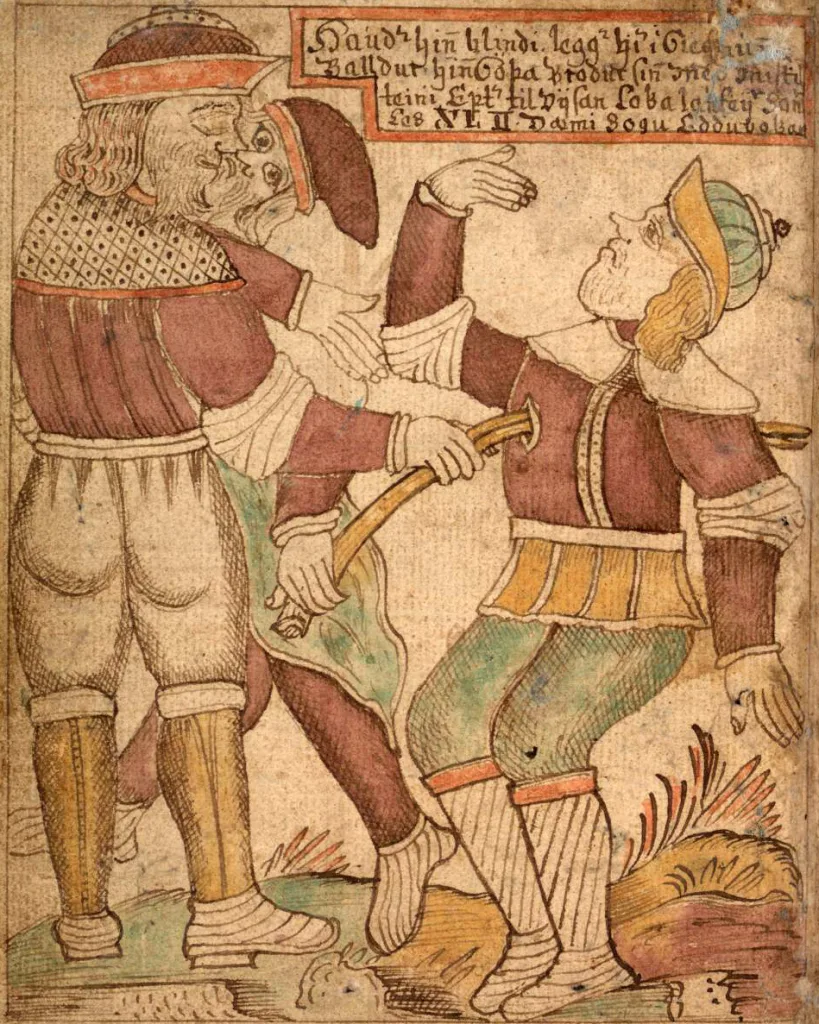
Baldur and Loki
In Norse Mythology, Baldur, the son of Odin who was a bright and cheerful God, was having premonitions of doom. Odin sought the advice of a dead seer who told him, Baldur was doomed. Baldur’s mother, the Goddess Frigg, was determined to save him. So got every entity in the cosmos live or dead to swear they would not harm Baldur.
Thereafter, the Gods enjoyed themselves at banquets by throwing missiles at Baldur who was now immune to all threats. The mischievous God, Loki, saw an opportunity for his evil skills. He spoke, in disguise, to Frigg asking if she had really got every single entity to swear? She said yes except the Mistletoe as it was so innocuous. So, ofcourse, Loki went to make a spear out of the mistletoe.
With the weapon, Loki attended a Banquet of twelve gods to which he was not invited, being therefore the 13th. When the Gods began their now customary game of throwing things at Baldur, Loki asked the slayer God Hodr to throw the mistletoe spear. It killed Baldur, and despite many attempts the Gods could not get Baldur out of Hell, Much of the joy of the world died with him. For more detail see norse-mythology.org.
By Jakob Sigurðsson[2] – SÁM 66, 75v. Digitized version available from http://sagnanet.is/saganet/?MIval=/SinglePage&Manuscript=1109&Page=150&language=english. Image processing (crop, rotate, color-levels) by Skadinaujo (talk · contribs)ou Jakob Sigurðsson. The Death of Baldr. From: Reykjavik: Stofnun Árna Magnússonar í íslenskum fræðum. SÁM 66. 1765. 75v. Hand copied paper manuscript. MyNDIR: My Norse Digital Image Repository. Ed. P. A. Baer. 2023. Edition 2.5.1. Victoria, B. C.: Humanities Computing and Media Centre, University of Victoria. 2023., Public Domain, https://commons.wikimedia.org/w/index.php?curid=6029049
Unlucky Friday?
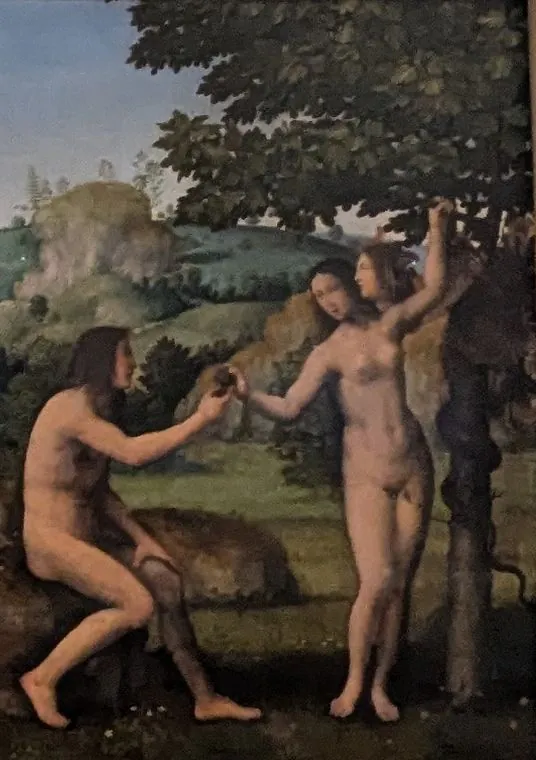
Friday was often an unlucky day in the Bible. In particular, it was the day Adam and Eve ate of the Tree of Knowledge. Below you can see the human-headed snake beguiling Eve who hands the fruit of knowledge to Adam.
Detail from The Creation and Fall of Man by Mariotto Albertinelli Courtauld Institute photo by KFlude
It was the day when Noah’s premonition was proven correct. In the Canterbury Tales, Chaucer writes that “And on a Friday fell all this mischance. O Venus, sweet goddess of love’s chance”. (Nun’s Priest’s Tale). And Friday was the normal Hangman’s Day in England.
But no one seems to have put the two together until the 19th Century. In 1834 a French play had a line
“I was born on a Friday, December 13th, 1813 from which come all of my misfortunes.”
There is one Friday 13th a year, and often three. They insist on appearing only in a month that starts on a Sunday. The compound word for fear of Friday 13th is paraskevidekatriaphobia.
On This Day (Friday 13th)
1307 – On Friday 13 October, King Philip IV of France arrested leading members of the Knight’s Templars. One of the most powerful monastic orders in Europe to whom many of the leading Knights belonged. They had basically become the bankers to the Royalty of Europe, But they had become too powerful, and were destroyed very violently.
First Published on Friday the 13th of February 2026
Winter’s End in ‘Winters in the World’ by Eleanor Parker
Eleanor Parker’s book, on the Anglo-Saxon Year, is a wonderful book. It has a poetry about it, that also provides an insight into how Anglo-Saxon thought the world works. For a non-Old-English speaker, it, also, really gives some understanding of the language. It reveals that for the Anglo-Saxons, Winter’s End was on the 7th February. We are now in the season of ‘lencten’. This probably comes from ‘lenghtening days’ or Spring as we call it. The word eventually got absorbed into the Christian calendar, giving us the name of the fasting season, which is ‘Lent’.
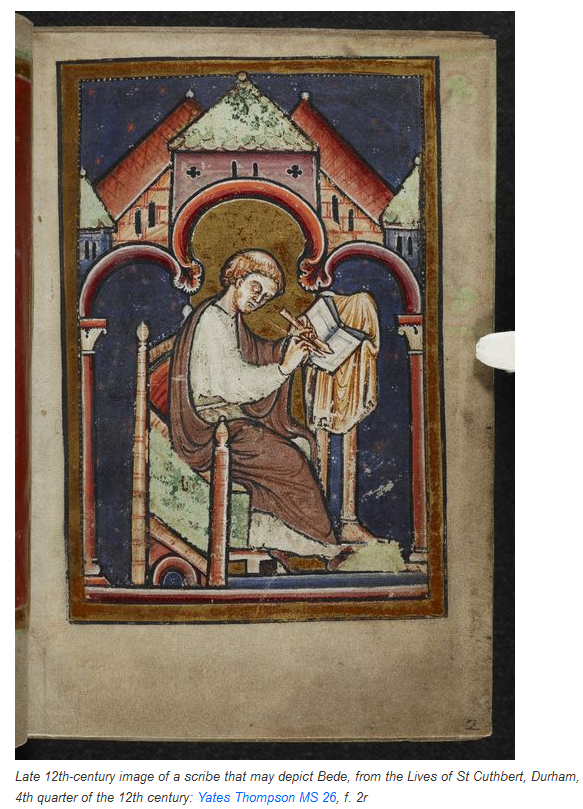
So Winter began, for the Anglo-Saxon, on 7th October and ended on the 7th February. January was called ‘Gēola‘ the month of Yule. February ‘Sol-mōnaþ‘ which is Mud month. The Venerable Bede in the 8th Century calls this the:
‘month of cakes which they offered to their gods in that month’.
Thought to be the Venerable Bede, the first historian of the English
Bede tells us that before conversion to Christianity, the Anglo-Saxons had two seasons – Winter and Summer. Winter began on the first full moon of October, which they called Winterfylleth. The summer was called ‘sumor’ or ‘gear’ which developed into our word ‘year’. As in: ‘he was a boy of 10 summers.’
Roman, Celtic and Saxon Winter’s End
There is some sense in Winter’s End on February 7th. Lambs are being born; buds and shoot are appearing on branches and poking up from the cold earth. So, their winter is essentially, the time when nothing is growing, while ours is more aligned to the coldest period.
The Roman author Marcus Terentius Varro divided the Roman Year into 8 phrases and his Winter/Spring divide is also on 7th February. This is when, in Italy, the west winds began to blow warmer weather. So farmers ‘purged’ the fields, readying them for planting. They would be cleared of old growth and debris. Then blessed, weeded, pruned with particular attention given to preparing the grain fields, the vineyards, olive trees and fruit trees.
The Celtic year began at Halloween, and the spring begins with Imbolc, a week earlier than the Saxon on the 1st of February.
Anglo-Saxon Winter
In the section on Winter, Eleanor Parker gives a poetic description of winter. What seems particularly interesting about it is that the harshness of winter is often paired with descriptions of the ruins of Roman Civilisation. So, the despair of winter, the barren soil, the fight for survival is made more melancholic by the comparison to failed civilisation. Nature battering away at the useless ruins, and the destruction of people’s dreams.
Here, is a flavour of the juxtaposition of the bleakness of winter and the sadness of lost society. It is from ‘The Wanderer’ an alliterative poem from the Exeter Book, dating from the late 10th century. I have presumed to change a couple of words to make it a little more accessible.
Who’s wise must see how ghostly it has been when the world and its things stand wasted — like you find, here and there, in this middle space now — there walls totter, wailed around by winds, gnashed by frost, the buildings snow-lapt. The winehalls molder, their Lord lies washed clean of joys, his people all perished, proud by the wall. War ravaged a bunch ferried along the forth-way, others a raptor ravished over lofty seas, this one the hoary wolf broke in its banes, the last a brother graveled in the ground, tears as war-mask.
“That’s the way it goes— the Shaper mills middle-earth to waste until they stand empty, the giants’ work and ancient, drained of the dreams and joys of its dwellers.”
As I read this, I wonder if it is a tradition that began in the cold of Scandinavia? England, at least Southern England, can often have mild, rather than ferocious winters?
However, there is also an idea about the circularity of life and the interconnectedness of everything. There are 4 Seasons, 4 Ages of Man, and the cycle was from childhood to old age, from Spring to Winter. We start young, and become vigorous, and then we decline and eventually die. And so does the world of the Anglo-Saxons. The world of Adam was young, restored to vigour by the coming of Jesus. Now the World was in its old age awaiting the Apocalypse, before the Day of Judgement. So Winter was connected with Old Age and Death.
Bede’s Metaphor for Winter
Parker recounts a beautiful image of Bede’s. The King of Northumberland is thinking of taking his wife’s religion. He, therefore, invites the Christian evangelist, Paulinus to his court. Inclined to convert. He asks the opinion of one of his pagan advisers, who answers to the effect.
‘We are in the Great Hall, gathered warm with friends and family around the roaring fire, with Winter raging outside. A sparrow comes in from a hole in the end wall, flies through the warm of the Hall, and flies out through the other side. Such is life. The Hall is this world, we are the Sparrow, and as pagans we have no idea what happens before we enter the Hall, nor what happens after we leave. How much better it is to embrace a religion that can give us certainty as to what happens when we leave the hall.’
Lovely image, although, the pagan adviser does seem to have made his mind up to try Christianity? . What I like about it is that it echoes feelings I have. We as a species worry about what happens after death. It seems to many so final, to others unknowable. But I think ‘I don’t worry about what happened before I was born, so why should I worry about what happens after I die?’ It’s the same state of non-being. It gives me some comfort that I’m going back where I came from.
1812 – Dickens born in Portsmouth. His father was the son of a Butler and a clerk in the Royal Navy Pay Board. He has much in common with Mr Micawber. His mother, Elizabeth Dickens was a source for the character of Mrs Nickleby. Dickens told a friend that his mother came to him exasperated by the stupidity of Mrs Nickelby. Dickens said words to the effect: ‘Little did she know that Mrs Nickleby was based on her’. Here is a section of Nicholas Nickleby that makes the point.
Nicholas Nickelby From Chapter 1
‘Mr Nickleby looked about him for the means of repairing his capital, now sadly reduced by this increase in his family, and the expenses of their education.
`Speculate with it,’ said Mrs Nickleby.
`Spec—u—late, my dear?’ said Mr Nickleby, as though in doubt.
`Why not?’ asked Mrs Nickleby.
`Because, my dear, if we should lose it,’ rejoined Mr Nickleby, who was a slow and time-taking speaker, `if we should lose it, we shall no longer be able to live, my dear.’
`Fiddle,’ said Mrs Nickleby.
`I am not altogether sure of that, my dear,’ said Mr Nickleby.
`There’s Nicholas,’ pursued the lady, `quite a young man—it’s time he was in the way of doing something for himself; and Kate too, poor girl, without a penny in the world. Think of your brother! Would he be what he is, if he hadn’t speculated?’
`That’s true,’ replied Mr Nickleby. `Very good, my dear. Yes. I will speculate, my dear.’
Speculation is a round game; the players see little or nothing of their cards at first starting; gains may be great—and so may losses. The run of luck went against Mr Nickleby. A mania prevailed, a bubble burst, four stock-brokers took villa residences at Florence, four hundred nobodies were ruined, and among them Mr Nickleby.’
Mr Nickleby ends up dead having falling 202 ft from the top of the Monument. In 1810 Elizabeth’s father, Chief Conductor of Monies in the Navy Pay Office was found guilty of embezzling £5,689 3s 3d.
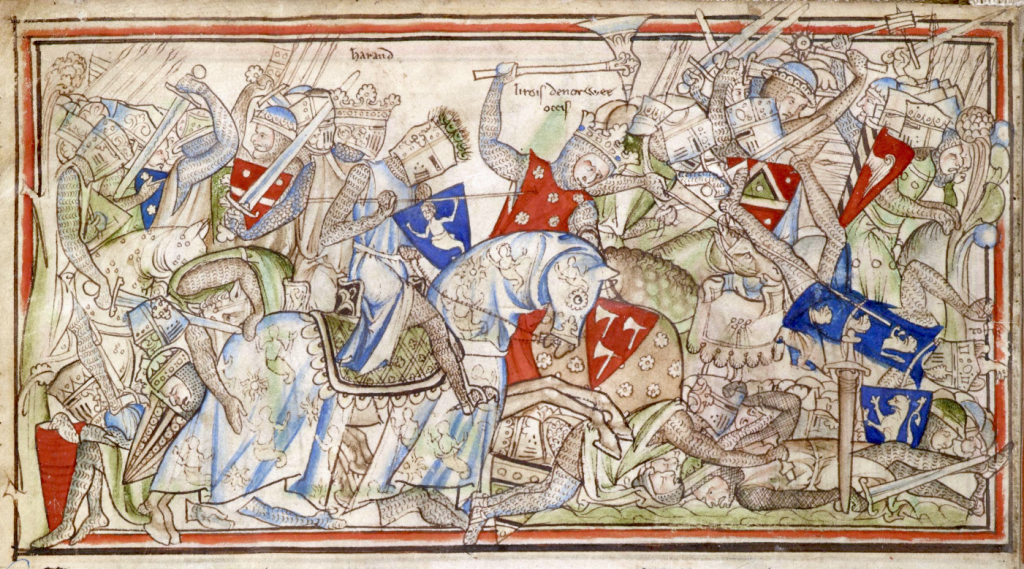
Following the Viking victory at the Battle of Fulford Bridge, York, on September 20th the Viking army camped at Stamford Bridge.This was on the River Derwent. Here they intended to rest and celebrate the defeat of the English Earls of Mercia and Northumbria. They were unaware that King Harold I of England had left London for the north on September 18th. (See my post on the Battle of Fulford Bridge here.)
Five days later, on September 25th, Harold’s army surprised the Vikings by marching towards the bridge over the Derwent. It is said that Harold’s army marched 185 miles from London in 4 days which is a scarcely believable 46 miles a day. But if they left on 18th and battle was 25th that’s as much as 7 days. This still means 26 miles a day which is still very quick for an army carrying weapons and armour. So no wonder the Vikings were surprised!
According to tradition, a large Viking held the English army as he blocked the narrow wooden bridge across the river. No one could defeat him. But an enterprising English soldier found a boat, floated under the bridge and killed the Viking by pushing his spear through the bridge timbers, killing the Viking.
According to the 13th Century Icelandic historian, Snorri Sturlson, the fight began only after a rider approached the Viking Army. He offered Harold’s Brother, Tostig back his Earldom if he would withdraw from the fight. Tostig asked what would be in it for his ally, the King of Norway? The reply was ‘Seven feet of English ground, as he is taller than other men’. The offer was refused. It was said that the rider was King Harold himself.
Once over the Bridge, the English found the Vikings had formed a defensive formation. However, they had left their armour behind at their boats. The battle lasted all day but ended with the slaughter of most of the Vikings. King Harold Hardrada, one of the greatest warriors of his age and Tostig were both killed. The extent of the slaughter is shown by the fact that of the 300 boats of the Viking army, only 24 returned to Norway.
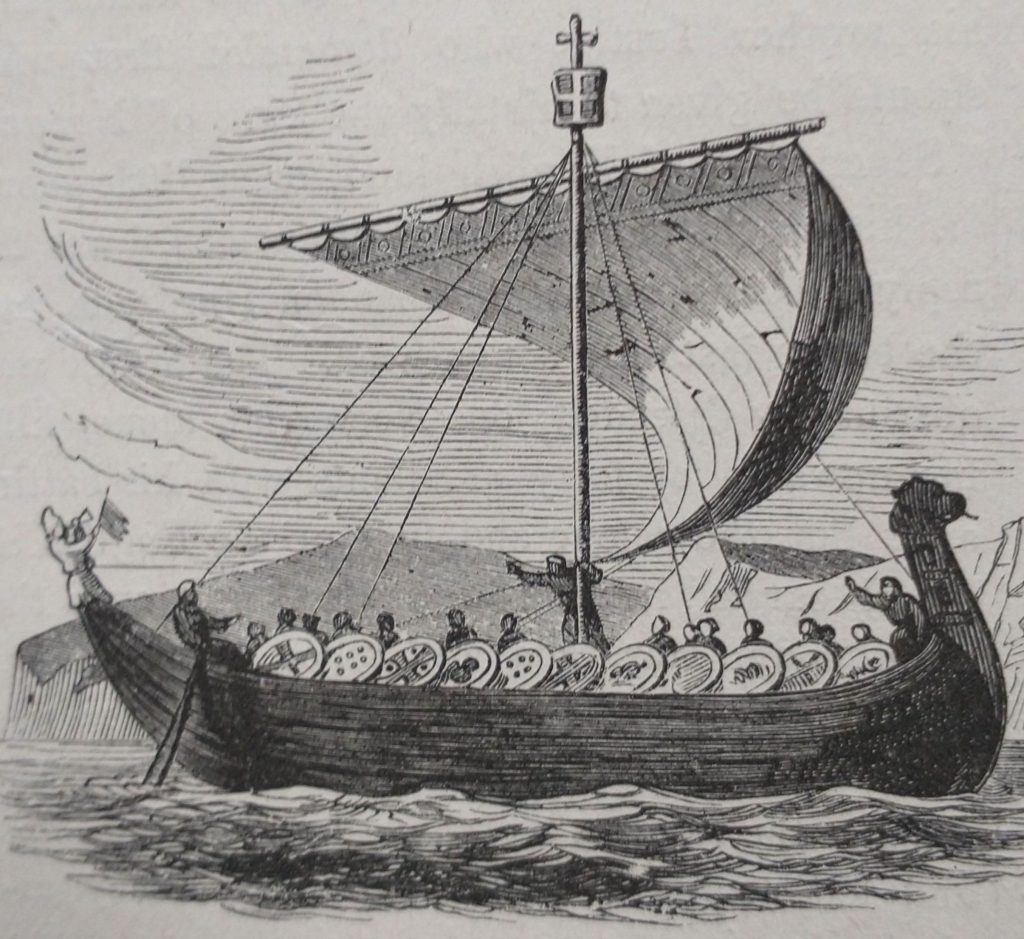
A boat of the period, derived from the Bayeaux Tapestry
A stunning victory for Harold I. But, the English had suffered terrible losses at the battle of Fulford. Harold had also left the South Coast unguarded And three days later, on September 28th, William, Duke of Normandy landed with his army at Pevensey. 256 miles south.