Walpurgis Nacht is the eve of the Feast of St Walpurga. On May 1st 870AD, St. Walpurga remains were ‘translated’ to Eichstätt. St Walpurgis Day is her feast day. Walpurga’s brother St Williibald had set up Eichstätt as the Diocesan centre of this part of Bavaria. Walpurga and her two brothers, Willibald and Winibald were Anglo-Saxon Saints who helped convert Germany to Christianity in the 8th Century. But, I wrote about the Saint and her brothers in on my page on St. Walpurga.
The Celtic Day began at Dusk, so May Day and the Feast of St Walpurga begins on 30th April. The Christian Church took over many local traditions and adapted them to the calendar of the Church. So a Saint’s Day, is preceded by an Eve. For example, All Hallows’ Day and Halloween, and May Day and May Eve.
Eve of Beltane
The evening of April 30th is also the beginning of Beltane. Beltane is one of the principal Celtic Festivals, dedicated to the God Belinus. It is a Celtic Fire Ceremony and the traditional beginning of Summer. It is 6 months before Halloween, (see my post of Halloween here.) Walpurgis Nacht is also halfway between the Spring equinox and the Summer solstice. So, a very important day in the Celtic Calendar. (see my post on May Day).
In Sweden it is known as Valborg and as Čarodejnice in the Czech Republic.
A day of Uncanny Weirdness?
As May Day was an uncanny period dedicated to Pagan Deities, Walpurgis Nacht became a time when all the weird things are alive in the world. In response, the Christian Church associated a saint to the day to be a focus for defeating witchcraft. So, it is a popular tradition for this Night to see the burning of an effigy of a witch on a bonfire.
Tomb of St Erconwald, destroyed by the Great Fire of London. By Wenceslaus Hollar – Artwork from University of Toronto Wenceslaus Hollar Digital CollectionScanned by University of TorontoHigh-resolution version extracted using custom tool by User:Dcoetzee, Public Domain, https://commons.wikimedia.org/w/index.php?curid=6235771
It is also the Feast Day of St Erconwald. He was a Royal Prince but no one can agree of which Saxon Kingdom. He became one of the most famous Bishops of London (675 and 693). Chertsey Abbey and Barking Abbey were founded by the Saint. His sisterwhich his sister, St Ethelburga, became Abbess of Barking. Not only that, but he was known as the light of London and was responsible for rebuilding St Pauls Cathedral. And helping to complete the conversion of the Kingdom of Essex.
Flora (Floralia festival named after her) on a gold aureus of 43–39 BC Wikipedia photot by АНО Международный нумизматический клуб
On the 28th of April began the Floralia. It continued to the Kalends (15th) of May. According to Ovid in the ‘Fasti’ Book IV, the Romans celebrated Flora, the Goddess of Spring. The Floralia celebrated flowering, blossoming, budding, planting and fertility.
Flora was one of the 15 Roman Deities offered a state-financed Priest. Her home in Rome, was on the lower slopes of the Aventine Hill near the Circus Maximus.
The Circus Maximus is the large long arena in the middle of Rome. Model Musee Arte et Histoire, Brussels, photo K Flude
Celebrations began with theatrical performances, at the end of which the audience were pelted with beans and lupins. Then there were competitive games, and spectacles. The latter, in the reign of Galba, including a tight-rope walking animal. A monkey you might guess but no, it was a tight-rope walking elephant!
The Year of the Four Emperors
Incidentally, Galba only survived for 7 months as Emperor. A little longer than our Liz Truss’s 44 days. But then she was not murdered by a rampaging mob at the end of her reign. It was the year known to history as the year of the 4 Emperors. (great description by Tacitus here).
Spectacles and Battles
Juvenal records that prostitutes were included in the celebration of Floralia by dancing naked, and fighting in mock gladiatorial battles. There is a raging debate about the existence of female gladiators. A burial in Southwark has been said to be one such. To hear what Natalie Haynes has to say on the subject look here🙂
Fauns, Satyrs, Goats and Hares
Hares and goats were released as part of the ceremonies. These animals were both considered to be very fertile and have a ‘salacious’ reputation! (Satyrs or Fawns were, famously, obsessed with sex and were half man half goat. A man can still be referred to, normally behind his back, as an ‘old goat’). Fauns were Roman, Satyrs Greek. The one half man half goat, the other half man half horse. It all got a little mixed up and fauns became very similar to satyrs.
1792 – France invaded the Spanish Netherlands to begin the French Revolutionary Wars which begin a period of near continuous European War until the defeat of Buonaparte in 1815.
1945 – Mussolini and mistress are shot by the Italian Resistance.
1967 – Muhammed Ali refuses his induction into the US Army on moral grounds. ‘I ain’t got no quarrel with them Viet Cong’. He said.
Written in 2023 revised April 2024, 2025, On This Day 2026
Bluebells, on average, bloom on April 9th, but can be seen through April and into May. Past their prime in London currently, although still thriving in my north-facing back garden. The Londonist has a great website on where to see them in London. And for the rest of the country, see the National Trust’s Bluebell walk page.
Hyacinthus
Our wild hyacinth is officially called Hyacinthoides non-scripta. Mrs Grieve, in her ‘Modern Herbal’ gives this charming account of the Linnean name:
‘Linnaeus first called it Hyacinthus, tradition associating the flower with the Hyacinth of the Ancients, the flower of grief and mourning. Hyacinthus was a charming youth whom both Apollo and Zephyrus loved, but Hyacinthus preferred the Sun-God to the God of the West Wind, who sought to be revenged, and one day when Apollo was playing quoits with the youth, a quoit (blown by Zephyrus out of its proper course) killed Hyacinthus. Apollo, stricken with grief, raised from his blood a purple flower, on which the letters Ai, Ai were traced, so that his cry of woe might for evermore have existence upon earth. As our native variety of Hyacinth had no trace of these mystic letters our older botanists called it Hyacinthus nonscriptus, or ‘not written on.”
Avoid the Spanish
The Spanish variety is causing havoc in some places. It is more robust and can interbreed with ours and endangers our beautiful bluebell walks. Native bluebells are therefore a protected species. We are not allowed to pick them, nor even tread on them.
Old Medical and Practical Uses of Bluebells
It was used as a diuretic and is styptic (Contracting the tissues or blood vessels; stopping blood flow). The bulbs are poisonous in the fresh state. But were used as a starch, much used when stiffs ruffs needed starching. Its gummy qualities led it to be used as a bookbinders gum, and to set feathers upon an arrow.
The Moon rules the months: this month’s span ends With the worship of the Moon on the Aventine Hill.
Fasti by Ovid
Cycle of the Moon, sketched from photo.
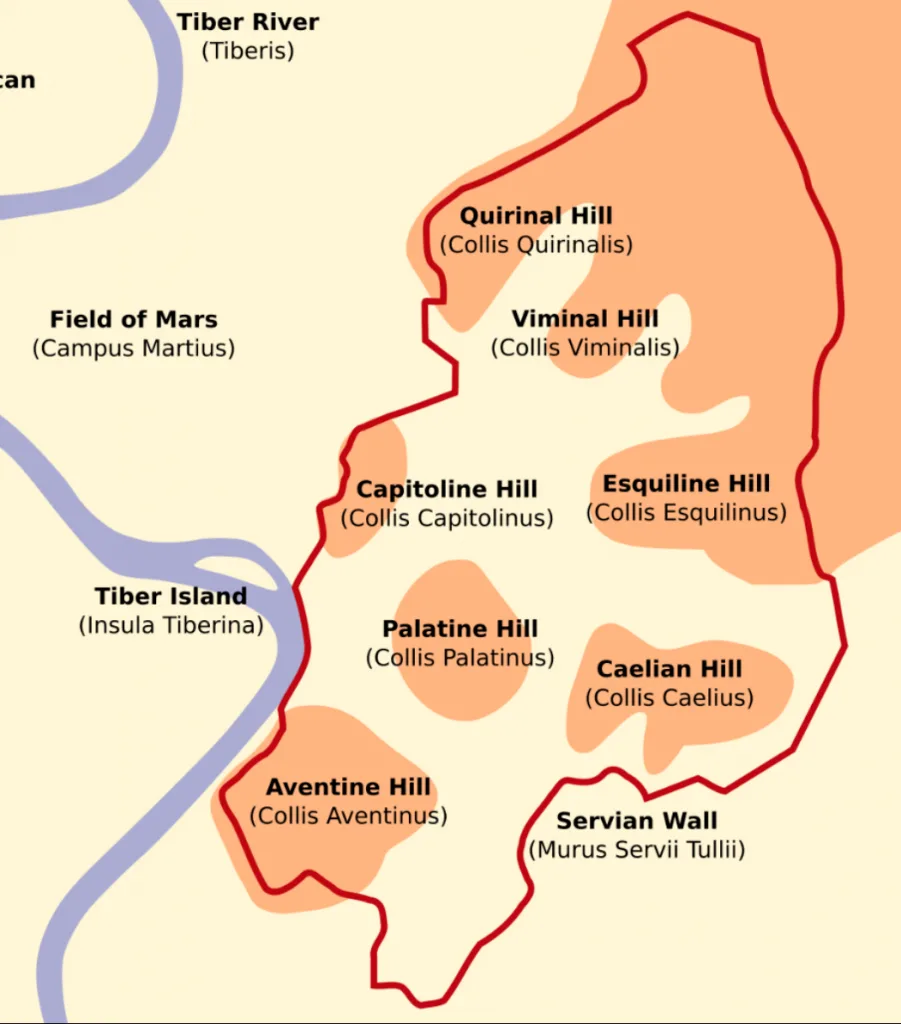
The Aventine Hill is one of the seven hills of Rome, named after a mythical King Aventinus. It is the hill where Hercules pastured his cattle. They were stolen by Cacus. According to Virgil in his Aeneid, the monstrous Cacus lived in a cave on a rocky slope near the River Tiber. Cacus was the son of Vulcan, the artificer God. He was, also, a fire breathing Giant who eat human flesh and stuck their skulls on the door of his house. When Hercules wrestled with him, Hercules hugged him so tight Cacus’ eyes popped out of his head.
The worship of Minerva also took place on the Hill. You can take a Google Earth fly past if you follow this link – also some nice photos.
The Aventine Hill & Romulus
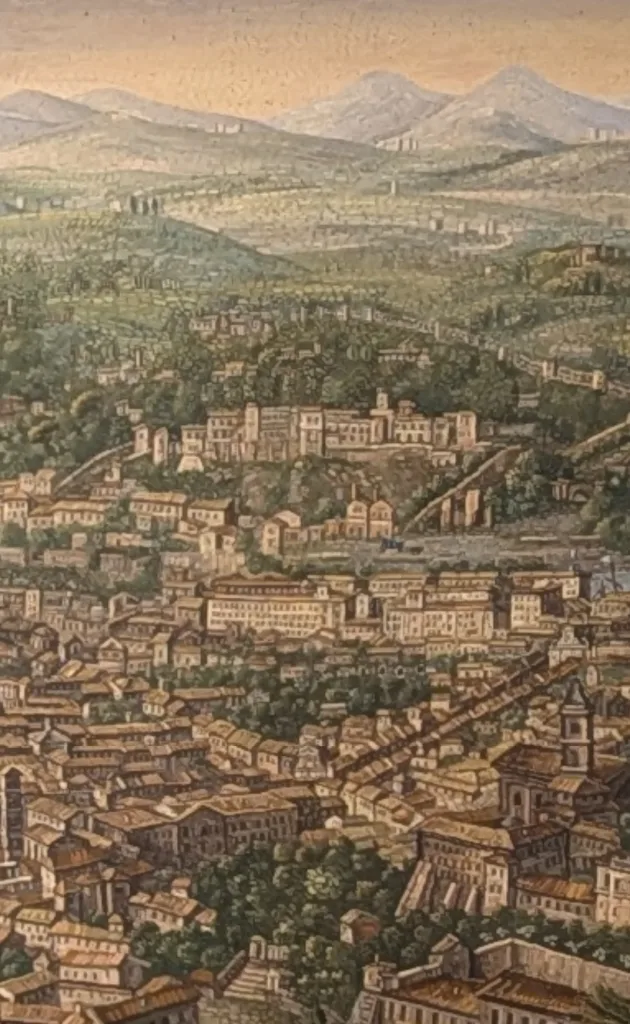
Aventine Hill in a detail of the ‘Panorama of Rome From the Janiculum Hill’ in miniature mosaics by Antonio Tesca 1800-25 , Gilbert Collection V&A Photo K Flude. You can see the Walls of Rome in the Background. The Tiber runs across the middle but is not clearly visible.
The Hill is famous in the mythology of Rome because it is associated with Romulus. He and his twin Brother Remus, were born to the vestal virgin, Rhea Silvia, in the pre-Roman City of Alba Longa, not far away. Rhea was the daughter of former King Numitor. Her uncle, killed Rhea’s brother and forced her to be a vestal Virgin. Thus ensuring Numitor’s line died out.
But, in her sacred grove she was put to sleep by Somnus dripping a sleeping draft into her eyes and then raped by the God Mars. This was a terrible breaking of the taboo for Vestal Virgins. Rhea gave birth to the twin boys. They had to be hidden from the wrath of their Granduncle.
The Palatine & the Lupercal
The Seven Hills of Room (Facebook)
The boys were saved by the River God Tiberinus and then by being suckled by a Wolf in a cave called the Lupercal, which is at the foot of the Palatine Hill in Rome. A ‘grotto’ under Augustus’ Palace on the Palatine, has been claimed as the original Lupercal, but it is disputed. (see www.digitalaugustanrome.org/records/lupercal/.
When the boys grew up, they helped their Grandfather (Numitor) reclaim the throne of Alba Longa. The boys, being the children of the War God, were obviously excellent at the art of war. Then they decided to found their own City, but they could not decide upon which hill to build it or whom to name it after (accounts vary!). Remus favoured the Aventine, Romulus the Palatine (some accounts say vice versa).
So they decided to let the Gods decide. Remus claimed to have won when he saw a flight of 6 auspicious birds. Romulus saw 12 and declared himself the winner. And Rome was named in his honour. It was on his choice of Hill – the Palatine Hill. The Aventine hill was, originally, outside the City boundary.
The two quarrelled. Remus was killed. This story was first written down in the Third Century BC. The traditional foundation date of Rome is 753BC. These mythical foundation stories continue are retold and celebrated. In Britain, we largely ignore our creation myths. Despite our legendary Founder, King Brutus, being a relative of Romulus and Remus.
The ‘Panorama of Rome From the Janiculum Hill’ in miniature mosaics by Antonio Tesca 1800-25 , Gilbert Collection V&A Photo K Flude. It took 20 years to make.
You didn’t think I’d leave you with just a detail of the superb map did you? And to see a much better photo of it look at the V&A’s photo. It is part of the Gilbert Collection which I introduced in this post.
First written in 2023 and revised March 30th 2024, 2025, Object of the Day added 2026
The expression ‘Mad as a March Hare’ comes from the displays of hare boxing that takes place as the Hare mating season begins. And no, it’s not the male March Hare fighting in the spirit of romantic rivalry. It is the female hares fighting off unwanted attention from the males. Hares are solitary creatures, and the mating season is, perhaps, particularly difficult for them. The Country File website has more on the subject. www.countryfile.com
Not only March Hares but March Kittens too
There are also March Kittens and March Chickens. Edward Topsell in his ‘History of Four-footed Beasts‘ 1607 says the best Kittens to keep are those born in March. ‘The Closet of Sir Kenelm Digby Opened‘ 1669 says:
‘Keep a black cock hatched in March as a protection against evil spirits: his crowing terrifies them.’
He also gives a recipe for Cock Ale:
Eight gallons of Ale, a boiled March Cock, four pounds of stoned Raisins, half a pound of dates, nutmegs, mace. Beat the ingredients in a mortar, add to two quarts of Sherry. Add to the ale. Stop it in a container for 6 or 7 days. Bottle it, drink after a month.
Very weird. I challenge my readers to try it and let me know how it goes?
Was the March Hare Sacred?
But it’s not only March Hares because the hare itself was a sacred animal. It was sacred to Aphrodite because of their prodigious ability to have offspring:
‘For you know, I imagine, what is said of the hare, that it possesses the gift of Aphrodite to an unusual degree. At any rate it is said of the female that while she suckles the young she has borne, she bears another litter to share the same milk; forthwith she conceives again, nor is there any time at all when she is not carrying young.’
Classical Texts Library. Philostratus the Elder, ‘Imagines’ Book 1.1-15 c 3rd Century AD. Translated by Arthur Fairbanks.
Divine Celtic & Neolithic Hares
Research reported by Exeter University suggests that hares were worshipped in pre-Roman Britain. Julius Caesar wrote:
“The Britons consider it contrary to divine law to eat the hare, the chicken, or the goose.”
‘The Battle for Gaul’ Translation by Wiseman, Anne, Wiseman, T. P. Published by Penguin Random House, 1980 ISBN 10: 0701125047 (TP Wiseman was my professor for Classical Studies at Leicester University).
Hares are thought to be the original Easter Bunny. But finding good evidence before Germany in the early modern period is difficult. There is a tradition that witches can be scared away at Easter. Exactly, how this works is not at all clear to me. But it has been said that witches could take on the form of a hare. So eating Hare Pie at Easter helps rid the land of the witches.
Jugged Hares
You could have a jugged hare. Jugging is cooking a whole animal in a container over water. Follow this link for a recipe for jugged wild hare. Remember, you are not allowed to shot or trap them on a Sunday or on Christmas Day! For a discussion of hares and folklore, click here:
Hare’s Feet Totems
A jointed hare’s foot was considered very lucky and a remedy against gout, stomach pains and insomnia. (The Perpetual Almanack of Folklore by Charles Kightly, which I have used several times in this piece.) You can buy one on eBay. (Don’t click the links, it’s not an advert but a picture of an advert). I remember friends having rabbit feet which they carried around with them for luck. The foot would often be on a key rings.
Georgiana, Duchess of Devonshire (Johann Heinrich Hurter after Angelica Kaufman). Photo by K Flude of the miniature at the Victoria and Albert Museum
The Gilbert Collection has been re-displayed in the V&A in London. It has just opened, and is one of the most opulent displays you could hope to see! But, I loved this miniature of Georgiana. She was one of the richest women in Britain, a compulsive gambler, and a powerful political force for the Whig Party. And despite the Georgian Hairstyle the artist has contrived to make a very down to earth portrait. I can imagine bumping into her at the local Overground Station! She became better known after the bio graphy by Amanda Foreman, followed by the Film starring Keira Knightly. The Museum label says the portrait is ‘after Angelica Kaufman’. But I cannot find a Kaufman of Georgiana, that has this charming informality.
I have just heard news that the Arts Council wants to charge overseas visitors to visit our wonderful free national Museums, while allowing British Citizens free entry. Now, there are lots of arguments to be made about it, particularly in a time where money is in short supply. But, one result will be longer waits to get into Museums and Galleries. I am not sure how we Brits, are going to be asked to prove our nationality. If they have to inspect our Electricity Bills, Drivers Licenses, Passports, Library Cards, or Bank Statements, expect chaos.
One more object from the Collection is made of minature mosaics, and the V&A has several, But I have chosen this fabulous image of the Colosseum in Rome:
Colosseum by Domenico Moglia c1851
First published March 28th 2023, revised 2024, 2025. 2026 Object of the Day added and post revised 2026
Study for Lady Lilith, by Rossetti. 1866, in red chalk. Now in the Tel Aviv Museum of Art (Wikipedia) Lilith born at The Beginning of the Universe
This is now my most popular post. March 25th is the Annunciation—the day that the Archangel Gabriel tells Mary she is pregnant. (to see some very fine paintings of this meeting, look at my other March 25th post march-25th-feast-of-the-annunciation/). When I first wrote this post I was discovering how it all fitted together as I wrote. So I’m leaving it the way it was, proof reading and clarifying if necessary, but keeping the thrill of the discovery of the the significance of March 25th as the day that saw the Beginning of the Universe.
March 25th is also the anniversary of the birth of Adam and Eve (and Lilith); the death of Jesus Christ; the anniversary of the Immolation of Isaac; the Parting of the Red Sea; the Fall of Lucifer; and, (until 1752 in the UK) the beginning of the Year.
Of course, it isn’t. Or to put it another way, no one can, or ever could, prove any of these dates except 1752. So what they speak to is the way the Church saw the world as logically structured by God. Christian thinking about the year, the world, the universe, creation, developed over many years and took influences from many cultures. It is also very complicated to work out the sequence, so I’m going to summarise what I know (or at least what I think I know).
Happy Birthday, Dear Jesus.
Christians chose Christmas Day as the Birthday of Jesus, probably partly because it was a prominent birthday already shared with several Gods. Particularly, Attis, Mithras, Saturn and the Unconquered Sun. It was approximately at Solstice, the beginning of the Solar Year, and close to one of the main festivals of the Roman World, the Saturnalia. So it made it easier for new converts who could retain elements of their festivals after conversion.
December 25th might have been selected by the pagan religions because it is the time when the Sun begins to rise further north each day. The days stop shortening and start lengthening, light increases with the promise of warmer weather and budding plants. It was considered a rebirth of the Sun.
Solstice Anniversaries
So, Jesus was born on/or around the Solstice, so he must have been conceived approx. 9 months earlier. This is approximately at the Spring Equinox.
Ah, you are thinking! But today isn’t the equinox. It’s a few days after the equinox. Surely, God doesn’t do approximately?
I have always thought that the 4 or 5 days difference between the Solstice, the Equinox and the Christian festivals was down to the fact that the Calendars were not well coordinated with the actual movements of the Sun (because the Sun does not circle the earth in 365 days, or in 365 and a quarter days, but 365 days, 6 hours, 9 minutes. Unless corrected for this means dates slip from their proper place in the Solar Year. It also makes lunar Calendars difficult to align with the Sun cycles, and vice versa.
But when I first wrote this a sudden revelation dawned upon me which will be revealed in the next few paragraphs.
So, God sends his Son to save the human race. God is a logical being, so she would send her Son at an appropriate time? If Jesus is born at or near the Solstice, which is an appropriate time for the Son of the Creator, then conception 9 months earlier, March 25th, is near the Equinox. This is the beginning of Spring. For many people, Spring is a new beginning, for example, the Anglo-Saxons saw Winter as the death of the year, and Spring as the young Year. It all makes sense.
The Creation
So to the Creation. God, having a free choice, would have created the world at the beginning of Spring. In fact, if you think about it, God creates everything necessary for life at the creation in 6 days. As soon as it has all been created and put together, it is bound to immediately spring into new life. The first season must, therefore, be Spring? Right? So March 25th?
This gives a nice symmetry with Jesus’s Life. Conceived on March 25th, born December 25th, and died 30–40 years later, according to the Church, at Easter, on March 25th. (the only other famous person I know, born and died on the same day is William Shakespeare).
Easter
Easter, when Jesus is martyred, isn’t March 25th I hear you saying. But remember, Easter is a lunar festival, so its date varies each year. In fact the next time is 2035. Births and deaths, on the other hand, are fixed to the Solar Calendar. Therefore, the Church chooses March 25th as the most appropriate day to pin the death of Jesus, on the anniversary of his conception and the anniversary of the creation of the Earth. I am guessing that this is also the preferred date for the Day of Judgement.
It is also the Birthday of Adam, and his first wife Lilith (or so some say), and Eve. More about Lilith below. I hope this is all making sense?
Why was Adam born on March 25th?
I had thought this date was just one of the parallels that the Church liked, Jesus and Adam born on the same day. But, I have just worked out why Adam is born on March 25th, and why these dates are not the Equinox, March 20th/21 but March 25th, which has been bugging me.
Let’s go back to the beginning of Creation as described in Genesis. It has the following sequence of Seven Days, beginning with the Equinox March 20th. I have added dates to the 6/7 day sequence of Creation:
Day 1: Light – March 20th
Day 2: Atmosphere / Firmament – March 21st
Day 3: Dry ground & plants – March 22nd
Day 4: Sun, moon & stars – March 23rd
Day 5: Birds & sea creatures – March 24th
Day 6: Land animals & Adam, Lilith and Eve – March 25th
So there you have it! Adam, Eve (and Lilith) were created on Day 6 with the Land Animals – March 25th. Jesus conceived, also on this date, and so 9 months later is born on December 25th. It all makes sense, and aligns the Jesus’s Life, the Christian year fully with the Solar Year and the Creation!
And that, dear Reader, is the very first time anyone has been able to explain to me why Christmas is not at the Solstice, and why the Annunciation was not at the Equinox. Maybe you all know this, but it is very exciting to work this out for myself. And believe me, I have done a lot of reading about calendars and not spotted an explanation.
When was the Creation?
The Anno Munda‘s is a Jewish Calendar which begins counting from a year before the Creation – the Year of Emptiness. This was 5500 years plus 2026 years ago so 7526 Before the Present. And it was supposed to have ended in 600AD, 6000 years after the Creation. So, they got that wrong.
Dionysius Exiguus replaced the Anno Mundo year with the AD/BC system in the 6th Century AD). This became popular when the Venerable Bede used it in his writings in the 8th Century.
Beginnings of the year
The Celts chose October 31st, Julius Caesar chose January 1st, other cultures have other dates, and the Spring Equinox is another choice sometimes made. The Church and Dionysius Exiguus choose March 25th, although secular society also recognised the claims of January 1st. Britain kept to March 25th until 1752 when we adopted the Gregorian Calendar. But people like Samuel Pepys celebrated New Year’s Eve on 31st December. So January 1st was the secular New Year, but the Christian year number did not change until March 25th. So King Charles I thought his head was being cut off on January 30th 1648; while history books will tell you it was cut off on January 30th 1649. Same day, same head, different reckonings.
January 1st, the New Moon and New Year
December 31st/January 1st is essentially a Solstice New Year Festival. And I have, previously, used the difficulty of keeping calendars as to why these days has slipped out of alignment with the Solstice. But, today I realised that it is as likely that the reason is the Solar/Lunar nature of our time keeping. The year, and its festivals, is largely arranged around the Solar Cycle. But our weekly and monthly cycles are orginally derived from the Moon.
The first of a month, was called the Kalends by the Romans, the Nones the half moon, and the Ides signified the New Moon. The kalends of January is then, originally, the First New Moon after the Winter Solstice. So, January 1st is not a slightly misdated Solstice Festival it is a Festival celebrating the first New Moon of the New Year! Sorry, to seem excited but this is the first time I have realised this.
Over time societies give up trying to sync the lunar and solar calendars. Roman and Christian cultures gave up and fixed the moon months, completely abandoning any attempt to keep the months to the actual lunar cycle. This is our current system, in which only Easter and festivals that depend on Easter remain true to the movements of the moon festival, much to our perennial confusion.
Maybe you all know this, but it’s put many things into perspective for me!
Lilith
The April 2023 Issue of ‘History Today’ had a short piece called ‘The Liberation of Lilith’ which suggests that the story of Lilith, a figure from Jewish Folklore, is first attested in a Medieval satirical text called ‘The Alphabet of Ben Sira’. The story goes that Lilith is created from the same clay as Adam. Adam then demands she lies below him during sex. She refuses, saying that they are both made from the same stuff and, therefore, equal. Adam refuses to accept this, and so Lilith leaves the Garden of Eden. So the story goes.
The story of Lilith, Sarah Clegg suggests, is one of a series of similar stories found around Europe and Asia. And Clegg assumes that it is gradually modified to make Lilith a demon who will kill babies unless the names of three angels are spoken out loud.
The story survived as a charm to keep babies safe, and perhaps to remind people of equality among the sexes. But this causes problems for, OK, let’s call them out, the Patriarchy. Lilith cannot be equal to Adam so she is made into a monster, not made from the same clay as Adam but from the scum and waste left over from Adam’s creation. I imagine the story then went on to propose that God creates Eve from Adam’s rib, and so she is created from Adam, and is, therefore, not equal, but subservient to him, although not as bad as Lilith. Lilith is now a significant figure in feminist folklore circles.
Attached to the watercolour of Lilith by Rossetti (at the top of the page), was a label with a verse from Goethe‘s Faust as translated by Shelley. (Wikipedia)
“Beware of her fair hair, for she excells All women in the magic of her locks, And when she twines them round a young man’s neck she will not ever set him free again.”
The model is Fanny Cornforth, Rossetti’s mistress. He painted another version a few years later, but the model in that is Alexa Wilding. His models are arguably more interesting than the man himself and include: Elizabeth Siddall, Jane Morris and Fanny Cornforth. Christina Rossetti, his poet sister, modelled for Rossetti’s painting, Ecce Ancilla Domini which you can see here.
For more on the Annunciation, look at my other March 25th post here.
I think I might have enough material to begin my own Cult.
The store cupboards are getting denuded of the fruits, nuts, preserves, pickles, salted and dried foods saved from the summer and autumnal abundance. Of course, this is alleviated by the reduced consumption of the Lenten fast. (I’m continuing my lenten practice of giving up, giving up things for Lent). But nettles are budding. I take a regular cup of nettle tea. Normally, provided by the excellent Cowan’s tea emporium in the Covered Market in Oxford. But I’m running out and not due to visit Oxford for a month or so. So Charles Kightley in his Perpetual Almanac tells me that young stinging nettles are appearing and this is the time to collect own young, juicy nettles.
Here is a video about collecting them.
YouTube Video on making Nettle Tea
Nettle Beer
Or better still, change up the tea for a nettle beer:
Take a gallon measure of freshly gathered young nettles washed well dried and well packed down. Boil them in a gallon of water for at least a quarter of an hour. Then strain them, press them and put the juice in an earthenware pot with a pound of brown sugar and the juice and grated skin of a lemon. Stir well, and before it grows cool put in an ounce of yeast dissolved in some of the liquid. Cover with a cloth and leave in a warm place for four or five days and strain again and bottle it, stopping the bottles well. It’ll be ready after a week, but better if left longer.
Nettle Beer was brewed for old people against ‘gouty and rheumatic pains’.
Nettle: Detecting Virgins
A more sinister use is provided by William Coles who gives a method of detecting virginity.
‘Nettle tops are usually boiled in pottage in the Springtime, to consume the Phlegmatic superfluities in the body of man, that the coldness and moistness of the winter have left behind. And it is said that if the juice of the roots of nettles be mixed with ale and beer, and given to one that suspected to have lost her maidenhood, if it remain with her, she is a maid, But if she’s spews forth, she is not.‘
William Cole’s Adam in Eden 1657.
Flagellation with Nettles?
William Camden reported that Roman soldiers used nettles to heat up their legs in the cold of a British winter. (from Mrs Greaves’ ‘A Modern Herbal). Perhaps, I should have sent that idea to PM Keir Starmer? He might have suggested the method to Senior Citizens to alleviate the loss of their Winter Fuel Allowance? (which he has now restored). Flogging with nettles was a cure for rheumatism and the loss of muscle power in the early modern period. Nettles were also added to horse feed to make their coats shine. It was used as a hair tonic for humans.
Nettle Fabrics
The 18th century poet Thomas Campbell is quoted on the virtues of nettles:
“I have slept in nettle sheets, and I have dined off a nettle tablecloth. The young and tender nettle is an excellent potherb. The stalks of the old nettle are as good as flax for making cloth. I have heard my mother say that she thought nettle cloth more durable than any other linen.”
In 2012, a Danish Bronze Age Burial was found to be dressed in a shroud made of Nettle. Strangely, the nettle was not local, perhaps being made in Austria where other objects in the rich burial came from. However, the person was thought to be Scandinavian. For more have a look at this article on www.nbcnews.com.
In the Irong Age, also in Denmark, Huldremose Woman was found buried in a bog. She had a severed arm and was buried in elaborate sheep and goat skin clothes, but underneath:
‘she wore a white inner garment made from plant fibres that reached from the shoulders to below the knees. The type of plant fiber is unclear but other evidence from the time period suggests that it could have been made of nettle.’
Greaves tells us that the German and Austrians had a shortage of cotton during the blockade of World War 1. They turned to nettles to replace cotton production believing it to be the only effective substitute. It was also substituted for sugar, starch, protein, paper and ethyl alcohol.
YouTube Video on making fabric from nettles
Nettle Pudding
Pepys ate Nettle Pudding in February 1661 and pronounced it ‘very good’. Here is more on Nettles in history AND a recipe for Nettle Pudding! I can see I’m going to have to get out there and carefully pick myself some nettles! ( For Folklore of Nettles look here).
Remember, none of the above is necessarily good advice as far as medicine is concerned. For smoking herbs see my post coltsfoot-smoking-cholera
March Weather
In the early modern almanacs there is much weather and horticultural advice to be had (Weather Lore. Richard Inwards).
‘March damp and warm Will do farmer much harm‘
or
‘In March much snow to plants and trees much woe‘
On This Day
March 10th is St Kessog Day. He is associated with Luss on Loch Lomond, and was Robert the Bruce’s rallying cry. St Kessog and Scotland!
241 BC – The Battle of the Aegates in which the Carthaginian fleet is sunk, and the First Punic War ends. Carthage was destroyed in the Third Punic War in 146BC. Rebuilt as a Roman City 100 years later.
1629 – Parliament is dissolved by Charles I. This was followed by a Royal dictatorship which lasted 11 years, and then led to Civil War.
1906 – Bakerloo Line Opened. The name originated from the Baker Street and Waterloo Railway. It goes from Harrow &Wealdstone in the NW to Elephant & Castle in the South East, via the Central London section which goes from Bakers Street to Waterloo, Sherlock Holmes didn’t use the Tube very much (see this post here for those times he did). There is a proposed extension from Elephant & Castle to Lewisham.
1969 – James Earl Ray sentenced to 99 years in jail for murdering Martin Luther King. While Ray was a segrationalist and a supporter of George Wallace, he maintained he was set up as the scapegoat. He died in prison in 1998.
Portrait of Saint Guénolé (St Winnold) after a bust in silver on a reliquary from the Church Saint-Guénolé in Locquénolé.Public Domain Abgrall Jean-Marie (1846-1926) – Bibliothèque nationale de France
Here is a weather poem in which St Winnold appears
First comes David, then comes Chad. And comes Winnold, roaring like mad. White or black. Or old house thack.
St David’s Day was March 1st. St Chad, the 2nd. St Winnold’s Day is the third of March. Winnold is his English name, and Winneral, or Winwaloe or Guénolé his Celtic names.
The poem suggests that snow, rain or wind is going to come on these three days. When the wind roars, it will threaten the thatch of houses. If the storms do not come in the first 3 days, then they will come on the last three days of March, which were called ‘the Borrowing Days’. Or so it is said.
St Winnold was around 50 years (460 – 3 March 532) after the end of Roman Britain. His family was from Cornwall. He was the son of a Prince Fragan of Dumnonia, and St Gwen the Three-Breasted, His mother’s Feast day is October 3rd. She is a Saint of fertility, because of God’s Gift of an extra breast. They moved to Brittany to escape a British Plague. Their son grew up to be holy and was the founder and first abbot of Landévennec Abbey (the Monastery of Winwaloe). It is south of Brest.
Winwaloe became what is known as a ‘phallic saint’ because he was associated with fertility. Wikipedia says this came about because of confusion about the origin of his name:
‘his name was thought to derive from gignere (French engendrer, “to beget”)’
St Winnold’s Breton name is Guénolé. How this etymology works is not clear to me! But surely, he as likely to have got a reputation for helping people with fertility problems from his mother? Supplicants would make a wax phallus to persuade the Saint to help them conceive. There are several churches/ chapels dedicated to him in Wales, and a Priory in East Anglia.
Today is the Feast day of two significant Saints, St. Walpurga and St. Ethelbert.
St. Walpurga
St. Walpurga was a nun at Wimborne in Dorset. She, and her brothers St Willibald and St Winebald, accompanied their uncle, St Boniface of Crediton (in Devon) on his mission to convert the Germans to Christianity. They all became leading figures in the new German Church. Willibald set up the Monastery at Heidenheim, which was a duel monastery housing both Monks and Nuns. His sister, St Walpurga, became Abbess of the Monastery in 761. She died on 25 February 777 or 779 (the records are unclear),
In 870, St. Walpurga remains were ‘translated’ to Eichstätt, which St Willibald had set up as the Diocesan centre of this part of Bavaria. The date of the transfer was the night of April 30th/May 1st. This was her feast day. But the Church moved it to February 25th, to commemorate her death. However, May Eve is now ‘notorious’ as Walpurgis Night. This is the night of May Eve when witches are abroad up to all sorts of mischief, May Day being one of the main pagan festival days. Her body was placed in a rock-cut niche and her bones started exuding an oil called Walpurgis Oil which was said to have medical properties. She was also involved in a miracle of a boat saved in a storm-tossed sea.
For these reasons, Walpurgis is the Saint for battling pests, rabies, whooping cough, storms and sailors. She is also associated with witchcraft but not because of any actual association with it. Her remains were moved again in 1035 when she was enshrined at the Benedictine Abbey of St. Walburga which was named after her.
Walpurgis Nacht
Terrible things happen on Walpurgis Night in Dracula by Bram Stoker. So, the night has now become a trope for Heavy Metal Bands, doyens of horror stories and the Satanic. For more on this read my piece on Walpurgis Nacht.
Coincidently, I was reading about the fuss made about a Heavy Metal Band, called a Plague of Angels, playing in the glorious York Minster. A member of the band tried to calm down the controversy, saying people should just chill out. But other group members used to be in a band called ‘The Cradle of Filth’. Among their claims for Heavy Metal Fame is that they wore the most controversial t-shirt in heavy metal history. This has a visual of a nun in a compromising position and a slogan saying ‘Jesus is a ……..’ (add your favourite swear word here). All very silly. But it struck a cord with me, as I have a scene in my novel (unpublished) which is based on extreme forms of Heavy Metal Bands. I thought I might have gone over the top, but this story reassures me that extreme Metal can be extremely offensive!
Ethelbert is responsible for welcoming the Augustinian Mission to the Angles sent by the Pope, St Gregory. This re-established Christianity in Eastern Britain, and set up the Anglican Church or the Church of England as it became known.
1308 – Edward II crowned King of England. His reign ended disastrously, with his Queen having an affair with Lord Mortimer and Edward losing control of the country (and Scotland). He was forced to abdicate, and died/was murdered/killed with red-hot pokers/or escaped to live a life as a hermit on the continent. Choose your favourite or read my History of the Kings and Queens of Britain.
1507 – Queen Elizabeth I excommunicated by Pope Pius and declared usurper of the throne, leading to the Spanish Armada and various plots against her life. (my post on Queen Elizabeth’s nicknames is here)
1836 – The Colt Revolver awarded a United States patent. Previously, he had obtained a UK Patent. It created the classic ‘Western’ Revolver’, much later called the Colt 45. It was a revolving-breech loading, folding trigger hand gun.
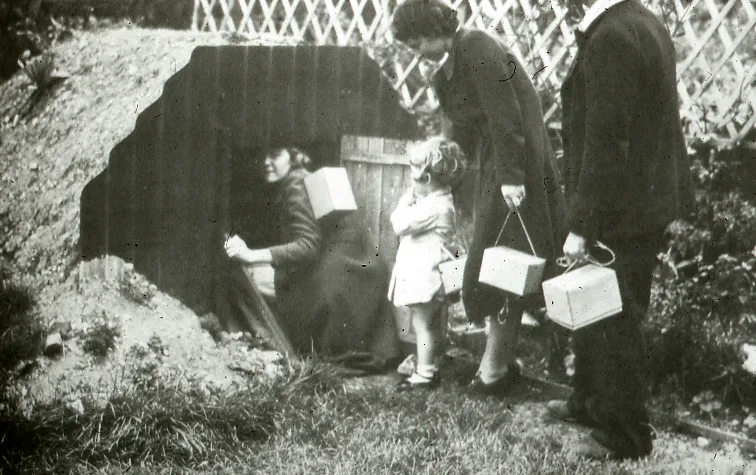
1939 – The first Anderson shelter built in a garden in Islington, London. They were named after the Home Secretary, and were dug in a trench with soil piled over the corrugated iron domed roof. Inside were bunks for the occupants to sleep in. They were 6 ft high, 4.5 ft wide, and 6.5 ft long. 2.5 million were built. The next shelter was the Morrison Shelter named after Herbert Morrison, who succeeded Anderson as Home Secretary. The Morrison Shelter was like a massive table that would protect the shelterers if the house collapsed above it. It allowed the family to sleep inside. London also had public shelters made of brick in many streets, or used cellars and brick arches as shelters. A small proportion of the population preferred to sleep in the Underground. Many stayed in their beds, unless planes were directly overhead. Photos from ‘The British People at War’ published during the war.
Anderson ShelterMorrison ShelterConcrete Public Shelter in London Museum Docklands (Photo C. Mossie)
1956 – Nikita Khrushchev denounces Stalin.
First Written February 2024, revised February 2025. On This Day added in 2026
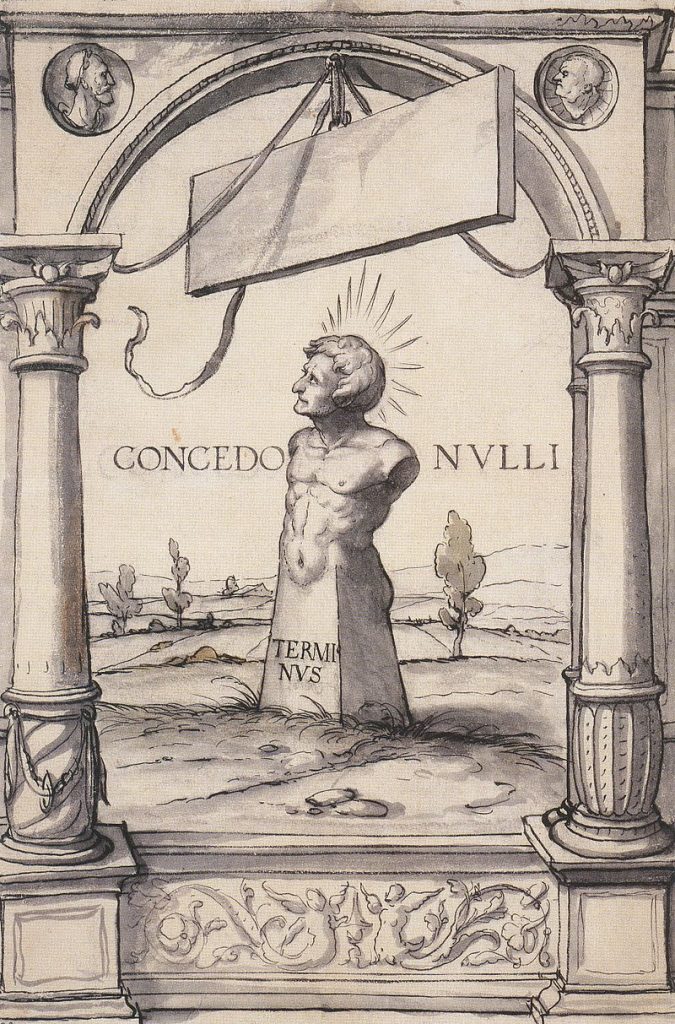
Hans Holbein the YoungerDesign for a Stained Glass Window with Terminus. Pen and ink and brush, grey wash, watercolour, over preliminary chalk drawing, 31.5 × 25 cm, Kunstmuseum Basel. ‘Terminus is often pictured as a bust on a boundary stone, His festival is ‘Terminalia’
Today is Terminalia, the Roman day for setting land boundaries. The festival of Terminus was a pastoral outdoor festival marking the boundaries of towns and villages. It resembles the Beating the Bounds tradition that we have in Britain. This is recorded, in the UK, from Anglo-Saxon times, and still continues in some parishes. I will talk about this on Ascension Day in May.
Terminus was an old ancient God who was the God of the boundary, the border, the edge, the liminal God. Ovid says King Tarquinus swept away the old Gods on the Capital Hill and Jupiter became the Great God. All the old temples were taken down, except for that of Terminus. Instead, Jupiter’s Temple was built around Terminus’ temple. They put a hole in the roof because Terminus had to be worshipped in the open air.
Terminus’s motto was “concedo nulli” which means “I yield to no one”. This was adopted by Erasmus as his personal motto in 1509.
Terminalia and the Roman Year
The Terminalia was celebrated on the last day of the old Roman year. February was the last month of the year. The rulers of Rome added an intercalary month called Mercedonius in an attempt to keep the Solar year in tune with the seasons. And when the intercalary month was added, the last five days of February were given to the month Mercedonius. The resulting ‘leap year‘ was either 377 or 378 days long. So, in those years, the 23rd of February was the Terminus of the year.
The intercalary months were added at the direction of the Pontiffs, supposedly every two or three years. But the Pontiffs were often swayed by political of financial advantage and delayed the decision. By the time of Julius Caesar, the seasons were wildly out of sync with the calendar year. The Dictator, responded by instituting a reform of the Calendar. It began with ‘the Year of Confusion’, over 400 days long.
The reforms introduced the Julian Calendar which realigned the calendar back in line with the seasons. It resolved the problem by adding leap day every four years. This was based on the almost correct calculation of a solar year being 365.25 days. It took another 1500 years before that inaccuracy was corrected. Then the year was another 11 days out of kilter, and the Julian Year was replaced by the Gregorian Year,
Here is what Ovid, in ‘Fasti’ says about Terminalis
When night has passed, let the god be celebrated With customary honour, who separates the fields with his sign. Terminus, whether a stone or a stump buried in the earth, You have been a god since ancient times. You are crowned from either side by two landowners, Who bring two garlands and two cakes in offering. An altar’s made: here the farmer’s wife herself Brings coals from the warm hearth on a broken pot. The old man cuts wood and piles the logs with skill, And works at setting branches in the solid earth. Then he nurses the first flames with dry bark, While a boy stands by and holds the wide basket. When he’s thrown grain three times into the fire
The little daughter offers the sliced honeycombs. Others carry wine: part of each is offered to the flames: The crowd, dressed in white, watch silently. Terminus, at the boundary, is sprinkled with lamb’s blood, And doesn’t grumble when a sucking pig is granted him. Neighbours gather sincerely, and hold a feast, And sing your praises, sacred Terminus: You set bounds to peoples, cities, great kingdoms: Without you every field would be disputed. You curry no favour: you aren’t bribed with gold, Guarding the land entrusted to you in good faith. If you’d once marked the bounds of Thyrean lands, Three hundred men would not have died, Nor Othryadesí name be seen on the pile of weapons. O how he made his fatherland bleed! What happened when the new Capitol was built? The whole throng of gods yielded to Jupiter and made room:
But as the ancients tell, Terminus remained in the shrine Where he was found, and shares the temple with great Jupiter. Even now there’s a small hole in the temple roof, So he can see nothing above him but stars. Since then, Terminus, you’ve not been free to wander: Stay there, in the place where you’ve been put, And yield not an inch to your neighbour’s prayers, Lest you seem to set men above Jupiter: And whether they beat you with rakes, or ploughshares, Call out: This is your field, and that is his! There’s a track that takes people to the Laurentine fields, The kingdom once sought by Aeneas, the Trojan leader: The sixth milestone from the City, there, bears witness To the sacrifice of a sheep’s entrails to you, Terminus. The lands of other races have fixed boundaries: The extent of the City of Rome and the world is one