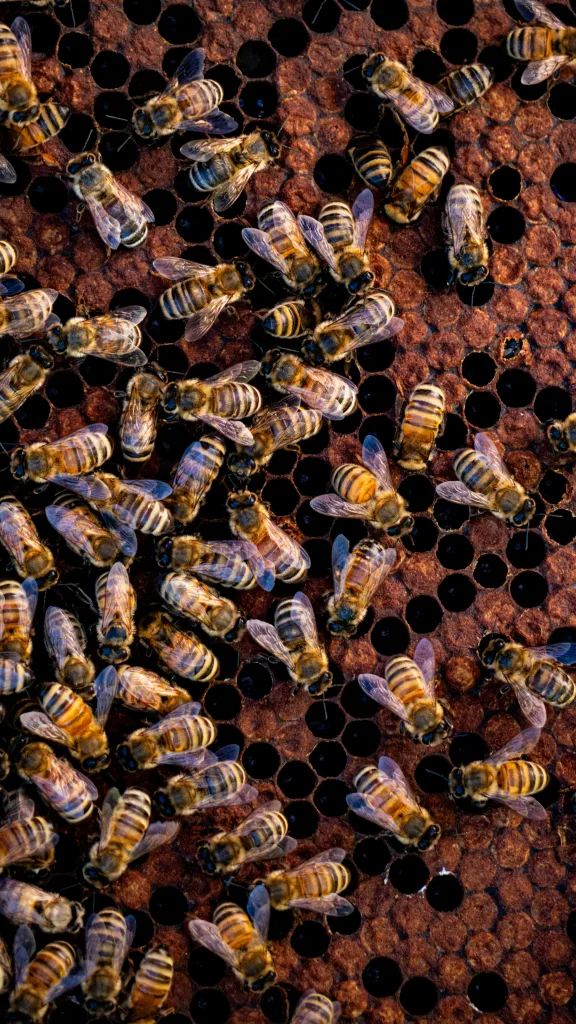
Photo by Alvin David on Unsplash
A Swarm of Bees in May
A swarm in May
Is worth a load of hay
A swarm in June
Is worth a silver spoon
A swarm in July
Is not worth a fly.‘
‘Five Hundred Points of Good Husbandry’ published 1573, suggests we should:
‘Take heed to thy Bees, that are ready to swarm, the loss thereof now, is a crown’s worth of harm.’
According to Hillman’s ‘Tusser Redivus’ of 1710, swarming in May produces particularly good honey. ‘Their hours of swarming are for the most part between the hours of ten and three, and they ought to be watched every day.’ He advises following the bees to retrieve them:
‘You are entitled by custom to follow them over anyone’s land and claim them … but only so long as you ‘ting-tang’ as you go, by beating some metal utensil – the sound whereof is also said to make your bees stop.’
Much of the above is quoted from The Perpetual Almanac of Folklore by Charles Kightly.
Queen Bee
Bees swarm when a new Queen Bee takes a proportion of the worker bees to form a new colony. They will latch unto a branch or a shrub, even a car’s wing mirror. Then sending worker bees out searching for a suitable new home, such as a hollow tree. There may be hundreds or even thousands in the new colony. This may be very alarming. But, at this point, they will not be aggressive as they do not have a hive to protect. Look here for more information on swarming.
Sweet, Long Distance Flyers
An average hive will produce 25 lbs of honey, and the bees will fly 1,375,000 miles to produce it. This is like flying 55 times around the world (according to the British beekeepers Association (and my maths)) https://www.bbka.org.uk/honey
Swarming in Hackney

In 2018, on 30th May, I was perturbed to find a swarm of Bees hanging outside my front door. Frightened of leaving my house, I rang a local beekeeper, who came to take possession of the Bees and take them to a new home. By the time he came, they had moved 20 yards to a Buddleia bush.

Helping Bees
Bees are still having a hard time as their habitats are diminishing and threats increasing. In July, DEFRA hosts Bees’ Needs Week 2026: 13 to 19 July. This aims to increase public awareness of the importance of pollinators.
They suggest we can help by these 5 simple actions
- Grow more nectar rich flowers, shrubs, and trees. Using window or balcony boxes are good options if you don’t have a garden.
- Let patches of garden and land grow wild.
- Cut grass less often.
- Do not disturb insect nests and hibernation spots.
- Think carefully about whether to use pesticides.
Patron Saints of Bees include: St. Ambrose, St. Gobnait, and St. Valentine. Click here to see my post of St Valentine.
On This Day
1821 – Napoleon dies in exile on the island of Saint Helena.
1835 – The first railway in continental Europe opens between Brussels and Mechelen, which is 36 kms.
1964 – Europe Day is launched by the Council of Europe but the European Union celebrates Peach and Unity in Europe on May 9th
First Published 2024, revised 2025, rearranged 2026
Discover more from And Did Those Feet
Subscribe to get the latest posts sent to your email.
Very interesting. I used the metaphor ‘swarming’ without knowing what it actually refers to!
I always buy honey at Cahors market from a local apicultor and, as I wondered how he could know which brand each honey was
(he produces 4 or 5 different ones), he explained it depends on the season of harvesting.
It would be interesting to know whether he agrees with the season to produce the best honey, or maybe the flavour changes depending on the flowers/crops in season at the time?.
Only a matter of taste I think. Yes, the flavour depends of the flowers the bees forage.
Prices are slightly different between different brands. I guess it depends on the amount cropped at a certain time.
I’ll ask him next time. He’s a typical ecologist guy, with a lovely occitan accent!
Should have checked before submitting: ‘beekeeper’ is the English word! Or ‘apiarist’
Apiculteur the French one!
I should put those terms in the tags!
Yes, it comes from the Latin word: ‘apis’. There are often two words in English, the common one and the ‘learned’ one that comes from Latin.