The Moon rules the months: this month’s span ends With the worship of the Moon on the Aventine Hill.
Fasti by Ovid
Cycle of the Moon, sketched from photo.
The Aventine Hill is one of the seven hills of Rome, named after a mythical King Aventinus. It is the hill where Hercules pastured his cattle. They were stolen by Cacus. According to Virgil in his Aeneid, the monstrous Cacus lived in a cave on a rocky slope near the River Tiber. Cacus was the son of Vulcan, the artificer God. He was, also, a fire breathing Giant who eat human flesh and stuck their skulls on the door of his house. When Hercules wrestled with him, Hercules hugged him so tight Cacus’ eyes popped out of his head.
The worship of Minerva also took place on the Hill. You can take a Google Earth fly past if you follow this link – also some nice photos.
The Aventine Hill & Romulus
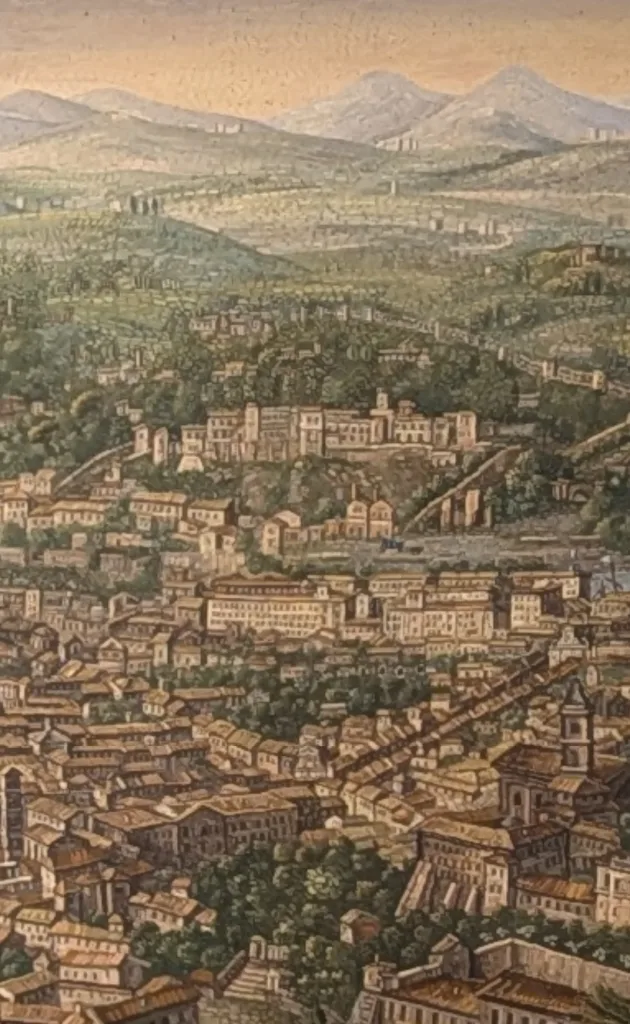
Aventine Hill in a detail of the ‘Panorama of Rome From the Janiculum Hill’ in miniature mosaics by Antonio Tesca 1800-25 , Gilbert Collection V&A Photo K Flude. You can see the Walls of Rome in the Background. The Tiber runs across the middle but is not clearly visible.
The Hill is famous in the mythology of Rome because it is associated with Romulus. He and his twin Brother Remus, were born to the vestal virgin, Rhea Silvia, in the pre-Roman City of Alba Longa, not far away. Rhea was the daughter of former King Numitor. Her uncle, killed Rhea’s brother and forced her to be a vestal Virgin. Thus ensuring Numitor’s line died out.
But, in her sacred grove she was put to sleep by Somnus dripping a sleeping draft into her eyes and then raped by the God Mars. This was a terrible breaking of the taboo for Vestal Virgins. Rhea gave birth to the twin boys. They had to be hidden from the wrath of their Granduncle.
The Palatine & the Lupercal
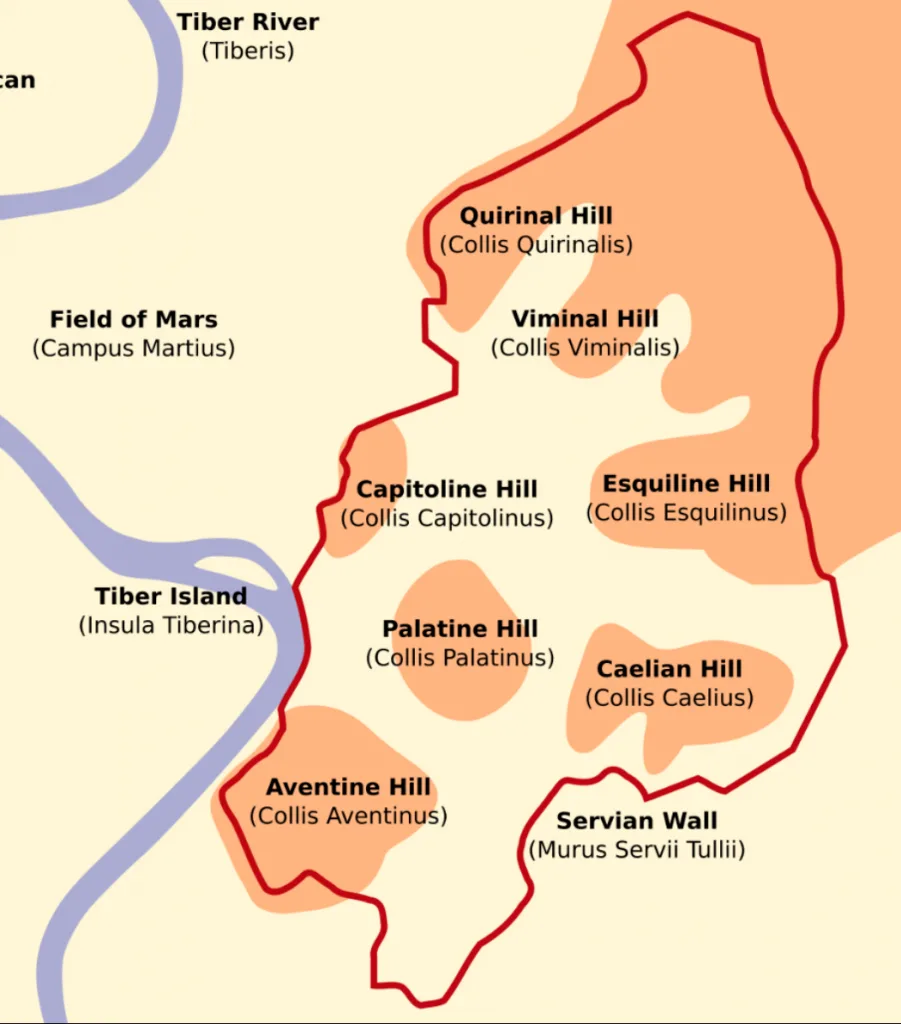
The Seven Hills of Room (Facebook)
The boys were saved by the River God Tiberinus and then by being suckled by a Wolf in a cave called the Lupercal, which is at the foot of the Palatine Hill in Rome. A ‘grotto’ under Augustus’ Palace on the Palatine, has been claimed as the original Lupercal, but it is disputed. (see www.digitalaugustanrome.org/records/lupercal/.
When the boys grew up, they helped their Grandfather (Numitor) reclaim the throne of Alba Longa. The boys, being the children of the War God, were obviously excellent at the art of war. Then they decided to found their own City, but they could not decide upon which hill to build it or whom to name it after (accounts vary!). Remus favoured the Aventine, Romulus the Palatine (some accounts say vice versa).
So they decided to let the Gods decide. Remus claimed to have won when he saw a flight of 6 auspicious birds. Romulus saw 12 and declared himself the winner. And Rome was named in his honour. It was on his choice of Hill – the Palatine Hill. The Aventine hill was, originally, outside the City boundary.
The two quarrelled. Remus was killed. This story was first written down in the Third Century BC. The traditional foundation date of Rome is 753BC. These mythical foundation stories continue are retold and celebrated. In Britain, we largely ignore our creation myths. Despite our legendary Founder, King Brutus, being a relative of Romulus and Remus.
The ‘Panorama of Rome From the Janiculum Hill’ in miniature mosaics by Antonio Tesca 1800-25 , Gilbert Collection V&A Photo K Flude. It took 20 years to make.
You didn’t think I’d leave you with just a detail of the superb map did you? And to see a much better photo of it look at the V&A’s photo. It is part of the Gilbert Collection which I introduced in this post.
First written in 2023 and revised March 30th 2024, 2025, Object of the Day added 2026
Drawing of a Badger for the Illustrated London Almanack for December 1873
‘The Badger diggeth her a den or cave in the earth, and there liveth, never coming forth, but for meat or easement, which she maketh out of her den. When they dig their den, after they have entered a good depth, one of them falleth on the back, and the other layeth all the earth on his belly, and so taketh his hinder feet in his mouth, and draweth the belly-laden badger out of the cave. He hath very sharp teeth, and is therefore accounted a deep, biting beast. His legs (as some say) are longer on the right side than the left, and therefore he runneth best when he getteth to the side of an hill. ‘
Edward Topsell, History of Four-footed beasts, 1607. (quoted in the Perpetual Calendar of Charles Kightly.
Setts of Badgers
The Badger is Britain’s biggest surviving wild carnivore (although they are actually omnivores. Badgers live in setts, which can be extensive multi-chambered underground dwellings. Several families will share and sometime other animals too. Badgers can live in their sett for decades. They are very clean, removing soiled bedding and replacing it with clean. They are nocturnal and have a winter sleep.
Conservationists want to help preserve the badger population, but farmers blame badgers for spreading bovine tuberculosis. A recent Government survey suggests that there are ‘approximately 485,000 individuals across 71,600 social groups.’ which I make on average 7 badgers per social group.
The Badger Trust says: ‘badgers are among the most legally protected British wildlife …. badgers are recognised as one of the most persecuted British wildlife species. From rising rates of badger crime to a decade of the controversial badger cull and increasing rates of housing and road development, badger populations continue to be threatened.‘ A 1992 report estimated that 50,000 were killed each year on the roads.
On This Day
1296 – Berwick-upon-Tweed, sacked brutally by Edward I in his attempt to subjugate Scotland to English rule. Bower’s Scotichronicon reports:
‘When the town had been taken in this way and its citizens had submitted, Edward spared no one, whatever the age or sex, and for two days streams of blood flowed from the bodies of the slain, for in his tyrannous rage he ordered 7,500 souls of both sexes to be massacred…. So that mills could be turned by the flow of their blood.’
Account of the Massacre of Berwick.
Edward forbade the removal of the corpses from the streets.
1842 – Ether anaesthesia used for the first time. In Georgia Dr. Crawford Long experimented on the effects of ether by giving it to 3 enslaved people. He then removed a tumor from the neck of a patient. Sulfuric ether administered on a towel for the patient to inhale. He didn’t publish his work so the first public demonstration of Anaesthesia was on October 16, 1846, (now known as Ether Day) at the Ether Dome Massachusetts General Hospital.
1944 – From the British point of view, the worst day of the Nuremberg Raids. 795 Lancasters, Halifaxes and Mosquitos went on the Nuremberg raid. 95 bombers did not return. The worst day in RAF Bomber Command existence. And thousands of civilians died..
Object of the Day
‘The Wanderer’ 2013 by Sean Henry outside Woking Station
As I go to visit my father in Woking (where I went to school) I see statues by Sean Henry, which are larger than life and vivid. (the opposite of Woking itself!). Sean Henry is a pioneer of polychromic statues. By 2020 Henry had 7 statues in Woking.
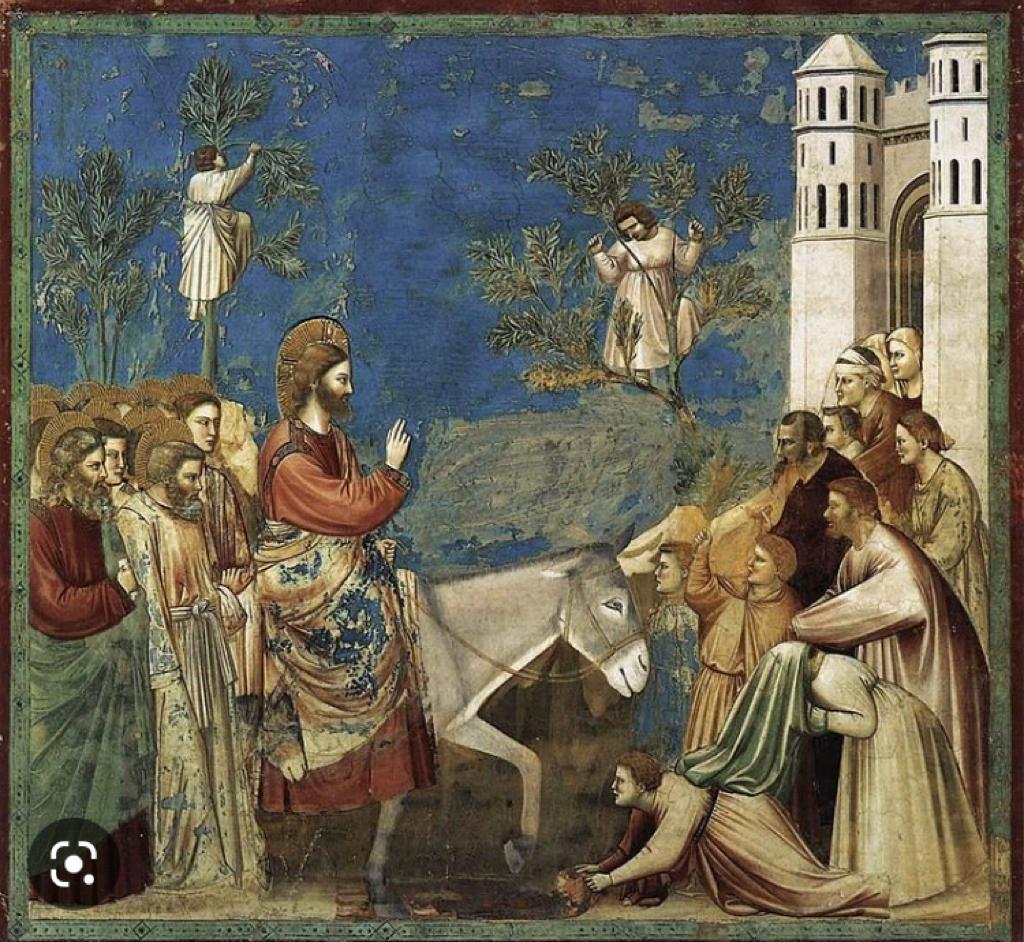
Palm Sunday (Yew Sunda) by Giotto. Entry into Jerusalem from the Cappella degli Scrovegni in Padova (sent to me by Lucia Granatella)
Yew Sunday (Domhnach an Iúir in Irish) is the medieval name for Palm Sunday. This is the day that Jesus entered Jerusalem in triumph on a donkey, with palm leaves being laid in front of him. It has always been very curious to me, this triumph preceded such heavy and heartbreaking tragedy. It is the Sunday before the Betrayal, which leads to the Crucifixion on Good Friday and the Resurrection on Sunday. A busy week for the Church.
I got a little insight into the powers of the procession when on a Field trip to Nice with Students from Central Saint Martins College. We set the Students the task of creating an ‘art intervention’. They came up with the idea of a Procession to the Mayor. It was extraordinary how deploying a few placards, saucepans as drums, and some chanting could create an instant event,. It made people smile and join in, even if clueless about the cause!!
Palms
Palm Sunday can be celebrated by making crosses out of palms, or with processions bearing palm branches or eating special cakes. There is always room in any ritual for cake). But in the North, where do you get your Palms from? So, it was often substituted by Box, or Olive or Willow and particularly, in Britain and Ireland, by Yew. Yew is evergreen and is so long-lived as to be a symbol of everlasting life. (I wrote more about the Yew here). See also my post on Ash Wednesday.
Giotto Bondone
Giotto was a Florentine painter of the 14th Century of whom Giorgio Vasari, in his essential guide to the artists of the Renaissance, ‘The Lives of the Artists‘ said of the 10 year old:
One day Cimabue, going on business from Florence to Vespignano, found Giotto, while his sheep were feeding, drawing a sheep from nature upon a smooth and solid rock with a pointed stone, having never learnt from any one but nature. Cimabue, marvelling at him, stopped and asked him if he would go and be with him. And the boy answered that if his father were content he would gladly go. Then Cimabue asked Bondone for him, and he gave him up to him, and was content that he should take him to Florence.
There in a little time, by the aid of nature and the teaching of Cimabue, the boy not only equalled his master, but freed himself from the rude manner of the Greeks, and brought back to life the true art of painting, introducing the drawing from nature of living persons, which had not been practised for two hundred years; or at least if some had tried it, they had not succeeded very happily.
Written in 1550.
Giotto & The Development of Perspective
If you look at the painting, above. you will see, even the faces of the people are rounded and, and at least somewhat, individual. The crowd scene, particularly, to the right, has some depth. The people further away seem to recede from the viewer. This contrasts with the Byzantine style of paintings, where figures either float or seem to stand on or support themselves on each other’s shoulders. The Gate into Jerusalem has been rendered by an arist who has seen something that he believes has the key to realistic scenes. One day it will be rediscovered, and named single-point perspective.
Yes, Giotto doesn’t know the secret but he is working to find out what the trick is. The people in the trees are also in the distance. These are the giant strides that Vasari is referring to in the quotation above. Realistic people, in spaces with depth. The donkey is quite sweet too! Cimabue, Giotto’s Master was particularly good at painting Crucifix scenes.
For more on early attempts at creating perspective, see my post on Duccio and the Annunciation here.
Digital tour of the Cappella degli Scrovegni
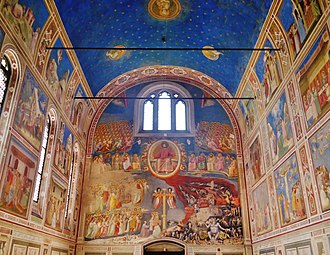
The Cappella degli Scrovegni in Padova is a World Heritage Site decorated by Giotto and his team. They covered all the walls and ceiling with frescos. Depicting the Life of Jesus, the Life of Mary, and the Last Judgement.
Giotto, The Last Judgement. Cappella degli Scrovegni, In Padova. Wikipedia
Here is a real Digital Heritage treat – a 360 Degree tour of the Chapel! Follow the link below. If it seems to be taking a long time to load press the information button. Once pressed will allow the panorama to load immediately.
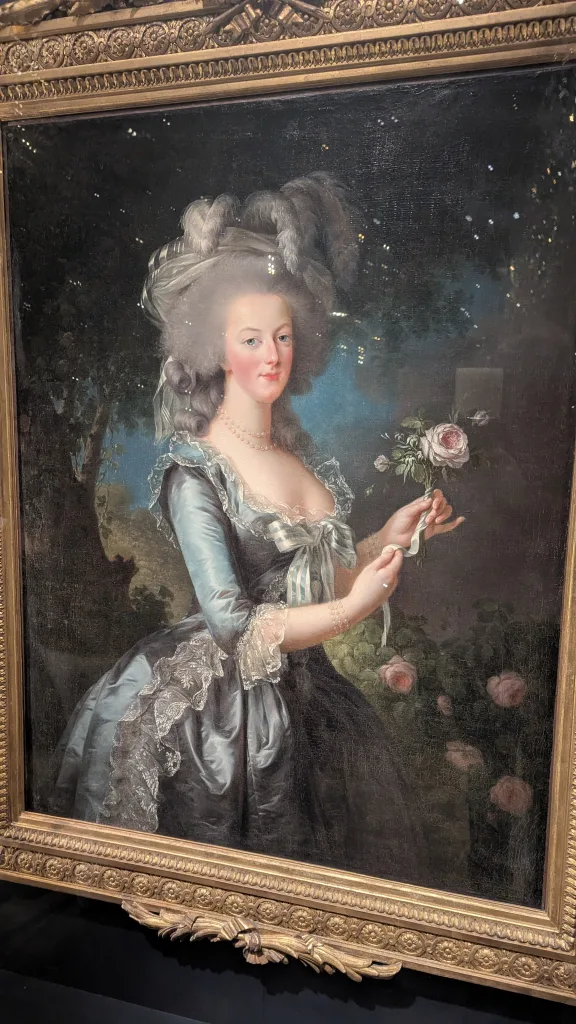
Marie Antoinette was about 28 when this portrait was made, She was about 10 years from her death by guillotine. The painting featured in the V&A’s exhibition about the Queen of France which has just finished. It was not my favourite V&A block-buster exhibition. I think mainly because I came out not knowing very much more about Marie, than when I went it. But I had seen countless extravagant dresses. Yes, she commissioned a lot of dresses, and as patron and model influenced French fashion. And, yes, she wasn’t the air-head of the ‘let them eat cake’ version of history. But I’m not much the wiser.
I’m more interested in the painter, Élisabeth Vigée Le Brun. This is what Wikipedia says about her:
‘She enjoyed the patronage of European aristocrats, actors, and writers, and was elected to art academies in ten cities. Some famous contemporary artists, such as Joshua Reynolds, viewed her as one of the greatest portraitists of her time, comparing her with the old Dutch masters.’
And I have never heard of her, I’m fairly sure nor have you! You might like to see my post on 17th female painter Mary Beale. My original shortlist for Object of the Day were these two items from the Exhibition:
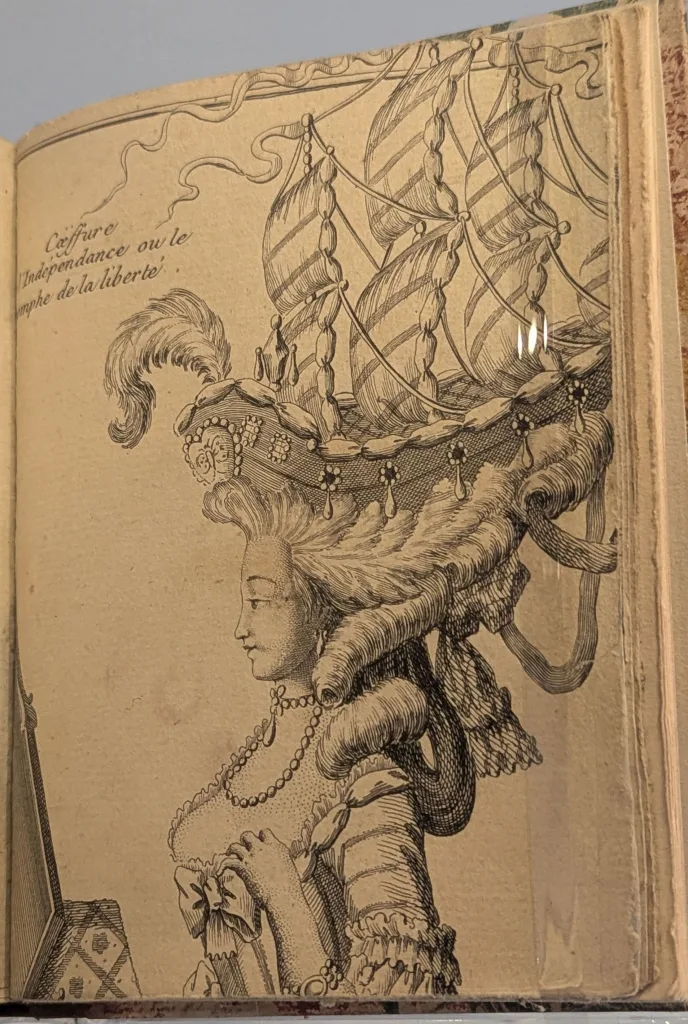
Guilotine blade from the French Revolution, purchased by the sons of Madame Tussaud as the blade that killed Marie Antoinette. Photo Kevin FludeSketch of the Triumph of Liberty Hairdress, associated with Marie Antoinette. It is her most famous headress. Created to celebrate the victory of the French over the British Navy in the American War of Independence.
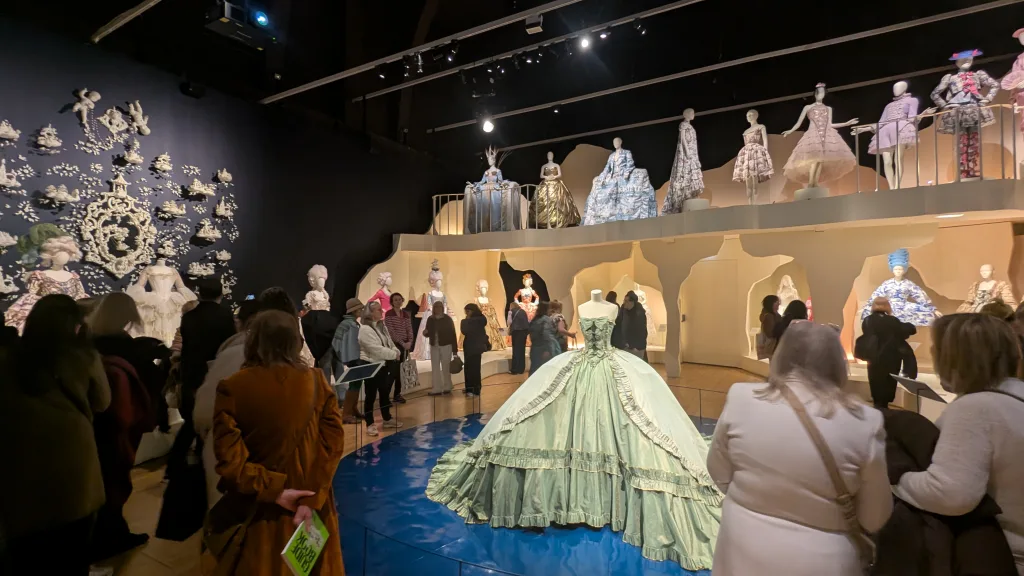
Both these objects did no favours to the Queen’s neck! And lastly, those a few of those dresses:
Centre piece of the V&A exhibition on Marie Antoinette, photo K Flude.
The Stormy Borrowing Days of March
Sir Walter Scott recorded that ‘the last three days of March are called the borrowing days; for as they are remarked to be unusually stormy, it is feigned that March has borrowed them from April to extend his sphere of his rougher sway.’
There are various traditions and poems that record the borrowing days, and this is in the Scotch dialect:
March borrowed from April Three Days, and they were ill: The first was frost, the second was snaw, The third was cauld as ever’t could blaw.
The Borrowing Days in Spain
There is a Spanish story which explains this a little more. A shepherd asked March to calm the winds to suit his flock of sheep, in return for a lamb. March compiled but, then, the Shepherd refused to hand over the lamb. So, March borrowed three days from April and made them fierce and stormy. Versions of this tale are known from Staffordshire, North England and Scotland. (Source ‘Weather Law’ by Richard Inwards 1994 (first published 1893).
Warm days at the end of March or the beginning of April bring the Blackthorns into bloom. This can be followed by a cold snap which is known as a ‘Blackthorn Winter.’
February 2023 in Haggerston Park, London showing early blossom (Blackthorn?) Photo K Flude
For more on blossom and Haggerston Park follow my link to haggerston-park/
On This Day.
Photo of cover of Chambers Book of Days
2024– I purchased the Chamber’s Book of Days, updated from the original 1864 publication, and began adding occasional ‘On This Day’ epilogues to my posts.
1461– The Battle of Towton, England’s bloodiest battle, in which Edward IV defeated the Lancastrian forces of Queen Margaret, thus securing the throne for the Yorkists. Margaret, her husband, Henry VI, and son, fled to Scotland.
1871 – Official Opening of the Royal Albert Hall
1912 – Captain Scott’slast entry in his diary.
‘We shall stick it out to the end, but we are getting weaker, of course, and the end cannot be far, It seems a pity, but I do not think I can write more.’
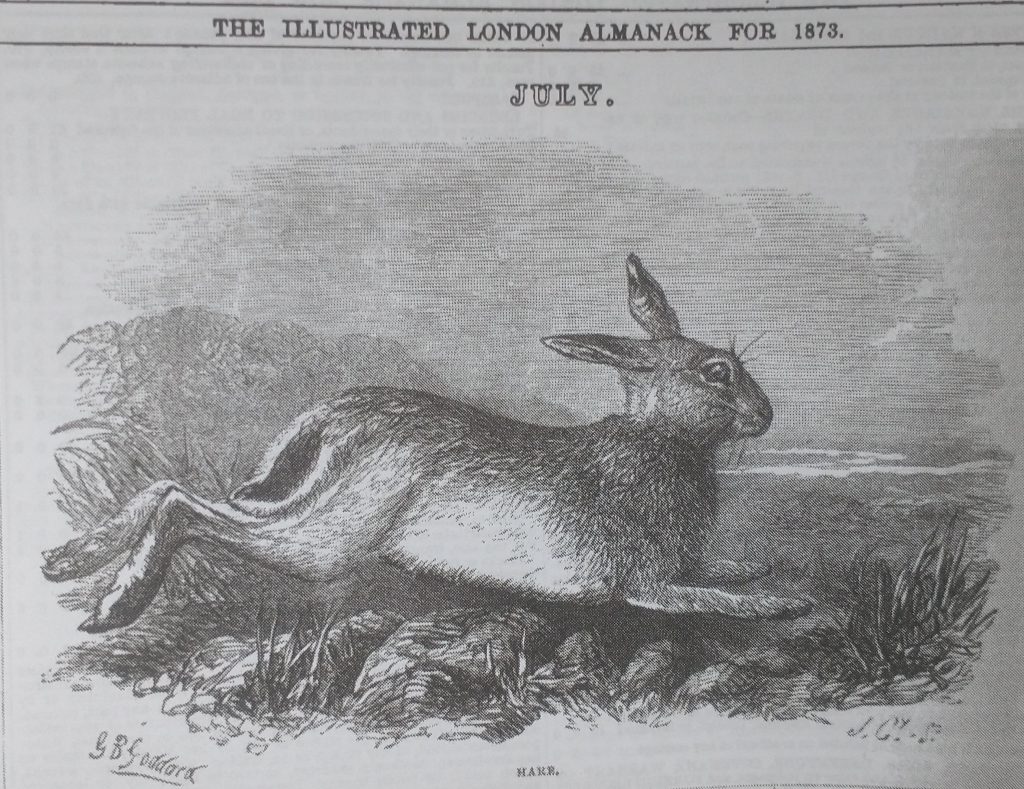
The expression ‘Mad as a March Hare’ comes from the displays of hare boxing that takes place as the Hare mating season begins. And no, it’s not the male March Hare fighting in the spirit of romantic rivalry. It is the female hares fighting off unwanted attention from the males. Hares are solitary creatures, and the mating season is, perhaps, particularly difficult for them. The Country File website has more on the subject. www.countryfile.com
Not only March Hares but March Kittens too
There are also March Kittens and March Chickens. Edward Topsell in his ‘History of Four-footed Beasts‘ 1607 says the best Kittens to keep are those born in March. ‘The Closet of Sir Kenelm Digby Opened‘ 1669 says:
‘Keep a black cock hatched in March as a protection against evil spirits: his crowing terrifies them.’
He also gives a recipe for Cock Ale:
Eight gallons of Ale, a boiled March Cock, four pounds of stoned Raisins, half a pound of dates, nutmegs, mace. Beat the ingredients in a mortar, add to two quarts of Sherry. Add to the ale. Stop it in a container for 6 or 7 days. Bottle it, drink after a month.
Very weird. I challenge my readers to try it and let me know how it goes?
Was the March Hare Sacred?
But it’s not only March Hares because the hare itself was a sacred animal. It was sacred to Aphrodite because of their prodigious ability to have offspring:
‘For you know, I imagine, what is said of the hare, that it possesses the gift of Aphrodite to an unusual degree. At any rate it is said of the female that while she suckles the young she has borne, she bears another litter to share the same milk; forthwith she conceives again, nor is there any time at all when she is not carrying young.’
Classical Texts Library. Philostratus the Elder, ‘Imagines’ Book 1.1-15 c 3rd Century AD. Translated by Arthur Fairbanks.
Divine Celtic & Neolithic Hares
Research reported by Exeter University suggests that hares were worshipped in pre-Roman Britain. Julius Caesar wrote:
“The Britons consider it contrary to divine law to eat the hare, the chicken, or the goose.”
‘The Battle for Gaul’ Translation by Wiseman, Anne, Wiseman, T. P. Published by Penguin Random House, 1980 ISBN 10: 0701125047 (TP Wiseman was my professor for Classical Studies at Leicester University).
Hares are thought to be the original Easter Bunny. But finding good evidence before Germany in the early modern period is difficult. There is a tradition that witches can be scared away at Easter. Exactly, how this works is not at all clear to me. But it has been said that witches could take on the form of a hare. So eating Hare Pie at Easter helps rid the land of the witches.
Jugged Hares
You could have a jugged hare. Jugging is cooking a whole animal in a container over water. Follow this link for a recipe for jugged wild hare. Remember, you are not allowed to shot or trap them on a Sunday or on Christmas Day! For a discussion of hares and folklore, click here:
Hare’s Feet Totems
A jointed hare’s foot was considered very lucky and a remedy against gout, stomach pains and insomnia. (The Perpetual Almanack of Folklore by Charles Kightly, which I have used several times in this piece.) You can buy one on eBay. (Don’t click the links, it’s not an advert but a picture of an advert). I remember friends having rabbit feet which they carried around with them for luck. The foot would often be on a key rings.
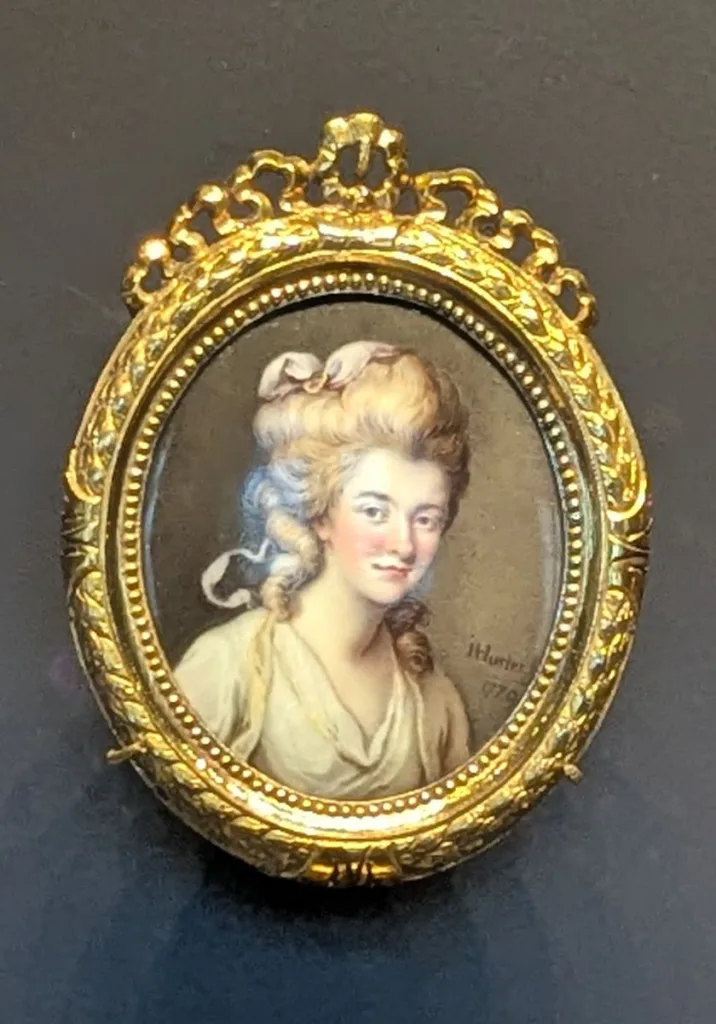
Georgiana, Duchess of Devonshire (Johann Heinrich Hurter after Angelica Kaufman). Photo by K Flude of the miniature at the Victoria and Albert Museum
The Gilbert Collection has been re-displayed in the V&A in London. It has just opened, and is one of the most opulent displays you could hope to see! But, I loved this miniature of Georgiana. She was one of the richest women in Britain, a compulsive gambler, and a powerful political force for the Whig Party. And despite the Georgian Hairstyle the artist has contrived to make a very down to earth portrait. I can imagine bumping into her at the local Overground Station! She became better known after the bio graphy by Amanda Foreman, followed by the Film starring Keira Knightly. The Museum label says the portrait is ‘after Angelica Kaufman’. But I cannot find a Kaufman of Georgiana, that has this charming informality.
I have just heard news that the Arts Council wants to charge overseas visitors to visit our wonderful free national Museums, while allowing British Citizens free entry. Now, there are lots of arguments to be made about it, particularly in a time where money is in short supply. But, one result will be longer waits to get into Museums and Galleries. I am not sure how we Brits, are going to be asked to prove our nationality. If they have to inspect our Electricity Bills, Drivers Licenses, Passports, Library Cards, or Bank Statements, expect chaos.
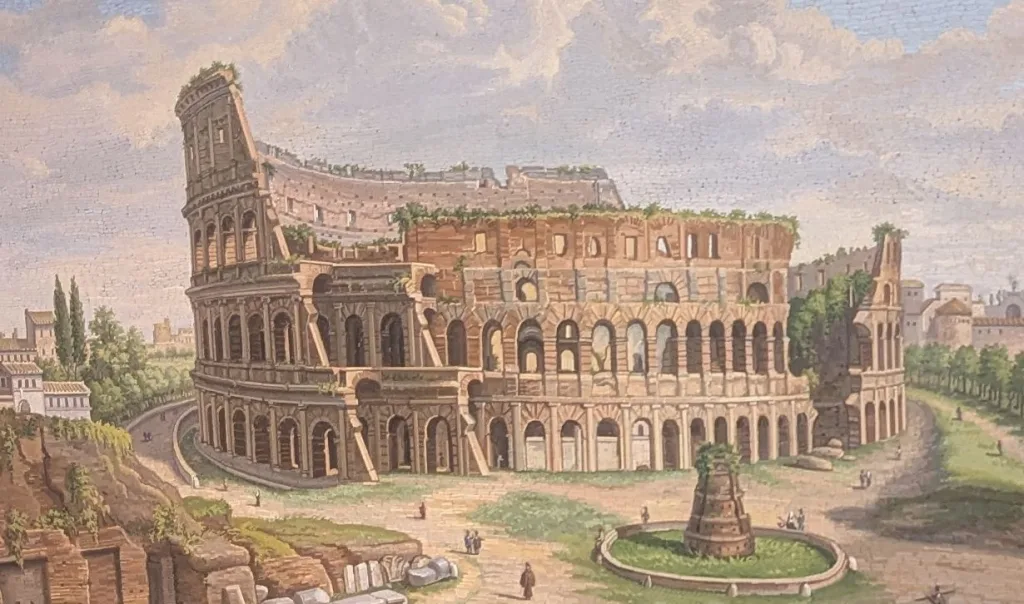
One more object from the Collection is made of minature mosaics, and the V&A has several, But I have chosen this fabulous image of the Colosseum in Rome:
Colosseum by Domenico Moglia c1851
First published March 28th 2023, revised 2024, 2025. 2026 Object of the Day added and post revised 2026
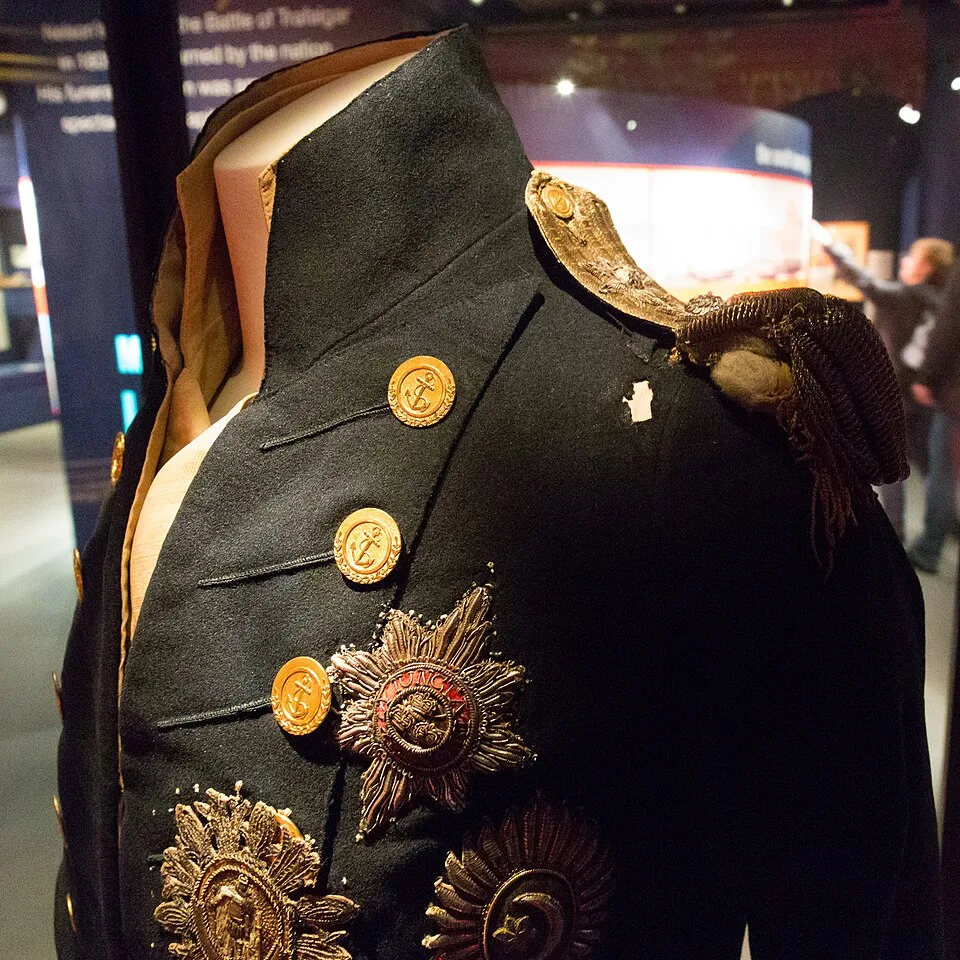
Uniform worn by Nelson at the Battle of Trafalgar (1805), his final engagement, showing the musket ball hole; now displayed at the National Maritime Museum, Greenwich By Morio – Own work, CC BY-SA 3.0,
Virginia Woolf In Greenwich
‘Where shall I spend the day? decided on Greenwich, arrived there at 1; lunched, everything fell out pat; smoked a cigarette on the pier promenade, saw the ships swinging up, one, two, three, out of the haze; adored it all; yes, even the lavatory keepers little dog; saw the grey Wren buildings fronting the river, & then another great ship, grey and orange; with a woman walking on deck; & then to the hospital; first to the museum, where I saw John Franklin’s pen and spoons (a spoon asks a good deal of imagination to consecrate it) – I played with my mind watching what it would do, and behold if I didn’t burst into tears over the coat Nelson wore at Trafalgar with the medal which he hid with his hand when they carried him down, dying, lest the sailors might see it was him.
There was too, his little fuzzy pigtail of golden greyish hair tied in black, & his long white stockings, one much stained, & his white breeches with the gold buckles, & his stock – all of which I suppose they must have undone & taken off as he lay dying. Kiss me Hardy, &c – Anchor, anchor, – I read it all when I came in, & could swear I was there on the Victory – So the charm worked in that case. Then it was raining a little, but I went into the Park, which is all prominence and radiating paths, then back on top of a Bus & so to tea. ‘
Virginia. Woolf, Diary, 1926, quoted from ‘A London Year’ Compiled by Travis Ellborough & Nick Bennison
Greenwich
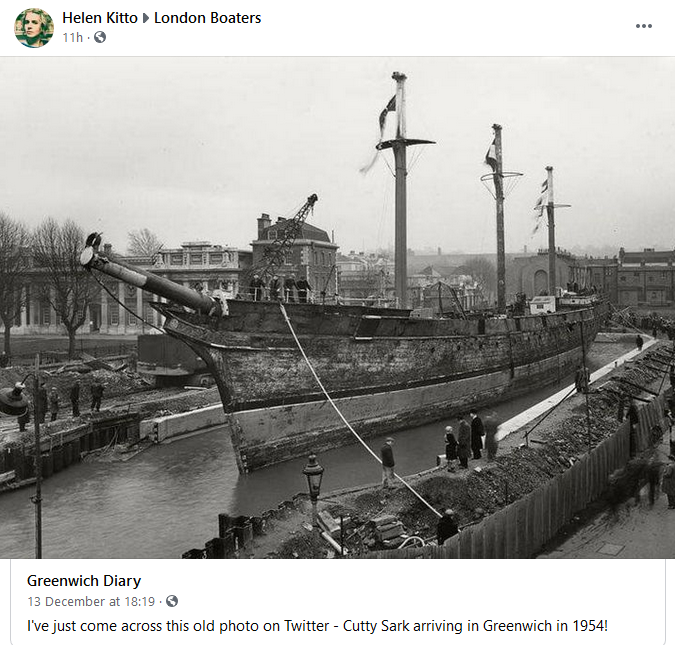
It’s a lovely description of her day out. I think it is like most of our excursions to Greenwich, except she didn’t go to the Market, nor stop in one of the historic pubs, nor go the Royal Observatory. Cutty Sark was not there until 1954. The Museum she mentions is not the National Maritime Museum as that was not opened till 1937, although the idea dates from the year after Woolf’s visit. So, the Museum is a precursor. Nelson’s funeral was preceded by a lying-in-state for three days at the Royal Hospital for Seamen at Greenwich, (which is the Hospital Viriginia Woolf mentions). He was buried in St Pauls on 9 January 1806 , with his body taken by boat from Greenwich to St Pauls. So, there was a local Museum with maritime content in it. I assume associated with the Royal Hospital.
I hate to think what my, unforgiving, on-line grammar editor will make of those long sentences with so many sub-clauses! It is a problem for me as the tool rates the writing on various criteria and refuses to give you a green tick when you have long sentences, not enough headings, paragraphs too short or long, passive writing, etc. etc. And an on-line automated, probably AI assisted tool is not going to let it through just because it is by Virginia Woolf.
Cutty Sark
The Cutty Sark was one of the fastest Tea Clipper Ships. It was built in Dumbarton, Scotland in 1869. And is resting as a Tourist Attraction in Greenwich. She gets her name from Tam O’Shanter, one of Robert Burns’ greatest poems. written in 1791. The story of the name is told by the Figurehead.
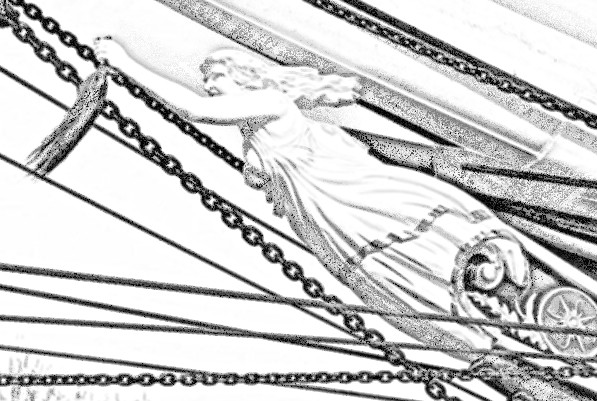
Figureheads on the prow of ships are very often of a semi naked women with her torso breasting the water. The young witch, Nannie Dee, in Tam O’Shanter is identified as the one who is very ‘Vauntie’ and with a short shift that she wore as a child and so is now short and revealing. The poem names this garment as her ‘Cutty Sark. Sark is her shift. Cutty is dialect for short. The Cutty Sark’s figurehead shows Nannie in her shift holding the tail of Tam’s horse.
Tam O’Shanter
Her cutty sark, o’ Paisley harn, That while a lassie she had worn, In longitude tho’ sorely scanty, It was her best, and she was vauntie.— Ah! little kend thy reverend grannie, That sark she coft for her wee Nannie, Wi’ twa pund Scots, (’twas a’ her riches), Wad ever grac’d a dance of witches!
The story is that the drunken Tam on his steady horse Maggie is travelling home when he seems a devilish dance taking place in a graveyard, presided over by the devil himself. Tam is so excited when he sees the young beautiful witch that he bellows his approval and all of a sudden the merriment ends, and in deadly silence the witches turn on Tam and race to catch him.
Tam tint his reason a’ thegither, And roars out, ‘Weel done, Cutty-sark!’ And in an instant all was dark: And scarcely had he Maggie rallied. When out the hellish legion sallied.
As bees bizz out wi’ angry fyke, When plundering herds assail their byke; As open pussie’s mortal foes, When, pop! she starts before their nose; As eager runs the market-crowd, When ‘Catch the thief!’ resounds aloud; So Maggie runs, the witches follow, Wi’ mony an eldritch skreech and hollow.
Maggie
Tam and his horse have to get across a brook before the witches because the witches cannot cross the water. The witches must get him before the bridge over the brook or face burning at the stake. All depends on Maggie (Meg). The young witch in the Cutty Sark is catching up as they approach the bridge. Maggie makes a magnificent leap, the witch makes a despairing grab and only can reach Maggie’s tail but Tam and his horse make it to safety leaving the witch the tail.
Cutty Sark Figurehead
Ah, Tam! Ah, Tam! thou’ll get thy fairin! In hell they’ll roast thee like a herrin! In vain thy Kate awaits thy comin! Kate soon will be a woefu’ woman! Now, do thy speedy utmost, Meg, And win the key-stane of the brig; There at them thou thy tail may toss, A running stream they dare na cross. But ere the key-stane she could make, The fient a tail she had to shake! For Nannie, far before the rest, Hard upon noble Maggie prest, And flew at Tam wi’ furious ettle; But little wist she Maggie’s mettle— Ae spring brought off her master hale, But left behind her ain gray tail: The carlin claught her by the rump, And left poor Maggie scarce a stump.
Now, follow the link below and read the whole poem but read it out loud, standing up and with gusto. Don’t worry about the pronunciation, just enjoy it.
1802 – Treaty of Amiens brought peace between Revolutionary France and Britain. A Soho factory was lit up with gas lighting to celebrate, But it only lasted a year. Then began the Napoleonic Wars, which continued to 1815.
First Published on March 27th. 2026. Cutty Sark content transferred in from 2022.
Study for Lady Lilith, by Rossetti. 1866, in red chalk. Now in the Tel Aviv Museum of Art (Wikipedia) Lilith born at The Beginning of the Universe
This is now my most popular post. March 25th is the Annunciation—the day that the Archangel Gabriel tells Mary she is pregnant. (to see some very fine paintings of this meeting, look at my other March 25th post march-25th-feast-of-the-annunciation/). When I first wrote this post I was discovering how it all fitted together as I wrote. So I’m leaving it the way it was, proof reading and clarifying if necessary, but keeping the thrill of the discovery of the the significance of March 25th as the day that saw the Beginning of the Universe.
March 25th is also the anniversary of the birth of Adam and Eve (and Lilith); the death of Jesus Christ; the anniversary of the Immolation of Isaac; the Parting of the Red Sea; the Fall of Lucifer; and, (until 1752 in the UK) the beginning of the Year.
Of course, it isn’t. Or to put it another way, no one can, or ever could, prove any of these dates except 1752. So what they speak to is the way the Church saw the world as logically structured by God. Christian thinking about the year, the world, the universe, creation, developed over many years and took influences from many cultures. It is also very complicated to work out the sequence, so I’m going to summarise what I know (or at least what I think I know).
Happy Birthday, Dear Jesus.
Christians chose Christmas Day as the Birthday of Jesus, probably partly because it was a prominent birthday already shared with several Gods. Particularly, Attis, Mithras, Saturn and the Unconquered Sun. It was approximately at Solstice, the beginning of the Solar Year, and close to one of the main festivals of the Roman World, the Saturnalia. So it made it easier for new converts who could retain elements of their festivals after conversion.
December 25th might have been selected by the pagan religions because it is the time when the Sun begins to rise further north each day. The days stop shortening and start lengthening, light increases with the promise of warmer weather and budding plants. It was considered a rebirth of the Sun.
Solstice Anniversaries
So, Jesus was born on/or around the Solstice, so he must have been conceived approx. 9 months earlier. This is approximately at the Spring Equinox.
Ah, you are thinking! But today isn’t the equinox. It’s a few days after the equinox. Surely, God doesn’t do approximately?
I have always thought that the 4 or 5 days difference between the Solstice, the Equinox and the Christian festivals was down to the fact that the Calendars were not well coordinated with the actual movements of the Sun (because the Sun does not circle the earth in 365 days, or in 365 and a quarter days, but 365 days, 6 hours, 9 minutes. Unless corrected for this means dates slip from their proper place in the Solar Year. It also makes lunar Calendars difficult to align with the Sun cycles, and vice versa.
But when I first wrote this a sudden revelation dawned upon me which will be revealed in the next few paragraphs.
So, God sends his Son to save the human race. God is a logical being, so she would send her Son at an appropriate time? If Jesus is born at or near the Solstice, which is an appropriate time for the Son of the Creator, then conception 9 months earlier, March 25th, is near the Equinox. This is the beginning of Spring. For many people, Spring is a new beginning, for example, the Anglo-Saxons saw Winter as the death of the year, and Spring as the young Year. It all makes sense.
The Creation
So to the Creation. God, having a free choice, would have created the world at the beginning of Spring. In fact, if you think about it, God creates everything necessary for life at the creation in 6 days. As soon as it has all been created and put together, it is bound to immediately spring into new life. The first season must, therefore, be Spring? Right? So March 25th?
This gives a nice symmetry with Jesus’s Life. Conceived on March 25th, born December 25th, and died 30–40 years later, according to the Church, at Easter, on March 25th. (the only other famous person I know, born and died on the same day is William Shakespeare).
Easter
Easter, when Jesus is martyred, isn’t March 25th I hear you saying. But remember, Easter is a lunar festival, so its date varies each year. In fact the next time is 2035. Births and deaths, on the other hand, are fixed to the Solar Calendar. Therefore, the Church chooses March 25th as the most appropriate day to pin the death of Jesus, on the anniversary of his conception and the anniversary of the creation of the Earth. I am guessing that this is also the preferred date for the Day of Judgement.
It is also the Birthday of Adam, and his first wife Lilith (or so some say), and Eve. More about Lilith below. I hope this is all making sense?
Why was Adam born on March 25th?
I had thought this date was just one of the parallels that the Church liked, Jesus and Adam born on the same day. But, I have just worked out why Adam is born on March 25th, and why these dates are not the Equinox, March 20th/21 but March 25th, which has been bugging me.
Let’s go back to the beginning of Creation as described in Genesis. It has the following sequence of Seven Days, beginning with the Equinox March 20th. I have added dates to the 6/7 day sequence of Creation:
Day 1: Light – March 20th
Day 2: Atmosphere / Firmament – March 21st
Day 3: Dry ground & plants – March 22nd
Day 4: Sun, moon & stars – March 23rd
Day 5: Birds & sea creatures – March 24th
Day 6: Land animals & Adam, Lilith and Eve – March 25th
So there you have it! Adam, Eve (and Lilith) were created on Day 6 with the Land Animals – March 25th. Jesus conceived, also on this date, and so 9 months later is born on December 25th. It all makes sense, and aligns the Jesus’s Life, the Christian year fully with the Solar Year and the Creation!
And that, dear Reader, is the very first time anyone has been able to explain to me why Christmas is not at the Solstice, and why the Annunciation was not at the Equinox. Maybe you all know this, but it is very exciting to work this out for myself. And believe me, I have done a lot of reading about calendars and not spotted an explanation.
When was the Creation?
The Anno Munda‘s is a Jewish Calendar which begins counting from a year before the Creation – the Year of Emptiness. This was 5500 years plus 2026 years ago so 7526 Before the Present. And it was supposed to have ended in 600AD, 6000 years after the Creation. So, they got that wrong.
Dionysius Exiguus replaced the Anno Mundo year with the AD/BC system in the 6th Century AD). This became popular when the Venerable Bede used it in his writings in the 8th Century.
Beginnings of the year
The Celts chose October 31st, Julius Caesar chose January 1st, other cultures have other dates, and the Spring Equinox is another choice sometimes made. The Church and Dionysius Exiguus choose March 25th, although secular society also recognised the claims of January 1st. Britain kept to March 25th until 1752 when we adopted the Gregorian Calendar. But people like Samuel Pepys celebrated New Year’s Eve on 31st December. So January 1st was the secular New Year, but the Christian year number did not change until March 25th. So King Charles I thought his head was being cut off on January 30th 1648; while history books will tell you it was cut off on January 30th 1649. Same day, same head, different reckonings.
January 1st, the New Moon and New Year
December 31st/January 1st is essentially a Solstice New Year Festival. And I have, previously, used the difficulty of keeping calendars as to why these days has slipped out of alignment with the Solstice. But, today I realised that it is as likely that the reason is the Solar/Lunar nature of our time keeping. The year, and its festivals, is largely arranged around the Solar Cycle. But our weekly and monthly cycles are orginally derived from the Moon.
The first of a month, was called the Kalends by the Romans, the Nones the half moon, and the Ides signified the New Moon. The kalends of January is then, originally, the First New Moon after the Winter Solstice. So, January 1st is not a slightly misdated Solstice Festival it is a Festival celebrating the first New Moon of the New Year! Sorry, to seem excited but this is the first time I have realised this.
Over time societies give up trying to sync the lunar and solar calendars. Roman and Christian cultures gave up and fixed the moon months, completely abandoning any attempt to keep the months to the actual lunar cycle. This is our current system, in which only Easter and festivals that depend on Easter remain true to the movements of the moon festival, much to our perennial confusion.
Maybe you all know this, but it’s put many things into perspective for me!
Lilith
The April 2023 Issue of ‘History Today’ had a short piece called ‘The Liberation of Lilith’ which suggests that the story of Lilith, a figure from Jewish Folklore, is first attested in a Medieval satirical text called ‘The Alphabet of Ben Sira’. The story goes that Lilith is created from the same clay as Adam. Adam then demands she lies below him during sex. She refuses, saying that they are both made from the same stuff and, therefore, equal. Adam refuses to accept this, and so Lilith leaves the Garden of Eden. So the story goes.
The story of Lilith, Sarah Clegg suggests, is one of a series of similar stories found around Europe and Asia. And Clegg assumes that it is gradually modified to make Lilith a demon who will kill babies unless the names of three angels are spoken out loud.
The story survived as a charm to keep babies safe, and perhaps to remind people of equality among the sexes. But this causes problems for, OK, let’s call them out, the Patriarchy. Lilith cannot be equal to Adam so she is made into a monster, not made from the same clay as Adam but from the scum and waste left over from Adam’s creation. I imagine the story then went on to propose that God creates Eve from Adam’s rib, and so she is created from Adam, and is, therefore, not equal, but subservient to him, although not as bad as Lilith. Lilith is now a significant figure in feminist folklore circles.
Attached to the watercolour of Lilith by Rossetti (at the top of the page), was a label with a verse from Goethe‘s Faust as translated by Shelley. (Wikipedia)
“Beware of her fair hair, for she excells All women in the magic of her locks, And when she twines them round a young man’s neck she will not ever set him free again.”
The model is Fanny Cornforth, Rossetti’s mistress. He painted another version a few years later, but the model in that is Alexa Wilding. His models are arguably more interesting than the man himself and include: Elizabeth Siddall, Jane Morris and Fanny Cornforth. Christina Rossetti, his poet sister, modelled for Rossetti’s painting, Ecce Ancilla Domini which you can see here.
For more on the Annunciation, look at my other March 25th post here.
I think I might have enough material to begin my own Cult.
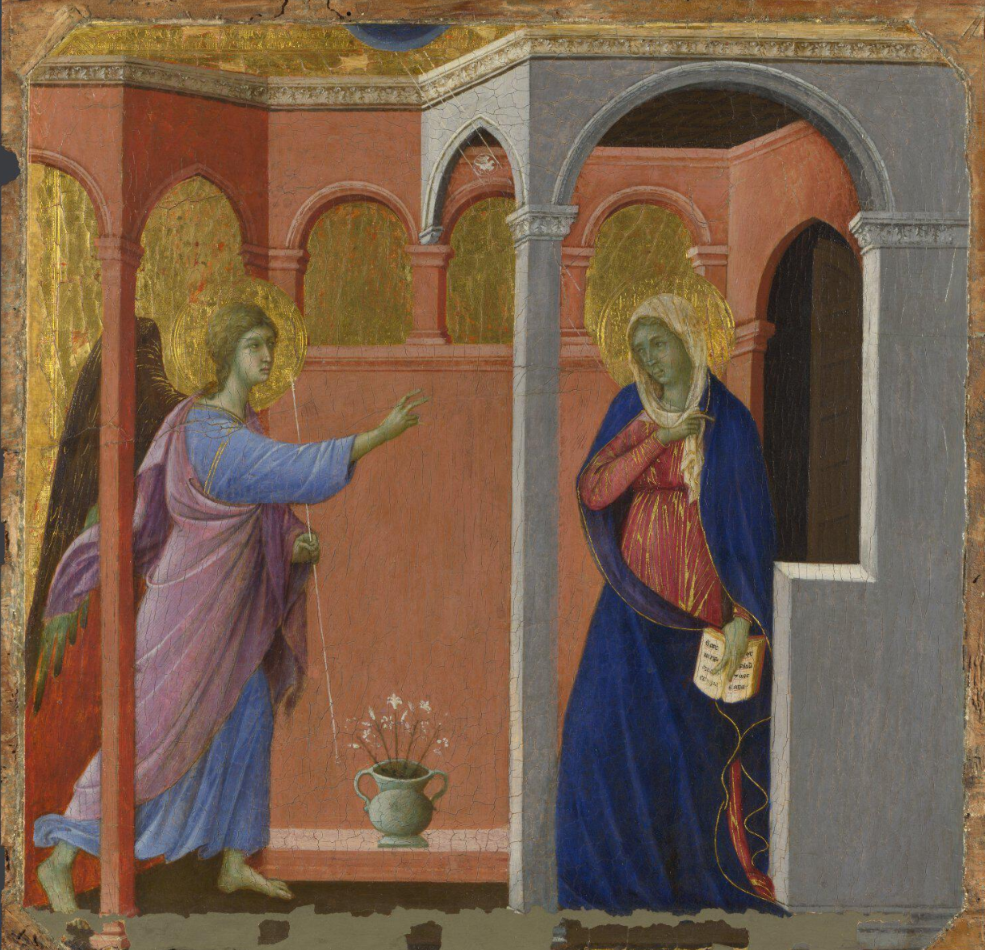
Duccio’s The Annunciation. Egg Tempera on Wood c 1307-11
The Annunciation by Duccio
Today, is the anniversary of the conception of Jesus Christ, called the Annunciation. I told some of this story yesterday which was St Gabriel’s Day. So, sorry for any repetition but I think the extra detail makes it worthwhile! There is a third post in my Annuciation series where I go into the wider implications of the date March 25th, and how it has a fundamental place in Christian Theology.
The picture above is by Duccio, from Sienna in Italy. It shows the Archangel Gabriel bringing Mary the news that she is to give birth to the Son of God. It is in the Sainsbury Wing of the National Gallery. This was the second painting on the National Gallery tour I used to give. The Tour told the story of the development of perspective. I had been reading a book on the subject by David Hockney.
The painting shows that Duccio does not understand single-point perspective. But then, no one could do perspective at that time in Europe. This skill was lost following the Roman Period. But at the beginning of the 14th Century, painters like Duccio from Sienna, and Giotto from Florence, were groping towards more realistic representation.
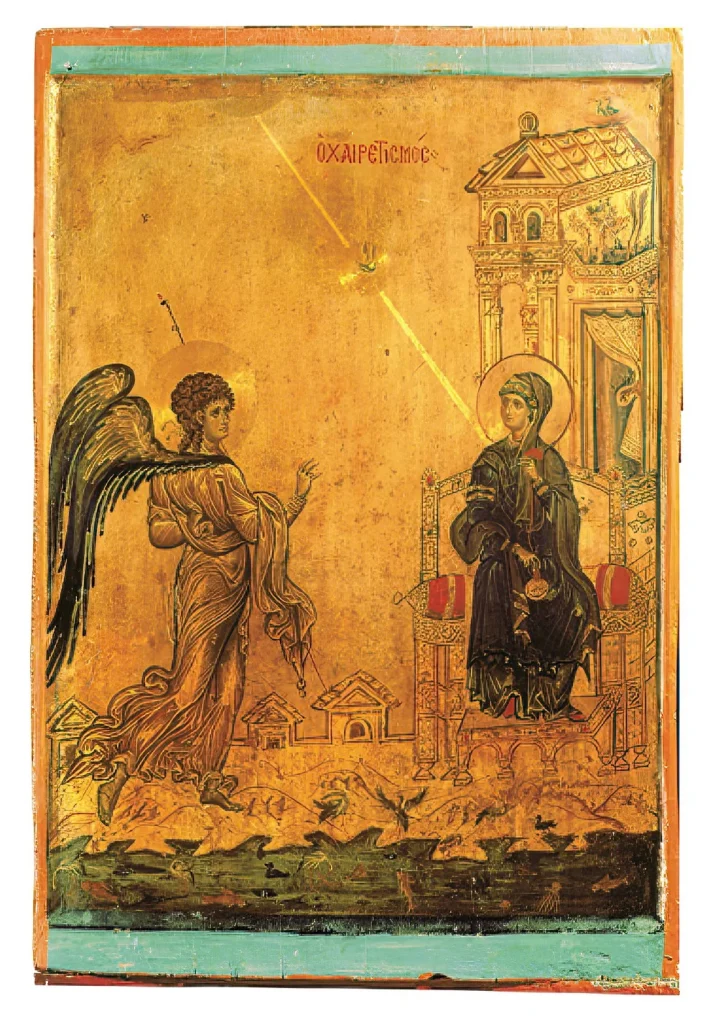
You might say they wanted a more human depiction, in which events are shown in spaces that are trying to look real. Filled with more realistic looking people and beginning to show on their faces real emotions. Previously, the Byzantine style produced iconic, storytelling images, that were somewhat cartoon-like rather than realistic. Here, is a detail from one such.
The Annunciation, St Catherine’s Monastery, 12th Century.
The encounter takes place in a space that is not very real. But it does tell the story effectively.
Moving towards Perspective
Now, look at the Duccio, he uses the arcading at the top of the painting to give an impression of this being an encounter in a real space. The Archangel Gabriel is moving through that space decisively. This is not just a picture with a story, it shows Duccio’s interest in capturing a fleeting but incredibly emotional moment. It happens to be the most important moment in the history of the world (from a Christian view point), the moment that the son of God is conceived as a human.
Gabriel is striding purposefully towards Mary, who has come out of her house to see him. He saying ‘Hey, you are going to give birth to the Son of God.’
She looks overwhelmed, (as you would) holding her arm protectively towards her. ‘What me?’ she might be saying. But she is also pointing at the Bible where this moment in time is predicted by Isaiah. Their faces are quite realistic, Mary is clearly emotional.
Also, if you look at Gabriel’s feet he is quite well grounded unlike many other medieval paintings, where people often seem to be floating above the ground. Mary, too is firmly, anchored, although you cannot see her feet.
It is by no means ‘perfect’ because they don’t yet know the rules of perspective. Neither have they discovered they could use lenses to create ‘photorealistic’ portraits. But they are searching for methods that can bring spaces and people towards realistic life. It mirrors a humanistic trend to see Mary not as a sort of Goddess, but as a real mother. A key point in the Renaissance. (For more on perspective, see my post on Giotto and Palm Sunday. )
The Moment of Conception
Above the arcading can be seen a small sphere of blue sky from which emanates several ‘rays’ and a tiny Holy Dove. As I told the story, yesterday, the rays are coming from Heaven to her womb which is hinted at by the red of her dress. The National Gallery commentary, which you can read here, suggests ‘The conception takes place at the moment she hears the words, which is why a tiny white dove, representing the Holy Ghost, flies towards her ear‘.
This made me stop and think – the tiny dove is heading to her ear is it? Really? Why? Gabriel is the messenger saying the words, the words head to the ear. The Holy Dove is a symbol of the Holy Spirit, part of the Trinity of Father, Son and Holy Ghost. Its role, in the painting, is to show that God is the Father. So why, would the Holy Spirit enter by the ear?
I have been using a ruler to try to see if the National Gallery are right! It’s difficult to be sure with a reproduction. but my ruler says the rays from Heaven are neither heading to the ear nor directly to the womb but in the general direction of her body. If they are right that the rays from heaven are heading for her ear, then is this rather the moment she is being told she will conceive rather than the moment of conception?
The Conception in St Luke
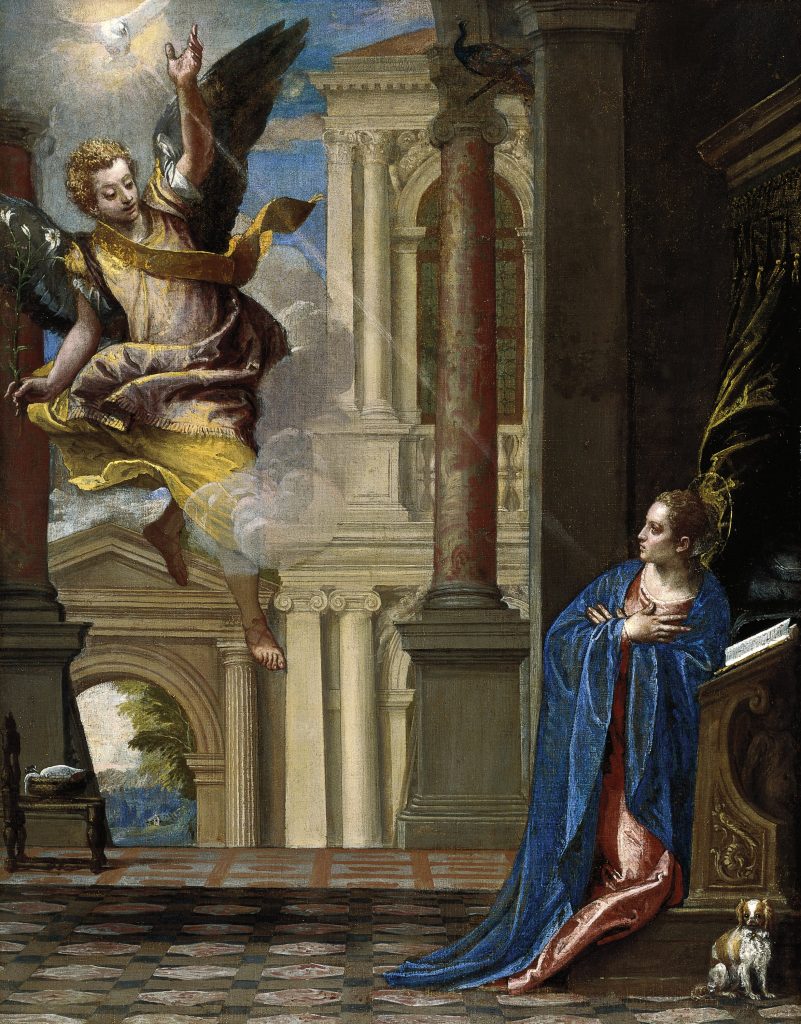
Veronese ‘The Annunciation’
But the National Gallery text accepts that it is the moment of conception that is shown. So, I’ve looked at Luke 1:26-38:
‘Do not be afraid, Mary, for you have found favour with God. And now, you will conceive in your womb and bear a son, and you will name him Jesus.‘
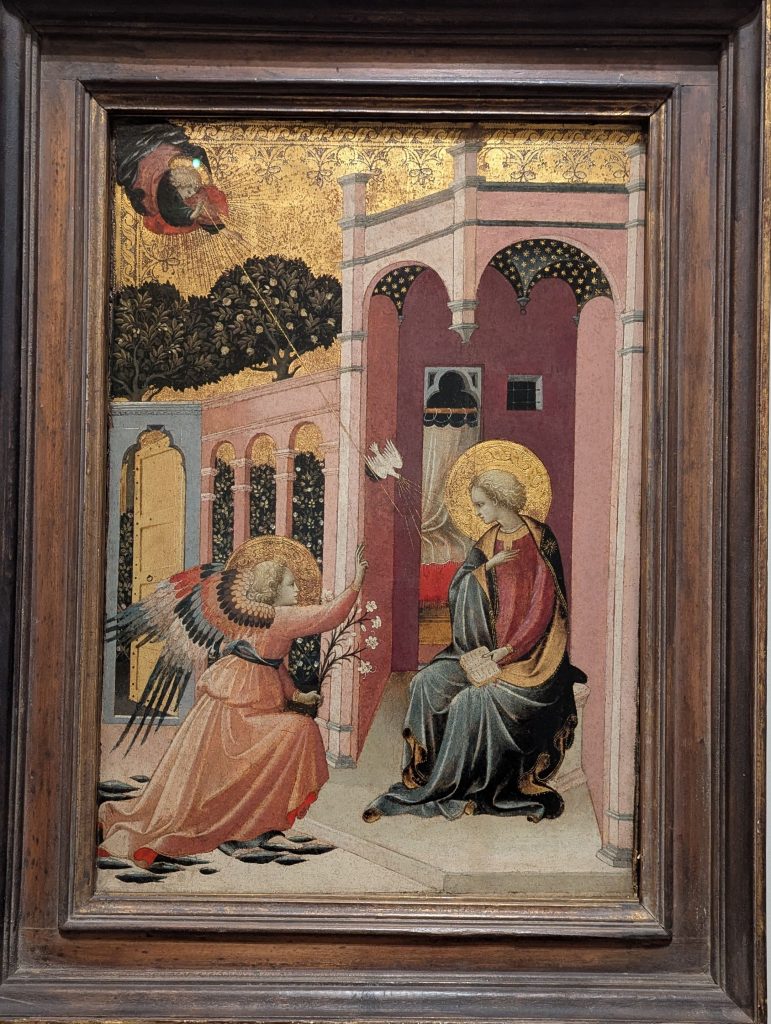
On first reading he is telling her she will conceive, but reading it more carefully he is saying ‘now, you will conceive’. So Duccio is paying very careful attention to the Gospel. By the time Gabriel finishes his sentence, she will have been impregnated by the Holy Dove. Looking at other paintings of the Annunciation the rays from heaven head generally towards the virgin, sometimes to her head, nothing suggesting the ear. In the St Catherine’s Monastery’s Annunciation, above, the ray is going to Mary’s back. Veronese’s ‘The Annunciation’ is similarly going towards Mary’s Back, shoulder, or breast. The Annunciation by the Master of the Judgement of Paris which I showed yesterday has the ray heading to Mary’s lap.
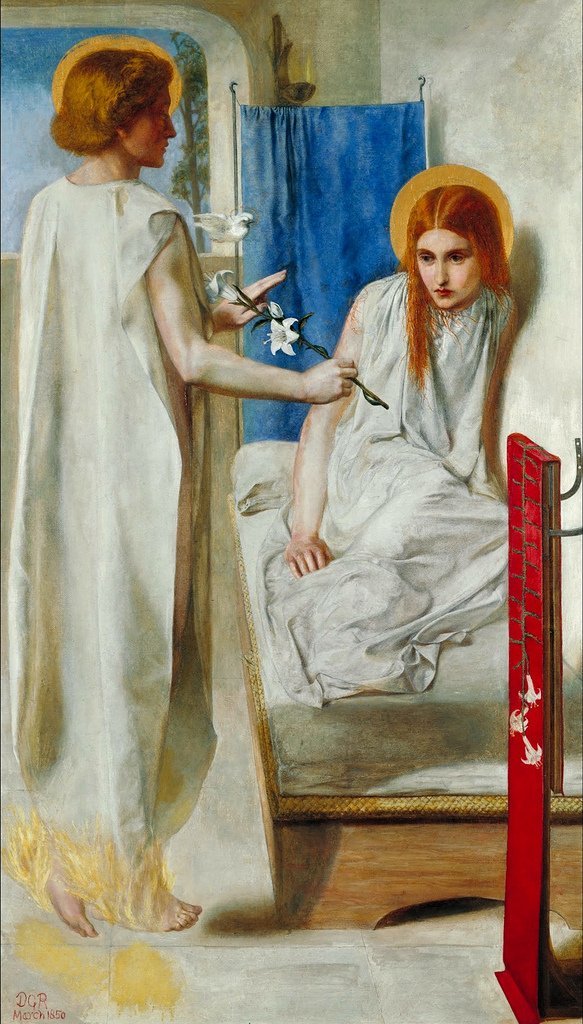
Rossetti’s Annunciation
The Annunciation by Rossetti originally known as Ecce Ancilla Domini! 1849 – 1850
I’ve included a 19th Century Rossetti painting because it is so beautiful. It shows a lilly representing purity, instead of the rays, pointing to Mary’s womb. The use of white throughout also represents Mary’s ‘purity’. While the Blue is the traditional colour for Mary. The use of the primary colours red and blue with the predominant White, gives a vivid clarity to the picture. At the time, showing the Virgin as a red-head was quite controversial.
By the way, look at the feet in the Rossetti’s painting. This is an early Rossetti painting, who was a poet and I’m not sure he yet had the skills to ground feet. But he takes advantage of it in this case and confirms Gabriel’s supernatural status by giving Gabriel fiery feet but no wings. Subsequently, Rossetti concentrated on paintings of women from the waist up. Since, first writing this, I have visited an exhibition of Rossetti’s drawings, and they show a very capable draughtsman.
For more on March 25th and the Universe and everything, see my post here (which will be revised later today).
On This Day
If Easter fell on March 25th it was thought to be bad news, particularly if on Good Friday. As the world was created, according to Christians, round about March 25th, God being a logical being, would end it on its anniversary. And all those people who went to the top of the hill, to see out the Day of Judgement, had to trudge down again, murmuring ‘Maybe next time.’ Hampstead Heath was a popular place for Apocalyptaphiles to go in London, the Green next to White Stone Pond, to be precise.
1306 – Robert the Bruce crowned King of Scotland.
1807 – The Abolition of the Slave Trade Act became law.
1843 – the first Tunnel built under a River was opened at Rotherhithe designed by Marc Isambard Brunel, and helped by his son Isambard Kingdom Brunel. I managed the Brunel Engine House for a few years, which was the steam engine house to pump out the water from the tunnel. In fact, a Babylonian (?) Queen built the first tunnel under a River, but what she did was divert the river, build the tunnel, redirect the River back to its original course. So strictly, the Brunels built the first tunnel constructed under a River while the River was still flowing above. I find that most firsts are much more complicated that you think!
1949 – Hamlet became the first British Film to win the Oscar for Best Film. Lawrence Olivier also won the Best Actor Oscar and he was the Director of the Film too. Olivier was the first person to achieve this double feat, and the only one until 1998, when Roberto Benigni won both Oscars in Life Is Beautiful.
Source: Chambers Book of Days
First published 2024, revised 2025, Revised and On This Day added 2026
The Annuciation St Gabriel and the Virgin Mary by the Master of the Judgement of Paris c 1430-1440. Courtauld Gallery. Note the ray of light coming from God (top left), nearly winging the Holy Dove, and heading to the book in Mary’s Lap where it is held by her hand. Gabriel has arrived on the dot. This depicts the moment that Mary is impregnated. Photo K Flude
Today, is St Gabriel’s Day, or rather it was. Because the Church amalgamated the Archangel’s Celebration onto St. Michael’s Day, or Michaelmas on October 11th. It is now St Michael and the Archangels Day. You can read all about this in my post here.
Angels and Archangels are a complex and disputed subject. Angels appear in many religions in some guise or other. But they sit in a difficult place in a modern monotheistic religion. Does an omnipotent God need whole levels of messengers and intermediaries? And Angels and their heavenly host are they semi-divine demigods? For more about Archangels read my post here.
St Gabriel’s Day, is the eve of the Annunciation. The day he announces to the Virgin Mary that she is pregnant with the Son of God. The most important news the world has had, if you believe in the story. But more about that tomorrow. Tomorrow, March 25th is, from a Christian perspective, the most important day in the history of the Universe (if you are a Christian). It is:
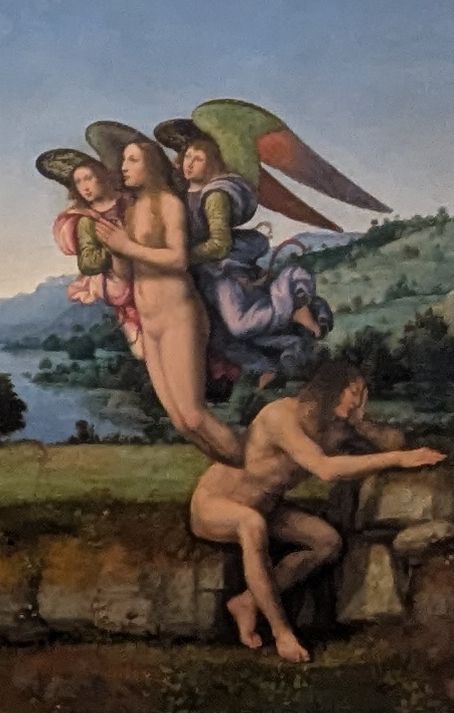
The Birth of Eve, supported by Angels Detail from The Creation and Fall of Man by Mariotto Albertinelli 1513-14 Courtauld Gallery, photo K.Flude
St Gabriel’s Day, the National Gallery, the Courtauld, Italian Food and Mrs Malaprop
My interest in St Gabriel began when I was Course Director for the Road Scholar programme ‘London in Depth’. What I love about working for Road Scholar is the opportunity it gave me to spread my didactic wings. So, I could order a specialist to guide my group in the National Gallery or do it myself. I chose the vainglorious choice. But I loved standing in front of a painting in the Sainsbury Wing talking about the renaissance development of perspective with a Giotto behind me, a Masaccio on the horizon and Duccio’s Annunciation in front of me. I created the narrative myself but what a thrill to speak about a painting with such, perhaps unjustified, confidence? I was a mere Archaeologist after all.
Egregious Malapropisms
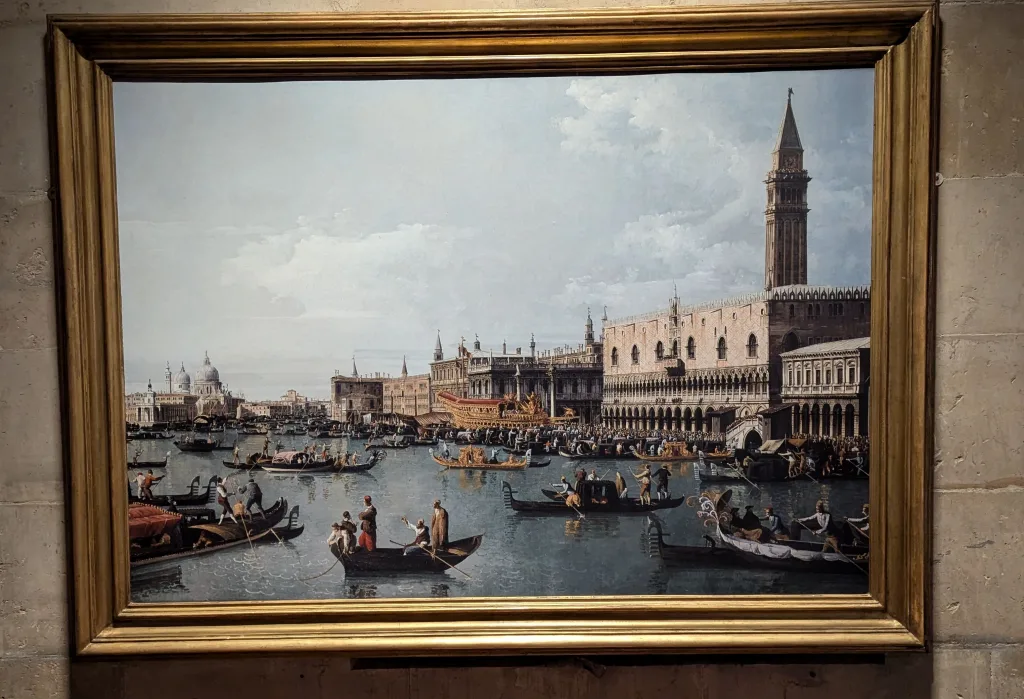
Canaletto. Venice.Castle Howard.Photo K Flude
The tour went on via Michelangelo, Leonardo, Titian, Holbein and wound up with a Canaletto of two. I did it for maybe 10 years, and loved it. On one tour, I finished, went for lunch with a nagging worry in my head. I mulled it over. Had I really stood in front of a precise work of architectural perspective, and enjoined my group to look at the simple way Cannelloni had rendered the water in the Grand Canal?
Yes, I had manifested Mrs Malaprop. I’m not sure what Canaletto would have thought of it! The practice is named after a character in the Rivals by Sheridan. Defined by Wikiepedia as:
‘a malaprop, acyrologia or Dogberryism) is the incorrect use of a word in place of a word with a similar sound, either unintentionally or for comedic effect, resulting in a nonsensical, often humorous utterance.‘
Anyone for a Panini?
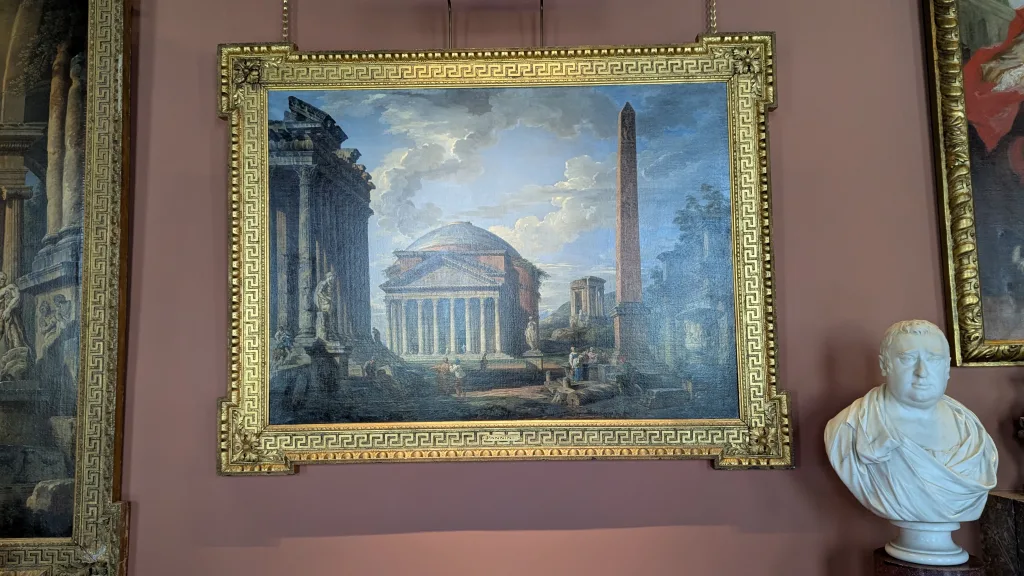
Panini showing the Pantheon Rome. Castle Howard Photo by K Flude
Shamed, but the worst of it is that there are so many Italian Painters (and footballers for that matter) who sound like food. And the fear of repeating that faux pas, lives with me. Whenever I go with a group to any Stately Home, not only will there be a Canaletto or two, but also there is bound to be several Paninis. When I tell my group ‘Look at the Panini’ I feel a momentary shudder of fear: can he really be called Panini?
Courtauld Gallery
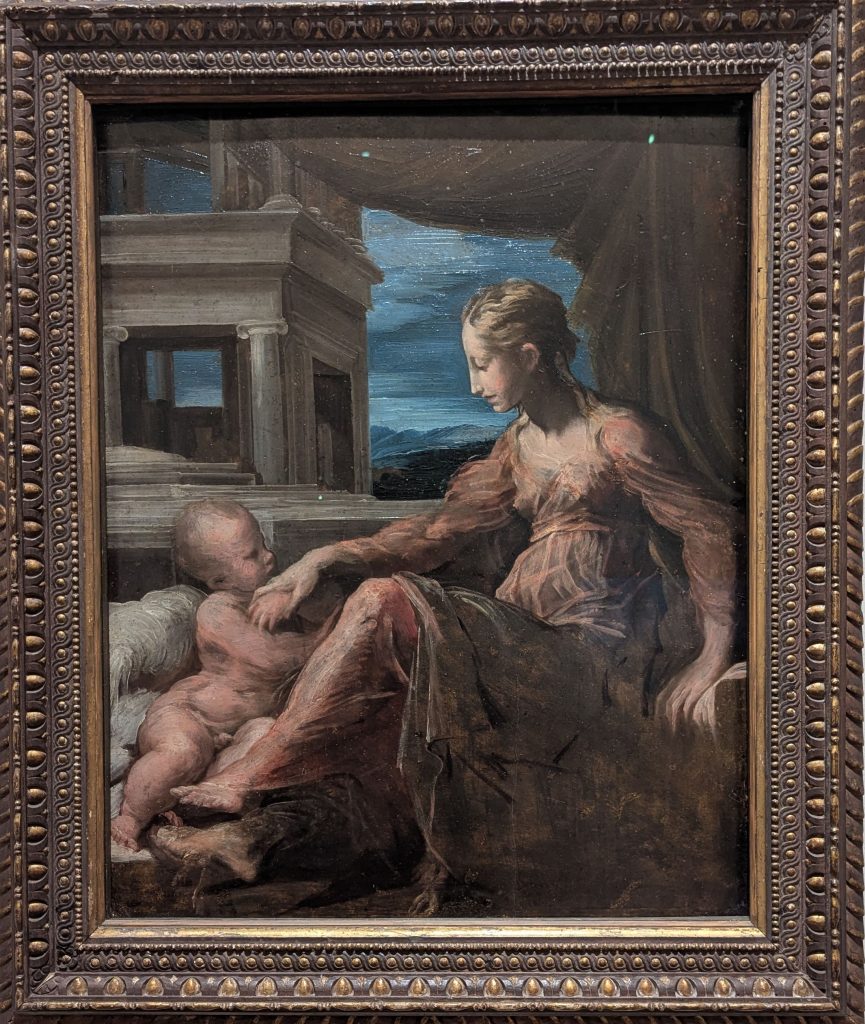
Virgin and Child’. Parmigianino .around 1527-28
So, On March 24th 2025 I was in the Courtauld, enjoying the pictures, the old rooms of the Royal Academy and photographing paintings. Looking for something for St Gabriel’s Day or anything else that might be useful for the Almanac of the Past? Out of the corner of my eye, in a Renaissance room, I spotted a painting that seemed out of place. A stunning painting but the woman looked modern or at least 19th Century, and the colour palette very subdued and certainly not like most Great Masters. I looked at the label ‘Virgin and Child’. Parmigianino. Whose real name turns out to be Mazzola. I rest my case.
It’s a great gallery! Do visit.
On This Day
1603 – Queen Elizabeth I died in the small hours of the morning of March 24th. Sir Robert Carey immediately set off on his horse to be the first to tell James VI of Scotland he was now King James I of England.
He left around 9.30 got to Doncaster by night time. Next night he got to his own house in Witherington in the Borders Country, Next day he left for Edinburgh but fell off his horse. So didn’t get to Edinburgh until James was about to go to bed. He was carried to the King’s Chamber and knelt, saluted him by his new title King of “England, Scotland, France and Ireland”.
1944 – 76 out of 200 potential escapees, escape from the German Prisoner of War camp Stalag Luft III. The camp was especially built to hold persistent escapees. Three tunnels were built, Tom, Dick and Harry. Tom was discovered. Dick was abandoned. But on March 24th. 200 prisoners were ready to escape through Tunnel Harry. But the attempt was discovered when the 77th person came out of it. Of the 76 who escaped, only 2 got out of occupied Europe. One got to Sweden the other to Spain. Hitler wanted to execute the 74 who were recaptured but was persuaded against it. Instead, 50 recaptured prisoners were deliberately shot ‘while trying to escape’. The Great Escape film (1963) is based on the escape. To read more, see the BBC report here. Or for those who love detail here.
Baptist Hicks and his, wife, Elizabeth in their Chapel at St James Church, Chipping Campden (Photo Kevin Flude)
This anniversary commanded my attention because I spend a few weekends each summer in the Cotswolds. There I see the ruins of Campden House in Chipping Campden. This was burnt down in 1645. So, when I read about the burning down of Campden House in the 19th Century, it had to be another one. And it turns out this one is in Kensington, London, Both Campden Houses were built for Sir Baptist Hicks, Viscount Campden.
Baptist Hicks Rise to Aristocracy
Baptist Hicks is an example of the flexibility of the British system of aristocracy. Hicks was a commoner, the son of a wealthy Mercer from Cheapside in the City of London. A mercer traded in prestige clothes imported into England. When Hicks’ Father died, his mother, who is said to have been a moneylender, was resourceful enough to take over their mercery business. She made a success of it and eventually passed it on to her son.
The family shop was on the corner of Cheapside and Soper Lane. Soper Lane is where Queens Street is. Their shop was signposted by the sign of the White Bear. Soper Lane was in the Cordwainers Ward. It was the haunt of soap makers and shoemakers (cordwainers got their name from their use of Spanish Cordovan leather). But Cheapside, itself, was the home of Goldsmiths and generally a wealthy area.
Hicks was educated at Trinity College, Cambridge and at the Inner Temple in London. But despite the education as a lawyer, he chose to continue in the family business. He supplied members of the Aristocracy with silk, velvet, taffeta, and other expensive fabrics. He rose to be Mercer to Queen Elizabeth I in 1598, and supplied James VI of Scotland. Indeed, he provided velvet, damask, and satin for the coronation of James 1st on 25 July, 1603.
As his business grew, he was able to lend large sums of money to the aristocracy and the King. He was duly knighted in 1603. He was still running his shop but was elected as an MP. Now, Hicks needed a country estate to further his transition to the aristocracy. So, in 1608, purchased the manor in Chipping Campden. Here he built a splendid new Mansion.
Baptist Hicks and Campden House, Kensington
At about the same time, he won a game of cards with Sir Walter Cope of the Strand. Cope was engaged in building himself a mansion (Holland House) on top of the Hill in Kensington. Hicks won a few acres of the Estate at cards. And he asked Cope’s architect John Thorpe to design him a house, which Hicks called Campden House after his Cotswold estate. Thus, Kensington became fashionable, and Campden Hill got its name. Campden Hill runs into Notting Hill.
After Baptist Hicks death there were many tenants of the house. One was Princess Anne before she became Queen Anne. Also Lady Burlington and her son, Richard Boyle, who became Britain’s first Palladian Architect.
Hicks was made a Baron in 1620 and Viscount of Campden in 1628. (a viscount is 4th in the ranks of aristocracy, being below an Earl and above a Baron). He died in 1629. He was buried in a very impressive marble monument in St James Church, Chipping Campden shown above.
Campden House, Chipping Campden
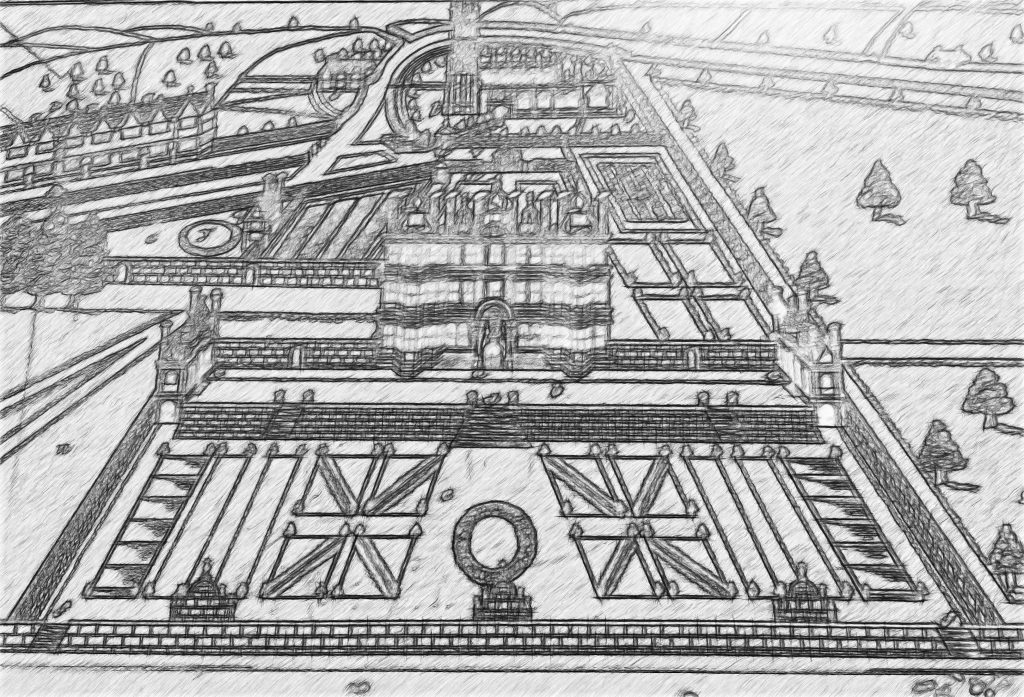
Sketch from a display of Campden House, Chippping Campden. St James Church at the back, House in the Centre, Banqueting Houses in front of, and other side of the house. (A Banqueting House was originally where you had your pudding.)
After his death, the house in Chipping Campden was held by the Royalists in the Civil War. But the Parliamentary Army forced the King’s men to retreat towards Oxford. Prince Maurice ordered the house to be burned down. All that survives of the property are two banqueting houses, and the entrance. All show what a fine building it was.
Sketch from photo of the entrance to Campden House, Chipping Camden.
Behind the wall can be seen the fire reddened ruin of the Banqueting House of Campden House, Chipping Campden. Photo of the other Banqueting House to follow in April
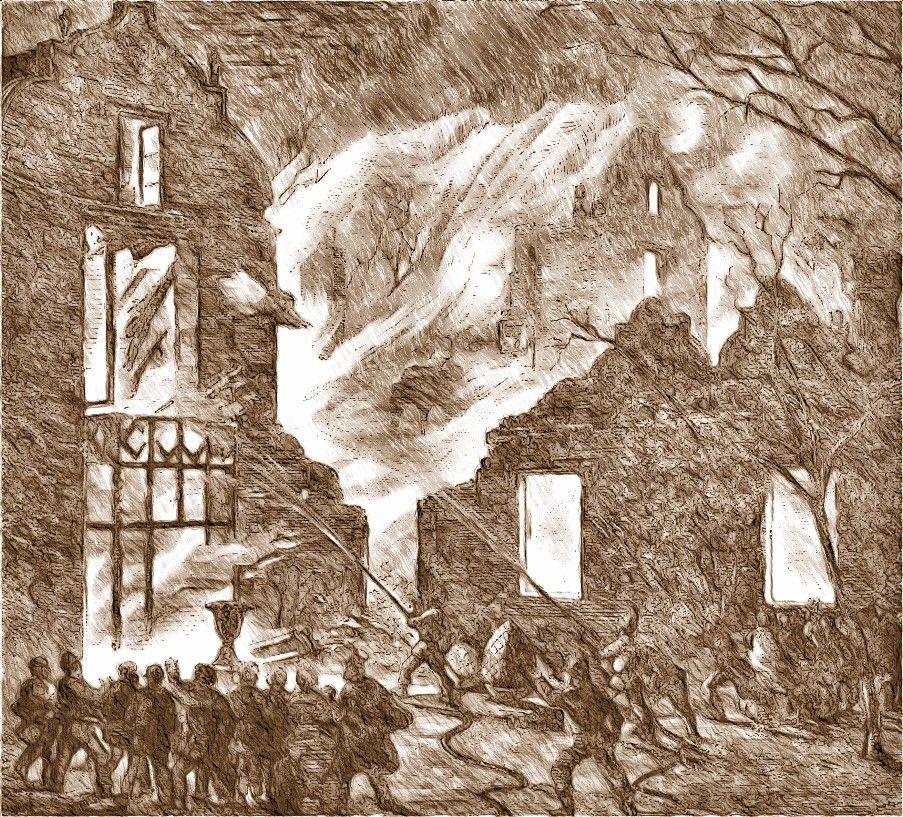
The fire at Campden House on 23rd March, 1862 gutted the building. It is really well described in this post. Briefly, a neighbour saw the fire. A fire engine was summoned. But before it could arrive, a servant appeared at a window. Her son tried to push past her, and she fell out of the window but survived. When the fire engine arrived, it was too late. So the house and its wonderful contents were destroyed. The owner was sued by the Insurance Company for fraud, but they lost the case.
Sketch from contemporary Magazine,showing the servant dropping out of the window. )In reality it was a first floor window.)
The English Year Almanac
I came across the anniversary of the fire in a secondhand book I picked up. It is by my old boss, Sir Roy Strong. The book is called ‘The English Year’. It is co-written by Julia Trevelyan Oman. The contents are ‘A Personal Selection from Chambers’ Book of Days’. Last year I also purchased the Chambers book on Abebooks for £2.10!) Both have been a useful source of information for my Almanac of the Past.
Sir Roy Strong was the Director of the V&A. Sir Roy is a dapper dresser you might almost call him a neo-Georgian. Certainly, a bit of a dandy. I always thought he resembled Charles 1, one of our most ineffectual Kings. I didn’t really have much contact with him, being a lowly Assistant Keeper at the V&A. But at the one Keepers’ Meeting I did attend he seemed rather ineffectual as the chairman of the meeting. But this is mere gossip! And I mention it to show how wrong one can be, in judging people.
Because, when I consider the revival of the V&A under his tenure, my judgement was facile. Sir Roy transformed the V&A. The Museum had been damaged by years of under-investment in the building since WW2. Sir Roy began a campaign to restore the rich and very beautiful old Victorian interior design. The original Victorian Restaurant was transformed. The shop turned into a retail paradise. Generally, the V&A ceased to be dusty and old under his tenure. The wonders of the Victorian Museum shone again with rich and vibrant colours. It reminds me that good leadership is allowing beneficial change to happen. It’s not about the leader being a dynamic leader. It’s about moving an institution positively forward, which Sir Roy certainly did.
1769 – William ‘Strata’ Smith was born. (died 28 August 1839) Smith is known as the Father of English Geology. He was a Canal and Mining Engineer and created ‘the first detailed, nationwide geological map of any country’. (Wikipedia). He worked in a town just down the road from Chipping Camden, and there is a plaque to him in Stow-on-the-Wold which I will write up at some point.
1839 – OK, this is the anniversary of the first appearance in print of the word OK! OK? OK, so, I see you want more of an explanation. The editor of the Boston Morning post had an interest in abbreviations. Charles Gordon Greene in a satirical article about the editorial practices of the rival Providence Journal coined OK as an abbreviation for “oll korrect,” or “all correct”. The rest is history. For more on this story, go to the Smithsonian here. OK?
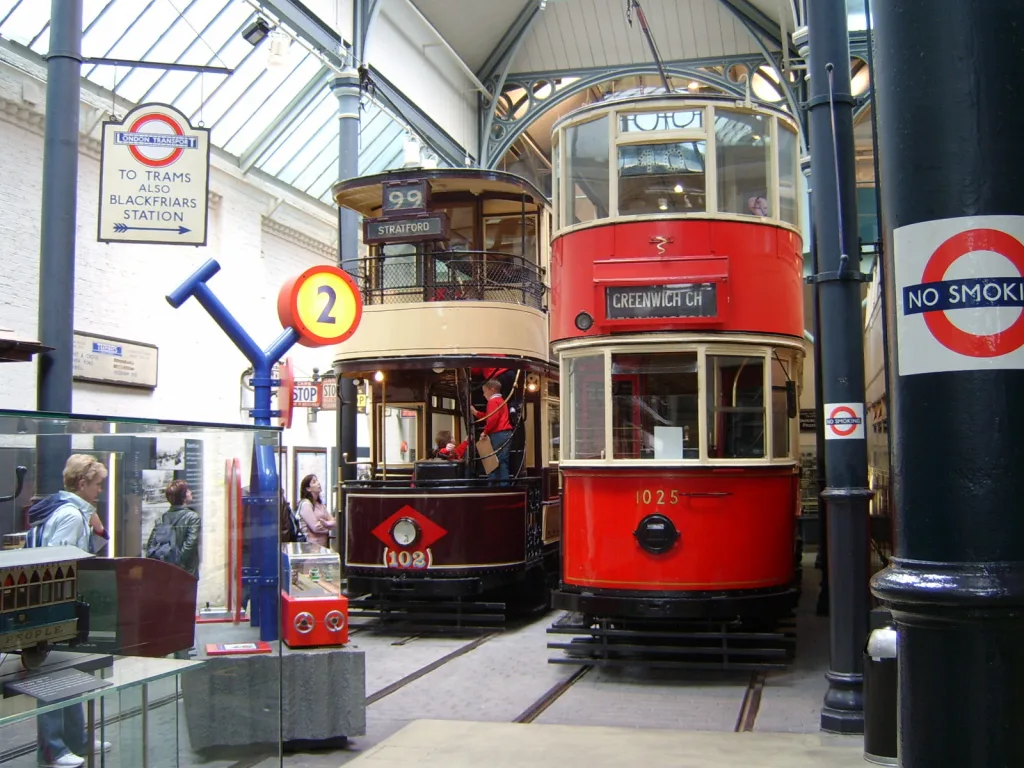
1861 – The first Trams plied London’s Streets.
London Trams, London Transport Museum (Photo KFlude)
1919 – Fascism invented when Mussolini founded the Italian Fascist Party. The repercussions of which led to World War II and the estimated deaths of 65 – 75 million people.
2020 – The UK’s first Covid-19 national lockdown ordered by Boris Johnson.