St Columba (St Colmcille) Day June 9th

St Columba st margarets chapel by Graham van der Wielen  Edinburgh  Lead glass
St Columba Stained Glass window in St Margaret’s Chapel Edinburgh Castle Photo by Graham van der Wielen Wikipedia CC BY 2.0

St Columba, or Colmcille is one of the most important saints for the early transmission of Christianity. He was born in 521 and said to be a descendant of the possibly legendary Irish King Niall of the Nine Hostages. But then again, there are legends that say he fathered a good proportion of the Irish.

Niall & the Nine Hostages

(Why do so many of my titles and subtitles sound like a 70/80s band?) The Hostages were a token of Niall’s power over Ireland as they came from the five provinces of Ireland. These are Ulster, Connacht, Leinster, Munster, and Meath. The other four hostages represented Scotland, the Saxons, the Britons, and the Franks.) His legend suggests he lived in the 5th Century (although some say 100 years earlier) and that he raided Britain and Brittany. It is also said that on one of his raids he captured St Patrick. (see my post on St Patrick) .

Iona

St. Columba was sent at an early age to be brought up as a Monk. He went on to set up Monasteries in Ireland at Derry and Durrow. In 563, he left Ireland, possibly because he got involved in a dispute that had a deadly outcome. He went into exile to Scotland and set up the famous Monastery on the island of Iona, Inner Hebrides. This is off the coast of what would one day be called Scotland. At the time, the west coast was under the control of the Kingdom of Dál Riata, which was, Gaelic, nominally Christian, and controlled parts of Ulster and Western Scotland. These people the Romans called the Scotti.

Picts

From Iona, Columba led the conversion of the Picts to Christianity. The Picts were Britons, speaking a different dialect of Celtic than the Gaels of Ireland and Dál Riata. Their name is said to have been given by the Romans and meant Painted Men. A shared religion, which St Columba brought from Ireland, helped towards the eventual union of the Gaels, the Picts and other British groups into the Kingdom of Alba.

Alba

Alba is the Gaelic name for Scotland – meaning white, and from which we also get Albion. Alba became Scotland, which is derived from the Roman word for the area which in Latin was “Scotia” (from the Scotti). Iona became the traditional burial place of early Scottish Kings such as Macbeth (Mac Bethad mac Findlaích). These Kings were crowned at Scone and buried in Iona. Alba was also able to take territory from the Anglian Kingdom of Northumbria, namely, the Scots-speaking areas South of the Firth of Forth. (Scots being a dialect of English). There were also Norse settlers in the Ireland so Scotland was made of a coalition of Gaelic, Brittonic, Norse, and Scots (English) speakers.

St Columba and the Loch Ness Monster

Much of the events of this part of Columba’s life are recorded by St. Adamnan in The Life of Saint Columba. This was written in the 7th Century, much of which is apocryphal. One notable story tells how he came across a group of pagan Picts who were mourning a child killed by a monster in the River Ness. St Columba revived the child. He then sent one of the Brothers to swim across the Loch to fetch a boat. The “water beast” pursued the Monk and was about to attack him when St Columba told the monster to stop. So it did, retreating to the depths of Loch Ness. Thus began the legend of the Loch Ness monster.

From Iona to Lindisfarne

St Columba died in 597AD. Iona continued to prosper and in, 634 sent St Aidan from Iona to found the Monastery at Lindisfarne. The island is on the Eastern coast of Britain in the Anglo-Saxon Kingdom of Northumbria. This Kingdom of the North Angles, was one of the most powerful at the time and Lindisfarne was instrumental in its conversion to Christianity. Also to the reconciliation between Celtic and Roman Catholic traditions, at the Synod of Whitby. The tradition of evangelism took hold in the British Isles, and it was from here that much of the German-speaking world was converted to Christianity.

This is St Columba’s legacy.

Northumbria’s Contribution to the development of Christianity

There is a developing understanding among scholars that this Irish inspired form of Christianity, fused with the Anglo-Saxon Northumbria took a leading role in ritual, art, scholarship in the Roman Catholic world. Just stop and think about that sentence for a moment. The northern parts of an out of the way set of islands off the edge of Europe took a leading role in the development of Western Christianity. This was highlighted in a recent exhibition of Anglo-Saxon art at the British Library.

British Library with Poster for Anglo-Saxons Kingdoms Exhibition, Photo K Flude

A look at the Lindisfarne Gospel and the Book of Kells showcases the amazing art of this period. For a real treat, look through this scrollable virtual copy of the Lindisfarne Gospel. (Currently this is unavailable, I suspect since the BL was hacked. So instead, here is a slightly breathless online introductory video of the Gospel.)

https://smarthistory.org/the-lindisfarne-gospels

The Book itself has been missing from the displays of the British Library for a couple of years, but was on display in Northumberland in 2022. I’m not sure whether it is yet back on display at the British Library. I think not. You can see the Book of Kells at Trinity College, Dublin or look at their online offering here: Not quite as joyous an experience as the online Lindisfarne but beautiful enough.

Carpet Page from the Lindisfarne Gospel
Carpet Page from the Lindisfarne Gospel Photo Wikiepedia Eadfrith –
Lindisfarne evangeliarium, tapijtbladzijde op f26v, Matteüsevangelie

Click here to read my post on Scone and the emergence of Alba.

Here is a virtual tour of Iona

Here is a 360-degree panoramic photo tour of Lindisfarne Abbey

For a tour of virtual treats about Celtic art follow this link: https://harvardartmuseums.org/exhibitions/6342/celtic-art-across-the-ages

First Published in 2023, revised, 2024 and improved 2025, and Niall & the Nine Hostages added 2026
The Ashmolean Museum First Opened May 24th 1683

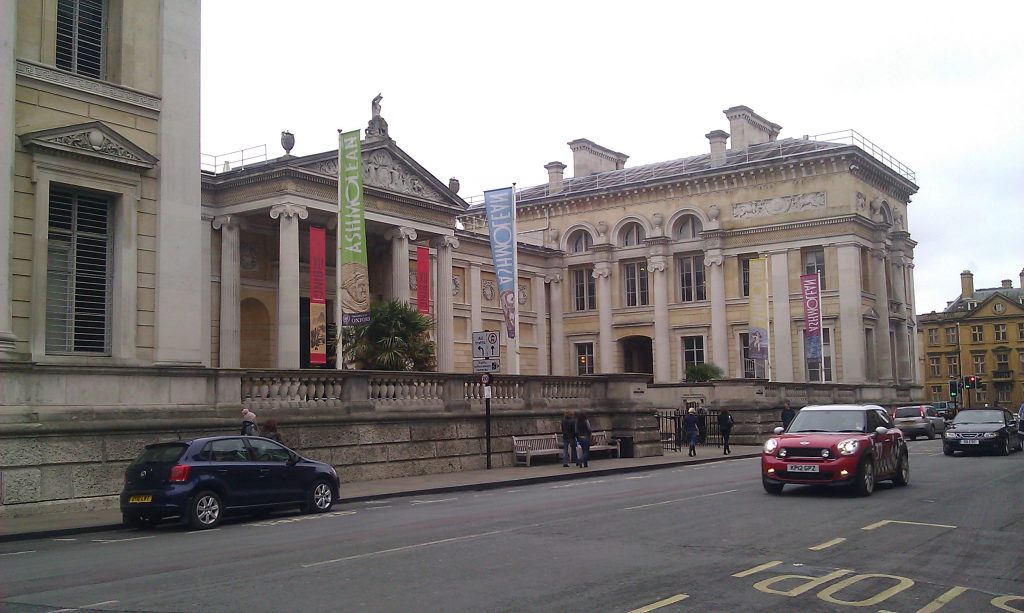
The Ashmolean Museum, Oxford Photo K. Flude

The Ashmolean is a lovely museum. It’s like a miniature combination of the British Museum, The National Gallery, and the V&A. It has a superb collection including the Cretan Archaeology excavated by the Museum’s Director, Arthur Evans in Knossos. Not only that, but it is Britain’s oldest secular Museum, opening over fifty years before the British Museum.

But its origins are even older. This is a story near to my heart. And and I’m going to tell the story as it was told to me by Mrs Nicholson. She founded the Garden History Museum (now Garden Museum) and a formidable person. I was the part-time Curator for a few years in the 1990s.

The Garden History Museum

The Museum is in St Mary’s Church, Lambeth. The Church, despite being the last burial place of various Bishops of London, was going to be made redundant. Mrs Nicholson was not having this and launched a campaign to preserve it. In the graveyard was the grave of the famous Gardeners the Tradescants, father, son, and grandson. She hit on the idea of saving the Church by making it into the Museum of Garden History. One of the first in the world, apparently. Some years later, I was employed as the part-time Curator, despite knowing very little about flowers or gardens.

So What Has This to do with the Ashmolean Museum

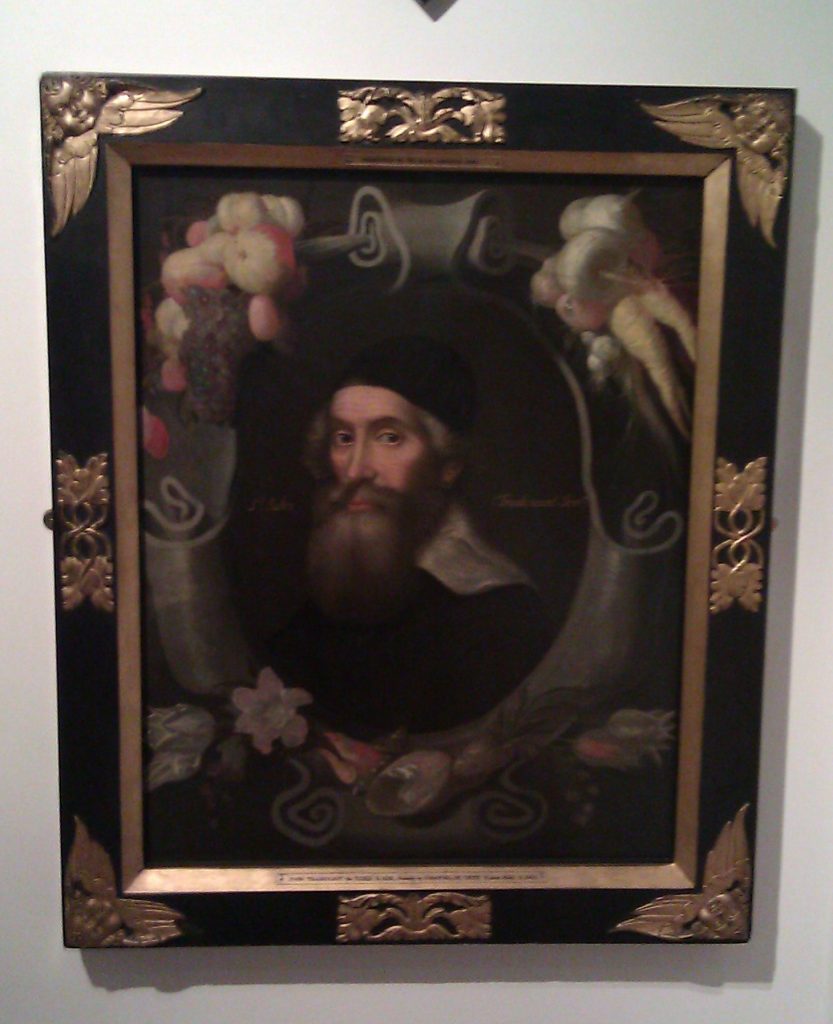
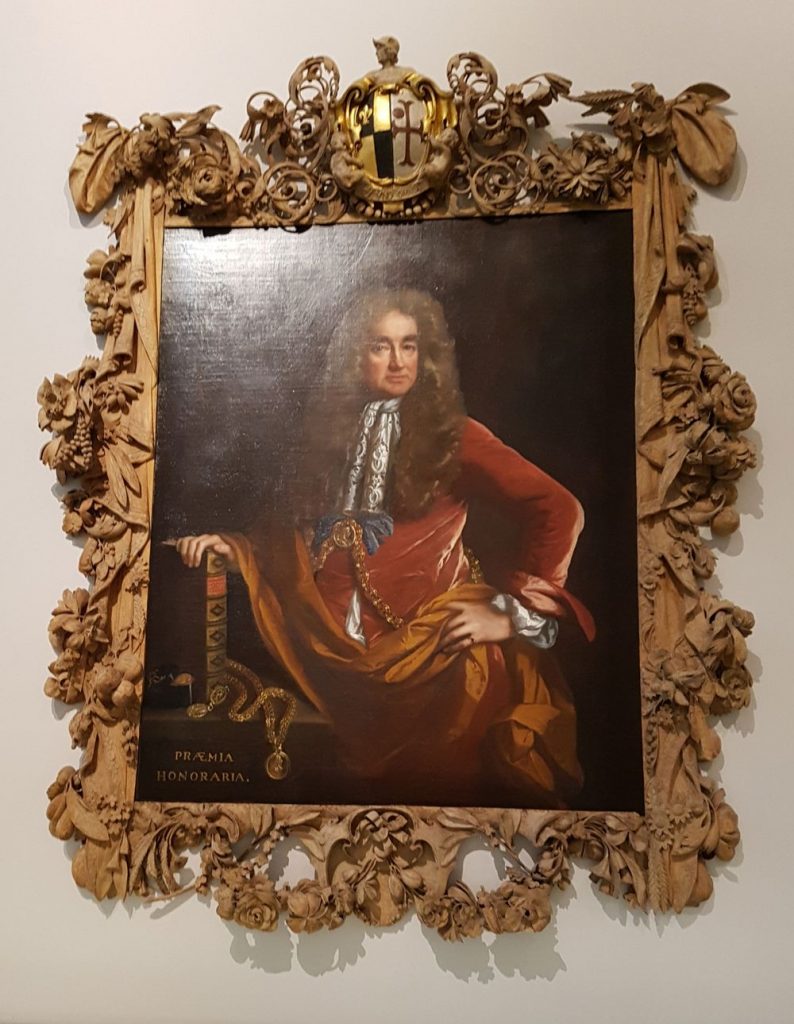
Elias Ashmole in a frame by Grlinling Gibbons, Ashmolean Museum, Photo K Flude

You are wondering?

When Mrs Nicholson came into the Church she stamped on the floor. I enquired why? And was told that this was where Elias Ashmole was buried. He being the founder of the Ashmolean Museum in Oxford. This is the wonderful story which I tell every time I take a group to the Ashmolean Museum.

Tradescants Ark

John Tradescant the Elder, Ashmolean Museum photo by K Flude

Apart from being among the first famous Gardeners in the UK, the Tradescants ran Britain’s first Museum. It was in Lambeth, London and was called the Ark. The cabinet of curiosities was famous in Britain and Abroad. It had many wonders, shells, sculptures, weapons, clothes, shells, a piece of the True Cross, a Vegetable Lamb, and the lamp held by Guy Fawkes in the Gunpowder plot

John Tradescant the Elder, collected for the Duke of Buckingham. He also helped build the fortifications at the La Rochelle for Buckingham’s disastrous expedition. Tradescant travelled as far afield as Africa to collect curiosities. He also wrote to Ships’ Captains travelling to Africa to bring anything strange back for him.

John Tradescant Junior and Elias Ashmole

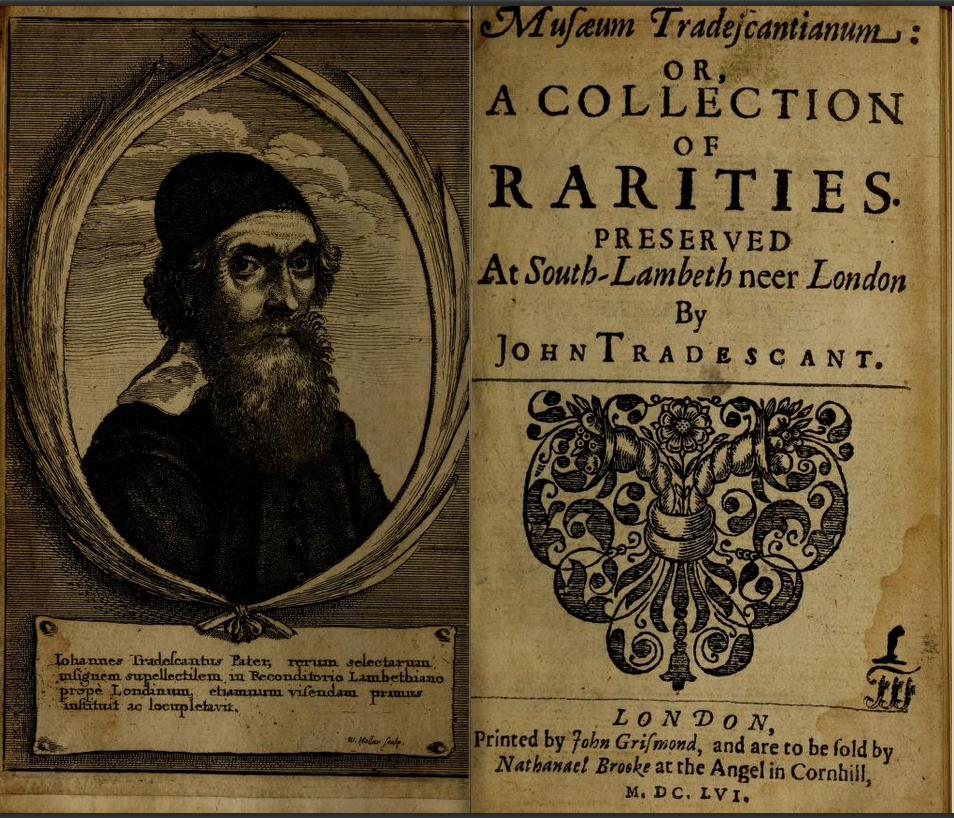
When he died, his son, John Tradescant the Younger, took over. Both the Gardening and the Museum. His neighbour Elias Ashmole helped out, and together they created Britain’s first Museum Catalogue (shown below).

Catalogue of the Museum Tradescantianum

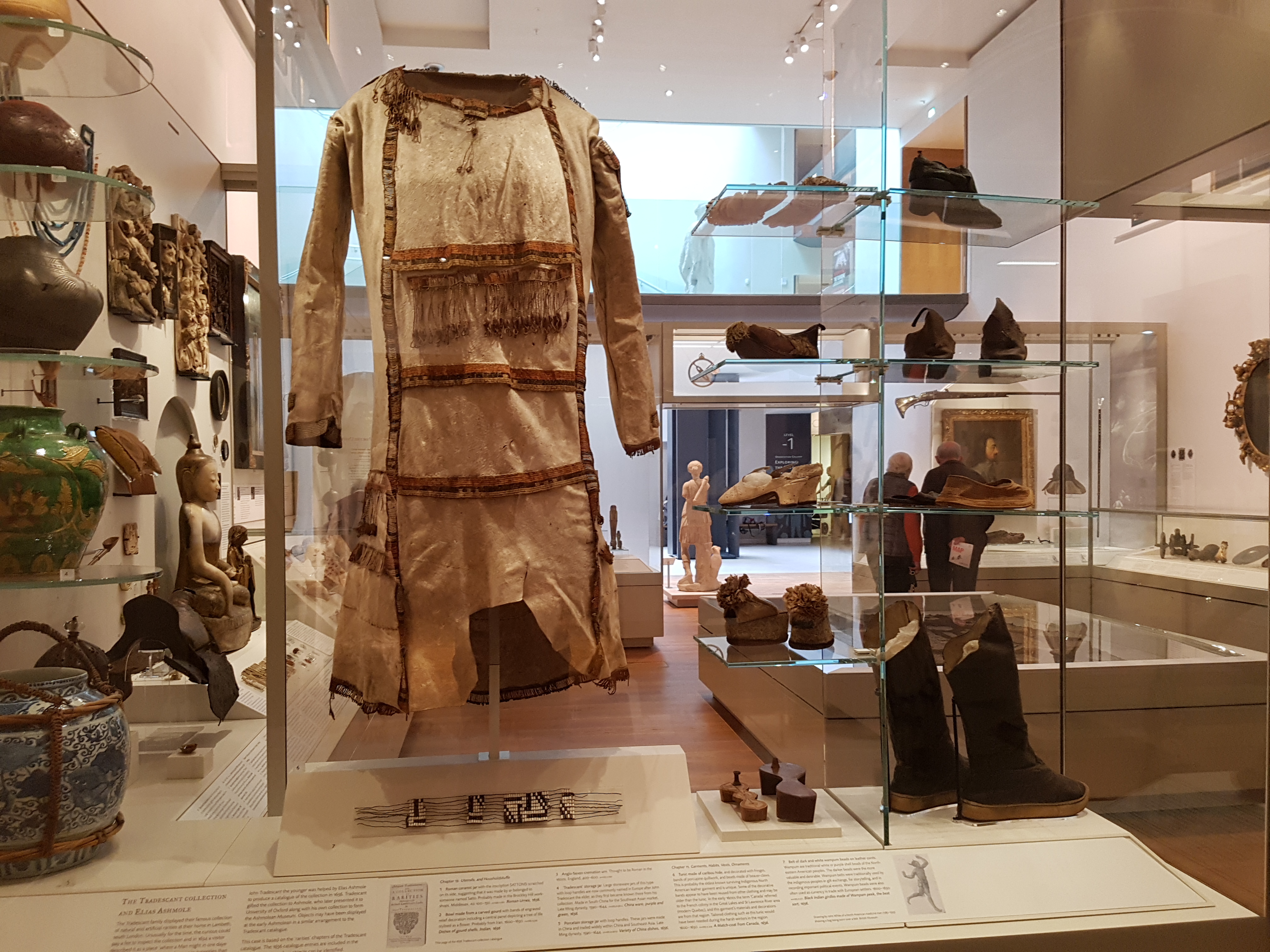
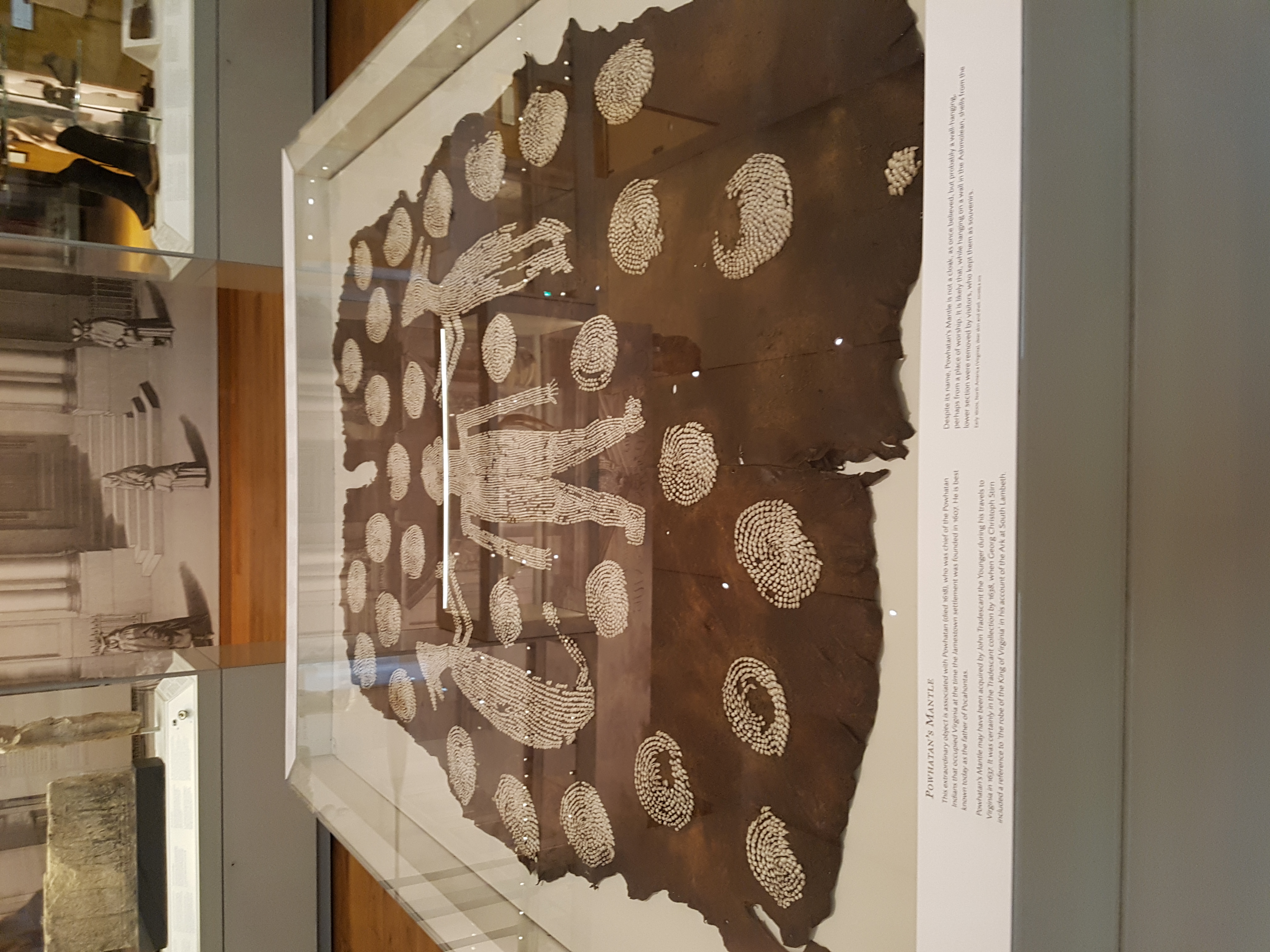
Sadly, the third John Tradescant, died. His father was bereft, and feared what would come of the wonderful collection. The collection his father had left him and which he had augmented. He travelled to America and bought back some of the oldest Native American clothing surviving, including Powhatan’s Mantle (or cloak).

One day, he went to the pub at Elias Ashmole’s request. They discussed the problem of the survival of the collection. Ashmole took out a document and told Tradescant that if he signed it, it would ensure that the collection survived. Tradescant signed it. Went home, his wife, Hester called him a fool and told him to rescind it. Ashmole refused pointing out it was a legal document that had been freely signed before witnesses.

Hester Tradescant and the Ashmolean Museum

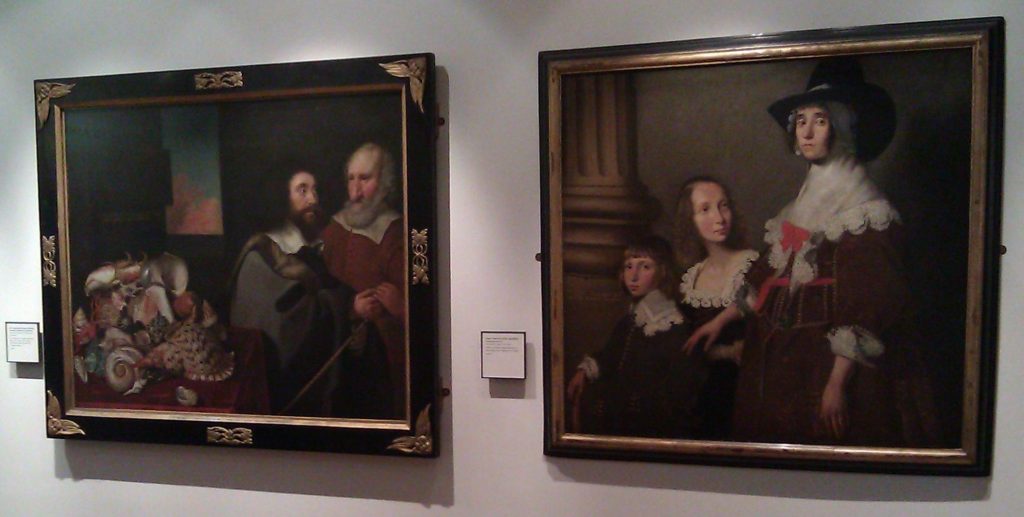
John Tradescant and his friend, Roger Friend with the collection of shells. right Hester Tradescant, daughter and John Tradescant the Youngest. Ashmolean Museum, photo K Flude

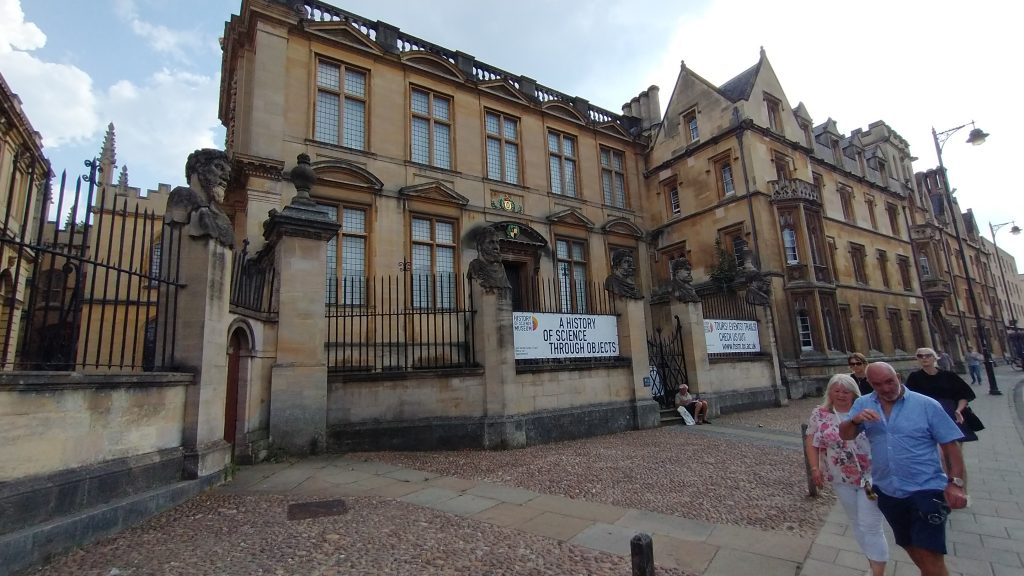
Tradescant died. His wife, who had control of the collection till she died, was legally harassed by Ashmole. He accused her of profiting from the collection. She was found dead in her garden pond. Ashmole shipped the collection up the Thames to Oxford. He made a legal agreement with the University to provide it a permanent home. They built the original Ashmolean which is still on Broad Street but is now the Museum of the History of Science. The building was not used just for a collection of ‘knic-knackery’ as it was called but also a laboratory, dissection theatre, and with meeting rooms.

The Original Ashmolean Museum in Broad Street. Photo k Flude

Now, the problem with all this according to Mrs Nicholson, was twofold. Firstly, Ashmole was responsible for the death of Hester. Secondly, the oldest Museum in Britain should be called the Tradescant Museum, not the Ashmolean. The core of the Museum was, after all, Tradescant’s Ark. (Ashmole did add his own collections to the Gift).. Mrs Nicholson could never forgive Ashmole for stealing the Tradescants’ glory. Arthur MacGregor, Director of the Ashmolean Museum was a trustee of the Museum of Garden History, and would point out that without Ashmole the collection might well not have survived.

For other posts relevant to Tradescant and Ashmole, see the following posts:

Cog Almanac’s on Display at the Ashmolean Museum:

https://www.chr.org.uk/anddidthosefeet/making-my-own-cog-almanac-for-my-halloween-walk/

the Duke of Buckingham and the True Cross:

https://www.chr.org.uk/anddidthosefeet/may-3rd-roodmas-the-true-cross-and-the-coronation/

Mr Ashmole’s cure for toothache:

https://www.chr.org.uk/anddidthosefeet/february-9th-st-apollonia-a-day-to-cure-the-toothache/

Arts and Crafts at the Ashmolean Museum:

https://www.chr.org.uk/anddidthosefeet/december-12th-ashmolean-advent-calendar-the-singing-pierides/

First Published May 24th 2025, revised 2026

The most important weather forecast in History D Day June 6th

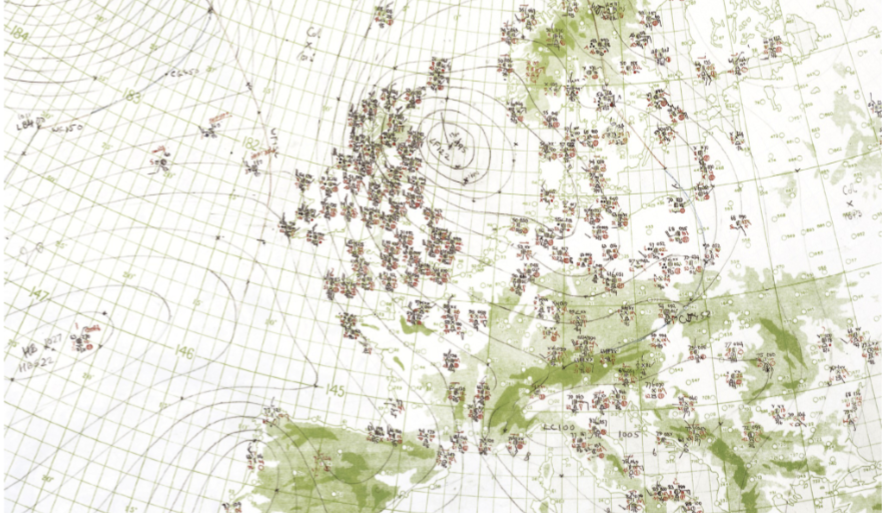
D Day Weather Forecast. North Atlantic chart of weather for June 6th 1944.  . Showing occupied Europe with observations obtained from the enigma machine

No Pressure – D-Day Weather Forecast

In 2014 or thereabouts, I went to a play by David Haig which was based on the true story of a weather forecaster’s role in D Day. James Stagg’s advice was that the weather on June 5th, the intended day, was too volatile. He suggested the 6th June 1944 instead.

The play, ‘Pressure’, is great because it really conveyed the enormity of the decision that Ike, Churchill, and others had to make.  To go ahead in bad weather risked enormous casualties and the failure of the Landings.  To postpone, might mean Hitler discovered the location of the invasions and might lead to disaster.

Major characters portrayed in the play included Ike and his driver, Kay Summersby with whom he was very close. Also depicted was an American forecaster who disagreed with the British meteorologist James Stagg.  How much of the play was for dramatic effect and how much is true, I’m not entirely sure but it is a fascinating D Day story.

The maps were hand drawn. They are partially based on intercepted data decoded by the enigma machine.  Stagg recommended postponing the landings one day from the 5th to the 6th of June. This provided the ideal combination of calm seas, low water at first light and a full moon would occur.

D Day Weather Maps have recently been  up for sale and are discussed here https://www.bbc.co.uk/news/uk-england-somerset-68845546

For more information the weather forecast for DAY read this article from the BBC website https://www.bbc.co.uk/weather/articles/c2995n9wgz8o.

On this Day

1683 – Ashmolean Opens, Britain’s longest surviving Museum, and the World’s First University Museum. Or at least June 6th is the opening date according to some people, and May 24th for others. See my post on the Ashmolean Museum here.

First published 2024, republished 2025., OnThis Day 2026

St Kevin’s Day June 3rd

St Kevin of Glendalough (Wikipedia)

Thank you very much to my subscriber for alerting me to St Kevin’s Day, which is my Saint’s Day. I was aware of St Kev and that the name meant ‘of noble birth’ but that was the extent of my knowledge.

But a little research on Wikipedia while on the train to visit my Dad, revealed that Kev lived to the grand old age of 120, born in 498 and died in 628.  As my Dad is 98 and still going strong, maybe he and St Kevin will inspire my longevity?

Briefly, St Kevin met the great St. Columba; had a poem written about him by the marvelous Seamus Heaney (https://poetryarchive.org/poem/st-kevin-and-blackbird/); a song by the Dubliners; several mentions by James Joyce and a long-distance path, the St Kevin’s Way, part of the Camino de Santiago network, named after him. And St Kev can help us understand the weather for the rest of June :

The weather on St Kevin’s Day will last all month‘. 

So that means, sadly. rain for the rest of June.  At least in Edinburgh where I currently am.

Live recording of Dubliners’ Song about St Kevin

Coemgen, as he is known in Irish, was a hermit, living in a cave-like ledge above a lake.  His piety attracted followers and a monastic settlement.  He was known for his ascetic life and love for nature.  So, a role model for all us Kevins?

His hagiography was written very late, so little of it can be confirmed. But, like other saintly hermits, he is associated with being tempted by women or the devil disguised as a woman.  (St. Anthony the Great, St. Benedict of Nursia, Saint Chrysanthus, St. Vitus,  St. Bernard of Clairvaux, St. Hilary etc.)  Unfortunately, rather than just resisting his temptress, Coemgen is said to have drowned her. Not so good!

On the other hand, my sister sent me this photo of a souvenir from a shop in Northumberland.

That’s more like it! And oh so true! Clearly we, handsome, clever, positive, analytical Kevins have a lot going for us, despite the name.

For more on the Temptations of Hermits read this article:

Nechita, Andrea.“Offering Body, Pleasure, and Wealth: The Visual Representation of Women Tempting Saints (Fifteenth and Sixteenth Century).”Annual of Medieval Studies at CEU, 20 (2014): 96-112.

On This Day

1726 – Birth of James Hutton – Father of Geology. Today is his tercentenary. An observant farmer (but much more) he realised that ‘”a vast proportion of the present rocks are composed of materials afforded by the destruction of bodies, animal, vegetable and mineral, of more ancient formation” (John Playfair). For example, Sandstone is on hills, and erodes to sand which is taken down river to the delta where it is laid down in the sluggish water. Time changes it into Sandstone, which uplifted into hills, starts the cycle again. He realised that this process must take millions of years, and thought it was part of a never-ending cycle. Both showing that the Creation myth in the Bible was metaphorical at best. At Edinburgh, where he was born, he spotted a layer of Dolerite which once must have been molten and which had forced its way into an earlier strata of sedimentary Rocks. This was Salisbury Crags which takes its place as one of those places key to the development of modern science. For more on the Centenary look here.

First written in 2023. revised June 2024, 2025, On This Day added 2026

First Zeppelin Raid on London, May 31st 1915

Zeppelin caught in the Searchlights

I republished this two days ago, but I think it did not get distributed to subscribers. So I’m posting it again. On May 31st, 1915 Zeppelin LZ38 came into UK airspace over Margate. It proceeded to Stoke Newington in N London at 10.55. It was a dark, moonless night. No searchlights found the ship, no guns fired. 15 aeroplanes scrambled but only one got a sighting. Engine trouble ended the pursuit.

The Zeppelin sailed up to 10,000 feet above London unopposed.

16 Alkhan Road was hit first but with no injuries. In Cowper Road Samual Leggart’s house was hit. In the panic the family got the children out, but found one was missing, found later, burnt to death while hiding under the bed.

187 Balls Pond Road was next to be hit, the Zeppelin following the A10 South towards Central London. Thomas Sharpling and family escaped, but 2 lodgers were found dead, kneeling by their bed praying.

The next bombs landed in Southgate Road, Hoxton and Shoreditch. In Hoxton Street a Russian Nightwatchman was attacked coming out of a burning building, mistaken for a German saboteur. The following days, ‘German’ shops in the area were attacked.

The attack continued to Bishopsgate Goods Yard, Spitalfields, Whitechapel, as the Zeppelin began its journey home via Whitechapel and Commercial Street. A bomb in Christian Street injured 9 pedestrians and killed one 8 year old boy. Then to Stepney, Stratford, Leytonstone where 6 bombs were dropped.

The raid took 20 minutes to traverse Central London 7 premises were destroyed. 7 dead.£18,000 of property damage. 91 incendaries, and 28 High Explosive bombs were dropped plus 2 grenades.

Source London 1914-17 The Zeppelin Menace by Ian Castle.

More Zeppelin stories in the Almanac of the Past.

Pallio di Ferrara May 31st

Pallio di Ferarra

Last year, on an archaeological reunion to Ferrara we attended the Ferrara Pallio.  Museum of London archaeologists, in the 1980’s worked with Italian archaeologists excavating medieval town houses in the centre of the historic town of Ferrara. Here is a video of the history of Ferrara and the excavations which includes a picture of a young me. (I’m standing up in grey cap-sleeved t-shirt.)

https://youtu.be/v4zQxFA_dYA?si=EdBMR3XZ3oDEBKOH

The Pallio is a traditional event taking place since 1259.  The town is divided into 8 contrade and each mounts a procession to the centre.  Here there is some tremendous flag waving and hurling accompanied by drums and trumpets.  Then the procession  to the Piazza di Ariosto, where there is a stadium for a horse track.  The procession marches around the stadium.  Then there are foot races, a donkey race and finally a horse race.  There is intense rivalry between the groups but a lovely atmosphere. 

Spectators have to be patient during the events to allow the joy of the winners to be shared with the winning contrade.  The final horse race takes an absolute age to begin because the horses will not settle. Apparently, there is some gamesmanship by trying to exhaust the other teams horses. It certainly exhausted me.  And once they got started at very long last they were recalled almost immediately. I decided to go to bed.

But you can see edited highlights on the official Ferrara youtube post here.

https://m.youtube.com/watch?v=zs0Vel67KpA

First posted June 2nd 2025, Zeppelin content added 2026.

June & Juno, Queen of Goddesses June 1st

Palazzo Scifanoia, Ferrara Showing Fresco of June

I republished this yesterday, but I think it did not get distributed to subscribers. So I’m posting it again. June is, probably, named after Juno, the leading lady of Olympus, sister and brother to the Great God Jupiter (Jove). In Welsh, it’s ‘Mehefin’ – Midsummer. Gaelic: ‘An t’Og mhios’ – the Young Month. Anglo-Saxon, ‘Litha’, the month of the Midsummer Moon.

June in Ferrara

The Fresco of June is from Palazzo Schifanioa, which was the home of the Este Family, theDukes of Ferrara. Borso D’Este in the 15th Century initiated the frescos on the wall of the Hall of the Months. There is one for each month, although not all survive in recognisable form. But above is June. The top panels show the Gods of the Month with their chariots or waggons. Below are the star signs for the month, and at the bottom a scene from the 15th Century seen from an aristocratic perspective. June has a delightful agricultural scene. Ferrara is a beautiful UNESCO World Heritage City.

June in the Kalendar of Shepherds

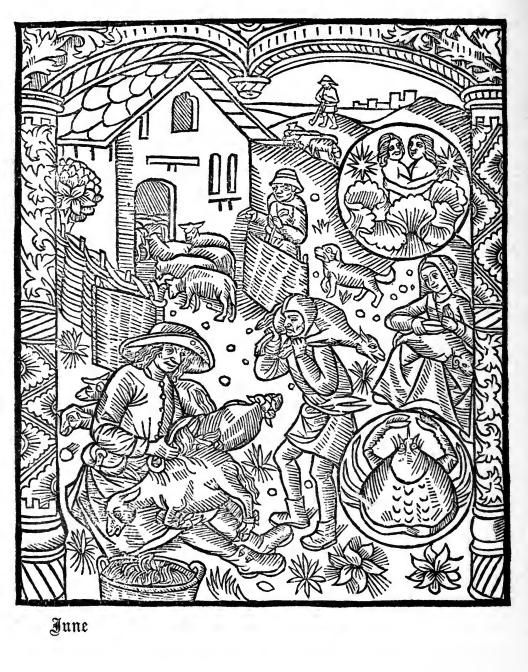
Black and white engraving for June from Kalendar of Shepherds.
Kalendar of Shepherds. Title page for June

The picture above is from the Kalendar of Shepherds, with its 15th Century French Illustration. It shows shearing as the main occupation for the month but set within a flowery summer scene. In the roundels are the Gemini twins and the Cancer Crab, the star signs of June.

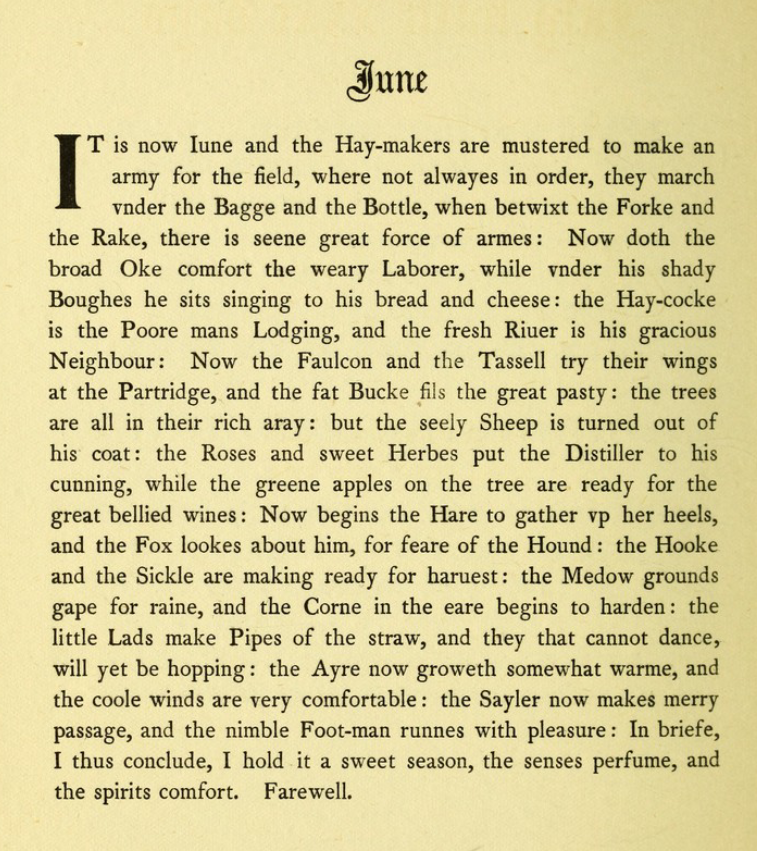
The text of the Kalendar of Shepherds gives a lyrical view of the joys of June:

From Kalendar of Shepherds, 17th Century Text Wellcome Library
From Kalendar of Shepherds, 17th Century June Text Wellcome Library

Ovid and June

June might come, not from Juno’s name, but from an Indo-European word for youth or vital energy. Ovid in Fasti, his poem about the Roman Year, lets Juno make her own case:

O poet, singer of the Roman year,
Who dares to tell great things in slender measures,
You’ve won the right to view a celestial power,
By choosing to celebrate the festivals in your verse.
But so you’re not ignorant or led astray by error.
June in fact takes its name from mine.
It’s something to have wed Jove, and to be Jove’s sister:
I’m not sure if I’m prouder of brother or husband.
If you consider lineage, I was first to call Saturn
Father, I was the first child fate granted to him.
Rome was once named Saturnia, after my father:
This was the first place he came to, exiled from heaven.
If the marriage bed counts at all, I’m called the
Thunderer’s Wife, and my shrine’s joined to that of Tarpeian Jove.
If his mistress could give her name to the month of May,
Shall a similar honour be begrudged to me?
Or why am I called queen and chief of goddesses?
Why did they place a golden sceptre in my hand?’

Translated by A. S. Kline © Copyright 2004 All Rights Reserved

June named after juvenis, “youth”

In the previous Book (on May), Ovid told another story that June was named for young men.

‘So I deduce that the elders gave their own title
To the month of May: and looked after their own interests.
Numitor too may have said: ‘Romulus, grant this month
To the old men’ and his grandson may have yielded.
The following month, June, named for young men’
Gives no slight proof of the honour intended.’

The Latin for ‘Young men’ comes from the Latin iuvenis, “youth”)

But let’s not go into Indo-European roots, and let’s simply accept the most wonderful month is named after Juno, the Queen of Goddesses, the deity of marriage and women. Probably most famous for hating the Trojans – she had a grudge against Paris, as he ruled against her in that famous divine beauty competition. And more seriously, what other reaction can the Deity of Marriage, have to the man who showed such disregard for the sanctity of marriage that he ran away with the already spoken for Helen?

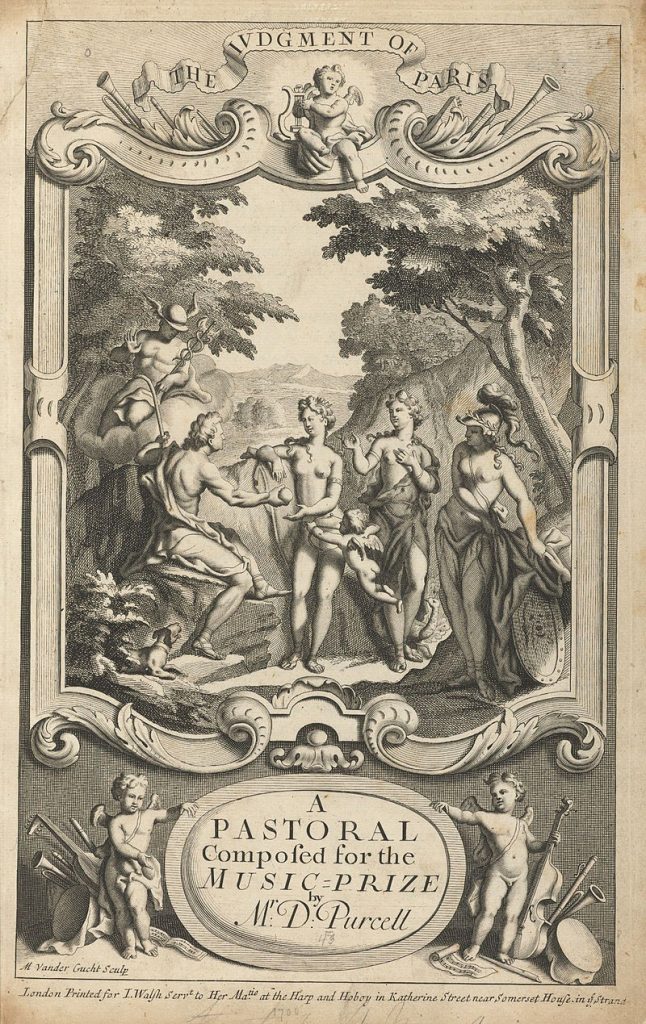
The Judgment of Paris 1700 by Daniel Purcell. Houghton Museum (Paris, Venus, Juno, Minerva)

‘A sweet season, the senses perfume and the spirits comfort.’

Here is a treat for June. This is from Bellerby and so who make Globes in London. Click on the video to see their work.

First Written in June 2023 and revised June 2024, 2025, 2026

Cotswold Olimpicks May 30th

Shinkicking part of the Cotswold Olumpicks. screen shot from https://youtube.com/shorts/wBOPAZ2131Y?si=UEED_F8QjSb_wW6Z 2025

The Cotswold Olimpicks take place on the Thursday and Friday of the week of Whitsun, normally between mid-May and mid-June. This year it was on May 29th. The Olimpicks were set up by Robert Dover on Dover’s Hill near Chipping Camden, in the early 17th Century. Inspired by the Greek Olympics, he felt the modern world could do with an infusion of the original spirit.

The Olimpicks has a collection of tradition sports such as the sack race, and the tug of war.  But the one that receives the most attention is shin-kicking.  Two contestants try to knock each other over by kicking each other in the shins!  They are not supposed to pull or push their opponent over. Or use Judo style throws.  Protective gear is supplied in the form of straw or hay packed down the socks.

For more, see the official site below:

For other Cotswold content, look at my posts:

coopers-hill-cheese-rolling-may-26th/
campden-house-fire-sunday-march-23rd-1862/
chipping-campden-murder-august-16th-1660/

On This Day

70 – Siege of Jerusalem moves towards its end as the Roman legions breach the Outer Wall of Jerusalem. The Romans build a circumvallation, around the City cutting it off.

1381 – Beginning of the Peasants’ Revolt in England. John Bampton arrives in Brentwood demanding payment of unpaid Poll Tax. He interrogates Thomas Baker of Fobbing. Violence breaks out Bampton flees to London, three of his clerks and some townsfolk are killed. (see my post on the Peasants Revolt here.)

1431 – 19-year-old Joan of Arc is burned at the stake in Rouen. France (for her canonisation see my post here. Near the bottom under On This Day section).

1842 – Assassination attempt on Queen Victoria as she drives down Constitution Hill near Buckingham Palace in London. John Francis had tried to shoot her on the previous day near the Mall. His gun misfired and he escaped. On the 30th May, Queen Victoria deliberately went out again to try to encourage a second attempt. Francis shot his pistol, but didn’t hit anybody. He was arrested and sentenced to death (later commuted to life imprisonment).

First published 1 June 2025, Revised OnThis Day added May 30th 2026

Oak Apple day May 29th

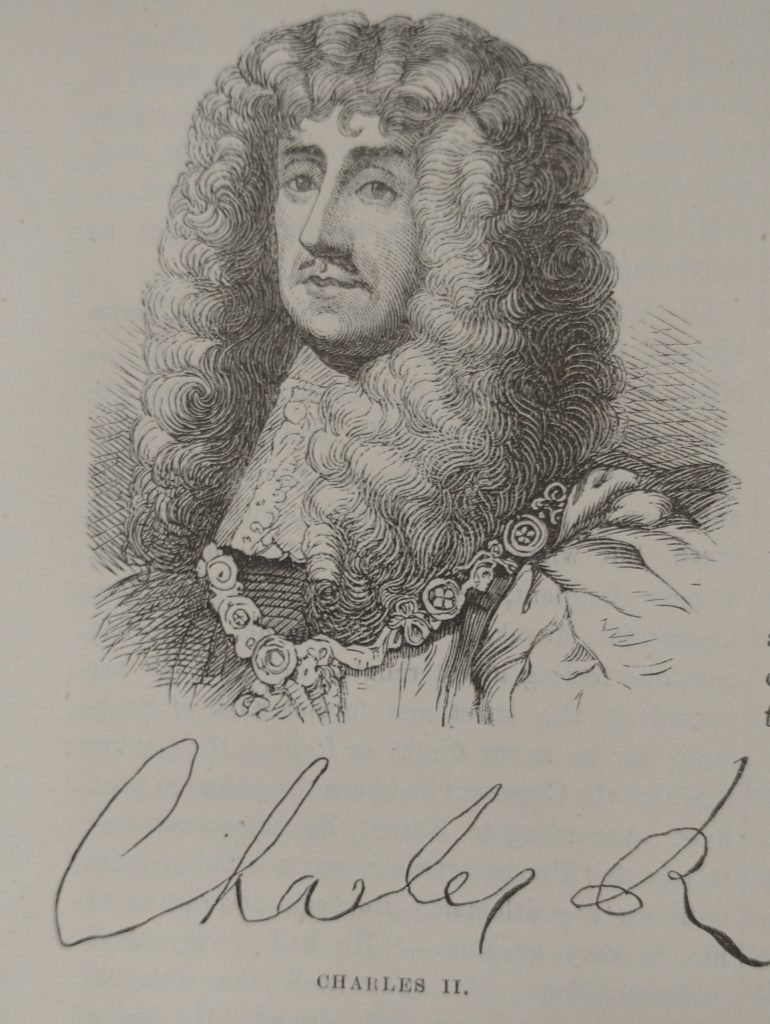
Charles II from an old illustration

Today is both Oak Apple Day and Garland Day. Oak Apple Day was set up by Parliament in 1660 as “An Act for a Perpetual Anniversary of Thanksgiving”.  They were celebrating the restoration of Charles II to the throne in May of 1660. It was abolished in 1859, but a few places continue to celebrate the day.

The Oak was chosen partly as a symbol of England but particularly because Charles II hid in an Oak Tree while escaping from Cromwell’s Parliamentary Army. Charles II attempt to restore the Monarchy ended with his defeat at the Battle of Worcester (September 3rd 1651). This was Cromwell’s Lucky Day as he also won the Battle of Dunbar on September 3rd (1650). (For more on these two battles see my post: https://chr.org.uk/anddidthosefeet/oliver-cromwell-and-his-lucky-day-september-3rd/) The Oak Tree was near Boscobel House in Shropshire which was on the route of his epic journey to the South Coast and the safety of France.

People wore oak apples (or shick-shacks) which are a type of ‘plant-gall‘. . If Oak Apples are not available, people used sprigs of Oak leaves instead.

The text of the Parliamentary Bill said:

That in all succeeding ages, the 29th of May be celebrated in every parish Church and Chapel in England and the Dominions thereof, by rendering thanks to God for the Kings (Charles II’s) restoration to actual possession and exercise of his legal authority over his subjects’

Church Services for the Restoration; for the preservation from the Gunpowder Plot and the death of Charles the First were kept until the year 1859.

Oak Apples

Oak apples on Quercus robur leaf. Photo Ivar Leidus – Own work: CC BY-SA 4.0

The oak apples are a type of ‘plant-gall‘. This is an abnormal growth from a point of irritation on a plant. The irritation normally comes from the larvae of an insect. Oak Galls on leaves are called Oak Apples. But they can also form on the shoots, where they check and distort growth.

Oak galls are full of gallic or tannic acid. They were very useful in tanning and dyeing. Medically, they were used against dysentery, diarrhoea and cholera, using a tincture. By injection they were used against gonorrhoea and leucorrhoea.

You might like to look at my posts on the Civil War period:

and I posted on John Evelyn’s reaction to the Restoration

The Castleton Garland Day

Screenshot from https://www.castleton-garland.com/ showing the Garland King (possibly representing Charles II hiding in an Oak tree)

The Castleton Garland Day is a procession led by a man dressed in a big bell shaped Floral Garland. Research cannot trace it back further than the later 18th or early 19th Century. But it may have developed from the rush bearing ceremonies, where a procession led by Morris Men went to the Church to renew the strewing herbs on the floor of the Church which once were of beaten earth. Strewing herbs were sweet smelling or insect repellent, and added insulation to the floor. Strewing herbs included: Lavender, Camomile, Meadowsweet, Thyme, Oregano, Rue, Rosemary and Tansy. In historic properties, visitors are often told that the word ‘threshold’ stems from the wooden timber that held the thresh or strewing herbs in place. However, etymologists suggests the thresh comes from an old English word to trample.

Abbotsbury in Dorset has its own Garland Day on May 13th. It consists of making and blessing Garlands in the Church and taking them either to Boats, or to the War Memorial.

First Published 2025, and revised 202 with the Addition of Oak Galls, and Castleton Garland Day

St Augustine & the Origins of Christianity in Britain May 27th

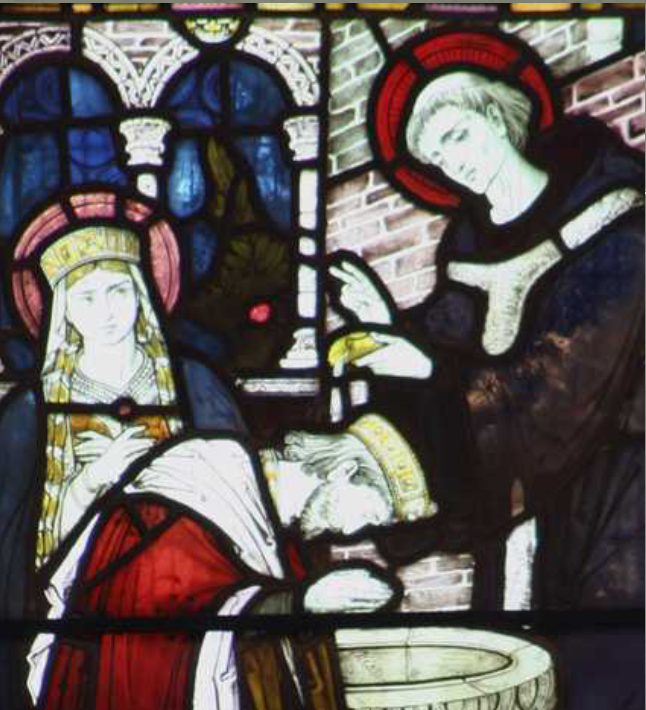
Stained glass window showing Baptist of King Ethelred of Kent by St Augustine watched by Queen Bertha. In St Martins Church, Canterbury

This post is about St Augustine and Christianity in Roman and Post Roman Britain. But first:

On This Day

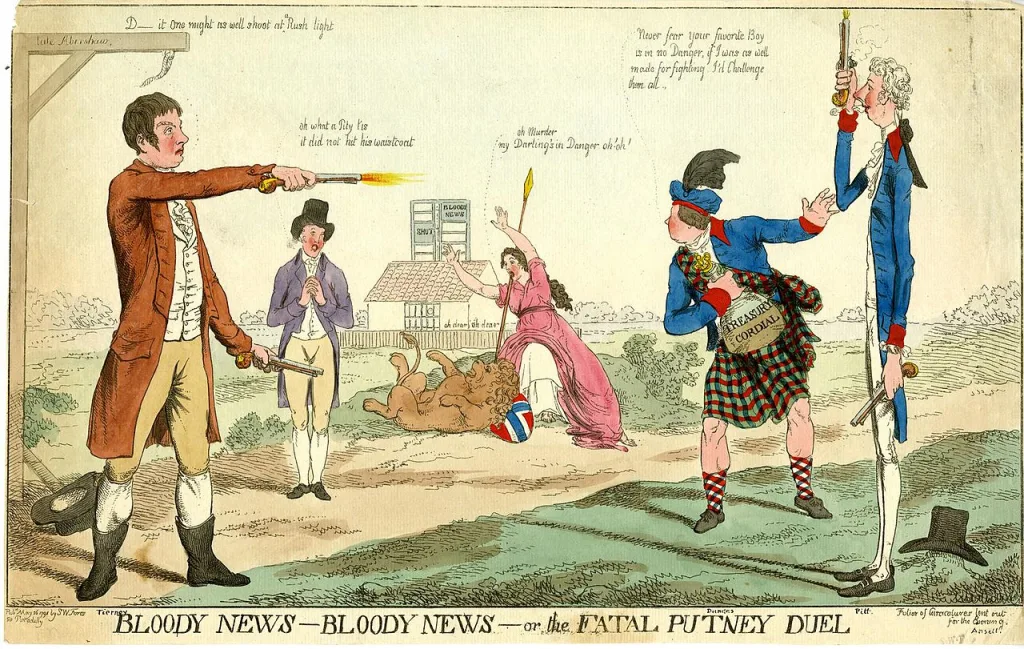
A satirical print of the duel by Charles Williams. showing the duel between Pitt and Tierney on Putney Heath

On May 27th 1798, Prime Minister Pitt, a Tory, meet George Tierney on Putney Heath for a two pistol duel. In the absence of the Whig Leader Charles James Fox, Tierney questioned the Prime Minister’s plan to increase the Royal Navy’s man power. Pitt suggested Tierney’s opposition came about through ‘desire to obstruct the defence of the country’. Tierney objected, the Speaker upheld his complaint. Pitt refused to withdraw the remark. Tierney sent his second to demand satisfaction. Pitt accepted. Both missed their first shots, Pitt shot his second shot vertically up. The seconds stopped Tierney responding. The King was furious that Pitt should put his own pride against the interests of the Country. The other two people are the seconds.

The Cartoon above shows, skinny Pitt on the right, Tierney on the left under the shadow of the Gibbet. Britannia is horrified with the British Lion in the background. Behind them is one of the new Telegraph systems which is conveying news of the duel.

The Augustinian Mission

St Augustine brought Christianity to England, leading the mission sent by Pope Gregory to Canterbury in 597AD. He was the Abbot of a Monastery in Rome before the Pope sent him to convert the Angles. I tell the story of the mission in my post: March-12th-St-Gregory-Punster-Extraordinary/.

Augustine is the patron saint of England and the Anglican Communion. But he is not the person who brought Christianity to Britain. To England, maybe.  Britain. No. The Romans did this. I summarise the evidence in my post on St Lucius, who is claimed to have brought Christianity to Britain in the 2nd Century. Our first martyr was  St. Albans. (see my post on St Albans here.

Feast Day(s) of St Augustine.

We have a variety of days to celebrate St Augustine of Canterbury.  These are according to Google; 26 May (Anglican, Eastern Orthodox, and Catholic Extraordinary Form calendar in Great Britain). 27 May (Catholic Ordinary Form calendar). 28 May (Catholic Extraordinary Form calendar outside Great Britain).

Perhaps, like the Venerable Bede he died after Dusk?  (see yesterday’s post.)

Romano-Britain and Christianity

There is good reason to think Christianity was strong in Roman Britain, particularly in towns. There is also some evidence of non-Christian religious centres surviving in the countryside (the Roman word for non-Christians, pagans, comes from the Latin word paganus, which meant someone who lived in the country.)

After the Romans, the Christian Church continued to thrive, with a host of Saints particularly in Cornwall, and Wales. The first substantial eye-witness account of post-Roman Britain, dated to the early 5th Century, concerns the Catholic Bishop Germanus. This shows a battle for souls in Britain not between Christians and Pagans, but between Catholics and other Christians who the Catholic Church targeted as heretics. I talk about this in my post about St Germanus here.

The next insight comes from the conversion of the Irish to Christianity later in the 5th Century. St Patrick’s account gives an eyeyewitness view. What is interesting is that St Patrick’s family were living in a town where aspects of Roman life were still continuing.  After being kidnapped by Irish raiders, St Patrick went on to lead the conversion of the Irish (with the help of St Bridget).  See my post on St Patrick here, St Bridget here.

I cannot see any sense of personality or charisma in the story of St Augustine.  But Welsh history shows him to be an unsympathetic hierarchical character.

Clashes with Celtic Christianity

What many people forget is that St Augustine came to a country with over two hundred years of Christian belief.  So, meetings were held between the British Church and St Augustine, culminating in the Synod of Chester in the early 7th Century.   Seven British Bishops and others prepared for their response to St Augustine’s insistence on the primacy of the Roman Catholic Church. One of the contentious issues was the ‘computus’ for deciding the date of Easter. Another was the style of the monks’ tonsure.  But it was a major step for the British churches to align themselves with a foreign ecclesiastical structure.

The delegates were advised by a wise hermit to arrive late at the planned meeting with St Augustine to see how he reacted.  If he got up and welcomed them, then he was a fit leader to follow. If he acted imperiously, then he was not worthy.  St Augustine failed the test, the meeting was a failure. And St Augustine cursed the British, which was said to have led to  a military campaign against them by the Anglo-Saxons.  The British lost the subsequent battle of Chester.  It was said that 2000 monks from the nearby monastery of Bangor-in-Dee were slaughtered. This seems like a huge exaggeration, unless the definition of a monk was just loosely people associated with the Monastery..

The battle severed the connections between the British Kingdoms in Cumbria and Scotland from the Kingdoms in Wales and made it very unlikely that the British would ever regain control of Britain from the English.

The two churches were reconciled at the Synod of Whitby (664AD).  For more about the calculations for Easter and the Synod of Whitby look at my post here.

First written on 27th May 3025, revised On This Day added 2026

The Venerable Bede Died – May 26th 735AD

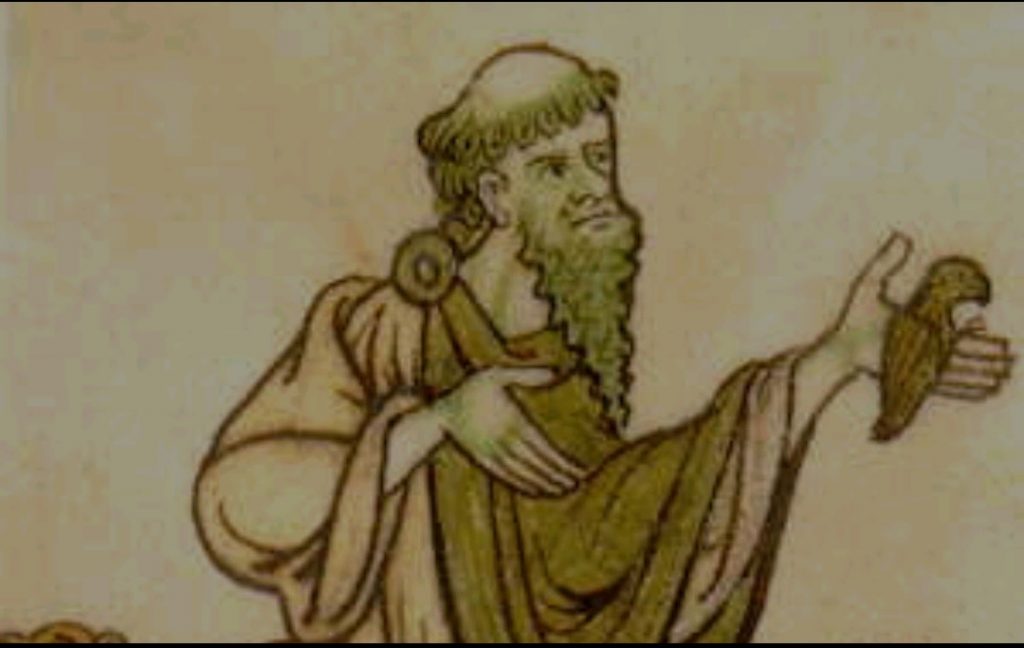
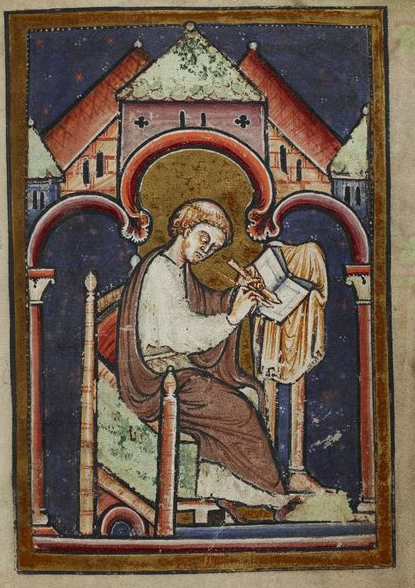
A Scribe – possibly the Venerable Bede. Late 12th Century from Lives of St Cuthbert.

He died on the evening of what we would call the 25th. In ancient times, the Day changed at dusk. So for his contemporaries, he died on 26th May. But, as he shares his day with St Augustine, some celebrate the Venerable Bede on May 27th!

Called the Father of English History, the Venerable Bede was an excellent historian. He set the tone and standard for many centuries of English Historiography.  Mostly remembered for the ‘Ecclesiastical History of the English People’. This provides the most trusted account of the events of the Post Roman, Migration, and Anglo-Saxon periods. But he also wrote on time and bible commentaries. (see below). He is said to be the only Medieval Englishman, other than Chaucer to be read by every generation.

Dante’s Bede

So well regarded is he that he is the only Englishman mentioned in Dante’s Paradiso.  (I have just discovered that there is another Englishman mentioned. But he is the murderer Guy de Montfort, who fled after the battle of Evesham. He then murdered his cousin in a church, and is in hell according to Dante.)

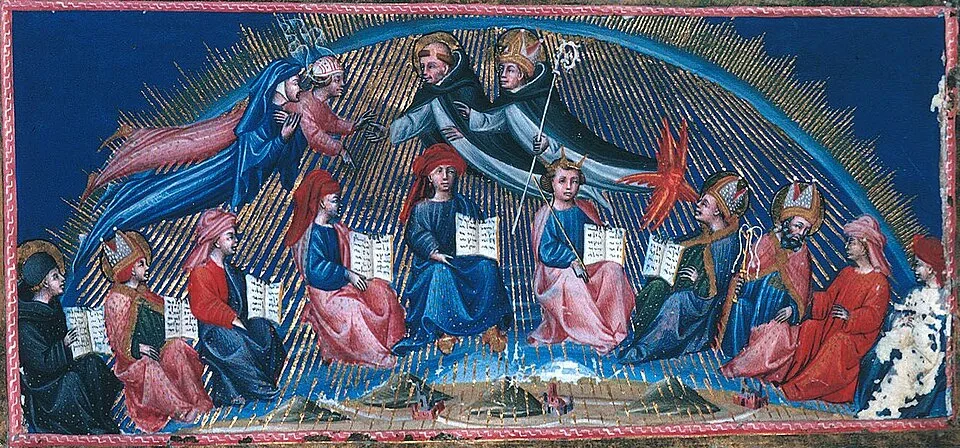
Bede is in Heaven and in the fourth sphere of Prudence. This is the Sun. Dante and Beatrice are surrounded by bright sparks which are the souls of 12 men. These the wise, who illuminate the earth intellectually.

Dante and Beatrice meet twelve wise men in the Sphere of the Sun (miniature by Giovanni di Paolo), Canto 10. (Public Doman via Wikipedia). Pictured are: Thomas Aquinas, Albertus Magnus, Gratian, Peter Lombard, King Solomon, Dionysius the Areopagite, Orosius, Boethius, Isidore of Seville, Bede, Richard of Saint Victor, Siger of Brabant.

Next, see the glowing breath of Isidore of Seville flame out, of Bede, and Richard of SaintVictor, who in contemplation exceeded Man. The one from whom your glance returns to me, is the light of a spirit, who, of profound thought, seemed to himself to reach death too slowly: it is the eternal light of Sigier, who, lecturing in the Rue du Fouarre, syllogised truths that brought him hatred.’

https://www.poetryintranslation.com/PITBR/Italian/DantPar8to14.php#anchor_Toc64099872Bene

Venerable?

He is Venerable. But not only in the general sense of being wise, old and respected, but also in the technical Catholic sense:

a title given to a deceased person who has attained a certain degree of sanctity but has not been fully beatified or canonized.‘ (Oxford Languages)

In 1899, the Catholic Church honoured him with the title of Doctor of the Church. This title is given to someone holy who has contributed to the theology of the Church.

He is considered by some to be the best historian in olden times, only equalled by Herodotus (said Thomas Carlyle). Thucydides surely says I! (Note: Herodotus is known as the ‘Father of History’ for his storytelling and breadth of the scope of his attention. While Thucydides didn’t tell tales, he concentrated on empirical evidence and so is known as the Father of Scientific History).

A Good Historian?

Bede is so good because he checked his sources and had access to a wide range of books. He even had a line to the Vatican so he could check his facts with Vatican records. This in the 8th Century! The Venerable Bede is the polar opposite of Geoffrey of Monmouth, (writing in the 12th Century). If Bede mentions a person or an event then they are accepted as part of the story of the English. By contrast, if Geoffrey of Monmouth mentions a person or event, without further corroboration, then historians tend to consider it a story, myth or simply made up by Geoffrey.

But, the truth is not so straightforward. Bede is not without his biases. Nor were his sources always reliable. And he is not above accepting myth, legends and miracles as fact.  Geoffrey also has access to some, probably, oral traditions. So that some (but which?) of his many tales of the Kings of Britain may hold considerable historical information.

Bede’s Influence on English History

Bede followed Gildas (A British Monk writing in the 6th Century) in wondering why God allowed the native Christian Britons to be defeated by the foreign Pagan English.  Gildas assumed God was punishing the Britons because of the evil deeds of their so-called Christian Kings.  Bede extends this to argue that God is punishing the Britons for not trying to convert the English to Christianity. God knows that the English, when converted, will be much better Christians than the Britons seems to be Bede’s understanding.

This starts a histographical trend for the English to think of themselves as the chosen people. By contrast, the Britons (Welsh, Scots and Irish) are feckless Barbarians (they thought).  Bede concentrates on the English. Countless generations of Historians have either left out the Britons, or demeaned them in their histories of England and indeed of Britain.

For example, most histories of Kings, deal only with England. They either begin with William the Conqueror or Alfred the Great and omit any British, Welsh, Scots or Irish Kings. Except, of course, for my book on the Kings and Queens of Britain. This starts with the largely legendary Kings of Britain, and includes some Welsh and Scottish Kings.  To buy it, you will find details of it here.

So Bede is a great historian without whom we would have an even less clear idea about what happened in the centuries following the Roman Period.  He also, contributed to an Anglo centric view of history. He was writing in Northumberland at the Monastery of Jarrow. So is more sympathetic to Northumbria than to Wessex, Mercia, and the British Kingdoms.

Bede’s Books

He wrote over 60 books. One was about the theological science of computus. In particular, the dating of Easter. The British Church had one method, the Catholic Church another. This contributed to a series of confrontations between the 2 Churches. And was only finally resolved at the Synod of Whitby in the favour of the Catholic Church.

Bede was instrumental in making Dionysius Exiguus idea of dating from the birth of Christ as the standard system. He also thought the Catholic calculation that Jesus was born 5000 years ago was wrong. He used the Bible to calculate the more ‘correct’ date was was 3952 BC.  Archbishop Ussher in the 17th Century took Bede’s calculation and improved it and suggested the proper date was 4004 BC.

For more about Dionysius Exiguus and the division of time, see my post here.

First Written on May 26th 2025, revised and Dante expanded 2026