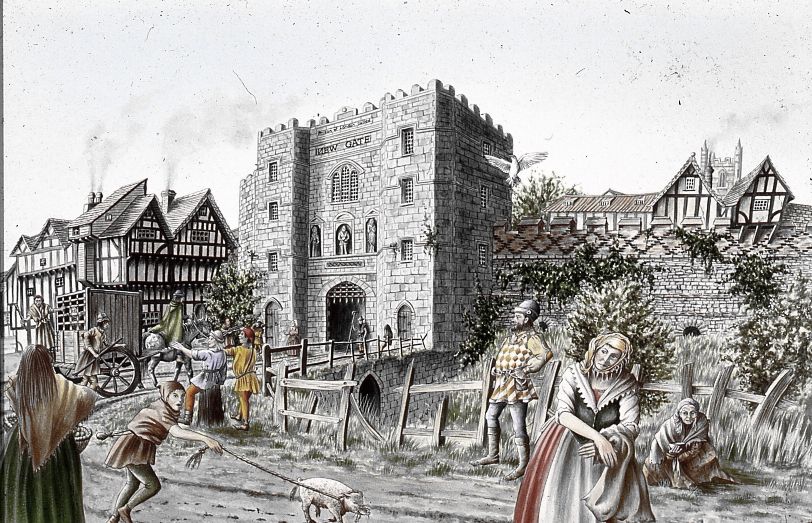
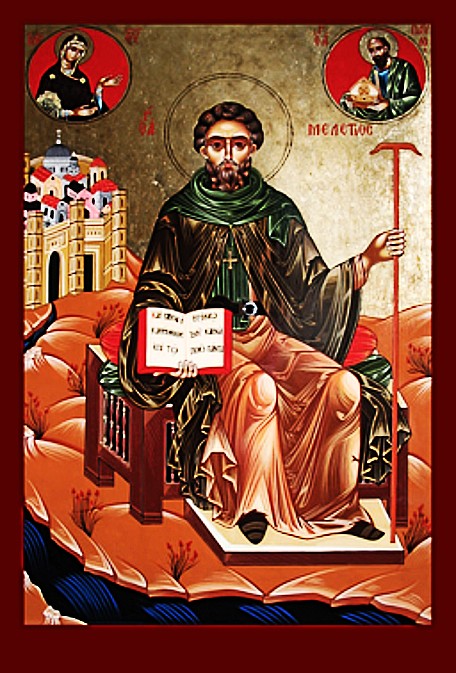
St Mellitus (Source: from saint-mellitus-of-canterbury-died-624
St Mellitus was the first Bishop of London (AD604) and the third Archbishop of Canterbury. But was he really? No, he was the first Bishop of London of the English Church. There were many before him. We know there were bishops of London from Britannia during the Roman period. And, according to John Stow, London’s first history. there were also post-Roman bishops. That line of Bishops ended, in 584 AD, when the 14th Bishop, Theanus, fled London. He headed for Wales to escape the Anglo-Saxon threat. However, even Stow was uncertain whether the list was genuine.
In 314 a Church Council or Synod was called at Arles, in France. Amongst those attending were three bishops from Britain, (and a Deacon and a presbyter) :
Adelfius “de civitate Colonia Londenensium” – that is, from the “colonia of the people of London”.
(Wikipedia)
The fact that two came from London suggests to some a mistake. Adelfus, perhaps, was either from Lincoln or Colchester which were Colonies. The Synod was called by the Emperor Constantine. Amongst its acts were to order that Easter should be held at the same time throughout the Empire. (See also my post on the Synod of Whitby which fixed the date of Easter in Britain as late as 684). They also banned Races, and Amphitheatre Games. and excommunicated all actors and charioteers. But it gives us our first certain facts about the origins of Christianity in Britain.
The Augustinian Mission and Mellitus
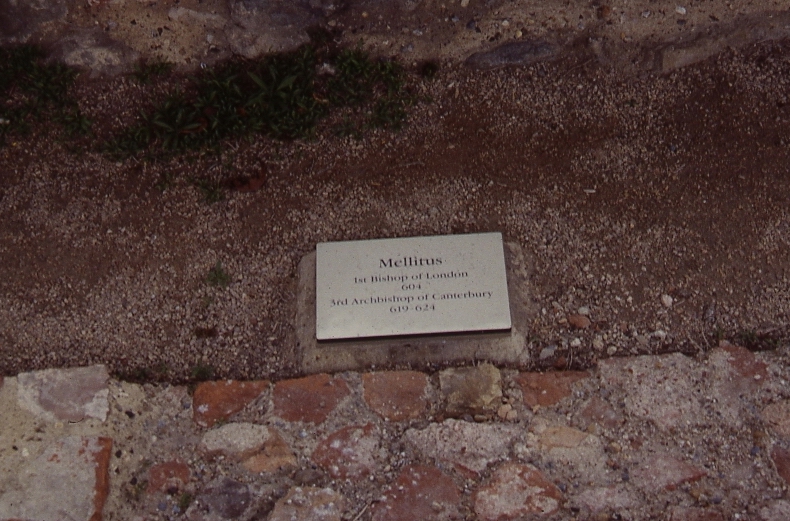
St Mellitus Burial Place, St Augustine’s Abbey, Canterbury. Photo K. Flude
In 597, the Augustinian Mission came to Kent. Mellitus was sent by Pope Gregory to join St Augustine’s mission in 601AD,. He was then sent to London to set up St Pauls and become its bishop (604). London was under the control of the Kingdom of Essex in those days. The King was Saberht, who was the nephew of St Ethelred, King of Kent. Saberht accepted Christianity but when he died. His heirs reverted to paganism and kicked Mellitus out. Mellitus went into exile in Gaul but came back to become the third Archbishop of Canterbury. He was buried in St Augustine’s Abbey in Canterbury. He is known as St Mellitus of Canterbury. St Mellitus had gout so is the go-to Saint for sufferers of gout.
London reverted to paganism until 654AD when St Cedd became its next Bishop.
1925 – McVitie’s Chocolate Digestive was created. There were made in Stockport and in Harlesden, London. I have moored my narrowboat outside the factory and been kept awake by the churning of chocolate in vast vats. News stories suggest that the Digestive was meant to be eaten with the chocolate on the bottom side. This is one of the most ridiculous things I have heard! But apparently it helps the chocolate get to your taste buds that bit quicker. But judge for yourself and read this page for the facts. And this one for more on the history of the Chocolate Digestive.
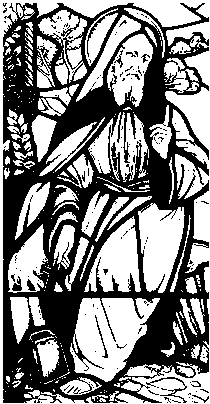
Drawing of a Stained glass window depicting Saint Beuno. D A R C 12345 – Own work
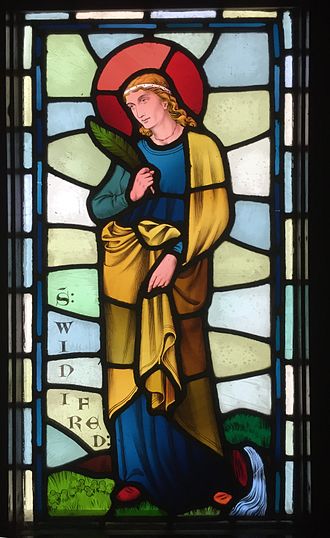
Today is St Beuno’s Day. St Beuno is also known as St Bono. He was an 8th Century Welsh Abbot of some power. The grandson of a prince of Powys in Wales who was descended from Vortigern. (see my post on Vortigern here.) Vortigern was a predecessor to King Arthur. Beuno was educated in Bangor Monastery, one of the foremost Celtic monasteries in Wales. During his ministry he restored 7 dead people to life including St Winifred (or Winefred).
Winifred & St Beuno
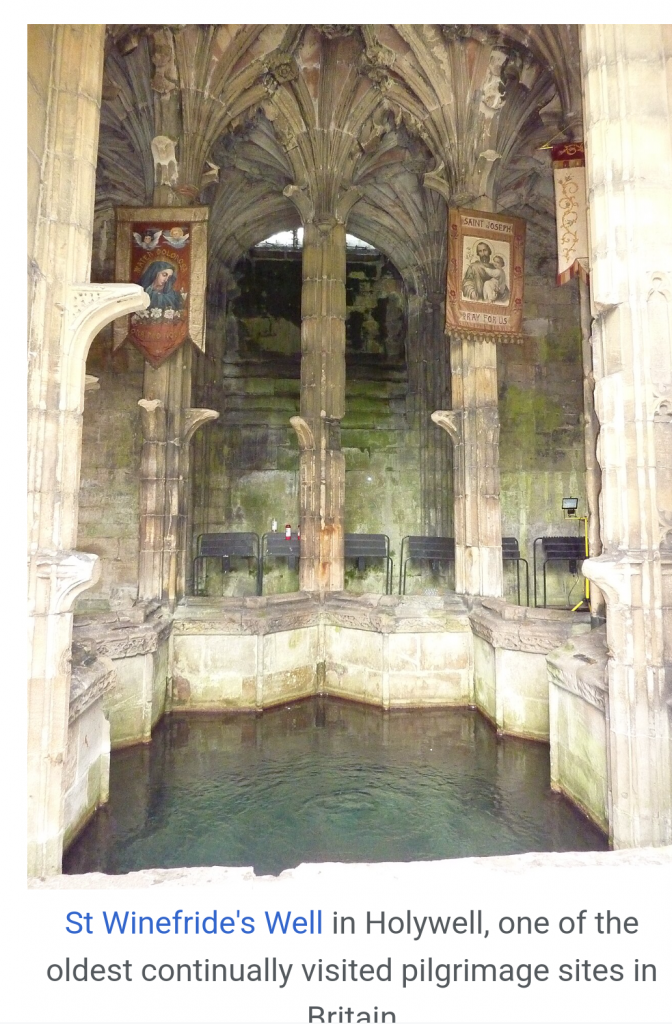
St Winifred’s Holywell, from Facebook.
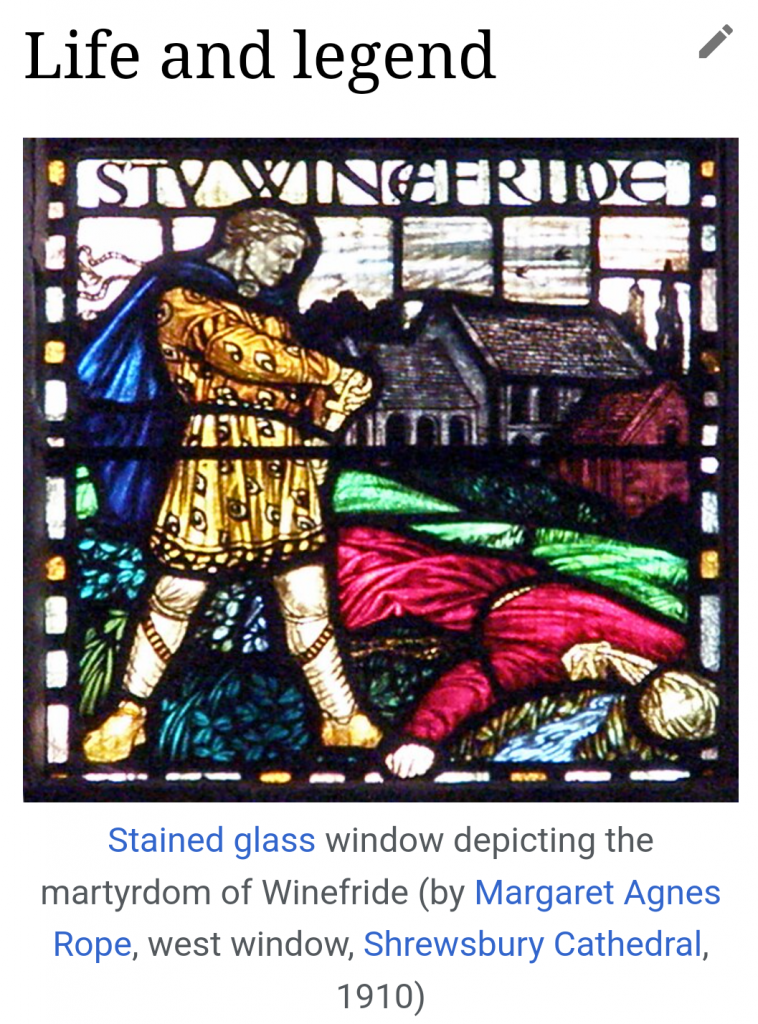
She was Beuno’s niece, a virgin who refused the advances of a certain Caradog. Furious at her taking vows, Caradog tried to seduce her, but she refused. So, he chopped her head off.
Where her head landed a spring sprung amd became a holy spring. The spot, in Flintshire is still called Holywell. It has been described as the Lourdes of Wales and one of my tours go past it . This is how I heard about St Beuno.
Anyway, the story goes that Beuno put his niece’s head back on her shoulders and restored her to life. How he did that, is a mystery.
From Facebook
She lived a full life with a brilliant Church career. Of course, she is the patron of those who have suffered unwanted advances (but believe me there are many other candidates for that particular honour amongst the female Saints! Have a look at my post on St Agatha for another example of male sexual abuse).
Medieval Powys, & Neglected Parts of the Female Anatomy
I drafted this in January 2025, when I came across a reference to St Beuno in a fabulous exhibition at the British Library. The show was called ‘Medieval Women – In their own Words’.
On display amongst the many wonderful manuscripts and books of the 11th – 15th Century was a Welsh poem. The author was Gwerful Mechain (1460–1502), the only female medieval Welsh poet with a surviving and a substantial body of work. She is known for her erotic poetry, in which she praised the vulva among other things.
What is extraordinary is that I should, by complete chance, be publishing this the day after posting about the statue of the erect Minotaur! So, you can see how even-handed I am? Erect penises one day, love poem to the Vagina the next!
Here it is in full, in a modern translation:
To the Vagina by Gwerful Mechain
Every poet, drunken fool Thinks he’s just the king of cool, (Every one is such a boor, He makes me sick, I’m so demure), He always declaims fruitless praise Of all the girls in his male gaze. He’s at it all day long, by God, Omitting the best bit, silly sod: He praises the hair, gown of fine love, And all the girl’s bits up above, Even lower down he praises merrily The eyes which glance so sexily; Daring more, he extols the lovely shape Of the soft breasts which leave him all agape, And the beauty’s arms, bright drape, Even her perfect hands do not escape. Then with his finest magic Before night falls, it’s tragic, He pays homage to God’s might, An empty eulogy: it’s not quite right: For he’s left the girl’s middle unpraised, That place where children are upraised, The warm bright quim he does not sing, That tender, plump, pulsating broken ring, That’s the place I love, the place I bless, The hidden quim below the dress. You female body, you’re strong and fair, A faultless, fleshy court plumed with hair. I proclaim that the quim is fine, Circle of broad-edged lips divine, It’s a valley, longer than a spoon or hand, A cwm to hold a penis strong and grand; A vagina there by the swelling bum, Two lines of red to song must come. And the churchmen all, the radiant saints, When they get the chance, have no restraints, They never fail their chance to steal, By Saint Beuno, to give it a good feel. So I hope you feel well and truly told off, All you proud male poets, you dare not scoff, Let songs to the quim grow and thrive Find their due reward and survive. For it is silky soft, the sultan of an ode, A little seam, a curtain on a hole bestowed, Neat flaps in a place of meeting, The sour grove, circle of greeting, Superb forest, faultless gift to squeeze, Fur for a fine pair of balls, tender frieze, A girl’s thick glade, it is full of love, Lovely bush, blessed be it by God above.
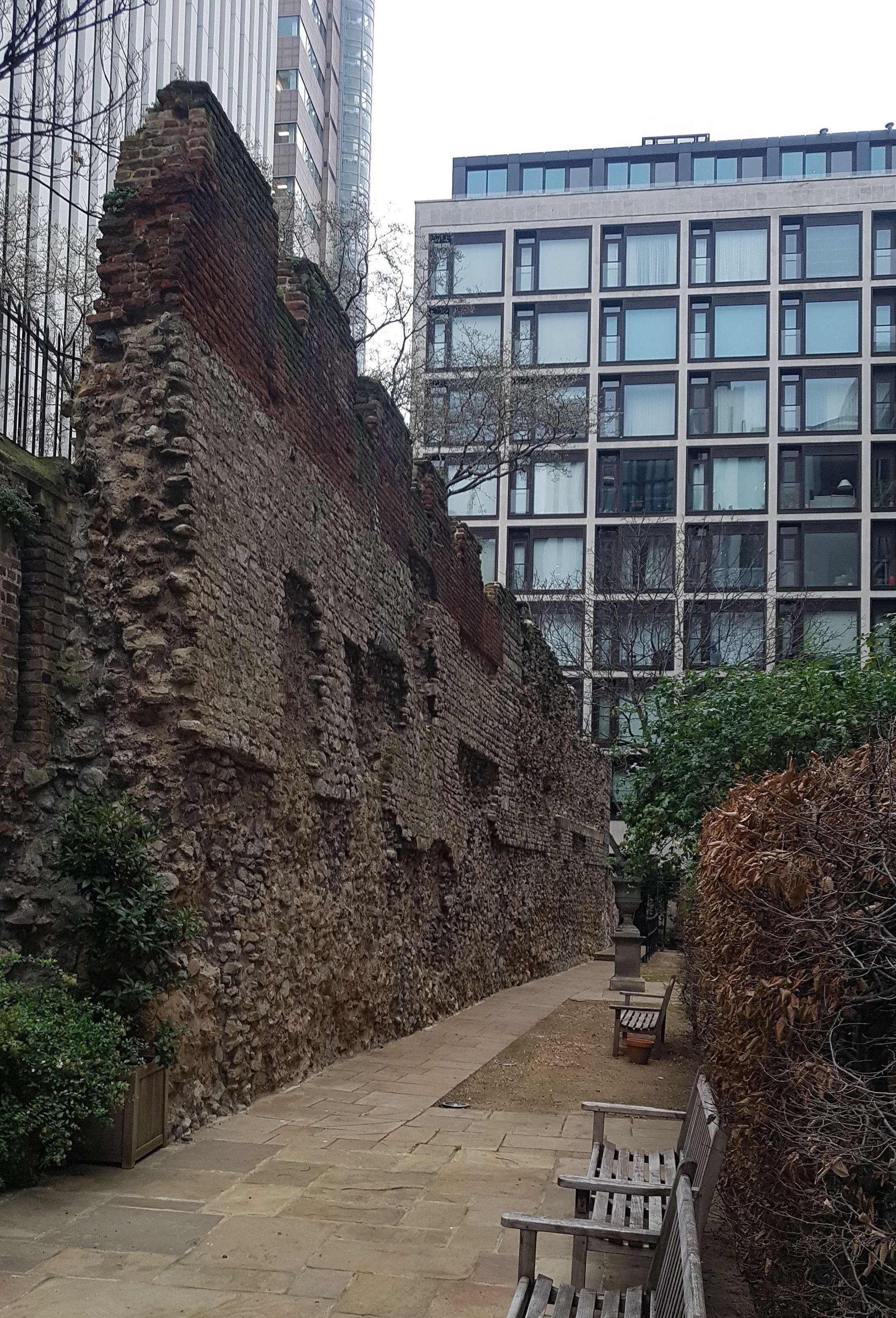
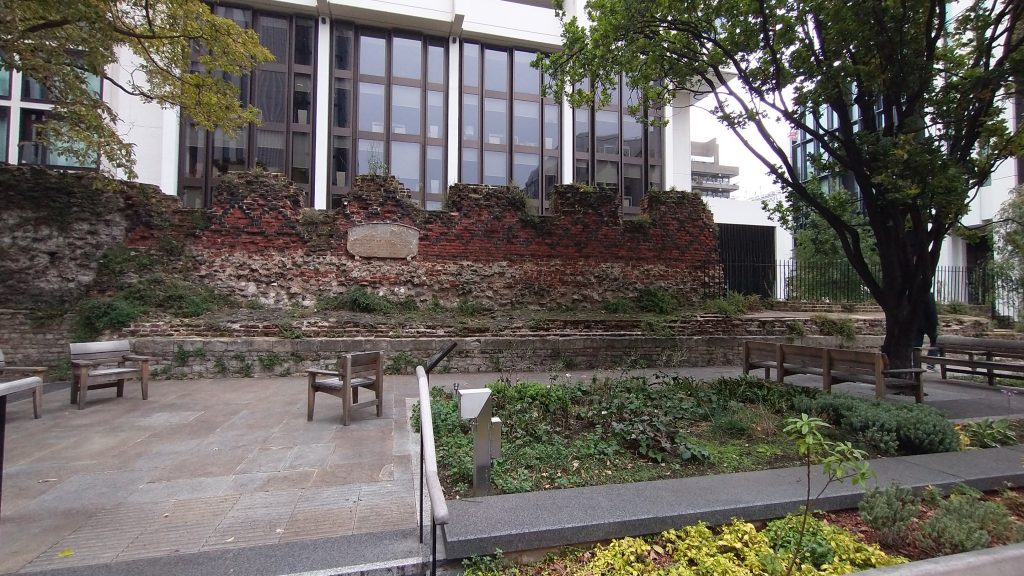
St Alphage. Church Tower on right, City Wall to left. Photo K Flude
I first came across St Alphage when I was working at the Museum of London. The Museum was built on the High Walk at London Wall. The raised Courbusian Walkway looked down on a ruin of a Gothic Church Tower, almost destroyed during the Blitz. This was St Alphage, a Church dedicated to the Saxon Archbishop of Canterbury. (Alphage is also spelt Alphege or Alfege or Ælfheah.)
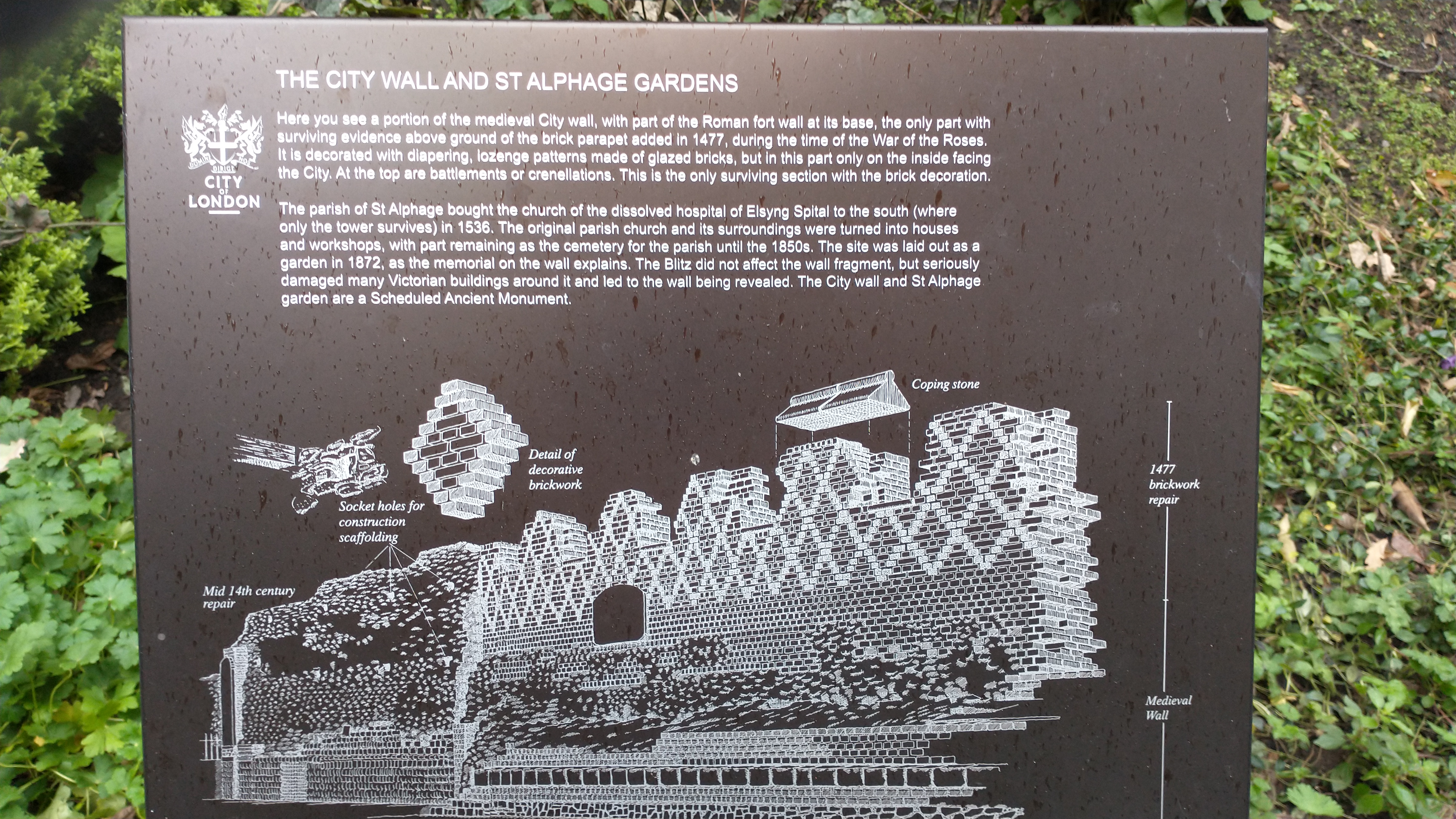
On the other side of the Walkway was the old graveyard of the Church. This preserved one of the very best sections of the old London Wall. Special because on one side its full height was displayed. On the other, the only crenelated bit of the City Wall survived. And the only surviving part of the Wall dating to the War of the Roses.
St Alphage Roman and Medieval WallThe Crennelated Red Brick Section dates to 1477, during the War of the RosesSt Alphage Wall explained on an information plaque.
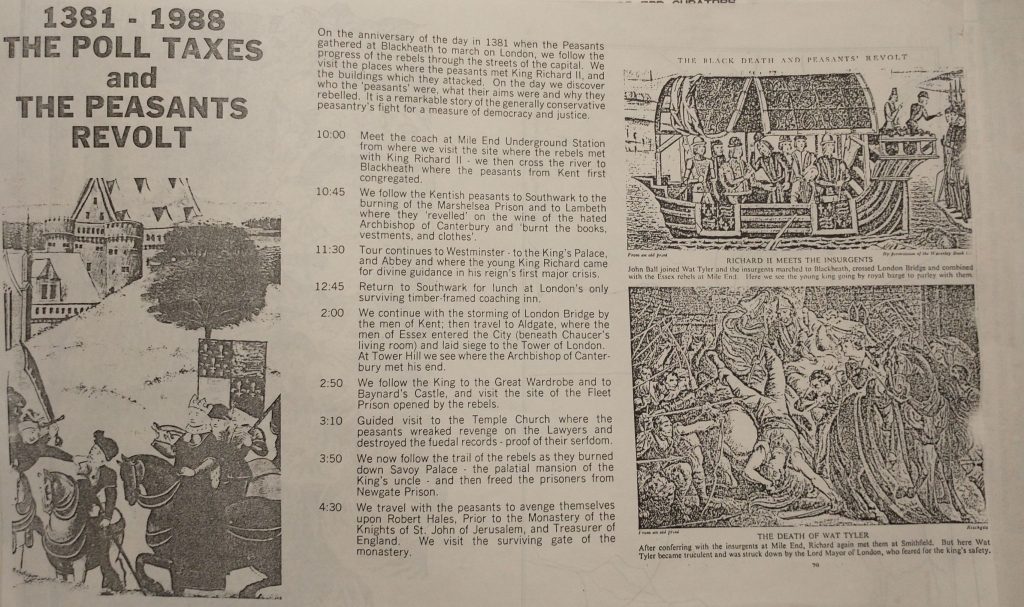
In the 1980s fellow Museum of London Archaeologist, Paul Herbert and I set up a Guided Walks company (Citisights of London). Our walks started from outside the Museum of London, and so St Alphage formed a big part of our success. It led to Guided Walks and tours being a big part of my life. So, St Alphage, thank you!
A Citisights Day Tour the Peasants Revolt (1980s)
St Alphage, Elsyng Spittle and St Mary
The Church was previously a monastic settlement called Elsyng Spittle (aka St Mary within Cripplegate). The Augustinian Canons looked after 100 blind men. It was refounded by Williain Elsing, and dissolved by Henry VIII in 1536. The Church was kept for a Parish Church. But the Puritans were not keen on dedications to St Mary. So, they renamed it after a London based Christian Martyr.
It remained a Parish Church until damaged in an air raid in World War One. (possibly on 8th September 1916 in a Zeppelin Raid – but I am speculating). The Church was partly demolished in 1923, leaving the Tower. The lower part of the Medieval Tower survived bombing in the Blitz. At 12.15 am on 25th Aug 1940, the first bombs on the City of London fell nearby in Fore Street. But the tower was hit in 1940. It was listed Grade 1 in 1950. Kept by the rebuilding of London Wall, and the Barbican area. Then substantially benefitting from a remodelling of the area in an excellent scheme of 2022.
St Ælfheah of Canterbury and Greenwich
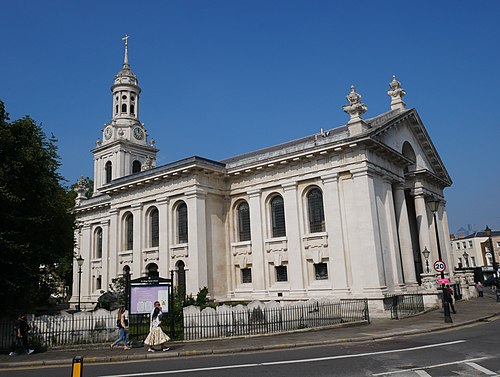
StAlfege Greewich – Doyle own work Wikipedia CC BY-SA 4.0
St Ælfheah was captured during a Viking attack on Canterbury. The Viking hoard relocated to Greenwich where they tried to negotiate a fat ransom for him. He was one of the richest men in the Kingdom. This is what the Anglo Saxon Chronicle says:
.. the raiding-army became much stirred up against the bishop because he did not want to offer them any money, and forbade that anything might be granted in return for him. Also they were very drunk, because there was wine brought from the south. Then they seized the bishop, led him to their “hustings” on the Saturday in the octave of Easter, and then pelted him there with bones and the heads of cattle; and one of them struck him on the head with the butt of an axe, so that with the blow he sank down and his holy blood fell on the earth, and sent forth his holy soul to God’s kingdom.
St Alfege Greenwich, which is now a lovely Hawksmoor Church is said to be on the site of St Ælfheah‘s death. Thorkell the Tall tried to save the Archbishop, but failed and subsequently changed sides and joined the English King. Thrum, who was converted by Alphage, ended his agony by hitting him on the head with the butt of an axe. This seems like a strangely Viking form of mercy!
St Alphage’s body was taken to St Pauls Cathedral where it became venerated and brought income to St Pauls. His remains were removed in suspicious and violent circumstances by soldiers of King Cnut who translated the Saint’s bones to Greenwich. It is suggested King Cnut was punishing London for their opposition to him.
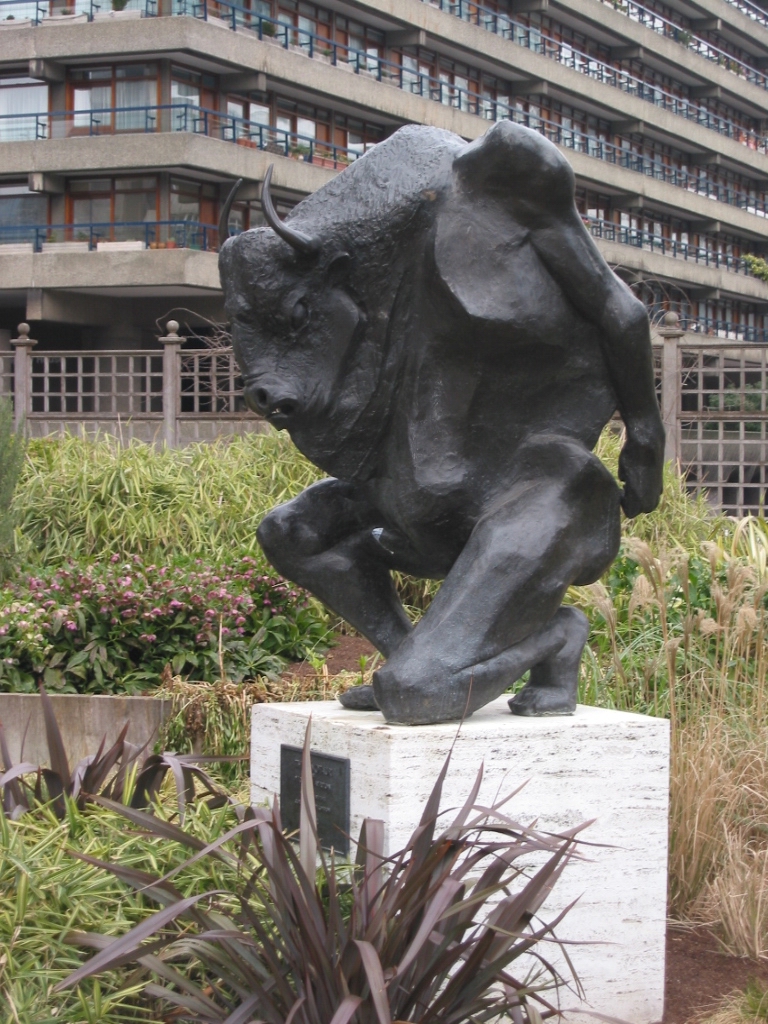
The Minotaur by Michael Ayrton
Also, part of the experience of visiting St Alphage from the High Walk was the statue of the Minotaur. I first came across this phallic Bull in Postman’s Park and am very fond of him. Then it disappeared and reappeared on the High Walk. Now it is on the ground level near the garden of St Alphage.
I understand that Michael Ayrton wanted to make a point about the destruction of London. He felt that the developers were more destructive than the Luftwaffe. They were like a Bull in a China Shop! So he created this statue of a very vigorous Bull (represented by the Minotaur). It is a very unusual work of art in that it sports a fully erect penis. Art History is full of naked women, but the erect male organ has largely not been seen to be a fit subject for art. For more about Ayrton follow this link.
The Minotaur in its present positionThe Minotaur on the High Walk
On This Day
1775 – Battles of Lexington and Concorde begin the American Revolutionary War.
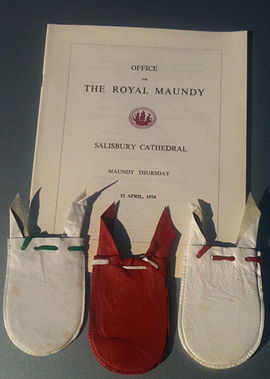
Maundy Thursday Money Pouches. and cover of the Order of Service for Royal Maundy service 1974 Photo Wehwalt
Maundy Thursday Meaning
Maundy Thursday is on April 2nd in 2026. This is the last day of Lent, and the day before the Passion. It’s also called Holy Thursday when Christians remember the Washing of the Feet, and the Last Supper. . Maundy is thought to be from the:
‘Latin word mandatum, or commandment, reflecting Jesus’ words “I give you a new commandment.’ (Wikipedia).
I much prefer the derivation of Maundy Thursday from the English Kings giving alms to poor people.
‘English name “Maundy Thursday” arose from “maundsor baskets” or “maundy purses” of alms which the king of England distributed to certain poor at Whitehall before attending Mass on that day. Thus, “maund” is connected to the Latin mendicare, and French mendier, to beg.‘
The monarch gives out money in special red and white pouches to old people. In modern times, the money is specially minted for the occasion. It is now more symbolic than a practical gesture. But It dates back to the 13th Century, when the money was a vital lifeline for its recipients.
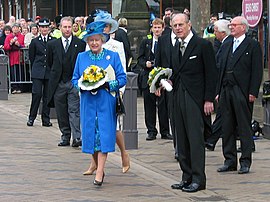
Queen Elizabeth II and Prince Philip after the 2005 Royal Maundy Ceremony at Wakefield Cathedral. Photo Runner1928
In 1572 Queen Elizabeth 1 washed one foot of a group of poor women, then wiped, crossed and kissed them. In fact, the Queen was ‘protected ‘ as the women first had their feet washed by the laundress, then the sub-almoner, then the almoner. Only finally by the Queen. (The Perpetual Almanac of Folklore by Charles Kightley’)
When was The Last Supper?
One scholar, Prof Humphreys author of ‘The Mystery Of The Last Supper’, (2011) has reconciled differences between John and the other evangelists. He believes two calendars were in use, one from before the exile and the other using a Babylonian Calendar. This confusion means that there is too much going on between the Last Supper and the Crucifixion. He suggests that the solution is that Last Supper was on the Wednesday not the Thursday. He also calculates a date for the Last Supper as:
Wednesday, 1 April AD33.
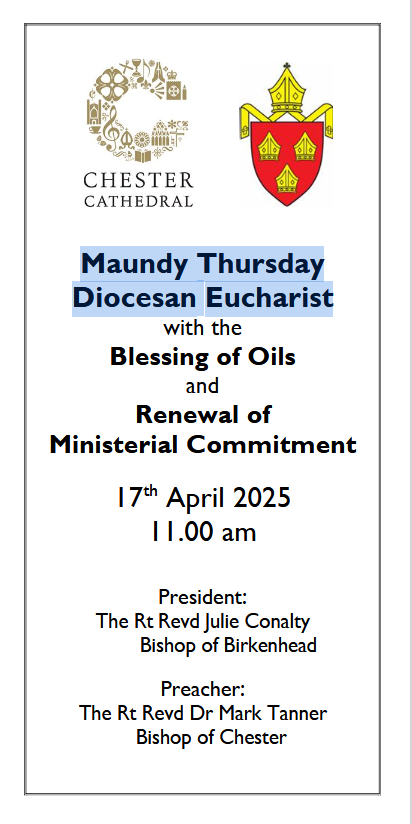
Maundy Thursday at Chester Cathedral
Last year, I was in Chester Cathedral on Maundy Thursday where the Diocesan Eucharist was held. The Cathedral was awash with Clergy, (I counted at least 4 Bishops) and most of the priests in the area.
The Moon rules the months: this month’s span ends With the worship of the Moon on the Aventine Hill.
Fasti by Ovid
Cycle of the Moon, sketched from photo.
The Aventine Hill is one of the seven hills of Rome, named after a mythical King Aventinus. It is the hill where Hercules pastured his cattle. They were stolen by Cacus. According to Virgil in his Aeneid, the monstrous Cacus lived in a cave on a rocky slope near the River Tiber. Cacus was the son of Vulcan, the artificer God. He was, also, a fire breathing Giant who eat human flesh and stuck their skulls on the door of his house. When Hercules wrestled with him, Hercules hugged him so tight Cacus’ eyes popped out of his head.
The worship of Minerva also took place on the Hill. You can take a Google Earth fly past if you follow this link – also some nice photos.
The Aventine Hill & Romulus
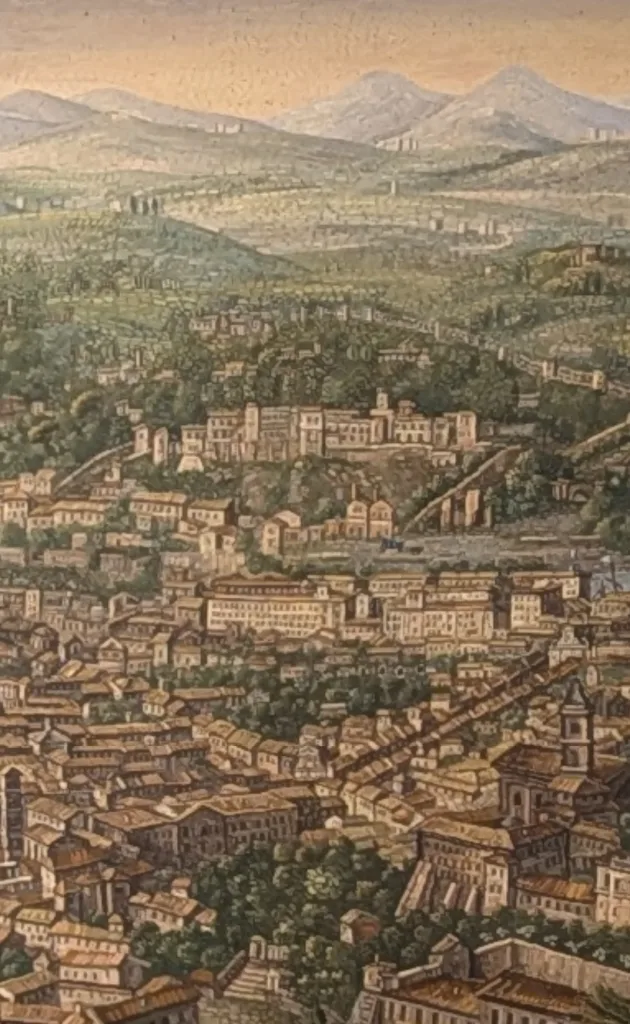
Aventine Hill in a detail of the ‘Panorama of Rome From the Janiculum Hill’ in miniature mosaics by Antonio Tesca 1800-25 , Gilbert Collection V&A Photo K Flude. You can see the Walls of Rome in the Background. The Tiber runs across the middle but is not clearly visible.
The Hill is famous in the mythology of Rome because it is associated with Romulus. He and his twin Brother Remus, were born to the vestal virgin, Rhea Silvia, in the pre-Roman City of Alba Longa, not far away. Rhea was the daughter of former King Numitor. Her uncle, killed Rhea’s brother and forced her to be a vestal Virgin. Thus ensuring Numitor’s line died out.
But, in her sacred grove she was put to sleep by Somnus dripping a sleeping draft into her eyes and then raped by the God Mars. This was a terrible breaking of the taboo for Vestal Virgins. Rhea gave birth to the twin boys. They had to be hidden from the wrath of their Granduncle.
The Palatine & the Lupercal
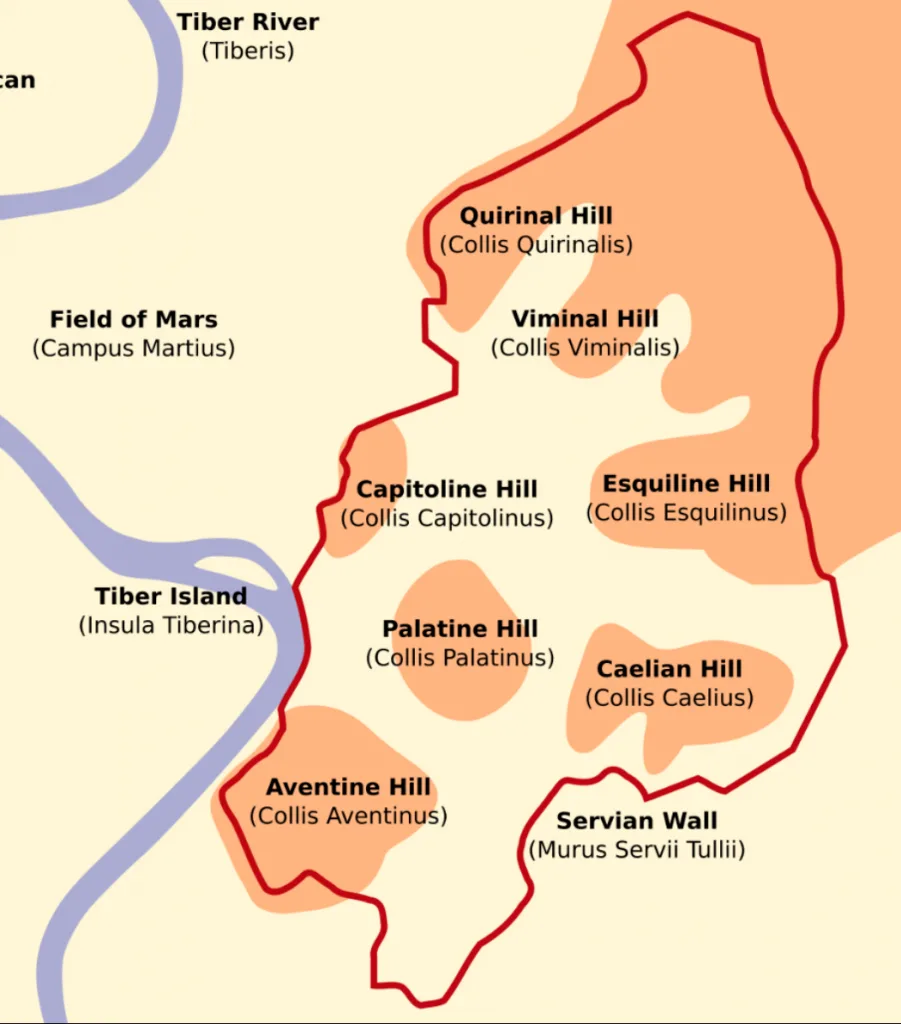
The Seven Hills of Room (Facebook)
The boys were saved by the River God Tiberinus and then by being suckled by a Wolf in a cave called the Lupercal, which is at the foot of the Palatine Hill in Rome. A ‘grotto’ under Augustus’ Palace on the Palatine, has been claimed as the original Lupercal, but it is disputed. (see www.digitalaugustanrome.org/records/lupercal/.
When the boys grew up, they helped their Grandfather (Numitor) reclaim the throne of Alba Longa. The boys, being the children of the War God, were obviously excellent at the art of war. Then they decided to found their own City, but they could not decide upon which hill to build it or whom to name it after (accounts vary!). Remus favoured the Aventine, Romulus the Palatine (some accounts say vice versa).
So they decided to let the Gods decide. Remus claimed to have won when he saw a flight of 6 auspicious birds. Romulus saw 12 and declared himself the winner. And Rome was named in his honour. It was on his choice of Hill – the Palatine Hill. The Aventine hill was, originally, outside the City boundary.
The two quarrelled. Remus was killed. This story was first written down in the Third Century BC. The traditional foundation date of Rome is 753BC. These mythical foundation stories continue are retold and celebrated. In Britain, we largely ignore our creation myths. Despite our legendary Founder, King Brutus, being a relative of Romulus and Remus.
The ‘Panorama of Rome From the Janiculum Hill’ in miniature mosaics by Antonio Tesca 1800-25 , Gilbert Collection V&A Photo K Flude. It took 20 years to make.
You didn’t think I’d leave you with just a detail of the superb map did you? And to see a much better photo of it look at the V&A’s photo. It is part of the Gilbert Collection which I introduced in this post.
First written in 2023 and revised March 30th 2024, 2025, Object of the Day added 2026
Fascinating read about the King’s Evil by Andrew Taylor
Aries & Noses
We have just entered Aries. Now according to astrology, Aries is associated with health issues of the face. This, according to ‘Skin and Astrology Signs‘ is because of the “level of heat in their bodies”. So Arians tend to have problems such as “flushing, heat rashes, skin eruptions, and rosacea”. They suggest using chilled cucumber for the eyes and forehead, and using beauty products with soothing aloe vera in them. ‘Touching’ by the King could also cure certain nose conditions, particularly if caused by ‘The King’s Evil’.
Charles Kightly, in his Perpetual Almanac enjoins us to ‘Observe the features of the face which are ruled by Aries and seek cures for ills of the nose’.
The first example, Kightly gives, is from The Shepherd’s Prognostication of 1729 which explains how to understand people by studying their noses:
Nose round with a sharpness at the end signifies one to be wavering of mind; the nose wholly crooked, to be sure unshamefaced and unstable; crooked like an eagle’s beak, to be bold. The nose flat, to be lecherous and hasty in wrath; the nostrils large, to be ireful.’
A Fungous Nose & the King’s Evil
The second rather revolting tale is from John Aubrey.
Arise Evans had a fungous Nose and said, it was revealed to him, that the King’s hand would cure him. At the first coming of Charles II into St James Park he kissed the king’s hand and rubbed his nose with it: which disturbed the king, but cured him.
Now, on the subject of revolting nose conditions, I have just been reading a review of a book ‘Civility and the Theatre in Early Modern England’. The author, Indira Ghose, is studying early self-help books of manners and conduct, and how they influence or appear in contemporary plays. One such manual by Giovanni Della Casa has the following advice:
‘when thou hast blowne thy nose, use not to open thy handkerchief, to glare uppon thy snot, as if thou hadst pearles and Rubies fallen from thy braynes’.
Galateo: The Rules of Polite Behaviour published in Venice in 1558. It was translated into French (1562), English (1576), Latin (1580), Spanish (1585), and German (1587), (Wikipedia). Galateo translates as etiquette.
There is no need to thank me for passing on such good advice! I bet “Miss Manners” Judith Martin didn’t pass this particular gem on, but Wikipedia claims that modern books of manners are influenced by Galateo.
Scofula and the King’s Touch
Sketch of Dr Johnson from a portrait.
People believed that Scrofula, could be cured by touching the Monarch. Tuberculous cervical lymphadenitis was, thus, known as the King’s Evil. So, the King or Queen would make herself, very reluctantly, available for his sick public to touch her. Dr Samuel Johnson suffered from Scofula and received the “royal touch” from Queen Anne on 30 March 1712 at St James’s Palace. He was given a ribbon, which he wore around his neck for the rest of his life (with a coin strung on it, I think see below). But it did not cure the disease, and he had to have an operation.
The Touching took place in the winter, between Michaelmas and Easter, when cold weather provoked the disease. The lucky few, who were allowed the Touch, would be touched or stroked by the King or Queen on the face or neck. Then a special gold coin, touched by the Monarch, was put around their neck. Readings from the bible and prayer finished the ceremony. Before Queen Elizabeth I, the Touch was said to cure many diseases such as Rheumatism, convulsions, fever and blindness, but after it was reserved for Scrofula.
Who Started touching for the King’s Evil?
It was only the French and the English who believed the King’s touch could cure people. The French claimed it began with Philip 1 in the 11th Century. The English claimed Edward the Confessor as the first. But this was denied by the French who claimed that the French King of England, Henry 1 introduced it to the English. The practice lasted until George 1 who resolutely refused to have anything to do with it.
For more on the King’s Evil have a look at this blogpost. Or read the book pictured at the top of the post.
On This Day
1312 – The Knights Templars are abolished by Pope Clement. King Philip of France had a massive debt owed to the Templars, following his war with England. He chose to avoid payment by accusing the Templars of impious acts, and homosexuality. Evidence was collected by torture and thus unreliable.
1622 – Jamestown massacre: 347 English settlers killed by Powhatan People of Tsenacommacah. This is estimated as a third of the colony’s population, during the Second Anglo-Powhatan War. Powhatan (Chief Wahunsunacawh) was the father of Pocahontas (aka Amonute, or Matoaka and Rebecca Rolfe). But it was Powhatan’s son, Opechancanough, who was in charge during the massacre. They were of the Algonquian peoples.
1888 – The English Football League was founded at Anderton’s Hotel, Fleet Street. Representatives from Aston Villa, Blackburn Rovers, Bolton Wanderers, Preston North End and West Bromwich Albion met. They discussed other teams that might join. Another meeting was called at the Royal Hotel in Manchester on 17 April 1888 to establish the league. The 12 founding members were: Accrington, Aston Villa, Blackburn Rovers, Bolton Wanderers, Burnley, Derby County, Everton, Notts County, Preston, Stoke City, West Bromwich Albion, Wolverhampton Wanderers. None from London. In season 1894–95 Woolwich Arsenal joined the 2nd Division of the Football League as the first London Team. For more information see: the-football-league-conceived-in-fleet-street-born-in-manchester/
First published in 2024, revised in 2025, Etiquette and On This Day added 2026
Gregorius I is known as Saint Gregory the Great. Pope from 3 September 590 to his death on 12th March 604. So 12th March is traditionally his feast day. It was changed to September 3rd, the date of his elevation to Pope because 12th March was often in Lent.
His is the 2nd most popular name for Popes. This is the top 18. I guess St Peter was too hard an act to follow, but then there are only 6 Pauls? I can’t help feeling there should be six Sixtus’s?
St Gregory is the patron saint of musicians, singers, students, and teachers. It is traditionally believed he instituted the form of plainsong known as Gregorian Chant. However, he was also a formidable organiser and reformer. He made changes that helped the Catholic tradition survive Arian and Donatist challenges. To read more about the Arian Heresy look at my post on St. Hilary and the Arians. (St Gregory and the Angles – why do these all sound like 80’s post punk bands?)
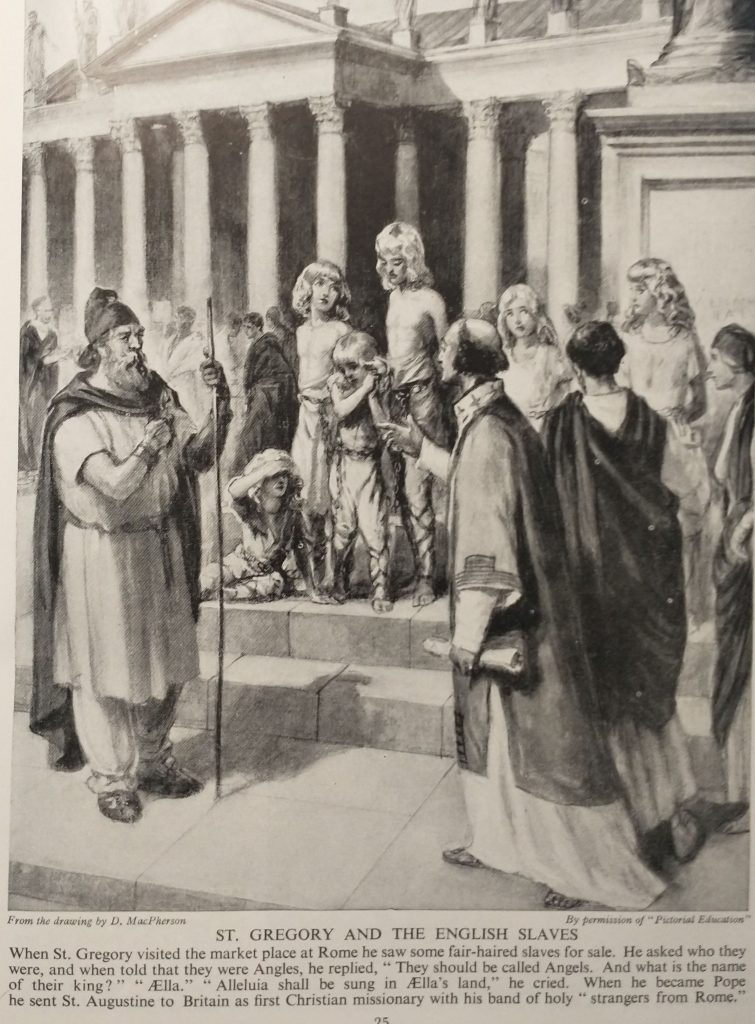
In the UK, St Gregory is venerated with St Augustine for bringing Christianity to the largely pagan Anglo-Saxons. The caption to the illustration above tells the story of how he came to send a mission to the pagan Angles in Briton. It includes his two most famous puns, riffing on the similarity of the words Angles/Angels and Aella/Alleluia. But in between these two he also punned on the name of Aella’s kingdom. This was called Deira which later joined with Bernicia to become the Kingdom of Northumbria. St Gregory said he would save them from the wroth of God which is ‘de ira’ in Latin. The ire of God. Deira. No? Not hitting your funny bone?
St Augustine’s Mission
In 597AD St Gregory sent St Augustine to Canterbury. His mission to convert the Germanic peoples of the former Roman Province of Britannia. Canterbury was chosen because its King was the ‘Bretwalda’ of Britain. And he, was married to Bertha, a French Princess who was already a Christian. The enigmatic title of Bretwalda was given to Britain’s most powerful King. At the time, it was Ethelbert of Kent. So, it was a relatively safe haven for St Augustine’s mission. The King was baptised, shortly, after in Canterbury.
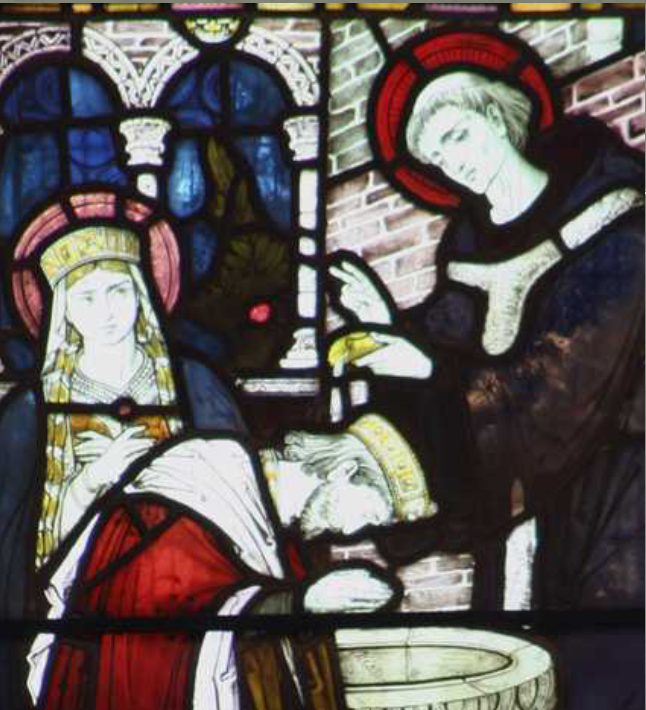
Stained glass window showing the Baptism of King Ethelbert of Kent by St Augustine watched by Queen Bertha. In St Martins Church, Canterbury
Archbishop of London?
The mission came with a plan to recreate the ecclesiastical arrangements set up in the Roman period. From the early 4th Century there were archbishops in the two main capitals at London and York. (We know because they attended the Synod of Arles in 314). After Kent was converted, St Augustine sent St Mellitus to London. London was part of the Kingdom of Essex, ruled by St Ethelbert’s nephew, Sæberht. Mellitus was the first Anglo-Saxon bishop of London and he established St Pauls Cathedral in 604. St Paulinus was sent to convert Northumbria and established a Cathedral in York.
Unfortunately, for the plan, Sæberht died. His sons returned to paganism and Mellitus was kicked out. He returned to Canterbury, where he, eventually, became Archbishop. Ever since we have had an Archbishop of Canterbury and York and never had an Archbishop of London.
St Martin’s Church, Canterbury – where the Church of England began. Note the Roman tiles in the wall.
St Gregory and England
It is possible to argue (and I do) that St Gregory’s encounter with the Angles is why we are called English, not Saxons, nor Wessexians. Gregory sent Augustine to set up the Church of the Angles, not the Church of the Saxons. Saxon was the normal name used by the Romans for Germanic barbarians. The old Roman province of Brittania was by now divided into 3 Saxon Kingdoms. Essex, Wessex, and Sussex. (East, West, and South Saxons). 3 Anglian Kingdom, Mercia, East Anglia and Northumbria. (Middle, East and North Angles). And Kent, which the Venerable Bede says was a Jutish King of Germans from Jutland. These Kingdoms were often at war., sometimes allied, or subjected.
The Vikings then conquered most of these Kingdoms, except parts of Wessex and Mercia. After the attacks of the Vikings were beaten back, Alfred and his son, daughter and grandson reconquered or ‘liberated’ the ex-Viking areas. Alfred renamed the united kingdoms of Wessex and Mercia, the Kingdom of the Anglo-saxons. Athelstan his son liberated Northumbria and other areas, and in joining it to the Kingdom of the Anglo-Saxons renamed it Angeland or England.
The Church of England had made the term Anglish/English became a unifying term to unite Angles, Saxons and Jutes. Otherwise, the ‘liberated’ Angles and Jutes would have to swallow being part of Greater Wessex, rubbing in their loss of independence. Of course, it was all a bit more complicated, but it gives a summary of the formation of England, which was created by the end of the 10th Century.
St Gregory in Amsterdam
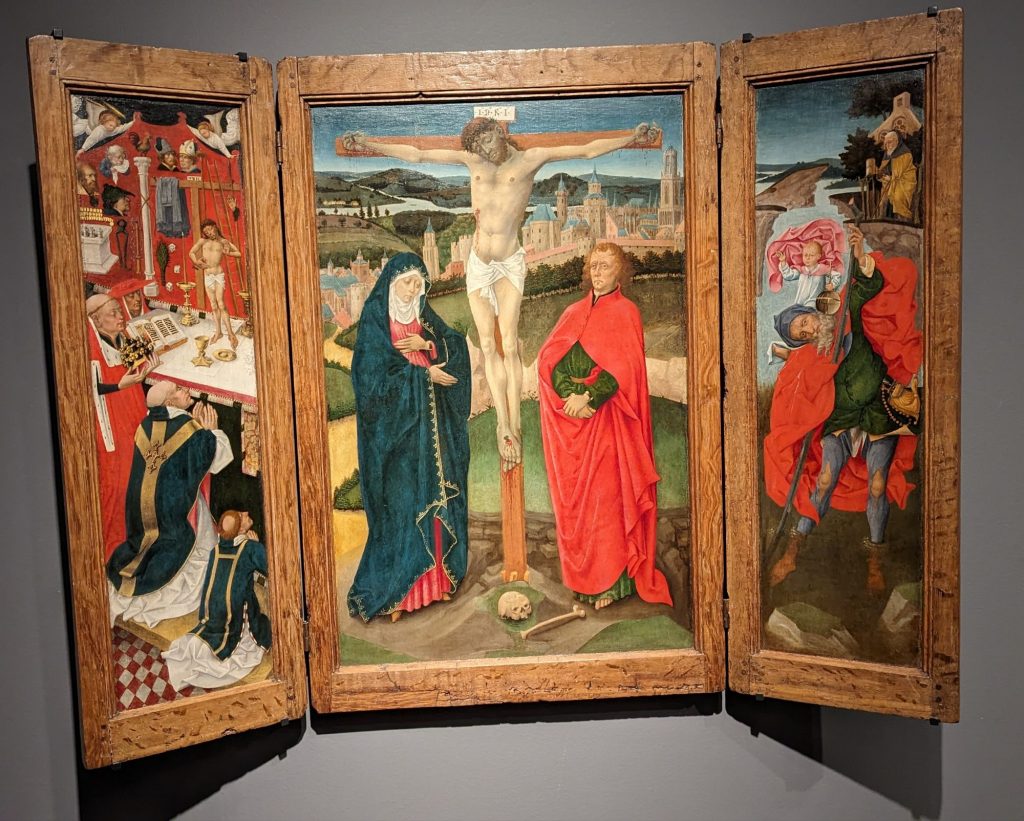
On a visit to Amsterdam and the Rijksmuseum I came across this painting which features Pope Gregory the Great. He is in the left hand part of the Triptych, shown in green kneeling at the altar. It shows Utrecht in the background.
Triptych of the Crucifixion. Showing the vision of the Crucifixion that St Gregory had while celebrating Mass (left). Crucifixion centre. St Christopher (right)
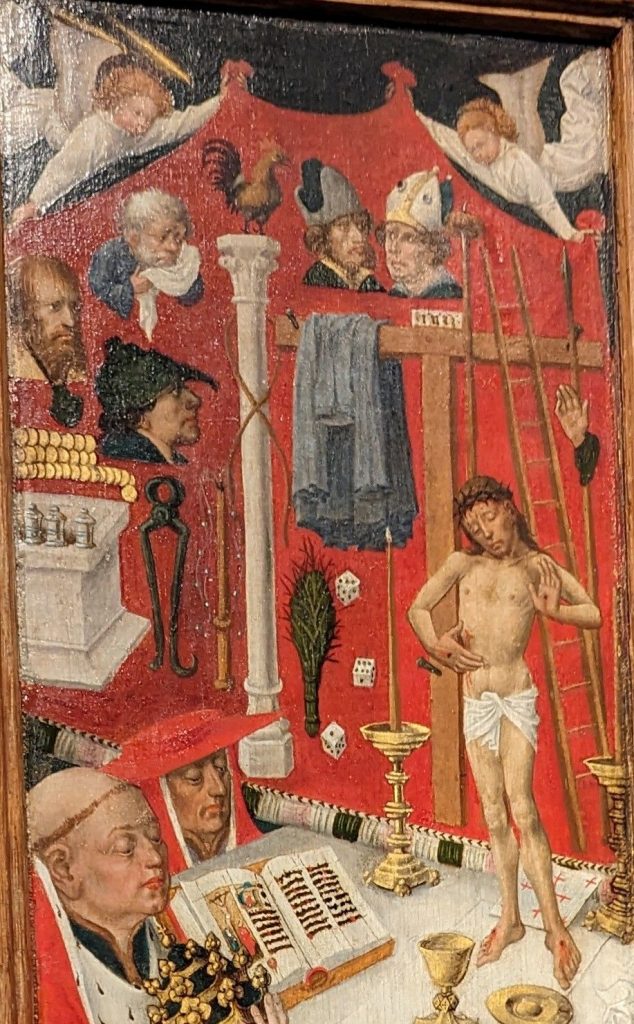
What is fascinating is all the paraphernalia of the Crucifixion above Gregory’s head. You’ll see 30 pieces of silver, dice to decide who gets Jesus’ robes, flails and torture devices, sponge and spear etc. Close up below.
Lazy Day in Anglo-Saxon Times. In the Laws of King Alfred the Great, this day was a day off for freemen. For more on Days off in the Anglo Saxon Calender see my post on August 15th.
1689 – Catholic King James II landed at Kinsale, County Cork, Ireland, in an attempt to regain the Kingdom from his daughter and son-in-law, William and Mary. James had fled to the continent following riots against his rule. William defeated James II at the Battle of the Boyne. James II returned to France never to return. Mary ruled jointly with her husband until she died of Smallpox, and he ruled alone until he fell off his horse.
1930 – Mahatma Gandhi begins the Salt March, a 200-mile march to protest the British monopoly on salt in India. One of the defining moments in non-violent civil disobedience. Offering the world a possible alternative to violent revolution, or military regime change.
1999 – Former Warsaw Pact countries, Czech Republic, Hungary and Poland join NATO. Bulgaria, Estonia, Latvia, Lithuania, Romania, Slovenia and Slovakia joined in March 2004; Croatia and Albania joined on 1 April 2009. Montenegro 2017. North Macedonia. 2020: (Ukraine) can forget about (NATO membership). That’s probably the reason the whole thing (war) started,” said U.S. President Donald Trump on February 26, 2026
First published in 2024, republished in 2025. On This Day added 2026
Portrait of Saint Guénolé (St Winnold) after a bust in silver on a reliquary from the Church Saint-Guénolé in Locquénolé.Public Domain Abgrall Jean-Marie (1846-1926) – Bibliothèque nationale de France
Here is a weather poem in which St Winnold appears
First comes David, then comes Chad. And comes Winnold, roaring like mad. White or black. Or old house thack.
St David’s Day was March 1st. St Chad, the 2nd. St Winnold’s Day is the third of March. Winnold is his English name, and Winneral, or Winwaloe or Guénolé his Celtic names.
The poem suggests that snow, rain or wind is going to come on these three days. When the wind roars, it will threaten the thatch of houses. If the storms do not come in the first 3 days, then they will come on the last three days of March, which were called ‘the Borrowing Days’. Or so it is said.
St Winnold was around 50 years (460 – 3 March 532) after the end of Roman Britain. His family was from Cornwall. He was the son of a Prince Fragan of Dumnonia, and St Gwen the Three-Breasted, His mother’s Feast day is October 3rd. She is a Saint of fertility, because of God’s Gift of an extra breast. They moved to Brittany to escape a British Plague. Their son grew up to be holy and was the founder and first abbot of Landévennec Abbey (the Monastery of Winwaloe). It is south of Brest.
Winwaloe became what is known as a ‘phallic saint’ because he was associated with fertility. Wikipedia says this came about because of confusion about the origin of his name:
‘his name was thought to derive from gignere (French engendrer, “to beget”)’
St Winnold’s Breton name is Guénolé. How this etymology works is not clear to me! But surely, he as likely to have got a reputation for helping people with fertility problems from his mother? Supplicants would make a wax phallus to persuade the Saint to help them conceive. There are several churches/ chapels dedicated to him in Wales, and a Priory in East Anglia.
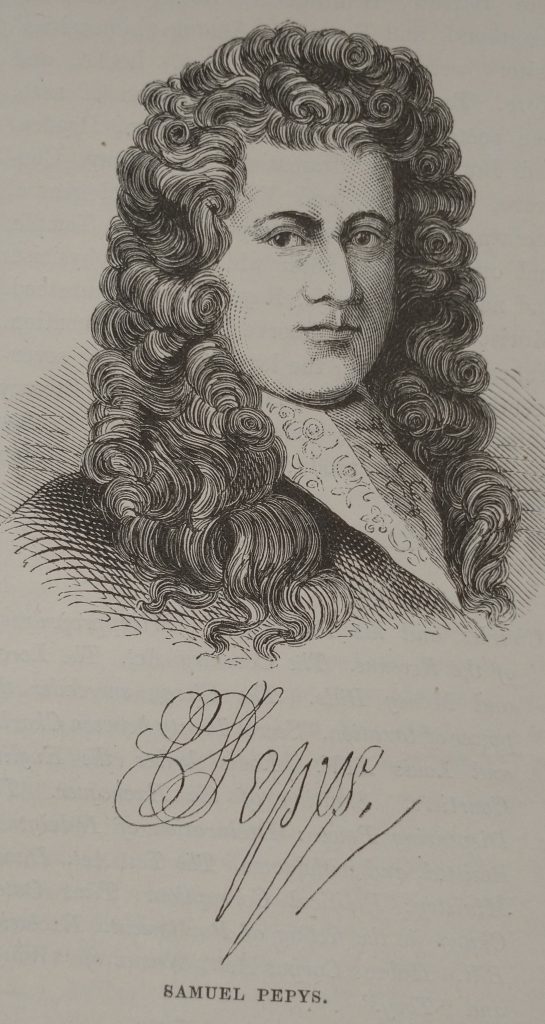
John Evelyn is, with Pepys and Wren, one of the great figures of 17th Century London. Unlike Pepys, he was an avowed Royalist who hated Oliver Cromwell and all he stood for. He went into exile with his King and gives a great description of Paris (see below).
Like Pepys, John Evelyn was a diarist and a writer. And they, like Wren, were alumni of the Royal Society, one of the great scientific societies. John Evelyn was a founding fellow. It was innovative in that it employed an experimenter. This was Robert Hooke – one of the great early Scientists, who also worked with Wren rebuilding London after the Great Fire. The Royal Society encouraged scientists to experiment, write up their observations, and submit their theories for peer review. This is the foundation of modern Science, and a bedrock of the Enlightenment.
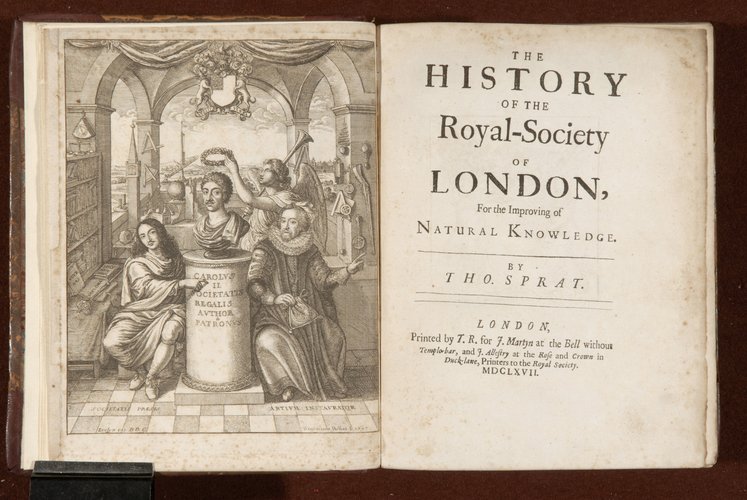
Frontispiece of ‘the History of the Royal-Society of London by Thomas Sprat. John Evelyn was a founder member
Evelyn the Writer.
John Evelyn has a place in my history because, in the 1980’s I worked. with Paul Herbert, on a project to create an interactive history of London. It was financed by Warner Brothers, and in cooperation with the short-lived ‘BBC Interactive TV Unit’. One part of it was a Literary Tour of London. The first half of this Tour is the basis for my book ‘In Their Own Words’ (To buy click here ) And this is where I came across John Evelyn using several of the quotations on this page.
Evelyn was a prolific traveller and a polymath. He wrote on the need to improve London’s architecture and air in Fumifugium (or The Inconveniencie of the Aer and Smoak of London Dissipated). Here is an extract from his Furmifugium.
‘That this Glorious and Antient City, which from Wood might be rendred Brick, and (like another Rome) from Brick made Stone and Marble; which commands the Proud Ocean to the Indies, and reaches to the farthest Antipodes, should wrap her stately head in Clowds of Smoake and Sulphur, so full of Stink and Darknesse, I deplore with just Indignation.
That the Buildings should be compos’d of such a Congestion of mishapen and extravagant Houses; That the Streets should be so narrow and incommodious in the very Center, and busiest places of Intercourse: That there should be so ill and uneasie a form of Paving under foot, so troublesome and malicious a disposure of the Spouts and Gutters overhead, are particulars worthy of Reproof and Reformation; because it is hereby rendred a Labyrinth in its principal passages, and a continual Wet-day after the Storm is over. ‘
And he was an expert on trees. Author of: Sylva, or A Discourse of Forest-Trees (1664). He lived at Sayes Court in Depford near Greenwich, which he ill-advisedly rented to Peter the Great of Russia. Letting to Peter was a lot-like inviting a 1960s Rock Band to trash your mansion.
John Evelyn the Exile
Here is a taste of Evelyn’s time as an Exile. It is a short extract from a long entry on the splendid Palaces in and around Paris.
27th February, 1644. Accompanied with some English gentlemen, we took horse to see St. Germains-en-Laye, a stately country house of the King, some five leagues from Paris. By the way, we alighted at St. Cloud, where, on an eminence near the river, the Archbishop of Paris has a garden, for the house is not very considerable, rarely watered and furnished with fountains, statues,[and groves; the walks are very fair; the fountain of Laocoon is in a large square pool, throwing the water near forty feet high, and having about it a multitude of statues and basins, and is a surprising object. But nothing is more esteemed than the cascade falling from the great steps into the lowest and longest walk from the Mount Parnassus, which consists of a grotto, or shell-house, on the summit of the hill, wherein are divers waterworks and contrivances to wet the spectators; this is covered with a fair cupola, the walls painted with the Muses, and statues placed thick about it, whereof some are antique and good. In the upper walks are two perspectives, seeming to enlarge the alleys, and in this garden are many other ingenious contrivances.
This was Evelyn’s reaction when Charles II was restored to the throne in 1660,
May 29th 1660:
This day came in his Majestie Charles the 2d to London after a sad, and long exile… this was also his birthday, and with a Triumph of above 20,000 horse and foote, brandishing their swords and shouting with unexpressable joy; the wayes strawed with flowers, the bells ringing, the streets hung with Tapisry, fountains running with wine: ‘
‘The mayor, Aldermen, all the companies in their liveries, chaines of gold, banners, Lords and nobles, cloth of Silver, gold and velvet every body clad in, the windows and balconies all set with Ladys, Trumpetes, Musik, and myriads of people … All this without one drop of bloud …it was the Lords doing…
1661 – ‘Ash Wednesday. Preached before the King the Bishop of London (Dr. Sheldon) on Matthew xviii. 25, concerning charity and forgiveness.‘
John Evelyn’s Diary Dr Sheldon, the Bishop of London mentioned above, went on to become Archbishop of Canterbury. He was a friend of Wren’s Father, and commissioned Wren to build the Sheldonian Theatre, in Oxford.
1782 – OK! Let’s give up! The House of Commons votes against continuing the war with Revolutionary America.
1900 – The Labour Party is founded. And today, the UK woke up to a by-election in a safe Labour seat won by the Greens (40%) with Reform 2nd (29%) and the Labour Party third (26%) Conservatives fourth (2%). So, clearly a progressive vote determined to beat Reform, Labour won about 50% of the vote last time, so a disaster for them. Not a success for Reform, and bad result for the Conservatives.
1933 – Reichstag burns down. Hitler uses it to suspend Civil Liberties, and attack the German Communist Party which was falsely blamed for the fire.
First Published 2024, republished 2025, Making Lardy Cake moved to Fat Thursday and On This Day added 2026
Today is the Feast day of two significant Saints, St. Walpurga and St. Ethelbert.
St. Walpurga
St. Walpurga was a nun at Wimborne in Dorset. She, and her brothers St Willibald and St Winebald, accompanied their uncle, St Boniface of Crediton (in Devon) on his mission to convert the Germans to Christianity. They all became leading figures in the new German Church. Willibald set up the Monastery at Heidenheim, which was a duel monastery housing both Monks and Nuns. His sister, St Walpurga, became Abbess of the Monastery in 761. She died on 25 February 777 or 779 (the records are unclear),
In 870, St. Walpurga remains were ‘translated’ to Eichstätt, which St Willibald had set up as the Diocesan centre of this part of Bavaria. The date of the transfer was the night of April 30th/May 1st. This was her feast day. But the Church moved it to February 25th, to commemorate her death. However, May Eve is now ‘notorious’ as Walpurgis Night. This is the night of May Eve when witches are abroad up to all sorts of mischief, May Day being one of the main pagan festival days. Her body was placed in a rock-cut niche and her bones started exuding an oil called Walpurgis Oil which was said to have medical properties. She was also involved in a miracle of a boat saved in a storm-tossed sea.
For these reasons, Walpurgis is the Saint for battling pests, rabies, whooping cough, storms and sailors. She is also associated with witchcraft but not because of any actual association with it. Her remains were moved again in 1035 when she was enshrined at the Benedictine Abbey of St. Walburga which was named after her.
Walpurgis Nacht
Terrible things happen on Walpurgis Night in Dracula by Bram Stoker. So, the night has now become a trope for Heavy Metal Bands, doyens of horror stories and the Satanic. For more on this read my piece on Walpurgis Nacht.
Coincidently, I was reading about the fuss made about a Heavy Metal Band, called a Plague of Angels, playing in the glorious York Minster. A member of the band tried to calm down the controversy, saying people should just chill out. But other group members used to be in a band called ‘The Cradle of Filth’. Among their claims for Heavy Metal Fame is that they wore the most controversial t-shirt in heavy metal history. This has a visual of a nun in a compromising position and a slogan saying ‘Jesus is a ……..’ (add your favourite swear word here). All very silly. But it struck a cord with me, as I have a scene in my novel (unpublished) which is based on extreme forms of Heavy Metal Bands. I thought I might have gone over the top, but this story reassures me that extreme Metal can be extremely offensive!
Ethelbert is responsible for welcoming the Augustinian Mission to the Angles sent by the Pope, St Gregory. This re-established Christianity in Eastern Britain, and set up the Anglican Church or the Church of England as it became known.
1308 – Edward II crowned King of England. His reign ended disastrously, with his Queen having an affair with Lord Mortimer and Edward losing control of the country (and Scotland). He was forced to abdicate, and died/was murdered/killed with red-hot pokers/or escaped to live a life as a hermit on the continent. Choose your favourite or read my History of the Kings and Queens of Britain.
1507 – Queen Elizabeth I excommunicated by Pope Pius and declared usurper of the throne, leading to the Spanish Armada and various plots against her life. (my post on Queen Elizabeth’s nicknames is here)
1836 – The Colt Revolver awarded a United States patent. Previously, he had obtained a UK Patent. It created the classic ‘Western’ Revolver’, much later called the Colt 45. It was a revolving-breech loading, folding trigger hand gun.
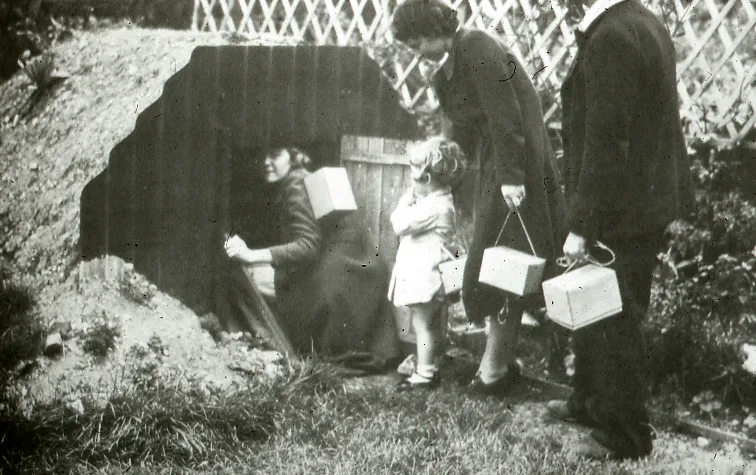
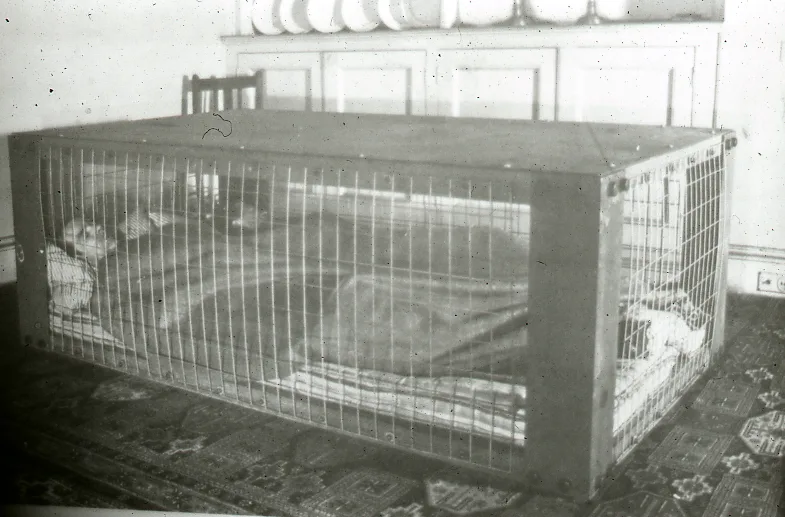
1939 – The first Anderson shelter built in a garden in Islington, London. They were named after the Home Secretary, and were dug in a trench with soil piled over the corrugated iron domed roof. Inside were bunks for the occupants to sleep in. They were 6 ft high, 4.5 ft wide, and 6.5 ft long. 2.5 million were built. The next shelter was the Morrison Shelter named after Herbert Morrison, who succeeded Anderson as Home Secretary. The Morrison Shelter was like a massive table that would protect the shelterers if the house collapsed above it. It allowed the family to sleep inside. London also had public shelters made of brick in many streets, or used cellars and brick arches as shelters. A small proportion of the population preferred to sleep in the Underground. Many stayed in their beds, unless planes were directly overhead. Photos from ‘The British People at War’ published during the war.
Anderson ShelterMorrison ShelterConcrete Public Shelter in London Museum Docklands (Photo C. Mossie)
1956 – Nikita Khrushchev denounces Stalin.
First Written February 2024, revised February 2025. On This Day added in 2026