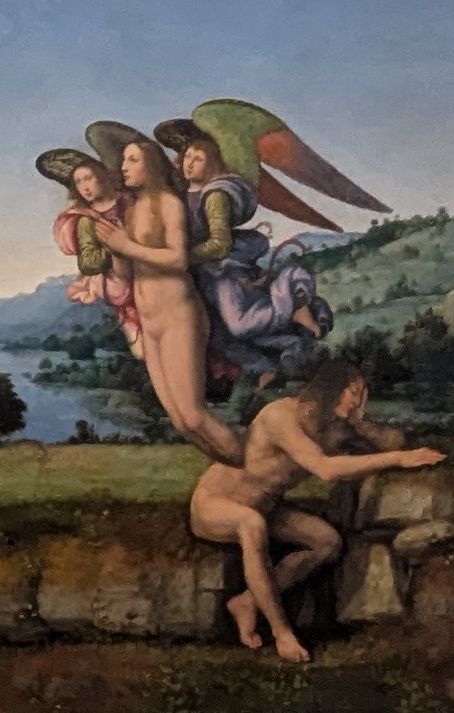
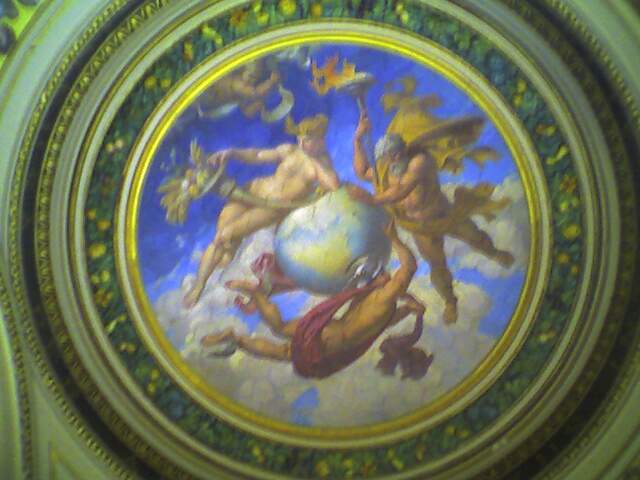
Detail from ‘The Creation and the Fall of Man’ by Mariotta Alberinelli 1513-14 showing Archangels helping in the creation of Eve from Adam’s Rib’
September 29th used to be St Michael’s Day, or Michaelmas. But in the 20th Century, the Catholic Church made it the day to celebrate the three chief Archangels and all Angels. Previously, September 29th was for St Michael, March 24th for St Gabriel, and October 24th for St Raphael.
It was an important day in the medieval civil calendar and was the date on which Oxford, Cambridge and the Legal system started their autumn terms. It is also the date the Lord Mayor of London is elected at Guildhall in the City of London.
About this time, the Michaelmas Daisy (an Aster) comes out in profusion. They have been out in my Father’s garden since August, but have only been flowering for a few weeks in my own garden. Here is an old rhyme:
“The Michaelmas daisies, among dead weeds, Bloom for St Michael’s valorous deeds …
The Angelic Host
Personally, I don’t understand what Archangels are doing in a monotheistic religion. They seem to be supernatural demigods which seems odd. The Book of Revelations is one of the most important sources, but they are scattered around the Bible. Perhaps the most famous is the visitation of Gabriel to the Virgin Mary, (see my post here)They are 15 Archangels:Adabiel, Azrael, Chamuel, Gabriel, Haniel, Jeremiel, Jophiel, Melatron, Michael, Raguel, Raphael, Raziel, Sandalphon, Uriel, and Zadkiel.
Melatron has to be my favourite, given his name which sounds like something from a kids superheros cartoon! He is made from the human Enoch and Keeper of the Book of Life so perhaps the most powerful of the Archangels. He is good for relationship, career, and parenting advice!
The Book of Enoch mentions 200 Fallen Angels including Satan, but Alphonso di Spina a 15th Century Monk calculated there were 133 million fallen angels, one third of the original Angelic Host.
What are Angels for? Something to give us hope that somewhere, somehow something might be looking out for us? As Sir Antony Gormley says of the Angel of the North ;“People are always asking, why an angel? The only response I can give is that no-one has ever seen one and we need to keep imagining them.”
On This Day
1564 – Lord Dudley Created Earl of Leicester
‘After the service at St James on Michaelmas Day, Lord Robert Dudley was led by the earls of Sussex and Huntingdon into the queen’s presence chamber. He wore a black gown edged with lace with nineteen pairs of gold aglets on the sleeves. Before him, his brother Ambrose, Earl of Warwick bore his sword, Garter bore his patent and Lord Clinton, Lord Admiral, his cap and coronal. All made obeisance to the queen three times. Lord Robert knelt before her.
Garter gave the patent to Cecil, who read it out aloud. The Earl of Warwick presented the sword to the queen, who put it about the neck of her new Earl of Leicester, putting the point under his left arm and then, while putting his cap and coronal on his head, with a mischievous smile, tickled his neck. Solemn-faced, the new earl gave the queen his humble thanks and arose and went to the council chamber to dinner, trumpets sounding before him.’
From The Progresses and Public Processions of Queen Elizabeth by John Nichols (London, John Nichols & Son, 1823) with thanks to Jan Knights for the information.
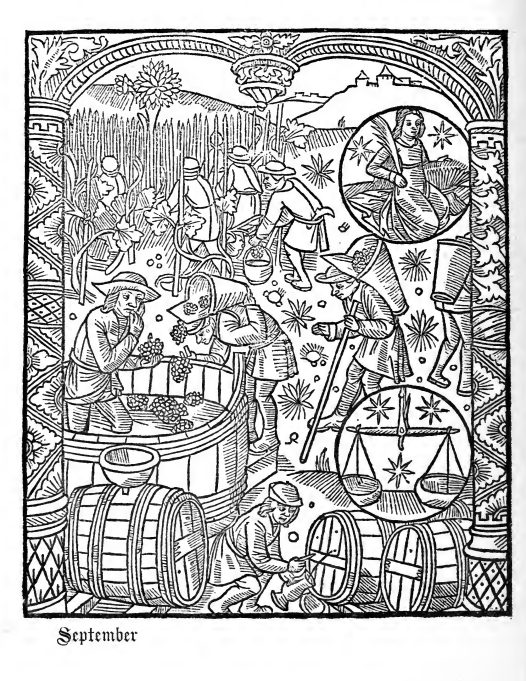
Kalendar of Shepherds illustration of September showing harvesting grapes and the astrological signs for Virgo (August 23 – September 22) and Libra (September 23 – October 22)
It is that time of the year when you say ‘Where has the Summer gone? It can’t be September already?’ But, meteorology, speaking, Autumn starts today. September 1st was chosen on a numerical basis for ease of measuring rather than any profound floral, agricultural or solar reason. So, there are three Gregorian Calendar months for each season, and each season starts on the first of the month. Autumn: September, November and December.
Autumn, Harvest, Fall
Autumn comes from Latin (autumnus) which went into French and then into English. The season was also called Harvest (which went into Dutch herfst, German Herbst, and Scots hairst -Wikipedia) or from the 16th Century: the ‘fall of the year’ or ‘fall of the leaf’ which spread to America as Fall.
Summer’s Ending
It still feels like summer. In England, we often have a glorious September, and what we can an ‘Indian’ Summer, an unexpectedly warm period in mid-September to October.
Solar Autumn
Of course, for the real Autumn, we have to wait for the Equinox, the beginning of Astronomical or Solar Autumn. This year, it is on Monday, September 22nd, 2025, 7:19 pm.
Astrological September
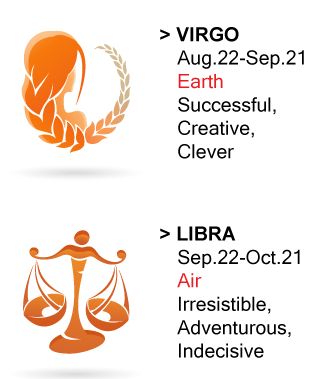
The star signs for astrological September are: Virgo which is linked to Aphrodite (Venus) the Goddess of Love and Libra which is linked to Artemis (Diana), virgin goddess of many things, including hunting, wild animals, children, and birth.
Star signs for September
September
September gets its name from the Romans, for whom it was the 7th Month of the year (septem is Latin for seven). Later, they added two new months so it became our 9th Month. (For more on the Roman year, look at my post here).
It is called Halegmonath in the early English language, or the holy month, named because it is the month of offerings, because of the harvest, and the mellow fruitfulness of September? Medi in Welsh is the month of reaping, and An Sultuine in Gaelic which means the month of plenty.
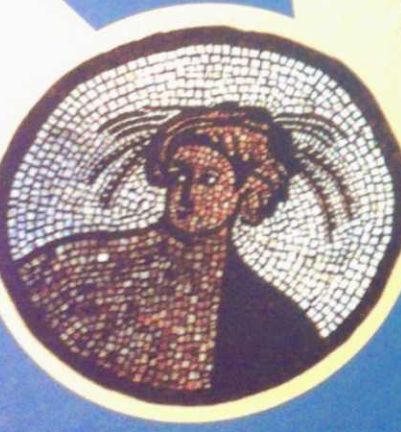
Roman personification of Autumn from Lullingstone mosaic
Early Modern September and the autumn of Life
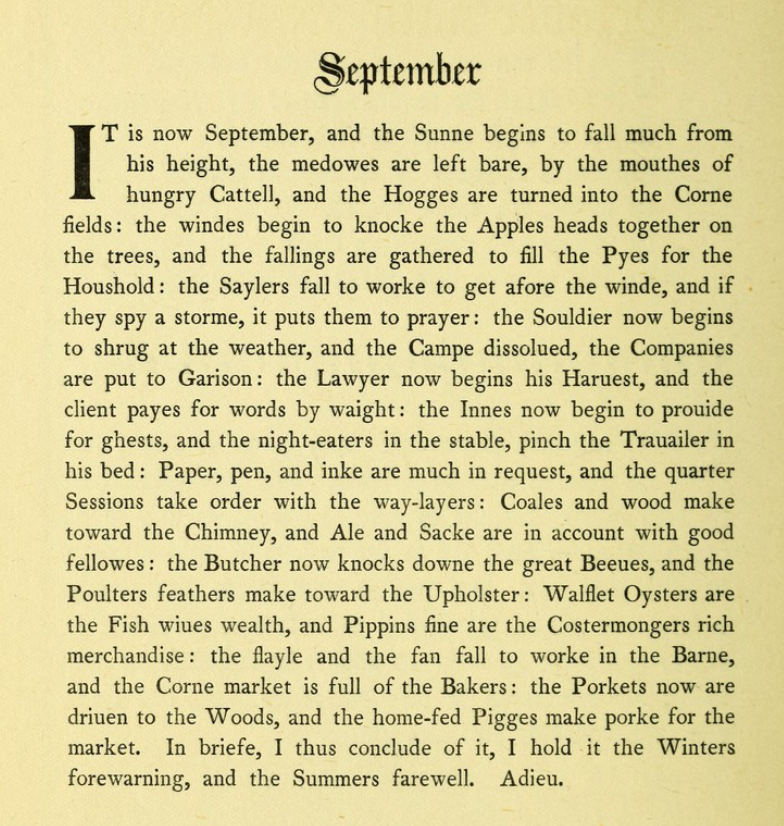
Here is an early 17th Century look at September from the Kalendar of Shepherds – for more on the Kalendar, look at my post here.
From the Kalendar of Shepherds
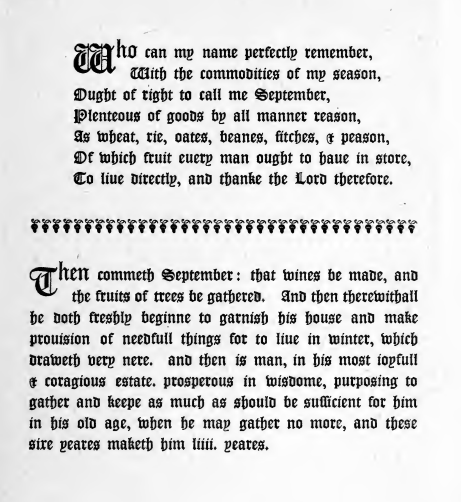
The Kalendar has an additional shorter look at September (see below). And it continues with its theme, linking the 12 months of the year with the lifespan of a man – 6 years for each month. So September is a metaphor for man at 56 years of age, in their prime and preparing for old age.
September from the Kalendar of Shepherds. The last sentence beginning ‘and then is man’ shows the link between September and the beginning of the autumn of life.
Season of ‘mists and mellow fruitfulness‘
John Keats (1795 – 1821) wrote a great poem called ‘To Autumn’:
Season of mists and mellow fruitfulness, Close bosom-friend of the maturing sun; Conspiring with him how to load and bless With fruit the vines that round the thatch-eves run; To bend with apples the moss’d cottage-trees, And fill all fruit with ripeness to the core; To swell the gourd, and plump the hazel shells With a sweet kernel; to set budding more, And still more, later flowers for the bees, Until they think warm days will never cease, For summer has o’er-brimm’d their clammy cells.
Who hath not seen thee oft amid thy store? Sometimes whoever seeks abroad may find Thee sitting careless on a granary floor, Thy hair soft-lifted by the winnowing wind; Or on a half-reap’d furrow sound asleep, Drowsed with the fume of poppies, while thy hook Spares the next swath and all its twined flowers: And sometimes like a gleaner thou dost keep Steady thy laden head across a brook; Or by a cider-press, with patient look, Thou watchest the last oozings, hours by hours.
Where are the songs of Spring? Ay, where are they? Think not of them, thou hast thy music too,— While barred clouds bloom the soft-dying day, And touch the stubble-plains with rosy hue; Then in a wailful choir the small gnats mourn Among the river sallows, borne aloft Or sinking as the light wind lives or dies; And full-grown lambs loud bleat from hilly bourn; Hedge-crickets sing; and now with treble soft The redbreast whistles from a garden-croft, And gathering swallows twitter in the skies.
Written September 19, 1819; first published in 1820. This poem is in the public domain and available here:
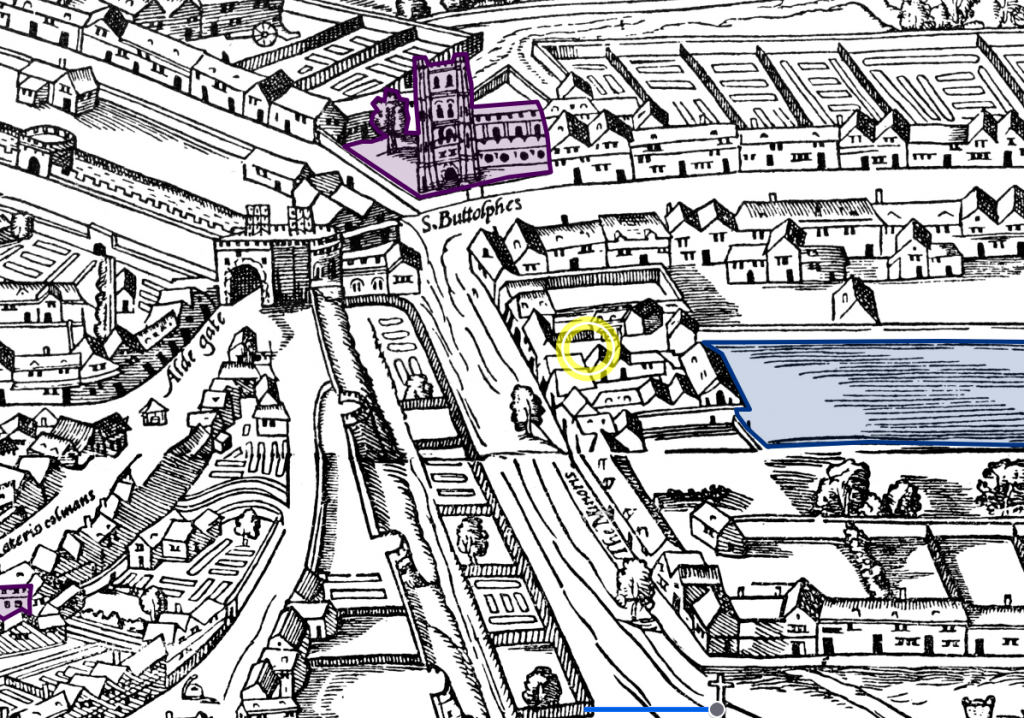
The ‘Agas’Map of 16th Century Map of London showing the Abbey of the Minoresses of St Clare with the yellow circle and St Botolphs in mauve just outside Aldgate. from the Map of Early Modern London project.
Today is the Feast day of St Clare of Assisi. An area of the City of London, called the Minories, is still to this day named after the Abbey of the Minoresses of St. Clare without Aldgate. This was was founded in 1294. The Abbey was part of the Order of St Clare or the Poor Clares as they were known . A minoress was a nun from the Order of Friars Minor (aka Franciscans) .who were also known as the Minoresses of St Clare.
Fresco of Saint Clare and sisters of her order, church of San Damiano, Assisi Wikipedia
Clare Sciffi was born in Assisi to a rich family. On Palm Sunday, 20 March 1212 Clare left her house, after refusing offers of an advantageous marriage. She had been inspired by hearing St Francis the founder of the Franciscan Monks who was also from Assisi. St Francis facilitated her transfer to Benedictine Nunneries. Her sisters followed her, one renamed Agnes became an Abbess and eventually a saint in her own right. Her family tried repeatedly to take her back into secular life. Eventually, they gave in – apparently when they saw that she had cut her flowing locks off and donned a plain robe.
A small nunnery was set up for them next to the church of San Damiano. More women joined, and they became known as the “Poor Ladies of San Damiano”. They undertook to live impoverished, and secluded.
The Franciscan friars were an itinerant order where the Friars preached to the people and were supported by begging. But this was not possible for women at that time so they lived a simple life of labour and prayer.:
‘The nuns went barefoot, slept on the ground, ate no meat, and observed almost complete silence.’ Wikipedia
Here is a site that gives information about the new Museum that will be established on the site of the Poor Clares. It also gives an outline history of the site.
The following link explores the illustrious noble women who choose to be buried in the Minories. It shows how important the Poor Clares were considered to be. It was dissolved by Henry VIII in 1539.
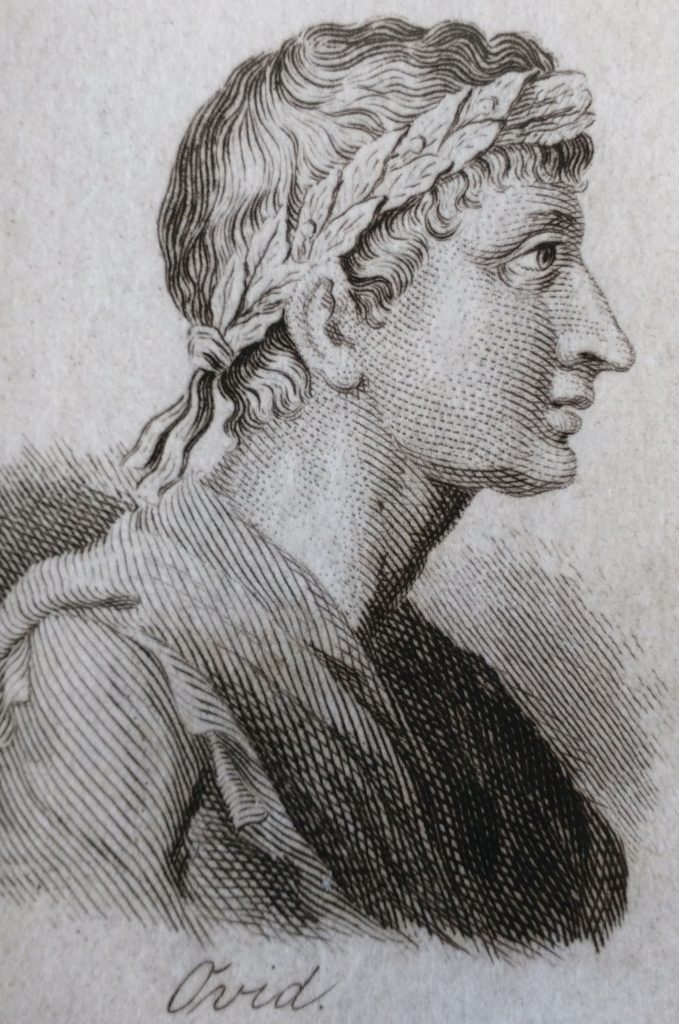
If you want to read Ovid’s almanac of the year, the ‘Fasti’, for yourself, this is the translation I am using. Fasti is very valuable because it tells the stories of the main religious and folk festivals of the Roman year. It also tells the story of the Gods and Goddesses behind the festivals,
Fasti is sadly unfinished because Pūblius Ovidius Nāsō was exiled by the Emperor Augustus. The last entry is for 30th June where Ovid writes: ‘put the last touches to my undertaking’. It suggests he knew he was finished, despite only being halfway through the year.
He was exiled to the Black Sea at Tomis where he died ten years later. It is not clear exactly why he was exiled. Ostensibly it was for the immorality of his book ‘The Art of Love’. But that was published almost a decade earlier. So, it seems a strange, delayed, cause for exile.
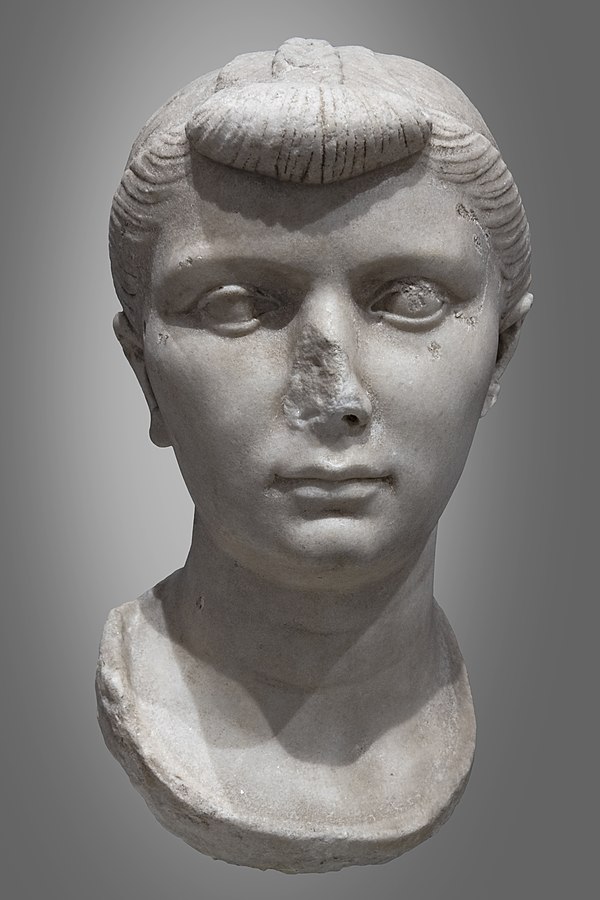
Was he involved with a plot against Augustus that saw the Emperor’s own daughter exiled? Her lover was Lullus Antonius, son of Mark Antony. Unlike Julia’s other lovers, he was forced to commit suicide.
Sculpture of Julia the Elder, daughter of Augustus, divorced wife of Tiberius Public Domain . Musée Saint-Raymond in Béziers
But this also happened years before Ovid’s exile. Julia’s daughter, Julia the Younger, was herself exiled closer to the time of Ovid’s exile. Her husband, Lucius Aemilius Paullus, was executed for treason. So, might this be the context of his exile? No one knows. Ovid said the reason for his exile was a ‘poem and a mistake’. The nature of that mistake is not recorded, but he said the crime was worse than murder and more harmful than poetry.
Here is one of my favourite Ovid quotations. Here he recommends how the aspiring male should dress for a night out on the town:
Don’t torture your hair, though, with curling-iron: don’t pumice Your legs into smoothness. Leave that To Mother Cybele’s votaries, ululating in chorus With their Phrygian modes. Real men Shouldn’t primp their good looks …
… Keep pleasantly clean, take exercise, work up an outdoor Tan; make quite sure that your toga fits And doesn’t show spots; don’t lace your shoes too tightly, Or ignore any rusty buckles, or slop Around in too large a fitting. Don’t let some incompetent barber Ruin you looks: both hair and beard demand Expert attention. Keep your nails pared, and dirt-free; Don’t let those long hairs sprout In your nostrils, make sure your breath is never offensive.
Avoid the rank male stench That wrinkles noses. Beyond this is for wanton women – Or any half-man who wants to attract men.
The translation is from Green, Peter (Trans) ‘Ovid The Erotic Poems’ Penguin Classics, London 1982‘
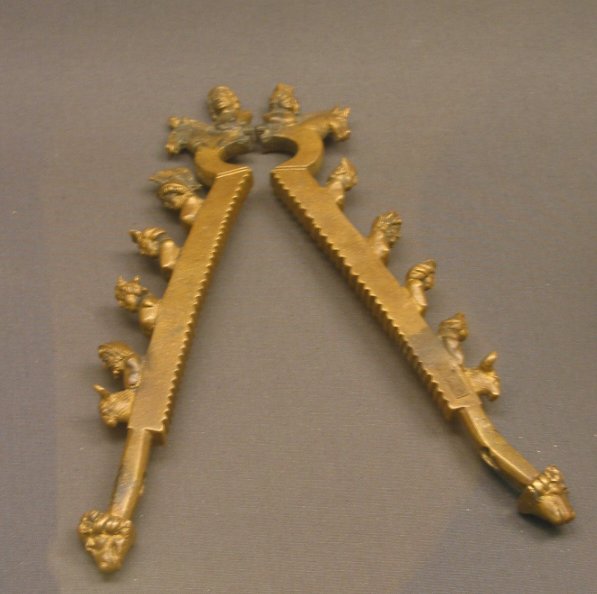
Mother Cybele’s votaries were castrati, hence their high-pitched voices. The Cybele, the Mother Goddess, fell in love with Attys, who made her jealous. She made him mad, whereupon he castrated himself and bled to death. The Goddess had him resurrected body and soul. They enjoyed divine bliss ever after. A Cybelian castration device, dredged out of the Thames, can be seen in the Roman Gallery of the British Museum.
British Museum Castration Device from the River Thames at London Bridge Photo: K Flude
The paragraph above is a quotation from In Their Own Words – A Literary Companion To The Origins Of London‘ D A Horizons, 2009. by Kevin Flude. To buy the Kindle or Paperback version click here.
1381 – King revokes abolition of Serfdom. This had been ‘forced’ upon the Government at Mile End during the Peasants Revolt. The royal charter was revoked July 2nd
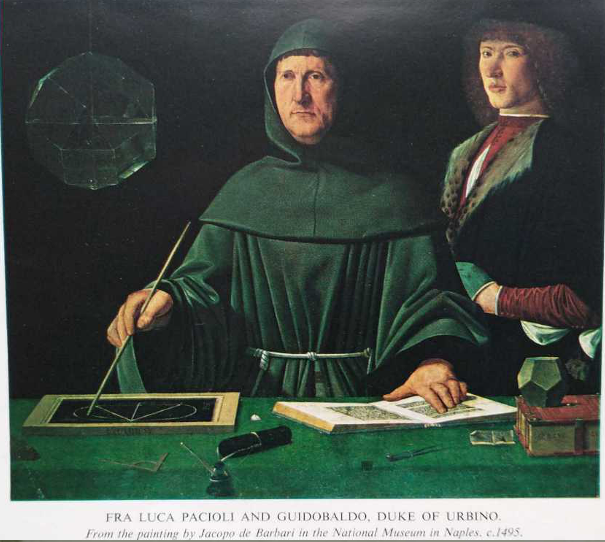
Luca Pacioli, father of double entry book keeping.
Luca Pacioli was a mathematician, whose mathematical text book had a section on Venetian book-keeping. It was published in 1494 although double entry booking keeping was probably being used earlier. The accountancy is a 27-page section called “Particularis de computis et scriptus. It is part of the compendious ‘Summa de Arithmetica, Geometrica, Portiona et Proportionali’.
It is the source of modern double entry accounting, which spread from Venice as it was the printing capital of Southern Europe.
The key discovery, reported by Luca Pacioli, was that every transaction had to have an entry in both a debit and credit account. So if I lend you £10,000 then my account is debited by 10k and yours is credited by the same amount. Fra Luca (he was a Franciscan Friar) would have it that the accountant could not go to bed until the ledgers balanced. That is, that all the credits and balances in all the ledgers balance.
Double entry bookkeeping has prevented numberless frauds, kept many businesses on the straight and narrow. But it is of course not proof against sophisticated fraud.
Assyrian Double Entry booking keeping?
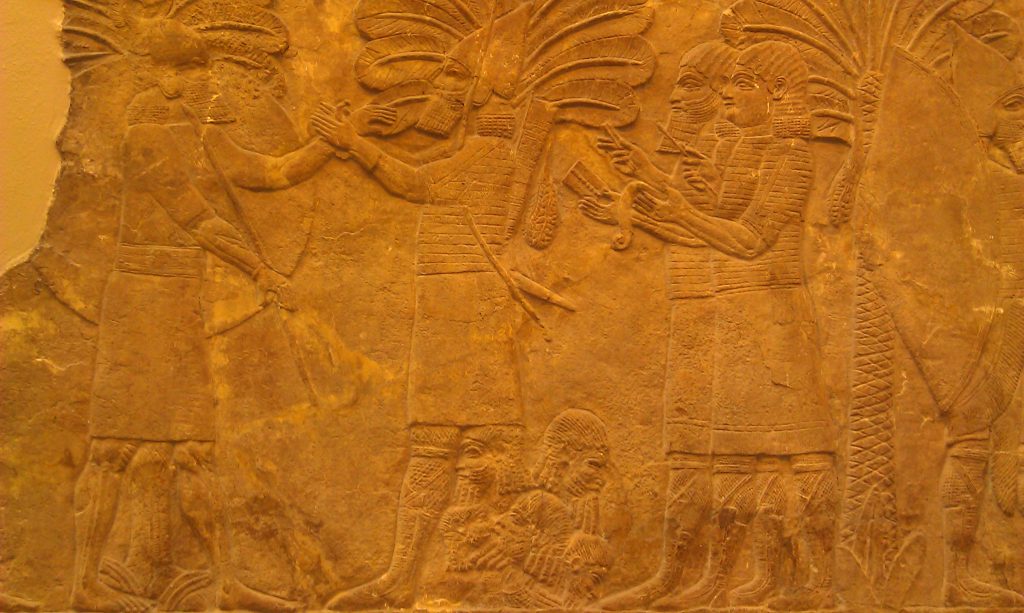
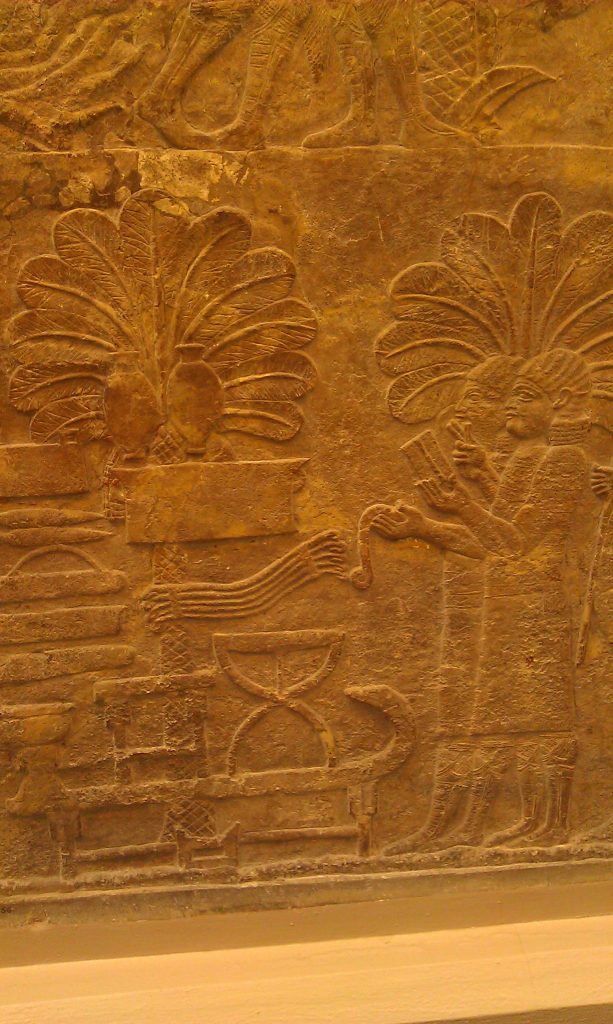
The gypsum stone reliefs shown below on display in the British Museum show clerks recording booty plundered in the Assyrians’ wars. The soldiers are bringing goods in to be counted. In the first picture, the goods are severed skulls. In the second are a wide range of booty.
In every scene like this, there are two scribes writing notes on clay tablets with styli. They stand side by side. I presume their role is to make sure the other man doesn’t cheat, rather than to facilitate double entry book keeping as such. Assyrians paid their soldiers for each enemy soldier they killed, and the head was the proof. You will see a little pile of severed heads between the soldier and the scribes.
Assyrian scribes recording severed heads.. British Museum. Photo Kevin FludeAssyrian scribes recording war booty. British Museum. Photo Kevin Flude
Italians, Accountancy and London.
The earliest work on double entry in England was by Oldcastle in 1543. There were a lot of Italian businessmen in Tudor London. Thomas Cromwell was friends, and indeed neighbours, with some. As a young man he was helped out by the head of one of the great Florentine Finance houses, Frescobaldi. They had branches in Bruges and London, and were major financiers to the Kings of England. Thomas More lived among the colony of Merchants from Lucca. The business centre of London before the building of the Royal Exchange was in Lombard St, where the Lombardian bankers hung out.
Pentecost by Giotto and Workshop, probably about 1310-18, National Gallery
Today, is Whitsun or Pentecost. (Sun, May 24th 2026, 16 May 2027, 4 June 2028), 50 days after the Crucifixion. Celebrated on the 7th Sunday after Easter. The Day the Holy Ghost descends on the disciples. According to one of my teachers, it gave the disciples the power of expression and turned them from bereft disciples to self-confident Apostles. They could now begin to spread the Christian message.
Giotto’s painting shows the Apostles with their halos in the chamber. There are 12 of them, St Matthias having replaced the dead, Judas. The Holy Spirit is represented by the little dove in the centre of the Ceiling. The narrative is carried by the two men in the foreground leaning towards each other. We imagine them saying something like ‘What’s all this about! Galilean nonentities, lost their guru and yet, confident, speaking authoritatively to all and sundry and they can all understand them?‘
Giotto was a forerunner of the Renaissance. According to the great Giorgio Vasari (30 July 1511 – 27 June 1574) who wrote about the advances in painting achieved by Italian artists:
‘that very obligation which the craftsmen of painting owe to nature, who serves continually as model to those who are ever wresting the good from her best and most beautiful features and striving to counterfeit and to imitate her, should be owed, in my belief, to Giotto, painter of Florence, for the reason that, after the methods of good paintings and their outlines had lain buried for so many years under the ruins of the wars, he alone, although born among inept craftsmen, by the gift of God revived that art, which had come to a grievous pass, and brought it to such a form as could be called good.‘
The miracle was that this boy, a poor shepherd with no training in art was able to show nature its true face.
‘One day [the artist] Cimabue, going on business from Florence to Vespignano, found Giotto, while his sheep were feeding, drawing a sheep from nature upon a smooth and solid rock with a pointed stone, having never learnt from anyone but nature.’
One of the points Vasari is making is that the Byzantine Art had lost the use of perspective, something the Romans knew. Paintings had become cartoon like spaces had no solidarity, groups of people stood on shoulders. If you look at the painting above you will the room the Apostles are in has the beginnings of a realistic space, the rafters slope down to a vanishing point. The Apostles are ranged convincingly around the space. Their faces are rounded and realistic. They are separated from the outside world by a dividing wall. And two dudes at the front are convincingly on the ground, rather than hovering in mid air (though I might have cropped the photo too closely!)
It would be over one hundred years before photo realistic portraits and realistic perspective paintings were rediscovered but Giotto showed the way.
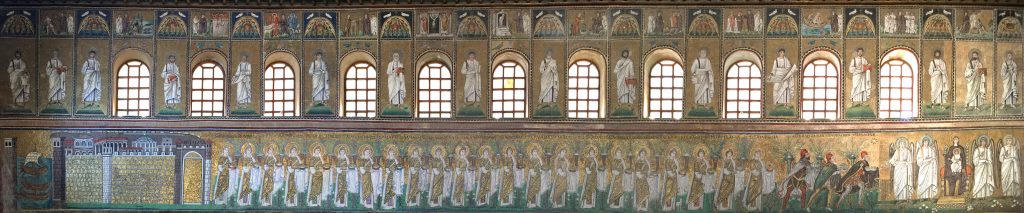
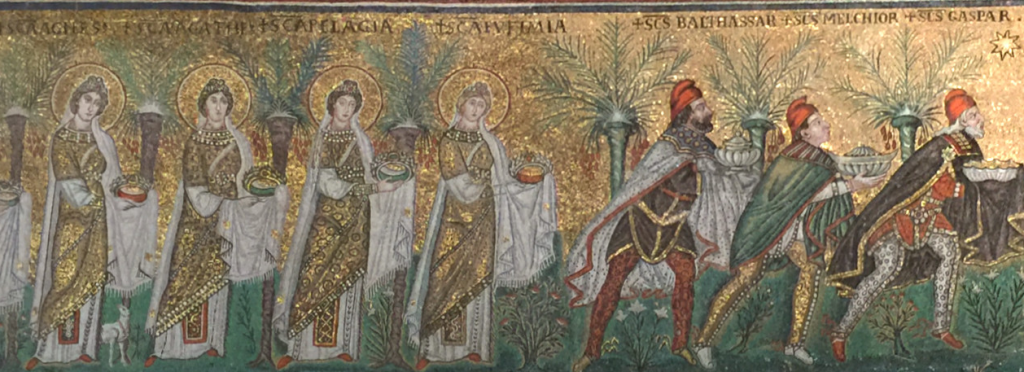
Procession of female saints leaving Classis (bottom left) behind the Three Kings heading to the Virgin Mary (bottom right between four angels). Basilica of Sant’Apollinare Nuovo (pic. Wikipedia)
Today, I am in Ravenna. One of those places where the history brings gasps of amazement. To honour my visit, I thought I should roll out last year’s post. This is what I said:
When I revised my Saint Agatha post (link see below), I felt I needed an early image of Agatha. After all, her cult spread early on, and therefore, was likely to be genuine.
As I started to track down her image I was led, with some joy, to one of the most amazing Churches in the wonderful town of Ravenna. I visited the Basilica of Sant’Apollinare Nuovo with some wonderment when working as an archaeologist at Ferrara, in Emilia-Romagna. Forty Years ago.
I found out that Agatha was one of 22 female Saints on one of the walls of the Church. I discovered a pretty comprehensive description of the Church. As I looked at it, I noticed the record was made by, or involved, Professor Bryan Ward-Perkins. He was the Director of the site my friends and I worked on in Ferrara! (And I met him again last night, 2025 for the first time in years! We had dinner with fellow archaeologists, and Bryan was talking about the work he did on the Saints of St Apollinaire.)
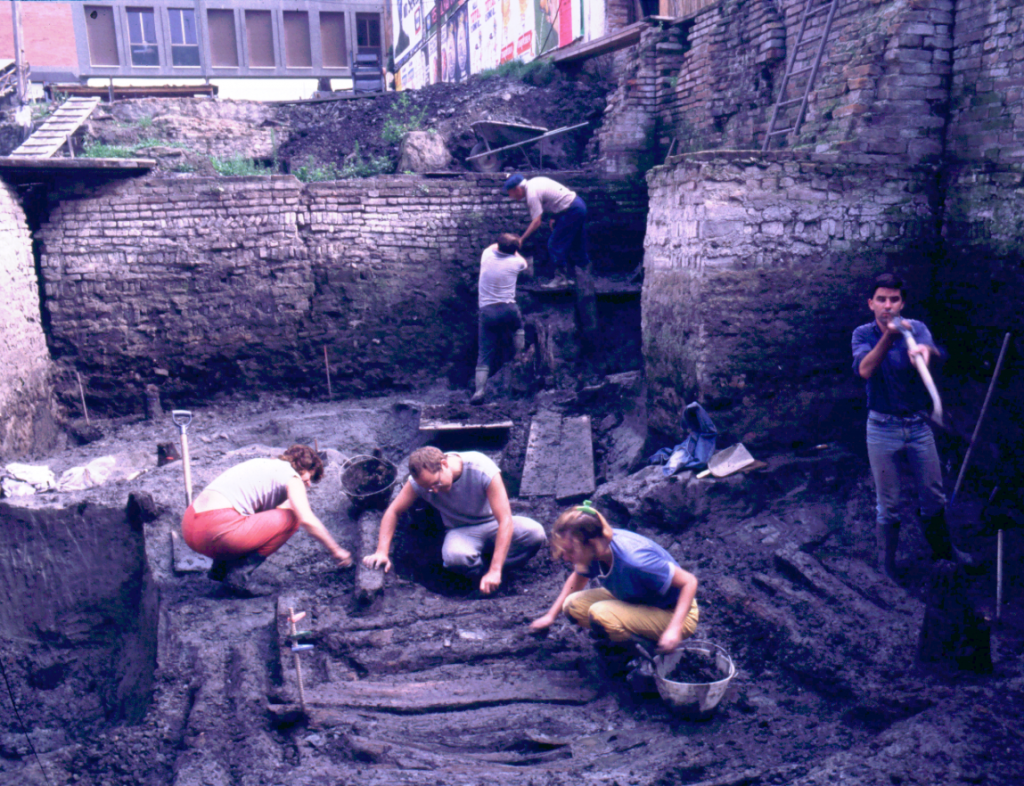
Medieval Excavation in Ferrara. The author is in the centre of the photo,
Ravenna
I’m guessing Bryan suggested we visit Ravenna on one of our trips to the beach at nearby Rimini. Ravenna was so awesome because the City became the capital of the Roman Empire in the West. It took over when Rome fell, then it was part of the Ostrogothic Kingdom, then of the Byzantine Empire. It spanned the period of the Arian Heresy.
And so, it was provided with some of the great glories of 5th and 6th Century Architecture. These include the Mausoleum of Galla Placidia, the Neronian Baptistery, the Basilica of Sant’Apollinare Nuovo, the Arian Baptistery, the Archiepiscopal Chapel, the Mausoleum of Theodoric, the Church of San Vitale and the Basilica of Sant’Apollinare in Classe. It’s hard to overestimate the impact on a young British archaeologist of seeing 5th Century buildings with roofs and astonishingly detailed mosaics still intact. Please visit!
Detail showing the first four female saints behind the Three Kings. Basilica of Sant’Apollinare Nuovo wikipedia
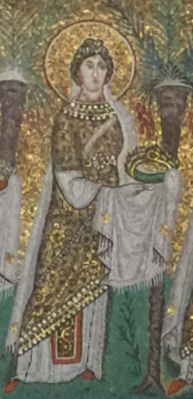
Bryan Ward-Perkins description says ‘All the saints are haloed, bear crowns and are dressed in elaborate court dress. Unlike the men …., all have essentially the same youthful features. The only saint with a distinguishing attribute is Agnes, who is accompanied by a lamb.’ The men are given some personality, some have white beards others are youthful. While all the female martyrs are, essentially young virgins, and cannot be distinguished from each other. St Agatha, the list says, is the Saint next to Agnes with her lamb; the third in precedent. You can see her above and in detail below.
St Agatha Basilica of Sant’Apollinare Nuovo wikipedia
Motorcycling from Ravenna to Inferno
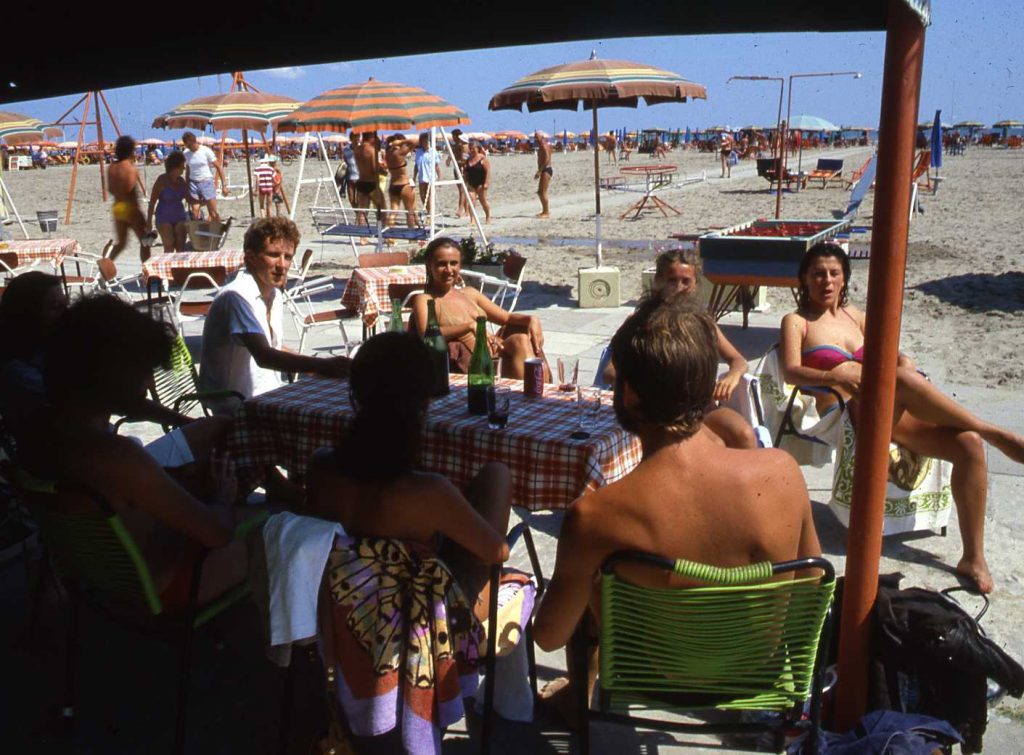
Enough of the sublime! Now for the ridiculous. Whether on this visit or another, we decided to have a day at the beach at Rimini. After the day on the beach, a collective decision to stay over was made. The reason was to go to one of the big clubs (did we still call them discos?) probably to dance to ‘Frankie Goes to Hollywood’.
Archaeologists, Italian and English, on the beach at Lido di Spina
However, the hotels were all full. So I decided, late at night, to go back to Ferrara, on my own on my 175 cc Yamaha motorbike.
My Yamaha 175cc bike looked something like this but was red. A thing of underpowered beauty.
Thing was, I had started the day in Ferrara in the blazing Italian summer heat. So, I had hopped onto my bike dressed in shorts and t-shirt. Ferrara was 77 miles away (says google). One hour into the trip back, I was getting pretty cold, and really not enjoying driving through the lonely countryside. Therefore, I decided to pull off the main road to find a rural hostelry for what remained of the night.
Now, I remember this very vividly – the only likely road I could find was signposted to ‘Inferno’. I shrugged my shoulders, wondering what that was about, and drove towards it on a very deserted road. Eventually, I came to a sign which told me I was about to enter ‘Inferno’.
There was something very surreal about the situation. My courage failed me! I was not going to stay in a ‘motel’ in a place called ‘inferno’! I had seen too many horror films set in Motels and one in Inferno seemed madness. So, I turned round and continued my cold journey to Ferrara.
Inferno
Whenever I tell this story, I have some doubt about it. Did I really drive into a place called ‘Inferno’? But I have, for the first time, checked Google. It tells me that the road off the Rimini to Ferrara road goes through somewhere called: Vicolo Inferno, 40026 Imola BO, Italy.
June is, probably, named after Juno, the leading lady of Olympus, sister and brother to the Great God Jupiter (Jove). In Welsh, it’s ‘Mehefin’ – Midsummer. In Gaelic, ‘An t’Og mhios’ – the Young Month. In Anglo-Saxon, ‘Litha’, the month of the Midsummer Moon.
I am in Ferrara where I worked on a joint UK/Italian excavation in the 1980’s. We are currently at a reunion, in the beautiful UNESCO World Heritage City. The weather is beautiful, and so are the people and the City! One of its gems is the Palazzo Schifanioa, which was the home of the Este Family, Dukes of Ferrara. Borso D’Este in the 15th Century initiated the frescos on the wall of the Hall of the Months. There is one for each month although not all survive in recognisable form. But above is June. The top panels show the Gods of the Month with their chariots or waggons. Below are the star signs for the month, and at the bottom a scene from 15th Century seen from an aristocratic perspective. June has a delightful agricultural scene. You will see more of these in future months. Although I won’t say much today as its difficult to do anything serious without a desk and a decent internet connection.
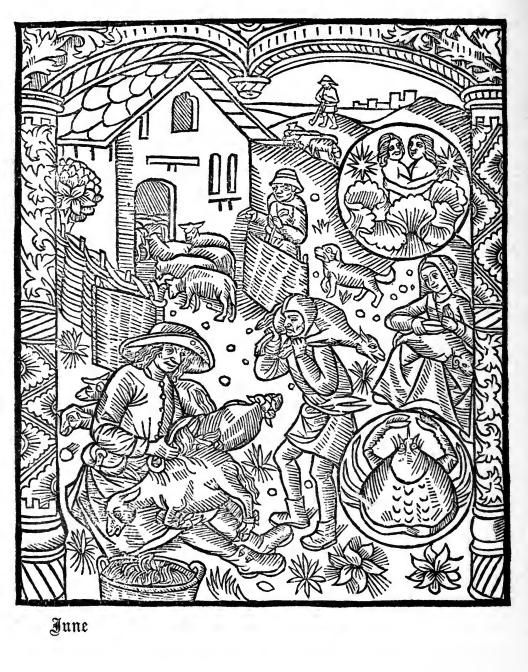
Kalendar of Shepherds. Title page for June
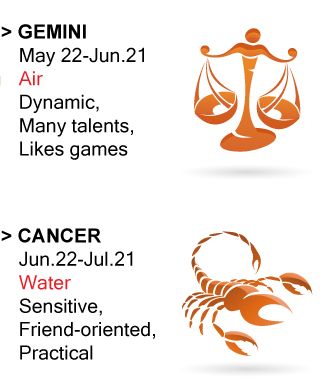
The picture above is from the Kalendar of Shepherds, with its 15th Century French Illustration. It shows shearing as the main occupation for the month but set within a flowery summer scene. In the roundels are the Gemini twins and the Cancer Crab, the star signs of June.
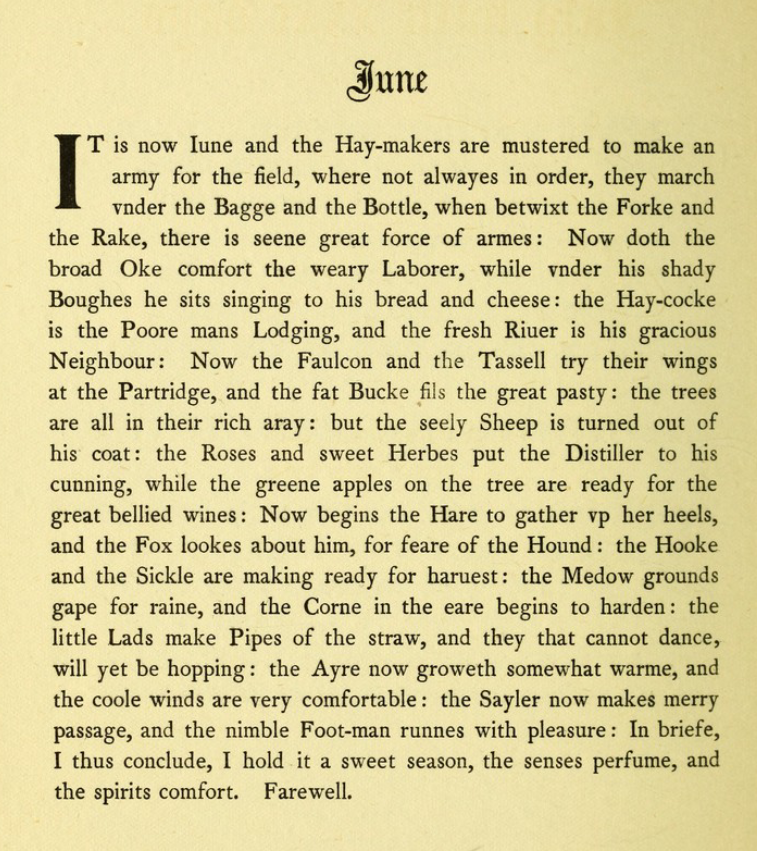
The text of the Kalendar of Shepherds gives a lyrical view of the joys of June:
From Kalendar of Shepherds, 17th Century Text Wellcome Library
June might come, not from Juno’s name, but from an Indo-European word for youth or vital energy. Ovid in Fasti, his poem about the Roman Year, lets Juno make her own case:
‘O poet, singer of the Roman year, Who dares to tell great things in slender measures, You’ve won the right to view a celestial power, By choosing to celebrate the festivals in your verse. But so you’re not ignorant or led astray by error. June in fact takes its name from mine. It’s something to have wed Jove, and to be Jove’s sister: I’m not sure if I’m prouder of brother or husband. If you consider lineage, I was first to call Saturn Father, I was the first child fate granted to him. Rome was once named Saturnia, after my father: This was the first place he came to, exiled from heaven. If the marriage bed counts at all, I’m called the Thunderer’s Wife, and my shrine’s joined to that of Tarpeian Jove. If his mistress could give her name to the month of May, Shall a similar honour be begrudged to me? Or why am I called queen and chief of goddesses? Why did they place a golden sceptre in my hand?’
In the previous Book (on May), Ovid told another story that June was named for young men.
‘So I deduce that the elders gave their own title To the month of May: and looked after their own interests. Numitor too may have said: ‘Romulus, grant this month To the old men’ and his grandson may have yielded. The following month, June, named for young men’ Gives no slight proof of the honour intended.’
The Latin for ‘Young men’ comes from the Latin iuvenis, “youth”)
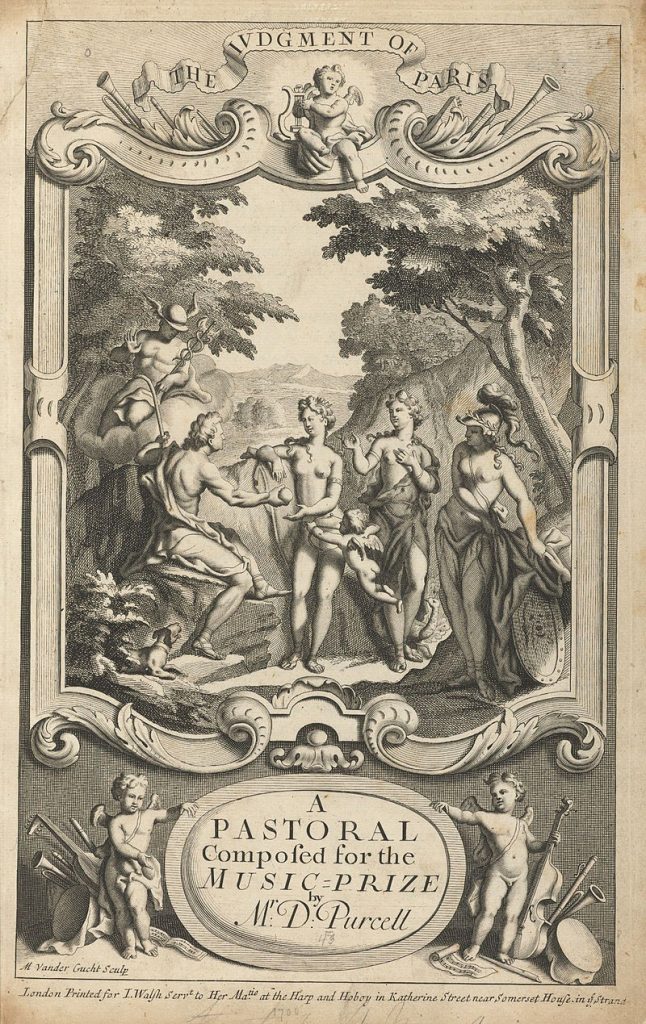
But let’s not go into Indo-European roots, and let’s simply accept the most wonderful month is named after Juno, the Queen of Goddesses, the deity of marriage and women. Probably most famous for hating the Trojans – she had a grudge against Paris, as he ruled against her in that famous divine beauty competition. And more seriously, what other reaction can the Deity of Marriage, have to the man who showed such disregard for the sanctity of marriage that he ran away with the already spoken for Helen?
The Judgment of Paris 1700 by Daniel Purcell. Houghton Museum (Paris, Venus, Juno, Minerva)
‘A sweet season, the senses perfume and the spirits comfort.’
First Written in June 2023 and revised June 2024, 2025
Sementivae, was a festival dedicated to seed and to Ceres. Ceres is an Earth Goddess who gives her name to our word cereal. The festival was also called. Paganalia. The Mediterranean world had many names for the Earth Goddess. Tellus, Demeter, Cybele, Gaia, Rhea etc..
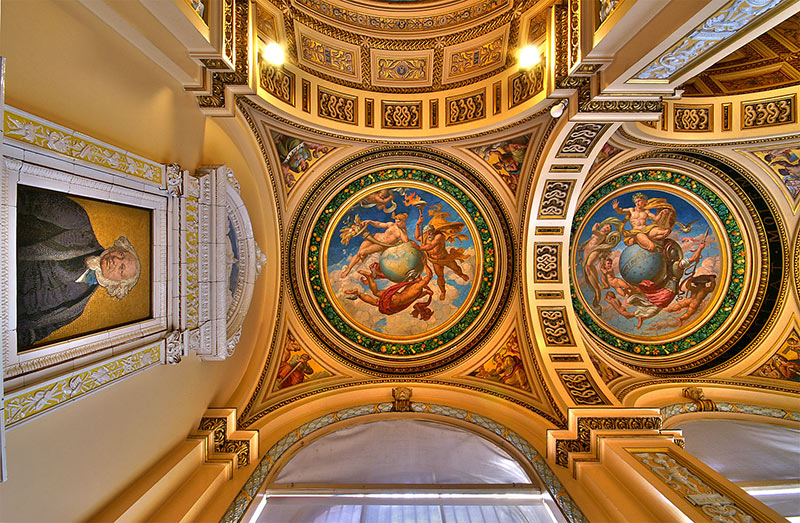
Ceres can be seen on the top left roundel resting on the Globe on the marvellous Ceramic Staircase at the V&A (photo above). And in my slightly out of focus photograph below. (To be honest, in real life, it looks a little more like my photo than the gorgeous photo above!)
Ceres represented Agriculture, Mercury Commerce, and Vulcan Industry. Old Photo by the Author.
Sementivae Dies – a moveable feast.
To create life, we need earth and water to nurture and seeds for fertility. And so into the cold dead world of January the Romans created a festival of sowing. It had two parts, one presided over by Mother Earth (Tellus) and the other by Ceres, the Goddess of Corn. The actual day of the festival was chosen not by rote on a set day of the calendar but by the priests, in accordance with the weather. This seems very sensible, as there is no point sowing seeds in terrible weather conditions. I’m assuming the Priests took professional advice!
On the 24th-26th January Tellus prepared the soil, and in early February seeds were sown under the aegis of Ceres. Tellus Mater (also Terra Mater) was known as Gaia to the Greeks.
Gaia
Gaia was selected by James Lovelock & Lynn Margulis in the 1970s as the face of their Gaia hypothesis. To me, the importance of the idea is not the scientific principle that environments co-evolve with the organisms within them. But, rather in Gaia as a personification of our world as a complex living ecosystem. One that we have to care for. Gaia exists as a series of feedback loops. Lovelock hypotheses that she will spit us out unless we can live in balance with our alma mater.
Ovid and Sementivae
This is what the Roman Poet Ovid has to say in his poetic Almanac known as ‘Fasti’ (www.poetryintranslation.com)
Book I: January 24
I have searched the calendar three or four times, But nowhere found the Day of Sowing: Seeing this, the Muse said: That day is set by the priests, Why are you looking for moveable days in the calendar? Though the day of the feast ís uncertain, its time is known, When the seed has been sown and the land ís productive. You bullocks, crowned with garlands, stand at the full trough, Your labour will return with the warmth of spring. Let the farmer hang the toil-worn plough on its post: The wintry earth dreaded its every wound.
Steward, let the soil rest when the sowing is done, And let the men who worked the soil rest too. Let the village keep festival: farmers, purify the village, And offer the yearly cakes on the village hearths. Propitiate Earth and Ceres, the mothers of the crops, With their own corn, and a pregnant sow ís entrails. Ceres and Earth fulfil a common function: One supplies the chance to bear, the other the soil. Partners in toil, you who improved on ancient days Replacing acorns with more useful foods, Satisfy the eager farmers with full harvest, So they reap a worthy prize from their efforts. Grant the tender seeds perpetual fruitfulness, Don’t let new shoots be scorched by cold snows. When we sow, let the sky be clear with calm breezes, Sprinkle the buried seed with heavenly rain. Forbid the birds, that prey on cultivated land, To ruin the cornfields in destructive crowds. You too, spare the sown seed, you ants, So you’ll win a greater prize from the harvest.
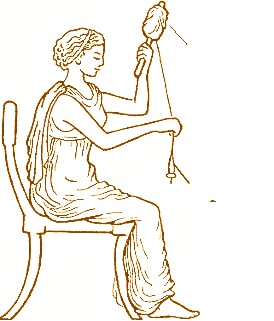
Spinning—showing the distaff in the left hand and the spindle or rock in the right hand
I’m not sure what the Three Kings were doing on the day after Epiphany. But, the shepherds, if they were like medieval English farmworkers, would still be on holiday. They went back to work, traditionally, next Monday, which is Plough Monday. By contrast, the women, according to folk customs, went back to work St. Distaff’s Day, the day after Epiphany. In an ideal world, St Distaff’s Day is the Sunday after Epiphany (January 6th), and Plough Monday is the next day. Of course, it doesn’t always work out that way. I am not sure the woman going back to work on the 7th January, would be happy with the men lounging about until Plough Monday,. This year on the 13th January.
A distaff is ‘a stick or spindle on to which wool or flax is wound for spinning’. Because of its importance in the medieval and early modern economy, it became a synecdoche for women. St Distaff is a ‘canonisation’ of this use of the word. So, a day to celebrate working women.
We know that medieval and early modern women were a vital part of the work force, despite the demands of childcare. Many women took on apprenticeships, even more continued their husband’s work after he died. Some professions like silk became a female speciality. Plus, London was full of female servants and nurses. Many women had several jobs. The exhibition at the British Library on Medieval Women. In Their Own Words, indicated that most of the sex workers had two or more other jobs. In the house, the wife was the mistress of a formidable range of technologies. Baking, Brewing, Cooking, Laundry, Gardening, Dairy, Medicine (including distillation), horticulture, spinning, sewing and embroidery. Even, aristocratic women did embroidery of the finest quality, and it often made an important financial contribution to the household.
St Distaff’s Day and Plough Monday
Robert Herrick (1591–1674), born in Cheapside, London, a Goldsmith, priest, Royalist and Poet wrote in ‘Hesperides’.
Partly work and partly play You must on St. Distaff’s Day: From the plough, soon free your team; Then come home and fother them; If the maids a-spinning go, Burn the flax and fire the tow. Bring in pails of water then, Let the maids bewash the men. Give St. Distaff all the right; Then bid Christmas sport good night, And next morrow every one To his own vocation.
Here he links the plough team with St Distaff’s Day. This implies that the ploughs would be out on the next day. So as St Distaff’s Day is not always on a Sunday, perhaps Plough Monday is not always on a Monday? He certainly suggests everyone goes back to work on the day after St Distaff’s Day.
Saints & Goddesses of the Distaff Side
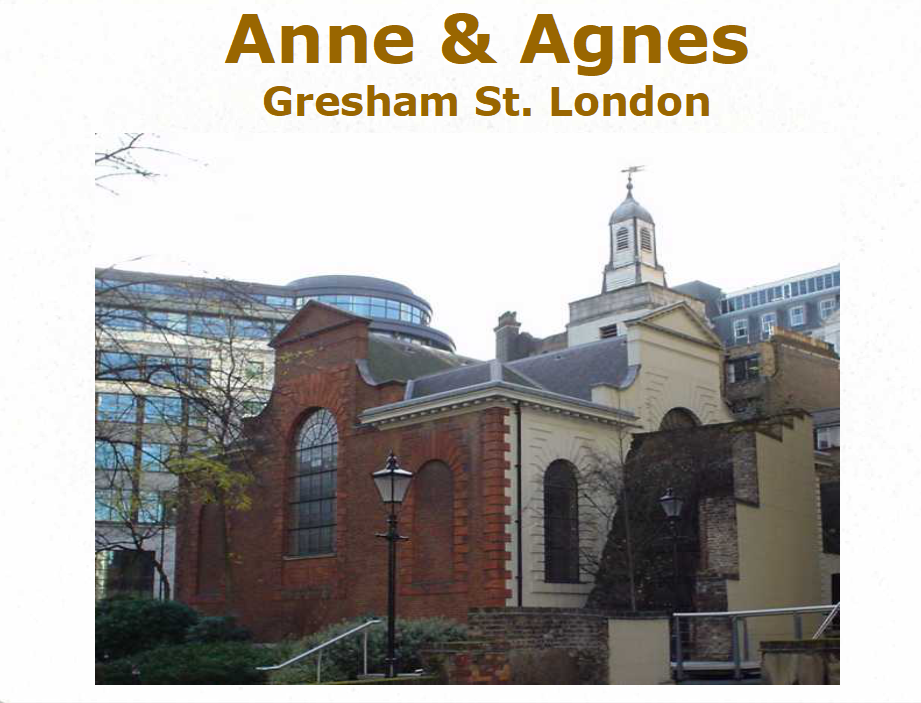
In London, the Fraternity of St Anne and St Agnes met at the Church dedicated to the saints. It is by a corner of the Roman Wall on the junction of Gresham Street and Noble Street. St Agnes is the patron saint of young girls, abused women and Girl Scouts. St Anne is the mother of the mother of the Son of God. So, she represents the three generations of women: maidens, mothers, and grandmothers.
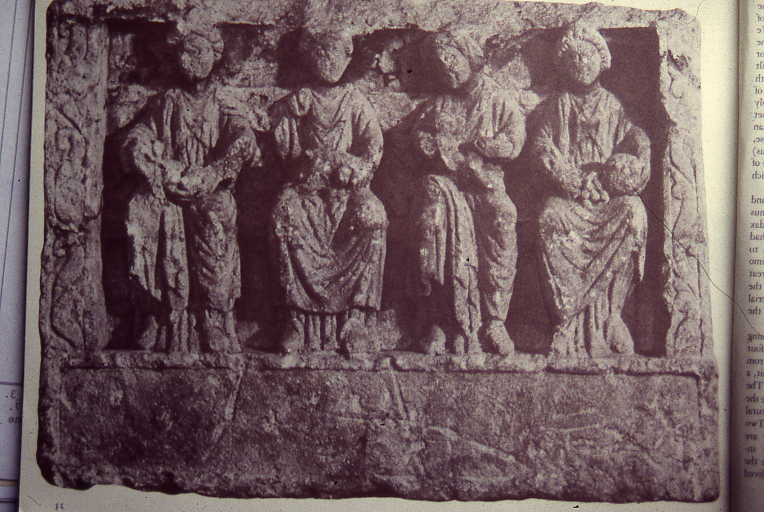
The Three Mother Goddesses (and someone else) “Limestone relief depicting four female figures sitting on a bench holding bread and fruit, a suckling baby, a dog and a basket of fruit’ the Museum of London
This trinity of women were worshipped by the Celts. Archaeologists discovered the sculpture above while investigating the Roman Wall a few hundred yards away at Blackfriars. Scholars believe it depicts the Celtic Three Mother Goddesses. The fourth person is a mystery, maybe the patron of a nearby temple. The relief sculpture was removed perhaps from a temple, or the temple was trashed at some point. Then the sculpture was used as rubble and became part of the defences of London.
The idea of triple goddesses is a common one. In Folklore and History they have been referred to as Maiden, Mother, and Crone, or even Maiden, Mother and Hag. They come in Roman, Greek, Celtic, Irish, and Germanic forms. Their names include the Norns, the Three Fates, the Weird Sisters, the Mórrígan and many more. The Three Fates, the Goddess Book of Days says, were celebrated during the Gamelia. This is the Greco/Roman January Festival to the marriage of Zeus and Juno. The Festival also gives its name to the Athenian month of January.
The use of the terms Hag and Crone for the third Goddess is rare now, but was common. It does a great disservice to the importance of the Grandmother figure. (Although the original meaning of the words were less pejorative. For example, Hag may have meant diviner, soothsayer.) The three phases of womanhood are equally as important to the continuation of the species. They provide love, support, and experience through the generations. Compare these three generations of supportive deities with Ouranos (Uranus), Cronus (Saturn) and Zeus (Jupiter). Saturn castrated and deposed his father, Uranus. Later, he tried to eat his son, Jupiter. But then, Jupiter is nobody’s idea of an ideal father. As one example, he eats his lover, Metis, to avoid her giving birth. (See my post on the birth of Athena.)
Recent work on human evolution has suggested that the role of the Grandmother is crucial to our species’ ability to live beyond the age of fertility. Because, in evolutionary terms, once an individual cannot procreate, their usefulness for the survival of the genes is finished. So what’s the point of putting resources into grandma’s survival? The theory is the Grandmother has such an impact on the survival of the next generation, that longevity. for the female, beyond fertility makes evolutionary sense.
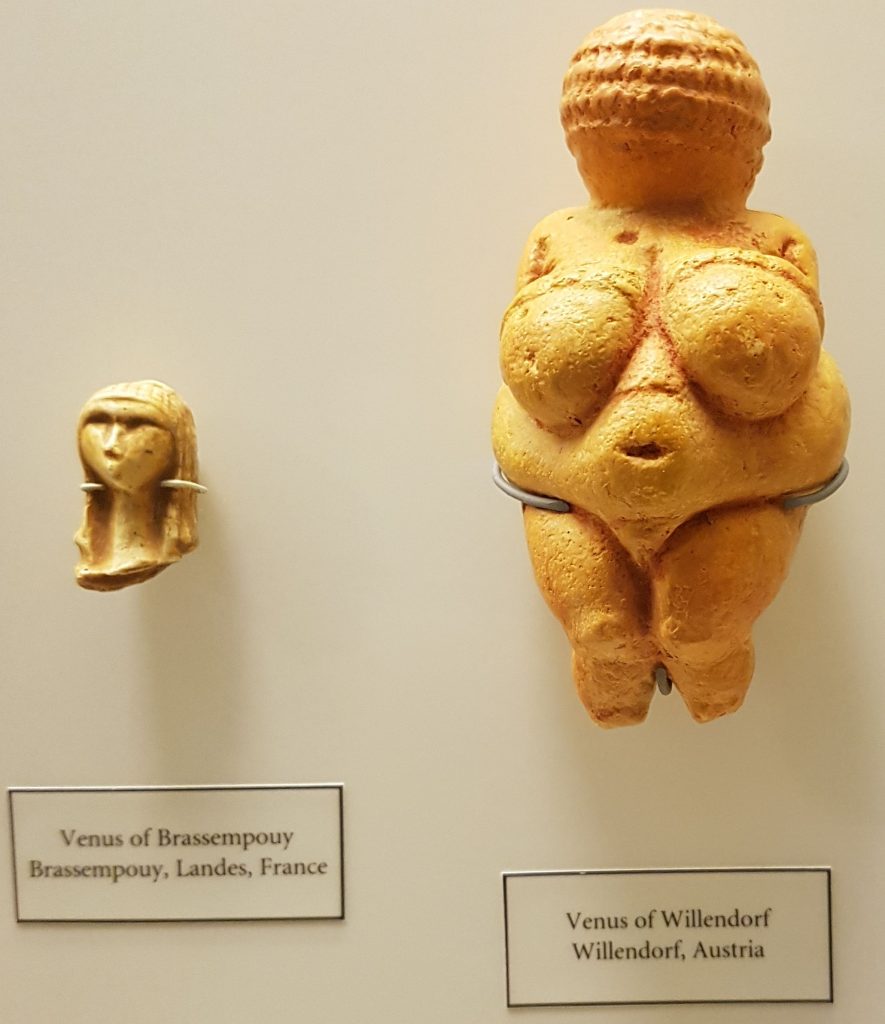
There was a theory widely held that the original Deities, dating before the spread of farming, were mother goddesses. The idea is that the hunter-gather goddesses (perhaps like the Venus of Willendorf) were overthrown by the coming of farmers. These patriarchal societies worshipped the male gods, which destroyed the ancient Matriarchy. Jane Ellen Harrison proposed an ancient matriarchal civilization. Robert Graves wrote some interesting, but no longer thought to be very scientific studies, on the idea. Neopaganism has taken these ideas forward.
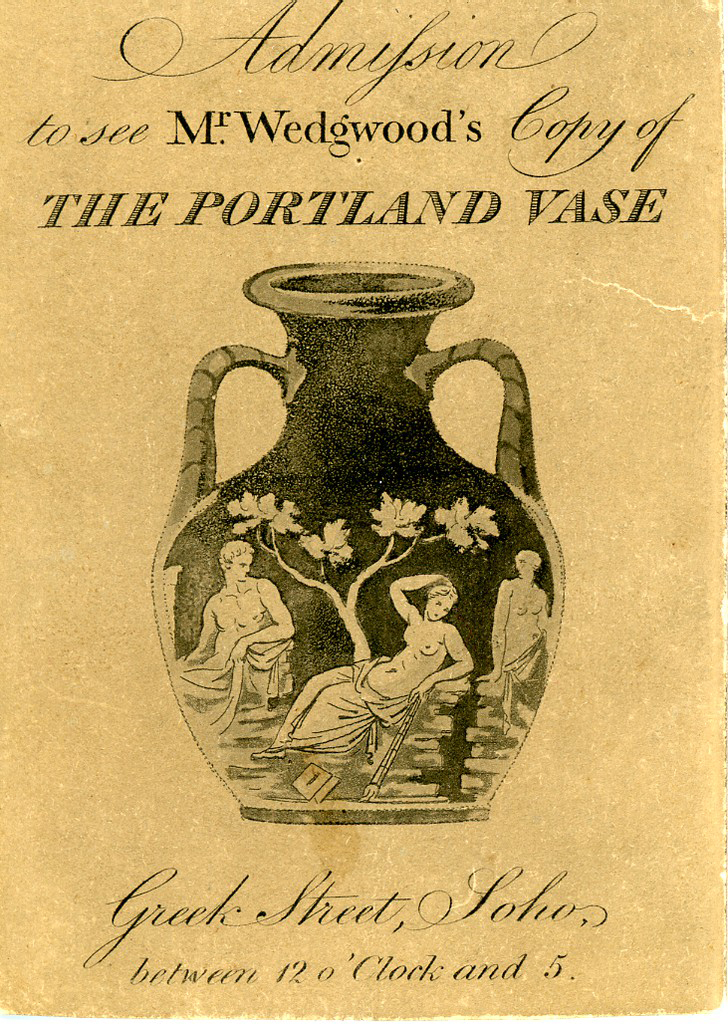
1845. Today is the anniversary of the breaking of the fabulous Portland Vase by a drunken visitor to the British Museum. It looks immaculate despite being smashed into myriad pieces, a wonder of the conservator’s art. To see the vase and read its story, go to the BM web site here:
In the orthodox church, дед Мороз (Ded Moroz= father of frost), accompanied by Cнегурочка (Snieguroshka= fairy of the snow) brings gifts on New year’s eve, (which is on January 7th). He travels with a horse drawn troika.