A History of the Roman Empire in 21 women

Below, I give links to the Late November and early December Posts I have revised and republished. But, first, I would like to tell you about a great lecture I heard at the British Museum, this evening. It was given by Dr Emma Southon on her book about women in the Roman Empire. Her viewpoint was that a study of women in the Roman Empire gives a radically different insight into the Roman world than the traditional. One full of humanity rather than normal evidence which is, generally, about wars, and Empires and bravery and horrific cruelty and ambition and honour. She started with the story of Turia, whose extraordinary epitaph on her tombstone miraculous survived and gave her husband’s view of his extraordinary wife, and his utter sorrow at his loss on her death. Below, is a review of the book and a link to a podcast with the Author.

So, here are the December posts. December 1st and 2nd give an overview of December and the meaning of Winter. December 3rd is about Advent and the fact that you were not allowed to marry during Advent. December 4 gives a Shakespearean view of a cold winter’s day, and a composition by Vaughan Williams.

And late November posts, November 28th tells some interesting tales, both ancient and modern, about Eels, Pies, Rock ‘n’ Roll and my horror of Jellied Eels. November 29th, tells you how to make a ‘dish of snow’ and introduces Ice Houses. November 30th is about Scotland and St Andrews. Like them if you like them! And share them if you want to share them.

New Discovery about Elections in Ancient Pompeii

Recent discoveries from Pompeii are being reported in a timely fashion on an interesting website – one of the recent posts is about the discovery of a Roman Electoral Poster. Please enjoy the read! electoral-inscriptions-discovered-in-pompeii

Below, I enclose a short section of my book ‘In Their Own Words – A Literary Companion To The Origins Of London‘ on Roman Elections, which might be of interest. But first, I have updated and republished my Almanac of the Past Blog posts for November 4th and November 5th, which you can see my following these links:

Extract from ‘In Their Own Words – A Literary Companion To The Origins Of London‘ about Roman Local Politics.

The forum in a Roman town was the central meeting place, used for offices, shops, market, meetings and political elections. Inscriptions show that the Londinium forum was the home of the provincial assembly, and that local government in London continued down to the ward (vicus) level. Surviving political `posters’ and graffiti from Pompeii provides some idea of the concerns of the Roman citizens:

Neighbours! Vote L Status Receptus for duumvir. He is fine. Posted by Aemilius Celer Vicinus.

A Plague on any wretch who scrubs this out!

Vote for M Casellius Marcellus ,a good aedile. He will grant great Games!

Bruttius Balbus for duumvir. Genialis supports him. He will conserve the treasury.

Trebius for aedile! The barbers support him.

M.Cerrinius Vatia for aedile! All night drinkers back him. Vatia for aedile! The pick pockets back him!

Spend for the public welfare! Keep the rates down!

— John Morris,‘londinium’22

A duumvir was the chief magistrate of the town, the equivalent of the Consul in Rome, and he was helped by `junior’ magistrates including aediles. As magistrates, they were expected to fund public works and entertainments from their pocket, so they had to be independently wealthy or backed by wealthy interests.

In addition, a property qualification could be imposed. A surviving charter provides:

A councillor of Tarentum…shall possess a building within the borders of the territory of Tarentum that shall be roofed with no fewer than 1,500 tiles.

Voting was strictly controlled, with returning officers, supervision by independent witnesses, and ballot boxes.

In Their Own Words – A Literary Companion To The Origins Of London‘ D A Horizons, 2009.  Kevin Flude

To buy Kindle version click here.  To buy paperback click on the paypal link below or  email kpflude AT anddidthosefeet.org.uk

Digital Heritage – The Past Deciphered by AI

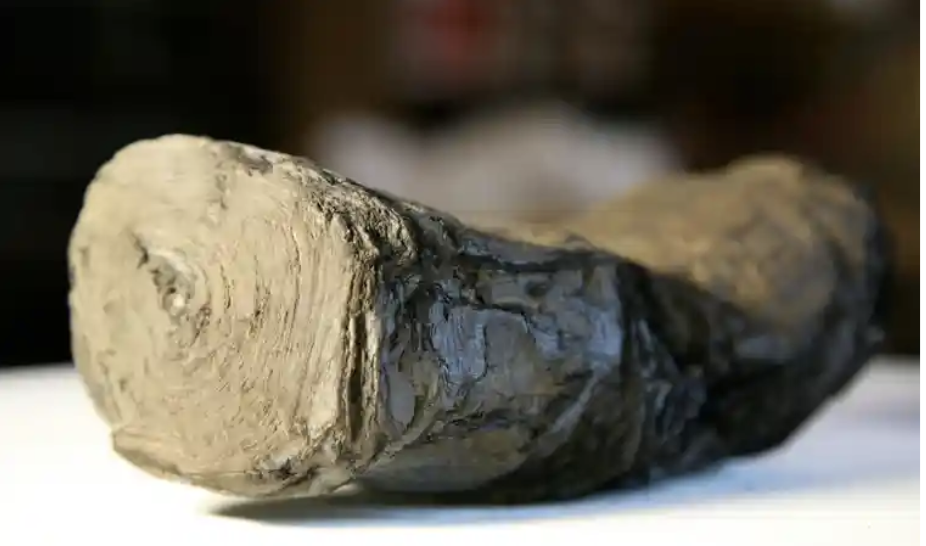
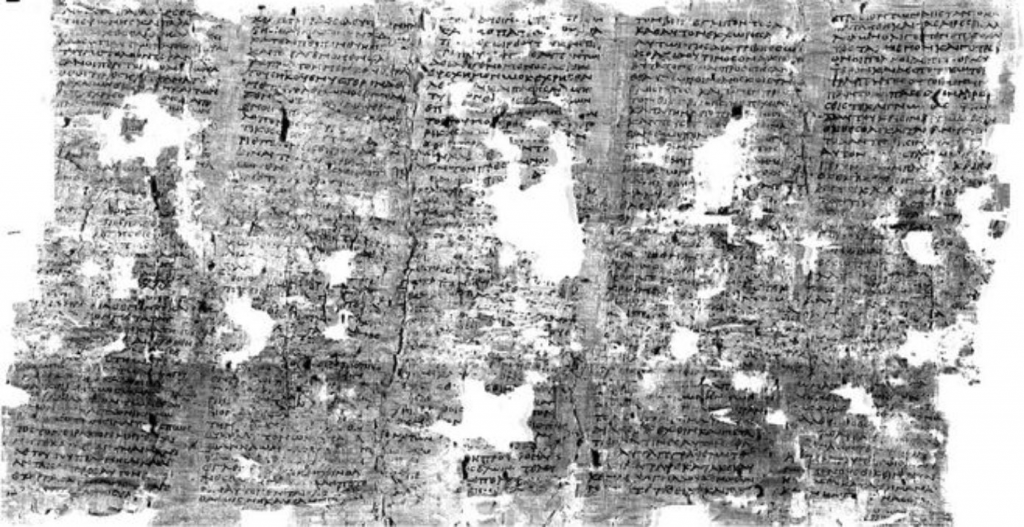
This is one of the most exciting advances I have read about for a long time! A pile of burnt scrolls survive from the Villa dei Papiri, Herculaneum. They are being examined by several teams from American Universities including the University of Michigan, and the University of Kentucky. They are just beginning to read fragments of the texts, using all the scientific techniques they can throw at it including AI. The AI has begun to learn to read fragments of the tightly rolled scroll.

Burnt Scroll
Burnt Scroll

The scroll they are working on appears to be a piece about Alexander the Great and his legacy. It is an unknown text or to put it another way, it is potentially a brand new source of information for this period of time. It has been suggested that it might possibly be a copy of the lost diary of Alexander’s secretary, Eumenos or may have been written by a friend of the general Antigonos.  Either way, potentially eye witness accounts. Or not, as perhaps, they may be asking too much from the first investigation. It may be more prosaic. Time will tell.

The implications, however, are so exciting! Just as the amazing excavations at Stonehenge (and indeed in London) have revolutionised our knowledge of these places, so AI could introduce completely new insights into the past. There are many rolls that were burnt in the collection, but now AI is beginning to read them. what insights we might get even from small fragments? One of the scholars involved is particularly excited to imagine the discoveries that could be forthcoming from the Middle East

‘While others would love to see some of the lost work of the ancients, what I’d like to see is evidence of the turmoil that was happening in the first century around the development of Christianity and the Judeo-Christian tradition as it was evolving.’

Brent Seales, University of Kentucky

Part of scroll unfolded

But those ‘lost works of the ancients’. There are so many that would rock history: Tacitus’s ‘Annals’ missing missing the last two years of Nero’s reign. Pytheas ‘On the Ocean’ with its first references to Britain in writing. 6 Plays of Aeschylus, 9 Books of Sappho and the list goes on. Have a look at Charlotte Higgins piece in Prospect Magazine for a little more detail.

Another feature of the study is that the teams have released images to the cloud and are encouraging others to ‘have a go’ at reading them. This shows the strides that Citizen Science has made, and how, scientists acknowledge that, in the days of big data, cooperation pays huge dividends.

My source of information is the marvellous The Society of Antiquaries of London Online Newsletter (Salon) which ‘is a fortnightly digest of heritage news‘ and for more information look at Issue 509.

Another source is Interestingengineering.com.

Mystery of Roman Concrete Solved?

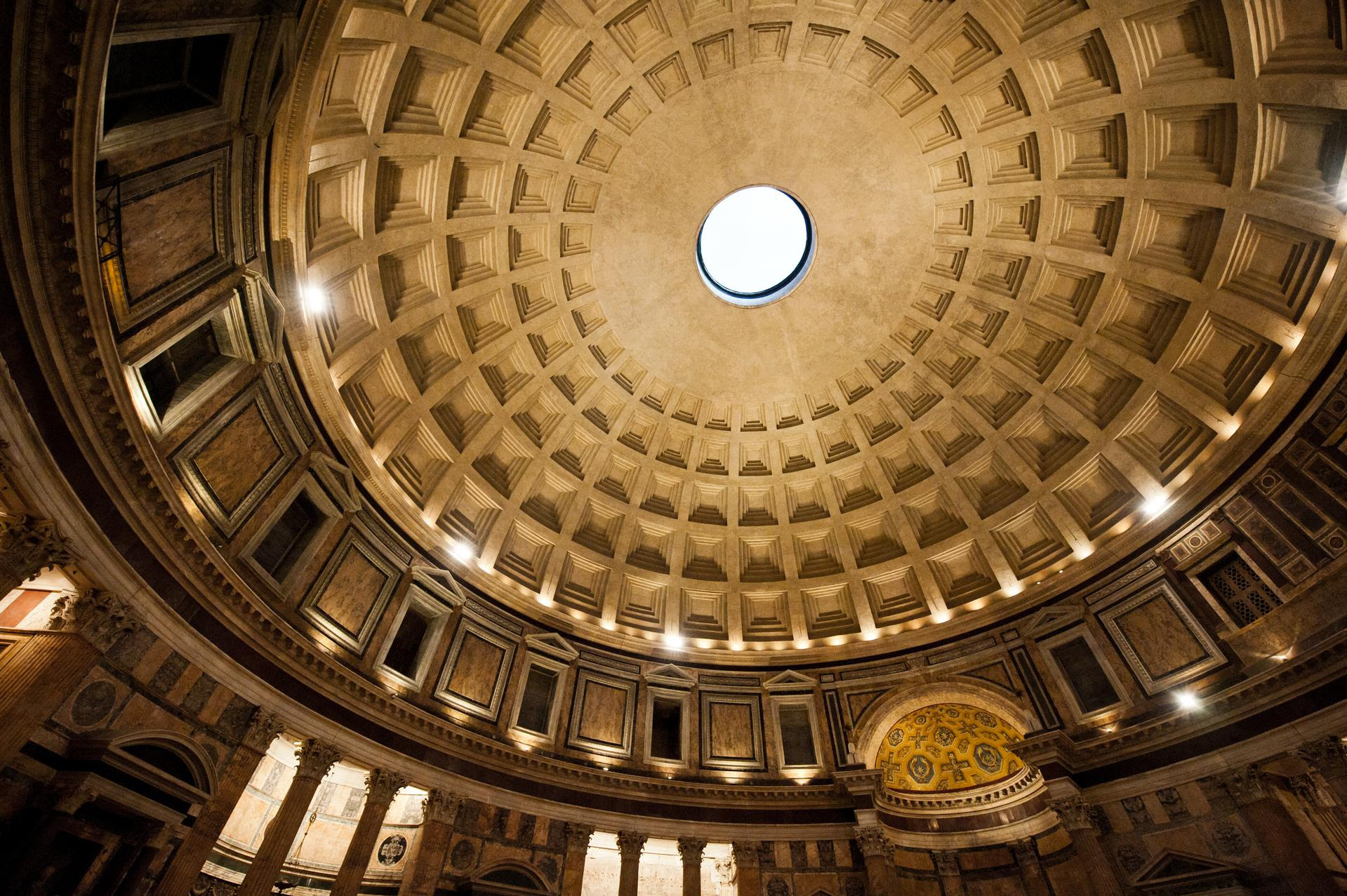
Image credits: Concrete Interior or the Pantheon, FLICKR / CC BY-SA 2.0

The Society of Antiquaries Salon Newsletter has a fascinating report on an analysis of the virtues of Roman Concrete. Working as an archaeologist in the City of London, Roman concrete (opus signinum and opus caementicium) has long been a fascinating subject upon which I have pontificated (without a huge amount of research).

I first came across it at the GPO site just north of St Paul’s Cathedral and what I remember is the contrast to the sandy mortar of 10th/11th Century St Nicholas Church which we were also excavating.

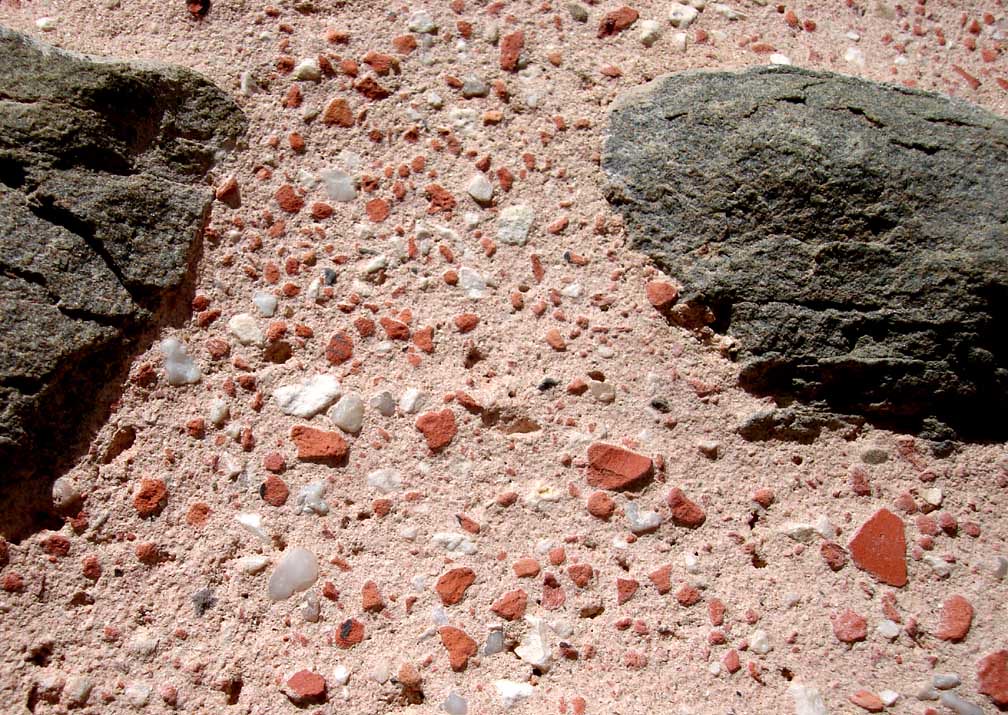
Roman cement, which was pink, was incredibly hard. Medieval mortar was yellow and soft. You could successfully get through the medieval stuff with a trowel or, if you had to, with your finger nail. But opus signinum required a kango pneumatic drill. Properly, signinum has fragments of pottery bonded into the concrete, but we also found it used without inclusions.

Roman Cemement – Opus Signinum

According to the 10 Books of Architecture by Vitruvius (Marcus Vitruvius Pollio) it should be made using volcanic ash which outcropped around Rome and Naples. Without volcanic ash in Britain, the Romans ground down tiles/bricks and added it to lime and sand to make a very effective cement. It was often then ‘reinforced’ by using a mixture of cement and rubble limestone in the core of a wall.

As medieval Londoners dug under the City during building work or while digging pits, they often struck unlucky by hitting some rock-hard Roman foundations. The legend spread that the Roman cement was so hard because it was made of a magical formula that contained Bull’s Blood. (It was also normally said to be built by Julius Caesar!)

The Roman cement was also made in a water-proof version, allowing Roman amphitheatres to be flooded for naval re-enactments. All proper Roman archaeologists have also paid homage by going to Rome to see the totally amazing domed roof of the Pantheon, commissioned by Augustus’ right hand man Marcus Agrippa. Marcus Agrippa (27 BC – 14 AD).

So, this article by the Salon gives some explanation as to how the concrete vault of the Pantheon roof can have stayed up for 2,000 years and defied inevitable cracking. I have copied it word for word, (I did once ask if they minded and they said no) but also give a link to the original below.

By the way, the GPO site was a landmark in Roman Archaeology because it completely changed the view of early Roman London when we discovered densely occupied Roman houses, a long way outside of the area thought to be the core of the early City. And Vitruvius’s book on architecture is well worth reading. I might add a sample tomorrow?. Finally, I remember reading that when the Custom House in London suffered a collapse after only a few years, it was rebuilt by Robert Smirke (who also bulit the Classical British Museum building) using a new formulae for cement was is said to be the first concrete in Britain to surpass the quality of the Roman original.

https://mailchi.mp/sal/salon-issue-547287?e=34bc1ba8ed#edhighlights

Analysis of Roman Concrete Reveals Self-Healing Properties

Many of us will have stood in the Pantheon in Rome and wondered how this beautiful structure can still be standing today. It is the largest unreinforced concrete dome in the world, built under the emperor Hadrian in 126 AD. Researchers have recently been analysing the content and technique of mixing Roman concrete to identify why it has lasted so long and they may have uncovered its secret.

Admir Masic, Professor of civil and environmental engineering at Massachusetts Institute of Technology, led the research project, working with Harvard University. In his paper published in Science Advances, Masic explains that Roman concrete contains millimetre-scale white lumps known as lime clasts, which may have helped seal up cracks, formed over time.

The Romans made concrete by made by mixing lumps of volcanic rock and other aggregates, together with a mortar such as volcanic ash, a source of lime (calcium oxide) and water. The lime clasts found were ‘porous with cracks’ and had most likely been formed at a high temperature in a low water environment. This suggests the quicklime was not mixed with water before it was added to the other ingredients as is the case in modern concrete, but was mixed with the ash and aggregates first. This ‘hot mixing’ produces heat, which helps set the concrete and reduces the water content around the lime clasts.

This means that, if subsequently, water seeps into the Roman concrete, it will dissolve the calcium carbonate and form new calcite as it passes through the lime clasts, which will help to seal up any cracks that have formed. Indeed, cracks filled with recently formed calcium carbonate have been found in Roman concrete.

Masic and his team tested this theory out by creating chunks of Roman-style concrete, containing cracks 0.5mm wide. They ran water over the concrete and in the samples containing lime clasts, within two weeks, the cracks sealed over with newly-formed calcite. Control samples of the concrete made without the lime clasts, did not seal.

Masic believes modern construction techniques could learn something from the Romans; ‘Roman-inspired approaches, based for example on hot mixing, might be a cost-effective way to make our infrastructure last longer through the self-healing mechanisms we illustrate in this study.’ An added bonus is that the development of a more resilient concrete ‘could help reduce the environmental impact of cement production, which currently accounts for about 8% of global greenhouse gas emissions’.

Image credits: Concrete Interior or the Pantheon, FLICKR / CC BY-SA 2.0′

Plaque in the Roman Empire

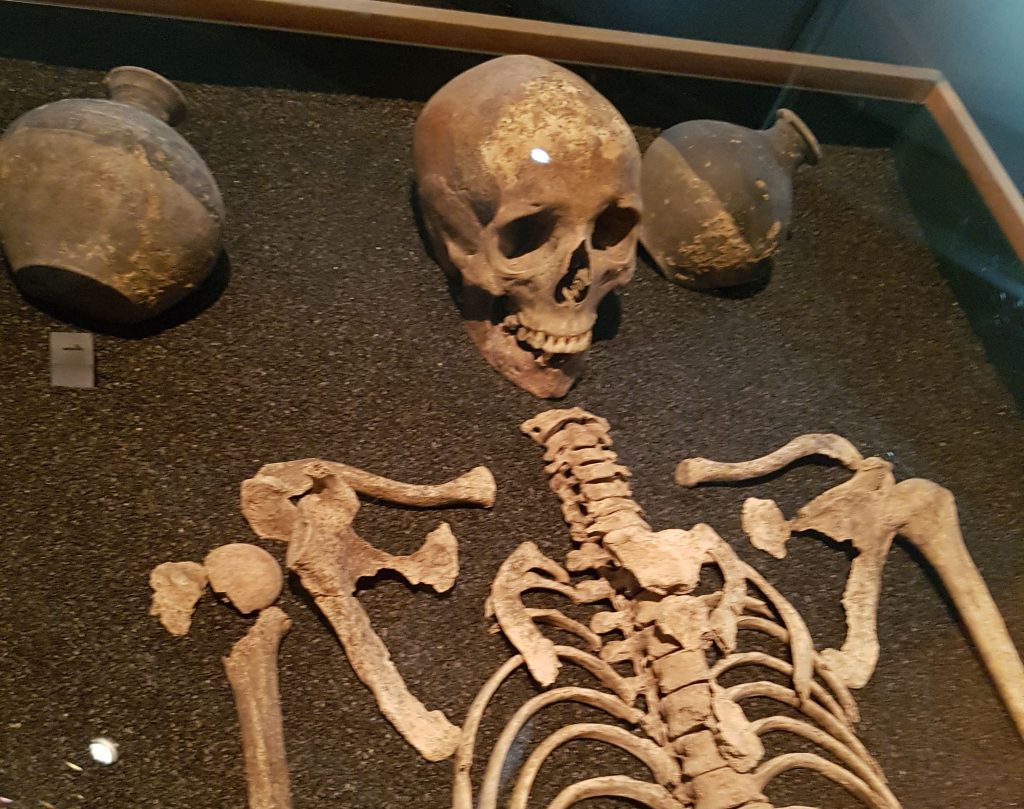
Roman Skeleton Museum of London in Docklands Exhibition 2018 photo K. Flude

I was puzzled to find a message, from reader of this blog Harriet Salisbury, voicing interest in coming on my ‘Decline and Fall of Roman London’ Walk in order to find out about Roman Dental problems.

Harriet is not only a brilliant editor, but also the author of a great book on the oral history of war time London, so I had to follow up this puzzling comment. And my recent post on my upcoming walk said:

Faced with plaque, civil war, invasion, mass immigration,  industrial decline, reversion to barter; the authorities struggled against anarchy and descent into a Dark Age

Now there are many reasons for the decline and fall of the Roman Empire but I have never yet heard anyone, apart from me, blame dental plaque. So, I then spent a couple of hours changing the q of plaque to the g of plague in various places where the deadly dental disease was referred to. Of course, Harriet might equally have wondered whether a rash of information panels had been a contributory cause?

As you will know I have an interest in the history of health and medicine. A cursory glance at any of the skeletons you find in museums will normally show that pre-modern skulls have much better teeth health than modern people. And the reason for this is, mostly, because they did not have sugar to rot their teeth. Instead of sugar-created cavities, their problem tended to be wearing teeth out by the roughness of the grain they used. But I investigated more and found that recent work in Herculaneum and Pompeii had investigated Roman teeth health in a scientific manner. This showed that the diet of even the poor was much better than most modern diets because it was essential the much lauded ‘Mediterranean Diet’ with olive oil, no added sugar, lots of vegetables,fruits and smaller amounts of meat. In short, Roman society had a system in which even the poor had balanced nutritional diets, and therefore good levels of natural immunity.

Pompeii also had a high level of fluoride in the water. The Romans seem to have brushed their teeth with a flayed stick and used abrasives made of ‘ground-up hooves, pumice, eggshells, seashells, and ashes‘. They used a mouth wash of human and animal urine, and disgusting as this may seem, the ammonia would have acted as a cleansing agent.

To find out more about the science behind the story please go to: https://www.docseducation.com/blog/ancient-romans-had-healthier-smiles-we-do-today

This picture from ebay shows you a flayed stick toothbrush – I include the seller information so you can buy some!

Ebay Ad for natural toothbrushes

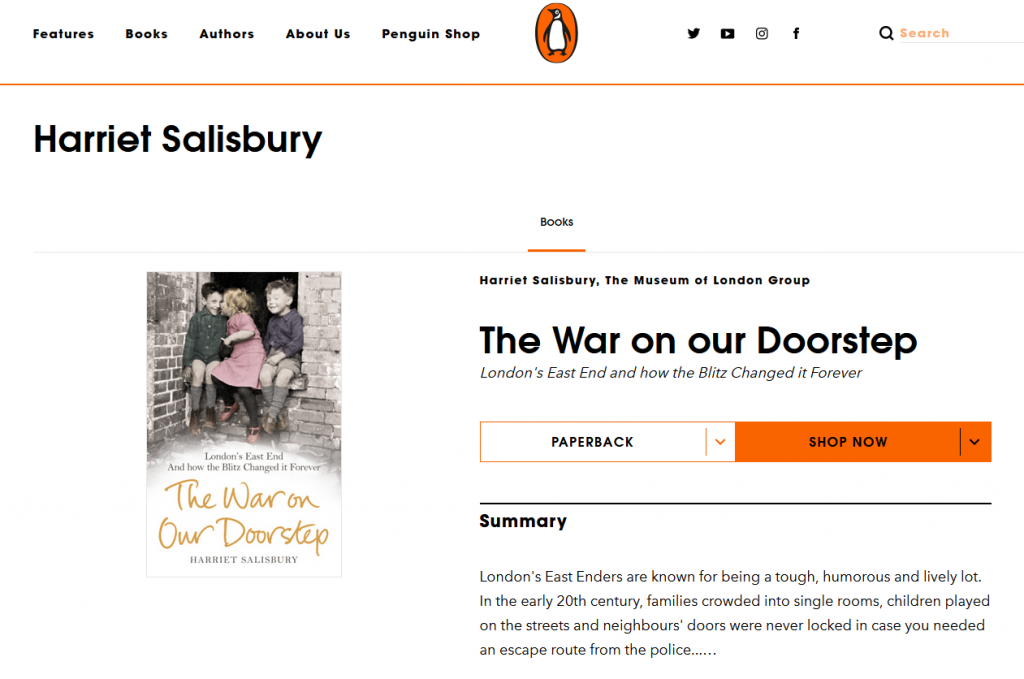
Harriet’s book was based on a wonderful oral history collection at the Museum of London. Worth having in you are interested in London history, the Blitz and ordinary people’s lives. And also for any lover of ‘Call the Midwife’.

This is a screenshot of ‘The War on our Doorstep’ so the link won’t work, but World of Books or any other online book seller (including the ‘evil empire’ but best not to boost the income of such stupidly rich people?)

I have updated and reposted my January 4th post to include what to look out for in the night skies in January.

Epulum Jovis – The Capitoline Cult

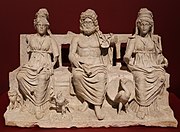
Capitoline Triad – Museum of Guidonia (Wikipedia)

This was the second festival in the year dedicated to the three most important deities in the Roman pantheon. Jupiter the Sky God, God of Justice, God of Rome. His wife and sister, ‘Queen’ Juno, protector of women. Minerva, Daughter of Jupiter. Goddess of Wisdom and Craft.

The main Temple was in Rome on the Capitoline Hill, known as aedes Iovis Optimi Maximi Capitolini (“Temple of Jupiter Best and Greatest on the Capitoline”). Similar temples spread throughout the Roman world, normally with a triple cella (inner sanctum) to allow separation of worship between the three cults.

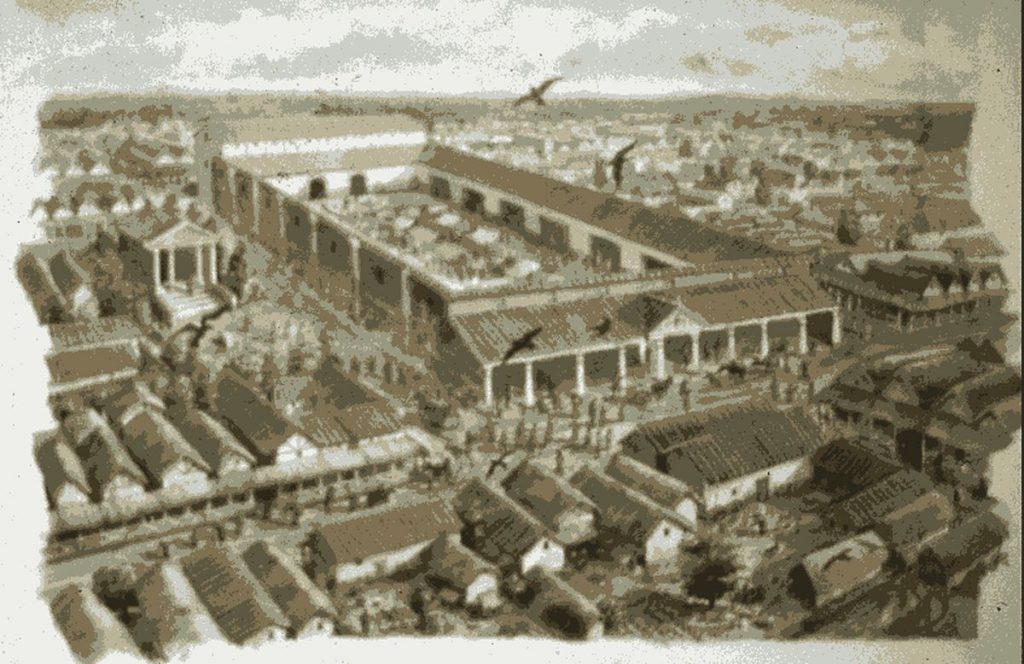
In London, a temple was discovered to the west of the first Forum (built AD 75). There is no clue as to its dedication, but the Capitoline Cult has been suggested as well as for the Cult of the Emperor.

Painting of the Roman Forum of London from the air
Painting of the Roman Forum of London from the air (Note Temple on the left)

Originally posted on November 12th, 2021. Revised November 15, 2023