Ashmolean Advent Calendar, William Burges & the Singing Pierides December 12th

The Great Bookcase by William Burges Ashmolean Museum (Photo K. Flude)

The Ashmolean posts, every year, an online Advent Calendar with gorgeous items behind each ‘flap’. The choice seems to be, mostly, a random selection. But their collection is so wonderful, they are all interesting.

The Great Bookcase by William Burges & the Singing Pierides

In 2022 The Ashmolean featured the Great Bookcase by William Burges. Burges is one of the great Gothic Revival architects and a designer in the Arts & Crafts Movement with an affinity for Pre-Raphaelite painters. He asked 14 of them to paint panels on his bookcase. The decorative scheme was to represent the Pagan and Christian Arts (Museum label).At the bottom of the Wardrobe are the Singing Pierides painted by Henry Stacy Marks. The Pierides were a sort of classical Greek Von Trapp singers, 9 daughters who foolishly challenged the Muses to a singing competition. Of course, the Goddesses of the Arts — the Muses won., As punishment for their vanity, they turned the Pierides into songbirds. Let this be a warning to all those who overrate their own talents!

‘Whenever the daughters of Pierus began to sing, all creation went dark and no one would give an ear to their choral performance. But when the Muses sang, heaven, the stars, the sea and rivers stood still, while Mount Helicon, beguiled by the pleasure of it all, swelled skywards tilI, by the will of Poseidon, Pegasus checked it by striking the summit with his hoof.

Since these mortals had taken upon themselves to strive with goddesses, the Muses changed them into nine birds. To this day people refer to them as the grebe, the wryneck, the ortolan, the jay, the greenfinch, the goldfinch, the duck, the woodpecker and the dracontis pigeon.’

Antoninus LiberalisMetamorphoses (wikipedia)

Burges & the International Exhibition of 1862

Engraving of the International exhibition of 1862, Cromwell Road
Print of the International Exhibition of 1862, South Kensington

The bookcase by William Burges was originally displayed as the centre point of the ‘Medieval Court’ of the 1862 International Exhibition, South Kensington, London. The Exhibition was almost as successful as the more famous Great Exhibition of 1851. Both got about 6m visitors. The 1862 Exhibition was just south of the site of the 1851 (on the south side of Hyde Park) and in what were then the Royal Horticultural Society’s gardens (now the Science, Natural History Museum, Imperial College etc.)

Raphael

This year, they posted a Raphael drawing of an angle. I show a screen shot below. But to have a real look click here.

The Nuragi

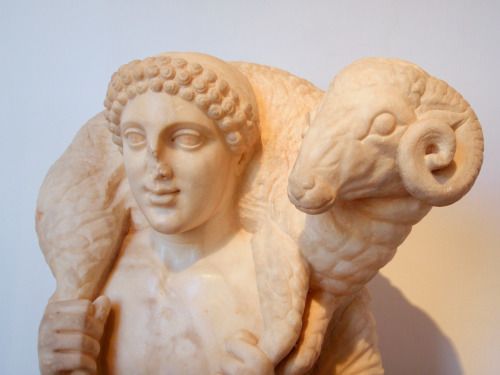
Last year it was a nuragi bronze age stature of a shepherd, a screen shot of which I show below. 2023 December 12th’s choice was a netsuke.

Nuragi statue of a Shepberd

I discovered the Nuragi on a University Field trip, with my students, to the Capital of Sardinia, Cagliari. The Nuragic culture is not well known. However they have amazing Bronze sculptures which give the viewer a really vivid view of their lives and fashions in the Bronze Age. They lived in round towers called nuraghe, which are a little like the Brochs of Scotland. They were around during the time of the Mycenaean Culture in Greece. But their origins and indeed their history are argued about. They may be part of the ‘Sea People’ who brought the end to the Bronze Age cultures of the Eastern Mediterranean, or they may not.

Here, in Britain, the Bronze Age is dominated by discussions of henges, barrows, metal axes and swords. But with very little sense of what life was like to live in those days. However, go to the Cagliari Museum, look at these wonderful statues, and it becomes possible to picture the people. Particularly with a copy of ‘Il Popolo di Bronzo’ by Angela Demontis to hand. It is a catalogue of Nuragi statures with interpretative drawings. It really brings the people to life depicted in the statues. They are mostly warriors, but also there are ‘normal trades’ such as shepherds and bakers which are depicted as well.

Here is my slight adaption of one of the drawings. It is of a shepherd similar to the one photo’d above.

A sketch drawing of a Nuragi sculpture derived from ‘Il Popolo di bronzo’ by Angela Demontis

What you can see is some detail of the clothes and the knife belt around the torso. Not to mention the sheep around his neck! The drawing brings a living person from the Bronze Age before you, not just a lump of bronze. Wikipedia has a long article on the nuragic culture. You can see a wonderful collection of nuragi bronzes and their homes on this website.here.

Originally written for December 12, 2022, revised and republished December 2023, and the Nuragi added in 2024 and Raphael added in 2025

The Winter Festival of Brumalia, Roman Hoodies and Diocletian’s Edict of Maximum Prices December 11th

December 11th is dedicated to Bruma the Roman Goddess of Winter or so says my Goddess Book of Days,. However, I’m not having much luck tracking her down. Elsewhere, I find reference to a Greek or Roman festival of Winter called Brumalia. It starts in late November and ends on the 25th December, the Roman Solstice. Or so they say. But, only the Goddess Book of Days has it on December 11th.

cOVER OF THE GODDESS BOOK OF DAYS by Diane Stein
Cover of the Goddess Book of days

However, there is more evidence for the Brumalia festival in the Eastern Roman Empire. So, let’s imagine a Winter Goddess beginning her reign on November 24th. Then, Saturnalia took place from 17th – 24th December and the climax of the reign of the Winter Goddess was Brumalia on the 25th December. The festival was celebrating the seeds in the ground, necessary for a good harvest. To ensure a good harvest Civic officials delivered gifts of wine, olive oil, grain, and honey to the Priests and Priestesses of the Goddess Ceres. Farmers sacrificed sheep and pigs to Saturn and Ceres. They inflated sheep bladders with air and jumped upon them as part of the celebration!

December 25th

Aurelian in 274 AD fixed December 25th by as the day to celebrate Sol Invictus. The worship of the Unconquered Sun was the Roman attempt to have a monotheistic element to their religion. December 25th was also chosen by Mithras, Saturn, and Christians. For more about December 25th see my post here.

Underlying this confusion of dates is the difficulty of aligning the solar year to the calendar year, and in the Roman period it was all over the place until Julius Caesar fixed the Calendar. (for more on that, see my post here)

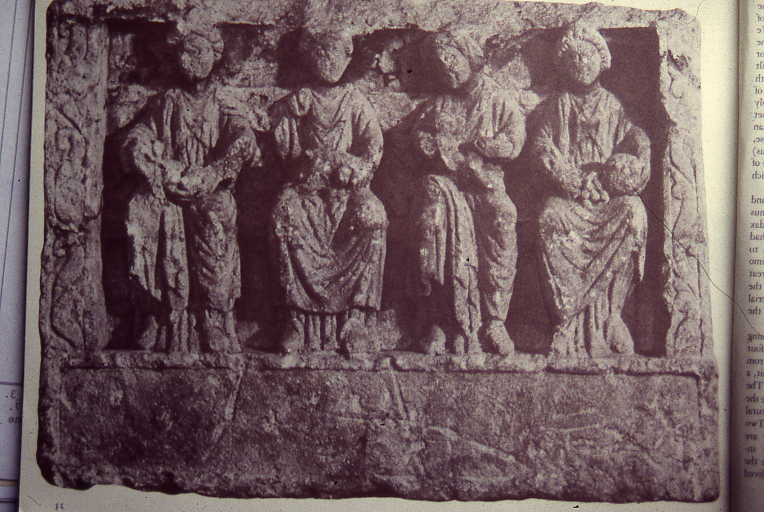
Roman Hoodie

The picture of the tombstone, above, comes from Cirencester, and the inscription says:

Philus, son of Cassavus, a Sequanian, aged 45, lies buried here.

For details look at the ‘Roman Inscriptions of Britain.org’ here:

Philus’ cloak is very interesting. Similar Hoodies are found in other places in Roman Britain, for example, on a mosaic at Chedworth. They are called the Birrus Britannicus. And were famous throughout the Empire. It was a hunting cloak made of wool. I imagine it was a sort of ‘thorn proof’ woollen garment that was warm, rugged, and waterproof. Britain was exported hunting dogs and slaves. The Cotswold wool was also famous in medieval Europe. It was made from Cotswold Lion sheep which were introduced first during the Roman period into the local sheep stock. The large number of rich Roman villas in the area suggest that the wool made the local economy strong.

The British Hoodie, and Inflation.

In AD 301, the emperor Diocletian issued his Edict of Maximum Prices. In it, the Emperor rages against inflation:

Greed raves and burns and sets no limit on itself. Without regard for the human
race, it rushes to increase and augment itself, not by years or months or else days, but almost by hours and very moments. Diocletian Maximum Prices Edict (click here for Pdf)

The Edict then lists maximum wages and prices. The birrus listing says that the Tailor,

cutting and finishing a hooded cloak (birrus) of the finest quality shall have a maximum wage of 60 denarii. ‘

The sanctions against breaking the Edict were terrifying. This suggests the difficulty of enforcement was compensated for by extreme punishment. Diocletian also insisted that labour shortages were addressed by making children follow the same profession as fathers. Interesting how familiar rampaging inflation and severe staff shortages seems to a post.

Reorganisation of the Roman World

Diocletian, having a hug in with his junior Augustus and 2 Caesars, Venice

Diocletian was obviously a very logical man, looking for structural fixes to society’s problems. His analysis of the Roman Empire and its frequent Civil Wars/Coup D’Etats/Usurpers was that there was a deficiency in the career ladder for megalomaniacs. So to stop them usurping the Emperorship, he set up a rational career progression and divided up the Empire as follows:

1 Augustus for the Eastern (Greek speaking) Empire
1 Augustus for the Western (Latin speaking) Empire
2 Caesars for each Augustus
Prefects reporting to the Caesars
Vicari reporting to the Prefects
Governors reporting to the Vicarius.

So you could begin your career in charge of a Province, then progress to the Diocese, then to the Prefecture, then to a quarter of the Empire, then to the Western Empire and finally to be the top dog in the richest Greek-speaking part of the Empire – the supreme Augustus. Brittania was divided up into 4 provinces, each controlled by a non-military Governor. They reported to the Vicarius in London, who reported to the praetorian prefecture of the Gallic region, which was based at Trier, who reported to Rome. They copied in the supreme Emperor who normally hung out in the East of the Empire. (the rich bit).

Did it work? Well, while Diocletian was alive maybe. When his Augustus of the West Constantius Chlorus died, his troops, in York, declared his son Constantine to be Augustus. Thus, bypassing the peaceful progression from Governor to Augustus. The system reverted to the usual tactic of wiping out your fellow Prefects, Caesars and Augustii. After his victory at the Battle of Milvian Bridge, Constantine was universally recognised as the supreme Augustus. He moved the Eastern Capital from Nicosia to Byzantium and renamed it Constantinople.

More on the Sequani

The Sequani were from the upper Saône Valley, near Besançon.

One of our readers alerted me to the Wikipedia page on the Sequani which explains that the name comes from the Goddess Sequana who is a water goddess. The centre of the territory is Besançon which is on the Doubs River. part of the Haute Saône Doubs and near to the springs that are the source of the Seine (west of Dijon). The Fontes Sequanae (“The Springs of Sequana”) gave her name to the River Seine, and a healing spring was established in the 2nd/1st BC. Enlarged by the Romans, it became a significant health centre. as Wikipedia explains in the clip below:

Image of Sequana in a duck boat by Wikipedia FULBERT • CC BY-SA 4.0

‘Many dedications were made to Sequana at her temple, including a large pot inscribed with her name and filled with bronze and silver models of parts of human bodies to be cured by her. Wooden and stone images of limbs, internal organs, heads, and complete bodies were offered to her in the hope of a cure, as well as numerous coins and items of jewellery. Respiratory illnesses and eye diseases were common. Pilgrims were frequently depicted as carrying offerings to the goddess, including money, fruit, or a favourite pet dog or bird.’

https://en.m.wikipedia.org/wiki/Sequana

First, published on December 11th,2022. Revised and republished on December 11th 2023, 2024, 2025

Winter December 2nd

lullingstone mosaic for winter
Roman Mosaic from Lullingstone Villa, Kent representing winter

This is the second day of Winter. Winter is hiems in Latin; Gaeaf in Welsh. Geimhreadh in Old Irish; Wintar in Anglo-Saxon. The Anglo-Saxons counted years by winters, so a child might be said to be 4 winters old.

Winter, meteorologically speaking, is described in the Northern Hemisphere as being December, January, and February, which is, of course, a convention rather than a fact. There is nothing about December 1st that makes it more ‘wintery’ than November 30th or December 2nd. Astronomically, winter starts with the Winter Solstice when the sun is at its lowest and so stretches from around December 21st to the Equinox around March 21st.

Logically, the solstice, when the Sun is at its weakest, should be the coldest day, and a midpoint of winter rather than the beginning of it. With 6 weeks of winter on either side of it. This is roughly what the Celtic year does, winter starts at dusk on 31st October (Halloween/Samhain) and continues to the evening of 31st January (Candlemas/Imbolc). So a Celtic Winter is November, December, and January.

As far as the Sun goes, this is logically correct. In fact, because of the presence of the oceans (and to a lesser extent) the earth, the coldest time is not the Solstice when the Sun is at its weakest. But a few weeks later in January. Heat is retained by oceans (and the landmass), and so the coldest (and the warmest) periods are offset. Therefore, January 13th is probably the coldest day, not December 21st.

Medieval Liturgical Calendar for December. Note the image at the top which suggests this is the month for hunting bears.

My Own Winter

My personal calendar suggests that winter begins on November 5th because this is the day I generally notice how cold it has suddenly become. The house smart meter also identifies the week of November 4th being the day when the heating bill goes through the roof. However, this was not true this year, where in the London area we had a warm spell.

A final thought about Winter. Isn’t it strange that a small change in the axis of the planet should create such opposites? Cold and little growth, then hot and an explosion of flowers. Opposites just with a little tilt of the Globe towards the Sun. This, in the vastness of space, with unimaginably cold and unbelievable hot places and spaces. These make tiny the little difference between Summer and Winter seem insignificant. And yet to us, they are opposites and central facts to our existence as a species. In places, temperature ‘extremes’ make it hard to survive in. Some think this is because God made the Universe just for us. But, just think, we are completely adapted to our lives on our very own, blue planet.

A Roman View of Winter

Ovid, the great Roman poet wrote this poem on his exile from Rome to Tomis, on the Black Sea in what is now Romania. We don’t know why he was exiled, but he felt it bitterly. And winter is used to effect to show his pain.

Winter in Tomis

Harsh lands lie before him
As he struggles to keep his wit
Malicious thoughts infecting-
Crippling the morale of his spirit
Shattered visions of the fallen begin to transpire..
An awful nostalgia consumes him.
A crooked smile forms..exalting the dead

So began the fall of a mastermind.

Realizing as his mind falls to pieces
They are but catalysts – parts of a puzzle to a different plan
As the images surfaced, his virtue descends
Living amongst those barbarians
Though a fierce complication
Their tact was that of a wounded creature
And they were overrun

“I remain in exile
My bones grow weak like the sun
Descending into the trees
To end this daily affliction
As winter shows its pallid face
And the earth veiled with marbled frost
Forsaken –  this gradual madness consumes my mind
Perdition in Tomis

Undead armies of Tomis
Commanded only by the presence of my absense
Brought to life by the death of myself
Risen to ease this torment
Sacrilege; The second chance to formulate a reason
The relapse crucifixion forthwith to go into effect
Casting him away; instead insuring their demise.

I remain in exile
My bones grow weak like the sun
Descending into the trees
To end this daily affliction
As winter shows its pallid face
And the earth veiled with marbled frost
Forsaken –  this gradual madness consumes my mind
Perdition in Tomis

Each day passing now I beg for some remorse
Desperately grasping at what I feel to be my last bit of life
But unlike the cycle of the attic
I feel as though there is no recourse
I’ve withered to nothing.”

“Save me from drowning, and death will be a blessing.”
Hope for his designed tomb
“Rescue my weary spirit from annihilation
If one already lost may be un-lost”

Ovid abandoned writing his almanac poem because of his exile, so it never got beyond the Summer. To read about this see my post here or search for Ovid from the menu.

On this day

1859 – John Brown was hanged, following his raid on Harpers Ferry, violently opposing slavery.

1954 – Joseph McCarthy was formally censured by the Senate for the methods used in his anti-communist campaigns.

Published in 2024, and revised adding Ovid in 2025

St Cecilia’s Day, Henry Wood and the BBC Proms November 17th

St Sepulchre-without-Newgate, Musician’s Chapel, St Cecilia window. 17 August 2022, Andy Scott

November 17th is St Cecilia’s Day She is the patron saint of musicians and was martyred in Rome in the Second or Third Century AD. The story goes that she was married to a non-believer. During her marriage ceremony she sang to God in her heart (hence her affiliation with musicians). She then told her husband that she was a professed Virgin. So, if he violated her, he would be punished by God. Cecilia told him she was being protected by an Angel of the Lord who was watching over her. Valerian, her husband, asked to see the Angel. ‘Go to the Third Milestone along the Appian Way’ he was told where he would be baptised by Pope Urban 1. Only then would he see the Angel. He followed her advice, was converted and he and his wife were, later on, martyred.

The Church in Rome, Santa Cecilia in Trastevere, is said to be built on the site of her house, and has 5th Century origins. My friend, Derek Gadd, recently visited and let me use these photographs:

St Cecilia in London

There is a window dedicated to her in the Holy Sepulchre Church-without-Newgate, In London, opposite the site of the infamous Newgate Prison.  Henry Wood, one of our most famous conductors and the founder of the Promenade Concerts, played organ here when he was 14. In 1944, his ashes were placed beneath the window dedicated to St Cecilia and, later, the Church became the National Musician’s Church.

This window is dedicated to the memory of
Sir Henry Wood, C.H.,
Founder and for fifty years Conductor of
THE PROMENADE CONCERTS
1895-1944.
He opened the door to a new world
Of sense and feeling to millions of
his fellows. He gave life to Music
and he brought Music to the People.
His ashes rest beneath.

The Concerts are now called the BBC Proms and continue an 18th and 19th Century tradition of, originally, outdoor concerts, and then indoor promenade concerts. At the end of the 19th Century, the inexpensive Promenade Concerts were put on to help broaden the interest in classical music. Henry Wood was the sole conductor.

Wikipedia reports :

Czech conductor Jiří BÄ›lohlávek described the Proms as “the world’s largest and most democratic musical festival”.

The Eight-week Festival is held at the Royal Albert Hall. It moved here during World War 2 after the original venue, the Queen’s Hall, was destroyed in the Blitz in May 1941.

On This Day

1278 Edward 1 had over 600 Jews imprisoned in the Tower of London for coining, clipping and other counterfeiting. Of these, 269 Jews, along with 29 Christians, were executed. They were hanged at the Guildhall in the City of London. By 1290, the King had squeezed all the money he could from the Jews, and they were expelled, not to be let back into the Kingdom until the reign of Oliver Cromwell in the 17th Century. This ended a long period of savage state run antisemitism. Click here for further information.

First Published on November 17th 2023 and revised in November 2024, 2025.

All Souls Day – November 2nd

Picture of window sill with skulls, Chrysanthemums  and pictures of remembrance
El Dia de los Muertos – All Souls Day, in Haggerston, London. Photo K Flude.

Today is the Mexican Day of the Dead. In fact, the second day of El Dia de Muertos. Here is a video from Mexico, which you will enjoy for its Latin song and images of the Day of the Dead in Mexico. (It’s on Facebook, so may not work unless you have a login). And here is a YouTube explanation of celebrations in Mexico.

Today is the day to celebrate all those loved ones who have passed away. To keep them in mind, to remind you that you still care about them. It is the third day of the season of Allhallowstide, following All Hallows Evening (Halloween), and All Saint’s Day.

Beata, who comes from Poland, tells me that, November the 1st is the day when relatives visit the cemeteries of the dead. Loved ones bringing chrysanthemums to decorate the graves. It’s a happy day for the dead because they are being remembered and visited. Today, November 2nd, is a more sombre day – a day to stay at home and think of the loved ones. Perhaps looking through albums of photographs?

Souling

In England, it was the time of year in which ‘Souling’ used to take place. Households made soul-cakes. Children or people in need of food come to visit and are given soul cakes in exchange for praying for the dead.

Soul, soul, for a souling cake.
I pray good Missus for a souling cake.
Apple or pear, plum or cherry.
Anything good to make us merry.

Traditional rhyme from Shropshire and Cheshire

Moving on from Purgatory

This is based upon the idea of Purgatory, and the belief that intervention on Earth can influence the amount of time an ancestor spends in purgatory for their sins. John Aubrey (1626 – 1697), antiquarian, collector of folklore and writer, mentions a custom in Hereford which shows a variant of the idea.

John Aubrey (Wikipedia)

In the County of Hereford was an old Custom at Funerals, to hire poor people, who were to take upon them all the Sins of the part deceased. One of them I remember (he was a long, lean, lamentable poor rascal). The manner was that when a Corpse was brought out of the house and laid on the Bier; a Loaf of bread was brought out and delivered to the Sin-eater over the corps, as also a Mazer-bowl full of beer, which he was to drink up, and sixpence in money, in consideration whereof he took upon him all the Sins of the Defunct, and freed him (or her) from Walking after they were dead.

John Aubrey, Remains of Gentilism 1688

This belief in the power of action in the Here and Now to lubricate passage through Purgatory to the Ever After was a major part of fund-raising for Catholic Institutions before the Reformation. For example, in the records of St Thomas Hospital, Southwark, a wealthy widow called Alice (de Bregerake – if I remember the spelling correctly) left her wealth to the hospital in return for an annual Rose rent; lifetime accommodation in the Hospital in Southwark, and for the monks and nuns to pray for her soul and the souls of her ancestors.

Purgatory was not a settled thing in Catholic Theology before the 12th Century or so. However, the idea that prayers for the dead could be useful dates back before the Roman period. Catholics took 2 Maccabees as their biblical authority for Purgatory. But Luther demoted Maccabees to “apocrypha“. And today the Anglicans view it as ‘useful’ but not to be used for ‘doctrine.’

Ludovico Carracci: English: An Angel Frees the Souls of Purgatory (Wikipedia)
Ludovico Carracci: English: An Angel Frees the Souls of Purgatory 1610 (Wikipedia)

All Souls, London

One of London’s most beautiful churches is dedicated to All Souls. It is All Souls, Langham Place. It is just near the BBC HQ and on a wonderful site, as it is on a bend in Regent’s Street. This shows it to great advantage. The architect was John Nash (1824) as part of his transformation of the West End with his boulevard from Regent’s Park south to Westminster. As he could not get all the property owners on the alignment of the road to sell him the land, he disguised this enforced bend with a magnificent Church.

All Souls Langham Place By David Castor (dcastor) – Own work, Public Domain, https://commons.wikimedia.org/w/index.php?curid=6516081
Regent’s Street looking north to All Souls (photo K Flude)

See my posts on Halloween and, and All Hallows Day here

Revised 2nd November 2025, 2024, 2023 and first published 2nd Nov 2021

Halloween October 31st

From the Perpetual Almanack of Folklore by Charles Kightly

I began my perpetual Almanac of the Past four years ago on the 31st October 2021. This was the first line:

‘This blog is to celebrate the Year. I will post, hopefully, once a day, so we can follow the seasons, as they happen naturally, and as people in Britain and Ireland have responded to the changes in the year.’

It was inspired by Charles Kightly’s book, which is a pot-pourri of folklore taken mostly from old Almanacs. I haven’t managed, yet to create a post for every day of the year, nearly managed it in the winter but falling behind in the Summer when I take Road Scholar groups around the UK. My plan is to fill in the gaps, improve posts and get rid of typos. Another aim is to add more London-specific content.

Cover of Charles Knightly's Perpetual Almanac
Cover of Charles Kightly’s Perpetual Almanac

I started on Halloween because Samhain (pronounced Sow-in) was the beginning of the year for the Celtic world. It may mean Summer’s End. In Wales, it is Calan Gaeaf (first day of winter) and Kala Goafiv (beginning of November in Brittany).

Why did the Celts start their year at such an unlikely time? A clue is that they began the next day at dusk. The Sun dies at dusk so it is the end of the day, and the next day begins with the death of the old day. 

So the New Year begins with the Death of the Old Year. Now that might suggest the Winter Solstice as the best time to start the year as this celebrates the death of the old Sun. (see my winter solstice post here :) But, the end of October has, perhaps a better claim. The harvest is in, the fruits in the trees and the nuts are harvested, all the growth of the Summer is over and collected.  Plants are mostly dead or dormant, except some evergreens. It is the end of the growing year. The seeds have fallen from the trees and shrubs and are nestling in the soil, ready to begin their cycle again. All is over and all is ready for the new year. Makes sense?

The Celtic way also explains eves; Christmas Eve, New Year’s Eve, May Eve, All Hallow’s Eve.  They are not the night before the day, they are the beginning of the day.  This is when you begin the celebration.

For the Romans, today is the day that Adonis is injured hunting a wild boar. Against his lover’s (Venus)  advice, he descends to the underworld. Nature withers and dies until he returns from the underworld. His blood stains a flower and was transformed into the Crimson Anemone. There is a similar story in Babylon of Ishtar and Tammuz.

By Alexander Marshall, crimson and other anemones
Binyon 1898-1907 / Catalogue of drawings by British artists, and artists of foreign origin working in Great Britain (5(c))

Adonis comes back on May Day when he meets Venus again, so the world flourishes and is bright and warm.

Julius Caesar says the Gauls venerated the God Dis Pater on this day – an aspect of Pluto, the God of the Underworld, ruler of the Dead. There was a Roman Festival on the Kalends of November dedicated to Pomona, the goddess of the fruit of trees. This may influence the use of Apples, which are prominent in Halloween festivities.

For more about the origins of Halloween, please look at my post on All Hallows Day here:

First written in 2021, and revised 2023, 4 and 5.

Goddess Felicitas’s Festival October 9th

Copy of plaque found Pompeii outside of a bakery, fellicitas dwells her
Copy of plaque found Pompeii outside of a bakery, Translation is ‘Felicitas dwells here’ Wikipedia. Wolfgang Sauber. CC BY-SA 3.0

Felicitas is the Roman Goddess of happiness, blessedness, prosperity. And a far more reliable creature than Fortuna. Fortuna rode the wheel of fortune. So you could either be at the top of the wheel or at the bottom of an unfortunate cycle. By contrast, Felicitas was always on the happy upbeat.

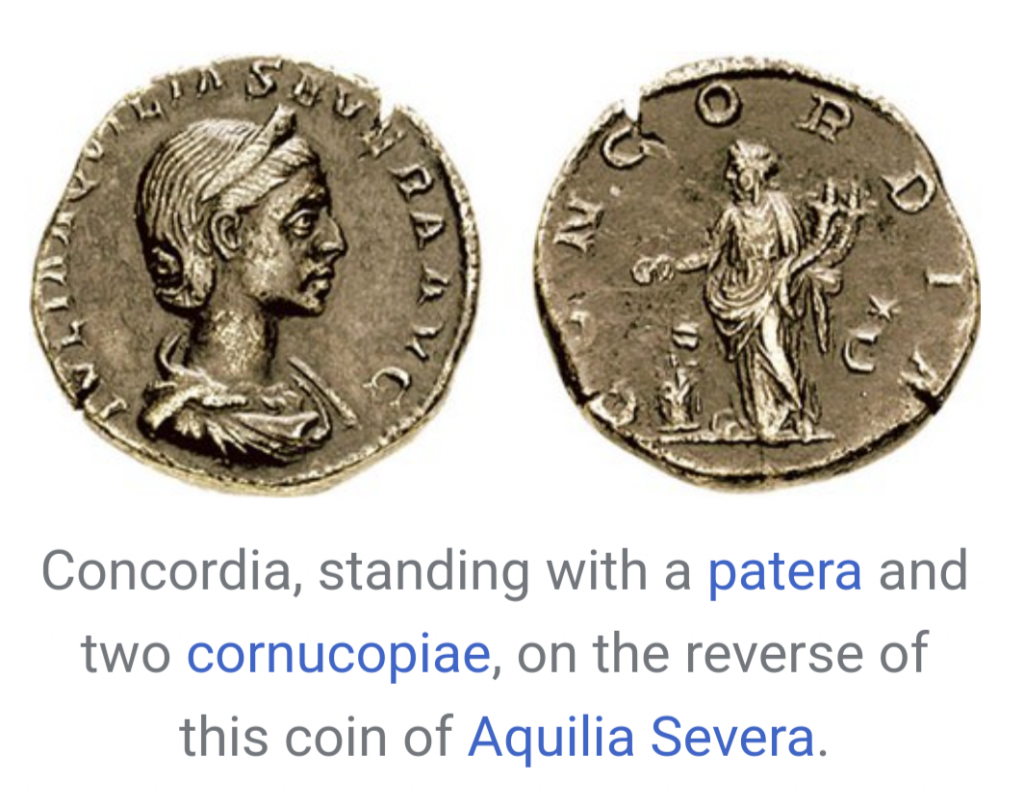
She had her own temple in Rome from the 2nd Century BC, and had two official festivals a year. The July 1st one shared with Juno and the October 9th (Fausta Felicitas) one on her own. She was often depicted on coins. Identified by her cornucopia and her staff called a caduseus.

Denarius of Macrinus showing Felicitas with her caduseus in her left hand and cornucopia in her right. By NumisAntica – http://www.numisantica.com, CC BY-SA 3.0, https://commons.wikimedia.org/w/index.php?curid=36585800

Why the association with the erect penis?

Steve Coates wrote in the New York Times,

“There seems to be phalluses everywhere. Enormous ones, tiny ones, doubles, singles; attached to men, gods or satyrs in every medium or in dismembered splendor; over doors, carved into the pavement, on chains and serving trays, turned into lamps, winged like birds, with bells on. Even some of the phalluses have phalluses. “

Quoted in Priapus and Phalluses in Ancient Rome webpage.

Parents hung them around the necks of their children as amulets of good luck. I’m guessing they are a symbol of a healthy body and a beating heart. As well as being the bringer of the greatest joy, we mere mortals ever experience in our lives. (having children I mean!)

Here are two I’ve come across on my travels. Both from the Roman Fort on Hadrian’s Wall at Chesters.

See March 7th for my post on Saint Felicitas

First Published on October 9th 2025

Michaelmas, St Michael and All Angels September 29th

Detail from ‘The Creation and the Fall of Man’ by Mariotta Alberinelli 1513-14 showing Archangels helping in the creation of Eve from Adam’s Rib’

September 29th used to be St Michael’s Day, or Michaelmas. But in the 20th Century, the Catholic Church made it the day to celebrate the three chief Archangels and all Angels. Previously, September 29th was for St Michael, March 24th for St Gabriel, and October 24th for St Raphael.

It was an important day in the medieval civil calendar and was the date on which Oxford, Cambridge and the Legal system started their autumn terms. It is also the date the Lord Mayor of London is elected at Guildhall in the City of London.

For more about Michaelmas see my post on Old Michaelmas.

Michaelmas Daisies in my Father’s Garden

About this time, the Michaelmas Daisy (an Aster) comes out in profusion. They have been out in my Father’s garden since August, but have only been flowering for a few weeks in my own garden. Here is an old rhyme:

“The Michaelmas daisies, among dead weeds, Bloom for St Michael’s valorous deeds …

The Angelic Host

Personally, I don’t understand what Archangels are doing in a monotheistic religion. They seem to be supernatural demigods which seems odd. The Book of Revelations is one of the most important sources, but they are scattered around the Bible. Perhaps the most famous is the visitation of Gabriel to the Virgin Mary, (see my post here)They are 15 Archangels:Adabiel, Azrael, Chamuel, Gabriel, Haniel, Jeremiel, Jophiel, Melatron, Michael, Raguel, Raphael, Raziel, Sandalphon, Uriel, and Zadkiel.

Melatron has to be my favourite, given his name which sounds like something from a kids superheros cartoon! He is made from the human Enoch and Keeper of the Book of Life so perhaps the most powerful of the Archangels. He is good for relationship, career, and parenting advice!

The Book of Enoch mentions 200 Fallen Angels including Satan, but Alphonso di Spina a 15th Century Monk calculated there were 133 million fallen angels, one third of the original Angelic Host.

What are Angels for? Something to give us hope that somewhere, somehow something might be looking out for us? As Sir Antony Gormley says of the Angel of the North ;“People are always asking, why an angel? The only response I can give is that no-one has ever seen one and we need to keep imagining them.”

On This Day

1564 – Lord Dudley Created Earl of Leicester

After the service at St James on Michaelmas Day, Lord Robert Dudley was led by the earls of Sussex and Huntingdon into the queen’s presence chamber. He wore a black gown edged with lace with nineteen pairs of gold aglets on the sleeves. Before him, his brother Ambrose, Earl of Warwick bore his sword, Garter bore his patent and Lord Clinton, Lord Admiral, his cap and coronal. All made obeisance to the queen three times. Lord Robert knelt before her.

Garter gave the patent to Cecil, who read it out aloud. The Earl of Warwick presented the sword to the queen, who put it about the neck of her new Earl of Leicester, putting the point under his left arm and then, while putting his cap and coronal on his head, with a mischievous smile, tickled his neck. Solemn-faced, the new earl gave the queen his humble thanks and arose and went to the council chamber to dinner, trumpets sounding before him.’

From The Progresses and Public Processions of Queen Elizabeth by John Nichols (London, John Nichols & Son, 1823) with thanks to Jan Knights for the information.

First Written in September 2025

September – ‘Winter’s Forewarning and Summer’s Farewell’

Kalendar of Shepherds illustration of September showing harvesting grapes and the astrological signs for Virgo (August 23 – September 22) and Libra (September 23 – October 22)

It is that time of the year when you say ‘Where has the Summer gone? It can’t be September already?’ But, meteorology, speaking, Autumn starts today. September 1st was chosen on a numerical basis for ease of measuring rather than any profound floral, agricultural or solar reason. So, there are three Gregorian Calendar months for each season, and each season starts on the first of the month. Autumn: September, November and December.

Autumn, Harvest, Fall

Autumn comes from Latin (autumnus) which went into French and then into English. The season was also called Harvest (which went into Dutch herfst, German Herbst, and Scots hairst -Wikipedia) or from the 16th Century: the ‘fall of the year’ or ‘fall of the leaf’ which spread to America as Fall.

Summer’s Ending

It still feels like summer. In England, we often have a glorious September, and what we can an ‘Indian’ Summer, an unexpectedly warm period in mid-September to October.

Solar Autumn

Of course, for the real Autumn, we have to wait for the Equinox, the beginning of Astronomical or Solar Autumn. This year, it is on Monday, September 22nd, 2025, 7:19 pm.

Astrological September

The star signs for astrological September are: Virgo which is linked to Aphrodite (Venus) the Goddess of Love and Libra which is linked to Artemis (Diana), virgin goddess of many things, including hunting, wild animals, children, and birth.

Star signs for September

September

September gets its name from the Romans, for whom it was the 7th Month of the year (septem is Latin for seven). Later, they added two new months so it became our 9th Month. (For more on the Roman year, look at my post here).

It is called Halegmonath in the early English language, or the holy month, named because it is the month of offerings, because of the harvest, and the mellow fruitfulness of September? Medi in Welsh is the month of reaping, and An Sultuine in Gaelic which means the month of plenty.

Roman personification of Autumn from Lullingstone mosaic

Early Modern September and the autumn of Life

Here is an early 17th Century look at September from the Kalendar of Shepherds – for more on the Kalendar, look at my post here.

From the Kalendar of Shepherds

The Kalendar has an additional shorter look at September (see below). And it continues with its theme, linking the 12 months of the year with the lifespan of a man – 6 years for each month. So September is a metaphor for man at 56 years of age, in their prime and preparing for old age.

September from the Kalendar of Shepherds. The last sentence beginning ‘and then is man’ shows the link between September and the beginning of the autumn of life.

Season of ‘mists and mellow fruitfulness

John Keats (1795 – 1821) wrote a great poem called ‘To Autumn’:

Season of mists and mellow fruitfulness,
  Close bosom-friend of the maturing sun;
Conspiring with him how to load and bless
  With fruit the vines that round the thatch-eves run;
To bend with apples the moss’d cottage-trees,
  And fill all fruit with ripeness to the core;
    To swell the gourd, and plump the hazel shells
  With a sweet kernel; to set budding more,
And still more, later flowers for the bees,
Until they think warm days will never cease,
    For summer has o’er-brimm’d their clammy cells.

Who hath not seen thee oft amid thy store?
  Sometimes whoever seeks abroad may find
Thee sitting careless on a granary floor,
  Thy hair soft-lifted by the winnowing wind;
Or on a half-reap’d furrow sound asleep,
  Drowsed with the fume of poppies, while thy hook
    Spares the next swath and all its twined flowers:
And sometimes like a gleaner thou dost keep
  Steady thy laden head across a brook;
  Or by a cider-press, with patient look,
    Thou watchest the last oozings, hours by hours.

Where are the songs of Spring? Ay, where are they?
  Think not of them, thou hast thy music too,—
While barred clouds bloom the soft-dying day,
  And touch the stubble-plains with rosy hue;
Then in a wailful choir the small gnats mourn
  Among the river sallows, borne aloft
    Or sinking as the light wind lives or dies;
And full-grown lambs loud bleat from hilly bourn;
  Hedge-crickets sing; and now with treble soft
  The redbreast whistles from a garden-croft,
    And gathering swallows twitter in the skies.

Written September 19, 1819; first published in 1820. This poem is in the public domain and available here:

First published September 2024, revised 2025

St Clare’s Day & the Minoresses of St. Clare August 11th

The ‘Agas’Map of 16th Century Map of London showing the Abbey of the Minoresses of St Clare with the yellow circle and St Botolphs in mauve just outside Aldgate. from the Map of Early Modern London project.

Today is the Feast day of St Clare of Assisi.  An area of the City of London, called the Minories, is still to this day named after the Abbey of the Minoresses of St. Clare without Aldgate. This was was founded in 1294. The Abbey was part of the Order of St Clare or the Poor Clares as they were known . A minoress was a nun from the Order of Friars Minor (aka Franciscans) .who were also known as the Minoresses of St Clare.

Fresco of Saint Clare and sisters of her order, church of San Damiano, Assisi Wikipedia

Clare Sciffi was born in Assisi to a rich family. On Palm Sunday, 20 March 1212 Clare left her house, after refusing offers of an advantageous marriage. She had been inspired by hearing St Francis the founder of the Franciscan Monks who was also from Assisi. St Francis facilitated her transfer to Benedictine Nunneries. Her sisters followed her, one renamed Agnes became an Abbess and eventually a saint in her own right. Her family tried repeatedly to take her back into secular life. Eventually, they gave in – apparently when they saw that she had cut her flowing locks off and donned a plain robe.

A small nunnery was set up for them next to the church of San Damiano. More women joined, and they became known as the “Poor Ladies of San Damiano”. They undertook to live impoverished, and secluded.

The Franciscan friars were an itinerant order where the Friars preached to the people and were supported by begging. But this was not possible for women at that time so they lived a simple life of labour and prayer.:

‘The nuns went barefoot, slept on the ground, ate no meat, and observed almost complete silence.’ Wikipedia

Here is a site that gives information about the new Museum that will be established on the site of the Poor Clares. It also gives an outline history of the site.

https://www.ianvisits.co.uk/articles/new-museum-to-show-archaeology-from-the-abbey-of-st-clare-70048/?utm_source=newsletter&utm_medium=email

The following link explores the illustrious noble women who choose to be buried in the Minories. It shows how important the Poor Clares were considered to be. It was dissolved by Henry VIII in 1539.

To read about the nearby Roman Bastion at Crosswall see my post here: