Van Gogh & the London Suburbs October 8th 1876

From https://agtyler.medium.com/part-i-van-gogh-in-london-9a26ff5427dd’s website describing Van Gogh’s experiences while living in London.

It’s not so well known that Van Gogh spent some time in London. Vincent spent three years in London, working as an Art Dealer in Covent Garden. He lived in Brixton, then the Oval. He was very impressed with London; its technology and culture. London was:

a city lit by streetlights, a city powered by electricity and a city that relied on industrial power. It was impressive in all its accomplishments.’

To find out more about his experience in London look at this Tate website. https://www.tate.org.uk/art/artists/vincent-van-gogh-1182/seven-things-know-about-van-goghs-time-britain. The above quotation came from the site. For more details of Vincent’s time in London read Medium.

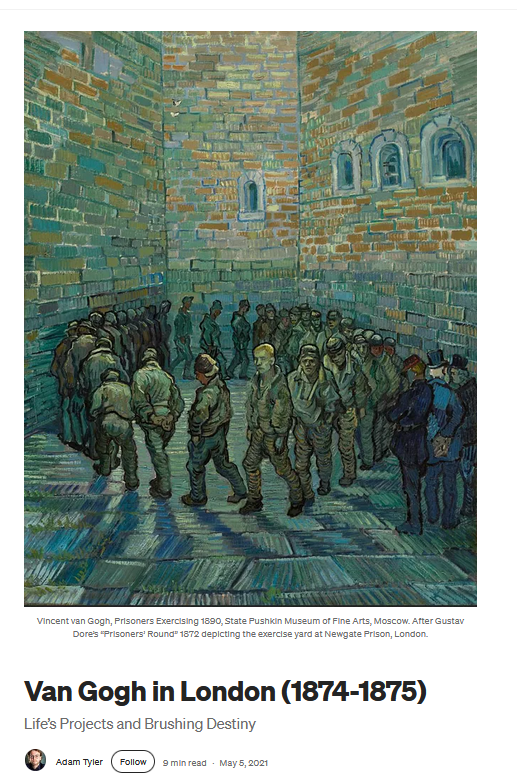
Van Gogh’s Newgate Prison Painting

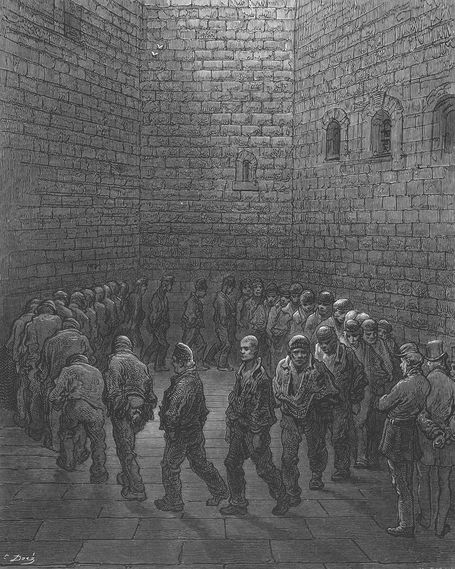
This is where I got the image of Van Gogh’s painting of Newgate Prison above. Apart from sketches, this seems to be his only London painting. But Van Gogh did this painting well after his visit to London,. He copied Gustave Doré‘s engraving which you will see below. Further research tells me that he did this painting while in Saint-Paul Asylum. He was detained inside so could not continue his practice of painting outdoors, so copied from illustrations. He used a Héliodore Pisan copy of Doré‘s engraving. Van Gogh died a few months later, and this was one of the pictures that were displayed around his Coffin.

Vincent in Brixton

There is a play from 2002 called ‘Vincent in Brixton’, by Nicholas Wright, which I saw and very much enjoyed. It is scheduled to be performed in 2026 (14 March 2026 to 18 April 2026) at the Orange Tree, Richmond.

Letters to Theo

Vincent often wrote to his brother, Theo, about his experiences in London. This is a quotation I first found in ‘A London Year’ compiled by Travis Elborough and Nick Rennison. It provides a beautiful description of the London suburbs. This is a book well worth a place on a lover of London’s History’s bedside table.

Letter to Theo, October 8th 1876

In the City I also went to see Mr Gladwell and to St Paul’s. And from the City to the other end of London, there I visited a boy who had left Mr Stokes’s school because of illness, and I found him completely recovered, outside in the street. Then on to the place where I had to collect the money for Mr Jones. The suburbs of London have a peculiar beauty; between the small houses and gardens there are open places covered with grass and usually with a church or school or poorhouse between the trees and shrubbery in the middle, and it can be so beautiful there when the sun goes down red in the light evening mist. It was like that yesterday evening, and later I did so wish that you had seen the streets of London when it began to grow dark and the street-lamps were lit and everyone was going home, it was obvious from everything that it was Saturday evening, and in all that hustle and bustle there was peace, one felt, as it were, the need for and joy at the approach of Sunday. Oh those Sundays and how much is done and striven for on those Sundays, it’s such a relief to those poor neighbourhoods and busy streets. It was dark in the City, but it was a lovely walk past all those churches along the way. Close to the Strand I found an omnibus that brought me a long way, it was already rather late. I rode past Mr Jones’s little church and saw another in the distance where light was still burning so late. I headed for it and found it to be a very beautiful little Roman Catholic church in which a couple of women were praying. Then I came to that dark park I already wrote to you about, and from there I saw in the distance the lights of Isleworth and the church with the ivy and the cemetery with the weeping willows on the banks of the Thames.  

To see this letter and his letters to Theo, follow look at this link.

Gustave Doré and Pisan’s Newgate Excercise Yard 1872, from which Van Gogh clearly derived the image for his painting at the top of the page.

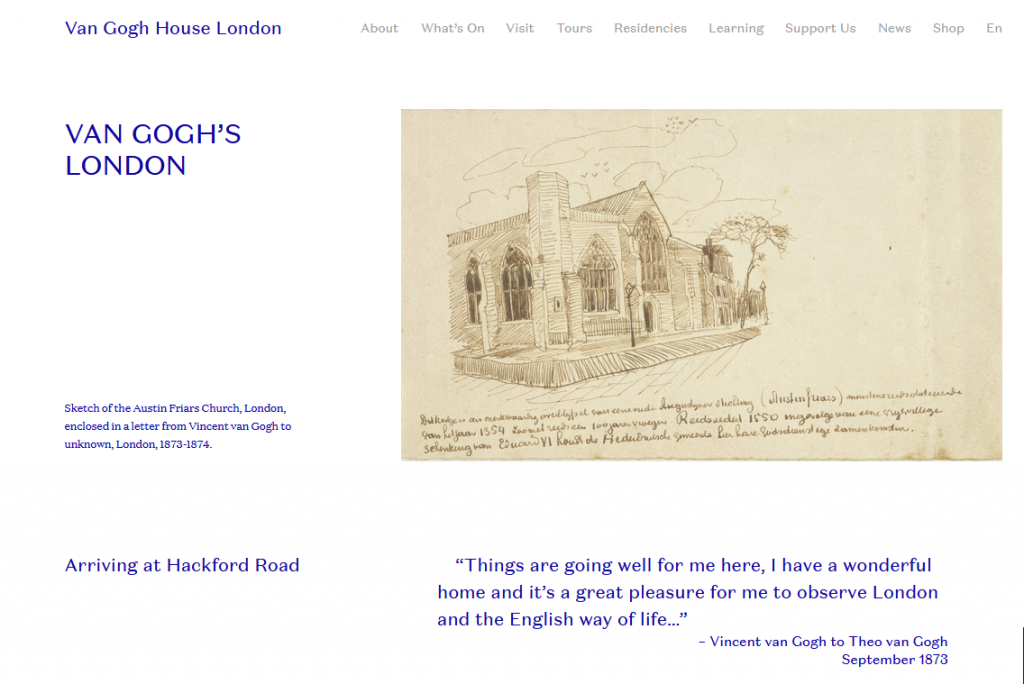
To see some of his London sketches please look at this web site.

Image of Van Gogh’s House web site.showing Austin Friars, Church, City of London

First Published October 8th, 2025

St Matthews Day & Christ’s Hosptial September 21st

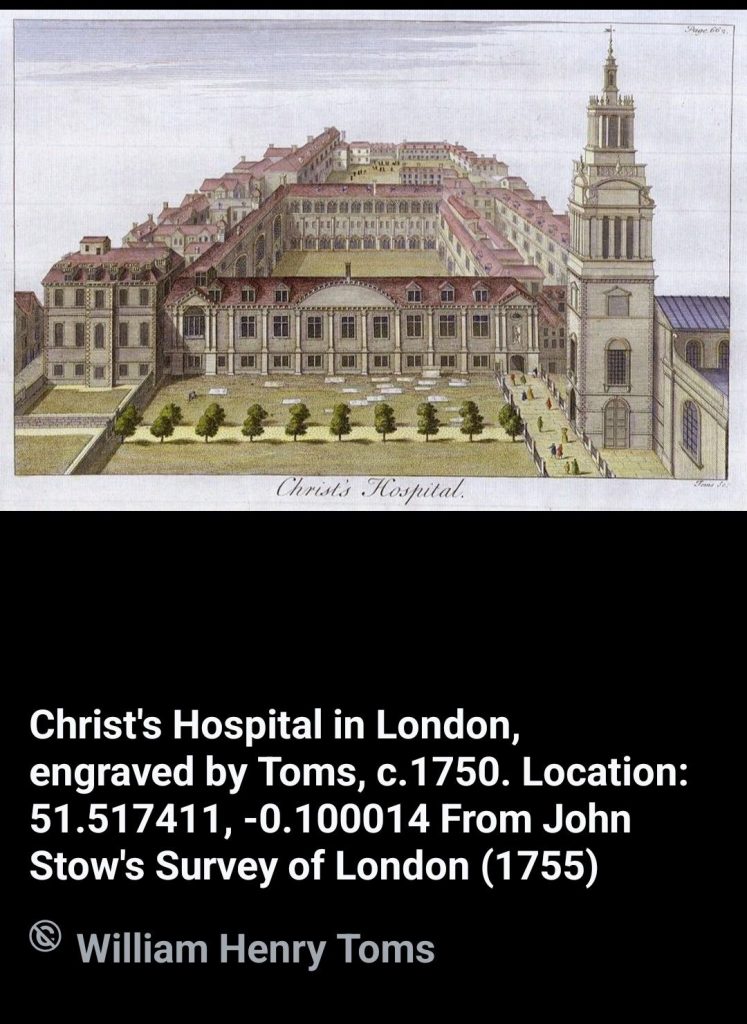
Christ’s Hospital from Wikipedia

In the City of London, St Matthew’s Day was the day that they elected Governors to Christ’s Hospital, it was followed by a service at Christchurch attended by Aldermen, Sheriffs, the Lord Mayor and a procession of the children attending the school. 

Dissolution of the Monasteries

Christ’s Hospital was founded in 1552 by a settlement arranged by Edward VI after the Reformation.  The abolition of the Monasteries by Henry VIII caused a huge problem for the City of London, with the destruction of education and social services managed by monks and nuns.  Henry VIII had already re-established St Bartholomew’s to look after the Poor Sick in the City.  To complete the post dissolution, Edward IV established three Royal Hospitals to sort out additional problems.  Bridewell Hospital became an orphanage and place of correction for wayward women.  St Thomas Hospital for the homeless and poor sick of South London. Christ’s Hospital was to provide schooling.  The school was originally near Newgate and Christchurch Church, which was originally the Choir of the Greyfriars Church.

The school was set up in 1552 and was for boys and girls.   The Mathematical School was added in the late 17th Century to provide navigation skills for sailors.

Flogging the boys

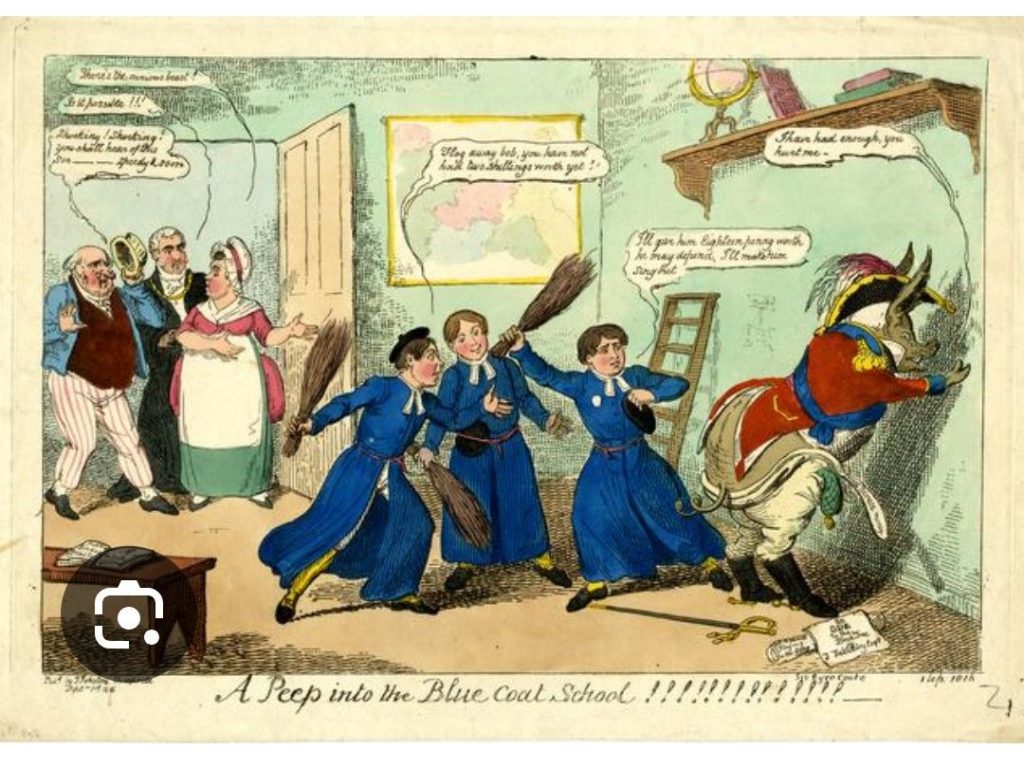
In 1815, a shocking event took place. An MP named Sir Eyre Coote entered the Mathematical school.  He shooed  the younger boys away but paid the older ones to participate in mutual flogging. He was discovered by the school nurse doing up his breeches.  George Cruikshank, a vaunted caricaturist, created a cartoon of the occasion, and it is extraordinary how it was treated far from seriously. 

Cruikshank Cartoon

The blue-coated boys of Christ’s Hospital, eventually moved to Hertford but are now in Horsham.  They maintain their City affiliation and still come to the City on or around St Matthews Day and take part in the Lord Mayor’s Show.  The school is a public school, but has a large percentage of its students funded by bursaries.  In 2016 former pupils opened up about historic sexual abuse leading to the prosecution of 6 teachers of Christchurch.

For more information look here: https://blogs.bl.uk/untoldlives/2015/09/st-matthews-day.html

Also on St Matthews Day, the historic Bush Hotel in Farnham distributed bread to the poor.  This began in 1660 a local benefactor bequeathed one pound annually to pay for the bread.

First Published in 2024, and revised 2025

September – ‘Winter’s Forewarning and Summer’s Farewell’

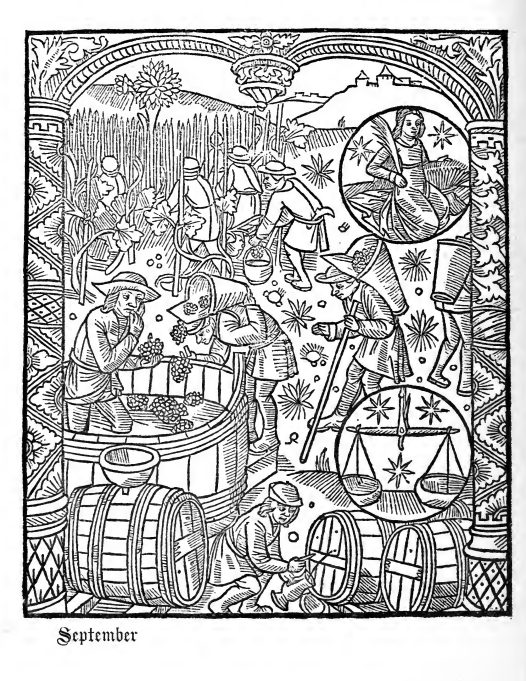
Kalendar of Shepherds illustration of September showing harvesting grapes and the astrological signs for Virgo (August 23 – September 22) and Libra (September 23 – October 22)

It is that time of the year when you say ‘Where has the Summer gone? It can’t be September already?’ But, meteorology, speaking, Autumn starts today. September 1st was chosen on a numerical basis for ease of measuring rather than any profound floral, agricultural or solar reason. So, there are three Gregorian Calendar months for each season, and each season starts on the first of the month. Autumn: September, November and December.

Autumn, Harvest, Fall

Autumn comes from Latin (autumnus) which went into French and then into English. The season was also called Harvest (which went into Dutch herfst, German Herbst, and Scots hairst -Wikipedia) or from the 16th Century: the ‘fall of the year’ or ‘fall of the leaf’ which spread to America as Fall.

Summer’s Ending

It still feels like summer. In England, we often have a glorious September, and what we can an ‘Indian’ Summer, an unexpectedly warm period in mid-September to October.

Solar Autumn

Of course, for the real Autumn, we have to wait for the Equinox, the beginning of Astronomical or Solar Autumn. This year, it is on Monday, September 22nd, 2025, 7:19 pm.

Astrological September

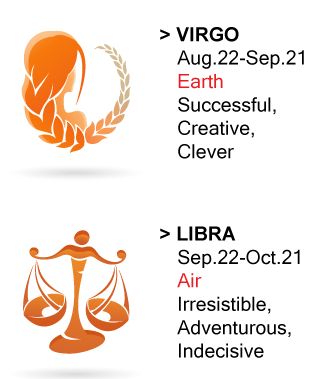
The star signs for astrological September are: Virgo which is linked to Aphrodite (Venus) the Goddess of Love and Libra which is linked to Artemis (Diana), virgin goddess of many things, including hunting, wild animals, children, and birth.

Star signs for September

September

September gets its name from the Romans, for whom it was the 7th Month of the year (septem is Latin for seven). Later, they added two new months so it became our 9th Month. (For more on the Roman year, look at my post here).

It is called Halegmonath in the early English language, or the holy month, named because it is the month of offerings, because of the harvest, and the mellow fruitfulness of September? Medi in Welsh is the month of reaping, and An Sultuine in Gaelic which means the month of plenty.

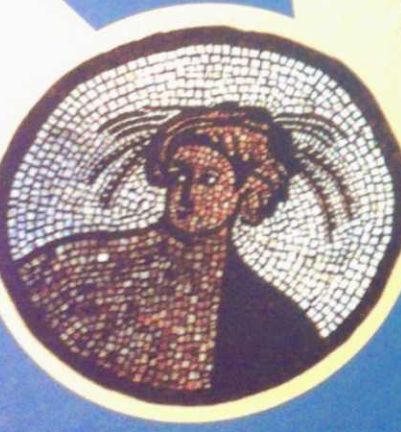
Roman personification of Autumn from Lullingstone mosaic

Early Modern September and the autumn of Life

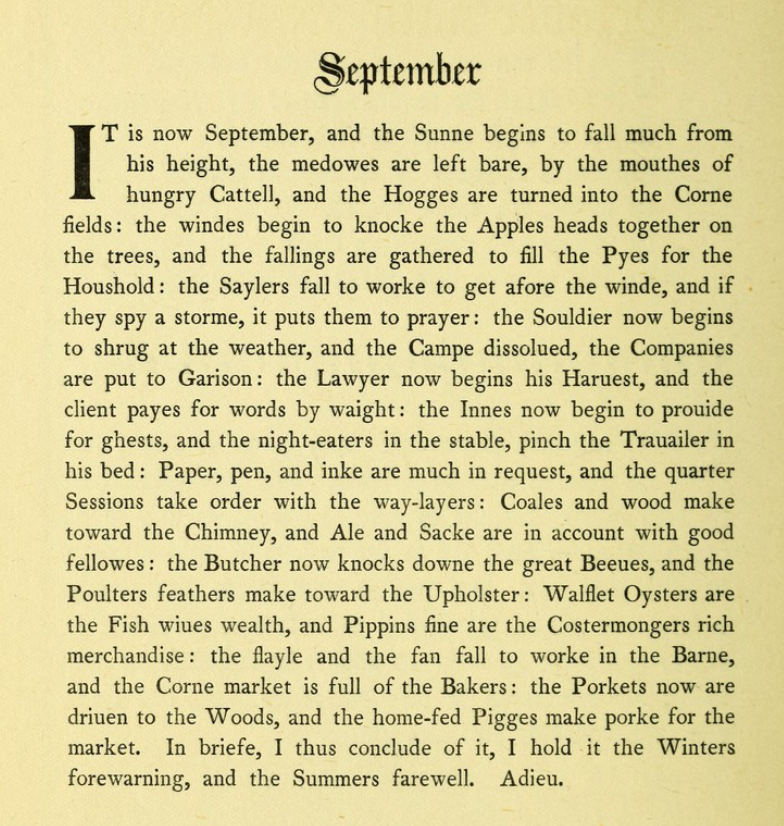
Here is an early 17th Century look at September from the Kalendar of Shepherds – for more on the Kalendar, look at my post here.

From the Kalendar of Shepherds

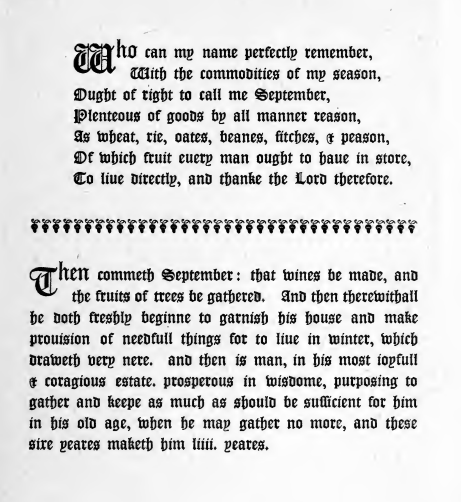
The Kalendar has an additional shorter look at September (see below). And it continues with its theme, linking the 12 months of the year with the lifespan of a man – 6 years for each month. So September is a metaphor for man at 56 years of age, in their prime and preparing for old age.

September from the Kalendar of Shepherds. The last sentence beginning ‘and then is man’ shows the link between September and the beginning of the autumn of life.

Season of ‘mists and mellow fruitfulness

John Keats (1795 – 1821) wrote a great poem called ‘To Autumn’:

Season of mists and mellow fruitfulness,
  Close bosom-friend of the maturing sun;
Conspiring with him how to load and bless
  With fruit the vines that round the thatch-eves run;
To bend with apples the moss’d cottage-trees,
  And fill all fruit with ripeness to the core;
    To swell the gourd, and plump the hazel shells
  With a sweet kernel; to set budding more,
And still more, later flowers for the bees,
Until they think warm days will never cease,
    For summer has o’er-brimm’d their clammy cells.

Who hath not seen thee oft amid thy store?
  Sometimes whoever seeks abroad may find
Thee sitting careless on a granary floor,
  Thy hair soft-lifted by the winnowing wind;
Or on a half-reap’d furrow sound asleep,
  Drowsed with the fume of poppies, while thy hook
    Spares the next swath and all its twined flowers:
And sometimes like a gleaner thou dost keep
  Steady thy laden head across a brook;
  Or by a cider-press, with patient look,
    Thou watchest the last oozings, hours by hours.

Where are the songs of Spring? Ay, where are they?
  Think not of them, thou hast thy music too,—
While barred clouds bloom the soft-dying day,
  And touch the stubble-plains with rosy hue;
Then in a wailful choir the small gnats mourn
  Among the river sallows, borne aloft
    Or sinking as the light wind lives or dies;
And full-grown lambs loud bleat from hilly bourn;
  Hedge-crickets sing; and now with treble soft
  The redbreast whistles from a garden-croft,
    And gathering swallows twitter in the skies.

Written September 19, 1819; first published in 1820. This poem is in the public domain and available here:

First published September 2024, revised 2025

Eels, Pies, Islands, the deep Sargasso Sea & Rock and Roll July 23rd

 Photo by Natalia Gusakova on Unsplash
Photo by Natalia Gusakova on Unsplash, Eels

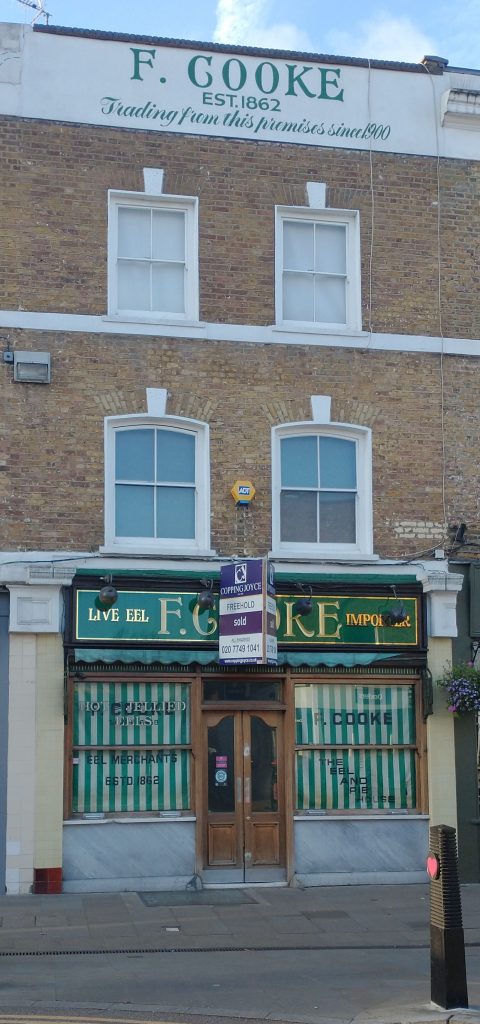
Summer is the best time to fish for Eels. Mid May to the end of July. But they can be caught all year around. Jellied Eels have been a staple of East End diets since the 18th Century. They were to be found in many stalls dotted around the East End, from vendors venturing into pubs and in Pie and Mash shops. Tubby Isaacs is perhaps, the most famous. Jellied eels are still sold in a diminishing number of places in the East End. Manze’s Eel, Pie, and Mash shop at 204 Deptford High Street, London was listed in December 2023. The shop opened in 1914 and was a pioneer of commercial branding. This is the fourth Manze’s shop to be listed: Tower Bridge Street, Chapel Market Islington, and Walthamstow High street. The current owner of the Deptford shop is retiring and so the shop will close.

There are three Pie and Mash shops near me in Hackney. The one in Dalston has become a bar. In Broadway Market it is now an optician. But the one in Hoxton Market is surviving, and all three have retained their distinctive interiors. On the River Lee Navigation is another piece of Eel history which is the excellent Fish and Eel Pub at Dobbs Weir.

Pie and Mash Shop. Established 1862, closed down 2021. Broadway Market, Hackney (photo, copyright the author)

My mum loved jellied eels. It took me until I was over 60 before I could bring myself to try them. And I have no wish to repeat, what for me, was a revolting experience.

By JanesDaddy (Ensglish User) - English Wikipedia - [1], CC BY-SA 3.0, https://commons.wikimedia.org/w/index.php?curid=1663124
By JanesDaddy (Ensglish User) – English Wikipedia – [1], CC BY-SA 3.0, https://commons.wikimedia.org/w/index.php?curid=1663124

Gervase Markham in his ‘The English Husbandman’ of 1635 provides instructions on how:

To take Eels in Winter, Make a long bottle or tube of Hay, wrapped about Willow boughs, and having guts or garbage in the middles. Which being soaked in the deep water by the river side, after two or three days the eels will be in it and you may tread them out with your feet.

And here is a fascinating article on Eel fishing.

Eel traps at Bray, on the River Thames (Henry Taught 1885)

Romans, Saxons and Eels

Eels have been eaten for thousands of years. Apicius, author of a famous collection of Roman Recipes tells us of two sauces for eels:

Sauce for Eel Ius in anguillam

Eel will be made more palatable by a sauce which has​ pepper, celery seed, lovage,​ anise, Syrian sumach,​ figdate wine,​ honey, vinegar, broth, oil, mustard, reduced must.

Another Sauce for Eel Aliter ius in anguillam

Pepper, lovage, Syrian sumach, dry mint, rue berries, hard yolks, mead, vinegar, broth, oil; cook it.

Bede’s Historia Ecclesiastica, which tells of Britain as a land with “the greatest plenty of eel and fish.” Several fish traps have been found in and around the Thames, one for example in Chelsea.

Aristotle, Freud and the Deep Sargasso Sea

But eels had a great mystery no one knew where they came from or how they reproduced. Aristotle thought they spontaneously emerged from the mud. Sigmund Freud dissected hundreds of Eels, hoping to find male sex organs. It was only on 19th October 2022 that an article in the science journal Nature disclosed the truth. The article was ‘First direct evidence of adult European eels migrating to their breeding place in the Sargasso Sea‘. Ir proved beyond doubt that the theory that Eels go to the sea near Bermuda to spawn was, incredibly, true.

Eel Pie Island

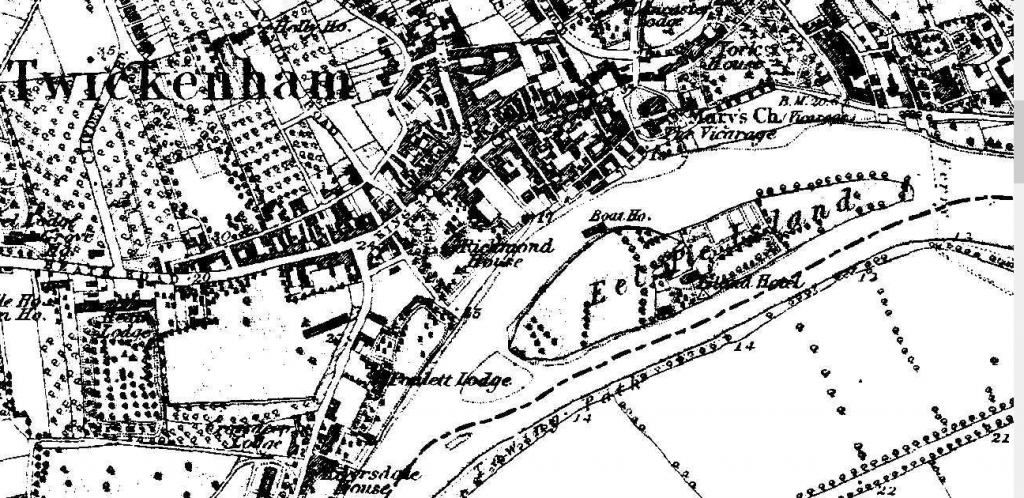
Eel Pie Island . Ordnance Survey In 1871 to 1882 map series (OS, 1st series at 1:10560: Surrey (Wikipedia)

But Eels also have their place in Rock and Roll History. Eel Pie island is on the Thames, near Twickenham and Richmond. It is famous for its Eels. But was home to an iconic music venue. The Eel Pie Hotel hosted most of the great English Bands of the 50s. 60s, and 70s. The roll call of bands here is awesome. The Stones, Cream, Rod Stewart, Pink Floyd, you name it, they were here:

David Bowie, Jeff Beck, Howlin’ Wolf, John Lee Hooker, Memphis Slim, Champion Jack Dupree. Buddy Guy, Geno Washington, Long John Baldry, Julie Driscoll and Brian Auger. John Mayall’s Bluesbreakers, Ten Years After, Chicken Shack, and one of my all-time favourite bands. the Savoy Brown Blues Band. And I have forgotten the Nice, the Crazy World of Arthur Brown, Joe Cocker, and the Who. And many more!

The Rolling Stones played at the Railway Tavern, Richmond on Sunday, February 24, 1963. Here they were spotted by people from the nearby Eel Pie Hotel. They were booked for a 6 month residency, which they began as virtually unknown and ended as famous.

Here is a recipe for Baked Eel pie from Richmond, near the famous Eel Pie Island.

This was first published as part of another post in 2022, and revised and republished on 28th November 2023, 2024.Moved from November 28th to July 23rd in 2025

(I moved it to make room for a post on Mrs Shakespeare. Also, because I cannot find anything to substantiate the opening statement that the Eel Season had its second day on November 28th. All evidence I find says the best fishing is in the Summer.

Twin, Twins – Festival of Castor and Pollux July 15th

The Ashwini kumaras twins, sons of the sun god Surya. Vedic gods representing the brightness of sunrise and sunset Wikipedia

The Divine Twins, aka the Dioscuri, were horsemen. Patrons of calvary, athletes and sailors, one of many Indo-European twin gods.   They had many adventures including sailing with Jason and the Argonauts.

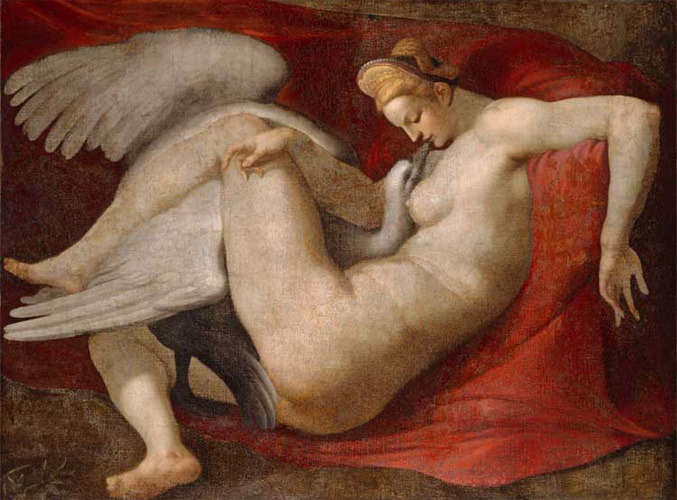
And are they well connected?! Pollux is the son of Zeus  His twin brother has a different and mortal father, the King of Sparta.  But the boys share the same mother, Leda.  She was raped by Zeus in the guise of a swan.

This makes them examples of heteropaternal superfecundation as Mary Poppins didn’t sing.  But their different paternity had consequences. The most important is that one was (is?) therefore immortal and the other wasn’t. 

According to some version of the story, Castor (the mortal one) was mortally wounded. Zeus gave Pollux the option of letting his brother die while Pollux could spend eternity on Mount Olympus. The alternative was to share his immortality with his brother. Pollux did the good thing. So the twins spend half their year as the Constellation of Gemini and the rest, immortal, on Mount Olympus.  Thus, they are the epitome of brotherly love.

Divine Twins or Sisters from Hell?

The Dioscuri’s sisters were no less than Helen of Troy and Clytemnestra. Never mind the Brothers, what Sisters! Helen of Troy you know. And Clytemnestra! They were also twins, Helen the divine daughter of Zeus, husband of Menelaus, lover of Paris. Sister, Clytemnestra, mortal daughter of the King of Sparta, husband of Agamemnon (brother of Menelaus).

It happened like this.  The Swan was being pursued by an eagle, so Leda protected the Swan and took it to bed.  On the same night she slept with her husband Tyndareus of Sparta. Two eggs were fertilised, each split in two to give two sets of twins.

Leda and the Swan, 16th-century copy after the lost painting by Michelangelo

Clytemnestra

She was the wife of Agamemnon, the arrogant leader of the Greeks.  On the way to retrieve Helen from Troy, the Greek Fleet was becalmed. So, following his seers’ advice, Agamemnon sacrificed his own daughter, Iphigenia, on the island of Aulis.  The Gods then set the winds fair to Troy. (Read Iphigenia at Aulis by Aeschylus, a great play which I studied in Classical Studies at University).

Meanwhile, Queen Clytemnestra, abandoned at home, broods on her husband’s heartless fillicide. She takes a lover. After 10 years of war, Agamemnon comes back, in triumph, from the destruction of Troy. He brings with him his prize, the Trojan Princess, Cassandra, sister of Hector.

Cassandra has been gifted with the ability of accurate prophecy. But, as often in the case of prophecy stories, the gift came with a sting in its tale. She was also cursed with the inability to get anyone to believe her!  She prophesies disaster and that she too will be a victim.

Strutting with arrogance, Agamemnon demands Clytemnestra prepare him a bath. And, so she runs it for him, and she gives him the hottest bath possible. With the help of her lover, she hacks Agamemnon to pieces with an axe. Cassandra is butchered.

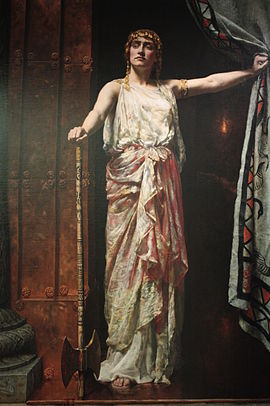
painting of Clytemnestra after she has slaughtered her husband Agamemnon _by_John_Collier,_1882 (Wikipedia Guildhall Museum)
Clytemnestra by John Collier,_1882 (Wikipedia Guildhall Museum)

Attitudes

I visit John Collier’s painting of Clytemnestra at the Guildhall, in London, regularly. I am fascinated by her grim, yet satisfied, expression.

In the 18th/19th Century, rich people were into ‘attitudes’.  For example, Emma Hart, later Lady Hamilton, would be invited to present an attitude in front of a dinner party of mostly male aristocrats.  She would dress up in a flowing, revealing unstructured classical gown.  Then she would stand on a table or pedestal, and present herself as Helen or Andromache or any other classical beauty guests might fancy an eyeful of.  She would assume an appropriate facial expression and posture for everyone’s pleasure. 

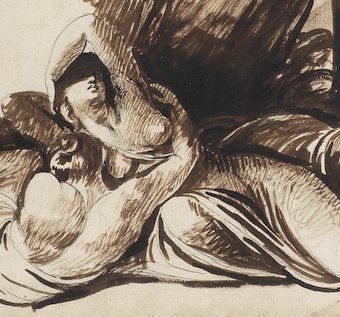
Detail of Emma Hart modelling as Iphigenia by George Romney in ‘Cimon and Iphigenia’

Being Clytemnestra is, surely, the most difficult? I imagine Collier’s model being prompted to look both sad at the loss of the daughter. Outraged at the arrogance of the husband. Horrified at the gore of the murder. But, overall, she has to portray a grim satisfaction that the bastard got exactly what he deserved.

Dorothy Dene

Lord Leighton had a famous model who was exceptionally skilled at adopting poses for his paintings. He determined to help her with an acting career. As part of the plan he helped improve her cockney accent. It is said this inspired Bernard Shaw’s story Pygmalion, which, in turn, inspired My Fair Lady and Eliza Doolittle. 

Leighton’s model was Dorothy Dene.  She became a famous actress, outstripping the fame of Ellen Terry and Lily Langtry. For more on Leighton and Dene look at my post here.

John Collier

Before we finish, do have a look at John Collier’s Wikipedia because he is the most ridiculously well-connected painter you can imagine! Related to half the Cabinet and married to TWO daughters of Darwin’s Bulldog, T.H. Huxley (grandfather of Aldous Huxley).

For more on Flaming June see my blog post of 12 July 2024

European Twin Gods

It is suggested that twin male gods are a feature of Indo-European religions. The divine Twins are associated with horses/chariots and are responsible for moving the Sun and the Moon. Their use of a horse above the water means that they can rescue people lost at sea.  

St Elmo’s fire was said to be the way they manifested their divinity to sailors.   Diodorus Siculus records that the Twins were Argonauts with Heracles, Telamon, and Orpheus. Further, he tells us, in the fourth book of Bibliotheca historica, that the Celts who dwelt along the ocean worshipped the Dioscuroi “more than the other gods”.

First written in 2023 updated in July 24 and 25

Thoreau moves to Walden Pond July 4th 1845

1967 postage stamp of Thoreau

Today, is Independence Day. The day that a great democracy came into being and established a rational system of Government, designed to stop autocracy. One of the great thinkers of the US was Henry David Thoreau. He moved into his hut on Waldon Pond on 4th July 1845. He wanted to experience life to the full. He thought he could best do that by living a simple life in the wild. 

Some think he was autistic, but his journals and publications show he lived a rich life.  His work links observations of nature with philosophic meditations and folk lore. His interest in ecology and avoidance of waste are forerunners of modern environmentalism. 

‘Walden’ his book about life in his hut near Concord, Massachusetts is his best known work. 

I began to occupy my house on the 4th of July, as soon as it was
boarded and roofed, for the boards were carefully feather-edged and
lapped, so that it was perfectly impervious to rain; but before
boarding I laid the foundation of a chimney at one end, bringing two
cartloads of stones up the hill from the pond in my arms. I built the
chimney after my hoeing in the fall, before a fire became necessary for warmth, doing my cooking in the mean while out of doors on the ground, early in the morning: which mode I still think is in some respects more convenient and agreeable than the usual one. When it stormed before my bread was baked, I fixed a few boards over the fire, and sat under them to watch my loaf, and passed some pleasant hours in that way. In those days, when my hands were much employed, I read but little, but the least scraps of paper which lay on the ground, my holder, or tablecloth, afforded me as much entertainment, in fact answered the same purpose as the Iliad.

Thoreau and Civil Disobedience.

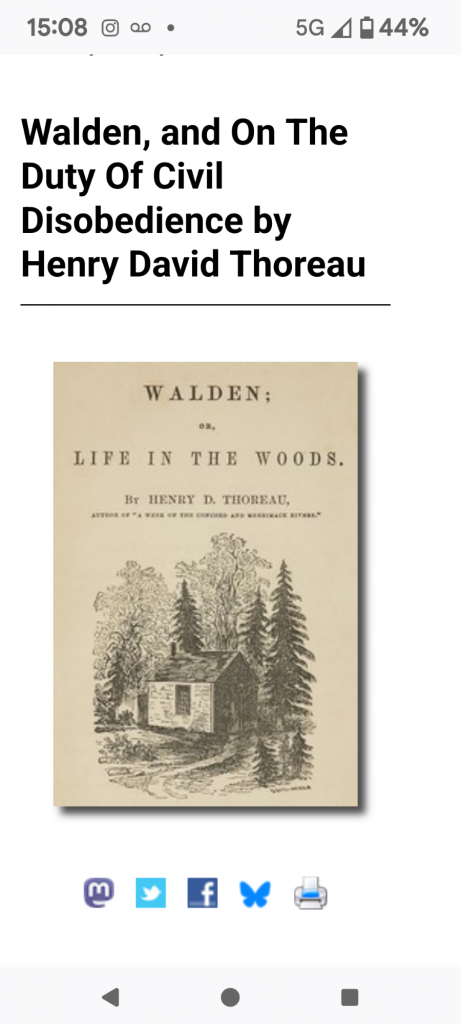
From Project Gutenberg. Thoreau was also a principled opponent of unjust laws. He inspired Gandhi, amongst others, in the principles of Civil Disobedience.  He was imprisoned for refusing to pay tax to the American state in protest at the African-American War and Slavery.  He supported John Brown. 

Project Gutenberg page of Thoreau’s ebook.

John Brown’s Body lies a mouldering in his grave.

Brown believed that slavery would only be ended by fighting to liberate the slaves.  He was involved in the State Civil War in Kansas. Subsequently, he then launched a raid on Harper’s Ford, which caused several deaths.  Brown was found guilty of Treason against the Commonwealth of Virginia and executed. He was the first American to be found guilty of Treason. But Thoreau supported him, while other Abolitionists took a more pacifist position.

All in all, he is therefore an inspiring character. His life can inform that still tricky debate about challenging injustice in the modern world. Attitudes to ‘Just Stop Oil’ and the war in Gaza are causes where the same issues are still open to debate.

First published July 2025

The Great Broadway Paint off

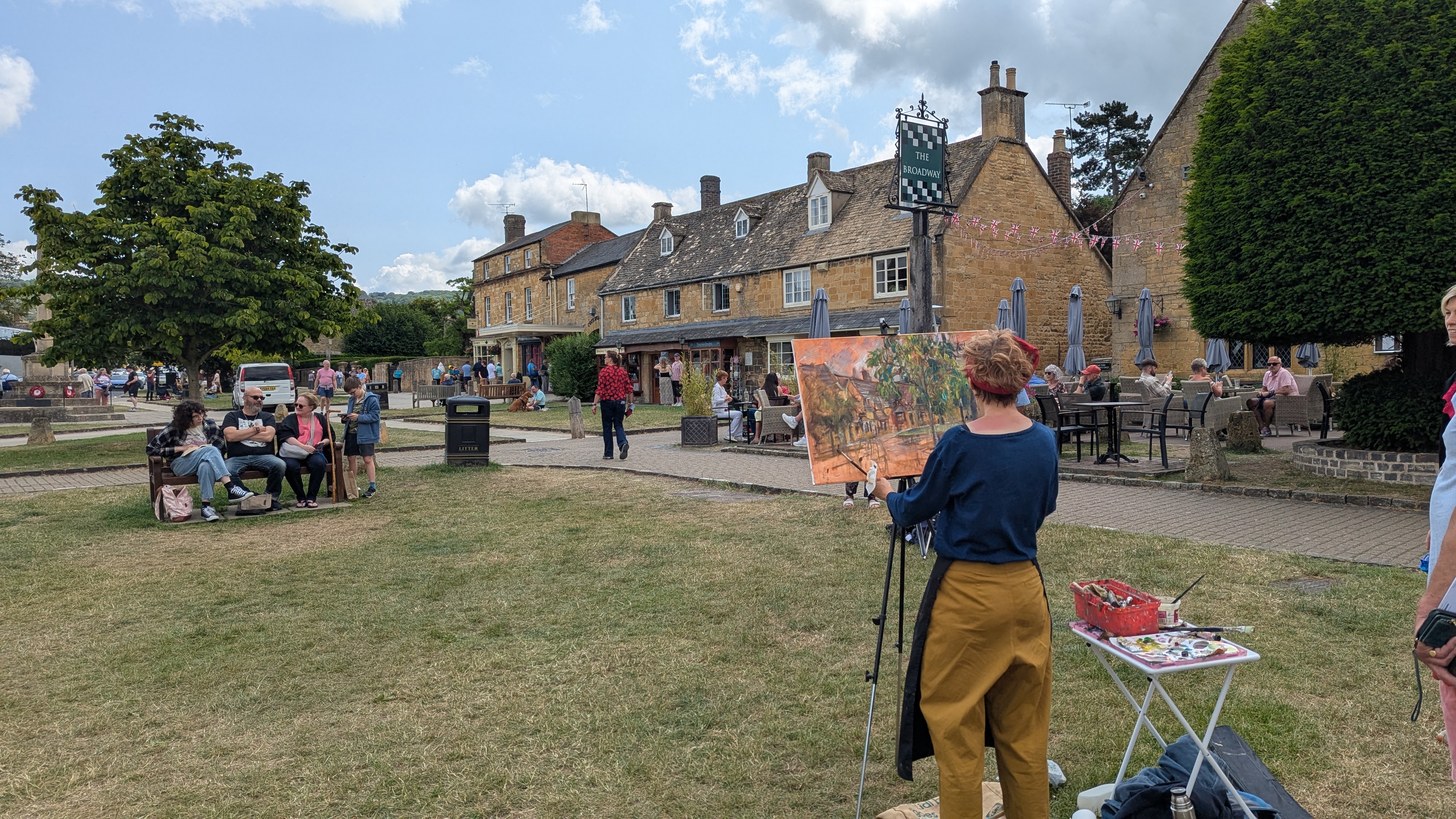
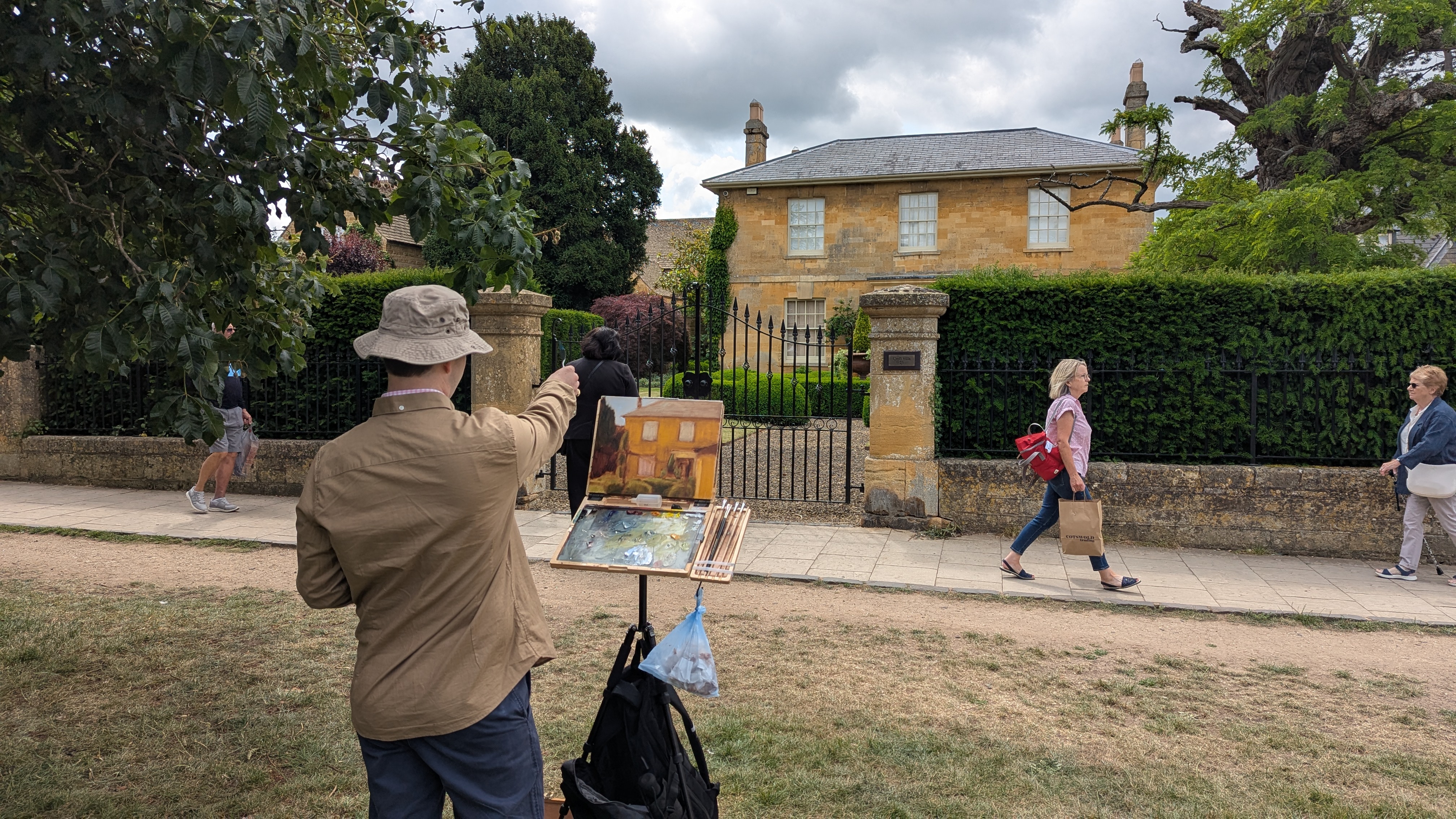
The Great Broadway Paint Off. Photo K Flude 2025

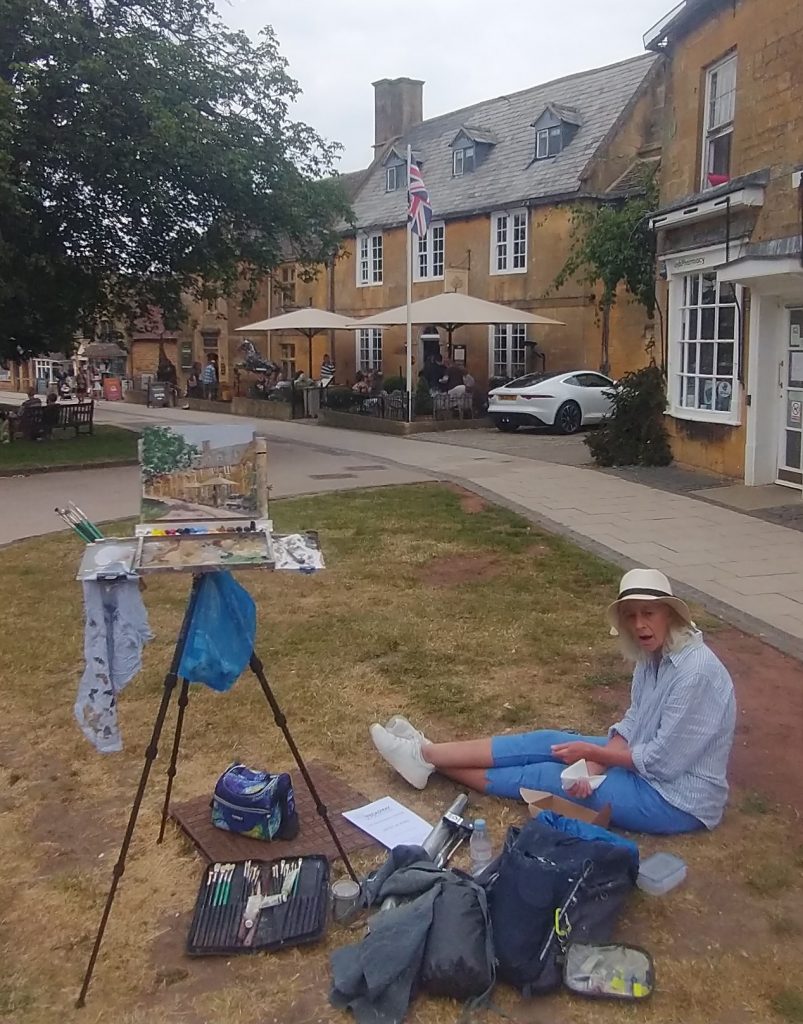
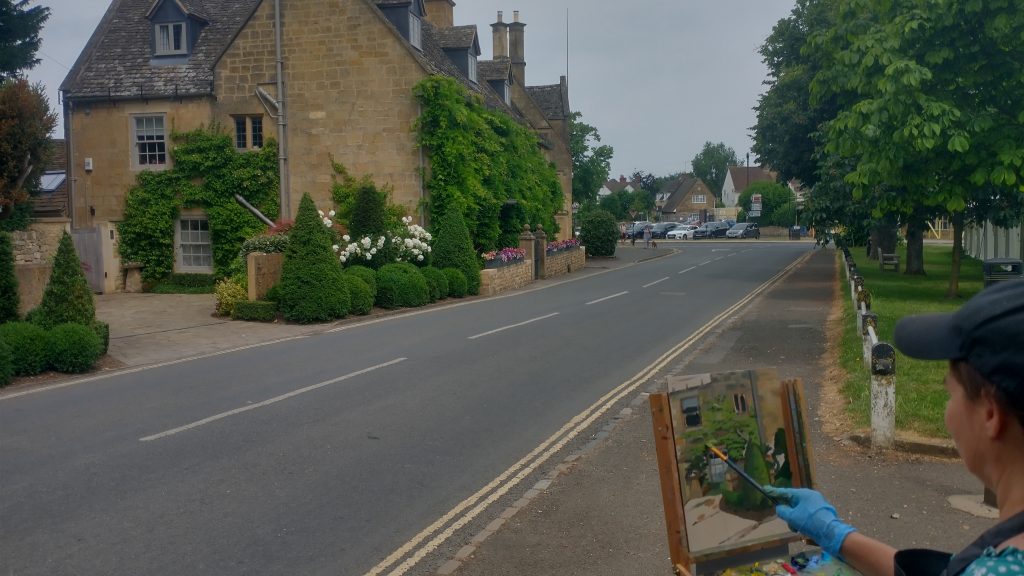
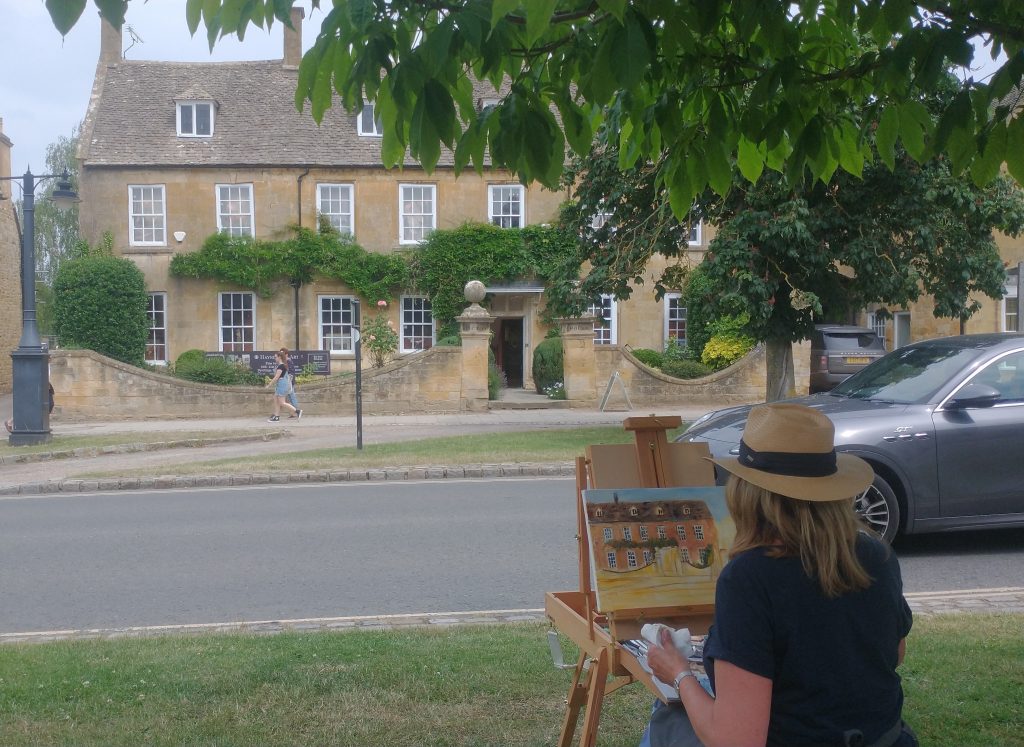
One of the joys of my Summer is revisiting places I know and love in my role as a Course Director for Road Scholar. I first came across the ‘en plein air’ in 2023. On Sunday, June 18th. I was in Broadway, once considered the most beautiful village in Britain. It was also the model for Riseholme in the wonderful Lucia books by E. F. Benson (made into a TV series by the BBC starring Prunella Scales, Geraldine McEwan and Nigel Hawthorne).

The day I visited, in 2025, was last Sunday, June 15th. I have added new photos and revised the texts.

How it Works

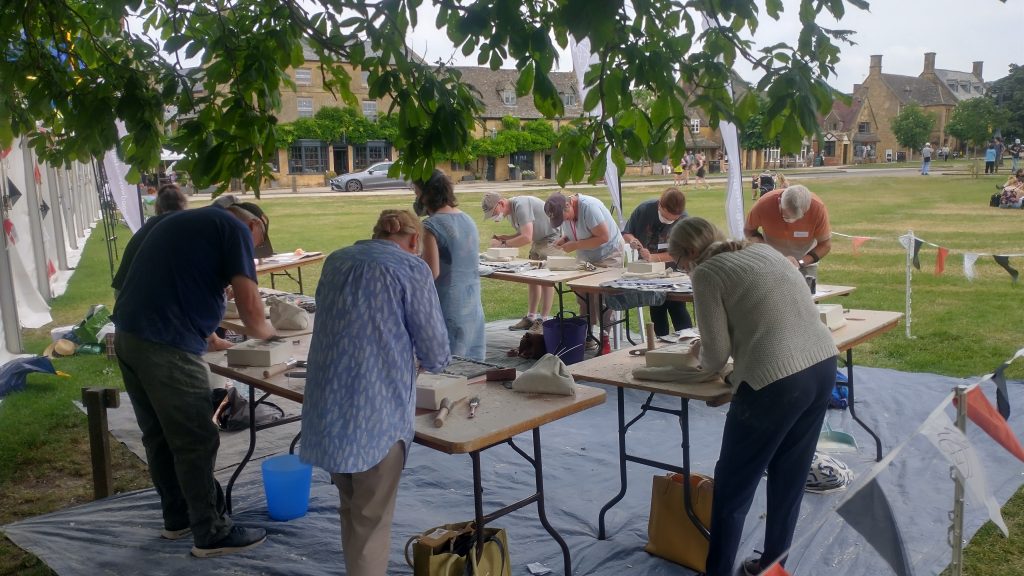
The artists register in the morning and have their paper or canvas stamped, or given a block of Maltese stone. This proves that they have done all the work on the day itself.

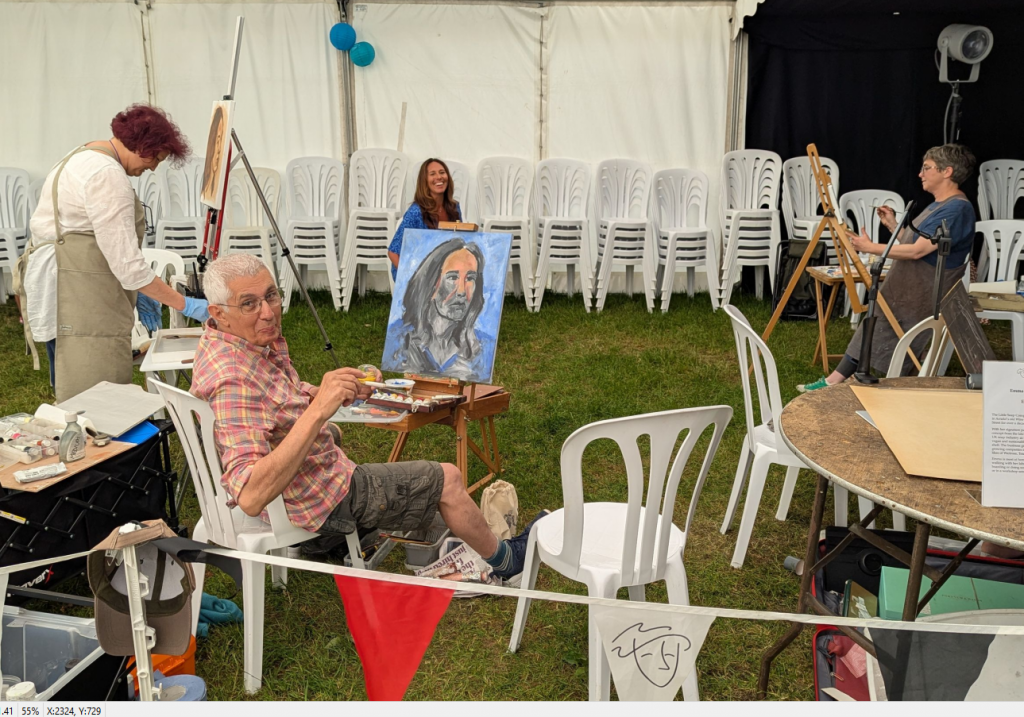
This year there were no sculptors.  Instead, there were live models in the marquee being painted by portrait painters. 

Broadway Paint off, Local Portraits. 2025 Photo K Flude

They take their blank canvases to create a work of art in the village. At 4pm or so, they are judged. At 5pm, the art works are exhibited and are on sale in the Marquee on the village green.

Broadway Arts Festival 2025, Photo K Flude

It’s always a delight walking around Broadway. Bun, but with an artist and easel every 50 yards or so even more enjoyable.

The Most Beautiful Village?

The appellation of most beautiful village, came in the late 19th Century. Broadway, once gained its wealth by selling wool. When that declined, the village became an important stop on the Toll Roads. It was on the stage coach route from Aberystwyth to Worcester, Oxford, and London. Fish Hill, nearly 1000 feet high, was an obstacle and coaches made a stop here to prepare or recover. Some coaches used up to 10 horses to get to the top. But with the arrival of Brunel’s Great Western Railway to the Cotswolds the village was nearly ruined. Half the village, the Broadway Museum says, moved away as their livelihood serving the coaching trade died.

Artist painting in the Broadway 'Great Paint off'
Artist painting in the ‘Great Broadway Paint off’ 2023 Photo K Flude
Artist painting in the Broadway 'Great Paint off'
Another artist participating Artist in the ‘Great Broadway Paint off’ Photo K Flude 2023
Painting in Broadway
@dawnjordanart Great Broadway Paint off’ Photo K Flude 2023

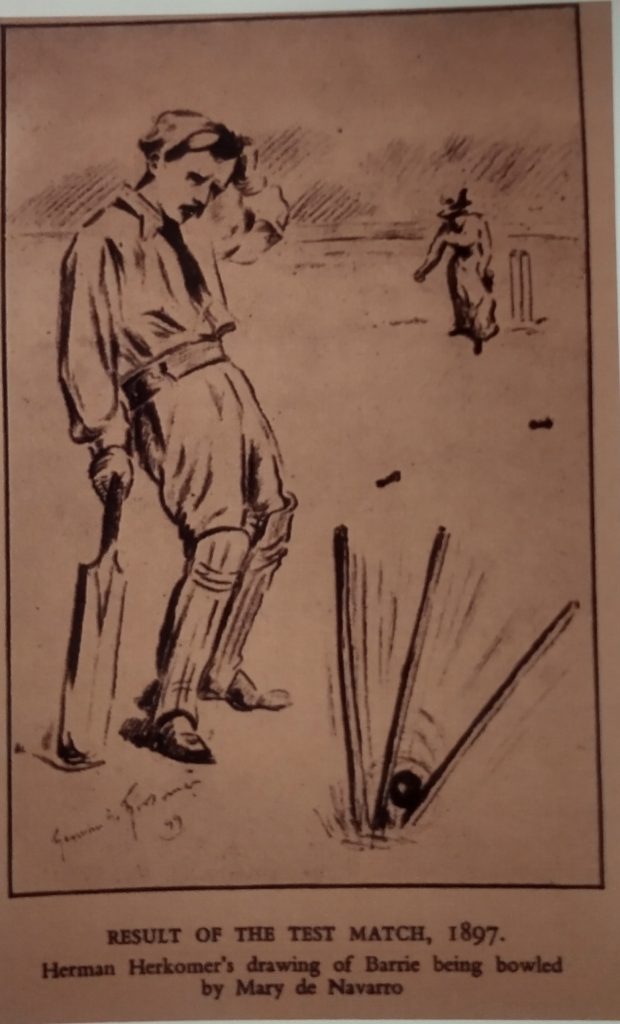
But artists and writers, led by Americans Frances Millet and Edwin Abbey, turned Broadway into a much sort-after country retreat. Visitors included Oscar Wilde, J. M. Barrie, Singer-Sargeant, William Morris, Edward Burne-Jones, Gabriel Dante Rossetti, American actress, Mary Anderson, Edward Elgar, E. F, Benson. Mark Twain visited for Millet’s marriage.

J.M. Barrie being bowled by Mary de Navarro. (aka Mary Anderson, who played many roles including Juliette at Stratford-on-Avon)

Gordon Russell & Henry T Ford

What made the visit particularly interesting was the story told by the volunteer at the Gordon Russell Museum in Broadway. This is the story as I understood it:

The Russells restored the Lygon Arms in Broadway using Arts And Crafts architects. They also restored antique furniture. The son, Gordon Russell, became a leading designer of modernist Furniture. He advertised to passengers on the Cunard Line in order to attract the attention of rich American visitors. One, Henry T Ford, was interested. He came to Broadway, staying at the Lygon arms. He was taken to nearby village Snowshill, where Ford bought a Cotswolds Farmhouse, complete with Blacksmith’s workshop. They were shipped stone by numbered stone to Brentford on the Thames. Then to the London Docks and across the Atlantic. Here. Ford set them up in a Museum in Michigan where they still are!

Sculptors at the Great Broadway Paint off.
Sculptors at the Great Broadway Paint off (2023)

Research suggests it’s a little more complicated, in so far as Ford purchased his first Cottage before coming to Broadway. But it still leaves a delightful story about American ideas of Quintessential English village life. For pictures see my post here. And for another look at the story look at this web site here:

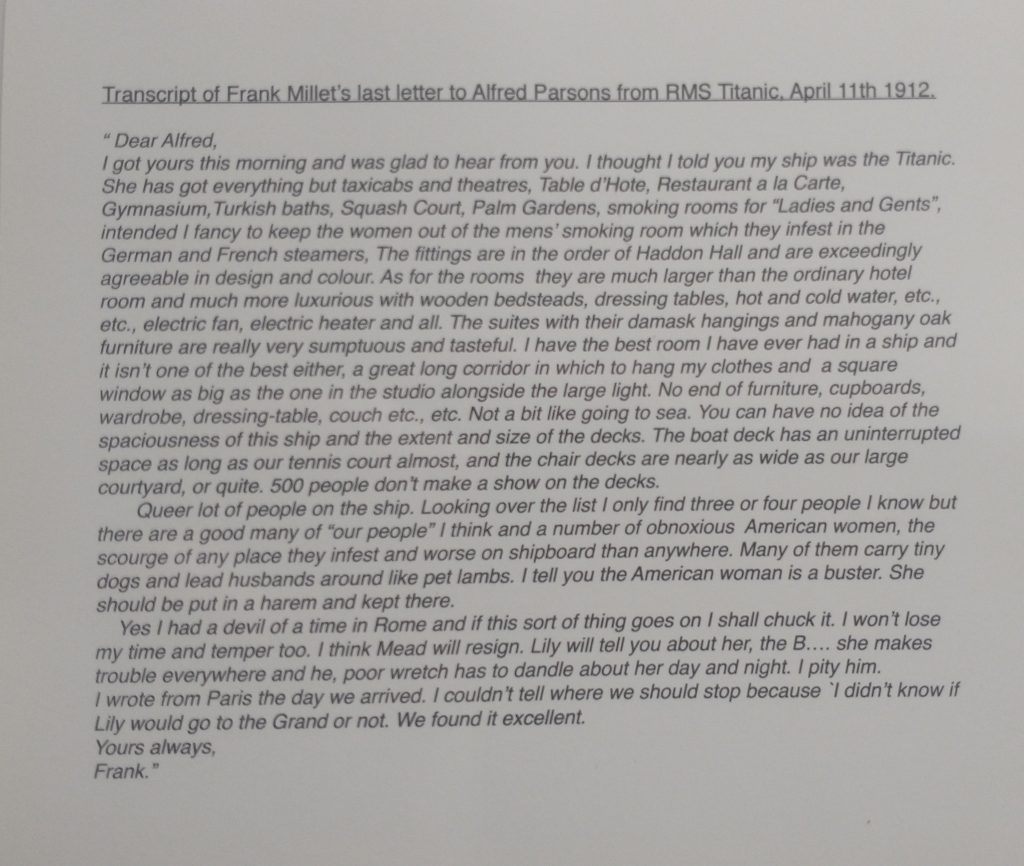
By the way, Frances Millet planned to return to the States on the Titanic. He was one of the 1500 who drowned. A letter he wrote while on the ship was posted, probably in France. It is on display in the Broadway Museum (2023).

For more about Broadway, Gordon Russell and Word War 2 see my post here:

June 18th is also:

International Sushi Day

Autistic Pride Day

National Chocolate Ice Cream Day

First Published in June 18th 2023, Republished in June 2024, and revised in 2025

May & June: Dandelions, Hinder Fallings and Bed Wetting

This post sprang from something that my grandson said to  in the middle of the park. He was curious as to why I was concerned that the park toilets were out of action. He told me I could, like him, just pull down my trousers and wee, right here, right then, up against the tree in the park. My attempt at explanation drew a perplexed, ‘What?’ ‘What?’ is his new word. After an explanation, his next word is invariable another ‘What?’.Hopefully the relevance of this will become apparent.

May and June are the most prolific months for dandelions, which used to be known as ‘piss-a-beds’. They are diuretic and were often eaten, and so might well have consequences for the young trainee child.

John Hollybush in his 1561 ‘The Homish Apothecary’ says:

‘When a young body does piss in his bed either oft or seldom: if ye will help him take the bladder of a goat and dry it to powder, and get him to drink with wine, or else take the beans or hinder fallings of a goat, and give him of the powder in his meat morning and evening, a quarter ounce at every time.’

(quoted in ‘The Perpetual Almanac by Charles Kightley)

Hinder fallings are what falls out of the hind-quarters of a goat. I’m not sure even an indulgent Grandparent is allowed to give droppings and wine to the little ones. Nor can I find any mention of goat products in modern medical recommendations. So I won’t be recommending this as a practical aid.

Medically, dandelions were very well regarded. Mrs Grieve’s ‘Modern Herbal’ reports that it are diuretic and a general stimulant to the system but particularly the urinary system. They were good for liver and kidney complaints; gall-stones; and piles. They were considered excellent to eat and drink. Particularly, dandelion sandwiches using young leaves, with salt, pepper, and lemon juice. They were also taken in salads, teas, and beers.

We used to blow the seeds from the dandelion seed head saying ‘She loves me. She loves me not’ at each blow, until the truth was revealed.

First written in June 2023, revised june 2024,2025.  Rewritten 2025

May Day May 1st

May Day – Bringing the Maypole, Bedfordshire. Image from ‘Romantic Britain’

Maypoles were often stored during the year. A few days before May Day they were repainted, and bedecked with May Garlands – mostly made from Hawthorn. The Maypole used in London in 1660 was 134 feet high. Tall straight trees were used, sometimes of Larch, and they might be spliced together to get the requisite height. John Stow says that each parish in London had their own Maypole, or combined with a neighbouring Parish. The main Maypole was on the top of Cornhill, in Leadenhall Street. It was stored under the eves of St Andrew’s Church, which became known as St Andrew’s Undershaft as a result.

Padstow May Day Festival

Padstow holds, perhaps, the most famous May Day festival on May 1st. It feels feels very ‘pagan’ or do I mean it is fuelled by an enormous amount of drink?

Here is a video, watch until you see the ‘obby ‘orse and the teaser dancing.

Why May Eve?

The celebrations begin on May Eve because the Celtic calendar starts the day at Dusk. This seems strange to us who, perversely, ‘start’ our day at Midnight just after everyone has gone to bed! The other choice, and maybe the most logical is Dawn. But Dawn and Dusk are difficult to fix. Midnight was chosen by Julius Caesar when he created the Julian Calendar. Midnight has the virtue of being a fixed metric, being half way between Dawn and Dusk. From the Celtic point of view. The day ends when the Sun goes down over the western horizon. So the end of the old day, is the beginning of the new day. Makes sense?

For Walpurgis Nacht see my post on April 30th here: walpurgis-nacht-april-30th/

Beltane

Celebrations centred around the Bonfire. The day was sacred to the fire God Belenus (Gaulish: Belenos, Belinos, British Belinus, Bel, or Beli), and May Day was called Beltane. Bonfires continued to be a part of the celebration into the 16th Century, and in places until the 20th Century. According to folklore tradition, the bonfire should be made of nine types of wood. They must be collected by nine teams of married men (or first born men). They must not carry any metal with them. The fire has to be lit by rubbing oak sticks together or a wooden awl twisted in a wooden log.

Participants, have to run sunwise around the fire. Oatcakes are distributed, with one being marked with a black spot. The one who collects it has to jump through the fire three times. Bonfires would have been, by choice on the top of hills. But then they were also held in the streets in London.

May celebrations have a similarity to Halloween. This was also a fire festival and both are uncanny times when sprites and spirits abound. Hawthorn was a favoured wood not only because of its beautiful may flower. It was also said to be the wood the crown of thorns was made from. Hawthorn had the power of resisting supernatural forces. Therefore, it was used to protect doors, cribs, cow sheds and other places from witches. Witches, it was said, got their power to fly from potions made from chopped up infants. The best protection was Christening. The custom was that christening took place as early as possible and normally three days after birth. Shakespeare was baptised on 26th April 1564, so we celebrate his birthday on 23rd April. See my post for more on this subject.

Special May Babies

Cribs would be bedecked with Hawthorn and protection might be augmented by a bible, rowan, and garlic. Babies born between May 1 and 8 were thought to be special. They were destined to have power over man and beast. Weddings were frowned upon in Lent and in May, so April became a popular choice for marriage.

May Dew

After celebrations on May Eve (April 30th), women would go out in the woods to collect May, other flowering plants. They would wash their faces in May Dew preferable from the leaves of Hawthorn. If not from beneath an oak tree, or from a new-made grave. The dew was said to improve their complexion. It was also used for medical conditions such as gout and weak eyes. Thinking of one’s lover on May Day might bring marriage within the year.

May morning would commence with dancing around the Maypole, followed by feasting, and summer games. for more about Maypoles and May Day see my post may-2nd-this-stinking-idol-the-end-of-may-day/

Belenus is a Celtic God of whom very little is clear and unambiguous. He was linked in Gaul with Apollo. The name, some people think, comes from ‘Shining’ but others disagree and think it means ‘Master of Power.’ His association with Irish mythology and the festival of Beltane suggests he was a powerful god in Celtic Europe. Geoffrey of Monmouth has a King called Belinus, and spins a yarn about Belinus and Billingsgate. Linguists prefer the idea that Billingsgate is named after some unknown Saxon called Billings. This may be a little more likely but far less interesting.

See my post on Midsummer for more on Celtic Festivals.

On This Day

1707 The Union of Scotland and England Proclaimed

1945 German Fascist Goebbels kills himself and his entire family

Revised May 1st 2024 and 2025

Heritage with my Grandson 2 – British Library & British Museum March 9th

Grandson on a visit to the British Library and British Museum. Photo of the Beethoven Exhibition, British Library, March 2022

A visit to the Britsh Museum & British Library? I think this might be worth reposting in the absence of anything else compelling for the day!

So this was my outing with my grandson on March 9th 2022.

For our second museum outing we went to the British Library. He didn’t like the Beethoven exhibition. It was too dark and nothing to surreptitiously climb on. He definitely does not like dark exhibitions. This is a shame because it seems to be the design idea of the moment. The Nero and the Stonehenge exhibitions were also dark spaces. The desigers working on creating atmospheric views using bright colours, spot lighting and spectacular objects on a dark background. But it doesn’t work for a sensitive 20 month year old!

Nor did the largely text based Paul McCartney’s Lyrics exhibition attract a second of his attention. ‘Paul who?’ he seemed to be saying as we stumped past to the very quiet sound of ‘Hey Jude’.

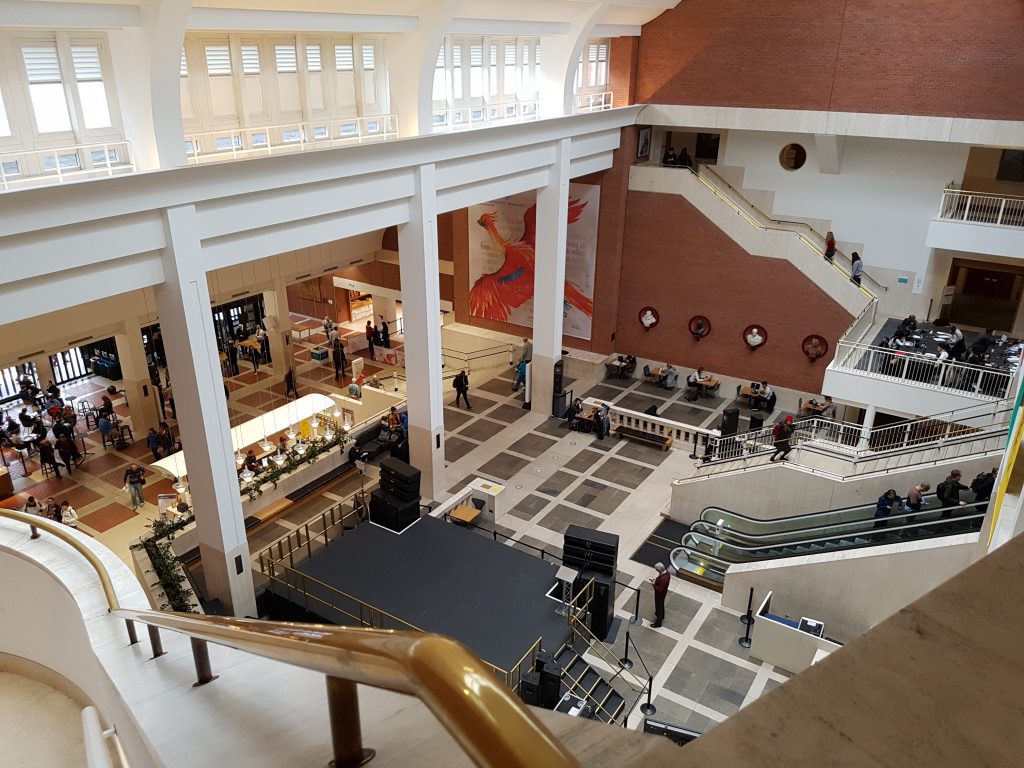
What he did like was the escalators. We went up and down, and up and down, and then onto the second set where we repeated the repeat.

British Library – note the escalator to the right

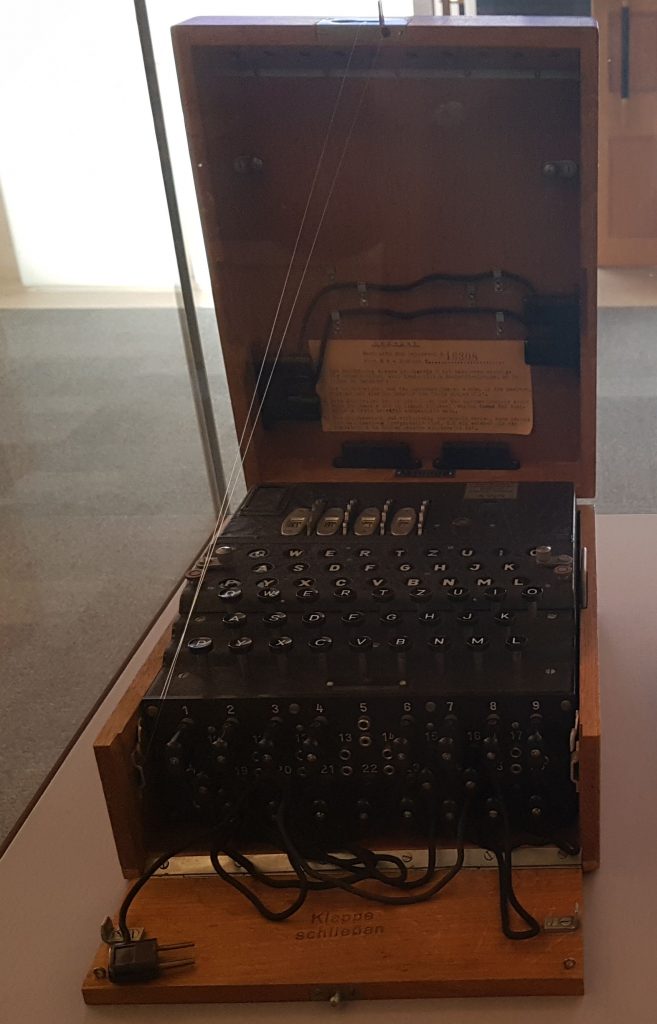
And then we went down and back up again, and no time to see the enigma machine. We ate in the upstairs Restaurant, which is a really pleasant place to spend a lunch time.

Enigma Machine, British Library

Time for him to have a sleep so we walked to the British Museum through Bloomsbury. However, there was very little sign that he wanted to nod off. But we found a couple of interesting revolutionaries of the 19th Century en-route. The first was to Robert Owen, the founder of the Cooperative Movement, famous for his model factories in New Lanarkshire.

Plaque to Robert Owen ‘father of the Cooperative Movement’, Burton Street

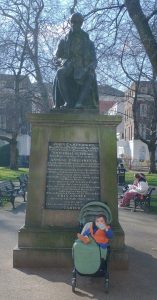
Then to Cartwright Gardens, named after John Cartwright, who was called ‘the Father of Reform’. He had quite an amazing life. He refused to serve in the Navy against the American Colonists in the War of Independence. Not only that, but he supported reform of Parliament, universal suffrage, annual Parliaments and secret ballots.

John Cartwright Statue Cartwright Gardens.

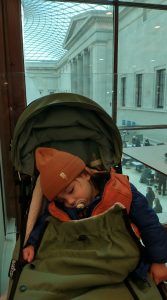
The milk soon did its job and my grandson was asleep. So I took him to the Member’s Room for a cup of tea.

Sleep in the Member’s Room overlooking the Great Court

When he woke we whizzed around the third Floor. But he was reluctant to leave his buggy because it was much more crowded than our last visit. Then he could run free around the almost empty galleries which he loved.

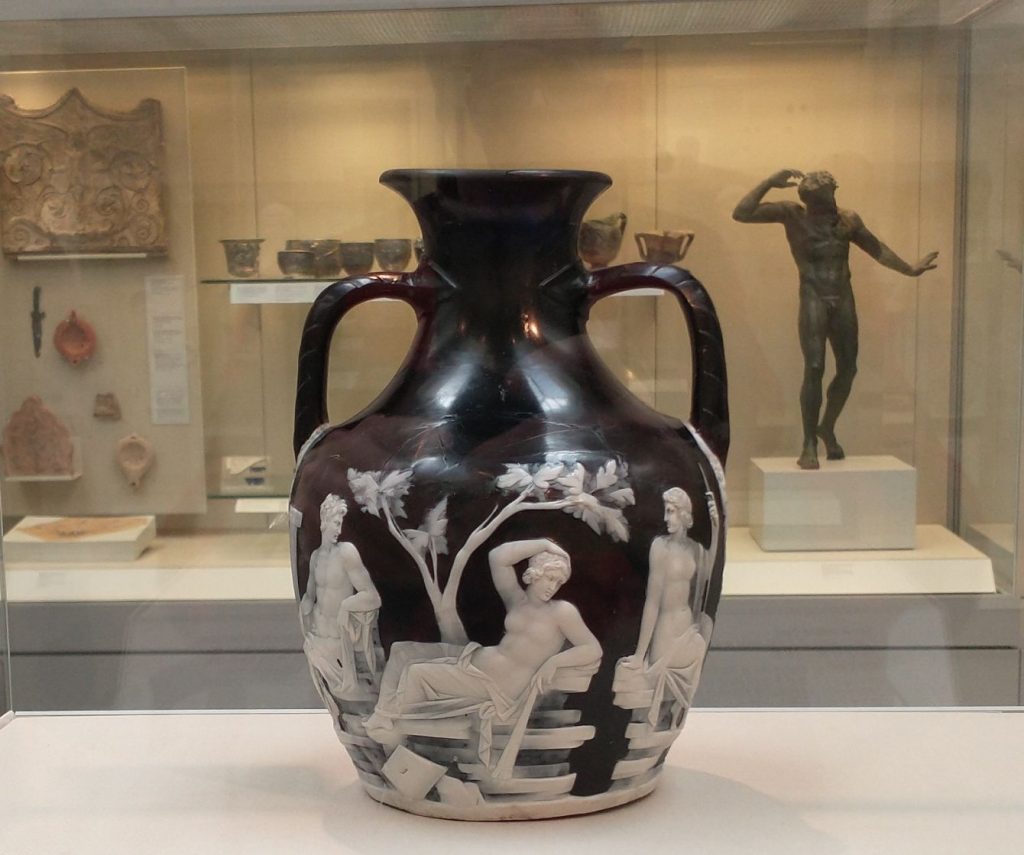
But, I was able to visit old favourites like the Portland Vase. This was smashed into hundreds of pieces, in 1848 by a drunken visitor. He threw a sculpture into the case and smashed the vase. It was restored, but 37 pieces were missing. In 1988 the vase was reunited with the missing pieces and expertly restored.

The Portland Vase – 15BC = 25AD Cameo Glass
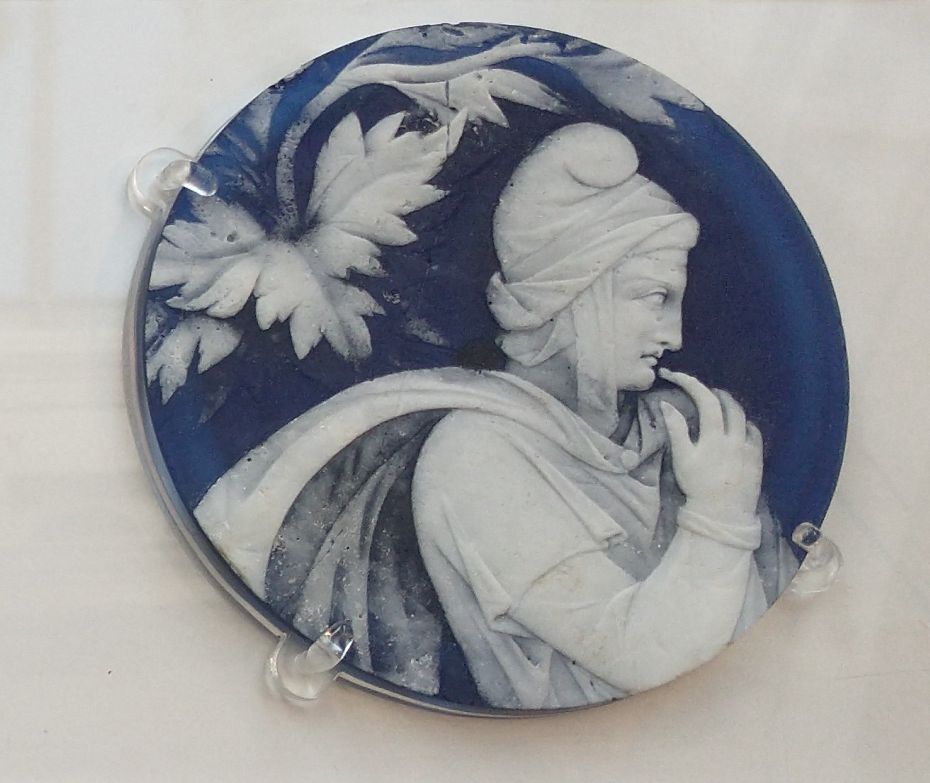
Plate Cameo Glass 15BC – 25AD

For more exploration of Museums with toddlers see my post: https://www.chr.org.uk/anddidthosefeet/museums-for-toddlers/

First Published 9th March 2022.. Revised and reposted 2025