Birthday Of The Sun December 25th

The First Day of Christmas, my true love sent to me a Partridge in a Pear Tree

Nebra Sun disc from Stonehenge Exhibition British Museum
Nebra Sun disc. Photo from Stonehenge Exhibition British Museum (photo Kevin Flude) The Disc shows the Sun, the Moon, the Pleides, and illustrates the Summer and Winter Solstice movements of the Sun.

Dies Natalis Solis Invicti

On the 25th December were born Jesus, Mithras, Attis, Saturn, Apollo, and the Invincible Sun.

The Sun Gods have quite a complicated interrelationship. Zeus, and Apollo are both also considered to be Sun Gods. Apollo is particularly interrelated to Helios, the Greek God who drives the Chariot that carries the Sun across the skies every day. The Romans had a God called Sol who some say was a deity but who declined to be of minor importance. Then Sol was championed by the transexual Emperor Elagabalas. Aurelian revived the cult in 274 AD. Sol Invictus was the focus of Constantine the Great. Sol has been suggested as a response of the Romans to a trend towards monotheism in the later Roman period. Sol for Constantine was a gateway God to Christianity.

It is also notable that early worship of Jesus is full of solar metaphors, Jesus being, for example, the light of the world. Churches are also virtually all orientated East West, aligned with the rising and setting suns. The Altar is always at the East End, and effigies on tombs face the rising sun.

First Christmas?

The first recorded Christmas Day is in AD336. It was in an almanac that lists Roman Holidays, officials and martyrs. The entry for December 25th says: ‘natus Christus in Betleem Judeae’. For more early Christian Dates have a look here.

Celtic Sun Gods?

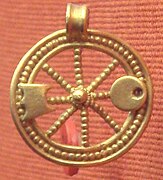
The Golden Wheel from Haute Marne in France

The Golden Wheel from Haute Marne in France, (Public Domain, Wikipedia)

Did the Celts have a sun-god? Belenos is a contender, but linguists are proposing his name does not come from words meaning bright but from strong. The God Lugh’s name is suggested to mean ‘shining’ but his attributes are more of a warrior than a sun god. Taranis is probably the best candidate, but he is more of a sky or thunder god than specifically a sun god. However, his symbol is a 8 spoked wheel is said to be symbolic of the Sun. It also represents the division of the year by the 4 quarterly sun festivals (Winter Solstice, Spring Equinox, Summer Solstice and Autumn Equinox) and the 4 cross-quarter festivals, (Samhain or Halloween, Imbolc or Candlemas, Beltane or May Day, Lughnasa or Harvest Festival).

December 25th is a few days after our reckoning of the Solstice. But, as we have previously seen, Christians believed the world was created on the Spring Equinox, and humans on the 4th day, so Adam was created on March 25th. Mary conceived on the same day, and therefore Jesus, after a perfect labour was born 9 Months later on December 25th. (See my post on March 25th and the Creation)

Christmas Cake

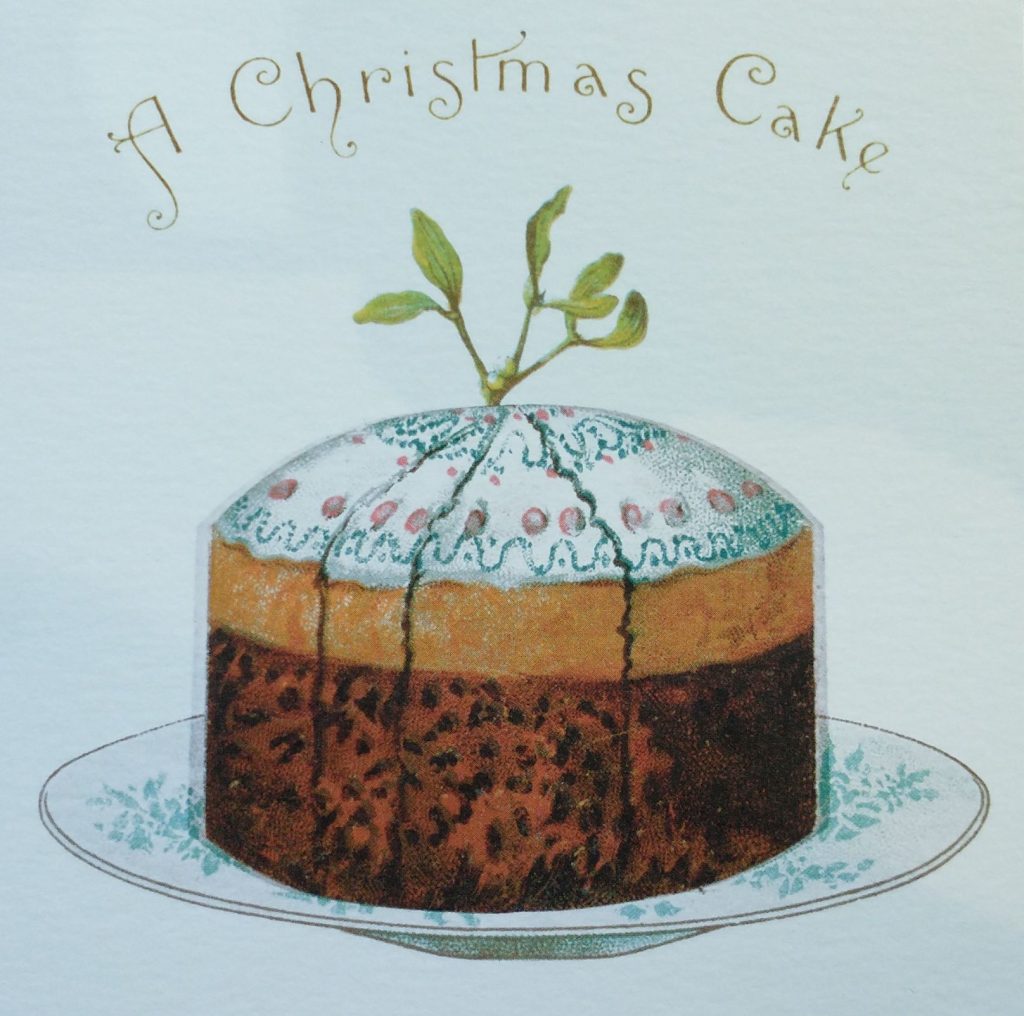
Today, you might be tucking into a Christmas Cake (originally eaten on Twelfth Night). Now, I know many Americans have a bizarre belief that fruit cake is the cake of the devil. Something you receive as a gift and give away to someone else, as most Americans hate it. More fool them for missing out on one of the delights of the Christmas period, that and cold turkey sandwiches. Christmas Cake is made on stir up Sunday, the last Sunday in November, to let the ingredients develop their flavour. They are then covered with marzipan and decorative icing.

19th Century Christmas Cake, generally now the icing continues down the side of the cake.

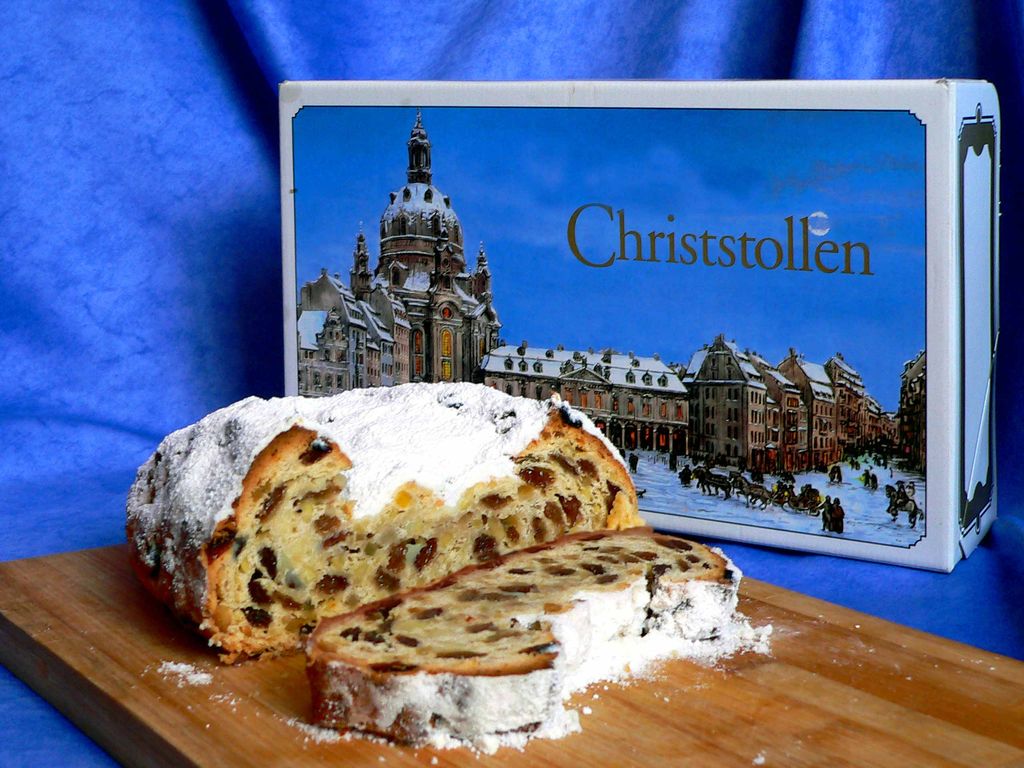
In Germany, they also eat a fruit bread called Stollen or Weihnachtsstollen. The tradition is said to have been started in the 15th Century, when the Pope gave dispensation to allow the use of butter in the fasting period of Advent. Previously, the Germans had to use oil to replace the banned butter, but they could only make oil from turnips, so eventually the Pope allowed the use of butter, with which they made bread with added dried fruits.

Stollen By Gürgi – Own work, Public Domain, https://commons.wikimedia.org/w/index.php?curid=3720379

In Italy, they eat Panettone, a fruit bread/cake. It is a sourdough, and a cross between a brioche and a cake. It often comes in a beautiful decorative tin, and is delicious. The centre of panettone production is Milan. Last year was the 200th Anniversary of Milan’s famous Marchesi 1824 which makes artisanal Panettone. It used ‘fine ingredients such as six-crown sultan as, naturally candied fruit, Bourbon vanilla from Madagascar, Italian honey and eggs from free-range hens, blended in a slow-rising dough with the exclusive use of Marchesi 1824 sourdough starter‘. Thank you, Mara from Milan, for the heads-up.

Screen shot from website – does not click through to sales!

Which is best? The only way to find out is to eat several slices of each. America, you don’t know what you are missing.

For stir up sunday see the second half of this post of mine.

First Published 24th December 2022, Republished 25th December 2023, 2024, 2025

Collect your Holly & Ivy December 18th

Picture of Christmas greenery on a gift box
Holly and Ivy by Tjana Drndarski-via unsplash

So, the old Sun is dying, and if the Sun keeps going down we are all going to die. With all of nature dying or hibernating, evergreens are a symbol of a promise/proof that life will continue through the dark days. So, with its bright-green leaves and its luminous berries, Holly is the ideal evergreen for the Solstice. And as the prickles symbolise Christ’s Crown of Thorns, and the berries the red blood of Jesus, the symbolism works, too, for Christians.

Henry Mayhew (editor of Punch) in his ‘London Labour and London Poor’ (1851–62) talks of Christmasing for Laurel, Ivy, Holly, and Mistletoe. He calculated that 250,000 branches of Holly were purchased from street coster mongers every Christmas. He says that every housekeeper will expend something from 2d to 1s 6d, while the poor buy a pennyworth or halfpennyworth each. He says that every room will have the cheery decoration of holly. St Pauls Cathedral would take 50 to a 100 shillings worth.

He also calculates that 100,000 plum puddings are eaten. Mistletoe he believes is less often used than it used to be, and he hopes that ‘No Popery’ campaigners will not attack Christmassing again.

Hot plum pudding seller from Sam Syntax Cries of London 1820s
from the Gentle Author Spitalfields Life web site
Hot plum pudding seller from Sam Syntax Cries of London, 1820s
from the Gentle Author Spitalfields Life website

Culpeper on Ivy (1814 edition):

‘Ivy’ says Culpeper in his Herbal of 1653, its winter-ripening berries are useful to drink before you ‘set to drink hard’ because it will ‘preserve from drunkenness’. And, moreover, the leaves (bruised and boiled) and dropped into the same wine you had a ‘surfeit’ of the night before provides the ‘speediest cure’. (The Perpetual Almanac of Charles Kightly)

It is so well known to every child almost, to grow in woods upon the trees, and upon the stone walls of churches, houses, &c. and sometimes to grow alone of itself, though but seldom.

Time. It flowers not until July, and the berries are not ripe until Christmas, when they have felt Winter frosts.

Government and virtues. It is under the dominion of Saturn. A pugil of the flowers, which may be about a dram, (saith Dioscorides) drank twice a day in red wine, helps the lask, and bloody flux. It is an enemy to the nerves and sinews, being much taken inwardly, out very helpful to them, being outwardly applied. Pliny saith, the yellow berries are good against the jaundice; and taken before one be set to drink hard, preserves from drunkenness, and helps those that spit blood; and that the white berries being taken inwardly, or applied outwardly, kills the worms in the belly. The berries are a singular remedy to prevent the plague, as also to free them from it that have got it, by drinking the berries thereof made into a powder, for two or three days together. They being taken in wine, do certainly help to break the stone, provoke urine, and women’s courses. The fresh leaves of Ivy, boiled in vinegar, and applied warm to the sides of those that are troubled with the spleen, ache, or stitch in the sides, do give much ease. The same applied with some Rosewater, and oil of Roses, to the temples and forehead, eases the head-ache, though it be of long continuance. The fresh leaves boiled in wine, and old filthy ulcers hard to be cured washed therewith, do wonderfully help to cleanse them. It also quickly heals green wounds, and is effectual to heal all burnings and scaldings, and all kinds of exulcerations coming thereby, or by salt phlegm or humours in other parts of the body. The juice of the berries or leaves snuffed up into the nose, purges the head and brain of thin rheum that makes defluxions into the eyes and nose, and curing the ulcers and stench therein; the same dropped into the ears helps the old and running sores of them; those that are troubled with the spleen shall find much ease by continual drinking out of a cup made of Ivy, so as the drink may stand some small time therein before it be drank. Cato saith, That wine put into such a cup, will soak through it, by reason of the antipathy that is between them.

https://www.complete-herbal.com/culpepper/ivy.htm

Happy Eponalia

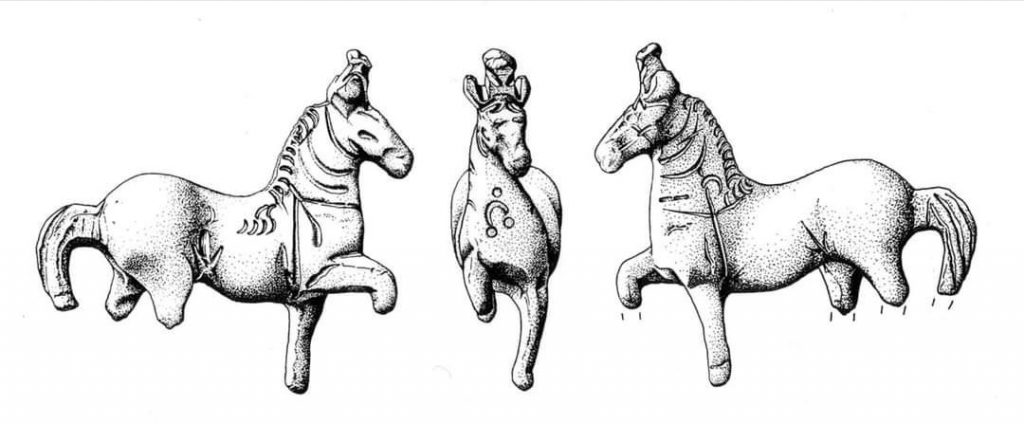
Roman Horse from Bunwell, Norfolk. Illustration by Sue Walker.

In 2021 I posted about Eponalia for the 18th Dec but I have now added the text to this page.

I’ve been too busy working on my Jane Austen and Christmas Virtual Tour ) to post over the last few days. And I have, therefore, shamelessly stolen this post off my Facebook friend Sue Walker, who is a talented archaeological illustrator, artist and a very good photographer.

She wrote: ‘the 18th December is the festival of the Celtic goddess Epona, the protector of horses, she was adopted by the Romans and became a favourite with the cavalry. This finely sculpted bronze horse with a head dress and symbol on its chest is 37mm high – found in Bunwell #Norfolk #Archaeology’

First published on December 17th 2022, Revised and republished December 2023

Trotty Veck, the Chimes and Charles Dickens’ Christmas Books December 16th

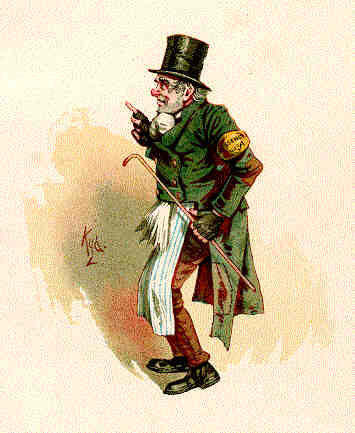
Dickens character Trotty Veck waits to run a message
Trotty Veck 1889 Dickens The Chimes by Kyd (Joseph Clayton Clarke)

As Christmas looms, seasonal publications have a mixture of wonder and joy at the coming family reunions and festivities mingled with an awareness that, for some, Christmas will depend on the Food Bank or the Charity Shelter. The weather is now cold, living costs continue to rise at the very time extra spending is needed to unlock the joy of the Season. Also to counter the dark, the cold, and the spectre of death which, in fact, has always been central to the season of winter.

Charles Dickens’ Christmas Books epitomise this dichotomy.And by adding an element of the supernatural, provided a vehicle for joy and hope. It also came with a forceful political message that the authorities and the rich were not doing their Christian duty to alleviate poverty. Christmas Carol contrasts the wealth of a mean rich Stockbroker with the family of his poor employee Bob Cratchit, and provides a powerful tale of redemption.

The Chimes

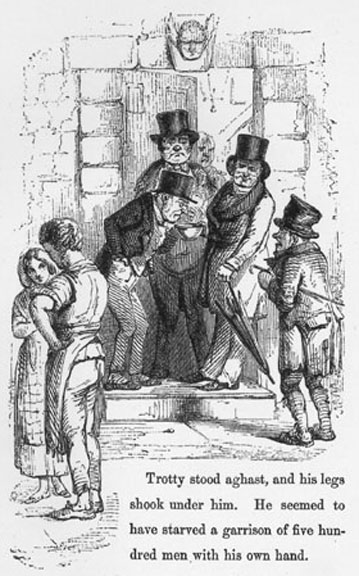
But in this post I want to concentrate on his second Christmas Book, ‘The Chimes’. It was published on December 16th, 1844. And tells the story of the stick-thin Trotty Veck who is an aged City messenger, nicknamed Trotty because of his habit of keeping himself warm by running on the spot. He is afraid to let his daughter, Meg, marry as he has so little hope for the future. While he is worrying, he, Meg and her intended Richard are approached by Alderman Cute and Mr Filer.

Meg, Richard, Mr Filer, Gentleman, Alderman Cute and Trotty Veck. Probably located by the door of St Nicholas, Colechurch, City of London.

Cute represents the financial industries in the City of London and the Law. Filer the new breed of political economists. These, working with the ideas of Malthus and the new science of Statistics, had proved, that generous support for the poor would, inevitably, lead to a country full of poor people and no rich people. And thus, they justified the Poor Law Amendment Act of 1832. At this time Dickens was a Parliamentary reporter (1831-1834), and he observed the cruelty and absurdity of this piece of iniquitous legislation. In 1929 my mother was born in a workhouse, where she had been taken by her unmarried mother. She was so ashamed she didn’t tell her children until she was in her 70s.

The Workhouse

That is the legacy of the cruel Workhouse system. It was based on providing the lowest possible level of support offering separation from family, meagre food, and sparse comforts. This the rate payers believed would encourage the poor to stop being lazy and get back out there to earn their own living. Thus allowing taxes to fall. (brilliantly satirised by Dickens’ Oliver Twist, asking for ‘More’).

Below, I enclose the scene from the Chimes, which satirises the attitude of the governing classes.

‘And you’re making love to her, are you?’ said Cute to the young smith.

‘Yes,’ returned Richard quickly, for he was nettled by the question.
‘And we are going to be married on New Year’s Day.’

‘What do you mean!’ cried Filer sharply?Enough  ‘Married!’

‘Why, yes, we’re thinking of it, Master,’ said Richard.  ‘We’re rather in a hurry, you see, in case it should be Put Down first.’

‘Ah!’ cried Filer, with a groan.  ‘Put that down indeed, Alderman, and you’ll do something.  Married!  Married!!  The ignorance of the first principles of political economy on the part of these people; their improvidence; their wickedness; is, by Heavens! enough to—Now look at that couple, will you!’

...

‘A man may live to be as old as Methuselah,’ said Mr. Filer, ‘and may
labour all his life for the benefit of such people as those; and may heap up facts on figures, facts on figures, facts on figures, mountains high and dry; and he can no more hope to persuade ’em that they have no right or business to be married, than he can hope to persuade ’em that they have no earthly right or business to be born.  And that we know they haven’t.  We reduced it to a mathematical certainty long ago!’

Alderman Cute was mightily diverted, and laid his right forefinger on the side of his nose, as much as to say to both his friends, ‘Observe me, will you!  Keep your eye on the practical man!’—and called Meg to him. 

...

‘Now, I’m going to give you a word or two of good advice, my girl,’ said the Alderman, in his nice easy way.  ‘It’s my place to give advice, you know, because I’m a Justice. ...

‘You are going to be married, you say,’ pursued the Alderman.  ‘Very
unbecoming and indelicate in one of your sex!  But never mind that.
After you are married, you’ll quarrel with your husband and come to be a distressed wife.  You may think not; but you will, because I tell you so. Now, I give you fair warning, that I have made up my mind to Put distressed wives Down.  So, don’t be brought before me.  

You’ll have children—boys.  Those boys will grow up bad, of course, and run wild in the streets, without shoes and stockings.  Mind, my young friend!  I’ll convict ’em summarily, every one, for I am determined to Put boys without shoes and stockings, Down.  Perhaps your husband will die young (most likely) and leave you with a baby.  Then you’ll be turned out of doors, and wander up and down the streets.  Now, don’t wander near me, my dear, for I am resolved, to Put all wandering mothers Down.  All young mothers,of all sorts and kinds, it’s my determination to Put Down.  Don’t think
to plead illness as an excuse with me; or babies as an excuse with me;
for all sick persons and young children (I hope you know the
church-service, but I’m afraid not) I am determined to Put Down.  

And if you attempt, desperately, and ungratefully, and impiously, and
fraudulently attempt, to drown yourself, or hang yourself, I’ll have no pity for you, for I have made up my mind to Put all suicide Down!  If there is one thing,’ said the Alderman, with his self-satisfied smile, ‘on which I can be said to have made up my mind more than on another, it is to Put suicide Down.  So don’t try it on.  That’s the phrase, isn’t it?  Ha, ha! now we understand each other.’

Project Gutenberg - The Chimes by Charles Dickens

It is a savage burlesque of a satire but at its core, Filer provides the economic/statistical justification. Cute enforces it by legal harassment of the poor. Dickens was writing after a recent introduction of legislation making suicide a punishable offence.

Government Cruelty

This has a contemporary resonance. During my lifetime, the first British Government to be cruel in its provision of benefits, in my opinion, for the poor was Teresa May’s Conservative Government. Her laws made getting help so difficult that people died as a result of the deliberately difficult system. ‘I, Daniel Blake’ a 2016 film by Ken Loach brilliantly captured the essence of this system. That government’s treatment of the Windrush generation was a similar example of bureaucratic cruelty. And the continual decline of the benefit system over the 14 years of Conservative Government meant that the poor bore the brunt of austerity. Keir Starmer started his period in office on the wrong foot too cutting benefits to the poor.

Dickens, progressive propagandist

The piece above reminds us what a brilliant propagandist Dickens was. Every generation of children, since he wrote Christmas Carol, has read it or seen it in popular retellings such as The Muppet Movie. I think it could be argued that the ‘More’ scene in Oliver Twist and the Christmas Carol have made the case for compassionate care and redemption far better than contemporary Christianity or political parties.

In the Chimes. these two men discourage Trotty from letting the young ones marry. He has a dream and sees the hopeless result of his decision: suicide, prostitution, crime. When he wakes up, he realises that what they do have is hope. Hope springs eternal and he lets them marry.

For more on this scene, have a look at the Victorian Web

Dickens was not a socialist. ‘Hard Times’ shows that Dickens was against strikes, despite leading a strike when he was a young newspaper man. He was a free trade Liberal; a reformer who believed that the rich needed to do their Christian duty and provide charitable support, pay decent wages and look after their dependents and servants. He thought society should care less about the dogma of Christianity but look to its essence, ‘love your neighbour like yourself’. This, alone, was sufficient to right the wrongs caused by the selfish.

First Published on December 16th 2022, republished and revised in December 2023, 2024, 2025

Ashmolean Advent Calendar, William Burges & the Singing Pierides December 12th

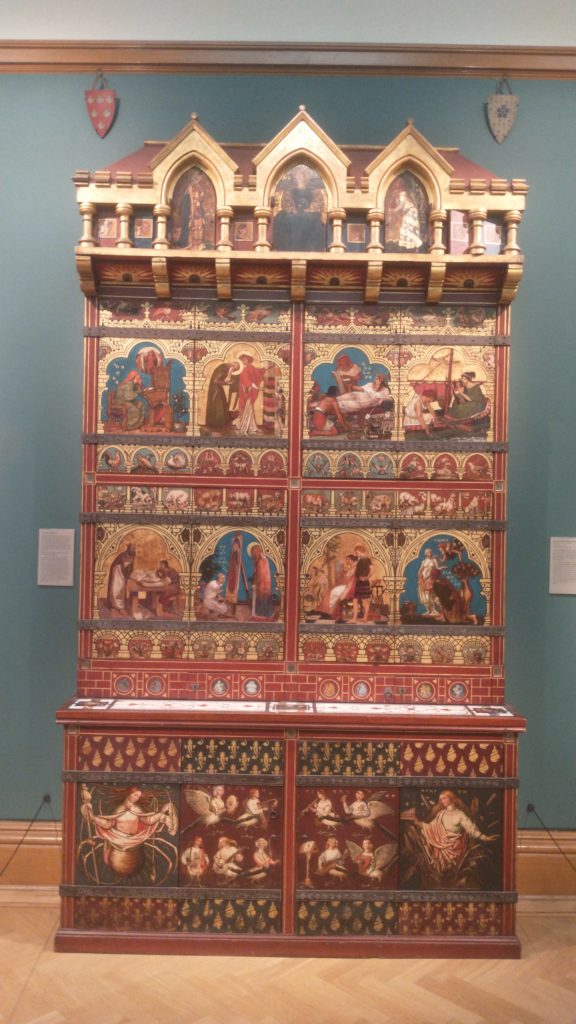
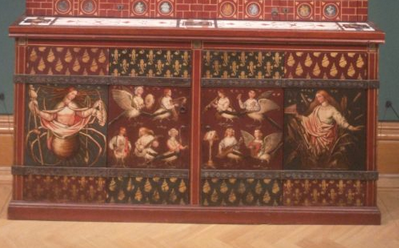
The Great Bookcase by William Burges Ashmolean Museum (Photo K. Flude)

The Ashmolean posts, every year, an online Advent Calendar with gorgeous items behind each ‘flap’. The choice seems to be, mostly, a random selection. But their collection is so wonderful, they are all interesting.

The Great Bookcase by William Burges & the Singing Pierides

In 2022 The Ashmolean featured the Great Bookcase by William Burges. Burges is one of the great Gothic Revival architects and a designer in the Arts & Crafts Movement with an affinity for Pre-Raphaelite painters. He asked 14 of them to paint panels on his bookcase. The decorative scheme was to represent the Pagan and Christian Arts (Museum label).At the bottom of the Wardrobe are the Singing Pierides painted by Henry Stacy Marks. The Pierides were a sort of classical Greek Von Trapp singers, 9 daughters who foolishly challenged the Muses to a singing competition. Of course, the Goddesses of the Arts — the Muses won., As punishment for their vanity, they turned the Pierides into songbirds. Let this be a warning to all those who overrate their own talents!

‘Whenever the daughters of Pierus began to sing, all creation went dark and no one would give an ear to their choral performance. But when the Muses sang, heaven, the stars, the sea and rivers stood still, while Mount Helicon, beguiled by the pleasure of it all, swelled skywards tilI, by the will of Poseidon, Pegasus checked it by striking the summit with his hoof.

Since these mortals had taken upon themselves to strive with goddesses, the Muses changed them into nine birds. To this day people refer to them as the grebe, the wryneck, the ortolan, the jay, the greenfinch, the goldfinch, the duck, the woodpecker and the dracontis pigeon.’

Antoninus LiberalisMetamorphoses (wikipedia)

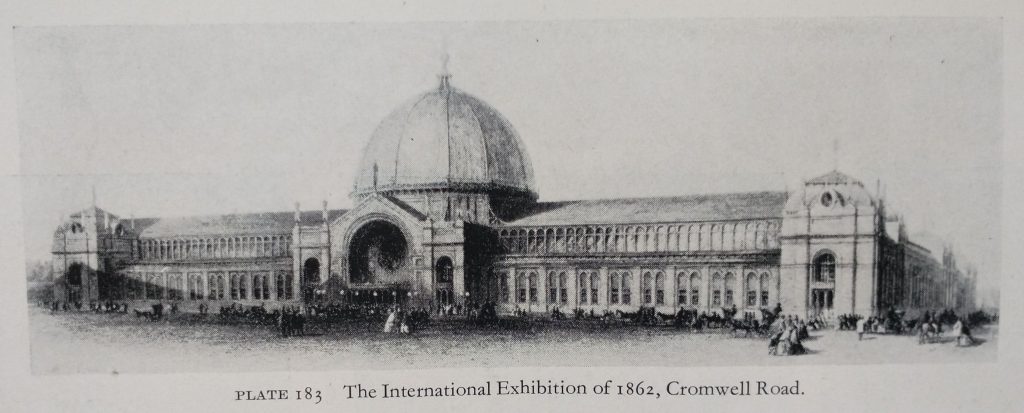
Burges & the International Exhibition of 1862

Engraving of the International exhibition of 1862, Cromwell Road
Print of the International Exhibition of 1862, South Kensington

The bookcase by William Burges was originally displayed as the centre point of the ‘Medieval Court’ of the 1862 International Exhibition, South Kensington, London. The Exhibition was almost as successful as the more famous Great Exhibition of 1851. Both got about 6m visitors. The 1862 Exhibition was just south of the site of the 1851 (on the south side of Hyde Park) and in what were then the Royal Horticultural Society’s gardens (now the Science, Natural History Museum, Imperial College etc.)

Raphael

This year, they posted a Raphael drawing of an angle. I show a screen shot below. But to have a real look click here.

The Nuragi

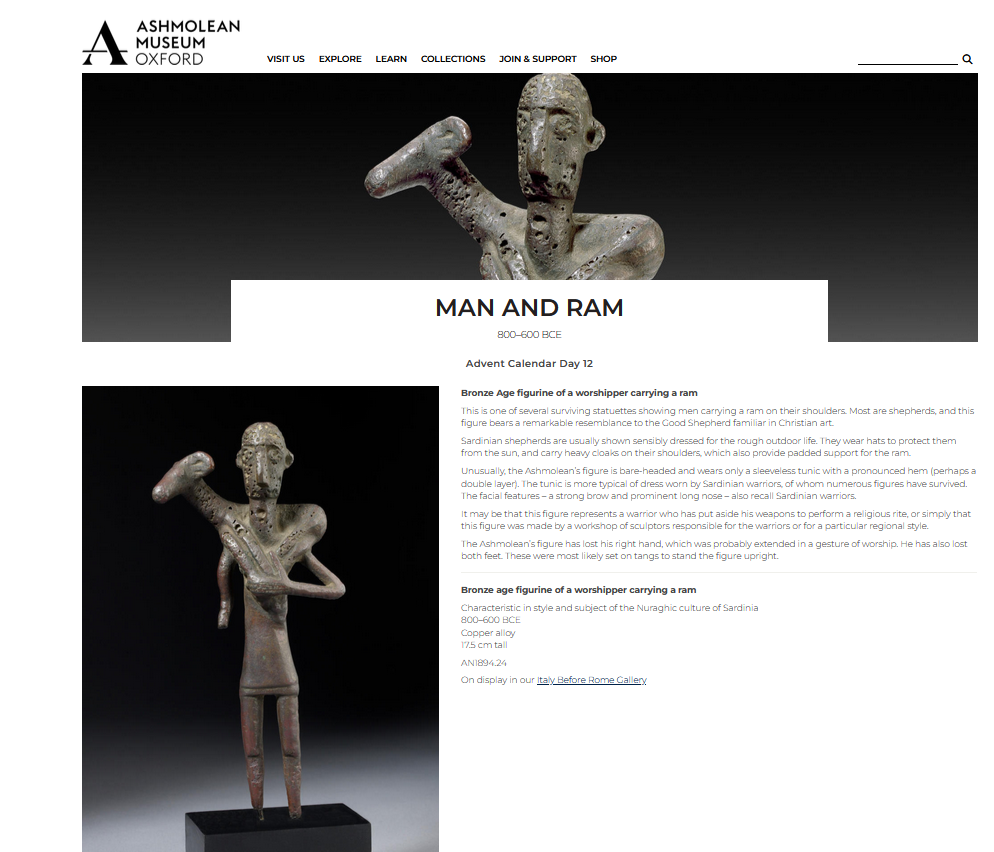
Last year it was a nuragi bronze age stature of a shepherd, a screen shot of which I show below. 2023 December 12th’s choice was a netsuke.

Nuragi statue of a Shepberd

I discovered the Nuragi on a University Field trip, with my students, to the Capital of Sardinia, Cagliari. The Nuragic culture is not well known. However they have amazing Bronze sculptures which give the viewer a really vivid view of their lives and fashions in the Bronze Age. They lived in round towers called nuraghe, which are a little like the Brochs of Scotland. They were around during the time of the Mycenaean Culture in Greece. But their origins and indeed their history are argued about. They may be part of the ‘Sea People’ who brought the end to the Bronze Age cultures of the Eastern Mediterranean, or they may not.

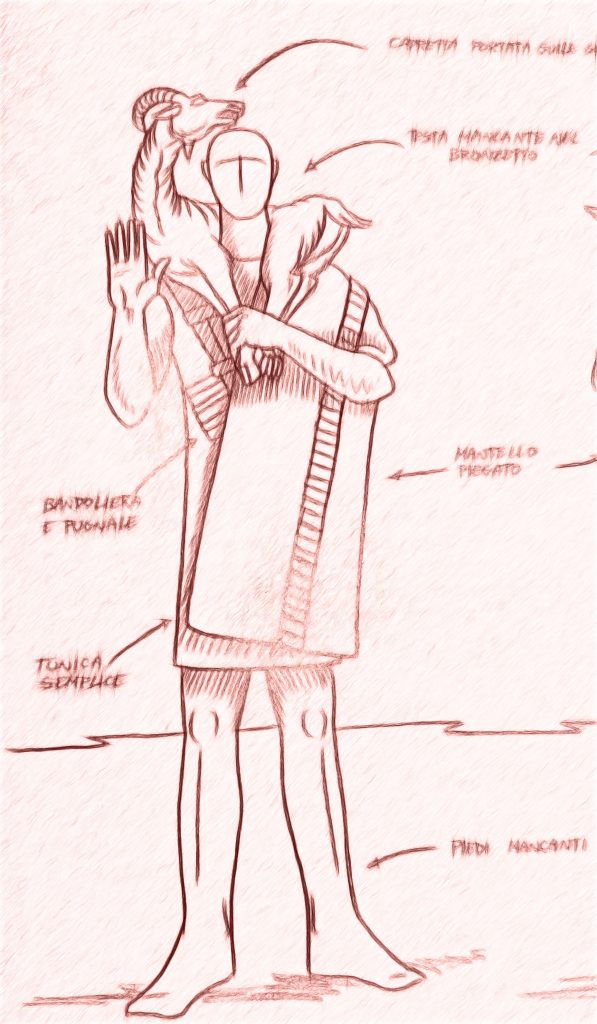
Here, in Britain, the Bronze Age is dominated by discussions of henges, barrows, metal axes and swords. But with very little sense of what life was like to live in those days. However, go to the Cagliari Museum, look at these wonderful statues, and it becomes possible to picture the people. Particularly with a copy of ‘Il Popolo di Bronzo’ by Angela Demontis to hand. It is a catalogue of Nuragi statures with interpretative drawings. It really brings the people to life depicted in the statues. They are mostly warriors, but also there are ‘normal trades’ such as shepherds and bakers which are depicted as well.

Here is my slight adaption of one of the drawings. It is of a shepherd similar to the one photo’d above.

A sketch drawing of a Nuragi sculpture derived from ‘Il Popolo di bronzo’ by Angela Demontis

What you can see is some detail of the clothes and the knife belt around the torso. Not to mention the sheep around his neck! The drawing brings a living person from the Bronze Age before you, not just a lump of bronze. Wikipedia has a long article on the nuragic culture. You can see a wonderful collection of nuragi bronzes and their homes on this website.here.

Originally written for December 12, 2022, revised and republished December 2023, and the Nuragi added in 2024 and Raphael added in 2025

How to make a Dish of Snow & Ice Houses November 29th

Photo Zdenek Machacek -unsplash

Yesterday, I posted about the exciting discovery that Ann Shakespeare might have stayed in London with her husband. Here you can read the academic article about the research. Really worth reading!

A Dish of Snow

There is a 0% chance of snow, in London and 90% chance of snow in Glen Shee, Scotland, according to the Snow Risk Forecast. And here is an appropriate medieval recipe:

To make a dish of Snowe

Take a potte of sweete thicke creme and the white of eight egges and beate them altogether with a spoone then putte them into your creame with a dish full of Rose Water and a dishfull of Sugar withall then take a sticke and make it cleane and then cutt it in the ende fowre square and therewith beate all the aforesayd thinges together and ever as it ariseth take it of and putte it into a Cullander thys done take a platter and set an aple in the middest of it and sticke a thicke bush of Rosemarye in the apple then cast your snowe upon the rosemarye and fill your platter therewith and if you have wafers cast some withall and thus serve them forth

From Medieval Manuscripts, British Library. Blog. https://blogs.bl.uk/digitisedmanuscripts/medieval-history/page/2/

BF – Before Fridges

Before fridges, snow gave the chance for ice cream and other cold desserts. The problem was keeping it for longer than the cold spell. So many Stately Homes had ice-houses. The V&A had an ice-house just outside their glorious, Henry Cole commissioned restaurant. There is an ice house preserved at the Canal Museum, in Kings Cross. It was set up by Carlo Gatti in 1857 to store ice shipped in from Norway. Another one, in Holland Park, dates from 1770 and served the infamous Fox family (PM Charles James Fox etc).

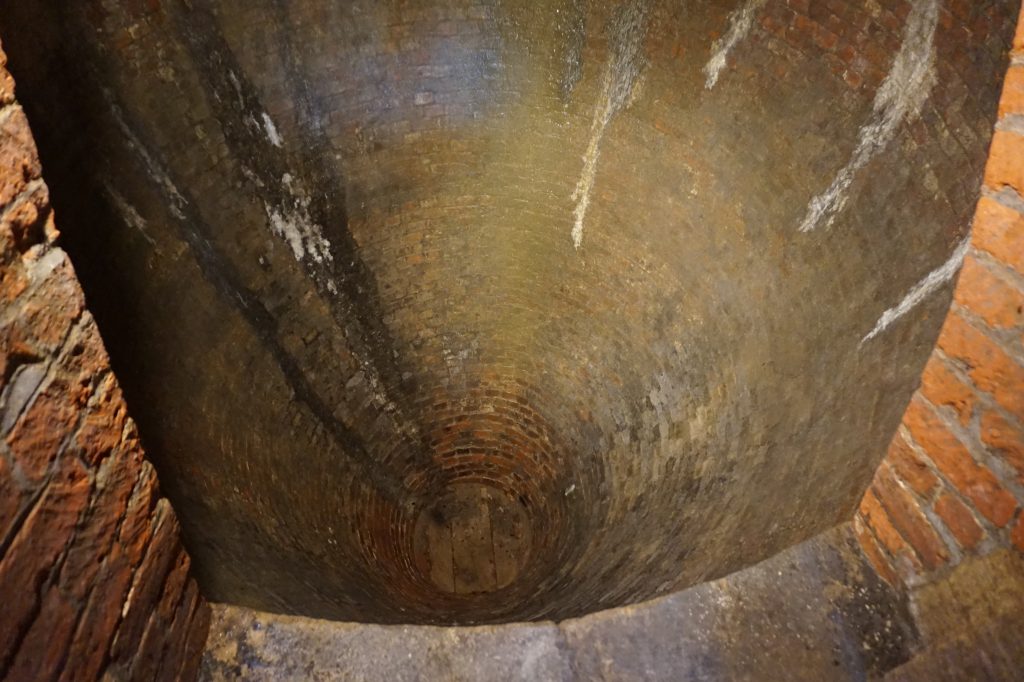
The first ice house was in Mesopotamian, but in the UK they were introduced by James 1 at his palaces in, first, Greenwich Park, and then Hampton Court. An ice house generally consists of a pit in the ground, brick lined, which tapered to a point. Above was a circular, often domed building. The ice was protected by insulation such as straw, and this structure would allow ice to be available all through the summer.

Ice House Dillington, Somerset
Ice House Dillington, Somerset, photo K Flude

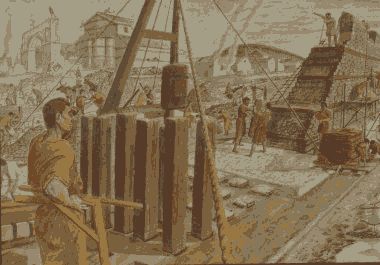
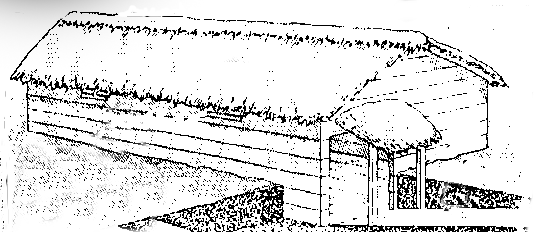
My great-grandmother hung a basket outside the window in winter to keep things cold. On my fridge-less narrow boat, I have been known to keep milk and butter outside the door on the front deck. And to suspend and submerge wine in a plastic bag in the canal in high summer. Butteries and Pantries were typically cut into the ground to make them cooler. A Roman Warehouse in Southwark, of which the wooden floor still survived, had a ramp down to the floor which was cut into the ground surface. The ramp suggests it was used for storing barrels, where they were kept cool.

Sketch of Roman Warehouse found in Southwark.

For more on Icehouses (and an Icehouse in York) and the history of ice cream, see my post from August.

Written November 28th 2022, revised and republished 2023, 2024,2025

St Cecilia’s Day, Henry Wood and the BBC Proms November 17th

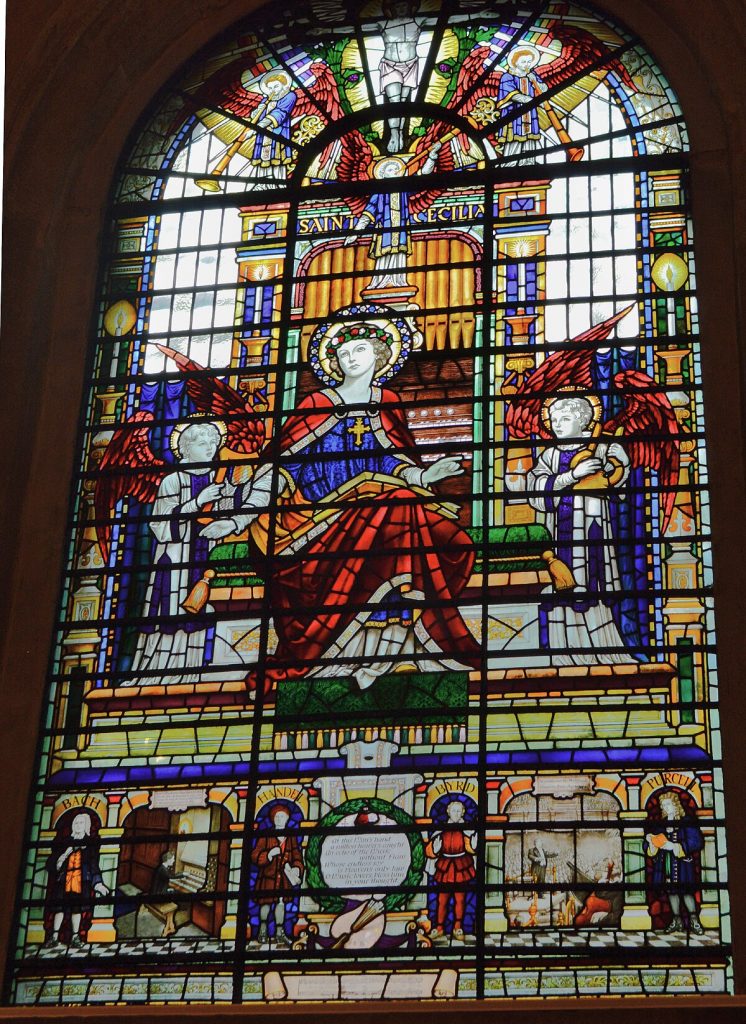
St Sepulchre-without-Newgate, Musician’s Chapel, St Cecilia window. 17 August 2022, Andy Scott

November 17th is St Cecilia’s Day She is the patron saint of musicians and was martyred in Rome in the Second or Third Century AD. The story goes that she was married to a non-believer. During her marriage ceremony she sang to God in her heart (hence her affiliation with musicians). She then told her husband that she was a professed Virgin. So, if he violated her, he would be punished by God. Cecilia told him she was being protected by an Angel of the Lord who was watching over her. Valerian, her husband, asked to see the Angel. ‘Go to the Third Milestone along the Appian Way’ he was told where he would be baptised by Pope Urban 1. Only then would he see the Angel. He followed her advice, was converted and he and his wife were, later on, martyred.

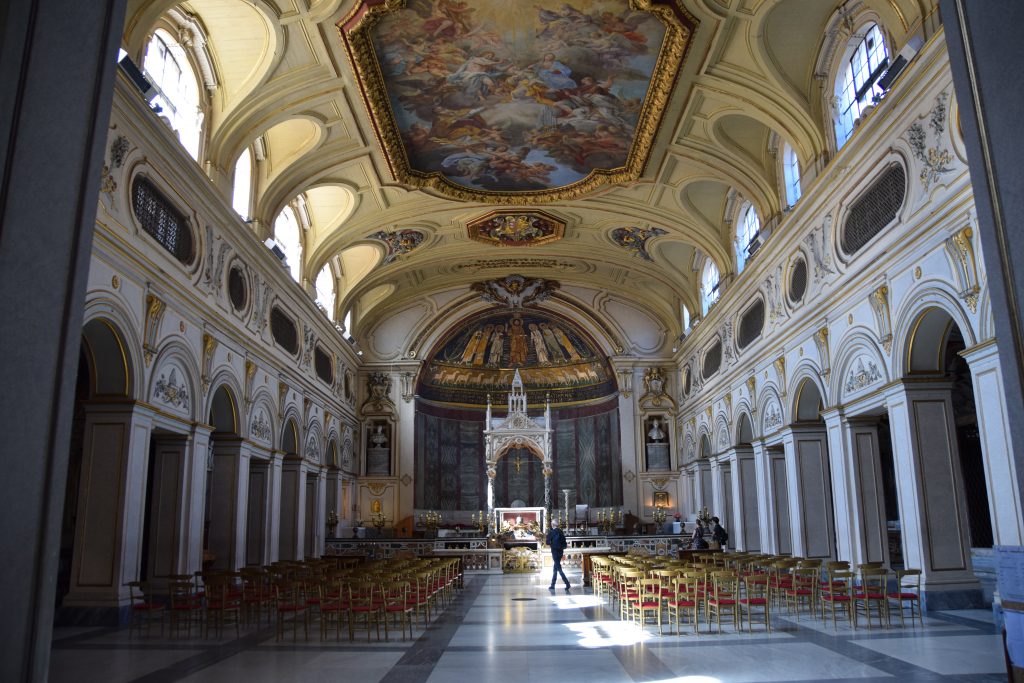
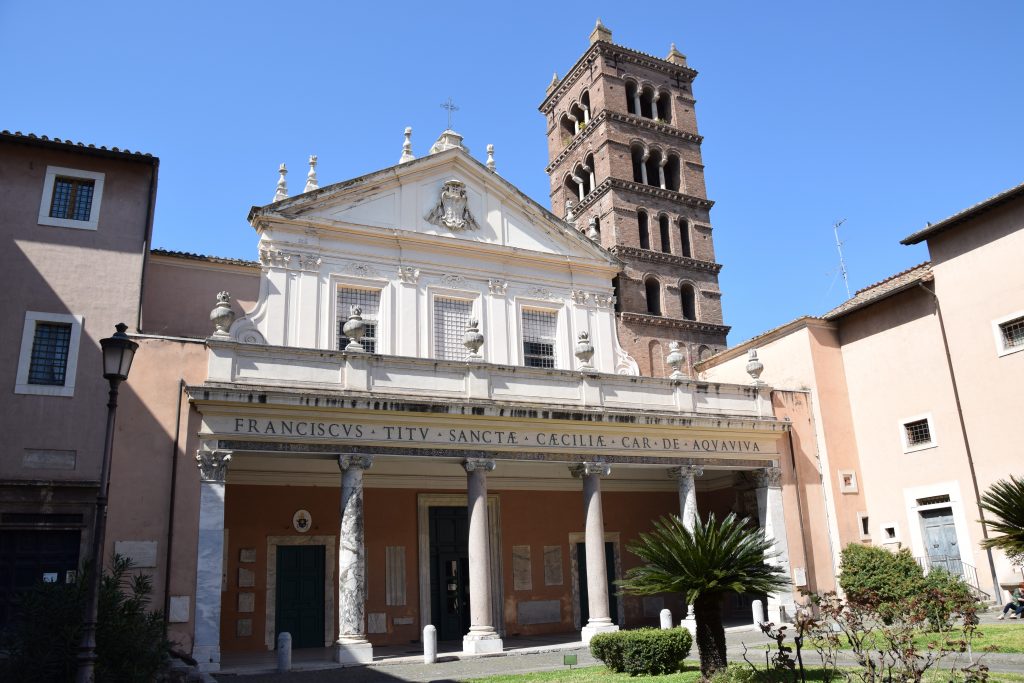
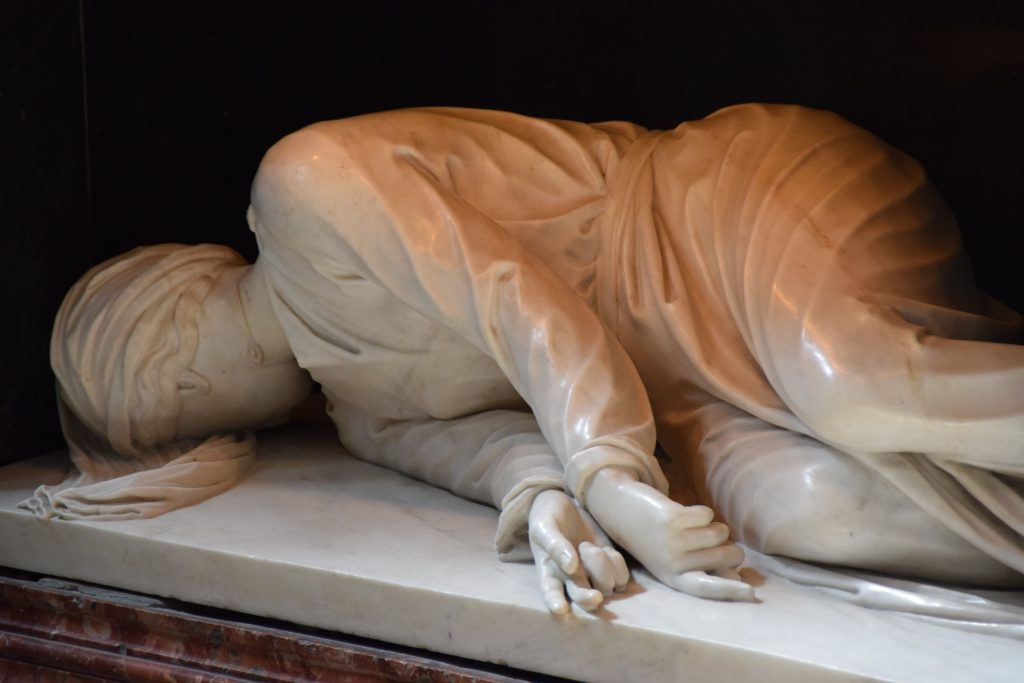
The Church in Rome, Santa Cecilia in Trastevere, is said to be built on the site of her house, and has 5th Century origins. My friend, Derek Gadd, recently visited and let me use these photographs:

St Cecilia in London

There is a window dedicated to her in the Holy Sepulchre Church-without-Newgate, In London, opposite the site of the infamous Newgate Prison.  Henry Wood, one of our most famous conductors and the founder of the Promenade Concerts, played organ here when he was 14. In 1944, his ashes were placed beneath the window dedicated to St Cecilia and, later, the Church became the National Musician’s Church.

This window is dedicated to the memory of
Sir Henry Wood, C.H.,
Founder and for fifty years Conductor of
THE PROMENADE CONCERTS
1895-1944.
He opened the door to a new world
Of sense and feeling to millions of
his fellows. He gave life to Music
and he brought Music to the People.
His ashes rest beneath.

The Concerts are now called the BBC Proms and continue an 18th and 19th Century tradition of, originally, outdoor concerts, and then indoor promenade concerts. At the end of the 19th Century, the inexpensive Promenade Concerts were put on to help broaden the interest in classical music. Henry Wood was the sole conductor.

Wikipedia reports :

Czech conductor Jiří BÄ›lohlávek described the Proms as “the world’s largest and most democratic musical festival”.

The Eight-week Festival is held at the Royal Albert Hall. It moved here during World War 2 after the original venue, the Queen’s Hall, was destroyed in the Blitz in May 1941.

On This Day

1278 Edward 1 had over 600 Jews imprisoned in the Tower of London for coining, clipping and other counterfeiting. Of these, 269 Jews, along with 29 Christians, were executed. They were hanged at the Guildhall in the City of London. By 1290, the King had squeezed all the money he could from the Jews, and they were expelled, not to be let back into the Kingdom until the reign of Oliver Cromwell in the 17th Century. This ended a long period of savage state run antisemitism. Click here for further information.

First Published on November 17th 2023 and revised in November 2024, 2025.

Time to Tup your Sheep – November 7th

City Farm, Hackney. Small flock of Bluefaced Leicester Sheep, the big golden one is the Ram, the others are the ewes he has tupped. Photo K Flude

The old Shepherd’s saw is:

‘In with a bang and out with the fools’.

The bang is Guy Fawkes Day on November 5th, and the fools are a reference to All Fools Day on April 1st. The gestation period of a ewe is 147 days (on average). (sheep-farmers-year). So farmers introduce the Ram into a field of Ewes on or around November 5th. This means the lambs will be born around the beginning of the traditional lambing season.

(see my posts on Guy Fawkes Day and All fools Day)

Tupping Times

The Ewes have been enjoying themselves in the fields, The flocks have been thinned out, with the young ones being sent to market, mostly for meat. The grass has been growing at the end of the summer, with the wetter weather. The ewes will be in excellent condition, and will have been thoroughly checked by the shepherd.

The chosen ram will be dressed with a harness on his chest, which will have a sheep’s crayon on it. The crayon is known as raddle or reddle. The ram, also know as a tup, will mate with whichever of the ewe(s) that catch his eye. Each one he tups (mounts or covers) will be left with a paint mark, from the reddle on his chest, on her back. The farmer will inspect the ewes periodically. A ewe with two or more reddle marks on her back, will be taken out of the field. This will force the ram to spread his attentions to the, as yet, untupped, ewes. He will continue until all ewes have been tupped. And then onto the next field full of ewes. Diggory Veen is the Reddleman in Hardy’s ‘Return of the Native’. I talk about him, lambing and reddle in my post here.

Some of the young ewes will be kept to reinforce the flock. Males will only be kept if they will be sold to another farmer as a tupping ram. They cannot breed on the farm as this will lead to inbreeding. So, a ram will be purchased or swapped from another farm. The farmer will want to choose one that fits into his/her idea of what the ideal sheep is. whether it is grown for meat, or to be hardy, or for its wool etc.

Raddled

To be raddled is to be flushed, red with drink, or over made up. It has a sense of dissipation about it. One might have more sexual encounters than is normal. Just like the ewe with too many raddle marks on her back? Or the Raddle man with a red face and hands from all the raddle he handles?

Bluefaced Leicester Sheep and my Hat!

I was delighted to see my local City Farm had a small herd of Bluefaced Leicester Sheep. I was visiting with my Grandson when I took the photograph at the top of the page. The sherderdess told me the blue-marking in this case was not a result of mating. She thought 2 or more of them were already pregnant, however.

My association with the breed comes from a lovely yarn shop in Conwy (Ewe Felty Thing) which had a rail of clothes marked ‘wearable art’. I bought a woolly beanie which they told me was:

‘Hand-spun, hand knitted from a bluefaced leicester sheep.

Hand-spun, hand knitted Beanie from a Bluefaced Leicester sheep. purchased at (Ewe Felty Thing) Photo K Flude

I still have it. It cost a small fortune, but worth every penny!

A bluefaced Leicester Ram, might cost £1000 if a bought as a lamb, £4,000 if bought as a shearling, or up to £40,000 if a prize lamb. It is one of the biggest lambs with a long back, and longwool with ringlets. There is no wool on the face and neck so you can see its blue-grey skin, below the white hair – hence its name. It is often bred with hill sheep ewes, which combines the prolificacy of the ram with the mothering abilities of the ewes.

Generally, nowadays the wool from a shearing will only be worth about 80p in today’s market. This will not pay for the cost of the shearing, but it is necessary for health and hygiene reasons.

Posted on 7th November 2025

St Etheldreda October 17th 679

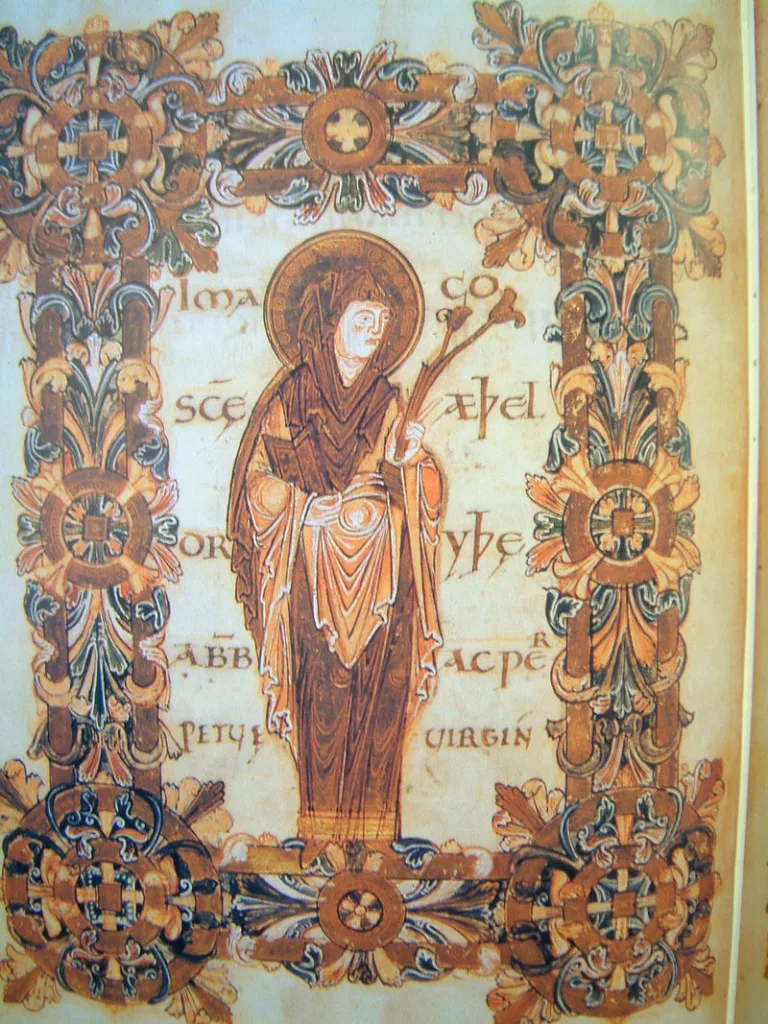
St Etheldreda or St Audrey By monk – [1], Public Domain, https://commons.wikimedia.org/w/index.php?curid=32907989

I’m republishing this post as I dated it to February 17th rather than October 17th and a few other egregious typos.

Etheldreda, also known as Audrey or Æthelthryth or Æðelþryð or Æþelðryþe is celebrated on October 17th, (the date her remains were ‘translated’ from her burial place to the Church at Ely) and on 23 June the date she died,

She lived from March 4th 636 to June 23rd 679. She is one of the well-born Saxon Virgin Saints of the 7th Century. This is when many royal Abbeys were founded by female members of the Anglo-Saxon Royal families, in the years following the conversion of the Anglo-Saxons to Christianity. She is the daughter of King Anna of East Anglia, and the sister of Saint Sexburga (widow of King Erconbert of Kent).

Etheldreda is said to be a Virgin despite being married twice. Etheldreda was widowed after three years of her first marriage. Then she married Egfrid, son of King Oswy of Northumbria. Egfrid got fed up with her virgin state. With the support of St Wilfrid, St Etheldreda was released to a Nunnery run by Wilfred’s aunt. In 672 she founded the famous double monastery at Ely, which is where the wondrous Cathedral of Ely still stands.

Here she died, and the many miracles that followed, led to Ely being one of the main destinations for Pilgrimages. St Sesxburga took over as Abbess after her death. By the number of Churches and holy days remembering Etheldreda show she was perhaps the most famous female saint of the era.

Tawrdy Audrey

Etheldreda died of a neck tumour, which she blamed on the heavy jewellery she wore around her neck before she became a nun. So she is a patron of those with neck or throat ailments. Accordingly, on February 3rd St Etheldreda’s Church in London holds the Blessing of the Throats ceremony. St Blaise is also a saint protecting the throat and you might like to read my post about him and throats here.

Pilgrims used to buy cheap, old-fashioned linen from the market at Ely, which they would wear around their neck to protect or cure them of throat illnesses. Puritans satirised the practice by coining the word Tawdry, from St Audrey, which came to represent cheap goods sold to gullible pilgrims.

Mopsa the shepherdess in Shakespeare’s Twelfth night says to her sweetheart:

“Come, you promised me a tawdry-lace and a pair of sweet gloves.

Have a look at this excellent article to read more about Tawdry and St Etheldreda.

However, I thought something was amiss and searched for Tawdry in the excellent website SHAKESPEARE’S WORDS by DAVID CRYSTAL & BEN CRYSTAL (which I use all the time). And indeed Mopsa is not in Twelfth Night but in the Winter’s Tale which I saw recently at the RSC. Mopsa’s man can’t buy it for her as he has been cheated out of his money by the fey Autolycus.

St Etheldreda’s Church in Ely Place London

Church of St Etheldreda., Ely Place London

St Etheldreda’s in London is in Ely Place, near Hatton Garden. There is a lovely old pub there called the ‘Ye Olde Mitre’ (which is a reference to a Bishop’s Mitre). The Church was founded (1250 and 1290) as the London residence of the Bishops of Ely. Inside are memorials to Catholic martyrs executed during the Reformation. (see my post on the Douai Martyrs here).

Ely place was lived in by John of Gaunt following the destruction of his Savoy Palace in the Peasants Revolt. Christopher Hatton rented parts of it in the reign of Queen Elizabeth II. During the Civil War it was used to hold Royalist Prisoners of War. Agnes Wicks fictionally lives at Ely Place. (Agnes is the woman David Copperfield should have married, rather than the ridiculous Dora).

In the 19th Century, the former Chapel was bought by the Catholic Church and restored by George Gilbert Scott.

Etheldreda is remembered in the Church of England with a Lesser Festival on 17 October according to Book of Common Prayer tradition, and alternatively 23 June in the Common Worship calendar of Saints. (Wikipedia.

First Published on October 17th 2025

I went to the Stratford-upon-Avon Mop on October 12th

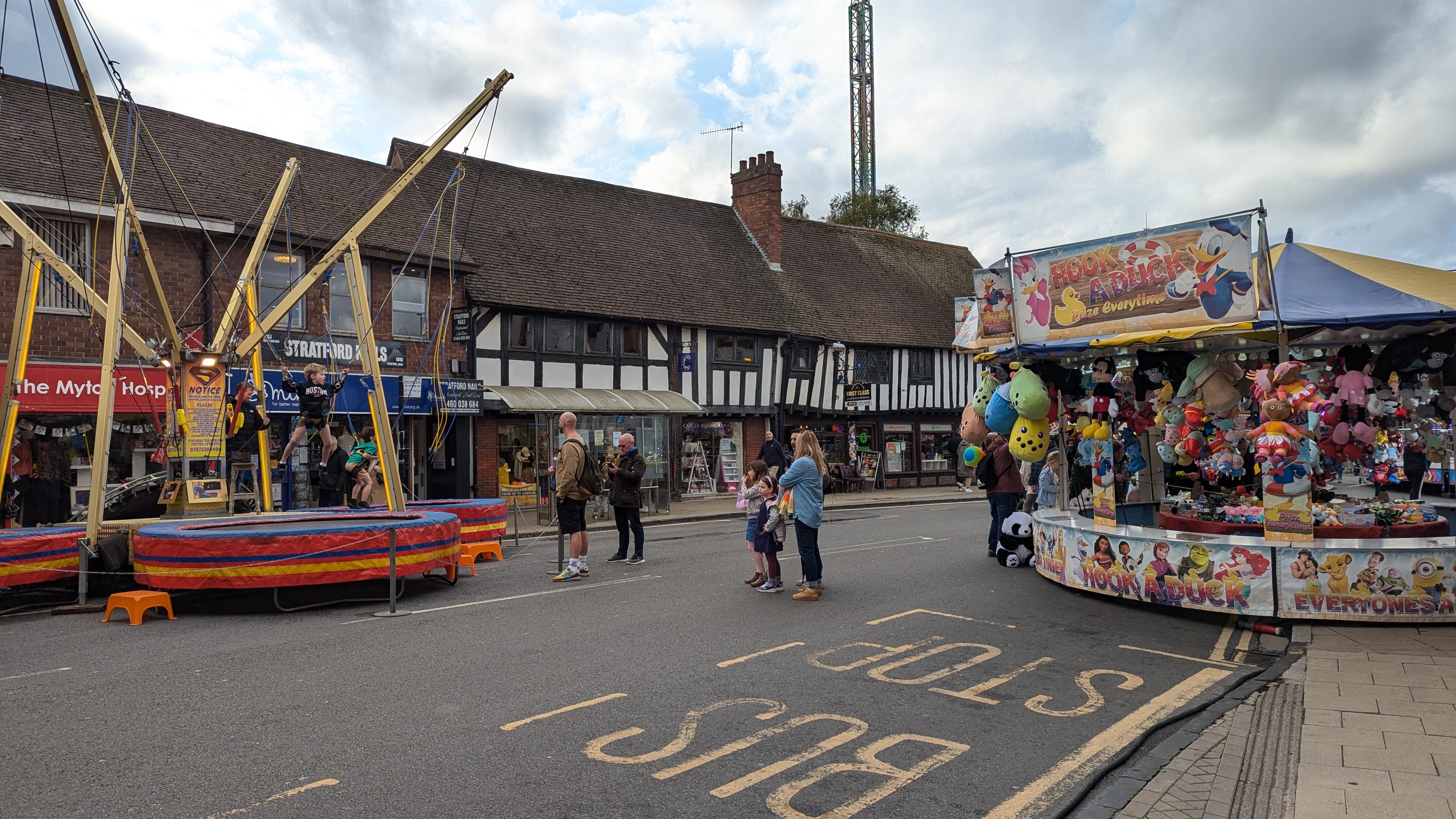
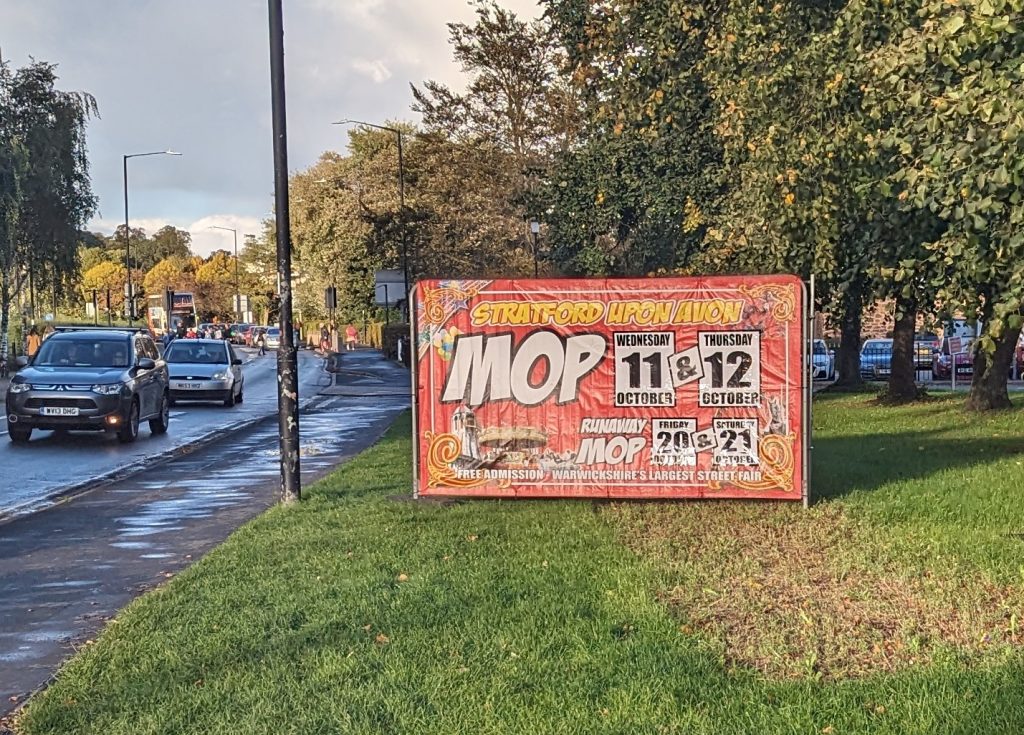
This year the Stratford Mop fair was on the 11th and 12th October, and I was there to see it!As I reposted a long post about the Mop a couple of days ago, I thought I should report back. To recap, the Mop began as a Michaelmas (Old Style) Hiring Fair, and has continued in Stratford ever since. But the modern incarnation is no longer a Hiring Fair and no shepherds were to be seen.

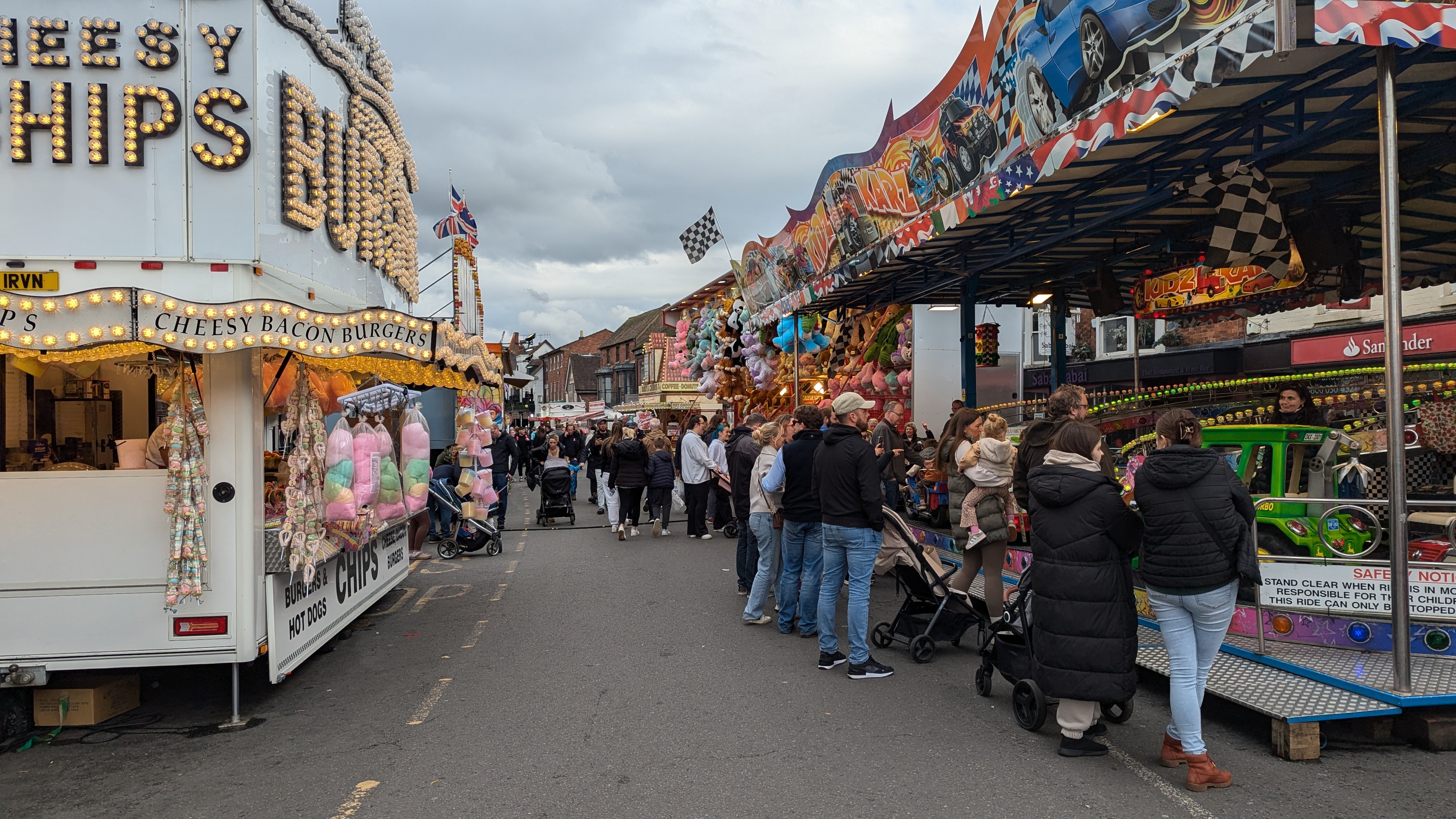
2024 Stratford on Avon Mop. Photo Kevin Flude

The centre of the Town was crowded with a cacophony of shooting galleries, games to win soft toys, stalls selling toffee apples, candy floss, burgers, and all things bad for you. And interspersed with the stalls were all sorts of rides, carousels and all the raucous fun of the fair.

Stratford-upon-Avon Mop Festival (2023 sign)

You might have noticed I have labelled the photographs differently, one Stratford-upon-Avon, the other Stratford-on-Avon. Most prefer the ‘upon’ but I thought this wrong as the Council building in Church Street uses the simpler ‘on’. Having looked it up, I see that the answer is both are correct. Stratford-upon-Avon is used for the Town, and Stratford-on-Avon for the Town and area around the town. Now you know!

Now, I cannot find any reference in Shakespeare to a funfair, and all references to a Mop, are to the thing you mop the floor with. But he does mention St Bartholemew’s Fair obliquely, and certainly knew his friend, Ben Jonson’s Play ‘St Bartholemew’s Fair’. It is a great play based in London, at the annual fair in Smithfield. It was one of the great Wool fairs of England. It was held every year on St Bartholemew’s Day August 24th, and lasting sometimes weeks long. Please read my post on Bartlemas here.

Going to the Mop in Stratford-upon-Avon & Henley-in-Arden 11th & 12th October

The Mop Festival in Stratford-upon-Avon

This year the Stratford mop festival was on the 11th and 12th October. I am in Stratford. The the centre of town is a cacophany of shooting galleries, stalls selling toffee apples, candy floss, burgers and all things bad for you. And a fun fair.Nothing at all sophisticated, or literary or dramatic, or folkloric. Just a good old-fashioned fun fair in the middle of the town. Quite raucous, but they leave Henley Street, and Shakespeare’s’ Birthplace, free of it. Below I tell the story of my discovery of the Mop.

In 2023, I was on my way to Stratford-upon-Avon Railway station, I saw the sign at the top of this page, but had no idea what on earth a Mop was. I put it to the back of my mind as I took the train to Henley-in-Arden. My interest in the town was that Shakespeare was born in Henley St. And his mother was called Mary of Arden. So, naturally, I wanted to find out about Henley-in-Arden. To turn curiosity to action, it took our Tour Coach Driver telling me he lived there and that it was a pretty but small town.

Mary Arden doesn’t live here any more!

I had a free afternoon from my duties as Course Director on the ‘Best of England’ Road Scholar trip. I got on the very slow train to Henley-in-Arden. One of the first stops was Wilmcote, where Mary Arden’s House is. I visited two years ago, when I was astonished to find it was a different building to the one I had visited in the 1990s! In 2000, they discovered they had been showing the wrong building to visitors for years! Mary Arden’s House was, in fact, her neighbour Adam Palmer’s. And her house was Glebe Farm.

On that visit, I walked from Stratford-upon-Avon to Anne Hathaway’s Cottage. Then to Mary Arden’s House and back to Stratford along the Stratford Canal. It is a lovely country walk if you are ever in the area.

The Forest of Arden

The train route to Henley is through what remains of the ancient forest of Arden. The forest features in, or inspired, the woody Arcadian idylls which feature in several of Shakespeare’s plays, particularly the Comedies. ‘As You Like It’, for example, is explicitly set in the Forest of Arden, as this quotation from AYL I.i.107 makes clear:

Oliver:  Where will the old Duke live?

Charles. They say he is already in the Forest of Arden, and a many merry men with him; and there they live like the old Robin Hood of England: they say many young gentlemen flock to him every day, and fleet the time carelessly as they did in the golden world.

Guildhall, Henley-in-Arden

Henley-in-Arden

Not much remains of the old Forest. It was cut down to make timber-framed buildings and ships for the British Navy – the so-called Wooden Walls. Henley has a beautiful high street. Further down the road is a lovely Heritage Centre full of old-fashioned and DIY Information panels. And that is not a criticism, it provided a very enjoyable visit full of interesting stuff. And gave me a couple of snippets of information I have not seen anywhere else.

One, was a panel dedicated to the Henley Mop. A mop turns out to be a hiring fair. Think of Gabriel Oak in Hardy’s ‘Far from the Madding Crowd’. His attempt to become an independent farmer destroyed when his sheepdog runs amok. The dog sends his sheep over a cliff to their doom. So he takes his shepherd’s crock to the hiring fair or Mop as they are known in the Midlands. There, potential employers can size up possible employees and strike mutually agreeable terms and conditions. And Gabriel becomes the shepherd for the delightful and wilful Bathsheba Everdene.

So, a shepherd would take his staff, or a loop of wool. A cleaner her mop (hence the name of the fair). A waggoner a piece of whipcord. A shearer their shears etc. Similarly, in the Woodlanders (by Thomas Hardy) the cider-maker, Giles Winterborne, brings an apple tree in a tub to Sherborne, to advertise his wares.

The retainers thus employed would be given an advance and would be engaged, normally, for the year. So there was quite a widespread moving around of working people to new jobs and often new housing. Not quite how we imagine the past?

The perceptive among you will have noted the bottom of the sign in Stratford which advertised the ‘Runaway Mop’. This was held later in the year, so that employers could replace those who ran away from their contracts. And those who ran away could find a better, kinder or more generous boss. See also my post of Gabriel Oak and Pack Rag Day which is another hiring fair which was help on Martinmas Old Style.

Henley Mop – panel from the heritage centre

Court Leets and Barons

Also of interest to me was the panel about Court Leets and Barons. These were the ancient courts which dealt with, respectively, crime and disorder, and property and neighbourhood disputes. Henley still has its ancient manorial systems in use, at least ceremonially. The Centre shows a video of the installation of a new Lord of the Manor at the Guildhall. The title had been purchased by a cigar-smoking Stetson-wearing large rich American.

Johnson’s Coaches

Another panel was the story of a Coaching Company. When I lead the Best of England programme we are driven around by Johnson’s Coach Company. It was a delight to discover that it has a history that can be traced back to 1909 in Henley. I conveyed this information to our group on the next day as we toured the Cotswolds. Curtis, our driver, was able to update the panel. He told us that the family were still involved with the firm, which is still operating from the area. He said the two brothers who run the company come in every working day. They do everything they require of their drivers to do; i.e. they drive coaches, clean coaches, sweep the floors and generally treat their staff like part of a big family. I should have asked him whether he got his job at the Mop, while holding a steering wheel in his hands!

Johnson’s Coach Company -Panel from Henley Heritage Centre

Note: It seems that Johnson has now merged with another company. But it keeps its depot in Henley and maintains its connection with the town.

First published in 2023 updated 2024, 2025