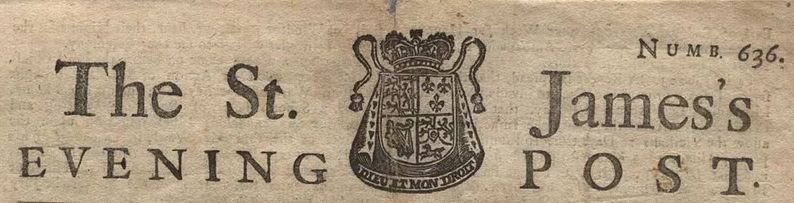
Mast head of the St James Evening Post (June 1719), the paper that carried the accusation of Sodomy
On 16th May 1719, the St James Evening Post (later called the Evening Post) reported on the Guilty Verdict returned against ex-Servants Stephen Margrove and John Wood. The two men were accused of extorting money by threatening to expose George Smith as a sodomist (then punishable by death).
The Proceedings of the Old Bailey Archive gives details of the case. This took place in the Parish of St. Martins in the Fields (near what is now Trafalgar Square), on 18th, January 1718. George Smith told the Court that:
‘ the Prisoners came up to him (and John Wood took him hold by the Collar of his Coat) and demanded his Money, and said if he would not give it them they would take away his Life and swear Sodomy against him; that by means of this Violence, and being under a Terror, and in great-Fear he gave them what he had in his Pocket.’
But they wanted more and forced Smith to take them to his Master’s House in Golden-Square. Here, he gave them another Guinea, to add to the 22 shillings they had already extorted.
The Accusation of Sodomy
Margrove and Wood protested that Smith: ‘came up to Wood while he was making Water, and took hold of his Yard, using some unseemly Expressions, whereupon he (Wood) called out a Sodomite‘.
At this accusation, Smith ‘fell on his Knees, and begg’d them not to expose him‘ and gave them the money. So, the accused argued it could not be ‘robbing on the High Way‘ because their victim gave them the money.
The Defence
The Court held that the threats, and violence they used made them guilty of Violent Robbery. The men called witnesses to their good employment record, but were unable to show any evidence of ‘how they spent the last 6 Months of their Lives.’ And so the Jury found them Guilty, and the judge put on the Black Cap to pronounce the death sentence.
The Verdict
On the 8th of June 1719 10 people, 7 men and 3 women were sentenced to hang, but 5 were reprieved. Wood, aged 22, and Margrove, aged 21, were however, executed. Rictor Norton in ‘Homosexuality in 18th Century England has more details, including the confessions of the two extortionists.
For the trail of Body snatchers look to the bottom of my post here:
Sorry to send an additional post but coming up are a couple of fascinating Virtual Tours which I would like to remind you of!
Tonight is an exploration of early 19th Century London. It is based on the 1809 Picture of London Guide book. An original copy was given to me by someone grateful to have attended one of my lectures at the Old Operating Theatre Museum. It is a tour of what Jane Austen could have visited on her walks around London. There are Austen associations, but mainly we are looking at London in 1809.
Jane Austen’s ‘A Picture of London in 1809’ Virtual Walk Mon 7.30 27th Jan25 To book
Yesterday, I was asked to give a Cromwell’s London walk as a 75th Birthday present. I haven’t done one for at least 25 years. But I really enjoyed the research. So added a guided walk and a virtual tour to my programme. This is the first time I have done this VT and it is a cracking story.
The Civil War, Restoration and the Great Fire of London Virtual Tour 7:30pm Thurs 30th Jan25To book
Finally, April is the month we go on pilgrimages, as Chaucer said (in Old English). So, in addition to my Chaucer Walks, I have added a Virtual tour so we can go all the way to Canterbury.
Chaucer’s London To Canterbury Virtual Pilgrimage 7.30pm Friday 18th April 25 To book
I may add one or two more before the Sun comes back
This was 5 years after his death. It is now celebrated around the world, making clear the importance of Robert Burns.
Burns himself would have been astonished at the spread of Burn’s Night. He was modest about his attainments, saying, in his introduction to the Commonplace Book:
‘As he was but little indebted to scholastic education, and bred at a plough-tail, his performance must be strongly tinctured with his unpolished rustic way of life. ‘
Fair fa’ your honest, sonsie face, Great Chieftain o’ the Puddin-race! Aboon them a’ ye tak your place, Painch, tripe, or thairm: Weel are ye wordy of a grace As lang ‘s my arm.
The groaning trencher there ye fill, Your hurdies like a distant hill, Your pin wad help to mend a mill In time o’ need, While thro’ your pores the dews distil Like amber bead.
His knife see Rustic-labour dight, An’ cut ye up wi’ ready slight, Trenching your gushing entrails bright, Like onie ditch; And then, O what a glorious sight, Warm-reekin, rich!
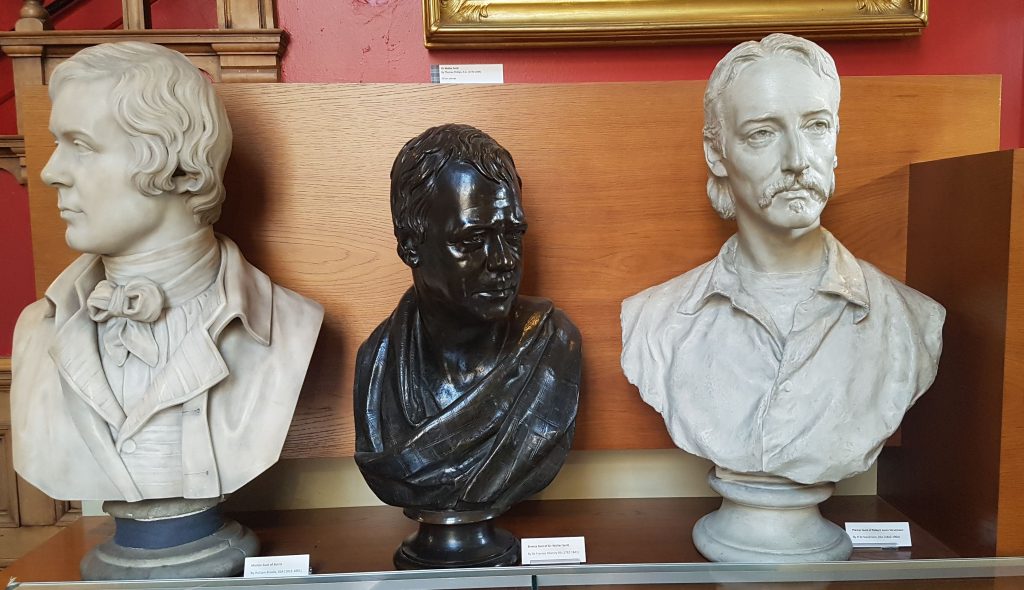
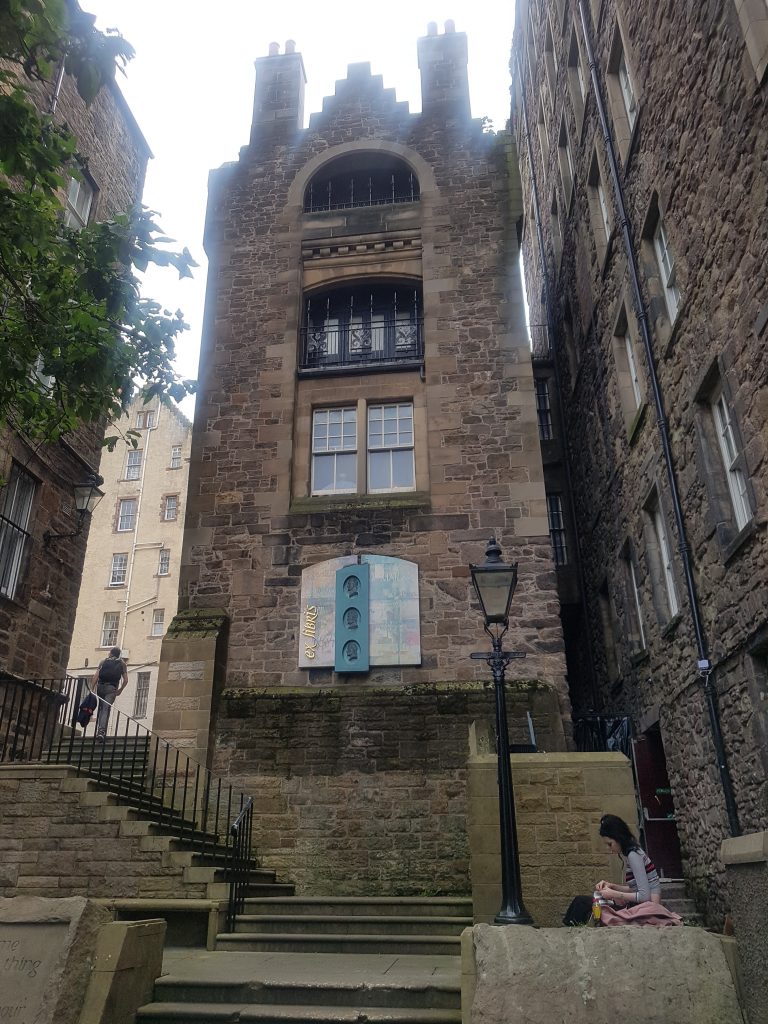
Often bypassed by the tourists on a visit to the wonderful City of Edinburgh is the Writer’s Museum. It is in one of those remarkable Tower houses which seem unique to the High Street in Edinburgh. Inside, it gives a great introduction to the great writers of Scotland.
‘Is it not strange’ wrote philosopher David Hume in 1757 ‘that a time when we have lost our Princes, our Parliament, Independent Government …..that we shou’d really be the people most distinguish’d for literature in Europe?’ (source: Museum display panel)
Edinburgh Writer’s Museum Burns, Scott, Stevenson.
A Visual for Burn’s Night ‘Window in the Writer’s Museum, Edinburgh’ Photo by K Flude
Writer’s Museum photo K. Flude
First published Jan 2023, republished Jan 2024, 2025
News from the Almanac showing readership/viewership of the site.
I have been waiting for a day when I haven’ t got a post to publish. Why? To update readers about the Almanac of the Past. And with a bit of manoeuvring today is the day.
What is the News from the Almanac of the Past?
The plan is to have a post for each day. I am virtually there for November to March, but a way away for the warmer months.
In the winter months, I have been revising, improving, developing and adding content to previously published pages. For those of you who have been here a while, you will have been receiving posts you have seen before. Next year, you might be seeing some for the third time. I’m not sure what to do about this except improve posts and add content. But I am considering stopping automatically posting repeated posts to subscribers. Maybe from next November? Feed back would be good – please email me at kpflude at chr . org . uk (I’ve slightly scrambled the email to stop the robots).
What is the planned content for the Almanac of the Past?
The nature of an almanac is to be a pot-pourri. They are about seasons, time, folklore, history, important events, and anniversaries. I also like to cover history, famous people and discoveries. Gods, Goddesses, Saints, sinners, and archaeology. What I want it to be is something that makes us more mindful about the passing of the year. How seasons and time change the way people see their world. My focus is mostly on the UK, but also on Rome and Greece. With occasional excursions to other places. I am trying to find more content that is London-based, but not to the exclusion of everything else. I also have an ambition to add more important news of discoveries that change our view of the past. If I get the formula right, I will attempt to get a publication from it, otherwise it will remain online.
Developments for the Almanac
It takes quite a lot of time for me to keep it up. You will see, from the graph above, that the readership is yearly making progress. Particularly, last year. But then it’s a steady progress from a small base, rather than Kardashian viral.
This is, at least, partially because I would rather not spend my time marketing. I want to be writing. But, I have decided I need to spend a little more time marketing the site. When I ran the Old Operating Theatre Museum, I had the skills to get our web site to first place on google searches. But this was in the pioneering days of the World Wide Web. Now, it’s more difficult, but I am taking a ‘Search Engine Optimisation’ (SEO) course. I have also loaded some ‘plugins’ to WordPress which help with SEO. I thought you might be interested in some of the consequences.
The plugins ‘parse’ the site and give recommendations for improvements. This should, get the site further up the Google landing page. I have no doubt that it involves or will involve AI. The ‘Yoast’ plugin I am using as I type this, tells me words like ‘however’ are a ‘complex’ word and so they down grade my ‘readability’ quotient. It also tells me that that last sentence was too long. So, it wants simple sentences, and words that join sentences together. And not too many sentences in a paragraph and a proper scattering of headings.
It also assesses the SEOness of the text. So I have to tell it what the main subject of the page is. And it wants that word or phrase in:
the title: the first paragraph the image the meta description tag and scattered, but not too densely (because Google will punish the site for playing the algorithm) through the text.
Hence, you will see the phrase ‘News from the Almanac’ scattered more than I would normally like through this text. Of course, I know no one really will be searching for ‘News from the Almanac. So I should change the SEO phrase just to Almanac. But, then I’m not really interested in attracting non-readers to this page. I see this as between me and my email subscribers!
After writing that paragraph I realised that I would want people to land up here if they typed in ‘Almanac of the Past’. So you will see, I’ve editing the text scattering that phrase here and thereabouts.
In effect, I am being trained by a slightly stupid tutor who has no particular understanding of the needs of a writer of history! And you can’t answer back, you just get downgraded!
And it seems to be working as my numbers are getting better more quickly.
Any problems for the Almanac of the Past?
Obviously, my terrible proofreading is a concern! Maybe that’s one-way republishing helps. A year later, it’s easier to see the typos, the ugly writing, and issues with the content.
But there is another issue with the emails, which I have been trying to solve for about 6 months. The links in the emailed posts don’t work. But they do work if you visit the almanac on the web. This is nuts as I always use the full URL. For example: https://www.chr.org.uk/anddidthosefeet/december-29th-st-thomas-wassailing/.
So, this is very much a technical issue, one might say a bug in the system. I think it stems from the fact that my blog was stored not in https:/public_html/ but in https://public_html/anddidthosefeet. This seemed a logical choice at the time, as the blog shared space with other things. I haven’t managed to convince the tech guys at either the internet provider or WordPress that this is a bug. So, the alternative is to move the blog. But I am reluctant to do this in case it completely messes everything up.
Change the content of the newsletter, you might think. But I can find nothing that allows me to alter or add anything to the email version of the post. As I write this, I think I will temporarily add a line at the bottom of the post which says:
if the links are not working, copy and paste this URL https://www.chr.org.uk/anddidthosefeet/whateverkevinsalmanacpageiscalled
to your browser. This, will get you to the Almanac of the Past on the web where all the links will work.
And this will allow you to easily copy or link to the webpage and send the Almanac of the Past to your friends and followers. (I’m hoping you are Taylor Swift). You willalso be able to comment easily and maybe even like the post?
Another advantage of visiting the web version is that you get a better version to read. This is because I often find howling typos when I read the emailed post. I correct them, with a red embarrassed face.
If you are reading this on the web, then all the above must have been very annoying to read! Maybe I will move it down to the bottom of the post! (which I did).
Trying new things on the Blog
Do you want to make a comment?
Please leave me a comment – its great to hear what you think.Cancel reply
In order to clear January 22nd I moved the previous January 22nd post to December 10th. As its all about Mulled Wine, Glugg, and Gluwein., its better at the beginning of the Christmas Season than in late January.
To see it click here: or cut and past this url https://www.chr.org.uk/anddidthosefeet/january-22-22-time-to-mull-it-over/
I also didn't tell you Monday was Blue Monday because I had already sent you one post on the 20th. So this is the Blue Monday Post. https://www.chr.org.uk/anddidthosefeet/january-13th-18th-blue-monday-wolf-moon-start-of-lambing-and-twelfth-night-old-style/
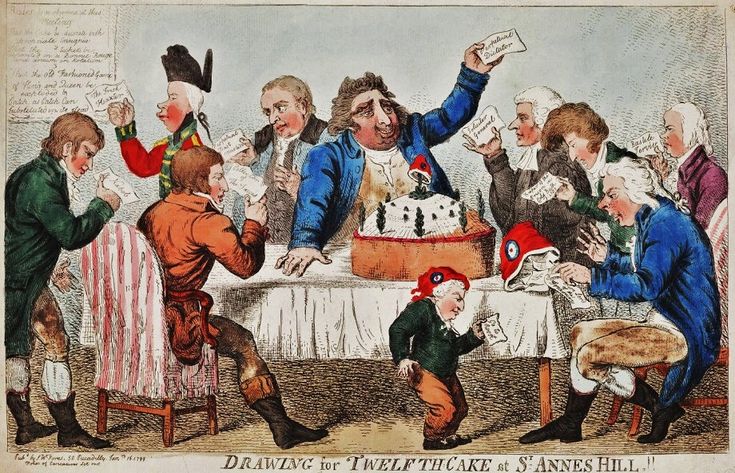
‘Drawing for Twelfth Cake’ at St. Annes Hill ’12th Night Cruikshank, Isaac, 1756-1811 printmaker. Published Janr. 10, 1807 by Thomas Tegg, 111 Cheapside’
Twelfth Night
Yesterday was Twelfth Night for the modern Church of England, but today is Twelfth Night for the Catholic Church and in England in former times. It is also Epiphany or Three Kings Day and because of calendrical differences, Christmas Eve for the Orthodox Church. In Ireland, it is Nollaig na mBan. This is Women’s Little Christmas; when Women get to rest and let men do the work. This is a typical Saturnalia-style reversal of roles.
I used the print above, three years ago for my post on New’s Day, then moved it to Twelth Night. I also use it for lectures on Christmas and Jane Austen. But the focus of my presentation is explaining the Twelfth Night Cake and the game that was played. But in fact, this is a very political satirical cartoon. More of that, later, let’s begin with the more trivial aspect of the print above.
Twelfth Night and Christmas Cake
It used to be the big party night, featuring the famous Twelfth Night Cake and theatrical entertainments; mumming and wassailing. The cake has disappeared from current Christmas celebration, probably because it transmuted into our present Christmas Cake. This, I regret. I have had a lifetime when a very heavy Christmas Dinner is followed first, by Christmas Pudding. Then, overloading with food, the Christmas Cake is brought out. No one, in their right mind, wants a slice of heavy Christmas Cake at that time. Many of my American friends disparage fruit cake, but they are mistaken. Good Christmas Cake is something to be thoroughly enjoyed, but on the days following Christmas Day.
I gave a recipe for the Twelfth Night Cake in another post, (here it is). But the important point is that it had a bean and a pea in it. The one who got the bean was selected as King for night and the pea the Queen. Traditionally, the women draw a card from a ‘reticule’ (bag) and the men’s from a hat. But there are no women at this satirical party. The cards detailed a role they were to play for the rest of the night. The card began with an introductory speech, or rhyme, for the person to speak. The King and Queen led the way, and for the rest of the evening the party members adopted their persona. They might be an aristocrat, a soldier, a cook, a parson, a dairy maid etc. The French do something similar with their Galette des Rois. The bean is called the feve, and may be replaced by a porcelain model. Other places have a King’s Cake for epiphany.
Twelfth Night Satire
So, as I was rushing to get the original Twelfth Night post done, I failed to examine it in any detail. I assumed the cards gave them satirical occupations which would be funny to the contemporary audience in 1807. But then, I noticed the title mentioned St Anne’s Hill. I looked it up and discovered myself down a deep and very enjoyable research rabbit hole.
St Anne’s Hill & Charles James Fox
Now, let’s go down that rabbit hole and look a little deeper.
The caption mentions St Anne’s Hill. I believe this refers to St Anne’s Hill, near Chertsey (SW of London on the River Thames). Here, there was a grand house which was owed by Charles James Fox. He was the leader of the Whigs, a persistent opponent of King George III. He was a supporter of the American and French Revolutions. This explains the red bonnet used to pull out the cards in the illustration.
The central figure is then, Fox. But he died in September,. 1806. The print is dated January 1807. Just before he died, his Foreign Slave Trade Bill of 1806 began the dismantling of this pernicious trade in the British Empire. He was Foreign Minister who assumed a couple of civil chats with the French would end the long-standing war. But he soon discovered that Napoleon was not to be trusted in negotiations. The war went on for another 9 or so years.
Charles James Fox was a mercurial figure with many radical views. He was also a notorious gambler and loved the high life. One of his many lovers was Georgiana, Duchess of Devonshire. He eventually married, Elizabeth Armistead, an ex-mistress of the Prince of Wales. St Anne’s Hill was her house. I am pleased to report that she is credited with calming his life-style. He now spent more time at St Anne’s where they would ‘read, garden, explore the countryside and entertain friends’ (Wikipedia).
Isaac Cruikshank’s ‘Drawing for Twelfth Cake’ at St. Annes Hill
Cruikshank’s illustration is, of course, not designed to document quaint Twelfth Night customs but is a political satire and I discovered that the British Museum has the original version of this print, and. It is dated to 1799 which makes much more sense!
At the back right of the print is a notice which says:
‘Rules to be observed at this Meeting 1. That the Cake be decorated with appropriate insignia 2 That the tickets be deposited in a Bonnet Rouge and drawn in Rotation 3 That the Old Fashioned Game of King and Queen be exploded & Catch as Catch can Substituted in its stead.’
The bonnet rouge is defined by the Collins Dictionary as a ‘redcap worn by ardent supporters of the French Revolution’ or ‘an extremist or revolutionary’. The last point relates to Fox’s opposition to the King, and the expression Catch as Catch Can refers to a free form of wrestling without rules.
The characters in the scene (all men) are all political figures. They are associated with the opposition to the very right-wing Government of William Pitt. During the war with France, the opposition was led by a supporter of the French Revolution. For those on the right, which included Pitt’s government, supporting the French Revolution was tantamount to treason. Pitt suspended many civil liberties in ‘Pitt’s Reign of Terror’. He arrested and indeed executed leading members of those demanding political change. The Government even suspended Habeas Corpus to make it easier to arrest their opponents,
Fox is seen drawing a 12th Night Game ticket which is marked ‘Perpetual Dictator’. To his right is Frances Burdett. He was a radical politician, who supported universal male suffrage, equal electoral districts, vote by ballot, and annual parliaments. Note that this is well before these aims became the core of the Chartists campaign for electoral reform. (for other people in the illustration look at the British Museum notes on the print. )
Frances Burdett, Edward and Catherine Despard
Burdett is shown holding a ticket saying ‘Keeper of the Prison in Cold Bath Fields’. This is a satirical reference to a serious political crisis. The Cold Baths Fields was the site of a medical spring in Clerkenwell, London. This was where a prison was situated where radicals were imprisoned. They were held in poor conditions despite the recent rebuilding under the aegis of the prison reformer, John Howard. Burdett exposed the scandalous conditions in the House of Commons. He began a campaign against the magistrates involved in the arrests.
One of the prisoners was Edward Despard who had associations with many radical groups. These included the London Corresponding Society, the United Irishmen and United Britons. Despard was married to Catherine, the daughter of a free black woman from Jamaica. She, with Burdett, led the campaign against these arrests without trial. Catherine wrote a letter to the Attorney General who replied in a demeaning manner:
‘it was a well-written letter, and the fair sex would pardon him, if he said it was a little beyond their style in general’
He did not comment on her colour. She described the imprisonment of her husband as being :
“in a dark cell, not seven feet square, without fire, or candle, chair, table, knife, fork, a glazed window, or even a book”
Execution of Edward Despard
Despard was freed in 1802, went to Ireland. But returned to London, where he was arrested again. But this time he was accused of a being the ringleader of a plot to assassinate the King. There was little real evidence. Horatio Nelson was a character witness, and appealed to the King for clemency. It was given. But only in so far as Despard was not disembowelled but ‘only ‘Hanged and Drawn’ at Horsemonger Lane Gaol (1803). This was the last time someone was drawn through the streets at the tail of a horse before execution for treason. These are his last words:
Fellow Citizens, I come here, as you see, after having served my Country faithfully, honourably and usefully, for thirty years and upwards, to suffer death upon a scaffold for a crime which I protest I am not guilty. I solemnly declare that I am no more guilty of it than any of you who may be now hearing me. But though His Majesty’s Ministers know as well as I do that I am not guilty, yet they avail themselves of a legal pretext to destroy a man because he has been a friend to truth, to liberty, and to justice
(a considerable huzzah from the crowd)
and because he has been a friend to the poor and to the oppressed. But, Citizens, I hope and trust, notwithstanding my fate, and the fate of those who no doubt will soon follow me, that the principles of freedom, of humanity, and of justice, will finally triumph over falsehood, tyranny and delusion, and every principle inimical to the interests of the human race.
(a warning from the Sheriff)
I have little more to add, except to wish you all health, happiness and freedom, which I have endeavoured, as far as was in my power, to procure for you, and for mankind in general.
https://en.wikipedia.org/wiki/Edward_Despard
After his death, his family denied that Catherine was his wife but merely his ‘house-keeper.’ I assume, was because they wanted the inheritance rather than, or perhaps, as well as naked prejudice.
Francis Burdett married into the fabulously rich banking family the Coutts. His daughter was the famous Angela Burdett Coutts who was a philanthropist who collaborated extensively with Charles Dickens.
@Phew! This is what I love about what I do, you find things out that link disparate parts of your knowledge, creating an ever-interwining web of history.
On this Day
Harold Godwinson was crowned King of England on January 6, 1066, the same day as the funeral of the previous king, Edward the Confessor. m.
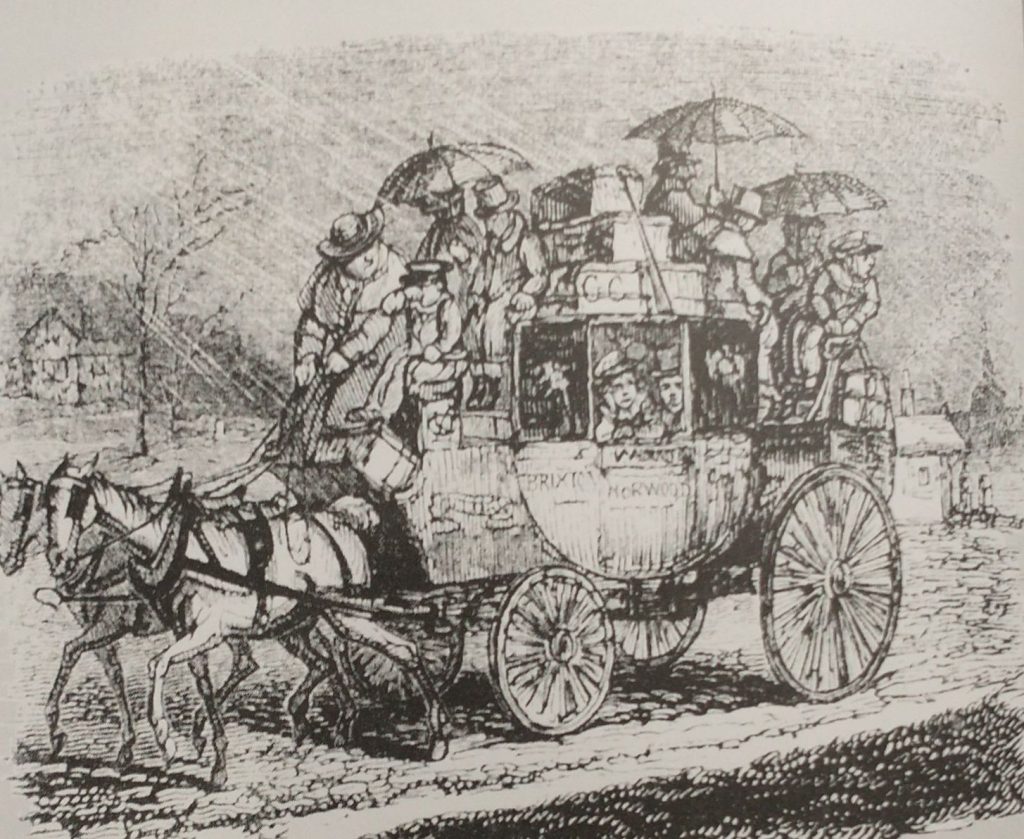
As the Sun enters the House of Capricorn remember the poor Coachman travelling all day everyday in all weathers. Washington Irving in his ‘Old Christmas’ (Originally ‘The Sketch Book of Geoffrey Crayon’ pub. 1819) describes him with a broad red face, a broad body widened by drinking beer; swathed with any numbers of layers of coats trying to keep the cold out. He has many worries on his mind as he has a coach full not only of people who need looking after but also a lot of parcels and commissions that need to be carried out in the many stops along the way. He is delivering parcels, turkeys, geese, presents, children, you name it he is responsible for its safe delivery.
Feel sorry for the people crowded inside the carriage but even sorrier for those sitting on the roof. They have umbrellas in a vain attempt to keep dry, but the umbrella tines will be poking you in your ear, and the run off from the canopy of the umbrella might trickle down your neck. There might be 6 people inside and up to 10 on the roof. 3d for travelling inside and half of that for the roof. voach
Inside, you are next to a large man who is not very salubrious looking, nor too worried about pressing his thighs against you.
John Keats blamed his consumption on his journey on the roof of a stage-coach travelling from London to Hampstead on a cold wet day in February.
Stage coaches became regular sights on the road during the 17th Century and were quite dangerous as the roads were in such a poor condition. It was suggested that passengers made their wills before travelling! From the late 17th and with Parliament increasingly used to set up not-for-profit toll road, the roads got better, and ‘Flyers’ and mail coaches could get up to the tremendous speed of 10 miles an hour, and averaging 7. This happened because improved roads meant improved suspensions, and wheels, and more and faster horses could be harnessed.
This revolutionized travel. It used to take 5 days in around 1700 to get to Manchester from London, by the mid 18th Century the time taken was reduced to 24 hours, and there were many more scheduled coaches, The mail coaches had priority, the coach had a blunderbuss and two pistols to deter highway men, and the guard had a post-horn with which to warn other vehicles to give clear passage, to alert tollgate keepers to open gates, and to announce arrival at a stop. Extra horses would be harnessed to help get up steep hills which, in some cases, like Broadway in the Cotswolds, might mean an additional 10 horses. Passengers might be asked not only to get off the coach to lighten the load but also to push if the going got boggy. On mail coaches, the passengers were not allowed to get off when the horses were changed, and only 4 were allowed inside the coach.
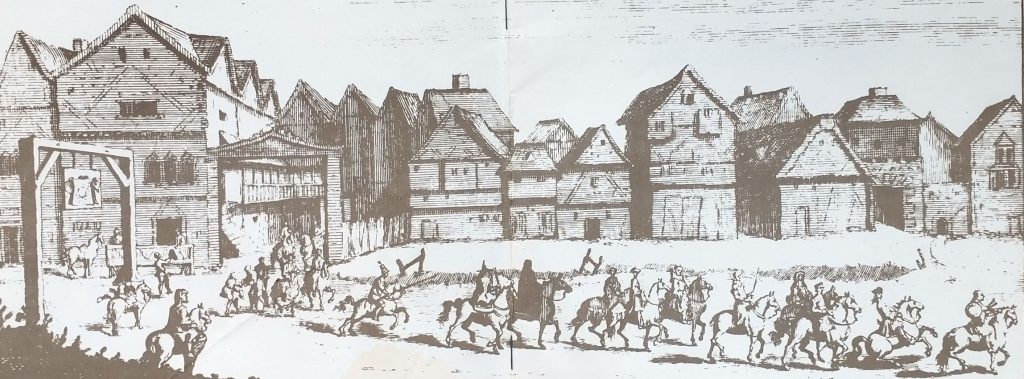
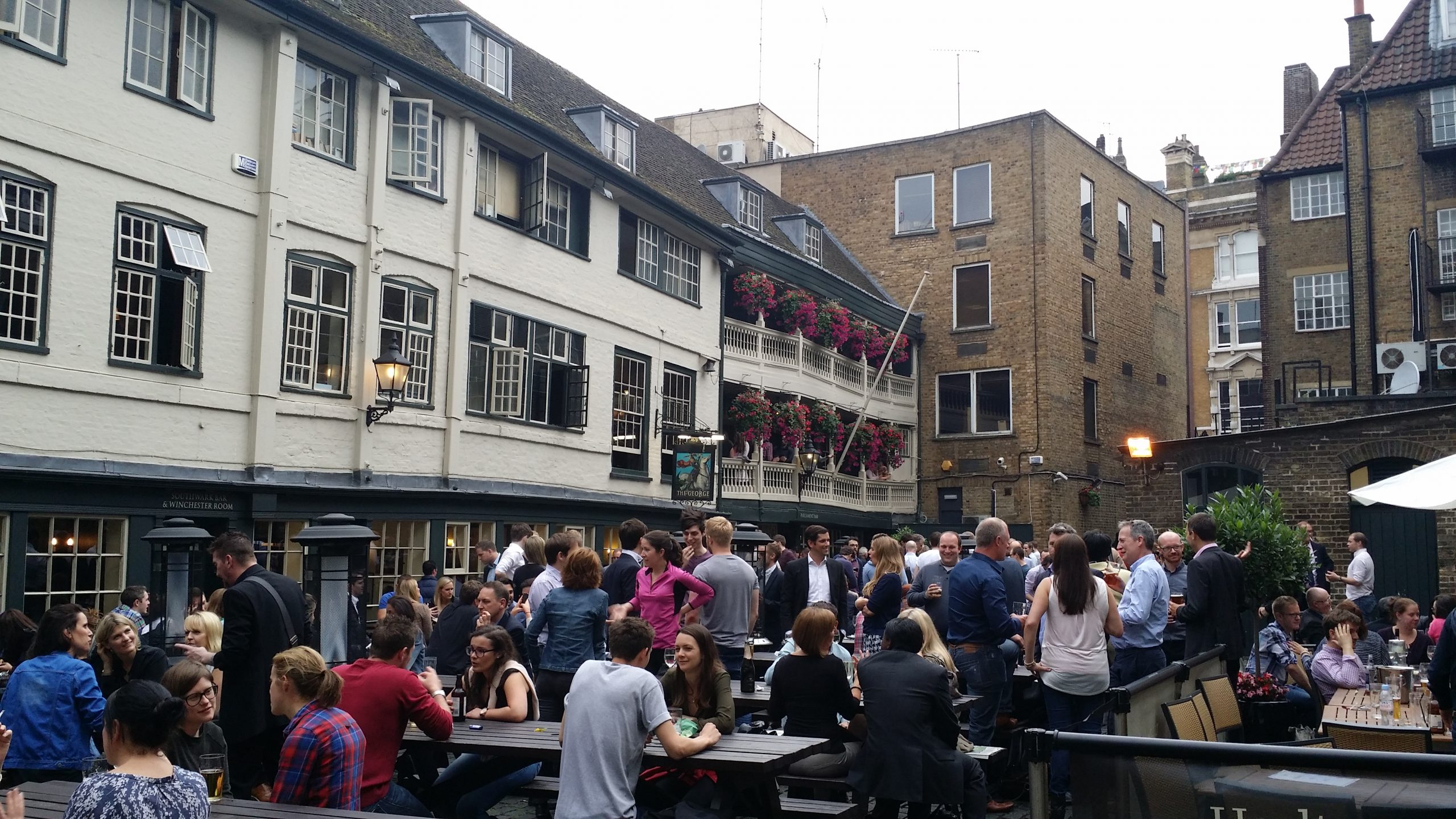
London was ringed by Coaching Inns, which were coach terminals and hotels. The most famous ones, remaining, are in Southwark on the approach road to London Bridge. The Tabard where the Chaucer’s Canterbury Tales started, The White Hart where Dickens’ Sam Wheeler is the Bootboy, and the George, which although not quite so literary is at least still half intact.
Pilgrims leaving the Tabard Inn for the Canterbury PilgrimageGeorge Inn,Southwark (photo Kevin Flude)
Capricorn
‘The man born under Capricorn shall be iracundious and a fornicator; a liar, and always labouring.
....The woman shall be honest and fearful, and have children of three men, she will do many pilgrimages in her youth and after have great wit.’
From Kalendar of Shepheards 1604 quoted in ‘The Perpetual Almanac of Folklore by Charles Kightly’.
iracundious is first mentioned in a work published by Caxton in the 15th Century and pretty much obselete by the 17th Century. It means easily angered or irritable.
My WordPress system decided to publish my notes upon the Parrot rather than reminding me to finish off the page. So, here is the updated post again.
The Parrot was republished for free on August 4th 2024 by the York St Johns University Critical Editions team, and they have enabled you to get your free copy by following the link at the bottom of the post.
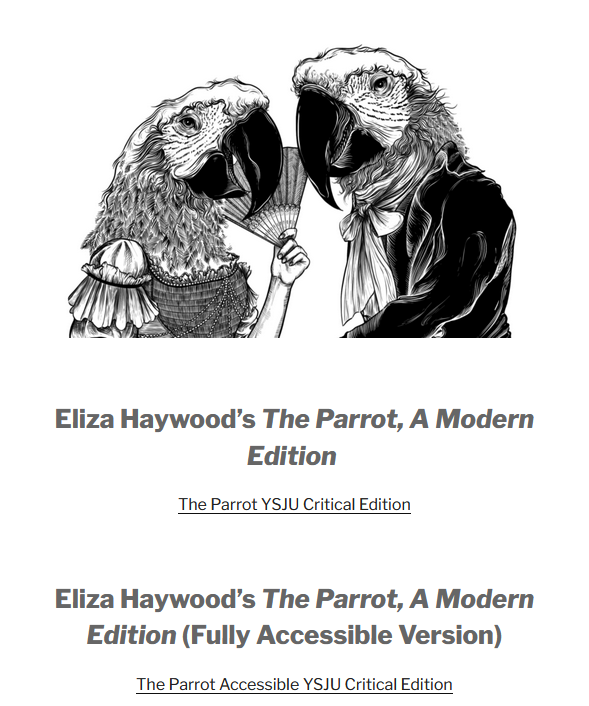
Published in 1746 ‘The Parrot’ by Elizabeth Haywood was a satire on the male-dominated London Society of the time. It was published in 9 parts. The name comes from the viewpoint from a Parrot’s perch in a wealthy London house. The Parrot is an enslaved creature that has travelled the world, observer to its follies. The bird wonders why people should dismiss opinions simply on the basis of A Parrot’s green colour.
The introduction to the author by the team says:
‘Eliza Haywood (c. 1693-1756) was one of the first generation of writers to “live by her pen.” Throughout her career, Haywood adopted many roles: she was an actress, playwright, novelist and prolific essayist.However, she always used her platform to celebrate and advocate for women.‘
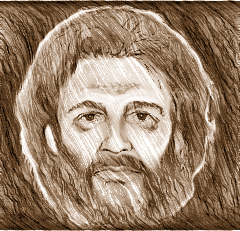
Archaeology discoveries. The Image is a sketch of the ‘Facial Reconstruction, Impossible Factual/BBC’
Interesting Archaeology discoveries.
The following discoveries were reported in Salon IFA the newsletter of the Society of Antiquaries of London in Salon: Issue 526 7 February 2024, which you can see here:
Pliny the Elder’s Villa found near Vesuvius?
The 1st Century seafront villa, with views of the Bay of Naples and of Mount Vesuvius, has been excavated at the town of Bacoli, which was the port of Misenum. Pliny commanded the fleet as ‘Praefectus classis Misenensis’. Pliny tried to rescue his friends and family, ignoring warnings saying ‘Fortune favours the brave’, ‘Audentes Fortuna luvat’. It didn’t and he died, at Stabiae, by toxic fumes. Read more about the villa here:
Face Reconstructed for a Victim of Roman Crucifixion
A male skeleton found, 4 years ago, in a Roman cemetery in Fenstaton in Cambridgeshire was found with a 2-inch nail through his heel bone. BBC 4 has made a documentary about the recent reconstruction of the man’s face by, as Salon reports it:
‘US forensic artist Joe Mullins, of George Mason University, Virginia. He usually works with law enforcement agencies, reconstructing the faces of modern-day crime victims. ‘
To follow the details, read more here, or watch the BBC documentary, ‘The Cambridgeshire Crucifixion’, which can be viewed on BBC iPlayer.
I have been waiting to post this for a long time, as it relates to Christmas. (Was it really a month ago?) By the way, I have added to some text to yesterday’s Brexit posts.
This evening is also Imbolc, the Celtic Festival to Brigantia and St. Bridget of Kildare. Candlemas tomorrow.
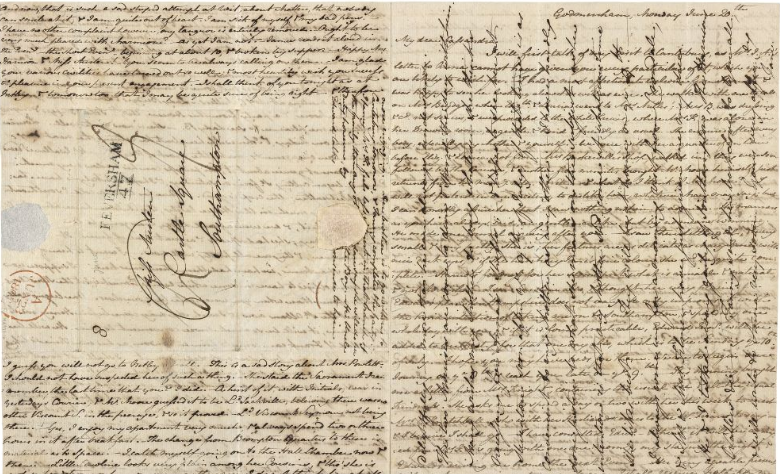
This is a letter from Mary Musgrove in Persuasion (Chapter 18). This is Jane Austen’s most mature and probably the best novel,. Here the moany Mary Musgrove writes a typically FOMO letter which illustrates how Christmas, for the well, off really continued to February 1st and Candlemas.
February 1st “My dear Anne,–I make no apology for my silence because I know how little people think of letters in such a place as Bath. You must be a great deal too happy to care for Uppercross, which, as you well know, affords little to write about. We have had a very dull Christmas; Mr. and Mrs. Musgrove have not had one dinner party all the holidays. I do not reckon the Hayters as anybody.
The holidays, however, are over at last: I believe no children ever had such long ones. I am sure I had not. The house was cleared yesterday, except of the little Harvilles; but you will be surprised to hear they have never gone home. Mrs. Harville must be an odd mother to part with them so long. I do not understand it. They are not at all nice children, in my opinion; but Mrs. Musgrove seems to like them quite as well, if not better, than her grandchildren.
What dreadful weather we have had! It may not be felt in Bath, with your nice pavements; but in the country it is of some consequence. I have not had a creature call on me since the second week in January, except Charles Hayter, who had been calling much oftener than was welcome.
Between ourselves, I think it a great pity Henrietta did not remain at Lyme as long as Louisa; it would have kept her a little out of his way. The carriage is gone to-day, to bring Louisa and the Harvilles to-morrow. We are not asked to dine with them, however, till the day after, Mrs. Musgrove is so afraid of her being fatigued by the journey, which is not very likely, considering the care that will be taken of her; and it would be much more convenient to me to dine there to-morrow.
I am glad you find Mr. Elliot so agreeable, and wish I could be acquainted with him too; but I have my usual luck: I am always out of the way when any thing desirable is going on; always the last of my family to be noticed. What an immense time Mrs. Clay has been staying with Elizabeth! Does she never mean to go away? But perhaps if she were to leave the room vacant, we might not be invited. Let me know what you think of this. I do not expect my children to be asked, you know. I can leave them at the Great House very well, for a month or six weeks.
I have this moment heard that the Crofts are going to Bath almost immediately; they think the Admiral gouty. Charles heard it quite by chance; they have not had the civility to give me any notice, or of offering to take anything. I do not think they improve at all as neighbours. We see nothing of them, and this is really an instance of gross inattention.
Charles joins me in love, and everything proper.
Yours affectionately,.”
It is my paragraphing rather than the original. The mystery of the book is how such a lovely, considerate, able daughter like Anne, can be from the same family as both her awful sisters, and her monstrous, egotistical father.




Please leave me a comment – its great to hear what you think.