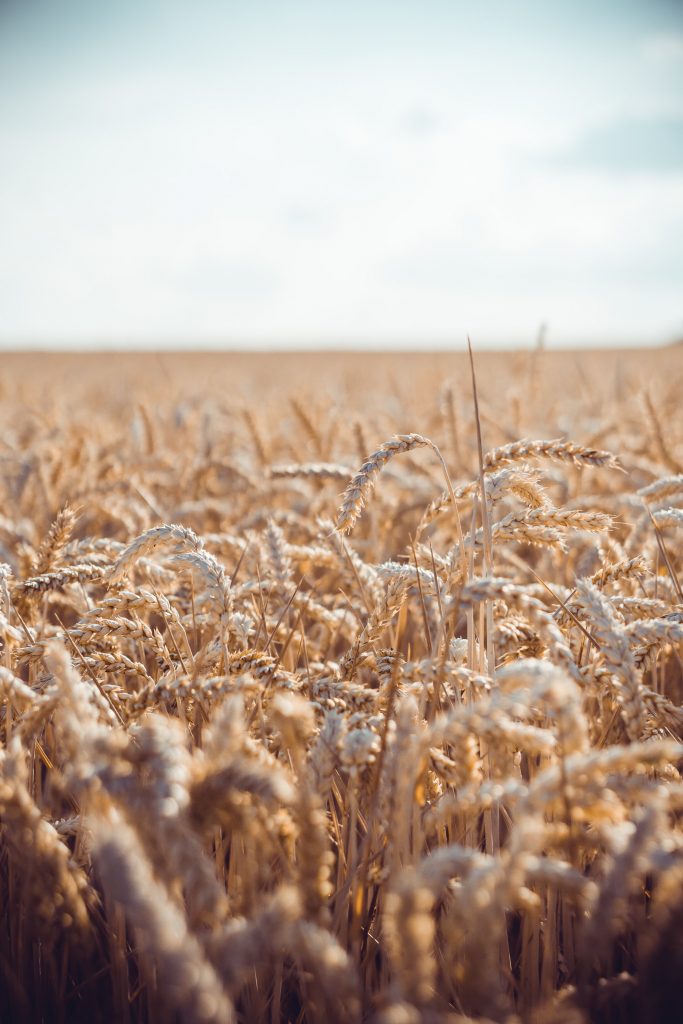
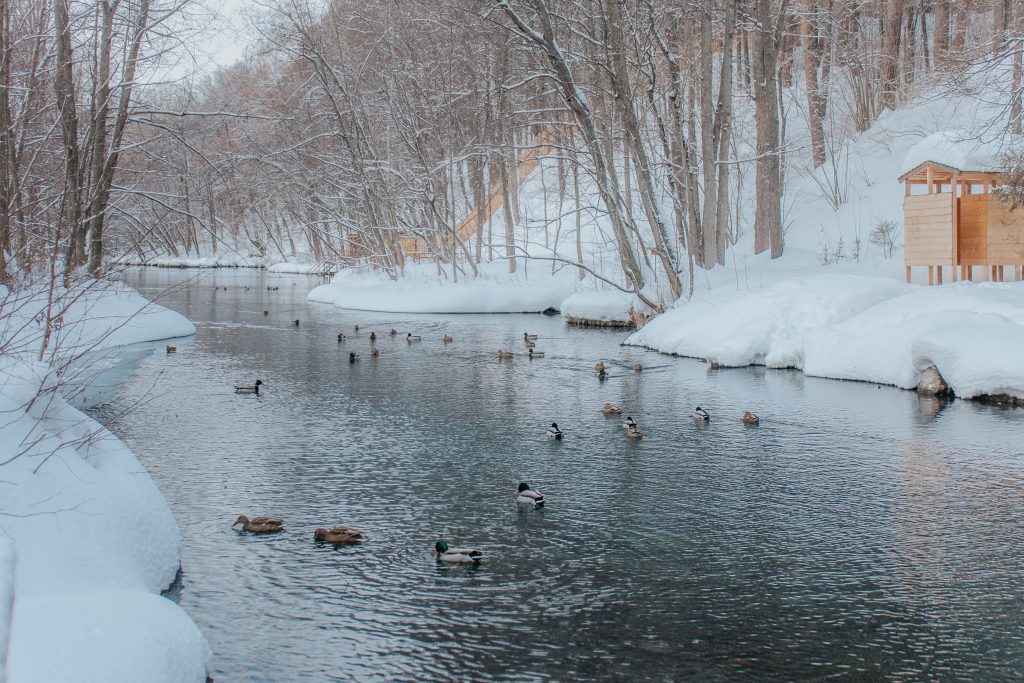
Autumn Equinox in Haggerston Park.Photo by K Flude.
Autumn Equinox.
This is the second day of the year when the sun rises due east and sets due west. When the day and night are of equal length. It is the beginning of the astronomical autumn. It is determined by the 23.5-degree tilt of the Earth’s rotation in relation to the orbit around the Sun.
In the Jewish Calendar, and the French Revolutionary Calendars it marks the new year. Many cultures preferred spring. But autumn is the end of harvest, when seeds are sown and the food stores are full of food. Similarly, the Celts started their new year at Halloween, half way between the equinox and the solstice.
For more about autumn, look at my post here. For my post on the Spring Equinox, see here. For the Celtic New Year see this post here and for the French Revolutionary Calendar, my post is here.
Rosh Hashanah, September 22nd to 25th.
Rosh Hashanah is the New Year in Judaism. There are other new years in the Jewish calendar. But this is for the Civil Year and to celebrate the anniversary of the birth of Adam.
The biblical name for this holiday is Yom Teruah. One of the High Holy Days, as specified by Leviticus 23:23–25. Like most New Years it is a time to reflect on life and put in place changes. It is after all a celebration of the beginning of the world.
Here is an excellent BBC web site which will tell you more.
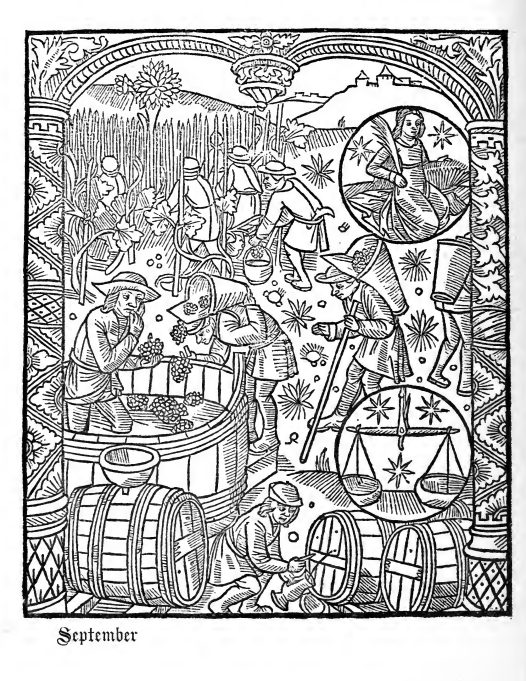
Kalendar of Shepherds illustration of September showing harvesting grapes and the astrological signs for Virgo (August 23 – September 22) and Libra (September 23 – October 22)
It is that time of the year when you say ‘Where has the Summer gone? It can’t be September already?’ But, meteorology, speaking, Autumn starts today. September 1st was chosen on a numerical basis for ease of measuring rather than any profound floral, agricultural or solar reason. So, there are three Gregorian Calendar months for each season, and each season starts on the first of the month. Autumn: September, November and December.
Autumn, Harvest, Fall
Autumn comes from Latin (autumnus) which went into French and then into English. The season was also called Harvest (which went into Dutch herfst, German Herbst, and Scots hairst -Wikipedia) or from the 16th Century: the ‘fall of the year’ or ‘fall of the leaf’ which spread to America as Fall.
Summer’s Ending
It still feels like summer. In England, we often have a glorious September, and what we can an ‘Indian’ Summer, an unexpectedly warm period in mid-September to October.
Solar Autumn
Of course, for the real Autumn, we have to wait for the Equinox, the beginning of Astronomical or Solar Autumn. This year, it is on Monday, September 22nd, 2025, 7:19 pm.
Astrological September
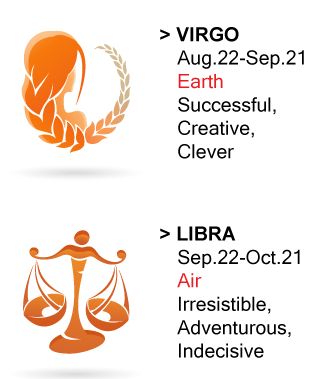
The star signs for astrological September are: Virgo which is linked to Aphrodite (Venus) the Goddess of Love and Libra which is linked to Artemis (Diana), virgin goddess of many things, including hunting, wild animals, children, and birth.
Star signs for September
September
September gets its name from the Romans, for whom it was the 7th Month of the year (septem is Latin for seven). Later, they added two new months so it became our 9th Month. (For more on the Roman year, look at my post here).
It is called Halegmonath in the early English language, or the holy month, named because it is the month of offerings, because of the harvest, and the mellow fruitfulness of September? Medi in Welsh is the month of reaping, and An Sultuine in Gaelic which means the month of plenty.
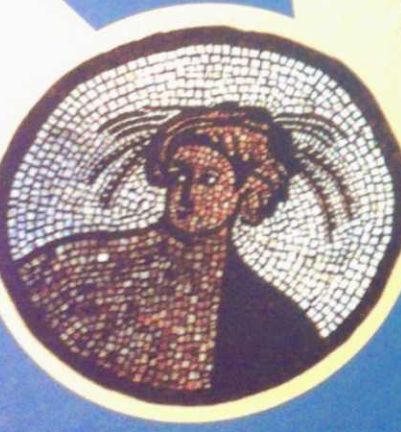
Roman personification of Autumn from Lullingstone mosaic
Early Modern September and the autumn of Life
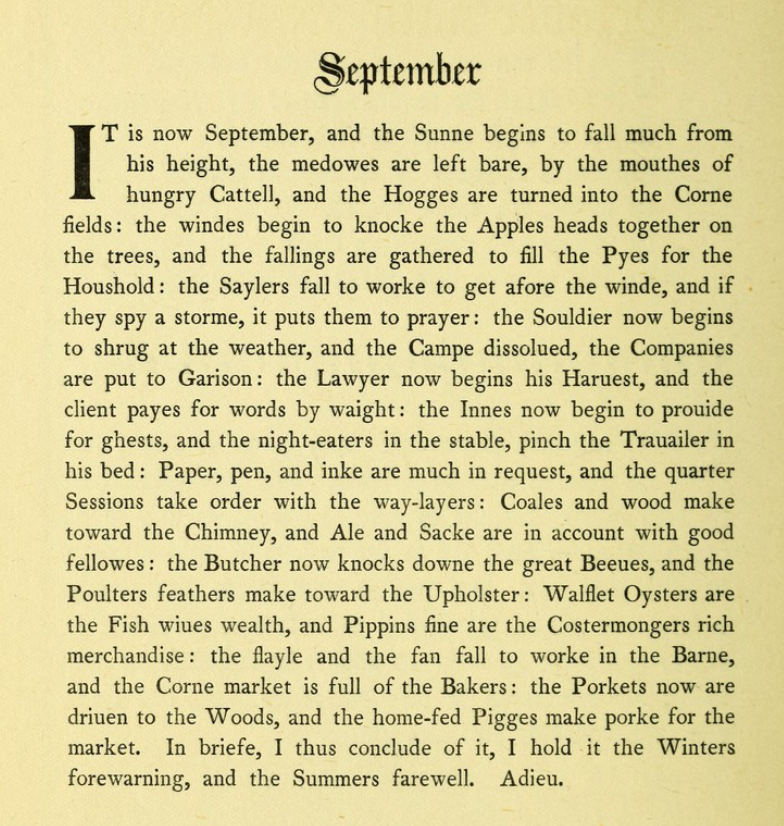
Here is an early 17th Century look at September from the Kalendar of Shepherds – for more on the Kalendar, look at my post here.
From the Kalendar of Shepherds
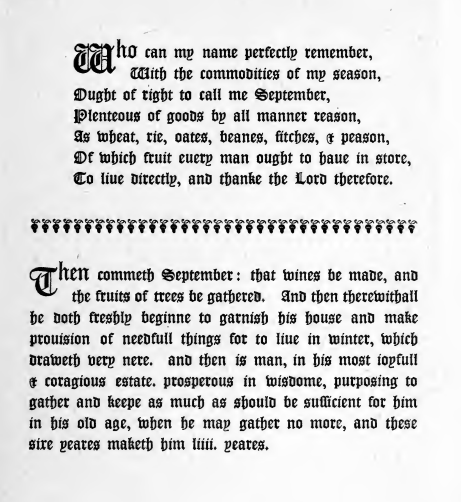
The Kalendar has an additional shorter look at September (see below). And it continues with its theme, linking the 12 months of the year with the lifespan of a man – 6 years for each month. So September is a metaphor for man at 56 years of age, in their prime and preparing for old age.
September from the Kalendar of Shepherds. The last sentence beginning ‘and then is man’ shows the link between September and the beginning of the autumn of life.
Season of ‘mists and mellow fruitfulness‘
John Keats (1795 – 1821) wrote a great poem called ‘To Autumn’:
Season of mists and mellow fruitfulness, Close bosom-friend of the maturing sun; Conspiring with him how to load and bless With fruit the vines that round the thatch-eves run; To bend with apples the moss’d cottage-trees, And fill all fruit with ripeness to the core; To swell the gourd, and plump the hazel shells With a sweet kernel; to set budding more, And still more, later flowers for the bees, Until they think warm days will never cease, For summer has o’er-brimm’d their clammy cells.
Who hath not seen thee oft amid thy store? Sometimes whoever seeks abroad may find Thee sitting careless on a granary floor, Thy hair soft-lifted by the winnowing wind; Or on a half-reap’d furrow sound asleep, Drowsed with the fume of poppies, while thy hook Spares the next swath and all its twined flowers: And sometimes like a gleaner thou dost keep Steady thy laden head across a brook; Or by a cider-press, with patient look, Thou watchest the last oozings, hours by hours.
Where are the songs of Spring? Ay, where are they? Think not of them, thou hast thy music too,— While barred clouds bloom the soft-dying day, And touch the stubble-plains with rosy hue; Then in a wailful choir the small gnats mourn Among the river sallows, borne aloft Or sinking as the light wind lives or dies; And full-grown lambs loud bleat from hilly bourn; Hedge-crickets sing; and now with treble soft The redbreast whistles from a garden-croft, And gathering swallows twitter in the skies.
Written September 19, 1819; first published in 1820. This poem is in the public domain and available here:
August was originally ‘sextilis’ or the 6th Month of the ten-month Roman Calendar. It became the 8th Month when January and February were added to the calendar to make a 12 month year. By tradition, this happened during the reign of King Numa Pompilius. Originally set as a 29-day month but changed to a 31-day month in the reforms of Julius Caesar. It was subsequently renamed August by a sycophantic Senate trying to flatter the divine Octavian, Emperor Augustus. (more of my posts about the Roman Calendar here and here)
The Celtic August
In modern Irish, it is Lúnasa, which means the month of the festival of Lughnasa. It is a harvest festival, celebrating the ripening of wheat, barley, rye, and potatoes. In Ireland, it is the festival of the God Lugh, celebrated with games, fairs, and ceremonies. Lughnasa is 6 months after Imbolc. It marks the ending of lactation of lambs and the beginning of the tupping season. (impregnation of the ewes). It can be celebrated by climbing hills, visiting springs, wells, lakes and eating bilberries. (Myths and Legends of the Celts. James MacKillop).
In Welsh, it is Awst which comes from the Latin. Called Calan Awst in Wales, it is the festival of August. In Gaelic Scotland it is called Lunasuinn, and Laa Luanistyn in the Isle of Man.
Lughnasa is one of the Celtic quarter days,. They are halfway between the Solstices and Equinoxes. They are: Samhain (1 Nov) Imbolc (1 Feb), Beltane (1 May) and Lughnasa (1 Aug). All are, or can be seen to be, a turning point in the farming year.
The Gallic Coligny ‘Celtic’ Calendar records August as a ‘great festival month’. The stone-carved Calendar was found near Lyon, whose Roman name was Lugodunum. The town is named after the Gaulish God Lugos. It is thought he is related to the Irish God, Lugh and the Welsh Llew Llaw Gyffes. He has an unstoppable fiery spear, a sling stone, and a hound called Failinis. The Romans associate Lugos with Mercury, and the Church associated Lugh with St Michael.
Lughnasa was founded by Lugh himself to honour his foster mother Tailtiu at Brega Co. Meath. Tailtiu became one of Ireland’s greatest festivals, springing from the horse races and marital contests set up by Lugh.
Anglo Saxon August
In Anglo-Saxon: the Venerable Bede, writing in the 8th Century, says August is Wēodmōnaþ or the Weed Month. Named because of the proliferation of weeds. Why does that seem such an unsatisfactory name for August? An early Kentish source calls the month Rugern – perhaps the month of the harvest of Rye? (Winters in the World by Eleanor Parker).
Lammas
For the Anglo-Saxons, August brings in the harvest period. This is the most important months of the year. The Harvest brings in the bounty of the earth. It needs to be carefully collected, enjoyed but not wasted. It begins with the festival of Lammas, which derives from the English words for bread and mass. The Bread Mass when bread made from the first fruits of the harvest is blessed.
Kalendar of Shepherds
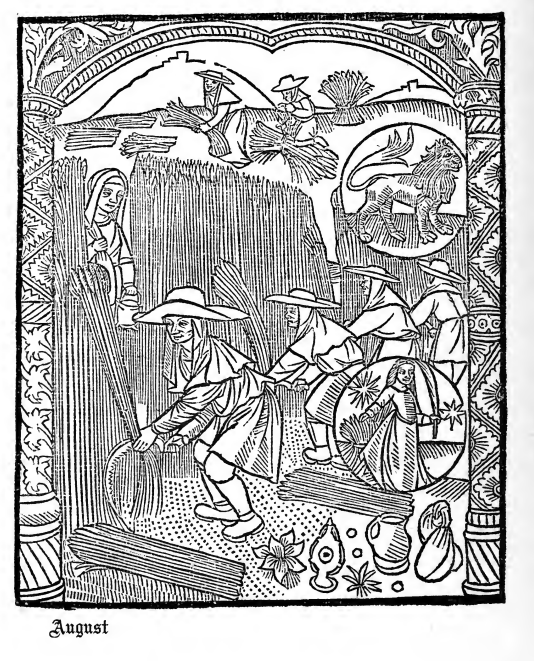
Kalendar of Shepherds, August
The 15th Century illustration in the Kalendar of Shepherds, above, shows that the Harvest is the main attribute of the Month, and the star signs, Leo and Virgo.
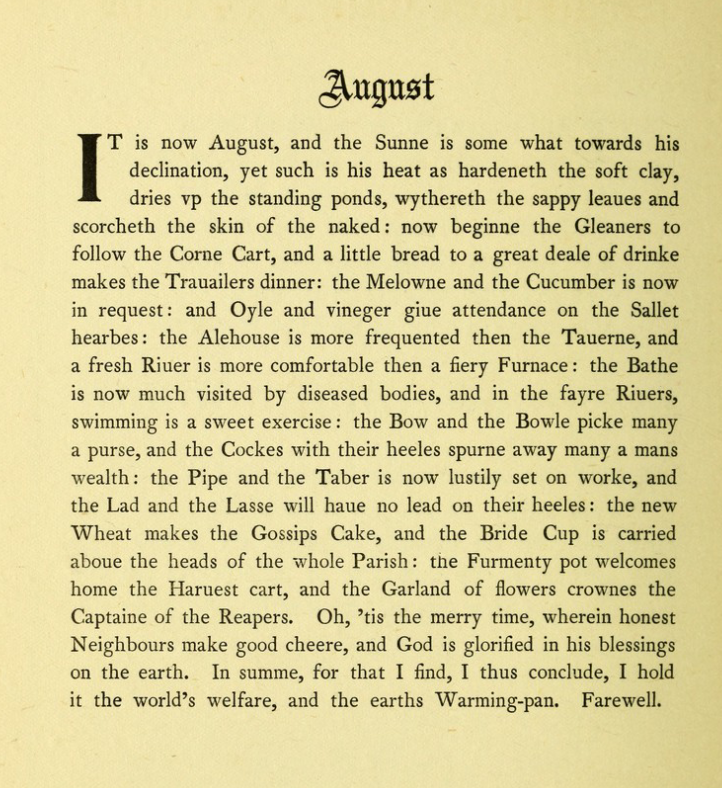
The 16th/17th Century text in the Kalendar of Shepherds gives an evocative insight into the month.
Summer is the best time to fish for Eels. Mid May to the end of July. But they can be caught all year around. Jellied Eels have been a staple of East End diets since the 18th Century. They were to be found in many stalls dotted around the East End, from vendors venturing into pubs and in Pie and Mash shops. Tubby Isaacs is perhaps, the most famous. Jellied eels are still sold in a diminishing number of places in the East End. Manze’s Eel, Pie, and Mash shop at 204 Deptford High Street, London was listed in December 2023. The shop opened in 1914 and was a pioneer of commercial branding. This is the fourth Manze’s shop to be listed: Tower Bridge Street, Chapel Market Islington, and Walthamstow High street. The current owner of the Deptford shop is retiring and so the shop will close.
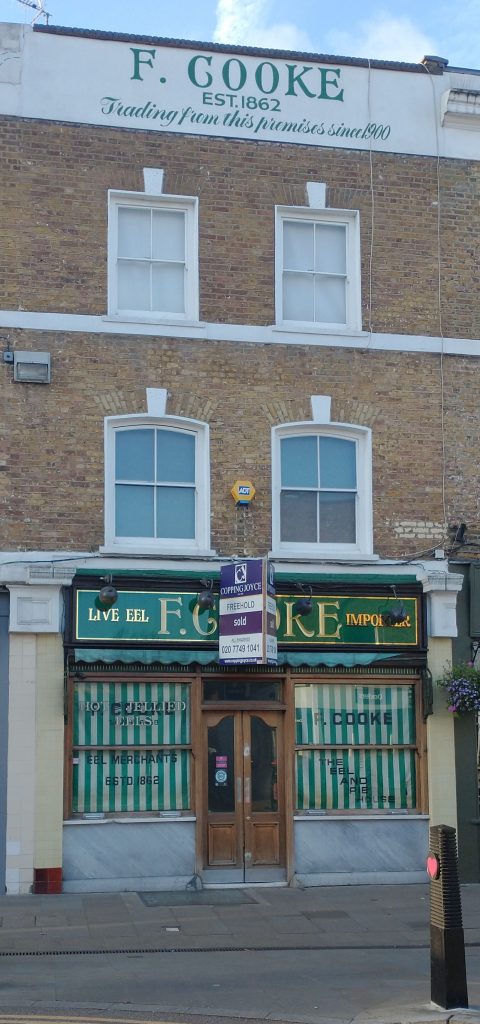
There are three Pie and Mash shops near me in Hackney. The one in Dalston has become a bar. In Broadway Market it is now an optician. But the one in Hoxton Market is surviving, and all three have retained their distinctive interiors. On the River Lee Navigation is another piece of Eel history which is the excellent Fish and Eel Pub at Dobbs Weir.
Pie and Mash Shop. Established 1862, closed down 2021. Broadway Market, Hackney (photo, copyright the author)
My mum loved jellied eels. It took me until I was over 60 before I could bring myself to try them. And I have no wish to repeat, what for me, was a revolting experience.
By JanesDaddy (Ensglish User) – English Wikipedia – [1], CC BY-SA 3.0, https://commons.wikimedia.org/w/index.php?curid=1663124
Gervase Markham in his ‘The English Husbandman’ of 1635 provides instructions on how:
To take Eels in Winter, Make a long bottle or tube of Hay, wrapped about Willow boughs, and having guts or garbage in the middles. Which being soaked in the deep water by the river side, after two or three days the eels will be in it and you may tread them out with your feet.
Eel traps at Bray, on the River Thames (Henry Taught 1885)
Romans, Saxons and Eels
Eels have been eaten for thousands of years. Apicius, author of a famous collection of Roman Recipes tells us of two sauces for eels:
Sauce for Eel Ius in anguillam
Eel will be made more palatable by a sauce which has pepper, celery seed, lovage, anise, Syrian sumach, figdate wine, honey, vinegar, broth, oil, mustard, reduced must.
Another Sauce for Eel Aliter ius in anguillam
Pepper, lovage, Syrian sumach, dry mint, rue berries, hard yolks, mead, vinegar, broth, oil; cook it.
Bede’s Historia Ecclesiastica, which tells of Britain as a land with “the greatest plenty of eel and fish.” Several fish traps have been found in and around the Thames, one for example in Chelsea.
Aristotle, Freud and the Deep Sargasso Sea
But eels had a great mystery no one knew where they came from or how they reproduced. Aristotle thought they spontaneously emerged from the mud. Sigmund Freud dissected hundreds of Eels, hoping to find male sex organs. It was only on 19th October 2022 that an article in the science journal Nature disclosed the truth. The article was ‘First direct evidence of adult European eels migrating to their breeding place in the Sargasso Sea‘. Ir proved beyond doubt that the theory that Eels go to the sea near Bermuda to spawn was, incredibly, true.
Eel Pie Island
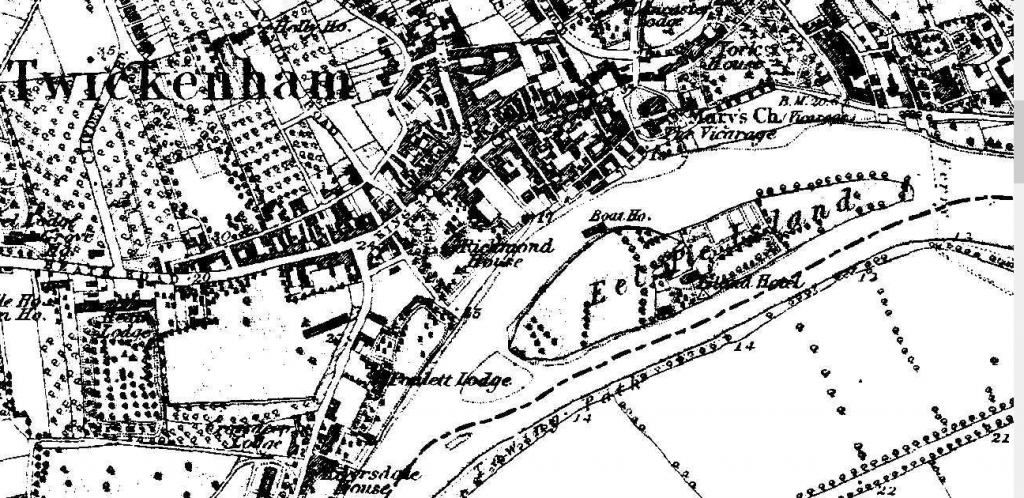
Eel Pie Island . Ordnance Survey In 1871 to 1882 map series (OS, 1st series at 1:10560: Surrey (Wikipedia)
But Eels also have their place in Rock and Roll History. Eel Pie island is on the Thames, near Twickenham and Richmond. It is famous for its Eels. But was home to an iconic music venue. The Eel Pie Hotel hosted most of the great English Bands of the 50s. 60s, and 70s. The roll call of bands here is awesome. The Stones, Cream, Rod Stewart, Pink Floyd, you name it, they were here:
David Bowie, Jeff Beck, Howlin’ Wolf, John Lee Hooker, Memphis Slim, Champion Jack Dupree. Buddy Guy, Geno Washington, Long John Baldry, Julie Driscoll and Brian Auger. John Mayall’s Bluesbreakers, Ten Years After, Chicken Shack, and one of my all-time favourite bands. the Savoy Brown Blues Band. And I have forgotten the Nice, the Crazy World of Arthur Brown, Joe Cocker, and the Who. And many more!
The Rolling Stones played at the Railway Tavern, Richmond on Sunday, February 24, 1963. Here they were spotted by people from the nearby Eel Pie Hotel. They were booked for a 6 month residency, which they began as virtually unknown and ended as famous.
This was first published as part of another post in 2022, and revised and republished on 28th November 2023, 2024.Moved from November 28th to July 23rd in 2025
(I moved it to make room for a post on Mrs Shakespeare. Also, because I cannot find anything to substantiate the opening statement that the Eel Season had its second day on November 28th. All evidence I find says the best fishing is in the Summer.
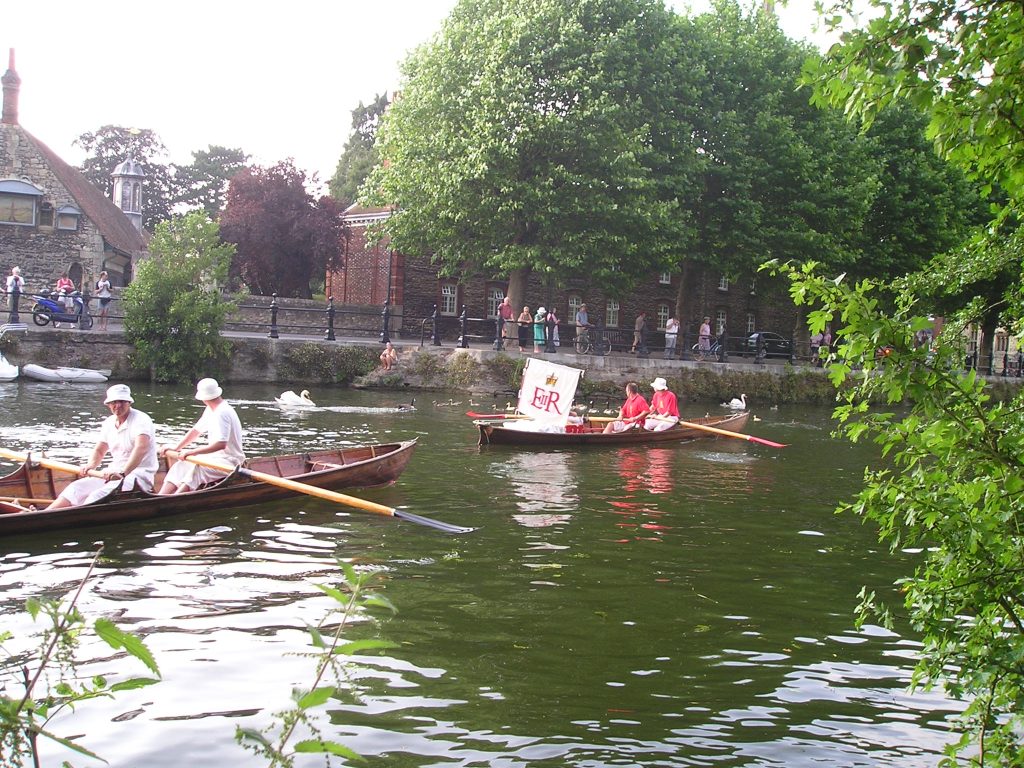
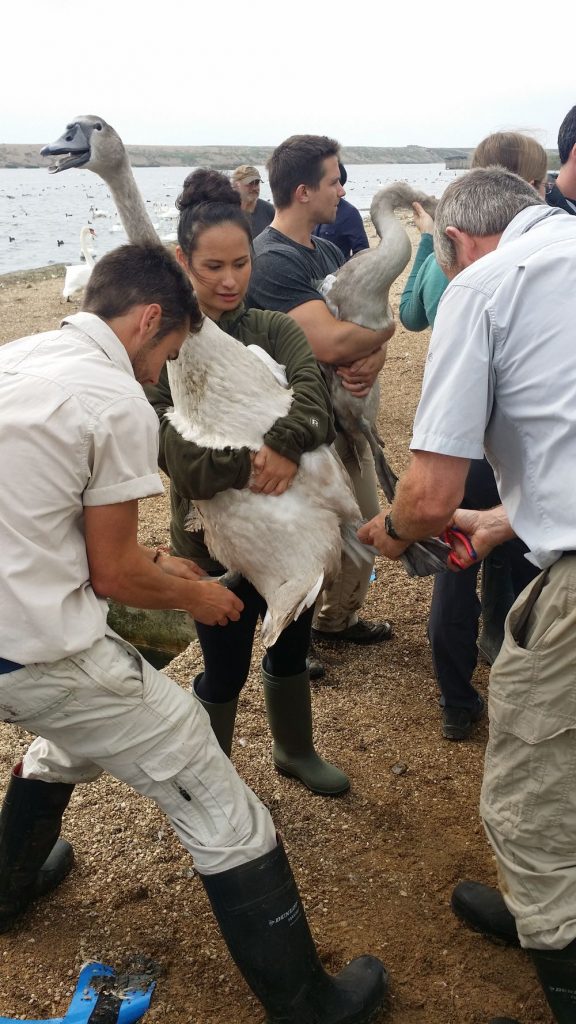
Swan Upping By Philip Allfrey Abingdon 2006 – CC BY-SA 3.0, https://commons.wikimedia.org/w/index.php?curid=2464315. The Royal Uppers are to the right and the Vintners’ Uppers on the left.
Swan upping takes place on the 3rd Week of July. It is an annual census of the Swans on the River Thames. This year it began on Monday, July 14th. It began in the 12th Century.
In theory, the King has the ownership of all unmarked Mute Swans on open water in the UK. Swan Upping is an ancient ceremony during which Swans are upped, checked for health and ringed if they do not belong to the King. In fact, it is the Cygnets which are upped. They are checked for weight and health. Their parents are checked for an ownership ring. If the parents are ringed then the young cygnets will be ringed accordingly. If the parents are not ringed, then they belong to the King and remain unringed.
This ceremony now only takes place on the Thames. It begins at Sunbury and progresses to Abingdon. The Swan Uppers have traditional wooden rowing skiffs and a scarlet Upping Shirt. They are managed by the Swan Marker. The Royal Uppers are accompanied by Swan Uppers from the two City Livery Companies that still have rights to ownership of Thames Mute Swans. These companies are the Dyers Company and the Vintners Company.
If you want to catch Swan Upping this year you will find them upping Swans at the following places:
Thursday 17th July 2025 Sonning-on-Thames 09.00 – Departure point Caversham Lock 10.15 Mapledurham Lock 12.30 Goring Lock 17.00 Moulsford 18.00
Swans moult in July and August, and this renders them flightless. This can last for a period of up to 6 weeks. So it makes them a lot easier to up!
The Swannery at Abbotsbury
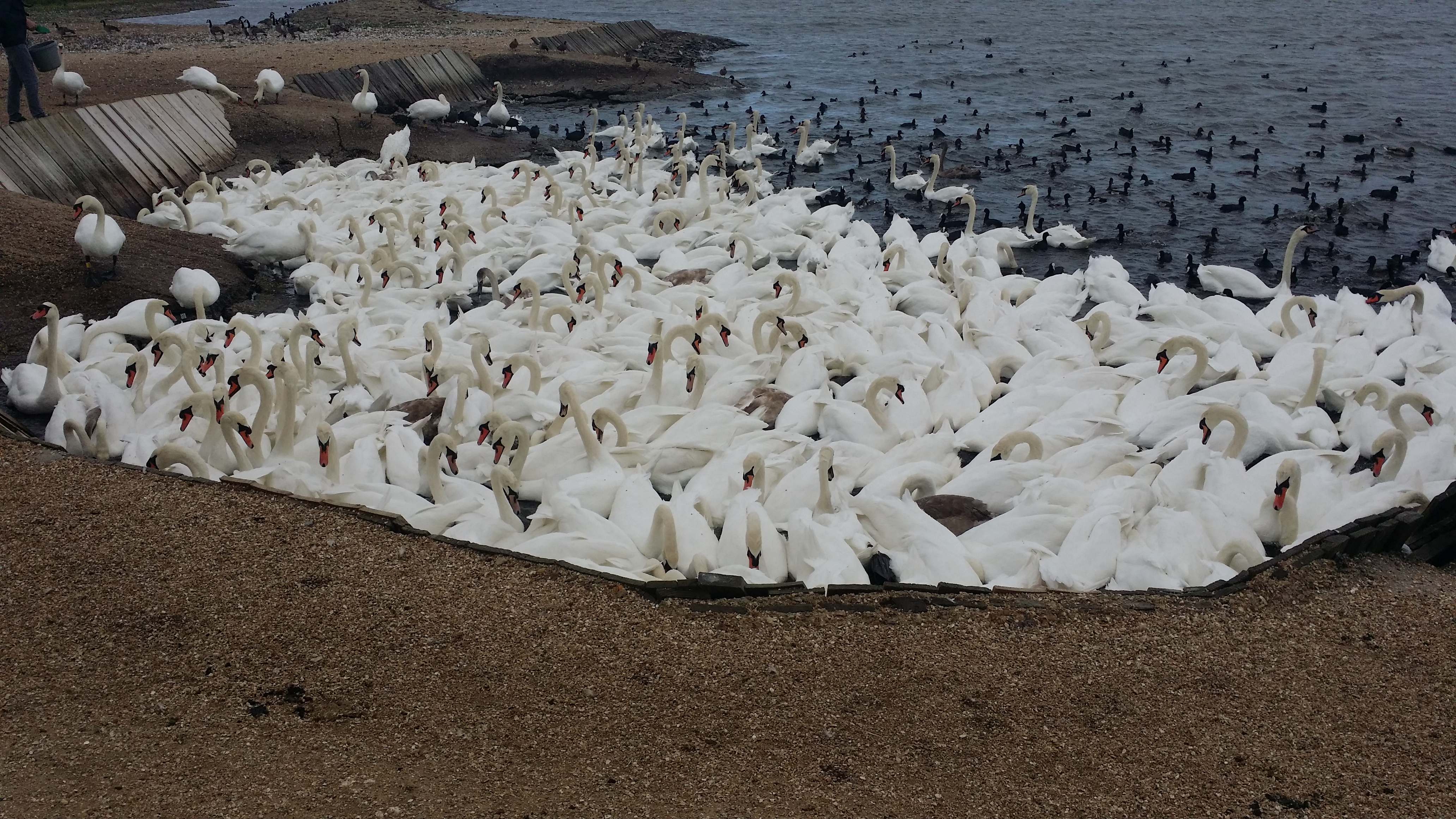
Now I didn’t find that fact on any of the web sites I consulted about Swan Upping. For many years I gave a wonderful programme called Literary Landscapes where we explored lanscapes associated with Jane Austen, Thomas Hardy, Agatha Christie, Conan-Doyle and Charles Dickens. On it, we went to the Swannery at Abbotsbury in Dorset. This was founded by Benedictine Monks in the time of King Cnut. The Strangeways family acquired the Monastery after the Dissolution and still own the Swannery. So they are the fourth authority in the UK who own Swans.
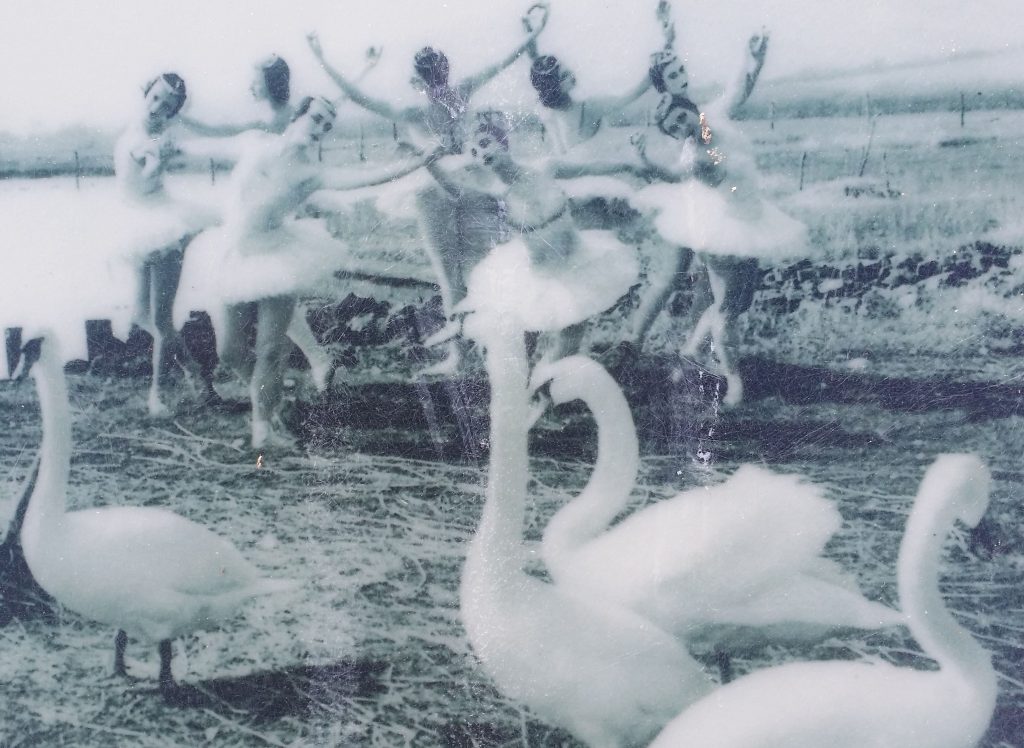
It is a remarkable place, in the heart of Hardy’s Wessex and by the glorious Chesil Beach. Every other year, the Mute Swans are checked and ringed during the flightless period. When Pavlova was working on Swan Lake, she took the dancers to Abbotsbury to observe the behaviour of the Swans.
Photo by the author of a panel at Abbotsbury showing Pavlova’s dancers posing by the Swans of Abbotsbury
Feathers are collected during the moulting season. They are used by Lloyds Registry, the Society of Calligraphers, illuminators, and other scribes for writing-quills. Other feathers are used by the Plummery to make headdresses for the Royal Bodyguard. They are also used for artists’ brushes, brushes for sweeping bees from honeycomb and arrow flights! (Source: panel at Abbotsbury).
Ringing the Swans at Abbotsbury 2018 Photo by Kevin Flude
St. Swithun’s day if thou dost rain For forty days it will remain St. Swithun’s day if thou be fair For forty days ’twill rain nae mare
It’s not just important for the farmer but, even more, for the corn factor, to get the weather right for harvest. So, this bit of weather lore, repeated every year in the media could be important. But the BBC tells us that, since records have been kept (1841) there has been no period of 40 days rain after St Swithuns Day. However, there is some suggestion of a period of stable weather from mid july to the end of August. But, generally, a lot of old nonsense.
St. Swithun was Bishop of Winchester from his consecration on 30 October 852 until his death on 2 July. And very little else is known about him. However, he is the patron Saint of Winchester, and has powers against Drought.
Weather Forecasting and Thomas Hardy
The price of corn is very dependent upon the weather. Michael Henchard in Thomas Hardy’s 1886 novel ‘The Mayor of Casterbridge’ has formed a terrible rivalry with his erstwhile friend Donald Fafrae. He is determined to outdo him in the Casterbridge Cornmarket. He has a hunch about the weather and the price of corn, but needs reassurances. So despite his doubts about the efficacy of prophecy he goes to see ‘a man of curious repute as a forecaster or weather-prophet.’ Henchard is shrouded to protect his identify. He will not stay to take hospitality from the prophet, nor cross the threshold. He masks his face with a handkerchief, as if suffering from a toothache.
However, the prophet knows this strange man is the former Mayor of Casterbridge, much to Henchard’s surprise. Henchard quizzes him. ‘can ye charm away warts?’ ‘Cure the evil?’ ‘Forecast the weather?’ Replying in the affirmative the cunning man takes Henchard’s crown piece and forecasts:
“By the sun, moon, and stars, by the clouds, the winds, the trees, and grass, the candle-flame and swallows, the smell of the herbs; likewise by the cats eyes, the ravens, the leeches, the spiders, and the dungmixen, the last fortnight in August will be – rain and tempest.’ ‘Twill be more like living in Revelations this autumn that in England.’
Henchard buys up grain at the current high price. But is ruined by the fine weather that sets in for an excellent harvest which sends corn prices tumbling.
The Withered Arm
Local folklore was at the heart of many of Hardy’s stories. Perhaps the most dramatic is the ‘Withered Arm’. Gertrude has a withered arm wished upon her by the former lover of her husband, with whom she has an illegitimate boy.
Years pass, and she is still determined to cure her arm. She visits a Casterbridge Cunning Man. He tells her the only cure is to touch the neck of a recently hanged man. So she goes to Casterbridge on a Hanging Day. She makes arrangements with the hangman. Then she touches the neck of the hanged man. There follows an immediate cure. She cannot resist looking at the victim. A young man she recognises as the illegitimate son of her husband.
I first read these stories one after another at a time I was going through a painful period in my life. I remember throwing the ‘Withered Arm’ at the wall shouting ‘Oh Thomas Hardy’ you miserable man.’ It took me twenty years to come back to him, to appreciate his amazing descriptions of life in rural Wessex. The cast of characters struggling to make a place for themselves in a world that was changing beyond all recognition.
For more about Thomas Hardy search the Almanac of the Past for Thomas Hardy, or look at the Skimmity Ride.
Today, is Independence Day. The day that a great democracy came into being and established a rational system of Government, designed to stop autocracy. One of the great thinkers of the US was Henry David Thoreau. He moved into his hut on Waldon Pond on 4th July 1845. He wanted to experience life to the full. He thought he could best do that by living a simple life in the wild.
Some think he was autistic, but his journals and publications show he lived a rich life. His work links observations of nature with philosophic meditations and folk lore. His interest in ecology and avoidance of waste are forerunners of modern environmentalism.
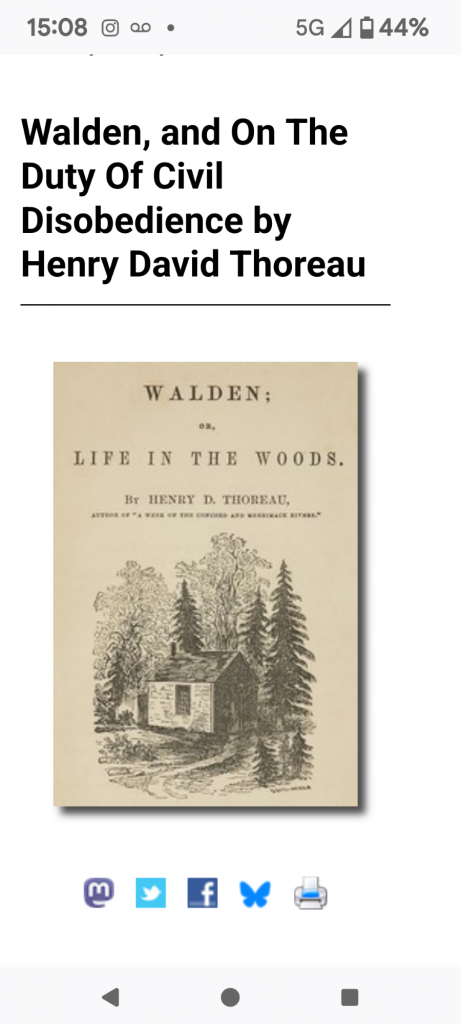
‘Walden’ his book about life in his hut near Concord, Massachusetts is his best known work.
I began to occupy my house on the 4th of July, as soon as it was boarded and roofed, for the boards were carefully feather-edged and lapped, so that it was perfectly impervious to rain; but before boarding I laid the foundation of a chimney at one end, bringing two cartloads of stones up the hill from the pond in my arms. I built the chimney after my hoeing in the fall, before a fire became necessary for warmth, doing my cooking in the mean while out of doors on the ground, early in the morning: which mode I still think is in some respects more convenient and agreeable than the usual one. When it stormed before my bread was baked, I fixed a few boards over the fire, and sat under them to watch my loaf, and passed some pleasant hours in that way. In those days, when my hands were much employed, I read but little, but the least scraps of paper which lay on the ground, my holder, or tablecloth, afforded me as much entertainment, in fact answered the same purpose as the Iliad.
Thoreau and Civil Disobedience.
From Project Gutenberg. Thoreau was also a principled opponent of unjust laws. He inspired Gandhi, amongst others, in the principles of Civil Disobedience. He was imprisoned for refusing to pay tax to the American state in protest at the African-American War and Slavery. He supported John Brown.
Project Gutenberg page of Thoreau’s ebook.
John Brown’s Body lies a mouldering in his grave.
Brown believed that slavery would only be ended by fighting to liberate the slaves. He was involved in the State Civil War in Kansas. Subsequently, he then launched a raid on Harper’s Ford, which caused several deaths. Brown was found guilty of Treason against the Commonwealth of Virginia and executed. He was the first American to be found guilty of Treason. But Thoreau supported him, while other Abolitionists took a more pacifist position.
All in all, he is therefore an inspiring character. His life can inform that still tricky debate about challenging injustice in the modern world. Attitudes to ‘Just Stop Oil’ and the war in Gaza are causes where the same issues are still open to debate.
‘They that wive twixt sickle and scythe shall never thrive’
The time between haymaking and the corn harvest was such a busy period, that it was considered a bad time to marry. Haymaking was done by hand with a sickle, these were swung at an angle to cut the grass. It was easier if a good rhyme could be set up. The first man would step out in to the meadow but the next man had to leave a little gap to ensure he was safe from his fellows swinging sickle.
Apparently, the song ‘One Man went to mow, went to move a meadow’ gives the right gap, the second man would come in with the next line ‘Two Men went to mow, went to move a meadow’ and so on.
Once cut, the grass needed to be dried out in the fields, and turned every so often with a pitchfork. Once dried, it was taken to the farmyard and the hay built into a hayrick. The rick typically had a thatched roof. The hay, normally made of a mixture of grasses, was cut off from the rick by a hay knife to fed to animals in the winter.
Experiments at Rothamsted Park Grass, in Hertfordshire, have allowed scientists to study the effects of annual hay cutting. This study has been in continuous operation since 1856 which makes it the oldest continuous field experiment in the world. Among the many findings is the counterintuitive discovery that when fertiliser was evenly applied, the number of plant species declined from forty to fewer than five. Here is an article on Rothamsted Park Grass which gives interesting details.
If you wish to grow your lawn to increase biodiversity and to make it wildlife friendly, then read this is article. It is very important that we revive our battered wildlife. 97% of the UK’s semi-natural grassland has been destroyed over the last 80 years says ecologist Jack Marley.
July Haymaking from the Kalendar of Shepherds 15th Century
First published in June 2023, and republished in July 2024.
A gentle midsummer reminder of our place in the universe – source Facebook post.
Midsummer Solstice is the 21st of June. The Celtic version begins when the Celtic Day begins. This is at dusk on June 20th, which we would call Midsummer’s Eve. Midsummer, astronomically, begins on 21st June. But, meteorologically speaking, it has been here Summer since the beginning of June.
Midsummer is a fire festival, dedicated to the Celtic Fire God, Belinus. His name might mean Powerful One or Shining One, and he is linked to Apollo, one of the Greco-Roman Sun Gods. His main festival is Beltane, May Day, but many of the attributes of May celebrations and indeed Halloween celebrations are also carried out at Midsummer. (See my post on May Day)
In the early medieval period, the Church hijacked Midsummer’s Day and transferred it to June 24th. St John the Baptist’s Day. John was born 6 months before Jesus. John Aubrey in the 17th Century writes:
‘Still in many places on St John’s Night they make Fires on the Hills: but the Civil Warres coming on have putt all these Rites or customes quite out of fashion.’
The lark at heaven’s gate sings, And Phoebus ‘gins arise, His steeds to water at those springs. On chalic’d flowers that lies; And winking Mary-buds begin To ope their golden eyes; With everything that pretty is, My lady sweet, arise: Arise, arise.
Cloten Scene III Cymberline. William Shakespeare
Or words for a Druid watching the Sun rise?
Arise, O Sun! Let the Darkness of Night Fade before the beams of your glorious Radiance
Uncanny Summer
To prepare for Midsummer, remember that it is, like Halloween, an uncanny period. Hobgoblins, Fairies and Sprites, are, as in Shakespeare’s Play, Midsummer’s Night’s Dream, all abroad making mischief. Like May Fires, Belinus’ fire should be made from wood donated from all farms in the area, and using a range of trees. Ideally, collected by 9 men and from 9 different trees. Blazing branches should be carried sunwise around the fields to bless the crops, and it was good luck to jump over the ashes of the fire.
St John’s Wort
First in the line of defence against the infernal is St John’s Wort, known as Chasse-diable, Demon Chaser, Fuga Daemonum (amongst many other appellations). It was used to keep demons away, and to exorcise haunted houses. John Aubrey in ‘Miscellanies’ talks about a haunted London house which was cured by a Doctor who put St John’s Wort under the pillow of the bed. Bankes Herbel 1525 says:
Sedum_telephium by Bernd Haynold wikipedia
‘The virtue of St John’s Wort is thus. If it be put in a man’s house, there shall come no wicked sprite therein.’
Vervain, yarrow, corn marigold, and orpins were also used, often woven into garlands, and hung around the necks of cows, or on door lintels as protection. If the St John’s Wort withered, the picker was to die or at least endure disappointment. If orpins entwined themselves on Midsummer’s Night, marriage would follow. Orpine, (Sedum Telephium) aka Live Long, or Life Everlasting was valued for the length of time it remained fresh after being gathered. Medicinally, it was considered good to use outwardly to cool scaldings, inflammations, and wounds.
St John’s Wort has a reputation for helping with depression, menopausal symptoms, ADHD, anxiety and other conditions.
A girl seeking love should walk around the Church seven or twelve times (accounts vary!) at midnight scattering hempseed, and singing:
Hempseed I sow Hempseed I hoe Let him that is my true love Come after me and mow
In the South West of England, there was a custom to watch the church porch on Midsummer Evening. This was when the spirits of all the living people of the village could be seen entering the church. Those not seen coming out again would surely die, as would any watcher foolish enough to fall asleep.
Thanks to the ‘Customs and Ceremonies of Britain’ by Charles Kightly.
First written in June 2023, and revised and republished in June 2024, and 2025
This post sprang from something that my grandson said to in the middle of the park. He was curious as to why I was concerned that the park toilets were out of action. He told me I could, like him, just pull down my trousers and wee, right here, right then, up against the tree in the park. My attempt at explanation drew a perplexed, ‘What?’ ‘What?’ is his new word. After an explanation, his next word is invariable another ‘What?’.Hopefully the relevance of this will become apparent.
May and June are the most prolific months for dandelions, which used to be known as ‘piss-a-beds’. They are diuretic and were often eaten, and so might well have consequences for the young trainee child.
John Hollybush in his 1561 ‘The Homish Apothecary’ says:
‘When a young body does piss in his bed either oft or seldom: if ye will help him take the bladder of a goat and dry it to powder, and get him to drink with wine, or else take the beans or hinder fallings of a goat, and give him of the powder in his meat morning and evening, a quarter ounce at every time.’
(quoted in ‘The Perpetual Almanac by Charles Kightley)
Hinder fallings are what falls out of the hind-quarters of a goat. I’m not sure even an indulgent Grandparent is allowed to give droppings and wine to the little ones. Nor can I find any mention of goat products in modern medical recommendations. So I won’t be recommending this as a practical aid.
Medically, dandelions were very well regarded. Mrs Grieve’s ‘Modern Herbal’ reports that it are diuretic and a general stimulant to the system but particularly the urinary system. They were good for liver and kidney complaints; gall-stones; and piles. They were considered excellent to eat and drink. Particularly, dandelion sandwiches using young leaves, with salt, pepper, and lemon juice. They were also taken in salads, teas, and beers.
We used to blow the seeds from the dandelion seed head saying ‘She loves me. She loves me not’ at each blow, until the truth was revealed.
First written in June 2023, revised june 2024,2025. Rewritten 2025