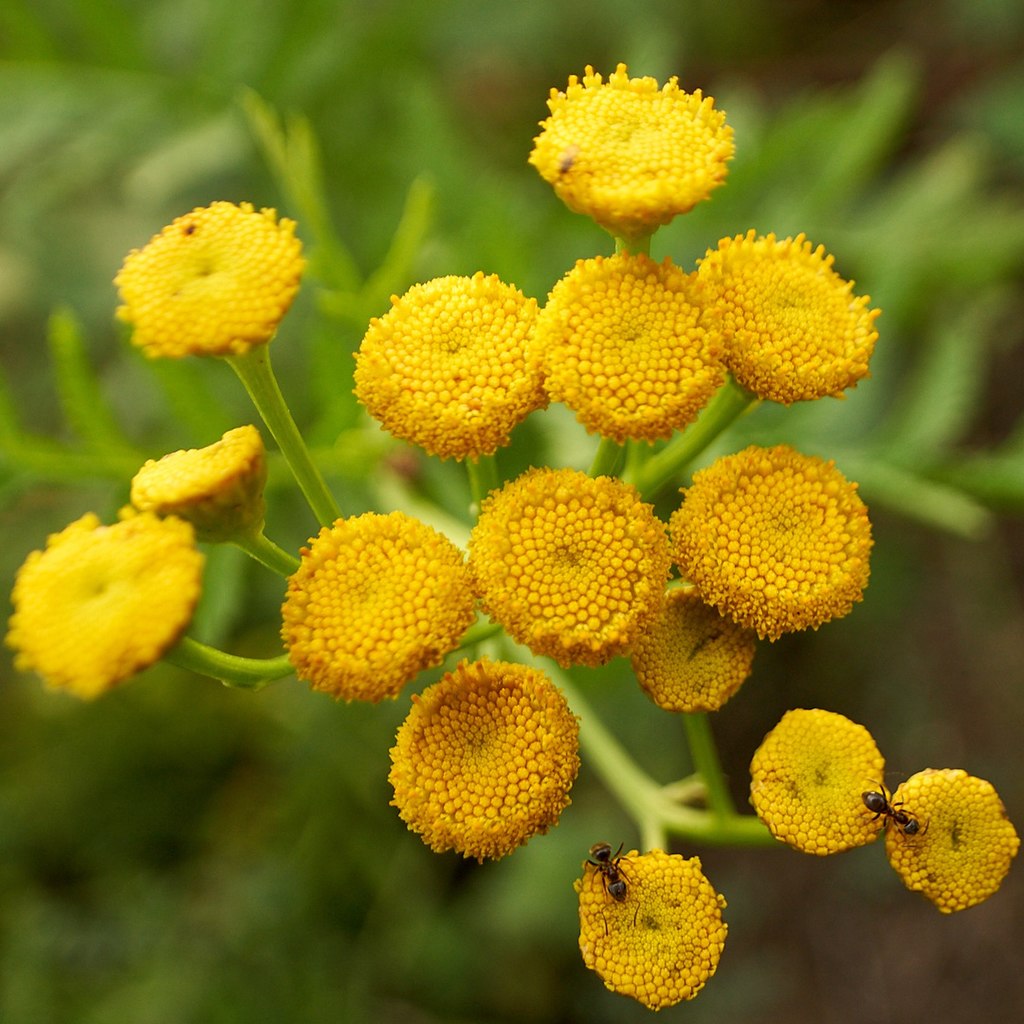
Spring is time for a tansy, so time to bring out again the many stories behind this awesome plant. The tansy not flowers display a classical Fibonacci spiral, which is two counter-rotating logarithmic spirals.
Mrs Grieve in her Modern Herbal repeats the belief that their name derives from the Greek word for immortality ‘Athanaton’. This might be because they grow so well that in some areas they are proscribed they are so prolific. But Tansy was supposed to have been given to Ganymede by Zeus to make him immortal. And, they were used for preserving dead bodies from corruption. So, Tansy was placed in coffins and winding sheets and tansy wreaths placed with the dead.
Its toxicity means that it repels many insects, particularly, flies and ants, and so it was used as a medieval and early modern strewing herb. And yet there are other insects that love Tansy – it seems to have a dark side and a light side.
It was collected in August (along with meadowsweet or elder leaves) and strewn on the floors of houses (and the ‘thresh’ was held in by the threshold). But it was also placed between mattresses to keep away bugs. People rubbed meat with Tansy to keep flies off. It is now used as a natural protection for crops from insects to reduce the amount of artificial pesticides.
It was an important medical and culinary herb, said to be a substitute for nutmeg and cinnamon, and the leaves, shredded, as a flavouring for puddings and omelettes. At Easter ball games a Tansy Cake was the reward for the winners. It was symbolic of the bitter herbs eaten by the Israelites at Passover. Tansy was thought to be a very wholesome ingredient to eat after the sparsity of Lent and Winter, and voiding the body of the worms caused by eating too many fish. It was used for expelling worms from the stomachs of children.
Interestingly it contains thujone, which is also in Wormwood, the other main herb for expelling intestinal worms. Thujone can cause convulsions, liver and brain damage if too much is taken.
In the 14th Century it was used for treating wounds. It was thought to be useful both to induce abortions but also to help women conceive and to prevent miscarriages. Culpepper and Gerard suggests the root was a cure for gout.
Here is a recipe from the ‘The Closet of Kenelm Digby Opened‘ 1669. It was essentially a form of omelette. I would not try the recipe! In the BBC documentary “The Supersizers go … Restoration“, Sue Perkins suffered from the effects of the toxic tansy.
A TANSY (Do not try this at home!)
Take three pints of Cream, fourteen New-laid-eggs (seven whites put away)
one pint of juyce of Spinage, six or seven spoonfuls of juyce of Tansy, a
Nutmeg (or two) sliced small, half a pound of Sugar, and a little Salt.
Beat all these well together, then fryit in a pan with no more Butter then
is necessary. When it is enough, serve it up with juyce of Orange or slices
of Limon upon it.
Sir Kenelm Digby was a Catholic and a natural philosopher of some reputation. After his death an employee published his cookery book. His father was executed after the Gunpowder Plot, and he supported Charles 1st but found a way to work with Oliver Cromwell.
He made a great success of his idea of the ‘powder of sympathy’ – 29 editions of his book on the subject were sold. He found the powder in France and it was made with precise ‘astrological’ techniques. The most famous example of a suggested application for the powder was to win the competition for a method of working out longitude (in the 18th Century). Basically, a working method meant knowing the time, normally noon, in two different places. This allowed a triangle to be created between the two points and the Sun which allowed the distance between the two places to be discovered by triangulation. Clocks were not accurate enough (yet) to help so Digby’s famous powder of sympathy was suggested.
This is the method:
A wounded dog would be taken on board a ship, and a bandage from the wound would be left in London. At noon in London it would be sprinkled with the powder of sympathy. The dog on the ship would, perforce, yelp when the powder was administered on the bandage in London and so the Captain would know when it was noon in London! Digby was long dead when the application for the prize money was made and rejected.
‘Longitude’ by Dava Sobel tells the story of the discovery of a clock-based method of calculating longitude.