Rodmas – Rood screen in St. Helen’s church, Ranworth, Norfolk by Maria CC BY-SA 3.0
Rood is another word for the Cross. Parish Churches used to have a Rood Screen separating the holy Choir from the more secular Nave. This screen was topped with a statue of the Crucified Jesus nailed to a Rood. So, Roodmas, is the festival of the Holy Cross. Roodmas is celebrated on May 3rd and September 14th, although the Church of England aligned has itself with the Catholic Church’s main celebration on September 14th.
See my post on September 14th here for more on the True Cross.
The Shropshire News reported that two pieces of the True Cross were given to Charles III by the Pope! They have been put into a cross called the Welsh Cross. This was part of the Coronation Procession. The King gave the Cross (I assume with the pieces of the Holy Cross) to the Church in Wales. Let the Shropshire News tell the story:
It is a clear reminder that we are subjects not citizens and news, as a nation, we still set store by superstitions.
The Duke of Buckingham and the True Cross
The Duke of Buckingham had a piece in his collection, which he kept at York House in the early 17th Century. How he got it, I don’t know. But I think he must have acquired it from the aftermath of the destruction of the Reformation. John Tradescant, who looked after the Duke’s collection until Buckingham was murdered, had a piece of the True Cross. Tradecant created Britain’s first Museum, Tradescant’s Ark. Again, I suspect (without any evidence) that he got the fragments from Buckingham. Did he acquire it after the murder? Or shiver off a timber fragment hoping no one would notice?
First Written on May 3rd 2023, revised May 3rd 2024, and 2025
St Alphage. Church Tower on right, City Wall to left. Photo K Flude
I first came across St Alphage when I was working at the Museum of London. The Museum was built on the High Walk at London Wall. The raised Courbusian Walkway looked down on a ruin of a Gothic Church Tower, almost destroyed during the Blitz. This was St Alphage, a Church dedicated to the Saxon Archbishop of Canterbury. (Alphage is also spelt Alphege or Alfege).
On the other side of the Walkway was the old graveyard of the Church. This preserved one of the very best sections of the old London Wall. Special because on one side its huge height was displayed. On the other, the only crenelated bit of the City Wall. And the only surviving part of the Wall dating to the War of the Roses.
St Alphage Roman and Medieval WallThe Crennelated Red Brick Section dates to 1477, during the War of the RosesSt Alphage Wall explained on an information plaque.
In the 1980’s fellow Museum of London Archaeologist, Paul Herbert and I set up a Guided Walks company (Citisights of London) . Our walks started from outside the Museum of London, and so St Alphage formed a big part of our success. It led to a life giving Guided Walks and tours. So, St Alphage, thank you!
A Citisights Day Tour of the 1980s
St Alphage Elsyng Spittle St Mary ?
The Church was previously a monastic settlement called Elsyng Spittle (aka St Mary within Cripplegate). The Augustinian Canons looked after 100 blind men. It was refounded by Williain Elsing, and dissolved by Henry VIII in 1536. The Church was kept for a Parish Church. But the Puritans were not keen on dedications to St Mary. So, they renamed it after a London based Christian Martyr.
It remained a Parish Church until damaged in an air raid in World War One. (possibly on 8th September 1916 in a Zeppelin Raid – but I am speculating). The Church was partly demolished in 1923, leaving the Tower. The lower part of the Medieval Tower survived bombing in the Blitz. At 12.15 am on 25th Aug 1940, the first bombs on the City of London fell nearby in Fore Street. But the tower was hit in 1940. It was listed Grade 1 in 1950. Kept by the rebuilding of London Wall, and the Barbican area. Then substantially benefitting from a remodelling of the area in an excellent scheme of 2022.
St Ælfheah of Canterbury and Greenwich
StAlfege Greewich – Doyle own work Wikipedia CC BY-SA 4.0
St Ælfheah was captured during a Viking attack on Canterbury. The Viking hoard relocated to Greenwich where they tried to negotiate a fat ransom for him. He was one of the richest men in the Kingdom. This is what the Anglo Saxon Chronicle says:
.. the raiding-army became much stirred up against the bishop, because he did not want to offer them any money, and forbade that anything might be granted in return for him. Also they were very drunk, because there was wine brought from the south. Then they seized the bishop, led him to their “hustings” on the Saturday in the octave of Easter, and then pelted him there with bones and the heads of cattle; and one of them struck him on the head with the butt of an axe, so that with the blow he sank down and his holy blood fell on the earth, and sent forth his holy soul to God’s kingdom.
St Alfege Greenwich, which is now a lovely Hawksmoor Church is said to be on the site of St Ælfheah‘s death.
St Alphage’s body was taken to St Pauls Cathedral where it was venerated. His remains were removed in suspicious circumstances by soldiers of King Cnut who translated the Saint’s bones to Greenwich. It is suggested King Cnut was punishing London for their opposition to him.
The Minotaur by Michael Ayrton
Also, part of the experience of visiting St Alphage from the High Walk was the statue of the Minotaur. I first came across this phallic Bull in the Postman’s Park and am very fond of it. Then it disappeared and reappeared on the High Walk. Now it is on the ground level near in the garden of St Alphage.
I understand that Michael Ayrton wanted to make a point about the destruction of London. He felt that the developers were more destructive than the Luftwaffe. They were like a Bull in a China Shop! So he created this statue of a very vigorous Bull representing the Minotaur. It is a very unusual work of art in that it sports a fully erect penis. Art History is full of naked women, but the male organ is largely left to pornography. For more about Ayrton follow this link.
The Minotaur in its present positionThe Minotaur on the High Walk
Sementivae, was a festival dedicated to seed and to Ceres. Ceres is an Earth Goddess who gives her name to our word cereal. The festival was also called. Paganalia. The Mediterranean world had many names for the Earth Goddess. Tellus, Demeter, Cybele, Gaia, Rhea etc..
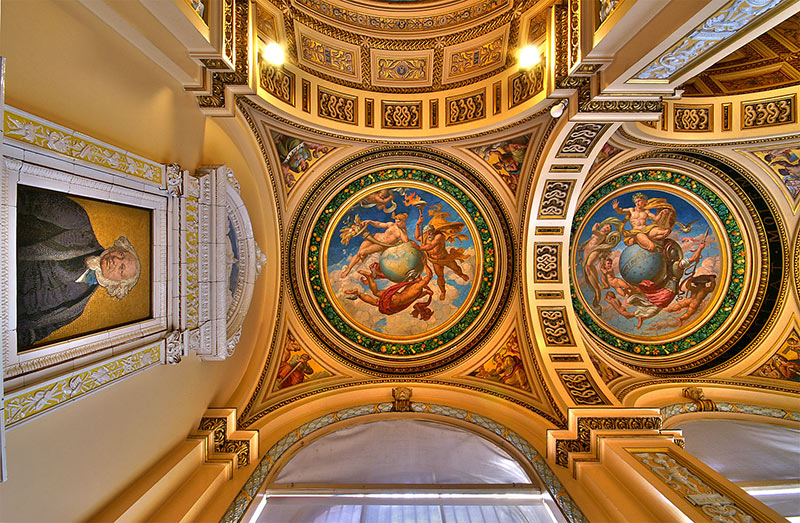
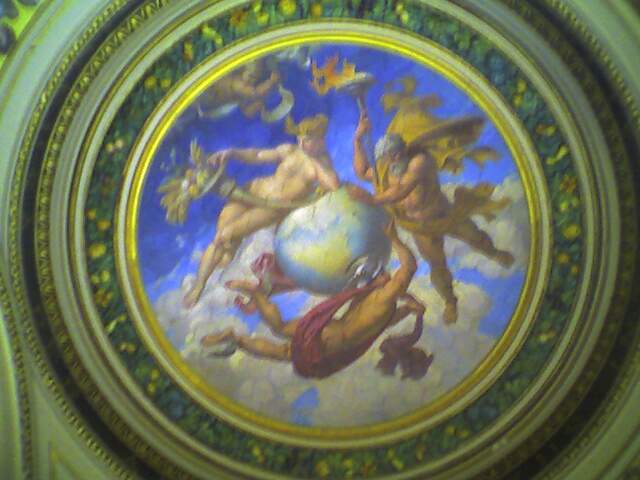
Ceres can be seen on the top left roundel resting on the Globe on the marvellous Ceramic Staircase at the V&A (photo above). And in my slightly out of focus photograph below. (To be honest, in real life, it looks a little more like my photo than the gorgeous photo above!)
Ceres represented Agriculture, Mercury Commerce, and Vulcan Industry. Old Photo by the Author.
Sementivae Dies – a moveable feast.
To create life, we need earth and water to nurture and seeds for fertility. And so into the cold dead world of January the Romans created a festival of sowing. It had two parts, one presided over by Mother Earth (Tellus) and the other by Ceres, the Goddess of Corn. The actual day of the festival was chosen not by rote on a set day of the calendar but by the priests, in accordance with the weather. This seems very sensible, as there is no point sowing seeds in terrible weather conditions. I’m assuming the Priests took professional advice!
On the 24th-26th January Tellus prepared the soil, and in early February seeds were sown under the aegis of Ceres. Tellus Mater (also Terra Mater) was known as Gaia to the Greeks.
Gaia
Gaia was selected by James Lovelock & Lynn Margulis in the 1970s as the face of their Gaia hypothesis. To me, the importance of the idea is not the scientific principle that environments co-evolve with the organisms within them. But, rather in Gaia as a personification of our world as a complex living ecosystem. One that we have to care for. Gaia exists as a series of feedback loops. Lovelock hypotheses that she will spit us out unless we can live in balance with our alma mater.
Ovid and Sementivae
This is what the Roman Poet Ovid has to say in his poetic Almanac known as ‘Fasti’ (www.poetryintranslation.com)
Book I: January 24
I have searched the calendar three or four times, But nowhere found the Day of Sowing: Seeing this, the Muse said: That day is set by the priests, Why are you looking for moveable days in the calendar? Though the day of the feast ís uncertain, its time is known, When the seed has been sown and the land ís productive. You bullocks, crowned with garlands, stand at the full trough, Your labour will return with the warmth of spring. Let the farmer hang the toil-worn plough on its post: The wintry earth dreaded its every wound.
Steward, let the soil rest when the sowing is done, And let the men who worked the soil rest too. Let the village keep festival: farmers, purify the village, And offer the yearly cakes on the village hearths. Propitiate Earth and Ceres, the mothers of the crops, With their own corn, and a pregnant sow ís entrails. Ceres and Earth fulfil a common function: One supplies the chance to bear, the other the soil. Partners in toil, you who improved on ancient days Replacing acorns with more useful foods, Satisfy the eager farmers with full harvest, So they reap a worthy prize from their efforts. Grant the tender seeds perpetual fruitfulness, Don’t let new shoots be scorched by cold snows. When we sow, let the sky be clear with calm breezes, Sprinkle the buried seed with heavenly rain. Forbid the birds, that prey on cultivated land, To ruin the cornfields in destructive crowds. You too, spare the sown seed, you ants, So you’ll win a greater prize from the harvest.
News from the Almanac showing readership/viewership of the site.
I have been waiting for a day when I haven’ t got a post to publish. Why? To update readers about the Almanac of the Past. And with a bit of manoeuvring today is the day.
What is the News from the Almanac of the Past?
The plan is to have a post for each day. I am virtually there for November to March, but a way away for the warmer months.
In the winter months, I have been revising, improving, developing and adding content to previously published pages. For those of you who have been here a while, you will have been receiving posts you have seen before. Next year, you might be seeing some for the third time. I’m not sure what to do about this except improve posts and add content. But I am considering stopping automatically posting repeated posts to subscribers. Maybe from next November? Feed back would be good – please email me at kpflude at chr . org . uk (I’ve slightly scrambled the email to stop the robots).
What is the planned content for the Almanac of the Past?
The nature of an almanac is to be a pot-pourri. They are about seasons, time, folklore, history, important events, and anniversaries. I also like to cover history, famous people and discoveries. Gods, Goddesses, Saints, sinners, and archaeology. What I want it to be is something that makes us more mindful about the passing of the year. How seasons and time change the way people see their world. My focus is mostly on the UK, but also on Rome and Greece. With occasional excursions to other places. I am trying to find more content that is London-based, but not to the exclusion of everything else. I also have an ambition to add more important news of discoveries that change our view of the past. If I get the formula right, I will attempt to get a publication from it, otherwise it will remain online.
Developments for the Almanac
It takes quite a lot of time for me to keep it up. You will see, from the graph above, that the readership is yearly making progress. Particularly, last year. But then it’s a steady progress from a small base, rather than Kardashian viral.
This is, at least, partially because I would rather not spend my time marketing. I want to be writing. But, I have decided I need to spend a little more time marketing the site. When I ran the Old Operating Theatre Museum, I had the skills to get our web site to first place on google searches. But this was in the pioneering days of the World Wide Web. Now, it’s more difficult, but I am taking a ‘Search Engine Optimisation’ (SEO) course. I have also loaded some ‘plugins’ to WordPress which help with SEO. I thought you might be interested in some of the consequences.
The plugins ‘parse’ the site and give recommendations for improvements. This should, get the site further up the Google landing page. I have no doubt that it involves or will involve AI. The ‘Yoast’ plugin I am using as I type this, tells me words like ‘however’ are a ‘complex’ word and so they down grade my ‘readability’ quotient. It also tells me that that last sentence was too long. So, it wants simple sentences, and words that join sentences together. And not too many sentences in a paragraph and a proper scattering of headings.
It also assesses the SEOness of the text. So I have to tell it what the main subject of the page is. And it wants that word or phrase in:
the title: the first paragraph the image the meta description tag and scattered, but not too densely (because Google will punish the site for playing the algorithm) through the text.
Hence, you will see the phrase ‘News from the Almanac’ scattered more than I would normally like through this text. Of course, I know no one really will be searching for ‘News from the Almanac. So I should change the SEO phrase just to Almanac. But, then I’m not really interested in attracting non-readers to this page. I see this as between me and my email subscribers!
After writing that paragraph I realised that I would want people to land up here if they typed in ‘Almanac of the Past’. So you will see, I’ve editing the text scattering that phrase here and thereabouts.
In effect, I am being trained by a slightly stupid tutor who has no particular understanding of the needs of a writer of history! And you can’t answer back, you just get downgraded!
And it seems to be working as my numbers are getting better more quickly.
Any problems for the Almanac of the Past?
Obviously, my terrible proofreading is a concern! Maybe that’s one-way republishing helps. A year later, it’s easier to see the typos, the ugly writing, and issues with the content.
But there is another issue with the emails, which I have been trying to solve for about 6 months. The links in the emailed posts don’t work. But they do work if you visit the almanac on the web. This is nuts as I always use the full URL. For example: https://www.chr.org.uk/anddidthosefeet/december-29th-st-thomas-wassailing/.
So, this is very much a technical issue, one might say a bug in the system. I think it stems from the fact that my blog was stored not in https:/public_html/ but in https://public_html/anddidthosefeet. This seemed a logical choice at the time, as the blog shared space with other things. I haven’t managed to convince the tech guys at either the internet provider or WordPress that this is a bug. So, the alternative is to move the blog. But I am reluctant to do this in case it completely messes everything up.
Change the content of the newsletter, you might think. But I can find nothing that allows me to alter or add anything to the email version of the post. As I write this, I think I will temporarily add a line at the bottom of the post which says:
if the links are not working, copy and paste this URL https://www.chr.org.uk/anddidthosefeet/whateverkevinsalmanacpageiscalled
to your browser. This, will get you to the Almanac of the Past on the web where all the links will work.
And this will allow you to easily copy or link to the webpage and send the Almanac of the Past to your friends and followers. (I’m hoping you are Taylor Swift). You willalso be able to comment easily and maybe even like the post?
Another advantage of visiting the web version is that you get a better version to read. This is because I often find howling typos when I read the emailed post. I correct them, with a red embarrassed face.
If you are reading this on the web, then all the above must have been very annoying to read! Maybe I will move it down to the bottom of the post! (which I did).
Trying new things on the Blog
Do you want to make a comment?
Please leave me a comment – its great to hear what you think.Cancel reply
In order to clear January 22nd I moved the previous January 22nd post to December 10th. As its all about Mulled Wine, Glugg, and Gluwein., its better at the beginning of the Christmas Season than in late January.
To see it click here: or cut and past this url https://www.chr.org.uk/anddidthosefeet/january-22-22-time-to-mull-it-over/
I also didn't tell you Monday was Blue Monday because I had already sent you one post on the 20th. So this is the Blue Monday Post. https://www.chr.org.uk/anddidthosefeet/january-13th-18th-blue-monday-wolf-moon-start-of-lambing-and-twelfth-night-old-style/
There are plenty of people who believe that eclipses can be predicted by Stonehenge. And it certainly can be used that way, but this doesn’t mean it was. A series of stones, and posts in concentric circles with sight lines to innumerable features on the horizon offers many ways of making calculations which combined with observations over a long period COULD predict, predictable celestial phenomena. Doesn’t mean they were. So it is very difficult to say what they were capable of, and only the most obvious alignments can be certainly confirmed.
This Washington Post article below suggests the Loughcrew Cairns near Dublin were built about the time of a total eclipse, and that one of the stones with complicated carvings on may show a lunar eclipse. If you look at the sketch of the stone above, you will see the biggest circle, near the middle, may represent the moon, and it obscures the circle behind it which may represent the sun. Read this for the details: https://www.washingtonpost.com/news/wonk/wp/2017/08/18/this-5000-year-old-stone-carving-may-be-the-worlds-first-drawing-of-an-eclipse/
What is striking is how can they say it was built around the time of a total eclipse and make that seem significant because there is no way archaeological dating is accurate enough to give any idea whether it was built for a particular day. Also, there are many more circles and objects on the large stone, and to pick two out to prove what you want it to prove, is not proof. We are left with the intriguing possibility, but it is no more than that.
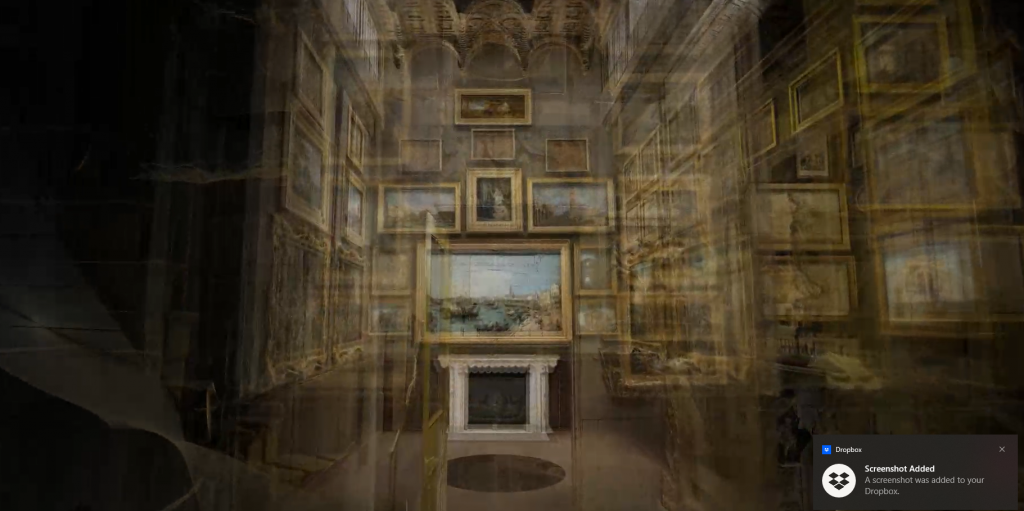
Screen Shot of the Virtual Tour of the Sir John Soane Museum
The Sir John Soane Museum is my second favourite London Museum. It’s the place I choose to take people who don’t know London. What I like about it is the atmosphere. It’s not a place I go because of the collection, it’s a place I go because I’m just awestruck when I enter the doors.
Architect Soane, made a Museum of his house, filling it with architectural and sculptural pieces but also some stupendous Art, particularly paintings by William Hogarth. But that isn’t my motivation to keep going back. It’s the Picture Room (and the domed ceilings). Soane had a great collection of paintings, but not enough walls. What he did was to design the Paintings Room. When you visit you go in, admire the paintings on the wall, and the attendant comes in, opens a shutter, and behind the great paintings are another wall of great paintings. And then he opens another set of shutters, and there, is another feast for your eyes.
Now, they have made high quality digital images of the rooms, and put them together using photogrammetry into a digital model which you can explore.
So, feast your eyes on it here: (choose Picture Room from the three options).
It’s not quite as user-friendly as it might be. Firstly, when the tour delivers you to the Picture Room, you have to take over control to go in and explore the 360 degree image of the room. Unfortunately, the pictures are not clickable, so you cannot get information about them from here. Also, the ‘hot spots’ which allow you to open the shutters, only reveal themselves, on my computer, if you approach them at a certain angle.
But don’t let this put you off, I’m sure you will find your way around. So go into the Room, look around, move the cursus, and you will see little signs pop up which open and close the shutters. Really, do try it! There are a couple of other rooms to explore too.
Oh, and the Dome Ceilings? Soane was a specialist in buildings that didn’t want windows in normal places. He was the architect of the Bank of England where windows in the walls were a security risk, and also of London’s first purpose built art gallery – the Dulwich Picture Gallery. Windows reduced the space for paintings, so he designed special low domed ceilings, and the Soane Museum is full of his experimentation in the form.
Scara Brae Three D Model
Another delight is the 3D model of Scara Brae which allows you to explore the Neolithic village, and walk around it. There are labels on this one, so you do get information too.
360 Degree Panorama Virtual Tours. My part in their development.
I was an early adopter of this form of virtual reality, setting up virtual tours of the Old Operating Theatre Museum in the 1990’s. I have a draft post of this which I have been awaiting time to finish, which I hope to finish soon….
Thanks to the Museum’s Journal article on Photogrametry of May/June 2022 for the two examples above.
You may have been following my ramblings on my attempts to work out Amsterdam’s history from maps and tramping the streets. But you might want to find out more about the History of Amsterdam from your armchair. So, this is my exploration of virtual Amsterdam. But bear in mind the ideas here can be used in any town exploration.
But if you have only a little time, here are my best tips for exploring Amsterdam online.
First, below is a very good 15 minute introduction to Amsterdam history on YouTube.
Encyclopedia Britannica | Britannica – https://www.britannica.com/place/Amsterdam
I quite often edit Wikipedia pages when I come across entries which are out of date or wrong. The quality of information can be variable but mostly its good. And reading the Amsterdam Page, as long as you are prepared to follow up some of the hypertext links, such as to the ‘Canals of Amsterdam’ or the ‘Defence Line of Amsterdam’ you can get a good idea of the history. But Wikipedia, however great for humanity, is none-the-less aspiring to be an encyclopedia, and not either literature, travel-writing, non-fiction nor entertainment. It is certainly not a virtual tour, and it takes quite a lot of timeto get a good overview of the City and it is not really something I ever do for ‘enjoyment’.
Encyclopedia Britannica has been published exclusively online since 2016 and it is a better read than Wikipedia, less rambling and more to the point. Definitely a better starting point, but still a long read, and, again, something I can’t remember reading with pleasure.
YouTube
There are a number of video lectures/talks/tours on YouTube for free and I will just mention a few – please let me know if you find anything else interesting and I will add it here.
I’ve already linked to the 15 minute ‘A Quick History of Amsterdam (That Dam Guide), which is well put together and gives a good summary. Not enough about the walls in my opinion, and probably a little too much about the major drivers of historical change and not enough about the specific details of what made Amsterdam the town. That is probably asking too much for a 15 minute introduction. And, in effect, this guide is an advert for ‘That Dam Guide’ and the author’s guided virtual tours. He does live streamed 1 hour Amsterdam Tours (none on in March) Very good production values too.
Searching for ‘Amsterdam Virtual Tour’ brings me to the: The Amsterdam Drone Tour which gives a largely drone-eye view of Amsterdam, with slightly annoying music and not enough captions to really feel you are getting to know streets, areas and districts, but it does give an interesting ‘overview’. It is 9 minutes long.
A Free Virtual Tours Amsterdam is an interesting intro to Amsterdam in two 5 minute videos. It does give you some more of, what I would call, ‘structural’ analysis of the history and development of Holland/Amsterdam. It is, to an extent, complimentary to ‘That Dam Guide’. I should not be mentioning it as the ‘Free Walks’ groups are deadly rivals to ‘London Walks’, who I do my walks for. We have a fixed fee for a professional guide, while the Free Walks say they are free but put a lot of pressure on to get customers to pay up a reasonable amount (or so we think!).
Another ‘Tips based’ guide on YouTube is Tim, who gives a 20 minute free walking tour. This one is more of a real virtual walk, as it is a filmed guided walk, with all its imperfections. But, very good in terms of authenticity.
Google Earth
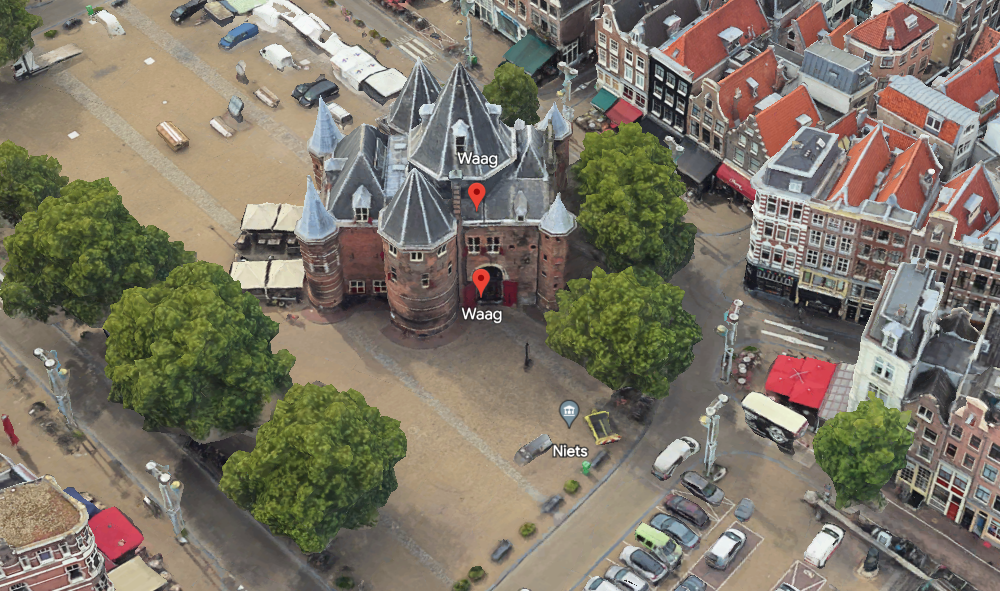
This uses the Google Earth satellite view of Amsterdam, with pins marking many, but by no means all, places of interest. Each place has a little information, and often, a link to Wikipedia. Clicking on the ‘more information’ tab brings up further, and sometimes an extensive number of pictures. There is also a paper aeroplane tab, and this brings up a virtual fly-past which is fun. I was looking for a tab for the Waag, which is one of the remaining gates of old Amsterdam, but I cannot find a tab for it. Nor a search button, which hinders the usefulness of the system. But it is definitely fun!
I have just gone back to Google Earth, found the search icon on the left of the screen, overflown my house, and then searched for the Waag, which I found and here it is! Follow the link to do the fly-past.
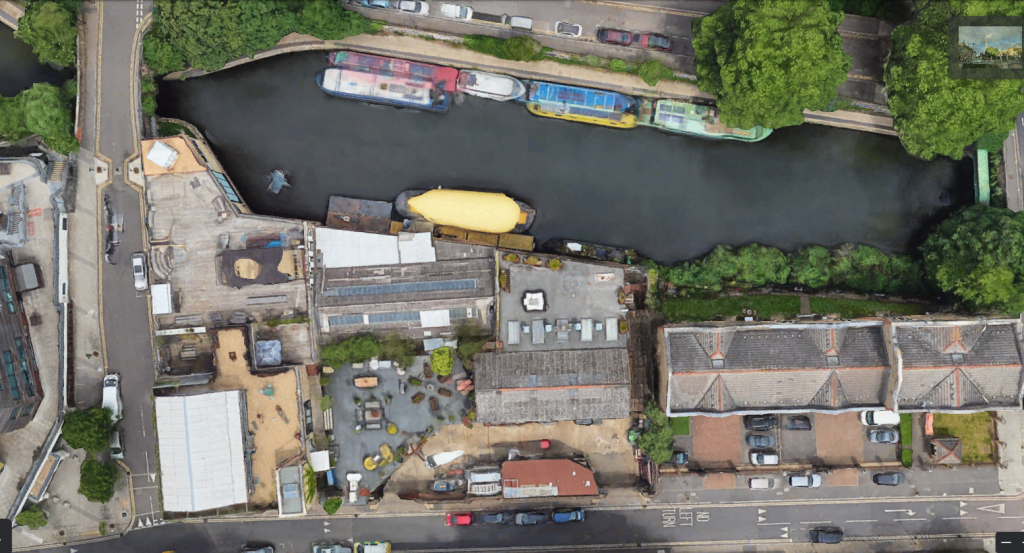
Google Earth view of the Waag, City Gate, Dissection Theatre, and now a Restaurant.My house, on google-earth, to the south of the Canal is a strip of Grass, I live at the extreme left of that strip of grass.
I would definitely use this to explore, and, if I were to be giving a guided tour of Amsterdam I would, indeed, use it in advance to consolidate my knowledge. It has the advantage that it brings to your attention things you would otherwise not know about, and gives a really clear idea of what the place is and what its environment looks like. For example it brought to my attention the houseboat museum, which is now on my must-see bucket list, previously unknown to me.
By the way, I found the Google Earth tour on this blog: www.asthebirdfliesblog.com which has other interesting tips for exploring virtual Amsterdam.
Guided Walks Apps
I thought these didn’t really count as they are designed to give a smart-phone based on location walking tour and not an armchair guide. GPSmycity.com is linked to GPS and the user can either access other people’s guided walks, or create their own. I tried it out in Stratford-on-Avon and found it remarkably easy to do. You find the places you want on the tour, and the app ‘sucks in’ the data and pictures from Wikipedia. So within a few minutes you have, a credible, guided tour and a GPS route around the City. In fact, I found it most useful just for creating my own walking routes – much easier than Google, or CityMapper, Just put in the stops and soon your SmartPhone will be dictating your route to you!
But you don’t have to access it via an app, in fact, if you are not going to Amsterdam, its better to visit the web site, and you can go to this link gpsmycity.com, scroll down and you will see a map, and the text for all the stops on the tour. Quite a good introduction, although not inspired. (Its possible you might need to login but I’m not sure as I do have a login.)
Another example is izi-travel, but this provides free and paid for audio guides. Again designed for a smart-phone app to guide around the location, but it can also be accessed on a computer at home. So here is the link to the Amsterdam tour – there are several to choose from.
I would definitely use gpsmycity on tour – I didn’t because I dropped my phone in the oily bilge of my boat, and it went insane for about 2 hours, and reset a lot of my settings, and deleted a few of my apps, including gpsmycity, before deciding to stage a recovery. Izi-travel I have had loaded for several years, and never used, but now listening to it I might have used it like a radio show to introduce me to Amsterdam. I’m also wondering about making my very many guided walks into virtual guided walks on apps like this.
Museum On Line Tours
The Amsterdam Museum should be the museum I would be pointing to for a great on line tour about Amsterdam’s History but it has a temporary Web Site while it works on opening a new Museum. The web has interesting stuff on it, and has the collection online, but nothing that pulls it together like an exhibition, or really gives you much of an introduction to the history of Amsterdam which is very disappointing.
The Van Gogh Museum, by contrast, has an excellent online collection which can be seen, as if a virtual exhibition. But this is much easier for an art museum than a history museum, for two main reasons: the art works are more immediately visually appealing that many objects in Museum Collections which often require context to understand; and art collections are much smaller than history museum collections and so easier to see as a ‘tour’.
Summary
There is nothing to beat walking around a City in the real world. There is nothing, yet, that even comes close to it. Smart Phone tours offer an easy way to tour the physical city, but its difficult to find content on line which provides a really enjoyable armchair online substitute.
The way I explore a City, after finding the walls of course(!), is to read a good guide book. Then buy a good non-fiction history of the city, and search the second hand bookshops for histories/guides/maps and that very special book that noone has heard of and no one knows about which gives unique insights/information that a good guided tour needs. Finally, I try to read a famous novel set in the City, or if in need of light relief, find a local fictional detective.
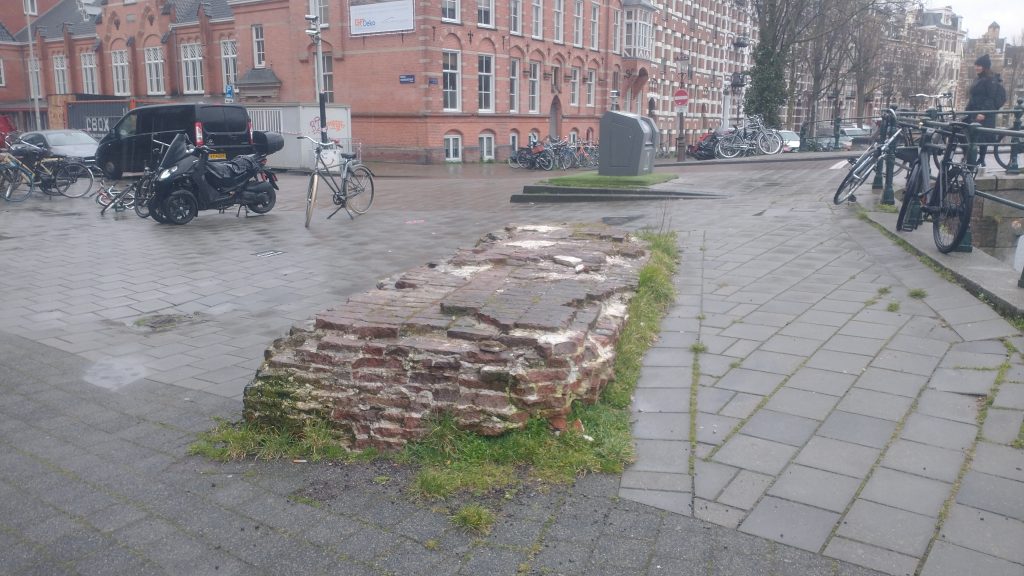
Oh! A glorious find! As I said yesterday, I wasn’t sure there was going to be a wall. But I headed towards the outer of the concentric rings of canals, thinking this is where a defense would be. I almost went straight to the centre but decided I had to give it a try so walked around the inner side of the outer canal. And almost immediately I found this slab of ruin.
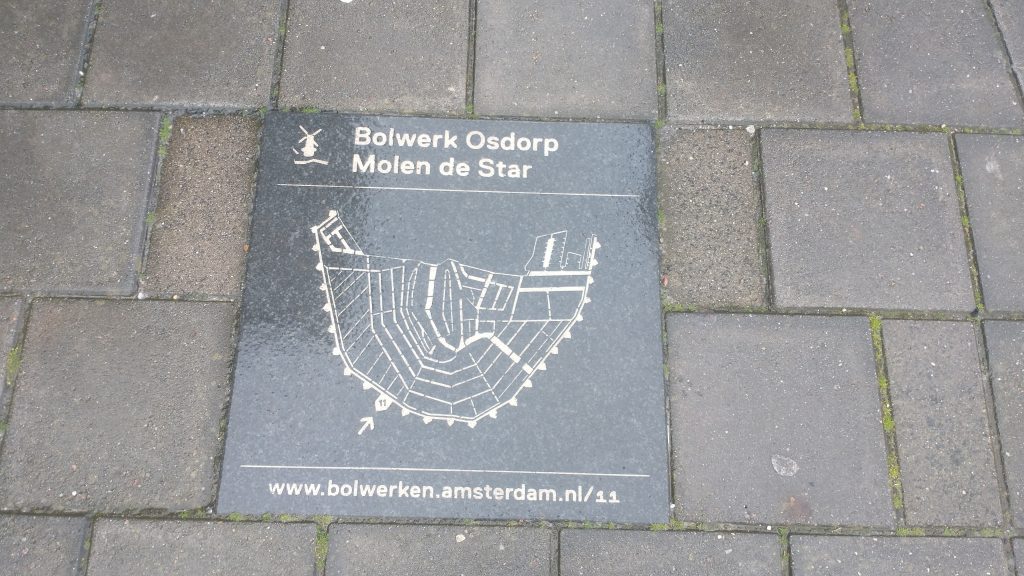
The Wall! I thought but was it? And there was a panel with a plan.
Plan of Amsterdam Wall Circuit
The panel links to this Dutch language site which seems to say in 1663 Amsterdam was given a 5 metre high City Wall. It talks about 5 sided ‘bolwerken’ which are bastions designed to withstand cannon fire. And this bit of the wall is near the Osdorp bolwerk.
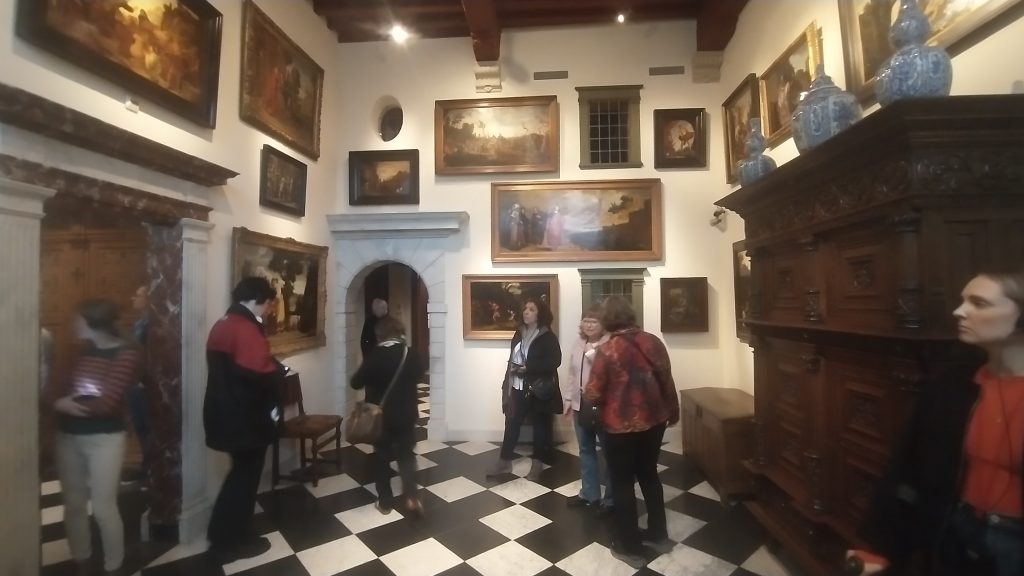
I then met my daughter and we went to the Rembrandt House which was interesting but very heavily reconstructed and in part difficult to know what was original and what a reconstruction.
Rembrandt House, Amsterdam. Photo K.Flude
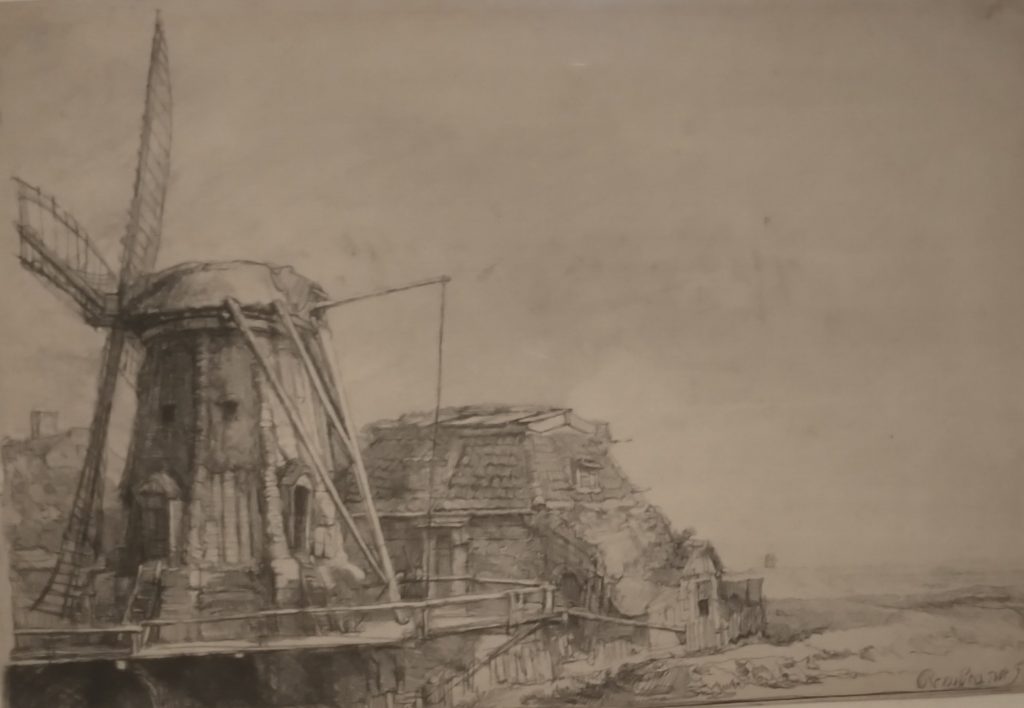
In the display was a Rembrandt Etching which features a section of the City Wall and a Windmill. It is dated to 1641 and so it suggests the 1663 date is for the bolwerken not the wall circuit as such.
The Windmill Rembrandt 1641
The mill was called the Little Stink Mill because it was used in the smelly process of making chamois leather.
There was a plan of the city in Rembrandt’s day but difficult to photo. Our next stop was the Amsterdam Museum which I had insisted we visited to find out information about the history of the City
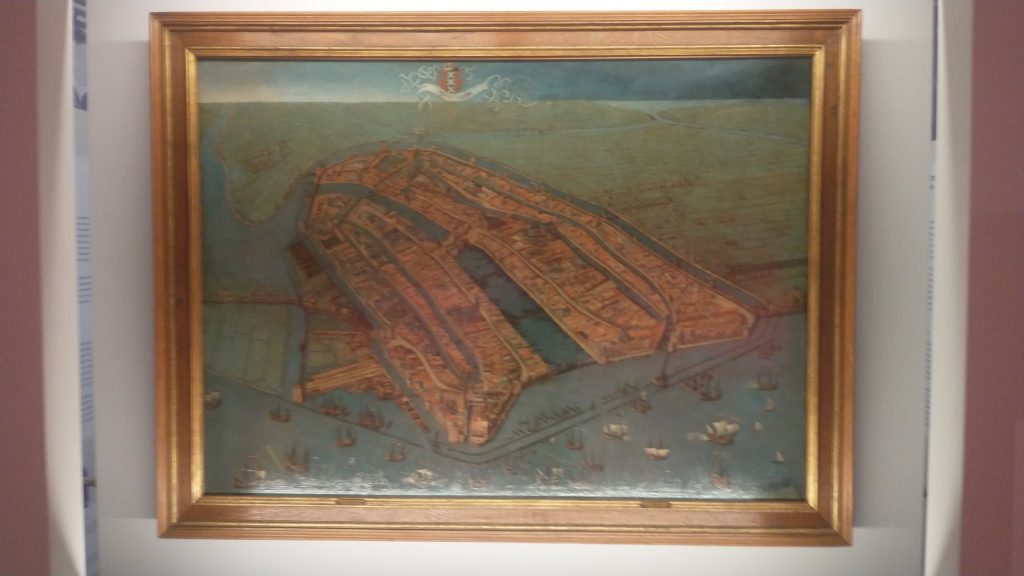
The oldest view of Amsterdam by Cornelius Antonisz 1538
This shows the City wall with bastions, the port on the seafront at the bottom of the painting with the River Amstel running through the middle of the City, and canals running parallel. There is a moat running outside the wall circuit. What is missing is the concentric ring of canals which now exist inside the wall circuit.
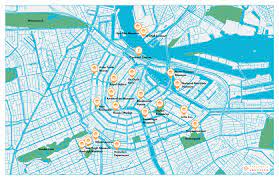
Just to remind you of the current city plan.
City plan
This needs to be turned upside down to match the 16th Century view. A panel in the museum’s notes that Amsterdam is first documented in the late Thirteenth Century. The Protestant Netherlands broke away from the Catholic Hapsburghs in the 16th Century. I’m guessing the walls were built in the late 15th or early 16th Century as the one section I’ve seen is of brick.
So, now I’ve been doing a little research after returning from a visit to the sobering Anne Frank Museum – please remember to challenge prejudice whenever it raises its ugly head. Amsterdam was able to develop into a major town, when a flood turned the shallow river Ij into a wide waterway that linked the Amstel River to the Zuiderzee and the Ijessel in the 12th Century. This gave access to the sea and to the Rhine. It allowed the draining of the banks of the Amstel and with the building of a dam, gave birth to Amsterdam, the Dam on the River Amstel,
In the medieval period the walls were built and bastions added in the 17th Century. In the 17th Century the concentric canal circuits were built and every area given its canal frontage. Virtually all the buildings on the canals have bars protruding from the gable from which to mount a pulley to transfer goods from barge to warehouse, or vice versa,
Between 1880 and 1920 an amazing new defensive circuit was constructed around Amsterdam, which depended up a shallow flooding of the land. But it soon became obelete but is now a Unesco World Heritage Site.
Oh, and to add to what I said, yesterday, the world’s first Stock Exchange was built in Amsterdam in 1602, the same year the Dutch East India company was founded.
It’s a great City, with lots to enjoy, Big enough to be exciting, small enough to be manageable. Full of cyclists on tall upright bikes, chatting to each other as they cycle. I have seen a lot of cyclists riding with their hands in their pockets or holding an umbrella, and it is the first City I have been terrified of crossing the road because of the bikes who seem to ignore pedestrians and expect them to get out of the way; and the trams that hurtle along.
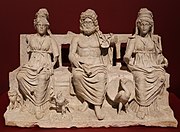
This was the second festival in the year dedicated to the three most important deities in the Roman pantheon. Jupiter the Sky God, God of Justice, God of Rome. His wife and sister, ‘Queen’ Juno, protector of women. Minerva, Daughter of Jupiter. Goddess of Wisdom and Craft.
The main Temple was in Rome on the Capitoline Hill, known as aedesIovis Optimi Maximi Capitolini (“Temple of Jupiter Best and Greatest on the Capitoline”). Similar temples spread throughout the Roman world, normally with a triple cella (inner sanctum) to allow separation of worship between the three cults.
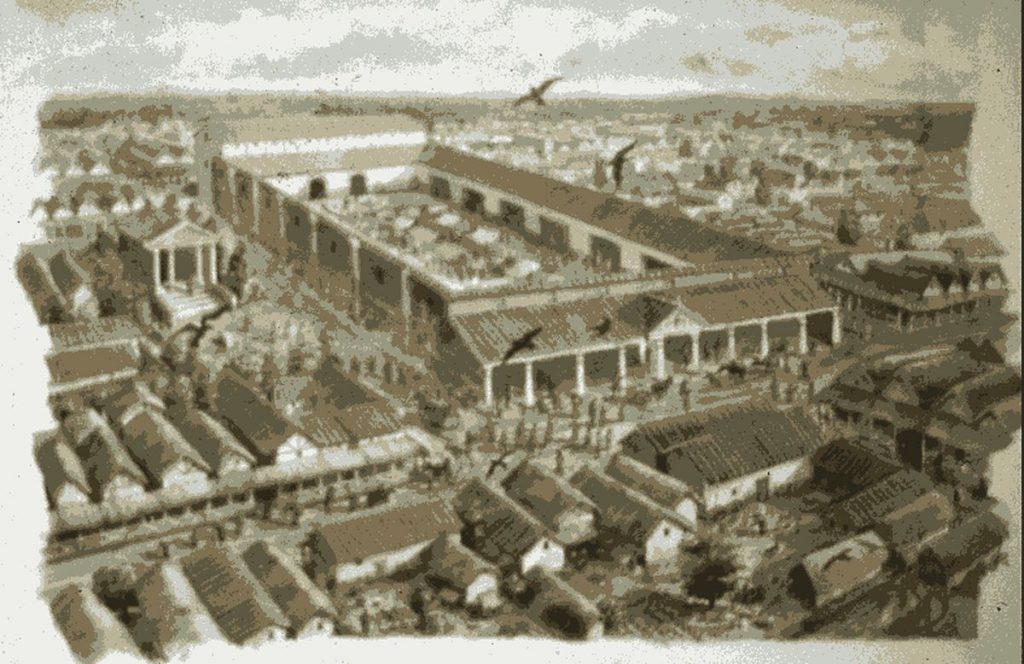
In London, a temple was discovered to the west of the first Forum (built AD 75). There is no clue as to its dedication, but the Capitoline Cult has been suggested as well as for the Cult of the Emperor.
Painting of the Roman Forum of London from the air (Note Temple on the left)
Originally posted on November 12th, 2021. Revised November 15, 2023
Please leave me a comment – its great to hear what you think.