St Catherine, Torture Victim & Patroness of the Catherine Wheel, November 25th

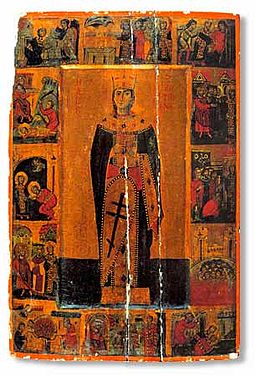
Icon of Saint Catherine of Alexandria, with scenes from her martyrdom (Wikipedia)

In the pantheon of horror that is the Saints’ martyrs’ calendar, St Catherine of Alexandria is very appropriate for, today, the UN’s International Day for the Elimination of Violence against Women.

Catherine was high-born, beautiful and learned. She disputed with pagan learned men against the worship of idols. She wiped the floor with them, and Emperor Maxentius had 50 of the learned men burnt alive for their failure to answer adequately.

Catherine was imprisoned, where many people came to visit her and were converted to Christianity. The most illustrious visitor was the Emperor’s wife, Valeria Maximilla who was, herself, martyred. Then, the Emperor offered to marry Catherine, but she refused to abandon her faith. So he had her tortured. In prison, she was fed by the holy dove and had visions of Christ.

Her gaolers then tried to break her on a wheel, although the wheel broke, killing spectators with the splinters, she stood steadfast. Two hundred soldiers were converted to the faith on the spot. They were then beheaded, followed by Catherine herself. Milk, not blood, flowed from her severed veins.

The persecution in the early 4th Century was real, but it wasn’t driven by Maxentius, who came to power promising religious tolerance. But, following the accession of Constantine the Great, Maxentius’s reputation was blackened. There is no contemporary evidence for the events of Catherine’s life. There is a modern theory that her tale was conflated with the remarkable story of Hypatia of Alexandria (d. 415), a pagan and a real learned woman; The first female Mathematician we know any facts about. She was murdered by a rampaging mob of xenophobic Christians.

Catherine is remembered by the firework: the Catherine Wheel and is, of course, the patron of Philosophers, Theologians, and Royal women; young women, students, spinsters, and anyone who lives by working with a wheel: carters, potters, wheelwrights, spinners, millers. And, I imagine, Formula 1 drivers.

St Catherine in London

St Catherine Coleman
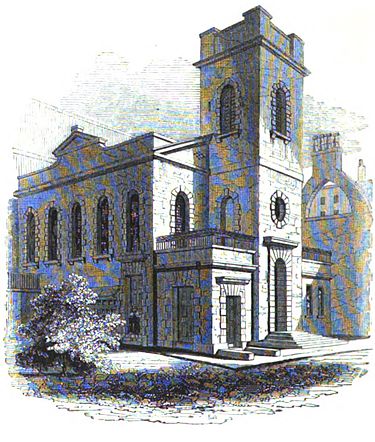
(Wikipedia: Robert William Billings and John Le Keux: The Churches of London by George Godwin (1839))

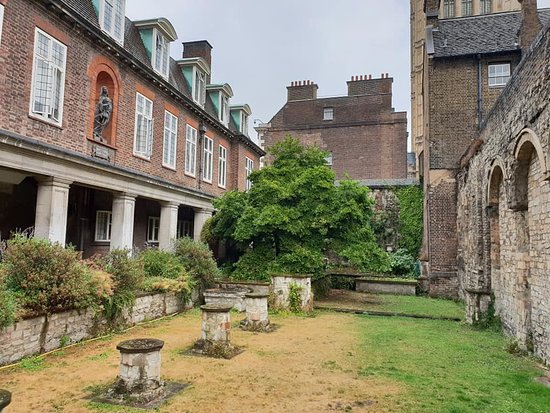
There are several Churches in London dedicated to St Catherine or St Katherine, dedicated to St Catherine of Alexandria. The one in Coleman Street, rebuilt by Christopher Wren and his team, was demolished in the 1920s. There was a Chapel to St Catherine at Westminster Abbey (c1160), the ruins of which are visible in St Catherine’s Garden. I am sure that St Katherine’s Dock and St Katherine’s Cree Church are also so dedicated, but cannot as yet find a dedication for either. Katherine of Aragorn was patron of the Royal Foundation of St Katherines’ which gives its name to the Dock.

Ruins of Chapel of St Catherine, Westminster Abbey

There are customs that have attached themselves to St Catherine including the baking and eating of Catten Cakes. These are really a biscuit (or cookie) made of dough, and cinnamon and dried fruit. Carraway seeds are also suggested. Here is a recipe.

It’s considered a good day for rituals and prayers to summon a husband. Katherine of Aragorn was also commemorated on this day. Lace makers would play ‘jump the candlestick’. If they put the candle out they had bad luck. Katherine of Aragorn is said to have introduced lace making to England.

Finally, for my thoughts why female saints martydrom stories are so violent, extreme and often downright bizarre. Have a look at my post on St Margaret. She is the Saint who suffered probably the most torture in her convoluted route to Martyrdom.

My post which includes a link to an article about medieval attitudes to these terrifying stories of martyrdom, illustrated by a reredos on display at the V&A, in Kensington, London here.

Gladiators Exhibition Touring Britain

Exhibition post of the British Museum Exhibition ‘Gladiators of Britain’

I was just reading an article about the British Museum touring exhibition: ‘Gladiators of Britain’ exhibition. And so updated my August 12th post on St Lawrence who is remembered in a Church in London on the site of the Roman Amphitheatre. But the Exhibition will be closed by August, so here is what I wrote, in time to go to see the Exhibition.

The exhibition is currently at the Grosvenor Museum in Chester – until 25th January 2026.It then moves to Tullie House Museum & Art Gallery, Carlisle from 7th February to 19th April 2026. Recent research has shown that a young man buried in what seems to be a Gladiators Cemetary near Michelgate in York has lion’s teeth marks on his pelvis. When talking about Gladiators I was always reticent about whether animals as exotic as Lions would have been used in the distance province of Britannia. Now we know they were. The Exhibition has a marble relief from Ephesus showing a venetor (beast fighter), taking on a lion. We also know one Roman legionary in Britain had the title of Bear Keeper.

Displayed on the poster above is the Colchester vase which shows an actual gladiatorial combat. The gladiators are named as Secundus, Marius, Memnon, and Valentinus. Secundus and Marius are fighting a bear, while Memmon is fighting Valentinus. Memmon is a secutor and Valentinus, a retiarius. The secutor is the chaser and lightly armed with a heavy shield and short sword. The retiarius has a net and trident. Memmon is described as a 9th time victor, and Valentinus, a legionary of the Legio XXX Ulpia Victrix raises his finger to acknowledge defeat.

Although death and life threatening injuries were often the result, the competition was also not, necessarily, a fight to the death, it was a fight until one or other was defeated. So they could be ended by surrender. Gladiators tombstones, often announce the number of fights a gladiator was involved in such as fighting 25 fights of which he was victorious in 22. The chairman of the show would be given the duty of deciding whether the defeated deserved to be spared, or hit over the head with a big hammer, or decapitated. The Gladiatorial cemetery in Driffield Terrace, York has a high proportion of decapitated corpses. The normal ratio of normal burials is 5% or less of decapitated skulls. Of the 80 burials in Driffield Street 46 were decapitated. Many of the young men in the cemetery have healed wounds. One had leg irons one which showed evidence of being put on while still red hot from the blacksmiths forge. For more on the Cemetery follow this link.

On this Day

1471 – the Thames froze over strongly enough to hold a Frost Fair upon it.

In the year 1434 a great frost began on the 24th of November, and held till the 10th of February, following ; whereby the River Thames was so strongly frozen, that all sorts of merchandizes and provisions brought into the mouth of the said river were unladen, and brought by land to the city.’

1715 – the Thames froze again 281 years later

‘The Thames seems now a solid rock of ice; and booths for sale of brandy, wine, ale, and other exhilarating liquors, have been for some time fixed thereon; but now it is in a manner like a town; thousands of people cross it, and with wonder view the mountainous heaps of water that now lie congealed into ice. On Thursday, a great cook’s-shop was erected, and gentlemen went as frequently to dine there as at any ordinary. Over against Westminster, Whitehall, and Whitefriars, printing presses are kept on the ice.(description of 14th January 1716 of the remaining ice by Dawkes’ News Letter.

Both quotes are from a list of times the Thames froze you can see here: https://thames.me.uk/s00051.htm. I have no idea where the evidence comes from for the Roman and Saxon era freezing, but the author says the source of it is:

The earliest chronology is given by Charles Mackay in “The Thames and its Tributaries”, 1840. He omits to mention how he knows!

1952 Agatha Christie’s the ‘Mousetrap’ opened in London, so it has now been continuously running for 73 years if my maths are correct.

First published on 25th November 2022. Revised and republished 25th November 23, 24, 25

St Cecilia’s Day, Henry Wood and the BBC Proms November 17th

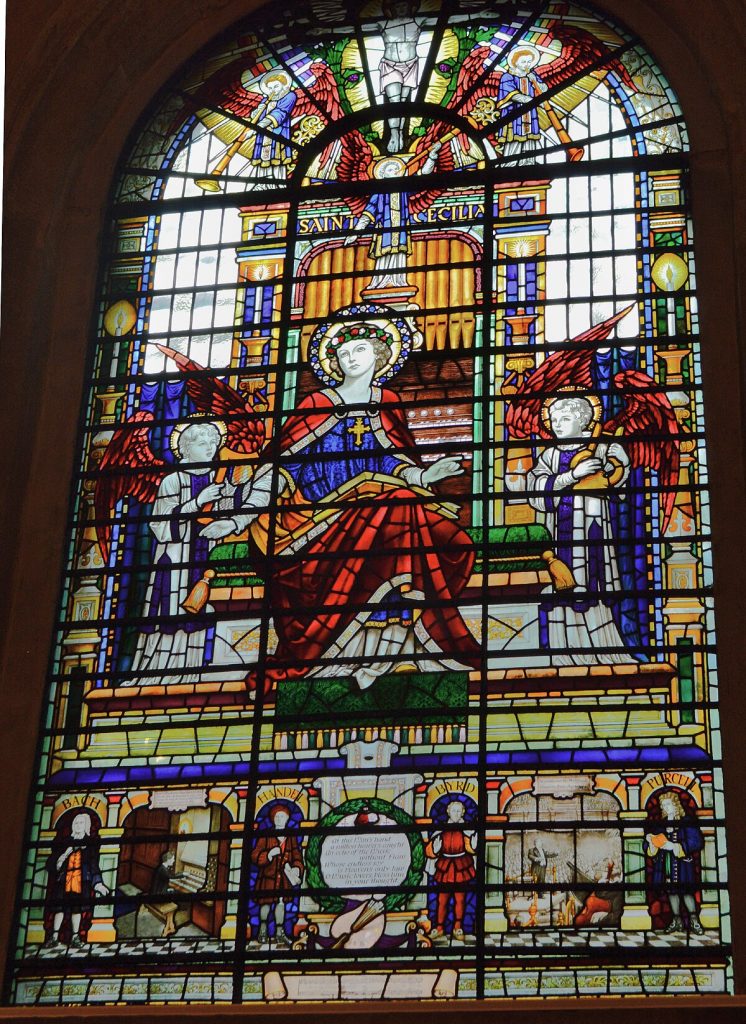
St Sepulchre-without-Newgate, Musician’s Chapel, St Cecilia window. 17 August 2022, Andy Scott

November 17th is St Cecilia’s Day She is the patron saint of musicians and was martyred in Rome in the Second or Third Century AD. The story goes that she was married to a non-believer. During her marriage ceremony she sang to God in her heart (hence her affiliation with musicians). She then told her husband that she was a professed Virgin. So, if he violated her, he would be punished by God. Cecilia told him she was being protected by an Angel of the Lord who was watching over her. Valerian, her husband, asked to see the Angel. ‘Go to the Third Milestone along the Appian Way’ he was told where he would be baptised by Pope Urban 1. Only then would he see the Angel. He followed her advice, was converted and he and his wife were, later on, martyred.

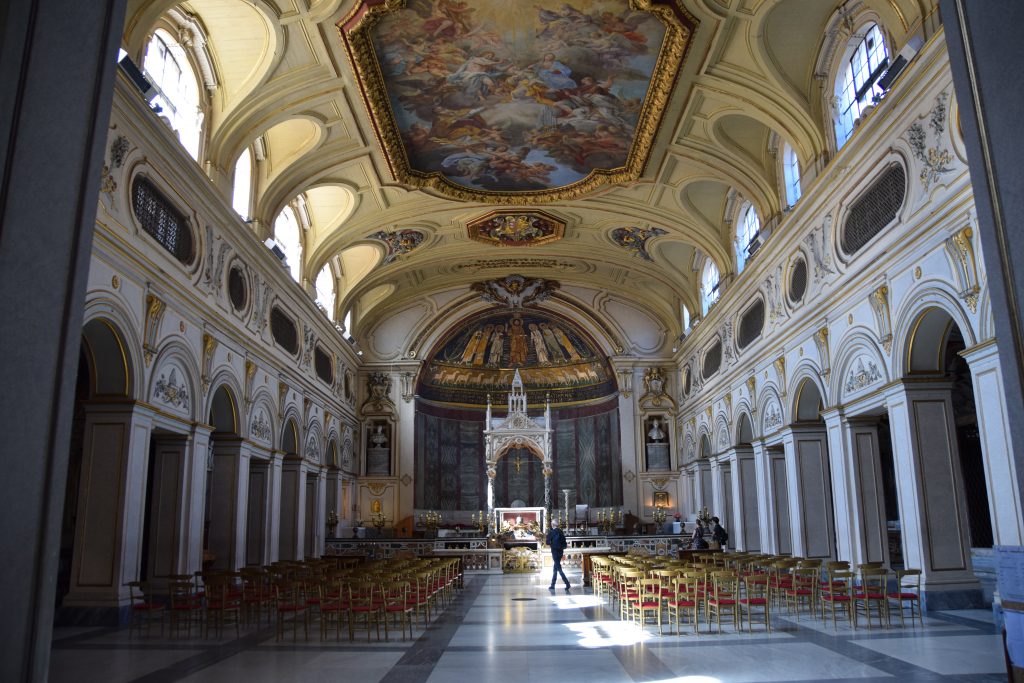
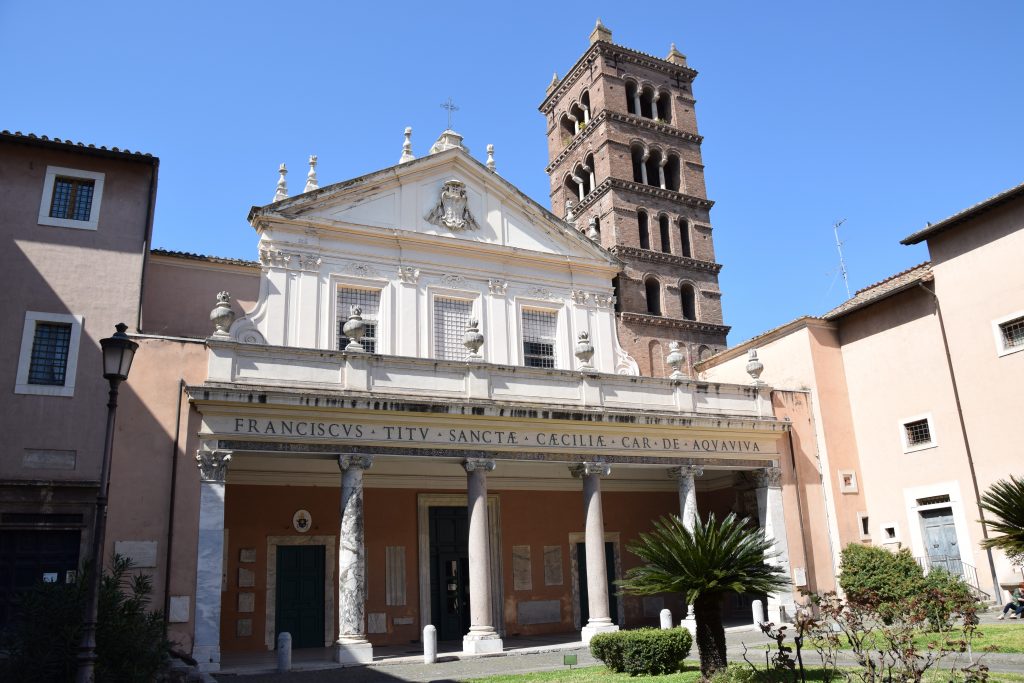
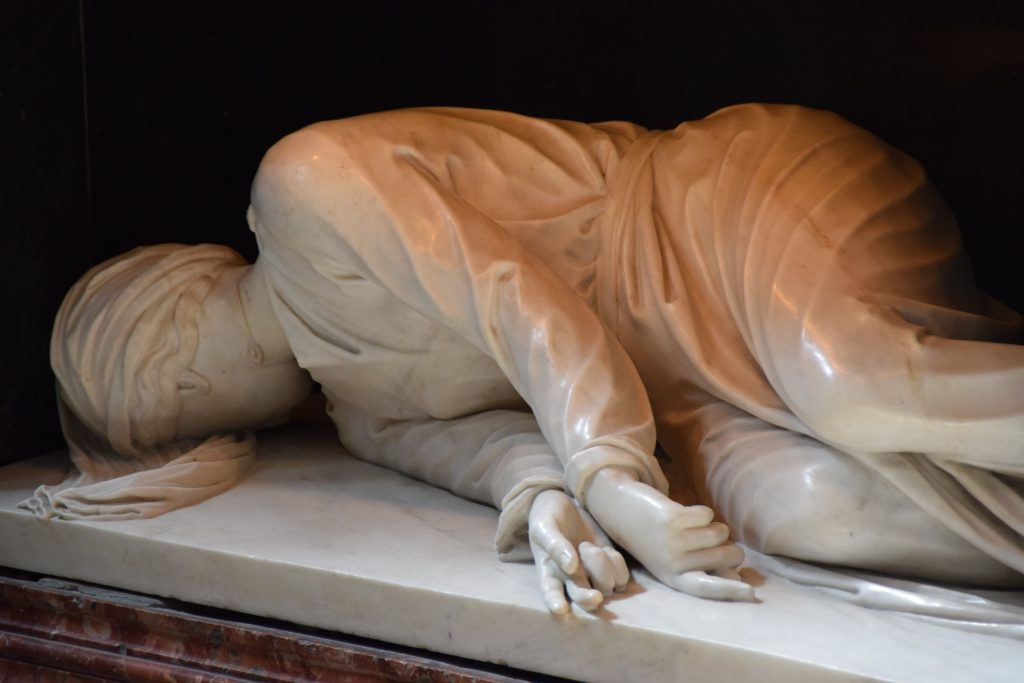
The Church in Rome, Santa Cecilia in Trastevere, is said to be built on the site of her house, and has 5th Century origins. My friend, Derek Gadd, recently visited and let me use these photographs:

St Cecilia in London

There is a window dedicated to her in the Holy Sepulchre Church-without-Newgate, In London, opposite the site of the infamous Newgate Prison.  Henry Wood, one of our most famous conductors and the founder of the Promenade Concerts, played organ here when he was 14. In 1944, his ashes were placed beneath the window dedicated to St Cecilia and, later, the Church became the National Musician’s Church.

This window is dedicated to the memory of
Sir Henry Wood, C.H.,
Founder and for fifty years Conductor of
THE PROMENADE CONCERTS
1895-1944.
He opened the door to a new world
Of sense and feeling to millions of
his fellows. He gave life to Music
and he brought Music to the People.
His ashes rest beneath.

The Concerts are now called the BBC Proms and continue an 18th and 19th Century tradition of, originally, outdoor concerts, and then indoor promenade concerts. At the end of the 19th Century, the inexpensive Promenade Concerts were put on to help broaden the interest in classical music. Henry Wood was the sole conductor.

Wikipedia reports :

Czech conductor Jiří Bělohlávek described the Proms as “the world’s largest and most democratic musical festival”.

The Eight-week Festival is held at the Royal Albert Hall. It moved here during World War 2 after the original venue, the Queen’s Hall, was destroyed in the Blitz in May 1941.

On This Day

1278 Edward 1 had over 600 Jews imprisoned in the Tower of London for coining, clipping and other counterfeiting. Of these, 269 Jews, along with 29 Christians, were executed. They were hanged at the Guildhall in the City of London. By 1290, the King had squeezed all the money he could from the Jews, and they were expelled, not to be let back into the Kingdom until the reign of Oliver Cromwell in the 17th Century. This ended a long period of savage state run antisemitism. Click here for further information.

First Published on November 17th 2023 and revised in November 2024, 2025.

All Souls Day – November 2nd

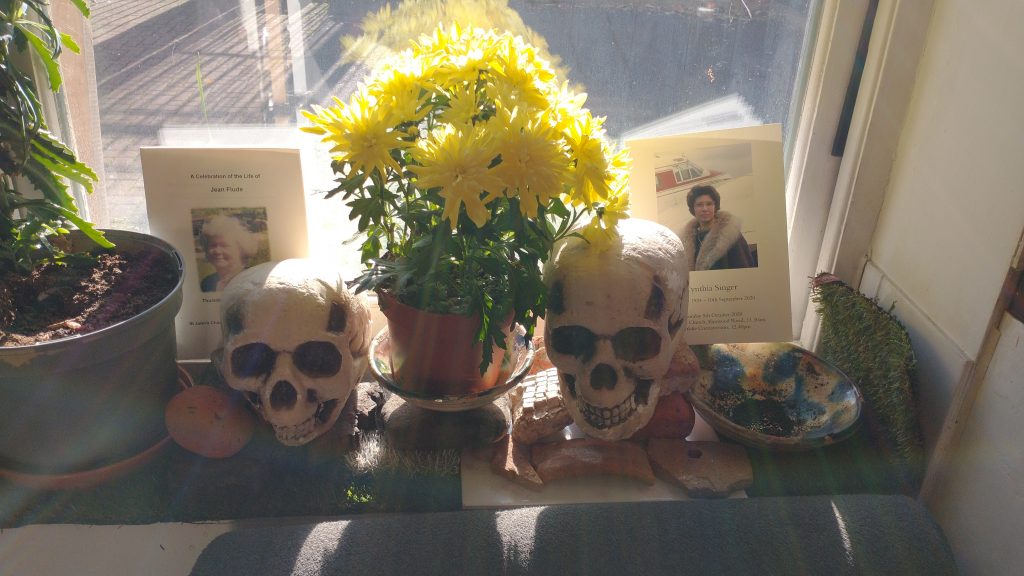
Picture of window sill with skulls, Chrysanthemums  and pictures of remembrance
El Dia de los Muertos – All Souls Day, in Haggerston, London. Photo K Flude.

Today is the Mexican Day of the Dead. In fact, the second day of El Dia de Muertos. Here is a video from Mexico, which you will enjoy for its Latin song and images of the Day of the Dead in Mexico. (It’s on Facebook, so may not work unless you have a login). And here is a YouTube explanation of celebrations in Mexico.

Today is the day to celebrate all those loved ones who have passed away. To keep them in mind, to remind you that you still care about them. It is the third day of the season of Allhallowstide, following All Hallows Evening (Halloween), and All Saint’s Day.

Beata, who comes from Poland, tells me that, November the 1st is the day when relatives visit the cemeteries of the dead. Loved ones bringing chrysanthemums to decorate the graves. It’s a happy day for the dead because they are being remembered and visited. Today, November 2nd, is a more sombre day – a day to stay at home and think of the loved ones. Perhaps looking through albums of photographs?

Souling

In England, it was the time of year in which ‘Souling’ used to take place. Households made soul-cakes. Children or people in need of food come to visit and are given soul cakes in exchange for praying for the dead.

Soul, soul, for a souling cake.
I pray good Missus for a souling cake.
Apple or pear, plum or cherry.
Anything good to make us merry.

Traditional rhyme from Shropshire and Cheshire

Moving on from Purgatory

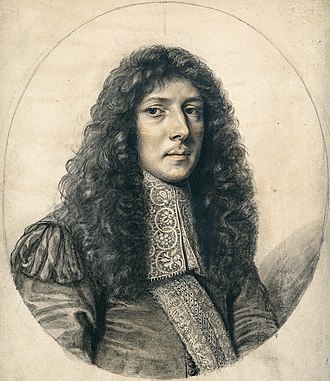
This is based upon the idea of Purgatory, and the belief that intervention on Earth can influence the amount of time an ancestor spends in purgatory for their sins. John Aubrey (1626 – 1697), antiquarian, collector of folklore and writer, mentions a custom in Hereford which shows a variant of the idea.

John Aubrey (Wikipedia)

In the County of Hereford was an old Custom at Funerals, to hire poor people, who were to take upon them all the Sins of the part deceased. One of them I remember (he was a long, lean, lamentable poor rascal). The manner was that when a Corpse was brought out of the house and laid on the Bier; a Loaf of bread was brought out and delivered to the Sin-eater over the corps, as also a Mazer-bowl full of beer, which he was to drink up, and sixpence in money, in consideration whereof he took upon him all the Sins of the Defunct, and freed him (or her) from Walking after they were dead.

John Aubrey, Remains of Gentilism 1688

This belief in the power of action in the Here and Now to lubricate passage through Purgatory to the Ever After was a major part of fund-raising for Catholic Institutions before the Reformation. For example, in the records of St Thomas Hospital, Southwark, a wealthy widow called Alice (de Bregerake – if I remember the spelling correctly) left her wealth to the hospital in return for an annual Rose rent; lifetime accommodation in the Hospital in Southwark, and for the monks and nuns to pray for her soul and the souls of her ancestors.

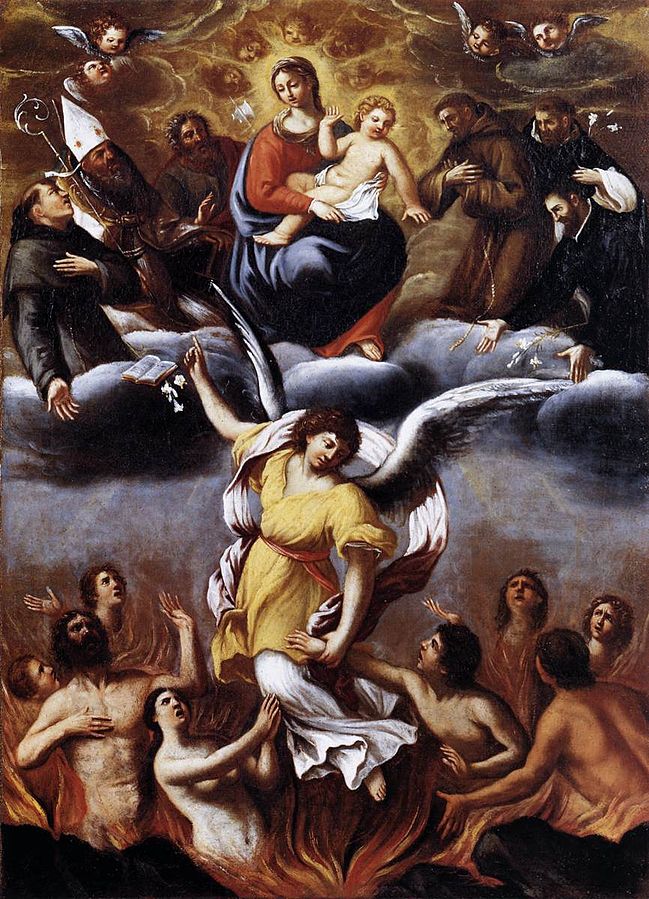
Purgatory was not a settled thing in Catholic Theology before the 12th Century or so. However, the idea that prayers for the dead could be useful dates back before the Roman period. Catholics took 2 Maccabees as their biblical authority for Purgatory. But Luther demoted Maccabees to “apocrypha“. And today the Anglicans view it as ‘useful’ but not to be used for ‘doctrine.’

Ludovico Carracci: English: An Angel Frees the Souls of Purgatory (Wikipedia)
Ludovico Carracci: English: An Angel Frees the Souls of Purgatory 1610 (Wikipedia)

All Souls, London

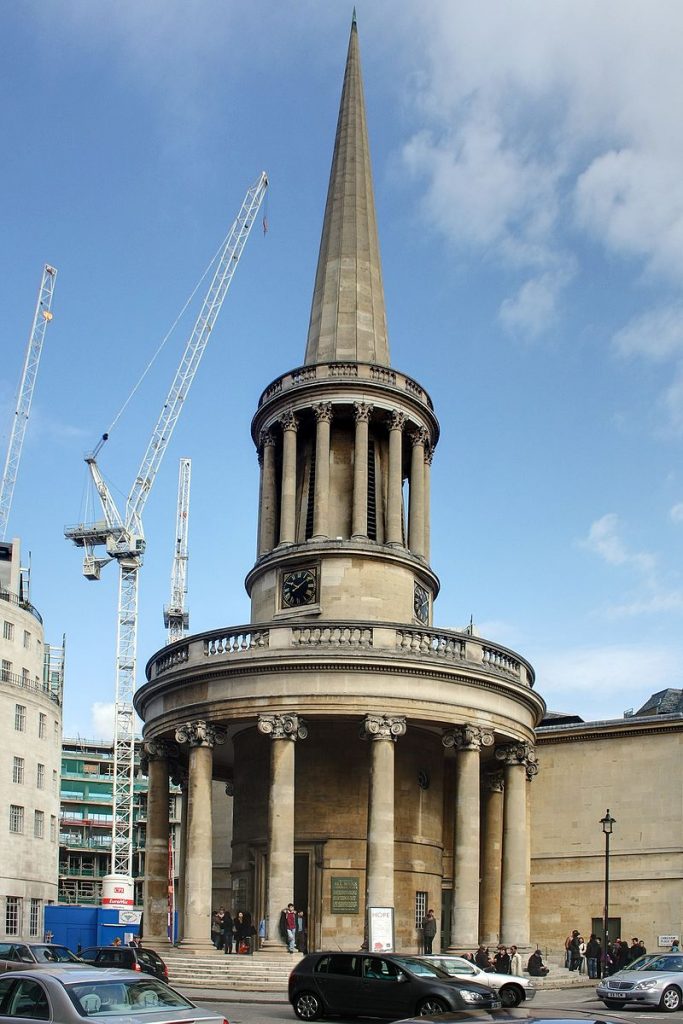
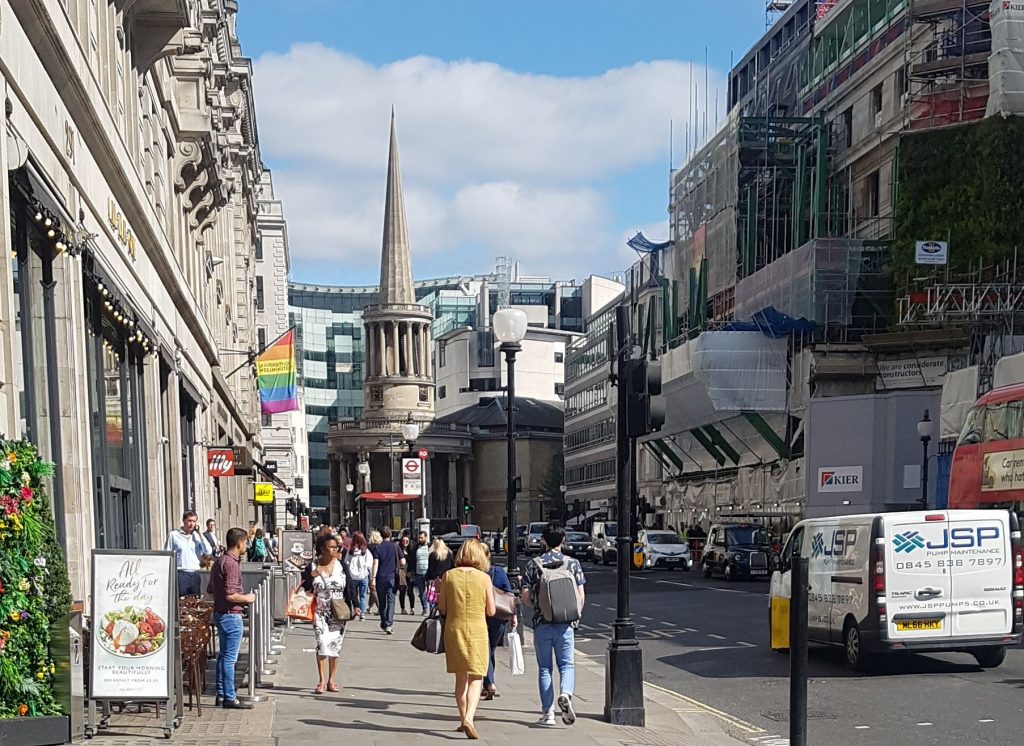
One of London’s most beautiful churches is dedicated to All Souls. It is All Souls, Langham Place. It is just near the BBC HQ and on a wonderful site, as it is on a bend in Regent’s Street. This shows it to great advantage. The architect was John Nash (1824) as part of his transformation of the West End with his boulevard from Regent’s Park south to Westminster. As he could not get all the property owners on the alignment of the road to sell him the land, he disguised this enforced bend with a magnificent Church.

All Souls Langham Place By David Castor (dcastor) – Own work, Public Domain, https://commons.wikimedia.org/w/index.php?curid=6516081
Regent’s Street looking north to All Souls (photo K Flude)

See my posts on Halloween and, and All Hallows Day here

Revised 2nd November 2025, 2024, 2023 and first published 2nd Nov 2021

All Hallows Day – November 1st

 chrysanthemums
Chrysanthemums Flowers for the Dead (the author’s back garden)

How the Celtic festival that marked the beginning of Winter became All Hallows is not clear. Some say the Church set up its own festival independent of the Northern European traditions. But it is as likely that the Church adopted existing pagan festivals, and gave them a Christian spin.

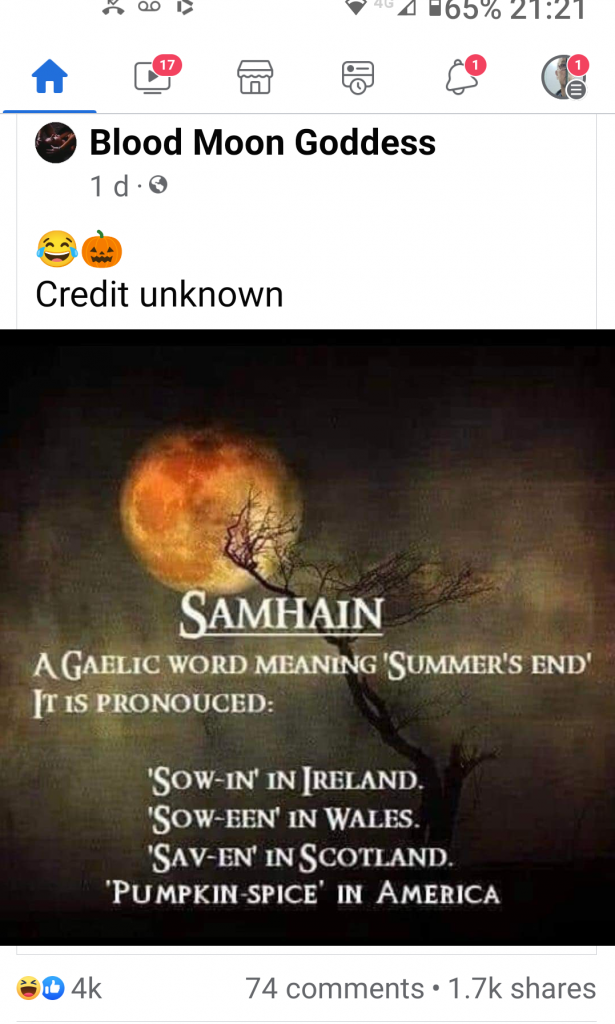
Samhain, on October 31st, was, for Celtic religions, not only the beginning of Winter but also the beginning of the Year. As I noted on my Halloween post the Festivities began in the evening before the day because Celtic and Germanic traditions began their day at Dusk. So Halloween is not, in fact, the evening before, it is the start of the day of the festival.

Facebook Image giving the words for Samhain in Celtic languages

The Church adopted the Roman tradition of the day beginning not at Dusk but at Midnight. So the festival of All Hallows is on November 1st not October 31st. But the Church mimicked the old ways of doing things by celebrating the evening before as the Vigil of All Hallows’ Day. This was called All Hallows Evening or Halloween.

All Hallows by the Tower, London

Engraving of All Hallows Barking

In London, there is a Church called All Hallows, on Tower Hill. It is associated with Barking Abbey, founded in the 9th Century. Therefore, it is known as All Hallows Barking or All Hallows by the Tower. The Church has a prominent position on Tower Hill, which would have been visible from boats coming up the Thames. Also in the Church is the earliest Post-Roman arch in a Church in the City of London. This is made of reused Roman bricks. Moreover, in the crypt are Roman tessellated floors.

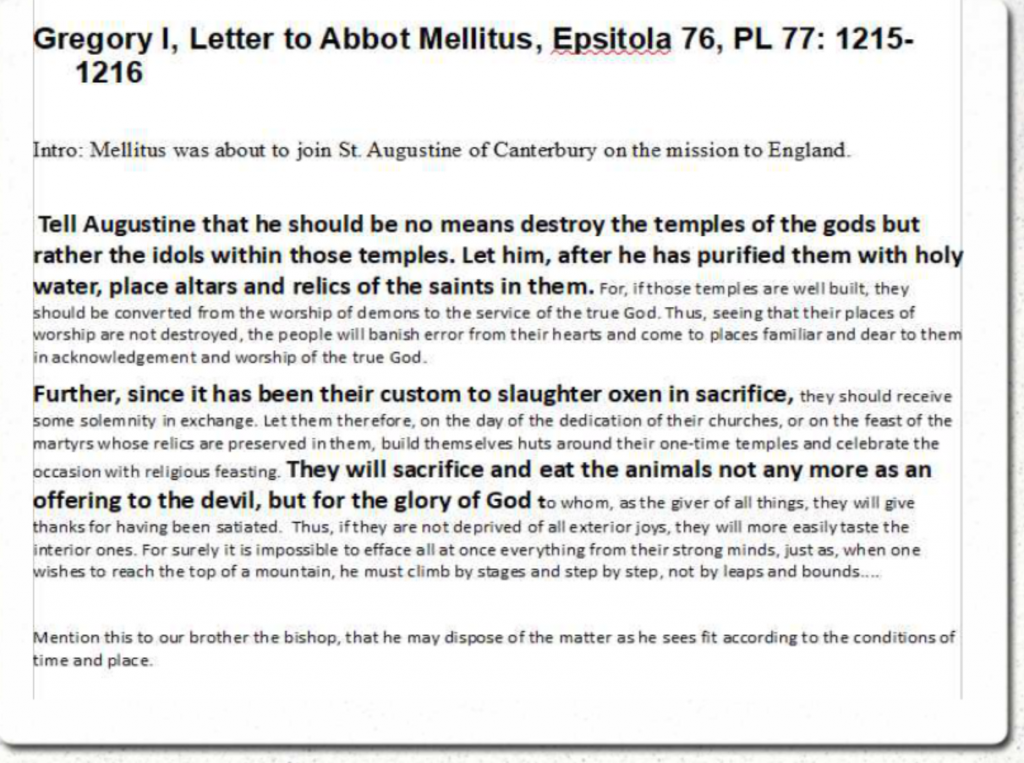
Letter from Pope Gregory to St Augustine

Now, I don’t want to be shot down in flames because there is no evidence that there was a Roman Temple here. Nor indeed a Roman or immediately Post-Roman Church. But it is one of the earliest Churches in the City of London. There must have been Christian Churches in Roman London, and this would be on my list of candidates. It is simply that the attribution to All Hallows provides a possible link to Celtic festivals. So speculation rather than anything else. The letter above, gives a context for the conversion of a pagan Temple to a Christian Place of Worship.

An Uncanny Day to Hallowed Day

For the Celts, Samhain was an uncanny day when all the sprites and spirits are alive and in the world. The Church took that, and span in on its head. So it became a ‘hallowed’ holy day when all Saints are celebrated and alive to us. Celebrated on October 31st and November 1st.

A celebration of All Saints was originally in May in the Church but was changed to the 1st November in the 7th Century by Pope Boniface. Later it was swapped back to May. But fixed again on the 1st November in the 9th Century. It is followed on the 2nd by All Souls’ Day. (see my post on All Souls Day here.

So on the 1st November, those celebrating the pagan festival would be in full swing after a hard night of celebration. The embers of the Fire would be still burning, stones left around the fire would be inspected for the prophecy they told of the future. Each person had a stone, and if it was still intact it was good luck, if it had disappeared the future was not good.

La Toussaint et Dia de Todo Los Santos

In France, All Hallows or All Saints is called La Toussaint, and flowers such as Chrysanthemums, which blossom in late October, were put on the graves. In Spain, it is Dia de Todo Los Santos and is a national holiday upon which people put flowers on the graves of the dead.

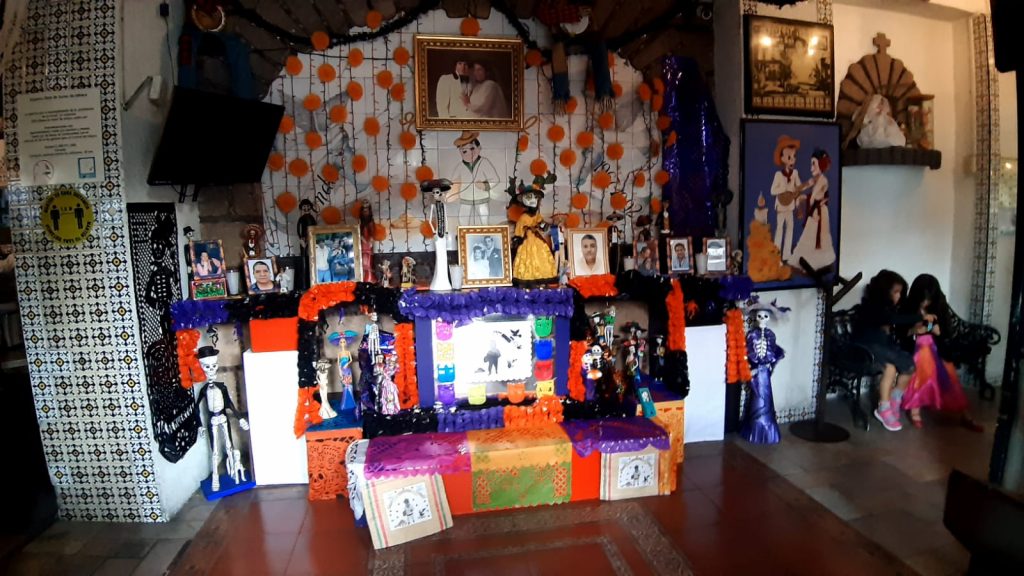
In Mexico, Dia de los Muertos celebrates Holy Innocents on the 1st. People create altars to the lost ones, with their favourite flowers, toys, food stuffs,, photographs. People argue about the pre-colombian aspects of the festival as there are similarities to European All Saints Days celebrations. But Quecholli, was a celebration of the dead that honoured Mixcóatl – the god of war. It was celebrated between October 20th and November 8th.

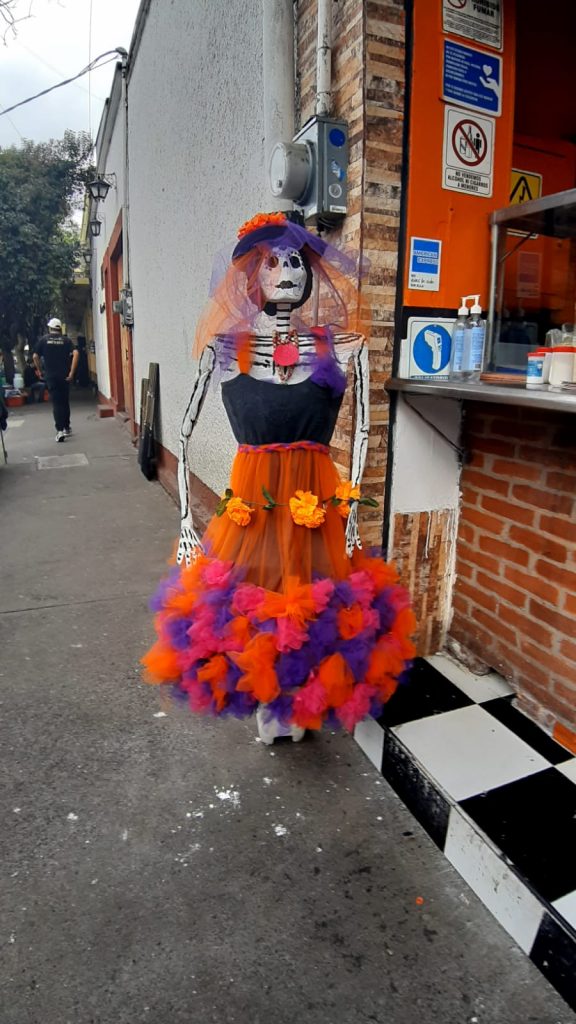
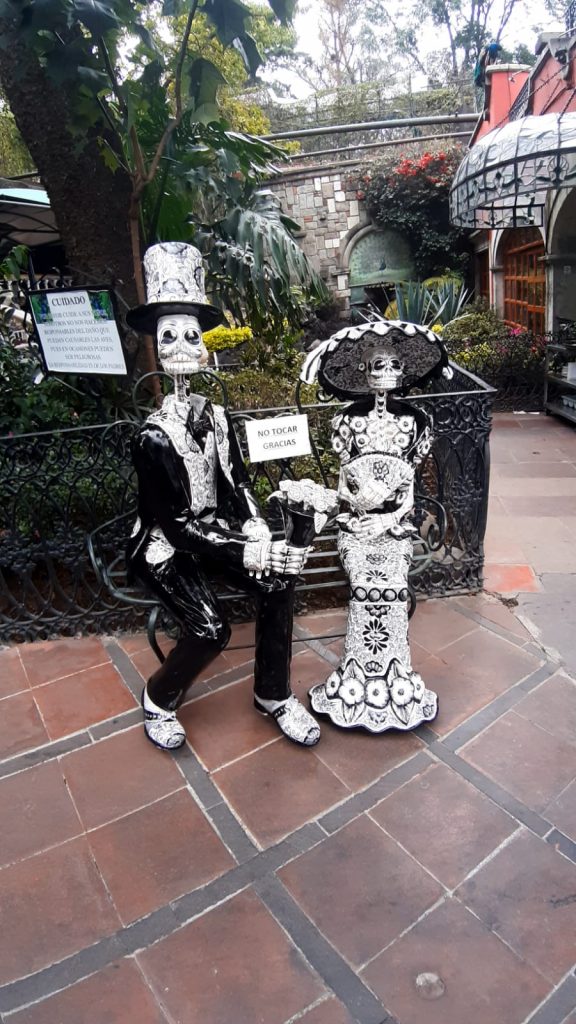
A correspondent in Mexico has sent back these pictures of the festivities in Mexico.

The female figure to the left is La Catrina. This image was popularised by an early 20th Century design by José Guadalupe Posada and developed in a mural by Diego Rivera. For more details click here.

A Day Off for the English

In the Laws of King Alfred the Great, this day was a day off for freemen. See my post on Days off in the Anglo Saxon Calender on August 15th.

First published in 2022, revised in 2023, 2024, 2025
Van Gogh & the London Suburbs October 8th 1876

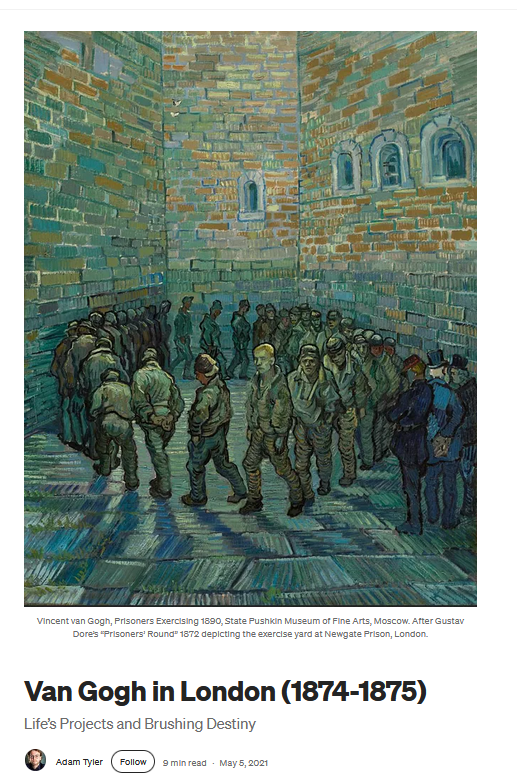
From https://agtyler.medium.com/part-i-van-gogh-in-london-9a26ff5427dd’s website describing Van Gogh’s experiences while living in London.

It’s not so well known that Van Gogh spent some time in London. Vincent spent three years in London, working as an Art Dealer in Covent Garden. He lived in Brixton, then the Oval. He was very impressed with London; its technology and culture. London was:

a city lit by streetlights, a city powered by electricity and a city that relied on industrial power. It was impressive in all its accomplishments.’

To find out more about his experience in London look at this Tate website. https://www.tate.org.uk/art/artists/vincent-van-gogh-1182/seven-things-know-about-van-goghs-time-britain. The above quotation came from the site. For more details of Vincent’s time in London read Medium.

Van Gogh’s Newgate Prison Painting

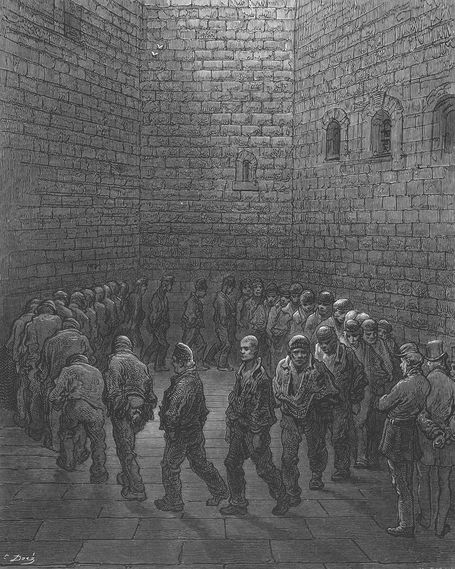
This is where I got the image of Van Gogh’s painting of Newgate Prison above. Apart from sketches, this seems to be his only London painting. But Van Gogh did this painting well after his visit to London,. He copied Gustave Doré‘s engraving which you will see below. Further research tells me that he did this painting while in Saint-Paul Asylum. He was detained inside so could not continue his practice of painting outdoors, so copied from illustrations. He used a Héliodore Pisan copy of Doré‘s engraving. Van Gogh died a few months later, and this was one of the pictures that were displayed around his Coffin.

Vincent in Brixton

There is a play from 2002 called ‘Vincent in Brixton’, by Nicholas Wright, which I saw and very much enjoyed. It is scheduled to be performed in 2026 (14 March 2026 to 18 April 2026) at the Orange Tree, Richmond.

Letters to Theo

Vincent often wrote to his brother, Theo, about his experiences in London. This is a quotation I first found in ‘A London Year’ compiled by Travis Elborough and Nick Rennison. It provides a beautiful description of the London suburbs. This is a book well worth a place on a lover of London’s History’s bedside table.

Letter to Theo, October 8th 1876

In the City I also went to see Mr Gladwell and to St Paul’s. And from the City to the other end of London, there I visited a boy who had left Mr Stokes’s school because of illness, and I found him completely recovered, outside in the street. Then on to the place where I had to collect the money for Mr Jones. The suburbs of London have a peculiar beauty; between the small houses and gardens there are open places covered with grass and usually with a church or school or poorhouse between the trees and shrubbery in the middle, and it can be so beautiful there when the sun goes down red in the light evening mist. It was like that yesterday evening, and later I did so wish that you had seen the streets of London when it began to grow dark and the street-lamps were lit and everyone was going home, it was obvious from everything that it was Saturday evening, and in all that hustle and bustle there was peace, one felt, as it were, the need for and joy at the approach of Sunday. Oh those Sundays and how much is done and striven for on those Sundays, it’s such a relief to those poor neighbourhoods and busy streets. It was dark in the City, but it was a lovely walk past all those churches along the way. Close to the Strand I found an omnibus that brought me a long way, it was already rather late. I rode past Mr Jones’s little church and saw another in the distance where light was still burning so late. I headed for it and found it to be a very beautiful little Roman Catholic church in which a couple of women were praying. Then I came to that dark park I already wrote to you about, and from there I saw in the distance the lights of Isleworth and the church with the ivy and the cemetery with the weeping willows on the banks of the Thames.  

To see this letter and his letters to Theo, follow look at this link.

Gustave Doré and Pisan’s Newgate Excercise Yard 1872, from which Van Gogh clearly derived the image for his painting at the top of the page.

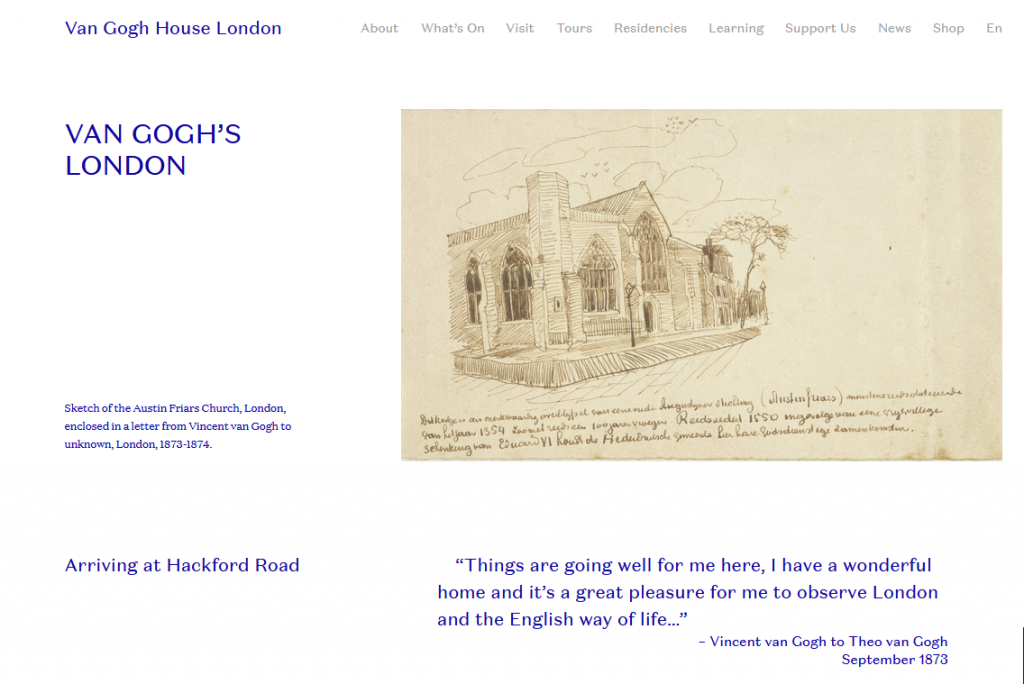
To see some of his London sketches please look at this web site.

Image of Van Gogh’s House web site.showing Austin Friars, Church, City of London

First Published October 8th, 2025
St Giles Day and Cripplegate September 1st

Public domainThe Master of St Giles, National Gallery. ‘St Giles and the Hind’
This work is in the public domain in its country of origin and other countries and areas where the copyright term is the author’s life plus 100 years or fewer.

St Giles

Today, is St Giles’ Feast Day. His story is mostly unknown, but his legend holds that he was a hermit who had a pet Hind in the Arles District of France sometime after the fall of the Roman Empire. The hounds of King Wamba (a Visigothic King) were chasing the deer, and shot an arrow into the undergrowth. The King and his men followed to discover Giles wounded by the arrow, protecting the hind, who he held in his arms. The hounds were miraculously stayed motionless as they leaped towards the hind. Wamba, which apparently means ‘Big paunch’ in Gothic, also had a Roman name: Flavius. Giles was injured in the leg, although the image above shows the arrow hit his hand. Wamba set him up as an Abbot of a Benedictine Monastery.

St Giles is, therefore, the patron saint of disabled people. He is also also invoked for childhood fears, convulsions and depression. He was very popular in medieval Britain, with over 150 churches dedicated to him, including four in London. Perhaps the two most famous are St Giles Without Cripplegate in London and St Giles Cathedral in Edinburgh.

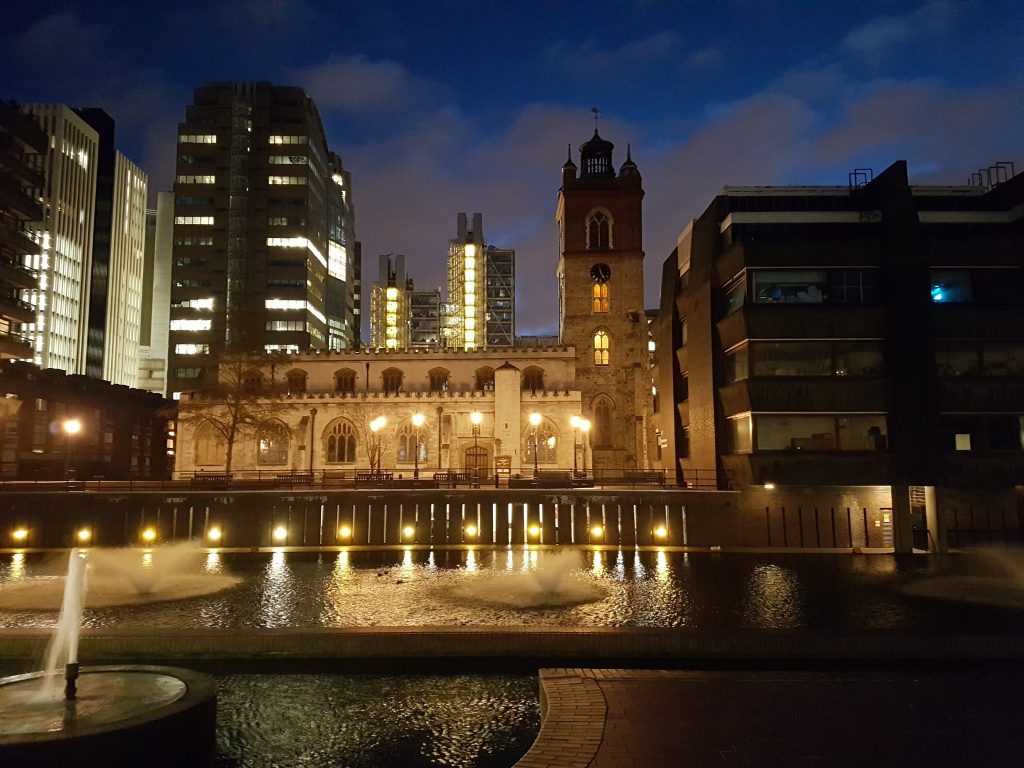
St Giles Cripplegate, photographed by the Author at night from the Barbican Centre.

St Giles Cripplegate

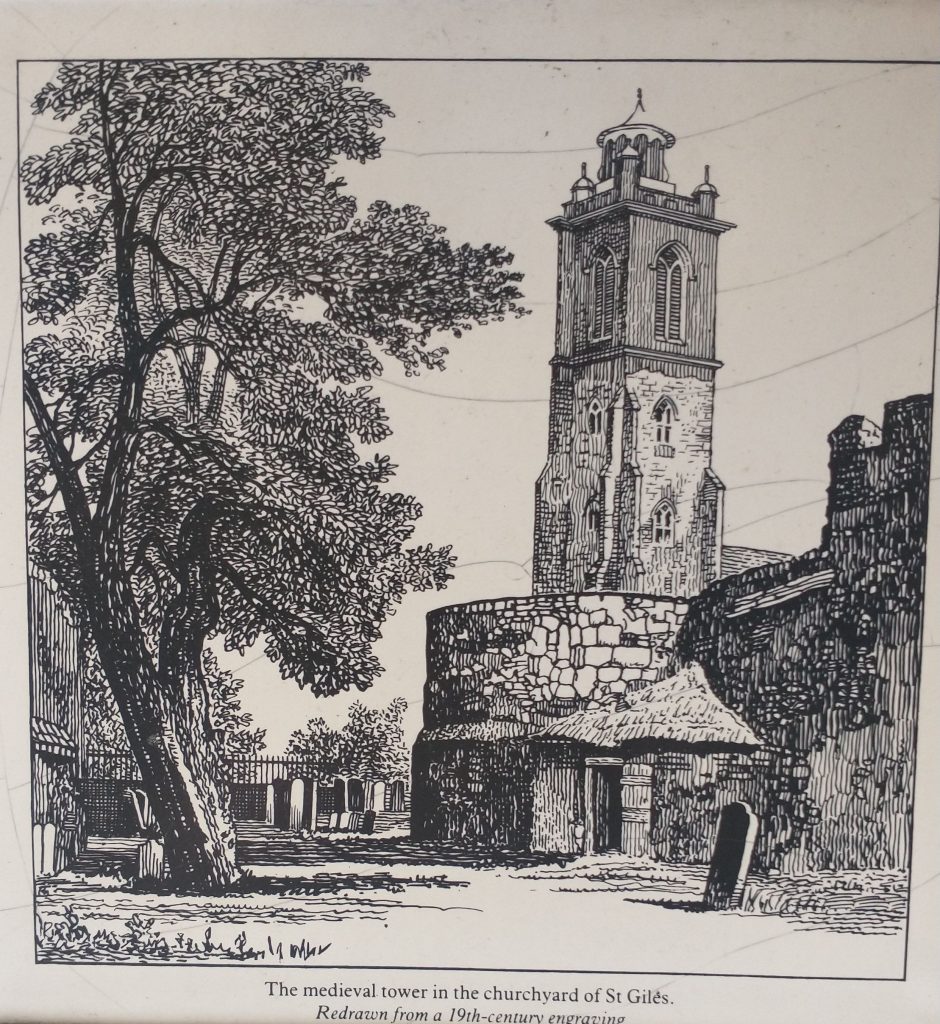
St Giles was built in the 11th Century, rebuilt in the 14th Century and again in 1545-50 after nearly being destroyed by fire. It survived the Great Fire of London, being just beyond the extent of the Fire. But it was badly damaged in the Blitz, although the Tower and the outer walls survived.

Oliver Cromwell married Elizabeth Bourchier here. John Foxe of the Book of Martyrs, John Speed, the Cartographer, Martin Frobisher, the explorer and John Milton, the Poet were buried here.

Shenanigans with Milton’s Coffin

Milton’s coffin was opened in 1793 and he was said to have looked as if he had just been buried. One of those present, then, had a go at pulling Milton’s teeth out. A bystander helped by hitting his jaw with a stone. The few teeth Milton had left in his head were divided between the men, who also took a rib bone and locks of his hair. The Caretaker then opened the coffin for anyone who wanted to see the corpse!

From the London City Wall Trail.

Cripplegate

St Giles is without Cripplegate. It is one of the Gates in the City Wall (originally the North Gate of the Roman Fort). It may be named because St Giles made it agood place to gather for those trying to beg alms for their disabilities. An alternative explanation it from the Anglo Saxon crepel, which is an underground tunnel which is said to have run from the Gate’s Barbican to the Gate. Or perhaps because of the cure of cripples when Edmund the Martyr’s remains passed through the Gate in 1010.

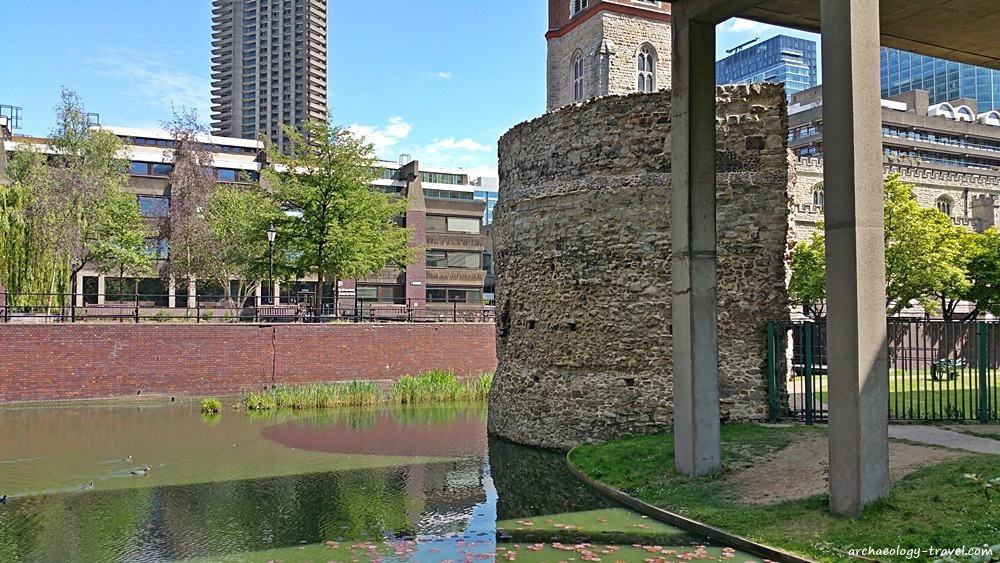
The Corner Tower of the London City Wall, the Barbican in the background, and the tower of St Giles’ Church behind the Tower. Photo by the author

First Published in September 2024, and revised in 2025.

Feast of St Mary & Days off in Anglo-Saxon England August 15th

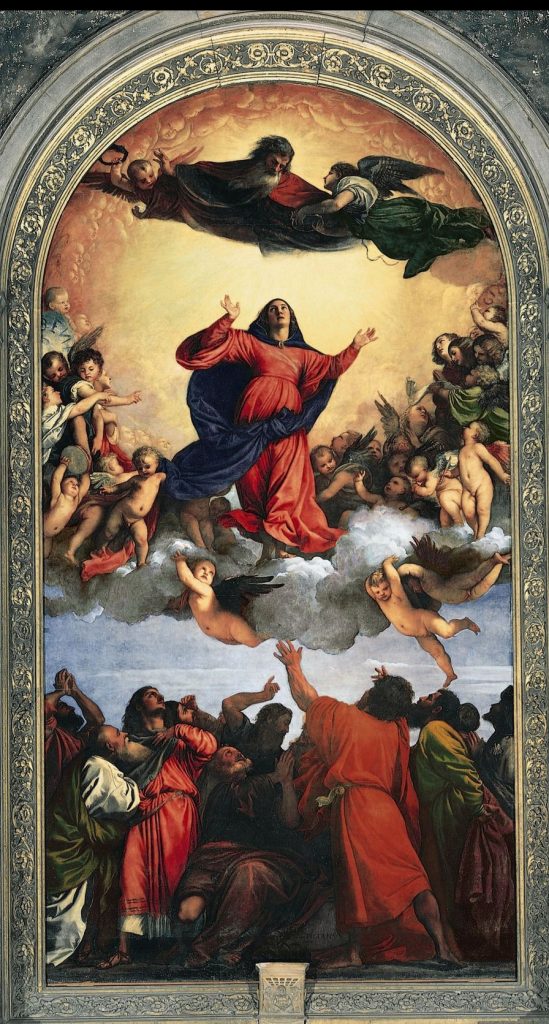
Titian’s Assumption of the Virgin Mary (Wikipedia)

August 15th is the date of the celebration of the Assumption of St Mary.  This is the day she went to heaven.  Opinion is divided as to whether she died and went straight to heaven. Or did she go directly to heaven without having to pass go?  The stories about the Virgin Mary were a big part of the controversy in the Reformation. Protestants did not find evidence in the Bible supporting many of the tales they had been told by the clergy.  Once they could read the Bible in their own language they were able to assess the evidence for themselves.

August 15th was taken as a day off in the Medieval oeriod.  My post is inspired by Octavia Randolph who has an excellent web site with a fine post on Anglo Saxon Slavery. You can read the post here: https://octavia.net/slavery-in-anglo-saxon-england.  But what particularly caught my attention was the excerpt from King Alfred the Great’s laws.  It lays down the law on the days off which should be given to freemen.

These days are to be given to all free men, but not to slaves and unfree labourers: twelve days at Christmas; and the day on which Christ overcame the devil (15 February); and the anniversary of St Gregory (12 March); and the seven days before Easter and the seven after; and one day at the feast of St Peter and St Paul (29 June); and in harvest-time the whole week before the feast of St Mary (15 August); and one day at the feast of All Saints (1 November). And the four Wednesdays in the four Ember weeks are to be given to all slaves, to sell to whomsoever they please anything of what anyone has given them in God’s name, or of what they can earn in any of their spare time.
Translated by Simon Keynes and Michael Lapidge and taken from Octavia.net

That comes to 38 days by my reckoning.  In the UK 4 weeks off is a good average holiday entitlement.  If we add 8 bank holidays in England and Wales  that gives us 36 days off a year.  So 1500 years of ‘progress’ has given us minus 2 days, and a lot less in the USA!

How depressing!  Of course, most of these days off were lost during the Industrial Revolution and only clawed back by Trade Unions.

The days off are interesting, obviously Christmas and Easter. Harvest is more of a surprise in that one would expect to be working very hard bringing in the harvest.  But, maybe the 7 days off were given after it was brought in?

The individual days make sense as they are the feasts of major saints or festivals – so St Gregory’s Day – he being the Pope who ordered the mission to convert the English to Christianity in 597AD.  (See my post on St Gregory here).

Saints Peter and Pauls Day. St Mary and All Saints Day. I’m surprised there is no Candlemas or Michelmas.(More information about celebration of St Peter and St Paul in London in my post here)

Slaves holidays

Slaves seem to only have 4 days however.  These are the Wednesday in Ember Weeks.  Ember Days and Ember Weeks were Fasting Days, either named after a latin phrase for fasting or from Ymbren which is the Anglo-Saxon for circuit or revolution.  It is thought that the days were originally tied to the ‘cycle of life’ that it part of each year.  But later on became more liturgical and based on fasting.

They may have been founded in Roman roots. There only seems to be 3  in the days of the early church, rising to 4 ember weeks by the late 5th Century. They were brought to Britain by the mission of St Augustine, under Pope Gregory.  These seem to be the dates:

December the week starting after St Lucy’s Day (Dec 13th)

March between 1st and 2nd Sunday

June between Pentecost and Trinity Sunday

September 3rd Week ending at Michaelmas.

So, the poor old slaves get 4 Wednesdays off in the year!  This is presumably because the work of the household continues throughout the year, irrespective of season or festival.  Maybe they are given a day off on the fasting days because household work can be put off as everyone is fasting?

But the laws make it clear: this is the time the poor slaves can work for themselves and make a little on the side.

Do have a look at Octavia’s web site which for more on slaves in the Anglo-Saxon period.

First published in August 2025
Twin, Twins – Festival of Castor and Pollux July 15th

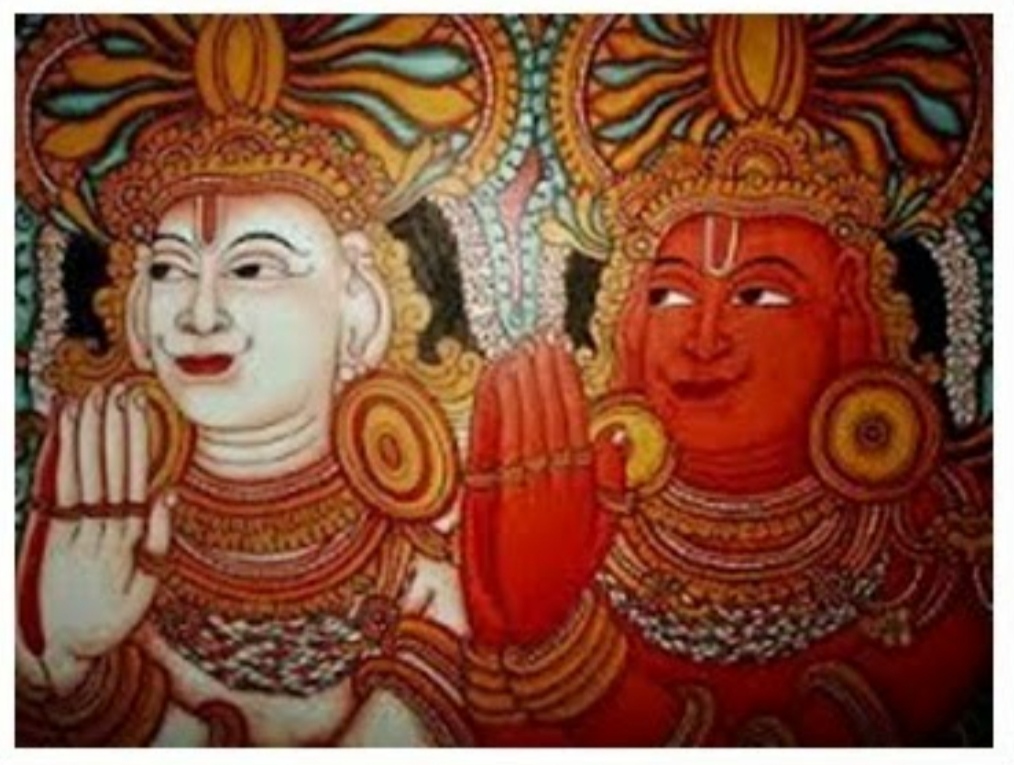
The Ashwini kumaras twins, sons of the sun god Surya. Vedic gods representing the brightness of sunrise and sunset Wikipedia

The Divine Twins, aka the Dioscuri, were horsemen. Patrons of calvary, athletes and sailors, one of many Indo-European twin gods.   They had many adventures including sailing with Jason and the Argonauts.

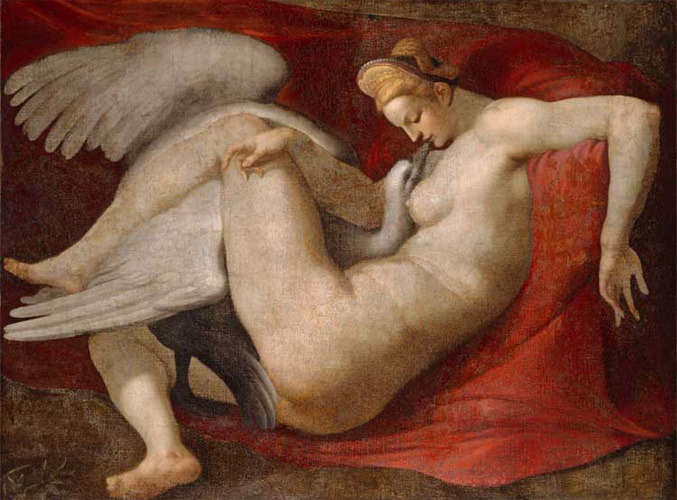
And are they well connected?! Pollux is the son of Zeus  His twin brother has a different and mortal father, the King of Sparta.  But the boys share the same mother, Leda.  She was raped by Zeus in the guise of a swan.

This makes them examples of heteropaternal superfecundation as Mary Poppins didn’t sing.  But their different paternity had consequences. The most important is that one was (is?) therefore immortal and the other wasn’t. 

According to some version of the story, Castor (the mortal one) was mortally wounded. Zeus gave Pollux the option of letting his brother die while Pollux could spend eternity on Mount Olympus. The alternative was to share his immortality with his brother. Pollux did the good thing. So the twins spend half their year as the Constellation of Gemini and the rest, immortal, on Mount Olympus.  Thus, they are the epitome of brotherly love.

Divine Twins or Sisters from Hell?

The Dioscuri’s sisters were no less than Helen of Troy and Clytemnestra. Never mind the Brothers, what Sisters! Helen of Troy you know. And Clytemnestra! They were also twins, Helen the divine daughter of Zeus, husband of Menelaus, lover of Paris. Sister, Clytemnestra, mortal daughter of the King of Sparta, husband of Agamemnon (brother of Menelaus).

It happened like this.  The Swan was being pursued by an eagle, so Leda protected the Swan and took it to bed.  On the same night she slept with her husband Tyndareus of Sparta. Two eggs were fertilised, each split in two to give two sets of twins.

Leda and the Swan, 16th-century copy after the lost painting by Michelangelo

Clytemnestra

She was the wife of Agamemnon, the arrogant leader of the Greeks.  On the way to retrieve Helen from Troy, the Greek Fleet was becalmed. So, following his seers’ advice, Agamemnon sacrificed his own daughter, Iphigenia, on the island of Aulis.  The Gods then set the winds fair to Troy. (Read Iphigenia at Aulis by Aeschylus, a great play which I studied in Classical Studies at University).

Meanwhile, Queen Clytemnestra, abandoned at home, broods on her husband’s heartless fillicide. She takes a lover. After 10 years of war, Agamemnon comes back, in triumph, from the destruction of Troy. He brings with him his prize, the Trojan Princess, Cassandra, sister of Hector.

Cassandra has been gifted with the ability of accurate prophecy. But, as often in the case of prophecy stories, the gift came with a sting in its tale. She was also cursed with the inability to get anyone to believe her!  She prophesies disaster and that she too will be a victim.

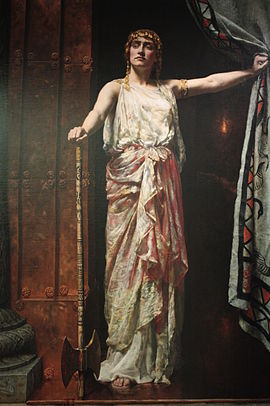
Strutting with arrogance, Agamemnon demands Clytemnestra prepare him a bath. And, so she runs it for him, and she gives him the hottest bath possible. With the help of her lover, she hacks Agamemnon to pieces with an axe. Cassandra is butchered.

painting of Clytemnestra after she has slaughtered her husband Agamemnon _by_John_Collier,_1882 (Wikipedia Guildhall Museum)
Clytemnestra by John Collier,_1882 (Wikipedia Guildhall Museum)

Attitudes

I visit John Collier’s painting of Clytemnestra at the Guildhall, in London, regularly. I am fascinated by her grim, yet satisfied, expression.

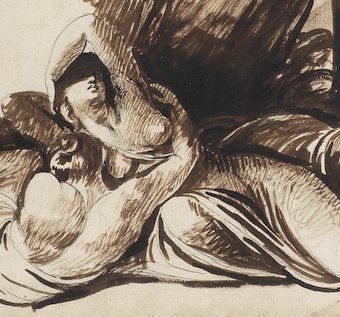
In the 18th/19th Century, rich people were into ‘attitudes’.  For example, Emma Hart, later Lady Hamilton, would be invited to present an attitude in front of a dinner party of mostly male aristocrats.  She would dress up in a flowing, revealing unstructured classical gown.  Then she would stand on a table or pedestal, and present herself as Helen or Andromache or any other classical beauty guests might fancy an eyeful of.  She would assume an appropriate facial expression and posture for everyone’s pleasure. 

Detail of Emma Hart modelling as Iphigenia by George Romney in ‘Cimon and Iphigenia’

Being Clytemnestra is, surely, the most difficult? I imagine Collier’s model being prompted to look both sad at the loss of the daughter. Outraged at the arrogance of the husband. Horrified at the gore of the murder. But, overall, she has to portray a grim satisfaction that the bastard got exactly what he deserved.

Dorothy Dene

Lord Leighton had a famous model who was exceptionally skilled at adopting poses for his paintings. He determined to help her with an acting career. As part of the plan he helped improve her cockney accent. It is said this inspired Bernard Shaw’s story Pygmalion, which, in turn, inspired My Fair Lady and Eliza Doolittle. 

Leighton’s model was Dorothy Dene.  She became a famous actress, outstripping the fame of Ellen Terry and Lily Langtry. For more on Leighton and Dene look at my post here.

John Collier

Before we finish, do have a look at John Collier’s Wikipedia because he is the most ridiculously well-connected painter you can imagine! Related to half the Cabinet and married to TWO daughters of Darwin’s Bulldog, T.H. Huxley (grandfather of Aldous Huxley).

For more on Flaming June see my blog post of 12 July 2024

European Twin Gods

It is suggested that twin male gods are a feature of Indo-European religions. The divine Twins are associated with horses/chariots and are responsible for moving the Sun and the Moon. Their use of a horse above the water means that they can rescue people lost at sea.  

St Elmo’s fire was said to be the way they manifested their divinity to sailors.   Diodorus Siculus records that the Twins were Argonauts with Heracles, Telamon, and Orpheus. Further, he tells us, in the fourth book of Bibliotheca historica, that the Celts who dwelt along the ocean worshipped the Dioscuroi “more than the other gods”.

First written in 2023 updated in July 24 and 25

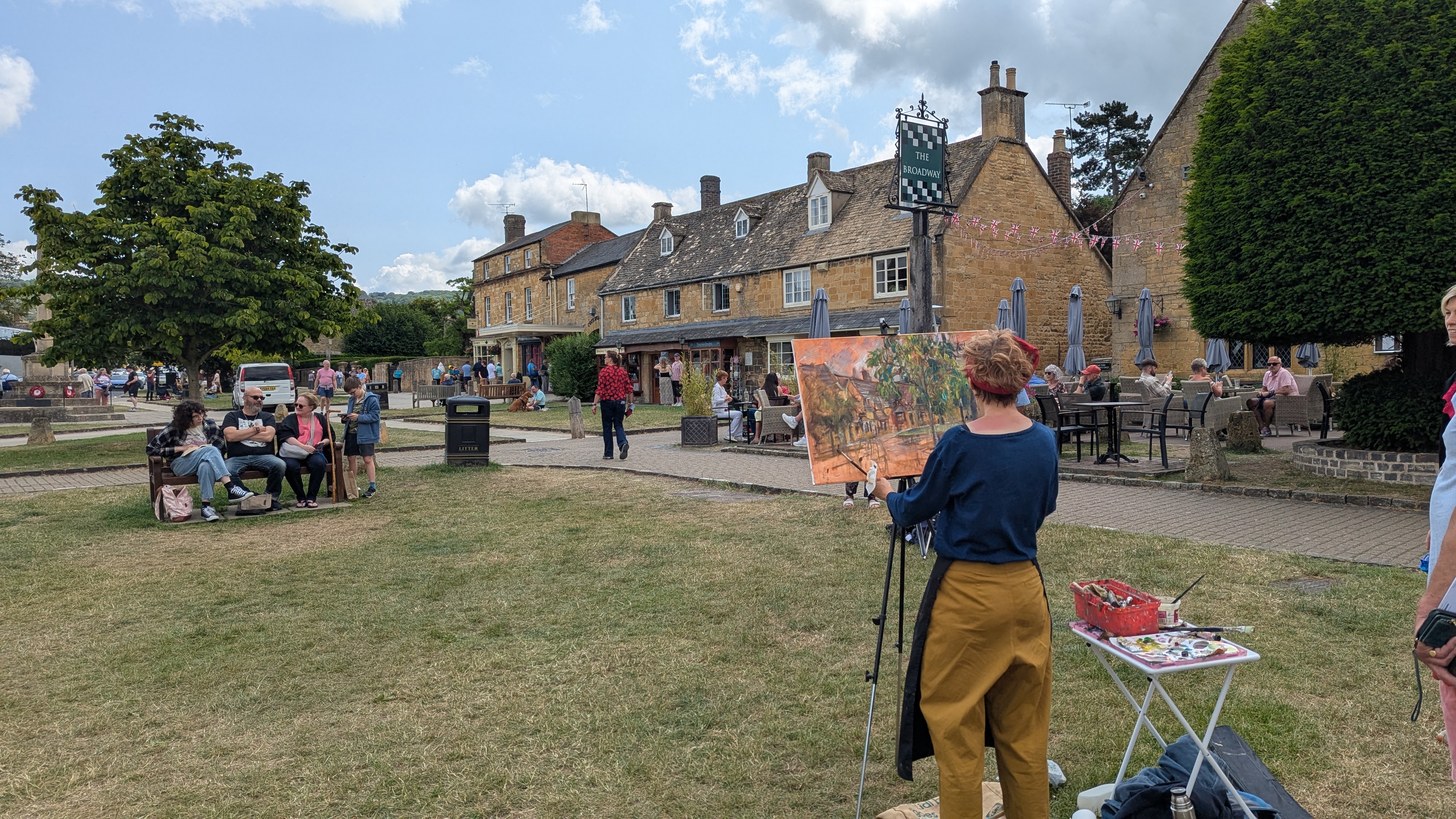
The Great Broadway Paint off

The Great Broadway Paint Off. Photo K Flude 2025
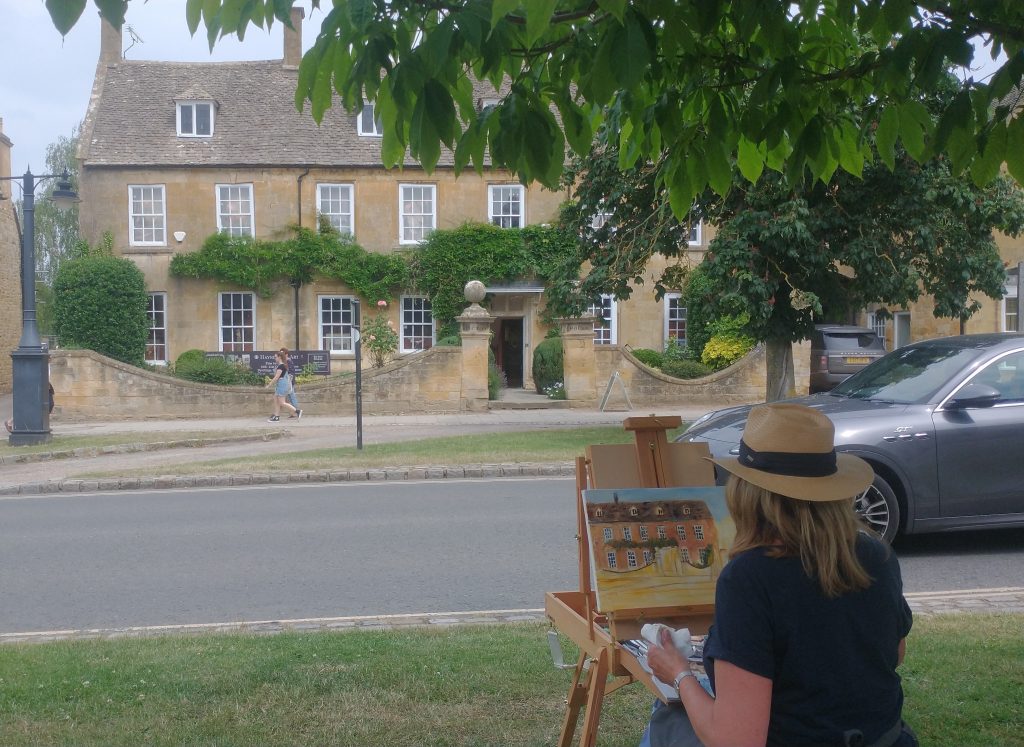
One of the joys of my Summer is revisiting places I know and love in my role as a Course Director for Road Scholar. I first came across the ‘en plein air’ in 2023. On Sunday, June 18th. I was in Broadway, once considered the most beautiful village in Britain. It was also the model for Riseholme in the wonderful Lucia books by E. F. Benson (made into a TV series by the BBC starring Prunella Scales, Geraldine McEwan and Nigel Hawthorne).

The day I visited, in 2025, was last Sunday, June 15th. I have added new photos and revised the texts.

How it Works

The artists register in the morning and have their paper or canvas stamped, or given a block of Maltese stone. This proves that they have done all the work on the day itself.

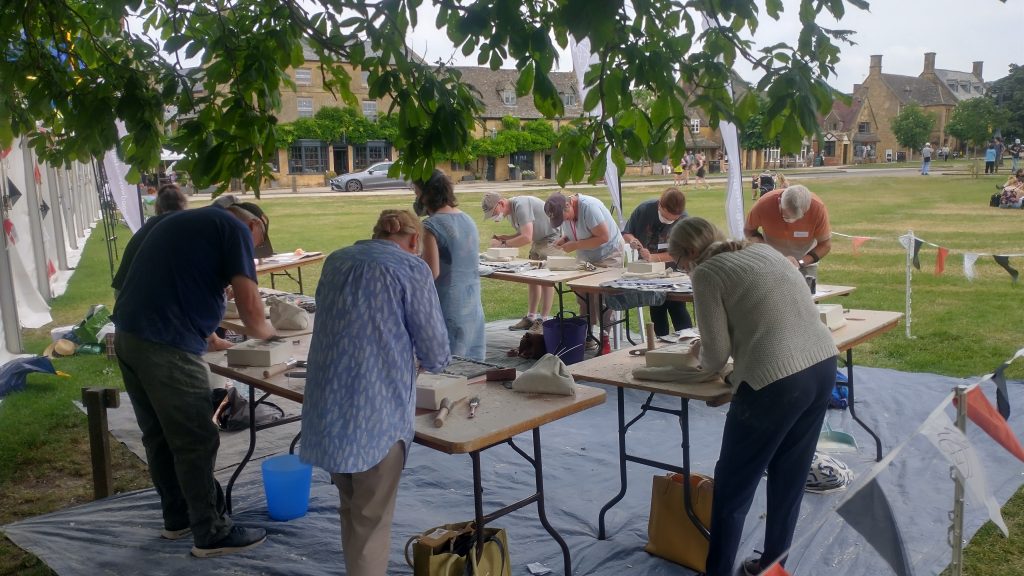
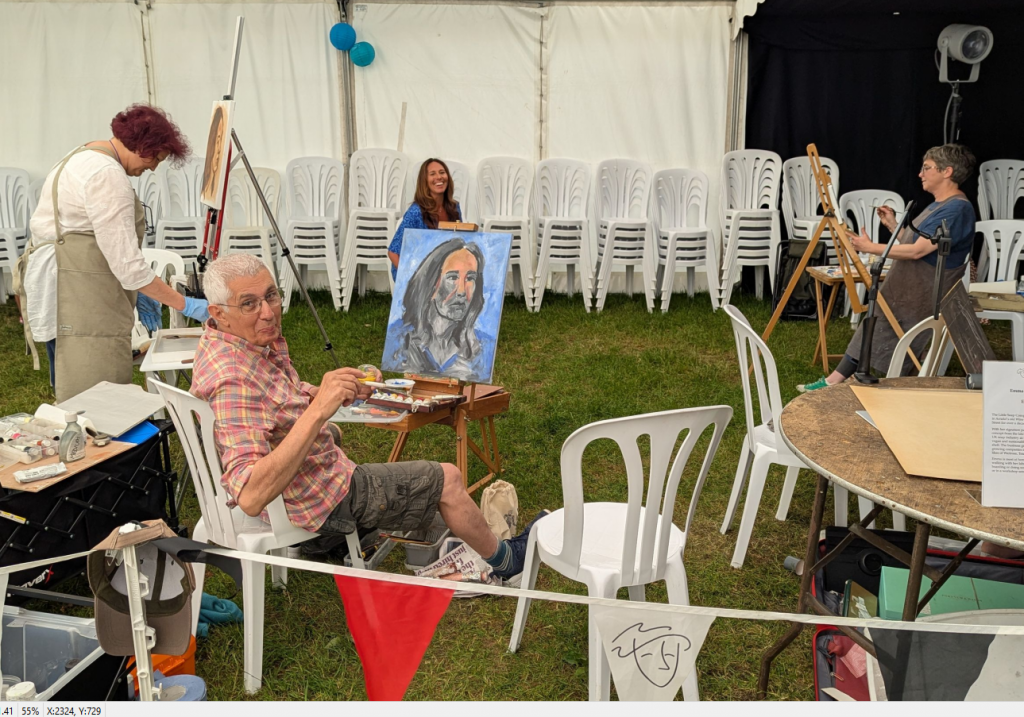
This year there were no sculptors.  Instead, there were live models in the marquee being painted by portrait painters. 

Broadway Paint off, Local Portraits. 2025 Photo K Flude
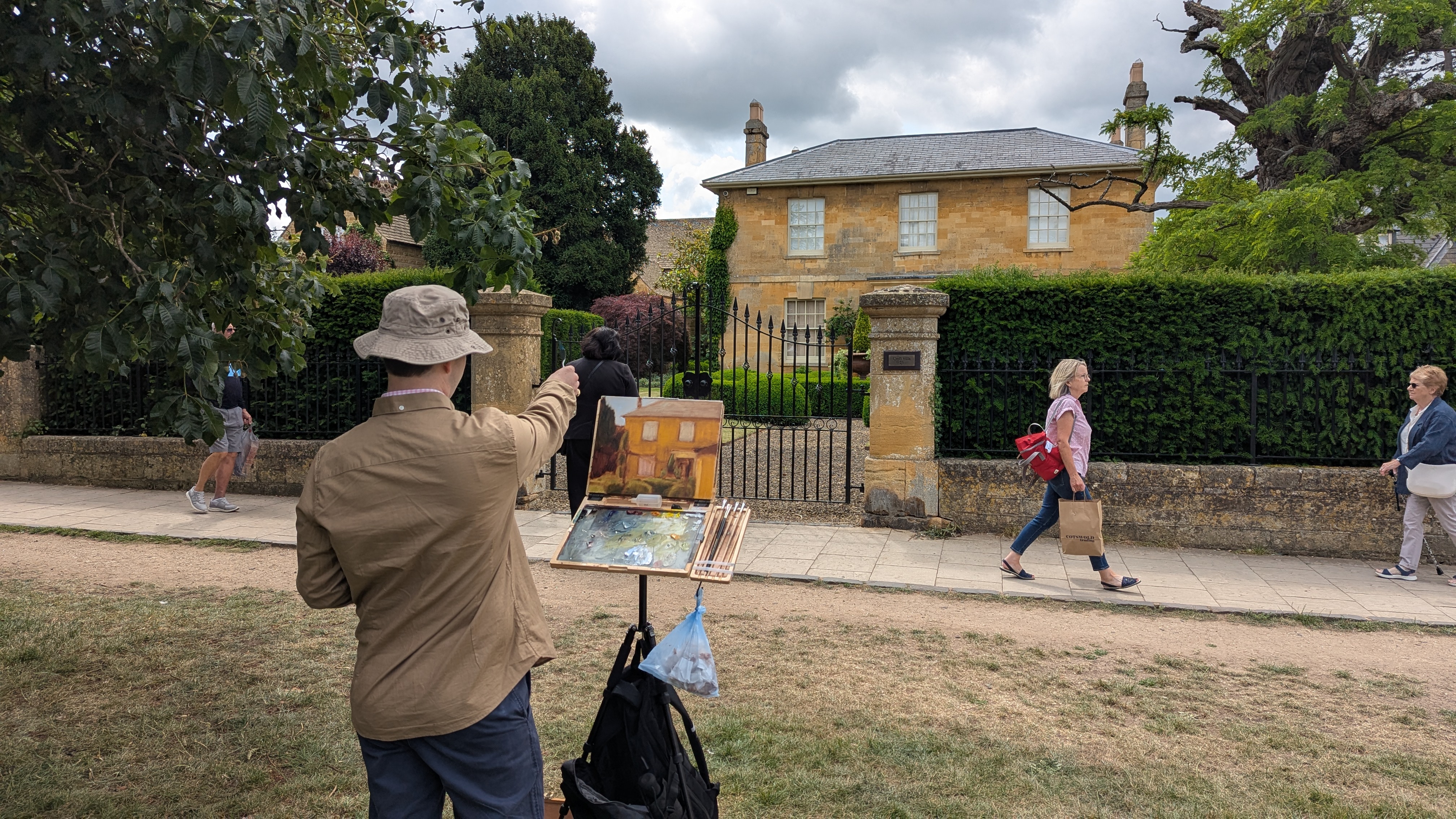
They take their blank canvases to create a work of art in the village. At 4pm or so, they are judged. At 5pm, the art works are exhibited and are on sale in the Marquee on the village green.

Broadway Arts Festival 2025, Photo K Flude

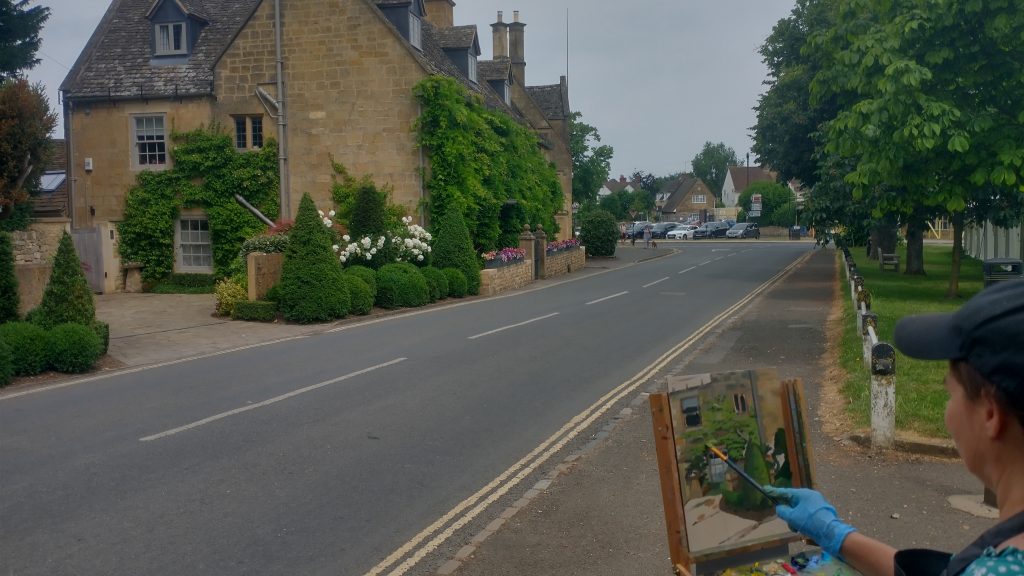
It’s always a delight walking around Broadway. Bun, but with an artist and easel every 50 yards or so even more enjoyable.

The Most Beautiful Village?

The appellation of most beautiful village, came in the late 19th Century. Broadway, once gained its wealth by selling wool. When that declined, the village became an important stop on the Toll Roads. It was on the stage coach route from Aberystwyth to Worcester, Oxford, and London. Fish Hill, nearly 1000 feet high, was an obstacle and coaches made a stop here to prepare or recover. Some coaches used up to 10 horses to get to the top. But with the arrival of Brunel’s Great Western Railway to the Cotswolds the village was nearly ruined. Half the village, the Broadway Museum says, moved away as their livelihood serving the coaching trade died.

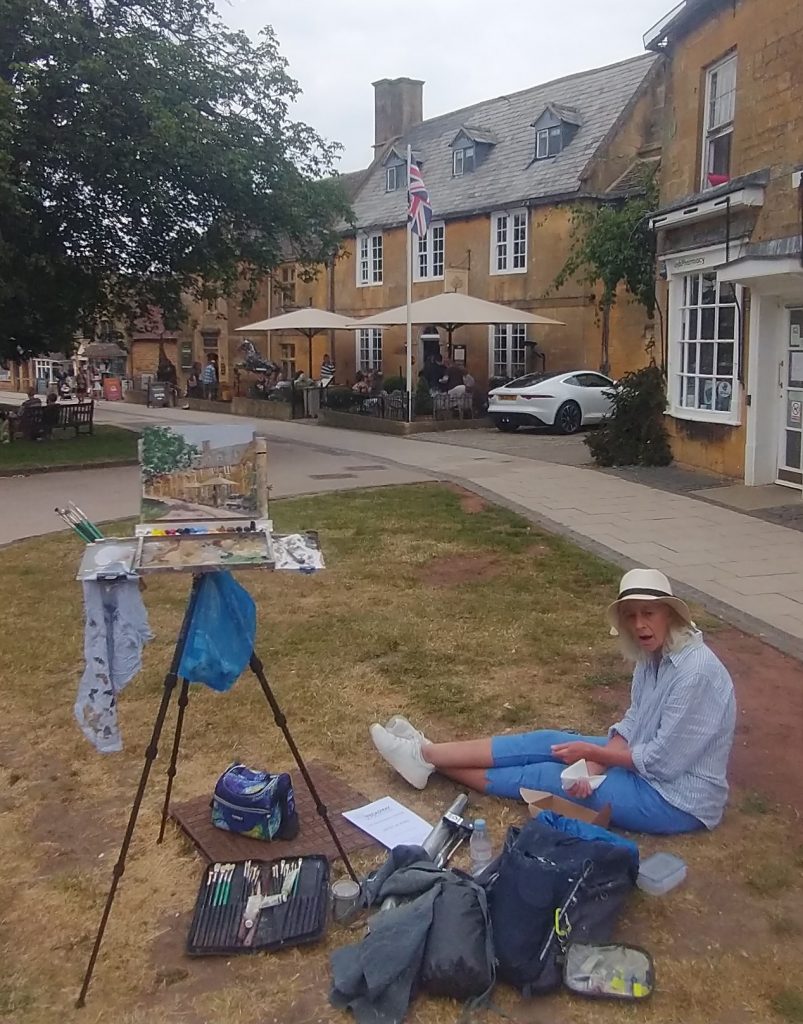
Artist painting in the Broadway 'Great Paint off'
Artist painting in the ‘Great Broadway Paint off’ 2023 Photo K Flude
Artist painting in the Broadway 'Great Paint off'
Another artist participating Artist in the ‘Great Broadway Paint off’ Photo K Flude 2023
Painting in Broadway
@dawnjordanart Great Broadway Paint off’ Photo K Flude 2023

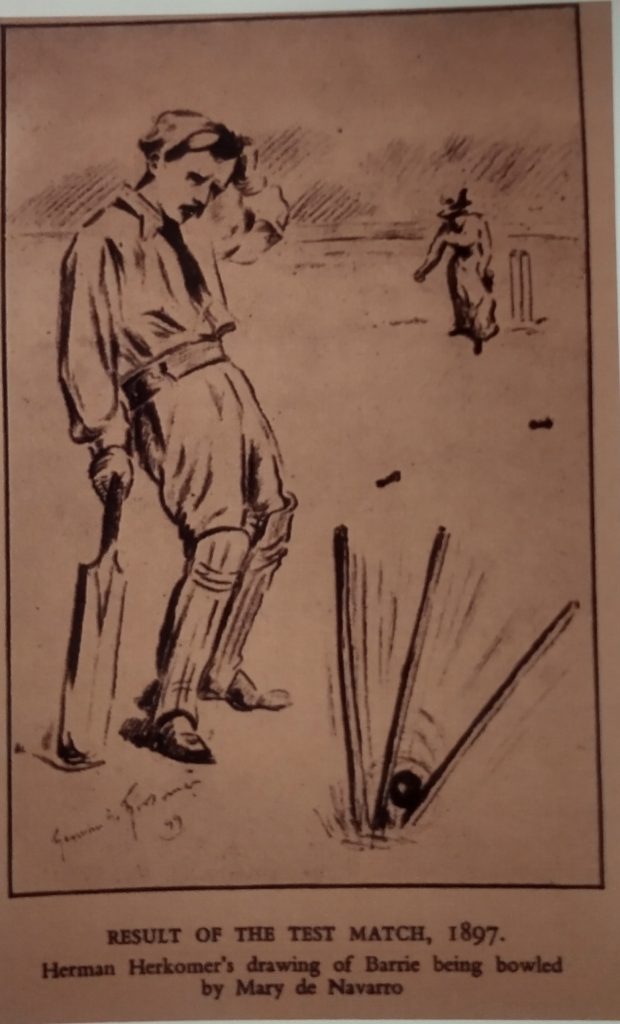
But artists and writers, led by Americans Frances Millet and Edwin Abbey, turned Broadway into a much sort-after country retreat. Visitors included Oscar Wilde, J. M. Barrie, Singer-Sargeant, William Morris, Edward Burne-Jones, Gabriel Dante Rossetti, American actress, Mary Anderson, Edward Elgar, E. F, Benson. Mark Twain visited for Millet’s marriage.

J.M. Barrie being bowled by Mary de Navarro. (aka Mary Anderson, who played many roles including Juliette at Stratford-on-Avon)

Gordon Russell & Henry T Ford

What made the visit particularly interesting was the story told by the volunteer at the Gordon Russell Museum in Broadway. This is the story as I understood it:

The Russells restored the Lygon Arms in Broadway using Arts And Crafts architects. They also restored antique furniture. The son, Gordon Russell, became a leading designer of modernist Furniture. He advertised to passengers on the Cunard Line in order to attract the attention of rich American visitors. One, Henry T Ford, was interested. He came to Broadway, staying at the Lygon arms. He was taken to nearby village Snowshill, where Ford bought a Cotswolds Farmhouse, complete with Blacksmith’s workshop. They were shipped stone by numbered stone to Brentford on the Thames. Then to the London Docks and across the Atlantic. Here. Ford set them up in a Museum in Michigan where they still are!

Sculptors at the Great Broadway Paint off.
Sculptors at the Great Broadway Paint off (2023)

Research suggests it’s a little more complicated, in so far as Ford purchased his first Cottage before coming to Broadway. But it still leaves a delightful story about American ideas of Quintessential English village life. For pictures see my post here. And for another look at the story look at this web site here:

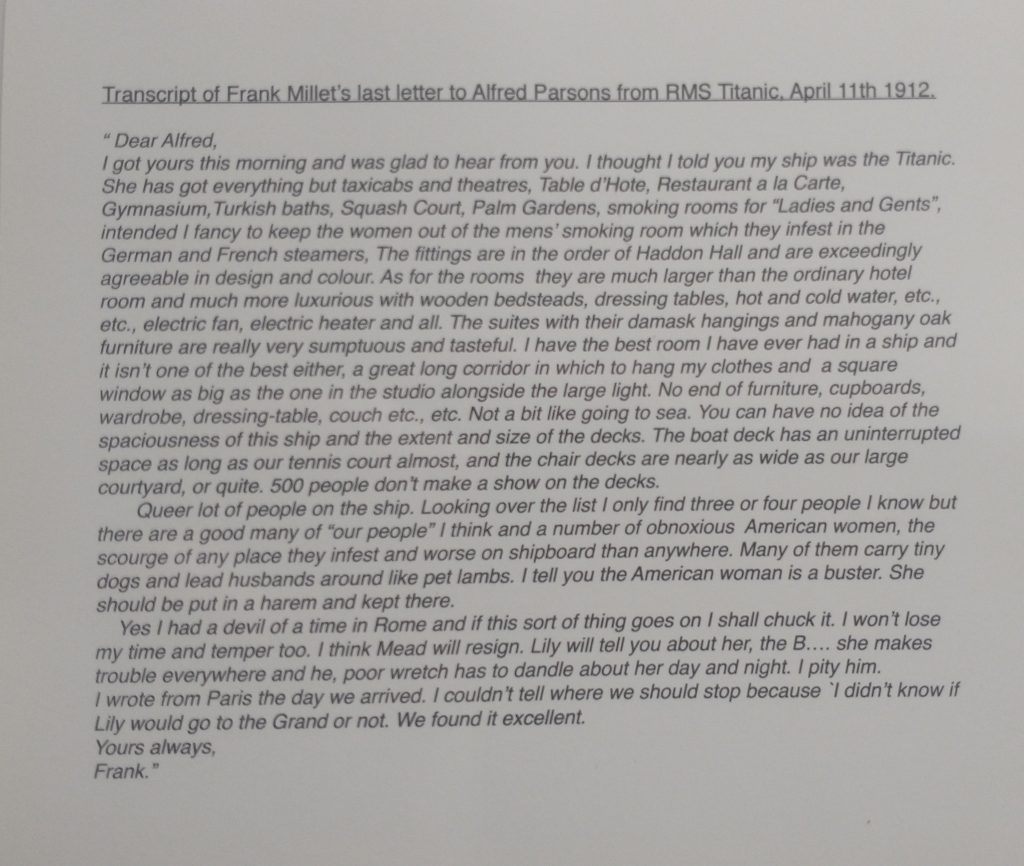
By the way, Frances Millet planned to return to the States on the Titanic. He was one of the 1500 who drowned. A letter he wrote while on the ship was posted, probably in France. It is on display in the Broadway Museum (2023).

For more about Broadway, Gordon Russell and Word War 2 see my post here:

June 18th is also:

International Sushi Day

Autistic Pride Day

National Chocolate Ice Cream Day

First Published in June 18th 2023, Republished in June 2024, and revised in 2025
St Columba (St Colmcille) Day June 9th

St Columba st margarets chapel by Graham van der Wielen  Edinburgh  Lead glass
St Columba Stained Glass window in St Margaret’s Chapel Edinburgh Castle Photo by Graham van der Wielen Wikipedia CC BY 2.0

St Columba, or Colmcille is one of the most important saints for the early transmission of Christianity. He was born in 521 and said to be a descendant of the possibly legendary Irish King Niall of the Nine Hostages. (The Hostages were a token of Niall’s power over Ireland as they came from the five provinces of Ireland. These are Ulster, Connacht, Leinster, Munster, and Meath. The other four hostages represented Scotland, the Saxons, the Britons, and the Franks.)

St. Columba was sent at an early age to be brought up as a Monk, and went on to set up Monasteries in Ireland at Derry and Durrow. In 563, he left Ireland, possibly because he got involved in a dispute that had a deadly outcome. He went into exile to Scotland and set up the famous Monastery on the island of Iona, Inner Hebrides. This is off the coast of what would one day be called Scotland. At the time, it was under the control of the Kingdom of Dál Riata, which was, Gaelic, nominally Christian, and controlled parts of Ulster and Western Scotland.

From Iona, Columba led the conversion of the Picts to Christianity. The Picts were Britons, speaking a different dialect of Celtic than the Gaels of Ireland and Dál Riata. Their name is said to have been given by the Romans and meant Painted Men. A shared religion, which St Columba brought from Ireland, helped towards the eventual union of the Gaels, the Picts and other British groups into the Kingdom of Alba. Alba is the Gaelic name for Scotland – meaning white, and from which we also get Albion. Alba became Scotland, which is derived from the Roman word for the area which in Latin was “Scotia”. Iona became the traditional burial place of early Scottish Kings such as Macbeth (Mac Bethad mac Findlaích). These Kings were crowned at Scone and buried in Iona. Alba was also able to take territory from the Anglian Kingdom of Northumbria, namely, the Scots-speaking areas South of the Firth of Forth. (Scots being a dialect of English). There were also Norse settlers in the Ireland so Scotland was made of a coalition of Gaelic, Brittonic, Norse and English speakers.

St Columba and the Loch Ness Monster

Much of the events of this part of Columba’s life are recorded by St. Adamnan in The Life of Saint Columba. This was written in the 7th Century, much of which is apocryphal. One notable story tells how he came across a group of pagan Picts who were mourning a child killed by a monster in the River Ness. St Columba revived the child. He then sent one of the Brothers to swim across the Loch to fetch a boat. The “water beast” pursued the Monk and was about to attack him when St Columba told the monster to stop. So it did, retreating to the depths of Loch Ness. Thus began the legend of the Loch Ness monster.

St Columba died in 597AD. Iona continued to prosper and in, 634 sent St Aidan from Iona to found the Monastery at Lindisfarne. The island is on the Eastern coast of Britain in the Anglo-Saxon Kingdom of Northumbria. This Kingdom of the North Angles, was one of the most powerful at the time and Lindisfarne was instrumental in its conversion. The tradition of evangelism took hold in the British Isles, and it was from here that much of the German-speaking world was converted to Christianity.

This is St Columba’s legacy.

Northumbria’s Contribution to the development of Christianity

There is a developing understanding among scholars that this Irish inspired form of Christianity, fused with the Anglo-Saxon Northumbria took a leading role in ritual, art, scholarship in the Roman Catholic world. Just stop and think about that sentence for a moment. The northern parts of an out of the way set of islands off the edge of Europe took a leading role in the development of Western Christianity. This was highlighted in a recent exhibition of Anglo-Saxon art at the British Library.

British Library with Poster for Anglo-Saxons Kingdoms Exhibition, Photo K Flude

A look at the Lindisfarne Gospel and the Book of Kells showcases the amazing art of this period. For a real treat, look through this scrollable virtual copy of the Lindisfarne Gospel. (Currently this is unavailable, I suspect since the BL was hacked. So instead, here is a slightly breathless online introductory video of the Gospel.)

The Book itself has been missing from the displays of the British Library for a couple of years, but was on display in Northumberland in 2022. I’m not sure whether it is yet back on display at the British Library. I think not. You can see the Book of Kells at Trinity College, Dublin or look at their online offering here: Not quite as joyous an experience as the online Lindisfarne but beautiful enough.

Carpet Page from the Lindisfarne Gospel
Carpet Page from the Lindisfarne Gospel Photo Wikiepedia Eadfrith –
Lindisfarne evangeliarium, tapijtbladzijde op f26v, Matteüsevangelie

Click here to read my post on Scone and the emergence of Alba.

Here is a virtual tour of Iona

Here is a 360-degree panoramic photo tour of Lindisfarne Abbey

First Published in 2023, revised, 2024 and improved 2025