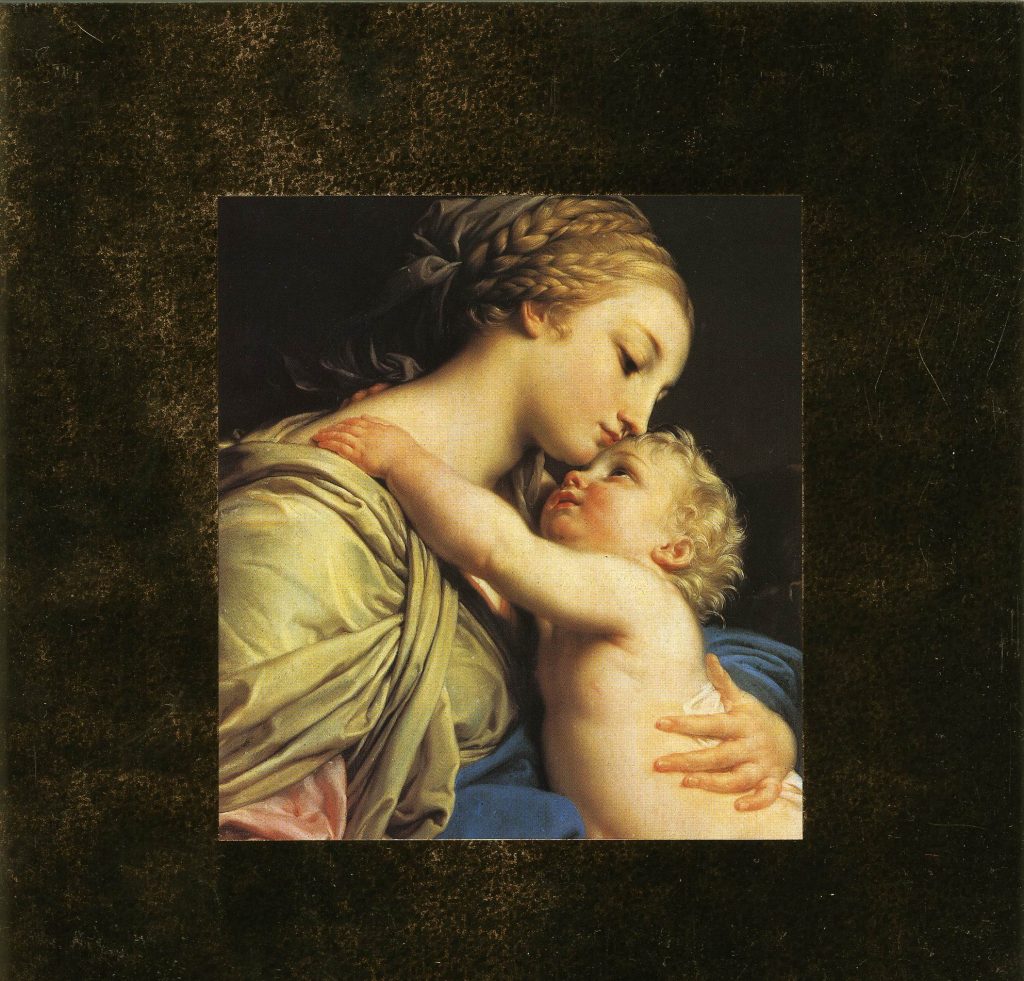
Virgin and Child (Image on a card of unknown origin) to illustrate Mothering Sunday or Mother’s Day
In 2026 Mothering Sunday is on March 15th. In 2027 it will be on March 7th. Strangely, originally not about Mothers! Mothering Sunday is the 4th Sunday in Lent. It is, in fact the day in which we are enjoined to visit our Mother Churches. It, therefore, became a day when people made processions to their Churches. Servants and workers could go to their home parishes. But not only go to the Mother Church but also to say hello to their mothers. So, it became increasingly about Mothers. It was called Mothering Sunday when I was little and has morphed into the Americanism that is Mother’s Day.
‘Rejoice ye with Jerusalem; and be ye glad for her, all ye that delight in her: exult and sing for joy with her, all ye that in sadness mourn for her; that ye may suck, and be satisfied with the breasts of her consolations.‘
Jerusalem is personified, here, as the Mother. Further associations with motherhood came from the Gospel for the day which is John 6:1–14, the story of the Feeding of the Five Thousand, which led to associations with the bounty of Mother Earth.
In the medieval period visits to the Mother Church seem to have become fiercely competitive. The Bishop of Lincoln, Robert Grosseteste decreed:
‘In each and every church you should strictly prohibit one parish from fighting with another over whose banners should come first in processions at the time of the annual visitation and veneration of the mother church. […] Those who dishonour their spiritual mother should not at all escape punishment, when those who dishonour their fleshly mothers are, in accordance with God’s law, cursed and punished with death.‘
(Letter 22.7 – Wikipedia)
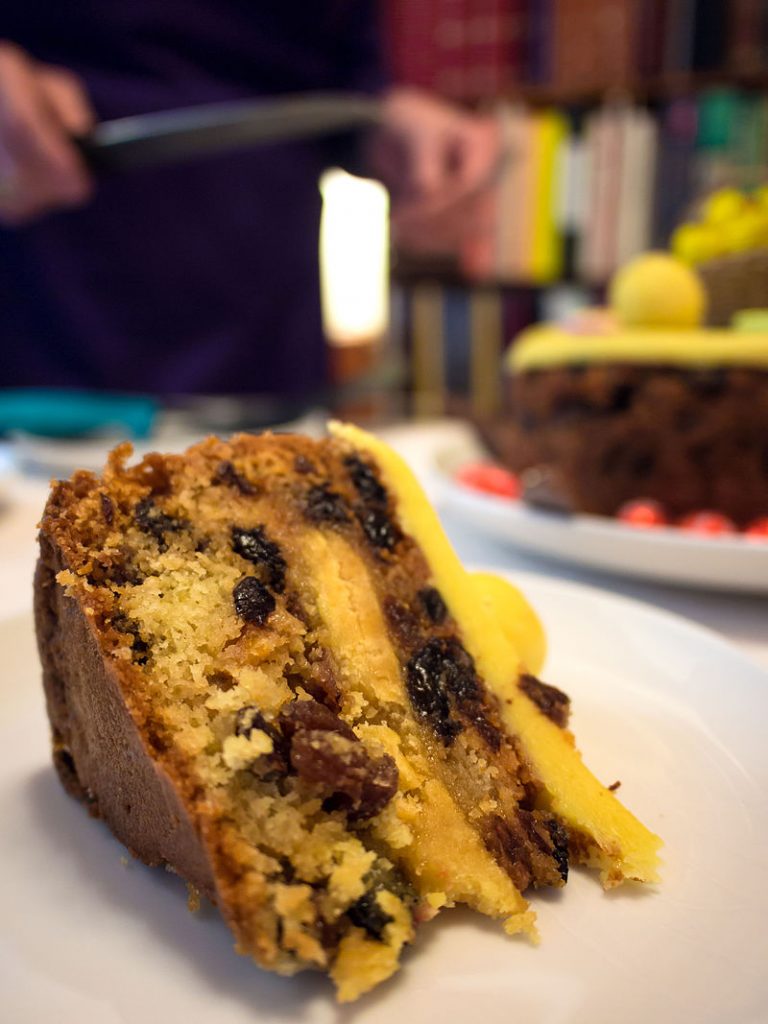
Simnel Cake
It was also the Sunday in the fasting period of Lent in which the restrictions were relaxed. So a special cake called Simnel Cake was made for the purpose.
I’ll to thee a Simnel bring ‘Gainst thou goest a-Mothering So that, when she blesseth thee Half that blessing thou’lt give me.
The Simnel cake is a fine flour light fruit cake (Latin simila, fine flour), with layers of marzipan in it. It often has 11 balls of marzipan on the top, representing the 11 (not Judas) apostles. The cake is first boiled for two hours and then baked. Now, I know 95% of my American readers hate fruit cake. But believe me when I tell you – change your ways – iI’s delicious. Try this BBC’s recipe: https://www.bbcgoodfood.com/recipes/easter-simnel-cake
And I’m beginning to see that cake is an emerging theme of this Almanac of the Past.
See my post on Chelsea Buns here; Lardy Cake and Doughnuts here.
Written in March 23, slightly revised in March 24, and 25, Revised 26
This post is about the Works and Days which is a farmer’s Almanac written for the brother of Hesiod. But today is also another Friday the Thirteenth so please read my post here to find out about the unlucky days of the year..
Hesiod’s Works and Days has a mixture of seasonal good advice and moralising. He is, one of the first great poets of the western world, and near contemporary with Homer. The poem is an important source for Greek Myths. For example, it tells us that the stories of Prometheus and Pandora are the reasons the Gods cannot give us a simple, wholesome life. He also describes the ages of humanity. These are: Golden Age, Silver Age, Bronze Age, Heroic Age, and his own modern day – the decadent Iron age. This idea was borrowed by C. J. Thomsen at the National Museum of Denmark in the early 19th Century. He created our modern Three Age System of Stone, Bronze and Iron Age. Our system is perhaps more optimistic with a progressive trend, while the Greek system degenerates through successive eras.
Hesiod’s Grecian Spring
Hesiod sees Spring as a time to begin trading by sea. He warns us not to put all our eggs in one vessel as Spring can bring nasty nautical surprises.
‘Spring too grants the chance to sail. When first some leaves are seen On fig-tree-tops, as tiny as the mark A raven leaves, the sea becomes serene For sailing. Though spring bids you to embark, I’ll not praise it – it does not gladden me. It’s hazardous, for you’ll avoid distress With difficulty thus. Imprudently Do men sail at that time – covetousness Is their whole life, the wretches. For the seas To take your life is dire. Listen to me: Don’t place aboard all your commodities – Leave most behind, place a small quantity Aboard. To tax your cart too much and break An axle, losing all, will bring distress.
Be moderate, for everyone should take An apt approach. When you’re in readiness, Get married. Thirty years, or very near, Is apt for marriage. Now, past puberty Your bride should go four years: in the fifth year Wed her. That you may teach her modesty Marry a maid. The best would be one who Lives near you, but you must with care look round Lest neighbours make a laughingstock of you. A better choice for men cannot be found Than a good woman,’
In Rome, early March is taken up with celebrations of the Great God Mars. His favour enabled the Romans to conquer most of the known world. But let the poet Horace explain:
Winter’s grip is loosening at the welcome turn of spring and the West Wind As windlasses haul empty hulls to the sea. Cattle no longer feel contented in their stables nor the farmer by his hearth, And no morning frosts are leaving a white sheen on the fields. Now Cytherean Venus leads the dance under a moon hanging high, And hand in hand nymphs and beauteous Graces, With rhythmic feet, stamp the ground, while busy, glowing Vulcan Tends the massive forges of the Cyclopes. Now ’tis time to wreathe our glistening locks with green myrtle And with flowers borne by the unshackled earth; Now ’tis time to make sacrifice in shadowy groves to Faunus, Whether he demands a lamb or a kid if he prefers
For the Anglo-Saxon their poetry shows Spring as a great release when the ‘fetters of frost’ fall off and allow a welcome return to sailing on the high seas
The Seafarer
The woods take on blossoms, towns become fair, meadows grow beautiful the world hastens on; all these things urge the eager mind, the spirit to the journey, in one who thinks to travel far on the paths of the sea.….
So now my spirit soars out of the confines of the heart, my mind over the sea flood; it wheels wide over the whale’s home,
Poem from the Exeter Book known as the Seafarer, quoted in Eleanor Parker’s ‘Winters in the World a journey through the Anglo Saxon year’.
Gregorius I is known as Saint Gregory the Great. Pope from 3 September 590 to his death on 12th March 604. So 12th March is traditionally his feast day. It was changed to September 3rd, the date of his elevation to Pope because 12th March was often in Lent.
His is the 2nd most popular name for Popes. This is the top 18. I guess St Peter was too hard an act to follow, but then there are only 6 Pauls? I can’t help feeling there should be six Sixtus’s?
St Gregory is the patron saint of musicians, singers, students, and teachers. It is traditionally believed he instituted the form of plainsong known as Gregorian Chant. However, he was also a formidable organiser and reformer. He made changes that helped the Catholic tradition survive Arian and Donatist challenges. To read more about the Arian Heresy look at my post on St. Hilary and the Arians. (St Gregory and the Angles – why do these all sound like 80’s post punk bands?)
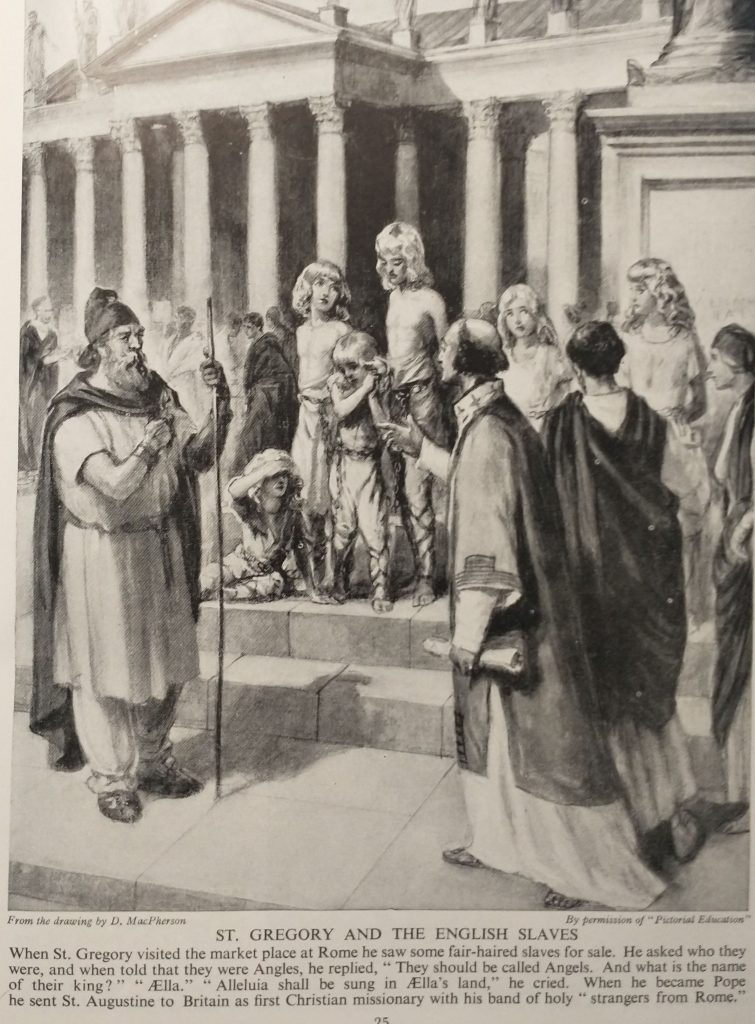
In the UK, St Gregory is venerated with St Augustine for bringing Christianity to the largely pagan Anglo-Saxons. The caption to the illustration above tells the story of how he came to send a mission to the pagan Angles in Briton. It includes his two most famous puns, riffing on the similarity of the words Angles/Angels and Aella/Alleluia. But in between these two he also punned on the name of Aella’s kingdom. This was called Deira which later joined with Bernicia to become the Kingdom of Northumbria. St Gregory said he would save them from the wroth of God which is ‘de ira’ in Latin. The ire of God. Deira. No? Not hitting your funny bone?
St Augustine’s Mission
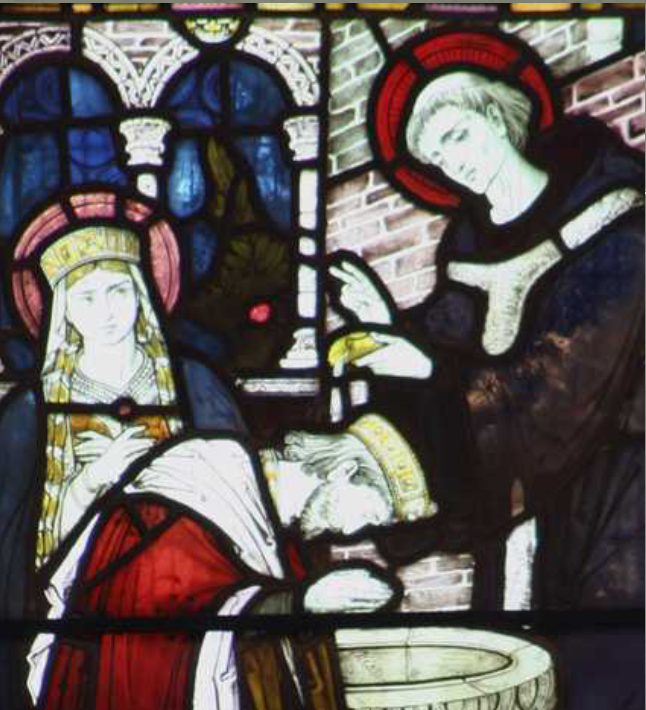
In 597AD St Gregory sent St Augustine to Canterbury. His mission to convert the Germanic peoples of the former Roman Province of Britannia. Canterbury was chosen because its King was the ‘Bretwalda’ of Britain. And he, was married to Bertha, a French Princess who was already a Christian. The enigmatic title of Bretwalda was given to Britain’s most powerful King. At the time, it was Ethelbert of Kent. So, it was a relatively safe haven for St Augustine’s mission. The King was baptised, shortly, after in Canterbury.
Stained glass window showing the Baptism of King Ethelbert of Kent by St Augustine watched by Queen Bertha. In St Martins Church, Canterbury
Archbishop of London?
The mission came with a plan to recreate the ecclesiastical arrangements set up in the Roman period. From the early 4th Century there were archbishops in the two main capitals at London and York. (We know because they attended the Synod of Arles in 314). After Kent was converted, St Augustine sent St Mellitus to London. London was part of the Kingdom of Essex, ruled by St Ethelbert’s nephew, Sæberht. Mellitus was the first Anglo-Saxon bishop of London and he established St Pauls Cathedral in 604. St Paulinus was sent to convert Northumbria and established a Cathedral in York.
Unfortunately, for the plan, Sæberht died. His sons returned to paganism and Mellitus was kicked out. He returned to Canterbury, where he, eventually, became Archbishop. Ever since we have had an Archbishop of Canterbury and York and never had an Archbishop of London.
St Martin’s Church, Canterbury – where the Church of England began. Note the Roman tiles in the wall.
St Gregory and England
It is possible to argue (and I do) that St Gregory’s encounter with the Angles is why we are called English, not Saxons, nor Wessexians. Gregory sent Augustine to set up the Church of the Angles, not the Church of the Saxons. Saxon was the normal name used by the Romans for Germanic barbarians. The old Roman province of Brittania was by now divided into 3 Saxon Kingdoms. Essex, Wessex, and Sussex. (East, West, and South Saxons). 3 Anglian Kingdom, Mercia, East Anglia and Northumbria. (Middle, East and North Angles). And Kent, which the Venerable Bede says was a Jutish King of Germans from Jutland. These Kingdoms were often at war., sometimes allied, or subjected.
The Vikings then conquered most of these Kingdoms, except parts of Wessex and Mercia. After the attacks of the Vikings were beaten back, Alfred and his son, daughter and grandson reconquered or ‘liberated’ the ex-Viking areas. Alfred renamed the united kingdoms of Wessex and Mercia, the Kingdom of the Anglo-saxons. Athelstan his son liberated Northumbria and other areas, and in joining it to the Kingdom of the Anglo-Saxons renamed it Angeland or England.
The Church of England had made the term Anglish/English became a unifying term to unite Angles, Saxons and Jutes. Otherwise, the ‘liberated’ Angles and Jutes would have to swallow being part of Greater Wessex, rubbing in their loss of independence. Of course, it was all a bit more complicated, but it gives a summary of the formation of England, which was created by the end of the 10th Century.
St Gregory in Amsterdam
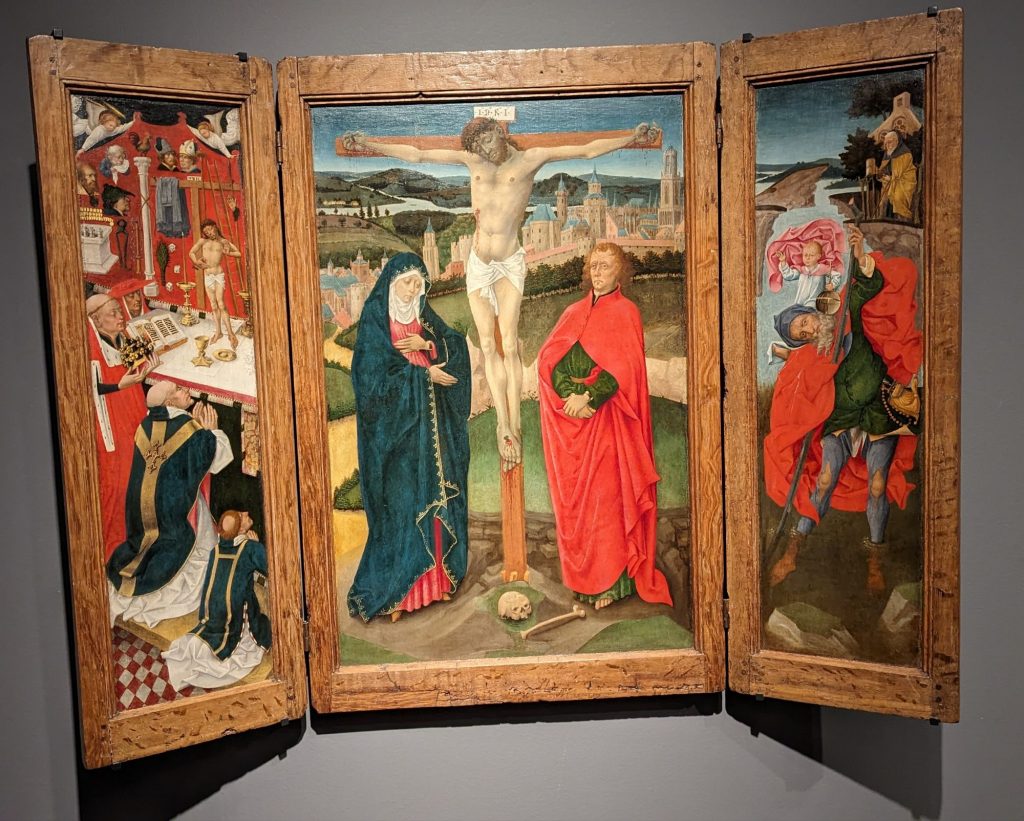
On a visit to Amsterdam and the Rijksmuseum I came across this painting which features Pope Gregory the Great. He is in the left hand part of the Triptych, shown in green kneeling at the altar. It shows Utrecht in the background.
Triptych of the Crucifixion. Showing the vision of the Crucifixion that St Gregory had while celebrating Mass (left). Crucifixion centre. St Christopher (right)
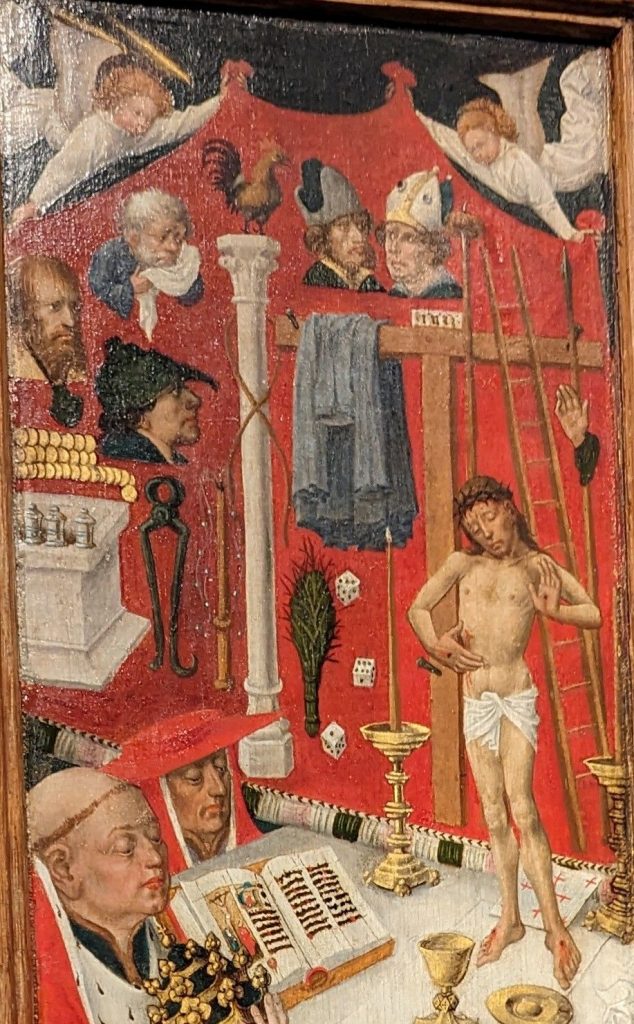
What is fascinating is all the paraphernalia of the Crucifixion above Gregory’s head. You’ll see 30 pieces of silver, dice to decide who gets Jesus’ robes, flails and torture devices, sponge and spear etc. Close up below.
Lazy Day in Anglo-Saxon Times. In the Laws of King Alfred the Great, this day was a day off for freemen. For more on Days off in the Anglo Saxon Calender see my post on August 15th.
1689 – Catholic King James II landed at Kinsale, County Cork, Ireland, in an attempt to regain the Kingdom from his daughter and son-in-law, William and Mary. James had fled to the continent following riots against his rule. William defeated James II at the Battle of the Boyne. James II returned to France never to return. Mary ruled jointly with her husband until she died of Smallpox, and he ruled alone until he fell off his horse.
1930 – Mahatma Gandhi begins the Salt March, a 200-mile march to protest the British monopoly on salt in India. One of the defining moments in non-violent civil disobedience. Offering the world a possible alternative to violent revolution, or military regime change.
1999 – Former Warsaw Pact countries, Czech Republic, Hungary and Poland join NATO. Bulgaria, Estonia, Latvia, Lithuania, Romania, Slovenia and Slovakia joined in March 2004; Croatia and Albania joined on 1 April 2009. Montenegro 2017. North Macedonia. 2020: (Ukraine) can forget about (NATO membership). That’s probably the reason the whole thing (war) started,” said U.S. President Donald Trump on February 26, 2026
First published in 2024, republished in 2025. On This Day added 2026
The store cupboards are getting denuded of the fruits, nuts, preserves, pickles, salted and dried foods saved from the summer and autumnal abundance. Of course, this is alleviated by the reduced consumption of the Lenten fast. (I’m continuing my lenten practice of giving up, giving up things for Lent). But nettles are budding. I take a regular cup of nettle tea. Normally, provided by the excellent Cowan’s tea emporium in the Covered Market in Oxford. But I’m running out and not due to visit Oxford for a month or so. So Charles Kightley in his Perpetual Almanac tells me that young stinging nettles are appearing and this is the time to collect own young, juicy nettles.
Here is a video about collecting them.
YouTube Video on making Nettle Tea
Nettle Beer
Or better still, change up the tea for a nettle beer:
Take a gallon measure of freshly gathered young nettles washed well dried and well packed down. Boil them in a gallon of water for at least a quarter of an hour. Then strain them, press them and put the juice in an earthenware pot with a pound of brown sugar and the juice and grated skin of a lemon. Stir well, and before it grows cool put in an ounce of yeast dissolved in some of the liquid. Cover with a cloth and leave in a warm place for four or five days and strain again and bottle it, stopping the bottles well. It’ll be ready after a week, but better if left longer.
Nettle Beer was brewed for old people against ‘gouty and rheumatic pains’.
Nettle: Detecting Virgins
A more sinister use is provided by William Coles who gives a method of detecting virginity.
‘Nettle tops are usually boiled in pottage in the Springtime, to consume the Phlegmatic superfluities in the body of man, that the coldness and moistness of the winter have left behind. And it is said that if the juice of the roots of nettles be mixed with ale and beer, and given to one that suspected to have lost her maidenhood, if it remain with her, she is a maid, But if she’s spews forth, she is not.‘
William Cole’s Adam in Eden 1657.
Flagellation with Nettles?
William Camden reported that Roman soldiers used nettles to heat up their legs in the cold of a British winter. (from Mrs Greaves’ ‘A Modern Herbal). Perhaps, I should have sent that idea to PM Keir Starmer? He might have suggested the method to Senior Citizens to alleviate the loss of their Winter Fuel Allowance? (which he has now restored). Flogging with nettles was a cure for rheumatism and the loss of muscle power in the early modern period. Nettles were also added to horse feed to make their coats shine. It was used as a hair tonic for humans.
Nettle Fabrics
The 18th century poet Thomas Campbell is quoted on the virtues of nettles:
“I have slept in nettle sheets, and I have dined off a nettle tablecloth. The young and tender nettle is an excellent potherb. The stalks of the old nettle are as good as flax for making cloth. I have heard my mother say that she thought nettle cloth more durable than any other linen.”
In 2012, a Danish Bronze Age Burial was found to be dressed in a shroud made of Nettle. Strangely, the nettle was not local, perhaps being made in Austria where other objects in the rich burial came from. However, the person was thought to be Scandinavian. For more have a look at this article on www.nbcnews.com.
In the Irong Age, also in Denmark, Huldremose Woman was found buried in a bog. She had a severed arm and was buried in elaborate sheep and goat skin clothes, but underneath:
‘she wore a white inner garment made from plant fibres that reached from the shoulders to below the knees. The type of plant fiber is unclear but other evidence from the time period suggests that it could have been made of nettle.’
Greaves tells us that the German and Austrians had a shortage of cotton during the blockade of World War 1. They turned to nettles to replace cotton production believing it to be the only effective substitute. It was also substituted for sugar, starch, protein, paper and ethyl alcohol.
YouTube Video on making fabric from nettles
Nettle Pudding
Pepys ate Nettle Pudding in February 1661 and pronounced it ‘very good’. Here is more on Nettles in history AND a recipe for Nettle Pudding! I can see I’m going to have to get out there and carefully pick myself some nettles! ( For Folklore of Nettles look here).
Remember, none of the above is necessarily good advice as far as medicine is concerned. For smoking herbs see my post coltsfoot-smoking-cholera
March Weather
In the early modern almanacs there is much weather and horticultural advice to be had (Weather Lore. Richard Inwards).
‘March damp and warm Will do farmer much harm‘
or
‘In March much snow to plants and trees much woe‘
On This Day
March 10th is St Kessog Day. He is associated with Luss on Loch Lomond, and was Robert the Bruce’s rallying cry. St Kessog and Scotland!
241 BC – The Battle of the Aegates in which the Carthaginian fleet is sunk, and the First Punic War ends. Carthage was destroyed in the Third Punic War in 146BC. Rebuilt as a Roman City 100 years later.
1629 – Parliament is dissolved by Charles I. This was followed by a Royal dictatorship which lasted 11 years, and then led to Civil War.
1906 – Bakerloo Line Opened. The name originated from the Baker Street and Waterloo Railway. It goes from Harrow &Wealdstone in the NW to Elephant & Castle in the South East, via the Central London section which goes from Bakers Street to Waterloo, Sherlock Holmes didn’t use the Tube very much (see this post here for those times he did). There is a proposed extension from Elephant & Castle to Lewisham.
1969 – James Earl Ray sentenced to 99 years in jail for murdering Martin Luther King. While Ray was a segrationalist and a supporter of George Wallace, he maintained he was set up as the scapegoat. He died in prison in 1998.
The Soviet Union 1949 CPA 1368 stamp (International Women’s Day, March 8. (Wikipedia)
Today, is International Women’s Day. It began, as an idea within Socialist organisations in 1909/1910. Following the February Revolution in Russia and women gaining the vote, March 8th was chosen as the day to celebrate. The wider feminist movement adopted it in the 1960s followed by the UN in 1977. Since when, it has been a day to celebrate women’s achievements and campaigns worldwide.
Harper’s Road burial
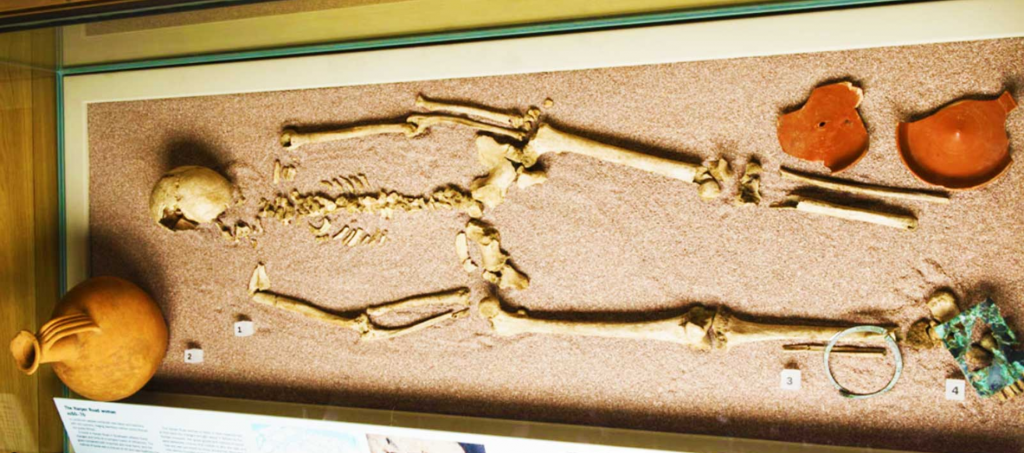
The Harper Road Burial Southwark (museum of London web site)
Another important historic female was found in an excavations at the Harper’s Road. . I was reminded about it by reading Dominic Perring’s new book ‘London in the Roman World.’ He uses it to establish that Southwark was a place where people lived both before and after the Roman Conquest in 43AD. The burial was found in the 1970s’ and dated to 50 – 70 AD (Roman Invasion of Britain was in 43 AD). Recent scientific analysis has shown that the burial was of a woman (21 – 38 years of age). She had brown eyes and black hair and was brought up in Britain. Her grave goods indicate she was wealthy. She had both imported Roman pottery but also typically British Iron Age objects. The combination shows some adaption between her native culture and the new Roman ways.
Her British objects included a bronze necklace (a torc possibly of Catevalaunian or Trinovantian origin) and a mirror. Dr Rebecca Redfern & Michael Marshall on the Museum of London’s website make a case for her being a:
‘Powerful women in late Iron Age London’.
Mirrors of Power?
They make a case for the mirror being
‘used by women for divination and magic, and were a source of knowledge that only women could command. Being able to use and read the mirror meant that the woman was highly regarded by her community.’
Iron age burials are often found either with a sword or a mirror and the thinking is that the mirror reflects an equivalent status to a sword. I think we can say that the finds do reflect someone of standing, but as to the use of the mirror that must be speculation. Divination using a mirror is called ‘scrying’ and the British Museum has John Dee’s scrying apparatus from the 16th Century. You can buy scrying mirrors on etsy. https://www.etsy.com/uk/market/scrying_mirror. But to make a case that Mirrors were not just utilitarian and prestige objects but also in use for supernatural/religious purposes is surely just speculation?
Melanie Giles & Jody Joy in ‘Mirrors in the British Iron Age: performance, revelation and power published in 2007 (and available to read here) concludes:
‘Iron Age mirrors, whether made of iron or bronze were beautiful, powerful, and potentially terrifying or dangerous objects. They were used in the preparation and presentation of the body and prestigious displays, but may also have been associated with powers of augury and insight into the past, or access to ancestral or spiritual worlds.’
Women in the Age of Iron
The evidence we have for iron communities is for a powerful role for women in contrast to the Romans. The Romans dismissed women when they wrote that Boudicca was ‘uncommonly intelligent for a women’. In fact, she nearly forced the Romans to abandon their conquest of Britain. We also know that Queen Cartimandua of the Brigantes had executive power in the North of Britain. The Britons also worshipped the three Mother Goddesses, which focussed on the value of woman as maidens, mothers, and grand-mothers.
A book to order for International Women’s Day is ‘Patriarchs’ in which Angela Saini investigates when the Patriarchy took over. I heard her talk about it and it seems an excellent introduction.
For March 6th, Ovid in his Almanac Poem called ‘Fasti’ (Book III: March 6) tells the story of Vesta. She is Hestria, in Greece and is depicted on the Parthenon Marbles, standing near Zeus and Athene. She was the Goddess of the Hearth, of the fire that keeps families warm, and fed. Vesta had 6 Virgins as her Priestesses. They had to remain 30 years, from before puberty, as a virgin. The punishment for breaking their vows was to be buried alive. Any partners in sin were beaten to death. At the end of their term they could marry, retire, or renew their vows. That suggests they would be late 30s, early 40s before they could be released
The Vestal Virgins tended Vesta’s hearth. It was not supposed to go out as it had, in theory, come from Troy with Aeneas. Vesta’s Temple also housed the Palladium. This was a wooden status of Pallas Athene, that kept Troy, then Rome free from invasion. Odysseus and Diomedes had stolen it just before the Trojan Horse episode ended the 10-year-long Trojan War. (To read more about palladiums, look at my post here.)
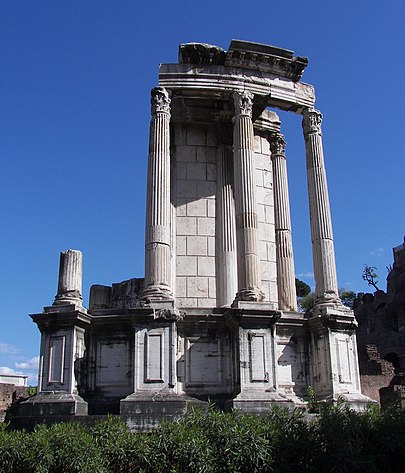
The Temple of Vesta was in Rome’s Forum, and it was a circular temple or a Tholos. Next to the Sacred Shrine at Bath was a circular Tholos, which may have been dedicated also to Vesta.
Ovid & Vesta
Here is what Ovid says in his March 6th entry:
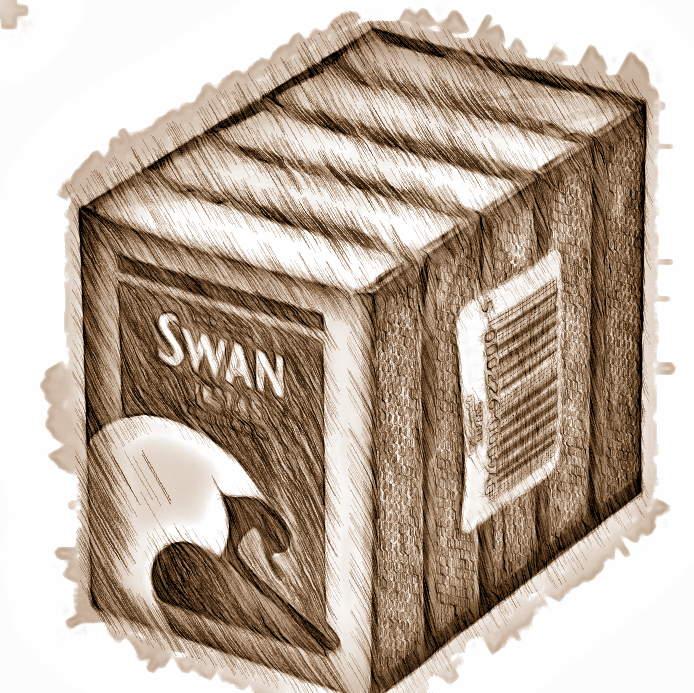
Sketch of Swan Vesta Matches
When the sixth sun climbs Olympus’ slopes from ocean, And takes his way through the sky behind winged horses, All you who worship at the shrine of chaste Vesta, Give thanks to her, and offer incense on the Trojan hearth. To the countless titles Caesar chose to earn, The honour of the High Priesthood was added. Caesar’s eternal godhead protects the eternal fire, You may see the pledges of empire conjoined. Gods of ancient Troy, worthiest prize for that Aeneas Who carried you, your burden saving him from the enemy, A priest of Aeneas’ line touches your divine kindred: Vesta in turn guard the life of your kin! You fires, burn on, nursed by his sacred hand: Live undying, our leader, and your flames, I pray.
Caesar is Julius Caesar. Aeneas was the last Trojan who survived the end of Troy. He came to Italy, founded a Kingdom (Latium) in which his descendant, Romulus, would found Rome. This is told in Virgil’s Aeneid.
Rhea Silvia the Vestal Virgin
At the beginning of Book 3 of Fasti. Ovid tells us the story of Rome’s foundation, and how Mars took Silvia the Vestal while she slept. She was descended from Aeneas. She later gave birth to Romulus and Remus. The betrayal displeased the Goddess Vesta. The holy fires went out, the altar shook and the eyes of Vesta’s statue shut. Venus was more forgiving. The children survived. But Silvia eventually drowned in the Tiber. (For more on the foundation of Rome see my post here)
Foundation Calendars
The new City chose Mars, the Roman God of War, father of their founder – as its patron God. He suited the Romans with their destiny to rule the world. So March was named after Mars, and 1st March was the beginning of the Roman year. (At least in Rome’s early days as I discussed in my post on March 1st). Ovid in the ‘Fasti’ makes the point, through Romulus’s voice, and explains something about the various Calendars run by different tribes/Cities:
‘And the founder of the eternal City said: ‘Arbiter of War, from whose blood I am thought to spring, (And to confirm that belief I shall give many proofs), I name the first month of the Roman year after you: The first month shall be called by my father’s name.’ The promise was kept: he called the month after his father. This piety is said to have pleased the god. And earlier, Mars was worshipped above all the gods:
A warlike people gave him their enthusiasm. Athens worshipped Pallas: Minoan Crete, Diana: Hypsipyleís island of Lemnos worshipped Vulcan: Juno was worshipped by Sparta and Pelopsí Mycenae, Pine-crowned Faunus by Maenalian Arcadia: Mars, who directs the sword, was revered by Latium: Arms gave a fierce people possessions and glory. If you have time examine various calendars. And you’ll find a month there named after Mars. It was third in the Alban, fifth in the Faliscan calendar, Sixth among your people, Hernican lands. The position’s the same in the Arician and Alban, And Tusculum’s whose walls Telegonus made. It’s fifth among the Laurentes, tenth for the tough Aequians,
First after the third the folk of Cures place it, And the Pelignian soldiers agree with their Sabine Ancestors: both make him the god of the fourth month. In order to take precedence over all these, at least, Romulus gave the first month to the father of his race. Nor did the ancients have as many Kalends as us: Their year was shorter than ours by two months.
The Sabine Women
This section mentions the Sabines, these were a neighbouring tribe. The Romans were short of women, so they kidnapped the Sabine Women. This became known as the Rape of the Sabine Women. People argue whether they were raped or kidnapped. Romulus worked to convince the women that it was done out of necessity for Rome’s future. The Women, or some of them, certainly tried to escape. Many became pregnant. The Sabine Army approached and entered Rome determined to free them and enact revenge on their neighbours. Ovid tells the story of Hersilia, Romulus’s wife trying to persuade the women to stay. The poem then returns to Mars’ viewpoint, and ends with a beautiful description of spring in March.
The battle prepares, but choose which side you will pray for: Your husbands on this side, your fathers are on that. The question is whether you choose to be widows or fatherless: I will give you dutiful and bold advice. She gave counsel: they obeyed and loosened their hair, And clothed their bodies in gloomy funeral dress. The ranks already stood to arms, preparing to die, The trumpets were about to sound the battle signal, When the ravished women stood between husband and father, Holding their infants, dear pledges of love, to their breasts. When, with streaming hair, they reached the centre of the field,
They knelt on the ground, their grandchildren, as if they understood, With sweet cries, stretching out their little arms to their grandfathers: Those who could, called to their grandfather, seen for the first time, And those who could barely speak yet, were encouraged to try. The arms and passions of the warriors fall: dropping their swords Fathers and sons-in-law grasp each other’s hands, They embrace the women, praising them, and the grandfather Bears his grandchild on his shield: a sweeter use for it.
Hence the Sabine mothers acquired the duty, no light one, To celebrate the first day, my Kalends. Either because they ended that war, by their tears, In boldly facing the naked blades, Or because Ilia happily became a mother through me, Mothers justly observe the rites on my day. Then winter, coated in frost, at last withdraws, And the snows vanish, melted by warm suns: Leaves, once lost to the cold, appear on the trees, And the moist bud swells in the tender shoot: And fertile grasses, long concealed, find out Hidden paths to lift themselves to the air.
Now the field’s fruitful, now ís the time for cattle breeding, Now the bird on the bough prepares a nest and home: It’s right that Roman mothers observe that fruitful season, Since in childbirth they both struggle and pray. Add that, where the Roman king kept watch, On the hill that now has the name of Esquiline, A temple was founded, as I recall, on this day, By the Roman women in honour of Juno. But why do I linger, and burden your thoughts with reasons? The answer you seek is plainly before your eyes. My mother, Juno, loves brides: crowds of mothers worship me: Such a virtuous reason above all befits her and me.í Bring the goddess flowers: the goddess loves flowering plants: Garland your heads with fresh flowers,
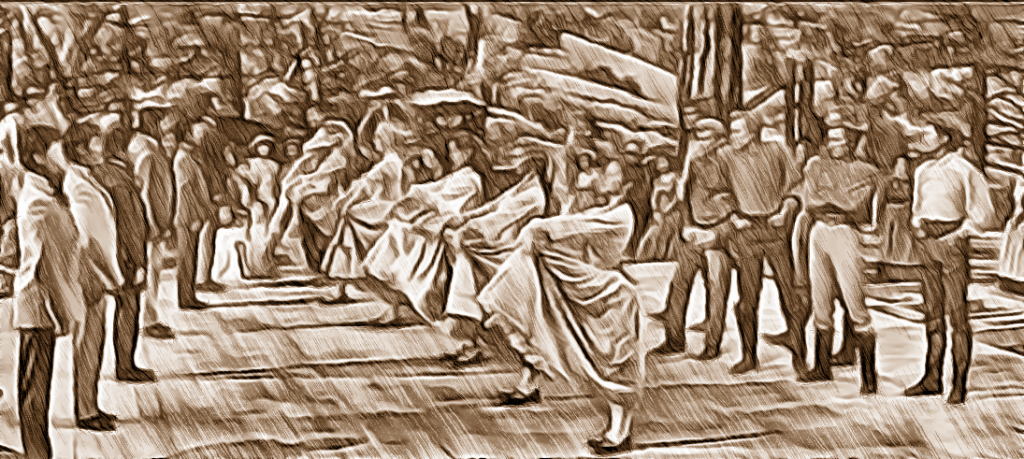
Sketch of scene from ‘Seven Brides for Seven Brothers’
My children’s favourite film in childhood was ‘Seven Brides for ‘Seven Brothers’. It was loosely based on the Rape of the Sabine Women, and very Hollywood.
On This Day
12 BC – Augustus named Pontifex Maximus, which is essentially ‘Chief Priest’ which is a bit like King Henry VIII being the Supreme Head of the Church of England.
1836 – The Alamo in Texas fell to Mexican General Santa Anna after a 13-day siege. (apologising to Texas for posting this yesterday on the wrong day)
1957 – Ghana becomes an Independent State, the first of the UK’s colonies in Sub-Saharan Africa to be independent. Ghana consists of four separate colonial territories: Gold Coast, Ashanti, the Northern Territories, and British Togoland. Ghana remained within the Commonwealth of Nations. Kwame Nkrumah was the first President. It ranks 7th (out of 54 African states) for good governance on the Ibrahim Index of African Governance (IIAG).
First published in 2024, republished in 2025. On This Day added 2026
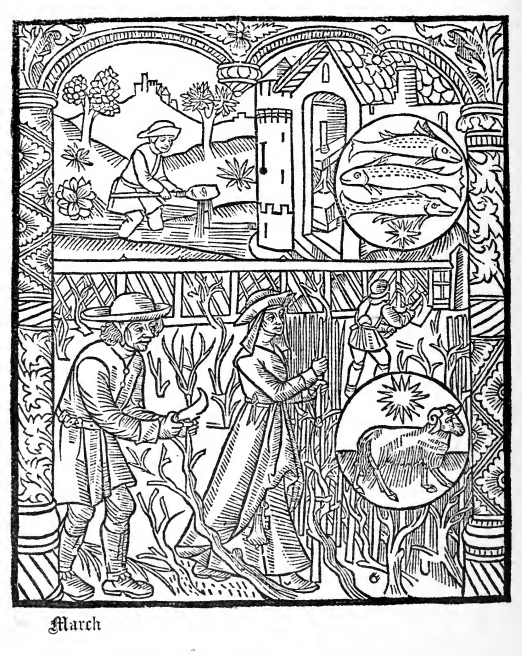
March from the Kalendar of Shepherds – French 15th Century
Spring & March
This is the beginning of Spring, meteorologically speaking. There is nothing magical about this day that makes it in any sense actually the start of Spring. It is a convenience determined by meteorologists. They divide the year up into 4 blocks of three months based on average temperature, and the convenience of keeping statistics to months. It could be that spring starts on 2nd March. 14th February. Or the 1st of February as the Celts favoured.
The Venerable Bede in his ‘The Reckoning of Time’, written in 725 AD, quotes more diversity of dates:
However, different people place the beginnings of the seasons at different times. Bishop Isidore the Spaniard said …, spring [starts] on the 8th kalends of March [22 February],…
But the Greeks and Romans, whose authority on these matters, rather than that of the Spaniards, it is generally preferable to follow, deem that spring [begins] on the 7th ides of February [7 February],…
Noting that summer and winter begin with the evening or morning rising and setting of the Pleiades, they place the commencement of spring and autumn when the Pleiades rise and set around the middle of the night.
There is nothing that says we have to have 4 seasons. Egypt had three seasons, the tropics have two. Celts divided the year into 8. Plants have been blooming, sprouting and budding since January, and some will wait until later in the year. Lambs have been born since January. But scientists and society find it easiest to keep statistics on a monthly basis so March 1st it is.
Astronomically, the seasons are more rationally divided by the movement of the Sun. So Spring begins on the spring or vernal equinox, 20th or 21st of March. For my Spring Equinox post go here.
Anglo-Saxon March
In Anglo-Saxon ‘Hrethamonath’ is the month of the Goddess Hretha. Bede gives no further information on who she was and nothing else is known about her. Her name is Latinised to Rheda. J R. R. Tolkein used the Anglo-Saxon calendar as the calendar for the Shire where the third month is called Rethe.
For the Anglo-Saxon, spring was looked forward to with great joy after the bleakness of winter. Christian Anglo-Saxons also saw this as the pivotal month in the year. It was in March that the world was created, and the Messiah conceived, revealed, executed, and ascended to heaven. See my post:
In Welsh the month is called Mawrth, (derived it is thought from the Latin Martius). Gaelic Mart or Earrach Geamraidth – which means the ‘winter spring’.
Medieval/Early Modern March
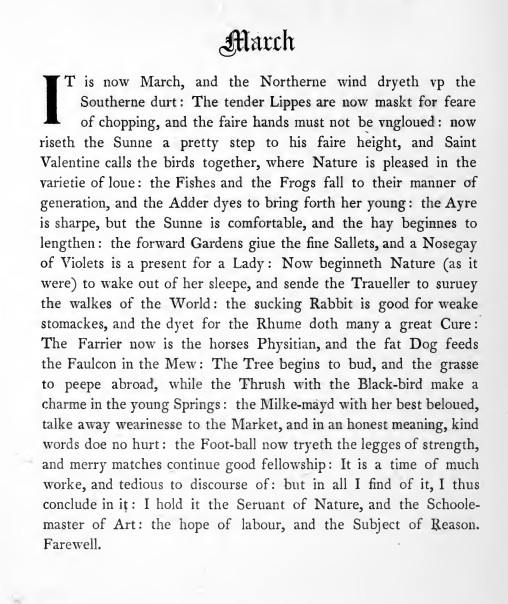
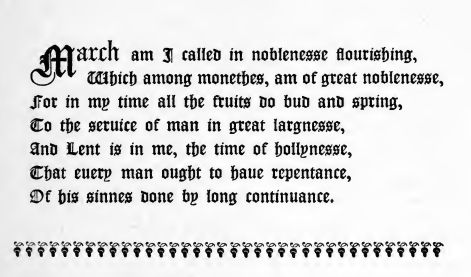
The illustration (above), from the Kalendar of Shepherds, shows that in Pisces and early Ares preparation was still the main order of the farming day, clearing out the moats, and preparing the fruit trees. Lambing is also increasing in number. And the early modern text below from the Kalendar gives a fine description of the joys of spring.
Kalendary of Shepherds- Description of March.March in the Kalendar of Shepherds.
March the 1st was the beginning of the Roman year in Rome’s early days. The Month was named after Mars, the God of War, as Mars was the patron God of the Rome. March was also the beginning of the campaign season, and the army was prepared, and ceremonies held to Mars. The Salii, twelve youths dressed in archaic fighting costumes led a procession singing the Carmen Saliare. March 1 was also the Matronalia a festival celebrating childbirth motherhood. Dedicated to the Mother Juno Lucina,
Ovid & March & Kalends, Nones & Ides
Ovid says the year started on the Kalends of March. Here is what Britannica says about their strange system of dividing months:
‘In a 31-day month such as March, the Kalends was day 1, with days 2–6 being counted as simply “before the Nones.” The Nones fell on day 7, with days 8–14 “before the Ides” and the 15th as the Ides. After this the days were counted as “before the Kalends” of the next month’.
More about this if you read my post on the Ides of March and Julius Caesar.
At the beginning of his book, Fasti, Ovid provides the story of Rome’s foundation. Mars took Silvia the Vestal while she slept. She later gave birth to Romulus and Remus. He also gives details of how Rome was organised. In the piece of the long text I have chosen below he discusses Romulus’ arrangement of the year. It is a year that began on the 1st March, and had only 10 months. 10 is the number of digits we have and the length of pregnancy (so Ovid says).
Ovid wrote in his almanac poem the Fasti:
So, untaught and lacking in science, each five-year lustre That they calculated was short by two whole months. A year was when the moon returned to full for the tenth time: And that was a number that was held in high honour: Because it’s the number of fingers we usually count with, Or because a woman produces in ten months, Or because the numerals ascend from one to ten, And from that point we begin a fresh interval.
So Romulus divided the hundred Senators into ten groups, And instituted ten companies of men with spears, And as many front-rank and javelin men, And also those who officially merited horses. He even divided the tribes the same way, the Titienses, The Ramnes, as they are called, and the Luceres. And so he reserved the same number for his year,
Itís the time for which the sad widow mourns her man. If you doubt that the Kalends of March began the year, You can refer to the following evidence. The priest’s laurel branch that remained all year, Was removed then, and fresh leaves honoured. Then the king’s door is green with Phoebus’ bough, Set there, and at your doors too, ancient wards. And the withered laurel is taken from the Trojan hearth, So Vesta may be brightly dressed with new leaves. Also, it’s said, a new fire is lit at her secret shrine, And the rekindled flame acquires new strength. And to me it’s no less a sign that past years began so, That in this month worship of Anna Perenna begins. Then too it’s recorded public offices commenced, Until the time of your wars, faithless Carthaginian.
Lastly Quintilis is the fifth (TXLQWXV) month from March, And begins those that take their names from numerals. Numa Pompilius, led to Rome from the lands of olives, Was the first to realise the year lacked two months, Learning it from Pythagoras of Samos, who believed We could be reborn, or was taught it by his own Egeria. But the calendar was still erratic down to the time When Caesar took it, and many other things, in hand. That god, the founder of a mighty house, did not Regard the matter as beneath his attention, And wished to have prescience of those heavens Promised him, not be an unknown god entering a strange house.
He is said to have drawn up an exact table Of the periods in which the sun returns to its previous signs. He added sixty-five days to three hundred, And then added a fifth part of a whole day. That’s the measure of the year: one day The sum of the five part-days is added to each lustre.
For much more about the Roman Year (and leap years) look at my post here.
On This Day
St David’s Day – It is also the Feast of St David, (or Dewi) the patron saint of Wales, who lived in the sixth century AD. Little that is known about him is contemporary but he was an abbot-bishop. His hagiography was written in the 11th Century and not very trustworthy, but the aim was to show the independence of the Welsh Church from Canterbury. His association with the leek is unexplained.
293 – Inauguration of the Tetrarchy
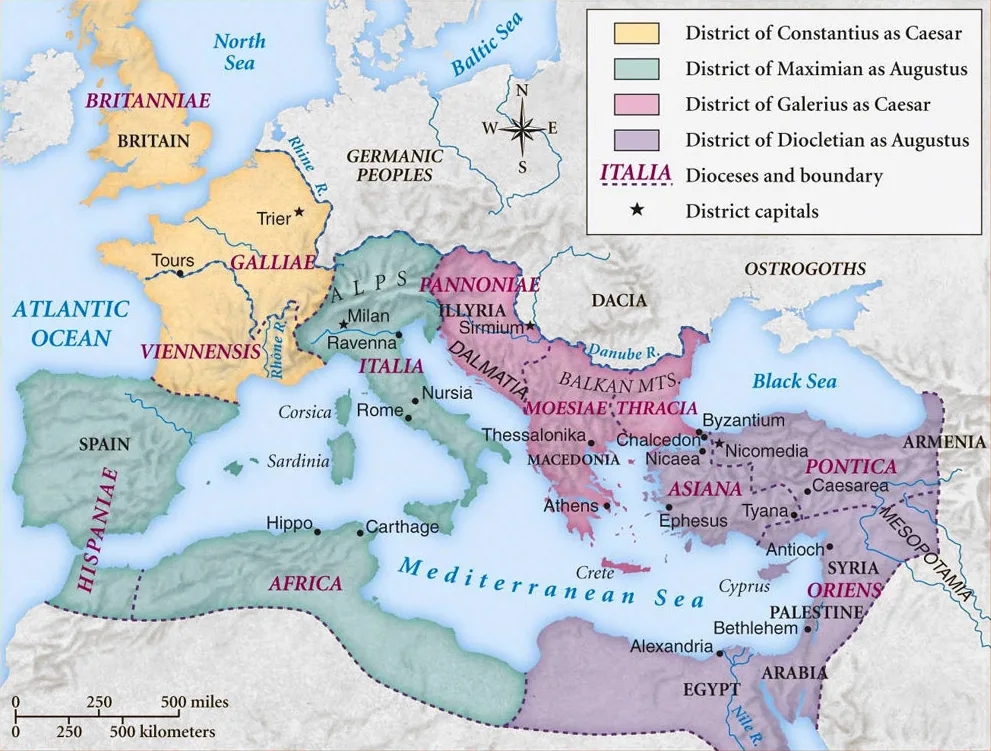
Diocletian reorganises the Roman Empire to be a Tetrarchy with himself and Maximian the Augusti, one in the East the other in the West. Below them were Constantius Chlorus and Galerius the Caesars.
Coppermine Photo Gallery – Coppermine Photo Gallery; Bishop, Aubrey. Imperial Imagery of the Tetrarchy. Rhodes College. Archived from the original on 15 September 2024. Historic map of Roman Empire during the first tetrarchyCC BY-SA 3.0
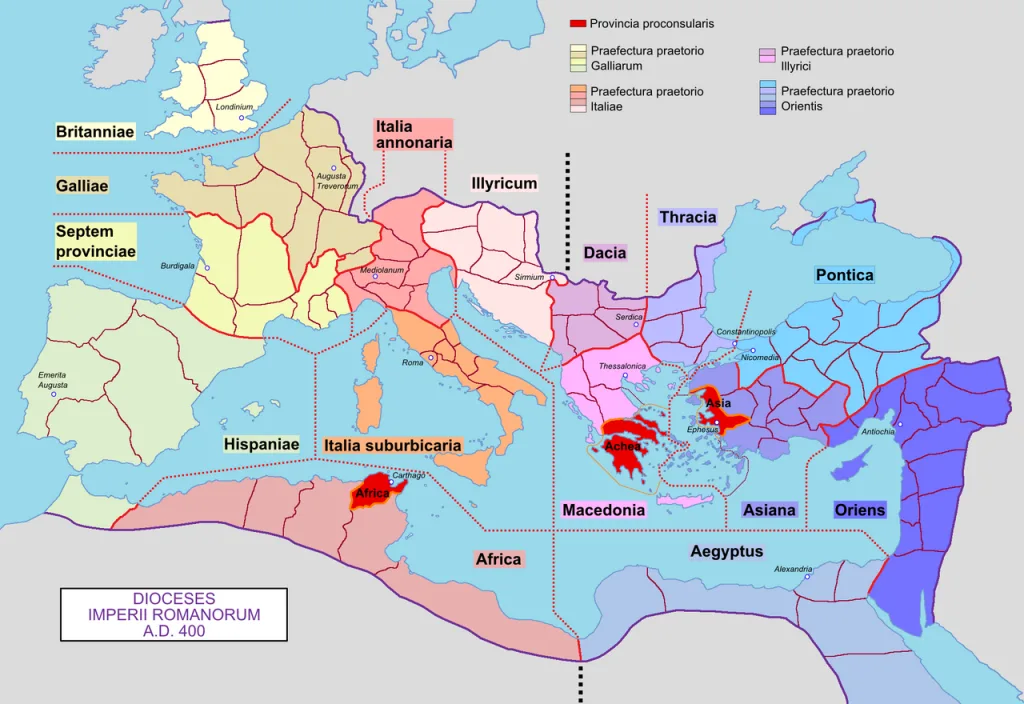
Below them were Prefectures run by Prefects, who controlled officials called the Vicarious. Britannia, was a Diocese ruled by the Vicarious in London. The Diocese was divided into 4 Provinces,. In charge of those were the Governors, who were now civilians rather than military figures.
Later dioceses of the Roman Empire, around 400 AD By Mandrak – Own work, Public Domain, https://commons.wikimedia.org/w/index.php?curid=6088363
The reorganisation was designed to provide a peaceful career path for ambitious men, but in that it failed.
1562 – Massacre in Wassy France, when sixty-three Huguenots were killed and the French Wars of Religion began. Many Huguenots came to Britain, and many settled in Spitalfields, London. My family believe we are Huguenots from the East End.
1628 – Charles I decrees that the ship tax should be extended to every county. This was not put to a Parliament, and illegal impositions like this eventually lead to the English Civil War in 1642. (see my post on the beginning of the Civil War here:
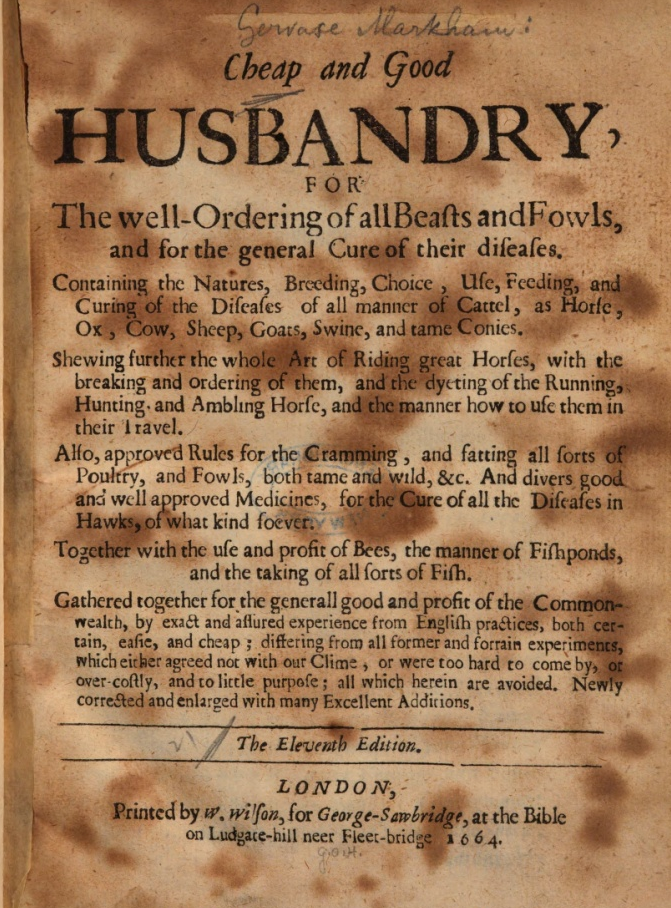
Spring Chickens appear in Cheap and Good Husbandry by Gervaise Markham London 1664
Of Setting Hens (and Spring Chickens)
Gervase Markham wrote a heap of farming and horticulture books in the 17th Century. In ‘Cheap and Good Husbandry’ he wrote about ‘Spring Chickens’. Spring Chickens are essentially March Chickens, March Hares and even March Cats are all special. Markham starts by suggesting this is the time to impregnate them for birth in March:
The best time to set Hens to have the best, largest, and most kindly Chickens;, is in February, in the increase of the Moon, so that they may hatch or disclose her Chickens; in the increase of the next new Moon, being in March; for one brood of March Chickens; is worth three broods of any other: You may set Hens from March; till October, and have good Chickens;, but not after by any means, for the Winter is a great enemy to their breeding….
The expression comes from the 17th Century when Spring/March Chickens were more profitable than old chickens that had gone through the winter. Commonly, it is used in the negative, as in ‘Kevin ain’t no spring chicken.’
Egyptian Book of the Dead goes on display at the Brooklyn Museum
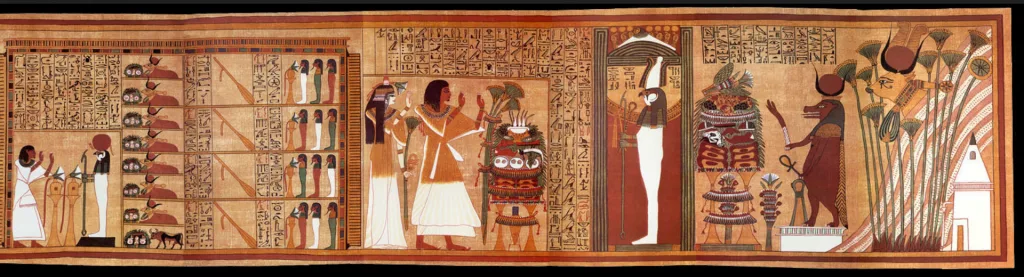
After three years of conservation, the world’s most complete gilded Book of the Dead goes on display at the Brooklyn Museum. Have a look at their post here. The Book of the Dead was prepared to accompany the deceased on their journey in the afterlife. It is full of spells, prayers and incantations. There was no one fixed format, but some are incredibly complex and beautiful. My own feeling is that they confirm my opinion that the Egyptian way of death is totally OCD. There is so much an Egyptian has to do to get a good afterlife. Not only embalming but having models of food, slaves, boats, mummies of dead cats, anything you want to have. It feels like they must have been terrified of death.
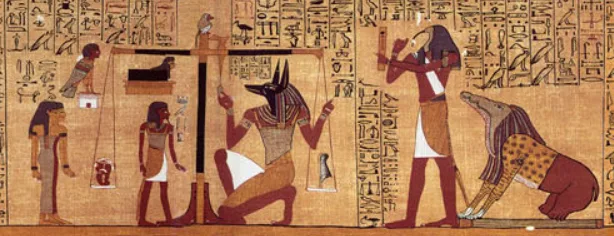
A scene from the Papyrus of Ani (British Museum) It shows the heart being weighed on the scale of Maat against the feather of truth. Doing the weighing is the jackal-headed Anubis The ibis-headed Thoth records the result. Behind Toth is Ammit part crocodile, lion, and hippopotamus. The facsimiles were produced by E. A. Wallis Budge; original artist unknown. Public Domain
One of the issues is that the deceased had to have their heart weighed against the feather of Truth (belonging to the Goddess of Truth, balance, law, morality, and justice, Maat) . If it was found deficient, the deceased would be eaten by Ammit who has the head of a crocodile, the shoulders of a lion, and the legs of a hippo.
Wikipedia has a tremendous scan of the facsimile of the Papyrus of Ani, it is a 78ft long scroll and wonderful to look at To see it click on the first picture and zoom in and look left and right! https://en.wikipedia.org/wiki/Papyrus_of_Ani.
The story of its acquisition is also gob-smacking. Budge acquired in it Luxor in 1888. The Egyptian Police came to investigate the house of the illegal dealers. Budge distracted the police while his people tunnelled into the house from the rear, and retrieved ‘his’purchases. He took them to the British Museum and was paid a gratuity of £150 for them!
On this day
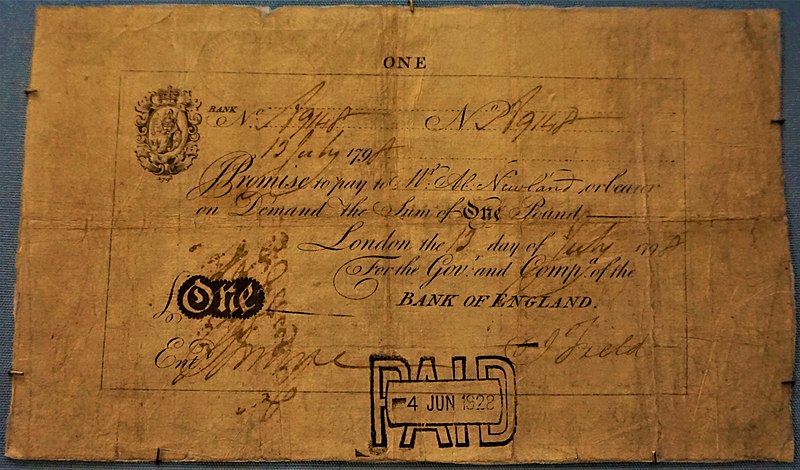
First £1 note of the Bank of England Museum 1797 Source Joy_of_Museums Public Domain (CC by sa 4.0)
February 26th 1797 First Pound Note:
The Bank of England issued it’s first ever one pound note (although some sources say March 1797). The Bank had been issuing paper notes since the late 17th Century, but this was the first £1 note. They still had to be signed by hand and allocated to a specific person. The hand signed white paper notes were withdrawn in 1820, and the pound note was, finally, withdrawn in 1988. The £1 in 1797 was worth the equivalent of £157.46 today, so quite a big note! (see here for the calculator.)
1815 – Bonaparte escapes from exile on the island of Elba. War begins all over again.
1995 – Barings Bank collapses after a rogue securities broker Nick Leeson loses $1.4 billion by speculating on futures contracts. Barings is the UK’s oldest investment banking institute,
Pound note first published 2024, Spring Chicken added February 26th 2025 Egyptian book of the Dead added February 26th 2026
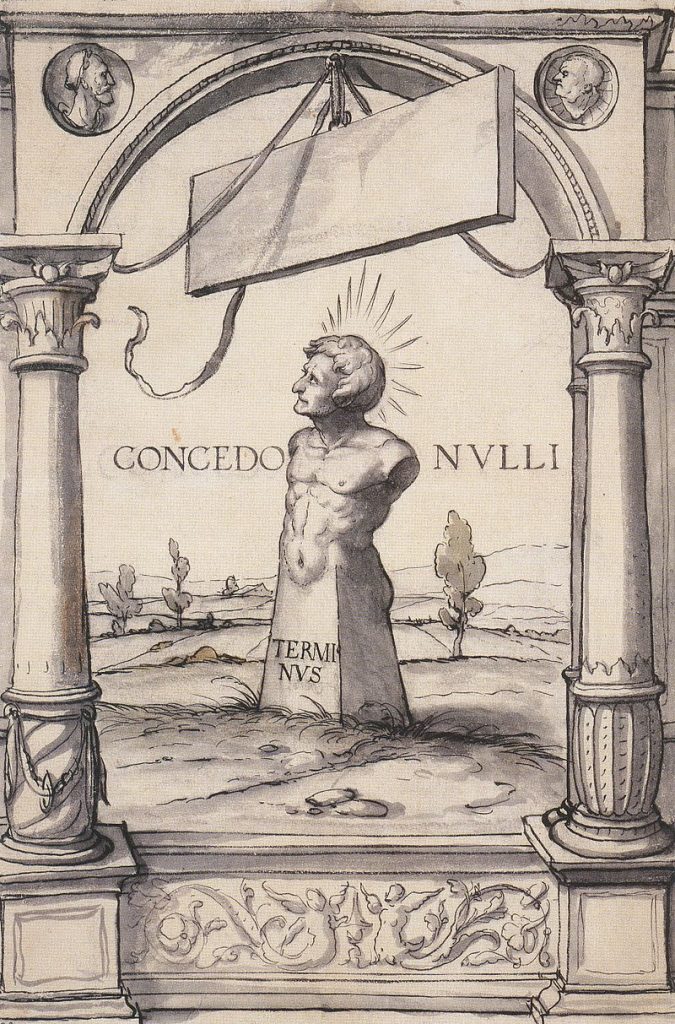
Hans Holbein the YoungerDesign for a Stained Glass Window with Terminus. Pen and ink and brush, grey wash, watercolour, over preliminary chalk drawing, 31.5 × 25 cm, Kunstmuseum Basel. ‘Terminus is often pictured as a bust on a boundary stone, His festival is ‘Terminalia’
Today is Terminalia, the Roman day for setting land boundaries. The festival of Terminus was a pastoral outdoor festival marking the boundaries of towns and villages. It resembles the Beating the Bounds tradition that we have in Britain. This is recorded, in the UK, from Anglo-Saxon times, and still continues in some parishes. I will talk about this on Ascension Day in May.
Terminus was an old ancient God who was the God of the boundary, the border, the edge, the liminal God. Ovid says King Tarquinus swept away the old Gods on the Capital Hill and Jupiter became the Great God. All the old temples were taken down, except for that of Terminus. Instead, Jupiter’s Temple was built around Terminus’ temple. They put a hole in the roof because Terminus had to be worshipped in the open air.
Terminus’s motto was “concedo nulli” which means “I yield to no one”. This was adopted by Erasmus as his personal motto in 1509.
Terminalia and the Roman Year
The Terminalia was celebrated on the last day of the old Roman year. February was the last month of the year. The rulers of Rome added an intercalary month called Mercedonius in an attempt to keep the Solar year in tune with the seasons. And when the intercalary month was added, the last five days of February were given to the month Mercedonius. The resulting ‘leap year‘ was either 377 or 378 days long. So, in those years, the 23rd of February was the Terminus of the year.
The intercalary months were added at the direction of the Pontiffs, supposedly every two or three years. But the Pontiffs were often swayed by political of financial advantage and delayed the decision. By the time of Julius Caesar, the seasons were wildly out of sync with the calendar year. The Dictator, responded by instituting a reform of the Calendar. It began with ‘the Year of Confusion’, over 400 days long.
The reforms introduced the Julian Calendar which realigned the calendar back in line with the seasons. It resolved the problem by adding leap day every four years. This was based on the almost correct calculation of a solar year being 365.25 days. It took another 1500 years before that inaccuracy was corrected. Then the year was another 11 days out of kilter, and the Julian Year was replaced by the Gregorian Year,
Here is what Ovid, in ‘Fasti’ says about Terminalis
When night has passed, let the god be celebrated With customary honour, who separates the fields with his sign. Terminus, whether a stone or a stump buried in the earth, You have been a god since ancient times. You are crowned from either side by two landowners, Who bring two garlands and two cakes in offering. An altar’s made: here the farmer’s wife herself Brings coals from the warm hearth on a broken pot. The old man cuts wood and piles the logs with skill, And works at setting branches in the solid earth. Then he nurses the first flames with dry bark, While a boy stands by and holds the wide basket. When he’s thrown grain three times into the fire
The little daughter offers the sliced honeycombs. Others carry wine: part of each is offered to the flames: The crowd, dressed in white, watch silently. Terminus, at the boundary, is sprinkled with lamb’s blood, And doesn’t grumble when a sucking pig is granted him. Neighbours gather sincerely, and hold a feast, And sing your praises, sacred Terminus: You set bounds to peoples, cities, great kingdoms: Without you every field would be disputed. You curry no favour: you aren’t bribed with gold, Guarding the land entrusted to you in good faith. If you’d once marked the bounds of Thyrean lands, Three hundred men would not have died, Nor Othryadesí name be seen on the pile of weapons. O how he made his fatherland bleed! What happened when the new Capitol was built? The whole throng of gods yielded to Jupiter and made room:
But as the ancients tell, Terminus remained in the shrine Where he was found, and shares the temple with great Jupiter. Even now there’s a small hole in the temple roof, So he can see nothing above him but stars. Since then, Terminus, you’ve not been free to wander: Stay there, in the place where you’ve been put, And yield not an inch to your neighbour’s prayers, Lest you seem to set men above Jupiter: And whether they beat you with rakes, or ploughshares, Call out: This is your field, and that is his! There’s a track that takes people to the Laurentine fields, The kingdom once sought by Aeneas, the Trojan leader: The sixth milestone from the City, there, bears witness To the sacrifice of a sheep’s entrails to you, Terminus. The lands of other races have fixed boundaries: The extent of the City of Rome and the world is one
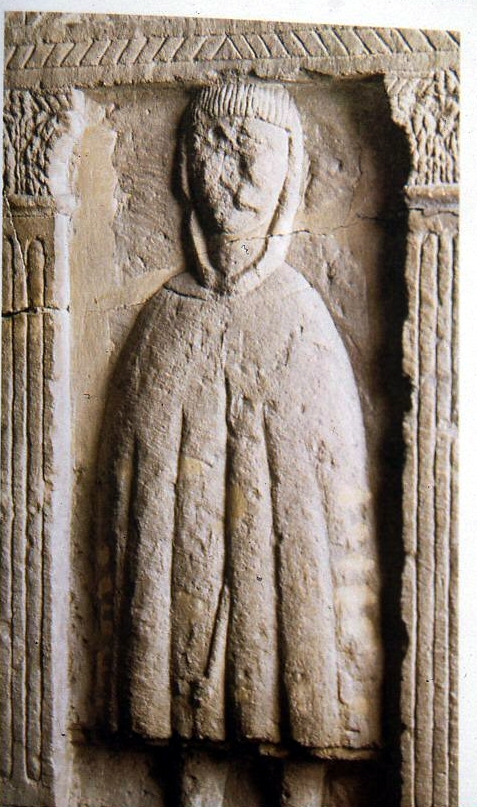
Tombstone of Philus from Cirencester (Corinium Dobunnorum) showing his rain cloak
Feralia & Parentalia
Feralia is the last day of Parentalia a 9-Day Festival for the spirits of the Dead. It is described in some detail by the Roman Poet, Ovid, in his Almanac of the year called the ‘Fasti’. Here, he describes how to honour a parent:
And the grave must be honoured. Appease your father’s Spirits, and bring little gifts to the tombs you built. Their shades ask little, piety they prefer to costly Offerings: no greedy deities haunt the Stygian depths. A tile wreathed round with garlands offered is enough, A scattering of meal, and a few grains of salt, And bread soaked in wine, and loose violets: Set them on a brick left in the middle of the path. Not that I veto larger gifts, but these please the shades: Add prayers and proper words to the fixed fires.
There is much more Ovid says about Feralia, and you can read it for free, in translation by A. S. Kline (which I used above, at www.poetryintranslation.com)
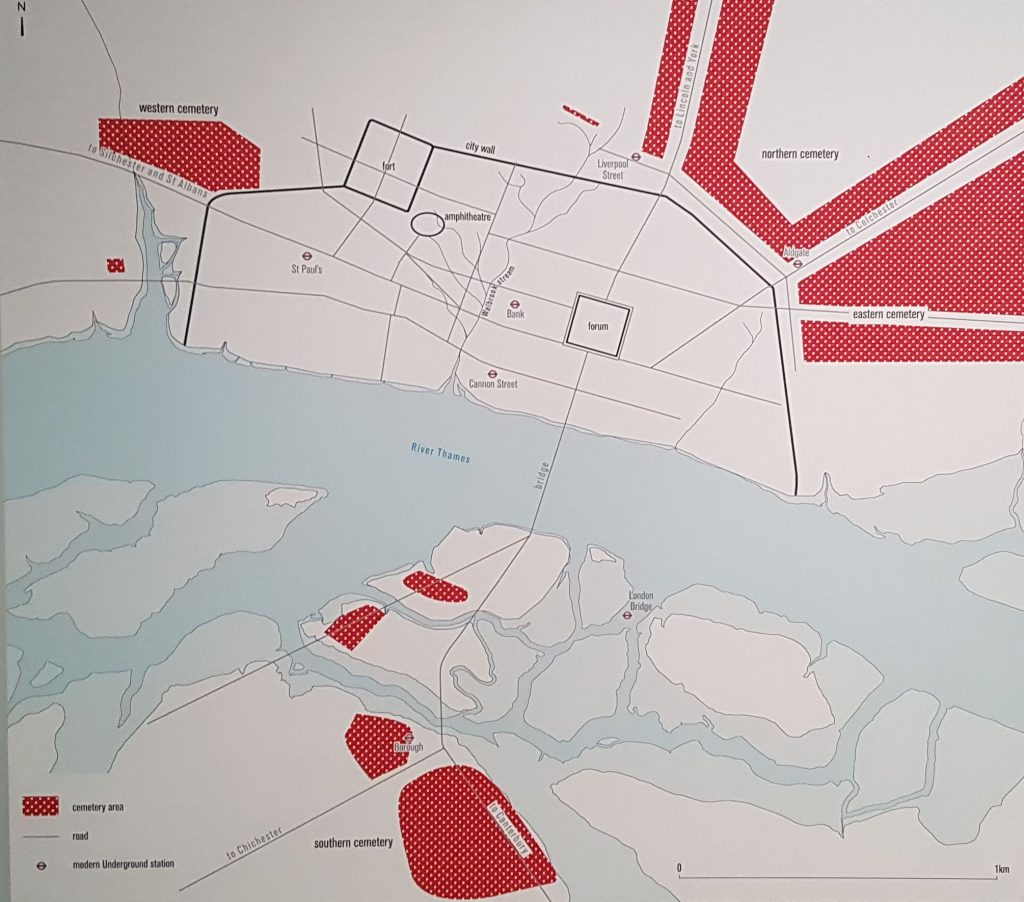
In London, archaeologists have found many Roman cemeteries around the City of London. The Romans forbade burial inside the City limits. So, the dead were buried alongside the main roads out of the City Gates. Aldgate towards Colchester, Bishopsgate to the North. Ludgate along Fleet Street to the West. Newgate to Holborn and the North West. From London Bridge to Southwark and the South. These are the places that parents would be remembered at Feralia.
Map of Roman Cemeteries from the Museum of London exhibition on the Roman Dead, showing the River Thames and River Fleet. Holborn is to the left, marked ‘Western Cemetery’.
Roman Burials
Roman Mortaria
Various rites have been observed. Both inhumation and cremation were practised. I remember excavating a Roman mortaria with a hole in the bottom with the ashes of the dead in it. These large bowls were used as a mortar for grinding foodstuffs. The bottom was deliberated gritted, but they often wore through, and sometimes were reused to hold cremation ashes. I like to imagine, granny being buried in her favourite cooking vessel (or maybe a grandad who baked?).
Many bodies were covered in chalk, perhaps to help preserve the body. A surprising number of bodies are found with the head by the knees. The large number of cases fuels speculation that this was a burial rite, of whom only a percentage were beheaded as a punishment. In York, near Micklegate archaeologists found a large number of beheaded graves in a cemetery thought to be of gladiators. Other graves shown signs of a funeral pyre.
Author’s photograph of a skeleton displayed at the Roman Dead Exhibition, Museum of London, She was between 26 and 35 years old, who lived a hard life, and possibly had anaemia. Her head was severed either: before and causing death, or shortly after death, and placed between her legs as shown.
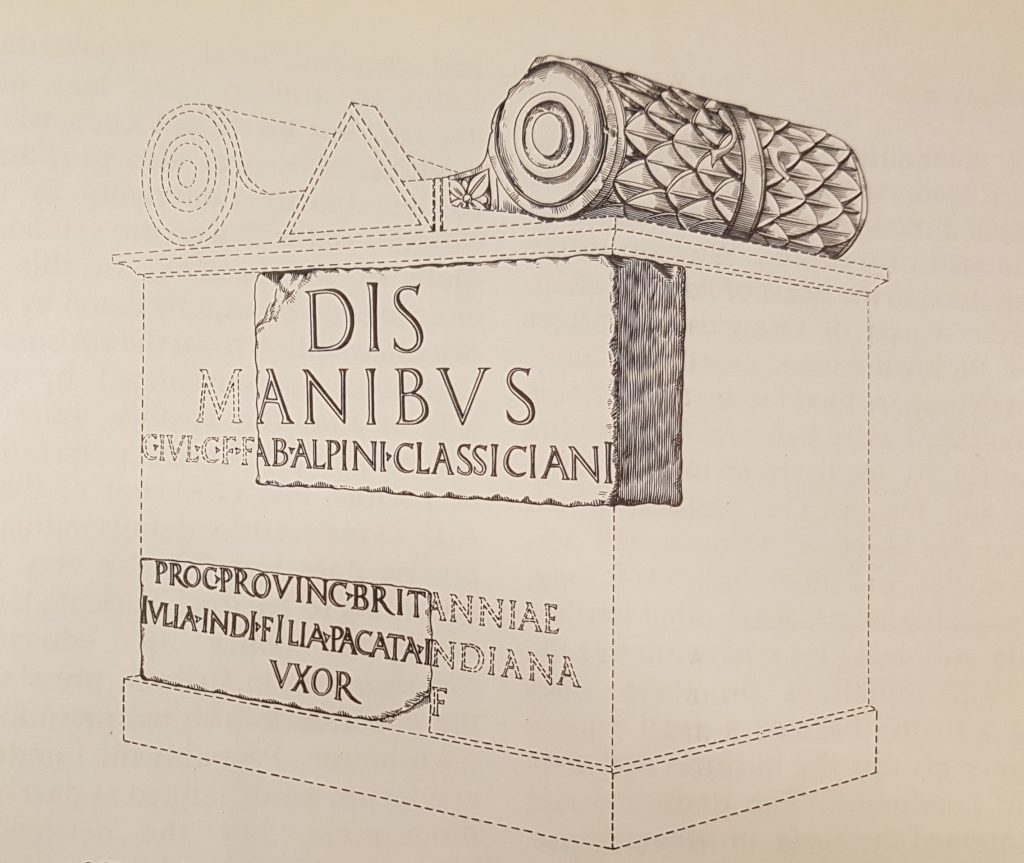
Procurator Classicianus.
The rich and powerful were remembered with huge monuments, prominently sited along the main roads. The most famous are the burial stones found at Tower Hill of the Procurator Classicianus. What makes this special is that he is mentioned in Roman accounts of the Boudiccan Revolt of AD 60-61. He suggested to Nero that the Province would only be saved if the revenge against the British was de-escalated. Nero wisely withdrew the vengeful Roman Governor Suetonius Paulinus and replaced him with someone ready to conciliate. The Romans held the province successfully for 350 years or so more.
Reconstruction drawing of two stones found while building Tower Hill Underground Station. They read, something like, ‘To the Spirits of the Dear Departed Fabius Alpini Classicianius, Procurator of the Province of Britannia.Julia, Indi (his wife) Daughter of Pacata of the Indiana voting tribe. Had This Set up.
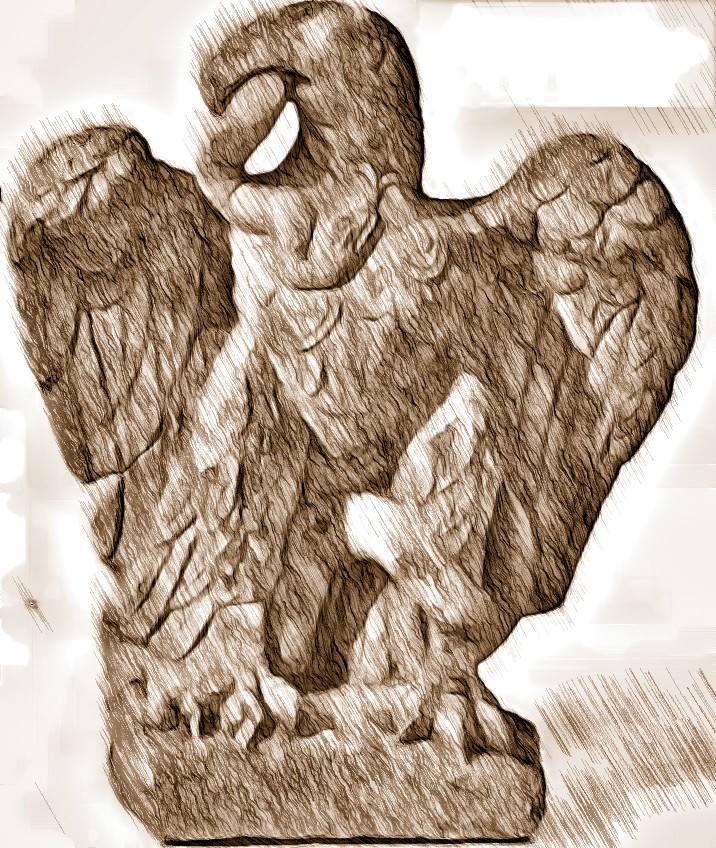
Sketch of a stone Eagle found in 2013 at an excavation at the Minories just outside the eastern side of the Roman Wall in the City of London.
A beautiful carved eagle which adorned a tombstone was found in the Cemetery in Tower Hamlets. Recently, a very grand mausoleum was excavated in Southwark. To find out more, have a look at the BBC website here:
Funerary Bed in Holborn
Finally, a couple of years ago an excavation ran by MOLA discovered a ‘funerary bed’ just outside Newgate in Holborn. It was on the banks of the River Fleet, a tributary to the River Thames. The fluvial location meant that there were extraordinary levels of preservation, which included this bed. It was dismantled and buried in the grave. It may have been a bed used as a grave good, perhaps for use in the hereafter. Or it might have been the bed upon which the deceased was carried to the funeral. (Or both?)
Reconstruction of a Roman ‘Funerary’ Bed found dismantled in Holborn, London (Sketch from a MOLA reconstruction drawing)
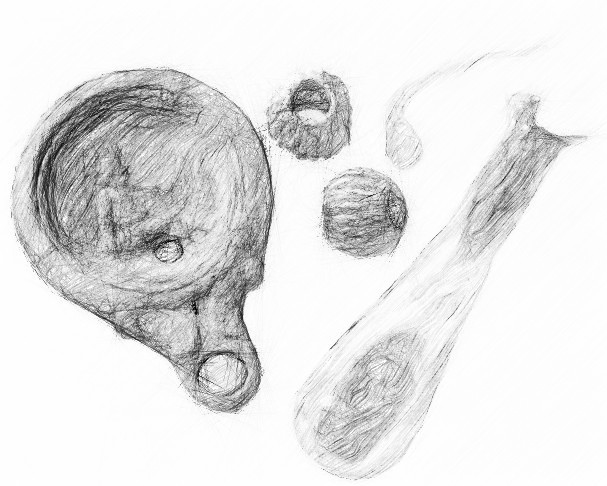
They found other grave goods. These included an olive oil lamp decorated with an image of a gladiator; jet and amber beads and a glass phial.
1804 – Richard Trevithick‘s steam locomotive is put on wheels at the Pen-y-Darren Ironworks in Wales. and shows its capability for pulling heavy loads. Unfortunately, the Engine weighs so much it breaks the rails, so the wheels are taken off.
Toad, Frogs & Newts Migration – as the weather warms up a little, later in February is when the amphibians wake up from hibernation, and begin their annual migration to their home pond for spawning. They may walk/hop/slither up to 2 kilometres. The kind people at www,froglife.org coordinate Toad Patrols to help toads across the roads that have sprung up along their traditional migration paths.
In the Garden – prune deciduous shrubs such as Buddleia and Spiraea. Sow seeds indoors. Order lots of compost.
First Published in February 2024, revised 2025, On this Day added 2026