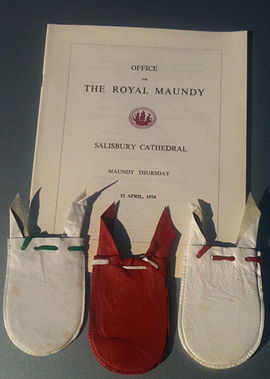
Maundy Thursday Money Pouches. and cover of the Order of Service for Royal Maundy service 1974 Photo Wehwalt
Maundy Thursday Meaning
Maundy Thursday is on April 2nd in 2026. This is the last day of Lent, and the day before the Passion. It’s also called Holy Thursday when Christians remember the Washing of the Feet, and the Last Supper. . Maundy is thought to be from the:
‘Latin word mandatum, or commandment, reflecting Jesus’ words “I give you a new commandment.’ (Wikipedia).
I much prefer the derivation of Maundy Thursday from the English Kings giving alms to poor people.
‘English name “Maundy Thursday” arose from “maundsor baskets” or “maundy purses” of alms which the king of England distributed to certain poor at Whitehall before attending Mass on that day. Thus, “maund” is connected to the Latin mendicare, and French mendier, to beg.‘
The monarch gives out money in special red and white pouches to old people. In modern times, the money is specially minted for the occasion. It is now more symbolic than a practical gesture. But It dates back to the 13th Century, when the money was a vital lifeline for its recipients.
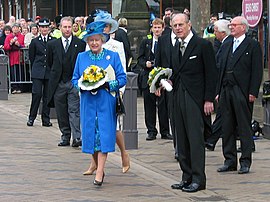
Queen Elizabeth II and Prince Philip after the 2005 Royal Maundy Ceremony at Wakefield Cathedral. Photo Runner1928
In 1572 Queen Elizabeth 1 washed one foot of a group of poor women, then wiped, crossed and kissed them. In fact, the Queen was ‘protected ‘ as the women first had their feet washed by the laundress, then the sub-almoner, then the almoner. Only finally by the Queen. (The Perpetual Almanac of Folklore by Charles Kightley’)
When was The Last Supper?
One scholar, Prof Humphreys author of ‘The Mystery Of The Last Supper’, (2011) has reconciled differences between John and the other evangelists. He believes two calendars were in use, one from before the exile and the other using a Babylonian Calendar. This confusion means that there is too much going on between the Last Supper and the Crucifixion. He suggests that the solution is that Last Supper was on the Wednesday not the Thursday. He also calculates a date for the Last Supper as:
Wednesday, 1 April AD33.
Maundy Thursday at Chester Cathedral
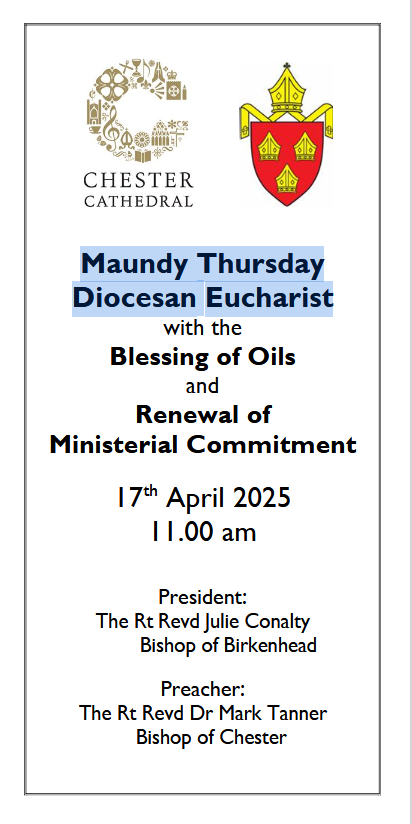
Last year, I was in Chester Cathedral on Maundy Thursday where the Diocesan Eucharist was held. The Cathedral was awash with Clergy, (I counted at least 4 Bishops) and most of the priests in the area.
The Famous Spaghetti Tree April Fool’s Joke (from facebook)
First Reference to April Fools Day
The first unambiguous British reference to April Fools Day is by diarist John Aubrey’s “Fooles holy day” in 1686 – although he might have been referring to Germany.
‘We observe it on ye first of April… And so it is kept in Germany everywhere.’ For more details read hoaxes.org.
Chaucer and April Fools Day
But there is a possible earlier reference in Chaucer in the Nun’s Priest’s Tale. This I find quite compelling but most Chaucer scholars don’t. This is the text:
When that the monthe in which the world bigan That highte March, whan God first maked man, Was complet, and passed were also Syn March bigan thritty dayes and two
So, if you have been keeping up with me, you will know that the first lines are referring to March 25th. This was the day Adam and Eve were created. The day when the Church started the New Year and the year number moved one on. This was a major Church festival, usually followed by a week of holiness. The Roman New Year, January 1st, ended with a light-hearted festival called Saturnalia, and it is suggested that April 1st was, similarly, a day of release after the festival of the official Church ceremony of the New Year.
Chaucer’s last line says ‘Since March began thirty-two days have passed.’ A foolish person would not realise this is a reference to April 1st. Hence, this suggests a Fool’s Day already existed. Some scholars think that Chaucer was referring to May 2nd, counting the 32 days not from the beginning of March but from the end of March. I think they look at the second and third lines which read ‘That high March…. was complete’ and so add the 32 days to the end of March. Foolish in my opinion and not reading what actually Chaucer wrote which is ‘Since March began….’
Hunting the Gowk
Generally, in Britain, we play a prank and say ‘April Fool’ with great delight. But we are not allowed to continue beyond midday. The Scots used to call it ‘Hunting the Gowk’ and the main prank was to give someone a letter to deliver, and the person who opened the letter would read:
“Dinna laugh, dinna smile. Hunt the gowk another mile” and send the fool onto another leg of his or her’s fool’s errand. In Ireland the letter would read ‘send the fool further’.
April Fools Day and Spaghetti Growing on Trees
I nearly always forget to honour April Fool’s Day (or April Fish Day as the French call it). But in Britain, somewhere in our newspaper or TV station there is an April Fools Joke slipped in. The most remembered is the BBC piece showing film of Italian Farmers picking spaghetti from trees.
2026 – Introduction of Coffee to England 200 years earlier than previously thought!
I have had a quick look at the Guardian for their 2026 April Fools Day Story and I think it is this one:
Guardian April Fools Joke for 2026
The clues are the expert is called Macky Arto. The find was in Ness, allowing them to say ‘Ness Cafe’, and ‘Ness-presso’, and the use of a pun ‘It would have costa for a coffee.’ The final confirmation is this sentence: ‘Back in the reigns of Henry V and VI, these were flat white fields …. and a village called Brew.’ Allowing the journalist to make up an origin for the expression ‘Fancy a Brew?’ it goes on to say.
2025 – Coffee Cups as Haut Courture?
Guardian April Fools Day Joke article or the world gone mad?
‘Meghan Markle was criticised after it was revealed that when you put her lifestyle brand name – American Riviera Orchard – into the What3words location service, it points to a statue of Oliver Cromwell, who famously had a King Charles executed‘
2023 – “Megxit: Call of Duke-y”
In 2023, Harry and Megan proved irresistible and the Guardian reported that:
‘The Sun published a piece announcing the launch of Prince Harry and Meghan’s new video game “Megxit: Call of Duke-y” in which the royal couple try to reach California while dodging obstacles, including rival royals and the media, along the way.‘
This post is about April Fools Day. But it is also the anniversary of the formation of the RAF.
On This Day
1854 – Hard Times by Charles Dickens Serialised in Household Words. A recent study of Victorian Grave yards in Yorkshire highlights the grim reality for young children. For the article see: https://core.ac.uk/reader/220156990
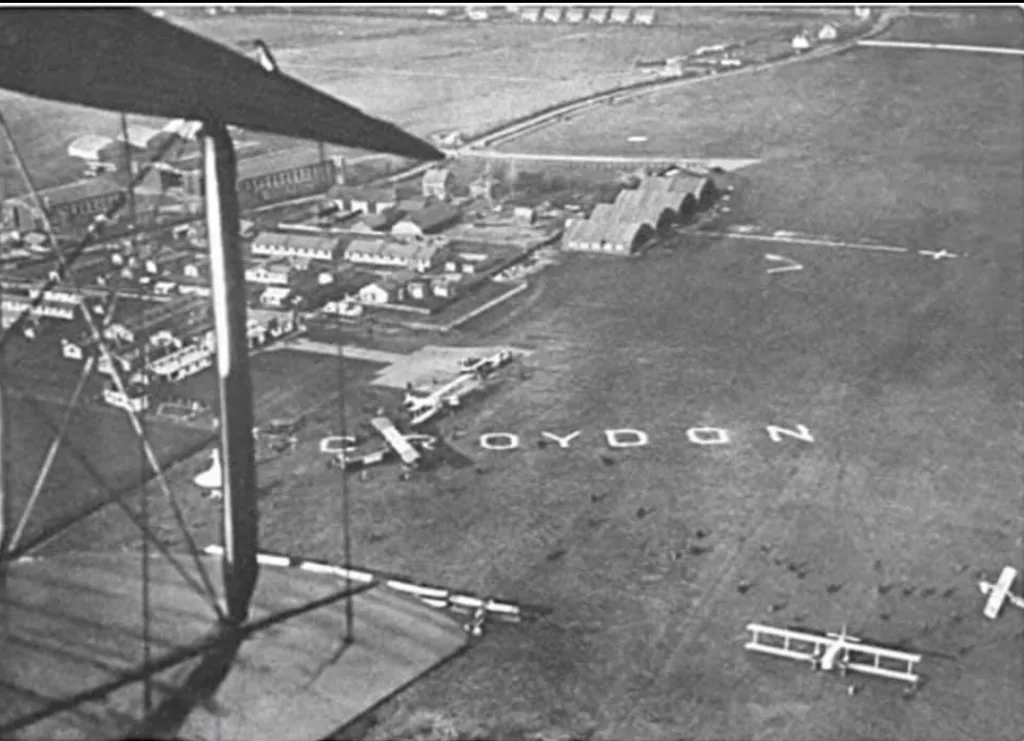
1918 – Near the end of World War 1 the Royal Flying Corps (RFC) and the Royal Naval Air Service were merged to create the Royal Air Force (RAF). It was the world’s biggest air force, and went on to secure Britain from invasion by Hitler.
Croydon RFC/RAF base for anti-Zeppelin Raids in WW1 and one of the world’s first international airports.
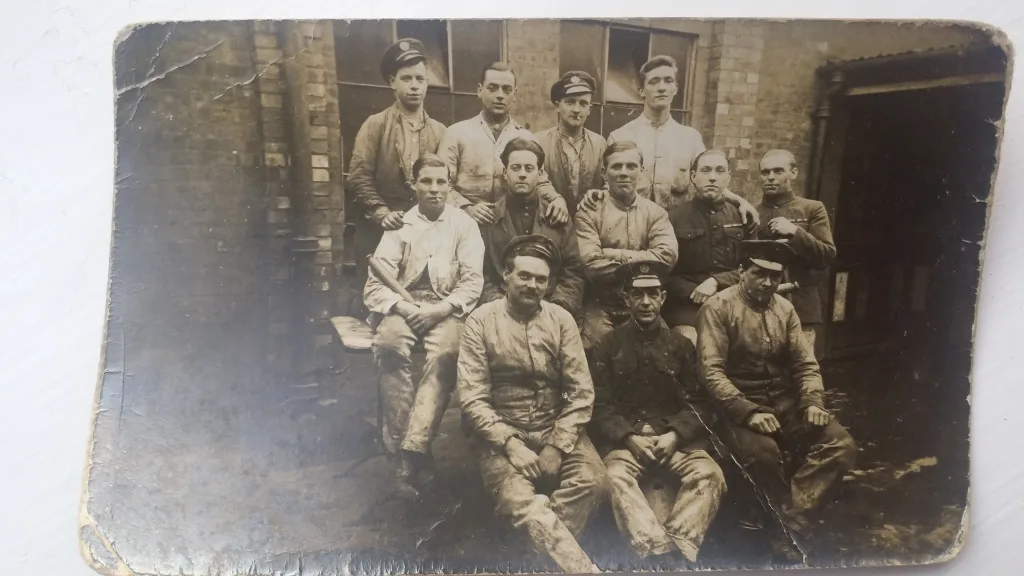
RAF Rigger, Benjamin Flude
My Grandfather was in the RAF as a fitter. My father tells some of his story in his autobiography ‘A Boy from Haggerston’:
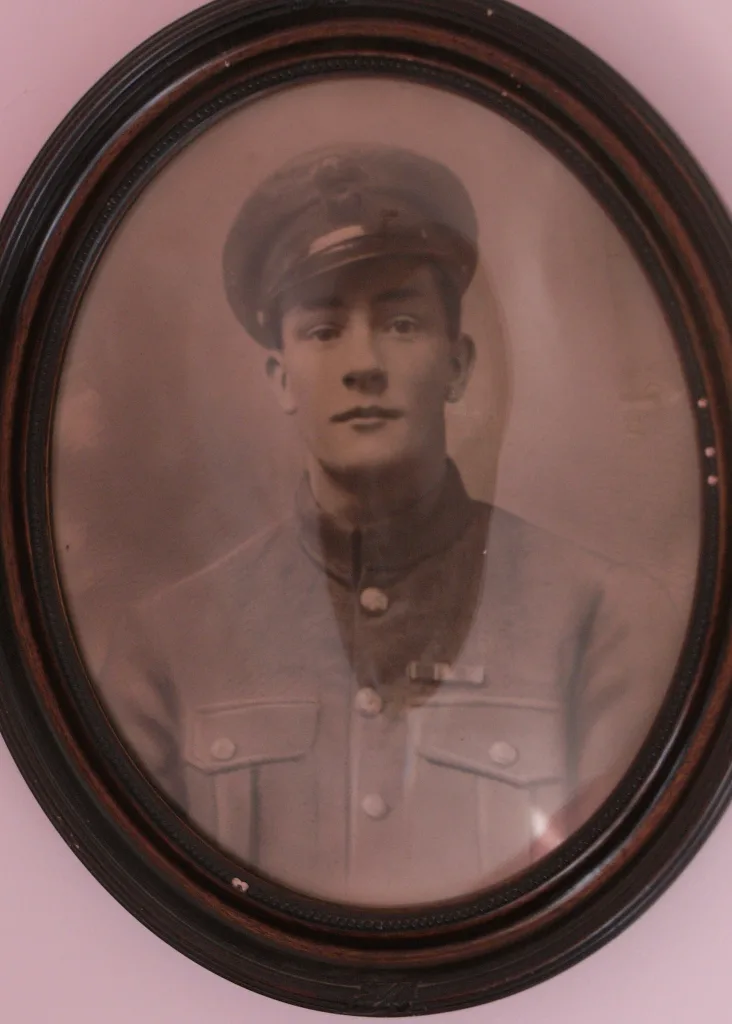
Benjamin Flude in RFC Uniform. My father, Ben Flude remembers a small model biplane hanging from the portrait.
‘I was 9 months old when he died, and he was just 28 years old. Everyone seemed to like him, and as a child, he was always my hero. In my imagination, I promoted him to being a brilliant and brave Ace RAF Pilot. But he was, in fact, a mechanic rather than a pilot in World War I. Following the war, he worked with Imperial Airways in Purley, Croydon. I don’t know the exact details and so have to piece the story together from the little information I have at my disposal.
My friend, Roy, tells me that the badge on his uniform in the oval picture is of the Royal Flying Corp. (RFC). But they were disbanded in 1916/17, and replaced by the RAF thereafter. As my dad was born in 1900, he must have joined up to fight in the war while underage at 16 or 17 as a volunteer. ‘
How a London lad became a Rigger for the RFC we don’t know, but the Fludes at that time were all employed as umbrella or walking stick makers in the East End of London. I think it is a case of transferable skills. WWI aeroplanes were made of wood, metal wire and fabric, which is precisely what an umbrella is made of.
RAF/RFC mecanics c 1917 . My grandfather is the handsome man standing tall in the back row extreme right
RAF Mechanic Ben Flude
My father went on to serve in the RAF during his national service: He writes:
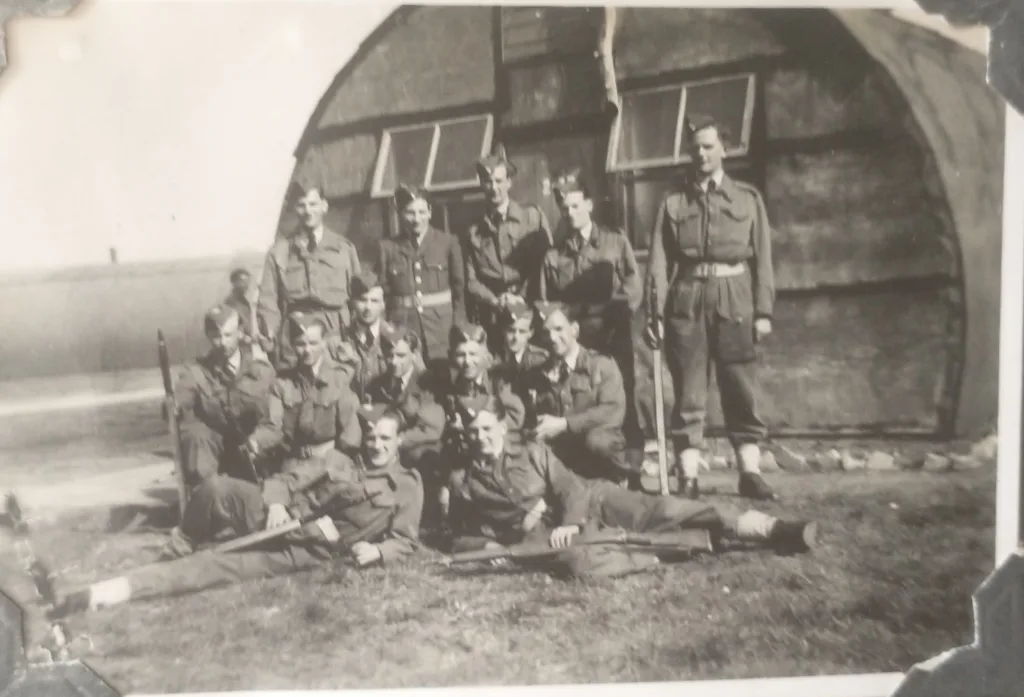
Ben Flude RAF Metfield. (dad is lying down at the bottom right. he is now 98)
‘Early in 1946 I received my call-up papers for the RAF. I was to report to the Recruitment Centre at Padgate in Lancashire. This is where I received my uniform after a medical examination, and then there were a number of intelligence/aptitude tests when they decided what trade I would join. I tried to get Air Crew and while there were no vacancies, I did have a wide group of trade offers open to me. The group that I was interested in was aircraft maintenance and repair, following in my Dad’s footsteps.’
‘However, before I could start, I had to do my basic training. This was designed to get you fit, and we did plenty of square-bashing or parade drills. For this, they sent me to Metfield in Suffolk, which had only very recently been made available to the RAF by the American Army Air Force. In fact, it was so recent a hand-over that whilst on picket duty, a coach rolled up packed with girls who were so disappointed by the lack of Americans that they got straight back on and returned to Ipswich! The motto of ‘overpaid, oversexed, over here’ certainly applied to these Americans in Suffolk.’
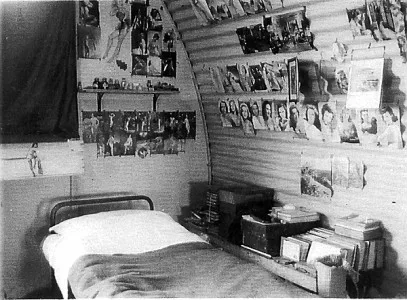
‘We found out that Metfield had been a US Army Air Force Base, where two squadrons of Flying Fortresses operated from. In all the Nissen Huts, those with the semicircular roofs, the ceilings were completely covered with pin-up pictures. My bed was just feet away from the huge Crocodile Stove, round which every evening we all clustered – as it was warm.‘
Interior of Nissan Hut 1944, Lasham
Dad specialised in the recovery of instruments from crashed planes, and was complimented by Air Chief Marshal Hugh Caswall Tremenheere Dowding, 1st Baron Dowding, GCB, GCVO, CMG on his ability to fix an instrument he had never seen before.
First published March 25th 4004 BC and republished yearly on every April Fool’s Day. The section on the meaning of April moved to my post on April 2025. On This Day added in 2026
The Moon rules the months: this month’s span ends With the worship of the Moon on the Aventine Hill.
Fasti by Ovid
Cycle of the Moon, sketched from photo.
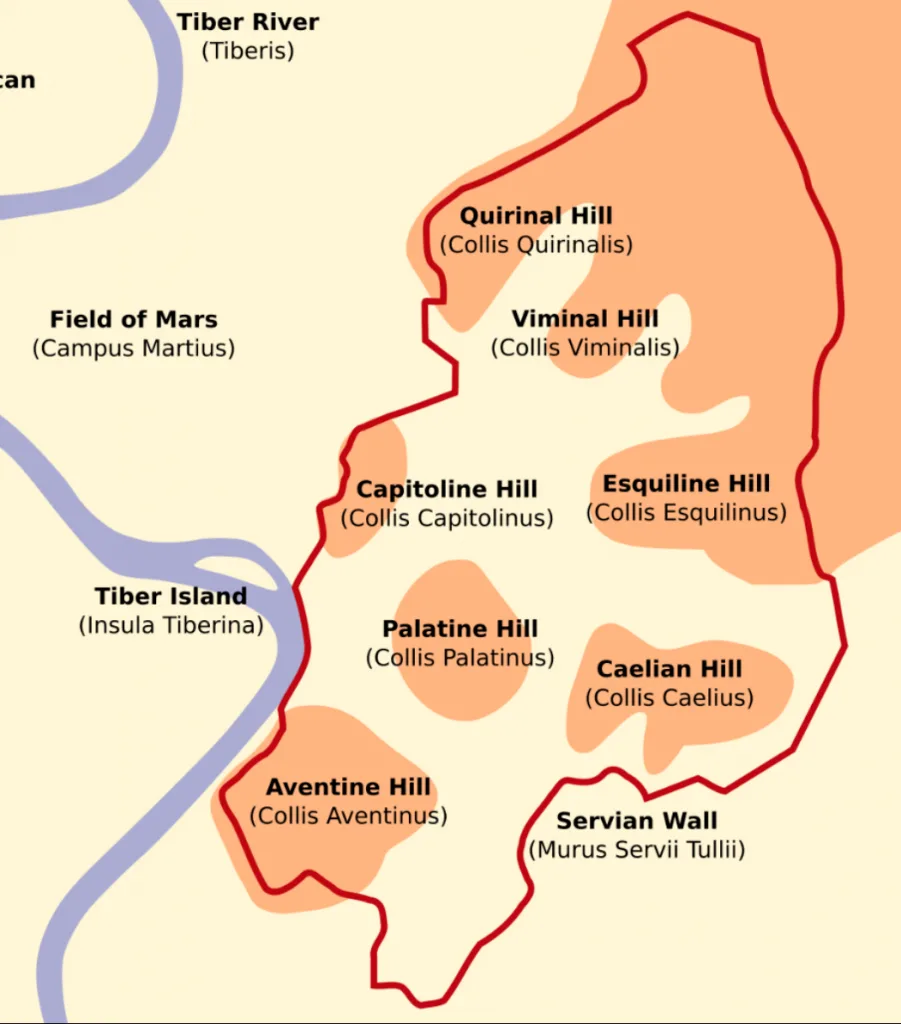
The Aventine Hill is one of the seven hills of Rome, named after a mythical King Aventinus. It is the hill where Hercules pastured his cattle. They were stolen by Cacus. According to Virgil in his Aeneid, the monstrous Cacus lived in a cave on a rocky slope near the River Tiber. Cacus was the son of Vulcan, the artificer God. He was, also, a fire breathing Giant who eat human flesh and stuck their skulls on the door of his house. When Hercules wrestled with him, Hercules hugged him so tight Cacus’ eyes popped out of his head.
The worship of Minerva also took place on the Hill. You can take a Google Earth fly past if you follow this link – also some nice photos.
The Aventine Hill & Romulus
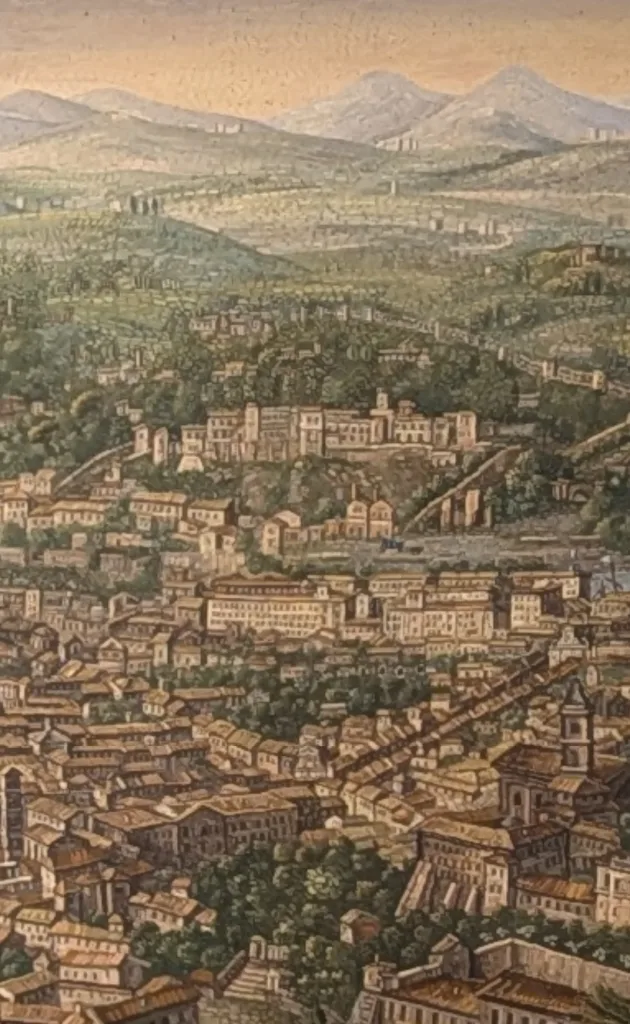
Aventine Hill in a detail of the ‘Panorama of Rome From the Janiculum Hill’ in miniature mosaics by Antonio Tesca 1800-25 , Gilbert Collection V&A Photo K Flude. You can see the Walls of Rome in the Background. The Tiber runs across the middle but is not clearly visible.
The Hill is famous in the mythology of Rome because it is associated with Romulus. He and his twin Brother Remus, were born to the vestal virgin, Rhea Silvia, in the pre-Roman City of Alba Longa, not far away. Rhea was the daughter of former King Numitor. Her uncle, killed Rhea’s brother and forced her to be a vestal Virgin. Thus ensuring Numitor’s line died out.
But, in her sacred grove she was put to sleep by Somnus dripping a sleeping draft into her eyes and then raped by the God Mars. This was a terrible breaking of the taboo for Vestal Virgins. Rhea gave birth to the twin boys. They had to be hidden from the wrath of their Granduncle.
The Palatine & the Lupercal
The Seven Hills of Room (Facebook)
The boys were saved by the River God Tiberinus and then by being suckled by a Wolf in a cave called the Lupercal, which is at the foot of the Palatine Hill in Rome. A ‘grotto’ under Augustus’ Palace on the Palatine, has been claimed as the original Lupercal, but it is disputed. (see www.digitalaugustanrome.org/records/lupercal/.
When the boys grew up, they helped their Grandfather (Numitor) reclaim the throne of Alba Longa. The boys, being the children of the War God, were obviously excellent at the art of war. Then they decided to found their own City, but they could not decide upon which hill to build it or whom to name it after (accounts vary!). Remus favoured the Aventine, Romulus the Palatine (some accounts say vice versa).
So they decided to let the Gods decide. Remus claimed to have won when he saw a flight of 6 auspicious birds. Romulus saw 12 and declared himself the winner. And Rome was named in his honour. It was on his choice of Hill – the Palatine Hill. The Aventine hill was, originally, outside the City boundary.
The two quarrelled. Remus was killed. This story was first written down in the Third Century BC. The traditional foundation date of Rome is 753BC. These mythical foundation stories continue are retold and celebrated. In Britain, we largely ignore our creation myths. Despite our legendary Founder, King Brutus, being a relative of Romulus and Remus.
The ‘Panorama of Rome From the Janiculum Hill’ in miniature mosaics by Antonio Tesca 1800-25 , Gilbert Collection V&A Photo K Flude. It took 20 years to make.
You didn’t think I’d leave you with just a detail of the superb map did you? And to see a much better photo of it look at the V&A’s photo. It is part of the Gilbert Collection which I introduced in this post.
First written in 2023 and revised March 30th 2024, 2025, Object of the Day added 2026
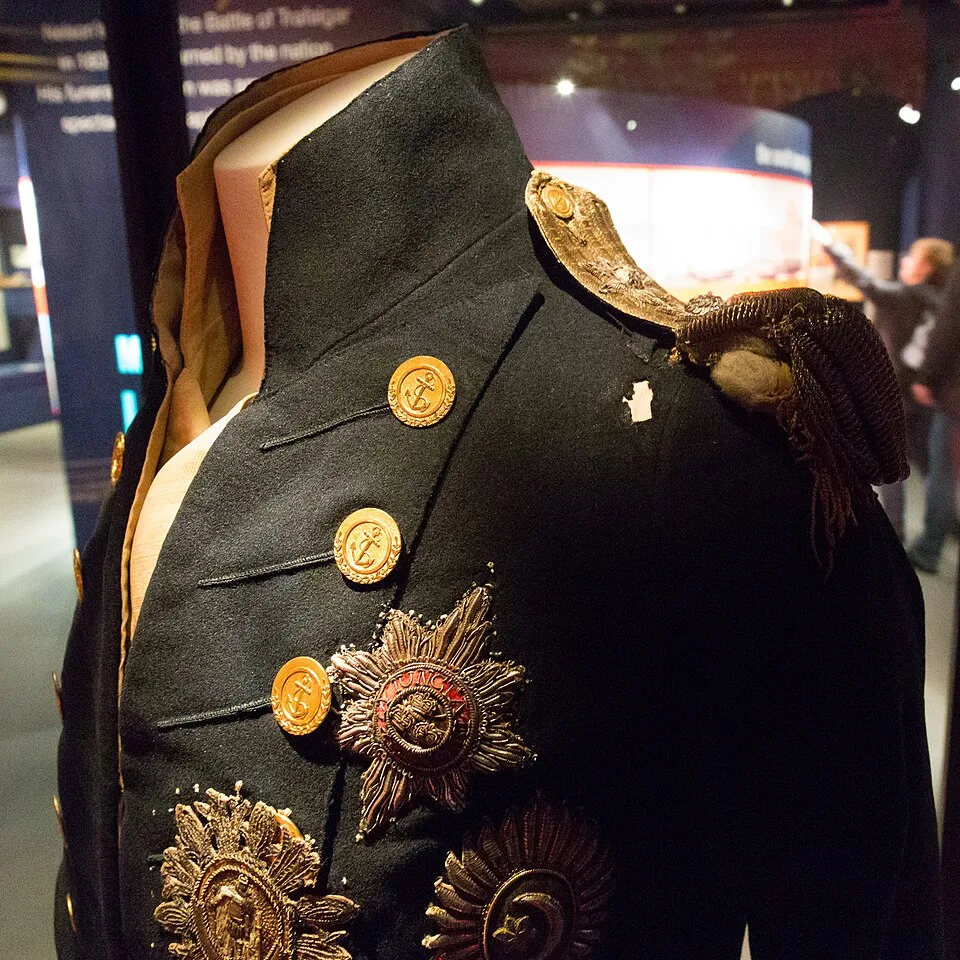
Uniform worn by Nelson at the Battle of Trafalgar (1805), his final engagement, showing the musket ball hole; now displayed at the National Maritime Museum, Greenwich By Morio – Own work, CC BY-SA 3.0,
Virginia Woolf In Greenwich
‘Where shall I spend the day? decided on Greenwich, arrived there at 1; lunched, everything fell out pat; smoked a cigarette on the pier promenade, saw the ships swinging up, one, two, three, out of the haze; adored it all; yes, even the lavatory keepers little dog; saw the grey Wren buildings fronting the river, & then another great ship, grey and orange; with a woman walking on deck; & then to the hospital; first to the museum, where I saw John Franklin’s pen and spoons (a spoon asks a good deal of imagination to consecrate it) – I played with my mind watching what it would do, and behold if I didn’t burst into tears over the coat Nelson wore at Trafalgar with the medal which he hid with his hand when they carried him down, dying, lest the sailors might see it was him.
There was too, his little fuzzy pigtail of golden greyish hair tied in black, & his long white stockings, one much stained, & his white breeches with the gold buckles, & his stock – all of which I suppose they must have undone & taken off as he lay dying. Kiss me Hardy, &c – Anchor, anchor, – I read it all when I came in, & could swear I was there on the Victory – So the charm worked in that case. Then it was raining a little, but I went into the Park, which is all prominence and radiating paths, then back on top of a Bus & so to tea. ‘
Virginia. Woolf, Diary, 1926, quoted from ‘A London Year’ Compiled by Travis Ellborough & Nick Bennison
Greenwich
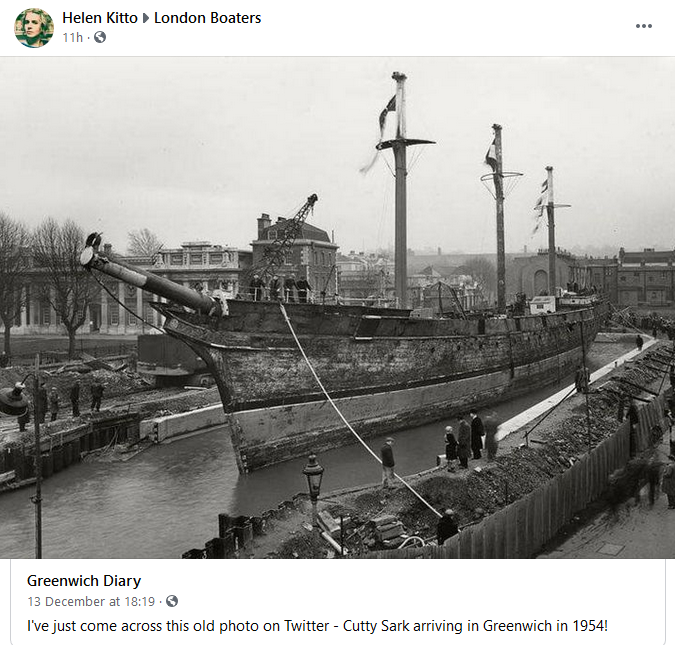
It’s a lovely description of her day out. I think it is like most of our excursions to Greenwich, except she didn’t go to the Market, nor stop in one of the historic pubs, nor go the Royal Observatory. Cutty Sark was not there until 1954. The Museum she mentions is not the National Maritime Museum as that was not opened till 1937, although the idea dates from the year after Woolf’s visit. So, the Museum is a precursor. Nelson’s funeral was preceded by a lying-in-state for three days at the Royal Hospital for Seamen at Greenwich, (which is the Hospital Viriginia Woolf mentions). He was buried in St Pauls on 9 January 1806 , with his body taken by boat from Greenwich to St Pauls. So, there was a local Museum with maritime content in it. I assume associated with the Royal Hospital.
I hate to think what my, unforgiving, on-line grammar editor will make of those long sentences with so many sub-clauses! It is a problem for me as the tool rates the writing on various criteria and refuses to give you a green tick when you have long sentences, not enough headings, paragraphs too short or long, passive writing, etc. etc. And an on-line automated, probably AI assisted tool is not going to let it through just because it is by Virginia Woolf.
Cutty Sark
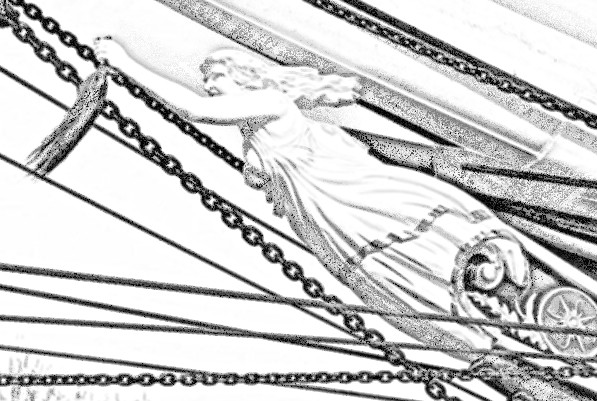
The Cutty Sark was one of the fastest Tea Clipper Ships. It was built in Dumbarton, Scotland in 1869. And is resting as a Tourist Attraction in Greenwich. She gets her name from Tam O’Shanter, one of Robert Burns’ greatest poems. written in 1791. The story of the name is told by the Figurehead.
Figureheads on the prow of ships are very often of a semi naked women with her torso breasting the water. The young witch, Nannie Dee, in Tam O’Shanter is identified as the one who is very ‘Vauntie’ and with a short shift that she wore as a child and so is now short and revealing. The poem names this garment as her ‘Cutty Sark. Sark is her shift. Cutty is dialect for short. The Cutty Sark’s figurehead shows Nannie in her shift holding the tail of Tam’s horse.
Tam O’Shanter
Her cutty sark, o’ Paisley harn, That while a lassie she had worn, In longitude tho’ sorely scanty, It was her best, and she was vauntie.— Ah! little kend thy reverend grannie, That sark she coft for her wee Nannie, Wi’ twa pund Scots, (’twas a’ her riches), Wad ever grac’d a dance of witches!
The story is that the drunken Tam on his steady horse Maggie is travelling home when he seems a devilish dance taking place in a graveyard, presided over by the devil himself. Tam is so excited when he sees the young beautiful witch that he bellows his approval and all of a sudden the merriment ends, and in deadly silence the witches turn on Tam and race to catch him.
Tam tint his reason a’ thegither, And roars out, ‘Weel done, Cutty-sark!’ And in an instant all was dark: And scarcely had he Maggie rallied. When out the hellish legion sallied.
As bees bizz out wi’ angry fyke, When plundering herds assail their byke; As open pussie’s mortal foes, When, pop! she starts before their nose; As eager runs the market-crowd, When ‘Catch the thief!’ resounds aloud; So Maggie runs, the witches follow, Wi’ mony an eldritch skreech and hollow.
Maggie
Tam and his horse have to get across a brook before the witches because the witches cannot cross the water. The witches must get him before the bridge over the brook or face burning at the stake. All depends on Maggie (Meg). The young witch in the Cutty Sark is catching up as they approach the bridge. Maggie makes a magnificent leap, the witch makes a despairing grab and only can reach Maggie’s tail but Tam and his horse make it to safety leaving the witch the tail.
Cutty Sark Figurehead
Ah, Tam! Ah, Tam! thou’ll get thy fairin! In hell they’ll roast thee like a herrin! In vain thy Kate awaits thy comin! Kate soon will be a woefu’ woman! Now, do thy speedy utmost, Meg, And win the key-stane of the brig; There at them thou thy tail may toss, A running stream they dare na cross. But ere the key-stane she could make, The fient a tail she had to shake! For Nannie, far before the rest, Hard upon noble Maggie prest, And flew at Tam wi’ furious ettle; But little wist she Maggie’s mettle— Ae spring brought off her master hale, But left behind her ain gray tail: The carlin claught her by the rump, And left poor Maggie scarce a stump.
Now, follow the link below and read the whole poem but read it out loud, standing up and with gusto. Don’t worry about the pronunciation, just enjoy it.
1802 – Treaty of Amiens brought peace between Revolutionary France and Britain. A Soho factory was lit up with gas lighting to celebrate, But it only lasted a year. Then began the Napoleonic Wars, which continued to 1815.
First Published on March 27th. 2026. Cutty Sark content transferred in from 2022.
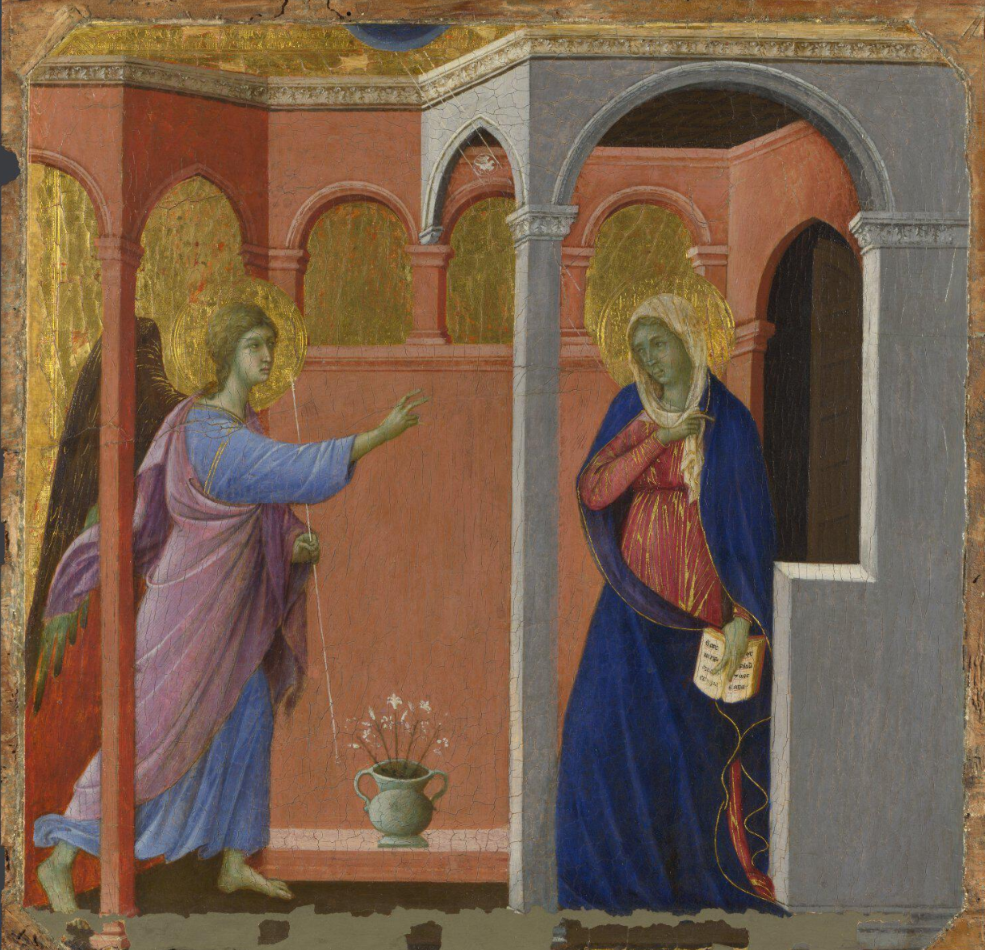
Duccio’s The Annunciation. Egg Tempera on Wood c 1307-11
The Annunciation by Duccio
Today, is the anniversary of the conception of Jesus Christ, called the Annunciation. I told some of this story yesterday which was St Gabriel’s Day. So, sorry for any repetition but I think the extra detail makes it worthwhile! There is a third post in my Annuciation series where I go into the wider implications of the date March 25th, and how it has a fundamental place in Christian Theology.
The picture above is by Duccio, from Sienna in Italy. It shows the Archangel Gabriel bringing Mary the news that she is to give birth to the Son of God. It is in the Sainsbury Wing of the National Gallery. This was the second painting on the National Gallery tour I used to give. The Tour told the story of the development of perspective. I had been reading a book on the subject by David Hockney.
The painting shows that Duccio does not understand single-point perspective. But then, no one could do perspective at that time in Europe. This skill was lost following the Roman Period. But at the beginning of the 14th Century, painters like Duccio from Sienna, and Giotto from Florence, were groping towards more realistic representation.
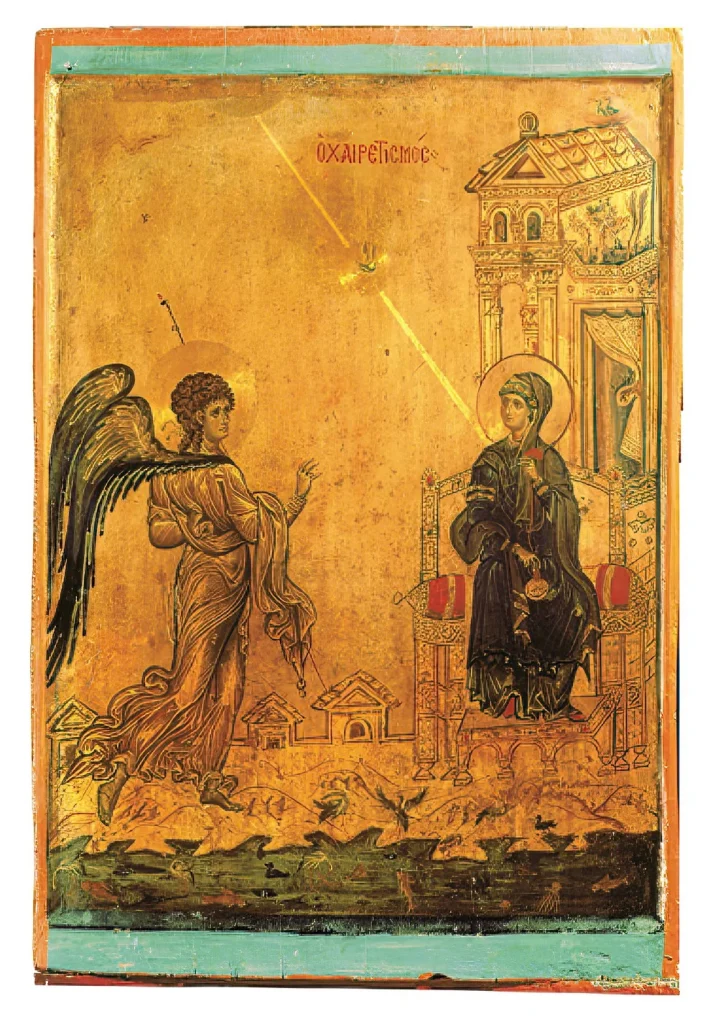
You might say they wanted a more human depiction, in which events are shown in spaces that are trying to look real. Filled with more realistic looking people and beginning to show on their faces real emotions. Previously, the Byzantine style produced iconic, storytelling images, that were somewhat cartoon-like rather than realistic. Here, is a detail from one such.
The Annunciation, St Catherine’s Monastery, 12th Century.
The encounter takes place in a space that is not very real. But it does tell the story effectively.
Moving towards Perspective
Now, look at the Duccio, he uses the arcading at the top of the painting to give an impression of this being an encounter in a real space. The Archangel Gabriel is moving through that space decisively. This is not just a picture with a story, it shows Duccio’s interest in capturing a fleeting but incredibly emotional moment. It happens to be the most important moment in the history of the world (from a Christian view point), the moment that the son of God is conceived as a human.
Gabriel is striding purposefully towards Mary, who has come out of her house to see him. He saying ‘Hey, you are going to give birth to the Son of God.’
She looks overwhelmed, (as you would) holding her arm protectively towards her. ‘What me?’ she might be saying. But she is also pointing at the Bible where this moment in time is predicted by Isaiah. Their faces are quite realistic, Mary is clearly emotional.
Also, if you look at Gabriel’s feet he is quite well grounded unlike many other medieval paintings, where people often seem to be floating above the ground. Mary, too is firmly, anchored, although you cannot see her feet.
It is by no means ‘perfect’ because they don’t yet know the rules of perspective. Neither have they discovered they could use lenses to create ‘photorealistic’ portraits. But they are searching for methods that can bring spaces and people towards realistic life. It mirrors a humanistic trend to see Mary not as a sort of Goddess, but as a real mother. A key point in the Renaissance. (For more on perspective, see my post on Giotto and Palm Sunday. )
The Moment of Conception
Above the arcading can be seen a small sphere of blue sky from which emanates several ‘rays’ and a tiny Holy Dove. As I told the story, yesterday, the rays are coming from Heaven to her womb which is hinted at by the red of her dress. The National Gallery commentary, which you can read here, suggests ‘The conception takes place at the moment she hears the words, which is why a tiny white dove, representing the Holy Ghost, flies towards her ear‘.
This made me stop and think – the tiny dove is heading to her ear is it? Really? Why? Gabriel is the messenger saying the words, the words head to the ear. The Holy Dove is a symbol of the Holy Spirit, part of the Trinity of Father, Son and Holy Ghost. Its role, in the painting, is to show that God is the Father. So why, would the Holy Spirit enter by the ear?
I have been using a ruler to try to see if the National Gallery are right! It’s difficult to be sure with a reproduction. but my ruler says the rays from Heaven are neither heading to the ear nor directly to the womb but in the general direction of her body. If they are right that the rays from heaven are heading for her ear, then is this rather the moment she is being told she will conceive rather than the moment of conception?
The Conception in St Luke
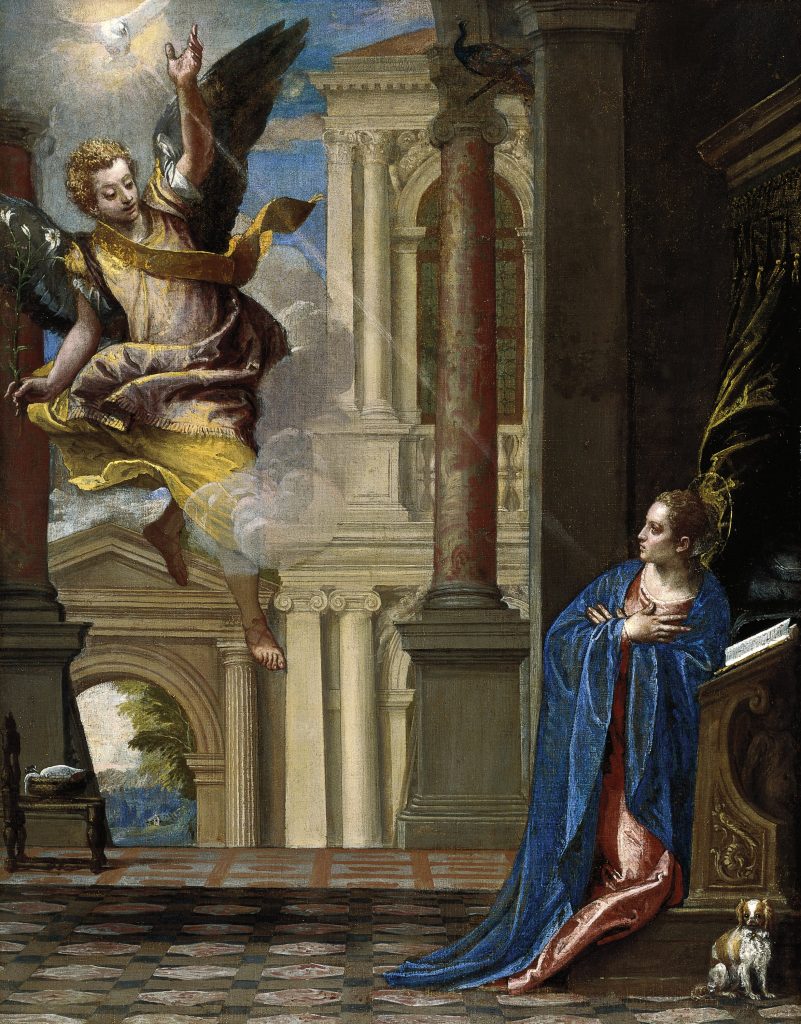
Veronese ‘The Annunciation’
But the National Gallery text accepts that it is the moment of conception that is shown. So, I’ve looked at Luke 1:26-38:
‘Do not be afraid, Mary, for you have found favour with God. And now, you will conceive in your womb and bear a son, and you will name him Jesus.‘
On first reading he is telling her she will conceive, but reading it more carefully he is saying ‘now, you will conceive’. So Duccio is paying very careful attention to the Gospel. By the time Gabriel finishes his sentence, she will have been impregnated by the Holy Dove. Looking at other paintings of the Annunciation the rays from heaven head generally towards the virgin, sometimes to her head, nothing suggesting the ear. In the St Catherine’s Monastery’s Annunciation, above, the ray is going to Mary’s back. Veronese’s ‘The Annunciation’ is similarly going towards Mary’s Back, shoulder, or breast. The Annunciation by the Master of the Judgement of Paris which I showed yesterday has the ray heading to Mary’s lap.
Rossetti’s Annunciation
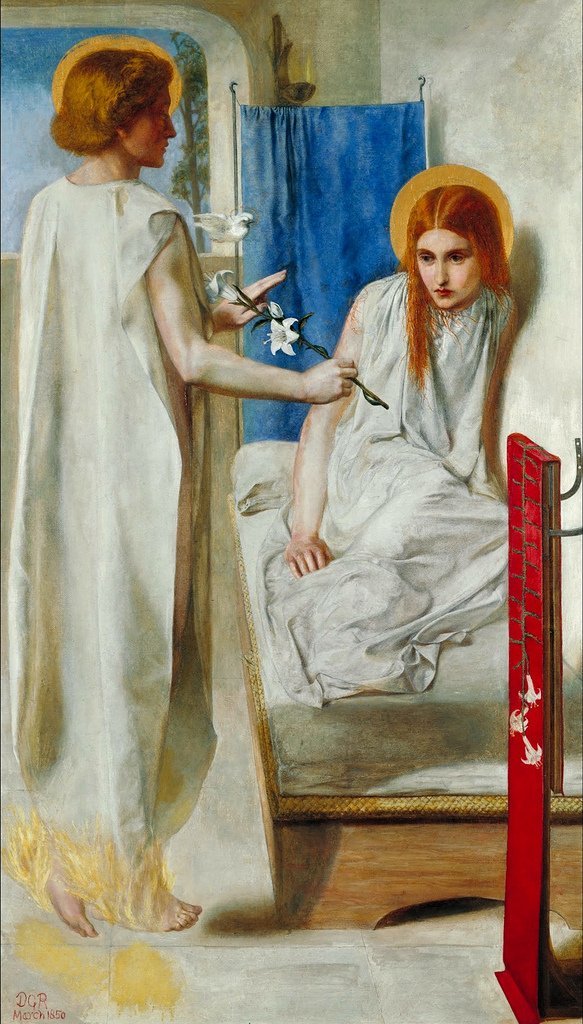
The Annunciation by Rossetti originally known as Ecce Ancilla Domini! 1849 – 1850
I’ve included a 19th Century Rossetti painting because it is so beautiful. It shows a lilly representing purity, instead of the rays, pointing to Mary’s womb. The use of white throughout also represents Mary’s ‘purity’. While the Blue is the traditional colour for Mary. The use of the primary colours red and blue with the predominant White, gives a vivid clarity to the picture. At the time, showing the Virgin as a red-head was quite controversial.
By the way, look at the feet in the Rossetti’s painting. This is an early Rossetti painting, who was a poet and I’m not sure he yet had the skills to ground feet. But he takes advantage of it in this case and confirms Gabriel’s supernatural status by giving Gabriel fiery feet but no wings. Subsequently, Rossetti concentrated on paintings of women from the waist up. Since, first writing this, I have visited an exhibition of Rossetti’s drawings, and they show a very capable draughtsman.
For more on March 25th and the Universe and everything, see my post here (which will be revised later today).
On This Day
If Easter fell on March 25th it was thought to be bad news, particularly if on Good Friday. As the world was created, according to Christians, round about March 25th, God being a logical being, would end it on its anniversary. And all those people who went to the top of the hill, to see out the Day of Judgement, had to trudge down again, murmuring ‘Maybe next time.’ Hampstead Heath was a popular place for Apocalyptaphiles to go in London, the Green next to White Stone Pond, to be precise.
1306 – Robert the Bruce crowned King of Scotland.
1807 – The Abolition of the Slave Trade Act became law.
1843 – the first Tunnel built under a River was opened at Rotherhithe designed by Marc Isambard Brunel, and helped by his son Isambard Kingdom Brunel. I managed the Brunel Engine House for a few years, which was the steam engine house to pump out the water from the tunnel. In fact, a Babylonian (?) Queen built the first tunnel under a River, but what she did was divert the river, build the tunnel, redirect the River back to its original course. So strictly, the Brunels built the first tunnel constructed under a River while the River was still flowing above. I find that most firsts are much more complicated that you think!
1949 – Hamlet became the first British Film to win the Oscar for Best Film. Lawrence Olivier also won the Best Actor Oscar and he was the Director of the Film too. Olivier was the first person to achieve this double feat, and the only one until 1998, when Roberto Benigni won both Oscars in Life Is Beautiful.
Source: Chambers Book of Days
First published 2024, revised 2025, Revised and On This Day added 2026
Baptist Hicks and his, wife, Elizabeth in their Chapel at St James Church, Chipping Campden (Photo Kevin Flude)
This anniversary commanded my attention because I spend a few weekends each summer in the Cotswolds. There I see the ruins of Campden House in Chipping Campden. This was burnt down in 1645. So, when I read about the burning down of Campden House in the 19th Century, it had to be another one. And it turns out this one is in Kensington, London, Both Campden Houses were built for Sir Baptist Hicks, Viscount Campden.
Baptist Hicks Rise to Aristocracy
Baptist Hicks is an example of the flexibility of the British system of aristocracy. Hicks was a commoner, the son of a wealthy Mercer from Cheapside in the City of London. A mercer traded in prestige clothes imported into England. When Hicks’ Father died, his mother, who is said to have been a moneylender, was resourceful enough to take over their mercery business. She made a success of it and eventually passed it on to her son.
The family shop was on the corner of Cheapside and Soper Lane. Soper Lane is where Queens Street is. Their shop was signposted by the sign of the White Bear. Soper Lane was in the Cordwainers Ward. It was the haunt of soap makers and shoemakers (cordwainers got their name from their use of Spanish Cordovan leather). But Cheapside, itself, was the home of Goldsmiths and generally a wealthy area.
Hicks was educated at Trinity College, Cambridge and at the Inner Temple in London. But despite the education as a lawyer, he chose to continue in the family business. He supplied members of the Aristocracy with silk, velvet, taffeta, and other expensive fabrics. He rose to be Mercer to Queen Elizabeth I in 1598, and supplied James VI of Scotland. Indeed, he provided velvet, damask, and satin for the coronation of James 1st on 25 July, 1603.
As his business grew, he was able to lend large sums of money to the aristocracy and the King. He was duly knighted in 1603. He was still running his shop but was elected as an MP. Now, Hicks needed a country estate to further his transition to the aristocracy. So, in 1608, purchased the manor in Chipping Campden. Here he built a splendid new Mansion.
Baptist Hicks and Campden House, Kensington
At about the same time, he won a game of cards with Sir Walter Cope of the Strand. Cope was engaged in building himself a mansion (Holland House) on top of the Hill in Kensington. Hicks won a few acres of the Estate at cards. And he asked Cope’s architect John Thorpe to design him a house, which Hicks called Campden House after his Cotswold estate. Thus, Kensington became fashionable, and Campden Hill got its name. Campden Hill runs into Notting Hill.
After Baptist Hicks death there were many tenants of the house. One was Princess Anne before she became Queen Anne. Also Lady Burlington and her son, Richard Boyle, who became Britain’s first Palladian Architect.
Hicks was made a Baron in 1620 and Viscount of Campden in 1628. (a viscount is 4th in the ranks of aristocracy, being below an Earl and above a Baron). He died in 1629. He was buried in a very impressive marble monument in St James Church, Chipping Campden shown above.
Campden House, Chipping Campden
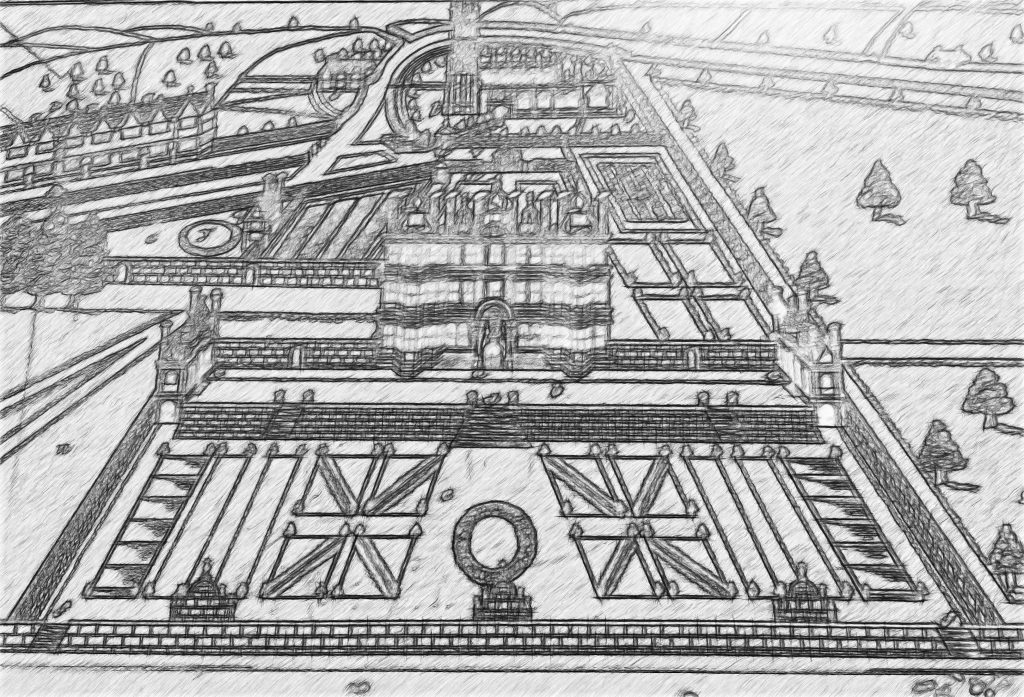
Sketch from a display of Campden House, Chippping Campden. St James Church at the back, House in the Centre, Banqueting Houses in front of, and other side of the house. (A Banqueting House was originally where you had your pudding.)
After his death, the house in Chipping Campden was held by the Royalists in the Civil War. But the Parliamentary Army forced the King’s men to retreat towards Oxford. Prince Maurice ordered the house to be burned down. All that survives of the property are two banqueting houses, and the entrance. All show what a fine building it was.
Sketch from photo of the entrance to Campden House, Chipping Camden.
Behind the wall can be seen the fire reddened ruin of the Banqueting House of Campden House, Chipping Campden. Photo of the other Banqueting House to follow in April
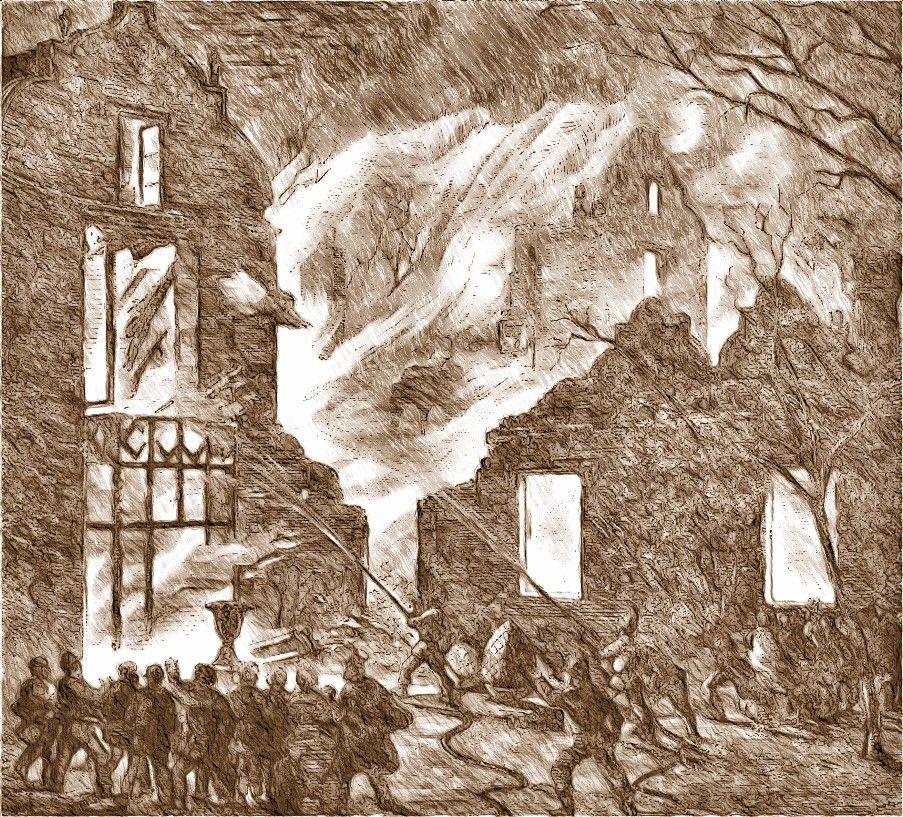
The fire at Campden House on 23rd March, 1862 gutted the building. It is really well described in this post. Briefly, a neighbour saw the fire. A fire engine was summoned. But before it could arrive, a servant appeared at a window. Her son tried to push past her, and she fell out of the window but survived. When the fire engine arrived, it was too late. So the house and its wonderful contents were destroyed. The owner was sued by the Insurance Company for fraud, but they lost the case.
Sketch from contemporary Magazine,showing the servant dropping out of the window. )In reality it was a first floor window.)
The English Year Almanac
I came across the anniversary of the fire in a secondhand book I picked up. It is by my old boss, Sir Roy Strong. The book is called ‘The English Year’. It is co-written by Julia Trevelyan Oman. The contents are ‘A Personal Selection from Chambers’ Book of Days’. Last year I also purchased the Chambers book on Abebooks for £2.10!) Both have been a useful source of information for my Almanac of the Past.
Sir Roy Strong was the Director of the V&A. Sir Roy is a dapper dresser you might almost call him a neo-Georgian. Certainly, a bit of a dandy. I always thought he resembled Charles 1, one of our most ineffectual Kings. I didn’t really have much contact with him, being a lowly Assistant Keeper at the V&A. But at the one Keepers’ Meeting I did attend he seemed rather ineffectual as the chairman of the meeting. But this is mere gossip! And I mention it to show how wrong one can be, in judging people.
Because, when I consider the revival of the V&A under his tenure, my judgement was facile. Sir Roy transformed the V&A. The Museum had been damaged by years of under-investment in the building since WW2. Sir Roy began a campaign to restore the rich and very beautiful old Victorian interior design. The original Victorian Restaurant was transformed. The shop turned into a retail paradise. Generally, the V&A ceased to be dusty and old under his tenure. The wonders of the Victorian Museum shone again with rich and vibrant colours. It reminds me that good leadership is allowing beneficial change to happen. It’s not about the leader being a dynamic leader. It’s about moving an institution positively forward, which Sir Roy certainly did.
1769 – William ‘Strata’ Smith was born. (died 28 August 1839) Smith is known as the Father of English Geology. He was a Canal and Mining Engineer and created ‘the first detailed, nationwide geological map of any country’. (Wikipedia). He worked in a town just down the road from Chipping Camden, and there is a plaque to him in Stow-on-the-Wold which I will write up at some point.
1839 – OK, this is the anniversary of the first appearance in print of the word OK! OK? OK, so, I see you want more of an explanation. The editor of the Boston Morning post had an interest in abbreviations. Charles Gordon Greene in a satirical article about the editorial practices of the rival Providence Journal coined OK as an abbreviation for “oll korrect,” or “all correct”. The rest is history. For more on this story, go to the Smithsonian here. OK?
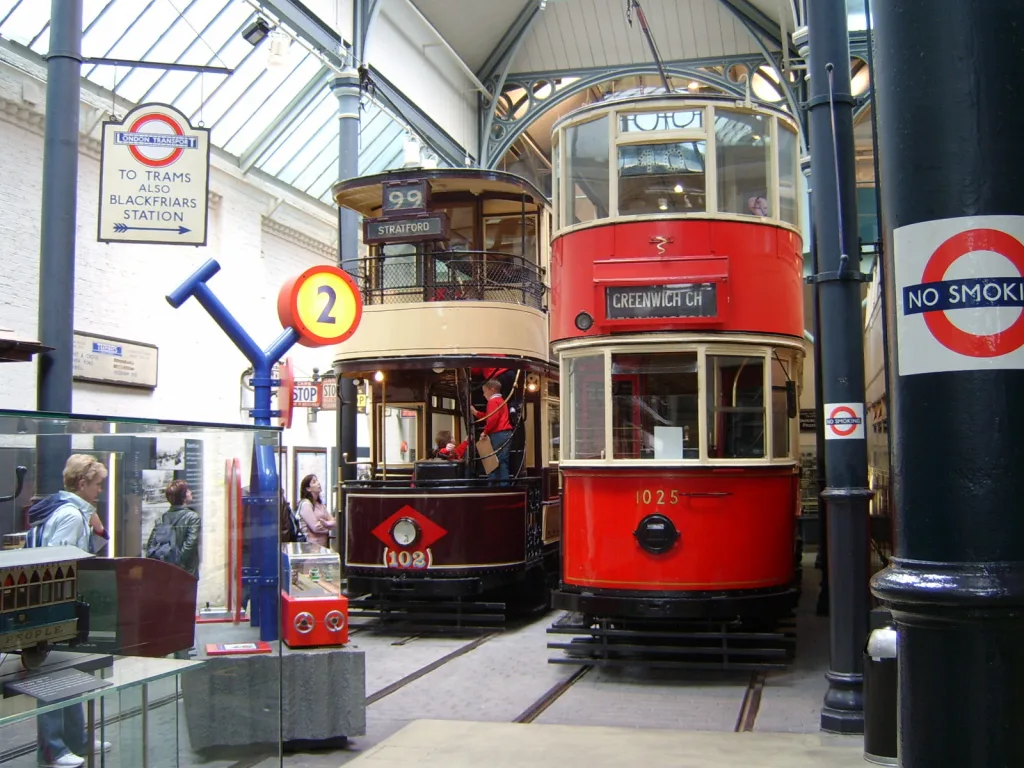
1861 – The first Trams plied London’s Streets.
London Trams, London Transport Museum (Photo KFlude)
1919 – Fascism invented when Mussolini founded the Italian Fascist Party. The repercussions of which led to World War II and the estimated deaths of 65 – 75 million people.
2020 – The UK’s first Covid-19 national lockdown ordered by Boris Johnson.
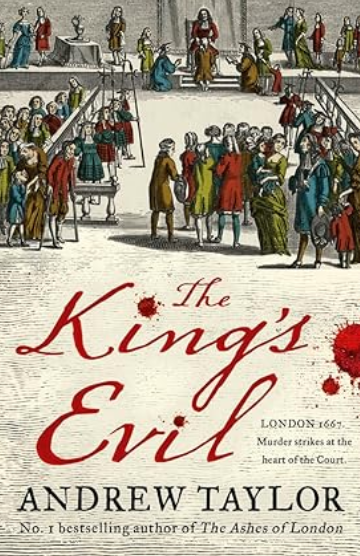
Fascinating read about the King’s Evil by Andrew Taylor
Aries & Noses
We have just entered Aries. Now according to astrology, Aries is associated with health issues of the face. This, according to ‘Skin and Astrology Signs‘ is because of the “level of heat in their bodies”. So Arians tend to have problems such as “flushing, heat rashes, skin eruptions, and rosacea”. They suggest using chilled cucumber for the eyes and forehead, and using beauty products with soothing aloe vera in them. ‘Touching’ by the King could also cure certain nose conditions, particularly if caused by ‘The King’s Evil’.
Charles Kightly, in his Perpetual Almanac enjoins us to ‘Observe the features of the face which are ruled by Aries and seek cures for ills of the nose’.
The first example, Kightly gives, is from The Shepherd’s Prognostication of 1729 which explains how to understand people by studying their noses:
Nose round with a sharpness at the end signifies one to be wavering of mind; the nose wholly crooked, to be sure unshamefaced and unstable; crooked like an eagle’s beak, to be bold. The nose flat, to be lecherous and hasty in wrath; the nostrils large, to be ireful.’
A Fungous Nose & the King’s Evil
The second rather revolting tale is from John Aubrey.
Arise Evans had a fungous Nose and said, it was revealed to him, that the King’s hand would cure him. At the first coming of Charles II into St James Park he kissed the king’s hand and rubbed his nose with it: which disturbed the king, but cured him.
Now, on the subject of revolting nose conditions, I have just been reading a review of a book ‘Civility and the Theatre in Early Modern England’. The author, Indira Ghose, is studying early self-help books of manners and conduct, and how they influence or appear in contemporary plays. One such manual by Giovanni Della Casa has the following advice:
‘when thou hast blowne thy nose, use not to open thy handkerchief, to glare uppon thy snot, as if thou hadst pearles and Rubies fallen from thy braynes’.
Galateo: The Rules of Polite Behaviour published in Venice in 1558. It was translated into French (1562), English (1576), Latin (1580), Spanish (1585), and German (1587), (Wikipedia). Galateo translates as etiquette.
There is no need to thank me for passing on such good advice! I bet “Miss Manners” Judith Martin didn’t pass this particular gem on, but Wikipedia claims that modern books of manners are influenced by Galateo.
Scofula and the King’s Touch
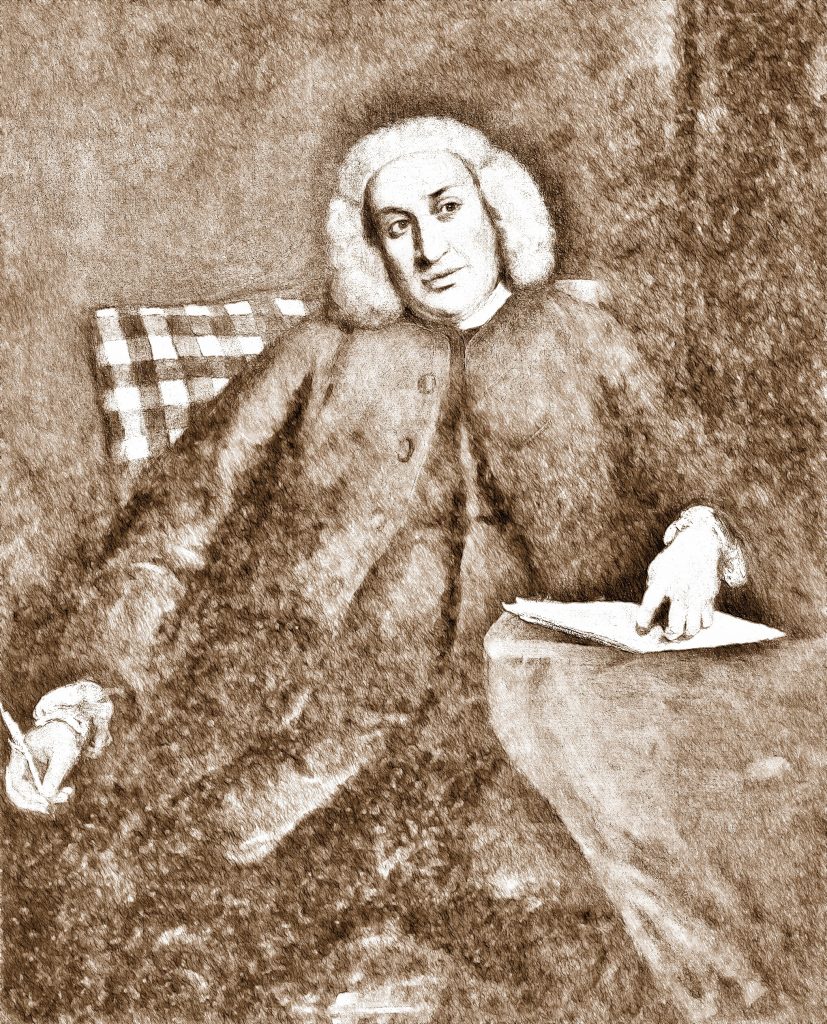
Sketch of Dr Johnson from a portrait.
People believed that Scrofula, could be cured by touching the Monarch. Tuberculous cervical lymphadenitis was, thus, known as the King’s Evil. So, the King or Queen would make herself, very reluctantly, available for his sick public to touch her. Dr Samuel Johnson suffered from Scofula and received the “royal touch” from Queen Anne on 30 March 1712 at St James’s Palace. He was given a ribbon, which he wore around his neck for the rest of his life (with a coin strung on it, I think see below). But it did not cure the disease, and he had to have an operation.
The Touching took place in the winter, between Michaelmas and Easter, when cold weather provoked the disease. The lucky few, who were allowed the Touch, would be touched or stroked by the King or Queen on the face or neck. Then a special gold coin, touched by the Monarch, was put around their neck. Readings from the bible and prayer finished the ceremony. Before Queen Elizabeth I, the Touch was said to cure many diseases such as Rheumatism, convulsions, fever and blindness, but after it was reserved for Scrofula.
Who Started touching for the King’s Evil?
It was only the French and the English who believed the King’s touch could cure people. The French claimed it began with Philip 1 in the 11th Century. The English claimed Edward the Confessor as the first. But this was denied by the French who claimed that the French King of England, Henry 1 introduced it to the English. The practice lasted until George 1 who resolutely refused to have anything to do with it.
For more on the King’s Evil have a look at this blogpost. Or read the book pictured at the top of the post.
On This Day
1312 – The Knights Templars are abolished by Pope Clement. King Philip of France had a massive debt owed to the Templars, following his war with England. He chose to avoid payment by accusing the Templars of impious acts, and homosexuality. Evidence was collected by torture and thus unreliable.
1622 – Jamestown massacre: 347 English settlers killed by Powhatan People of Tsenacommacah. This is estimated as a third of the colony’s population, during the Second Anglo-Powhatan War. Powhatan (Chief Wahunsunacawh) was the father of Pocahontas (aka Amonute, or Matoaka and Rebecca Rolfe). But it was Powhatan’s son, Opechancanough, who was in charge during the massacre. They were of the Algonquian peoples.
1888 – The English Football League was founded at Anderton’s Hotel, Fleet Street. Representatives from Aston Villa, Blackburn Rovers, Bolton Wanderers, Preston North End and West Bromwich Albion met. They discussed other teams that might join. Another meeting was called at the Royal Hotel in Manchester on 17 April 1888 to establish the league. The 12 founding members were: Accrington, Aston Villa, Blackburn Rovers, Bolton Wanderers, Burnley, Derby County, Everton, Notts County, Preston, Stoke City, West Bromwich Albion, Wolverhampton Wanderers. None from London. In season 1894–95 Woolwich Arsenal joined the 2nd Division of the Football League as the first London Team. For more information see: the-football-league-conceived-in-fleet-street-born-in-manchester/
First published in 2024, revised in 2025, Etiquette and On This Day added 2026
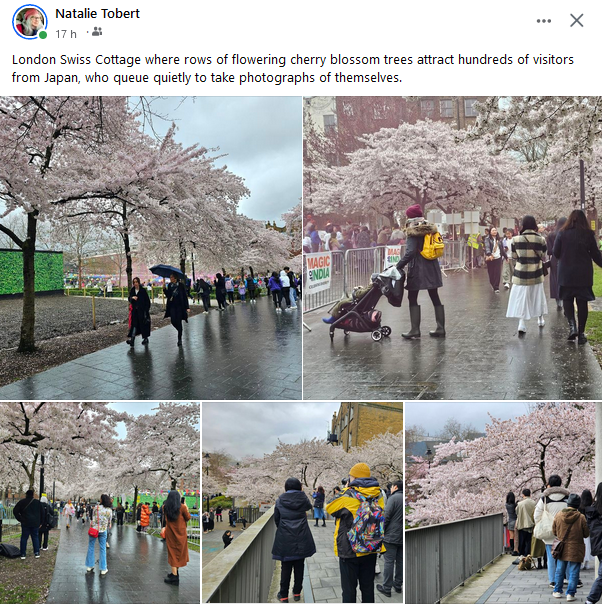
Peak Cherry Blossom Photos by Natalie Tobert (to see her fantastic sculptures, look here:)
This year, I don’t think it is yet Peak Blossom. Last week of March, first weeks of April, my best bet. But I’m going to keep this post here to encourage you to get out there and take joy from the Blossom season. Or Sakura as the Japanese call it.
In 2024, it was early, around March 19th, 2025, two weeks later. There are many suggested places, and I enclose a couple of web links with more details. But my friend, Natalie Tobert, posted in 2024 about Japanese people queuing up to photo cherry blossom in Swiss Cottage, which you can see above.
Sakura and Peak Cherry Blossom
For the Japanese Cherry Blossom represents both the beauty of life and its brevity. Sakura are honoured by the Samurai, and were on the badges of KamiKazi Pilots in World War 2. The Japanese began their blossom time with Plum Blossom. They can be difficult to tell apart from Cherry but it is much more fragrant. It blossoms earlier can also be white!).
Cherry trees consist of 430 species in the genus Prunus. Wild Cherry and Bird Cherry are native to the UK. Normal blossom time is April. In mild winters and sheltered places like London they can blossom as soon as February. The flowers are known as Sakura in Japan, and viewing them is ‘Hanami’. Bird Cherry usually flowers in May. Recent blossoming is over 7 days earlier than the average for the previous 1,200 years.
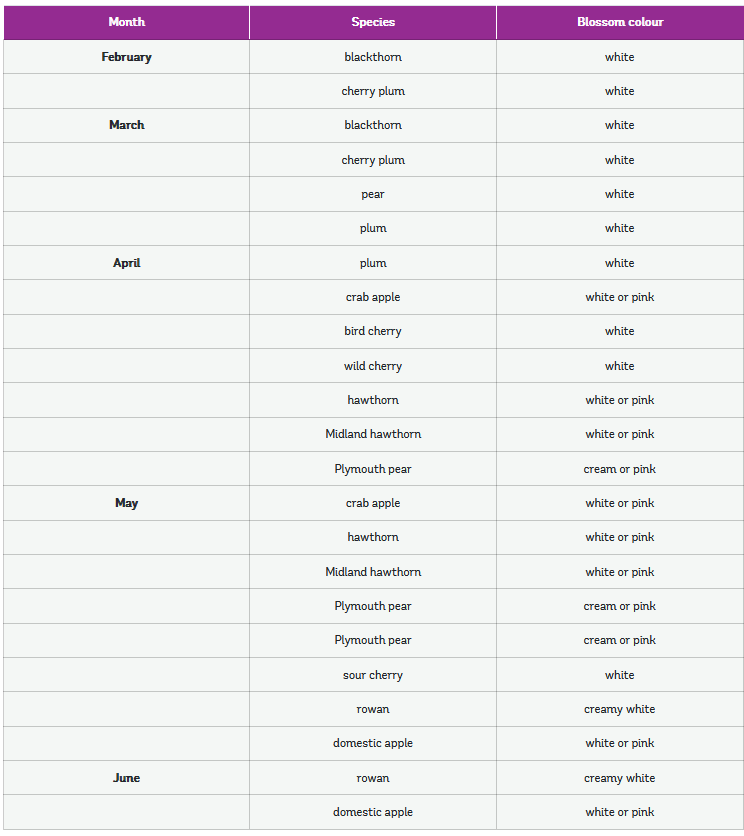
The Woodland Trust has a great web page about blossom in general and I include their useful table of blossom time, below. www.woodlandtrust.org.uk
The Trust also have a ‘nature’s calendar’ program. ‘Citizen Scientists’ can participate in projects to track the progress of the sessions in nature. https://naturescalendar.woodlandtrust.org.uk.
Feast day of St Joseph. Father? Step-Father? Guardian? of Jesus. I see that religious sites like to use the expression ‘Earthly father’. Images of the Annunciation, suggest a divine impregnation at the time that the Archangel Gabriel turned up to tell Mary what was going to happen. See my post on the Annuciation. Joseph is for fairly obvious reasons, patron saint of carpenters, working men, fathers, families and virgins. Emigrants, travellers and house hunters. But also pastry cooks, attorneys and barristers, for reasons I know not.
In Medieval Mystery plays, the scene where Joseph is told by Mary she is pregnant was played strictly for laughs. When Mary gives him the news that he is carrying ‘Gods and his (Joseph’s) child’. He warns all old men not to take young wives, and laments that his name is ruined. Nor is he very impressed when Mary tells him an angel told her the news. Below is a Middle English version of a section of the N-Town Plays, Play 12 Joseph’s Doubt. (these 15th Century Passion Plays are not linked to any particular town or author, hence their name). It is in middle english but just give it a go, don’t worry about the words you cannot understand. You will be able to guess enough of them to make sense of what is going on. If you follow the link below you will get help with particularly difficult words. y’s are often i’s. O’s can be a’s.
N-Town Plays, Play 12 Joseph’s Doubt
MARIA Sekyr, sere, beth nowth dysmayde, Ryth aftyr the wyl of Goddys sonde.
JOSEPH That semyth evyl, I am afrayd: Thi wombe to hyghe doth stonde! I drede me sore I am betrayd. Sum other man thee had in honde Hens sythe that I went. Thy wombe is gret; it gynnyth to ryse! Than has thu begownne a synful gyse! Telle me now in what wyse Thyself thu ast thus schent! Ow, dame, what thinge menyth this? With childe, thu gynnyst ryth gret to gon? Sey me, Mary — this childys fadyr, ho is? I pray thee, telle me and that anon!
MARIA The Fadyr of Hevyn and ye it is; Other fadyr hath he non. I dede nevyr forfete with man, iwys. Wherfore I pray yow, amende youre mon: This childe is Goddys and youre!
JOSEPH Goddys childe — thu lyist, in fay! God dede nevyr jape so with may! And I cam nevyr ther, I dare wel say, Yitt so nyh thi boure.
But yit I sey: Mary, whoos childe is this? MARIA Goddys and youre, I sey, iwys!
JOSEPH Ya, ya, all olde men to me take tent And weddyth no wyff, in no kynnys wyse, That is a yonge wench, be myn asent, For doute and drede and swych servyse! Alas, alas, my name is shent! All men may me now dyspyse And seyn: “Olde cokwold, thi bow is bent Newly now after the Frensche gyse!” Alas, and welaway! Alas, dame, why dedyst thu so? For this synne that thu hast do, I thee forsake and from thee go For onys evyr and ay!
Display of Antarctic Explorer’s Kit 1912 (reconstruction) at Gilbert White’s House in Hampshire {Photo K Flude). To illustrate Lawrence Oates self-sacrifice
This post is about Lawrence ‘Titus’ Oates and his self-sacrifice, on going out to his death to give the other members of the Antarctic Expedition a chance of survival. ‘I am just going outside and may be some time.’ he famously said . But first, for subscribers to the email, the new section ‘On This Day.’
On This Day
1190 – The Jewish Massacre at York. From 1189, anti-Jewish riots broke out as preparations for the Third Crusade were made. The rioters attempted to steal Jewish wealth, burn down their house, and forced conversion to Christianity. The unrest spread from Old Jewry in London to Ospringe., King’s Lynn, Colchester,, Stamford, Bury St Edmunds., and Thetford,. The Jews of Lincoln took refuge in the Castle and survived.
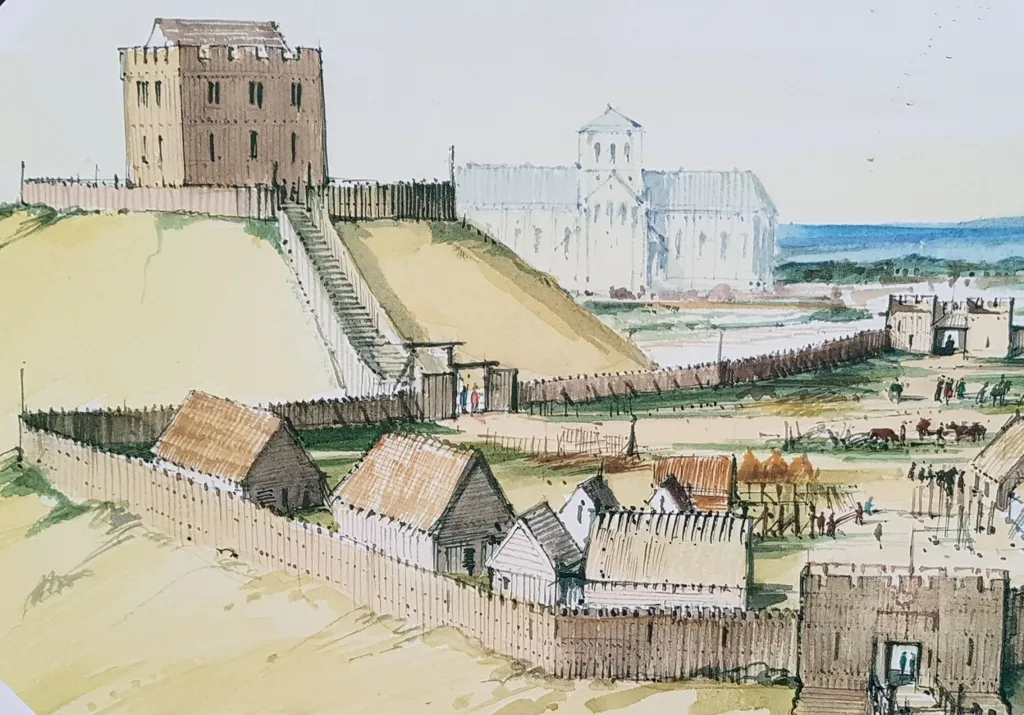
Reconstruction of York Castle, with Clifford’s Tower, originally made of wood, shown on the top of the Hill (photgraphed by KFlude from plaques on the displays nearby)
On March 16th, the Jews of York were attacked in their houses, and sought sanctuary in the Timber Keep of York Castle, known as Clifford’s Tower. Fearful of the willingness of the Sheriff of the County to ensure their survival, the community decided on mass suicide. Fathers, killed their children and wives, then killed themselves. The two leaders, then burnt down Clifford’s Tower and died.
1660 – The Long Parliament finally dissolved. It was elected in 1642 called by Charles I, before the English Civil War, and survived to be revived to usher in the restored monarchy under Charles II.
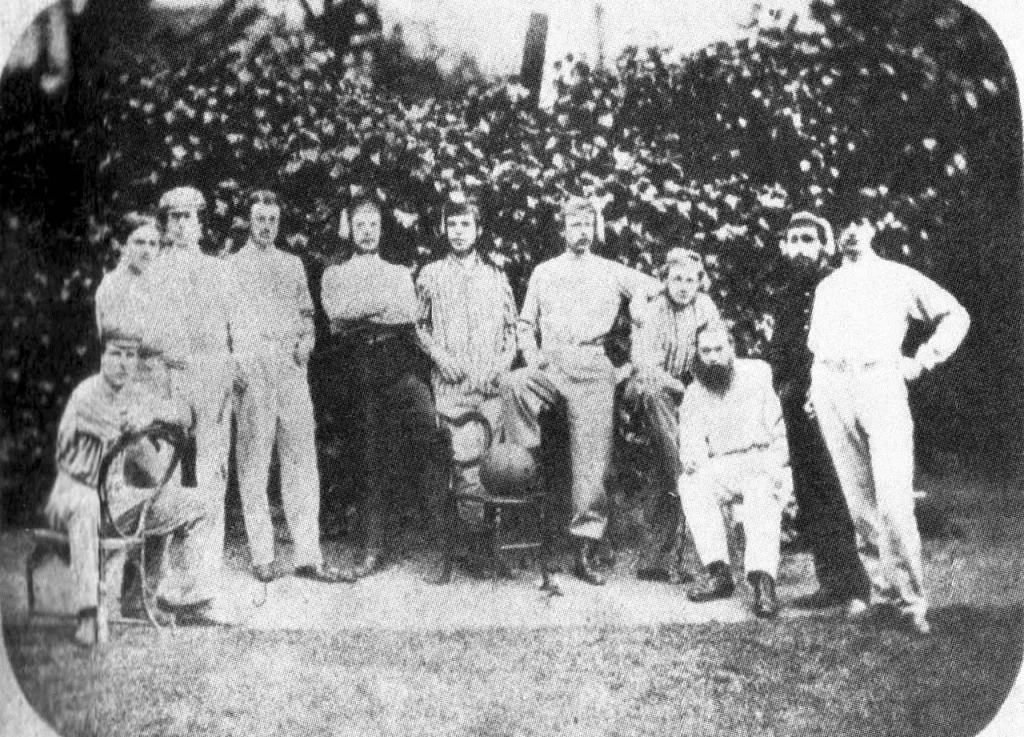
1872 – the first Football Association Cup Final took place on the Cricket Ground, the Kennington Oval. The Wanderers beat the Royal Engineers 1:0. The Wanderers were founded by Public School Old boys from Harrow. It began in Leytonstone, in East London 1859, originally known as the “Forest Football Club”. But then wandered around a number of grounds until they made the Oval their semi-permanent home. The Club’s last game was against Clapton Pilgrims in March 1872.
The only known Photo of the Wanderers from 1863. Public Domain, Wikipedia
The Royal Engineers were soldiers from Chatham, Kent and according to Wikipedia were: ‘the first club to play a passing game of cooperation and organisation with both their forwards and their defence’. Also the first club to have the word ‘beautiful’ applied to their game.
1956 – Fake Finnish Saint St Urho invented as a rival to St Patrick’s Day. Just as Patrick banished snakes from Ireland, Urho (which means ‘hero’) banished frogs (or grasshoppers) saving the grape crop. He was invented in the States but is celebrated by a bar in Helsinki.
1968 – the My Lai massacre, Sơn Mỹ village, Quảng Ngãi province, perpetrated by US Troops, slaughtering over 300 unarmed villages. 26 soldiers faced charges but only Lieutenant William Calley Jr. was convicted. He only served three and a half years of a life sentence (and that was served under house arrest).
Main Source Chambers Book of Days & Wikipedia
The Oates Museum in Gilbert White’s House
Last year, I went to Gilbert White’s House in Selborne. The naturalist’s House also houses the Oates Museum for Lawrence ‘Titus Oates’ and his uncle Frank. Oates was one of the ‘heroes’ I read about as a child. He epitomised what was sold as the British virtues of pluck, self-sacrifice, restraint.
Here is part of the story of Oates self-sacrifice over the days from February 29th to March 16th. 1912 as told in the diary of the commander of the expedition, Captain Scott:
Wednesday, February 29th 1912
Lunch. Cold night. Minimum Temp. -37.5°; -30° with north-west wind, force 4, when we got up. Frightfully cold starting; luckily Bowers and Oates in their last new finnesko; keeping my old ones for present. Expected awful march and for first hour got it. Then things improved and we camped after 5 1/2 hours marching close to lunch camp—22 1/2. Next camp is our depot and it is exactly 13 miles. It ought not to take more than 1 1/2 days; we pray for another fine one. The oil will just about spin out in that event, and we arrive 3 clear days’ food in hand. The increase of ration has had an enormously beneficial result. Mountains now looking small. Wind still very light from west—cannot understand this wind.
A finnesko is ‘a boot of tannedreindeer skin with the hair on the outside’.
Monday, March 5th 1912
Lunch. Regret to say going from bad to worse. We got a slant of wind yesterday afternoon, and going on 5 hours we converted our wretched morning run of 3 1/2 miles into something over 9. We went to bed on a cup of cocoa and pemmican solid with the chill off. (R. 47.) The result is telling on all, but mainly on Oates, whose feet are in a wretched condition. One swelled up tremendously last night and he is very lame this morning. We started march on tea and pemmican as last night—we pretend to prefer the pemmican this way. Marched for 5 hours this morning over a slightly better surface covered with high moundy sastrugi.
Sledge capsized twice; we pulled on foot, covering about 5 1/2 miles. We are two pony marches and 4 miles about from our depot. Our fuel dreadfully low and the poor Soldier nearly done. It is pathetic enough because we can do nothing for him; more hot food might do a little, but only a little, I fear. We none of us expected these terribly low temperatures, and of the rest of us Wilson is feeling them most; mainly, I fear, from his self-sacrificing devotion in doctoring Oates’ feet. We cannot help each other, each has enough to do to take care of himself. We get cold on the march when the trudging is heavy, and the wind pierces our warm garments.
The others, all of them, are unendingly cheerful when in the tent. We mean to see the game through with a proper spirit, but it’s tough work to be pulling harder than we ever pulled in our lives for long hours, and to feel that the progress is so slow. One can only say ‘God help us!’ and plod on our weary way, cold and very miserable, though outwardly cheerful. We talk of all sorts of subjects in the tent, not much of food now, since we decided to take the risk of running a full ration. We simply couldn’t go hungry at this time.
Pemmican is made of tallow, dried meat and dried berries. It is a calorie rich food stuff created by native American groups and used by expedition like Scotts. The name says Wikipedia ‘comes from the Cree word ᐱᒦᐦᑳᓐ (pimîhkân), which and adopted is derived from the word ᐱᒥᕀ (pimî), ‘fat, grease”. Sastrugi is a Russian word which are ripples or craters in the surface of the snow caused by strong winds. They make progressing through the terrain much more difficult.
Scott begins his March 16th entry unsure what the actual date is.
Friday March 16th
Lost track of dates, but think the last correct. Tragedy all along the line. At lunch, the day before yesterday, poor Titus Oates said he couldn’t go on; he proposed we should leave him in his sleeping-bag. That we could not do, and induced him to come on, on the afternoon march. In spite of its awful nature for him he struggled on and we made a few miles. At night he was worse and we knew the end had come.
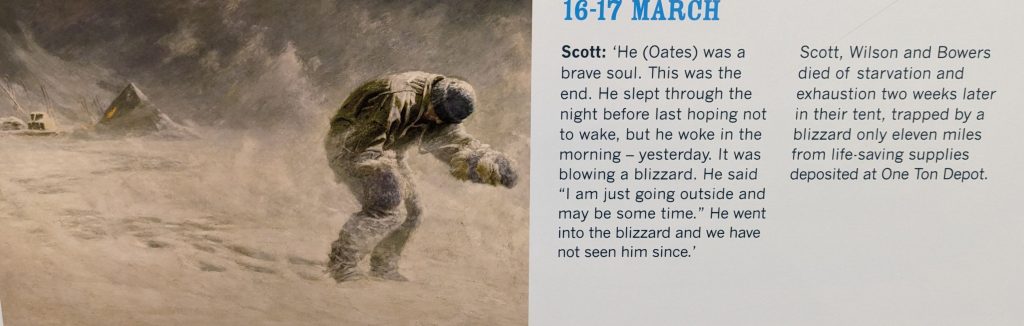
Should this be found I want these facts recorded. Oates’ last thoughts were of his Mother, but immediately before he took pride in thinking that his regiment would be pleased with the bold way in which he met his death. We can testify to his bravery. He has borne intense suffering for weeks without complaint, and to the very last was able and willing to discuss outside subjects. He did not – would not – give up hope to the very end. He was a brave soul. This was the end. He slept through the night before last, hoping not to wake; but he woke in the morning – yesterday. It was blowing a blizzard. He said, ‘I am just going outside and may be some time.’ He went out into the blizzard and we have not seen him since.
I take this opportunity of saying that we have stuck to our sick companions to the last. In case of Edgar Evans, when absolutely out of food and he lay insensible, the safety of the remainder seemed to demand his abandonment, but Providence mercifully removed him at this critical moment. He died a natural death, and we did not leave him till two hours after his death. We knew that poor Oates was walking to his death, but though we tried to dissuade him, we knew it was the act of a brave man and an English gentleman. We all hope to meet the end with a similar spirit, and assuredly the end is not far.
I can only write at lunch and then only occasionally. The cold is intense, -40º at midday. My companions are unendingly cheerful, but we are all on the verge of serious frostbites, and though we constantly talk of fetching through I don’t think anyone of us believes it in his heart.
We are cold on the march now, and at all times except meals. Yesterday we had to lay up for a blizzard and to-day we move dreadfully slowly. We are at No. 14 pony camp, only two pony marches from One Ton Depot. We leave here our theodolite, a camera, and Oates’ sleeping-bags. Diaries, &c., and geological specimens carried at Wilson’s special request, will be found with us or on our sledge.
From the display at Gilbert White’s House, in Selborne Hampshire, (Photo K Flude)
How much Oates story is tarnished by discoveries, published in 2002, that he fathered a child to a 12-year-old girl, I will leave to you to read here.
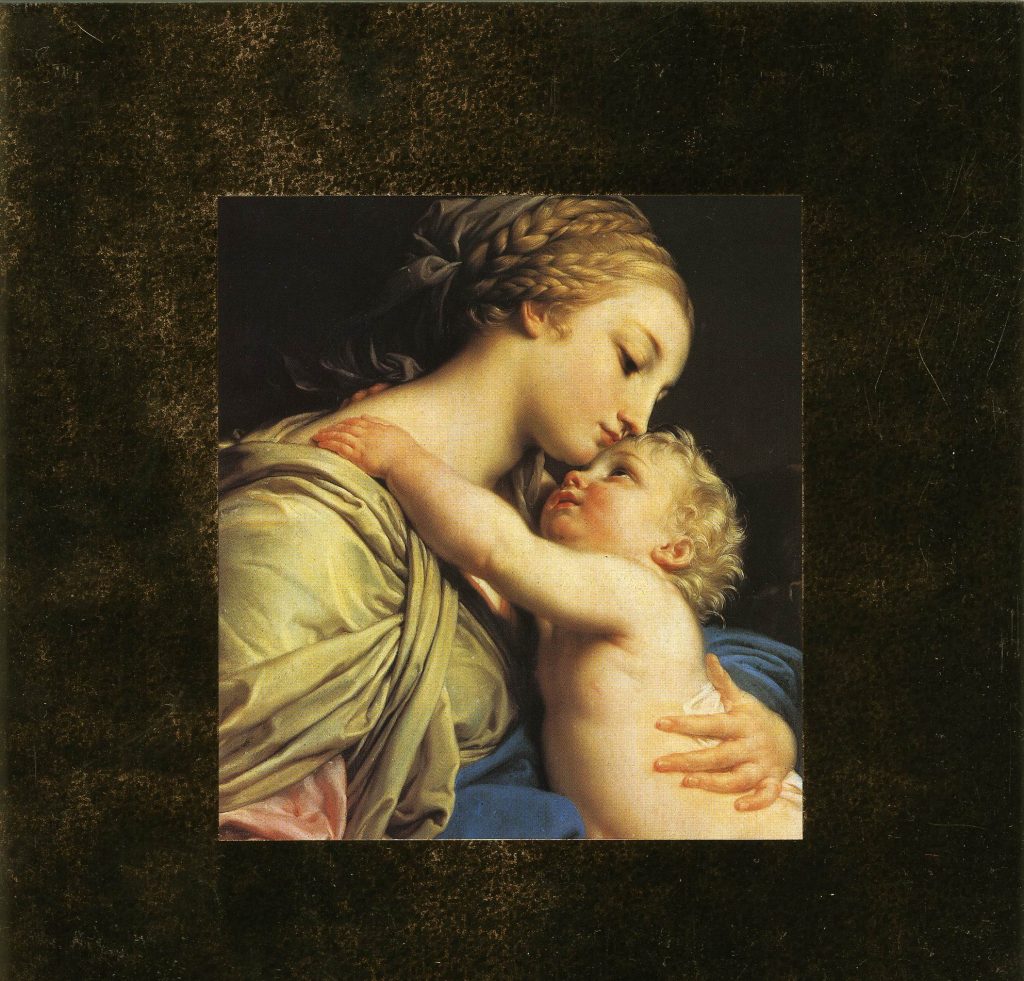
Virgin and Child (Image on a card of unknown origin) to illustrate Mothering Sunday or Mother’s Day
In 2026 Mothering Sunday is on March 15th. In 2027 it will be on March 7th. Strangely, originally not about Mothers! Mothering Sunday is the 4th Sunday in Lent. It is, in fact the day in which we are enjoined to visit our Mother Churches. It, therefore, became a day when people made processions to their Churches. Servants and workers could go to their home parishes. But not only go to the Mother Church but also to say hello to their mothers. So, it became increasingly about Mothers. It was called Mothering Sunday when I was little and has morphed into the Americanism that is Mother’s Day.
‘Rejoice ye with Jerusalem; and be ye glad for her, all ye that delight in her: exult and sing for joy with her, all ye that in sadness mourn for her; that ye may suck, and be satisfied with the breasts of her consolations.‘
Jerusalem is personified, here, as the Mother. Further associations with motherhood came from the Gospel for the day which is John 6:1–14, the story of the Feeding of the Five Thousand, which led to associations with the bounty of Mother Earth.
In the medieval period visits to the Mother Church seem to have become fiercely competitive. The Bishop of Lincoln, Robert Grosseteste decreed:
‘In each and every church you should strictly prohibit one parish from fighting with another over whose banners should come first in processions at the time of the annual visitation and veneration of the mother church. […] Those who dishonour their spiritual mother should not at all escape punishment, when those who dishonour their fleshly mothers are, in accordance with God’s law, cursed and punished with death.‘
(Letter 22.7 – Wikipedia)
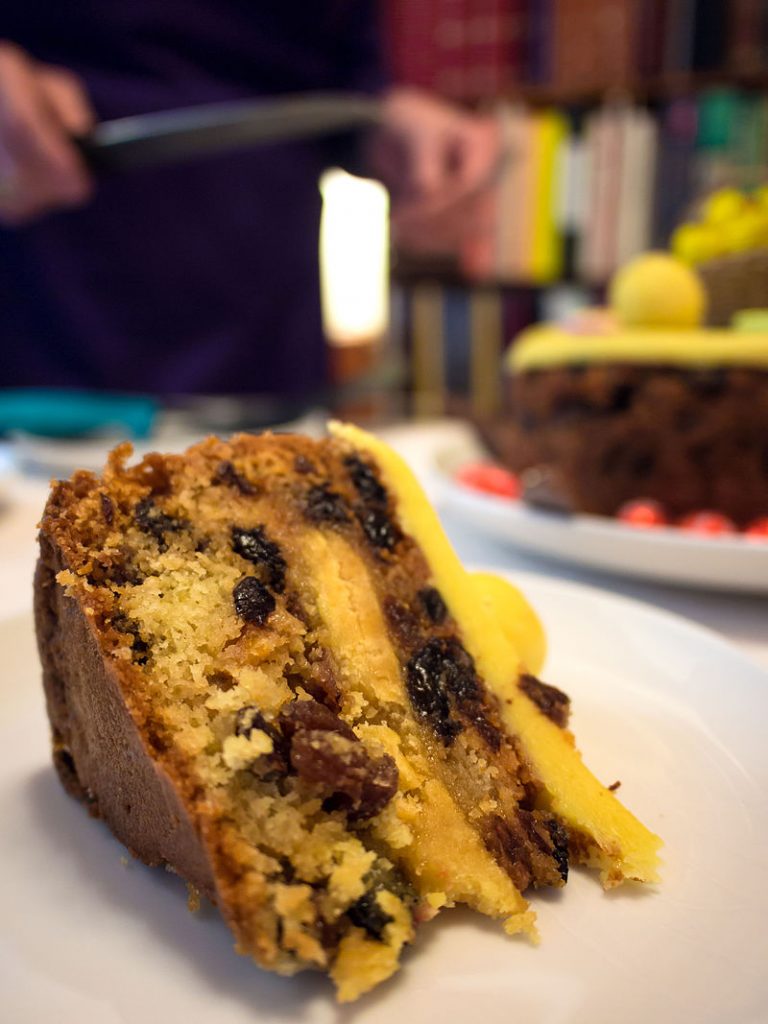
Simnel Cake
It was also the Sunday in the fasting period of Lent in which the restrictions were relaxed. So a special cake called Simnel Cake was made for the purpose.
I’ll to thee a Simnel bring ‘Gainst thou goest a-Mothering So that, when she blesseth thee Half that blessing thou’lt give me.
The Simnel cake is a fine flour light fruit cake (Latin simila, fine flour), with layers of marzipan in it. It often has 11 balls of marzipan on the top, representing the 11 (not Judas) apostles. The cake is first boiled for two hours and then baked. Now, I know 95% of my American readers hate fruit cake. But believe me when I tell you – change your ways – iI’s delicious. Try this BBC’s recipe: https://www.bbcgoodfood.com/recipes/easter-simnel-cake
And I’m beginning to see that cake is an emerging theme of this Almanac of the Past.
See my post on Chelsea Buns here; Lardy Cake and Doughnuts here.
Written in March 23, slightly revised in March 24, and 25, Revised 26