The anniversary was celebrated in London with bonfires and bell-ringing. Lighted fire-barrels were rolled along Cheapside. It was, in a way, the precursor to Guy Fawkes Day (1605 onwards). Protestants celebrated it with such joy as it was the end of the reign of Elizabeth’s sister, Queen Mary I. ‘Bloody’ Mary, as she was named by Protestants, was the daughter of Katherine of Aragon. Her Government had 287 Protestants burnt at the stake, mostly relatively ordinary people: clergy, apprentices, artisans, and agricultural workers. 60 were women; 67 were Londoners: the majority were of the younger generation, and most from the South East of England.
The executions were overwhelmingly unpopular, ghastly exhibitions of brutality. In 1555 the weather was unusually wet, so the burnings were an even slower form of torture. The savagery was blamed by the Protestants on the Old Religion and particular the Spaniards who came over with Mary’s Spanish husband. Ironically, Philip, in fact, urged caution. When Mary refused to be as lenient to religious dissidents as she was to political ones, he suggested the executions should, at least, be in private. She refused, as the immortal souls of the population were put at risk by Protestant dogma. So the public nature of the deaths was a justifiable deterrent.
When, three years later, in 1558, in the early hours of the 17th November (6am) Queen Mary died, London rejoiced. An old regime, a foreign regime, a Catholic regime was swept away by a young Queen (Elizabeth was 25), with a young Court sworn to protect the new Protestant religion. (For my post on the nicknames for her courtiers look here.)
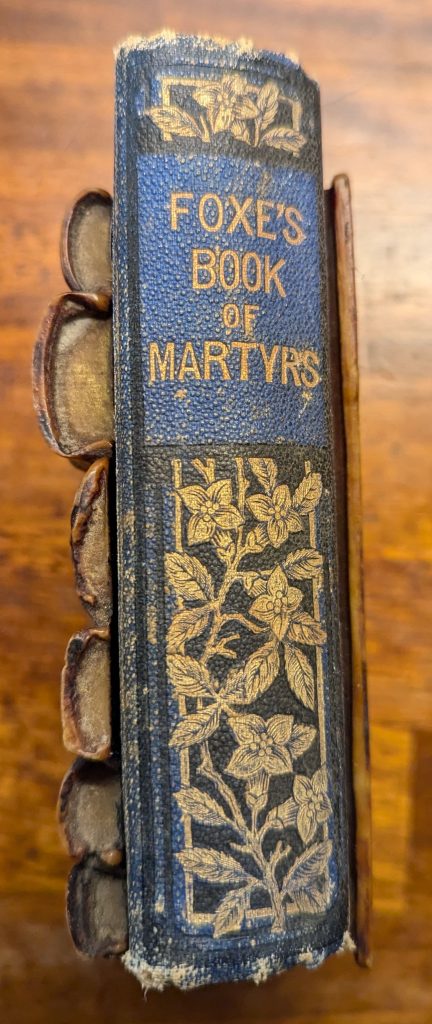
Soon, Foxe’s Book of Martyrs outsold all other books printed except the Bible, and enthusiasm for religious reform morphed into anti-Catholic intolerance.
The Author’s copy of Foxe’s Book of Martyrs
One of the martyrs in the book is Thomas Tomkins, a weaver and a Londoner from Shoreditch, a few hundred yards from where I live.
Tomkins was a humble but godly man who was kept imprisoned by Bishop Bonner, the Bishop of London, at his Palace at Fulham. Here he was beaten. The Bishop personally beat him around the face and ripped off part of his beard. The beatings continued for six months. Finally, exasperated at his failure to persuade the weaver of his error, Bonner burnt Tomkins hand with a lighted taper until ‘the veins shrunk and the sinews burst’. I assume Bonner would defend his action by saying he wanted to give the weaver Tomkins a foretaste not only of the burning he faced but of the very fires of Hell.
But nothing would avail; Tomkins, the simple man that he was, would not accept that bread was made into flesh. (Transubstantiation). He would not say that which he did not believe. So he met his end at Smithfield by fire with his bandaged hand in the reign of Queen Mary on 16th March 1555.
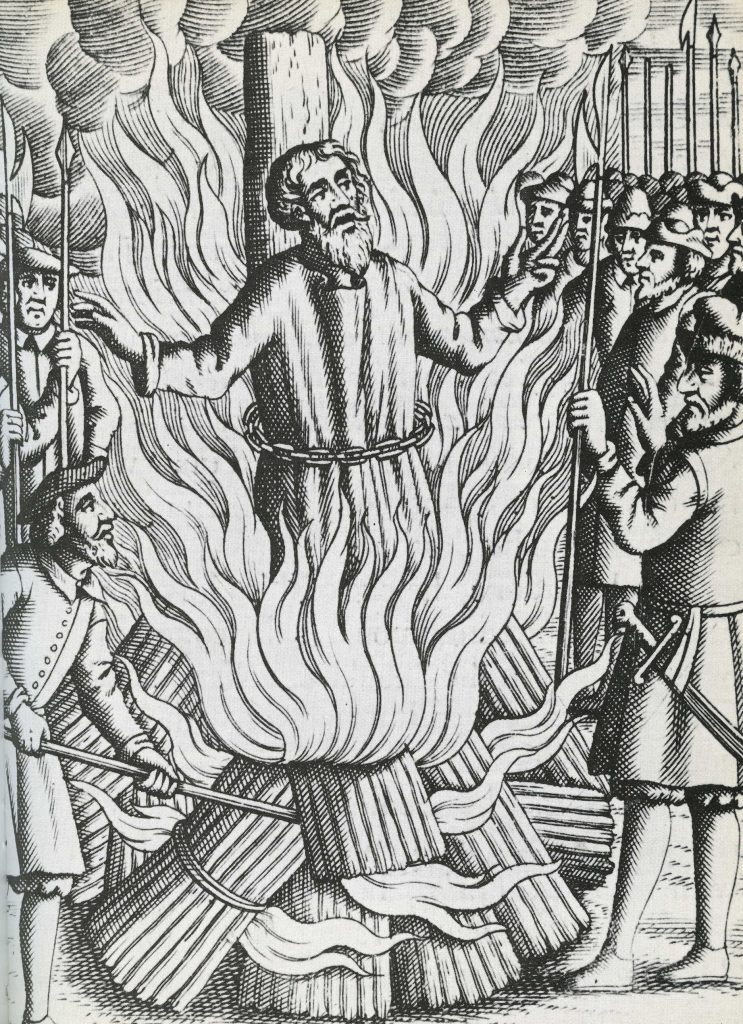
Thomas Bilney martyred in Smithfield.
First Published 17th November 2023, revised 2024,2025
Today, is the feast day of 158 English Martyrs from the English School at Douai. They were killed by the English state between 1577 and 1680.
On the accession of the Protestant Queen Elizabeth, Catholics who preferred exile gathered in Douai (125 Kilometres South of Calais). An English School was set up, which was in essence a Catholic Oxford College in Exile. Its mission became to train priests to re-enter England and minister to the many Catholics who wanted to continue to practice their faith despite official intolerance.
Catholic worshippers were fined if they did not attend Church of England services in their local churches. Catholic Priests re-entering England could be charged with High Treason and, if found guilty, hanged, drawn and quartered. This was often at Tyburn (at the west end of Oxford Street in London).
In the short reign of Mary I, nicknamed ‘Bloody Mary’, over 250 protestants were burned at the stake for heresy. In the long reign of her sister, Elizabeth I, over 300 Catholics were executed for Treason by being Hanged, Drawn and Quartered. Elizabeth is known as ‘Good Queen Bess’. There is no value in balancing evil, but pro-rata Mary’s reign was much more bloody. Elizabeth would probably also suggest that she did not execute Catholics because of their belief, but because the policy of the Catholic Church was to destroy Elizabeth’s regime. So, the Priests were not executed for heresy but for treason. However, this is a fine distinction to be made, in such horrendous blood-letting.
The number of martyrdoms from one institution shows incredible bravery in the face of intolerance, and the Douai Martyrs were a remarkable group of people. Most have been beatified by the church, some have been made ‘venerable’, twenty have been canonised. A few remain simply as ‘martyrs’
In London in Ely Place is St Etheldreda’s Church, which has memorials to Catholic Martyrs, and no mention of Protestant Martyrs. A few hundred yards away in Smithfield is a plaque to the Protestant Martyrs under Queen Mary and no mention of the Catholic Martyrs. Personally, I think it is about time the two traditions made it clear that both groups of martyrs are worthy of equal distinction, and the authorities who allowed such toxic intolerance to triumph deserve our contempt.
Two examples of martyrs in Smithfield:
John Forest, a Franciscan Monk was burnt at the stake at Smithfield and commemorated in St Etheldreda’s Church. He was Catherine of Aragon’s Confessor, and refused to accept King Henry VIII as head of the Church of England.
John Rogers was a scholar and worked to continue William Tyndale’s work in translating the bible into English. He was the Vicar of the Holy Sepulchre Church, which is halfway between Smithfield and St Etheldreda. He was the first person to be burned during Queen Mary I’s reign, and mentioned on the memorial in Smithfield.
Thanks to my friend Derek, who suggested I cover this topic. His children went to a school in London named after the 158 English Martyrs,
For a longer look at the Protestant Martyrs at Smithfield have a look at my post which deals with the martyrdom of Thomas Thompkins a simple honest man burnt at the stake.
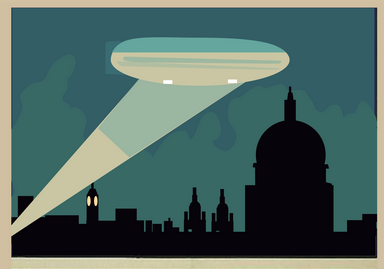
A silhouette of a Zeppelin caught in searchlights over the City of London
On the night of September 8th, 32 year old, Kapitanleutnant Heinrich Mathy piloted Zeppelin L 13 across Central London, dropping bombs as he went. This was the most damaging airship raid of the war.
Background to the War
Before World War One London was the centre of the largest Empire the world had ever known. It was the first great era of globalisation; international trade and finance was booming. London was full of the mega-rich, but poverty and substandard housing was extensive. Such extremes of rich and poor have only recently began to appear in our society.
Inner London was still the home of Industry, and home to large immigrant communities. Political dissent was widespread, with the Labour Party beginning to erode the Liberal Party’s power base. The issue of Female Suffrage was rocking society. Then, catastrophe struck as ‘the lights went out all over Europe’.
The Hague Convention in 1899 banned bombing from balloons or other aerial craft. But as the aircraft and air balloons developed, the threat moved from theoretical to actual. Zeppelins could undertake long flights at a speed of up to 47 mph. They could ascend and descend quicker than winged aircraft and achieve higher altitudes. The gas that held up the Zeppelins was held in over 200,000 bags of cattle intestines. The huge number needed in the war effort led to a shortage of sausages in Germany! But it also made them very difficult to be shot down with the technology available to Britain, France and Russia.
The Kaiser originally forbade bombing raids on London in deference to his relatives, the British Royal Family. But he progressively reduced restrictions until he allowed bombing of London itself. He first allowed bombing of the London docks on February 12th 1915, and on May 5th allowed London, East of the Tower of London to be bombed. The first Zeppelin raid on London took place on 31st May 1915. On July 20th, he allowed unrestricted bombing of London (albeit sparing historical and religious buildings).
On the 8th September, 1915 Mathy crossed the North Sea to the coast at King’s Lyne. He arrived at 8.45pm. The aircraft came South via Cambridge, Ware, circled to the North East of London and via Golders Green. Here he dropped 12 bombs at 10.40., and followed the Finchley Road to Primrose Hill, Regent’s Park. Over Euston he was at 8,500 ft, and slowed down to 37 mph.
The first incendiary bomb in Central London landed just north of Russell Square at Woburn Place. The next one landed in the garden in the middle of Russell Sq. He dropped his first Central London explosive bomb in the garden in the centre of Queen’s Square, near the Great Ormond St Hospital, where it is marked with a plaque. He was turning east along the Theobald’s Road where he dropped a number of bombs. One hitting the National Penny Bank killing a person standing outside. Another landed on the nearby Dolphin pub, blowing out the front of the pub and killing someone standing there. If you visit the Pub, on the wall you will see the clock that was stopped when the bomb exploded (10:40pm).
The next strike was on a cycle club, to the West of Gray’s inn. Then Gray’s Inn itself. At Portpool Lane his incendiary bombs killed three children and injured 25 others.
Maxim Gun
Near here are the workshops where Hiram Maxim developed the Maxim Gun that killed so many in the trenches in WW1. Unfortunately, the design was not kept as a state secret and in the War No Man’s Land was being strafed by British, French, German, Russian and later in American versions of the same gun. He had the idea for it when as a child his shoulder was broken by the recoil of a shotgun. He realised that the recoil could be used to load the next bullet. This created a machine gun that was far superior to the Gatling Gun.
A Bomb called the Love Gift
Hatton Garden and Farringdon were also hit, and the Zeppelin continued to Smithfield. The Zeppelin had one 660 lb bomb on board. Mathy’s ‘Love Gift’ fell on St Bartholomew’s Close. It shattered all the building fronts and killed 2 men running for cover when they emerged from a pub.
The Zeppelin kept north of St Paul’s and next bombed City workshops and warehouses in Wood St, Addle St, Basinghall St and Aldermanbury – just missing the historic Guildhall. He also failed to bomb the Bank of England which was a mere 300 yards south,
Searchlights were now scouring the sky and anti-aircraft guns were firing, but they were ;all firing too low’. An American reporter, William Shepherd wrote:
‘Among the autumn stars floats a long gaunt Zeppelin. It is dull yellow – the colour of the Harvest Moon. The long fingers of searchlights, reaching up from the roofs of the city are touching all sides of the death messenger with their white tips. Great, booming sounds shake the city. They are Zeppelin bombs falling- killing – burning. Lesser noises – of shooting – are nearer at hand, the noise of aerial guns sending shrapnel into the sky.’
The final bombs were released over Liverpool Street. Just by the station, an explosive bomb hit a No 35a bus, wounding the driver and killing the conductor and some of the passengers. Another bomb landed by a No 8 bus, killing the driver and 8 passengers.
Mathy turned north towards Edmonton and climbed to over 11,000 ft as an anti-aircraft gun on Parliament Hill put a shell uncomfortably close to the Zeppelin. He returned safely to Germany where he reported to the Kaiser. The raid killed 17 people, injured 78 and caused half a million pounds worth of damage. It was the most effective raid of the war.
The authorities in Britain were faced with a stark reality which was that a single German Airship could fly through the heart of Britain, into its Capital and bomb its people without any defensive measures capable of resisting attack. Although when we consider the horrors of civilian deaths in the 20th and 21st Centuries, the shock of random attacks on civilians should not be underestimated.
I will conclude Kapitanleutnant Heinrich Mathy’s story on October 1st, and add more images to this page.
Thanks to Ian Castle and his book ‘London 1914-17 ‘The Zeppelin Menace.
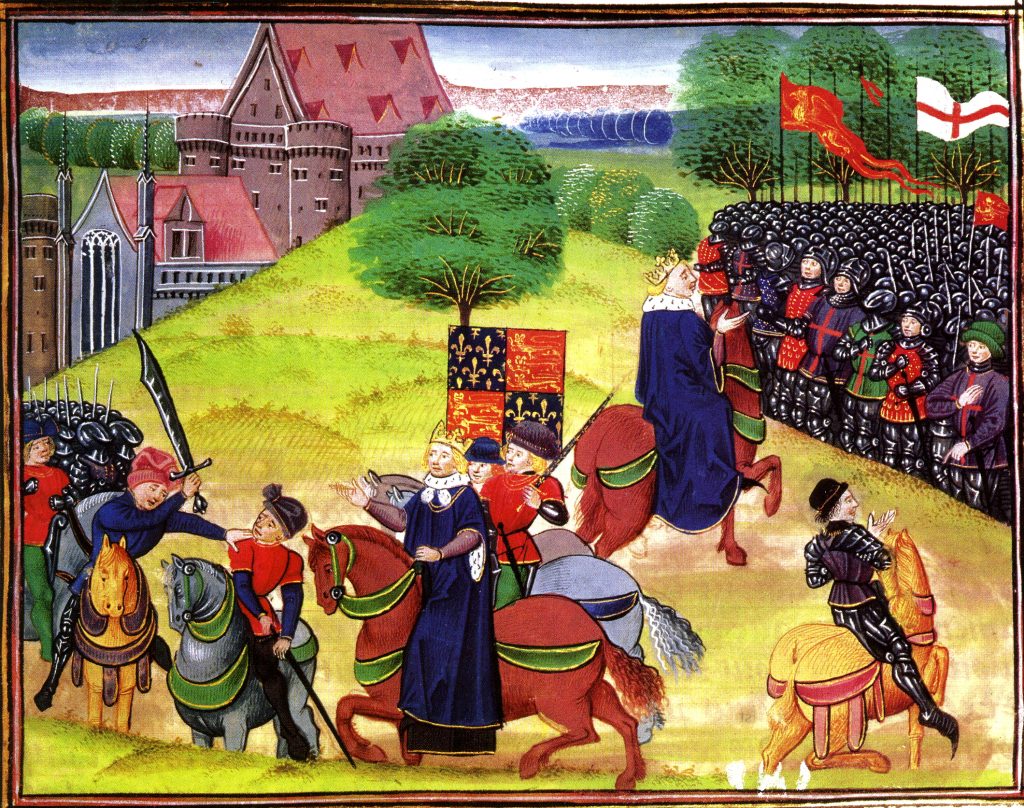
Smithfield & the Peasants’ Revolt. illustration from ‘Chroniques de France et d’Angleterre’, by Jean Froissart, c.1460-80. Walworth is showing killing Wat Tyler, King Richard is shown twice, first watching the death of Tyler, and secondly taking control of the Rebels
On the 15th June, King Richard went to pray at Westminster Abbey before the climax of Smithfield & the Peasants’ Revolt. He prayed at the shrine of St Edward the Confessor. A King who knew all about the sins Kings are forced to commit to rule an unruly Kingdom and could intercede on the King’s behalf in Heaven
The Peasants’ met at Smithfield, or maybe they had camped out there overnight. It was a big field where the livestock market was held. And where people were executed. Most famously Scottish patriot, William Wallace, who was hanged, drawn and quartered here on 23 August 1305. It was also used for jousting, and one of the streets off Smithfield is called GiltSpur Street.
The King, Smithfield and the Peasants’ Revolt
The King had agreed to meet the Peasants again. We don’t know how that was organised. The King turned up supported by a group of men who included members of the City of London Corporation including the Lord Mayor, Fishmonger, William Walworth. They seem to have worn armour under their clothes. The King’s Party lined up in front of St Bartholomew’s the Great Priory.
The rebels were on the other side of the field, presumably armed with the weapons and armour they had plundered from the Tower of London. It is not clear exactly what happened, and the sources are prejudiced against the rebels.
The Rebels demands were: the abolition of all Lords except the King; all bishops except the Archbishop; all monasteries except the Friaries and the replacement of the false House of Commons, with the True House of Commons.
Wat Tyler rode towards the King’s party. Got off his pony, spat out the wine he had been drinking, and ‘Hailed, Brother’ slapping the King on the shoulder. This was not normal court etiquette.
One of the King’s party shouted at Tyler that he was a thief and a murderer. Tyler drew his sword, and William Walworth struck him down, mortally wounding him.
Commentators speculate that this might have been part of a plan. To arrive seemingly without armour, to provoke a crisis, and disrupt the rebels.
The City’s part in the events in Smithfield is fascinating. City Merchants were not generally fighting men, but they seem to be the active group the King could rely on. Interestingly, there is no evidence that the Rebels attacked the Guildhall and destroyed the legal records. They attacked most important legal institutions in London, in the days before Smithfield. So why no attack on the Guildhall?
This surely must be because the Guildhall was protected by a competent military force. And it seems these are the same people who took on and defeated Wat Tyler.
In Smithfield, the Rebels didn’t know what to do. Is it possible the King’s party shielded the murder of Tyler behind a screen of people? So they didn’t know what happened and therefore didn’t know what to do?
For surely this was a moment of true danger. The Rebels would have had hundreds if not thousands in Smithfield, some at least well armed. Some must have been archers who would have been deadly. This is not that long after the Battles of Crecy and Poitiers, where the flower of the French Nobility was killed by the English Archers. Archers were normally rank and file soldiers, exactly the class of people supporting the Rebellion. Tyler was taken to St Bartholomew’s Hospital, where he died of his wounds.
In the moment of crisis, the King is said to have ridden forward on his horse and told the Rebels:
‘I will be your leader.’
And then he led them, like the Pied Piper of Hamlin, to their destruction.
He led them out of Smithfield into the field surrounding and told them they had their Charters so it was time to go home. And mostly they did.