Wife-Selling & the bonds of Marriage October 1837

October 1837, Wolverhampton Chronicle. A case of wife-selling

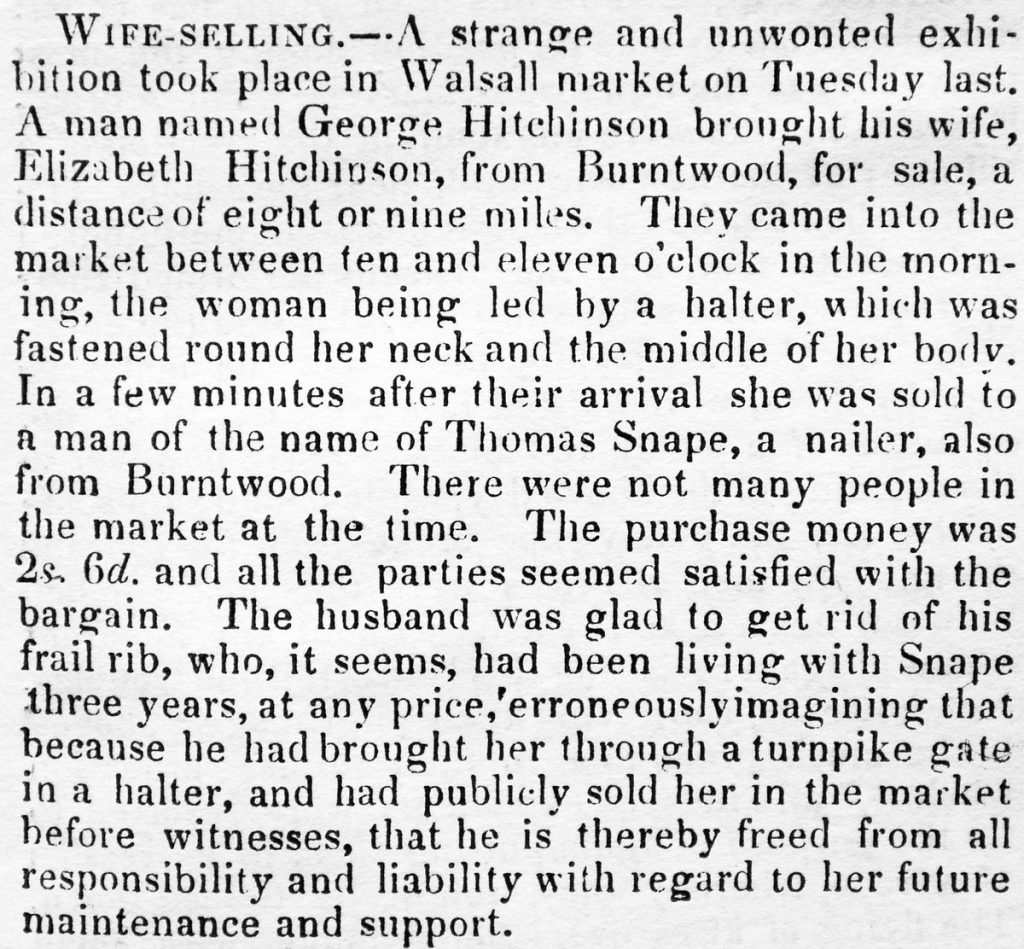
A strange and unwonted exhibition took place in Walsall market on Tuesday last,” the Wolverhampton Chronicle said about a case of wife-selling.

“A man named George Hitchinson brought his wife, Elizabeth Hitchinson, from Burntwood, for sale, a distance of eight or nine miles. They came into the market between ten and eleven o’clock in the morning, the woman being led by a halter, which was fastened round her neck and the middle of her body. “

“In a few minutes after their arrival she was sold to a man of the name of Thomas Snape, a nailer, also from Burntwood. There were not many people in the market at the time. “

“The purchase money was 2s 6d [about 13p today] and all the parties seemed satisfied with the bargain. The husband was glad to get rid of his frail rib, who, it seems, had been living with Snape three years, at any price, erroneously imagining that because he had brought her through a turnpike gate in a halter, and had publicly sold her in the market before witnesses, that he is thereby freed from all responsibility and liability with regard to her future maintenance and support.”

Wife-selling and the Mayor of Casterbridge

Readers will note the similarity of this to the plot of the Mayor of Casterbridge by Thomas Hardy, published in 1886. Michael Henchard, gets drunk on spiked Furmity. This is also known as frumenty – a mixture of Corn, milk, raisins and currents. The Furmity Woman at Weydon-Priors Fair adds Rum. Henchard, in a drunken rage, offers his wife for safe. She is purchased by Richard Newson, a sailor who goes on to have a successful relationship with Henchard’s wife until the sailor is drowned.

A cruel humiliation or a practical solution?

While not exactly legal, records show that wife-selling at markets happened occasionally from the 17th Century onwards. As in the case at Walsall Market, it seems to have been a recognised mechanism to end an unsuccessful marriage. In both factual and fictional cases, the wife accepts the sale to rid herself of a difficult husband. The husband is relieved of his lifelong duty to be financially responsible for his wife, and, for a fee, he passes that duty on to the buyer.

The sale seems to a modern onlooker to be a humiliation. But the public nature of it might be rather a public acknowledgement that the marriage has irrevocably broken down, and that another union has superseded the failed marriage. In the Walsall case, the new husband has, in fact, been living with the wife for some years.

At this time, there was no legal way to divorce except by the means of an expensive private Act of Parliament, far beyond the reach of any but the richest. Marriage itself was also a looser institution than we think. Hand-fasting and common-law marriages were very common in pre-Victorian times. The difficulty of divorce is also a theme in Hardy’s ‘The Woodlanders’.

A recipe for frumenty:

To make a rich frumenty for 10 people. Steep 1 lb of whole grain of wheat in water overnight, and then boil the steeped grains in one pint of milk until the whole be soft. Add thereto raisins and sultanas, honey a nutmeg freshly grated, a little cinnamon, brandy and cream: and serve it forty hot or cold.

Mistress Bartons Cookery book c1680. quoted in Charles Kightly’s Perpetual Almanac of Folklore

You might like to also see my post on the shaming skimmity ride, which also appears in the Mayor of Casterbridge.

On This Day

1415 St Crispin’s Day and the Battle of Agincourt.

This is part of the famous speech by Henry V, put in his mouth by William Shakespeare.


He that outlives this day, and comes safe home,
Will stand a tip-toe when this day is nam’d,
And rouse him at the name of Crispian.
He that shall live this day, and see old age,
Will yearly on the vigil feast his neighbours,
And say “To-morrow is Saint Crispian.”
Then will he strip his sleeve and show his scars,
And say “These wounds I had on Crispin’s day.”
Old men forget; yet all shall be forgot,
But he’ll remember, with advantages,
What feats he did that day. Then shall our names,
Familiar in his mouth as household words—
Harry the King, Bedford and Exeter,
Warwick and Talbot, Salisbury and Gloucester
Be in their flowing cups freshly rememb’red.
This story shall the good man teach his son;
And Crispin Crispian shall ne’er go by,
From this day to the ending of the world,
But we in it shall be rememberèd—
We few, we happy few, we band of brothers;
For he to-day that sheds his blood with me
Shall be my brother; be he ne’er so vile,
This day shall gentle his condition;
And gentlemen in England now a-bed
Shall think themselves accurs’d they were not here,
And hold their manhoods cheap whiles any speaks
That fought with us upon Saint Crispin’s day.

First published in July 2022, revised and reposted October 2024 and 2025

Forecasting the Harvest & the Downfall of the Mayor of Casterbridge. St Swithun’s Day July 15th

Harvest on St Swithun’s Day Photo by David Becker on Unsplash

St. Swithun’s day if thou dost rain
For forty days it will remain
St. Swithun’s day if thou be fair
For forty days ’twill rain nae mare

It’s not just important for the farmer but, even more, for the corn factor, to get the weather right for harvest. So, this bit of weather lore, repeated every year in the media could be important. But the BBC tells us that, since records have been kept (1841) there has been no period of 40 days rain after St Swithuns Day. However, there is some suggestion of a period of stable weather from mid july to the end of August. But, generally, a lot of old nonsense.

St. Swithun was Bishop of Winchester from his consecration on 30 October 852 until his death on 2 July. And very little else is known about him. However, he is the patron Saint of Winchester, and has powers against Drought.

Weather Forecasting and Thomas Hardy

The price of corn is very dependent upon the weather. Michael Henchard in Thomas Hardy’s 1886 novel ‘The Mayor of Casterbridge’ has formed a terrible rivalry with his erstwhile friend Donald Fafrae.  He is determined to outdo him in the Casterbridge Cornmarket. He has a hunch about the weather and the price of corn, but needs reassurances. So despite his doubts about the efficacy of prophecy he goes to see ‘a man of curious repute as a forecaster or weather-prophet.’ Henchard is shrouded to protect his identify. He will not stay to take hospitality from the prophet, nor cross the threshold. He masks his face with a handkerchief, as if suffering from a toothache.

However, the prophet knows this strange man is the former Mayor of Casterbridge, much to Henchard’s surprise. Henchard quizzes him. ‘can ye charm away warts?’ ‘Cure the evil?’ ‘Forecast the weather?’ Replying in the affirmative the cunning man takes Henchard’s crown piece and forecasts:

By the sun, moon, and stars, by the clouds, the winds, the trees, and grass, the candle-flame and swallows, the smell of the herbs; likewise by the cats eyes, the ravens, the leeches, the spiders, and the dungmixen, the last fortnight in August will be – rain and tempest.’ ‘Twill be more like living in Revelations this autumn that in England.’

Henchard buys up grain at the current high price. But is ruined by the fine weather that sets in for an excellent harvest which sends corn prices tumbling.

The Withered Arm

Local folklore was at the heart of many of Hardy’s stories. Perhaps the most dramatic is the ‘Withered Arm’. Gertrude has a withered arm wished upon her by the former lover of her husband, with whom she has an illegitimate boy.

Years pass, and she is still determined to cure her arm. She visits a Casterbridge Cunning Man. He tells her the only cure is to touch the neck of a recently hanged man. So she goes to Casterbridge on a Hanging Day. She makes arrangements with the hangman. Then she touches the neck of the hanged man. There follows an immediate cure. She cannot resist looking at the victim. A young man she recognises as the illegitimate son of her husband.

I first read these stories one after another at a time I was going through a painful period in my life. I remember throwing the ‘Withered Arm’ at the wall shouting ‘Oh Thomas Hardy’ you miserable man.’ It took me twenty years to come back to him, to appreciate his amazing descriptions of life in rural Wessex. The cast of characters struggling to make a place for themselves in a world that was changing beyond all recognition.

For more about Thomas Hardy search the Almanac of the Past for Thomas Hardy, or look at the Skimmity Ride.

On this day

1381 John Ball executed in St Alabans

First Published in 2022, revised July 2024, 2025

The Skimmity Ride

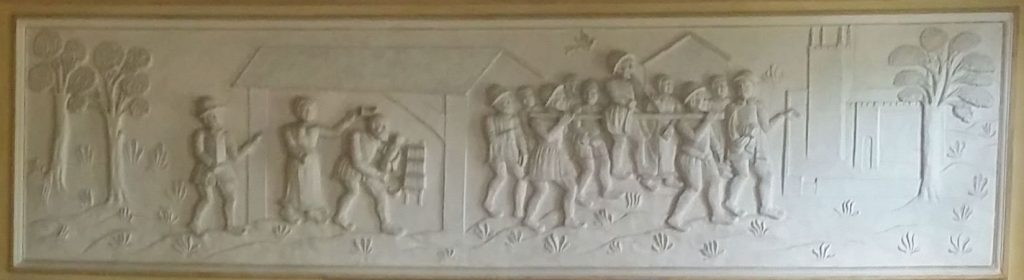
Skimmity Ride. Montecute House . Early 17th Century Plaster decoration

On June 2nd 1840, Thomas Hardy was born. He died on January 11th 1928. In January 1886 serialisation of the Mayor Casterbridge began. I wrote in a previous post about the custom of Wife-Selling which is the main plot driver of the book. In this book I want to look another folk custom which brings the erstwhile Mayor to the brink of suicide. This was the Skimmity Ride, or Skimmington Ride.

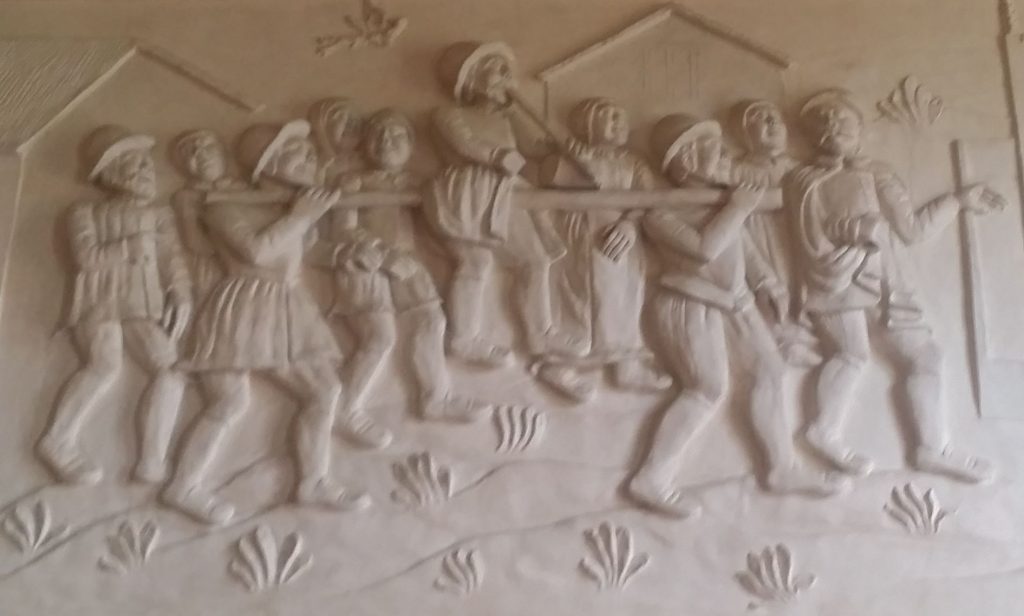
The ride, which has deep roots in history, was designed to humiliate a member of the community and it consisted of a procession through the streets of the community with music or at least percussion instruments. Those being mocked, or an effigy of them or a local dressed up to look like them rode a horse or donkey or sat on a pole.

The illustration above is from the early 17th Century. It is in Montecute House, in Somerset above one end of the Great Hall of Sir Edward Phelips, who rose to the top of the legal profession becoming Master of the Rolls. And yet he choose to have a representation of popular justice in this prestigious part of his house. ( more information here)

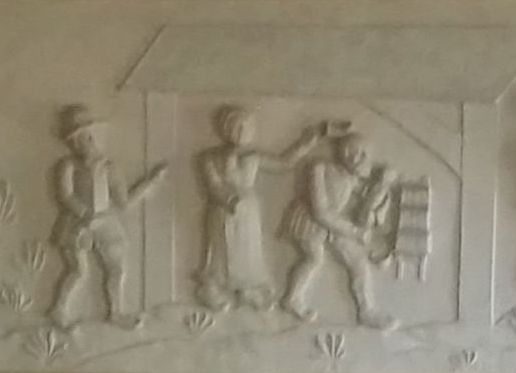
The ‘offence’ is seen on the left – a neighbour sees the wife hit her husband over his head with a clog while he is trying to get a drink of beer at the same time as holding the swaddled baby. They live in a simple thatched cottage.

The normal interpretation is that she is ruling the roost and taking over the man’s role. It is he who is being punished for losing control to his wife and he is seen ‘riding the stang’, or pole either in person, or in effigy, or played by a stand-in. It would be nicer to think he is being punished for being drunk in charge of a child. The Skimmity Ride is heading from the couple’s home to the Church, and thus shown as involving the entire community.

Detail of the Skimmity Ride

In the fictional ‘Mayor of Casterbridge’ skimmity ride effigies of the ex-Mayor and his lover, Lucetta Le Sueur, are tied back to back on a donkey and paraded through Casterbridge. She has just married the Mayor’s rival and on seeing the skimmity ride has a seizure which kills her. Henchard, full of remorse, decides to kill himself in the local river, but as he looks down into Ten Hatches Hole he sees an image of himself which stops him jumping in. It turns out to be his Skimmity effigy but he, none-the-less, sees it as divine intervention.

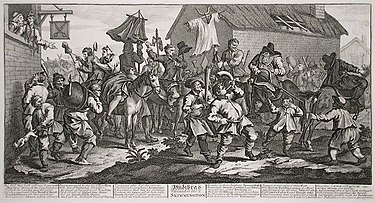
William Hogarth also portrays a Skimmington Ride in his illustration for Samuel Butler’s ‘Hudibras’. It illustrates the cacophonous nature of the Skimmington with horns and percussion the main forms of ‘music’.

William Hogarth. ‘Hudibras_Encounters the Skimmington’

You might also like Cunning Men in Thomas Hardy’s fiction.

Published in 2022, and revised in 2026.