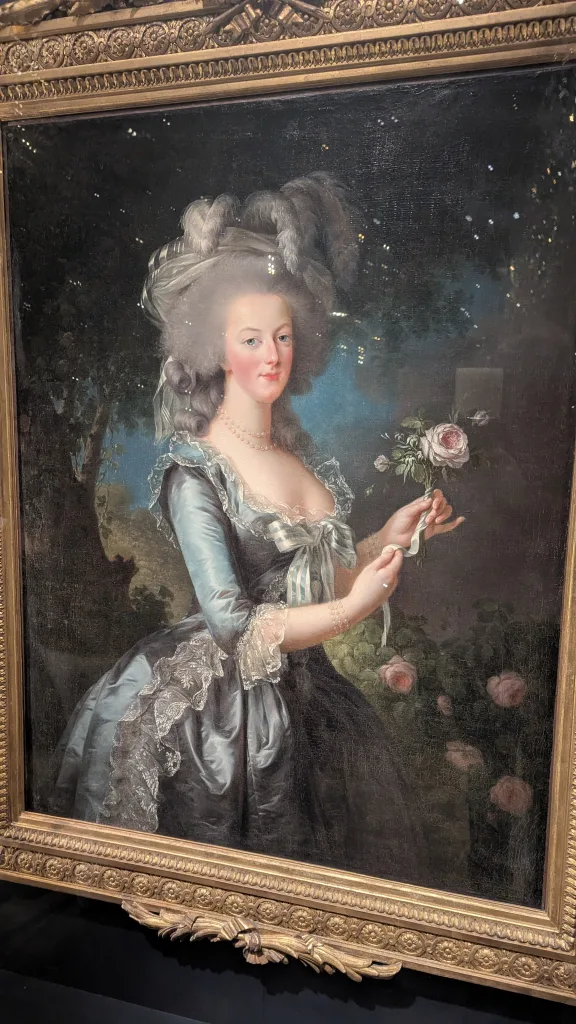
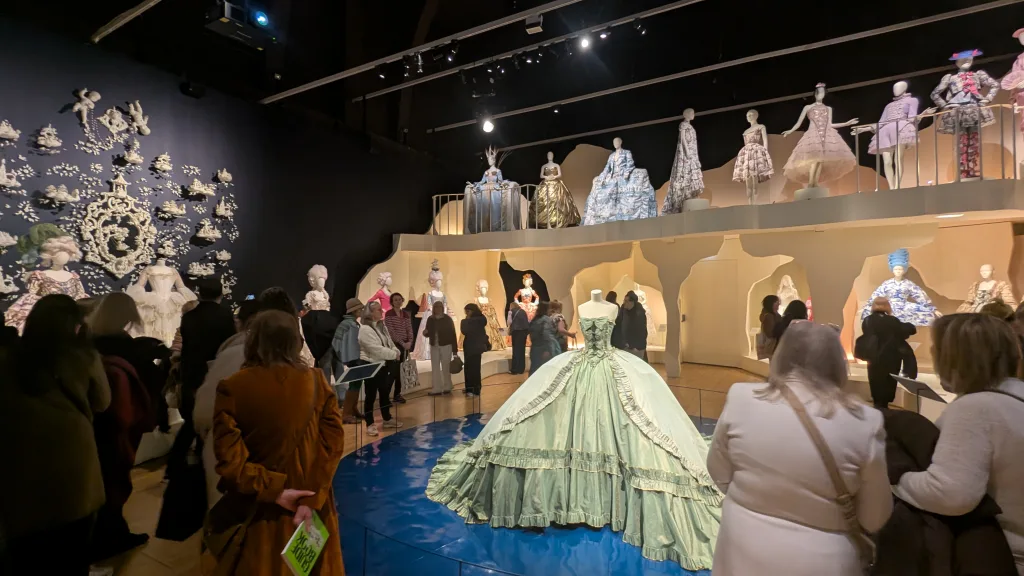
Marie Antoinette was about 28 when this portrait was made, She was about 10 years from her death by guillotine. The painting featured in the V&A’s exhibition about the Queen of France which has just finished. It was not my favourite V&A block-buster exhibition. I think mainly because I came out not knowing very much more about Marie, than when I went it. But I had seen countless extravagant dresses. Yes, she commissioned a lot of dresses, and as patron and model influenced French fashion. And, yes, she wasn’t the air-head of the ‘let them eat cake’ version of history. But I’m not much the wiser.
I’m more interested in the painter, Élisabeth Vigée Le Brun. This is what Wikipedia says about her:
‘She enjoyed the patronage of European aristocrats, actors, and writers, and was elected to art academies in ten cities. Some famous contemporary artists, such as Joshua Reynolds, viewed her as one of the greatest portraitists of her time, comparing her with the old Dutch masters.’
And I have never heard of her, I’m fairly sure nor have you! You might like to see my post on 17th female painter Mary Beale. My original shortlist for Object of the Day were these two items from the Exhibition:
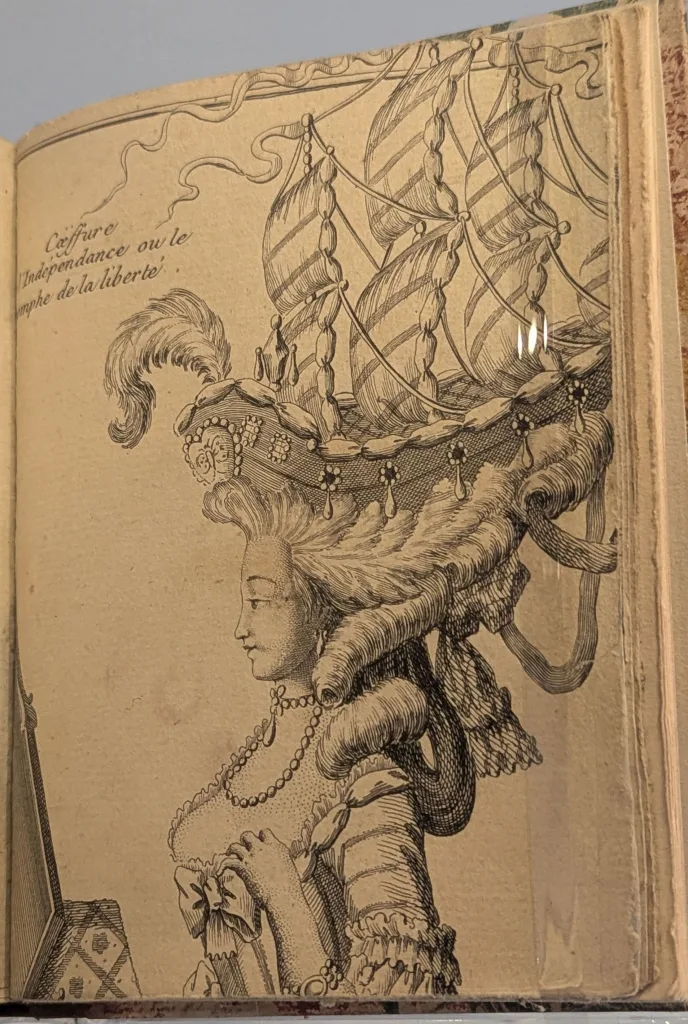
Guilotine blade from the French Revolution, purchased by the sons of Madame Tussaud as the blade that killed Marie Antoinette. Photo Kevin FludeSketch of the Triumph of Liberty Hairdress, associated with Marie Antoinette. It is her most famous headress. Created to celebrate the victory of the French over the British Navy in the American War of Independence.
Both these objects did no favours to the Queen’s neck! And lastly, those a few of those dresses:
Centre piece of the V&A exhibition on Marie Antoinette, photo K Flude.
The Stormy Borrowing Days of March
Sir Walter Scott recorded that ‘the last three days of March are called the borrowing days; for as they are remarked to be unusually stormy, it is feigned that March has borrowed them from April to extend his sphere of his rougher sway.’
There are various traditions and poems that record the borrowing days, and this is in the Scotch dialect:
March borrowed from April Three Days, and they were ill: The first was frost, the second was snaw, The third was cauld as ever’t could blaw.
The Borrowing Days in Spain
There is a Spanish story which explains this a little more. A shepherd asked March to calm the winds to suit his flock of sheep, in return for a lamb. March compiled but, then, the Shepherd refused to hand over the lamb. So, March borrowed three days from April and made them fierce and stormy. Versions of this tale are known from Staffordshire, North England and Scotland. (Source ‘Weather Law’ by Richard Inwards 1994 (first published 1893).
Warm days at the end of March or the beginning of April bring the Blackthorns into bloom. This can be followed by a cold snap which is known as a ‘Blackthorn Winter.’
February 2023 in Haggerston Park, London showing early blossom (Blackthorn?) Photo K Flude
For more on blossom and Haggerston Park follow my link to haggerston-park/
On This Day.
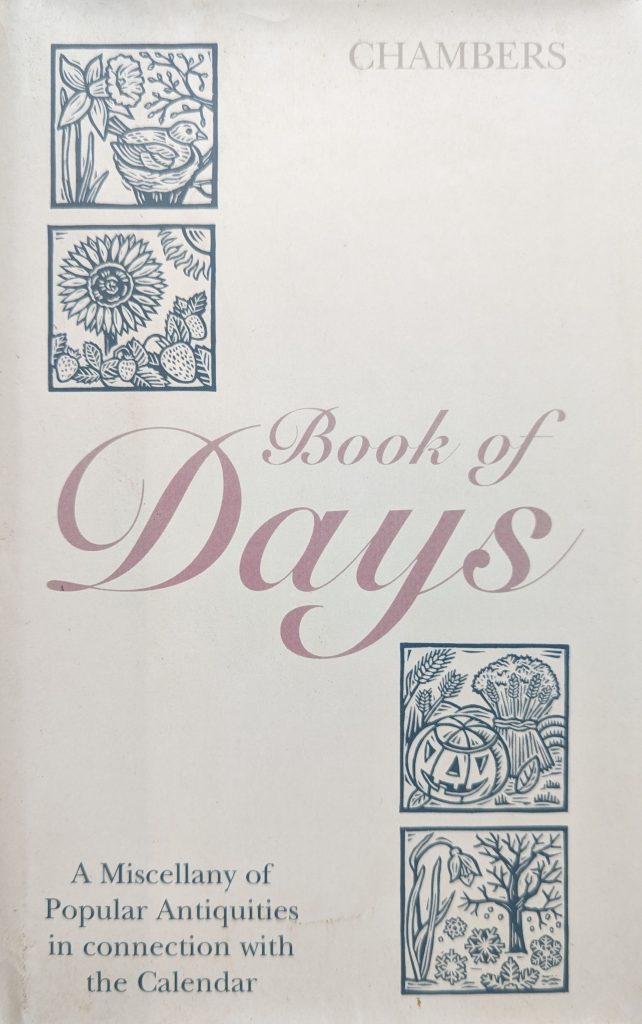
Photo of cover of Chambers Book of Days
2024– I purchased the Chamber’s Book of Days, updated from the original 1864 publication, and began adding occasional ‘On This Day’ epilogues to my posts.
1461– The Battle of Towton, England’s bloodiest battle, in which Edward IV defeated the Lancastrian forces of Queen Margaret, thus securing the throne for the Yorkists. Margaret, her husband, Henry VI, and son, fled to Scotland.
1871 – Official Opening of the Royal Albert Hall
1912 – Captain Scott’slast entry in his diary.
‘We shall stick it out to the end, but we are getting weaker, of course, and the end cannot be far, It seems a pity, but I do not think I can write more.’
The expression ‘Mad as a March Hare’ comes from the displays of hare boxing that takes place as the Hare mating season begins. And no, it’s not the male March Hare fighting in the spirit of romantic rivalry. It is the female hares fighting off unwanted attention from the males. Hares are solitary creatures, and the mating season is, perhaps, particularly difficult for them. The Country File website has more on the subject. www.countryfile.com
Not only March Hares but March Kittens too
There are also March Kittens and March Chickens. Edward Topsell in his ‘History of Four-footed Beasts‘ 1607 says the best Kittens to keep are those born in March. ‘The Closet of Sir Kenelm Digby Opened‘ 1669 says:
‘Keep a black cock hatched in March as a protection against evil spirits: his crowing terrifies them.’
He also gives a recipe for Cock Ale:
Eight gallons of Ale, a boiled March Cock, four pounds of stoned Raisins, half a pound of dates, nutmegs, mace. Beat the ingredients in a mortar, add to two quarts of Sherry. Add to the ale. Stop it in a container for 6 or 7 days. Bottle it, drink after a month.
Very weird. I challenge my readers to try it and let me know how it goes?
Was the March Hare Sacred?
But it’s not only March Hares because the hare itself was a sacred animal. It was sacred to Aphrodite because of their prodigious ability to have offspring:
‘For you know, I imagine, what is said of the hare, that it possesses the gift of Aphrodite to an unusual degree. At any rate it is said of the female that while she suckles the young she has borne, she bears another litter to share the same milk; forthwith she conceives again, nor is there any time at all when she is not carrying young.’
Classical Texts Library. Philostratus the Elder, ‘Imagines’ Book 1.1-15 c 3rd Century AD. Translated by Arthur Fairbanks.
Divine Celtic & Neolithic Hares
Research reported by Exeter University suggests that hares were worshipped in pre-Roman Britain. Julius Caesar wrote:
“The Britons consider it contrary to divine law to eat the hare, the chicken, or the goose.”
‘The Battle for Gaul’ Translation by Wiseman, Anne, Wiseman, T. P. Published by Penguin Random House, 1980 ISBN 10: 0701125047 (TP Wiseman was my professor for Classical Studies at Leicester University).
Hares are thought to be the original Easter Bunny. But finding good evidence before Germany in the early modern period is difficult. There is a tradition that witches can be scared away at Easter. Exactly, how this works is not at all clear to me. But it has been said that witches could take on the form of a hare. So eating Hare Pie at Easter helps rid the land of the witches.
Jugged Hares
You could have a jugged hare. Jugging is cooking a whole animal in a container over water. Follow this link for a recipe for jugged wild hare. Remember, you are not allowed to shot or trap them on a Sunday or on Christmas Day! For a discussion of hares and folklore, click here:
Hare’s Feet Totems
A jointed hare’s foot was considered very lucky and a remedy against gout, stomach pains and insomnia. (The Perpetual Almanack of Folklore by Charles Kightly, which I have used several times in this piece.) You can buy one on eBay. (Don’t click the links, it’s not an advert but a picture of an advert). I remember friends having rabbit feet which they carried around with them for luck. The foot would often be on a key rings.
Georgiana, Duchess of Devonshire (Johann Heinrich Hurter after Angelica Kaufman). Photo by K Flude of the miniature at the Victoria and Albert Museum
The Gilbert Collection has been re-displayed in the V&A in London. It has just opened, and is one of the most opulent displays you could hope to see! But, I loved this miniature of Georgiana. She was one of the richest women in Britain, a compulsive gambler, and a powerful political force for the Whig Party. And despite the Georgian Hairstyle the artist has contrived to make a very down to earth portrait. I can imagine bumping into her at the local Overground Station! She became better known after the bio graphy by Amanda Foreman, followed by the Film starring Keira Knightly. The Museum label says the portrait is ‘after Angelica Kaufman’. But I cannot find a Kaufman of Georgiana, that has this charming informality.
I have just heard news that the Arts Council wants to charge overseas visitors to visit our wonderful free national Museums, while allowing British Citizens free entry. Now, there are lots of arguments to be made about it, particularly in a time where money is in short supply. But, one result will be longer waits to get into Museums and Galleries. I am not sure how we Brits, are going to be asked to prove our nationality. If they have to inspect our Electricity Bills, Drivers Licenses, Passports, Library Cards, or Bank Statements, expect chaos.
One more object from the Collection is made of minature mosaics, and the V&A has several, But I have chosen this fabulous image of the Colosseum in Rome:
Colosseum by Domenico Moglia c1851
First published March 28th 2023, revised 2024, 2025. 2026 Object of the Day added and post revised 2026
For March 6th, Ovid in his Almanac Poem called ‘Fasti’ (Book III: March 6) tells the story of Vesta. She is Hestria, in Greece and is depicted on the Parthenon Marbles, standing near Zeus and Athene. She was the Goddess of the Hearth, of the fire that keeps families warm, and fed. Vesta had 6 Virgins as her Priestesses. They had to remain 30 years, from before puberty, as a virgin. The punishment for breaking their vows was to be buried alive. Any partners in sin were beaten to death. At the end of their term they could marry, retire, or renew their vows. That suggests they would be late 30s, early 40s before they could be released
The Vestal Virgins tended Vesta’s hearth. It was not supposed to go out as it had, in theory, come from Troy with Aeneas. Vesta’s Temple also housed the Palladium. This was a wooden status of Pallas Athene, that kept Troy, then Rome free from invasion. Odysseus and Diomedes had stolen it just before the Trojan Horse episode ended the 10-year-long Trojan War. (To read more about palladiums, look at my post here.)
The Temple of Vesta was in Rome’s Forum, and it was a circular temple or a Tholos. Next to the Sacred Shrine at Bath was a circular Tholos, which may have been dedicated also to Vesta.
Ovid & Vesta
Here is what Ovid says in his March 6th entry:
Sketch of Swan Vesta Matches
When the sixth sun climbs Olympus’ slopes from ocean, And takes his way through the sky behind winged horses, All you who worship at the shrine of chaste Vesta, Give thanks to her, and offer incense on the Trojan hearth. To the countless titles Caesar chose to earn, The honour of the High Priesthood was added. Caesar’s eternal godhead protects the eternal fire, You may see the pledges of empire conjoined. Gods of ancient Troy, worthiest prize for that Aeneas Who carried you, your burden saving him from the enemy, A priest of Aeneas’ line touches your divine kindred: Vesta in turn guard the life of your kin! You fires, burn on, nursed by his sacred hand: Live undying, our leader, and your flames, I pray.
Caesar is Julius Caesar. Aeneas was the last Trojan who survived the end of Troy. He came to Italy, founded a Kingdom (Latium) in which his descendant, Romulus, would found Rome. This is told in Virgil’s Aeneid.
Rhea Silvia the Vestal Virgin
At the beginning of Book 3 of Fasti. Ovid tells us the story of Rome’s foundation, and how Mars took Silvia the Vestal while she slept. She was descended from Aeneas. She later gave birth to Romulus and Remus. The betrayal displeased the Goddess Vesta. The holy fires went out, the altar shook and the eyes of Vesta’s statue shut. Venus was more forgiving. The children survived. But Silvia eventually drowned in the Tiber. (For more on the foundation of Rome see my post here)
Foundation Calendars
The new City chose Mars, the Roman God of War, father of their founder – as its patron God. He suited the Romans with their destiny to rule the world. So March was named after Mars, and 1st March was the beginning of the Roman year. (At least in Rome’s early days as I discussed in my post on March 1st). Ovid in the ‘Fasti’ makes the point, through Romulus’s voice, and explains something about the various Calendars run by different tribes/Cities:
‘And the founder of the eternal City said: ‘Arbiter of War, from whose blood I am thought to spring, (And to confirm that belief I shall give many proofs), I name the first month of the Roman year after you: The first month shall be called by my father’s name.’ The promise was kept: he called the month after his father. This piety is said to have pleased the god. And earlier, Mars was worshipped above all the gods:
A warlike people gave him their enthusiasm. Athens worshipped Pallas: Minoan Crete, Diana: Hypsipyleís island of Lemnos worshipped Vulcan: Juno was worshipped by Sparta and Pelopsí Mycenae, Pine-crowned Faunus by Maenalian Arcadia: Mars, who directs the sword, was revered by Latium: Arms gave a fierce people possessions and glory. If you have time examine various calendars. And you’ll find a month there named after Mars. It was third in the Alban, fifth in the Faliscan calendar, Sixth among your people, Hernican lands. The position’s the same in the Arician and Alban, And Tusculum’s whose walls Telegonus made. It’s fifth among the Laurentes, tenth for the tough Aequians,
First after the third the folk of Cures place it, And the Pelignian soldiers agree with their Sabine Ancestors: both make him the god of the fourth month. In order to take precedence over all these, at least, Romulus gave the first month to the father of his race. Nor did the ancients have as many Kalends as us: Their year was shorter than ours by two months.
The Sabine Women
This section mentions the Sabines, these were a neighbouring tribe. The Romans were short of women, so they kidnapped the Sabine Women. This became known as the Rape of the Sabine Women. People argue whether they were raped or kidnapped. Romulus worked to convince the women that it was done out of necessity for Rome’s future. The Women, or some of them, certainly tried to escape. Many became pregnant. The Sabine Army approached and entered Rome determined to free them and enact revenge on their neighbours. Ovid tells the story of Hersilia, Romulus’s wife trying to persuade the women to stay. The poem then returns to Mars’ viewpoint, and ends with a beautiful description of spring in March.
The battle prepares, but choose which side you will pray for: Your husbands on this side, your fathers are on that. The question is whether you choose to be widows or fatherless: I will give you dutiful and bold advice. She gave counsel: they obeyed and loosened their hair, And clothed their bodies in gloomy funeral dress. The ranks already stood to arms, preparing to die, The trumpets were about to sound the battle signal, When the ravished women stood between husband and father, Holding their infants, dear pledges of love, to their breasts. When, with streaming hair, they reached the centre of the field,
They knelt on the ground, their grandchildren, as if they understood, With sweet cries, stretching out their little arms to their grandfathers: Those who could, called to their grandfather, seen for the first time, And those who could barely speak yet, were encouraged to try. The arms and passions of the warriors fall: dropping their swords Fathers and sons-in-law grasp each other’s hands, They embrace the women, praising them, and the grandfather Bears his grandchild on his shield: a sweeter use for it.
Hence the Sabine mothers acquired the duty, no light one, To celebrate the first day, my Kalends. Either because they ended that war, by their tears, In boldly facing the naked blades, Or because Ilia happily became a mother through me, Mothers justly observe the rites on my day. Then winter, coated in frost, at last withdraws, And the snows vanish, melted by warm suns: Leaves, once lost to the cold, appear on the trees, And the moist bud swells in the tender shoot: And fertile grasses, long concealed, find out Hidden paths to lift themselves to the air.
Now the field’s fruitful, now ís the time for cattle breeding, Now the bird on the bough prepares a nest and home: It’s right that Roman mothers observe that fruitful season, Since in childbirth they both struggle and pray. Add that, where the Roman king kept watch, On the hill that now has the name of Esquiline, A temple was founded, as I recall, on this day, By the Roman women in honour of Juno. But why do I linger, and burden your thoughts with reasons? The answer you seek is plainly before your eyes. My mother, Juno, loves brides: crowds of mothers worship me: Such a virtuous reason above all befits her and me.í Bring the goddess flowers: the goddess loves flowering plants: Garland your heads with fresh flowers,
Sketch of scene from ‘Seven Brides for Seven Brothers’
My children’s favourite film in childhood was ‘Seven Brides for ‘Seven Brothers’. It was loosely based on the Rape of the Sabine Women, and very Hollywood.
On This Day
12 BC – Augustus named Pontifex Maximus, which is essentially ‘Chief Priest’ which is a bit like King Henry VIII being the Supreme Head of the Church of England.
1836 – The Alamo in Texas fell to Mexican General Santa Anna after a 13-day siege. (apologising to Texas for posting this yesterday on the wrong day)
1957 – Ghana becomes an Independent State, the first of the UK’s colonies in Sub-Saharan Africa to be independent. Ghana consists of four separate colonial territories: Gold Coast, Ashanti, the Northern Territories, and British Togoland. Ghana remained within the Commonwealth of Nations. Kwame Nkrumah was the first President. It ranks 7th (out of 54 African states) for good governance on the Ibrahim Index of African Governance (IIAG).
First published in 2024, republished in 2025. On This Day added 2026
Lide 5th is St Piran’s Day. Photo of St Piran’s Oratory at Trézilidé, Finistère (wikipedia) By Kieffer92 – Own work, CC BY-SA 4.0,
March is named after the Roman War God Mars, whose Month it was. But in England it had, until recent times, a dialect name which survived in the South west of England. This was ‘Lide’.
Lide was still used in the 17th Century, and then survived into the 19th Century only in Cornwall. The Cornish named the first Friday in March ‘Friday in Lide’. They had a proverb.
‘Ducks won’t lay till they’ve drunk Lide water’.
Daffodils were called Lide-lillies. Eleanor Parker, who is a Lecturer in Medieval Literature at Brasenose College, Oxford, wrote an interesting article in History Today. She called March the loudest month of the year. The early English names for March were Hlyda or Lide monath meaning stormy or loud month. Other names include Hraed monath (rugged month) and Lentmonath (month of lent).
March brings breezes loud and shrill, Stirs the dancing daffodil.
Sara Coleridge (1802–1852), “The Months,” Pretty Lessons In Verse, For Good Children; With Some Lessons in Latin, In Easy Rhyme, 1834
There are many references to the changeable weather in March. Sometimes lovely spring days, and at others raging storms, and frosts. Parker quotes a proverb which says that March comes in:
‘like a lion and goes out like a lamb’.
In 2026, the 5th of Lide has been a beautiful spring like day, with, over the last few days a outburst of Hawthorn and Plum blossom.
St Piran
Lide 5th was a holiday for Miners, probably because it was St Piran’s Day. Very little is clear about St Piran. But he is thought to have been an Irish Missionary who founded an Abbey in Cornwall in the 5th Century. His legend says he was tied to a millstone by the Irish, who rolled the stone over a cliff. The sea was stormy, but calmed as soon as he fell into it. He floated on his stone to Perranzabuloe in Cornwall. Here he landed and got his first converts: a badger, a fox, and a bear. Then, he founded the Abbey of Llanpirran.
He is said to have reintroduced smelting to Cornwall, hence his attribution as patron Saint of Miners. Piran was martyred by Theodoric or Tador, King of Cornwall in 480. His bones scattered in reliquaries in the South West and in Brittany. He is the patron saint of Cornwall, so the week before the 5th of March is known as Pirrantide. And there are events and parades to commemorate him. People dress in black white and gold, carrying daffodils and walk across the dunes to St Piran’s Cross.
1702 – Queen Anne becomes Queen – the last of the Stuarts. She had 18 pregnancies. The eldest survived to 11 and then died. Of the other 17, 8 miscarried, 5 were stillborn. 4 were born alive but died soon after. She had poor health, gout and drank a lot, but she might well have had an autoimmune deficiency and her body rejected the offspring. The fact that the eldest was the only one to survive might suggest rhesus disease, which can now be prevented with an injection of a medication called anti-D immunoglobulin. The problem occurs when a woman with RhD negative blood is exposed to RhD positive blood and develops an immune response to it. The first child is not affected, subsequent ones risk miscarriage.
1936 – The Spitfire makes its maiden test flight. By 1947 over 20,000 had been made and it had been in continuous production throughout the war, unlike most other aircraft.
1946 – Churchill makes his”Sinews of Peace” Speech in which he coins the phrase ‘Iron Curtain. President Trueman invited the unemployed Statesman to Fulton Missouri to make the speech. In 1961, the proposal was made to commemorate the speech by reconstructing the blitzed City Christopher Wren Church, St Mary Aldermanbury in Fulton, Missouri. The Church was shipped to the States, rebuilt and rededicated on the 7 May 1969.
First published in 2024, rewritten March 2025 Revised, On This Day added 2026.
St Chad’s Church, Hackney. Statue of Bishop (I’m guessing St Chad!) Photo K Flude
St Chad
Today, is the Feast Day of St Chad who died on 2nd March 672. St Chad’s Church, Hackney is 400 yards from my house. It is a massive late 19th Century Church. Grade 1 listed built by James Brooks in 1869 in ‘his austere and muscular red-brick Gothic.’
photo of St Chad’s Church Haggerston, London. Photo K FludeSt Chad’s Vicarage, 1870 St Chad’s Church, Hackney. Photo K. Flude
Chad was possibly of Celtic origins but associated with the Anglian nobility in Northumberland. He was a pupil of St Aidan who set up the Holy Island of Lindisfarne. As a young man, he spent time in Ireland, then became an Abbot, Bishop to the Northumbrians at York, and to the Mercians at Lichfield. His brother was St Cedd, who was important in early Christian Essex and Yorkshire.
Chad was very humble, refusing to ride around his diocese, preferring to walk, Whenever there was a violent storm, he would prostrate himself to pray to save his people. The weather, he believed, was one of the ways God communicated. This might reflect Chad’s Celtic origins. Chad is the patron saint of medicinal springs according to one source. St. Chad’s Day (2 March) is said to be the best time to sow broad beans in England. You see he is a humble man.
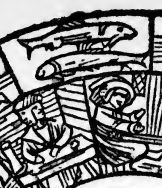
March & Pisces
From the zodiac from kalendar of shepherds
Roman Months, Weeks (hours, minutes and 24/7, 60/360)
I have been discussing the way the Roman Calendar used to work. Now it is our turn to look at the week. A week is a division of a month.
Oxford Languages says that the month derives from:
Old English mōnath, of Germanic origin; related to Dutch maand and German Monat, also to Moon.
Its length is roughly the length the moon takes to complete its cycle. So the obvious division of the month is into the phases of the Moon. The early Romans chose to keep the lunar associations with their division of the month. Their month was divided according to the Moon’s phases into the Kalends, the Nones and the Ides, as I describe in my Ides of March post here. Note that these Roman divisions divide only half the cycle. That is from new moon to full moon. The next 15 days are one block ‘before the Kalends’. So, not weeks as we know them! Although alongside Kalends, nones and ides, the Romans had 8 day market ‘weeks’.
Julius Caesar’s successful calendar reforms, restored the Calendar to alignment with the Sun, but stopped any pretence that months were linked to actual movements of the moon. So, I’m not sure why he kept the moon based Kalends system.
In the 4th Century, after re-uniting the Roman Empire, supreme leader, Constantine the Great, wanted to make his own contribution to the rationalisation of the calendar. So, he got rid of the moon based Kalends, Ides and Nones, and established the week as the main subdivision of the month.
To please the Christians, he swopped the day of leisure from old man Saturn’s Day to the Son of God’s Day, Sunday. This is the day Jesus ascended to heaven, but it was also the day for Mithras and the Unconquered Sun, so keeping some pagans happy. He then established the 7 day week. 7 was a sacred number and the number of the ‘planets’ in the Solar System as the Romans understood it (5 planets plus the sun and moon).
In Britain, we clung to some of our pagan names for the weeks. So Saturday, Sunday and Monday are Roman in origin. The Latin origins of the days of the week are obvious in the Romance languages, French, Spanish and Italian. Lundi from the moon, Mardi from Mars, Mecredi from Mercury, Jeudi from Jupiter, and Vendredi from Venus. Samedi came from Saturn. Dimanche from dies Dominica which means the Lord’s Day.
Tuesday – Friday are Anglo Saxon, named after the deities: Tiv, Woden, Thor, and Freya. Thank God its Freya’s Day, they probably didn’t say! (because they worked on Saturn’s Day.)
The Heavens and the Zodiac
The order of the days comes from their position in the sky. Not in their position around the Sun but their position in the zodiac. Babylon created the scheme of a division of the sky into 24 hour long sections, a god presided over each division. This is where we get our hours from. And half of 24 is 12 so the 12 signs of the Zodiac.
It is too complicated to explain but there were 7 deities and 24 divisions, so the deities rotated and did more than one shift. Babylon used the numerical base of 60. So we have 60 seconds in a minute, 60 minutes in an hour, 360 degrees in a circumference.
Other societies ignored hours until we had clocks to measure them. In Chaucer’s time, hours were a 12th of the Day and a 12th of the Night, so in summer, day time hours were longer, and nighttime hours shorter, and vice versa in winter. Those hours were called ‘artificial hours’. This makes a sort of sense – in winter, daytime hours are precious, so you get a shift on to get essential work done in the short hours of daylight. In summer, you have a long day, long hours, so you can take it a little easier. Therefore, your productivity in a winter hour might be similar to your productivity in a longer summer hour? Anglo-Saxons divided days by tides; morningtide, eventide and nighttide.
Ages of man
As I have mentioned before, prophecy often sees a connection between the yearly calendar and future events. For example, if it rains on the fourth day of the twelve days of Christmas, then it will rain during the fourth month (they say). The Kalendar of Shepherds illustrates this method, giving a comparison between the ages of man and the months of the year. Twelve months in a year, Twelve ages of man in six year blocks. So March represents ages twelve to eighteen, as it says, below, this is the ‘time to learn doctrine and science’.
Kalendar of Shepherds (translation from French 15th Century original)
On This Day
1836 – The Republic of Texas is set up as an independent State. The Alamo fell on March 6, 1836, but the Texans soon defeated the Mexicans and made the Republic a reality. It was annexed by the United States on December 29, 1845 and soon made a State.
While researching my Jane Austen’s London Walk I was delighted to find this plaque on a wall in Mayfair.
Plaque on Wall in Pickering Place, London (near Pall Mall) for Texas Legation (close up of photo by K Flude)Plaque on Wall in Pickering Place, London (near Pall Mall) for Texas Legation (photo by K Flude)
1969 – First flight of the Concorde, first supersonic aeroplane
1970 – the Republic of Rhodesia was set up by the Southern Rhodesian colonial government of Ian Smith. They declared a Unilateral Declaration of Independence (UDI) in 1965 in order to stop the transition to Black Majority Rule. The Republic of Zimbabwe took over on April 18th, 1980, after a bloody war.
First written in March 2023 revised on 2nd March 2024, St Chad added 2025, On This Day added 2026
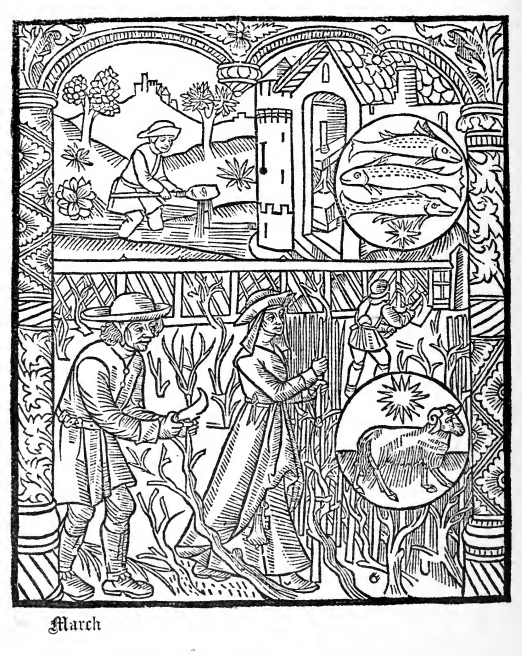
March from the Kalendar of Shepherds – French 15th Century
Spring & March
This is the beginning of Spring, meteorologically speaking. There is nothing magical about this day that makes it in any sense actually the start of Spring. It is a convenience determined by meteorologists. They divide the year up into 4 blocks of three months based on average temperature, and the convenience of keeping statistics to months. It could be that spring starts on 2nd March. 14th February. Or the 1st of February as the Celts favoured.
The Venerable Bede in his ‘The Reckoning of Time’, written in 725 AD, quotes more diversity of dates:
However, different people place the beginnings of the seasons at different times. Bishop Isidore the Spaniard said …, spring [starts] on the 8th kalends of March [22 February],…
But the Greeks and Romans, whose authority on these matters, rather than that of the Spaniards, it is generally preferable to follow, deem that spring [begins] on the 7th ides of February [7 February],…
Noting that summer and winter begin with the evening or morning rising and setting of the Pleiades, they place the commencement of spring and autumn when the Pleiades rise and set around the middle of the night.
There is nothing that says we have to have 4 seasons. Egypt had three seasons, the tropics have two. Celts divided the year into 8. Plants have been blooming, sprouting and budding since January, and some will wait until later in the year. Lambs have been born since January. But scientists and society find it easiest to keep statistics on a monthly basis so March 1st it is.
Astronomically, the seasons are more rationally divided by the movement of the Sun. So Spring begins on the spring or vernal equinox, 20th or 21st of March. For my Spring Equinox post go here.
Anglo-Saxon March
In Anglo-Saxon ‘Hrethamonath’ is the month of the Goddess Hretha. Bede gives no further information on who she was and nothing else is known about her. Her name is Latinised to Rheda. J R. R. Tolkein used the Anglo-Saxon calendar as the calendar for the Shire where the third month is called Rethe.
For the Anglo-Saxon, spring was looked forward to with great joy after the bleakness of winter. Christian Anglo-Saxons also saw this as the pivotal month in the year. It was in March that the world was created, and the Messiah conceived, revealed, executed, and ascended to heaven. See my post:
In Welsh the month is called Mawrth, (derived it is thought from the Latin Martius). Gaelic Mart or Earrach Geamraidth – which means the ‘winter spring’.
Medieval/Early Modern March
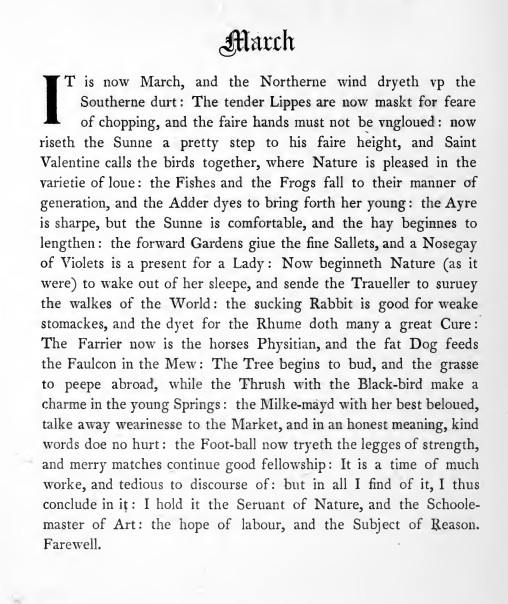
The illustration (above), from the Kalendar of Shepherds, shows that in Pisces and early Ares preparation was still the main order of the farming day, clearing out the moats, and preparing the fruit trees. Lambing is also increasing in number. And the early modern text below from the Kalendar gives a fine description of the joys of spring.
Kalendary of Shepherds- Description of March.March in the Kalendar of Shepherds.
March the 1st was the beginning of the Roman year in Rome’s early days. The Month was named after Mars, the God of War, as Mars was the patron God of the Rome. March was also the beginning of the campaign season, and the army was prepared, and ceremonies held to Mars. The Salii, twelve youths dressed in archaic fighting costumes led a procession singing the Carmen Saliare. March 1 was also the Matronalia a festival celebrating childbirth motherhood. Dedicated to the Mother Juno Lucina,
Ovid & March & Kalends, Nones & Ides
Ovid says the year started on the Kalends of March. Here is what Britannica says about their strange system of dividing months:
‘In a 31-day month such as March, the Kalends was day 1, with days 2–6 being counted as simply “before the Nones.” The Nones fell on day 7, with days 8–14 “before the Ides” and the 15th as the Ides. After this the days were counted as “before the Kalends” of the next month’.
More about this if you read my post on the Ides of March and Julius Caesar.
At the beginning of his book, Fasti, Ovid provides the story of Rome’s foundation. Mars took Silvia the Vestal while she slept. She later gave birth to Romulus and Remus. He also gives details of how Rome was organised. In the piece of the long text I have chosen below he discusses Romulus’ arrangement of the year. It is a year that began on the 1st March, and had only 10 months. 10 is the number of digits we have and the length of pregnancy (so Ovid says).
Ovid wrote in his almanac poem the Fasti:
So, untaught and lacking in science, each five-year lustre That they calculated was short by two whole months. A year was when the moon returned to full for the tenth time: And that was a number that was held in high honour: Because it’s the number of fingers we usually count with, Or because a woman produces in ten months, Or because the numerals ascend from one to ten, And from that point we begin a fresh interval.
So Romulus divided the hundred Senators into ten groups, And instituted ten companies of men with spears, And as many front-rank and javelin men, And also those who officially merited horses. He even divided the tribes the same way, the Titienses, The Ramnes, as they are called, and the Luceres. And so he reserved the same number for his year,
Itís the time for which the sad widow mourns her man. If you doubt that the Kalends of March began the year, You can refer to the following evidence. The priest’s laurel branch that remained all year, Was removed then, and fresh leaves honoured. Then the king’s door is green with Phoebus’ bough, Set there, and at your doors too, ancient wards. And the withered laurel is taken from the Trojan hearth, So Vesta may be brightly dressed with new leaves. Also, it’s said, a new fire is lit at her secret shrine, And the rekindled flame acquires new strength. And to me it’s no less a sign that past years began so, That in this month worship of Anna Perenna begins. Then too it’s recorded public offices commenced, Until the time of your wars, faithless Carthaginian.
Lastly Quintilis is the fifth (TXLQWXV) month from March, And begins those that take their names from numerals. Numa Pompilius, led to Rome from the lands of olives, Was the first to realise the year lacked two months, Learning it from Pythagoras of Samos, who believed We could be reborn, or was taught it by his own Egeria. But the calendar was still erratic down to the time When Caesar took it, and many other things, in hand. That god, the founder of a mighty house, did not Regard the matter as beneath his attention, And wished to have prescience of those heavens Promised him, not be an unknown god entering a strange house.
He is said to have drawn up an exact table Of the periods in which the sun returns to its previous signs. He added sixty-five days to three hundred, And then added a fifth part of a whole day. That’s the measure of the year: one day The sum of the five part-days is added to each lustre.
For much more about the Roman Year (and leap years) look at my post here.
On This Day
St David’s Day – It is also the Feast of St David, (or Dewi) the patron saint of Wales, who lived in the sixth century AD. Little that is known about him is contemporary but he was an abbot-bishop. His hagiography was written in the 11th Century and not very trustworthy, but the aim was to show the independence of the Welsh Church from Canterbury. His association with the leek is unexplained.
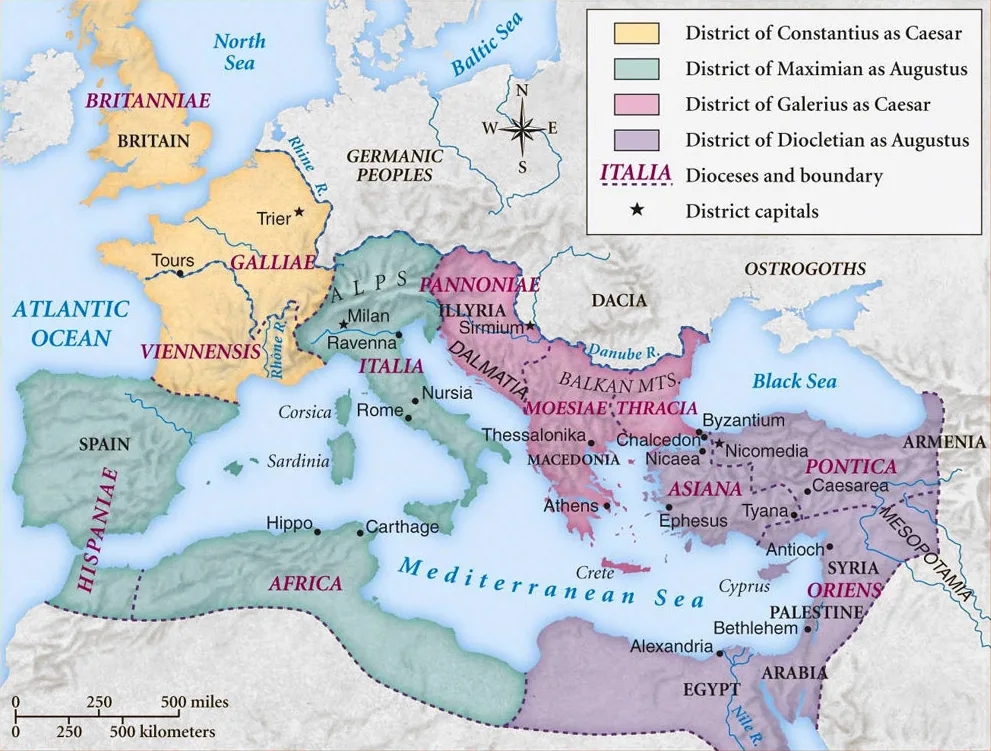
293 – Inauguration of the Tetrarchy
Diocletian reorganises the Roman Empire to be a Tetrarchy with himself and Maximian the Augusti, one in the East the other in the West. Below them were Constantius Chlorus and Galerius the Caesars.
Coppermine Photo Gallery – Coppermine Photo Gallery; Bishop, Aubrey. Imperial Imagery of the Tetrarchy. Rhodes College. Archived from the original on 15 September 2024. Historic map of Roman Empire during the first tetrarchyCC BY-SA 3.0
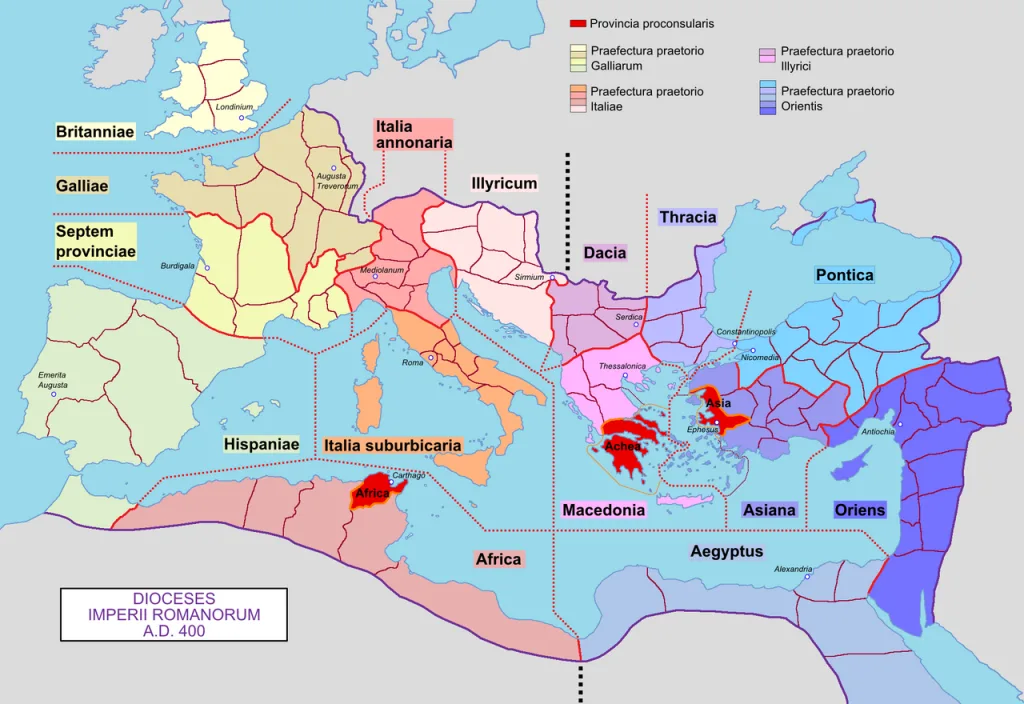
Below them were Prefectures run by Prefects, who controlled officials called the Vicarious. Britannia, was a Diocese ruled by the Vicarious in London. The Diocese was divided into 4 Provinces,. In charge of those were the Governors, who were now civilians rather than military figures.
Later dioceses of the Roman Empire, around 400 AD By Mandrak – Own work, Public Domain, https://commons.wikimedia.org/w/index.php?curid=6088363
The reorganisation was designed to provide a peaceful career path for ambitious men, but in that it failed.
1562 – Massacre in Wassy France, when sixty-three Huguenots were killed and the French Wars of Religion began. Many Huguenots came to Britain, and many settled in Spitalfields, London. My family believe we are Huguenots from the East End.
1628 – Charles I decrees that the ship tax should be extended to every county. This was not put to a Parliament, and illegal impositions like this eventually lead to the English Civil War in 1642. (see my post on the beginning of the Civil War here:













![Chad is the patron saint of medicinal springs,[37] although other listings[38] do not mention this patronage.
St. Chad's Day (2 March) is traditionally considered the most propitious day to sow broad beans in England.](https://www.chr.org.uk/anddidthosefeet/wp-content/uploads/2024/03/haggerston_may_2020.jpg)