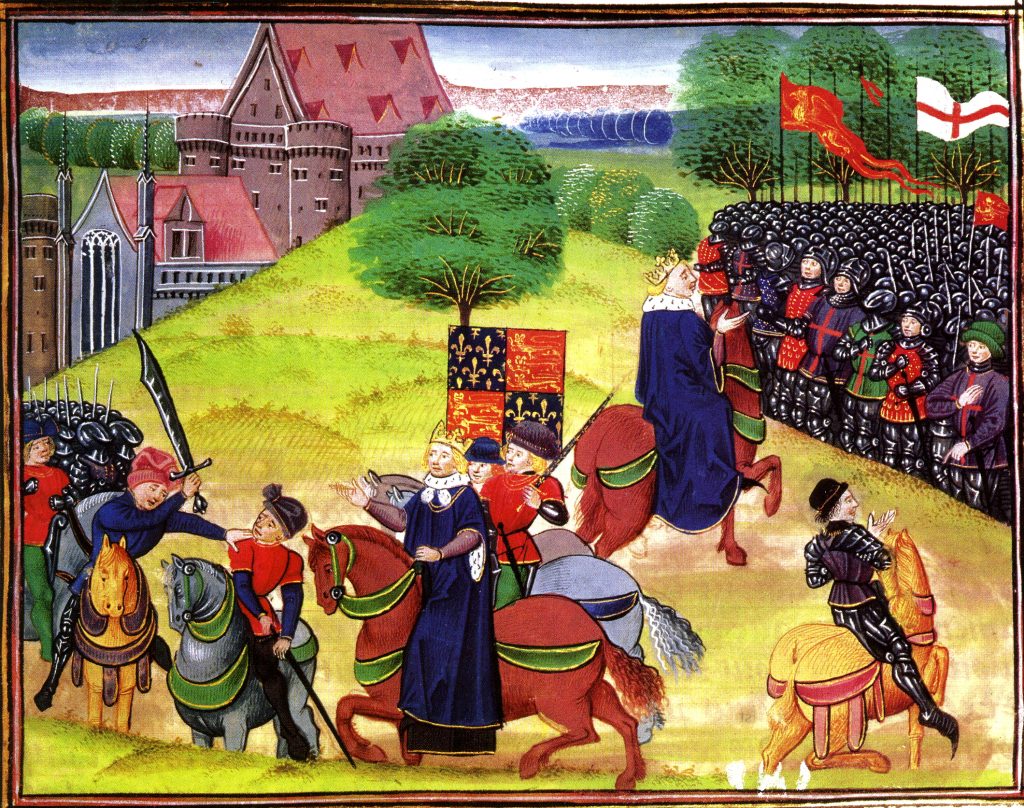
Smithfield & the Peasants’ Revolt. illustration from ‘Chroniques de France et d’Angleterre’, by Jean Froissart, c.1460-80. Walworth is showing killing Wat Tyler, King Richard is shown twice, first watching the death of Tyler, and secondly taking control of the Rebels
On the 15th June, King Richard went to pray at Westminster Abbey before the climax of Smithfield & the Peasants’ Revolt. He prayed at the shrine of St Edward the Confessor. A King who knew all about the sins Kings are forced to commit to rule an unruly Kingdom and could intercede on the King’s behalf in Heaven
The Peasants’ met at Smithfield, or maybe they had camped out there overnight. It was a big field where the livestock market was held. And where people were executed. Most famously Scottish patriot, William Wallace, who was hanged, drawn and quartered here on 23 August 1305. It was also used for jousting, and one of the streets off Smithfield is called GiltSpur Street.
The King, Smithfield and the Peasants’ Revolt
The King had agreed to meet the Peasants again. We don’t know how that was organised. The King turned up supported by a group of men who included members of the City of London Corporation including the Lord Mayor, Fishmonger, William Walworth. They seem to have worn armour under their clothes. The King’s Party lined up in front of St Bartholomew’s the Great Priory.
The rebels were on the other side of the field, presumably armed with the weapons and armour they had plundered from the Tower of London. It is not clear exactly what happened, and the sources are prejudiced against the rebels.
The Rebels demands were: the abolition of all Lords except the King; all bishops except the Archbishop; all monasteries except the Friaries and the replacement of the false House of Commons, with the True House of Commons.
Wat Tyler rode towards the King’s party. Got off his pony, spat out the wine he had been drinking, and ‘Hailed, Brother’ slapping the King on the shoulder. This was not normal court etiquette.
One of the King’s party shouted at Tyler that he was a thief and a murderer. Tyler drew his sword, and William Walworth struck him down, mortally wounding him.
Commentators speculate that this might have been part of a plan. To arrive seemingly without armour, to provoke a crisis, and disrupt the rebels.
The City’s part in the events in Smithfield is fascinating. City Merchants were not generally fighting men, but they seem to be the active group the King could rely on. Interestingly, there is no evidence that the Rebels attacked the Guildhall and destroyed the legal records. They attacked most important legal institutions in London, in the days before Smithfield. So why no attack on the Guildhall?
This surely must be because the Guildhall was protected by a competent military force. And it seems these are the same people who took on and defeated Wat Tyler.
In Smithfield, the Rebels didn’t know what to do. Is it possible the King’s party shielded the murder of Tyler behind a screen of people? So they didn’t know what happened and therefore didn’t know what to do?
For surely this was a moment of true danger. The Rebels would have had hundreds if not thousands in Smithfield, some at least well armed. Some must have been archers who would have been deadly. This is not that long after the Battles of Crecy and Poitiers, where the flower of the French Nobility was killed by the English Archers. Archers were normally rank and file soldiers, exactly the class of people supporting the Rebellion. Tyler was taken to St Bartholomew’s Hospital, where he died of his wounds.
In the moment of crisis, the King is said to have ridden forward on his horse and told the Rebels:
‘I will be your leader.’
And then he led them, like the Pied Piper of Hamlin, to their destruction.
He led them out of Smithfield into the field surrounding and told them they had their Charters so it was time to go home. And mostly they did.
The Execution of Treasurer Robert Hales and Chancellor Archbishop Sudbury on the Day the King met the Peasants at Mile End
To recap. On June 14th the 1381 Rebels have control of London. They are destroying any repository of legal records they can find. People are walking the streets dispensing street justice. Foreigners who speak Flemish are being beheaded. Enemies of the people are being dragged out of sanctuary and beheaded. Properties of the leaders of the government are being ransacked and burnt.
The King is in the Tower with his advisors, fearful that the Rebels will breach the defences. I would love to be a fly on the wall of that conversation. You would think it would go something like.
‘Sire. Your safety is paramount. We will leave the castle and draw off the rebels so you can go to a place of greater safety.’
What happened is astonishing. The Royal plan was to send the 14-year-old King Richard out to draw off the rebels so that the hated Chancellor of England, Archbishop Sudbury and the Treasurer of England, Robert Hales could slip away unseen! Putting the young boy king in the direct line of fire!
There are two explanations. Hales and Sudbury were arrant cowards. Or the King was very confident of his safety and despite his youth made his advisors accept his command. This was an age where young princes took adult responsibilities early.
The King left the Tower on horse back, accompanied by two half-brothers and his mother (and others). Their reception was hostile. We have eyewitness accounts of angry rebels pulling at the King’s bridle and that of one of his attendants from the City government. The King sent his mum and brothers back to the Tower as it was too dangerous. We can only assume the King sent them back sure that the peasants did not blame him for the mess the country was in.
He went to Mile End. His clerks set up tables and began writing charters freeing the peasants from feudal duties and turning their tenure into monetary rents.
As each village received its charter, many of the villagers went home. Back at home they sometimes attacked the people who had been manipulating the legal system, believing the King had given them permission to punish the guilty.
Whether the king believed in the justness of their claim or was just placating them to gain time, we do not know. But some historians believe that the young King was sympathetic to some of their claims, until older counsel made him change his mind.
Not all the rebels followed the King to Mile End, nor went home when their charters were sealed. It is thought Wat Tyler and thousands of rebels stayed at the Tower.
They saw the Archbishop of Canterbury trying to escape. They forced their way into the Tower. Here they jumped up and down on the Queen Mother’s bed, stole armour and weapons. Then dragged Hales, Sudbury, a Franciscan Friar (William Appleton, John of Gaunt’s physician), and John Legge, a royal sergeant to the scaffold at Tower Hill and beheaded them. Their heads were put on poles and paraded around town.
When the King left Mile End he couldn’t go to the Tower so he went to Baynards Castle, near Blackfriars. We also know that, the King’s cousin, Henry Bolingbroke was in the Tower. He was the son of the hated John of Gaunt. Years later, when he was King, he acknowledged the fact that a Londoner had been instrumental in saving his life in the Tower on the 14th of June, 1381. The man was fighting charges of stealing gold from the ransacking of Gaunt’s Savoy Palace. He was given a pardon.
That night rebels remained in London, and the king’s cause had been considerably weakened.
The Archbishop’s Head
You may wonder what happened to his head! Well, here is the answer!
Pentecost by Giotto and Workshop, probably about 1310-18, National Gallery
Today, is Whitsun or Pentecost. (Sun, May 24th 2026, 16 May 2027, 4 June 2028), 50 days after the Crucifixion. Celebrated on the 7th Sunday after Easter. The Day the Holy Ghost descends on the disciples. According to one of my teachers, it gave the disciples the power of expression and turned them from bereft disciples to self-confident Apostles. They could now begin to spread the Christian message.
Giotto’s painting shows the Apostles with their halos in the chamber. There are 12 of them, St Matthias having replaced the dead, Judas. The Holy Spirit is represented by the little dove in the centre of the Ceiling. The narrative is carried by the two men in the foreground leaning towards each other. We imagine them saying something like ‘What’s all this about! Galilean nonentities, lost their guru and yet, confident, speaking authoritatively to all and sundry and they can all understand them?‘
Giotto was a forerunner of the Renaissance. According to the great Giorgio Vasari (30 July 1511 – 27 June 1574) who wrote about the advances in painting achieved by Italian artists:
‘that very obligation which the craftsmen of painting owe to nature, who serves continually as model to those who are ever wresting the good from her best and most beautiful features and striving to counterfeit and to imitate her, should be owed, in my belief, to Giotto, painter of Florence, for the reason that, after the methods of good paintings and their outlines had lain buried for so many years under the ruins of the wars, he alone, although born among inept craftsmen, by the gift of God revived that art, which had come to a grievous pass, and brought it to such a form as could be called good.‘
The miracle was that this boy, a poor shepherd with no training in art was able to show nature its true face.
‘One day [the artist] Cimabue, going on business from Florence to Vespignano, found Giotto, while his sheep were feeding, drawing a sheep from nature upon a smooth and solid rock with a pointed stone, having never learnt from anyone but nature.’
One of the points Vasari is making is that the Byzantine Art had lost the use of perspective, something the Romans knew. Paintings had become cartoon like spaces had no solidarity, groups of people stood on shoulders. If you look at the painting above you will the room the Apostles are in has the beginnings of a realistic space, the rafters slope down to a vanishing point. The Apostles are ranged convincingly around the space. Their faces are rounded and realistic. They are separated from the outside world by a dividing wall. And two dudes at the front are convincingly on the ground, rather than hovering in mid air (though I might have cropped the photo too closely!)
It would be over one hundred years before photo realistic portraits and realistic perspective paintings were rediscovered but Giotto showed the way.
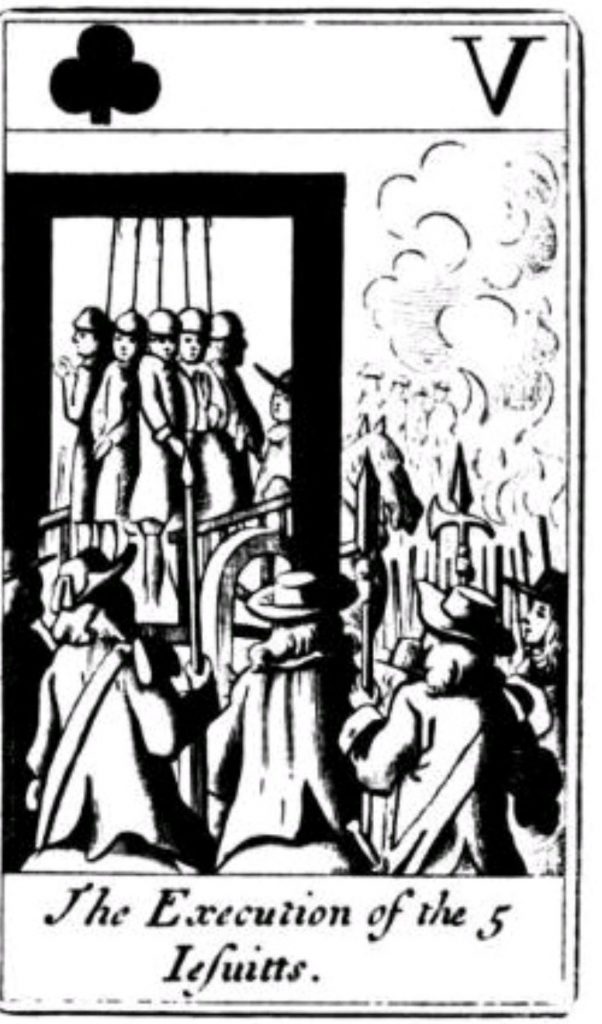
Titue Oates & Popish Plot. Set of playing cards themed on the Plot c1679 after a design by Francis Barlow
Titus Oates was a con-man. He accused leading Catholics of participating in a plot to kill King Charles II and restore a Catholic monarchy. Among his targets were the Queen, and the King’s Brother’s wife.
Titus Oates had a complicated past. He was a Baptist who turned to the Church of England on the Restoration of King Charles II. He went to Cambridge where he was accused of being a ‘Great Dunce’ and never took his degree. His next about turn saw him in St Omer to train as a Jesuit. He accused a man, whose job he wanted, of sodomy. Then, he became a Naval Chaplain. But he was, himself, accused of buggery and dismissed from the Navy. He was received into the Catholic Church while, at the same time, he wrote a series of anti-Catholic Pamphlets. He made accusations against over 500 people. This became known as the Popish Plot.
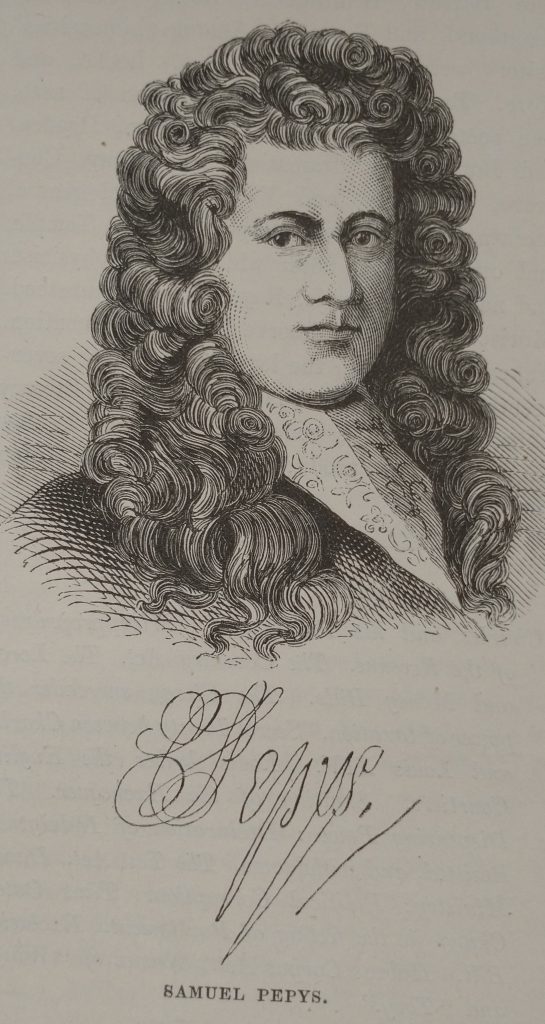
As a result, twenty-two people were executed, some ‘Hanged, Drawn and Quartered’ because of Oates’ baseless accusations. The Diarist, Samuel Pepys, was caught up in the anti-Catholic frenzy. Pepys was Secretary of the Navy during the Plot and was close to the Catholic, James, Duke of York. He was accused of selling secrets to the French. Awaiting trial for treason, he was imprisoned in the Tower of London. Eventually, he was able to clear himself and resume public life. (read this article on the /the-plot-against-pepys/.
Old Print of Samuel Pepys
It was only with the accession of James II that the climate of opinion changed. Then Titus Oates was found guilty of perjury. Perjury was not punishable with death, so Oates’ punishment was a long-drawn-out affair instead. He was sentenced to be imprisoned for life. And ‘whipped through the streets of London for five days a year for the remainder of his life.’
Oates was put in the pillory at Westminster Hall, where passers-by pelted him with eggs. He was again pilloried the next day in the City. On the third day, stripped, tied to a cart, and whipped from Aldgate to Newgate. The following day he was whipped from Newgate to Tyburn. (Source Wikipedia)
However, when the Catholic King, James II was, deposed and replaced by the joint Protestant monarchs William and Mary in 1689, Titus Oates was released and given a pension. He died in 1705.
For Pepys at the Execution of Charles I see my post here.
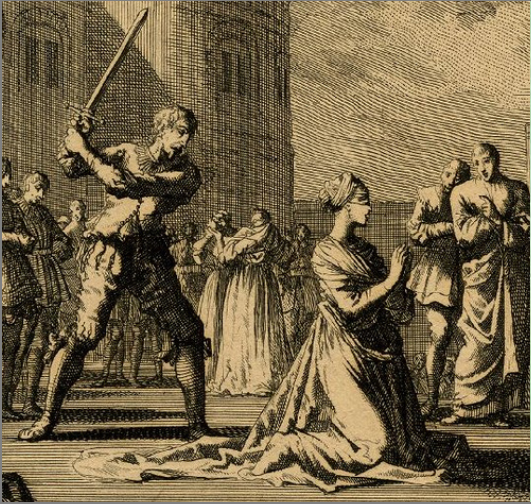
The beheading of Anne Boleyn began at 8am with her speech.
‘Good Christian people, I am come hither to die, for according to the law, and by the law I am judged to die, and therefore I will speak nothing against it.
I am come hither to accuse no man, nor to speak anything of that, whereof I am accused and condemned to die, but I pray God save the King and send him long to reign over you, for a gentler nor a more merciful prince was there never: and to me he was ever a good, a gentle and sovereign lord.
And if any person will meddle of my cause, I require them to judge the best. And thus I take my leave of the world and of you all, and I heartily desire you all to pray for me. O Lord have mercy on me, to God I commend my soul.’
She was blindfolded. She knelt down, putting her neck on the block and repeated:
‘ToJesus Christ I commend my soul; Lord Jesu receive my soul.’
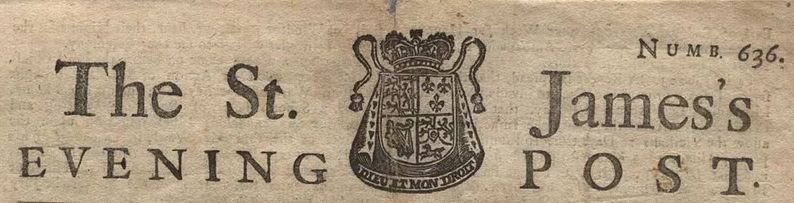
Mast head of the St James Evening Post (June 1719), the paper that carried the accusation of Sodomy
On 16th May 1719, the St James Evening Post (later called the Evening Post) reported on the Guilty Verdict returned against ex-Servants Stephen Margrove and John Wood. The two men were accused of extorting money by threatening to expose George Smith as a sodomist (then punishable by death).
The Proceedings of the Old Bailey Archive gives details of the case. This took place in the Parish of St. Martins in the Fields (near what is now Trafalgar Square), on 18th, January 1718. George Smith told the Court that:
‘ the Prisoners came up to him (and John Wood took him hold by the Collar of his Coat) and demanded his Money, and said if he would not give it them they would take away his Life and swear Sodomy against him; that by means of this Violence, and being under a Terror, and in great-Fear he gave them what he had in his Pocket.’
But they wanted more and forced Smith to take them to his Master’s House in Golden-Square. Here, he gave them another Guinea, to add to the 22 shillings they had already extorted.
The Accusation of Sodomy
Margrove and Wood protested that Smith: ‘came up to Wood while he was making Water, and took hold of his Yard, using some unseemly Expressions, whereupon he (Wood) called out a Sodomite‘.
At this accusation, Smith ‘fell on his Knees, and begg’d them not to expose him‘ and gave them the money. So, the accused argued it could not be ‘robbing on the High Way‘ because their victim gave them the money.
The Defence
The Court held that the threats, and violence they used made them guilty of Violent Robbery. The men called witnesses to their good employment record, but were unable to show any evidence of ‘how they spent the last 6 Months of their Lives.’ And so the Jury found them Guilty, and the judge put on the Black Cap to pronounce the death sentence.
The Verdict
On the 8th of June 1719 10 people, 7 men and 3 women were sentenced to hang, but 5 were reprieved. Wood, aged 22, and Margrove, aged 21, were however, executed. Rictor Norton in ‘Homosexuality in 18th Century England has more details, including the confessions of the two extortionists.
For the trail of Body snatchers look to the bottom of my post here:
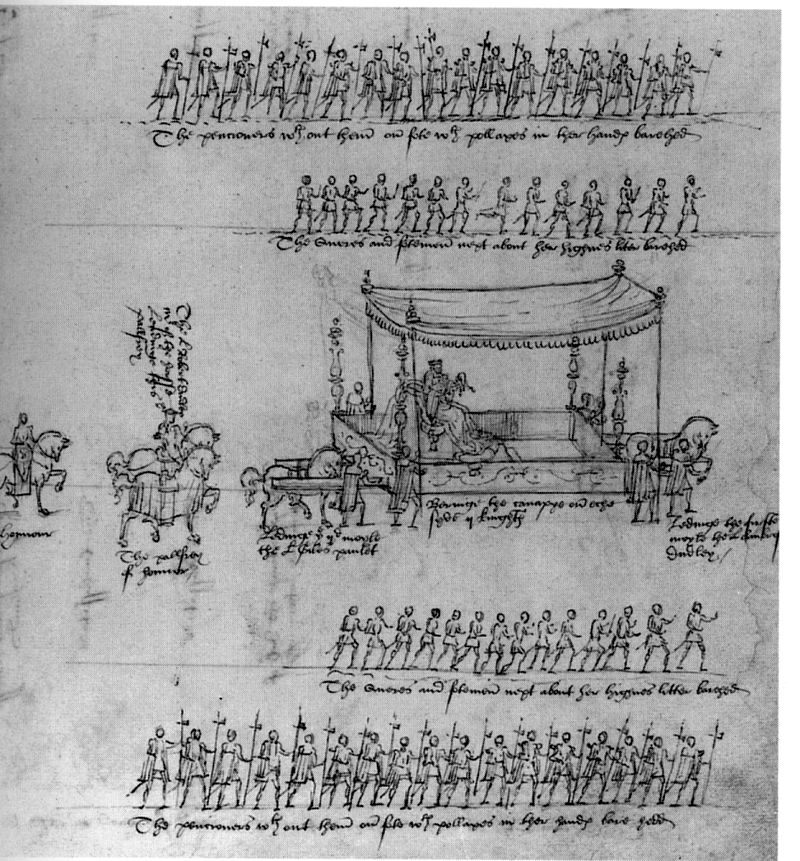
Queen Elizabeth 1 Coronation. Litter at her royal entry, accompanied by footmen and Gentlemen Pensioners. Unidentified engraver. (Wikipedia)
Queen Elizabeth 1 Accession
Queen Elizabeth 1 ascended the throne on 17 Nov 1558. Her accession was greeted with an outbreak of joy by the Protestant population. But the supporters of her dead sister Mary 1 did not want a Protestant monarch. On hearing the news of the death, Elizabeth rushed to occupy the Tower of London. She even risked shooting London Bridge, such was her haste. (see my post of the accession of Queen Elizabeth I)
She consulted lawyers about the legal position. Elizabeth, and her sister Mary, were declared bastards by two Succession Acts passed during Henry VIII’s ‘troubled’ married life. The Third Succession Act of 1543/44, following Henry’s marriage to Katherine Parr, restored Mary and Elizabeth to the Royal line. But it did not restore their legitimacy. Rather than tackle the complex legislation, Sir Nicholas Bacon, the Lord Keeper of the Great Seal, advised:
“the English laws have long since pronounced, that the Crown once worn quite taketh away all Defects whatsoever“. (Wikipedia)
Which, when you think about it, basically legitimises any successful ‘coup’! And, from a legal perspective, she was still, arguably, illegitimate.
Queen Elizabeth 1 Coronation
Her courtiers immediately began work on the Coronation, scheduled for January 15th 1559. In terms of Coronations, this was rushed. The precise date was, in fact, chosen by the Royal Astrologer. John Dee, a famous mathematician and credulous astrologer, found a date that the celestial bodies deemed propitious. But it needed to be sooner rather than later because Elizabeth’s position was so insecure.
Queen Elizabeth 1 Coronation Procession
The Coronation began with a procession from the Whitehall Palace in Westminster. Then back to the Tower of London for the Vigil. Followed by a Royal Procession through the City of London to Westminster Abbey for the Coronation service. After the Coronation, there was the traditional Coronation Banquet at Westminster Hall.
The Vigil Procession was on the Thames where she was escorted to the Tower by ‘ships, galleys, brigantines‘ sumptuously decorated. The Royal Entry consisted of 5 Pageants and 11 Triumphal Arches.
The first pageant showed the Queen’s descent from Henry VII and his marriage to Elizabeth of York. This marriage effectively ended the Wars of the Roses by linking the House of York and the House of Lancaster. The pageant also emphasised her ‘Englishness’ as opposed to the Spanish affiliations of Mary. The second pageant demonstrated that the Queen would rule by the four virtues of True Religion, Love of Subjects, Wisdom and Justice. At the same time she was shown trampling on Superstition, Ignorance and other vices.
The Procession at Cheapside
The third pageant, at the upper end of Cheapside near the Guildhall, provided the opportunity for the City to give Elizabeth a handsome present. This was a crimson purse with 1000 marks of gold, showing the closeness of the City and the Crown. The fourth pageant, contrasted a decaying country during the time of Mary with a thriving one under Elizabeth. It featured the figure of Truth, who was carrying a Bible written in English and entitled ‘the Word of Truth’. The Bible was lowered on a silken thread to the Queen. The Queen kissed it and laid it on her breast to the cheers of the crowd. She promised to read it diligently. The final pageant was Elizabeth portrayed as Deborah, the Old Testament prophet. Deborah rescued Israel and ruled for 40 years. So she was an ideal role model for Elizabeth. (For more details, look here.)
‘All the houses in Cheapside were dressed with banners and streamers, and the richest carpets, stuffs and cloth of gold tapestried the streets’.
British History.ac.uk Vol 1 pp315 -332
Queen Elizabeth 1 Coronation in Westminster Abbey
The Coronation was traditional – in Latin and presided by a Catholic Bishop, but there were significant innovations. Important passages were read both in Latin and in English. The Queen added to the Coronation Oath the promise that she would rule according to the:
‘true profession of the Gospel established in this Kingdom.’
This showed the path Queen Elizabeth was going to take. She would introduce innovation gradually into tradition, but emphasizing that the fundamentals had indeed changed. This was going to be a Protestant reign.
Can I remind you that I wrote a best-selling book on the Kings and Queens of Britain? It has sold over 130,000 copies, has been reprinted several times and in several editions and is available here.
The World’s Best Cities report makes London the top City followed closing by New York and Paris. London has had top spot for 10 years. The Report is based on core statistics plus a survey of visitors and residents. It is created by Resonance, a consultancy group working in real estate, tourism, and economic development. They are based in Vancouver.
“Navigating the complexities of a post-Brexit era, geopolitical uncertainties and economic challenges, London’s resilient spirit and unmatched global appeal have solidified its place at the pinnacle of our annual ranking,“
AFAR gives a good analysis of Resonance’s methods on its web site:
‘England’s capital snagged the top spot for the 10th year in a row, continuing to draw students, investors, and tourists alike. A $305 million upgrade of the Gatwick Airport and new metro stops on the Elizabeth line are a few of the developments that indicate the city’s focus on improving infrastructure. Resonance particularly spotlights the building of the Camden Highline, a mile-long greenway inspired by New York’s High Line, as a project that demonstrates “London’s dedication to enhancing quality of life for both residents and visitors.”
London No 1. Really?
Or is it a fix? It was a bit of a surprise to me given the hit Brexit has given to the City. But, London’s dominance for ten years may be because of the consultancy’s focus on real estate as well as tourism and economic development. This gives London a head start as it has long been considered a very safe place to invest in property. London, New York, Paris, Tokyo, Singapore as 1-5 also suggests the report writers might have a bias to the big hitters.
What London offers is its status as one of the world’s leading financial/business capitals. Supported by outstanding creative and services industries. At the same time, it has a superb cultural offering and, consequently, high figures for tourism. It is a City that seems to have a deep past behind it and an equally important future ahead.
The future might depend on the growing Knowledge Quarter around Kings Cross. (British Museum & Library, Wellcome Institute, Crick Institute, UCL, Central St. Martins, Google etc.) With Silicone Roundabout and the wealth of investments from the nearby City of London, providing London with a leading place in AI, the Knowledge economy, and Fintech. London also has a very high value on the internet as far as hashtags, and internet searches are concerned.
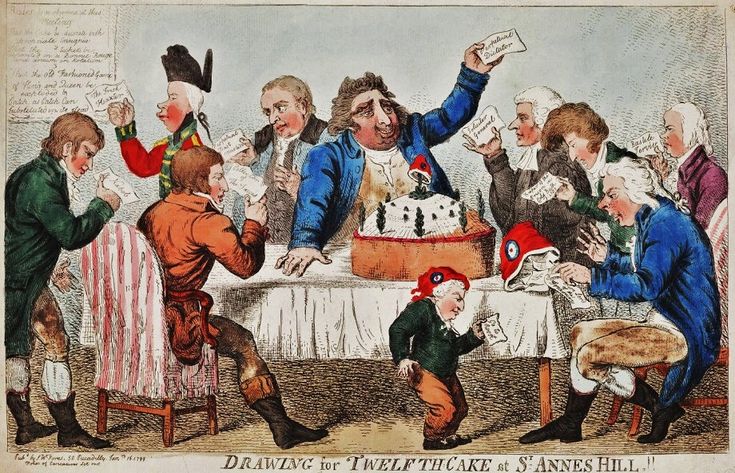
‘Drawing for Twelfth Cake’ at St. Annes Hill ’12th Night Cruikshank, Isaac, 1756-1811 printmaker. Published Janr. 10, 1807 by Thomas Tegg, 111 Cheapside’
Twelfth Night
Yesterday was Twelfth Night for the modern Church of England, but today is Twelfth Night for the Catholic Church and in England in former times. It is also Epiphany or Three Kings Day and because of calendrical differences, Christmas Eve for the Orthodox Church. In Ireland, it is Nollaig na mBan. This is Women’s Little Christmas; when Women get to rest and let men do the work. This is a typical Saturnalia-style reversal of roles.
I used the print above, three years ago for my post on New’s Day, then moved it to Twelth Night. I also use it for lectures on Christmas and Jane Austen. But the focus of my presentation is explaining the Twelfth Night Cake and the game that was played. But in fact, this is a very political satirical cartoon. More of that, later, let’s begin with the more trivial aspect of the print above.
Twelfth Night and Christmas Cake
It used to be the big party night, featuring the famous Twelfth Night Cake and theatrical entertainments; mumming and wassailing. The cake has disappeared from current Christmas celebration, probably because it transmuted into our present Christmas Cake. This, I regret. I have had a lifetime when a very heavy Christmas Dinner is followed first, by Christmas Pudding. Then, overloading with food, the Christmas Cake is brought out. No one, in their right mind, wants a slice of heavy Christmas Cake at that time. Many of my American friends disparage fruit cake, but they are mistaken. Good Christmas Cake is something to be thoroughly enjoyed, but on the days following Christmas Day.
I gave a recipe for the Twelfth Night Cake in another post, (here it is). But the important point is that it had a bean and a pea in it. The one who got the bean was selected as King for night and the pea the Queen. Traditionally, the women draw a card from a ‘reticule’ (bag) and the men’s from a hat. But there are no women at this satirical party. The cards detailed a role they were to play for the rest of the night. The card began with an introductory speech, or rhyme, for the person to speak. The King and Queen led the way, and for the rest of the evening the party members adopted their persona. They might be an aristocrat, a soldier, a cook, a parson, a dairy maid etc. The French do something similar with their Galette des Rois. The bean is called the feve, and may be replaced by a porcelain model. Other places have a King’s Cake for epiphany.
Twelfth Night Satire
So, as I was rushing to get the original Twelfth Night post done, I failed to examine it in any detail. I assumed the cards gave them satirical occupations which would be funny to the contemporary audience in 1807. But then, I noticed the title mentioned St Anne’s Hill. I looked it up and discovered myself down a deep and very enjoyable research rabbit hole.
St Anne’s Hill & Charles James Fox
Now, let’s go down that rabbit hole and look a little deeper.
The caption mentions St Anne’s Hill. I believe this refers to St Anne’s Hill, near Chertsey (SW of London on the River Thames). Here, there was a grand house which was owed by Charles James Fox. He was the leader of the Whigs, a persistent opponent of King George III. He was a supporter of the American and French Revolutions. This explains the red bonnet used to pull out the cards in the illustration.
The central figure is then, Fox. But he died in September,. 1806. The print is dated January 1807. Just before he died, his Foreign Slave Trade Bill of 1806 began the dismantling of this pernicious trade in the British Empire. He was Foreign Minister who assumed a couple of civil chats with the French would end the long-standing war. But he soon discovered that Napoleon was not to be trusted in negotiations. The war went on for another 9 or so years.
Charles James Fox was a mercurial figure with many radical views. He was also a notorious gambler and loved the high life. One of his many lovers was Georgiana, Duchess of Devonshire. He eventually married, Elizabeth Armistead, an ex-mistress of the Prince of Wales. St Anne’s Hill was her house. I am pleased to report that she is credited with calming his life-style. He now spent more time at St Anne’s where they would ‘read, garden, explore the countryside and entertain friends’ (Wikipedia).
Isaac Cruikshank’s ‘Drawing for Twelfth Cake’ at St. Annes Hill
Cruikshank’s illustration is, of course, not designed to document quaint Twelfth Night customs but is a political satire and I discovered that the British Museum has the original version of this print, and. It is dated to 1799 which makes much more sense!
At the back right of the print is a notice which says:
‘Rules to be observed at this Meeting 1. That the Cake be decorated with appropriate insignia 2 That the tickets be deposited in a Bonnet Rouge and drawn in Rotation 3 That the Old Fashioned Game of King and Queen be exploded & Catch as Catch can Substituted in its stead.’
The bonnet rouge is defined by the Collins Dictionary as a ‘redcap worn by ardent supporters of the French Revolution’ or ‘an extremist or revolutionary’. The last point relates to Fox’s opposition to the King, and the expression Catch as Catch Can refers to a free form of wrestling without rules.
The characters in the scene (all men) are all political figures. They are associated with the opposition to the very right-wing Government of William Pitt. During the war with France, the opposition was led by a supporter of the French Revolution. For those on the right, which included Pitt’s government, supporting the French Revolution was tantamount to treason. Pitt suspended many civil liberties in ‘Pitt’s Reign of Terror’. He arrested and indeed executed leading members of those demanding political change. The Government even suspended Habeas Corpus to make it easier to arrest their opponents,
Fox is seen drawing a 12th Night Game ticket which is marked ‘Perpetual Dictator’. To his right is Frances Burdett. He was a radical politician, who supported universal male suffrage, equal electoral districts, vote by ballot, and annual parliaments. Note that this is well before these aims became the core of the Chartists campaign for electoral reform. (for other people in the illustration look at the British Museum notes on the print. )
Frances Burdett, Edward and Catherine Despard
Burdett is shown holding a ticket saying ‘Keeper of the Prison in Cold Bath Fields’. This is a satirical reference to a serious political crisis. The Cold Baths Fields was the site of a medical spring in Clerkenwell, London. This was where a prison was situated where radicals were imprisoned. They were held in poor conditions despite the recent rebuilding under the aegis of the prison reformer, John Howard. Burdett exposed the scandalous conditions in the House of Commons. He began a campaign against the magistrates involved in the arrests.
One of the prisoners was Edward Despard who had associations with many radical groups. These included the London Corresponding Society, the United Irishmen and United Britons. Despard was married to Catherine, the daughter of a free black woman from Jamaica. She, with Burdett, led the campaign against these arrests without trial. Catherine wrote a letter to the Attorney General who replied in a demeaning manner:
‘it was a well-written letter, and the fair sex would pardon him, if he said it was a little beyond their style in general’
He did not comment on her colour. She described the imprisonment of her husband as being :
“in a dark cell, not seven feet square, without fire, or candle, chair, table, knife, fork, a glazed window, or even a book”
Execution of Edward Despard
Despard was freed in 1802, went to Ireland. But returned to London, where he was arrested again. But this time he was accused of a being the ringleader of a plot to assassinate the King. There was little real evidence. Horatio Nelson was a character witness, and appealed to the King for clemency. It was given. But only in so far as Despard was not disembowelled but ‘only ‘Hanged and Drawn’ at Horsemonger Lane Gaol (1803). This was the last time someone was drawn through the streets at the tail of a horse before execution for treason. These are his last words:
Fellow Citizens, I come here, as you see, after having served my Country faithfully, honourably and usefully, for thirty years and upwards, to suffer death upon a scaffold for a crime which I protest I am not guilty. I solemnly declare that I am no more guilty of it than any of you who may be now hearing me. But though His Majesty’s Ministers know as well as I do that I am not guilty, yet they avail themselves of a legal pretext to destroy a man because he has been a friend to truth, to liberty, and to justice
(a considerable huzzah from the crowd)
and because he has been a friend to the poor and to the oppressed. But, Citizens, I hope and trust, notwithstanding my fate, and the fate of those who no doubt will soon follow me, that the principles of freedom, of humanity, and of justice, will finally triumph over falsehood, tyranny and delusion, and every principle inimical to the interests of the human race.
(a warning from the Sheriff)
I have little more to add, except to wish you all health, happiness and freedom, which I have endeavoured, as far as was in my power, to procure for you, and for mankind in general.
https://en.wikipedia.org/wiki/Edward_Despard
After his death, his family denied that Catherine was his wife but merely his ‘house-keeper.’ I assume, was because they wanted the inheritance rather than, or perhaps, as well as naked prejudice.
Francis Burdett married into the fabulously rich banking family the Coutts. His daughter was the famous Angela Burdett Coutts who was a philanthropist who collaborated extensively with Charles Dickens.
@Phew! This is what I love about what I do, you find things out that link disparate parts of your knowledge, creating an ever-interwining web of history.
On this Day
Harold Godwinson was crowned King of England on January 6, 1066, the same day as the funeral of the previous king, Edward the Confessor. m.
My true love sent to me 6 Geese a Laying; 5 Golden Rings; 4 Calling Birds; 3 French Hens; 2 Turtle Doves and a Partridge in a Pear Tree
The Lord of Misrule, Masters of the Revels, and Boy Bishops
The Roman festival of Saturnalia, held between 17th and 23rd of December, included reversing rules so that slaves, ruled and masters served. In the medieval period, the disorder of Christmas was continued with the election of Lords of Misrule, Masters of the Revels, and Boy Bishops.
John Stow’s, Survey of London
He was London’s first great historian, wrote of the Lord of Misrule in London. In this section, Stow begins the role of the Lords of Misrule at Halloween and continues it until Candlemas, in erly February. See my post here for more details on Candlemas. This is what Stow says:
Now for sports and pastimes yearly used.
First, in the feast of Christmas, there was in the king’s house, wheresoever he was lodged, a lord of misrule, or master of merry disports, and the like had ye in the house of every nobleman of honour or good worship, were he spiritual or temporal. Amongst the which the mayor of London, and either of the sheriffs, had their several lords of misrule, ever contending, without quarrel or offence, who should make the rarest pastimes to delight the beholders.
These lords beginning their rule on Alhollon eve, continued the same till the morrow after the Feast of the Purification, commonly called Candlemas day. In all which space there were fine and subtle disguisings, masks, and mummeries, with playing at cards for counters, nails, and points, in every house, more for pastime than for gain.
Against the feast of Christmas every man’s house, as also the parish churches, were decked with holm, ivy, bays, and whatsoever the season of the year afforded to be green. The conduits and standards in the streets were likewise garnished; (…) , at the Leaden hall in Cornhill, a standard of tree being set up in midst of the pavement, fast in the ground, nailed full of holm and ivy, for disport of Christmas to the people…
Holm is an evergreen oak called Quercus ilex. John Stow talks about the Tree in Leadenhall Street being destroyed in the great wind of 1444 which you can read about here. You might also like to see the following posts, which include information about John Stow and London’s customs, and churches.