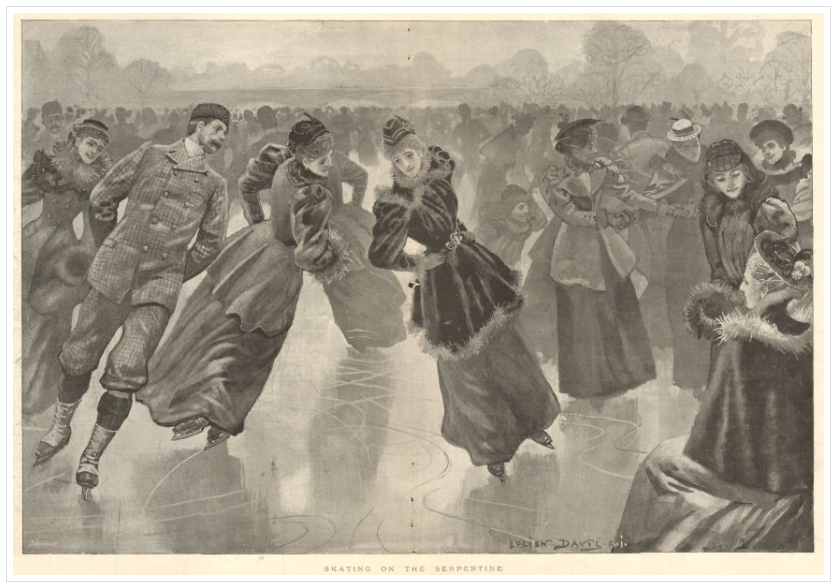
The Greeat Freeze. ‘Skating on the Serpentine’ by Lucien Davis Antique wood-engraved print. Illustrated London News double page from 2 March 1895 (print owned by K Flude)
The Great Freeze
London, February 12, (1895). There is no abatement of the abnormally cold weather which has prevailed in northern Europe for the last week. The Upper Thames is frozen over, and huge blocks of ice breaking away from the mass are floating down the river, causing much damage to the smaller shipping craft. Water traffic is consequently at a complete standstill.
Many cases of death from cold and exposure are reported, the privation and distress in the East End of the city being particularly severe. The cold is so intense that birds are found frozen to death on the branches of the trees, and thousands are perishing. The severe weather has also directly caused considerable mortality, a number of deaths from exposure having been reported among postmen, omnibus drivers, cabmen, and labourers.
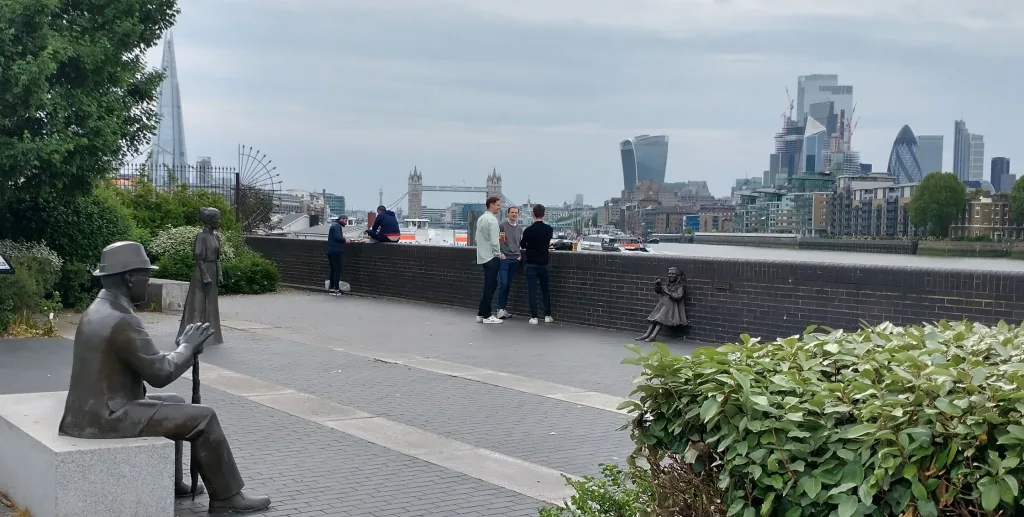
Winter of 1895 Limehouse to left, Tower of London to right. Images from Isle of Dogs blog.
The year 1895 was the culmination of a decade of particularly cold winters (and for some the end of the so-called Little Ice Age). On the 11th February, the coldest day in British History was recorded at Braemar at −27.2 °C. February 1895 was the second coldest on record, with the lowest minimum temperatures on record. Shipping in the biggest port in the world was stopped. Therefore, many workers were laid off, and had to resort to what were then called ‘soup kitchens’ and now ‘food banks’. Winter death rates were said to be doubled, with people dying in the street and in unheated homes.
Record minima were set for these dates in February 1895:
7th: −21.7 °C or −7.1 °F
8th: −25.0 °C or −13.0 °F
9th: −23.9 °C or −11.0 °F
10th: −25.6 °C or −14.1 °F
11th: −27.2 °C or −17.0 °F
12th: −20.6 °C or −5.1 °F
13th: −21.9 °C or −7.4 °F
14th: −21.7 °C or −7.1 °F
16th: −23.9 °C or −11.0 °F
17th: −23.9 °C or −11.0 °F
18th: −23.9 °C or −11.0 °F
19th: −22.2 °C or −8.0 °F
Source Wikipedia.
On the flip side people resorted to ponds around London particularly the Serpentine which had 6 inches of ice and 50,000 skaters, with speed skating competitions.
1554 – Lady Jane Grey was executed after a trial at the Guildhall. Her husband was executed on the same day. Her adoption as heir to the throne was ordered by her cousin Edward VI. His minister, John Dudley, Duke of Northumberland, (and Jane’s Father-in-Law) arranged for the Privy Council to accept Jane as the next monarch. They were trying to prevent Henry VIII’s Catholic daughter, Mary taking the throne. Jane was Queen for 9 Days. The Privy Council swapped sides as support for Jane collapsed. Jane was the Great-granddaughter of Henry VII and cousins to Mary, Elizabeth and Edward VI.
1993 – The South African Government agrees with the African National Congress to form an elected interim government comprised of both black and white members.
Published February 12th 2024, and republished 2025, 2026
John Constable. National Gallery of Art seascape with two sailboats. public domain
‘I am this morning, admitted a student at the Royal Academy; the figure which I drew for admittance was the torso. I‘m now comfortably settled in Cecil Street, Strand number 23. I shall begin painting as soon as I have the loan of a sweet little picture by Jacob Ruysdael to copy. Since I have been in town, I have seen some remarkably fine ones by him. …
Smith’s friend, Clanch has left off painting, at least for the present. His whole time and thoughts are occupied in exhibiting an old, rusty, fusty head with a spike in it, which he declares to be the real embalmed head of Oliver Cromwell. Where he got it, I know not.; ’tis to be seen in Bond Street at half a crown admittance.’
John Constable. Letter to John Dunthorne, 1799. From ‘A London Year. 365 Days of City Life in Diaries, Journals and Letters’ compiled by Travis Elborough and Nick Rennison.
John Constable in London
Constable would have had a short walk to the Royal Academy (in Piccadilly) from the Strand. As a painter, he subsequently spent his summers painting in Suffolk and his winters in London. When his wife became ill with Tuberculosis, they moved to Brighton. But he continued to return to London. Constable lived in a cottage in Hampstead, and is buried in the family tomb at the bottom of the graveyard of St John-at-Hampstead Church in Hampstead.
Royal Academy Photo KFlude
I don’t know what the Torso referred to was, but there was (and still is) a fine collection of plaster casts. The students used these for models.
A fine figure of the older man? Photo by K Flude of Zeus in the basement of the Royal AcademyPrint on display at the Royal Academy of students drawing the sculptures in the Collection. Photographed by K Flude.
Cromwell’s Head
As to the head, it is a fascinating tale, which I partly tell on my Martyrdom of Charles I post. here: But here is more details, relevant to the Constable quote. At the Restoration of Charles II Cromwell’s body was dug up. Then the head was stuck on a pole on top of Westminster Hall. It blew off probably in 1684. The head was on display at a museum, but then no one knows where it was until, in 1799 the Hughes brothers, bought ‘it’ for £230. It was exhibited in Bond Street. Entrance fee was 2 Shillings and 6p. Constable’s acquaintance Clanch who I think is actually John Cranch was the publicist for the event.
The display was not a success because the provenance was not clear. All Cranch could say was Cromwell’s head was the “the only instance of a head cut off and spiked that had before been embalmed; which is precisely the case with respect to the head in question”. But then Henry Ireton’s was also treated thus, and maybe others. A head is now in Cambridge, Sidney Sussex College, which Cromwell attended.
The Wikipedia page on Cromwell’s Head, here., has a very full description of its travels.
Weather Outlook
Feb fill the dyke Either black or white But if with white, ’tis the better to like
If February gives much snow A fine summer, it doth foreshow.
If in February there fall no rain. ‘Tis neither good for hay nor grain.
From The Perpetual Almanack of Folklore by Charles Kightly
On This Day
211 – Roman Emperor Septimius Severus dies at Eboracum (modern York, England). Leaving two sons, Caracalla and Geta, to dispute the succession. For several years York was the HQ for the Roman Emperor.
1555 – John Rogers, Vicar of the Holy Sepulchre Church in London and translator of the Bible, burned at the stake in Smithfield. The first of over 200 English Protestant martyrs condemned in the reign of Mary I. For more about Smithfield burnings see my post here.
1789 – George Washington unanimously elected as the first President of the United States. A great leader, who freed his slaves after his and his wife’s deaths, but who also evaded the rules against selling slaves. To consider the wrongs and rights of the issue look here.
1838 – ‘I walked with my daughter Charlotte across the Serpentine, much to my child’s delight, although I own I did not like to hear the ice cracking under the weight of thousands’.
19th Century illustration of St Blaise’s Chapel, Westminster Abbey
The Blessing of St Blaise helps protect the throat. The way it is works is that blessed candles are made into a cross. These are then touched against the throat of the afflicted one. Why? Because a story was told that Blaise, on his way to martyrdom, cured a boy who had a fish bone stuck in his throat. So, he is the patron Saint of Sores Throats.
Blaise is thought to have been an Armenian Bishop of Sebaste, martyred (316AD) in the persecution of the Emperor Licinius.
Sage Advice for Sore Throats:
Salvia officinalis. Lamiaceae By Kurt Stüber [1] – caliban.mpiz-koeln.mpg.de/mavica/index.html part of www.biolib.de, CC BY-SA 3.0, https://commons.wikimedia.org/w/index.php?curid=8109
In the spirit of St Blaise, here is advice for care of your throats.
Sage Tea is said to be excellent for many things, including dental hygiene and alleviating sore throats. The Kalendar of Shepherds tells us how to treat our throats:
Good for the throat honey, sugar, butter with a little salt, liquorice, to sup soft eggs, hyssop, a mean manner of eating and drinking and sugar candy. Evil for the throat: mustard, much lying on the breast, pepper, anger, things roasted, lechery, much working, too much rest, much drink, smoke of incense, old cheese and all sour things are naughty for the throat.
The Kalendar of Shepherds 1604
The Martyrdom of St Blaise
Internet Archive book illustrations collection on Flickr. (from wovember see below)
So far, an uplifting, healing story. However, the Medieval Church’s propensity for the gruesome and its peculiar need to allocate a unique method of martyrdom to each early saint leads us to Blaise being pulled apart by wool-combers irons. Then he was beheaded.
Hence, he is also the patron saint of wool-combers, and by extension, sheep. Wikipedia tells me that ‘Combing: was a regular form of torture.
Combing, sometimes known as carding (despite carding being a completely different process) is a sometimes-fatal form of torture in which iron combs designed to prepare wool and other fibres for woollen spinning are used to scrape, tear, and flay the victim’s flesh.
https://en.wikipedia.org/wiki/Combing_(torture)
Gory Martyrdoms Explained?
I am horrified by the goriness of these martyrdoms, and it needs some explanation. If we believe in Richard Dawkins idea of the meme we can find an explanation. Allocating a different and gory death to each and every saint has advantages for the survival of the cult. It brings a uniqueness to the story of the Saint. Particular details of death suggests authenticity. The extreme death creates an example of stoicism in the face of challenge to faith, and provokes empathy and piety. There is, also, we have to accept, a very human attraction in the bloodthirstiness of stories.
But, there is, I suspect, a financial interest too. In order for these cults to survive, they need adherents, acolytes, worshippers, donors, patrons. They require income streams that can help support the expensive clergy and the fabric of the Church or chapel. One source of income is from the wealthy, but in the medieval town, urban wealth was held within the booming guild structure. If the martyred Saint, could attract a particular Guild then (the sponsoring Priests, or Church) were quids in.
Wool was the mainstay of the economy in the medieval period. A martyr like St Blaise would prosper wherever there were people working with wool, cloth or sheep. So, is it too cynical to suggest someone with an eye for the main chance added the detail of the wool combing death to attract donations from rich wool merchants? As a successful meme, it spread throughout Europe.
Also, there were any number of endemic diseases and occupational hazards for which there was no clear cure. So if the Saint can become the Saint of common, preferably chronic, illnesses, he/she can attract all those who suffer from that or similar diseases.
Of course, it may not always be a cynical drive for more income. In exchange, the Church offered the sufferer comfort in the face of suffering. This quality is not only of great use on its own, but it would have maximised the placebo effect. The effect has been scientifically measured. And would often be more effective a cure as than the available, often bizarre, medieval remedies.
Blaise’s hagiography suggests he was a physician. The cult was able to grow into being not only the Saint for Sore Throats and Sheep but one of the go-to saints for diseases in both humans and animals.
His cult came to Britain when King Richard I was ship wrecked on Crusade. Richard was helped by Bishop Bernard of Ragusa where Richard was washed up. When the Bishop was deposed he sought sanctuary in Britain and was made Bishop of Carlisle where he promoted the cult of Blaise. Several churches in the UK founded churches named for him.
St Blazey in Cornwall is named after his Church and celebrates him by a procession of a ram and a wicker effigy of the Saint. Milton, in Berkshire, dedicated its Church to St Blaise, probably because the village’s wealth depended on sheep. The village held a feast on the third Sunday after Trinity, and the day after held the Tadpole Revels at Milton Hall. Tadpole is thought to be a corruption from the word ‘Tod’ which means cleaned wool.
Blaise in London
Westminster Abbey has a chapel dedicated to Blaise (see image at top of page). In the Bishop’s Palace at Bromley is St Blaise’s Well. It is thought to have begun as a spring when the Palace ‘was granted to Bishop Eardwulf by King Ethelbert II of Kent around 750 AD.’ A well near the spring became a place of pilgrimage and an Oratory to St Blaise was set up. In the 18th Century, the chalybeate waters of the well were considered to be useful for health. It still exists today.
On February 3rd, St Etheldreda’s Church in London holds the Blessing of the Throats ceremony. It was a Catholic Church in the medieval period, then, in Reformation was used for various purposes until returned to the Catholic Church in 1876. It has memorials for Catholic Martyrs killed in the reign of Queen Elizabeth I
One of London’s oldest guilds is the Worshipful Company of Woolmen, first mentioned in 1180, when fined, for operating without a license, by Richard 1’s dad, Henry II.
1870 – The 15th Amendment to the US Constitution was ratified. It prohibits the federal government or any state from denying or abridging a citizen’s right to vote “on account of race, colour, or previous condition of servitude”. What I don’t understand is how this is compatible with all the many ‘abridgements’ of a citizen’s right to vote which seem to flourish. In particular, Gerrymandering. Isn’t it effectively an abridgement of the right to vote, if the electoral districts are so artificially engineered as to make that vote meaningless? Maybe it’s ok if the abridgement is not about race, colour etc.? (OK as in ‘get away with subverting democracy’.
1917 – World War I: The USA enters the War (unrestricted submarine warfare being one of the causes)
1933 – The policy of Lebensraum announced by Adolf Hitler. This might be explained as one powerful country saying it is entitled to take over less powerful countries because they can?
Annual Grimaldi Memorial Service at All Saints Church, Haggerston.
Today, was the Annual Grimaldi Memorial Service in Haggerston, Hackney, London. It began as a memorial service for the famous Regency Clown Joseph Grimaldi. But it has become a service to celebrate Clowns. The service takes place on the first Sunday in February. The service used to be at Holy Trinity Church, but has switched to Haggerston.
Grimaldi was born on 18 December 1778. He died in poverty on 31 May 1837. In between, he was the most famous clown. He transformed the Harlequin role and made the white-faced clown the central part of the British Pantomime. The part became known as a Joey after Grimaldi. He performed at the Theatre Royal, Drury Lane, the Sadler’s Wells and Covent Garden theatres.
All Saints Church, Haggerston
Video by K Flude of Annual Grimaldi Clown Service in Haggerston
All Saints Church, Haggerston is 5 minutes walk from where I live and 2 minutes from where my Dad was born. (see my post here). So I popped in today and took this video. The service, which has been held since the 1940s, attracts clown performers from all over the world who attend the service in full clown costume. The Spitalfield’s Life blog has a very full description of the service, and lots of very good pictures. Follow the link below:
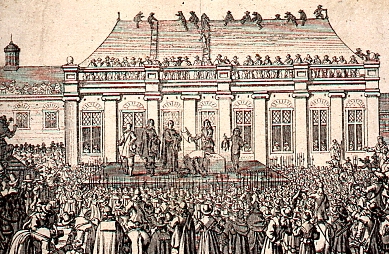
January 30th is the anniversary of the execution of King Charles I. Today, he was beheaded as a murderer and traitor. Or as a Royalist would see it, it is the anniversary of the Martyrdom of Charles I.
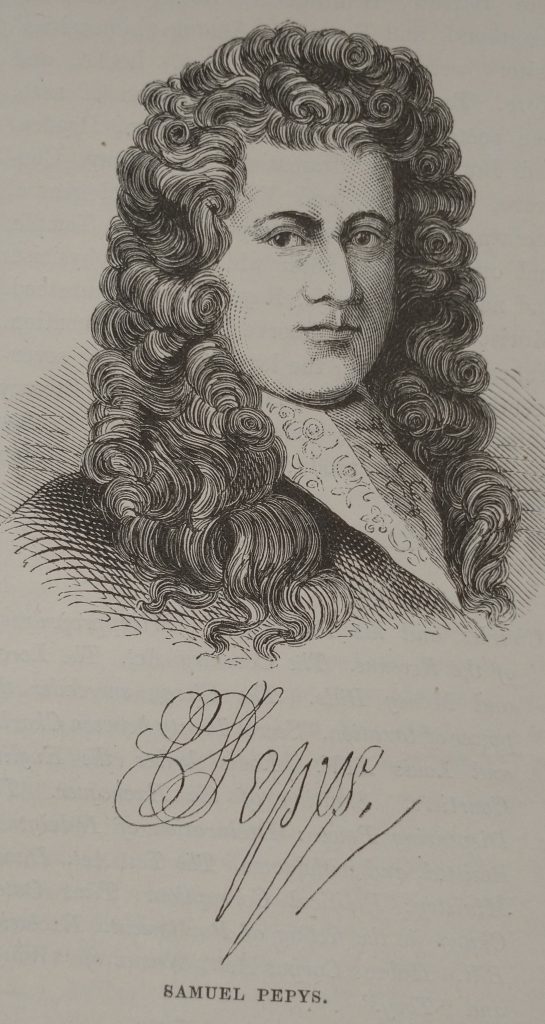
Thousands came to see the execution, amongst them Samuel Pepys. They crowded around the scaffold outside a window of Inigo Jones’s magnificent Banqueting Hall, in Whitehall, London. Charles was brought into the Banqueting House. There he must have looked up at the magnificent Peter Paul Reubens’ ceiling. Charles had commissioned the painting to depict of the Apotheosis of his father, James I. It was the symbol of the Divine Right of the King to rule.
Scaffold to Heaven?
I doubt he saw the irony. I suspect he thought he was going to heaven to join his father, in glory as a Martyr to his religion. He walked outside, through the window, into the cold January air. Two of his bloodstained shirts still exist, probably to stop him shivering. He wanted to be seen as going fearless to his death not shivering with fear. Then, he made a short speech exonerating himself. He spoke without stammering for the first time in his public life. The Rooftops around were lined with spectators. Black cloth framed the scaffold. As the executioner axe fell, there was a dull grown from the crowd (most could not see the axe falling).
This was on January 30th, 1648. But, if you look at a history book, it will tell you it was in 1649. This was before our conversation to the Gregorian calendar. Then the year number changed not as we do on January 1st but on March 25th. This was the day the Archangel Gabriel revealed to the Virgin Mary that she was pregnant. For more on the importance of March 25th look at my Almanac entry here:
‘Oh the stupendous, and inscrutable Judgements of God’
On the same day, twelve years later, in 1661 Oliver Cromwell and his chief henchmen were dug up from their splendid Westminster Abbey tombs. Their bodies were abused by official command. Cromwell’s head was stuck on the top of Westminster Hall. There it remained until blown off in the Great Fire of 1703 (or 1672, or 1684). Then, it taken to Cambridge, Sidney Sussex College, which Cromwell attended. Only the Head Porter knew where. (According to someone who came on my Oliver Cromwell Walk last year.) Whether it is his head or not is disputed. The tale of the head is told in detail here.
The Royalist, John Evelyn, said in his diary:
This day (oh the stupendous, and inscrutable Judgements of God) were the Carkasses of that arch-rebel Cromwel1, Bradshaw, the Judge who condemned his Majestie and Ireton, sonn in law to the usurper, dragged out of their superb Tombs (in Westminster among the Kings) to Tybourne, and hanged on the Gallows there from 9 in the morning till 6 at night, and then buried under that fatal and ignominious Monument in a deep pit. Thousands of people (who had seen them in all their pride and pompous insults) being spectators .
Samuel Pepys records by contrast:
…do trouble me that a man of so great courage as he was should have that dishonour, though otherwise he might deserve it enough…
Pepys served the Parliamentary side before the restoration of Charles II, when he adroitly, swapped over to the Royalist side.
Every year, I do a Guided Walk and a Virtual Tour on Charles I and the Civil War on this day or the last Sunday in January. Look here for details.
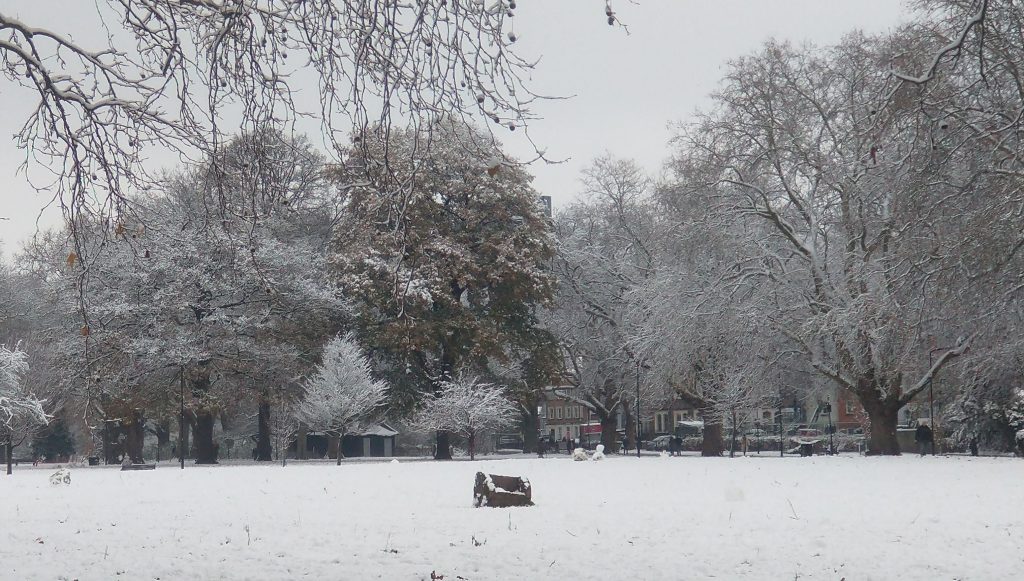
Photo of London Fields in the snow of 2022 by Kevin Flude
January 1776:
‘On the 27th much snow fell all day, and in the evening the frost became very intense. At South Lambeth, for the four following nights, the thermometer fell to 7, 6, 6, and at Selborne to 7, 6, 10, and on the 3ist of January , just before sunrise, with rime on the trees and on the tube of the glass, the quicksilver sunk exactly to zero, being 32 degrees below the freezing point’ Gilbert White
Gilbert White and Darwin
He, of course, is talking Fahrenheit, so well below zero. If there was a Giant upon whose shoulders Charles Darwin climbed, then Gilbert White owned one pair.. He was one of many churchmen of the 18th and 19th Century who spent their extensive leisure time, on observing God’s wonderful creation in their gardens and parishes. What made White so important was that his practice was ‘observing narrowly’ and regularly. For example, his observations of the importance of earth worms were fundamental to Charles Darwin’s own studies. When Darwin came back from his travels on the Beagle, he settled in a country property in Orpington. Like White, he used his garden and the local area as his laboratory. Here he worked to prove his theory of evolution.
Gilbert White and Earth worms
Earth worms were one of Darwin’s passions. This is what Gilbert White wrote about their contribution to nature:
“Earth-worms, though in appearance a small and despicable link in the chain of Nature, yet, if lost, would make a lamentable chasm. For, to say nothing of half the birds, and some quadrupeds which are almost entirely supported by them, worms seem to be the great promoters of vegetation, by boring, perforating, and loosening the soil, and rendering it pervious to rains and the fibres of plants, and, most of all, by throwing up such infinite numbers of lumps of earth called worm-casts, which, being their excrement, is a fine manure for grain and grass.”
By such minute and repeated observations, Gilbert White investigated the food chain, and the migration of birds (which was at the time disputed). He laid the foundations of what we now call ecology.
Gilbert White’s Career
He became Dean of Oriel College in Oxford. But chose to spend his career in the relatively humble occupation of Curate. A Curate is the bottom-feeder in the Anglican Church food chain. A Curate hardly earned enough to maintain a position in the Gentry (£50 p.a.). Although, White was upgraded to the title of Perpetual Curate. He still would only be pulling in, I guess, something like £200 p.a. (Patrick Bronte was also a Perpetual Curate). Essentially, it is Vicar looking after a part of a too large Parish.
Financially, White didn’t need much, he inherited his father’s property at Shelborne, Hampshire. White’s grandfather was the Vicar at Shelborne. But Gilbert could not inherit the title because he went to Oriel College. The ‘living’ of the Parish of Shelborne was ‘in the gift of’ Magdalen College. And they were not going to give the role to an alumnus of a rival college.
Gilbert White & The Austen Family
The house, now open to the public, is just around the corner from Chawton. This is where Jane Austen spent her last years. He was born in 1720; was 55 when Austen was born, and he died in 1793, when she was 18. He lived 4 miles away, so the families knew of each other. We know Jane Austen’s brother wrote a poem about Gilbert White and his natural history observations, particularly on birds.
From ‘Selbourne Hanger’ by James Austen
Who talks of rational delight } When Selbourne’s Hill appears in sight } And does not think of Gilbert White? } Such sure he was – by Nature grac’d With her best gift of genuine taste; And Providence – which cast his lot Within this calm, secluded spot, Plac’d him where best th’enquiring mind Might study Nature’s works, and find Within her ever open book Beauties which others overlook. Enthusiast sweet! Your vivid style The attentive reader can beguile Through many a page, and still excite An Interest in what you write! For whilst observant you describe The habits of the feathery tribe Their Loves and Wars – their nest and Song, We never think the tale too long.
For more information on White and Austen, go to Gilbert White’s House’s web page here:
More Snow!
Here is more of that epic cold January 1776
‘… but by eleven in the morning, though in the shade, it sprang up to I6J,1 — a most unusual degree of cold this for the south of England. During these four nights the cold was so penetrating that it occasioned ice in warm chambers and under beds ; and in the day the wind was so keen that persons of robust constitutions could scarcely endure to face it. The Thames was at once so frozen over both above and below bridge that crowds ran about on the ice. The streets were now strangely encumbered with snow, which crumbled and trod dusty ; and, turning grey, resembled bay-salt : what had fallen on the roofs was so perfectly dry that, from first to last, it lay twenty-six days on the houses in the city ; a longer time than had been remembered by the oldest housekeepers living…..’
‘The consequences of this severity were, that in Hampshire, at the melting of the snow, the wheat looked well, and the turnips came forth little injured. The laurels and laurustines were somewhat damaged, but only in hot aspects. No evergreens were quite destroyed ; and not half the damage sustained that befell in January, 1768. Those laurels that were a little scorched on the south-sides were perfectly untouched on their north-sides. The care taken to shake the snow day by day from the branches seemed greatly to avail the author’s evergreens. A neighbour’s laurel-hedge, in a high situation, and facing to the north, was perfectly green and vigorous ; and the Portugal laurels remained unhurt.’
More Frost!
‘We had steady frost on to the 25th, when the thermometer in the morning was down to 10 with us, and at Newton only to 21. Strong frost continued till the 31st, when some tendency to thaw was observed ; and, by January the 3d, 1785, the thaw was confirmed, and some rain fell.’
Rosemary flowering in my garden, photo by Kevin Flude
Gilbert White’s House is open to the public and also contains a display on Lawrence Oates, who died on Scots Antarctic expedition. For more information look at my post here.
There is another mention of Gilbert White in the Almanac of the Past here.
Herbs: Winter savory, parsley, chervil, coriander, rosemary, bay, sage
Cheeses: Stilton, Lanark Blue
(from the Almanac by Lia Leendertz)
On This Day
1754 – Horace Walpole coined the new word ‘serendipity’ from the ‘Three Princes of Serendip’ fairy tale. The Princes ‘ere always making discoveries, by accidents and sagacity, of things they were not in quest of.’
1898 – Walter Arnold became the first motorist to be fined for speeding. He was going 8 miles an hour in a 2 mile an hour area in Kent
1986 – Explosion of US Space Shuttle Challenger. All 7 astronauts killed, including teacher Christa McAuliffe who would have been the first civilian in space.
The food section posted originally in 2023, the part on Gilbert White written on 28th January 2024, revised 2025, On This Day added 2026
Today is the day after the anniversary of Queen Elizabeth 1’s coronation, 1559. She soon developed enduring relationships with the senior members of her Government. For example, William Cecil, Lord Burghley served the Queen for the rest of his life – from 1558 to 1598 when he died.
Queen Elizabeth I gave leading members of her Court, nicknames. I have been tracking them down. I eventually found a post in The Chronicles of History. The author is a follower of this blog. The Chronicles mentioned three of them, so I went in search for the rest, and here is what I found:
Her chief minister, William Cecil, Lord Burghley, was called her ‘spirit’ and her alleged lover, Robert Dudley, Earl of Leicester, was her ‘eyes’. Rather more cheekily, she called François, Duke of Anjou, her ‘frog’.
Putting my various sources here is my ‘definitive list’.
Elizabeth called Robert Dudley, Earl of Leicester “Eyes” William Cecil was “Spirit” Robert Cecil was her “pigmy” or “elf” Sir Christopher Hatton was “lids” or less flatteringly her “mutton” Francis Walsingham was her “Moor” Francis, Duke of Alencon, (her French suitor) her “frog”
People on the list of Queen Elizabeth I’s Nicknames
A comment on the same page says the ‘moor’ was, in fact, Edward De Vere Earl of Oxford, suggesting the attribution to Walsingham is a mistake. De Vere had a house in Clapton, Hackney, very close to where I lived. De Vere is one of the strongest candidates (or so the conspiracy theorists say) to have written Shakespeare’s plays. Queen Elizabeth 1 has also been named a candidate for the world’s greatest playwright.
Robert Cecil was Lord Burghley’s son and largely took over his father’s role. Christopher Hatton was a handsome aristocrat who had a lovely house and garden in Holborn. It is now a street called Hatton Garden, famous for jewellery and jewellery heists.
Francis Walsingham was the ruthless spy master that helped turn late Elizabethan England into a simulacrum of Stasi East Germany. Duke of Alencon was one suitor she seemed to take seriously, although she gently mocked him. Dudley was her favourite and almost her official escort/companion. (Did she have a sexual relationship with him?)
When I published this recently, I got an email from Jan-Marie Knights, an author, and she was able to persuade me that the Queen loved Dudley like a Brother, but never would marry him.
She showed me an extract from a book which has a letter saying the above – from Lord Burghley to his political agent in Germany. The book is The Private Character of Queen Elizabeth by Frederick Chamberlin (New York: Dodd Mead and Co, 1922).
Here is a photo of a page of the book with the letter.
Extract from the book is The Private Character of Queen Elizabeth by Frederick Chamberlin (New York: Dodd Mead and Co, 1922).
Jan has published a book called The Tudor Socialite, which documents the ‘Tudor High life in bite-sized chunks.’
27BC Gaius Julius Caesar given the title of Augustus by the Roman Senate marking the official end of the Roman Republic.
Another example of how a system with elections and checks and balances can be subverted.
550AD Ostrogoths conquer Rome after bribing the guard.
1275 Edward I allows his mother Eleanor of Provence to expell Jews from Winchester, Cambridge, Marlborough and Gloucester
1537 Bigod’s Rebellion. Following successful negotiations between the Pilgrims of Grace led by Robert Aske, a new rebellion was led by Sir Francis Begod. It failed utterly buy leald to the rescinding of pardons. This saw Robert Aske hanged at York. Bigod and many others were also hanged. The female conspirator was dealt with as follows:
‘And the same day Margaret Cheney, ‘other wife to Bulmer called’, was drawn after them from the Tower of London into Smithfield, and there burned according to her judgment, God pardon her soul, being the Friday in Whitsun week; she was a very fair creature, and a beautiful.’
Wriothesley’s Chronicle
First Published in January 2023, republished in January 2024,2025, 2026
Queen Elizabeth 1 Coronation. Litter at her royal entry, accompanied by footmen and Gentlemen Pensioners. Unidentified engraver. (Wikipedia)
Queen Elizabeth 1 Accession
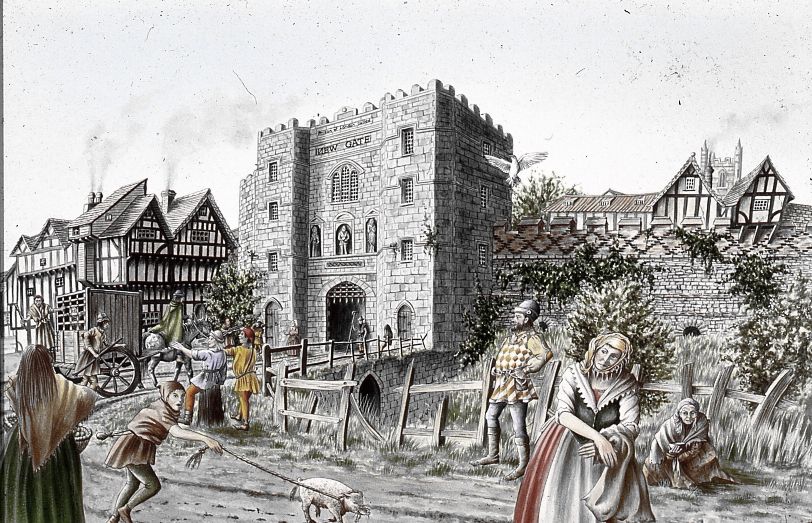
Queen Elizabeth 1 ascended the throne on 17 Nov 1558. Her accession was greeted with an outbreak of joy by the Protestant population. But the supporters of her dead sister Mary 1 did not want a Protestant monarch. On hearing the news of the death, Elizabeth rushed to occupy the Tower of London. She even risked shooting London Bridge, such was her haste. (see my post of the accession of Queen Elizabeth I)
She consulted lawyers about the legal position. Elizabeth, and her sister Mary, were declared bastards by two Succession Acts passed during Henry VIII’s ‘troubled’ married life. The Third Succession Act of 1543/44, following Henry’s marriage to Katherine Parr, restored Mary and Elizabeth to the Royal line. But it did not restore their legitimacy. Rather than tackle the complex legislation, Sir Nicholas Bacon, the Lord Keeper of the Great Seal, advised:
“the English laws have long since pronounced, that the Crown once worn quite taketh away all Defects whatsoever“. (Wikipedia)
Which, when you think about it, basically legitimises any successful ‘coup’! And, from a legal perspective, she was still, arguably, illegitimate.
Queen Elizabeth 1 Coronation
Her courtiers immediately began work on the Coronation, scheduled for January 15th 1559. In terms of Coronations, this was rushed. The precise date was, in fact, chosen by the Royal Astrologer. John Dee, a famous mathematician and credulous astrologer,. He found a date that the celestial bodies deemed propitious. But it needed to be sooner rather than later because Elizabeth’s position was so insecure.
Queen Elizabeth 1 Coronation Procession
The Coronation began with a procession from the Whitehall Palace in Westminster. Then back to the Tower of London for the Vigil. Followed by a Royal Procession through the City of London to Westminster Abbey for the Coronation service. After the Coronation, there was the traditional Coronation Banquet at Westminster Hall.
The Vigil Procession was on the Thames where she was escorted to the Tower by ‘ships, galleys, brigantines‘ sumptuously decorated. The Royal Entry consisted of 5 Pageants and 11 Triumphal Arches.
The first pageant showed the Queen’s descent from Henry VII and his marriage to Elizabeth of York. This marriage effectively ended the Wars of the Roses by linking the House of York and the House of Lancaster. The pageant also emphasised her ‘Englishness’ as opposed to the Spanish affiliations of Mary. The second pageant demonstrated that the Queen would rule by the four virtues of True Religion, Love of Subjects, Wisdom and Justice. At the same time she was shown trampling on Superstition, Ignorance and other vices.
The Procession at Cheapside
The third pageant, at the upper end of Cheapside near the Guildhall, provided the opportunity for the City to give Elizabeth a handsome present. This was a crimson purse with 1000 marks of gold, showing the closeness of the City and the Crown. The fourth pageant, contrasted a decaying country during the time of Mary with a thriving one under Elizabeth. It featured the figure of Truth, who was carrying a Bible written in English and entitled ‘the Word of Truth’. The Bible was lowered on a silken thread to the Queen. The Queen kissed it and laid it on her breast to the cheers of the crowd. She promised to read it diligently. The final pageant was Elizabeth portrayed as Deborah, the Old Testament prophet. Deborah rescued Israel and ruled for 40 years. So she was an ideal role model for Elizabeth. (For more details, look here.)
‘All the houses in Cheapside were dressed with banners and streamers, and the richest carpets, stuffs and cloth of gold tapestried the streets’.
British History.ac.uk Vol 1 pp315 -332
Queen Elizabeth 1 Coronation in Westminster Abbey
The Coronation was traditional – in Latin and presided by a Catholic Bishop, but there were significant innovations. Important passages were read both in Latin and in English. The Queen added to the Coronation Oath the promise that she would rule according to the:
‘true profession of the Gospel established in this Kingdom.’
This showed the path Queen Elizabeth was going to take. She would introduce innovation gradually into tradition, but emphasizing that the fundamentals had indeed changed. This was going to be a Protestant reign.
Can I remind you that I wrote a best-selling book on the Kings and Queens of Britain? It has sold over 130,000 copies, has been reprinted several times and in several editions. Further details here.
On This Day
1535 King Henry VIII became Supreme Head of the Church of England
1759 The British Museum opened to the Public.
1867 Ice breaks on the boating lake at Regent’s Park, London, Forty people die.
2001 Wikipedia Day. The free wiki content encyclopedia launched. (Other days are possible but this one is the earliest recovered wikipedia page. I begin editing pages on November 28th, 2003.
‘Negroland and Guinea with the European Settlements, Explaining what belongs to England, Holland, Denmark, etc’. By H. Moll Geographer (Printed and sold by T. Bowles next ye Chapter House in St. Pauls Church yard, & I. Bowles at ye Black Horse in Cornhill, 1729, orig. published in 1727) Source Wikicommons.
The Royal Africa Company
The Royal Africa Company was set up with a monopoly on trade with the west coast of Africa in:
“redwood, elephants’ teeth, negroes, slaves, hides, wax, guinea grains, or other commodities of those countries”
On January 10th. 1663 King Charles II affirmed the new charter for the Company that, above all else, was responsible for British continuing involvement in enslavement. Shareholders included his nephew, Prince Rupert, Samuel Pepys, and much of the British Establishment, Aristocracy, and City Merchants. Its headquarters were in Cornhill, not far from the East India Company’s HQ. The company was closed in 1752.
Guineas
Gold from the Gold Coast in Guinea was used to make coins, which became known as ‘guineas’. They were originally made from one quarter of an ounce of gold. Below is a sketch of a two guinea coin from the reign of Charles II. Note the elephant at the bottom of the coin.
Sketch of a two guinea coin from the reign of Charles II showing an elephant below the image of the King.
The guinea was original worth 1 pound but fluctuated with the price of Gold. Pepys records it at 24 or 25 shillings. It was eventually phased out, but it became a posh way of expressing value. Ordinary goods would be priced in pounds, but expensive ones in Guineas. By then valued at 21 shillings. (£1 pound 5 pence). Wikipedia suggests it was used for ‘prices of land, horses, art, bespoke tailoring, furniture, white goods and other “luxury” items‘. I remember going shopping with my parents in London and wondering at the fur coats being priced in Guineas. It died out, as a practice, in the 70s.
Enslavement, Government & the Royal Africa Company
There are many sites giving a history of slavery, and the British involvement with it. But, here, I would just like to point out how involved the British Royal Family was in the trade. One of the instigators of the Trade, in the 16th Century was John Hawkins. He secured investment in his second slaving expedition from: Queen Elizabeth I, Robert Dudley, Edward Clinton, Lord Burghley amongst others. Royal involvement in the foundation of the Royal Africa Company was only one of many connections between Royalty and Slavery.
It should be noted that the British education system has emphasised the role of Britain in the abolition of slavery. We are more reluctant to highlight our involvement in setting it up and continuing it. This has begun to change. A new generation of school children in London can visit the excellent London: Sugar & Slavery Gallery at the Museum of London in Docklands.
Compensation for Slavery & Reparations
University College, London has undertaken a profound project where they took the records of compensation payments to:
The slaves, you are thinking?
No, to the slave owners!
The compensation of £20m pounds was provided by a loan to the Governemt by Rothschilds Bank in the City of London. It probably represents around £16billion in modern terms. I have been unsure of the case for historic ‘reparations’. But when ‘we’ compensated the slave owners, it makes the case for compensation to the enslaved overwhelming. The least we can do is to fund projects to correct the educational and life disadvantages of people and countries impacted by slavery. And £16 billion seems like the right amount.
Legacies of British Slave-ownership project
UCL have created a resource where you can click on the streets of London and other areas, to find out the holders of slaves who were compensated in that street.
I looked at the UCL resource looking for the closest slave owner in my area of the East End of London. The nearest person lived about 500 yards away from me. Here are the abridged details from the database. It is very simple to use. Have a go by following this link.
Solomon Nunes Flamengo of Kingston, living at Mutton Lane in Hackney when he wrote his will in 1778. Merchant. Estate probated in Jamaica in 1779. Slave-ownership at probate: 6 of whom 2 were listed as male and 4 as female. 4 were listed as boys, girls or children. Total value of estate at probate: £21356.26 Jamaican currency of which £332.5 currency was the value of enslaved people.
I guess the value of his compensation was £332.5. Solomon was Jewish, which is unusual for the records, by far the majority being Christian. I chose Solomon simply because he was the closest to my house. The UCL website is at https://www.ucl.ac.uk/lbs/.
Britain began regulating the Slave trade in the late 18th Century, abolished the Slave Trade in 1807. Slavery, with the compensation to slave owners in 1833, was abolished but they replaced slavery with apprenticeship – in effect bound labour. This was ended in 1838. For more details look at https://www.parliament.uk/
Slavery or Enslavement
Finally, I have seen several exhibitions and TV documentares in recent months where victims of the pernicious trade are referred to as ‘enslaved’ and not slaves.
It is a profound difference. The victims did not make themselves slaves, they did not identify as slaves. They were forced into lt by violence, kidnap. rape, murder, torture, imprisonment, trafficking, forced exile. They were enslaved.
The World’s Best Cities report makes London the top City followed closely by New York and Paris. London has had top spot for 11 years now. The Report is based on core statistics plus a survey of visitors and residents. It is created by Resonance, a consultancy group working in real estate, tourism, and economic development. They are based in Vancouver.
142026WORLD’S BEST CITIES “London is a city of constant reinvention. It is this remarkable commitment to ongoing growth that has seen us retain our crown as the World’s Best City. In 2025 we launched a 10-year plan for growth in the capital and celebrated a number of wins: record-breaking London-based scaleups going global, growing visitor numbers and an almost £10 billion planned investment in our experience economy over the next decade.” —LAURA CITRON, CEO, LONDON & PARTNERS
AFAR gives a good analysis of Resonance’s methods on its web site:
‘London’s magnetic appeal continues to draw a global audience, from students and entrepreneurs to tourists and corporate titans. The city’s robust recovery post- pandemic is reflected in its strong international traveler spending, which in 2024 reached almost $22 billion (up from $17.4 billion in 2023) and secured London the third-highest amount globally, outpacing destinations like New York and Dubai. Benefiting from a softer pound, London has remained a compelling bucket-list destination. Heathrow Airport recorded record-breaking arrivals, exceeding pre-pandemic passenger levels, and Gatwick Airport’s recent $320-million upgrade underscores London’s infrastructural excellence, enhancing the visitor experience with new concourses and improved amenities. The city’s airports, not surprisingly, rank #1 in our Top 100 cities.’
London No 1. Really?
Last year, I asked the question. Is it a fix? My thought below largely repeat what I said last year. It was a bit of a surprise to me given the hit Brexit has given to the City. But, London’s dominance for eleven years may be because of the consultancy’s focus on real estate as well as tourism and economic development. This gives London a head start as it has long been considered a very safe place to invest in property. London, New York, Paris, Tokyo, Singapore as 1-5 also suggests the report writers might have a bias to the big hitters. This year it notes that tax rises have hit the wealthy sector property prices but, the reduction in prices at the top end has made London very attractive, particularly to Americans. London seems a very sane City when compared to what is going on in America.
What London offers is its status as one of the world’s leading financial/business capitals. Supported by outstanding creative and services industries. At the same time, it has a superb cultural offering and, consequently, high figures for tourism. It is a City that seems to have a deep past behind it and an equally important future ahead.
The future might depend on the growing Knowledge Quarter around Kings Cross. (British Museum & Library, Wellcome Institute, Crick Institute, UCL, Central St. Martins, Google etc.) With Silicone Roundabout and the wealth of investments from the nearby City of London, providing London with a leading place in AI, the Knowledge economy, and Fintech. London also has a very high value on the internet as far as hashtags, and internet searches are concerned. Click here to see last year’s post.
On This Day
1889 The first ‘tabulating machine’ was patented by Dr Herman Hollerith in the US. It provided the beginnings of IBM, and the age of the Computer.
1923 The World’s first Outside Broadcast took place. The BBC broadcasted Mozart’s Magic Flute from the Royal Opera House Covent Garden. Early radios were called ‘Listening In’ devices. (see ‘Lucia in London’ by E. F. Benson).
1940 Rationing Introduced in the UK (initially Bacon, Butter and Sugar).
1947 David Bowie Born in Brixton as David Robert Jones
Today’s Link Rare Iron Age war trumpet and boar standard found in Norfolk. The Britons, and Celts on the continent, used a carnyx to provide the soundtrack to battle. A bit like the vuvuzela used at football matches, they make a horrible noise! This one is one of the most complete ever found. It is found with a Boar’s Head standard. For pictures and more information, look here: https://www.bbc.co.uk/news/articles/cr7jvj8d39eo
Created on January 8th 2026 based on a similar post for 2025.