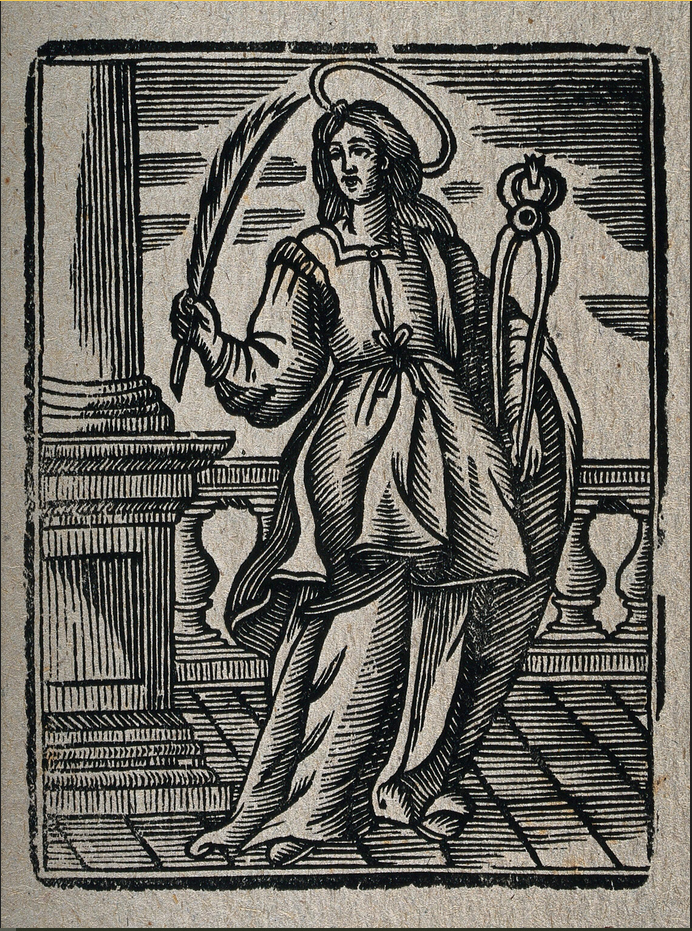
The 9th of February is the Feast of St Apollonia. She was martyred at Alexandria in 249 AD during the persecution of Emperor Decius. (see also my post on St Agatha) She was attacked during an anti-Christian riot and struck around the face knocking her teeth out. Then, she was taken to a bonfire and told they would throw her in if she did not renounce her faith. So, without waiting, she spoke a prayer and walked into the fire. This information is recorded in a near-contemporary letter from St Dionysius of Alexandria. This is rare well documented martyrdom. Because her teeth were knocked out she is, therefore, Saint of Toothache.
Suicide or Martyrdom?
St Augustine of Hippo touches on this spat of martyrs, often young women, killing themselves rather than losing their virginity, or like St Apollonia embracing death in the face of violent persecution. His answer is that like Samson, they are commanded by God to take their own lives, which is ok. Elsewhere, he condemns suicide as it is against the commandment ‘Thou shalt not kill’. He explains that God did not add ‘thy neighbour’ to it so it also forbids killing oneself. By contrast, it was added to ‘Thou shalt not bear false witness against thy neighbour’. The rest of St Augustine’s argument comes from Plato’s Phaedo. The introduction to the book on the Project Gutenberg web site sums up the arguments:
According to one explanation, because man is a prisoner, who must not open the door of his prison and run away—this is the truth in a ‘mystery.’ Or (2) rather, because he is not his own property, but a possession of the gods, and has no right to make away with that which does not belong to him.
The Project Gutenberg EBook of Phaedo, by Plato translated by Benjamin Jowett
Cloves for Toothache
I can remember my Grandmother prescribing cloves for me when I had toothache. And this was, and is, a common remedy. In my case, we would keep a clove or two in the mouth close to the site of the pain. According to Natural Ways to Sooth an Toothache cloves contain
‘Eugenol, a natural form of anaesthetic and antiseptic that helps get rid of germs. Eugenol is still used in dental materials today’
Dr John Hall, Shakespeare’s son-in-law, tended to use a pill to soothe sore gums. He also used an oil from a wood called ‘Ol. Lig. Heraclei’ which may be oil from the Bay Tree. (‘John Hall and his Patients’ by Joan Lane). Most of his tooth cases seem to be sore gums. This suggests to me Dr John Hall did not generally do dental work.
Death by Toothache
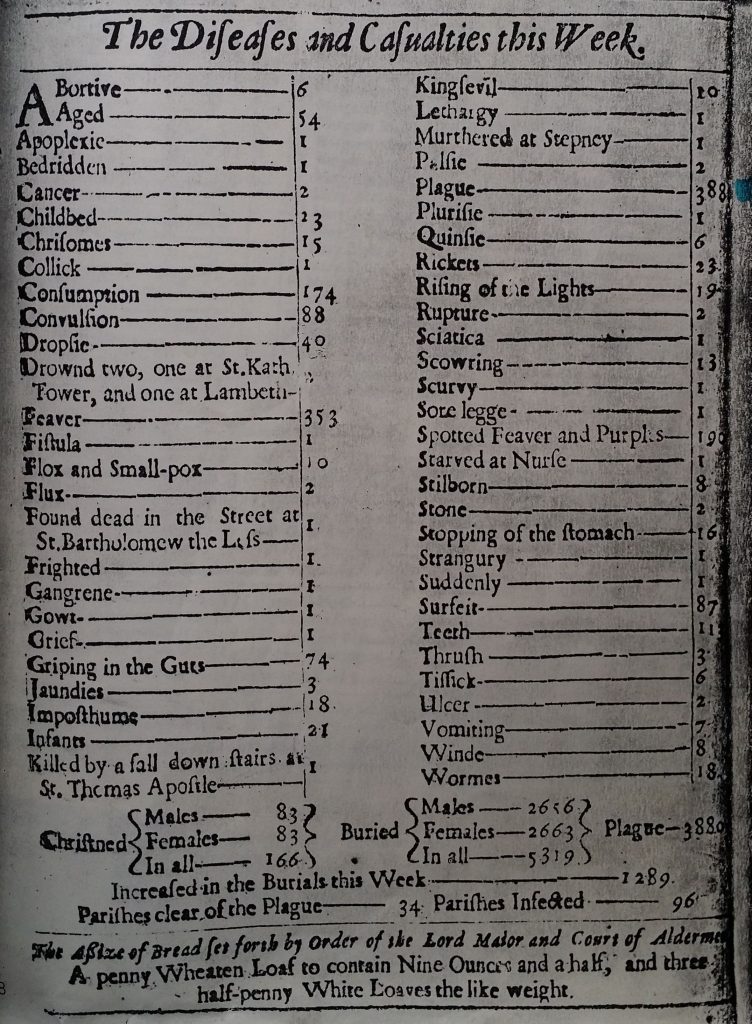
To get a tooth drawn you could go to a Barber Surgeon, a Blacksmiths or specialist Tooth Drawer. It would be terrifyingly painful. Probably only done when the pain was unbearable. Just think what a premium you would pay for a really competent drawer? The drawers would not have any formal training, but the skills would be passed on by the drawer to his apprentice or assistant. ‘Teeth’ was a common cause of death – most likely from infection or an abscess.
Magic and Toothache
John Aubrey, an erudite and educated 17th Century writer, reports on the use of Magick for tooth care. When he relates these unlikely cures he often provides information that the person who told him the story is worthy of belief. So he seems to give some credence to the efficacy of these magical ‘cures’. But, judge for yourself; this is what he wrote:
To Cure the Tooth-ach.
Take a new Nail, and make the Gum bleed with it, and then drive it into an Oak. This did Cure William Neal, Sir William Neal’s Son, a very stout Gentleman, when he was almost Mad with the Pain, and had a mind to have Pistoll’d himself.
To Cure the Tooth-ach, out of Mr. Ashmole’s Manuscript Writ with his own Hand.
Mars, hur, abursa, aburse.
Iesu Christ for Marys sake,
Take away this Tooth-ach.Write the words, Three times; and as you say the Words, let the Party burn one Paper, then another, and then the last.
He says, he saw it experimented, and the Party immediately Cured
Teeth and the Body-Snatchers
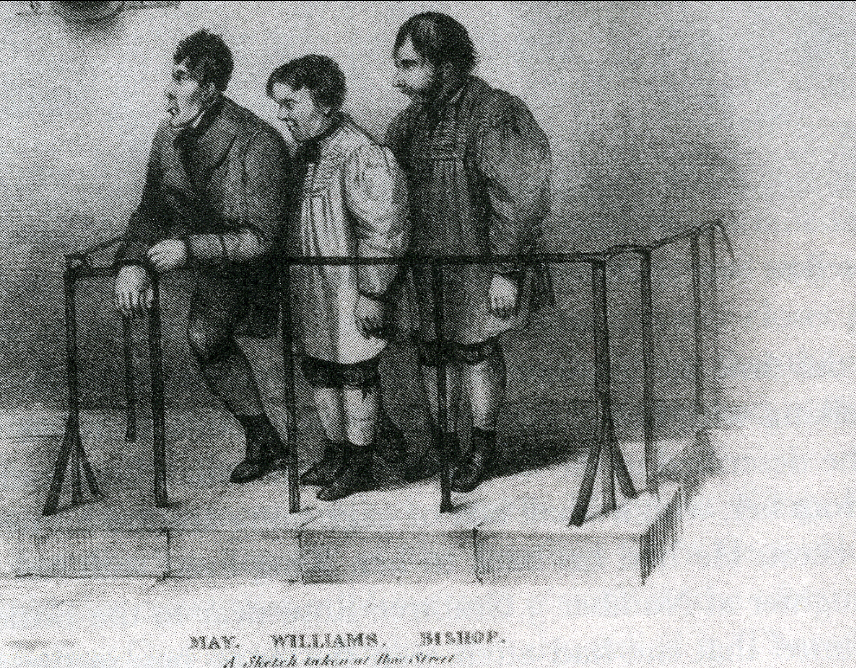
In 1832, in London Bishop, Williams, and May were accused of body snatching. After killing the Italian Boy (wonderful book by Sarah Wise ‘The Italian Boy‘) they jemmied out his teeth. Then, took the teeth to a South London Dentist. with whom they bargained for a good price. (They used the term ‘cheapened’ – I cheap, you cheap, we are cheapening: meaning to barter). The dentist wanted to use the dead boy’s teeth for false teeth for his patients. If memory serves, he paid £1 for them.
The teeth were used as evidence in the trial of the murderers. When the trial was over and the accused punished, the dentist asked for the teeth back! Two of the murderers were hanged but the third freed for turning King’s Evidence. Thereafter, the teeth were released back to the Dentist. He promptly put them in the window of his surgery as an advert for his professional skills!
Earlier, one of the Borough Boys Resurrectionist gang (based in Southwark, London) toured the battlefields of the Peninsular Wars collecting teeth. He made a substantial sum selling them to dentists as false teeth. They became known as Waterloo Teeth.
When I first wrote this in I added ‘How things have changed!’ But in recent years there have been reports of people undertaking their own dental work, if they cannot get access to an NHS dentist. Effectively, it seems that the Conservative Government was allowing dentistry to slip out of the NHS just like it did with eye health. For a study in what has happened to Dentistry in the UK in recent years, please look at this report here.
On This Day
1907 – the National Union of Women’s Suffrage Societies (NUWSS or Suffragists) organised the so-called the Mud March. This was the ‘first large procession’ in support of votes for women. It was called the Mud March because of the downpour of rain on the day.
1916 – Conscription started in World War 1 with the call-up of unmarried men aged between 18 – 41.
1933 – The Oxford Union passed the resolution ‘the House will in no circumstances fight for King and Country.’
Bird of the Month The Blackbird. The common Blackbird is a true Thrush. The male is black with a yellow beak and the female is dark brown with a yellow beak. The Blackbird begins to sing as early as January, and is one of the birds who sing first early in the morning. British Blackbirds do not migrate, but Northern European Blackbirds often migrate to the UK in the winter for warmer weather. Viruses have put the species under some threat and they need help to get through the winter. ArkWildlife suggests this is what you should feed blackbirds:
- ‘Mealworms A top choice, mimicking their natural insect diet.
- Suet and fat balls Provide energy, especially in winter.
- Soaked sultanas and currants Easier to digest than dry fruit.
- Specialist blackbird seed mixes These contain sunflower hearts, raisins, and mealworms.
- Pinhead oats and porridge oats Avoid sugary or flavoured varieties.
- Soft fruits, chopped apples, pears, grapes, or soaked raisins.’
For more bird advice see https://www.arkwildlife.co.uk/ from which the above feeding advice is taken.
Here is a blackbird song, royalty free, from https://creazilla.com/search/audio/blackbird.
Four and Twenty Blackbirds backed in a pie
Is an 18th Century nursery rhyme which refers to the medieval habit of baking a pie crust, and putting it over a bowlful of live birds. When it was opened all the birds, well sing the song to remind yourself what they do?
Sing a song of sixpence
A pocket full of rye
Four and twenty blackbirds
Baked in a pie
When the pie was opened
The birds began to sing
Wasn’t that a dainty dish
To set before the king?
The king was in his counting house
Counting out his money
The queen was in the parlor
Eating bread and honey
The maid was in the garden
Hanging out the clothes
When down came a blackbird
And pecked off her nose
Sing a song of sixpence
A pocket full of rye
Four and twenty blackbirds
Baked in a pie
When the pie was opened
The birds began to sing
Wasn’t that a dainty dish
To set before the king?
A stinging Cure for Lust
Another story told of the Blackbird is a similar tale I have told before about holymen and temptation. So St Benedict was pecked on the cheek by a Blackbird. Next day he finds himself assailed with lust. It was the Devil disguised as the Blackbird he decides that infected the Monk. Then Benedict did what a number of saints did in similar circumstances. He threw himself, naked, in a patch of nettles and brambles and rolled around, until his body was sore afflicted. But he had overcome his lust.
Then St Kevin held out his hand and a blackbird laid her eggs in it. So he stayed still for the two weeks it took the fledglings to hatch! (for more on St Kevin see my post here)
Icy Sedgwick has an excellent website on the folklore of Birds, containing a nice podcast, which for those who love a north-east accent will enjoy.
For my post on Robins and Wrens look here.
First written February 2023, revised February 2024, 2025. On This Day, Bird of the Month were added 2026