Anglo-Saxon Easter

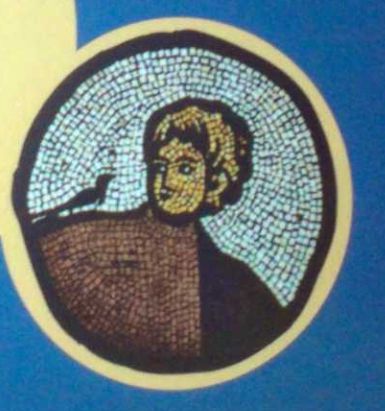
Lullingstone Mosaic representing Spring
Easter – Lullingstone Roman Mosaic representing Spring

The German name for Easter is Ostern. The English name is Easter which the Venerable Bede, in the 8th Century, derived from the Goddess Eostra. They probably have the same derivation. But this is all the evidence there is for the Goddess, despite many claims for the deep history of Easter traditions.

Easter, Estry and Canterbury

Philip A. Shaw has proposed that the name of Eastry in Kent might derive from a local goddess, called Eostra. Canterbury had a leading place in the development of the early Church both in England and Germany. So, perhaps, this led to the adoption of a local cult name in these two countries. Otherwise, the name for Easter in Europe derives from Pascha which comes from the Hebrew Passover and Latin. In French it’s Pâques, in Italian Pasqua, Spanish Pascua; Dutch Pasen, Swedish Påsk; Norwegian Påske and so on.

The Church’s Choice for the Date of Easter

The timing of Easter is the first full moon after the Spring Equinox. I have already explained that Spring was the time the Church set for the Creation, the Crucifixion and other key points in the Christian Calendar. See my post the-beginning-of-the-universe-as-we-know-it-birthday-of-adam-lilith-eve-conception-of-jesus-start-of-the-year.

Eleanor Parker in her lovely book ‘Winter in the World’ gives a lyrical insight into how the dates were chosen. The Anglo-Saxons held the belief that God would only choose the perfect time for the Creation and the events of Easter. The Creation began with the birth of the Sun and the Moon. So it was fixed to the Equinox, when the days were of equal length, and the fruits of the earth were stirring into life. But Holy Week also needed to be in harmony with the Moon. Therefore, Easter was tied, like Passover, to the first full moon after the Equinox, which is also when the events take place in the Gospels.

Winters in the World by Eleano Parker

The quotations Parker uses from early English religious writing and poetry shows a profound interest in nature and the universe. It is a very appealing viewpoint. It seems to me that this is something the Church lost in later times, and replaced with a fixation with dogma and ‘worship’ of the Holy Trinity, rather than a spiritual sense of wonder at the Universe.

Celtic & Roman Churches in Conflict

At the time, fixing the date of Easter was very controversial as the Celtic Church in Britain had a different calendar to the Roman Catholic Church. Easter fell on a different day. The Anglian King of Northumberland, for example, celebrated Easter on a different day to that of his wife. King Oswiu was exiled to Ireland where he was influenced by Celtic Christianity. His wife, Eanflæd, from Northumberland, had been baptised by the Roman Catholic missionary, Paulinus.

Easter and the Synod of Whitby

Oswiu, became King of Northumberland and ‘Bretwalda’ (ruler of all Britain). He encouraged a reconciliation. This culminated at the Synod of Whitby (664AD), between the two churches. The Celtic Church finally agreed to follow the Catholic calendar and other controversial customs. The Abbess at Whitby during the Synod was Hilda of Whitby. The Celtic position was defended by Bishop Colmán and the Roman position by St Wilfred. Bishop Colmán resigned his position as Bishop of Lindisfarne, returned to Iona and then set up a monastery back in Ireland. Wilfrid studied at Lindisfarne, Canterbury, France and Rome. After her husband’s death, Queen Eanflaed became Abbess of Whitby,

The antagonism between the two churches went back to the time of St Augustine in the early 7th Century. In a meeting between St Augustine and Celtic churchmen, St Augustine was judged to have been arrogant, unwilling to listen. So agreement was not reached. Sometime afterwards, the Anglo-Saxons attacked the Celts at the Battle of Chester. Hundreds of monks from the Abbey at Bangor were slaughtered.

Days off at Easter & Rituals

Ælfric of Eynsham gives a powerful commentary on the rituals of the Church over Easter. They were full of drama and participation. These included Palm leaf processions on Palm Sunday, feet washing and giving offerings to the poor on Maundy Thursday. Then followed three ‘silent days’ with no preaching. Instead there were rituals and services aiming to encourage empathy for the ordeal of Jesus. This included the nighttime service of Tenebrae. All lights were extinguished in the Church while the choir sang ‘Lord Have Mercy’. The darkness represented the despair that covered the world after Jesus’ death. Good Friday was the day for the adoration of the Cross. The Cross would be decorated with treasures and symbolised turning a disaster into a triumph.

It seemed to me that I saw a wondrous tree
Lifted up into the air, wrapped in light,
brightest of beams. All that beacon was
covered with gold; gems stood
beautiful at the surface of the earth,….

The Dream of the Rood quoted in Eleanor Parker’s ‘Winter in the World’

The Harrowing of Hell

The days before Easter Sunday are known as the ‘Harrowing of Hell’. This was a very popular theme in the medieval period (featuring in Piers Plowman for example). Jesus went down to hell to free those, like John the Baptist, who had been trapped. Becauase when he died the world had no saviour until the first Easter. The name ‘Harrowing’ comes from ‘Old English word hergian ‘to harry, pillage, plunder’. The ‘Clerk of Oxford’ Blog provides more information on the Harrowing of Hell on this page,

The Clerk of Oxford Blog is written by Eleanor Parker. She started in 2008, whilst an undergraduate student at Oxford. The blog won the 2015 Longman-History Today award for Digital History‘.

The above is but a very poor précis of Eleanor Parker’s use of Anglo-saxon poetry and literature. She brings an Anglo-Saxon Easter to life. So if you are interested to know more please get a copy of her book.

Easter Days off

King Alfred’s law code gave labourers the week before and after Easter off work. This made it the main holiday of the year.

First Published in 2023 and republished in 2025, 2026

The Beginning of the Universe as We Know It; Birthdays of Adam, Lilith, & Eve; Conception of Jesus, Start of the Year March 25th

Lilith is shown coming her hair and looking in a mirror
Study for Lady Lilith, by Rossetti. 1866, in red chalk. Now in the Tel Aviv Museum of Art (Wikipedia
Study for Lady Lilith, by Rossetti. 1866, in red chalk. Now in the Tel Aviv Museum of Art (Wikipedia) Lilith born at The Beginning of the Universe

This is now my most popular post. March 25th is the Annunciation—the day that the Archangel Gabriel tells Mary she is pregnant. (to see some very fine paintings of this meeting, look at my other March 25th post march-25th-feast-of-the-annunciation/). When I first wrote this post I was discovering how it all fitted together as I wrote.  So I’m leaving it the way it was, proof reading and clarifying if necessary, but keeping the thrill of the discovery of the the significance of March 25th as the day that saw the Beginning of the Universe.

March 25th is also the anniversary of the birth of Adam and Eve (and Lilith); the death of Jesus Christ; the anniversary of the Immolation of Isaac; the Parting of the Red Sea; the Fall of Lucifer; and, (until 1752 in the UK) the beginning of the Year. 

Of course, it isn’t. Or to put it another way, no one can, or ever could, prove any of these dates except 1752. So what they speak to is the way the Church saw the world as logically structured by God. Christian thinking about the year, the world, the universe, creation, developed over many years and took influences from many cultures. It is also very complicated to work out the sequence, so I’m going to summarise what I know (or at least what I think I know).

Happy Birthday, Dear Jesus.

Christians chose Christmas Day as the Birthday of Jesus, probably partly because it was a prominent birthday already shared with several Gods.  Particularly, Attis, Mithras,  Saturn and the Unconquered Sun. It was approximately at Solstice, the beginning of the Solar Year, and close to one of the main festivals of the Roman World, the Saturnalia. So it made it easier for new converts who could retain elements of their festivals after conversion.

December 25th might have been selected by the pagan religions because it is the time when the Sun begins to rise further north each day.  The days stop shortening and start lengthening, light increases with the promise of warmer weather and budding plants. It was considered a rebirth of the Sun.

Solstice Anniversaries

So, Jesus was born on/or around the Solstice, so he must have been conceived approx. 9 months earlier.  This is approximately at the Spring Equinox.

Ah, you are thinking!  But today isn’t the equinox. It’s a few days after the equinox. Surely, God doesn’t do approximately?

I have always thought that the 4 or 5 days difference between the Solstice, the Equinox and the Christian festivals was down to the fact that the Calendars were not well coordinated with the actual movements of the Sun (because the Sun does not circle the earth in 365 days, or in 365 and a quarter days, but 365 days, 6 hours, 9 minutes. Unless corrected for this means dates slip from their proper place in the Solar Year. It also makes lunar Calendars difficult to align with the Sun cycles, and vice versa.

But when I first wrote this a sudden revelation dawned upon me which will be revealed in the next few paragraphs.

So, God sends his Son to save the human race. God is a logical being, so she would send her Son at an appropriate time? If Jesus is born at or near the Solstice, which is an appropriate time for the Son of the Creator, then conception 9 months earlier, March 25th, is near the Equinox.  This is the beginning of Spring. For many people, Spring is a new beginning, for example, the Anglo-Saxons saw Winter as the death of the year, and Spring as the young Year. It all makes sense.

The Creation

So to the Creation. God, having a free choice, would have created the world at the beginning of Spring. In fact, if you think about it, God creates everything necessary for life at the creation in 6 days. As soon as it has all been created and put together, it is bound to immediately spring into new life. The first season must, therefore, be Spring? Right? So March 25th?

This gives a nice symmetry with Jesus’s Life. Conceived on March 25th, born December 25th, and died 30–40 years later, according to the Church, at Easter, on March 25th. (the only other famous person I know, born and died on the same day is William Shakespeare).

Easter

Easter, when Jesus is martyred, isn’t March 25th I hear you saying. But remember, Easter is a lunar festival, so its date varies each year. In fact the next time is 2035. Births and deaths, on the other hand, are fixed to the Solar Calendar. Therefore, the Church chooses March 25th as the most appropriate day to pin the death of Jesus, on the anniversary of his conception and the anniversary of the creation of the Earth. I am guessing that this is also the preferred date for the Day of Judgement.

It is also the Birthday of Adam, and his first wife Lilith (or so some say), and Eve. More about Lilith below. I hope this is all making sense?

Why was Adam born on March 25th?

I had thought this date was just one of the parallels that the Church liked, Jesus and Adam born on the same day. But, I have just worked out why Adam is born on March 25th, and why these dates are not the Equinox, March 20th/21 but March 25th, which has been bugging me.

Let’s go back to the beginning of Creation as described in Genesis. It has the following sequence of Seven Days, beginning with the Equinox March 20th. I have added dates to the 6/7 day sequence of Creation:

  • Day 1: Light – March 20th
  • Day 2: Atmosphere / Firmament – March 21st
  • Day 3: Dry ground & plants – March 22nd
  • Day 4: Sun, moon & stars – March 23rd
  • Day 5: Birds & sea creatures – March 24th
  • Day 6: Land animals & Adam, Lilith and Eve – March 25th
  • Day 7: The Sabbath of rest – March 26th
  • For more information www.bibleinfo.com

So there you have it! Adam, Eve (and Lilith) were created on Day 6 with the Land Animals – March 25th. Jesus conceived, also on this date, and so 9 months later is born on December 25th. It all makes sense, and aligns the Jesus’s Life, the Christian year fully with the Solar Year and the Creation!

And that, dear Reader, is the very first time anyone has been able to explain to me why Christmas is not at the Solstice, and why the Annunciation was not at the Equinox. Maybe you all know this, but it is very exciting to work this out for myself. And believe me, I have done a lot of reading about calendars and not spotted an explanation.

When was the Creation?

The Anno Munda‘s is a Jewish Calendar which begins counting from a year before the Creation – the Year of Emptiness. This was 5500 years plus 2026 years ago so 7526 Before the Present. And it was supposed to have ended in 600AD, 6000 years after the Creation. So, they got that wrong.

Dionysius Exiguus replaced the Anno Mundo year with the AD/BC system in the 6th Century AD). This became popular when the Venerable Bede used it in his writings in the 8th Century.

Beginnings of the year

The Celts chose October 31st, Julius Caesar chose January 1st, other cultures have other dates, and the Spring Equinox is another choice sometimes made. The Church and Dionysius Exiguus choose March 25th, although secular society also recognised the claims of January 1st. Britain kept to March 25th until 1752 when we adopted the Gregorian Calendar. But people like Samuel Pepys celebrated New Year’s Eve on 31st December. So January 1st was the secular New Year, but the Christian year number did not change until March 25th. So King Charles I thought his head was being cut off on January 30th 1648; while history books will tell you it was cut off on January 30th 1649. Same day, same head, different reckonings.

January 1st, the New Moon and New Year

December 31st/January 1st is essentially a Solstice New Year Festival. And I have, previously, used the difficulty of keeping calendars as to why these days has slipped out of alignment with the Solstice. But, today I realised that it is as likely that the reason is the Solar/Lunar nature of our time keeping. The year, and its festivals, is largely arranged around the Solar Cycle. But our weekly and monthly cycles are orginally derived from the Moon.

The first of a month, was called the Kalends by the Romans, the Nones the half moon, and the Ides signified the New Moon. The kalends of January is then, originally, the First New Moon after the Winter Solstice. So, January 1st is not a slightly misdated Solstice Festival it is a Festival celebrating the first New Moon of the New Year! Sorry, to seem excited but this is the first time I have realised this.

Over time societies give up trying to sync the lunar and solar calendars. Roman and Christian cultures gave up and fixed the moon months, completely abandoning any attempt to keep the months to the actual lunar cycle. This is our current system, in which only Easter and festivals that depend on Easter remain  true to the movements of the moon festival, much to our perennial confusion.

Maybe you all know this, but it’s put many things into perspective for me!

Lilith

The April 2023 Issue of ‘History Today’ had a short piece called ‘The Liberation of Lilith’ which suggests that the story of Lilith, a figure from Jewish Folklore, is first attested in a Medieval satirical text called ‘The Alphabet of Ben Sira’. The story goes that Lilith is created from the same clay as Adam. Adam then demands she lies below him during sex. She refuses, saying that they are both made from the same stuff and, therefore, equal. Adam refuses to accept this, and so Lilith leaves the Garden of Eden. So the story goes.

The story of Lilith, Sarah Clegg suggests, is one of a series of similar stories found around Europe and Asia. And Clegg assumes that it is gradually modified to make Lilith a demon who will kill babies unless the names of three angels are spoken out loud.

The story survived as a charm to keep babies safe, and perhaps to remind people of equality among the sexes. But this causes problems for, OK, let’s call them out, the Patriarchy. Lilith cannot be equal to Adam so she is made into a monster, not made from the same clay as Adam but from the scum and waste left over from Adam’s creation. I imagine the story then went on to propose that God creates Eve from Adam’s rib, and so she is created from Adam, and is, therefore, not equal, but subservient to him, although not as bad as Lilith. Lilith is now a significant figure in feminist folklore circles.

I wrote about more about eras and ages in my post which you can see her: Greater Cycles and the Six or Seven Ages

Lilith by Rossetti

Attached to the watercolour of Lilith by Rossetti (at the top of the page), was a label with a verse from Goethe‘s Faust as translated by Shelley. (Wikipedia)

“Beware of her fair hair, for she excells
All women in the magic of her locks,
And when she twines them round a young man’s neck
she will not ever set him free again.”

The model is Fanny Cornforth, Rossetti’s mistress. He painted another version a few years later, but the model in that is Alexa Wilding. His models are arguably more interesting than the man himself and include: Elizabeth Siddall, Jane Morris and Fanny Cornforth. Christina Rossetti, his poet sister, modelled for Rossetti’s painting, Ecce Ancilla Domini which you can see here.

For more on the Annunciation, look at my other March 25th post here.

I think I might have enough material to begin my own Cult.

First Written 25th March 2024, revised 2025, 2026

Greater Cycles & the Ages of Man December 19th

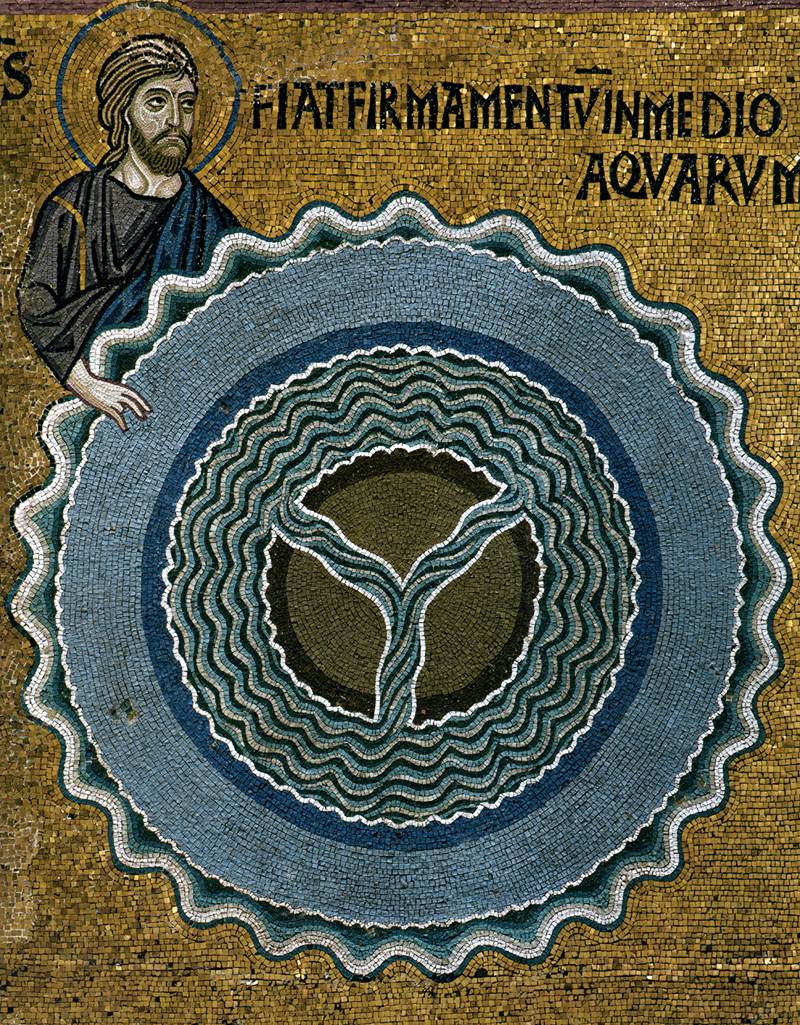
Capella Palatina Palermo 12th Century Mosaics God is shown creating the firmament. ‘And God said, Let there be a firmament in the midst of the waters, and let it divide the waters from the waters’

We are coming up to the key days in the year. And so will be looking at calendars and counting days. But what about ages, epochs and aeons?

‘Practical Magic in the Northern Tradition’ reports that there are seven ages of the world:

This is how they calculate it: the life of a yew tree is 729 years, and there are seven ages from the creation of the world until its doom. So the world will last 5103 years.

‘Practical Magic’ divides ages up as follows:

A wattle has a life of 3 years (1*3)
Three wattles are the life of a hound – 9 years (3*3)
Three hounds are the life of a steed – 27 years (9*3)
Three steeds are the life of a man – 81 years (27*3)
Three men are the life of an eagle – 243 years (81*3)
Three Eagles are the life of a yew. – 729 years (243*3)

How Old is a Yew Tree/Eagle

A comment by a reader has prompted me to write the following about the ages given above:

‘Practical magic’ says the poem is ‘Ancient’. So it’s folklore and not science, and the ages are opinion not scientific fact.

As I understand it Yew trees live a long time but not quite as long as many people think. I base this on the Yew Tree at Steventon, Hampshire where Jane Austen was born. The tree has/had a plague on it saying it was 1200 years old. I used to visit it regularly. On one visit, I was told that an expert opinion suggested it was more like 700 years old. (ifmy memory serves). I do not have the details, but my source would have been one of the people associated with the Church.

The Woodland Trust (says Yew Trees get old at 900 years. They cite a few which are ‘said to be’ over 2000 years old. But are they? The scientific sites I have looked at suggest that Yew Trees should be described as ‘ancient’ from 400 not 900 years. There are problems with dendrochronology dating of yew trees, and so most methods depend upon an estimation from the width of the tree trunk. But that, itself, depends upon how much you believe in the claims of the ancient trees. So, I think it’s best to take the extreme cases with a very large pitch of salt. So 729 years is probably not so far off the mark for a Yew tree.

As to Eagles, this website on eagles says they can live to 30ish in the wild and 68 years in captivity. So the claim for 243 years is way off the mark! Wattles what are they? I have searched, but not found any reference. My guess is a short-lived bird.

The End Was Nigh

Archbishop Usher of Armagh (1581 – 1656) calculated that the world was created in 4004 BC. He counted the begettings in the Bible. If we accept his date, and apply the seven yew tree ages rule (5,103), then the world should have ended in AD 1099 (give or take a year). But it didn’t end then, did it? We are in the 9th Age and counting.

It doesn’t make sense to me to have a factor of 3 for the smaller divisions, and then to switch to a factor of seven. Surely, far more logical is to have a factor of 3*3 years. So, if there were nine ages of the world, then it would survive for 6561 years, which will end in approx. 535 years time (cAD2557). This calculation has the massive advantage of not yet being proved wrong! (Please note, cult owners, I have copyright on this date).

It’s notable that when a Cult declares the imminent end of the world, and they trudge up to the top of a high eminence to observe it (normally by Hampstead Pond in London). They seem quite happy to trudge back down again. Soon they are up and running again with the same enthusiasm for the next ‘end of the world’ date.

Of course, the world was created around 4.54 ± 0.05 billion years ago according to Wikipedia. According to the Doomsday Clock the world will end at 12 O’clock and we are 89 seconds away from it. This is based on a catastrophic end for our civilisation. If we avoid this then other scientists have suggested mammals will be wiped out in approximately 250 million years.

Abrahamic Ages

The Jewish tradition was for six or seven ages of 1000 years. The seventh didn’t really count because it was the age of the messiah when there was a 1000-year sort of super sabbath. Or another idea is that it was an age that ran parallel with the other six. So the world was to be 6000 years long.

With the coming of Christianity, dating the Creation, and (therefore the Day of Judgement) became more important. The Romans dated from the foundation of Rome, and the Greeks from the First Olympiad. But beyond that they had a whole mythology and creation myths about an Age of Gold. Followed by a Bronze Age (Troy and all that) followed by their very own base Iron age. You can read about this in my post about Hesiod.

The Anno Munda

An early Christian attempt to tell the age of creation was the Anno Munda‘s arrangement of the Year. This is pretty complicated and is based on a Talmudic tradition. A late Roman version uses ‘the Diocletian Years’, which is when the persecution of Christians began. It held that the world was created 5500 years before the Birth of Christ. So we are 5500BC plus 2025 years since the date of the creation. And it was supposed to have ended in 500AD. 6000 years after the Creation. so we have outlived Creation by 1525 years.

St Augustine of Hippo took the tradition of six ages and brought it into the Christian canon. These are the six ages:

  • The First Age “is from the beginning of the human race. That is, from Adam, who was the first man that was made. Down to Noah, who constructed the ark at the time of the flood“, i.e. the Antediluvian period.
  • The Second Age “extends from that period on to Abraham, who was called the father indeed of all nations”.
  • The Third Age “extends from Abraham on to David the king”.
  • The Fourth Age is “from David on to that captivity whereby the people of God passed over into Babylonia”.
  • The Fifth Age is “from that transmigration down to the advent of our Lord Jesus Christ
  • The Sixth Age: “With His [Jesus Christ’s] coming, the sixth age has entered on its process.”

Wikipedia.

As each age is 1000 years, then you can see why so many people were worried as 1000 AD approached.

The Seven Ages of Man

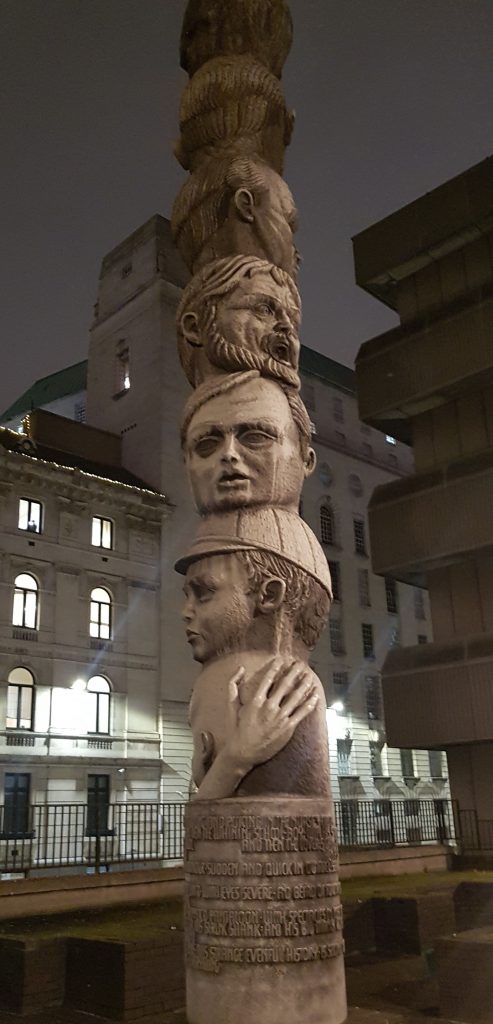
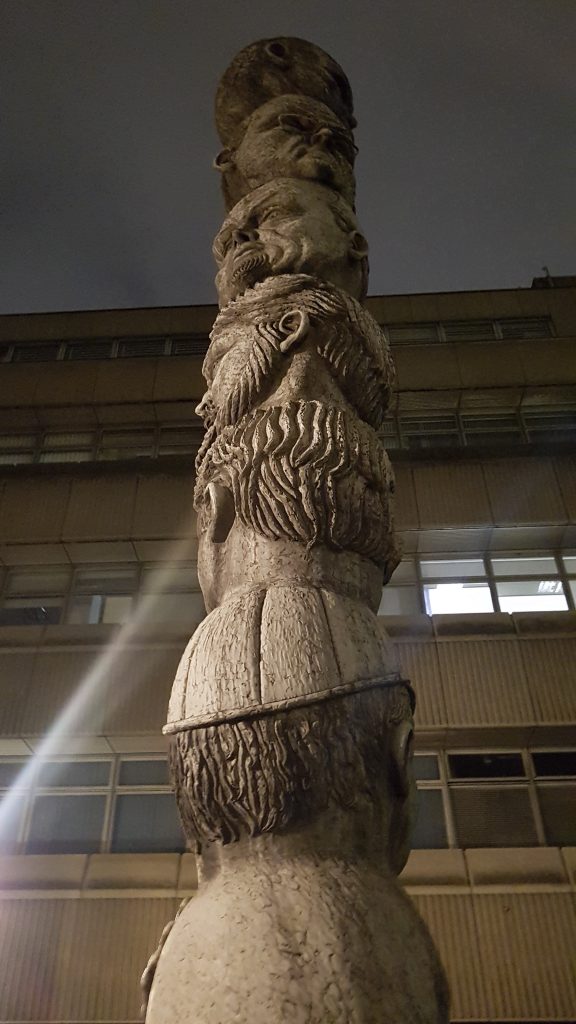
The Age of Man can also relate to the average age of a human lifespan. Of course, six is not such a magical number as seven, and so Shakespeare ran with the idea in the Seven Ages of Man spoken by Jacques in ‘As you like it’. If there are seven ages of human life, and we have a span of six score and ten, then each age is ten years.

All the world’s a stage,
And all the men and women merely players;
They have their exits and their entrances,
And one man in his time plays many parts,
His acts being seven ages. At first, the infant,
Mewling and puking in the nurse’s arms.
Then, the whining school-boy with his satchel
And shining morning face, creeping like snail
Unwillingly to school. And then the lover,
Sighing like furnace, with a woeful ballad
Made to his mistress’ eyebrow. Then, a soldier,
Full of strange oaths, and bearded like the pard,
Jealous in honour, sudden, and quick in quarrel,
Seeking the bubble reputation
Even in the cannon’s mouth.

And then, the justice,
In fair round belly, with a good capon lined,
With eyes severe, and beard of formal cut,
Full of wise saws, and modern instances,
And so he plays his part. The sixth age shifts
Into the lean and slippered pantaloon,
With spectacles on nose and pouch on side,
His youthful hose, well saved, a world too wide
For his shrunk shank, and his big manly voice,
Turning again toward childish treble, pipes
And whistles in his sound. Last scene of all,
That ends this strange eventful history,
Is second childishness and mere oblivion,
Sans teeth, sans eyes, sans taste, sans everything.


(Jacques, Act 2, Scene 7)

The Kalendar of Shepherds

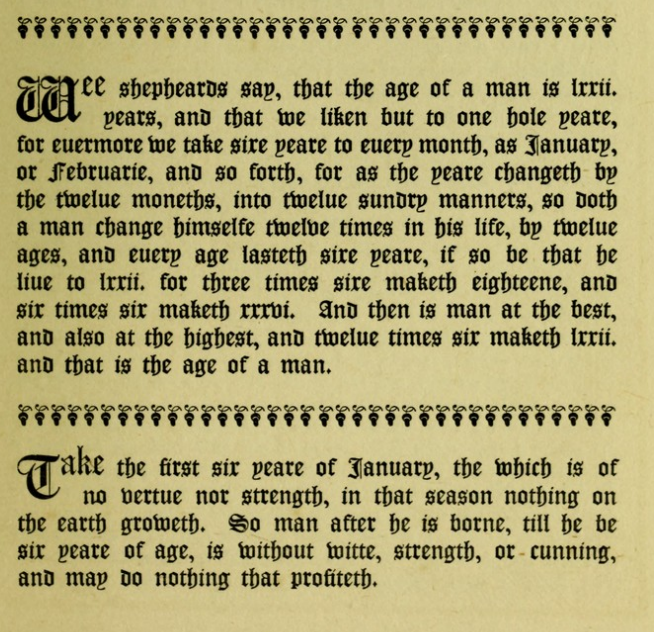
Now, the Kalendar of Shepherds has a similar idea, but it calculates it differently. The Kalendar, based on a 15th Century French original, says there are 12 ages of man, corresponding with the 12 months of the year. Each age is 6 years long, and so our likely lifespan is 72.

Kalendar of Shepherds

Each month is allocated to one of the ages, and has an insight into human life for that span. In January, the first 6 years of a human life are mapped out. If you read above you will see we have no ‘wit, strength or cunning. Nor ‘may do nothing that profiteth’ in those first years. A little harsh, and as a fond grandfather, it, I refute it. In December, the last 6 years are prefigured.

Our alloted span, says Practical Magic is 81 years, Kalendar of Shepherds say 72, and Shakespeare offers us 70.

The Office of National Statistics says:

In 2022 to 2024:

  • Life expectancy at birth in the UK was 83.0 years for females and 79.1 years for males. This is an increase of 18 weeks from 82.7 years for females and 21 weeks from 78.7 years for males since 2019 to 2021.

Capella Palatina, Sicily

By the way, the Capella Palatina, illustrated at the top of this post, is a marvel of gold mosaics. It is absolutely stunning. It makes a trip to Palermo a must.

On This Day

1843 – Charles Dickens published ‘A Christmas Carol’

First Published on December 18th 2022, revised and republished in December 2023, 2024,2025