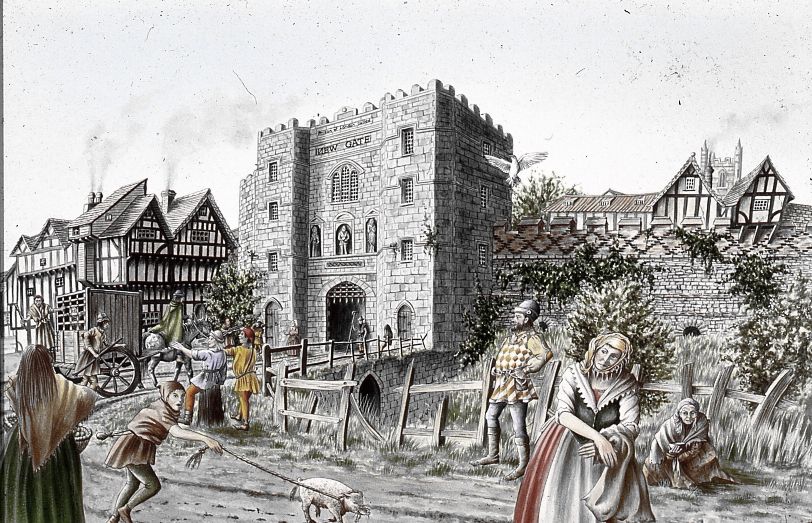
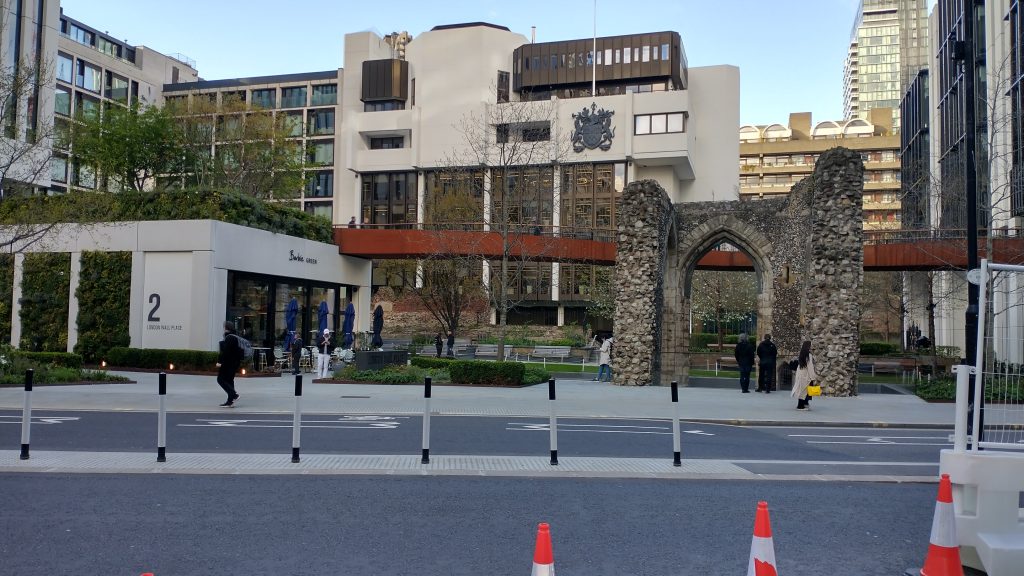
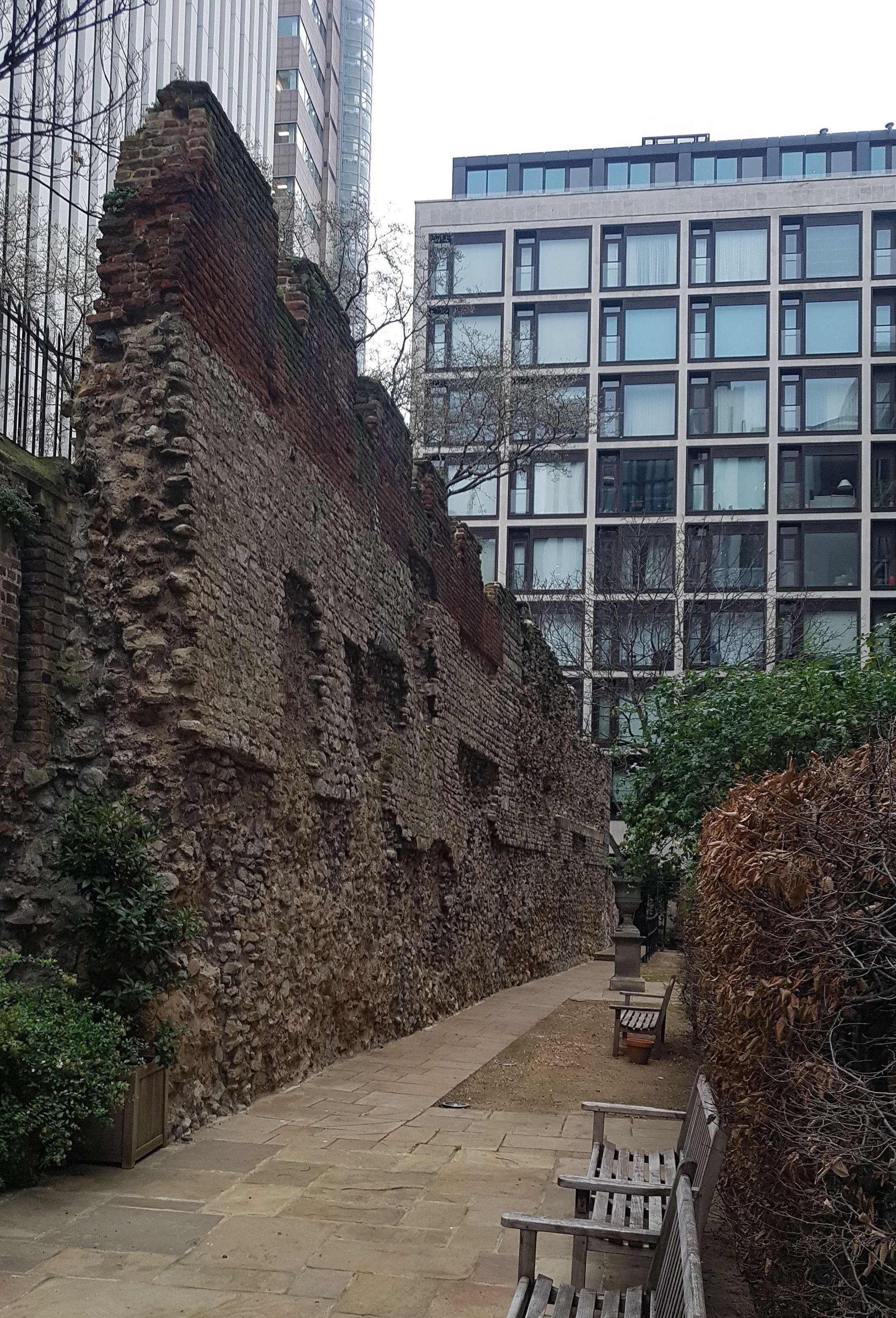
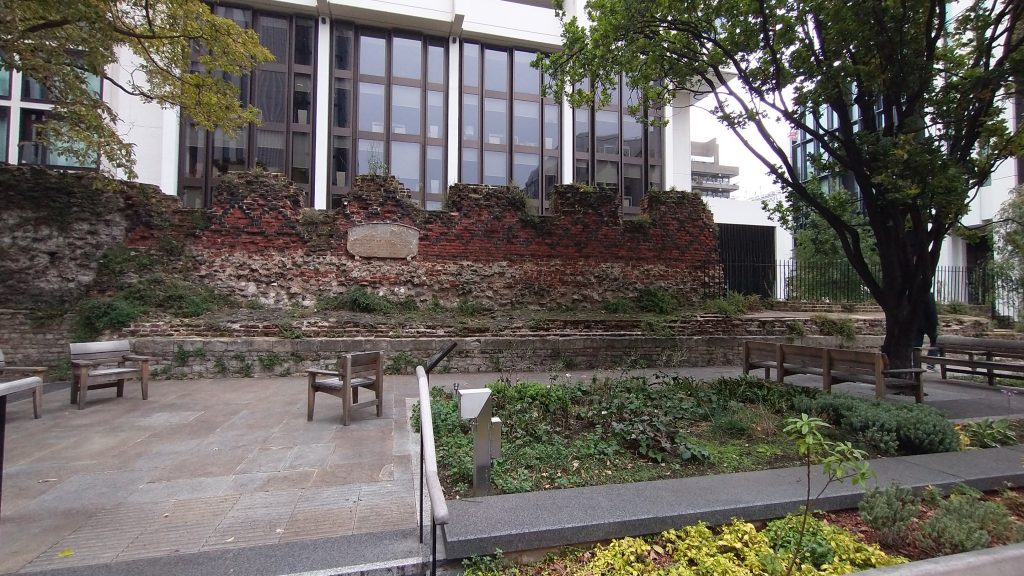
St Alphage. Church Tower on right, City Wall to left. Photo K Flude
I first came across St Alphage when I was working at the Museum of London. The Museum was built on the High Walk at London Wall. The raised Courbusian Walkway looked down on a ruin of a Gothic Church Tower, almost destroyed during the Blitz. This was St Alphage, a Church dedicated to the Saxon Archbishop of Canterbury. (Alphage is also spelt Alphege or Alfege or Ælfheah.)
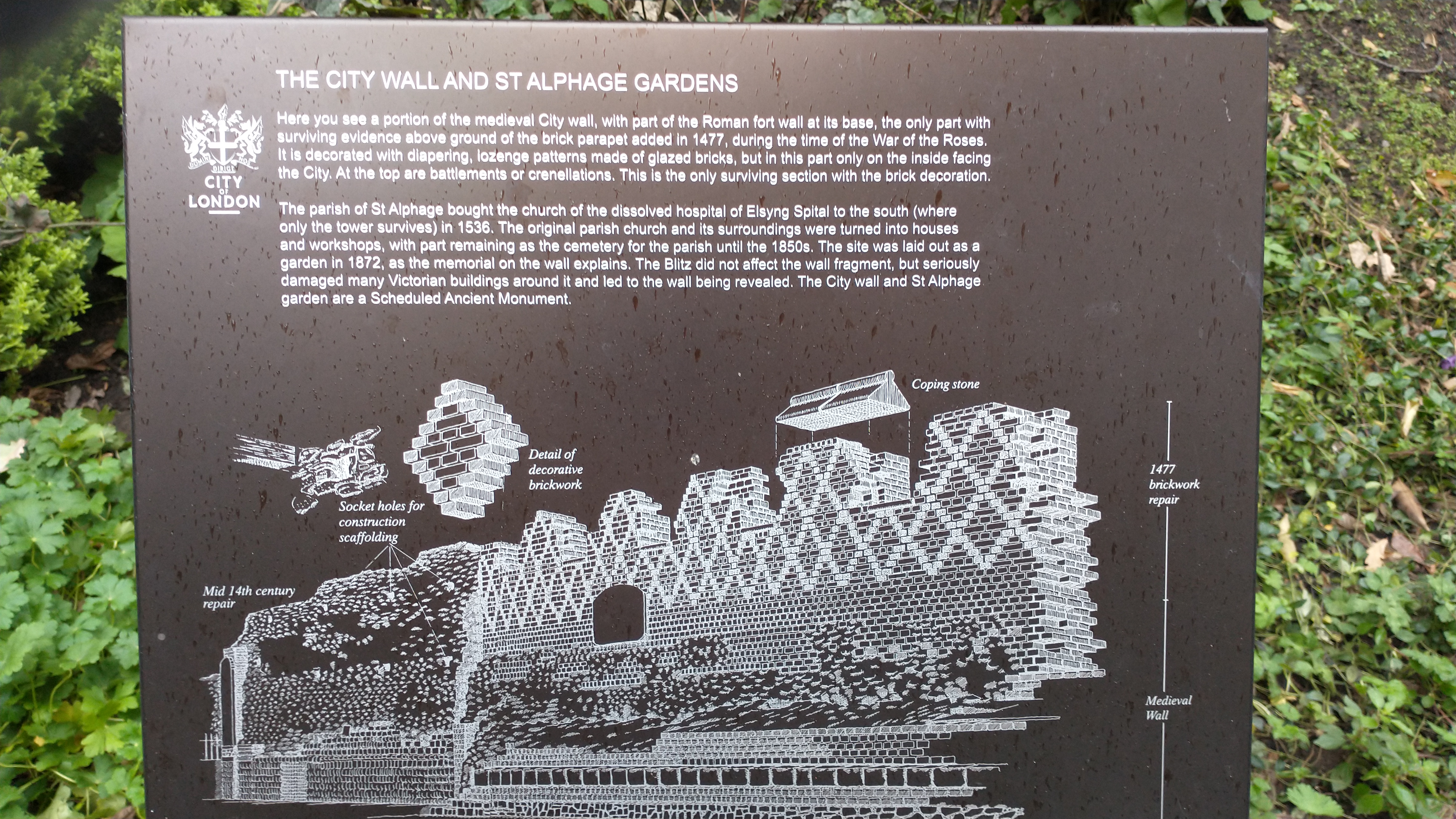
On the other side of the Walkway was the old graveyard of the Church. This preserved one of the very best sections of the old London Wall. Special because on one side its full height was displayed. On the other, the only crenelated bit of the City Wall survived. And the only surviving part of the Wall dating to the War of the Roses.
St Alphage Roman and Medieval WallThe Crennelated Red Brick Section dates to 1477, during the War of the RosesSt Alphage Wall explained on an information plaque.
In the 1980s fellow Museum of London Archaeologist, Paul Herbert and I set up a Guided Walks company (Citisights of London). Our walks started from outside the Museum of London, and so St Alphage formed a big part of our success. It led to Guided Walks and tours being a big part of my life. So, St Alphage, thank you!
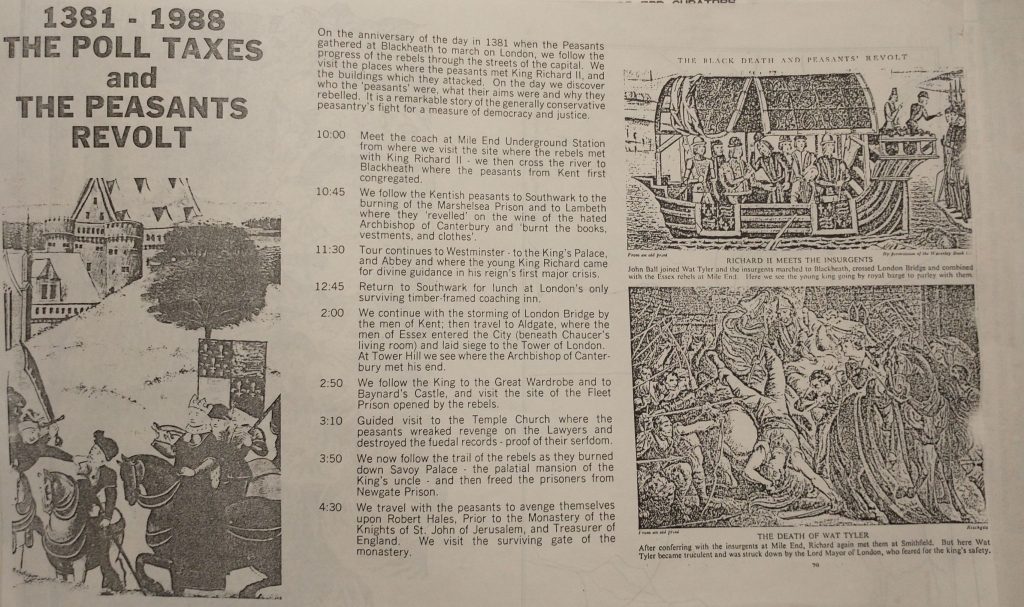
A Citisights Day Tour the Peasants Revolt (1980s)
St Alphage, Elsyng Spittle and St Mary
The Church was previously a monastic settlement called Elsyng Spittle (aka St Mary within Cripplegate). The Augustinian Canons looked after 100 blind men. It was refounded by Williain Elsing, and dissolved by Henry VIII in 1536. The Church was kept for a Parish Church. But the Puritans were not keen on dedications to St Mary. So, they renamed it after a London based Christian Martyr.
It remained a Parish Church until damaged in an air raid in World War One. (possibly on 8th September 1916 in a Zeppelin Raid – but I am speculating). The Church was partly demolished in 1923, leaving the Tower. The lower part of the Medieval Tower survived bombing in the Blitz. At 12.15 am on 25th Aug 1940, the first bombs on the City of London fell nearby in Fore Street. But the tower was hit in 1940. It was listed Grade 1 in 1950. Kept by the rebuilding of London Wall, and the Barbican area. Then substantially benefitting from a remodelling of the area in an excellent scheme of 2022.
St Ælfheah of Canterbury and Greenwich
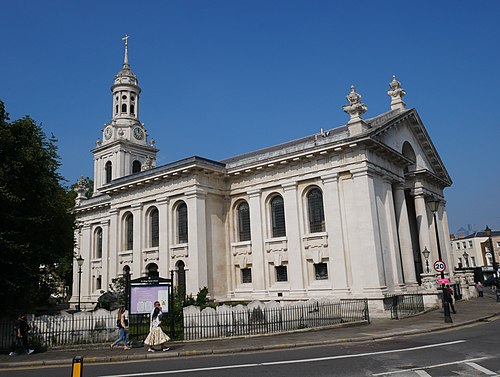
StAlfege Greewich – Doyle own work Wikipedia CC BY-SA 4.0
St Ælfheah was captured during a Viking attack on Canterbury. The Viking hoard relocated to Greenwich where they tried to negotiate a fat ransom for him. He was one of the richest men in the Kingdom. This is what the Anglo Saxon Chronicle says:
.. the raiding-army became much stirred up against the bishop because he did not want to offer them any money, and forbade that anything might be granted in return for him. Also they were very drunk, because there was wine brought from the south. Then they seized the bishop, led him to their “hustings” on the Saturday in the octave of Easter, and then pelted him there with bones and the heads of cattle; and one of them struck him on the head with the butt of an axe, so that with the blow he sank down and his holy blood fell on the earth, and sent forth his holy soul to God’s kingdom.
St Alfege Greenwich, which is now a lovely Hawksmoor Church is said to be on the site of St Ælfheah‘s death. Thorkell the Tall tried to save the Archbishop, but failed and subsequently changed sides and joined the English King. Thrum, who was converted by Alphage, ended his agony by hitting him on the head with the butt of an axe. This seems like a strangely Viking form of mercy!
St Alphage’s body was taken to St Pauls Cathedral where it became venerated and brought income to St Pauls. His remains were removed in suspicious and violent circumstances by soldiers of King Cnut who translated the Saint’s bones to Greenwich. It is suggested King Cnut was punishing London for their opposition to him.
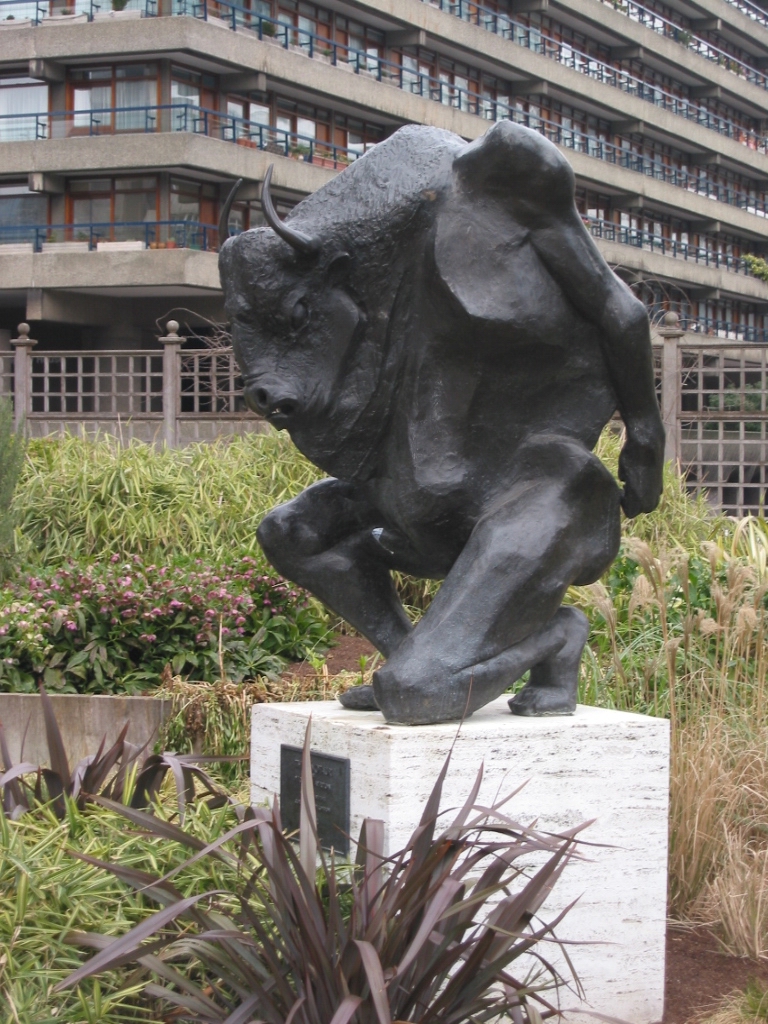
The Minotaur by Michael Ayrton
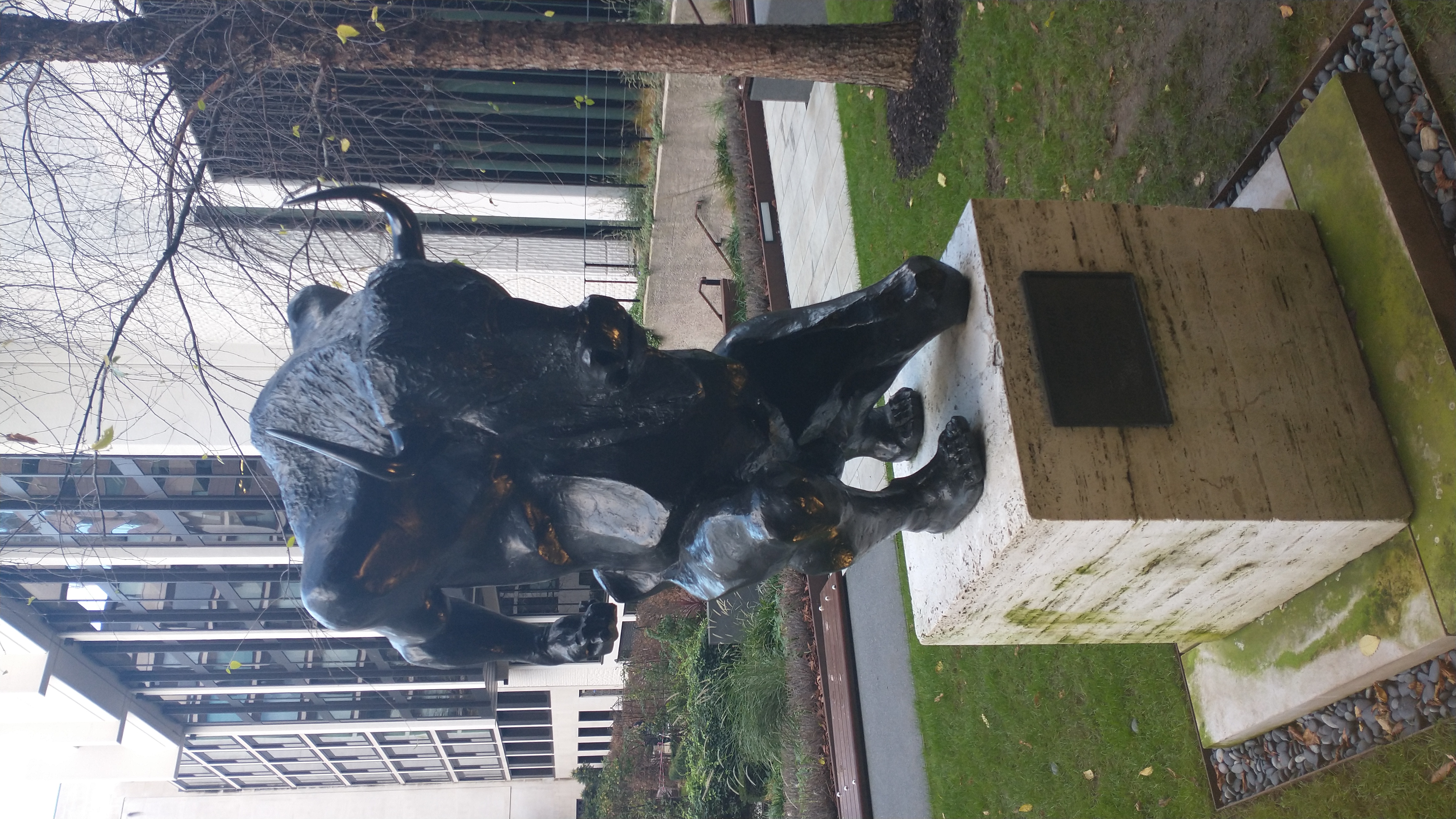
Also, part of the experience of visiting St Alphage from the High Walk was the statue of the Minotaur. I first came across this phallic Bull in Postman’s Park and am very fond of him. Then it disappeared and reappeared on the High Walk. Now it is on the ground level near the garden of St Alphage.
I understand that Michael Ayrton wanted to make a point about the destruction of London. He felt that the developers were more destructive than the Luftwaffe. They were like a Bull in a China Shop! So he created this statue of a very vigorous Bull (represented by the Minotaur). It is a very unusual work of art in that it sports a fully erect penis. Art History is full of naked women, but the erect male organ has largely not been seen to be a fit subject for art. For more about Ayrton follow this link.
The Minotaur in its present positionThe Minotaur on the High Walk
On This Day
1775 – Battles of Lexington and Concorde begin the American Revolutionary War.
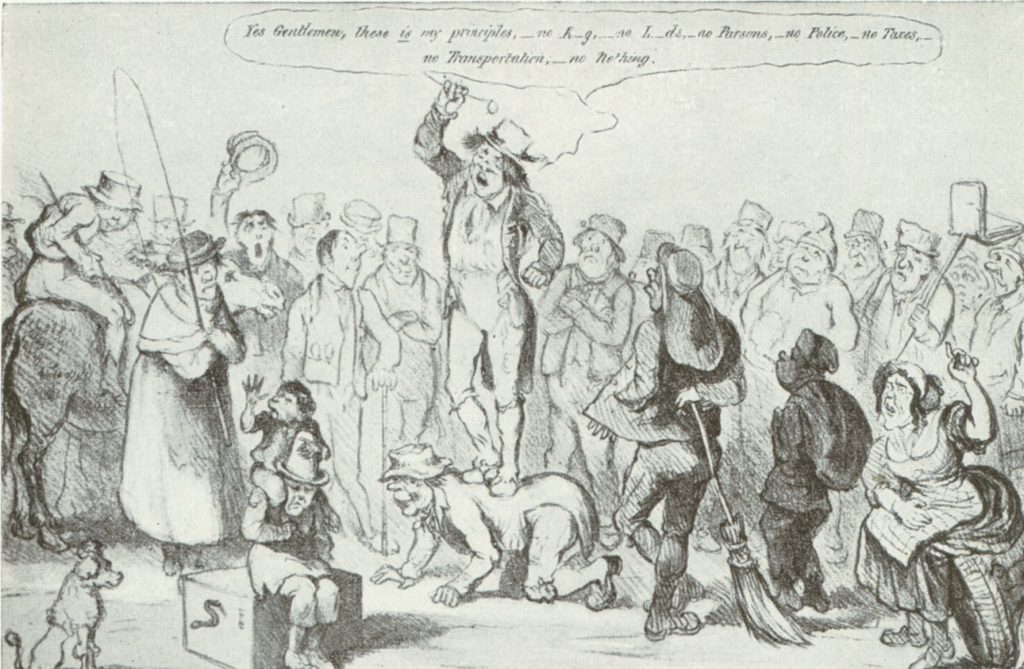
Victorian lampoon on Socialist Values ‘Yes Gentlemen, these is my principles, no King, no Lords, No Parsons, No Police, No Taxes, No Transportation, no No’thing.’
Walk of Socialists at St. Paul’s February 28th & London Socialism 1887
My French friend went yesterday to St. Paul’s and saw a large procession of socialists. It is a strange move of the socialists to visit all the Churches. The Archdeacon of London preached to them from: “the rich and poor meet together, and the Lord is the maker of them all.” A noble sermon, they behaved fairly well.
Helen G. McKenney, Diary, 1887 (source: A London Year. Compiled by Travis Eldborough and Nick Bennison)
The quotation is from the Bible, Proverbs 22, where it sits with a number of other wise sayings. Perhaps, number 16:
‘One who oppresses the poor to increase his wealth and one who gives gifts to the rich—both come to poverty‘
is most likely to stir a Socialist. I imagine the Archdeacon was also making a point that the Lord made the Rich and the Poor. So there is nothing wrong with being Rich, as long as you are generous to the Poor. Equally, nothing wrong with being Poor.
Bloody Sunday
It’s rather lovely to imagine the Walk of Socialists walking around Wren’s masterpieces in the City of London. However, later in 1887, things turned much worse. The Social Democratic Federation and the Irish National League organised a march against Unemployment and the Irish Coercion Acts. Among the 10 to 30 thousand citizens present were William Morris, Annie Besant , George Bernard Shaw and Eleanor Marx.
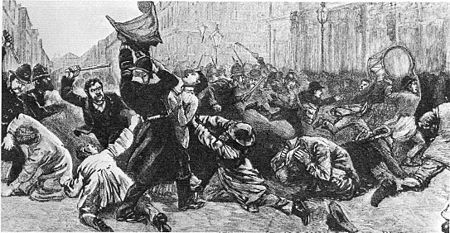
The Police had been trying to prevent the ever-increasing use of Trafalgar Square and Hyde Park as protest venues. So, on November 13th, Bloody Sunday, the Police Commissioner, Charles Warren, ordered a massive police presence. He backed this up with 400 Soldiers. He aimed to prevent the entry to Hyde Park. Warren was acting as a caretaker until a new Commissioner was in place. He had already resigned following criticism of the failure to find Jack the Ripper. By the end of the day there were 2 people dead, 100 seriously injured, and 45 arrests, as well as 75 accusations of police brutality. On the other hand there were many police casualties.
Engraving from The Graphic (published 19 November 1887). Wikipedia describes it as ‘depicting a policeman being clubbed by a demonstrator as he wrests a banner from “a Socialist woman leader, one Mrs. Taylor”, while other people are covering their heads to protect themselves from raised police batons.’ Pubic Domain
Progressive Politics
Before the Foundation of the Labour Party, progressive politics were in the lukewarm hands of the Liberal Party. This Party developed from the Restoration period Whig Party. Although, the Liberal Party had a radical wing, it had a reluctance to put forward working-class candidates. In the early 19th Century, much of the agitation was led by a movement called the Chartists. But as their goals became adopted by the main two parties, progressive politics was led by various reform, radical, socialist, marxist and anarchic groups.
I have not been able to find out who led the 1887 Walk of Socialists around the City Churches. However, William Morris’ presence suggests the Socialist League? In 1885, the Socialist League was an offshoot of the Social Democratic Federation. But it was not a harmonious group. Its most famous members were William Morris, and Eleanor Marx. It included Fabians, Christian Socialists and Anarchists. By 1887 it was split ideologically into three main factions, Anarchists, parliamentary orientated Socialists, and anti-parliamentary Socialists. William Morris was the editor of their newspaper, ‘the Commonweal’ but he was sacked and replaced by Frank Kitz as the Anarchists took over the organisation.
So, without going into a long history of Socialism in London, what happened was that the Socialist groups made very little impact until the Independent Labour Party was set up in Bradford 1893. And in 1900, Keir Hardie, who was already an independent MP in Parliament, set up the Labour Representation Committee in 1900. This was soon renamed the Labour Party. The Independent Labour Party joined, and Labour began to take over control of the working-class vote. It fought for this with the Liberal Party. The Liberal vote, declined after WW1 and Labour was able to secure minority Governments. After World War 2 the Labour Party replaced the Liberals as one of the two Political Parties which could win a majority in Parliament.
London ‘Soviets’
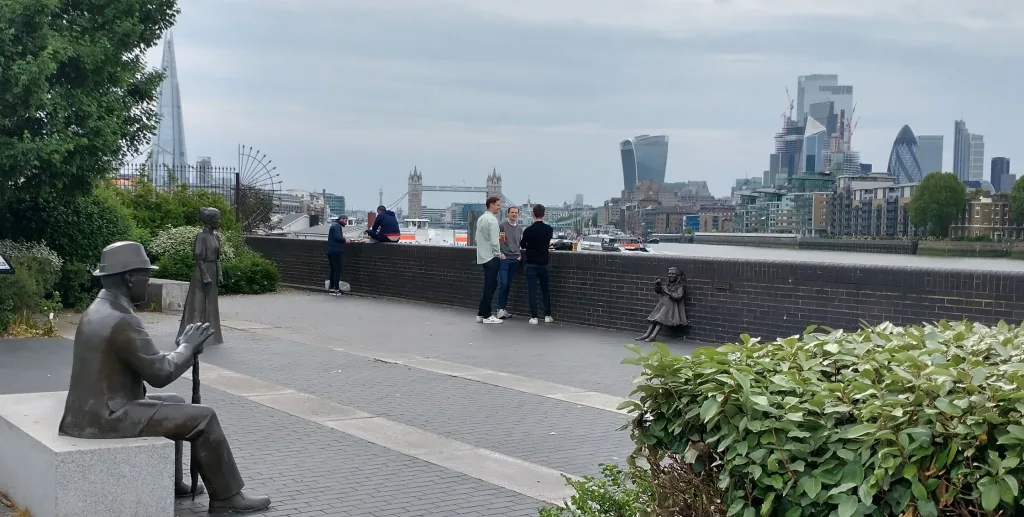
London was one of the places where the Party experimented with left wing policies. The East End areas of Poplar, Limehouse and Bermondsey were particularly important. Alfred and Ada Salter were ‘typical’ activists. She became the first female Mayor of a London Borough. She was Returning Officer when her husband was elected MP for Bermondsey. His medical practice gave free medical care for poor people. From this they established a free medical clinic, that was a forerunner to the formation of the National Health Service. The London Councils also led the way in promoting mass council housing and Trade Union reform.
Here is a part of a letter from Alfred to Ada:
“Oh, the cruel wickedness of our society today! To thrust down these people by means of low wages and chronic unemployment into hopeless despair, and then leave them in that condition with no organised or conscious effort to rehabilitate them. What can we do?”
“You and I feel we have the same mission in life… we are living and working for the same goal- to make the world, and in particular, this corner of the world, happier and holier for our joint lives.”
Fenner Brockway said that in his youth Salter was a “Settlement firebrand – militant Republican, militant Socialist, militant Agnostic, militant Teetotaller, militant Pacifist.” Alfred converted Ada to Socialism and she converted Alfred to Christianity. They became Quakers.
Statues of Alfred Salter (sitting down) Ada Salter (behind his walking stick) and their only daughter Joyce (leaning against the River wall) who died aged 8 of Scarlet Fever. Garden near the Angel Pub, Rotherhithe. Photo K Flude
Life-long Labour voter
My Grandma, who was born in Hoxton in 1902, voted for Labour all her life. I’m pretty sure it was out of class loyalty because I always thought her opinions were more traditional than progressive. But she would never dream of voting anything other than Labour. For more on Hoxton and revolution, you may want to see my post on Hoxton and the Gunpowder plot.
1931 – Oswald Moseley formed the New Party which became the British Union of Fascists. He was a promising and economically radical MP for the Labour Party but resigned in frustration with their reluctance to adopt his policies. And his egotism, led him to the dark side.
1975 – An underground train ran into the end wall having failed to stop at the Moorgate terminus. 43 people died and 74 were injured. An inquiry concluded, in the absence of any faults in the train, that it was a driver’s error.
First Published in February 2024, republished in 2025 The Salters & On This Day added February 2026
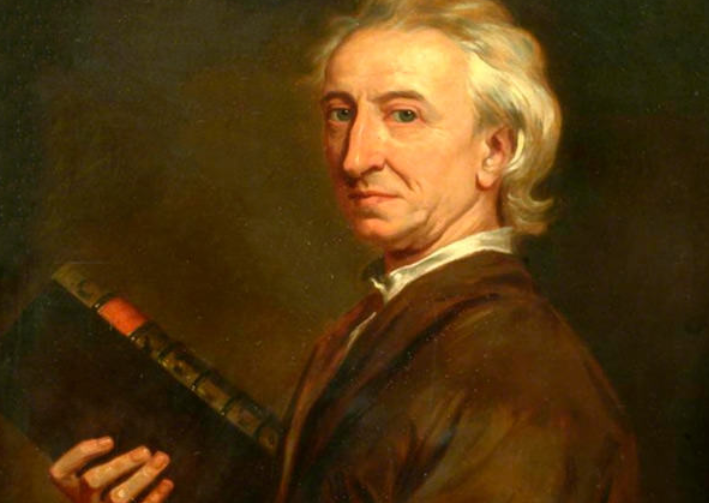
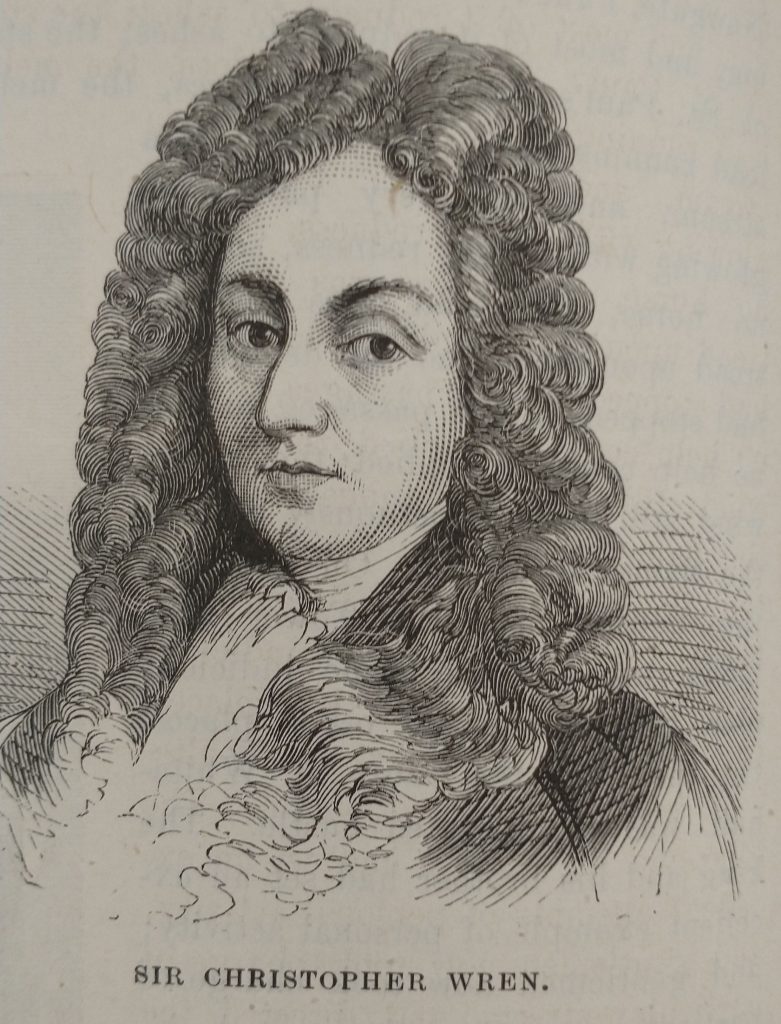
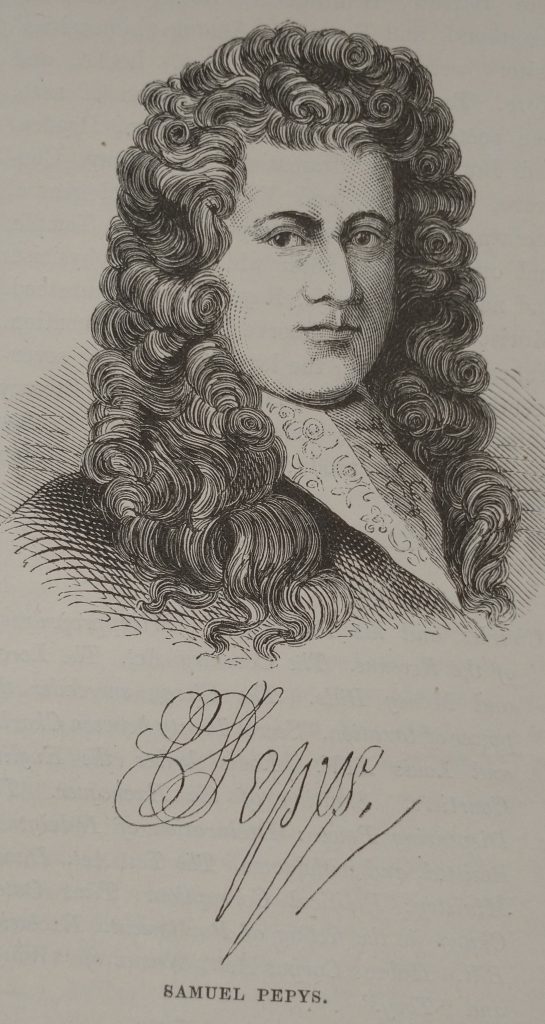
John Evelyn is, with Pepys and Wren, one of the great figures of 17th Century London. Unlike Pepys, he was an avowed Royalist who hated Oliver Cromwell and all he stood for. He went into exile with his King and gives a great description of Paris (see below).
Like Pepys, John Evelyn was a diarist and a writer. And they, like Wren, were alumni of the Royal Society, one of the great scientific societies. John Evelyn was a founding fellow. It was innovative in that it employed an experimenter. This was Robert Hooke – one of the great early Scientists, who also worked with Wren rebuilding London after the Great Fire. The Royal Society encouraged scientists to experiment, write up their observations, and submit their theories for peer review. This is the foundation of modern Science, and a bedrock of the Enlightenment.
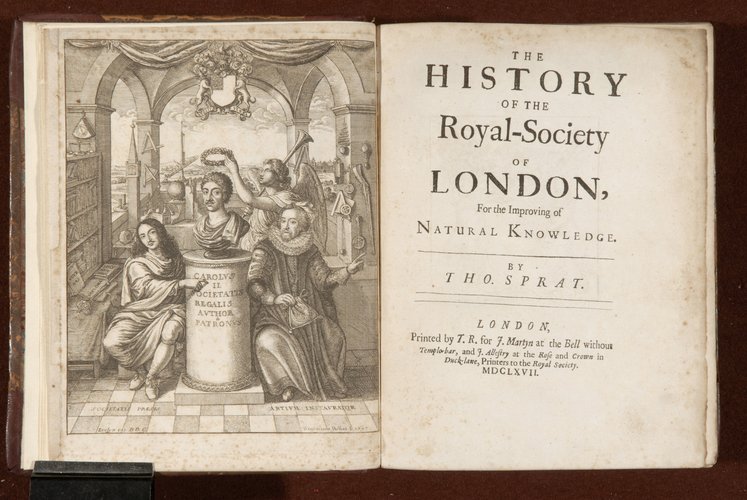
Frontispiece of ‘the History of the Royal-Society of London by Thomas Sprat. John Evelyn was a founder member
Evelyn the Writer.
John Evelyn has a place in my history because, in the 1980’s I worked. with Paul Herbert, on a project to create an interactive history of London. It was financed by Warner Brothers, and in cooperation with the short-lived ‘BBC Interactive TV Unit’. One part of it was a Literary Tour of London. The first half of this Tour is the basis for my book ‘In Their Own Words’ (To buy click here ) And this is where I came across John Evelyn using several of the quotations on this page.
Evelyn was a prolific traveller and a polymath. He wrote on the need to improve London’s architecture and air in Fumifugium (or The Inconveniencie of the Aer and Smoak of London Dissipated). Here is an extract from his Furmifugium.
‘That this Glorious and Antient City, which from Wood might be rendred Brick, and (like another Rome) from Brick made Stone and Marble; which commands the Proud Ocean to the Indies, and reaches to the farthest Antipodes, should wrap her stately head in Clowds of Smoake and Sulphur, so full of Stink and Darknesse, I deplore with just Indignation.
That the Buildings should be compos’d of such a Congestion of mishapen and extravagant Houses; That the Streets should be so narrow and incommodious in the very Center, and busiest places of Intercourse: That there should be so ill and uneasie a form of Paving under foot, so troublesome and malicious a disposure of the Spouts and Gutters overhead, are particulars worthy of Reproof and Reformation; because it is hereby rendred a Labyrinth in its principal passages, and a continual Wet-day after the Storm is over. ‘
And he was an expert on trees. Author of: Sylva, or A Discourse of Forest-Trees (1664). He lived at Sayes Court in Depford near Greenwich, which he ill-advisedly rented to Peter the Great of Russia. Letting to Peter was a lot-like inviting a 1960s Rock Band to trash your mansion.
John Evelyn the Exile
Here is a taste of Evelyn’s time as an Exile. It is a short extract from a long entry on the splendid Palaces in and around Paris.
27th February, 1644. Accompanied with some English gentlemen, we took horse to see St. Germains-en-Laye, a stately country house of the King, some five leagues from Paris. By the way, we alighted at St. Cloud, where, on an eminence near the river, the Archbishop of Paris has a garden, for the house is not very considerable, rarely watered and furnished with fountains, statues,[and groves; the walks are very fair; the fountain of Laocoon is in a large square pool, throwing the water near forty feet high, and having about it a multitude of statues and basins, and is a surprising object. But nothing is more esteemed than the cascade falling from the great steps into the lowest and longest walk from the Mount Parnassus, which consists of a grotto, or shell-house, on the summit of the hill, wherein are divers waterworks and contrivances to wet the spectators; this is covered with a fair cupola, the walls painted with the Muses, and statues placed thick about it, whereof some are antique and good. In the upper walks are two perspectives, seeming to enlarge the alleys, and in this garden are many other ingenious contrivances.
This was Evelyn’s reaction when Charles II was restored to the throne in 1660,
May 29th 1660:
This day came in his Majestie Charles the 2d to London after a sad, and long exile… this was also his birthday, and with a Triumph of above 20,000 horse and foote, brandishing their swords and shouting with unexpressable joy; the wayes strawed with flowers, the bells ringing, the streets hung with Tapisry, fountains running with wine: ‘
‘The mayor, Aldermen, all the companies in their liveries, chaines of gold, banners, Lords and nobles, cloth of Silver, gold and velvet every body clad in, the windows and balconies all set with Ladys, Trumpetes, Musik, and myriads of people … All this without one drop of bloud …it was the Lords doing…
1661 – ‘Ash Wednesday. Preached before the King the Bishop of London (Dr. Sheldon) on Matthew xviii. 25, concerning charity and forgiveness.‘
John Evelyn’s Diary Dr Sheldon, the Bishop of London mentioned above, went on to become Archbishop of Canterbury. He was a friend of Wren’s Father, and commissioned Wren to build the Sheldonian Theatre, in Oxford.
1782 – OK! Let’s give up! The House of Commons votes against continuing the war with Revolutionary America.
1900 – The Labour Party is founded. And today, the UK woke up to a by-election in a safe Labour seat won by the Greens (40%) with Reform 2nd (29%) and the Labour Party third (26%) Conservatives fourth (2%). So, clearly a progressive vote determined to beat Reform, Labour won about 50% of the vote last time, so a disaster for them. Not a success for Reform, and bad result for the Conservatives.
1933 – Reichstag burns down. Hitler uses it to suspend Civil Liberties, and attack the German Communist Party which was falsely blamed for the fire.
First Published 2024, republished 2025, Making Lardy Cake moved to Fat Thursday and On This Day added 2026
Today is the day after the anniversary of Queen Elizabeth 1’s coronation, 1559. She soon developed enduring relationships with the senior members of her Government. For example, William Cecil, Lord Burghley served the Queen for the rest of his life – from 1558 to 1598 when he died.
Queen Elizabeth I gave leading members of her Court, nicknames. I have been tracking them down. I eventually found a post in The Chronicles of History. The author is a follower of this blog. The Chronicles mentioned three of them, so I went in search for the rest, and here is what I found:
Her chief minister, William Cecil, Lord Burghley, was called her ‘spirit’ and her alleged lover, Robert Dudley, Earl of Leicester, was her ‘eyes’. Rather more cheekily, she called François, Duke of Anjou, her ‘frog’.
Putting my various sources here is my ‘definitive list’.
Elizabeth called Robert Dudley, Earl of Leicester “Eyes” William Cecil was “Spirit” Robert Cecil was her “pigmy” or “elf” Sir Christopher Hatton was “lids” or less flatteringly her “mutton” Francis Walsingham was her “Moor” Francis, Duke of Alencon, (her French suitor) her “frog”
People on the list of Queen Elizabeth I’s Nicknames
A comment on the same page says the ‘moor’ was, in fact, Edward De Vere Earl of Oxford, suggesting the attribution to Walsingham is a mistake. De Vere had a house in Clapton, Hackney, very close to where I lived. De Vere is one of the strongest candidates (or so the conspiracy theorists say) to have written Shakespeare’s plays. Queen Elizabeth 1 has also been named a candidate for the world’s greatest playwright.
Robert Cecil was Lord Burghley’s son and largely took over his father’s role. Christopher Hatton was a handsome aristocrat who had a lovely house and garden in Holborn. It is now a street called Hatton Garden, famous for jewellery and jewellery heists.
Francis Walsingham was the ruthless spy master that helped turn late Elizabethan England into a simulacrum of Stasi East Germany. Duke of Alencon was one suitor she seemed to take seriously, although she gently mocked him. Dudley was her favourite and almost her official escort/companion. (Did she have a sexual relationship with him?)
When I published this recently, I got an email from Jan-Marie Knights, an author, and she was able to persuade me that the Queen loved Dudley like a Brother, but never would marry him.
She showed me an extract from a book which has a letter saying the above – from Lord Burghley to his political agent in Germany. The book is The Private Character of Queen Elizabeth by Frederick Chamberlin (New York: Dodd Mead and Co, 1922).
Here is a photo of a page of the book with the letter.
Extract from the book is The Private Character of Queen Elizabeth by Frederick Chamberlin (New York: Dodd Mead and Co, 1922).
Jan has published a book called The Tudor Socialite, which documents the ‘Tudor High life in bite-sized chunks.’
27BC Gaius Julius Caesar given the title of Augustus by the Roman Senate marking the official end of the Roman Republic.
Another example of how a system with elections and checks and balances can be subverted.
550AD Ostrogoths conquer Rome after bribing the guard.
1275 Edward I allows his mother Eleanor of Provence to expell Jews from Winchester, Cambridge, Marlborough and Gloucester
1537 Bigod’s Rebellion. Following successful negotiations between the Pilgrims of Grace led by Robert Aske, a new rebellion was led by Sir Francis Begod. It failed utterly buy leald to the rescinding of pardons. This saw Robert Aske hanged at York. Bigod and many others were also hanged. The female conspirator was dealt with as follows:
‘And the same day Margaret Cheney, ‘other wife to Bulmer called’, was drawn after them from the Tower of London into Smithfield, and there burned according to her judgment, God pardon her soul, being the Friday in Whitsun week; she was a very fair creature, and a beautiful.’
Wriothesley’s Chronicle
First Published in January 2023, republished in January 2024,2025, 2026
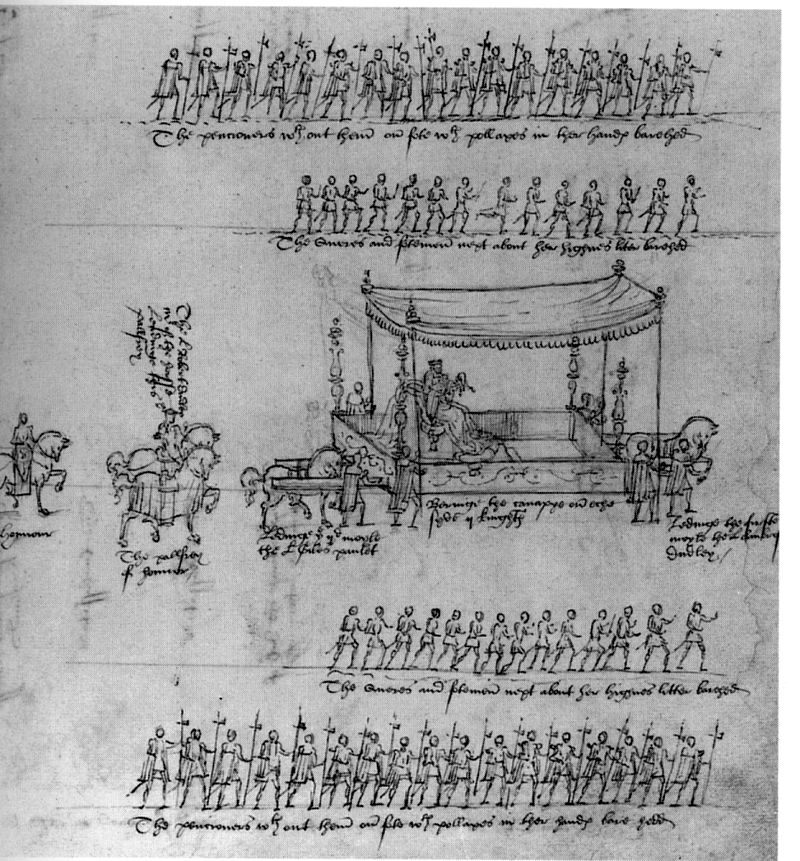
Queen Elizabeth 1 Coronation. Litter at her royal entry, accompanied by footmen and Gentlemen Pensioners. Unidentified engraver. (Wikipedia)
Queen Elizabeth 1 Accession
Queen Elizabeth 1 ascended the throne on 17 Nov 1558. Her accession was greeted with an outbreak of joy by the Protestant population. But the supporters of her dead sister Mary 1 did not want a Protestant monarch. On hearing the news of the death, Elizabeth rushed to occupy the Tower of London. She even risked shooting London Bridge, such was her haste. (see my post of the accession of Queen Elizabeth I)
She consulted lawyers about the legal position. Elizabeth, and her sister Mary, were declared bastards by two Succession Acts passed during Henry VIII’s ‘troubled’ married life. The Third Succession Act of 1543/44, following Henry’s marriage to Katherine Parr, restored Mary and Elizabeth to the Royal line. But it did not restore their legitimacy. Rather than tackle the complex legislation, Sir Nicholas Bacon, the Lord Keeper of the Great Seal, advised:
“the English laws have long since pronounced, that the Crown once worn quite taketh away all Defects whatsoever“. (Wikipedia)
Which, when you think about it, basically legitimises any successful ‘coup’! And, from a legal perspective, she was still, arguably, illegitimate.
Queen Elizabeth 1 Coronation
Her courtiers immediately began work on the Coronation, scheduled for January 15th 1559. In terms of Coronations, this was rushed. The precise date was, in fact, chosen by the Royal Astrologer. John Dee, a famous mathematician and credulous astrologer,. He found a date that the celestial bodies deemed propitious. But it needed to be sooner rather than later because Elizabeth’s position was so insecure.
Queen Elizabeth 1 Coronation Procession
The Coronation began with a procession from the Whitehall Palace in Westminster. Then back to the Tower of London for the Vigil. Followed by a Royal Procession through the City of London to Westminster Abbey for the Coronation service. After the Coronation, there was the traditional Coronation Banquet at Westminster Hall.
The Vigil Procession was on the Thames where she was escorted to the Tower by ‘ships, galleys, brigantines‘ sumptuously decorated. The Royal Entry consisted of 5 Pageants and 11 Triumphal Arches.
The first pageant showed the Queen’s descent from Henry VII and his marriage to Elizabeth of York. This marriage effectively ended the Wars of the Roses by linking the House of York and the House of Lancaster. The pageant also emphasised her ‘Englishness’ as opposed to the Spanish affiliations of Mary. The second pageant demonstrated that the Queen would rule by the four virtues of True Religion, Love of Subjects, Wisdom and Justice. At the same time she was shown trampling on Superstition, Ignorance and other vices.
The Procession at Cheapside
The third pageant, at the upper end of Cheapside near the Guildhall, provided the opportunity for the City to give Elizabeth a handsome present. This was a crimson purse with 1000 marks of gold, showing the closeness of the City and the Crown. The fourth pageant, contrasted a decaying country during the time of Mary with a thriving one under Elizabeth. It featured the figure of Truth, who was carrying a Bible written in English and entitled ‘the Word of Truth’. The Bible was lowered on a silken thread to the Queen. The Queen kissed it and laid it on her breast to the cheers of the crowd. She promised to read it diligently. The final pageant was Elizabeth portrayed as Deborah, the Old Testament prophet. Deborah rescued Israel and ruled for 40 years. So she was an ideal role model for Elizabeth. (For more details, look here.)
‘All the houses in Cheapside were dressed with banners and streamers, and the richest carpets, stuffs and cloth of gold tapestried the streets’.
British History.ac.uk Vol 1 pp315 -332
Queen Elizabeth 1 Coronation in Westminster Abbey
The Coronation was traditional – in Latin and presided by a Catholic Bishop, but there were significant innovations. Important passages were read both in Latin and in English. The Queen added to the Coronation Oath the promise that she would rule according to the:
‘true profession of the Gospel established in this Kingdom.’
This showed the path Queen Elizabeth was going to take. She would introduce innovation gradually into tradition, but emphasizing that the fundamentals had indeed changed. This was going to be a Protestant reign.
Can I remind you that I wrote a best-selling book on the Kings and Queens of Britain? It has sold over 130,000 copies, has been reprinted several times and in several editions. Further details here.
On This Day
1535 King Henry VIII became Supreme Head of the Church of England
1759 The British Museum opened to the Public.
1867 Ice breaks on the boating lake at Regent’s Park, London, Forty people die.
2001 Wikipedia Day. The free wiki content encyclopedia launched. (Other days are possible but this one is the earliest recovered wikipedia page. I begin editing pages on November 28th, 2003.
‘Negroland and Guinea with the European Settlements, Explaining what belongs to England, Holland, Denmark, etc’. By H. Moll Geographer (Printed and sold by T. Bowles next ye Chapter House in St. Pauls Church yard, & I. Bowles at ye Black Horse in Cornhill, 1729, orig. published in 1727) Source Wikicommons.
The Royal Africa Company
The Royal Africa Company was set up with a monopoly on trade with the west coast of Africa in:
“redwood, elephants’ teeth, negroes, slaves, hides, wax, guinea grains, or other commodities of those countries”
On January 10th. 1663 King Charles II affirmed the new charter for the Company that, above all else, was responsible for British continuing involvement in enslavement. Shareholders included his nephew, Prince Rupert, Samuel Pepys, and much of the British Establishment, Aristocracy, and City Merchants. Its headquarters were in Cornhill, not far from the East India Company’s HQ. The company was closed in 1752.
Guineas
Gold from the Gold Coast in Guinea was used to make coins, which became known as ‘guineas’. They were originally made from one quarter of an ounce of gold. Below is a sketch of a two guinea coin from the reign of Charles II. Note the elephant at the bottom of the coin.
Sketch of a two guinea coin from the reign of Charles II showing an elephant below the image of the King.
The guinea was original worth 1 pound but fluctuated with the price of Gold. Pepys records it at 24 or 25 shillings. It was eventually phased out, but it became a posh way of expressing value. Ordinary goods would be priced in pounds, but expensive ones in Guineas. By then valued at 21 shillings. (£1 pound 5 pence). Wikipedia suggests it was used for ‘prices of land, horses, art, bespoke tailoring, furniture, white goods and other “luxury” items‘. I remember going shopping with my parents in London and wondering at the fur coats being priced in Guineas. It died out, as a practice, in the 70s.
Enslavement, Government & the Royal Africa Company
There are many sites giving a history of slavery, and the British involvement with it. But, here, I would just like to point out how involved the British Royal Family was in the trade. One of the instigators of the Trade, in the 16th Century was John Hawkins. He secured investment in his second slaving expedition from: Queen Elizabeth I, Robert Dudley, Edward Clinton, Lord Burghley amongst others. Royal involvement in the foundation of the Royal Africa Company was only one of many connections between Royalty and Slavery.
It should be noted that the British education system has emphasised the role of Britain in the abolition of slavery. We are more reluctant to highlight our involvement in setting it up and continuing it. This has begun to change. A new generation of school children in London can visit the excellent London: Sugar & Slavery Gallery at the Museum of London in Docklands.
Compensation for Slavery & Reparations
University College, London has undertaken a profound project where they took the records of compensation payments to:
The slaves, you are thinking?
No, to the slave owners!
The compensation of £20m pounds was provided by a loan to the Governemt by Rothschilds Bank in the City of London. It probably represents around £16billion in modern terms. I have been unsure of the case for historic ‘reparations’. But when ‘we’ compensated the slave owners, it makes the case for compensation to the enslaved overwhelming. The least we can do is to fund projects to correct the educational and life disadvantages of people and countries impacted by slavery. And £16 billion seems like the right amount.
Legacies of British Slave-ownership project
UCL have created a resource where you can click on the streets of London and other areas, to find out the holders of slaves who were compensated in that street.
I looked at the UCL resource looking for the closest slave owner in my area of the East End of London. The nearest person lived about 500 yards away from me. Here are the abridged details from the database. It is very simple to use. Have a go by following this link.
Solomon Nunes Flamengo of Kingston, living at Mutton Lane in Hackney when he wrote his will in 1778. Merchant. Estate probated in Jamaica in 1779. Slave-ownership at probate: 6 of whom 2 were listed as male and 4 as female. 4 were listed as boys, girls or children. Total value of estate at probate: £21356.26 Jamaican currency of which £332.5 currency was the value of enslaved people.
I guess the value of his compensation was £332.5. Solomon was Jewish, which is unusual for the records, by far the majority being Christian. I chose Solomon simply because he was the closest to my house. The UCL website is at https://www.ucl.ac.uk/lbs/.
Britain began regulating the Slave trade in the late 18th Century, abolished the Slave Trade in 1807. Slavery, with the compensation to slave owners in 1833, was abolished but they replaced slavery with apprenticeship – in effect bound labour. This was ended in 1838. For more details look at https://www.parliament.uk/
Slavery or Enslavement
Finally, I have seen several exhibitions and TV documentares in recent months where victims of the pernicious trade are referred to as ‘enslaved’ and not slaves.
It is a profound difference. The victims did not make themselves slaves, they did not identify as slaves. They were forced into lt by violence, kidnap. rape, murder, torture, imprisonment, trafficking, forced exile. They were enslaved.
John Stow reports on the Lord of Misrule. Memorial in St Andrew’s Church
On the sixth day of Christmas
My true love sent to me 6 Geese a Laying; 5 Golden Rings. 4 Calling Birds; 3 French Hens; 2 Turtle Doves and a Partridge in a Pear Tree
The Lord of Misrule, Masters of the Revels, and Boy Bishops
The Roman festival of Saturnalia reversed the rules so that slaves, ruled and masters served. It was held between 7th and 23rd of December. It also included giving gifts. In the medieval period, the disorders of Saturnalia was continued. Monarchs, Lords and Gentlemen, City Institutions elected Lords of Misrule, Masters of the Revels, and Boy Bishops. John Stow was London’s first great historian. In his Survey of London, he wrote of the Lords of Misrule in London. They were chooses at Halloween and continued until Candlemas, in early February. See my post here for more details on Candlemas.
From John Stow’s Survey of London
This is what Stow says:
Now for sports and pastimes yearly used.
First, in the feast of Christmas, there was in the king’s house, wheresoever he was lodged, a lord of misrule, or master of merry disports, and the like had ye in the house of every nobleman of honour or good worship, were he spiritual or temporal. Amongst the which the mayor of London, and either of the sheriffs, had their several lords of misrule, ever contending, without quarrel or offence, who should make the rarest pastimes to delight the beholders.
These lords beginning their rule on Alhollon eve, continued the same till the morrow after the Feast of the Purification, commonly called Candlemas day. In all which space there were fine and subtle disguisings, masks, and mummeries, with playing at cards for counters, nails, and points, in every house, more for pastime than for gain.
Against the feast of Christmas every man’s house, as also the parish churches, were decked with holm, ivy, bays, and whatsoever the season of the year afforded to be green. The conduits and standards in the streets were likewise garnished; (…) , at the Leaden hall in Cornhill, a standard of tree being set up in midst of the pavement, fast in the ground, nailed full of holm and ivy, for disport of Christmas to the people…
Holm is an evergreen oak. Its Latin name is Quercus ilex. The Tree in Leadenhall Street was also used as the Maypole. And he tells us it was destroyed in the great wind of 1444. You can read all about that here. You might also like to see my posts. These include information about John Stoww and midsummer celebrations and Boy Bishops, and l Stow’s Memorial.
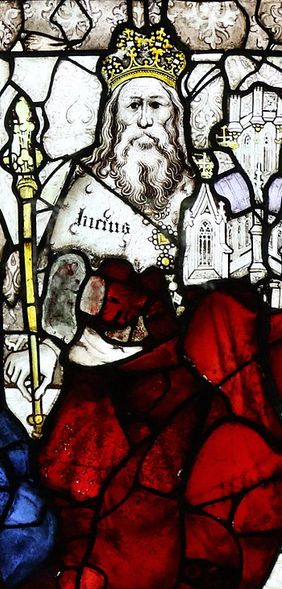
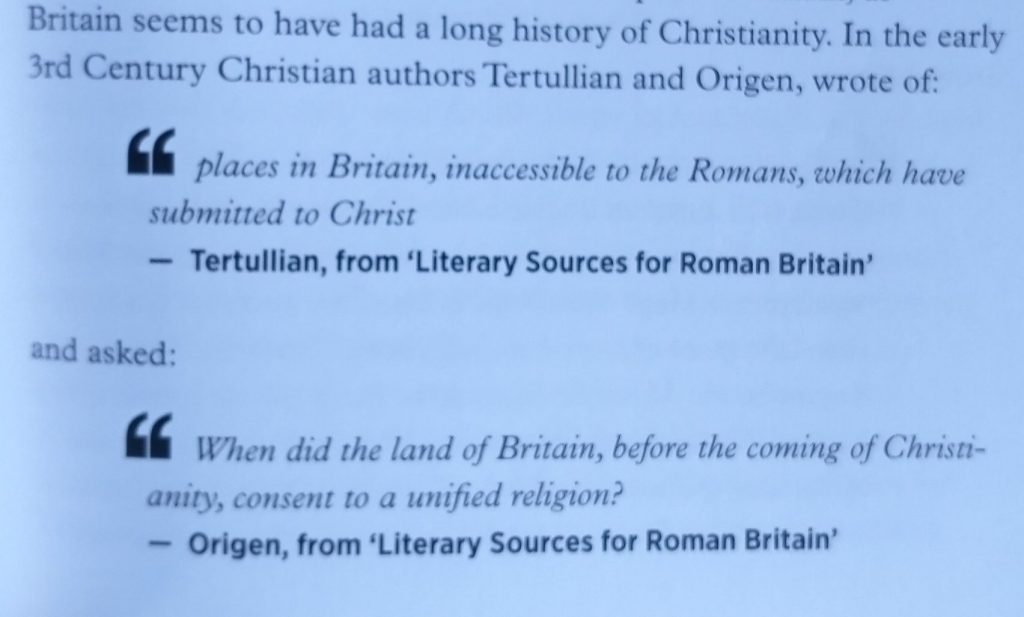
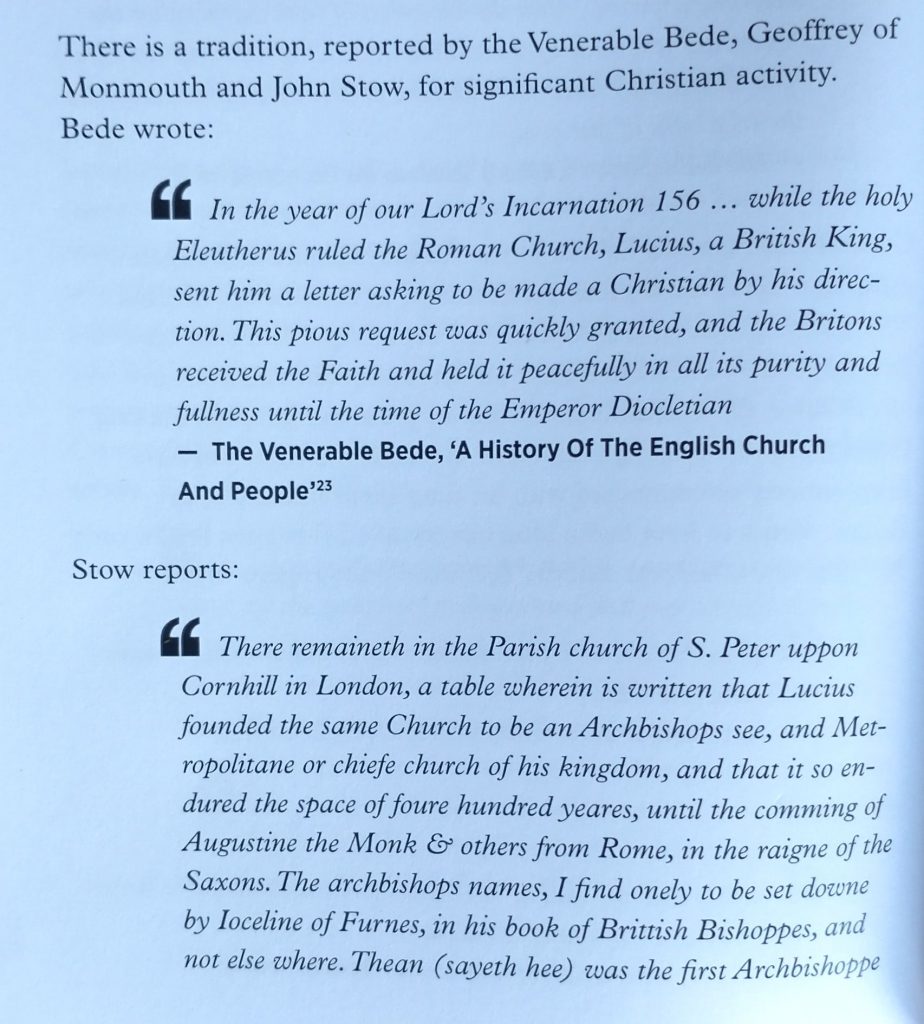
The Venerable Bede tells us that King Lucius converted to Christianity in around 180AD. He says that the King asked Pope Eleutherius to send teachers to instruct him. The Venerable Bede (died 735 AD) got this from the Liber Pontificalis of c 590. There is also a tradition that St Peter’s Cornhill in London was set up by King Lucius, and that St Peter’s is the oldest Church in London.
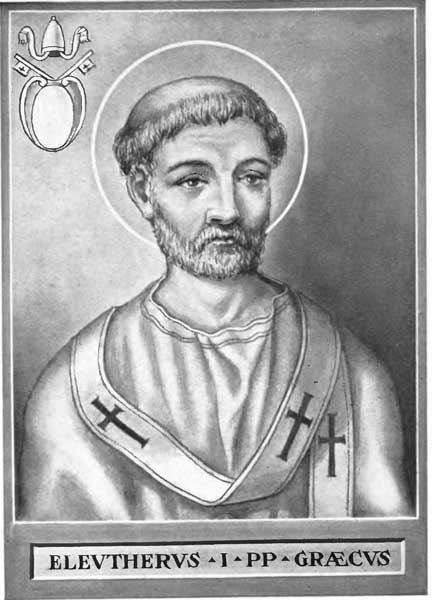
13th Pope Eleutherius
What to make of this? Bede is considered to be a reliable historian and got his information, in this case, from the Vatican. Pope Eleutherius is held to be a real Pope. He reigned at the right time, from perhaps as early as c. 171, and to his death which may be as late as AD 193. (Wikipedia). But the tradition of Lucius has been written off as a legend.
But to my mind there are questions that need asking. Not the least of the questions to ask about the veracity of this legend is: ‘What does it mean to be called the King of Britain in the middle of the Roman occupation?’
St Peters Church First Cathedral in Britain?
As to the early origin of St Peters Church, archaeologists dismissed the tradition of a Roman St Peters Church because it is built over the Roman Forum. So how can it have been the site of a Christian Church?
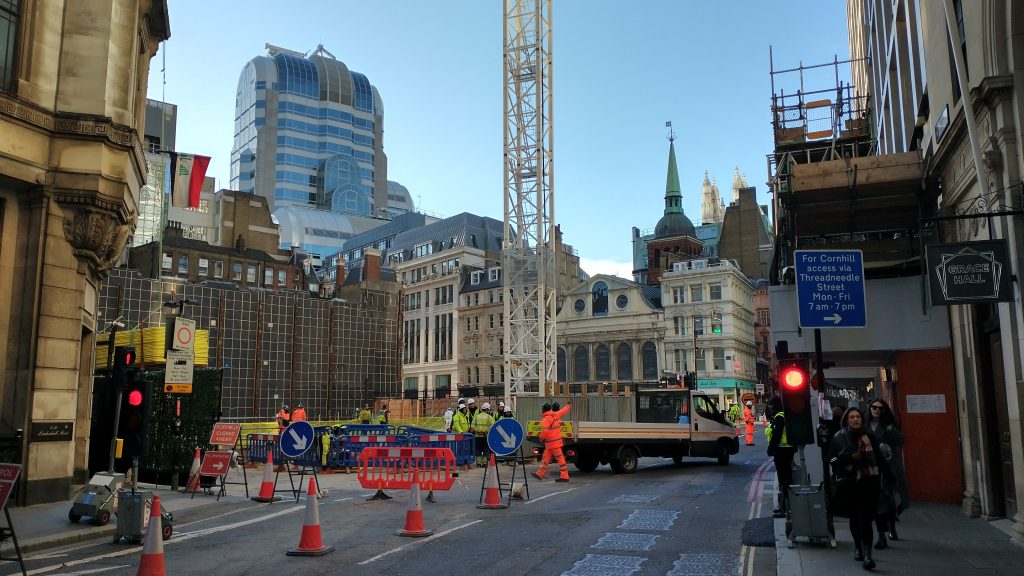
St. Peter’s seen from Cornhill in a rarely seen view as there is normally a building in the way. (Photo K Flude)
But the balance of possibilities, arguably, changed in the 1980s, when archaeologists led by Gustav Milne showed that the Basilica of the Forum was pulled down in about 300AD. So from being practically an impossibility, there is now a possibility that this subsequently became the site of a Roman Church. It doesn’t make it true but it makes it more of a possibility.
We know London sent at least one Bishop to Constantine the Great’s Council of Arles in AD 314. So a Christian community in London must have predated this time. There must have been Churches, here. And a site at the prestigious centre of the Capital of Londinium, makes a lot of sense. There are, in fact, three Churches on the site of the Roman Forum: St Peters, St Michael and St Edmund the Martyr.
Constantine the Great
In AD 306, Constantine was acclaimed Emperor on the death of his Father, Constantius Chlorus. Constantius’s wife was Helena, a Christian. He and his mother were in York when his father died. He was recognised as Caesar, (but not Augustus) by Emperor Galerius and ruled the province for a while. Then he moved to Trier, then moved on Rome, where he accepted the Christian God’s help to win the Battle of Milvian Bridge. This led him to supreme power in the Roman Empire. And might give a context for the demolished Basilica to be replaced by a Church.
There is, however, no archaeological evidence for St Peters being Roman in origin apart from the demolition of the Basilica and the legends. And there is certainly no evidence of the Basilica being turned into a Church as early as the 2nd Century.
Early Christianity in Britain
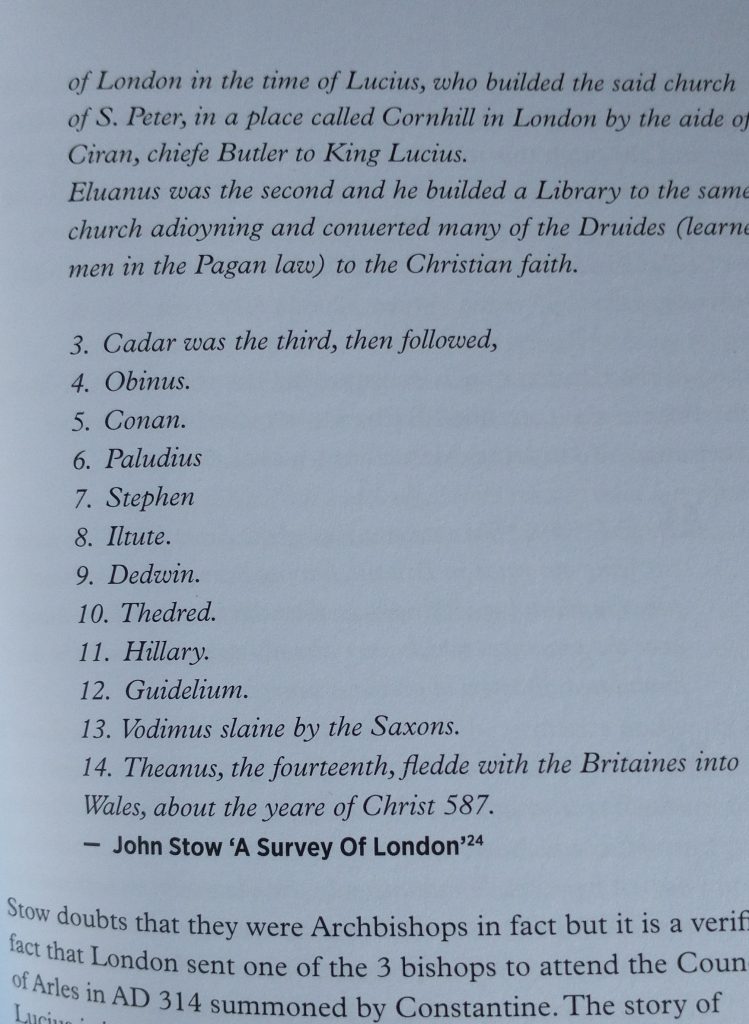
Where does that leave King Lucius? There are well attested Christian traditions that Britain was an early convert to Christianity. (The following quotes are from my book ‘In Their Own Words – A Literary Companion To The Origins Of London‘ D A Horizons, 2009 by Kevin Flude and available here.)
‘In Their Own Words – A Literary Companion To The Origins Of London‘ D A Horizons, 2009
So, an early date for an active Christian community is likely. A Church, replacing the Basilica, is plausible, particularly, after Constantine the Great probably passed through London on his way to seize the Roman Empire. So an early date for St Peters in possible. But there is no evidence for its origin as early as the late 2nd Century, the time of King Lucius.
A King of Britain in the Roman Era?
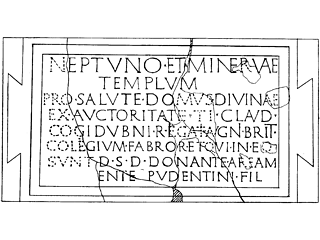
And could anyone, claim to be the ‘King of Britain’ at this date? We do know that King Togidubnus was called Great King of Britain in a Roman Temple inscription in Chichester in the First Century.
Altar Dedication, Chichester
To Neptune and Minerva, for the welfare of the Divine House by the authority of Tiberius Claudius Togidubnus, Great King of Britain, the Guild of Smiths and those therein gave this Temple from their resources, Pudens, son of Pudentinus, presenting the site.
Togidubnos seems to have been placed in control of a large part of Southern England, centred around Chichester, after the invasion of 43AD. He is thought to have been the successor to Verica, who was exiled and called on the Romans to restore his throne. Tactitus says that Togidubnos remained loyal down ‘to our own times’ that is to the 70s AD. So he presumably held the line for the Romans against the Boudiccan revolt in 60AD.
The Romans had used Verica’s fall as their excuse for invasion, and so an honorific of Great King to him and his successors makes sense. It is assumed that after Togidubnos’s death after 80AD, the title lapsed. But it might have stayed with the family as an empty honour? Furthermore, we know that Britain had a plethora of Kings and Queens before the Roman period. Also, the Romans never conquered the whole of Britain. There were, therefore, many British Kings all the way through the period of Roman control, not least beyond Hadrian’s Wall.
So, it is possible there was someone in Britain who had, or made, a claim to be ‘King’. Whether he was ‘a’ or ‘the’ or merely descended from a King of Britain, we don’t know. And that that someone, perhaps converted to Christianity, possibly in the time of Pope Eleutherius. He may have taken the Roman name Lucius. Who knows? Its possible.
Confusing Luci?
It has been suggested that King Lucius of Britain was confused with King Lucius of Edessa, but this is considered unsatisfactory. Also, the link to London and St Peters, need not be a contemporary one. It might be two traditions that are linked together at a later period. But, of course, there is a faint possibility that the Basilica shrine room, above which St Peter’s is built, was converted for Christian use at the earlier time necessary to make sense of the King Lucius story.
King Lucius may not be a proper saint, but he has a feast day. This is because of his connections to Chur in Switzerland. There is a tradition that Lucius was martyred here. This got him an entry in the Roman Martyrology. David Knight proposes that the Chur connection comes from the transplanting of rebellious Brigantes to the Raetia frontier in the 2nd Century AD. He suggests that the Brigantes brought the story of Lucius to Chur. At the end of the King’s life, is it possible he travelled to join his people in exile in Switzerland. Here he met his unknown end. If true, this would base the story of Lucius in the North rather than London. For further reading, see ‘King Lucius of Britain’ by David J Knight.
Early Bishops of London
John Stow in the 16th Century records the tradition of King Lucius, which comes with a list of early British Bishops of London. These he finds are recorded in Jocelin of Furness’s ‘Book of British Bishops’. This book is discussed by Helen Birkett ‘Plausible Fictions: John Stow, Jocelin of Furness and the Book of British Bishops’. In Downham C (ed) /Medieval Furness: Texts and Contexts/, Stamford: Paul Watkins, 2013.
Her analysis concludes that the book is a ’12th-century confection in support of moving the archbishopric from Canterbury ‘back’ to its proper place in London. (This information was included in a comment to the original post by John Clark, Emeritus Curator of the Museum of London.)
To sum up. We can’t bring King Lucius out of legend, nor find any credible source linking him him with St Peters Cornhill. But the site of St Peters is a plausible, though unproven, location for a Roman Church from the 4th Century onwards. It also makes sense of the choice of the Saxons, to name their Church St Pauls. St Peter is more common as a dedication for important Churches and perhaps they chose St Paul as they knew of the ruins of St Peters the old Cathedral.
Any other early Cathedrals?
Archaeologists have also tentatively identified a masonry building in Pepys Street on Tower Hill as the Episcopal Church of late Roman London. The foundations suggest a large aisled building. Its identification as a Cathedral springs from multiplying the found foundations symmetrically by a factor of four and comparing the result to Santa Tecla in Milan. The discovery of Marble and window glass doesn’t sit so well with the alternative suggestion that it is a granary. But, to my mind, it’s not very convincing, although Dominic Perring in his recent book ”London in the Roman World’ makes the most of the case for it being a Cathedral.
And Finally?
Roman ForumSite of Roman Forum Google Maps
If you look at the two maps above. The one on the left shows the Forum, the white lines are the Roman Road system. You might just be able to see the modern road system super-imposed. What this shows is that the Forum is on a different axis than the modern day road system. Cornhill cuts right across the North Western corner of the Forum. Where the letter L is, and to the left is under the modern road. So, that shows that this part of the Forum must have been knocked down before Cornhill was built. On the right hand side you can see the dark grey east-west road which is Cornhill. To the South of it you can see a dark area (above the green of St Peter’s Churchyard). This grey area is St Peters. What the Google map shows clearly, is that the orientation of St Peters, is clearly on a different orientation to that of the modern road of Cornhill. And that orientation is closer to the orientation of the Roman Forum. This makes it more likely that the axis upon which St Peters was originally built (assuming Wren followed the original axis when he rebuilt it after the Great Fire) conformed to the Roman grid pattern. This is by no means proof, and can only be proved by excavation. But, its interesting.
On This Day
1660 – Margaret Hughes became the first woman (we know about) to act on the English Stage. She played Desdemona in Shakespeare’s Othello. It was staged in a converted tennis court called the Vere Street Theatre, which was in Lincoln’s Inn Fields. In 1660 Charles II was restored to the throne, and had got used to watching female actors perform while he was in exile in France. So when he returned, he licensed two theatre managers, Thomas Killigrew and Sir William Davenant to run theatre. Davenant claimed to be the natural son of William Shakespeare, suggesting that Shakespeare stayed in his parents’ Inn, the Crown, in Cornmarket, Oxford on his way home to Stratford-upon-Avon.
First Published on December 3rd, 2022. Revised in December, 2023, 2024 and 2025
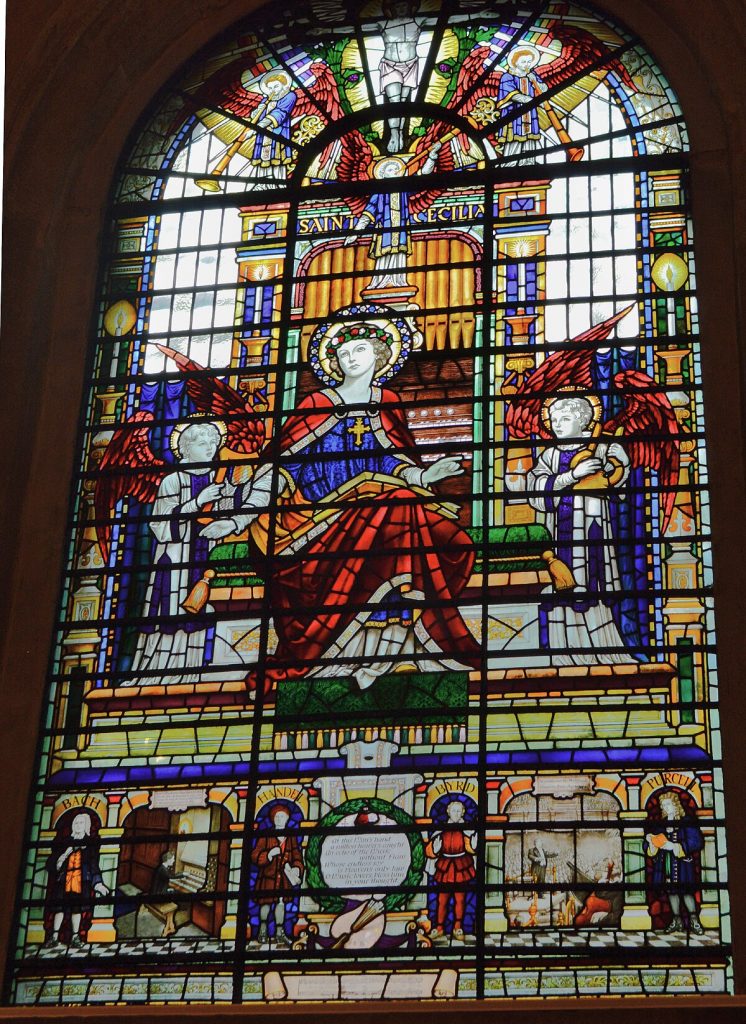
St Sepulchre-without-Newgate, Musician’s Chapel, St Cecilia window. 17 August 2022, Andy Scott
November 17th is St Cecilia’s Day She is the patron saint of musicians and was martyred in Rome in the Second or Third Century AD. The story goes that she was married to a non-believer. During her marriage ceremony she sang to God in her heart (hence her affiliation with musicians). She then told her husband that she was a professed Virgin. So, if he violated her, he would be punished by God. Cecilia told him she was being protected by an Angel of the Lord who was watching over her. Valerian, her husband, asked to see the Angel. ‘Go to the Third Milestone along the Appian Way’ he was told where he would be baptised by Pope Urban 1. Only then would he see the Angel. He followed her advice, was converted and he and his wife were, later on, martyred.
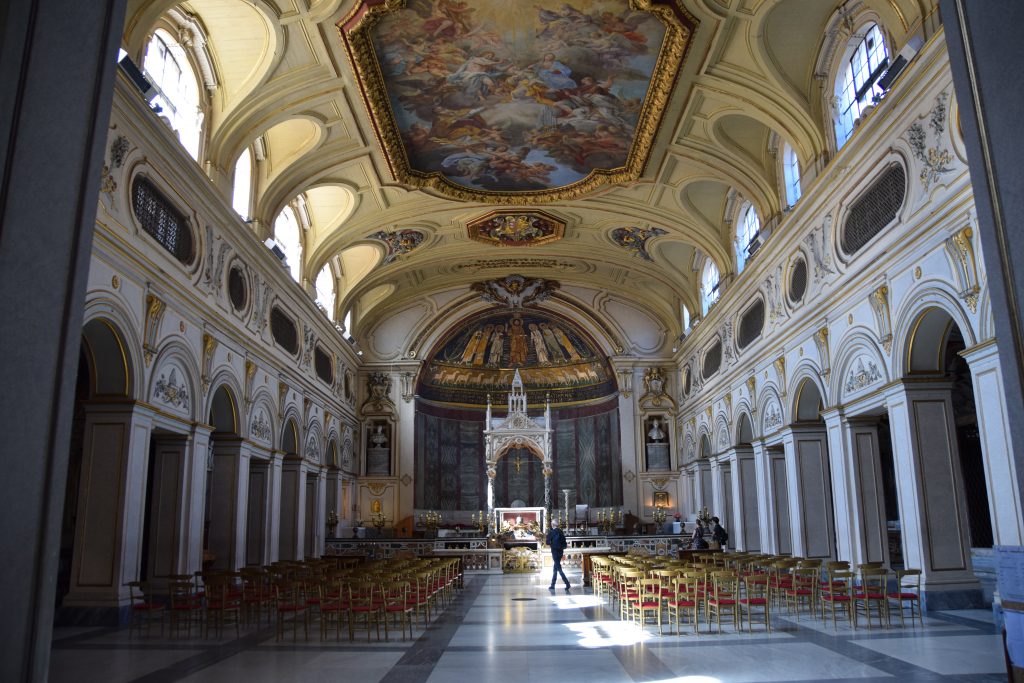
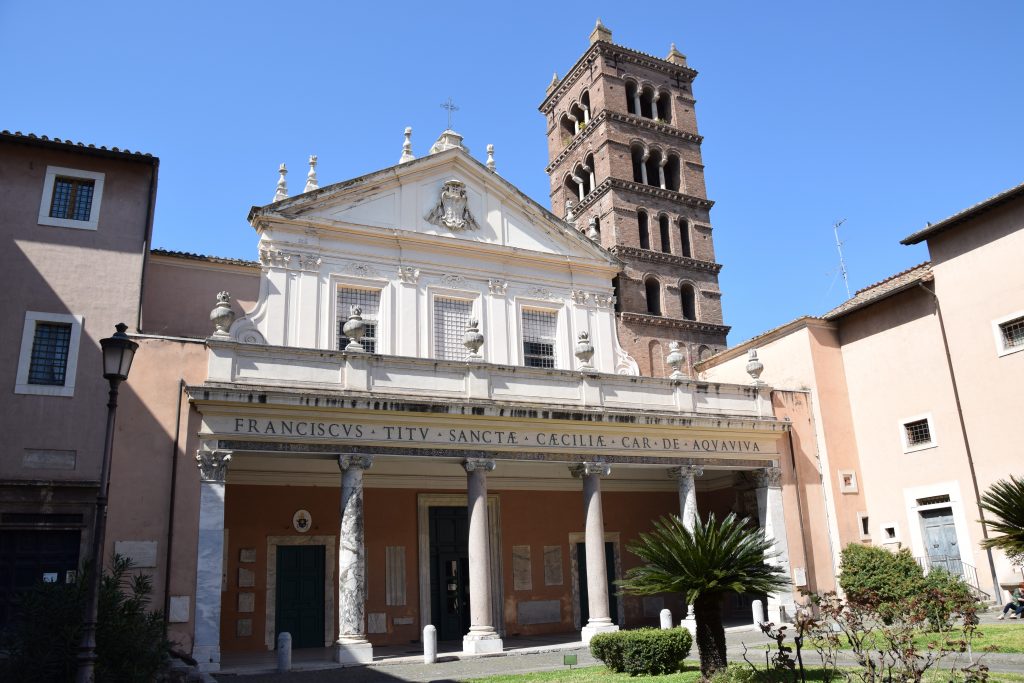
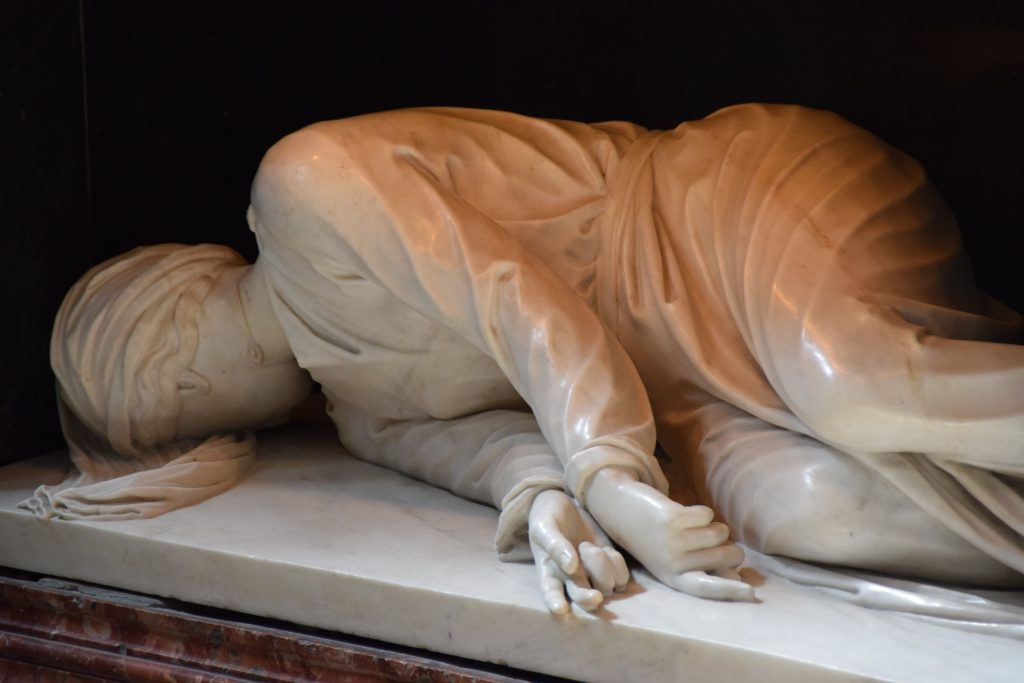
The Church in Rome, Santa Cecilia in Trastevere, is said to be built on the site of her house, and has 5th Century origins. My friend, Derek Gadd, recently visited and let me use these photographs:
St Cecilia in London
There is a window dedicated to her in the Holy Sepulchre Church-without-Newgate, In London, opposite the site of the infamous Newgate Prison. Henry Wood, one of our most famous conductors and the founder of the Promenade Concerts, played organ here when he was 14. In 1944, his ashes were placed beneath the window dedicated to St Cecilia and, later, the Church became the National Musician’s Church.
This window is dedicated to the memory of Sir Henry Wood, C.H., Founder and for fifty years Conductor of THE PROMENADE CONCERTS 1895-1944. He opened the door to a new world Of sense and feeling to millions of his fellows. He gave life to Music and he brought Music to the People. His ashes rest beneath.
The Concerts are now called the BBC Proms and continue an 18th and 19th Century tradition of, originally, outdoor concerts, and then indoor promenade concerts. At the end of the 19th Century, the inexpensive Promenade Concerts were put on to help broaden the interest in classical music. Henry Wood was the sole conductor.
Czech conductor Jiří Bělohlávek described the Proms as “the world’s largest and most democratic musical festival”.
The Eight-week Festival is held at the Royal Albert Hall. It moved here during World War 2 after the original venue, the Queen’s Hall, was destroyed in the Blitz in May 1941.
On This Day
1278 Edward 1 had over 600 Jews imprisoned in the Tower of London for coining, clipping and other counterfeiting. Of these, 269 Jews, along with 29 Christians, were executed. They were hanged at the Guildhall in the City of London. By 1290, the King had squeezed all the money he could from the Jews, and they were expelled, not to be let back into the Kingdom until the reign of Oliver Cromwell in the 17th Century. This ended a long period of savage state run antisemitism. Click here for further information.
First Published on November 17th 2023 and revised in November 2024, 2025.
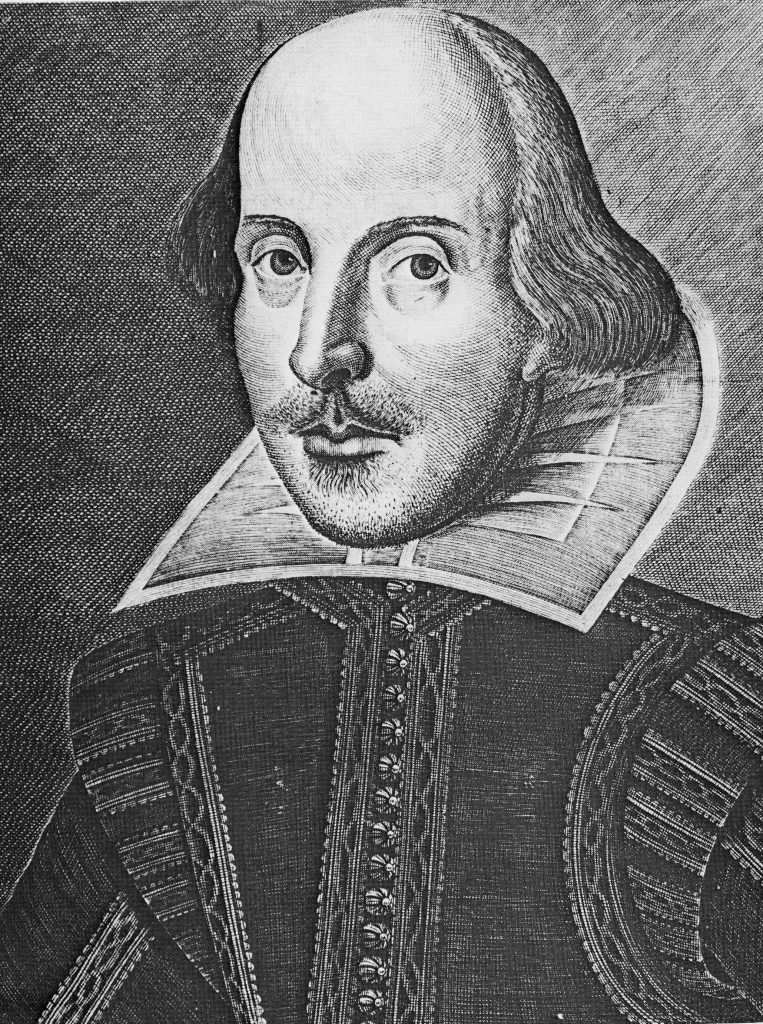
Droeshout Portrait of Shakespeare from the First Folio
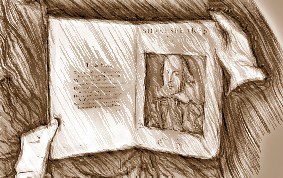
On November 8th in 1623, the First Folio was registered at Stationer’s Hall near the publishing district around St Pauls Cathedral in London. It was actually called:
Mr. William Shakespeare’s Comedies, Histories, & Tragedies
Sketch of the First Folio
It was put together by his actor friends, John Heminge and Henry Condell seven years after his death. They wanted to replace all the corrupt editions of his plays and poems that had been:
“stol’n and surreptitious copies, maimed and deformed by frauds and stealths of injurious impostors”
The true texts of his plays and poems “are now offer’d to your view cured, and perfect of their limbes; and all the rest, absolute in their numbers as he conceived them.” Wikipedia
Shakespeare at the Frankfurt Book Fair
In fact, the plays were ready earlier than 1623, as they entered into the catalogues for the Frankfurt Book festival to appear between April and October 1622. How amazing is it that the Frankfurt Book festival is still the dream of any aspirant writer? Wikipedia tells me that hand-written books were traded at the general trade fair in Frankfurt from the 12th Century. But 1462 is the date that appointed as being when the Book Fair was certainly established.
The First Folio offers plenty of proof that Shakespeare was the author of the plays. He left gold rings of remembrance to Heminge and Condell in his Will. They were part of his Players Company, and had worked together on many of the plays. The Folio has forewords by people extolling the virtues of the writer. Enough proof for any reasonable person.
Heminge and Condell
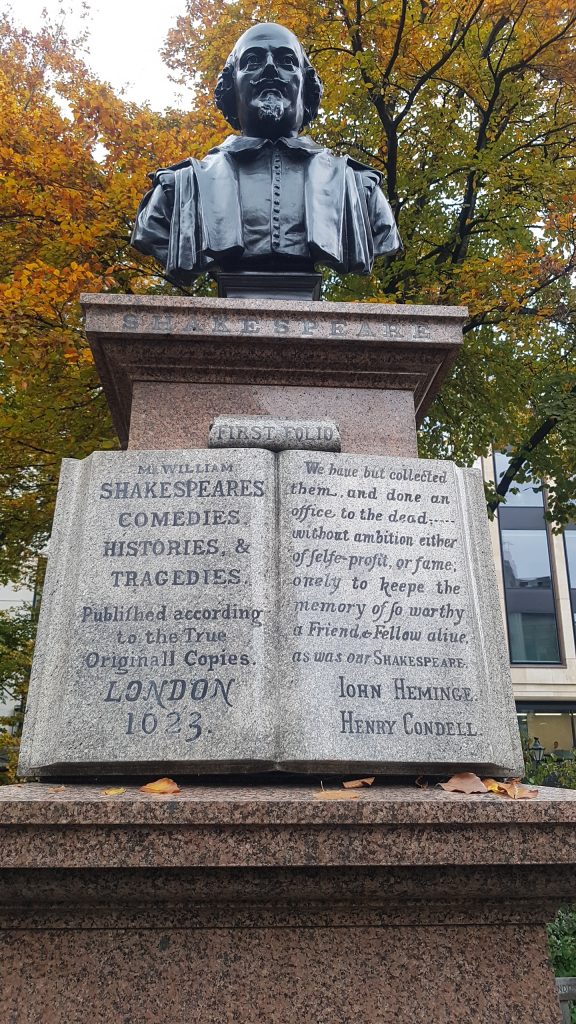
Heminge and Condell are commemorated in the Garden of St Mary Aldermary behind the Guildhall. They were Churchwardens of St Mary. A few streets away lived William Shakespeare in 1611. True friends, so don’t go telling me he didn’t write the plays!
St Mary Aldermany monument to Shakespeare, Heminge and Condell and the First Folio.
There was a wonderful BBC festival of Shakespeare on in 2023/24 to celebrate. If you look at this link, here. You will find great content. Much of it is available if you search BBC Sounds, or BBC iPlayer.