February From the Illustrated London Almanac 0f 1873 for Candalmas
Candlemas is an important festival of the Church, celebrated throughout the Christian world. It is the day Jesus was presented to the Temple as a young boy and prophesied to be ‘a light to lighten the Gentiles’. The day is therefore celebrated by lighting candles. Hence its name.
It is also called the Feast of the Purification of the Blessed Virgin Mary. It is 40 days after the birth of Jesus which was fixed as the 25th December by Pope Liberius by AD 354. So it is the end of the postpartum period ‘as the mother’s body, including hormone levels and uterus size, returns to a non-pregnant state’. Mary went to the Temple to be ritually cleansed. This later became known as ‘churching’.
Candlemas a Cross Quarter Day.
It is also one of the cross quarter days of the Celtic tradition, that is halfway between Winter Solstice and May Day. The candles also suggest a light festival marking the lengthening days. It is probably another of those festivals where the Christian Church has taken on aspects of the pagan rituals, so Brigantia’s (celebrated at Imbolc on February 1st) role in fertility is aligned with the Virgin Mary’s.
Weather Lore for Candlemas
Folklore prophecies for today: ‘If it is cold and icy, the worst of the winter is over, if it is clear and fine, the worst of the winter is to come.’ Looking overhead I can see a little blue sky but I can’t say it is ‘clear and fine’. But it is certainly not ‘cold and icy’. So, for what it is worth, we are in for some cold weather.
Candlemas – the Last day of medieval Christmas and the Lords of Misrule.
It’s also the official end of all things Christmas. For most of us Christmas decorations were supposed to be pulled down on January 5th, but, the Church itself puts an end to Christmas officially at Candlemas so Cribs and Nativity tableaux need to be removed today.
John Stow, in the 16th Century describes the period between Halloween and Candlemas as the time when London was ruled by various Lords of Misrule and Boy Bishops (see my post here). In the piece below, Stow also talks about a terrible storm that took place in February 1444.
Against the feast of Christmas every man’s house, as also the parish churches, were decked with holm, ivy, bays, and whatsoever the season of the year afforded to be green. The conduits and standards in the streets were likewise garnished; amongst the which I read, in the year 1444, that by tempest of thunder and lightning, on the 1st of February, at night, Powle’s steeple was fired, but with great labour quenched; and towards the morning of Candlemas day, at the Leaden hall in Cornhill, a standard of tree being set up in midst of the pavement, fast in the ground, nailed full of holm and ivy, for disport of Christmas to the people, was torn up, and cast down by the malignant spirit (as was thought), and the stones of the pavement all about were cast in the streets, and into divers houses, so that the people were sore aghast of the great tempests.’
Robert Herrick has a 17th Century poem about Candlemas:
Ceremony Upon Candlemas Eve
Down with the rosemary, and so Down with the bays and misletoe; Down with the holly, ivy, all Wherewith ye dress’d the Christmas hall; That so the superstitious find No one least branch there left behind; For look, how many leaves there be Neglected there, maids, trust to me, So many goblins you shall see.
1602 – Twelfth Night by William Shakespeare performed for the first time.
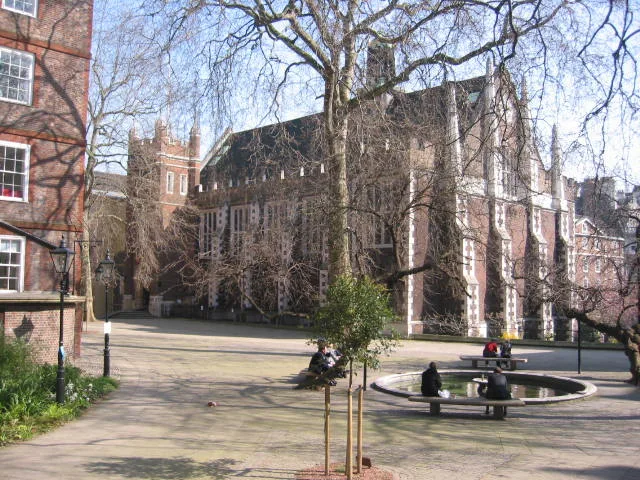
Middle Temple Hall. Photo K Flude.
This play was commissioned by the Lawyers of Middle Temple, in Fleet Street London for the end of the Christmas Season. It was written by Shakespeare and first performed in Middle Temple Hall which is still standing. For the folklore of Twelfth Night see my post here.
1880 – First shipment of frozen meat arrives in London from Australia. It was in excellent condition despite a leaving Melbourne in Dec 1879. Hay’s Gallerie in London was one of the world’s first warehouses with refrigeration.
1943 – German Army surrenders ending the Battle of Stalingrad, marking the beginning of the end of the WW2.
Today is Groundhog Day in the USA. This is when the groundhog comes out to see what the weather is like. If it is dull and wet he stays up because winter will be soon over, if it is sunny and bright he goes back to his burrow to hibernate for another 6 weeks. Originally, a German custom associated with the badger. A groundhog is a woodchuck which is a marmot. Does this workas a forecast method? Not being in America I don’t know but what I do know is:
How much wood could a woodchuck chuck If a woodchuck could chuck wood? As much wood as a woodchuck could chuck, If a woodchuck could chuck wood.
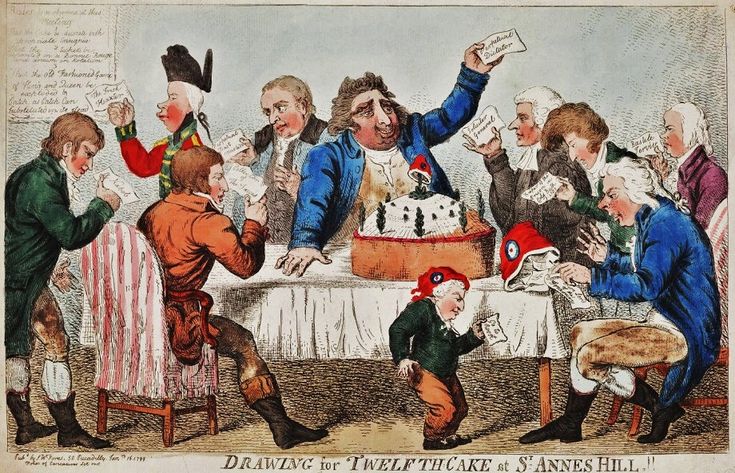
‘Drawing for Twelfth Cake’ at St. Annes Hill ’12th Night Cruikshank, Isaac, 1756-1811 printmaker. Published Janr. 10, 1807 by Thomas Tegg, 111 Cheapside’
Twelfth Night/Twelfth Day
Yesterday was Twelfth Night for the modern Church of England, but today is Twelfth Night for the Catholic Church and in England in former times ~(yesterday was Twelfth Day Eve. It is also Epiphany or Three Kings Day and because of calendrical differences, Christmas Eve for the Orthodox Church.
In Ireland, it is Nollaig na mBan. This is Women’s Little Christmas; when Women get to rest and let men do the work. This is a typical Saturnalia-style reversal of roles.
‘Drawing for Twelfth Cake’ at St. Annes Hill
I used the print above, three years ago for my post on New’s Day, then moved it to Twelfth Night. I also use it for lectures on Christmas and Jane Austen. But the focus of my presentation here is explaining the Twelfth Night Cake and the game that was played. But in fact, this is a very political satirical cartoon. More of that, later, let’s begin with the more trivial aspect of the print above.
Twelfth Night Performance, Party
It used to be the big party night, featuring the famous Twelfth Night Cake and theatrical entertainments; mumming and wassailing. Essentially, these terms mean wandering around the Town or Village dressed in costume and drinking beer, cider, or wine cups. The tradition of performance also was kept by the Royal Court and by institutions such as City Livery Companies and the Inns of Court in London.
These traditions saw someone chosen as the King for the night, and often someone else chosen as Queen. In 1606 Ben Jonson’s masque Hymen was performed before the Court. In 1613 Lord Bacon gave Gray’s Inn permission to a Twelfth Night Masque at Whitehall. During the performance, a character called Baby Cake brought in a ‘great cake with a bean and a pease’. On the Candlemas Feast of 2 February 1602 Middle Temple performed a play called Twelfth Night that the lawyers had commissioned from one William Shakespeare. Candlemas was the end of the Christmas Season. See my post on Candlemas here.
The cake has disappeared from current Christmas celebration, probably because it transmuted into our present Christmas Cake. This, I regret. I have had a lifetime when a very heavy Christmas Dinner is followed, first, by Christmas Pudding. Then, overloading with food, the Christmas Cake is brought out. No one, in their right mind, wants a slice of heavy Christmas Cake after a Christmas Dinner, and Christmas Pudding! Many of my American friends disparage fruit cake, but they are mistaken. Good Christmas Cake is something to be thoroughly enjoyed, but on the days following Christmas Day.
I gave a recipe for the Twelfth Night Cake in another post, (here it is). But the important point is that it had a bean and a pea in it. The one who got the bean was selected as King for night and the pea the Queen. The rest of the Christmas Party draw cards. Traditionally, the women draw a card from a ‘reticule’ (bag) and the men’s from a hat. But there are no women at this satirical party (pictured above).
The cards detailed a role the party goers were to play for the rest of the night. The card began with an introductory speech, or rhyme, for the person to speak. The King and Queen led the way, and for the rest of the evening the party members adopted their persona. They might be an aristocrat, a soldier, a cook, a parson, a dairy maid etc. The French do something similar with their Galette des Rois. The bean is called the feve, and may be replaced by a porcelain model. Other places have a King’s Cake for epiphany.
Twelfth Night Satire
So, as I was rushing to get the original Twelfth Night post done, I failed to examine it in any detail. I assumed the cards gave them satirical occupations which would be funny to the contemporary audience in 1807. But then, I noticed the title mentioned St Anne’s Hill. I looked it up and discovered myself down a deep and very enjoyable research rabbit hole.
St Anne’s Hill & Charles James Fox
Now, let’s go down that rabbit hole and look a little deeper.
The caption mentions St Anne’s Hill. I believe this refers to St Anne’s Hill, near Chertsey (SW of London on the River Thames). Here, there was a grand house which was owed by Charles James Fox. He was the leader of the Whigs, a persistent opponent of King George III. He was a supporter of the American and French Revolutions. This explains the red bonnet used to pull out the cards in the illustration.
The central figure is then, Fox. But he died in September,. 1806. The print is dated January 1807. Just before he died, his Foreign Slave Trade Bill of 1806 began the dismantling of this pernicious trade in the British Empire. He was Foreign Minister, who assumed a couple of civil chats with the French would end the long-standing war. But he soon discovered that Napoleon was not to be trusted in negotiations. The war went on for another 9 or so years.
Charles James Fox was a mercurial figure with many radical views. He was also a notorious gambler and loved the high life. One of his many lovers was Georgiana, Duchess of Devonshire. He eventually married, Elizabeth Armistead, an ex-mistress of the Prince of Wales. St Anne’s Hill was her house. I am pleased to report that she is credited with calming his life-style. He now spent more time at St Anne’s where they would ‘read, garden, explore the countryside and entertain friends’ (Wikipedia).
Isaac Cruikshank’s ‘Drawing for Twelfth Cake’ at St. Annes Hill
Cruikshank’s illustration is, of course, not designed to document quaint Twelfth Night customs but is a political satire and I discovered that the British Museum has the original version of this print, and. It is dated to 1799 which makes much more sense!
At the back right of the print is a notice which says:
‘Rules to be observed at this Meeting 1. That the Cake be decorated with appropriate insignia 2 That the tickets be deposited in a Bonnet Rouge and drawn in Rotation 3 That the Old Fashioned Game of King and Queen be exploded & Catch as Catch can Substituted in its stead.’
The bonnet rouge is a ‘redcap worn by ardent supporters of the French Revolution’ or ‘an extremist or revolutionary’. (defined by the Collins Dictionary as). Point 3 relates to Fox’s opposition to the King and the Republicanism of the French Revolution. The expression Catch as Catch Can refers to a free form of wrestling without rules, and presumably a satire on ideas of democracy.
Opponents of William Pitt
The characters in the scene (all men) are all political figures. They are associated with the opposition to the very right-wing Government of William Pitt. During the war with France, the opposition was led by a supporter of the French Revolution. For those on the right, which included Pitt’s government, supporting the French Revolution was tantamount to treason. Pitt suspended many civil liberties in ‘Pitt’s Reign of Terror’. He arrested and indeed executed leading members of those demanding political change. The Government even suspended Habeas Corpus to make it easier to arrest their opponents,
Fox is seen drawing a 12th Night Game ticket which is marked ‘Perpetual Dictator’. To his right is Frances Burdett. He was a radical politician, who supported universal male suffrage, equal electoral districts, vote by ballot, and annual parliaments. Note that this is well before these aims became the core of the Chartists campaign for electoral reform.
Frances Burdett
Burdett is shown holding a ticket saying ‘Keeper of the Prison in Cold Bath Fields’. This is a satirical reference to a serious political crisis. The Cold Baths Fields was the site of a medical spring in Clerkenwell, London. It was a prison where radicals were imprisoned. Conditions were very poor, despite the recent rebuilding under the aegis of the prison reformer, John Howard. Burdett exposed the scandalous conditions in the House of Commons. He began a campaign against the magistrates involved in the arrests. Francis Burdett married into the fabulously rich banking family the Coutts. His daughter was the famous Angela Burdett Coutts who was a philanthropist who collaborated extensively with Charles Dickens.
Edward and Catherine Despard
One of the prisoners was Edward Despard who had associations with many radical groups. These included the London Corresponding Society, the United Irishmen and United Britons. Despard married Catherine, the daughter of a free black woman from Jamaica. She, with Burdett, led the campaign against her husbands and other arrests without trial. Catherine wrote a letter to the Attorney General who replied in a demeaning manner:
‘it was a well-written letter, and the fair sex would pardon him, if he said it was a little beyond their style in general’
He did not comment on her colour. She described the imprisonment of her husband as being :
“in a dark cell, not seven feet square, without fire, or candle, chair, table, knife, fork, a glazed window, or even a book”
Despard was freed in 1802, went to Ireland. He returned to London. He was arrested again. And accused of a being the ringleader of a plot to assassinate the King. There was little real evidence. Horatio Nelson was a character witness, and appealed to the King for clemency. Clemency was granted. But only in so far as Despard was not disembowelled. Just ‘Hanged and Drawn’ at Horsemonger Lane Gaol in Southwark (1803). He was the last person to be drawn through the streets at the tail of a horse before execution for treason. These are his last words:
Fellow Citizens, I come here, as you see, after having served my Country faithfully, honourably and usefully, for thirty years and upwards, to suffer death upon a scaffold for a crime which I protest I am not guilty. I solemnly declare that I am no more guilty of it than any of you who may be now hearing me. But though His Majesty’s Ministers know as well as I do that I am not guilty, yet they avail themselves of a legal pretext to destroy a man because he has been a friend to truth, to liberty, and to justice
(a considerable huzzah from the crowd)
and because he has been a friend to the poor and to the oppressed. But, Citizens, I hope and trust, notwithstanding my fate, and the fate of those who no doubt will soon follow me, that the principles of freedom, of humanity, and of justice, will finally triumph over falsehood, tyranny and delusion, and every principle inimical to the interests of the human race.
(a warning from the Sheriff)
I have little more to add, except to wish you all health, happiness and freedom, which I have endeavoured, as far as was in my power, to procure for you, and for mankind in general.
https://en.wikipedia.org/wiki/Edward_Despard
After his death, his family denied that Catherine was his wife but merely his ‘house-keeper.’ I assume, this was because they wanted the inheritance rather than, or perhaps, as well as naked prejudice.
@Phew! This is what I love about what I do, you find things out that link disparate parts of your knowledge, creating an ever-interwining web of history.
On this Day
1066 Harold Godwinson crowned King of England on January 6, 1066, the same day as the funeral of the previous king, Edward the Confessor.
London. 1066 and All That Walk 11.30am Sun 8th March 2026 To book Tudor London – The City of Wolf Hall 2.30 8th March 2026 Barbican Underground Station To book The Spring Equinox London Virtual Tour 7.30pm Fri 20th March26 To book The Decline And Fall Of Roman London Walk 11.30 Sat 21st March26 To book The London Equinox and Solstice Walk 2:30pm Sat 21st March26 To book Roman London – Literary & Archaeology Walk 11.15pm Sun April 5th 2026 To book Samuel Pepys’ London – Bloody, Flaming, Poxy London 2:15pm Sun 5th April 26 To book Chaucer’s Medieval London Guided Walk 11.00am Sat 18th April 2026 To book Chaucer’s London To Canterbury Virtual Pilgrimage 7.45pm Sat 18th April 26 To book Jane Austen’s London Walk 11.00am Sun 19th April 26 To book Myths, Legends, Archaeology, and the Origins of London 11:15am Sat 2nd May 26 to Book London Bridge to Bermondsey Sat 2nd May 2026 To book
For a complete list of my guided walks for London Walks in 2025 look here
John Stow reports on the Lord of Misrule. Memorial in St Andrew’s Church
On the sixth day of Christmas
My true love sent to me 6 Geese a Laying; 5 Golden Rings. 4 Calling Birds; 3 French Hens; 2 Turtle Doves and a Partridge in a Pear Tree
The Lord of Misrule, Masters of the Revels, and Boy Bishops
The Roman festival of Saturnalia reversed the rules so that slaves, ruled and masters served. It was held between 7th and 23rd of December. It also included giving gifts. In the medieval period, the disorders of Saturnalia was continued. Monarchs, Lords and Gentlemen, City Institutions elected Lords of Misrule, Masters of the Revels, and Boy Bishops. John Stow was London’s first great historian. In his Survey of London, he wrote of the Lords of Misrule in London. They were chooses at Halloween and continued until Candlemas, in early February. See my post here for more details on Candlemas.
From John Stow’s Survey of London
This is what Stow says:
Now for sports and pastimes yearly used.
First, in the feast of Christmas, there was in the king’s house, wheresoever he was lodged, a lord of misrule, or master of merry disports, and the like had ye in the house of every nobleman of honour or good worship, were he spiritual or temporal. Amongst the which the mayor of London, and either of the sheriffs, had their several lords of misrule, ever contending, without quarrel or offence, who should make the rarest pastimes to delight the beholders.
These lords beginning their rule on Alhollon eve, continued the same till the morrow after the Feast of the Purification, commonly called Candlemas day. In all which space there were fine and subtle disguisings, masks, and mummeries, with playing at cards for counters, nails, and points, in every house, more for pastime than for gain.
Against the feast of Christmas every man’s house, as also the parish churches, were decked with holm, ivy, bays, and whatsoever the season of the year afforded to be green. The conduits and standards in the streets were likewise garnished; (…) , at the Leaden hall in Cornhill, a standard of tree being set up in midst of the pavement, fast in the ground, nailed full of holm and ivy, for disport of Christmas to the people…
Holm is an evergreen oak. Its Latin name is Quercus ilex. The Tree in Leadenhall Street was also used as the Maypole. And he tells us it was destroyed in the great wind of 1444. You can read all about that here. You might also like to see my posts. These include information about John Stoww and midsummer celebrations and Boy Bishops, and l Stow’s Memorial.
On the fourth day of Christmas My true love sent to me Four calling birds, Three French hens, Two turtle-doves And a partridge in a pear tree.
Holy Innocents Day or Childermas is dedicated to children on the day Herod ordered the slaughter of children aged two or under, in an attempt to kill the prophesied Messiah. However, the massacre is only mentioned by Matthew, and other classical sources, despite being anti-Herod, don’t mention it. It is thought to be ‘modelled’ on the massacre of young children mentioned in Exodus when the Pharoah hears about the birth of Moses.
It is, therefore, as far as folklore is concerned, an ill-omened day so don’t begin any new enterprise or, indeed, attempt to go back to work. And remember, as Childermas falls on a Sunday this year, Sundays throughout the year are all ill-omened days. There was a medieval tradition that people should avoid work on the day of the week that Childermas fell until the next childermas. Bad luck this year as it’s a Sunday!
Weather wise, according to a 17th formulae, as the fourth day of Christmas is warm, expect the fourth month, April to be similarly warm.
Christmas Games
So, no sloping off to the Study, it’s best to spend the time playing Christmas Games. The one I remember, most fondly, is pick-up-sticks or spillikins. You drop a pile of sticks onto a table-top or the floor. Then have to pick up as many sticks as you can without disturbing any others. Your turn ends when you move a stick. Different sticks have different values. We also played Dominoes, Ludo and Snakes and Ladders.
But, to get the whole room joining in, we played two card games. Participants could sit in their comfy armchairs rather than at a table. Chase the Ace. Newmarket.
Chase the Ace is, apparently, also, rather unpleasantly, called Screw Your Neighbour in the US! Each person is dealt a card. In turn, they choose to swap it with their neighbour. At the end of the round, the lowest cardholder (ace is low) loses a life. A player is excluded after losing 3 lives. Last one standing is the winner.
Newmarket (or Michigan) is a gambling game in which everyone places a stake on 4 picture cards. Theare are placed in the centre of the room. If your cards comes out in the play, you win the money staked on the card. The point of both these games is that any number of people can play, and they are simple and fast.
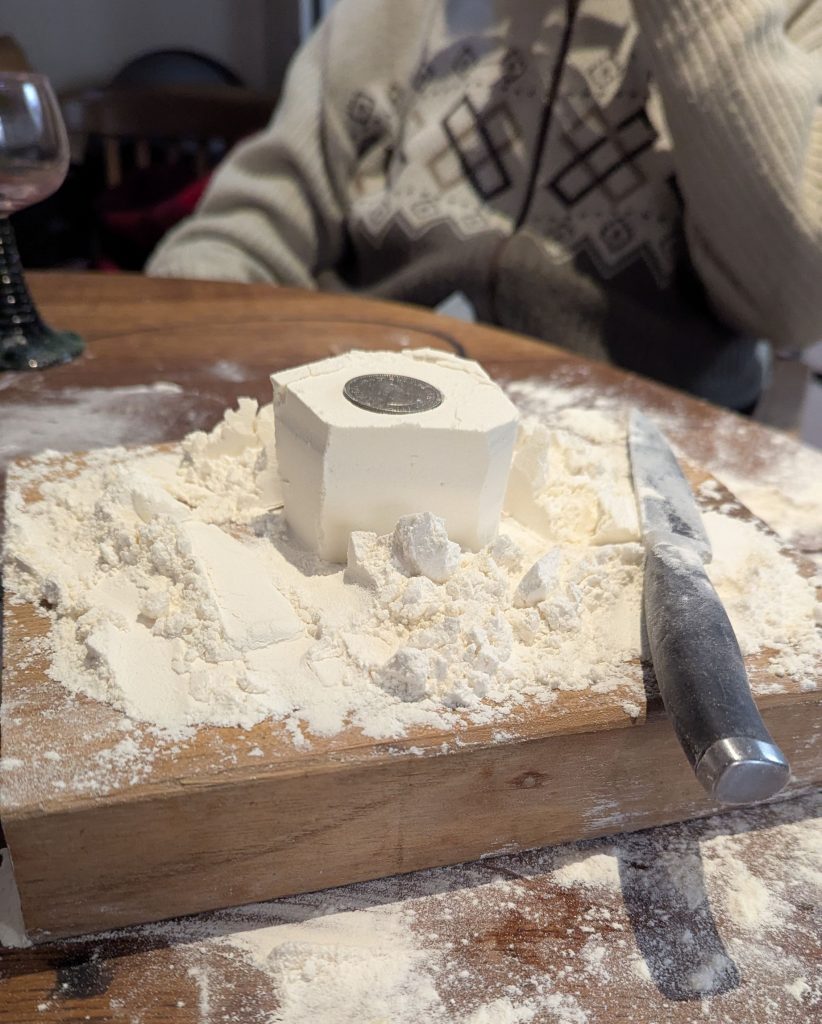
Another game we played at parties was Bullet Pudding. Players cut off bits of a flour pudding until the coin or bullet falls into the basin. The unlucky player (me last time I played) has to pick it up with his teeth.
Here is a photo of the one we played on 24th December,2024. My 97-year-old dad is in the background. You can see what a messy game it can be!
Apparently, the development of the American Santa Klaus was a way for the elite to keep control of the rowdy working class in New York. The argument, in a nutshell, is that the folk Christmas was outside and rowdy. Then Clement Moore wrote “A Visit from St. Nicholas”. This introduced a domesticated indoor middle-class version of Father Christmas. It’s a fascinating spin on the traditional story.
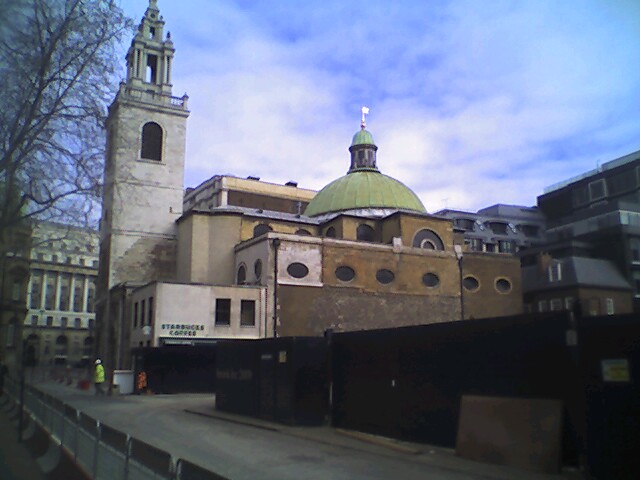
St Stephens, Walbrook. This view of the Church is not normally visible. The brown brick area to the right is much ‘cruder’ than the left. Christopher Wren was saving money by not ‘finishing off’ parts that were not visible from the public thoroughfare. Photo by the Author in 2008
On the second day of Christmas my true love sent to me: 2 Turtle Doves and a Partridge in a Pear Tree
Feast Day of St Stephens
It is the Feast day of St Stephen. He was the first Christian Martyr and was stoned to death not long after Jesus’ apotheosis. He was a deacon in the early Church, brought before the Sanhedrin for blasphemy. At the trial, he made a long speech outraging the audience. St Paul was in the audience (also known as Saul).
Stephen attacked the importance of the Temple to Judaism, making parallels with idolatry. Perhaps, I wonder, this explains why there are so few early Christian Churches identified in the archaeological record? Were they consciously avoiding large Temple Basilican structures to differentiate themselves from pagan religions?
Wrens & Presents
The 26th is the day when Wrens could be hunted. Read my post about Robins and Wrens and their seasonal importance here. Also, the day, people gave presents (Boxes) to servants and working people. Other days for presents included St Nicholas’s Day (December 6th), Christmas Eve, Christmas Day, New Year’s Day, and Twelfth Night.
St Stephens Walbrook
Wren’s most beautiful Parish Church is dedicated to St Stephen. It is one of the first Parish Churches to have a dome. There is also a splendid Altar designed by Henry Moore. I took a Swedish Choir around the City of London on a guided walk. St Stephen’s was open, and, once inside, they just fancied the acoustics. So, they sang. I recorded. Listen below:
In 1858, James Ewing Richie wrote about ‘Boxing Night’ in ‘The Night Side of London’. I’ve mixed it up with another source. So here is a list of the people who might come knocking at the door for their traditional Boxing Day Box.
Richie’s advice was to tie up your knocker to avoid paying these people:
The Chimney sweep. Then varlets playing French Horns pretending to be the Waits – {The Waits were licensed musical beggars}
Then came the Turncock, who switched the water supply to your side of the street on alternative days. Followed by the Postman, the Dustman; the Road Waterer in summer, and the Road Scrapper in Winter. After this, the real Waits turned up for a musical turn. Then the Lamplighter, the Grocer’s Boy and the Butcher’s Boy.
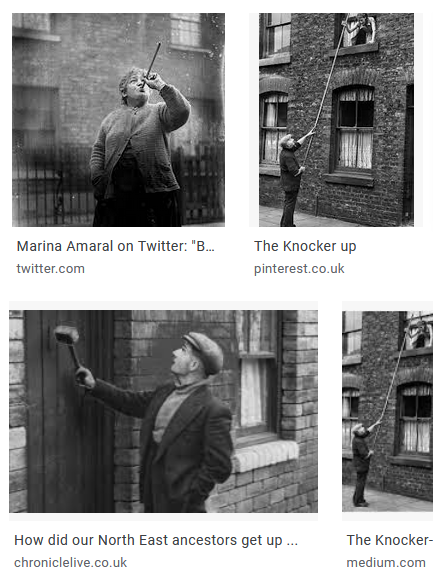
I imagine the Knocker-upper also got a Box. My grandmother told me about the knocker-upper in Old Street in the early Twentieth Century. He would tap on the window with his long stick to wake up those people without a reliable clock.
Google search image of the ‘knocker-upper’, the lady at top left worked in Limehouse and is using a pea-shooter.
Richie records that he had to give a tip to 6 people who wished him a Happy Christmas on his way to work. The tip he gave was half a crown each. He thought his wife would be lucky to get away with a shilling per person for the trade men listed above. Strange that he gave more than twice as much to random strangers than his wife gave to people who served them all year. Perhaps this reflects his belief that the size of his tip reflected his position in society. It is all curmudgeonly. This is probably because he believed it would be spent on drink, leading to the miseries of drunkenness.
The Drunkards Children by Cruikshank 1848. Cruikshank was a famous illustrator from a dynasty of visual satirists and one of Dickens illustrators. The story shows the effect of alcoholism on a family. It ends with the suicide from London Bridge of the mother.
First Published on Dec 26th 2022, Republished December 2023, 2024, 2025
The First Day of Christmas, my true love sent to me a Partridge in a Pear Tree
Nebra Sun disc. Photo from Stonehenge Exhibition British Museum (photo Kevin Flude) The Disc shows the Sun, the Moon, the Pleides, and illustrates the Summer and Winter Solstice movements of the Sun.
On the 25th December were born Jesus, Mithras, Attis, Saturn, Apollo, and the Invincible Sun.
The Sun Gods have quite a complicated interrelationship. Zeus, and Apollo are both also considered to be Sun Gods. Apollo is particularly interrelated to Helios, the Greek God who drives the Chariot that carries the Sun across the skies every day. The Romans had a God called Sol who some say was a deity but who declined to be of minor importance. Then Sol was championed by the transexual Emperor Elagabalas. Aurelian revived the cult in 274 AD. Sol Invictus was the focus of Constantine the Great. Sol has been suggested as a response of the Romans to a trend towards monotheism in the later Roman period. Sol for Constantine was a gateway God to Christianity.
It is also notable that early worship of Jesus is full of solar metaphors, Jesus being, for example, the light of the world. Churches are also virtually all orientated East West, aligned with the rising and setting suns. The Altar is always at the East End, and effigies on tombs face the rising sun.
First Christmas?
The first recorded Christmas Day is in AD336. It was in an almanac that lists Roman Holidays, officials and martyrs. The entry for December 25th says: ‘natus Christus in Betleem Judeae’. For more early Christian Dates have a look here.
Celtic Sun Gods?
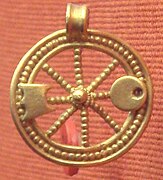
The Golden Wheel from Haute Marne in France, (Public Domain, Wikipedia)
Did the Celts have a sun-god? Belenos is a contender, but linguists are proposing his name does not come from words meaning bright but from strong. The God Lugh’s name is suggested to mean ‘shining’ but his attributes are more of a warrior than a sun god. Taranis is probably the best candidate, but he is more of a sky or thunder god than specifically a sun god. However, his symbol is a 8 spoked wheel is said to be symbolic of the Sun. It also represents the division of the year by the 4 quarterly sun festivals (Winter Solstice, Spring Equinox, Summer Solstice and Autumn Equinox) and the 4 cross-quarter festivals, (Samhain or Halloween, Imbolc or Candlemas, Beltane or May Day, Lughnasa or Harvest Festival).
December 25th is a few days after our reckoning of the Solstice. But, as we have previously seen, Christians believed the world was created on the Spring Equinox, and humans on the 4th day, so Adam was created on March 25th. Mary conceived on the same day, and therefore Jesus, after a perfect labour was born 9 Months later on December 25th. (See my post on March 25th and the Creation)
Christmas Cake
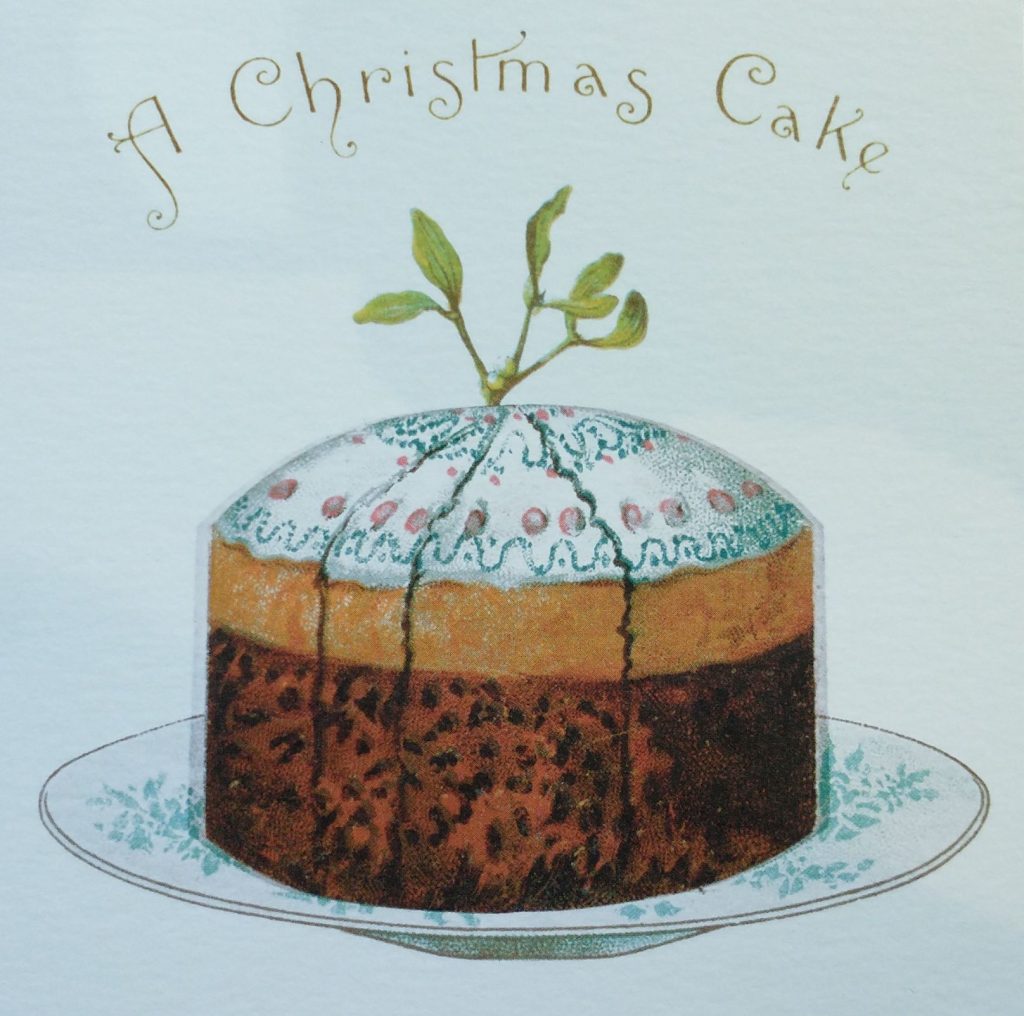
Today, you might be tucking into a Christmas Cake (originally eaten on Twelfth Night). Now, I know many Americans have a bizarre belief that fruit cake is the cake of the devil. Something you receive as a gift and give away to someone else, as most Americans hate it. More fool them for missing out on one of the delights of the Christmas period, that and cold turkey sandwiches. Christmas Cake is made on stir up Sunday, the last Sunday in November, to let the ingredients develop their flavour. They are then covered with marzipan and decorative icing.
19th Century Christmas Cake, generally now the icing continues down the side of the cake.
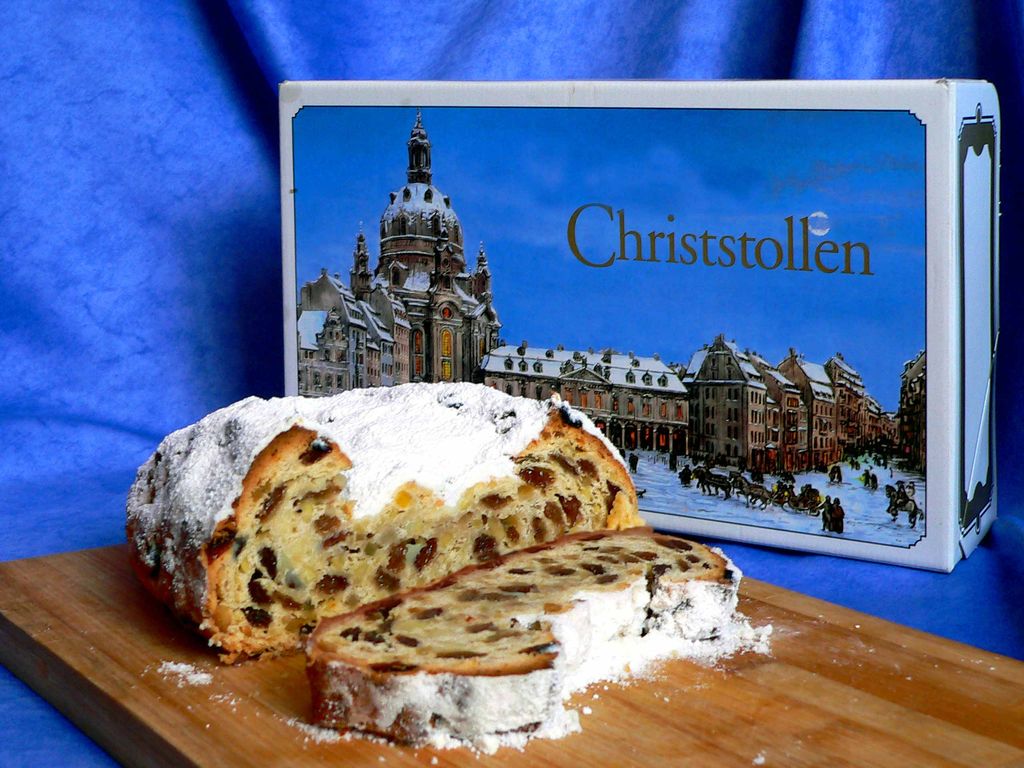
In Germany, they also eat a fruit bread called Stollen or Weihnachtsstollen. The tradition is said to have been started in the 15th Century, when the Pope gave dispensation to allow the use of butter in the fasting period of Advent. Previously, the Germans had to use oil to replace the banned butter, but they could only make oil from turnips, so eventually the Pope allowed the use of butter, with which they made bread with added dried fruits.
Stollen By Gürgi – Own work, Public Domain, https://commons.wikimedia.org/w/index.php?curid=3720379
In Italy, they eat Panettone, a fruit bread/cake. It is a sourdough, and a cross between a brioche and a cake. It often comes in a beautiful decorative tin, and is delicious. The centre of panettone production is Milan. Last year was the 200th Anniversary of Milan’s famous Marchesi 1824 which makes artisanal Panettone. It used ‘fine ingredients such as six-crown sultan as, naturally candied fruit, Bourbon vanilla from Madagascar, Italian honey and eggs from free-range hens, blended in a slow-rising dough with the exclusive use of Marchesi 1824 sourdough starter‘. Thank you, Mara from Milan, for the heads-up.
Screen shot from website – does not click through to sales!
Which is best? The only way to find out is to eat several slices of each. America, you don’t know what you are missing.
For stir up sunday see the second half of this post of mine.
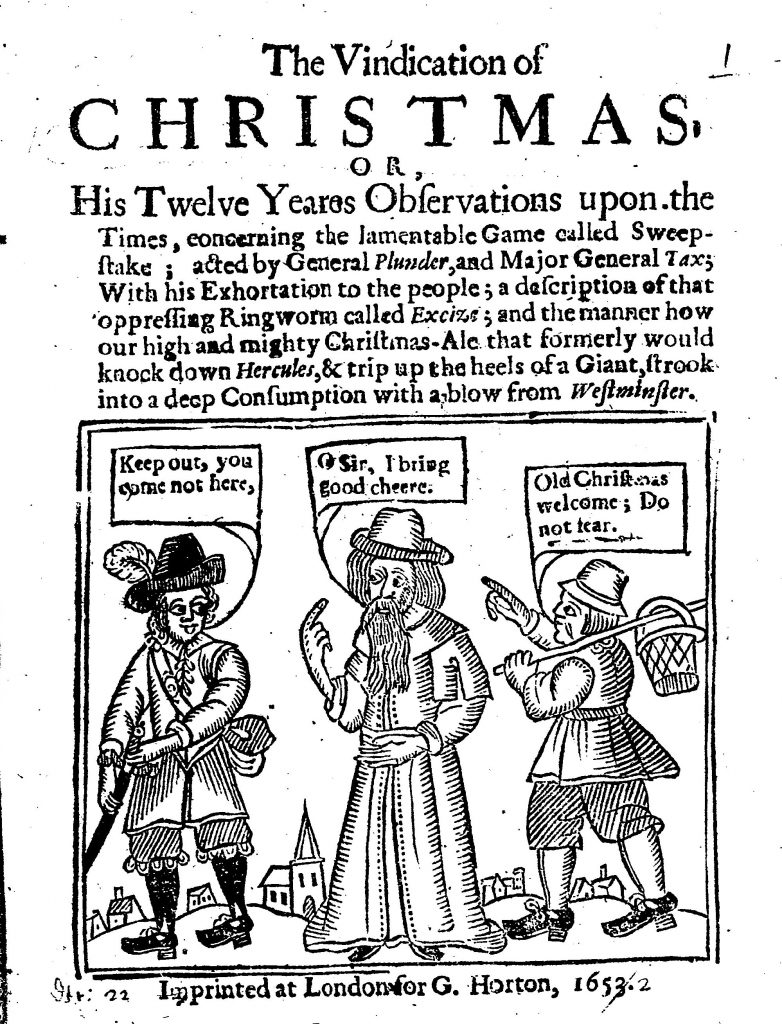
1653 Illustration of Old Christmas being rejected by the Puritan from London and welcome from the rustic from Dorset
23rd December 1652 Resolved by Parliament. : ‘That no Observation shall be had of the five-and-twentieth day of December, commonly called Christmas-Day.’
This was one of several bans on Christmas that Parliament introduced. (Parliament not Cromwell). It banned Christmas Services and ordered that shops be kept open, but it was, at least, inside people’s homes, largely unenforceable.
The logic for banning it was that Christmas is not mentioned in the Bible and was thus a Catholic superstition.
Christmas struggled through the Commonwealth, and then came back with a bang in 1660 on the Restoration of Charles II. However, it did shorten the period of Christmas festivities and make it more low-key, really all the way till the 19th Century when Dickens and Washington Irving revived the traditions of Christmas.
The Winter Solstice this year is: Sunday, December 21, at 3.03pm GMT in the UK. according to the Royal Museums Greenwich. Today, the Sun is at its lowest midday height of the year. This morning was the most southerly rising of the Sun this year. If the southward diminishing of the Sun everyday were to continue, life will be extinguished on earth. The world would have no light and no heat. So, societies all round the world, made a point of honouring their Sun Gods and Goddesses on this day.
And so on this day, or so it was thought, our Deities renew their promises as the Sun begins its rebirth. It begins to rise further north each day, the Sun at noon is higher, and it sets further north. So the days are longer, brighter, eventually warmer. Thank God(s)!
For some, it’s just the turn in the cycle of life. For others, it’s the death of the old Sun and the birth of a brand-new Sun. The Egyptians believed that the sun was reborn every day as a dung beetle.
Symbolically, the winter solstice is an ending as well as a beginning. It is a turning point and a promise by the Deity that the world will continue. It will turn, the wheel will turn. Warmth and growth will return. Buds already growing in the earth will break out and bring new growth.
The Winter Solstice – time for a party!
Culturally, it’s a time to have a party before the weather gets really cold. It is a time to evaluate your life; look back at the lessons from the last year. A time to begin, like the Sun, a new and hopefully better cycle.
Note. So if the Sun is at its shortest and weakest, why isn’t it the coldest time of the year? That is because the earth and particularly the oceans retain the heat of the Sun, and so the coldest time is at the end of January.
Fanny Austen Knight was the daughter of Jane Austen’s rich older brother Edward. He, rather strangely to our modern minds, was adopted by distant relatives who were childless. ‘Hey! We have enough boys to be going on with – happy for you to take one, particularly as you own two stately homes!’ as Mr and Mrs George Austen probably never said.
One of those homes was Godmersham Park in Kent, the other was in Chawton, a lovely Hampshire Village where Jane, Cassandra and Mum Cassandra lived, and is now a Museum dedicated to Jane Austen.
Fanny also rather cruelly remembers Jane and Cassandra as being unfashionably dressed and not up with upper-class etiquette. She wrote this when she was an old woman. When she was a teenager and being well brought up, she wrote letters to friends of the family and relatives. Here are extracts from her Christmas letters.
Christmas Games
1811 to 1812 Fanny writing to a friend, Miss Dorothy Chapman
‘I don’t know whether I told you that Misss Morris’s are at home for the Christmas holidays. They are very nice girls and have contributed a good deal to our entertainment. None of us caught the whooping cough and have been very well the whole time. We have, in general, had cards, snapdragons, bullet pudding etc on any particular evening and Whist, Commerce and others and tickets were the favourite games. I think when cards fail the boys played every evening at draughts, chess, and backgammon.‘
Commerce is a three card poker type game played with counters. Tickets was Lydia Bennett’s favourite game, which is a gambling game based on luck. It is called, in Pride and Prejudice, ‘Lottery Tickets.’ One imagines it is not a compliment to Lydia’s intelligence that she prefers a game of pure chance.
Bullet Pudding
Bullet Pudding is explained by Fanny in another letter
‘You must have a large pewter dish filled with flour which you must pile up into a sort of pudding with a peak at the top, you must then lay a Bullet at the top & everybody cuts a slice of it & the person who is cutting it when the Bullet falls must poke about with their noise & chins until they find it & then take it out with their mouths which makes them strange figures all covered with flour, but the worst is that you must not laugh for fear of the flour getting up your nose & mouth & choking you. You must not use your hands in taking the bullet out.’
I used to play this as a child at Christmas. We used a coin, not a bullet. The contestants walk around the table with the flour pudding on which has a knife ready for cutting the pudding. When the music stops, the one the knife is pointing at cuts off a slice of the flour pudding. They hope not to make the flour collapse and the coin fall. In my family, we pushed the winner’s head into the flour to maximise the fun. Snapdragons is a lively game, you put some brandy in a tray or flat dish, add a few raisins, light the brandy and the game is to pick up and eat the raisins without getting burnt!
Other games mentioned by Fanny
Hunt the Slipper, Oranges and Lemons, Wind the Jack; Lighting a Candle in Haste; Spare Old Noll.
Another niece Anna received Jane Austen’s advice on writing a novel:
‘You are now collecting your people delightfully, getting them exactly into such a spot as is the delight of my life. Three or four families in a country village is the very thing to work on, and I hope you will do a great deal more, and make full use of them while they are so very favourably arranged.’