
St Chad & Roman Weeks March 2nd

St Chad’s Church, Hackney. Statue of Bishop (I’m guessing St Chad!) Photo K Flude

St Chad

Today, is the Feast Day of St Chad who died on 2nd March 672. St Chad’s Church, Hackney is 400 yards from my house. It is a massive late 19th Century Church. Grade 1 listed built by James Brooks in 1869 in ‘his austere and muscular red-brick Gothic.’

Chad is the patron saint of medicinal springs,[37] although other listings[38] do not mention this patronage.

St. Chad's Day (2 March) is traditionally considered the most propitious day to sow broad beans in England.
photo of
St Chad’s Church Haggerston, London. Photo K Flude

Chad was possibly of Celtic origins but associated with the Anglian nobility in Northumberland. He was a pupil of St Aidan who set up the Holy Island of Lindisfarne. As a young man, he spent time in Ireland, then became an Abbot, Bishop to the Northumbrians at York, and to the Mercians at Lichfield. His brother was St Cedd, who was important in early Christian Essex and Yorkshire.

Chad was very humble, refusing to ride around his diocese, preferring to walk, Whenever there was a violent storm, he would prostrate himself to pray to save his people. The weather, he believed, was one of the ways God communicated. This might reflect Chad’s Celtic origins. Chad is the patron saint of medicinal springs according to one source. St. Chad’s Day (2 March) is said to be the best time to sow broad beans in England. You see he is a humble man.

March & Pisces

Attributes of Pisceans selfless, mystical compassionate imaginative sensitive
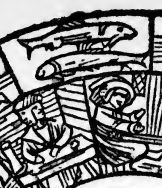
pisces from the zodiac from kalendar of shepherds
From the zodiac from kalendar of shepherds

Roman Months, Weeks (hours, minutes and 24/7, 60/360)

I have been discussing the way the Roman Calendar used to work.  Now it is our turn to look at the week.  A week is a division of a month. 

Oxford Languages says that the month derives from:

Old English mōnath, of Germanic origin; related to Dutch maand and German Monat, also to Moon.

Its length is roughly the length the moon takes to complete its cycle. So the obvious division of the month is into the phases of the Moon.  The early Romans chose to keep the lunar associations with their division of the month.  Their month was divided according to the Moon’s phases into the Kalends, the Nones and the Ides, as I describe in my Ides of March post here. Note that these Roman divisions divide only half the cycle. That is from new moon to full moon. The next 15 days are one block ‘before the Kalends’. So, not weeks as we know them! Although alongside Kalends, nones and ides, the Romans had 8 day market ‘weeks’.

Julius Caesar’s successful calendar reforms, restored the Calendar to alignment with the Sun, but stopped any pretence that months were linked to actual movements of the moon. So, I’m not sure why he kept the moon based Kalends system.

For more on Roman months, see my post on the Ides of March.

Constantine and the Week

In the 4th Century, after re-uniting the Roman Empire, supreme leader, Constantine the Great, wanted to make his own contribution to the rationalisation of the calendar. So, he got rid of the moon based Kalends, Ides and Nones, and established the week as the main subdivision of the month.

To please the Christians, he swopped the day of leisure from old man Saturn’s Day to the Son of God’s Day, Sunday.  This is the day Jesus ascended to heaven, but it was also the day for Mithras and the Unconquered Sun, so keeping some pagans happy. He then established the 7 day week.  7 was a sacred number and the number of the ‘planets’ in the Solar System as the Romans understood it (5 planets plus the sun and moon).

In Britain, we clung to some of our pagan names for the weeks. So Saturday, Sunday and Monday are Roman in origin. The Latin origins of the days of the week are obvious in the Romance languages, French, Spanish and Italian.  Lundi from the moon, Mardi from Mars, Mecredi from Mercury, Jeudi from Jupiter, and Vendredi from Venus.   Samedi came from  Saturn. Dimanche from dies Dominica which means the Lord’s Day.

Tuesday – Friday are Anglo Saxon, named after the deities: Tiv, Woden, Thor, and Freya. Thank God its Freya’s Day, they probably didn’t say! (because they worked on Saturn’s Day.)

The Heavens and the Zodiac

The order of the days comes from their position in the sky. Not in their position  around the Sun but their position in the zodiac. Babylon created the scheme of a division of the sky into 24 hour long sections, a god presided over each division.  This is where we get our hours from. And half of 24 is 12 so the 12 signs of the Zodiac.

It is too complicated to explain but there were 7 deities and 24 divisions, so the  deities rotated and did more than one shift. Babylon used the numerical base of 60.  So we have 60 seconds in a minute, 60 minutes in an hour, 360 degrees in a circumference.  

Other societies ignored hours until we had clocks to measure them.  In Chaucer’s time, hours were a 12th of the Day and a 12th of the Night, so in summer, day time hours were longer, and nighttime hours shorter, and vice versa in winter. Those hours were called ‘artificial hours’. This makes a sort of sense – in winter, daytime hours are precious, so you get a shift on to get essential work done in the short hours of daylight. In summer, you have a long day, long hours, so you can take it a little easier. Therefore, your productivity in a winter hour might be similar to your productivity in a longer summer hour? Anglo-Saxons divided days by tides; morningtide, eventide and nighttide.

Ages of man

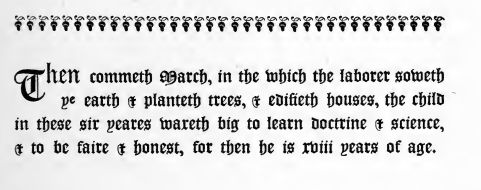
As I have mentioned before, prophecy often sees a connection between the yearly calendar and future events.  For example, if it rains on the fourth day of the twelve days of Christmas, then it will rain during the fourth month (they say).  The Kalendar of Shepherds illustrates this method, giving a comparison between the ages of man and the months of the year. Twelve months in a year, Twelve ages of man in six year blocks. So March represents ages twelve to eighteen, as it says, below, this is the ‘time to learn doctrine and science’.

Kalendar of Shepherds (translation from French 15th Century original)

On This Day

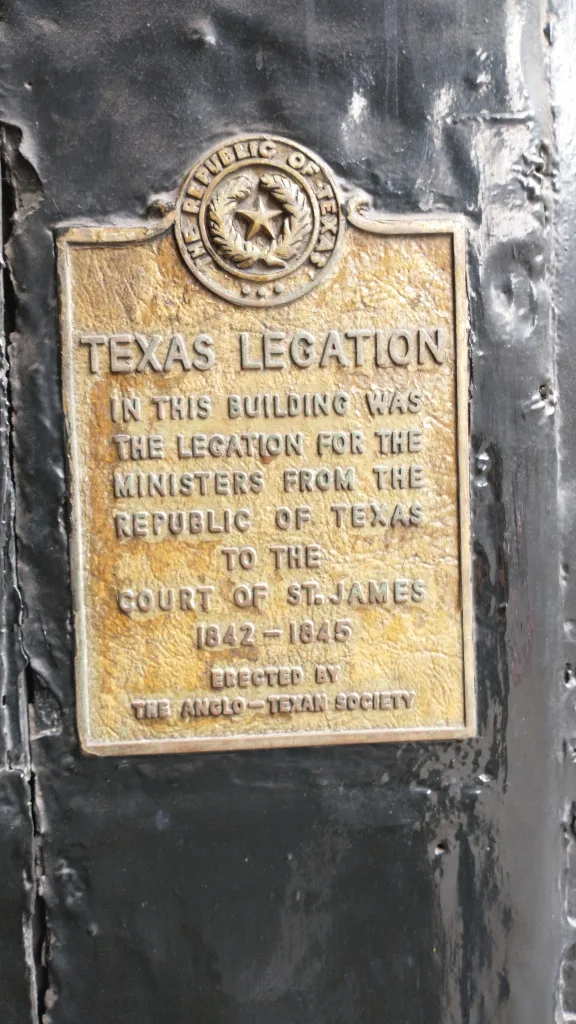
1836 – The Republic of Texas is set up as an independent State. The Alamo fell on March 6, 1836, but the Texans soon defeated the Mexicans and made the Republic a reality. It was annexed by the United States on December 29, 1845 and soon made a State.

While researching my Jane Austen’s London Walk I was delighted to find this plaque on a wall in Mayfair.

1969 – First flight of the Concorde, first supersonic aeroplane

1970 – the Republic of Rhodesia was set up by the Southern Rhodesian colonial government of Ian Smith. They declared a Unilateral Declaration of Independence (UDI) in 1965 in order to stop the transition to Black Majority Rule. The Republic of Zimbabwe took over on April 18th, 1980, after a bloody war.

First written in March 2023 revised on 2nd March 2024, St Chad added 2025, On This Day added 2026

Winter’s End February 7th

Photo of the cover of Winter's in the World by Eleanor Parker
Winter’s End in ‘Winters in the World’ by Eleanor Parker

Eleanor Parker’s book, on the Anglo-Saxon Year, is a wonderful book. It has a poetry about it, that also provides an insight into how Anglo-Saxon thought the world works. For a non-Old-English speaker, it, also, really gives some understanding of the language. It reveals that for the Anglo-Saxons, Winter’s End was on the 7th February. We are now in the season of ‘lencten’. This probably comes from ‘lenghtening days’ or Spring as we call it. The word eventually got absorbed into the Christian calendar, giving us the name of the fasting season, which is ‘Lent’.

So Winter began, for the Anglo-Saxon, on 7th October and ended on the 7th February. January was called ‘Gēola‘ the month of Yule. February ‘Sol-mōnaþ‘ which is Mud month. The Venerable Bede in the 8th Century calls this the:

‘month of cakes which they offered to their gods in that month’.

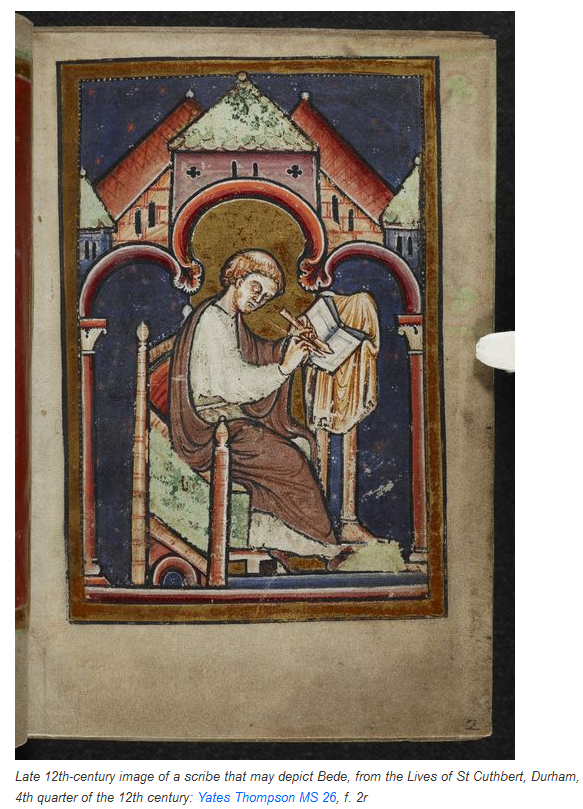
manuscript drawing possibly of the Venerable Bede
Thought to be the Venerable Bede, the first historian of the English

Bede tells us that before conversion to Christianity, the Anglo-Saxons had two seasons – Winter and Summer. Winter began on the first full moon of October, which they called Winterfylleth. The summer was called ‘sumor’ or ‘gear’ which developed into our word ‘year’. As in: ‘he was a boy of 10 summers.’

Roman, Celtic and Saxon Winter’s End

There is some sense in Winter’s End on February 7th. Lambs are being born; buds and shoot are appearing on branches and poking up from the cold earth. So, their winter is essentially, the time when nothing is growing, while ours is more aligned to the coldest period.

The Roman author Marcus Terentius Varro divided the Roman Year into 8 phrases and his Winter/Spring divide is also on 7th February. This is when, in Italy, the west winds began to blow warmer weather. So farmers ‘purged’ the fields, readying them for planting. They would be cleared of old growth and debris. Then blessed, weeded, pruned with particular attention given to preparing the grain fields, the vineyards, olive trees and fruit trees.

The Celtic year began at Halloween, and the spring begins with Imbolc, a week earlier than the Saxon on the 1st of February.

Anglo-Saxon Winter

In the section on Winter, Eleanor Parker gives a poetic description of winter. What seems particularly interesting about it is that the harshness of winter is often paired with descriptions of the ruins of Roman Civilisation. So, the despair of winter, the barren soil, the fight for survival is made more melancholic by the comparison to failed civilisation. Nature battering away at the useless ruins, and the destruction of people’s dreams.

Here, is a flavour of the juxtaposition of the bleakness of winter and the sadness of lost society. It is from ‘The Wanderer’ an alliterative poem from the Exeter Book, dating from the late 10th century. I have presumed to change a couple of words to make it a little more accessible.

Who’s wise must see how ghostly it has been
when the world and its things stand wasted —
like you find, here and there, in this middle space now —
there walls totter, wailed around by winds,
gnashed by frost, the buildings snow-lapt.
The winehalls molder, their Lord lies
washed clean of joys, his people all perished,
proud by the wall. War ravaged a bunch
ferried along the forth-way, others a raptor ravished
over lofty seas, this one the hoary wolf
broke in its banes, the last a brother
graveled in the ground, tears as war-mask.

That’s the way it goes—
the Shaper mills middle-earth to waste
until they stand empty, the giants’ work and ancient,
drained of the dreams and joys of its dwellers.”

Translation Dr. Aaron K. Hostetter.

Winter and Old Age

As I read this, I wonder if it is a tradition that began in the cold of Scandinavia? England, at least Southern England, can often have mild, rather than ferocious winters?

However, there is also an idea about the circularity of life and the interconnectedness of everything. There are 4 Seasons, 4 Ages of Man, and the cycle was from childhood to old age, from Spring to Winter. We start young, and become vigorous, and then we decline and eventually die. And so does the world of the Anglo-Saxons. The world of Adam was young, restored to vigour by the coming of Jesus. Now the World was in its old age awaiting the Apocalypse, before the Day of Judgement. So Winter was connected with Old Age and Death.

Bede’s Metaphor for Winter

Parker recounts a beautiful image of Bede’s. The King of Northumberland is thinking of taking his wife’s religion. He, therefore, invites the Christian evangelist, Paulinus to his court. Inclined to convert. He asks the opinion of one of his pagan advisers, who answers to the effect.

‘We are in the Great Hall, gathered warm with friends and family around the roaring fire, with Winter raging outside. A sparrow comes in from a hole in the end wall, flies through the warm of the Hall, and flies out through the other side. Such is life. The Hall is this world, we are the Sparrow, and as pagans we have no idea what happens before we enter the Hall, nor what happens after we leave. How much better it is to embrace a religion that can give us certainty as to what happens when we leave the hall.’

Lovely image, although, the pagan adviser does seem to have made his mind up to try Christianity? . What I like about it is that it echoes feelings I have. We as a species worry about what happens after death. It seems to many so final, to others unknowable. But I think ‘I don’t worry about what happened before I was born, so why should I worry about what happens after I die?’ It’s the same state of non-being. It gives me some comfort that I’m going back where I came from.

For the Ancient Grecian Winter looked at my Post on Hesiod

For the Roman Festival of Winter look at my post on the Festival of Brumalia

On This Day

1812 – Dickens born in Portsmouth. His father was the son of a Butler and a clerk in the Royal Navy Pay Board. He has much in common with Mr Micawber. His mother, Elizabeth Dickens was a source for the character of Mrs Nickleby. Dickens told a friend that his mother came to him exasperated by the stupidity of Mrs Nickelby. Dickens said words to the effect: ‘Little did she know that Mrs Nickleby was based on her’. Here is a section of Nicholas Nickleby that makes the point.

Nicholas Nickelby From Chapter 1

Mr Nickleby looked about him for the means of repairing his capital, now sadly reduced by this increase in his family, and the expenses of their education.

`Speculate with it,’ said Mrs Nickleby.

`Spec—u—late, my dear?’ said Mr Nickleby, as though in doubt.

`Why not?’ asked Mrs Nickleby.

`Because, my dear, if we should lose it,’ rejoined Mr Nickleby, who was a slow and time-taking speaker, `if we should lose it, we shall no longer be able to live, my dear.’

`Fiddle,’ said Mrs Nickleby.

`I am not altogether sure of that, my dear,’ said Mr Nickleby.

`There’s Nicholas,’ pursued the lady, `quite a young man—it’s time he was in the way of doing something for himself; and Kate too, poor girl, without a penny in the world. Think of your brother! Would he be what he is, if he hadn’t speculated?’

`That’s true,’ replied Mr Nickleby. `Very good, my dear. Yes. I will speculate, my dear.’

Speculation is a round game; the players see little or nothing of their cards at first starting; gains may be great—and so may losses. The run of luck went against Mr Nickleby. A mania prevailed, a bubble burst, four stock-brokers took villa residences at Florence, four hundred nobodies were ruined, and among them Mr Nickleby.’

Mr Nickleby ends up dead having falling 202 ft from the top of the Monument. In 1810 Elizabeth’s father, Chief Conductor of Monies in the Navy Pay Office was found guilty of embezzling £5,689 3s 3d.

Full text of Nicholas Nickely here.

First published in February 2023, republished on 7th February 2024, 2025, On This Day addedd 2026

July Julius Caesar’s Month

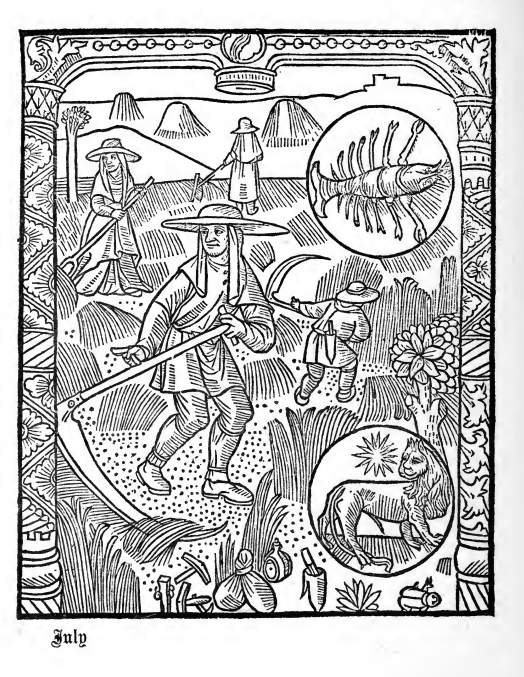
July – Kalendar of Shepherds 15th Century

July is named for Julius Caesar. Originally, the Roman Month was called Quintilis, as it was the fifth month of the Roman calendar, which originally started in March. Caesar reformed the calendar in 44BC and the Senate renamed the month after him. For more on Roman Months, see my post here.

The 7th month is called Lúil in Irish and Gorffennaf in Welsh. In Anglo Saxon it was Æfteraliða, or “after-mild;”, Liða, means “mild” or “gentle,” or the period of warm weather around Midsummer. June is Arraliða, or “before-mild”.

It is on average the warmest month in most of the Northern Hemisphere, where it is the second month of summer. The star signs are: Cancer (until July 22) and Leo (July 23 onwards),

July is the month of Haymaking, as you can see from the image (above from Kalendar of Shepherds). To find out more about haymaking, wait for the next post.

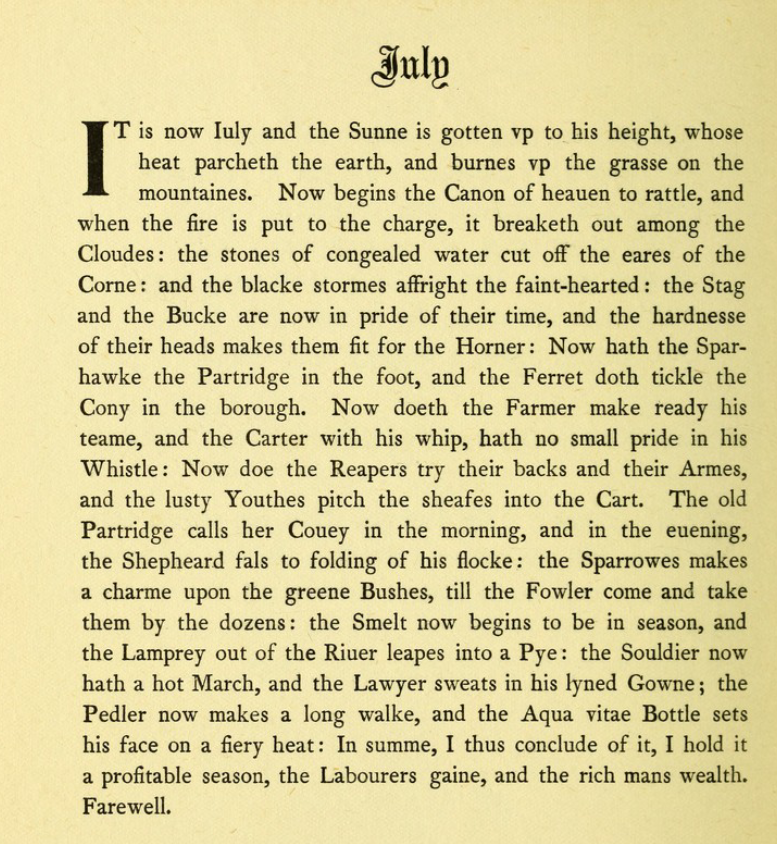
From the Kalendar of Shepherds comes this description of the month.

First published, in 2023 and republished in 2024, 2025

Beware the Ides of March March 15th

shows an image of Brutus stabbing Caesar with 'funny'  bubbles:
Caesar says 'Brutus, whats that loud pelting noise on the roof' and Brutus replies,  about to stab Julius Caesar 'Hail, Caesar'
The Ides of March – With Apologies. From Facebook

SOOTHSAYER: Caesar!
CAESAR: Ha! Who calls?
CASCA: Bid every noise be still; peace yet again!
CAESAR: Who is it in the press that calls on me?
I hear a tongue shriller than all the music
Cry ‘ Caesar!’ Speak. Caesar is turned to hear.
SOOTHSAYER: Beware the ides of March.
CAESAR: What man is that?
BRUTUS: A soothsayer bids you beware the ides of March.
CAESAR: Set him before me; let me see his face.
CASSIUS: Fellow, come from the throng; look upon Caesar.
CAESAR: What sayst thou to me now? Speak once again.
SOOTHSAYER: Beware the Ides of March.
CAESAR: He is a dreamer. Let us leave him. Pass.

Julius Caesar by William Shakespeare

Julius Caesar and the Ides of March

The Ides of March is the 15th of March. Julius Caesar didn’t take the warning that might have saved his life. You might suggest he got what was coming to first populist. But any study of Roman History will find many precursors in Roman and Greek History. Among populists, I rank Caesar with Napoleon as one of the Dictators who was, personally, an intelligent, reasonable man. They, in some ways, ruled ‘wisely’ but were nonetheless willing to sacrifice millions of people for their own personal ambition.

Today, the world is faced with the populists who are geniuses only in their own minds. I know, we as humans, might think, if only X would drop dead, how much better it would be? Brutus, being an honourable man, took action upon his thought. But, as often is the case, what seemed the ‘right thing’ to do, turned out to be a disaster. The plotters were trying to save the Roman Republic, but their murder destroyed the Republic. So, still those assassinary thoughts, read this article in ‘History Today’ about the impact of Julius Caesar’s murder. Do everything you can but use democratic means to defeat egotists to whom truth means nothing. In my opinion this is the major problem for humanity, it seems we do not know how to stop homicidal maniacs causing war without needing to fight a war to stop them. We do not have a method of peaceful mass rebellion. Perhaps Gandhi came closest but then he was working against a system that was not a dictatorship.

Ides of March

Now, what the heck are or indeed is the Ides of March?

A Roman month was divided into three, first the Kalends, then the Nones and finally the Ides. These three days were the important days of the month. The Kalends is the 1st of the Month. The Nones the 7th of the Month, And the Ides the Fifteenth. It is said to go back to the early days of Rome and a lunar calendar. The Kalends being the first tiny sliver of a crescent moon a couple of days after the New Moon. The Nones the first quarter of the Moon and the Ides was the full moon. To me, as a way of dividing a month it is very lopsided. The cycle of the moon is 29 days not 15. So the tripartite division divides up the first half of the month, and leave the second half undivided.

Debts were supposed to be paid on the Kalends and that is where we get our word calendar from. These public calendars were called Fasti. This is the name of Ovid’s great Almanac Poem, the Fasti, which I often quote from.

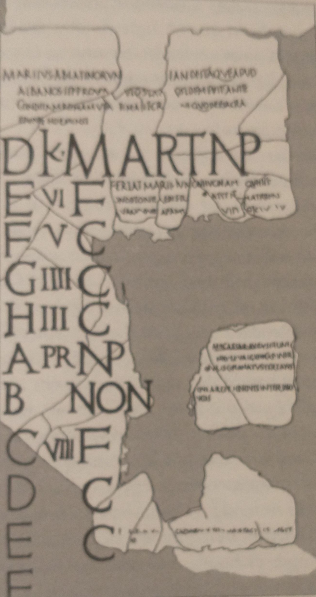
This is a very bad photograph of a drawing by Herbert E Duncan Jr of a 1st Century Calendar

How was it used? When talking about a day in the future month you might say I’ll meet you on the 5th day before the Kalends. I’ve never really understood this system, despite a few attempts, until I saw this drawing of a Roman Calendar. You’ll have to read this closely. The first column, on the left, with the letters from D to H then A – H. This is a recurring cycle of 8 market days, running in tandem with Kalends, Nones etc.. This gives an 8 day week.

Now reading across the top line DKMARTNP. So the D is the 4 day of the 8 day ‘market week’. The second column begins with the Letter K for Kalends, then MART for March. So it’s the Kalends of March. Then NP which means this day is a day for public festivals.

Back to the second column. Below the K for Kalends, the days are counted down to the upcoming Nones. So the next one after Kalends is VI, meaning the 6th day before the March Nones. Then V, IIII, III. There is no II because PR means the day before Nones. Below and to the right of the PR are the letters NON which is, as you might hope, is short for Nones.

In the second column below this is the number VIII which means the next day is the 8th day before the Ides of March. The fragment of stone from which this drawing comes does not continue down to the Ides, unfortunately.

Complicated, huh? It gets worse. The third column has a series of letters in it: F C C C NP NON F C C. We already know that the NON is short for Nones, The F means it’s a fastus, a permissible day when legal action can be taken. (the plural of Fastus is Fasti.) The C means C comitialis which on fasti days the Roman people could hold assemblies. (see my post for more on the curiae). We have already seen that NP marks days for public festivals. An N would mean days when political and judicial actions were prohibited, although there is not one here. The small unreadable text to the right is information, I believe, about holidays and historic events to be marked in the calendar. This is, in fact, a Roman Stone Almanac.

This confusing system survived Caesar’s major calendrical reforms. He transformed the Roman calendar, which was rotten at the core. He re-aligned with an almost accurate calculation of the time the Sun takes to circle the earth. (or the other way around!) This is known as the Julian Calendar.

But the Kalends, Nones, and Ides he left intact until Constantine the Great got rid of them. They were replaced with the familiar 4 fold division of the month. So, for the first time, you could work 24/7.

For more about Constantine’s Weeks look at my post here

For Caesar’s Calendrical reforms look at this post

2024 Revised March 2025