To Concordia on the Day of Peace January 17th

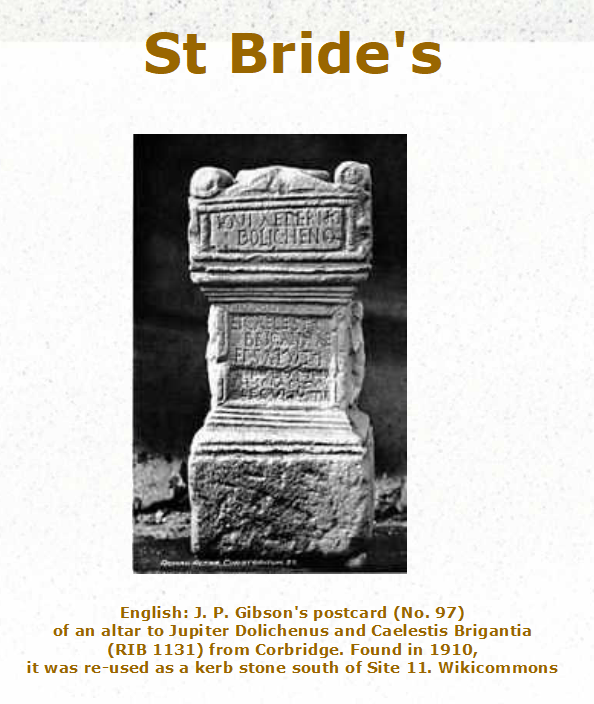
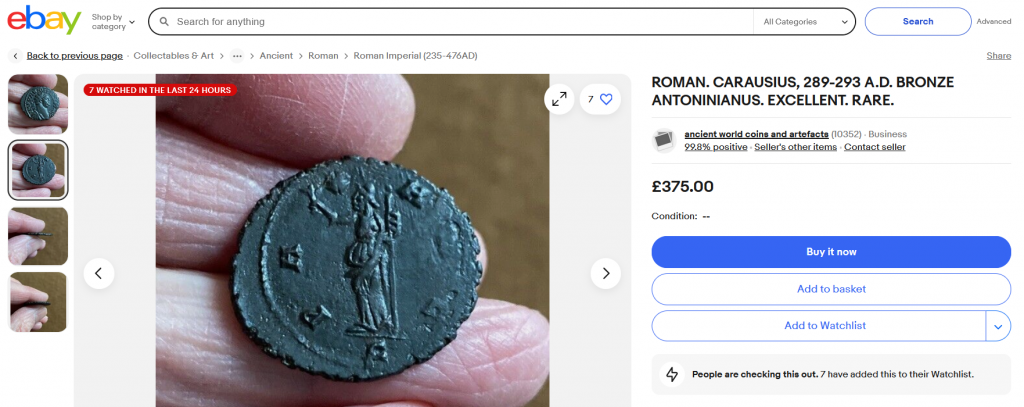
“To Concordia,¹ the Sixth Legion, Victorious, Loyal and Faithful and the Twentieth Legion [dedicates this].” found at  Roman Corbridge (Coriosopitum)
“To Concordia,the Sixth Legion, Victorious, Loyal and Faithful and the Twentieth Legion [dedicates this].” Found at Roman Corbridge (Coriosopitum)

Concordia on the Day of Peace

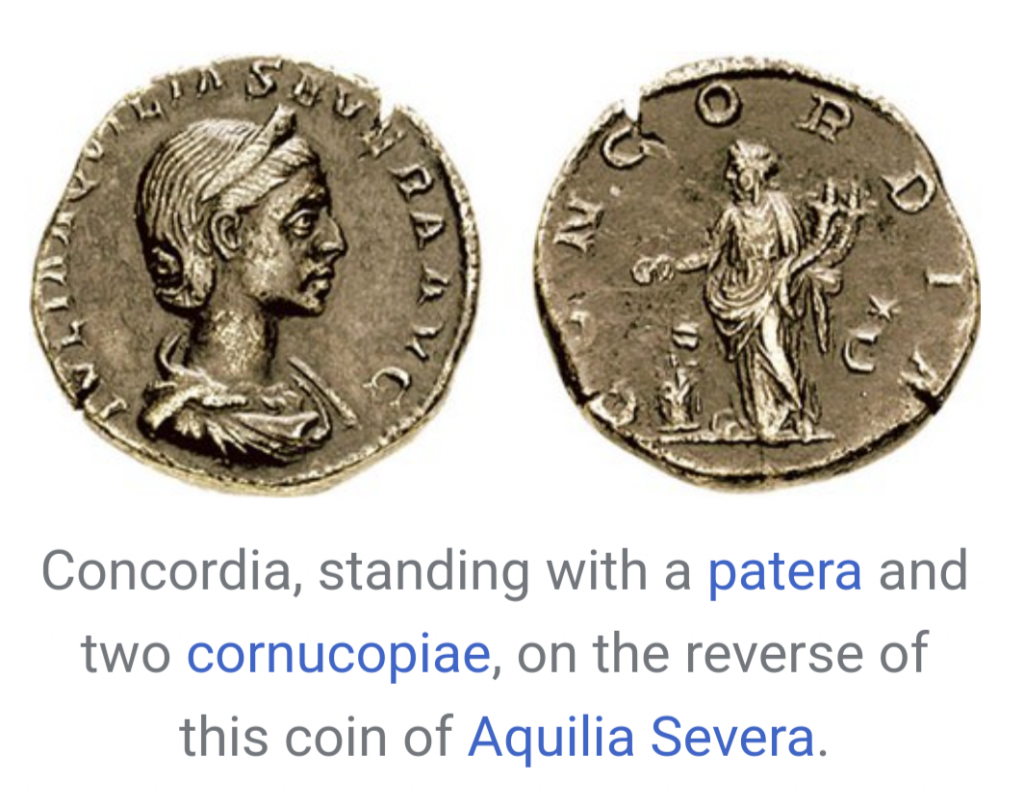
Today, doesn’t seem a great day for peace. But, Concordia was the Roman goddess of conciliation and harmony. The 17th January is also the Day of Peace for the Goddesses Felicitas, and Pax. So, let’s hope the Roman Goddesses can dispense some peaceful balm and wisdom on our leaders.

There are altars to Concordia in Britain at Corbridge and Carlisle on the Roman Frontier. The Gods of Roman Britain points out that the altars are found where there were:

detachments of troops from more than one Roman legion posted in the same place’.

Does this suggest that the soldiers needed to be reminded that they should not fight each other?

The altar stone pictured above is dedicated to the VI Legion and the Twentieth. The Twentieth, called Valeria Victrix, was stationed in Deva – Chester. But there are stones such as the one above which shows a detachment (or vexillation) was sent to Hadrian’s Wall. For more on the stone and Corbridge see this site. The VIth Victrix legion served on Hadrian’s Wall and their HQ was at Eboracum (York).

Ovid & Concordia

The Roman Poet, Ovid seemingly locates the Day of Peace on the 16th January. But for the 16th he writes: ‘Radiant One, the next day places you in your snow-white shrine’. The Goddess Book of Days puts her on the 17th. So, perhaps, I’m right placing her on the 17th, afterall?

The translator of Ovid’s almanac poem, the Fasti, A. S. Kline, explains that the Goddess Concordia:

symbolised the harmonious union of citizens. A temple was erected to her in 367BC (on the Capitol, near the temple of Juno Moneta) It was erected by Marcus Furius Camillus at the time when the plebeians won political equality. The Temple of Concord was restored by the Emperor Tiberius from his German spoils in AD10.

This is how Ovid puts it:

The Fasti, by Ovid

Book I: January 16
Radiant one, the next day places you in your snow-white
shrine,
Near where lofty Moneta lifts her noble stairway:
Concord, you will gaze on the Latin crowd’s prosperity,
Now sacred hands have established you.
Camillus, conqueror of the Etruscan people,
Vowed your ancient temple and kept his vow.
His reason was that the commoners had armed themselves,
Seceding from the nobles, and Rome feared their power.
This latest reason was a better one: revered Leader,
Germany
Offered up her dishevelled tresses, at your command:
From that, you dedicated the spoils of a defeated race,
And built a shrine to the goddess that you yourself
worship.
A goddess your mother honoured by her life, and by an
altar,
She alone worthy to share great Jupiter’s couch.

Book I: January 17
When this day is over, Phoebus, you will leave Capricorn,
And take your course through the sign of the WaterBearer.

Camillus was a semi-legendary military leader who is said to have built the Temple to Concordia in 367BC. The Temple was rebuilt several times. In 121 BC is was rebuilt at a larger size. Thereafter, the Senate would meet there during and after political conflict. Ovid’s revered Leader above is Tiberius, and his mother is Livia, the wife of Augustus. Tiberius filled the Temple full of art treasures. So, it became a museum and a tourist attraction for visitors to Rome. For more on Concordia and Pax look at my post here. For more Ovid, read my post here.

On This Day!

1752 – Today is also Twelfth Night Old style which is the date of the celebration of the last night of Christmas according to Julian Calendar which was replaced by the Gregorian in 1752. So Old Style time to Wassail the Orchard! Wassails are currently being held in various places in London. See here for the Bermondsey Wassail. See below for more details.

1773 – Captain Cook captained the first Ship (the Resolution) to cross the Antarctic Circle

1917 – The United States pays Denmark $25 million for the Virgin Island

Today is St Antony’s Day – father of Monasticism, curer of St Antony’s Fire, patron Saint of domestic animals, especially pigs. The runt of a litter is a ‘tantony pig’ and the smallest bell in a chime is a ‘tantony bell’. His symbols are pigs and bells.

Wassail Day at the Village Orchard Dulwich

London Wildlife Trust Wassail Day Website landing page

Run by the London Wild Life Trust. The web site says:

Celebrate Wassail Day with us on Saturday

London Wildlife Trust welcomes the local community to awaken the apple trees to ensure a good harvest of fruit in autumn in a traditional Wassailing event.

Activities on the day will include apple inspired crafts, bird feeders, warming bread on the fire (weather permitting), pinning toast to trees (this apparently helps with a good harvest!) and more! 

First written in Jan 2023, revised and republished in Jan 2024,2025,2026

Queen Elizabeth I’s Nicknames January 16th

Today is the day after the anniversary of Queen Elizabeth 1’s coronation, 1559. She soon developed enduring relationships with the senior members of her Government. For example, William Cecil, Lord Burghley served the Queen for the rest of his life – from 1558 to 1598 when he died.

Queen Elizabeth I gave leading members of her Court, nicknames. I have been tracking them down. I eventually found a post in The Chronicles of History. The author is a follower of this blog. The Chronicles mentioned three of them, so I went in search for the rest, and here is what I found:

Her chief minister, William Cecil, Lord Burghley, was called her ‘spirit’ and her alleged lover, Robert Dudley, Earl of Leicester, was her ‘eyes’. Rather more cheekily, she called François, Duke of Anjou, her ‘frog’.

https://www.historyextra.com/period/elizabethan/7-things-you-probably-didnt-know-about-elizabeth-i/

List of Queen Elizabeth I’s Nicknames

Putting my various sources here is my ‘definitive list’.

Elizabeth called Robert Dudley, Earl of Leicester “Eyes”
William Cecil was “Spirit”
Robert Cecil was her “pigmy” or “elf”
Sir Christopher Hatton was “lids” or less flatteringly her “mutton”
Francis Walsingham was her “Moor”
Francis, Duke of Alencon, (her French suitor) her “frog”

http://everythingelizabethan.blogspot.com/2011/03/she-was-fond-of-nicknames.html

People on the list of Queen Elizabeth I’s Nicknames

A comment on the same page says the ‘moor’ was, in fact, Edward De Vere Earl of Oxford, suggesting the attribution to Walsingham is a mistake. De Vere had a house in Clapton, Hackney, very close to where I lived. De Vere is one of the strongest candidates (or so the conspiracy theorists say) to have written Shakespeare’s plays. Queen Elizabeth 1 has also been named a candidate for the world’s greatest playwright.

Robert Cecil was Lord Burghley’s son and largely took over his father’s role.
Christopher Hatton was a handsome aristocrat who had a lovely house and garden in Holborn. It is now a street called Hatton Garden, famous for jewellery and jewellery heists.

Francis Walsingham was the ruthless spy master that helped turn late Elizabethan England into a simulacrum of Stasi East Germany.
Duke of Alencon was one suitor she seemed to take seriously, although she gently mocked him.
Dudley was her favourite and almost her official escort/companion. (Did she have a sexual relationship with him?)

When I published this recently, I got an email from Jan-Marie Knights, an author, and she was able to persuade me that the Queen loved Dudley like a Brother, but never would marry him.

She showed me an extract from a book which has a letter saying the above – from Lord Burghley to his political agent in Germany. The book is The Private Character of Queen Elizabeth by Frederick Chamberlin (New York: Dodd Mead and Co, 1922).

Here is a photo of a page of the book with the letter.

Page of The Private Character of Queen Elizabeth by Frederick Chamberlin (New York: Dodd Mead and Co, 1922)
Extract from the book is The Private Character of Queen Elizabeth by Frederick Chamberlin (New York: Dodd Mead and Co, 1922).

Jan has published a book called The Tudor Socialite, which documents the ‘Tudor High life in bite-sized chunks.’

For a list of Gifts to Queen Elizabeth I have a look at the Folger Library page here.

For Queen Elizabeth I’s Coronation look at my post here.

On This Day

27BC Gaius Julius Caesar given the title of Augustus by the Roman Senate marking the official end of the Roman Republic. 

Another example of how a system with elections and checks and balances can be subverted.

550AD Ostrogoths conquer Rome after bribing the guard.

1275 Edward I allows his mother Eleanor of Provence to expell Jews from Winchester, Cambridge, Marlborough and Gloucester

1537 Bigod’s Rebellion.  Following successful negotiations between the Pilgrims of Grace led by Robert Aske, a new rebellion was led by Sir Francis Begod. It failed utterly buy leald to the rescinding of pardons.  This saw Robert Aske hanged at York. Bigod and many others were also hanged. The female conspirator was dealt with as follows:

‘And the same day Margaret Cheney, ‘other wife to Bulmer called’, was drawn after them from the Tower of London into Smithfield, and there burned according to her judgment, God pardon her soul, being the Friday in Whitsun week; she was a very fair creature, and a beautiful.’

Wriothesley’s Chronicle

First Published in January 2023, republished in January 2024,2025, 2026

Queen Elizabeth 1 Coronation January 15th

Queen Elizabeth 1 Coronation. Litter at her royal entry, accompanied by footmen and Gentlemen Pensioners. Unidentified engraver. (Wikipedia)

Queen Elizabeth 1 Accession

Queen Elizabeth 1 ascended the throne on 17 Nov 1558. Her accession was greeted with an outbreak of joy by the Protestant population. But the supporters of her dead sister Mary 1 did not want a Protestant monarch. On hearing the news of the death, Elizabeth rushed to occupy the Tower of London. She even risked shooting London Bridge, such was her haste. (see my post of the accession of Queen Elizabeth I)

She consulted lawyers about the legal position. Elizabeth, and her sister Mary, were declared bastards by two Succession Acts passed during Henry VIII’s ‘troubled’ married life. The Third Succession Act of 1543/44, following Henry’s marriage to Katherine Parr, restored Mary and Elizabeth to the Royal line. But it did not restore their legitimacy. Rather than tackle the complex legislation, Sir Nicholas Bacon, the Lord Keeper of the Great Seal, advised:

“the English laws have long since pronounced, that the Crown once worn quite taketh away all Defects whatsoever“. (Wikipedia)

Which, when you think about it, basically legitimises any successful ‘coup’! And, from a legal perspective, she was still, arguably, illegitimate.

Queen Elizabeth 1 Coronation

Her courtiers immediately began work on the Coronation, scheduled for January 15th 1559. In terms of Coronations, this was rushed. The precise date was, in fact, chosen by the Royal Astrologer. John Dee, a famous mathematician and credulous astrologer,. He found a date that the celestial bodies deemed propitious. But it needed to be sooner rather than later because Elizabeth’s position was so insecure.

Queen Elizabeth 1 Coronation Procession

The Coronation began with a procession from the Whitehall Palace in Westminster. Then back to the Tower of London for the Vigil. Followed by a Royal Procession through the City of London to Westminster Abbey for the Coronation service. After the Coronation, there was the traditional Coronation Banquet at Westminster Hall.

The Vigil Procession was on the Thames where she was escorted to the Tower by ‘ships, galleys, brigantines‘ sumptuously decorated. The Royal Entry consisted of 5 Pageants and 11 Triumphal Arches.

The first pageant showed the Queen’s descent from Henry VII and his marriage to Elizabeth of York. This marriage effectively ended the Wars of the Roses by linking the House of York and the House of Lancaster. The pageant also emphasised her ‘Englishness’ as opposed to the Spanish affiliations of Mary. The second pageant demonstrated that the Queen would rule by the four virtues of True Religion, Love of Subjects, Wisdom and Justice. At the same time she was shown trampling on Superstition, Ignorance and other vices.

The Procession at Cheapside

The third pageant, at the upper end of Cheapside near the Guildhall, provided the opportunity for the City to give Elizabeth a handsome present. This was a crimson purse with 1000 marks of gold, showing the closeness of the City and the Crown. The fourth pageant, contrasted a decaying country during the time of Mary with a thriving one under Elizabeth. It featured the figure of Truth, who was carrying a Bible written in English and entitled ‘the Word of Truth’. The Bible was lowered on a silken thread to the Queen. The Queen kissed it and laid it on her breast to the cheers of the crowd. She promised to read it diligently. The final pageant was Elizabeth portrayed as Deborah, the Old Testament prophet. Deborah rescued Israel and ruled for 40 years. So she was an ideal role model for Elizabeth. (For more details, look here.)

‘All the houses in Cheapside were dressed with banners and streamers, and the richest carpets, stuffs and cloth of gold tapestried the streets’.

British History.ac.uk Vol 1 pp315 -332

Queen Elizabeth 1 Coronation in Westminster Abbey

The Coronation was traditional – in Latin and presided by a Catholic Bishop, but there were significant innovations. Important passages were read both in Latin and in English. The Queen added to the Coronation Oath the promise that she would rule according to the:

‘true profession of the Gospel established in this Kingdom.’

This showed the path Queen Elizabeth was going to take. She would introduce innovation gradually into tradition, but emphasizing that the fundamentals had indeed changed. This was going to be a Protestant reign.

See also tomorrow’s post on the Nicknames the Queen gave to her advisors.

‘Divorced, Beheaded, Died’

Can I remind you that I wrote a best-selling book on the Kings and Queens of Britain? It has sold over 130,000 copies, has been reprinted several times and in several editions. Further details here.

On This Day

1535 King Henry VIII became Supreme Head of the Church of England

1759 The British Museum opened to the Public.

1867 Ice breaks on the boating lake at Regent’s Park, London, Forty people die.

2001 Wikipedia Day. The free wiki content encyclopedia launched. (Other days are possible but this one is the earliest recovered wikipedia page. I begin editing pages on November 28th, 2003.

Revised January 2026

Ice age Lunar Calendar in the Palaeolithic (20,000 years ago) 14th January

The Moon over 28 days, sketch from photo.

This page is about the discovery of evidence for an Ice age Lunar Calendar. The alignment of Neolithic and Bronze Age monuments shows that there was a calendar of the year in use. But in 2023, evidence of a Palaeolithic Calendar was discovered by an ‘amateur’. Furniture maker Ben Bacon studied markings in cave paintings at Lascaux, Altamira and other caves.

Sketch of 23,000 year old cave painting, below the head of the animal are  dots which arethought to be lunar months of the mating season
Sketch of 23,000 year old cave painting, below the head of the animal are 4 dots which are thought to be lunar months of the mating season

He collaborated with Professors at UCL and Durham. They interpreted markings showing the use of an Ice age Lunar Calendar to mark the mating season of particular animals. A Y shaped mark he interpreted as meaning ‘giving birth’. The number of dots or dashes drawn by or in the outline of the creature coincided with their mating season. They determined this by studying the mating season of modern animals, which corresponded with the palaeolithic markings.

For further details, read the article in Cambridge Archaeology here.

At Stonehenge, there are suggestions that the alignments to Midsummer and Midwinter Solstices stretch further back into the Mesolithic period. (For more about Stonehenge see my post).

On this Day! A Whopping, whopping mallard!

1437 – Workmen discovered a giant Mallard which inaugurated ‘Mallard Day’ at All Souls, College, Oxford. It must have been colossal, as they celebrated with an annual torch lit duck hunt on the nearby River Thames.

Sadly, it is no longer annual and has been relegated to a once-a-century event. Each year, however, all they do is sing the song:

Griffin, Bustard, Turkey, Capon,
Let other hungry mortals gape on,
And on the bones their stomach fall hard,
But let All Souls men have their Mallard.
Oh! by the blood of King Edward.
It was a whopping, whopping mallard.

Therefore, let us sing and dance a galliard,
To the remembrance of the mallard.
And as the mallard dives in pool,
Let us dabble, dive and duck in bowl.
Oh! by the blood of King Edward.
It was a whopping, whopping mallard

Chambers. Book of Days, 1864

1872 Greyfriars Bobby died. Bobby was a Skye Terrier or Dandie Dinmont Terrier. When his master died, he spent 14 years guarding his owner’s grave in the famous Greyfriars’ graveyard in Edinburgh. There are books, there are films, there are statues. But facts are in short supply. One claim is that stray dogs have been known to find their way into graveyards, people feed them. The dog makes it their home. So Bobby may not have been related to anyone buried there, and was devoted to the food he was given. But then that ruins a good story.

Photos K Flude

1896 – First public screening of a motion picture was given in London at the Royal Photographic Society. But was it, as with most inventions, much more complex than that? So read WHO? WHAT? WHEN? WHERE? A mini chronology of the start of cinema to see how it really was.

Finale

All together now What was it? ‘A Whopping, whopping mallard!.’

First published 2023, Whopping Mallard! Introduced, 2025, Greyfriars Bobby developed 2026

St Hilary & the Arians. The Coldest Day of the Year? January 13th

Hackney Marshes, Jan 2022, Chris Sansom

St Hilary’s Day is traditionally the coldest day in the year. It is normally in January, or February. This is because although the Sun is at its lowest at the Solstice, the earth and the sea retains heat. But, even so, sometimes the coldest day is in December and occasionally as early as November, or as late as March.

In 2024 the coldest day, was at Dalwhinnie, 17th January at -14.0C. In 2023, it was -16.0C, recorded at Altnaharra on the 9th of March. The coldest day in 2025 was -18.9C Altnaharra 11 January. Both places are in the Scottish Highlands.

At the bottom of the post are the coldest days in the UK since 2000.

St Hilary & the Arians

I can’t help think that this heading sounds like a very good 1980s post-punk band?

St Hilary (born 315) was the Bishop of Poitiers in France, where he died around 367 AD. He was a vigorous opponent of the Arian Heresy, which swept through the Catholic world in the late Roman period. Catholic doctrine was that God – the Father, Son and Holy Ghost was a Trinity. Arius took the view that: “If the Father begat the Son, then he who was begotten had a beginning in existence, and from this it follows there was a time when the Son was not.” Seems like solid logic, doesn’t it? But this means that for Arians, Jesus was not equal with God. Another question at the time was, ‘Was Jesus divine?’

Eventually, the ecumenical First Council of Nicaea of 325, declared Arianism to be a heresy. This was during the reign of Constantine the Great. Arianism was strong in the Eastern Empire and was accepted by Constantine’s son. It continued as a major influence, especially among the Goths and Vandals who were an increasingly important force in the Late Roman Empire.

The Church takes the position that there is one God existing in three coequal, coeternal, consubstantial divine persons (wikipedia). It’s sobering to think how many people were martyred over these arcane attempts to maintain a coherent monotheism despite this difficult idea of three entities being one God. For more heresy please look at my post on the Pelagian Heresy and St Germanus.

Hilary Term

St Hilary was a scholar and is one of those rare early Saints not to be horrifically martyred. We remember him in the UK with the dedication of a few Churches, particularly in Wales. He has also given his name to one of the terms of the academic year. At least for Oxford. There, Hilary Term is their name for the ‘spring term’ and this year Hilary began on the 12th January.

Oxford names its terms Michaelmas, Hilary and Trinity. Cambridge and London School of Economics share Michaelmas but call the next term ‘Lent term’ and then ‘Summer Term’. Most other universities split the academic year into three terms (autumn, spring and summer) across two academic semesters. 

For most of us ‘terms’ are a thing of our youth. For the rest of our lives we participate in the hard slog of ‘real life’. Real life is not split into terms. It is work, work, work, separated by a few short breaks. But not for the High Court and the Court of Appeal. No! They have stuck to the idea of the term. The legal establishment also uses ‘Hilary.’ This year the legal year is:

2026

Hilary: Monday 12 January to Wednesday 1 April
Easter: Tuesday 14 April to Friday 22 May
Trinity: Tuesday 2 June to Friday 31 July
Michaelmas: Thursday 1 October to Monday 21 December

Too much like hard work, for the lords of Justice! Although to do them credit they have four terms.

As I travel around Britain I find there are a lot of historic ‘Stately Homes’ which were bought by eminent Judges or lawyers. The legal establishment is based at the four Inns of Court: Lincoln’s Inn, Grey’s Inn, Inner Temple and Middle Temple. These were founded in London in the medieval period. They provided homes and well as offices (chambers) for the lawyers. The lawyers stayed in them during the legal terms. About 30 weeks out of the 52 available in the year. Then they would go off to their country estates to recuperate and enjoy the fruits of their privileged position.

Coldest days in the UK

(according to https://www.trevorharley.com/coldest-days-of-each-year-from-1875.html and in centigrade.)

2000 -15.0 Dalmally (Argyll) 30 December

2001 -21.7 Kinbrace (Sutherland) 3 March

2002 -16.1 Grantown 2 January

2003 -18.3 Aviemore 7 January

2004 -15.2 Kinbrace (Sutherland) 19 December

2005 -13.2 Ravensworth (North Yorks.) 29 December

2006 -16.4 Altnaharra 2 March

2007 -13.0 Aboyne 22 December

2008 -12.9 Aviemore 30 December

2009 -18.4 Aviemore 9 February, Braemar 29 December

2010 -22.3 Altnaharra 8 January

2011 -13.0 Althnaharra 8 January

2012 -18.3 Chesham (Bucks.) 11 February

2013 -13.4 Marham (near Norwich, Norfolk) 16 January

2014 -9.0 Cromdale (Morayshire) 27 December

2015 -12.5 Tulloch Bridge, Glascarnoch 19 January

2016 -14.1 Braemar 14 February

2017 -13.0 Shawbury (Shropshire) 12 December

2018 -14.2 Faversham (Kent) 28 February

2019 -15.4 Braemar 1 February

2020 -10.2 Braemar 13 February and Dalwhinnie (30 December)

2021 -23.0 Braemar 11 February

2022 -17.3 Braemar 13 December

2023 -16.0 Altnaharra 9 March

2024 -14.0 Dalwhinnie 17 January

2025 -18.9 Altnaharra 11 January (so far – it hasn’t been finalised as of St Hilary’s Day)

If you look at the long list you will see that Braemar and Althnaharra, both in the Scottish Highlands are the most common places to host the coldest day in the UK.

On This Day

1404 King Henry IV banned alchemy. In fact, he banned transmutation of base metals into gold. Had someone succeeded, they could have turned upside down the basis of the medieval economy.

1893 The Independent Labour Party formed, led by Keir Hardie

1968 Johnny Cash performs live at Folsom State Prison

2021 – Outgoing President Donald Trump is impeached for a second time on a charge of incitement of insurrection following the January 6 United States Capitol attack one week prior. (Wikipedia)

First Published Jan 13th 2024, revised 2025, 2026
January & Almanacs

Relief sculpture of the God Janus

January is when people buy diaries, calendars and almanacs. January is named after the Roman God Janus. He faces both ways, to the old year and forward to the New Year. January is Ionawr in Welsh. An ceud Mhios Biadhna in Gaelic meaning ‘the first month of the year’.

This is a Roman Barrel from Scotland is shown on the Trimontium Web Site with the name Januarius on it.

Almanacs

Arguably, they grew from medieval manuscript Books of Hours. The 1493 Kalendar of Shepherds, published in Paris, was particularly important. Each month has a succinct description of the activity. Moreover, there was important information for farmers and others. Eventually, a British version was made.

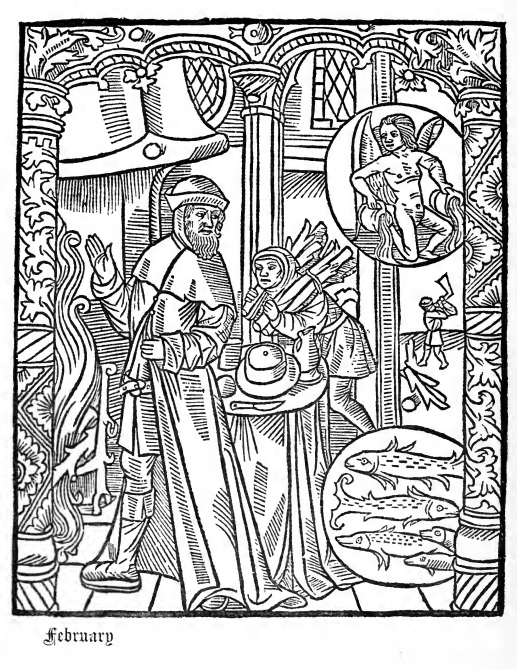
From the Kalendar of Shepherdes (illus. 1529)

Kalendar of Shepherds

The Kalendar of Shepherds was printed in 1493 in Paris and provided ‘Devices for the 12 Months.’ I use a modern (1908) reconstruction of it using wood cuts from the original French and adding various text from English 16th and 17th Century sources. The text of the month (as shown above) is provided from a 17th Century source. It gives an interesting view of the countryside in January. To see the full Kalendar, look here:

Nicholas Breton, the writer of the text above, concludes that January:

‘is a time of little comfort, the rich man’s charge, and the poore man’s misery.’

The rich man is burdened by having to help out all the poor people who depending upon him to get through the shortages of winter. The image for January shows that January is best spent indoors by a roaring fire, eating pies.

Months of Your Life

The Kalendar introduces a ‘conceit’ which is that the year mirrors our lives, and we can forecast what will happen in our lives by looking at the months.

Kalendar of Shepherds January text
Kalendar of Shepherds, January text

So our lives, which are of 72 years, can be divided into 12 ages of man, each of 6 years. So, January represents the first 6 years of a person’s life. And as you can see, that during these first 6 years, the child is ‘without witte, strength, or cunning, and may do nothing that profiteth‘. As the year changes every month, so, ‘a man change himself twelve times in his life’. At three times 6 (18 or March) a child becomes a man, and 6 times 6 (36 or June) man is at his best and highest. And at 12 times 6 (72 or December) man is at the end of his allotted span.

Shakespeare numbered the Ages of Man as seven, in the great speech of Jacques in ‘As You Like it’ I dealt with this and other Ages of the World in my post:

Growth of the market for Almanacs

By the 1600s almanacs were the most published form of book apart from the Bible. Lauren Kassell in ‘Almanacs and Prognostications’ reports estimates that by 1660 one third of every household had one.

Cover page of the Illustrated london almanack for 1867

Originally, they had a Calendar for each month, and information about the phases of the month, the tides. They gave predictions of the weather, and health issues likely to occur at that time of the year. Astrology was an important element. London Almanacs contained further information about the year, its ceremonies and elections of officials. As this informational side to the almanac grew, they included lists of monarchs, interesting stories, verse foretelling the weather, recipes and cures.

The earliest almanacs were made of wood and were called ‘clog almanacs. You can read more about them on my post here:

The Modern AlmanacOld Moore’s

Old Moore's Almanace  2026 FrontCover Photo
Old Moore’s Almanace 2026 Front Cover Photo

As the New Year dawns, we might turn to an almanac to see what the year has ahead. Newspapers and the web have now taken over largely from almanacs. They print articles about the upcoming highlights of the Political, Sporting, Gardening or the Musical year. But almanacs are still produced. One of the most popular is Old Moore’s which has been in production since 1697. For more on Old Moore’s see my post here. As you can see, they promise to help with your gambling, gardening, fishing and help you through the year with predictions and horoscopes.

Originally published in 2024, republished in 2025. Content moved to new page and expanded 2026.

Weather Lore: ‘If on January 12th the sun shine, it foreshows much wind.’

Abney Park cemetary in winter
Winter at Abney Park Cemetery photo by Harriet Salisbury

Or so says the Shepherd’s Almanac for 1676. Until the 12th Night we were predicting that the weather on each of the 12 days will match the month of the same number. But having past Twelfth Night we have to find turn to other methods of weather lore.

Weather lore seems convinced of the undesirability of a warm January

‘January warm, the Lord have mercy’.

‘January commits the fault and May bears the blame.’

If Birds begin to Whistle in January, frosts to come’

‘When gnats swarm in January, the peasant become a beggar’

Most of the sayings about January quoted in Richard Inwards ‘Weather Lore’ first published in 1893, have this as their main focus. And the contrary (cold January good growing season) also generally holds:

‘When oak trees bend with snow in January, good crops may be expected.’

‘A cold January, a feverish February, a dusty March, a weeping April , and a windy May presage a good year and gay.’

The Weather according to Animals

So much for long range forecasts. Let’s see how Weather Lore helps us use animals to determine whether it will rain today.

If animals crowd together, rain will follow.’

When dogs eat grass it will be rainy

When a cat sneezes, it is a sign of rain

‘If young horses do rub their backs against the ground, if is a sign of great drops of rain to follow.’

The only weather lore repeated in my family was ‘Cows sitting down means it will rain.’ (And of course ‘red sky at night, shepherd’s delight’).

Meteorology Office on weather lore.

A survey by the Met Office in 2017 found that a surprisingly large number of people (75%) use ‘folklore’ to predict weather, and 55% think they are useful methods of predictions. Here is a quote from their post.

  • Red sky at night, shepherd’s delight – used by 70% of UK adults – CORRECT
  • It can be too cold to snow – used by 49% – PROBABLY NOT IN THE UK
  • Cows lie down when it is about to rain – used by 44% – NOT CORRECT
  • Pine cones open up when good weather is coming – used by 26% CORRECT
  • If it rains on St Swithin’s day, it will rain on each of the next 40 days – used by 22% Not Correct. In fact since records began in 1861, there has never been a record of 40 dry or 40 wet days following St Swithin’s Day

Met Office 2017 do-cows-really-lie-down-when-its-about-to-rain and BBC Newsround

For more folk forecasting read my post on St Swithin’s Day

Published January 2025, republished 2025

New Year’s Eve Old Style, Witchcraft & Carmentalia January 11th

1375, French Caesarian Birth, (caesarians at this time would have killed the mother or be performed when she was already dead or dying.)

When Britain reluctantly joined the Gregorian Calendar, in 1752, we lost 11 days. So if you add 11 to 31st December you get to New Year’s Eve Old Style. You can do this with any festival date, and when celebrating, feel you are being really authentic.

So, anything you did on the New Year’s Eve New Style (31st Dec), you can do today New Year’s Eve Old Style. Except, of course, when you call in sick because of a hangover, you will need to convince your boss of the illegitimacy of the Gregorian Calendar! In case you have forgotten what you should be doing on New Year’s Eve you can look at my post here to find out.

Witchy New Year’s Eve Old Style

It’s a particularly ‘witchy’ evening because it is the traditional Eve, not the newfangled Gregorian one. Reginald Scot in his ‘Discovery of Witchcraft’ first published in 1584 reports on a way to find witches:

a charm to find who has bewitched your cattle. Put a pair of breeches upon the cow’s head, and beat her out of the pasture with a good cudgel upon a Friday and she will run right to the witch’s door and strike it with her horns

Reginald Scott’s book is available here and is a fascinating read. But, perhaps I need to say: don’t try this at home, as scientific research does not support it as a valid method!

Campaign against the slaughter of ‘poor, aged and the infirm’ as Witches

When I first posted this, I did not, to my shame, know the background to the book. I assumed the book was advocating this sort of nonsense. On the contrary. Reginald Scot was trying to debunk the absurd claims for witchcraft and magic. His book tries to prove that witchcraft and magic were rejected both by reason and religion. He believed that manifestations of either were ‘wilful impostures or illusions due to mental disturbance in the observers’.

The book is evidence that the large number of people who were executed as witches in the 16th and 17th Century, were the victims of a QAnon-style conspiracy, which was rejected by many educated and rational people. Please have a read of the cover of this 17th Century edition of Reginald Scot’s book. It gives a good idea of what he was setting out to counteract. Scot was a member of Parliament for New Romney, in Kent.

This is some of the text in the image below, which makes clear the prejudices at play in the campaign to execute witches:

‘For the preservation of poor, aged, deformed, ignorant people, frequently taken, arraigned, condemned and executed for witches, when, according to a right understanding and a good conscience, physic, food and necessaries should be administered to them.’

Frontispiece of Scots Discovery of Witchcraft.

Carmentalia

Carmenta or Nicostrata, black and white medallion of the Goddess of Childbirth
Carmenta or Nicostrata , Goddess of Prophecy, Childbirth, Midwives and Technical Innovations. Published by Guillaume Rouille (1518?-1589) – “Promptuarii Iconum Insigniorum”

It is also Carmentalia, the festival for Carmenta, the Roman Goddess of prophecy and childbirth. She was a much loved Goddess in the Roman pantheon. But little is known about her, perhaps because she has no clear match in the Greek pantheon? However, she was thought to be a nymph of the Arcadians, called Themis.

She has a long history in the story of Rome. She was the mother of Evander. Who is he? I hear you shouting! Well, he is the founder of Pallantium. Where on earth is that? You cry! It is the City on the site of Rome (on the Palatine Hill) that predated Rome! Who knew that? (The people at Vindolanda Roman Fort know, and they have a great page on Carmentalia here). The City was supposed to be of Greek origin, founded 60 years before the fall of Troy. Later, it was absorbed into Rome.

Carmenta

Carmenta had two sidekicks who were her sisters and attendants. Postvorta and Antevorta, They might be explained by Past and Future. (or, After and Before) as part of her role in prophecy. Or the two figures could represent babies that are either born head or legs first. She was an important enough Deity to command one of the fifteen flamens. These were priests of the state-sponsored religions. One of Carmenta’s flamen’s jobs was to ensure no one came to the temple wearing anything of leather. Leather was created from death, and not suitable for the Goddess of Childbirth, who was all about life.

The Vindolanda post makes the point that 2% of pre-modern births are likely to have caused the death of the mother. Because there was a high child mortality, the Roman Mother would have to have 5 children on average to keep the population stable. With a 2% death rate, and 5 children, they estimate that each mother had a 12% chance of death by giving birth. Good reason to have a Goddess on the Mum’s side. She is also the Goddess of Midwives.

Nicostrata

Carmenta was originally known as Nicostrata (which is Greek and means “victory-army”). She was credited with creating the Latin Alphabet by adding additional letters to the Greek one. So, she is also the Goddess of Technological Innovation. Some Goddess! . When she left Arcadia in Greece for Italy she took 15/16 letters of the Greek Alphabet, and joined them with local letters forming the original Latin alphabet. Later other letters were added. For more on Nicostrata see here. Her name was changed to Carmenta which comes from the word for song or spell or prophecy.

Old Archaic Latin Alphabet, founded by Nicostrata aka Carmenta from Wikipedia

On This Day

1869 The Anglo-Zulu War began

1963 Whisky-A-Go-Go, the first discotheque opened in Los Angeles or so says my copy of the Chambers Book of Days. But research suggest there was an earlier Whisky-A-Go-Go opened in 1958 in Chicago. And that the name sprang from the Whisky à Gogo, established in Paris in 1947. It got its name from the famous Ealing Comedy Film Whisky Galore which was marketed in Paris as ‘Whisky a Gogo‘. (à gogo, meaning, in French, “in abundance”, “galore”) (Wikipedia)

You can rent the film on YouTube but here is a little excerpt from Whisky Galore! where the Islanders start to sample the Whisky they have rescued from a War time ship wreck.

First published in Jan 2022, revised January 2024, 2025. Nicostrata and Whisky Galore! added 2026

How to Keep Apples & if the frost be very extreame January 9th

Gervase Markham was born in 1568, in Nottinghamshire, and was a prolific writer. Today, prompted by the Perpetual Almanac by Charles Kightly, I am looking through Markham’s eyes at Apples. Apples were an important source of joy as well as nutrition through a cold winter, as fresh produce became unavailable.

Markham wrote detailed books for use by the householders, the Husbands and the Housewives. And with the coming of frost, the survival of food in your food store might depend upon reading Markham’s books. When the frosts hit, as they are now doing in the UK, you had to look after your store of apples. They were an important sweet food source over the winter.

For the women, he wrote the English Housewife, published in 1615. Here is his recipe for Apple Tart.

For the Housewife How to Make Apple-tart

Take apples and peel them and slice them thin from the core into a pan with white wine, good store of sugar, cinnamon and rosewater, and so boil it all shall it be thick. Then cool it and strain it, and beat it very well together with a spoon, and then put it into your coffin or crust and bake it. It carrieth with the colour red.

Gervais Markham, the English Housewife 1683 version (quoted by Charles Kightly).

For the Husband, How to Keep Apples in Frost

Lots of apples in a pile Photo by sydney Rae on Unsplash
Photo by sydney Rae on Unsplash

For the men, he wrote the English Husbandsman, published in 1613 and ‘Printed by T. S. for Iohn Browne, and are to be sould at his shop in Saint Dunstanes Church-yard.’ This is the St Dunstan’s in Fleet Street, I think (near Sweeney Todds, the Barbers.) The book is available on Project Gutenberg (Gervase Markham the English Husbandman. Project Gutenberg).

So to the frost – Markham ends his extensive piece on the best way to store apples as follows:

To keepe Fruit in frost. If the frost be very extreame, and you feare the indangering your fruit, it is good to couer them somewhat thicke with fine hay, or else to lay them couered all ouer either in Barley-chaffe, or dry Salte: as for the laying them in chests of Iuniper, or Cipresse, it is but a toy, and not worth the practise: if you hang Apples in nettes within the ayre of the fire it will kéepe them long, but they will be dry and withered, and will loose their best rellish.

I remember my Grandmother would store her excess apples from the tree, wrapped in paper and stored in cupboards in the pantry or outbuilding. They were often wrinkled but always delicious, and I think were Russets, which remain my favourite apple.

At the bottom of the piece, I include the rest of Markham’s advice for storing apples. To summarise it: Don’t store them near the ground. Place them on shelves ordered by variety based on which variety lasts longest. So at the back will be the long-lived species such as Russets and Pippins, to eat as spring approaches. The front the ones you need to eat now such as the ‘Costard, Pome-water, Quéene-Apple‘ varieties.

Marocco, Pocahontas and the Rhino – performing at the Bell Savage

Markham wrote many books, including one on the famous performing horse Marocco. He starred in shows at the Bell Savage, just outside Ludgate in the City of London. The horse would whinny in triumph with the naming of an English King. But snort with derision with the naming of a Pope. He could also count and add up. He was rumoured to have been burnt at the stake as a witch in Edinburgh. But this does not appear to be true. Also, appearing at the Bell Savage in the 17th Century was a Rhinoceros, other prodigies and Pocahontas.

How to Keep Apples extended version

For a more modern text on what to do with excess apples from your tree, have a look here. However, do read on to get an insight into life and the varieties of Apples that were eaten in the 17th Century.

The place where you shall lay your fruit must neither be too open, nor too close, yet rather close then open, it must by no meanes be low vpon the ground, nor in any place of moistnesse: for moisture bréedes fustinesse, and such naughty smells easily enter into the fruit, and taint the rellish thereof, yet if you haue no other place but some low cellar to lay your fruit in, then you shall raise shelues round about, the nearest not within two foote of the ground, and lay your Apples thereupon, hauing them first lyned, either with swéet Rye-straw, Wheate-straw, or dry ferne: as these vndermost roomes are not the best, so are the vppermost, if they be vnséeld, the worst of all other, because both the sunne, winde, and weather, peircing through the tiles, doth annoy and hurt the fruit: the best roome then is a well séeld chamber, whose windowes may be shut and made close at pleasure, euer obseruing with straw to defend the fruit from any moist stone wall, or dusty mudde wall, both which are dangerous annoyances.

The seperating of Fruit. Now for the seperating of your fruit, you shall lay those nearest hand, which are first to be spent, as those which will last but till Alhallontide, as the Cisling, Wibourne, and such like, by themselues: those which will last till Christmas, as the Costard, Pome-water, Quéene-Apple, and such like: those which will last till Candlemas, as the Pome-de-roy, Goose-Apple, and such like, and those which will last all the yéere, as the Pippin, Duzin, Russetting, Peare-maine, and such like, euery one in his seuerall place, & in such order that you may passe from bed to bed to clense or cast forth those which be rotten or putrefied at your pleasure, which with all diligence you must doe, because those which are tainted will soone poyson the other, and therefore it is necessary as soone as you sée any of them tainted, not onely to cull them out, but also to looke vpon all the rest, and deuide them into thrée parts, laying the soundest by themselues, those which are least tainted by themselues, and those which are most tainted by themselues, and so to vse them all to your best benefit.

Turning your Fruit

Now for the turning of your longest lasting fruit, you shall know that about the latter end of December is the best time to beginne, if you haue both got and kept them in such sort as is before sayd, and not mixt fruit of more  earely ripening amongst them: the second time you shall turne them, shall be about the end of February, and so consequently once euery month, till Penticost, for as the yéere time increaseth in heate so fruit growes more apt to rot: after Whitsontide you shall turne them once euery fortnight, alwayes in your turning making your heapes thinner and thinner; but if the weather be frosty then stirre not your fruit at all, neither when the thaw is, for then the fruit being moist may by no meanes be touched: also in wet weather fruit will be a little dankish, so that then it must be forborne also, and therefore when any such moistnesse hapneth, it is good to open your windowes and let the ayre dry your fruit before it be turned: you may open your windowe any time of the yéere in open weather, as long as the sunne is vpon the skye, but not after, except in March onely, at what time the ayre and winde is so sharpe that it tainteth and riuelleth all sorts of fruits whatsoeuer.

Gervase Markham the English Husbandman Project Gutenberg

1799 – Income Tax introduced for the first time by Prime Minister William Pitt the Younger at the rate of two shillings to the pound. This novel tax was used to pay for the war against Napolean.

1806 – Huge numbers attend Funeral and internment in St Pauls of Horatio Nelson, Killed at the Battle of Trafalgar.

January 9th 2024, revised 2025, 2026
Strange Case of Dr Jekyll and Mr Hyde Published January 9th 1886 and My Edinburgh Booklist

Edinburgh from Arthur’s Seat. Castle to the left, St Giles the ’rounded’ spire in the middle, and Salisbury Crags to the right

Strange Case of Dr Jekyll and Mr Hyde by Robert Louis Stevenson

This is my select booklist for Edinburgh, one of my favourite towns. Strangely, heading it up is a book based in London, and written in Bournemouth. However, Stephenson’s Strange Case of Dr Jekyll and Mr Hyde is a very Edinburgh book but published in London on January 9th 1886.

What makes it fit for an Edinburgh booklist? Firstly, Edinburgh is the best place for a science-based Gothic Horror Novella. A City made for Ghost Tours, but with a scientific legacy arguably second to none. One of the inspirations for the book was the story of Deacon Brodie. He was a cabinetmaker who rose to be Deacon (president) of the craft of cabinetmaking. Therefore, he had wealthy clients and was impeccably respectable. When he went to his clients houses, or made them locked cabinets, he would copy the locks using wax moulds. Then he and his team would rob the house. He hid a cache of keys underneath Salisbury Crags which you can see above.

To cut a long story short, he made an attempt on robbing the Excise Office in Canongate, Edinburgh, on March 5th 1788. The heist failed, one of the robbers turned King’s Evidence. So Brodie fled to one of his mistresses in London, then to the Continent. But he was relentlessly pursued and captured in Amsterdam. He was brought back to face trial, found guilty, and hanged on a new scaffold, which he may just have had a part in designing.

Stevenson had cabinets made by William Brodie and as a young man produced a play about him. He was intrigued by the idea of a wealthy man having a dual life. The idea itself, seems obvious but the expression a ‘Jekyll and Hyde’ character is still often used to describe someone with two opposing sides to their characters. The idea of duality provides many ways to look at the book. Edinburgh itself was a duality. There was the old, filthy, higgledy-piggledy Old Town on top of the Volcanic Ridge, with the spacious New Town in the Valley below, with modern wealthy houses providing healthy homes for the rich. The idea of Two Cities, of the rich and the poor; the good and the evil; rationality and sensuality; hetero and homosexual fits well with Victorian Britain, but perhaps best into Victorian Edinburgh, the City of Burke and Hare. These famous Edinburgh serial killers were working for one of Europe’s greatest medical centres, where debate about Darwinism, and the powers of the brain were hotly debated in a City with a strong Presbyterian background.

In Bournemouth, Stevenson befriended the former Reverend Walter Jekyll, younger brother of gardener Gertrude Jekyll. He was probably homosexual and the author borrowed the name for the rational part of Jekyll and Hyde. At a time when to be gay was a crime, most gay people had to live a Jekyll and Hyde existence. In fact, Sodomy was a capital offence in Scotland until the year after the publication of the ‘Strange Case of Dr. Jekyll and Mr. Hyde.

Strangely, in a book list I would encourage you to watch the 1920 silent film starring John Barrymore to enjoy its ghastly atmosphere. You can watch it for free on YouTube here.

Ian Rankin’s Rebus

Ian Rankin is a typographical author of the highest rank. Every story brings Edinburgh, its people and its history to life. And yet set in a very readable crime fiction envelope. The Rebus I chose was ‘Set in Darkness‘ because it has the Scottish Parliament at its heart. It begins with a body found in Queensbury House, which is being preserved and incorporated into the new Scottish Parliament buildings. Please read my post on the book (link below).

Queensberry House to the right, with the Scottish Parliament in the background. Royal Mile, Cannongate in the foreground. (Photo: K. Flude)

Recently published is ‘Edinburgh a New History’ by Alistair Moffat. This is an excellent summary of Edinburgh’s History. He has written a large number of books about Scotland. I particularly liked ‘Reivers‘ which is a great book about the border raiders, both North English and Scottish who raided the borderlands between Edinburgh and York during the 13th to the 17th Centuries. They inspired the young Walter Scott, who collected Reivers ballads before inventing the Historical Novel.

Edinburgh-a-new-history-book-alistair-moffat

Walter Scott

The Heart of Midlothian photo K Flude

As to Walter Scot, our Blue Badge Guide for Edinburgh, considers his long descriptive passages unreadable. But I’m not so convinced, having read Ivanhoe and Rob Roy as a boy. But if I were to recommend a Walter Scot, it would be Heart of Midlothian as it is set in Edinburgh and deals with crime, poverty, urban riots and other manifestations of life in Edinburgh in the 18th Century.

Midlothian is the country around Edinburgh, named after the legendary Celtic King Loth. The Heart of Midlothian, is Edinburgh or more precisely, a heart marked out in the cobbles. It is located outside of St Giles, on the Royal Mile, where the Tollboth (townhall and prison) and execution site for the City used to be. To this day, Edinburghers (or more correctly, Dunediners) are supposed to spit on the heart for good luck.

Old Print of the Tollbooth with St Giles to the right of the print.

It is hard to exaggerate the importance of Walter Scot. Byron said he had read his books 50 times, and never travelled without them. Goethe said ‘he was a genius who does not have an equal.’ Pushkin said his influence was ‘felt in every province of the literature of his age. Balzac described him as ‘one of the noblest geniuses of modern times’. Jane Austen and Dickens loved his books. The point is he invented the Historical Novel, and for the first time, as Carlyle wrote, he showed that history was made by people ‘with colour in their checks and passion in their stomachs.’ The only other person I can think of who was held in such universal regard was Tolstoy. There is also sense in which Scott invented our modern idea of Scotland, with its kilts and bagpipes.

The Scottish Enlightenment

A walk through the centre of Edinburgh has so many statues of people who made the modern world it is astonishing. So you should read: ‘The Scottish Enlightenment – the Scots Invention of the modern world‘ by Arthur Herman.

Burke and Hare: The True Story Behind the Infamous Edinburgh Murderers by Owen Dudley-Edwards

The story of Burke and Hare is well known, but it shows how important Edinburgh was as a medical centre in the early 19th Century. Bodies were shipped to Edinburgh from the London docks, such was the demand for bodies for anatomy teaching. Arthur Conan Doyle got his medical training here from a man called Joseph Bell, whose logical mind was the model for Sherlock Holmes.

The Prime of Miss Jean Brodie

My last choice is Murial Spark’s The Prime of Miss Jean Brodie set in a school in Edinburgh where the teacher singles out 6 of her pupils for special education. She wants to give them a cultured outlook in life which includes her own fascistic views. Made into a wonderful film starring Maggie Smith, but also a great book. It also, in a strange way, reinforces the huge legacy of the Scottish Education system. It is said that the Reformation brought to the Scots the idea that everyone should be educated enough to read the Bible in their own language. But it seems to me the Scots had a particular understanding of the importance of Education before the Reformation. St Andrews University was founded in 1410, Glasgow in 1410, Aberdeen in 1495 and Edinburgh in 1510.

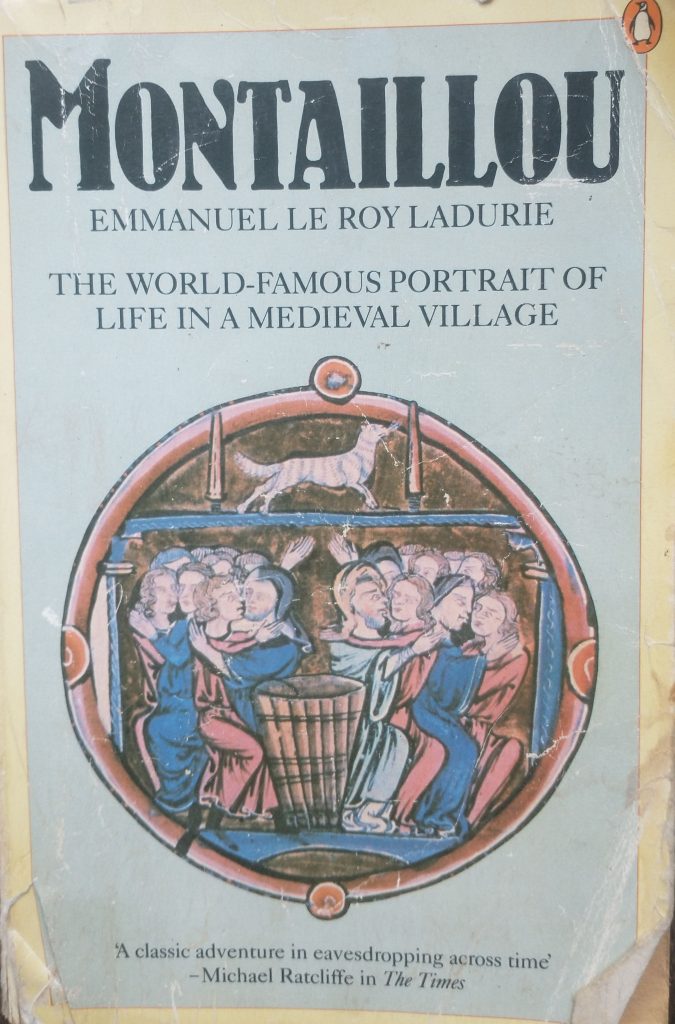
Of course, you should read some poetry by Burns, and I would begin with Tam O’Shanter the story of Tam, Maggie his horse and Nannie, the witch with the short skirt (Cutty Sark). The version above (see link) is read over a comic novel of the poem. But if you prefer the words, this is the one I read for my groups where I ruin the Scots dialect, and disgrace myself, but oh how I enjoy it! www.poetryfoundation.org tam-o-shanter

You may like to read:

My post on poetry on the wall of the Scottish Parliament.

Or look at my Oxford Booklist here. Others to follow.

Published on 2nd December 2024, moved to January 9th for 2026