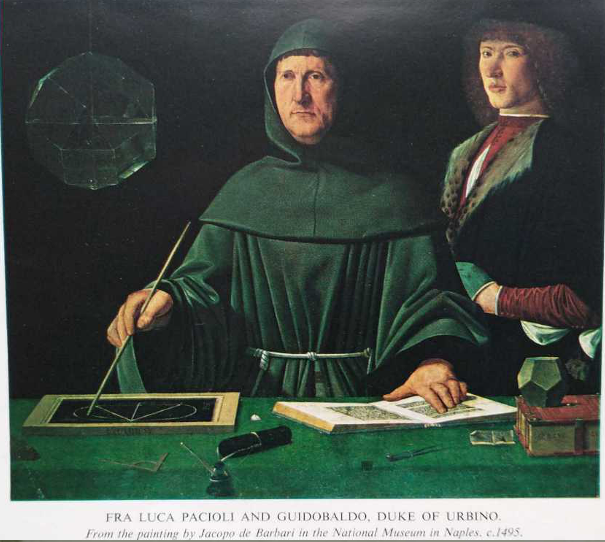
Luca Pacioli, father of double entry book keeping.
Luca Pacioli was a mathematician, whose mathematical text book had a section on Venetian book-keeping. It was published in 1494 although double entry booking keeping was probably being used earlier. The accountancy is a 27-page section called “Particularis de computis et scriptus. It is part of the compendious ‘Summa de Arithmetica, Geometrica, Portiona et Proportionali’.
It is the source of modern double entry accounting, which spread from Venice as it was the printing capital of Southern Europe.
The key discovery, reported by Luca Pacioli, was that every transaction had to have an entry in both a debit and credit account. So if I lend you £10,000 then my account is debited by 10k and yours is credited by the same amount. Fra Luca (he was a Franciscan Friar) would have it that the accountant could not go to bed until the ledgers balanced. That is, that all the credits and balances in all the ledgers balance.
Double entry bookkeeping has prevented numberless frauds, kept many businesses on the straight and narrow. But it is of course not proof against sophisticated fraud.
Assyrian Double Entry booking keeping?
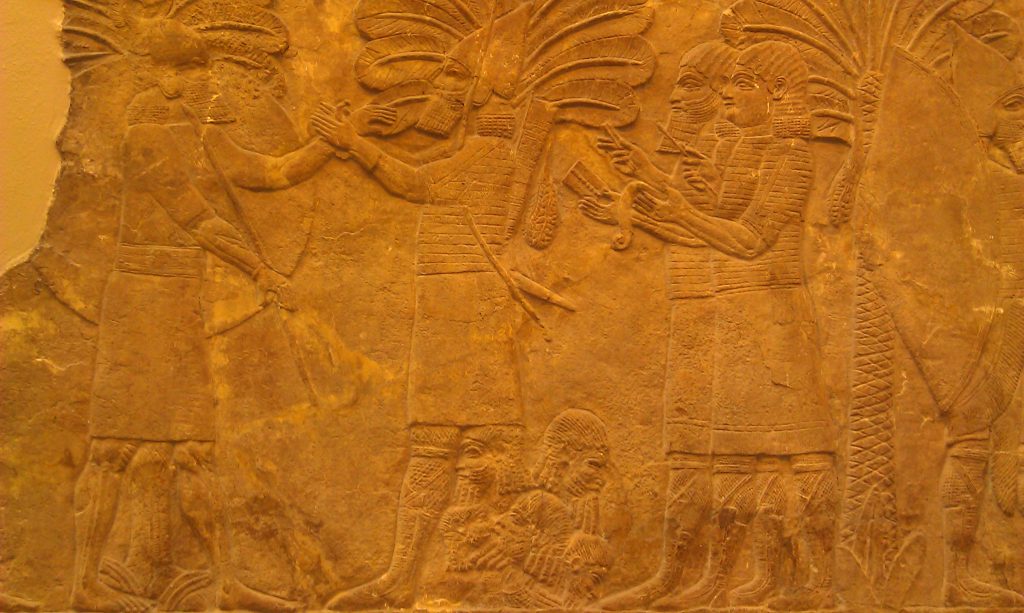
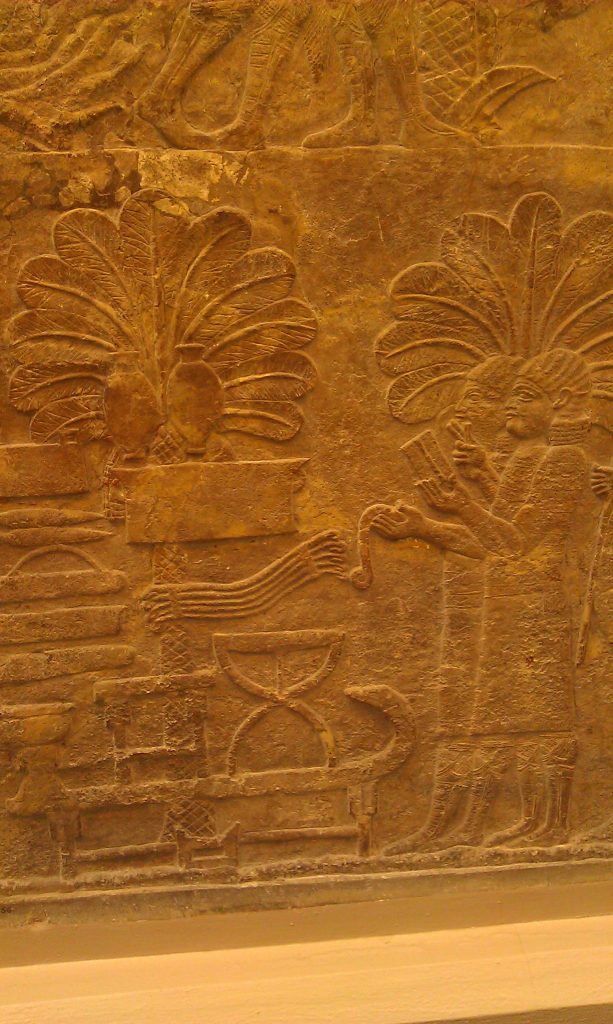
The gypsum stone reliefs shown below on display in the British Museum show clerks recording booty plundered in the Assyrians’ wars. The soldiers are bringing goods in to be counted. In the first picture, the goods are severed skulls. In the second are a wide range of booty.
In every scene like this, there are two scribes writing notes on clay tablets with styli. They stand side by side. I presume their role is to make sure the other man doesn’t cheat, rather than to facilitate double entry book keeping as such. Assyrians paid their soldiers for each enemy soldier they killed, and the head was the proof. You will see a little pile of severed heads between the soldier and the scribes.
Assyrian scribes recording severed heads.. British Museum. Photo Kevin FludeAssyrian scribes recording war booty. British Museum. Photo Kevin Flude
Italians, Accountancy and London.
The earliest work on double entry in England was by Oldcastle in 1543. There were a lot of Italian businessmen in Tudor London. Thomas Cromwell was friends, and indeed neighbours, with some. As a young man he was helped out by the head of one of the great Florentine Finance houses, Frescobaldi. They had branches in Bruges and London, and were major financiers to the Kings of England. Thomas More lived among the colony of Merchants from Lucca. The business centre of London before the building of the Royal Exchange was in Lombard St, where the Lombardian bankers hung out.
This post sprang from something that my grandson said to in the middle of the park. He was curious as to why I was concerned that the park toilets were out of action. He told me I could, like him, just pull down my trousers and wee, right here, right then, up against the tree in the park. My attempt at explanation drew a perplexed, ‘What?’ ‘What?’ is his new word. After an explanation, his next word is invariable another ‘What?’.Hopefully the relevance of this will become apparent.
May and June are the most prolific months for dandelions, which used to be known as ‘piss-a-beds’. They are diuretic and were often eaten, and so might well have consequences for the young trainee child.
John Hollybush in his 1561 ‘The Homish Apothecary’ says:
‘When a young body does piss in his bed either oft or seldom: if ye will help him take the bladder of a goat and dry it to powder, and get him to drink with wine, or else take the beans or hinder fallings of a goat, and give him of the powder in his meat morning and evening, a quarter ounce at every time.’
(quoted in ‘The Perpetual Almanac by Charles Kightley)
Hinder fallings are what falls out of the hind-quarters of a goat. I’m not sure even an indulgent Grandparent is allowed to give droppings and wine to the little ones. Nor can I find any mention of goat products in modern medical recommendations. So I won’t be recommending this as a practical aid.
Medically, dandelions were very well regarded. Mrs Grieve’s ‘Modern Herbal’ reports that it are diuretic and a general stimulant to the system but particularly the urinary system. They were good for liver and kidney complaints; gall-stones; and piles. They were considered excellent to eat and drink. Particularly, dandelion sandwiches using young leaves, with salt, pepper, and lemon juice. They were also taken in salads, teas, and beers.
We used to blow the seeds from the dandelion seed head saying ‘She loves me. She loves me not’ at each blow, until the truth was revealed.
First written in June 2023, revised june 2024,2025. Rewritten 2025
I’m in Ferrara, in the Po Valley near Bologna. Hence, falling behind on posts! I am on holiday but attending a reunion of Archaeologists who excavated here in the 1980’s. It was a collaboration between Italian and UK archaeologists. The British contingent was mostly from the Museum of London. More to follow over the next few days.
But on the 30th May I planned to tell you about the Cotswolds’ Olimpicks. This was set up by Robert Dover on a hill near Chipping Camden, in the early 17th Century.
Inspired by the Greek Olympics, he felt the modern world could do with an infusion of the original spirit.
The Olimpicks has a collection of tradition sports such as the sack race, and the tug of war. But the one that receives the most attention is shin-kicking. Two contestants try to knock each other over by kicking each other in the shins! They are not supposed to pull or push their opponent over. Or use Judo style throws. Protective gear is supplied in the form of straw or hay packed down the socks.
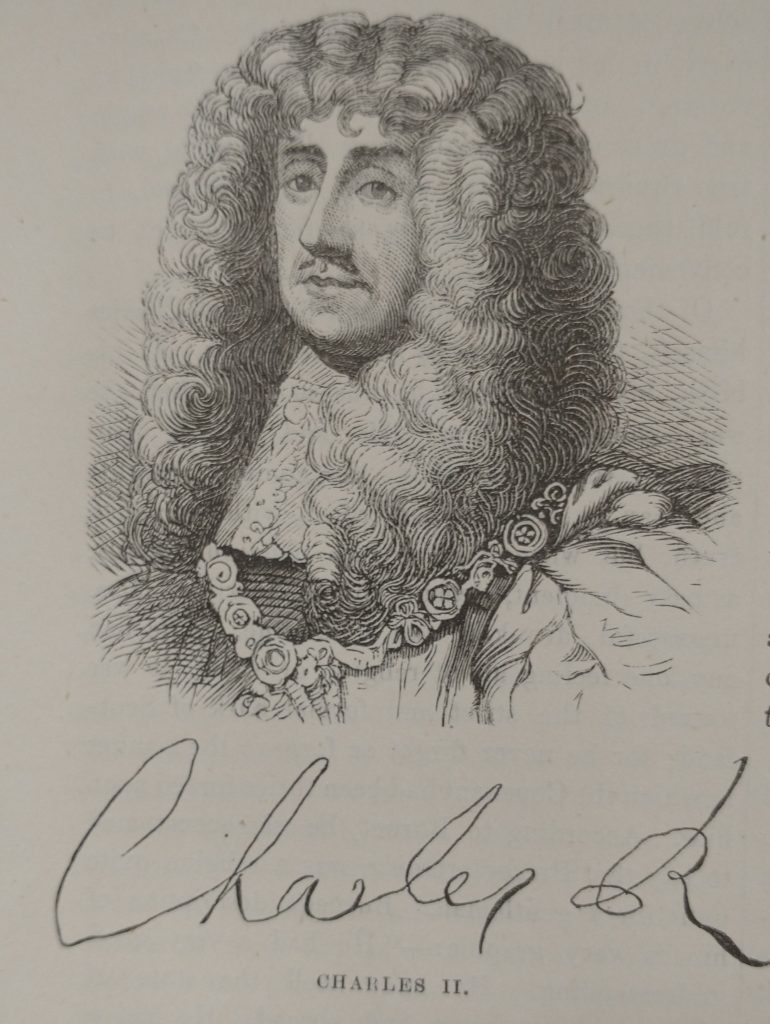
Oak Apple Day was set up by Parliament in 1660 as “An Act for a Perpetual Anniversary of Thanksgiving”. They were celebrating the restoration of Charles II to the throne in May of 1660. The Day was abolished in 1859, but a few places continue to celebrate the day.
The Oak was chosen partly as a symbol of England but particularly because after Cromwell’s Parliamentary Army defeated the Royalists at the Battle of Worcester (September 3rd 1651), Charles hid in an Oak Tree near Boscobel House in Shropshire on his epic journey to the South Coast and the safety of France.
People wore oak apples (or shick-shacks) which are a type of ‘plant-gall‘. This is an abnormal growth from a point of irritation on a plant. Or they were used sprigs of Oak leaves.
The text of the Parliamentary Bill said:
That in all succeeding ages, the 29th of May be celebrated in every parish Church and Chapel in England and the Dominions thereof, by rendering thanks to God for the Kings (Charles II’s) restoration to actual possession and exercise of his legal authority over his subjects’
Church Services for the Restoration; for the preservation from the Gunpowder Plot and the death of Charles the First were kept up until the year 1859.
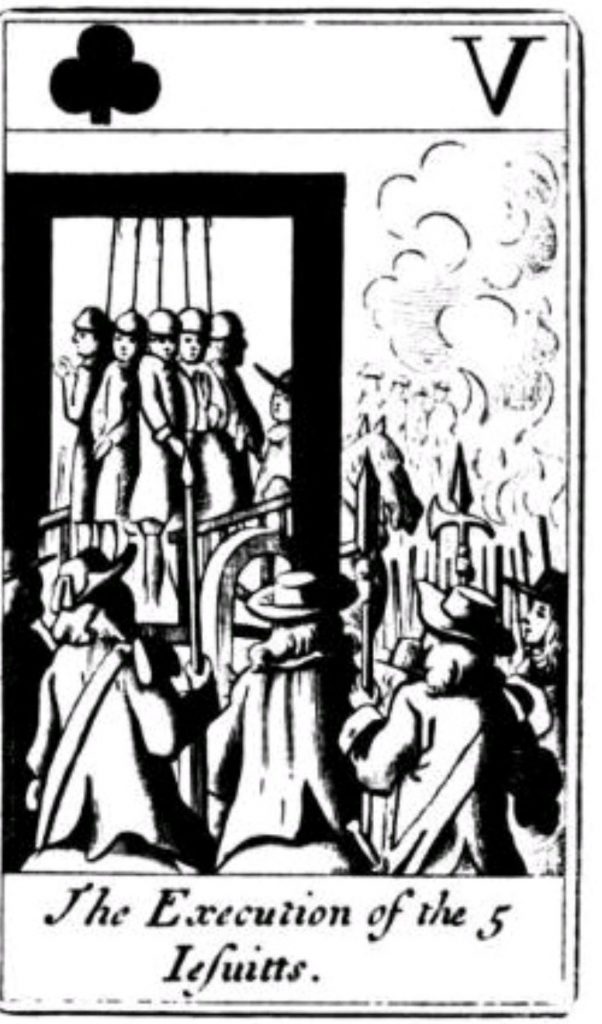
Titue Oates & Popish Plot. Set of playing cards themed on the Plot c1679 after a design by Francis Barlow
Titus Oates was a con-man. He accused leading Catholics of participating in a plot to kill King Charles II and restore a Catholic monarchy. Among his targets were the Queen, and the King’s Brother’s wife.
Titus Oates had a complicated past. He was a Baptist who turned to the Church of England on the Restoration of King Charles II. He went to Cambridge where he was accused of being a ‘Great Dunce’ and never took his degree. His next about turn saw him in St Omer to train as a Jesuit. He accused a man, whose job he wanted, of sodomy. Then, he became a Naval Chaplain. But he was, himself, accused of buggery and dismissed from the Navy. He was received into the Catholic Church while, at the same time, he wrote a series of anti-Catholic Pamphlets. He made accusations against over 500 people. This became known as the Popish Plot.
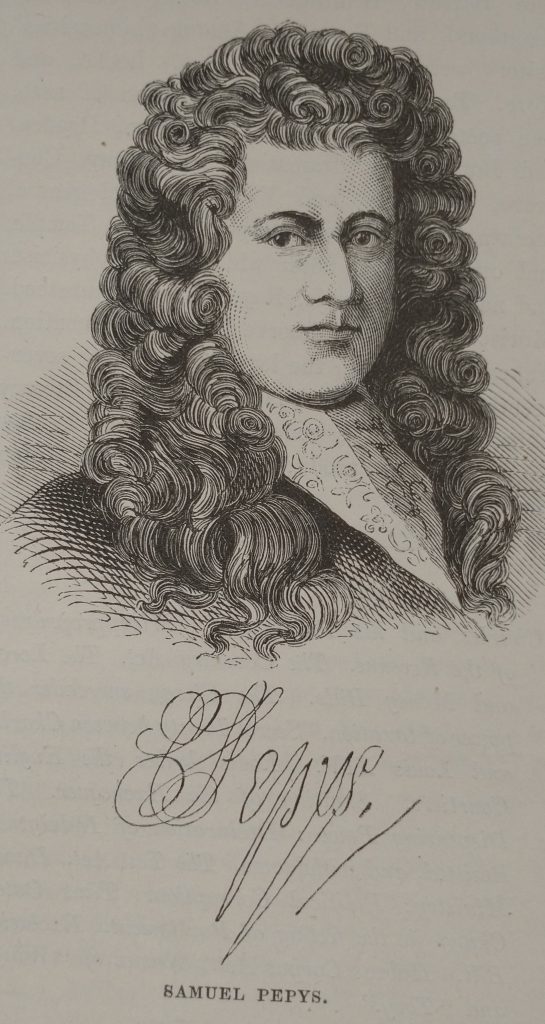
As a result, twenty-two people were executed, some ‘Hanged, Drawn and Quartered’ because of Oates’ baseless accusations. The Diarist, Samuel Pepys, was caught up in the anti-Catholic frenzy. Pepys was Secretary of the Navy during the Plot and was close to the Catholic, James, Duke of York. He was accused of selling secrets to the French. Awaiting trial for treason, he was imprisoned in the Tower of London. Eventually, he was able to clear himself and resume public life. (read this article on the /the-plot-against-pepys/.
Old Print of Samuel Pepys
It was only with the accession of James II that the climate of opinion changed. Then Titus Oates was found guilty of perjury. Perjury was not punishable with death, so Oates’ punishment was a long-drawn-out affair instead. He was sentenced to be imprisoned for life. And ‘whipped through the streets of London for five days a year for the remainder of his life.’
Oates was put in the pillory at Westminster Hall, where passers-by pelted him with eggs. He was again pilloried the next day in the City. On the third day, stripped, tied to a cart, and whipped from Aldgate to Newgate. The following day he was whipped from Newgate to Tyburn. (Source Wikipedia)
However, when the Catholic King, James II was, deposed and replaced by the joint Protestant monarchs William and Mary in 1689, Titus Oates was released and given a pension. He died in 1705.
For Pepys at the Execution of Charles I see my post here.
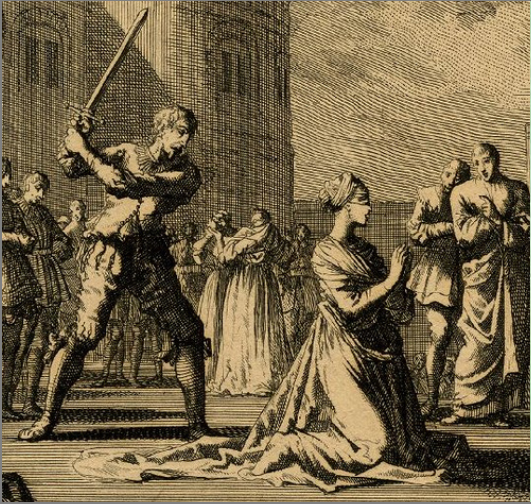
The beheading of Anne Boleyn began at 8am with her speech.
‘Good Christian people, I am come hither to die, for according to the law, and by the law I am judged to die, and therefore I will speak nothing against it.
I am come hither to accuse no man, nor to speak anything of that, whereof I am accused and condemned to die, but I pray God save the King and send him long to reign over you, for a gentler nor a more merciful prince was there never: and to me he was ever a good, a gentle and sovereign lord.
And if any person will meddle of my cause, I require them to judge the best. And thus I take my leave of the world and of you all, and I heartily desire you all to pray for me. O Lord have mercy on me, to God I commend my soul.’
She was blindfolded. She knelt down, putting her neck on the block and repeated:
‘ToJesus Christ I commend my soul; Lord Jesu receive my soul.’
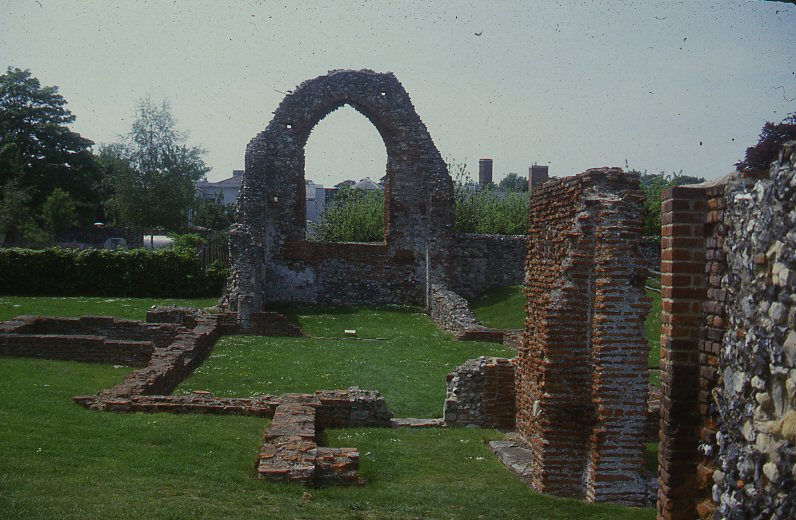
Ruins of St Pancras, Canterbury Photo: K Flude (note the reused Roman Bricks.)
Pancras means ‘all-powerful’ in Greek. St Pancras was a 14 year old who refused to give up his Christian Faith during the persecution of Christians by the Emperor Diocletian. He was beheaded on the Via Aurelia, traditionally, on 12 May 303 AD. His youth makes him the Patron Saint of children, but he is also the patron saint ofjobs and health. He is ‘invoked’ against cramps, false witnesses, headaches, and perjury. His body was buried in the Catacombs, but his head is kept in a reliquary in the Church of Saint Pancras in Rome, where he was buried.
Ice Saints
He is also one of the Ice Saints. These are saints with feast days from May 11th to May 14th. They are: St. Mamertus, St. Pancras, and St. Servatius (and in some countries, Saint Boniface of Tarsus – Wikipedia). They represent a belief that there was often a cold snap in early May. Although modern statistics disprove this, it is however true that a late frost can cause havoc with crops. So the Ice Saints help persuade farmers to delay sowing.
St Pancras in England
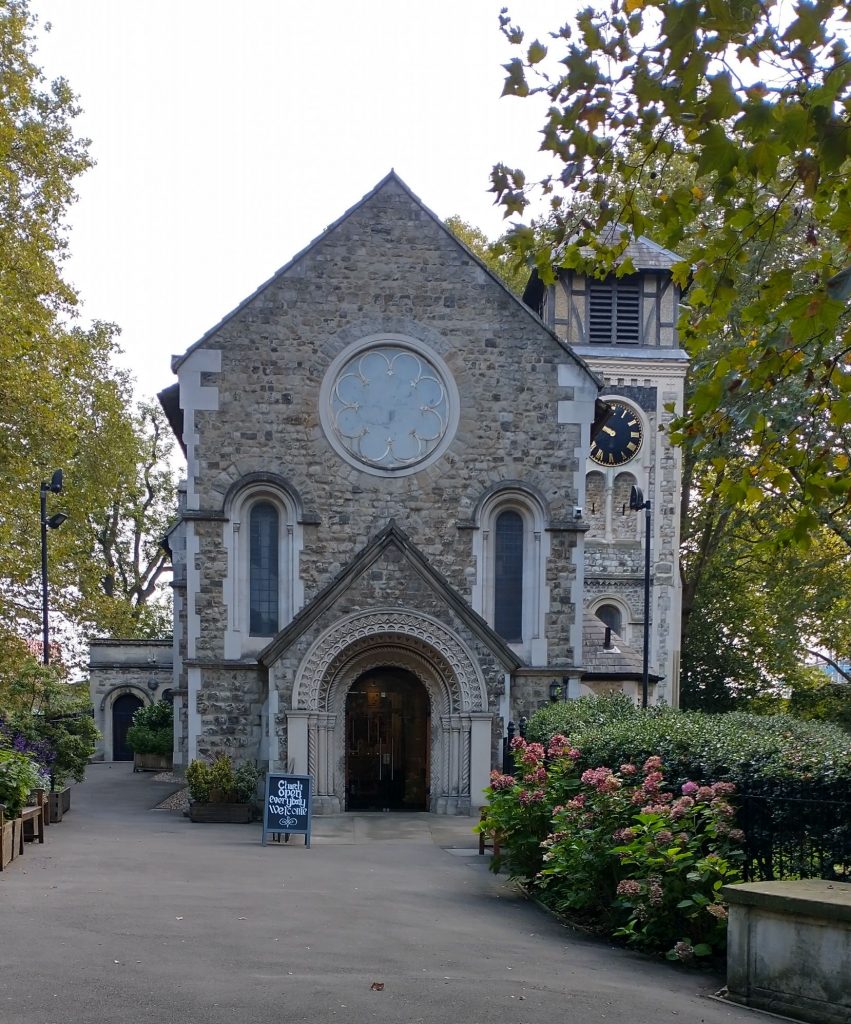
St Pancras, Old Church, London (Photo: Kevin Flude)
Pope Gregory is said to have given St Augustine relics from St Pancras when his mission came to Kent in 597AD. They built a church dedicated to St Pancras. The ruins still survive in the grounds of what is now St Augustine’s, Canterbury (see picture at tope of post).
This story is partly responsible for the claims that St Pancras Old Church, in Camden (pictured above) is a very old foundation. The idea being that there was a late Roman place of worship here. But there is very little solid evidence for this. It is also argued that, if it isn’t late Roman, then it dates to just after 604AD. This is when St Mellitus, sent by St Augustine, established St Pauls Cathedral. It is suggested that he also founded St Pancras Church. St Pancras’ Church was a Prebend of St Pauls Cathedral (a Prebend provides the stipend (pay) to support a Canon of a Cathedral). But this is not evidence it was established as early as the Cathedral was, and there really isn’t any other credible evidence for a 604 date.
When the Church was restored, the architects said it was mostly Tudor work with traces of Norman architecture. However, the suggested finding of a Roman tile or two, reused in the fabric, is used as evidence to keep the legend going.
If you read the Wikipedia page, you will see evidence of two strands to the contributions. One is playing down the legends of its early foundation. The other trying to keep hold of its place as among the ‘earliest sites of Christian worship’. Read the wikipedia page here: https://en.wikipedia.org/wiki/St_Pancras_Old_Church to make up your own mind.
It is a lovely Church, on an impressive site, with links to Thomas Hardy, and Sir John Soane whose tomb is the design inspiration for the iconic Red Telephone Box.
As Patron Saint of Headaches, St Pancras Day is a good day to make worms come out of your head. Or so say the Fairfax Household Book of the 17th/18th Century as quoted in Charles Kightly’s ‘The Perpetual Almanac’:
‘To make a worm come out of the head. Take, in May, the marrow of a bull or cow, and put it warm into the ear, and the worm will come forth for sweetness of the marrow.’
Generally, willowbark was used for headaches. We know this would have worked as the bark contains salicin, which is converted by the body into salicylic acid. This is a precursor to aspirin (acetylsalicylic acid). But it is not as effective.
Sorry to send an additional post but coming up are a couple of fascinating Virtual Tours which I would like to remind you of!
Tonight is an exploration of early 19th Century London. It is based on the 1809 Picture of London Guide book. An original copy was given to me by someone grateful to have attended one of my lectures at the Old Operating Theatre Museum. It is a tour of what Jane Austen could have visited on her walks around London. There are Austen associations, but mainly we are looking at London in 1809.
Jane Austen’s ‘A Picture of London in 1809’ Virtual Walk Mon 7.30 27th Jan25 To book
Yesterday, I was asked to give a Cromwell’s London walk as a 75th Birthday present. I haven’t done one for at least 25 years. But I really enjoyed the research. So added a guided walk and a virtual tour to my programme. This is the first time I have done this VT and it is a cracking story.
The Civil War, Restoration and the Great Fire of London Virtual Tour 7:30pm Thurs 30th Jan25To book
Finally, April is the month we go on pilgrimages, as Chaucer said (in Old English). So, in addition to my Chaucer Walks, I have added a Virtual tour so we can go all the way to Canterbury.
Chaucer’s London To Canterbury Virtual Pilgrimage 7.30pm Friday 18th April 25 To book
I may add one or two more before the Sun comes back
News from the Almanac showing readership/viewership of the site.
I have been waiting for a day when I haven’ t got a post to publish. Why? To update readers about the Almanac of the Past. And with a bit of manoeuvring today is the day.
What is the News from the Almanac of the Past?
The plan is to have a post for each day. I am virtually there for November to March, but a way away for the warmer months.
In the winter months, I have been revising, improving, developing and adding content to previously published pages. For those of you who have been here a while, you will have been receiving posts you have seen before. Next year, you might be seeing some for the third time. I’m not sure what to do about this except improve posts and add content. But I am considering stopping automatically posting repeated posts to subscribers. Maybe from next November? Feed back would be good – please email me at kpflude at chr . org . uk (I’ve slightly scrambled the email to stop the robots).
What is the planned content for the Almanac of the Past?
The nature of an almanac is to be a pot-pourri. They are about seasons, time, folklore, history, important events, and anniversaries. I also like to cover history, famous people and discoveries. Gods, Goddesses, Saints, sinners, and archaeology. What I want it to be is something that makes us more mindful about the passing of the year. How seasons and time change the way people see their world. My focus is mostly on the UK, but also on Rome and Greece. With occasional excursions to other places. I am trying to find more content that is London-based, but not to the exclusion of everything else. I also have an ambition to add more important news of discoveries that change our view of the past. If I get the formula right, I will attempt to get a publication from it, otherwise it will remain online.
Developments for the Almanac
It takes quite a lot of time for me to keep it up. You will see, from the graph above, that the readership is yearly making progress. Particularly, last year. But then it’s a steady progress from a small base, rather than Kardashian viral.
This is, at least, partially because I would rather not spend my time marketing. I want to be writing. But, I have decided I need to spend a little more time marketing the site. When I ran the Old Operating Theatre Museum, I had the skills to get our web site to first place on google searches. But this was in the pioneering days of the World Wide Web. Now, it’s more difficult, but I am taking a ‘Search Engine Optimisation’ (SEO) course. I have also loaded some ‘plugins’ to WordPress which help with SEO. I thought you might be interested in some of the consequences.
The plugins ‘parse’ the site and give recommendations for improvements. This should, get the site further up the Google landing page. I have no doubt that it involves or will involve AI. The ‘Yoast’ plugin I am using as I type this, tells me words like ‘however’ are a ‘complex’ word and so they down grade my ‘readability’ quotient. It also tells me that that last sentence was too long. So, it wants simple sentences, and words that join sentences together. And not too many sentences in a paragraph and a proper scattering of headings.
It also assesses the SEOness of the text. So I have to tell it what the main subject of the page is. And it wants that word or phrase in:
the title: the first paragraph the image the meta description tag and scattered, but not too densely (because Google will punish the site for playing the algorithm) through the text.
Hence, you will see the phrase ‘News from the Almanac’ scattered more than I would normally like through this text. Of course, I know no one really will be searching for ‘News from the Almanac. So I should change the SEO phrase just to Almanac. But, then I’m not really interested in attracting non-readers to this page. I see this as between me and my email subscribers!
After writing that paragraph I realised that I would want people to land up here if they typed in ‘Almanac of the Past’. So you will see, I’ve editing the text scattering that phrase here and thereabouts.
In effect, I am being trained by a slightly stupid tutor who has no particular understanding of the needs of a writer of history! And you can’t answer back, you just get downgraded!
And it seems to be working as my numbers are getting better more quickly.
Any problems for the Almanac of the Past?
Obviously, my terrible proofreading is a concern! Maybe that’s one-way republishing helps. A year later, it’s easier to see the typos, the ugly writing, and issues with the content.
But there is another issue with the emails, which I have been trying to solve for about 6 months. The links in the emailed posts don’t work. But they do work if you visit the almanac on the web. This is nuts as I always use the full URL. For example: https://www.chr.org.uk/anddidthosefeet/december-29th-st-thomas-wassailing/.
So, this is very much a technical issue, one might say a bug in the system. I think it stems from the fact that my blog was stored not in https:/public_html/ but in https://public_html/anddidthosefeet. This seemed a logical choice at the time, as the blog shared space with other things. I haven’t managed to convince the tech guys at either the internet provider or WordPress that this is a bug. So, the alternative is to move the blog. But I am reluctant to do this in case it completely messes everything up.
Change the content of the newsletter, you might think. But I can find nothing that allows me to alter or add anything to the email version of the post. As I write this, I think I will temporarily add a line at the bottom of the post which says:
if the links are not working, copy and paste this URL https://www.chr.org.uk/anddidthosefeet/whateverkevinsalmanacpageiscalled
to your browser. This, will get you to the Almanac of the Past on the web where all the links will work.
And this will allow you to easily copy or link to the webpage and send the Almanac of the Past to your friends and followers. (I’m hoping you are Taylor Swift). You willalso be able to comment easily and maybe even like the post?
Another advantage of visiting the web version is that you get a better version to read. This is because I often find howling typos when I read the emailed post. I correct them, with a red embarrassed face.
If you are reading this on the web, then all the above must have been very annoying to read! Maybe I will move it down to the bottom of the post! (which I did).
Trying new things on the Blog
Do you want to make a comment?
Please leave me a comment – its great to hear what you think.Cancel reply
In order to clear January 22nd I moved the previous January 22nd post to December 10th. As its all about Mulled Wine, Glugg, and Gluwein., its better at the beginning of the Christmas Season than in late January.
To see it click here: or cut and past this url https://www.chr.org.uk/anddidthosefeet/january-22-22-time-to-mull-it-over/
I also didn't tell you Monday was Blue Monday because I had already sent you one post on the 20th. So this is the Blue Monday Post. https://www.chr.org.uk/anddidthosefeet/january-13th-18th-blue-monday-wolf-moon-start-of-lambing-and-twelfth-night-old-style/



Please leave me a comment – its great to hear what you think.