The Miracle of the Testicles October 20th

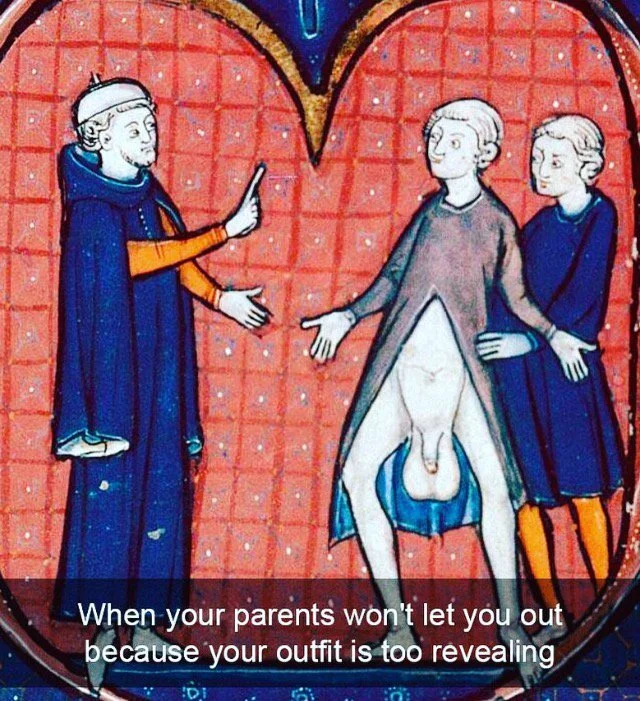
Image from Facebook, illustrating the miracle of the testicles

I’m having technicals problems, as well as being away from home. I posted this a few days ago but it doesn’t seem to have been posted to subscribers. So posting it again.

Today, almost my favourite of many bizarre tales of Saints. St Artemios is the patron saint of male genital disorders, more specifically, hernias and ruptures. His Saint’s Day is October 20th St. Artemios was Governor of Egypt during the reign of Julian the Apostate (331 – 26 June 363). Julian was a philosopher. Nephew to Constantine the Great, who tried to turn the tide and return to traditional Roman religious practices.

Artemios was called to a military meeting with Julian where he witnessed and objected to abuse of Christians. He was tortured with red hot irons, and miraculously cured. Then he was taken to the Amphitheatre where there was a big stone broken in half. He was put on half stone and the other half was raised above him and released, crushing Artemios. He was presumed dead, and left for a day. But he was still alive, broken boned, disembowelled, eyeless and remained unwilling to renounce his religion. Julian ordered his beheading.

A noble woman took his body to Constantinople where his shrine soon started attracting miracles. In the 7th Century, an anonymous author compiled a record of the miracles. St Artemios had become known for healing hernias and genital disorders ‘mostly in men.’ I’m not sure entirely why. Perhaps because of the red-hot pokers? The disembowelling? Maybe the stone that crushed him was round?

I first came across the Saint when I was given a wonderful book called ‘A Medieval Miscellany‘. Tales are selected by Judith Herrin and with an introduction by the great Emmanuel Le Roy Ladurie (see Jan 27th Post to read about Montaillou and Ladurie). It had a colourful spread called ‘The Miracle of the Testicles’. This was the story told by Stephen, a 7th Century deacon of St. Sophia in Constantinople who ‘suffered a rupture, whether from shouting acclamations or from a heavy weight, I cannot say.

To cut a long story short, Stephen was very embarrassed by his condition. He tried many cures but finally undertook surgery. This was successful, but very soon the condition reoccurred which left him to despair.

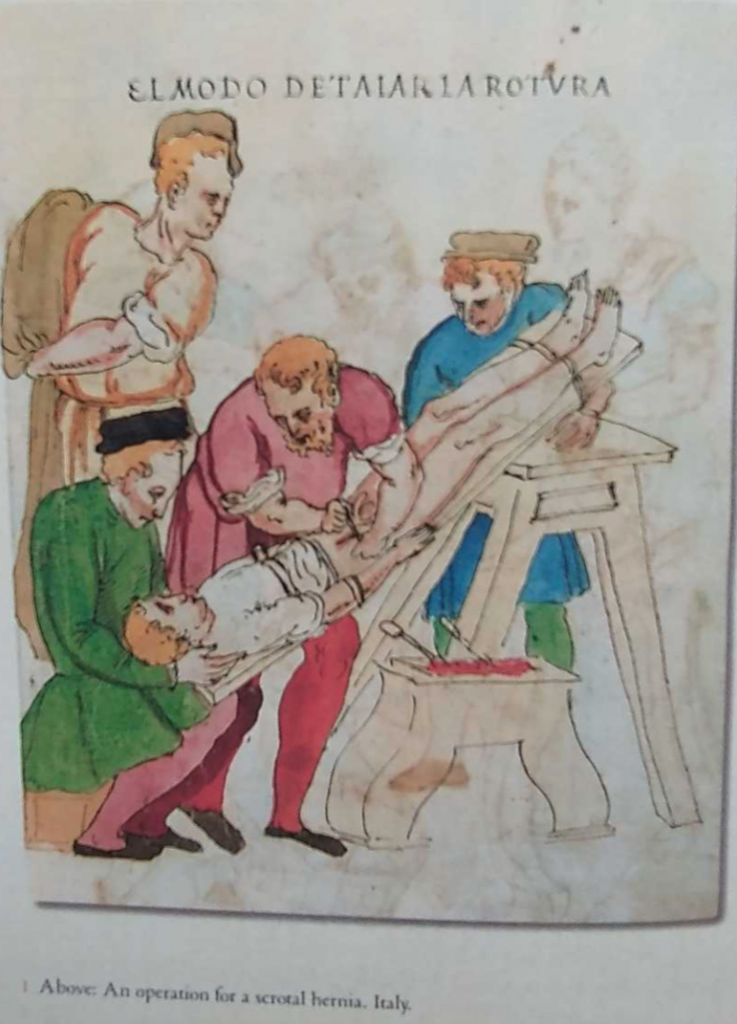
Scrotal Hernia Operation, italy

So he planned to visit the shrine of, Artemios, the great healer of testicles. However, he was too embarrassed to stand in the Church, ashamed to be seen by friends. But passing by one day he nipped into the Tomb, descended to where the relics were and ‘cast’ some of the Saint’s holy oil on his testicles. He then found, much to his surprise, that the doors to the Coffin itself were open. Seeing this as a divine intervention he jumped onto the coffin, straddled it face down, so that the corner of the tomb was rubbing his testicles and prayed:

And with tears, I spoke again to the martyr: “St.Artemios, by God, Who has given you the gift of cures, no doctor on Earth will ever touch me again. So if you please, cure me. But if not, to your everlasting shame I will live thus without cure.

He was not cured immediately. Later he went to the Hot Baths and bathed, and on leaving the baths, thanks be to St Artemios, he was completely cured.

I have transcribed the translation of Stephen’s writings and place it here below as it has many fascinating aspects and remember it is a 7th Century account. But what an extraordinary tale: that it seems reasonable to steal into a tomb, take the holy oil, rub your genitals all over the shrine, and then tell the Saint that it will be to his everlasting shame if he does not make the cure!

For more on the Hospital of Sampson click here. Livanon is one of the Roman Baths in Constantinople and it is interesting that the cure follows bathing in them. The Oxeia is a neighbourhood in Constantinople connected with St Antemios. A cautery is a method to remove or close off a part of the body. It can be hot, cold or chemical.

At long last I disclosed the misfortune to my parents, and after many treatments, (how many!) had been performed on me. Finally, after taking counsel with them, I entrusted myself for surgery to the surgeons in the hospital Sampson, and I reclined in the hospital room near to the entrance to the area devoted to eyes.

After I had been treated all over for three days at night with cold cauteries, surgery was performed on the fourth day. I will omit to what horrible things I experienced while on my back.

To sum up everything, I state that I actually despaired of life itself at the hands of the physicians. After God, entreated by the tears of my parents, restored my life to me, and after the scar from the incision and the cautery had healed, and just as I was believing that I was healthy, a short time later, the same condition recurred and so I reverted to my former state…

I had a plan to approach the holy martyr, as I had heard of his many great miracles. Still, I was unwilling to wait in the venerable church feeling ashamed before friends and acquaintances to be seen by them in such condition. But I frequently used to pass by (for at that time, I was staying in the Oxeia). And so I descended to the holy tomb of his precious relics, and I cast some of his holy blessing, I. e. oil on my testicles, hoping to procure a cure in this manner. And frequently, I entreated him to deliver me from the troublesome condition…

After descending to the holy tomb, I found the doors in front open and I was astounded that they were opened at such an hour. This was the doing of the martyr, in his desire to pity me, Stretching out facedown on the holy coffin, I straddled it, and thus contrived to rub the corner of the same Holy tomb on the spot where I was ailing. And with tears, I spoke again to the martyr: “St.Artemios, by God, Who has given you the gift of cures, no doctor on earth will ever touch me again. So if you please, cure me. But if not, to your everlasting shame I will live thus without cure.’ And after some days I went to the bath in the court of Anthemios, the one called Livanon to bathe by myself at dawn in order not to be seen by anyone . And entering the hot chamber, I noticed that I still had the injury. But upon exiting, I had no injury, and recognising the act of kindness on the part of God and the martyr which is befallen me… in thanksgiving… I do now glorify them proclaiming their deeds of greatness throughout my whole life.

From Medieval Miscellany selected by Judith Herrin Pg 54 the Miracle of the Testicles

First published in 2023, revised 2024 and 2025

John Goodricke and the Variable Star. September 17th 1764

John Goodricke and the Variable Star

Newton

What I really admire are people who, through their sheer brain power, can change our views of the world.  The first example that comes to mind is Newton’s insight that if the universe were infinite, the night sky would not be dark as everywhere there would be tiny pinpricks of starlight.  So, we don’t live in a infinite universe. Another one is Einstein’s thought experiment that proves that time is relative. But see below for a description of that.  But, now to John Goodricke and the Variable Star. (for Newton and the Maypole see my post here).

Goodricke

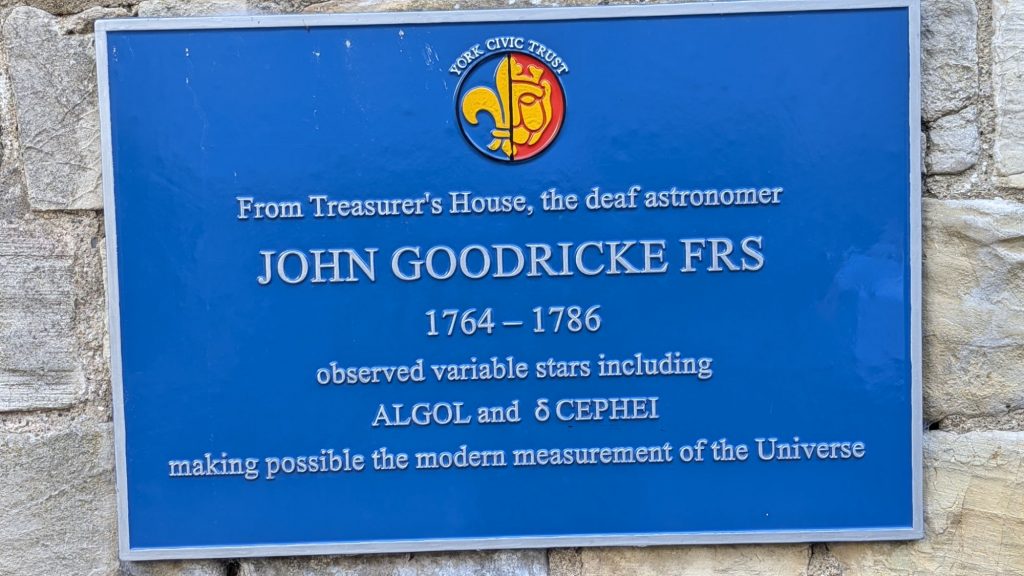
Last year in York, near the Minster, I saw the blue sign above. I thought, what on earth are ‘variable stars’?  Behind me, I heard two women say something like. ‘Here it is,”variable stars”‘.  I turned around and asked them what was a variable star?

‘Donno’ they said, ‘we’ve ‘just doing this escape room walk around York.’  They showed me a booklet they had received on the internet,. This is what I would call a treasure trail. Sadly, they showed no interest in finding out what a variable star is!

Aristotle and ancient philosophers held that the universe was unchanging and eternal. The first breach in that theory was the identification in 1638 of star Omicron Ceti. Johannes Holwarda discovered that the star pulsed on an 11-month cycle.  This and the discovery, of supernovae (first observed in 1572), proved that the ‘The starry sky was not eternally invariable’. But there was, as yet, no explanation for the phenomena.

John Goodricke was educated at Thomas Braidwood‘s Academy, school for deaf pupils in Edinburgh, and Warrington Academy. He returned to live with his parents, who rented an apartment at the Treasurer’s Hall. This is near the Minister in York. He used a friend’s personal observatory to look for variable stars. He found two of the first 10, and was the first to propose a solution. This was that two stars orbited each other causing eclipses between them and the observer. Thus creating a variation in the light emitted. To be able to extrapolate from a simple observation, and provide an explanation which necessitates a complete rethink about the nature of the universe seems, to me, to be awesome.

Einstein’s Thought Experiment

Back to Einstein, his thought experiment was something like this:

A train is travelling through a station. There is an observer on the train towards the front, another on the platform as the train goes through. There are two simultaneous lighting strikes at either end of the train. The observer on the platform sees the strikes as simultaneous. Why? Because she is in the middle between the two lighting strikes and light travels at the same speed. The observer on the train who is near the front of the train will see the lighting strike at the front of the train before the light from the strike at the back of the train can reach him. It has further to go.

This means that time is not a constant, it is relative to the observer. And yet, we think of time as a constant, something that remorselessly ticks forward and which we cannot alter. But it isn’t.

For a better explanation, see https://en.m.wikipedia.org/wiki/Relativity_of_simultaneity

First written 2024, revised 2025

September – ‘Winter’s Forewarning and Summer’s Farewell’

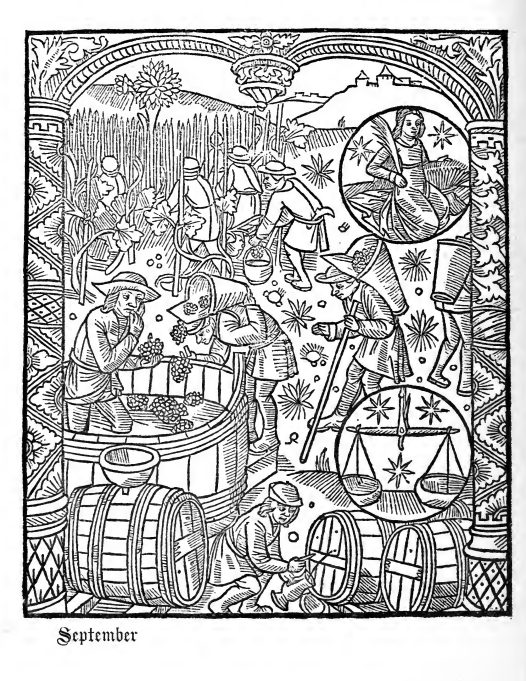
Kalendar of Shepherds illustration of September showing harvesting grapes and the astrological signs for Virgo (August 23 – September 22) and Libra (September 23 – October 22)

It is that time of the year when you say ‘Where has the Summer gone? It can’t be September already?’ But, meteorology, speaking, Autumn starts today. September 1st was chosen on a numerical basis for ease of measuring rather than any profound floral, agricultural or solar reason. So, there are three Gregorian Calendar months for each season, and each season starts on the first of the month. Autumn: September, November and December.

Autumn, Harvest, Fall

Autumn comes from Latin (autumnus) which went into French and then into English. The season was also called Harvest (which went into Dutch herfst, German Herbst, and Scots hairst -Wikipedia) or from the 16th Century: the ‘fall of the year’ or ‘fall of the leaf’ which spread to America as Fall.

Summer’s Ending

It still feels like summer. In England, we often have a glorious September, and what we can an ‘Indian’ Summer, an unexpectedly warm period in mid-September to October.

Solar Autumn

Of course, for the real Autumn, we have to wait for the Equinox, the beginning of Astronomical or Solar Autumn. This year, it is on Monday, September 22nd, 2025, 7:19 pm.

Astrological September

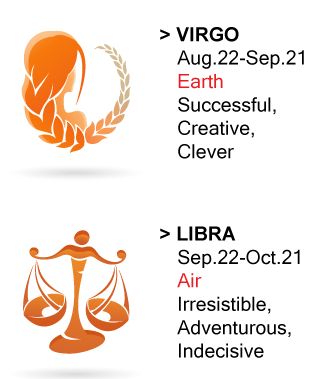
The star signs for astrological September are: Virgo which is linked to Aphrodite (Venus) the Goddess of Love and Libra which is linked to Artemis (Diana), virgin goddess of many things, including hunting, wild animals, children, and birth.

Star signs for September

September

September gets its name from the Romans, for whom it was the 7th Month of the year (septem is Latin for seven). Later, they added two new months so it became our 9th Month. (For more on the Roman year, look at my post here).

It is called Halegmonath in the early English language, or the holy month, named because it is the month of offerings, because of the harvest, and the mellow fruitfulness of September? Medi in Welsh is the month of reaping, and An Sultuine in Gaelic which means the month of plenty.

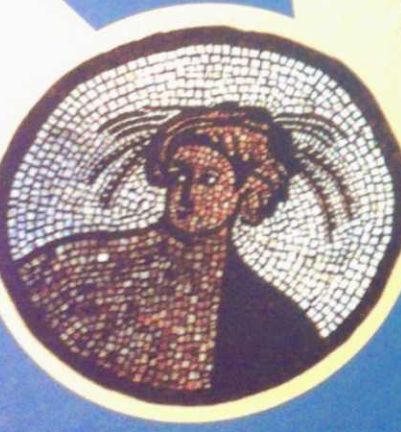
Roman personification of Autumn from Lullingstone mosaic

Early Modern September and the autumn of Life

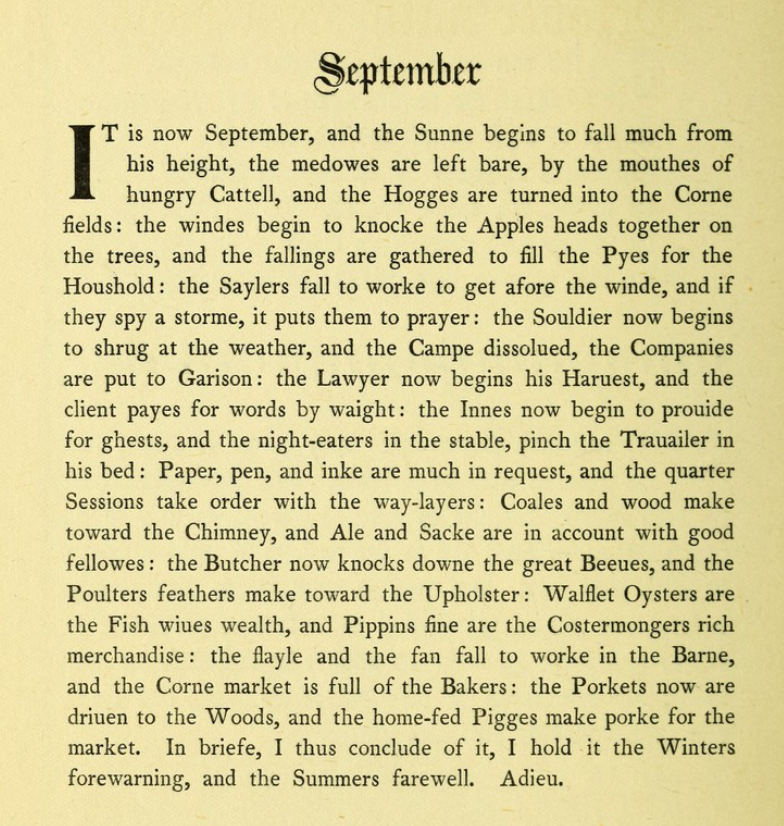
Here is an early 17th Century look at September from the Kalendar of Shepherds – for more on the Kalendar, look at my post here.

From the Kalendar of Shepherds

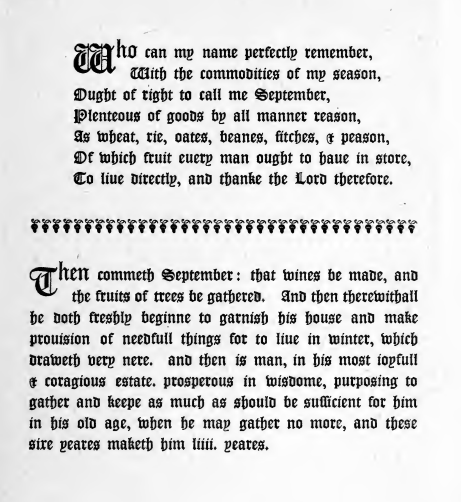
The Kalendar has an additional shorter look at September (see below). And it continues with its theme, linking the 12 months of the year with the lifespan of a man – 6 years for each month. So September is a metaphor for man at 56 years of age, in their prime and preparing for old age.

September from the Kalendar of Shepherds. The last sentence beginning ‘and then is man’ shows the link between September and the beginning of the autumn of life.

Season of ‘mists and mellow fruitfulness

John Keats (1795 – 1821) wrote a great poem called ‘To Autumn’:

Season of mists and mellow fruitfulness,
  Close bosom-friend of the maturing sun;
Conspiring with him how to load and bless
  With fruit the vines that round the thatch-eves run;
To bend with apples the moss’d cottage-trees,
  And fill all fruit with ripeness to the core;
    To swell the gourd, and plump the hazel shells
  With a sweet kernel; to set budding more,
And still more, later flowers for the bees,
Until they think warm days will never cease,
    For summer has o’er-brimm’d their clammy cells.

Who hath not seen thee oft amid thy store?
  Sometimes whoever seeks abroad may find
Thee sitting careless on a granary floor,
  Thy hair soft-lifted by the winnowing wind;
Or on a half-reap’d furrow sound asleep,
  Drowsed with the fume of poppies, while thy hook
    Spares the next swath and all its twined flowers:
And sometimes like a gleaner thou dost keep
  Steady thy laden head across a brook;
  Or by a cider-press, with patient look,
    Thou watchest the last oozings, hours by hours.

Where are the songs of Spring? Ay, where are they?
  Think not of them, thou hast thy music too,—
While barred clouds bloom the soft-dying day,
  And touch the stubble-plains with rosy hue;
Then in a wailful choir the small gnats mourn
  Among the river sallows, borne aloft
    Or sinking as the light wind lives or dies;
And full-grown lambs loud bleat from hilly bourn;
  Hedge-crickets sing; and now with treble soft
  The redbreast whistles from a garden-croft,
    And gathering swallows twitter in the skies.

Written September 19, 1819; first published in 1820. This poem is in the public domain and available here:

First published September 2024, revised 2025

Eels, Pies, Islands, the deep Sargasso Sea & Rock and Roll July 23rd

 Photo by Natalia Gusakova on Unsplash
Photo by Natalia Gusakova on Unsplash, Eels

Summer is the best time to fish for Eels. Mid May to the end of July. But they can be caught all year around. Jellied Eels have been a staple of East End diets since the 18th Century. They were to be found in many stalls dotted around the East End, from vendors venturing into pubs and in Pie and Mash shops. Tubby Isaacs is perhaps, the most famous. Jellied eels are still sold in a diminishing number of places in the East End. Manze’s Eel, Pie, and Mash shop at 204 Deptford High Street, London was listed in December 2023. The shop opened in 1914 and was a pioneer of commercial branding. This is the fourth Manze’s shop to be listed: Tower Bridge Street, Chapel Market Islington, and Walthamstow High street. The current owner of the Deptford shop is retiring and so the shop will close.

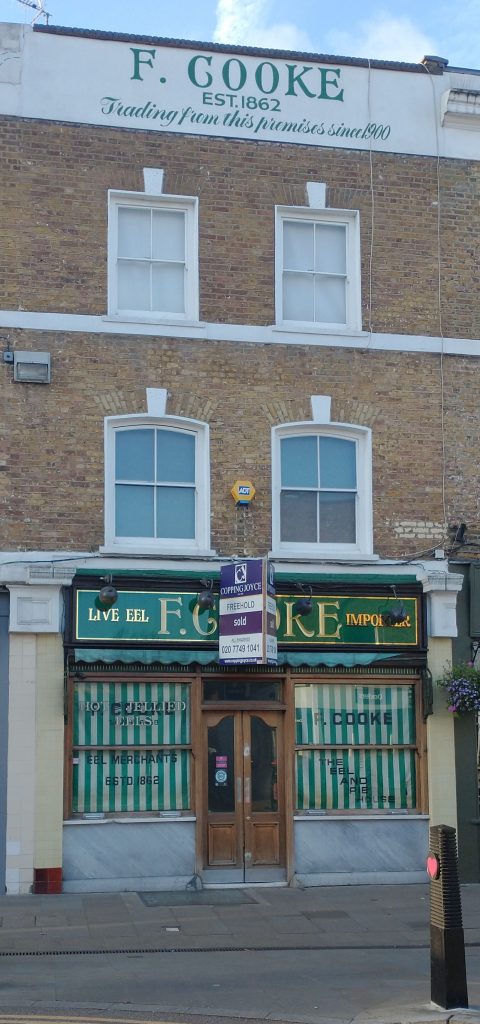
There are three Pie and Mash shops near me in Hackney. The one in Dalston has become a bar. In Broadway Market it is now an optician. But the one in Hoxton Market is surviving, and all three have retained their distinctive interiors. On the River Lee Navigation is another piece of Eel history which is the excellent Fish and Eel Pub at Dobbs Weir.

Pie and Mash Shop. Established 1862, closed down 2021. Broadway Market, Hackney (photo, copyright the author)

My mum loved jellied eels. It took me until I was over 60 before I could bring myself to try them. And I have no wish to repeat, what for me, was a revolting experience.

By JanesDaddy (Ensglish User) - English Wikipedia - [1], CC BY-SA 3.0, https://commons.wikimedia.org/w/index.php?curid=1663124
By JanesDaddy (Ensglish User) – English Wikipedia – [1], CC BY-SA 3.0, https://commons.wikimedia.org/w/index.php?curid=1663124

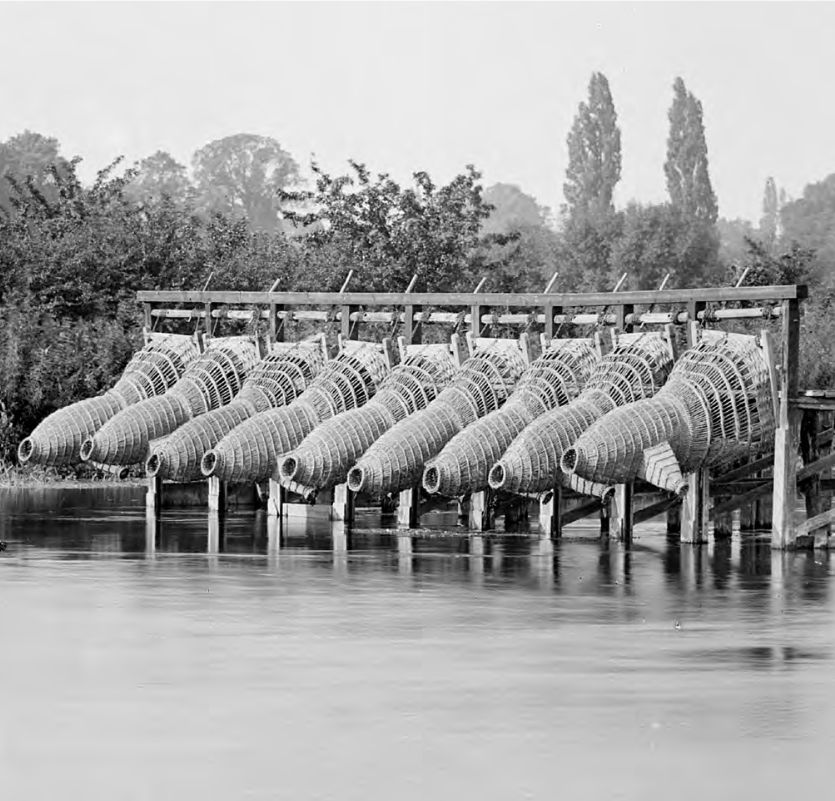
Gervase Markham in his ‘The English Husbandman’ of 1635 provides instructions on how:

To take Eels in Winter, Make a long bottle or tube of Hay, wrapped about Willow boughs, and having guts or garbage in the middles. Which being soaked in the deep water by the river side, after two or three days the eels will be in it and you may tread them out with your feet.

And here is a fascinating article on Eel fishing.

Eel traps at Bray, on the River Thames (Henry Taught 1885)

Romans, Saxons and Eels

Eels have been eaten for thousands of years. Apicius, author of a famous collection of Roman Recipes tells us of two sauces for eels:

Sauce for Eel Ius in anguillam

Eel will be made more palatable by a sauce which has​ pepper, celery seed, lovage,​ anise, Syrian sumach,​ figdate wine,​ honey, vinegar, broth, oil, mustard, reduced must.

Another Sauce for Eel Aliter ius in anguillam

Pepper, lovage, Syrian sumach, dry mint, rue berries, hard yolks, mead, vinegar, broth, oil; cook it.

Bede’s Historia Ecclesiastica, which tells of Britain as a land with “the greatest plenty of eel and fish.” Several fish traps have been found in and around the Thames, one for example in Chelsea.

Aristotle, Freud and the Deep Sargasso Sea

But eels had a great mystery no one knew where they came from or how they reproduced. Aristotle thought they spontaneously emerged from the mud. Sigmund Freud dissected hundreds of Eels, hoping to find male sex organs. It was only on 19th October 2022 that an article in the science journal Nature disclosed the truth. The article was ‘First direct evidence of adult European eels migrating to their breeding place in the Sargasso Sea‘. Ir proved beyond doubt that the theory that Eels go to the sea near Bermuda to spawn was, incredibly, true.

Eel Pie Island

Eel Pie Island . Ordnance Survey In 1871 to 1882 map series (OS, 1st series at 1:10560: Surrey (Wikipedia)

But Eels also have their place in Rock and Roll History. Eel Pie island is on the Thames, near Twickenham and Richmond. It is famous for its Eels. But was home to an iconic music venue. The Eel Pie Hotel hosted most of the great English Bands of the 50s. 60s, and 70s. The roll call of bands here is awesome. The Stones, Cream, Rod Stewart, Pink Floyd, you name it, they were here:

David Bowie, Jeff Beck, Howlin’ Wolf, John Lee Hooker, Memphis Slim, Champion Jack Dupree. Buddy Guy, Geno Washington, Long John Baldry, Julie Driscoll and Brian Auger. John Mayall’s Bluesbreakers, Ten Years After, Chicken Shack, and one of my all-time favourite bands. the Savoy Brown Blues Band. And I have forgotten the Nice, the Crazy World of Arthur Brown, Joe Cocker, and the Who. And many more!

The Rolling Stones played at the Railway Tavern, Richmond on Sunday, February 24, 1963. Here they were spotted by people from the nearby Eel Pie Hotel. They were booked for a 6 month residency, which they began as virtually unknown and ended as famous.

Here is a recipe for Baked Eel pie from Richmond, near the famous Eel Pie Island.

This was first published as part of another post in 2022, and revised and republished on 28th November 2023, 2024.Moved from November 28th to July 23rd in 2025

(I moved it to make room for a post on Mrs Shakespeare. Also, because I cannot find anything to substantiate the opening statement that the Eel Season had its second day on November 28th. All evidence I find says the best fishing is in the Summer.

Twin, Twins – Festival of Castor and Pollux July 15th

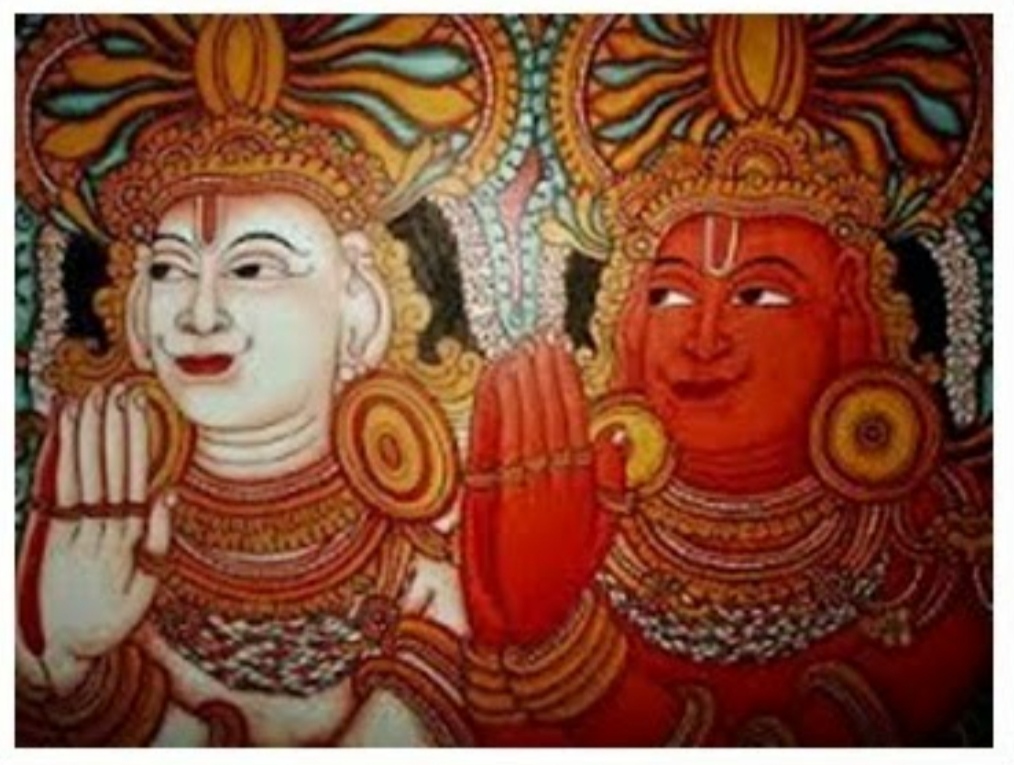
The Ashwini kumaras twins, sons of the sun god Surya. Vedic gods representing the brightness of sunrise and sunset Wikipedia

The Divine Twins, aka the Dioscuri, were horsemen. Patrons of calvary, athletes and sailors, one of many Indo-European twin gods.   They had many adventures including sailing with Jason and the Argonauts.

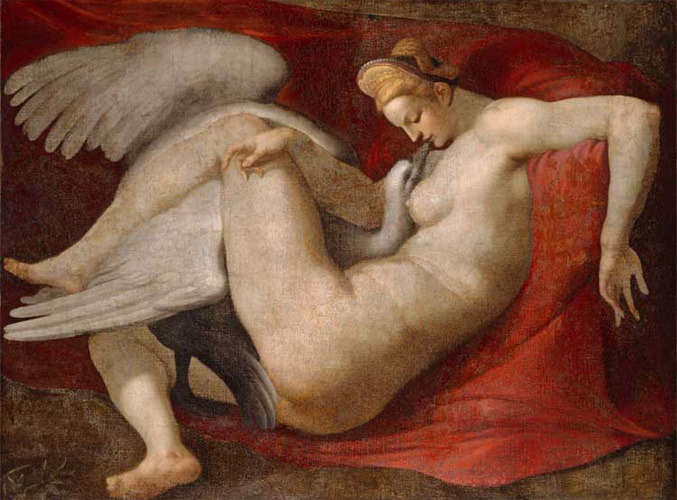
And are they well connected?! Pollux is the son of Zeus  His twin brother has a different and mortal father, the King of Sparta.  But the boys share the same mother, Leda.  She was raped by Zeus in the guise of a swan.

This makes them examples of heteropaternal superfecundation as Mary Poppins didn’t sing.  But their different paternity had consequences. The most important is that one was (is?) therefore immortal and the other wasn’t. 

According to some version of the story, Castor (the mortal one) was mortally wounded. Zeus gave Pollux the option of letting his brother die while Pollux could spend eternity on Mount Olympus. The alternative was to share his immortality with his brother. Pollux did the good thing. So the twins spend half their year as the Constellation of Gemini and the rest, immortal, on Mount Olympus.  Thus, they are the epitome of brotherly love.

Divine Twins or Sisters from Hell?

The Dioscuri’s sisters were no less than Helen of Troy and Clytemnestra. Never mind the Brothers, what Sisters! Helen of Troy you know. And Clytemnestra! They were also twins, Helen the divine daughter of Zeus, husband of Menelaus, lover of Paris. Sister, Clytemnestra, mortal daughter of the King of Sparta, husband of Agamemnon (brother of Menelaus).

It happened like this.  The Swan was being pursued by an eagle, so Leda protected the Swan and took it to bed.  On the same night she slept with her husband Tyndareus of Sparta. Two eggs were fertilised, each split in two to give two sets of twins.

Leda and the Swan, 16th-century copy after the lost painting by Michelangelo

Clytemnestra

She was the wife of Agamemnon, the arrogant leader of the Greeks.  On the way to retrieve Helen from Troy, the Greek Fleet was becalmed. So, following his seers’ advice, Agamemnon sacrificed his own daughter, Iphigenia, on the island of Aulis.  The Gods then set the winds fair to Troy. (Read Iphigenia at Aulis by Aeschylus, a great play which I studied in Classical Studies at University).

Meanwhile, Queen Clytemnestra, abandoned at home, broods on her husband’s heartless fillicide. She takes a lover. After 10 years of war, Agamemnon comes back, in triumph, from the destruction of Troy. He brings with him his prize, the Trojan Princess, Cassandra, sister of Hector.

Cassandra has been gifted with the ability of accurate prophecy. But, as often in the case of prophecy stories, the gift came with a sting in its tale. She was also cursed with the inability to get anyone to believe her!  She prophesies disaster and that she too will be a victim.

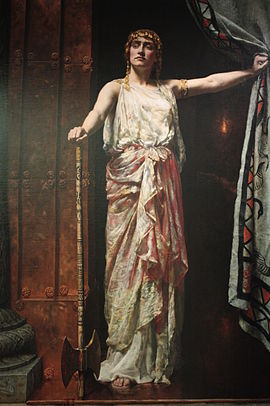
Strutting with arrogance, Agamemnon demands Clytemnestra prepare him a bath. And, so she runs it for him, and she gives him the hottest bath possible. With the help of her lover, she hacks Agamemnon to pieces with an axe. Cassandra is butchered.

painting of Clytemnestra after she has slaughtered her husband Agamemnon _by_John_Collier,_1882 (Wikipedia Guildhall Museum)
Clytemnestra by John Collier,_1882 (Wikipedia Guildhall Museum)

Attitudes

I visit John Collier’s painting of Clytemnestra at the Guildhall, in London, regularly. I am fascinated by her grim, yet satisfied, expression.

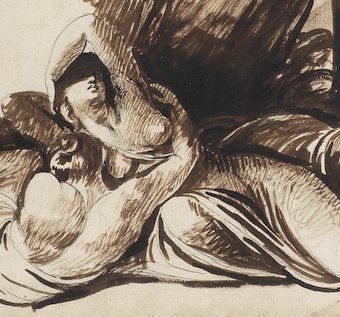
In the 18th/19th Century, rich people were into ‘attitudes’.  For example, Emma Hart, later Lady Hamilton, would be invited to present an attitude in front of a dinner party of mostly male aristocrats.  She would dress up in a flowing, revealing unstructured classical gown.  Then she would stand on a table or pedestal, and present herself as Helen or Andromache or any other classical beauty guests might fancy an eyeful of.  She would assume an appropriate facial expression and posture for everyone’s pleasure. 

Detail of Emma Hart modelling as Iphigenia by George Romney in ‘Cimon and Iphigenia’

Being Clytemnestra is, surely, the most difficult? I imagine Collier’s model being prompted to look both sad at the loss of the daughter. Outraged at the arrogance of the husband. Horrified at the gore of the murder. But, overall, she has to portray a grim satisfaction that the bastard got exactly what he deserved.

Dorothy Dene

Lord Leighton had a famous model who was exceptionally skilled at adopting poses for his paintings. He determined to help her with an acting career. As part of the plan he helped improve her cockney accent. It is said this inspired Bernard Shaw’s story Pygmalion, which, in turn, inspired My Fair Lady and Eliza Doolittle. 

Leighton’s model was Dorothy Dene.  She became a famous actress, outstripping the fame of Ellen Terry and Lily Langtry. For more on Leighton and Dene look at my post here.

John Collier

Before we finish, do have a look at John Collier’s Wikipedia because he is the most ridiculously well-connected painter you can imagine! Related to half the Cabinet and married to TWO daughters of Darwin’s Bulldog, T.H. Huxley (grandfather of Aldous Huxley).

For more on Flaming June see my blog post of 12 July 2024

European Twin Gods

It is suggested that twin male gods are a feature of Indo-European religions. The divine Twins are associated with horses/chariots and are responsible for moving the Sun and the Moon. Their use of a horse above the water means that they can rescue people lost at sea.  

St Elmo’s fire was said to be the way they manifested their divinity to sailors.   Diodorus Siculus records that the Twins were Argonauts with Heracles, Telamon, and Orpheus. Further, he tells us, in the fourth book of Bibliotheca historica, that the Celts who dwelt along the ocean worshipped the Dioscuroi “more than the other gods”.

First written in 2023 updated in July 24 and 25

Molly Bloomsday June 16th

Screenshot from Facebook about Bloomsday.

Molly Bloomsday & the Stream of Consciousness.

Molly Bloomsday is a new festival, an offshoot in Derry of the Dublin based Bloomsday. Both are celebrated on 16th June which is the day on which the great book Ulysses by James Joyce is set (16 June 1904). It was published in 1922.

Bloomsday is named after Leopold Bloom and is an international festival celebrating Ulysses.  Molly Bloom is her husband who has a soliloquy at the beginning of the book.  The Molly Bloomsday concentrates on Molly and women’s literature. The Dublin version is a literary festival as well with people dressing up as characters from the famous book, readings, plays etc..

The Bloomsday Book

Joyce thought Odysseus was the only all-round character in literature. Not a one dimensional hero, but a man with a complex character, not always making the good choice. He based Ulysses, loosely, on Homer’s plot. The main characters, Leopold and Molly Bloom were based on Odysseus and Penelope. Stephen Daedalus was Telemachus, their son. Daedalus is Joyce’s alter-ego.

What makes the book so great is that Joyce was, with Virginia Wolfe, one of the first great Modernist writers. They used stream of consciousness from the characters’ points of view from deep in their heads. This is how Joyce describes Ulysses according to Djuna Barnes:

“The pity is … the public will demand and find a moral in my book—or worse they may take it in some more serious way, and on the honour of a gentleman, there is not one single serious line in it. … In Ulysses I have recorded, simultaneously, what a man says, sees, thinks, and what such seeing, thinking, saying does, to what you Freudians call the subconscious.”

Ulysses and I

My copy of Ulysses is very well travelled. I very often take it on holiday.  I start on Chapter 1, and at some point before the end of the holiday I am still on Chapter. I stop reading.  I’ve got past the beginning of Chapter 2 once.

Don’t get me wrong, I am fully convinced it is a brilliant book.  It’s my best friend’s favourite book.  So one day I WILL READ IT!

Modernism & the Steam of consciousness

When I first published this piece I made a terrible typo and talked about the ‘steam of consciousness’. So I republished it immediately so not to embarass myself for too long. But, actually, I quite like the sound of a steam of consciousness. But what could it mean?

For a touch more modernism, see my post: boating-adventure-the-second-best-modernist-building-in-london/

First published on June 16th 2025

St Agatha, Ravenna and Motor Cycling in Inferno

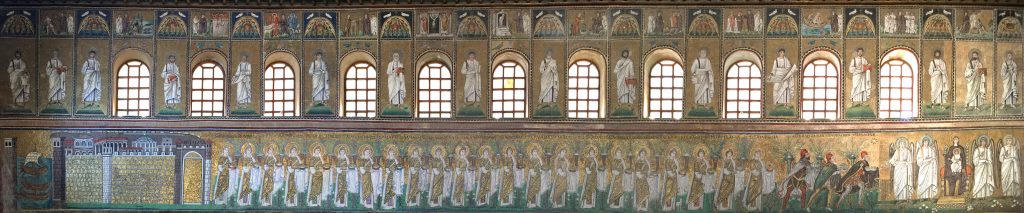
Procession of female saints leaving Classis (bottom left) behind the Three Kings heading to the Virgin Mary (bottom right between four angels). Basilica of Sant’Apollinare Nuovo (pic. Wikipedia)

Today, I am in Ravenna. One of those places where the history brings gasps of amazement.  To honour my visit, I thought I should roll out last year’s post. This is what I said:

When I revised my Saint Agatha post (link see below), I felt I needed an early image of Agatha.  After all, her cult spread early on, and therefore, was likely to be genuine.

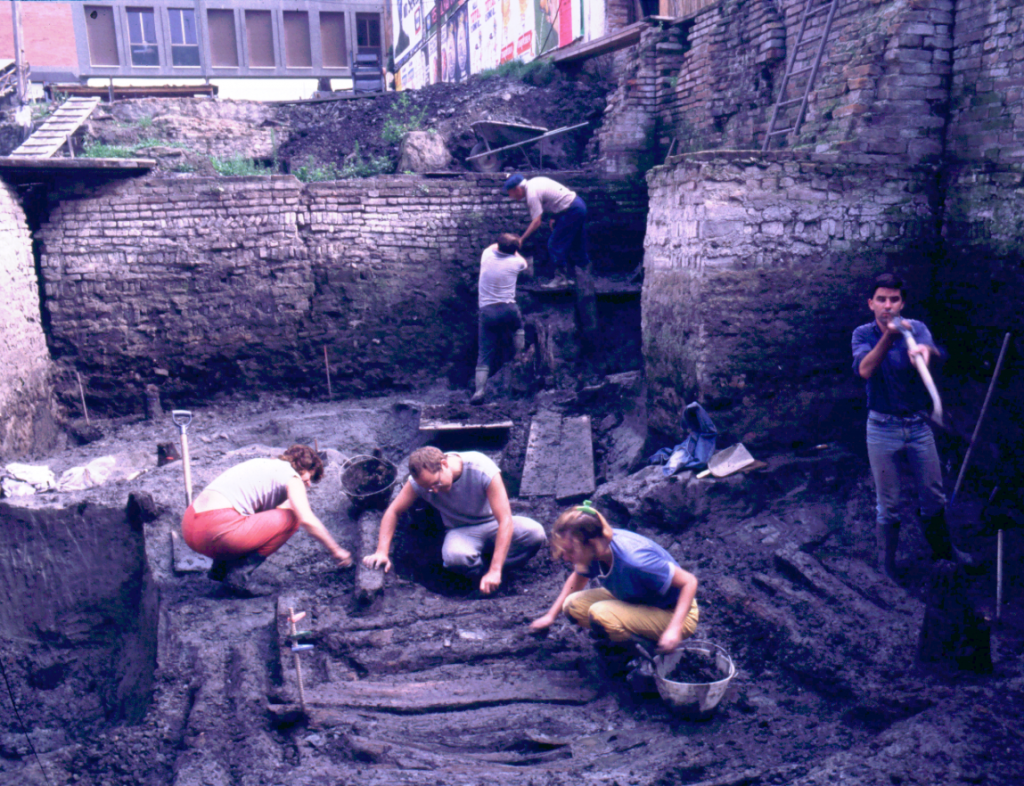
As I started to track down her image I was led, with some joy, to one of the most amazing Churches in the wonderful town of Ravenna. I visited the Basilica of Sant’Apollinare Nuovo with some wonderment when working as an archaeologist at Ferrara, in Emilia-Romagna. Forty Years ago.

I found out that Agatha was one of 22 female Saints on one of the walls of the Church. I discovered a pretty comprehensive description of the Church. As I looked at it, I noticed the record was made by, or involved, Professor Bryan Ward-Perkins. He was the Director of the site my friends and I worked on in Ferrara! (And I met him again last night, 2025 for the first time in years!  We had dinner with fellow archaeologists, and Bryan was talking about the work he did on the Saints of St Apollinaire.)

Medieval Excavation in Ferrara. The author is in the centre of the photo,

Ravenna

I’m guessing Bryan suggested we visit Ravenna on one of our trips to the beach at nearby Rimini. Ravenna was so awesome because the City became the capital of the Roman Empire in the West. It took over when Rome fell, then it was part of the Ostrogothic Kingdom, then of the Byzantine Empire. It spanned the period of the Arian Heresy.

And so, it was provided with some of the great glories of 5th and 6th Century Architecture. These include the Mausoleum of Galla Placidia, the Neronian Baptistery, the Basilica of Sant’Apollinare Nuovo, the Arian Baptistery, the Archiepiscopal Chapel, the Mausoleum of Theodoric, the Church of San Vitale and the Basilica of Sant’Apollinare in Classe. It’s hard to overestimate the impact on a young British archaeologist of seeing 5th Century buildings with roofs and astonishingly detailed mosaics still intact. Please visit!

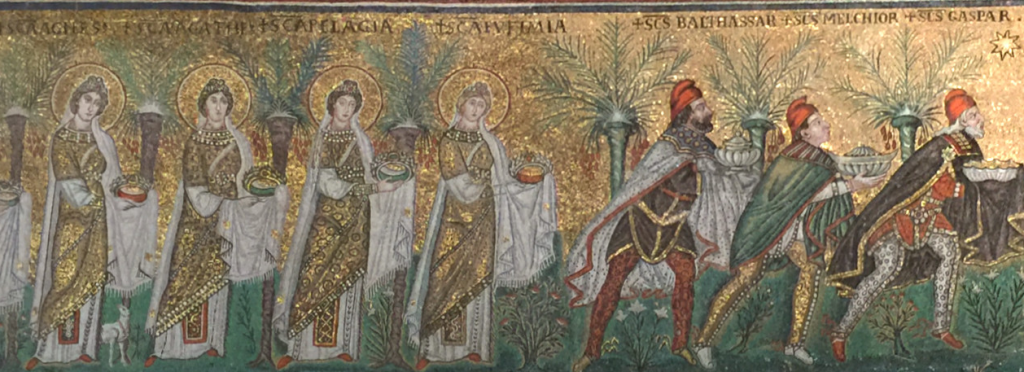
Detail showing the first four female saints behind the Three Kings. Basilica of Sant’Apollinare Nuovo wikipedia

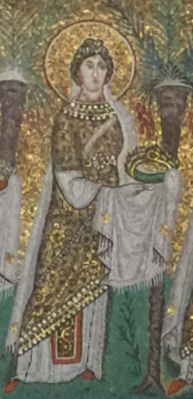
Bryan Ward-Perkins description says All the saints are haloed, bear crowns and are dressed in elaborate court dress. Unlike the men …., all have essentially the same youthful features. The only saint with a distinguishing attribute is Agnes, who is accompanied by a lamb.’ The men are given some personality, some have white beards others are youthful. While all the female martyrs are, essentially young virgins, and cannot be distinguished from each other. St Agatha, the list says, is the Saint next to Agnes with her lamb; the third in precedent. You can see her above and in detail below.

St Agatha
Basilica of Sant’Apollinare Nuovo wikipedia

Motorcycling from Ravenna to Inferno

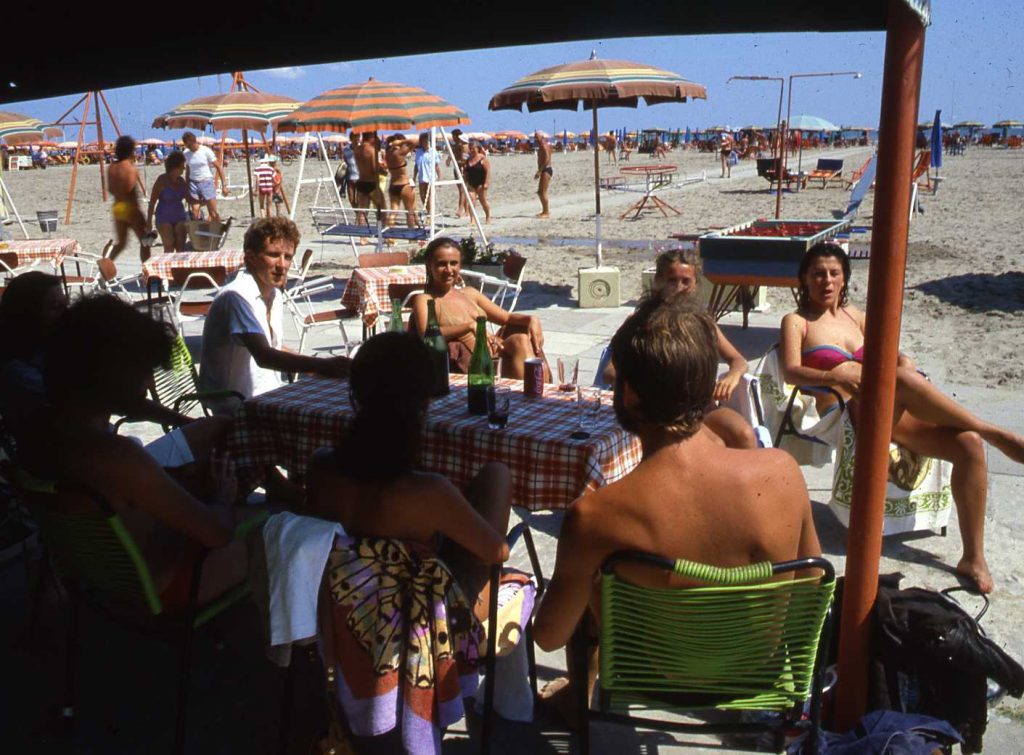
Enough of the sublime! Now for the ridiculous. Whether on this visit or another, we decided to have a day at the beach at Rimini. After the day on the beach, a collective decision to stay over was made. The reason was to go to one of the big clubs (did we still call them discos?) probably to dance to ‘Frankie Goes to Hollywood’.

Archaeologists, Italian and English, on the beach at Lido di Spina

However, the hotels were all full. So I decided, late at night, to go back to Ferrara, on my own on my 175 cc Yamaha motorbike.

My Yamaha 175cc bike looked something like this but was red. A thing of underpowered beauty.

Thing was, I had started the day in Ferrara in the blazing Italian summer heat. So, I had hopped onto my bike dressed in shorts and t-shirt. Ferrara was 77 miles away (says google). One hour into the trip back, I was getting pretty cold, and really not enjoying driving through the lonely countryside. Therefore, I decided to pull off the main road to find a rural hostelry for what remained of the night.

Now, I remember this very vividly – the only likely road I could find was signposted to ‘Inferno’. I shrugged my shoulders, wondering what that was about, and drove towards it on a very deserted road. Eventually, I came to a sign which told me I was about to enter ‘Inferno’.

There was something very surreal about the situation. My courage failed me! I was not going to stay in a ‘motel’ in a place called ‘inferno’! I had seen too many horror films set in Motels and one in Inferno seemed madness. So, I turned round and continued my cold journey to Ferrara.

Inferno

Whenever I tell this story, I have some doubt about it.  Did I really drive into a place called ‘Inferno’? But I have, for the first time, checked Google. It tells me that the road off the Rimini to Ferrara road goes through somewhere called: Vicolo Inferno, 40026 Imola BO, Italy.

Below is the post about St Agatha of Sicily who has a most interesting story.

Written in 2023 and updated in 2024, and 2025

Cotswolds Olimpicks May 30th

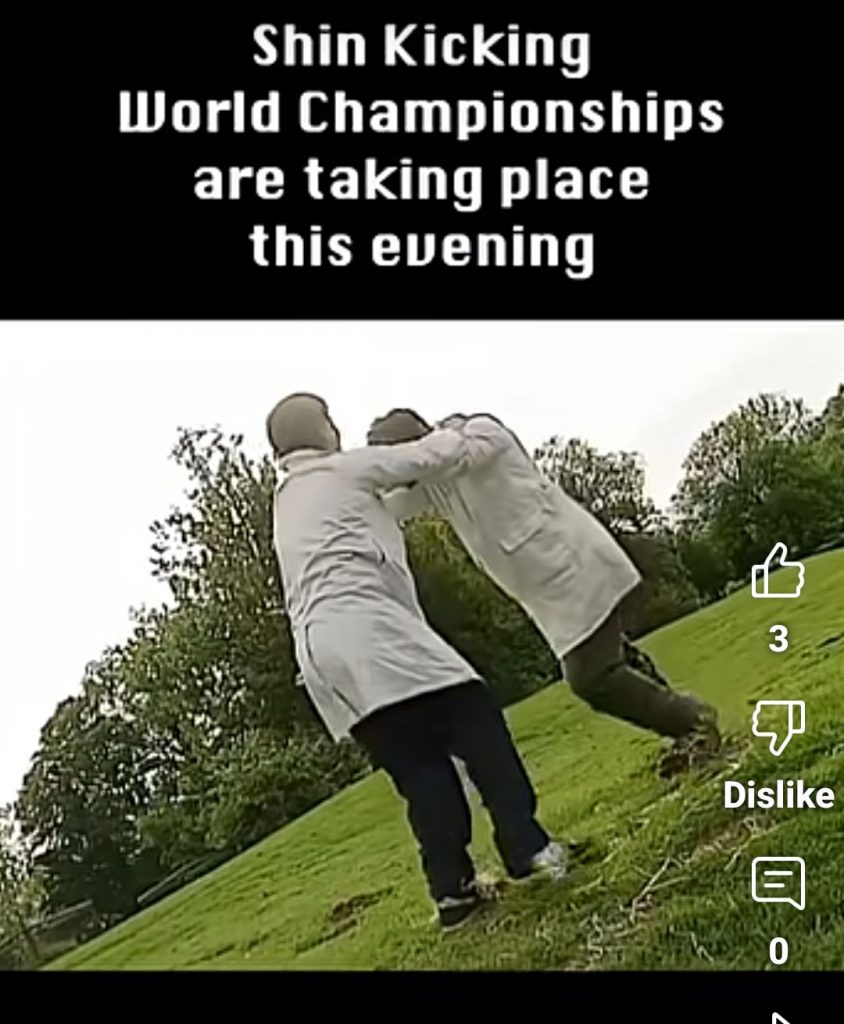
screen shot from https://youtube.com/shorts/wBOPAZ2131Y?si=UEED_F8QjSb_wW6Z

I’m in Ferrara, in the Po Valley near Bologna.  Hence, falling behind on posts!  I am on holiday but attending a reunion of Archaeologists who excavated here in the 1980’s.  It was a collaboration between Italian and UK archaeologists.  The British contingent was mostly from the Museum of London.  More to follow over the next few days.

But on the 30th May I planned to tell you about the Cotswolds’ Olimpicks.  This was set up by Robert Dover on a hill near Chipping Camden, in the early 17th Century.

Inspired by the Greek Olympics, he felt the modern world could do with an infusion of the original spirit.

The Olimpicks has a collection of tradition sports such as the sack race, and the tug of war.  But the one that receives the most attention is shin-kicking.  Two contestants try to knock each other over by kicking each other in the shins!  They are not supposed to pull or push their opponent over. Or use Judo style throws.  Protective gear is supplied in the form of straw or hay packed down the socks.

For other Cotswolds content look at my posts

coopers-hill-cheese-rolling-may-26th/

campden-house-fire-sunday-march-23rd-1862/

chipping-campden-murder-august-16th-1660/

First published 1 June 2025

Sementivae Dies—the Days of Sowing January 24–26

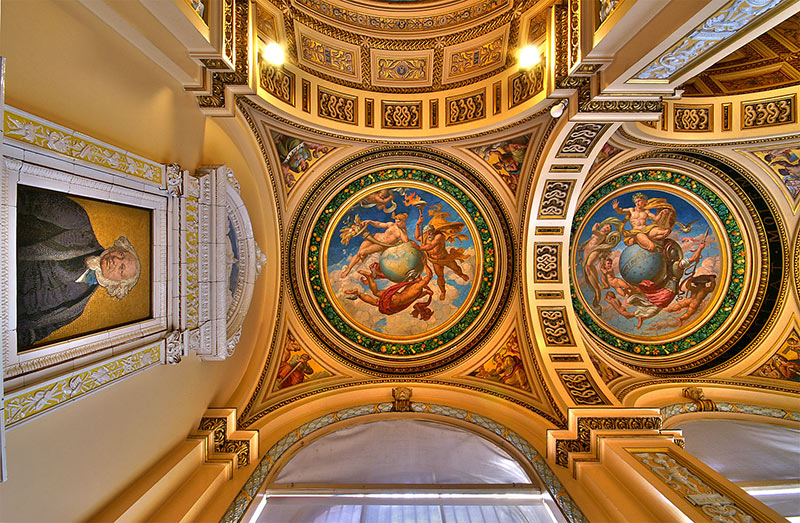
Victoria and Albert Museum” by Nick Garrod, licensed under CC BY-NC-ND 2.0. First V&A Director, Sir Henry Cole, to the left of the picture. Greek Deities in the roundells

Sementivae, was a festival dedicated to seed and to Ceres. Ceres is an Earth Goddess who gives her name to our word cereal. The festival was also called. Paganalia. The Mediterranean world had many names for the Earth Goddess. Tellus, Demeter, Cybele, Gaia, Rhea etc..

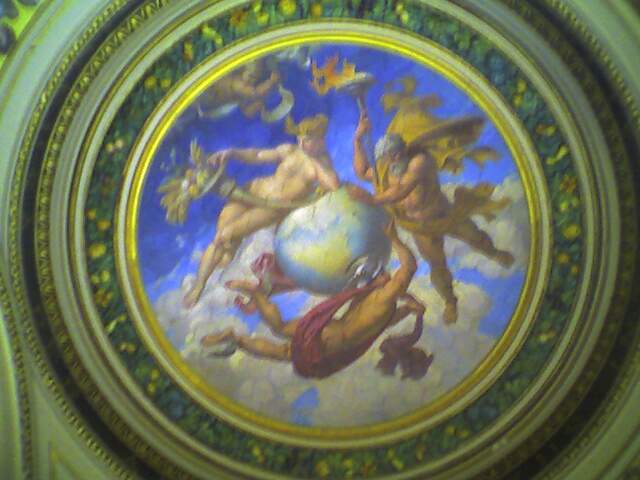
Ceres can be seen on the top left roundel resting on the Globe on the marvellous Ceramic Staircase at the V&A (photo above). And in my slightly out of focus photograph below. (To be honest, in real life, it looks a little more like my photo than the gorgeous photo above!)

Ceres represented Agriculture, Mercury Commerce, and Vulcan Industry.  Old Photo by the Author.  T
Ceres represented Agriculture, Mercury Commerce, and Vulcan Industry. Old Photo by the Author.

Sementivae Dies – a moveable feast.

To create life, we need earth and water to nurture and seeds for fertility. And so into the cold dead world of January the Romans created a festival of sowing. It had two parts, one presided over by Mother Earth (Tellus) and the other by Ceres, the Goddess of Corn. The actual day of the festival was chosen not by rote on a set day of the calendar but by the priests, in accordance with the weather. This seems very sensible, as there is no point sowing seeds in terrible weather conditions. I’m assuming the Priests took professional advice!

On the 24th-26th January Tellus prepared the soil, and in early February seeds were sown under the aegis of Ceres. Tellus Mater (also Terra Mater) was known as Gaia to the Greeks.

Gaia

Gaia was selected by James Lovelock & Lynn Margulis in the 1970s as the face of their Gaia hypothesis. To me, the importance of the idea is not the scientific principle that environments co-evolve with the organisms within them. But, rather in Gaia as a personification of our world as a complex living ecosystem. One that we have to care for. Gaia exists as a series of feedback loops. Lovelock hypotheses that she will spit us out unless we can live in balance with our alma mater.

Ovid and Sementivae

This is what the Roman Poet Ovid has to say in his poetic Almanac known as ‘Fasti’ (www.poetryintranslation.com)

Book I: January 24

I have searched the calendar three or four times,
But nowhere found the Day of Sowing:
Seeing this, the Muse said: That day is set by the priests,
Why are you looking for moveable days in the calendar?
Though the day of the feast ís uncertain, its time is known,
When the seed has been sown and the land ís productive.
You bullocks, crowned with garlands, stand at the full
trough,
Your labour will return with the warmth of spring.
Let the farmer hang the toil-worn plough on its post:
The wintry earth dreaded its every wound.

Steward, let the soil rest when the sowing is done,
And let the men who worked the soil rest too.
Let the village keep festival: farmers, purify the village,
And offer the yearly cakes on the village hearths.
Propitiate Earth and Ceres, the mothers of the crops,
With their own corn, and a pregnant sow ís entrails.
Ceres and Earth fulfil a common function:
One supplies the chance to bear, the other the soil.
Partners in toil, you who improved on ancient days
Replacing acorns with more useful foods,
Satisfy the eager farmers with full harvest,
So they reap a worthy prize from their efforts.
Grant the tender seeds perpetual fruitfulness,
Don’t let new shoots be scorched by cold snows.
When we sow, let the sky be clear with calm breezes,
Sprinkle the buried seed with heavenly rain.
Forbid the birds, that prey on cultivated land,
To ruin the cornfields in destructive crowds.
You too, spare the sown seed, you ants,
So you’ll win a greater prize from the harvest.

For more on Ovid look at my post on Ovid and Juno here. Or you can search for Ovid in the Search box.

First Published in January 2023, republished in January 2024, 2025


News from the Almanac of the Past January 22nd

News from the Almanac showing readership/viewership of the site.

I have been waiting for a day when I haven’ t got a post to publish. Why? To update readers about the Almanac of the Past. And with a bit of manoeuvring today is the day.

What is the News from the Almanac of the Past?

The plan is to have a post for each day. I am virtually there for November to March, but a way away for the warmer months.

In the winter months, I have been revising, improving, developing and adding content to previously published pages. For those of you who have been here a while, you will have been receiving posts you have seen before. Next year, you might be seeing some for the third time. I’m not sure what to do about this except improve posts and add content. But I am considering stopping automatically posting repeated posts to subscribers. Maybe from next November? Feed back would be good – please email me at kpflude at chr . org . uk (I’ve slightly scrambled the email to stop the robots).

What is the planned content for the Almanac of the Past?

The nature of an almanac is to be a pot-pourri. They are about seasons, time, folklore, history, important events, and anniversaries. I also like to cover history, famous people and discoveries. Gods, Goddesses, Saints, sinners, and archaeology. What I want it to be is something that makes us more mindful about the passing of the year. How seasons and time change the way people see their world. My focus is mostly on the UK, but also on Rome and Greece. With occasional excursions to other places. I am trying to find more content that is London-based, but not to the exclusion of everything else. I also have an ambition to add more important news of discoveries that change our view of the past. If I get the formula right, I will attempt to get a publication from it, otherwise it will remain online.

Developments for the Almanac

It takes quite a lot of time for me to keep it up. You will see, from the graph above, that the readership is yearly making progress. Particularly, last year. But then it’s a steady progress from a small base, rather than Kardashian viral.

This is, at least, partially because I would rather not spend my time marketing. I want to be writing. But, I have decided I need to spend a little more time marketing the site. When I ran the Old Operating Theatre Museum, I had the skills to get our web site to first place on google searches. But this was in the pioneering days of the World Wide Web. Now, it’s more difficult, but I am taking a ‘Search Engine Optimisation’ (SEO) course. I have also loaded some ‘plugins’ to WordPress which help with SEO. I thought you might be interested in some of the consequences.

The plugins ‘parse’ the site and give recommendations for improvements. This should, get the site further up the Google landing page. I have no doubt that it involves or will involve AI. The ‘Yoast’ plugin I am using as I type this, tells me words like ‘however’ are a ‘complex’ word and so they down grade my ‘readability’ quotient. It also tells me that that last sentence was too long. So, it wants simple sentences, and words that join sentences together. And not too many sentences in a paragraph and a proper scattering of headings.

It also assesses the SEOness of the text. So I have to tell it what the main subject of the page is. And it wants that word or phrase in:

the title:
the first paragraph
the image
the meta description tag
and scattered, but not too densely (because Google will punish the site for playing the algorithm) through the text.

Hence, you will see the phrase ‘News from the Almanac’ scattered more than I would normally like through this text. Of course, I know no one really will be searching for ‘News from the Almanac. So I should change the SEO phrase just to Almanac. But, then I’m not really interested in attracting non-readers to this page. I see this as between me and my email subscribers!

After writing that paragraph I realised that I would want people to land up here if they typed in ‘Almanac of the Past’. So you will see, I’ve editing the text scattering that phrase here and thereabouts.

In effect, I am being trained by a slightly stupid tutor who has no particular understanding of the needs of a writer of history! And you can’t answer back, you just get downgraded!

And it seems to be working as my numbers are getting better more quickly.

Any problems for the Almanac of the Past?

Obviously, my terrible proofreading is a concern! Maybe that’s one-way republishing helps. A year later, it’s easier to see the typos, the ugly writing, and issues with the content.

But there is another issue with the emails, which I have been trying to solve for about 6 months. The links in the emailed posts don’t work. But they do work if you visit the almanac on the web. This is nuts as I always use the full URL. For example: https://www.chr.org.uk/anddidthosefeet/december-29th-st-thomas-wassailing/.

So, this is very much a technical issue, one might say a bug in the system. I think it stems from the fact that my blog was stored not in https:/public_html/ but in https://public_html/anddidthosefeet. This seemed a logical choice at the time, as the blog shared space with other things. I haven’t managed to convince the tech guys at either the internet provider or WordPress that this is a bug. So, the alternative is to move the blog. But I am reluctant to do this in case it completely messes everything up.

Change the content of the newsletter, you might think. But I can find nothing that allows me to alter or add anything to the email version of the post. As I write this, I think I will temporarily add a line at the bottom of the post which says:

if the links are not working, copy and paste this URL https://www.chr.org.uk/anddidthosefeet/whateverkevinsalmanacpageiscalled

to your browser. This, will get you to the Almanac of the Past on the web where all the links will work.

And this will allow you to easily copy or link to the webpage and send the Almanac of the Past to your friends and followers. (I’m hoping you are Taylor Swift). You willalso be able to comment easily and maybe even like the post?

Another advantage of visiting the web version is that you get a better version to read. This is because I often find howling typos when I read the emailed post. I correct them, with a red embarrassed face.

If you are reading this on the web, then all the above must have been very annoying to read! Maybe I will move it down to the bottom of the post! (which I did).

Trying new things on the Blog

Do you want to make a comment?

Please leave me a comment – its great to hear what you think.

First Written and Published on 22nd January 2025

Mulled WIne and Blue Monday Posts

In order to clear January 22nd I moved the previous January 22nd post to December 10th. As its all about Mulled Wine, Glugg, and Gluwein., its better at the beginning of the Christmas Season than in late January.

To see it click here: or cut and past this url https://www.chr.org.uk/anddidthosefeet/january-22-22-time-to-mull-it-over/

I also didn't tell you Monday was Blue Monday because I had already sent you one post on the 20th. So this is the Blue Monday Post. https://www.chr.org.uk/anddidthosefeet/january-13th-18th-blue-monday-wolf-moon-start-of-lambing-and-twelfth-night-old-style/

If the links are not working on the email version of this post then:

copy and paste this URL https://www.chr.org.uk/anddidthosefeet/news-from-the-almanac-of-the-past-january-22nd/

To your browser. This, will get you to the Almanac of the Past on the web where all the links will work. (I hope).

First Written and Published on 22nd January 2025