December 21 – Reflections on the Solstice

The Solstice and the East Pediment of the Parthenon
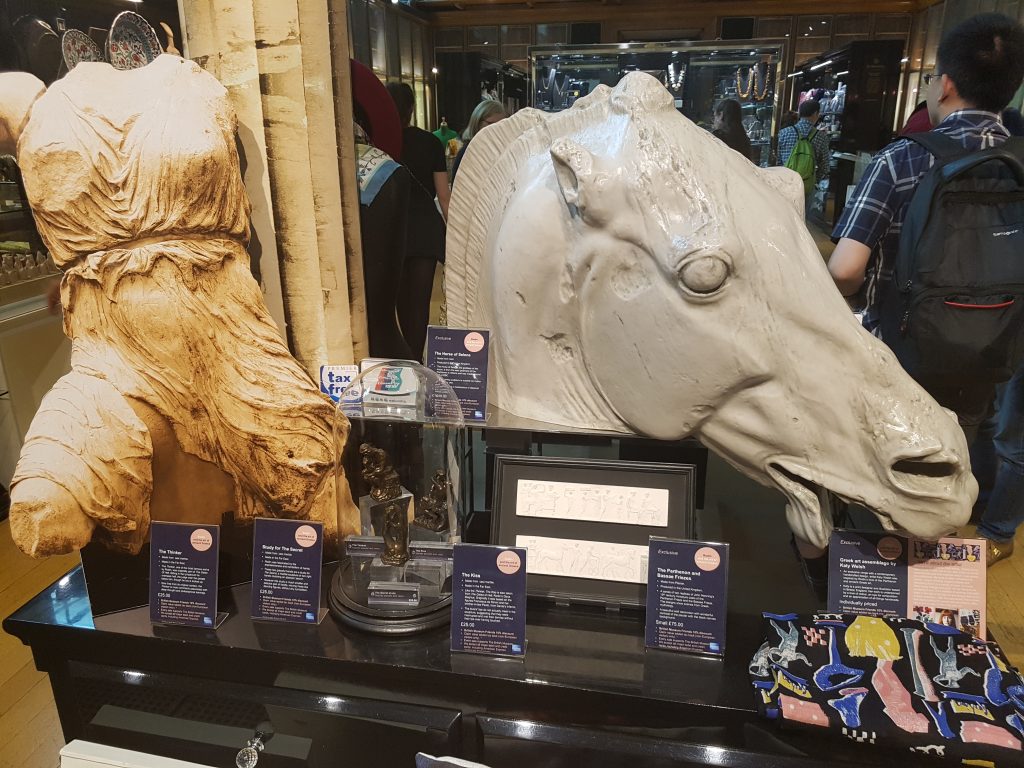
British Museum Shop, reproductions of Hestia and Selene’s Horse from the Parthenon Marbles

At the Summer Solstice, I took a group to the British Museum and, a few days later, to Stonehenge, and managed to ‘integrate’ the two into a solstice narrative. At the BM, over years of trying to explain the sculptures, I have been building in my mind an interpretation of the Pediment that gives, I hope, an original insight into the possible intentions of the sculptors. I don’t know how ‘true’ it is, but I do think it gives an insight into metaphor and symbolism in great works of art. Bear in mind that there is a lot of uncertainty about some of the attributions, and, that the male and female virtues that I am talking about are traditional ones, not necessarily how we would express it in the modern world.
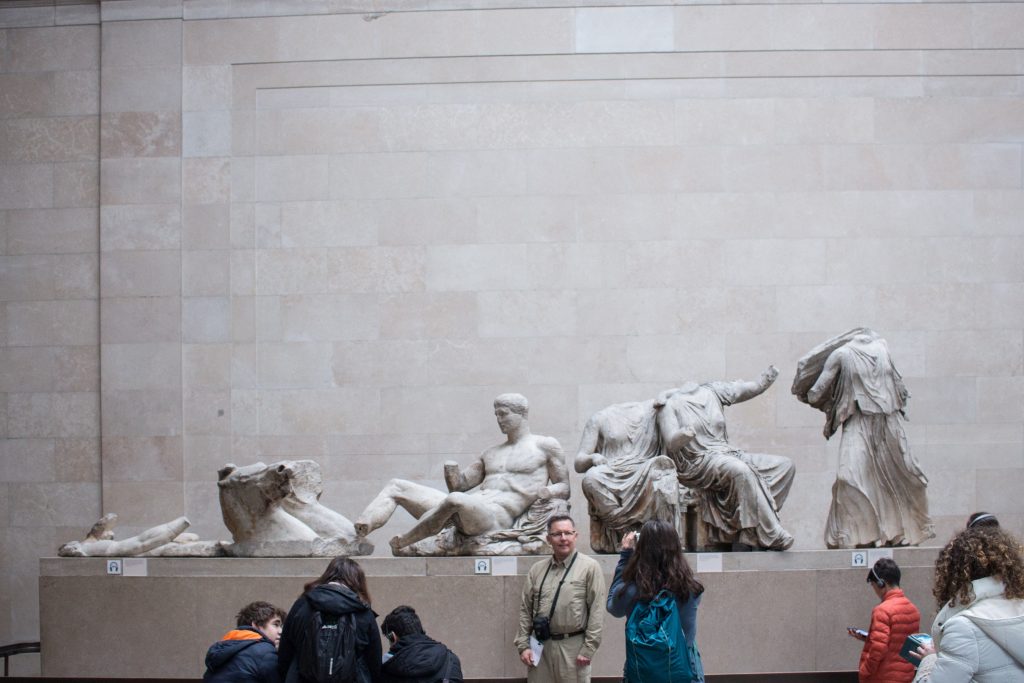
Pediment Sculptures Photo by Nicole Baster on Unsplash

At the left of the above photography, you see the horses that take Helios chariot into the sky to bring up the sun to light the world every day. Most sun deities are male, and the Sun gives light and life to the world, without it this earth is an inert block of ice cold stone. The next statue is casually laying back and looking fit, relaxed and not looking as if he is in that position because of the impossible triangular Pediment space he inhabits. He is the epitome of male strength, usually identified with Hercules but other people have other ideas and a young Dionysus is another suggestion. Whoever he is he represents male beauty and strength. So this end of the pediment represents the Sun and male virtues. This is the East Pediment of the Parthenon which is orientated to the rising sun, a little north of east.

Next are Demeter, the goddess of fertility, the goddess of the earth. Placed here to remind us that the Sun needs the Earth to create life and sustenance. It reminds us that the universe is not male, the male only works in conjunction with the female. Demeter is cuddling her daughter Persephone, the Goddess of Hades. She reminds us that life is a cycle of death and life. Plants die, turn into soil and create the conditions for future life.

Next is Hebe, daughter of Zeus and Hera, wife of Heracles (Hercules). She is the cupbearer to the Gods and gives them the ambrosia that keeps them forever young. She is the Goddess of Immortality, a reminder that the universe is eternal.

Next to Hebe is a void where there was the central statue of the east pediment depicting the Birth of Athena (according to Pausanias who wrote a guide in the 2nd Century BC to the Temple). Athena was born from the head of her father Zeus- a virgin birth. Athena therefore is, in some ways, the greatest of the Olympians, as she has the virtues of her female sex and the virtues of her father’s masculinity (and, dear Gods, hopefully not the massive ‘Me Too’ vices of her father). She is therefore, wise, nurturing, just, intuitive, decisive, a leader; an ideal combination of male and female.
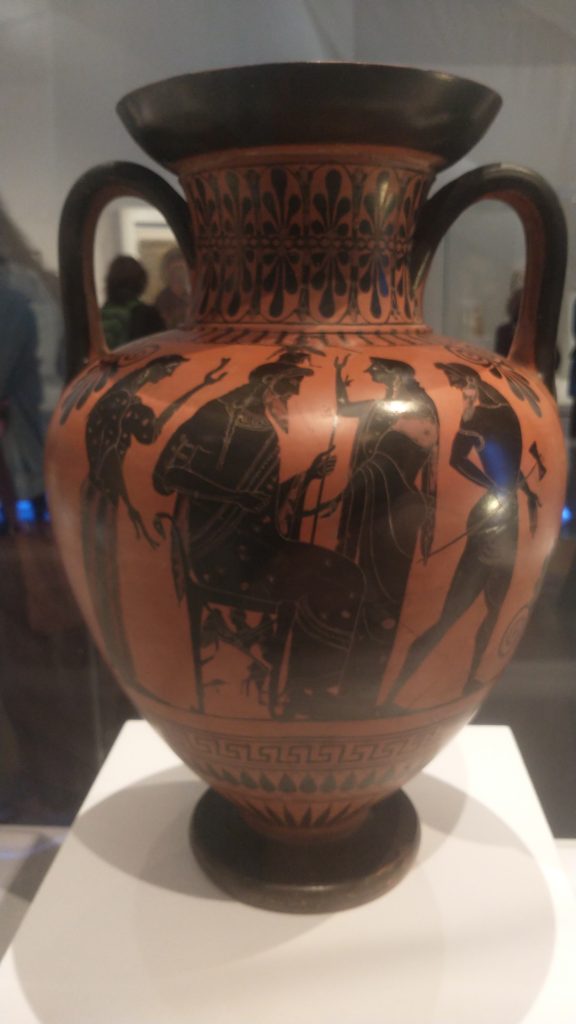
Zeus (sitting) Hephastus to right (looking back with Axe)  Athena just visible above Zeus's head
Zeus (sitting) Hephastus to right (looking back with Axe) Athena just visible above Zeus’s head

So Zeus eats Athena’s mum, Metis, who is pregnant with her. Sometime later he has a cracking headache. Hephaestus, the disabled artificer God hits Zeus over the head to clear the headache. Zeus gives birth to a fully formed Athena from the split in his head. She was known as Athena Parthenos, Athena the Virgin. Her name is originally Athene but it got changed to Athena in 500 BC.
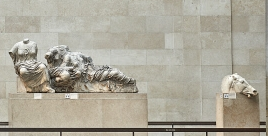
Hestia, Dione, Aphrodite, Horse of Selene’s chariot

To Athene’s left is Hestia (Vesta for the Romans). Her name means “hearth, fireplace, altar” and she is the goddess of the domestic sphere, of the comforts of home, of a warm fire enjoyed by a loving family.

The next set are two beautifully draped women languidly leaning on each other, and these are Dione, with her daughter Aphrodite – the Goddess of Love. Dione is the daughter of Gaia and Uranus daughter of earth and sky. So, here, counterpoised to Hercules, are epitomes of women. Women of power, creation, and love.

Finally, we have the exhausted horse of Selene. Her chariot takes the moon into the sky, positioned opposite to Helios and the Sun. Selene is the Moon goddess, and the Moon is beautiful, powerful as it gives us the tides and fundamental to the life of humans as she presides over the menstrual cycle. Compared to the movements of the Sun which any fool can work out, and which are relentless (symbolising Justice) the movements of the Moon are mysterious to most of us. So Selene is beautiful, powerful, creative and the Goddess of Intuition.

So, if you put it all together, the East Pediment of the Parthenon shows that the world is a union of the male and the female, balanced between the two with Zeus and Athene in the middle, with Athene holding the main part because she, in her person, represents both the male and the female.

Of course, we know that the Athenian society was a patriarchal one with women mostly kept in the domestic sphere. But here, at least, women were given an equal billing in the organisation of the Cosmos.
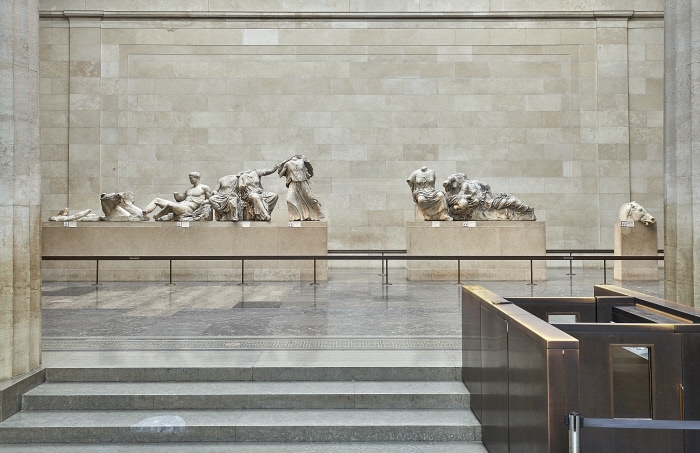
Sculptures from the east pediment of the Parthenon

I must end by warning the reader that this is only my interpretation. I am not a scholar of Ancient Greece. I have come to my own conclusion based on spending a lot of time looking at the marbles, doing Solstice Virtual Tours, and mostly informed by the labels in the gallery, with of course, some reading including Mary Beard’s book entitled ‘Parthenon’ and the BM’s guidebook. In particular, I have not incorporated into my ‘story’ the sculptures that were in the gaps that do not survive or only in fragments scattered throughout the Museum world. Mary Beard was cleverer than I, not reaching conclusions on the basis that we don’t know. But what we do know is that in the centre is Zeus and Athene and at the edges are the chariots of the Sun and the Moon. And so fitting to celebrate the Solstice.

Originally written in 2022 and revised 2024
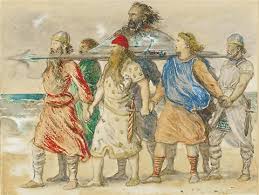
Myths, Legends & Halloween Virtual Tour October 31st 2024

Bran's head taken to Tower Hill
King Bran’s head buried at Tower Hill

Virtual Walk: Thurs 31st October 2024 8.00pm

On Thursday, I am doing my first London Walk Virtual Tour of the winter season.

The walk tells the story of London’s myths and legends and the Celtic origins of Halloween.

The walk will tell the story of London’s Myths and Legends, beginning with the tale of London’s legendary origins in the Bronze Age by an exiled Trojan called Brutus. Stories of Bladud, Belinus, Bran and Arthur will be interspersed with how they fit in with archaeological discoveries.

As we around the City, we also look at the origins of Halloween celebrations and how they may have been celebrated in early London


The virtual route starts at Tower Hill, then down to the River Thames at Billingsgate, to London Bridge and Southwark Cathedral, to the Roman Forum at the top of Cornhill, into the valley of the River Walbrook, passed the Temple of Mithras, along Cheapside to the Roman Amphitheatre, and finishing up in the shadow of St Pauls.

To book:

REVIEWS (from London Walks website)
“Kevin, I just wanted to drop you a quick email to thank you ever so much for your archaeological tours of London! I am so thrilled to have stumbled upon your tours! I have wanted to be an archaeologist since 1978 at the ripe old age of 8 years,… I was told for years that I could not be an archaeologist [for any number of reasons, which I now realise are completely ridiculous!], so I ended up on a different course of study. And now at the age of 50, it is my one great regret in life. So, I am thoroughly enjoying living vicariously through you, the digs you’ve been on, and the history you bring to life for us! British archaeology would have been my specific area of study had I pursued it. ?? Thank you SO MUCH for these! I look forward to them more than you can imagine, and honestly, I’ll be sad if you get them down to 1.5 hours! They’re the best 2 hours of my week! 🙂 Best, Sue

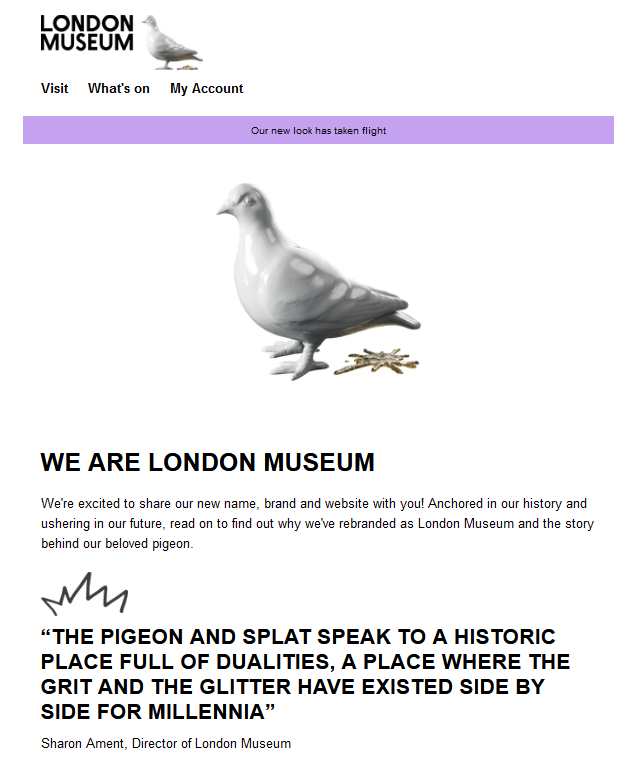
The London Museum Pigeon & Splat!

Screenshot concerning the new Logo of the Museum of London

I was quite surprised to see the image above appear in an email to my inbox. The London Museum (was the Museum of London) announced the Pigeon and Splat as the new logo to replace the old Dick Whittington one. I received the email on the 27th July 2024.

Is this a breath of fresh air? An unfussy humourous joke which 5 year old will love? Is a Pigeon uniquely London? Is the Splat too clever by half, or is it completely daft?

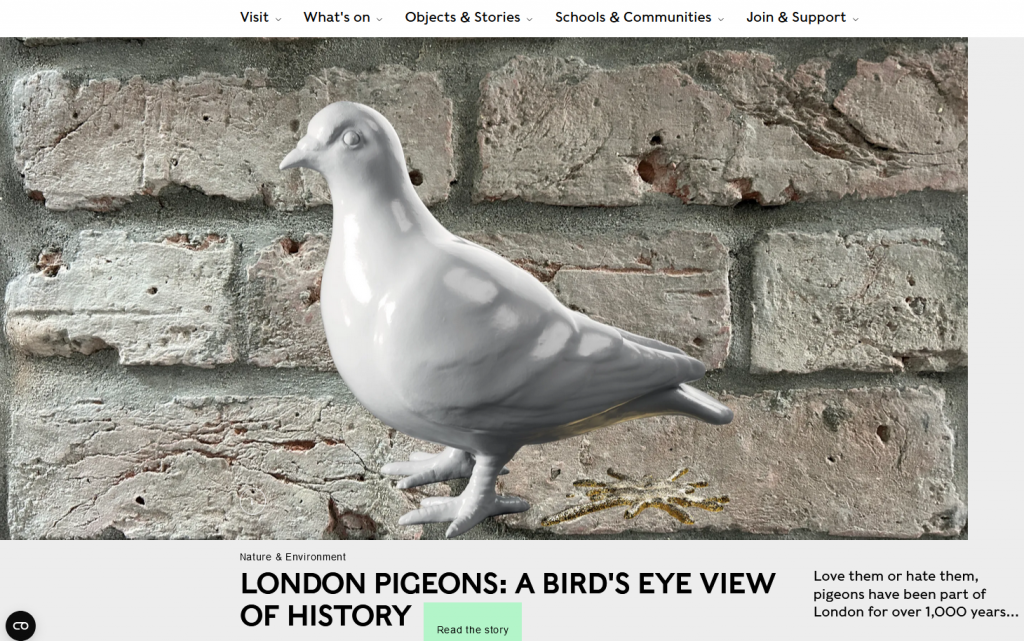
I’ll leave it to you to decide. However, a visit to the London Museum Website on 15/08/24 reveals the Pigeon logo displayed without the Splat!

Screenshot of London Museum’s new logo without the Splat!

Further down the page, is an article on the history of Pigeons and London, where there is a vestigial splat!

It seems to me there has been a climb down since I received the email on 27th July. Or are they phasing the Splat! in? Comments please.

For more on the new logo look at the Museums Associations’s Web site here. ‘The pigeon was chosen to symbolise the brand as “an impartial and humble observer of London life”, the museum said in a blog post on the redesign.’

Screenshot from the London Museum Web site with image of a Pigeon with a vestigial Splat!

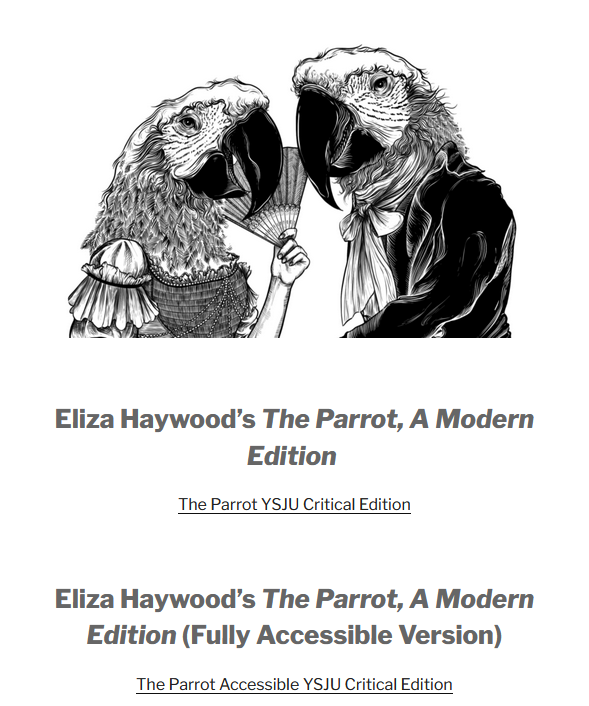
‘The Parrot’ an 18th Exposé Republished

My WordPress system decided to publish my notes upon the Parrot rather than reminding me to finish off the page. So, here is the updated post again.

The Parrot was republished for free on August 4th 2024 by the York St Johns University Critical Editions team, and they have enabled you to get your free copy by following the link at the bottom of the post.

Published in 1746 ‘The Parrot’  by Elizabeth Haywood was a satire on the male-dominated London Society of the time.   It was published in 9 parts. The name comes from the viewpoint from a Parrot’s perch in a wealthy London house. The Parrot is an enslaved creature that has travelled the world, observer to its follies. The bird wonders why people should dismiss opinions simply on the basis of A Parrot’s green colour.

The introduction to the author by the team says:

Eliza Haywood (c. 1693-1756) was one of the first generation of writers to “live by her pen.” Throughout her career, Haywood adopted many roles: she was an actress, playwright, novelist and prolific essayist. However, she always used her platform to celebrate and advocate for women.

Here is the Guardian’s description of the book https://www.theguardian.com:

It was launched on Sunday 4th August and is available to download at:

https://blog.yorksj.ac.uk/ysjucriticaleditions/read-eliza-haywoods-the-parrot/

Discovering Mary Beale in Pall Mall, Flaming June in Piccadilly March 26th

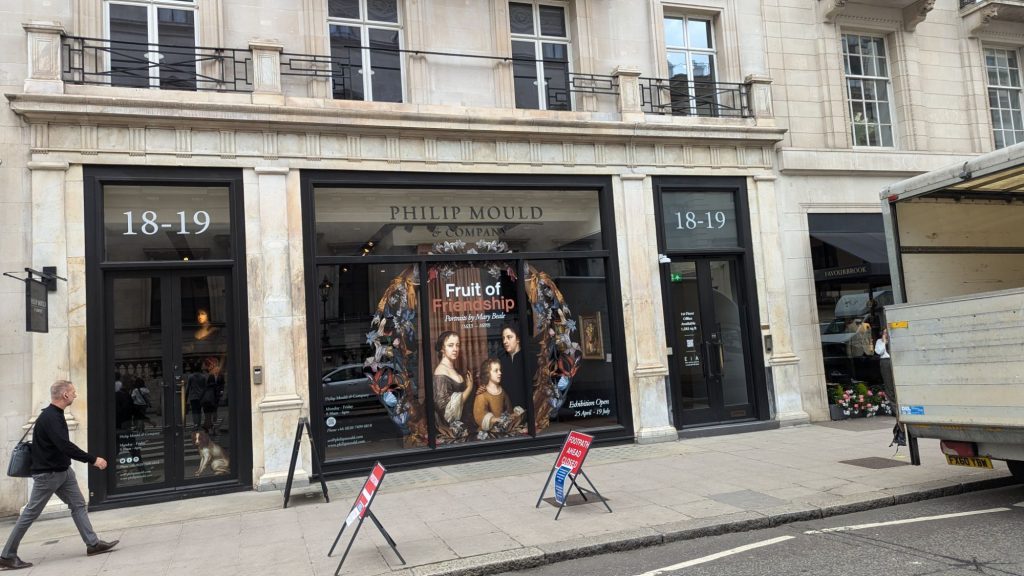
Philip Mould Galley,Bond Street.The home of painter Mary Beale

The painter Mary Beale was born on March 26th 1633 in Barrow.

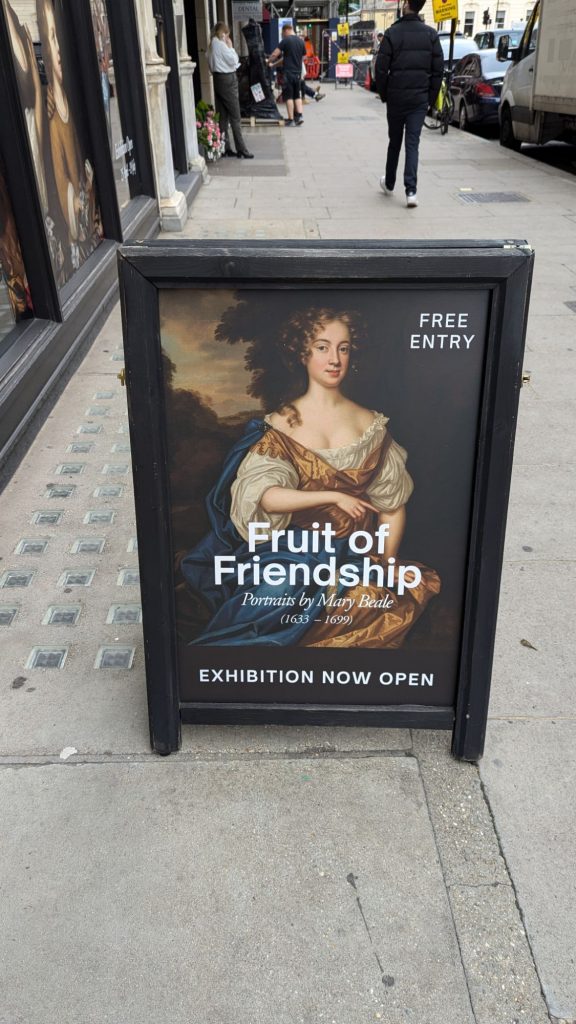
Last year, I was asked to do two Jane Austen’s London walks.  The walk explores Mayfair, where her brother, Henry lived and had his Bank, and where Austen placed the central drama of Sense and Sensibility. I decided to use the time between the walks to look for a shopping mall which dates back to Jane Austen’s time, but I got diverted as I saw a sign for a free exhibition on Mary Beale in Pall Mall. 

Mary Beale is that rare beast; a professional female artist of the 17th Century (1633-1699). So, I double-checked the ‘free entry’ notice because this was a posh West End private art gallery and the name Philip Mould was familiar.  I went in and realised that this was something special. I returned to the entrance to ask the very friendly staff whether I could take photographs.  ‘Yes, of course, they said.’ much to my surprise.

Mary Beale Exhibition sign.

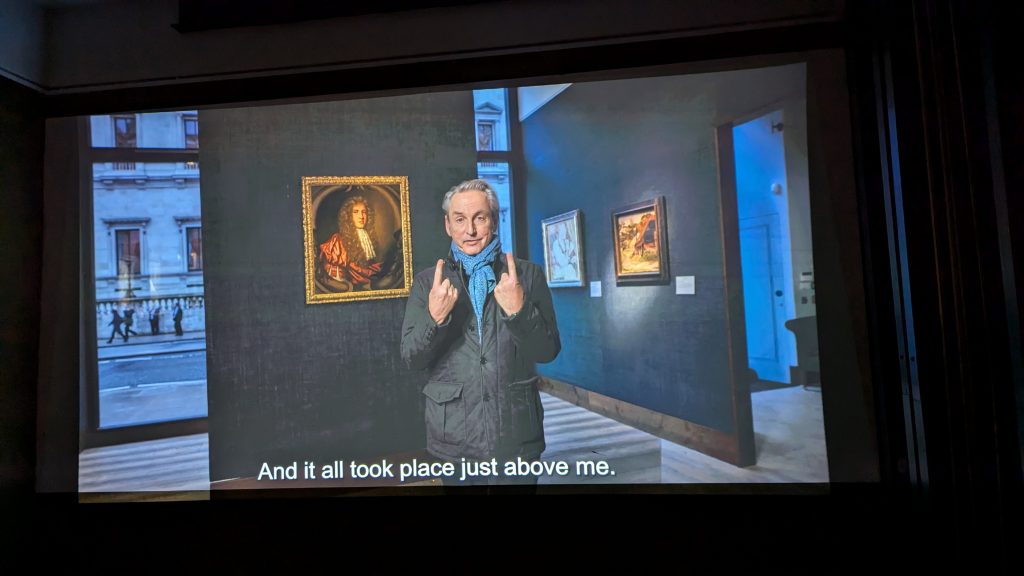
Downstairs, the art of Mary Beale was beautifully displayed, and the exhibition had a very interesting story to tell, which was well-told, using excellent labels and a film narrated by Philip Mould.  He was, as I thought, the co-presenter of ‘Fake or Fortune’ (with Fiona Bruce, newsreader and anchor of the BBC’s Antiques Roadshow). This is a BBC art programme which is in its 12th Series. The conceit of the show is that they investigate dubious paintings to find out whether they are genuine or not.

The film revealed that Philip Mould opened his Art Gallery here over a decade ago, but research has recently discovered that this is the very address where Mary Beale had her studio.

Scene shot of Philip Mould in the Mary Beale Exhibition in his short film shot in his Art Gallery.

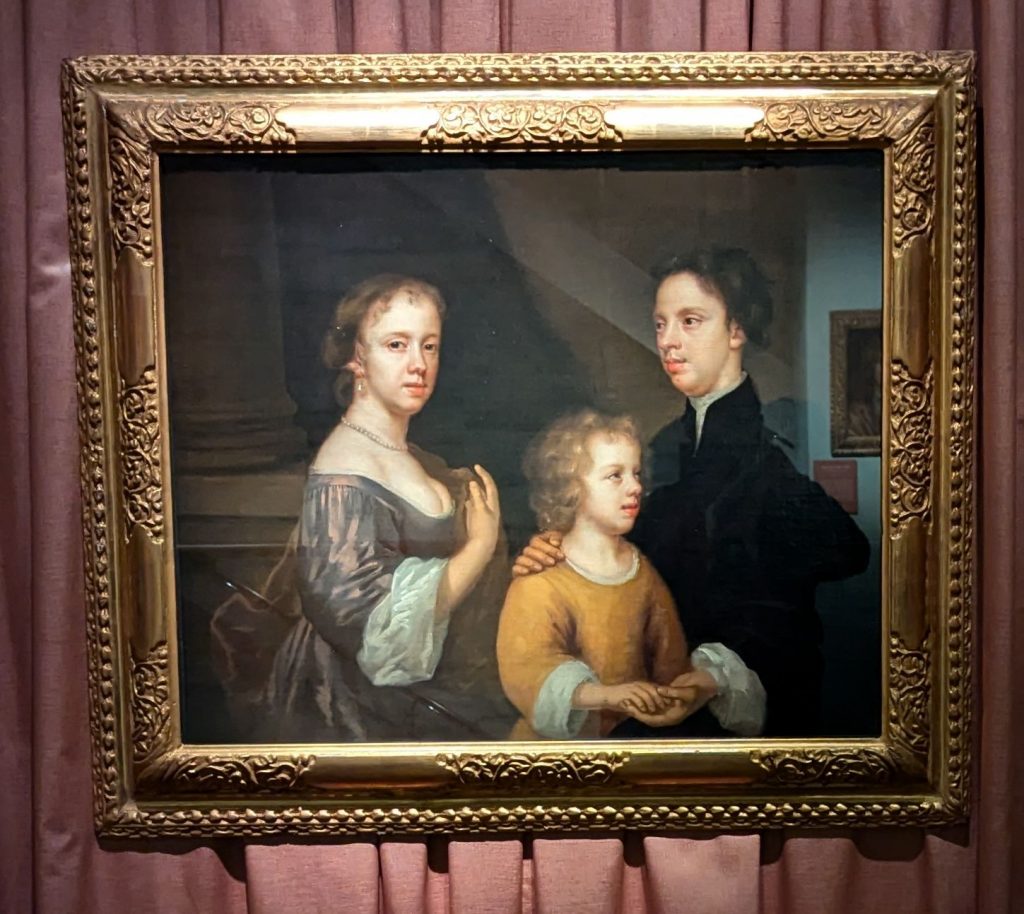
Her career is not only remarkable in itself, but it was recorded in great detail by her husband. She was the bread winner.  He was her partner, and in effect the studio manager. In correspondence, he describes her as his ‘dearest heart’. 

Self-Portrait of Mary, with her husband and son

It was a family business and their children also worked as painting assistants, doing draperies and other background details.   Her paintings gave them an income of around £200 a year, which is not riches but, by comparison, a labourer got about £30 a year.

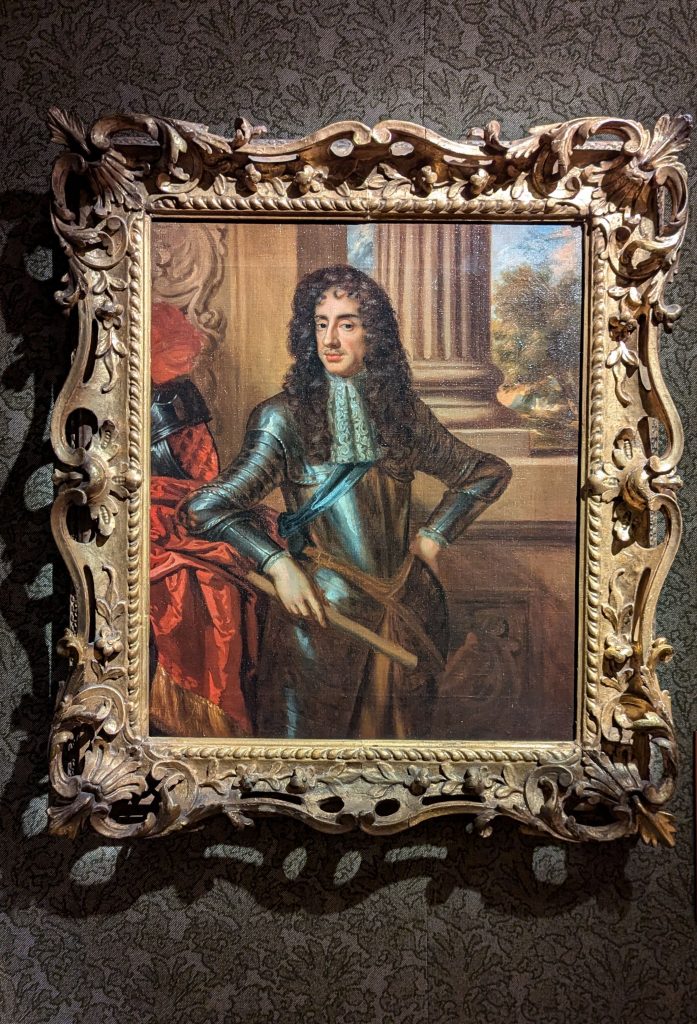
She was associated with Sir Peter Lely, the Court painter who succeeded Van Dyke. Mary Beale made copies of many of his paintings.  She also painted many pictures of her family.

Mary Beale’s painting after Sir Peter Lely’s portrait of Charles II

There are several excellent short films about Mary Beale on the Gallery’s web site, which is well worth a visit. The exhibition ends on the 19th July, but there is also, for you to see, Tate Britain’s exhibition ‘Now you see us’ which is the story of British female artists from the 1520’s to 1920.

On continued this walk to the Royal Academy when I encountered the painting ‘Flaming June’ by Lord Leighton – I removed the content to its own page which you can see here

May Posts & Medieval Royal Horses

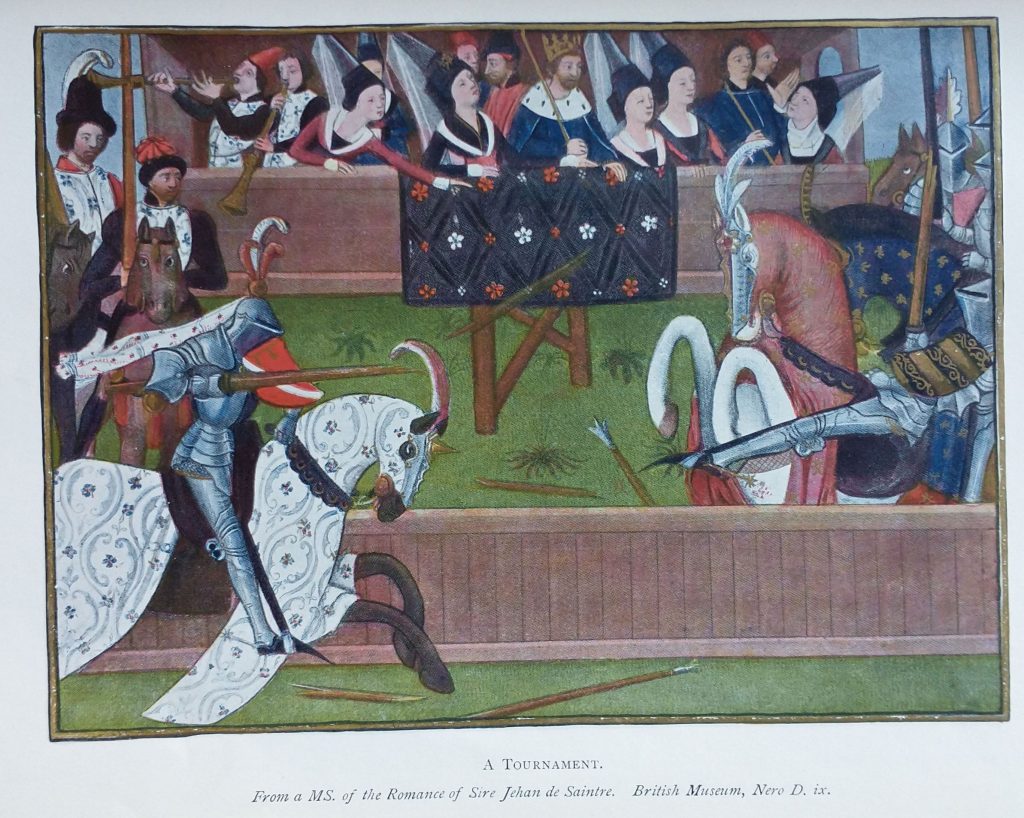
Medieval illumination of a medieval tournament

I’ve been taking groups around Britain from London to Edinburgh and have fallen behind on my postings.

So, I am going to post a few posts today to put them on my Almanac of the Past. They will be brief, and will be worked up for a re-publication in greater length next year.

Archaeological Discoveries at Elverton St. Westminster

Near the site of the medieval jousting arena in Westminster, London at Elverton St, archaeologists, nearly 30 years ago, excavated a Cemetery which contained the remains of horses. The University of Exeter has recently revealed the results of their analysis of the horses’ bones. The 15 animals studied were found to be above average in height, and marked by a life where they had been worked hard. Analysis of their teeth suggested they came from as far afield as Scandinavia, the Alps, Spain, and Italy.

Three of the animals are the largest found in England at the time. The findings suggest they might be from a Royal Stud farm, providing war, jousting or hunting animals for the elite.

For more details read: https://www.bbc.co.uk/news/uk-england-london-68632099

Boating adventure & the Second Best Modernist Building in London

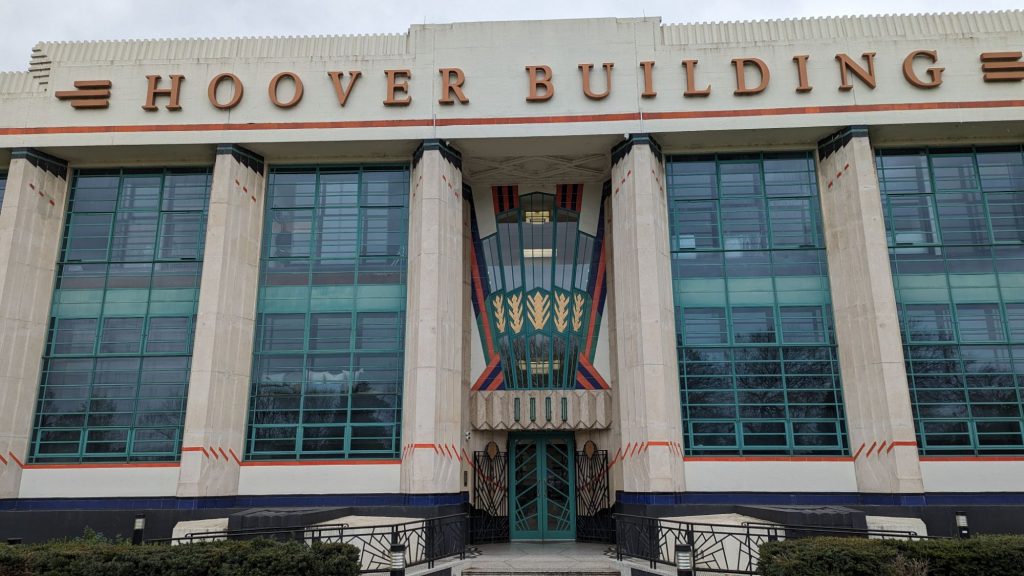
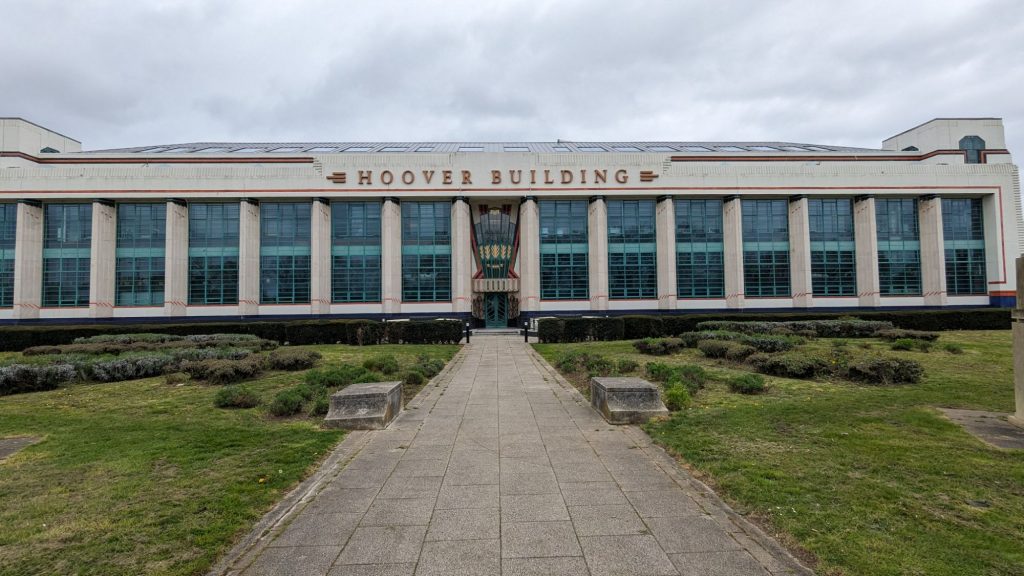
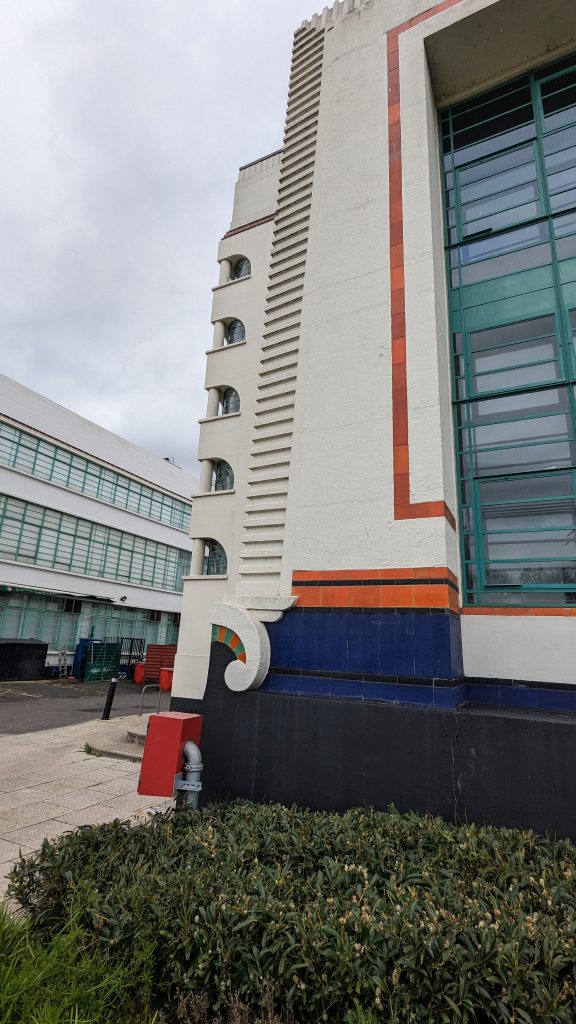
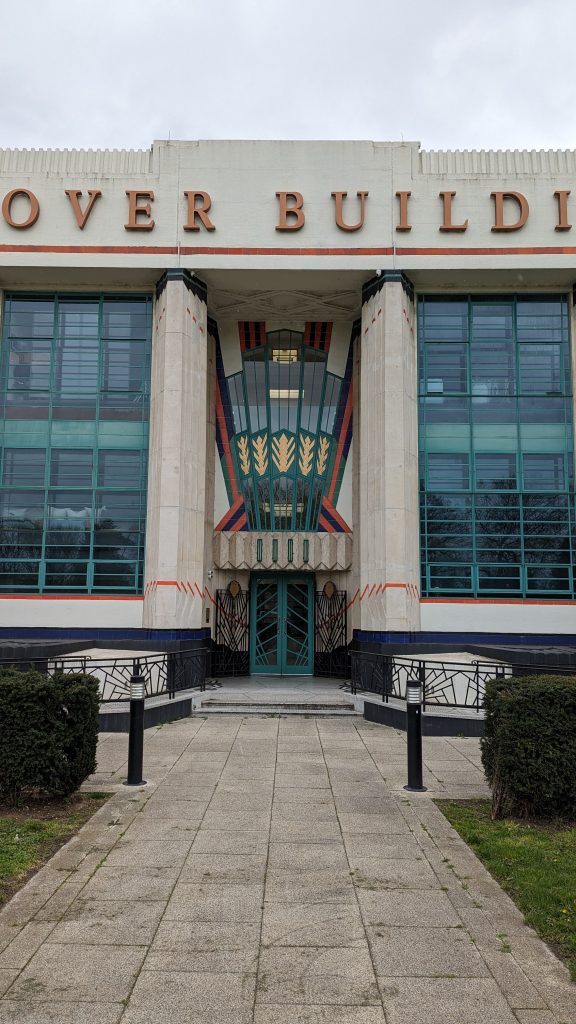
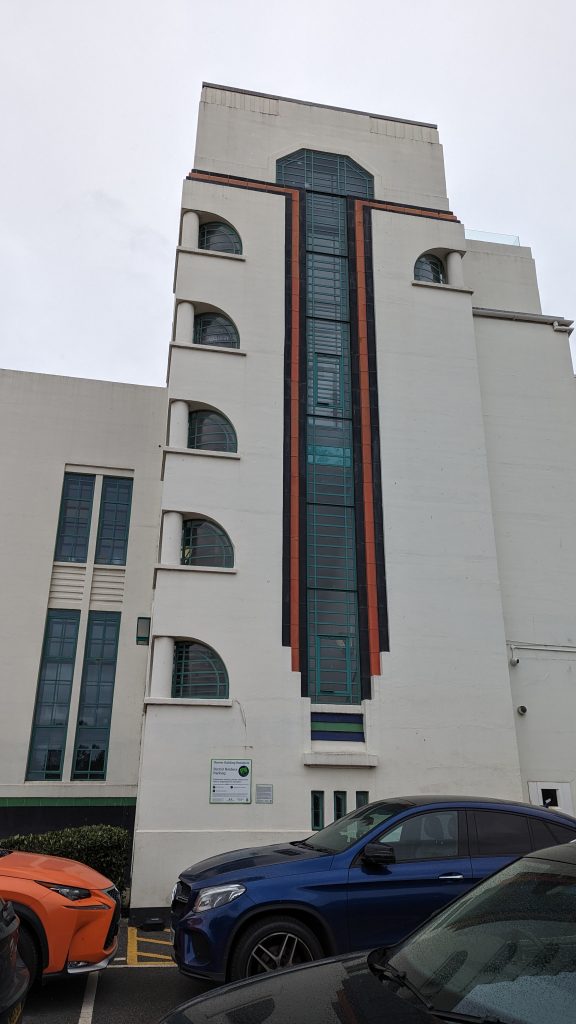
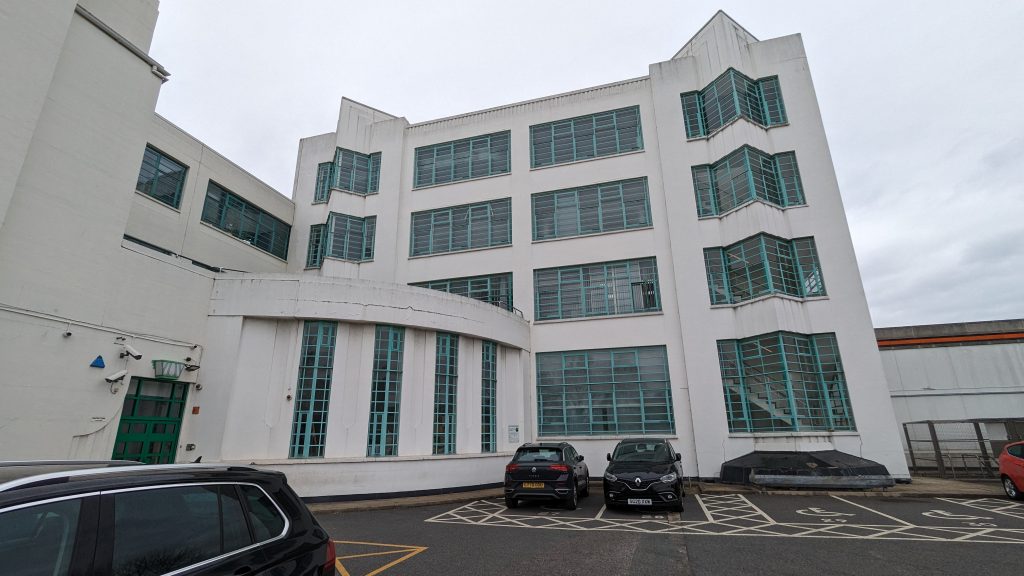
The Hoover Building in Perivale NW London, photo Kevin Flude

I published this piece in April, but for some reason to do with the fact that I published the posts from my phone rather than my computer, no email was sent to subscribers.

So, here is a chance to see it.

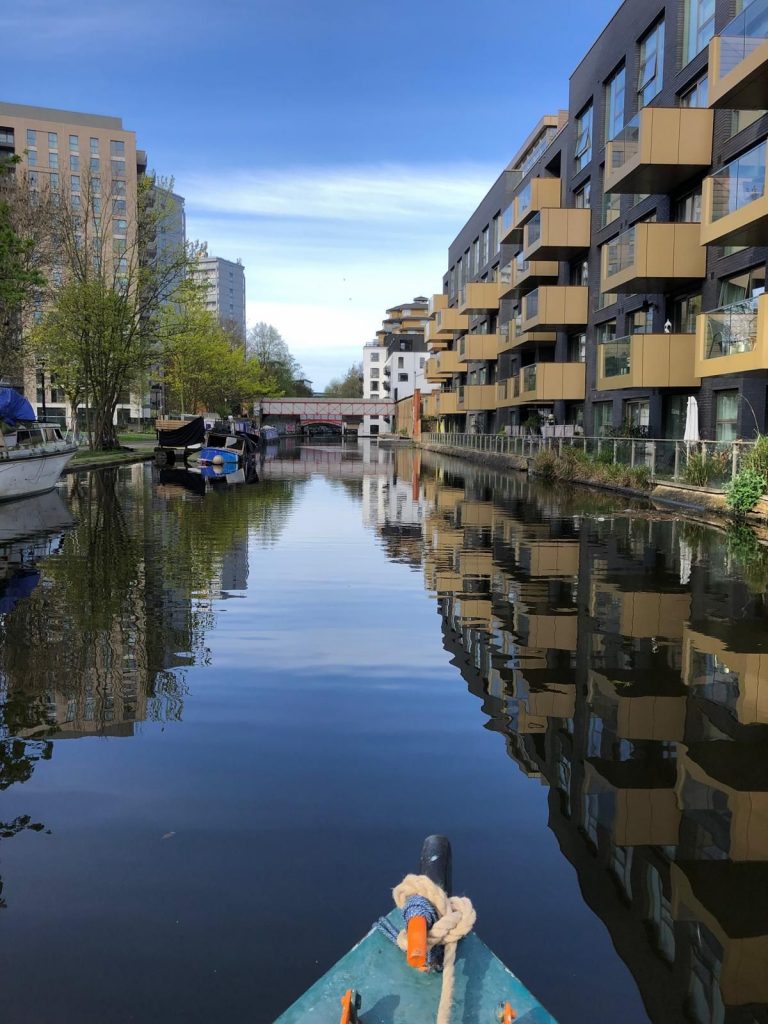
What makes owning a narrow boat so wonderful, apart from enjoying living amidst nature, is the accidental discovery of undreamt of wonders.  Last week, I moved my narrow boat from Westbourne Park, on the Grand Union Canal, to Perivale.  A 3-hour boat trip of less than 10 miles to a frankly uninspiring suburb.  But, as so often, mooring in an uninspiring place uncovered surprises that transform the mundane to the delightful.

Paddington branch of the Grand Union Canal heading west from Westbourne Park.  Photo Harriet Salisbury

We set off on a beautifully sunny April morning to move the boat the requisite distance to satisfy licence terms. Rain at 12 prompted a premature end to the trip.  We trudged to Perivale Underground Station, bemoaning our failure to get to Southall, to enjoy a Dosa In London’s Little India.

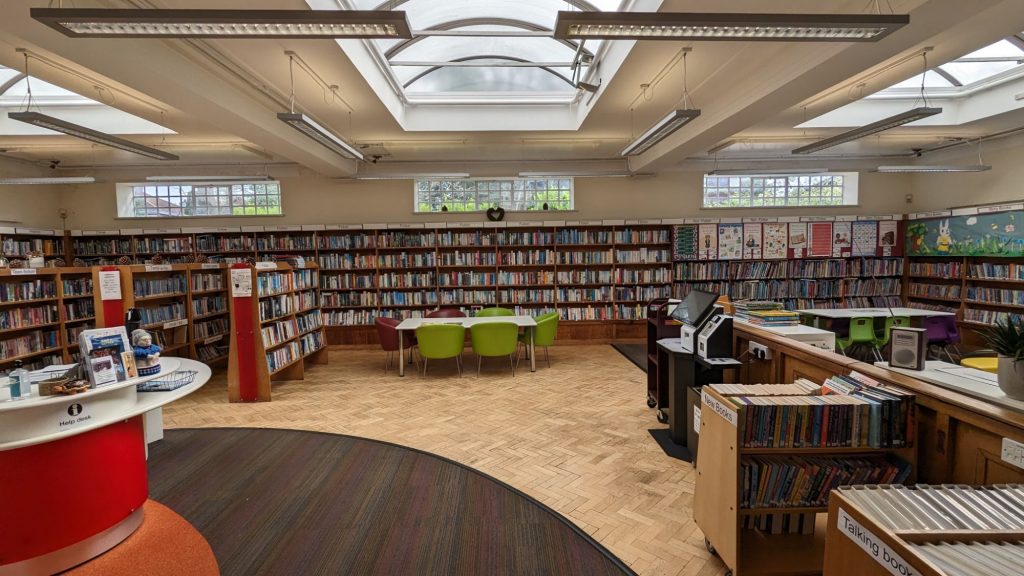
The road to Perivale is dull suburbia.  But we stopped at a library boasting a cafe, which turned out to be a really nice bit of early 20th Century library architecture, with a cheerful volunteer explaining they were keeping the library from closure due to council cost-cutting.

Perivale Library photo Kevin Flude

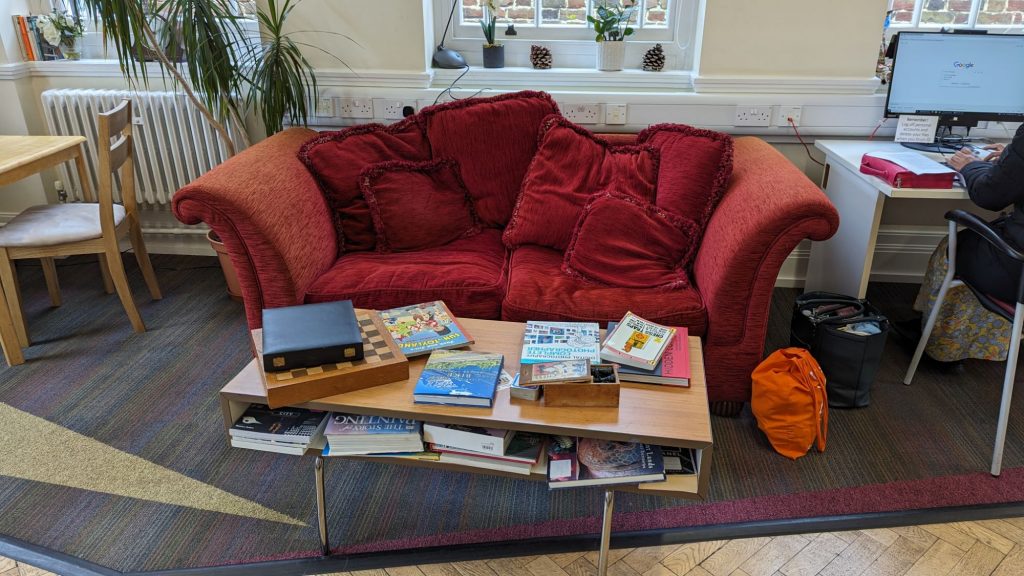
They had made the library really cosy with sofas and comfortably sitting areas. Sadly, the promised Café was not open.

Perivale Library. Interior. Photo Kevin Flude

The volunteer pointed us in the direction of a sandwich at the Tesco in the Hoover Building. I had no idea this icon of Modernism was a short walk away, so we jumped at the chance to see, at close range, one of my favourite London buildings. 

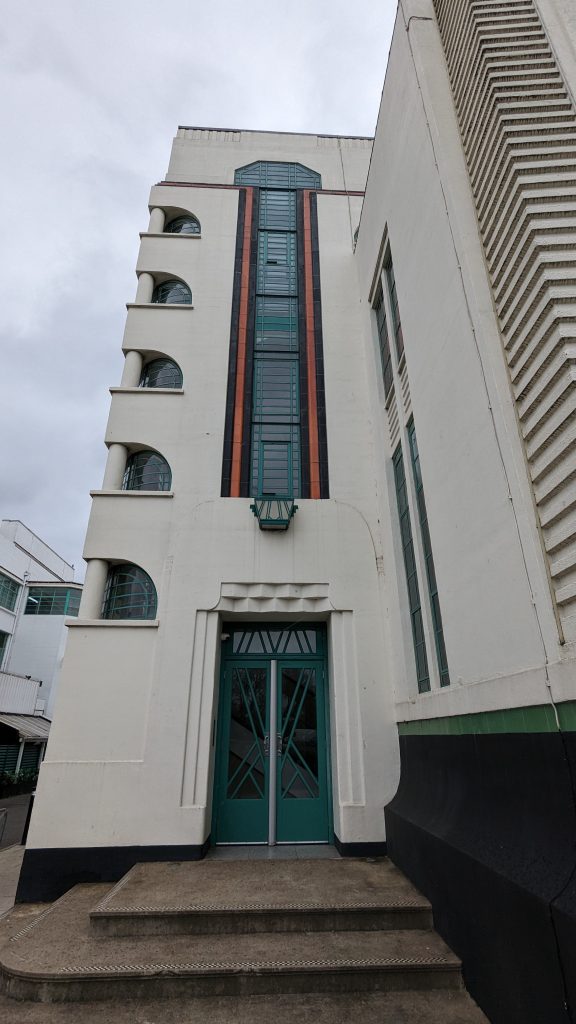
The Hoover Building (photo K Flude)

I regularly point it out to the groups I take to Oxford.  But I have never seen it up close nor standing still. Not only is the building a fabulous cream and green, but it has a backstory of interest to London’s history.  As road transport began to remake the geography of London in the early 20th Century, factories in Hackney, Tower Hamlets, Southwark, Lambeth, and other Inner London Boroughs closed, and new factories were constructed on the roads out of London, mostly manufacturing consumer goods.  Park Royal, Greenford, Slough and Staines were among the areas to develop as consumerism powered the 20th Century with the production of irons, kettles, hairdryers, radios, washing machines, vacuum cleaners and suchlike delights for the workers and families. The fields around were turned into rows of semi-detached houses to mortgage to the workers.

The Hoover Building is a Grade II* listed building of Art Deco architecture[1] designed by Wallis, Gilbert and Partners located in Perivale in the London Borough of Ealing. The site opened in 1933 as the UK headquarters, manufacturing plant and repairs centre for The Hoover Company.[2]‘ (Wikipedia). It has been converted to apartments and a Tesco occupies the Factory Floor.

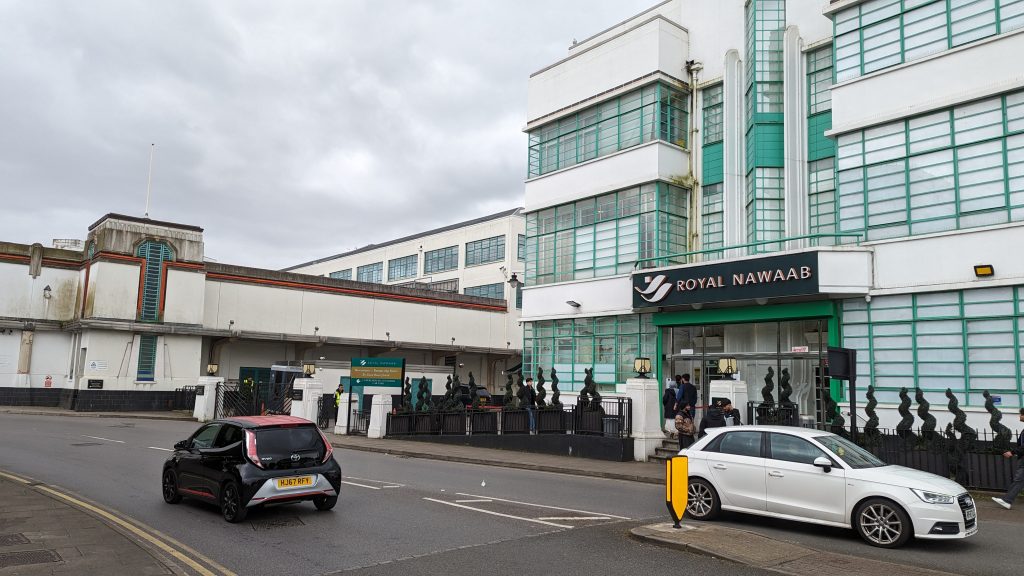
What made this trip even more special was that one of the original buildings has become a Hotel, in which we discovered a massive Indian Restaurant.  There, we found it full of about 500 people eating a fast-breaking Eid dinner. £26 to eat as much as you can, all self-service, with scores of chefs serving their delicious tureens of Asian food. Such a great cultural experience, and rather better than the tasteless Tesco sandwich we were expecting.

If I’m passing the factory on a tour, I tend to read to my group Sir John Betjeman’s patronising poem ‘Slough’ which is about the horror of the new consumer society.   ‘Slough’ is wonderful to read and, yet, also, awful, not just the Oxbridge author looking down his long privileged nose at the lower classes but going to the extreme of suggesting Slough would be better off bombed to smithereens.

Guernica was bombed on 26th April 1937 and ‘Slough appeared’ in a Betjeman collection called ‘Continual Dew’ in the same year (I havent located a reference with the actual date of publication).  Bad taste in the extreme, hardly mitigated by the fact that it was originally written in 1928 and was about trading estates in general rather than Slough in particular.  Still, despite all it is still one of my favourite poems for the insight it gives to attitudes of the British class system.

So, here it is.

Slough

Come friendly bombs and fall on Slough!
It isn’t fit for humans now,
There isn’t grass to graze a cow.
Swarm over, Death!

Come, bombs and blow to smithereens
Those air-conditioned, bright canteens,
Tinned fruit, tinned meat, tinned milk, tinned beans,
Tinned minds, tinned breath.

Mess up the mess they call a town-
A house for ninety-seven down
And once a week a half a crown
For twenty years.

And get that man with double chin
Who’ll always cheat and always win,
Who washes his repulsive skin
In women’s tears:

And smash his desk of polished oak
And smash his hands so used to stroke
And stop his boring dirty joke
And make him yell.

But spare the bald young clerks who add
The profits of the stinking cad;
It’s not their fault that they are mad,
They’ve tasted Hell
.

It’s not their fault they do not know
The birdsong from the radio,
It’s not their fault they often go
To Maidenhead

And talk of sport and makes of cars
In various bogus-Tudor bars
And daren’t look up and see the stars
But belch instead.

In labour-saving homes, with care
Their wives frizz out peroxide hair
And dry it in synthetic air
And paint their nails.

Come, friendly bombs and fall on Slough
To get it ready for the plough.
The cabbages are coming now;
The earth exhales.

850 new factories were built in Slough before the outbreak of world war two, and the Trading Estate was first seen here. And yes, they are bleak, and Slough is even now, not the most exciting or architecturally sophisticated of towns.  But to imagine bombing a town in a time when there was a real fear of mass destruction from the air?

I particularly object to the line about tinned food because I was brought up on tinned beans, peas, steak and kidney pudding, pineapple chunks, peaches, and rhubarb.  And exactly what is wrong with a hair-dryer?

Before I read Slough, I recount an experience I had years ago with an American group who suddenly started laughing for no reason.  I enquired, and they pointed to a huge advertising hoarding with a poster about the Electrolux Vacuum Cleaner.  Its location near the Hoover building, I imagine might have been deliberate, but what made the Americans laugh was the slogan:

‘Nothing sucks like an Electrolux’

To a British person, the slogan works in a positive sense and we appreciate the wit.  For the Americans, it made them all laugh with shock as to why anyone would pay to say their vacuum cleaner was complete pants.

Oh, and second best? Well, the best Modernist Building in London is the Daily Express Building, Fleet Street.

Archaeology discoveries, February 2024

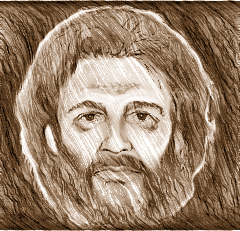
Sketch of a Roman skull of a man who was crucified.
Archaeology discoveries. The Image is a sketch of the ‘Facial Reconstruction, Impossible Factual/BBC’

Interesting Archaeology discoveries.

The following discoveries were reported in Salon IFA the newsletter of the Society of Antiquaries of London in Salon: Issue 526  7 February 2024, which you can see here:

Pliny the Elder’s Villa found near Vesuvius?

The 1st Century seafront villa, with views of the Bay of Naples and of Mount Vesuvius, has been excavated at the town of Bacoli, which was the port of Misenum. Pliny commanded the fleet as ‘Praefectus classis Misenensis’. Pliny tried to rescue his friends and family, ignoring warnings saying ‘Fortune favours the brave’, ‘Audentes Fortuna luvat’. It didn’t and he died, at Stabiae, by toxic fumes. Read more about the villa here:

Face Reconstructed for a Victim of Roman Crucifixion

A male skeleton found, 4 years ago, in a Roman cemetery in Fenstaton in Cambridgeshire was found with a 2-inch nail through his heel bone. BBC 4 has made a documentary about the recent reconstruction of the man’s face by, as Salon reports it:

‘US forensic artist Joe Mullins, of George Mason University, Virginia. He usually works with law enforcement agencies, reconstructing the faces of modern-day crime victims. ‘

To follow the details, read more here, or watch the BBC documentary, ‘The Cambridgeshire Crucifixion’, which can be viewed on BBC iPlayer.

For more archaeology read my post: https://www.chr.org.uk/anddidthosefeet/london-before-london-and-dna/

Published in February 2024, revised 2025

Coltsfoot & Smoking & Blossom & Cholera February 24th

Coltsfoot by Andreas Trepte Wikipedia

Coltsfoot is a daisy-like plant which is flowering about now. Gerard’s Herbal of 1633 suggests that the ‘fumes of the dried leaves taken through a funnel’ is good for those with coughs and shortness of breath. He suggests that it is smoked like tobacco and it ‘mightly prevaileth.’

This idea, Mrs Grieves says in her herbal (1931), is endorsed by ‘Dioscorides, Galen, Pliny, and Boyle’. And Coltsfoot is ‘nature’s best herb for the lungs’. (This is historic information re herbs and NOT current medical advice, as Coltsfoot can be very dangerous!).

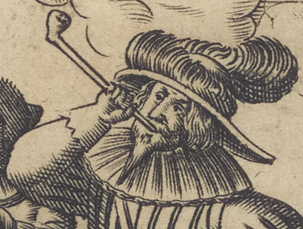
engraving of a man smoking
Lobspruch deß edlen hochberühmten Krauts Petum oder Taback Nuremberg, 1658 New York Public Library Public Domain
Detail from Lobspruch deß edlen hochberühmten Krauts Petum oder Taback Nuremberg, 1658 New York Public Library Public Domain

My grandson and parents found a 19th Century pipe bowl, much like the one above, by the Thames where there were many fragments of clay pipe. For more on 17th Century smoking, have a look here.

Blossom is also coming out in London a little early. (2022 we had a false spring when Cherry Blossom came out, and I think we are now just getting used to it, so I don’t think it is being noted so much in 2024). Blackthorn (I think) is coming out in profusion in my local park. Photos below by the Author of Haggerston Park in East London. Left February 2022, Right Feb 23.

One thing I am trying to improve in my Almanac of the Past, is to include more specific London content. This can be difficult on a daily basis. But I think I have, by chance, found a solution. I was trying to glue the toe flap on a perfectly good pair of trainers so that it did not flap, and I needed a heavy weight to press the two edges together. I found a random couple of heavy books for the purpose. 24 hours later, I lifted the books to discover the failure of my project. But, as I returned the books to their place in the book case, I found the heaviest was called ‘A London Year. 365 Days of City Life in Diaries, Journals, and Letters.’ Compiled by Travis Elborough and Nick Bennison, published in 2013, and the price on it of £5.99 makes me feel I must have bought it second hand. Have I opened it before now? Indeed, I had forgotten its existence, but Cometh the Hour, Cometh the Book! What a timely rediscovery.

Cholera in London.
The news of the Cholera being in London has been received abroad. According to the feelings of the different nations towards England, France, who wish to court us has ordered a quarantine in her ports of three days; Holland, who feels aggrieved by our conduct at the conference, one of 40 days. The fog so thick in London that the illuminations for the Queen’s Birthday were not visible.

24th February 1832 Thomas Raikes, Diary 1832 (from ‘A London Year’ Compiled by Travis Elborough and Nick Bennison, 2013,

I think the Conference mentioned above was the London Conference of May 1832, which aimed to establish a Kingdom of Greece with a King, It was set up by Foreign Secretary Lord Palmerston without discussion with the Greeks and ended up giving them a Bavarian King. King Otto. Otto was forced from the throne in a revolution in 1862, and replaced by a Danish King, from whom Prince Philip, Duke of Edinburgh was descended.

Festival of Imbolc, St. Bridget’s Day February 1st

Today is Imbolc, one of the four Celtic Fire Festivals. It corresponds with St Bridget’s Day, which is a Christian festival for the Irish Saint, and is the eve of Candlemas. Bridget is the patron saint of all things to do with brides, marriage, fertility, and midwifery (amongst many other things, see above). And in Ireland, last year (2024) was the very first St Bridget’s/ Imbolc Day Bank Holiday!

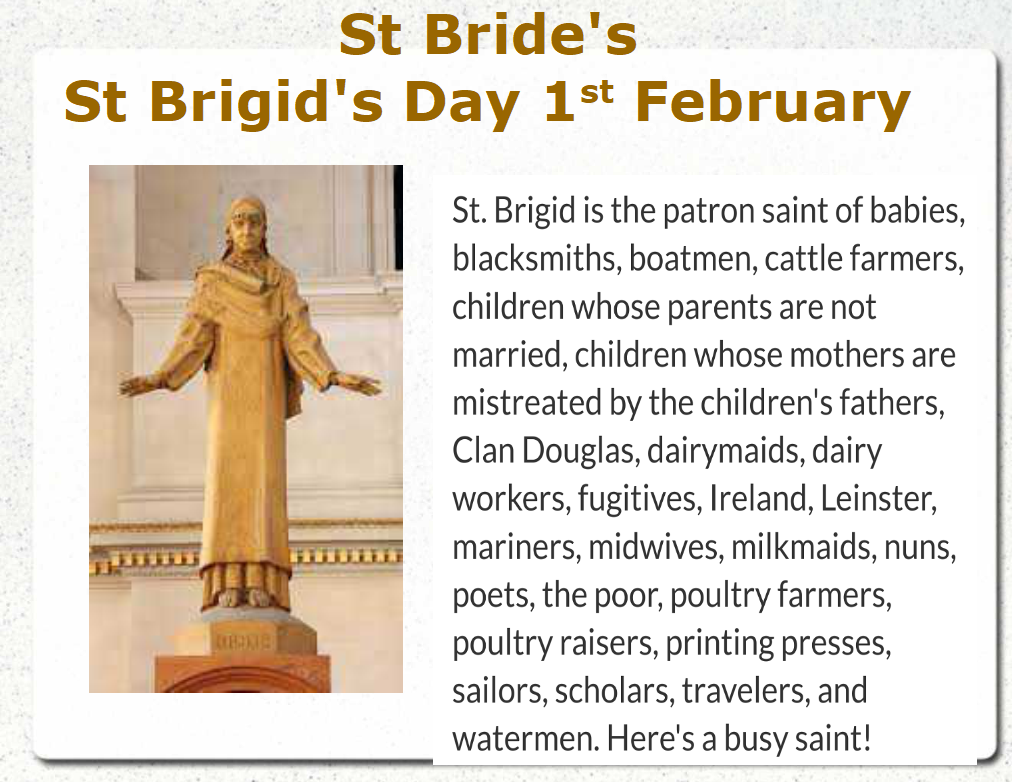
St Bride,s Statue St Bride's Church. Fleet Street
St Bride’s Statue, St Bride’s Church. Fleet Street from K.Flude’s virtual tour on Imbolc

St Bridget, aka Briddy or Bride, converted the Irish to Christianity along with St Patrick in the 5th Century AD. She appears to have taken on the attributes of a Celtic fertility Goddess, called Bridget or Brigantia, so some doubt she was a real person.

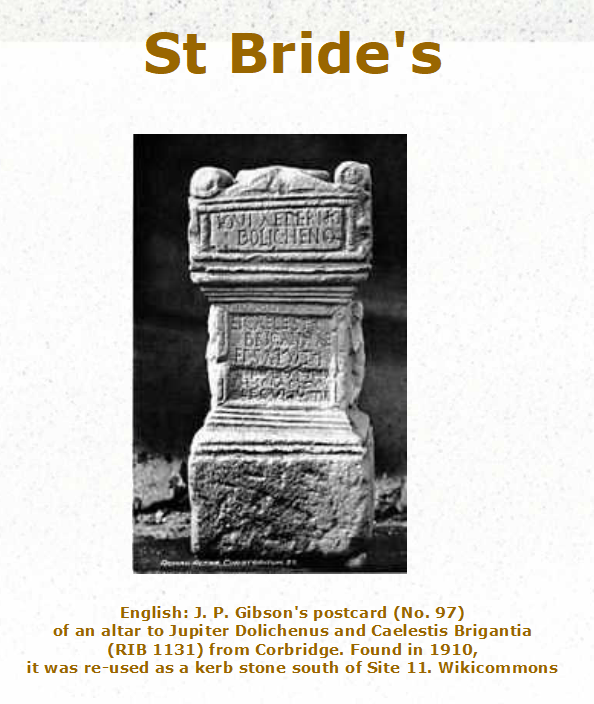
Brigantia

There are Roman altars dedicated to Brigantia The Brigantes tribe in the North were named after the Goddess. The Brigantes were on the front line against the invading Romans in the 1st Century AD, and led by Queen Cartimandua.  Cartimandua tried to keep her independence by cooperating with the Romans, while, a few years later, Boudica took the opposite strategy. But both women appear to have had agency as leaders of their tribes and show a great contrast with Roman misogyny.

altar to Brigantia
Altar to Brigantia from K Flude’s virtual tour on Imbolc

Last day of medieval Christmas and the Lords of Misrule.

This was the end of the Christmas period. John Stow, in the 16th Century describes the period between Halloween and Candlemas being the time that London was ruled by various Lords of Misrule and Boy Bishops (see my post here). In the piece below Stow goes on to talk about a terrible storm that took place on st February 1444.

Against the feast of Christmas every man’s house, as also the parish churches, were decked with holm, ivy, bays, and whatsoever the season of the year afforded to be green. The conduits and standards in the streets were likewise garnished; amongst the which I read, in the year 1444, that by tempest of thunder and lightning, on the 1st of February, at night, Powle’s steeple was fired, but with great labour quenched; and towards the morning of Candlemas day, at the Leaden hall in Cornhill, a standard of tree being set up in midst of the pavement, fast in the ground, nailed full of holm and ivy, for disport of Christmas to the people, was torn up, and cast down by the malignant spirit (as was thought), and the stones of the pavement all about were cast in the streets, and into divers houses, so that the people were sore aghast of the great tempests.’

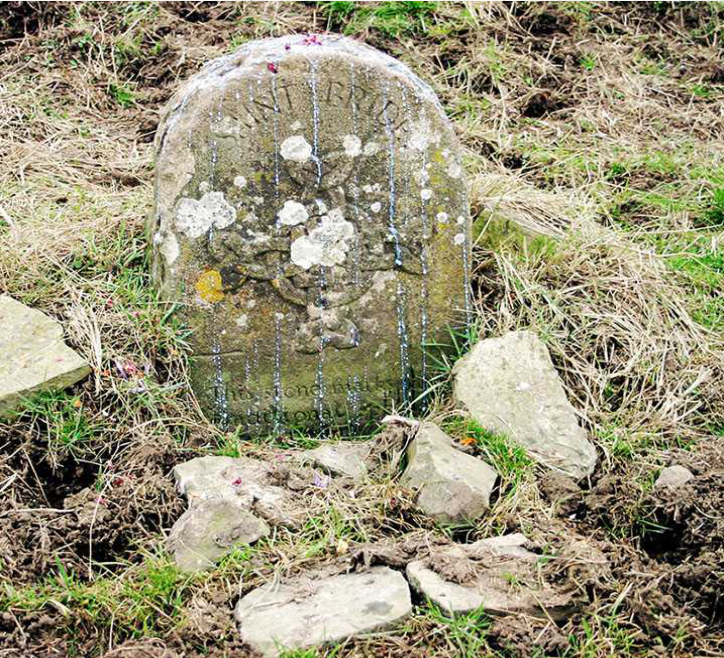
Wells dedicated to St Bridget

There are many wells dedicated to St Bride. They were often used in rituals and dances concerned with fertility and healthy babies. And perhaps, the most famous, was near Fleet Street. Henry VIII’s Palace of Bridewell, later an infamous prison, was named after the Well. St Bride’s Church has long been a candidate as an early Christian Church, and although the post World War Two excavations found nothing to suggest an early Church, they did find an early well near the site of the later altar of the Church, and by the remains of a Roman building, possibly a mausoleum. Therefore, it is possible that the Church was built on the site of an ancient, arguably holy, well.

St Bridget's Well Glastonbury
St Bridget’s Well, Glastonbury

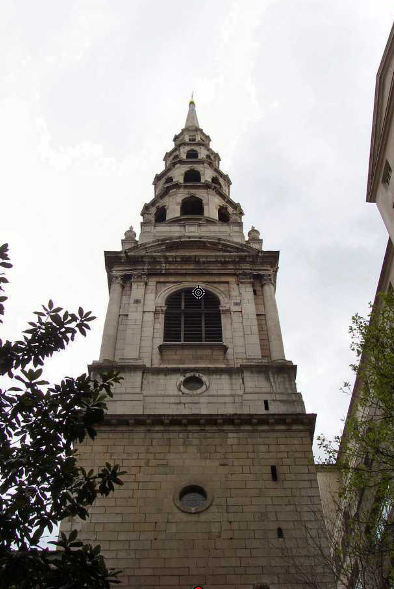
The steeple of St Brides is said to be the origin of the tiered Wedding Cake, which, in 1812, inspired a local baker to bake for his daughter’s wedding.

Steeple of St Brides Fleet Street

Imbolc and St Bridget’s Day are the time to celebrate the return of fertility to the earth as spring approaches. In my garden and my local park, the first snowdrops, violets, and daffodils are coming out, and below the bare earth, there is a frenzy of bulbs and seeds budding, and beginning to poke their shoots up above the earth, ready for the Spring. In the meadows, ewes are lactating, and the first lambs are being born.

Violets, bulbs, and my first Daffodil of the year. Hackney (2022), London by K Flude

I, occasionally, do walks about Imbolc and other Celtic festivals, in conjunction with the Myths and Legends of London, and at May Eve, the Solstices, Halloween and Christmas (when I have time). See the walks page of this blog

https://www.chr.org.uk/anddidthosefeet/walks

And let’s end with the Saint Brigid Hearth Keeper Prayer Courtesy of SaintBrigids.org

Brigid of the Mantle, encompass us,
Lady of the Lambs, protect us,
Keeper of the Hearth, kindle us.
Beneath your mantle, gather us,
And restore us to memory.
Mothers of our mother, Foremothers strong.
Guide our hands in yours,
Remind us how to kindle the hearth.
To keep it bright, to preserve the flame.
Your hands upon ours, Our hands within yours,
To kindle the light, Both day and night.
The Mantle of Brigid about us,
The Memory of Brigid within us,
The Protection of Brigid keeping us
From harm, from ignorance, from heartlessness.
This day and night,
From dawn till dark, From dark till dawn.

For more about St Bridget.

First published in 2023, revised and republished Feb 2024, 2025

I have republished my post of the Chinese New Year which you can see here: