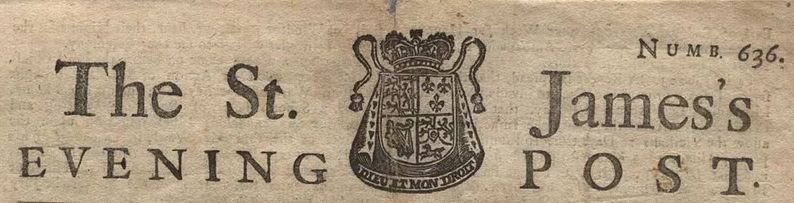
Mast head of the St James Evening Post (June 1719), the paper that carried the accusation of Sodomy
On 16th May 1719, the St James Evening Post (later called the Evening Post) reported on the Guilty Verdict returned against ex-Servants Stephen Margrove and John Wood. The two men were accused of extorting money by threatening to expose George Smith as a sodomist (then punishable by death).
The Proceedings of the Old Bailey Archive gives details of the case. This took place in the Parish of St. Martins in the Fields (near what is now Trafalgar Square), on 18th, January 1718. George Smith told the Court that:
‘ the Prisoners came up to him (and John Wood took him hold by the Collar of his Coat) and demanded his Money, and said if he would not give it them they would take away his Life and swear Sodomy against him; that by means of this Violence, and being under a Terror, and in great-Fear he gave them what he had in his Pocket.’
But they wanted more and forced Smith to take them to his Master’s House in Golden-Square. Here, he gave them another Guinea, to add to the 22 shillings they had already extorted.
The Accusation of Sodomy
Margrove and Wood protested that Smith: ‘came up to Wood while he was making Water, and took hold of his Yard, using some unseemly Expressions, whereupon he (Wood) called out a Sodomite‘.
At this accusation, Smith ‘fell on his Knees, and begg’d them not to expose him‘ and gave them the money. So, the accused argued it could not be ‘robbing on the High Way‘ because their victim gave them the money.
The Defence
The Court held that the threats, and violence they used made them guilty of Violent Robbery. The men called witnesses to their good employment record, but were unable to show any evidence of ‘how they spent the last 6 Months of their Lives.’ And so the Jury found them Guilty, and the judge put on the Black Cap to pronounce the death sentence.
The Verdict
On the 8th of June 1719 10 people, 7 men and 3 women were sentenced to hang, but 5 were reprieved. Wood, aged 22, and Margrove, aged 21, were however, executed. Rictor Norton in ‘Homosexuality in 18th Century England has more details, including the confessions of the two extortionists.
For the trail of Body snatchers look to the bottom of my post here:
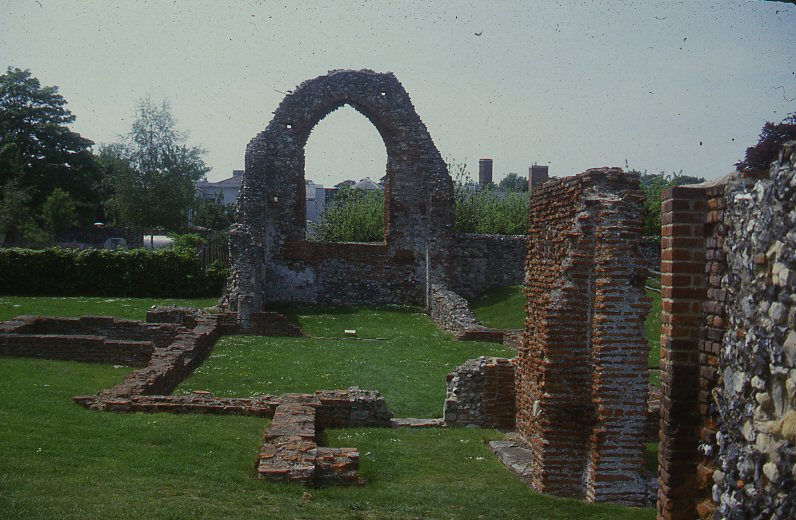
Ruins of St Pancras, Canterbury Photo: K Flude (note the reused Roman Bricks.)
Pancras means ‘all-powerful’ in Greek. St Pancras was a 14 year old who refused to give up his Christian Faith during the persecution of Christians by the Emperor Diocletian. He was beheaded on the Via Aurelia, traditionally, on 12 May 303 AD. His youth makes him the Patron Saint of children, but he is also the patron saint ofjobs and health. He is ‘invoked’ against cramps, false witnesses, headaches, and perjury. His body was buried in the Catacombs, but his head is kept in a reliquary in the Church of Saint Pancras in Rome, where he was buried.
Ice Saints
He is also one of the Ice Saints. These are saints with feast days from May 11th to May 14th. They are: St. Mamertus, St. Pancras, and St. Servatius (and in some countries, Saint Boniface of Tarsus – Wikipedia). They represent a belief that there was often a cold snap in early May. Although modern statistics disprove this, it is however true that a late frost can cause havoc with crops. So the Ice Saints help persuade farmers to delay sowing.
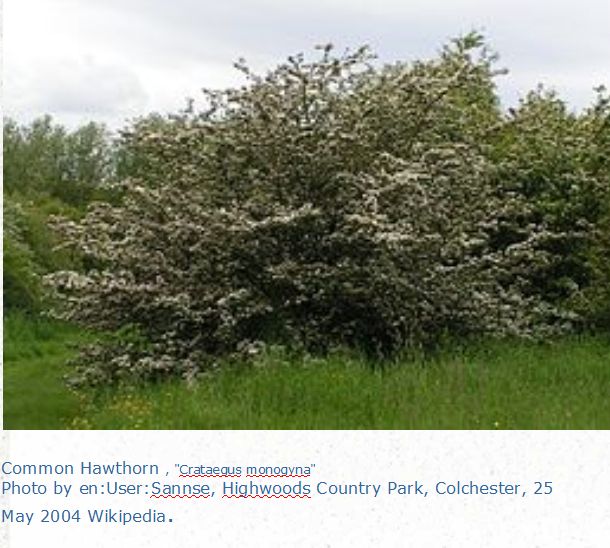
In England, we have a saving ‘never cast a clout while may is out’. Which suggest you keep a coat at hand while the May flowers (Hawthorn) are still out, as it can be cold even in May. For more on the Folklore of Hawthorn -see my post here.
St Pancras in England
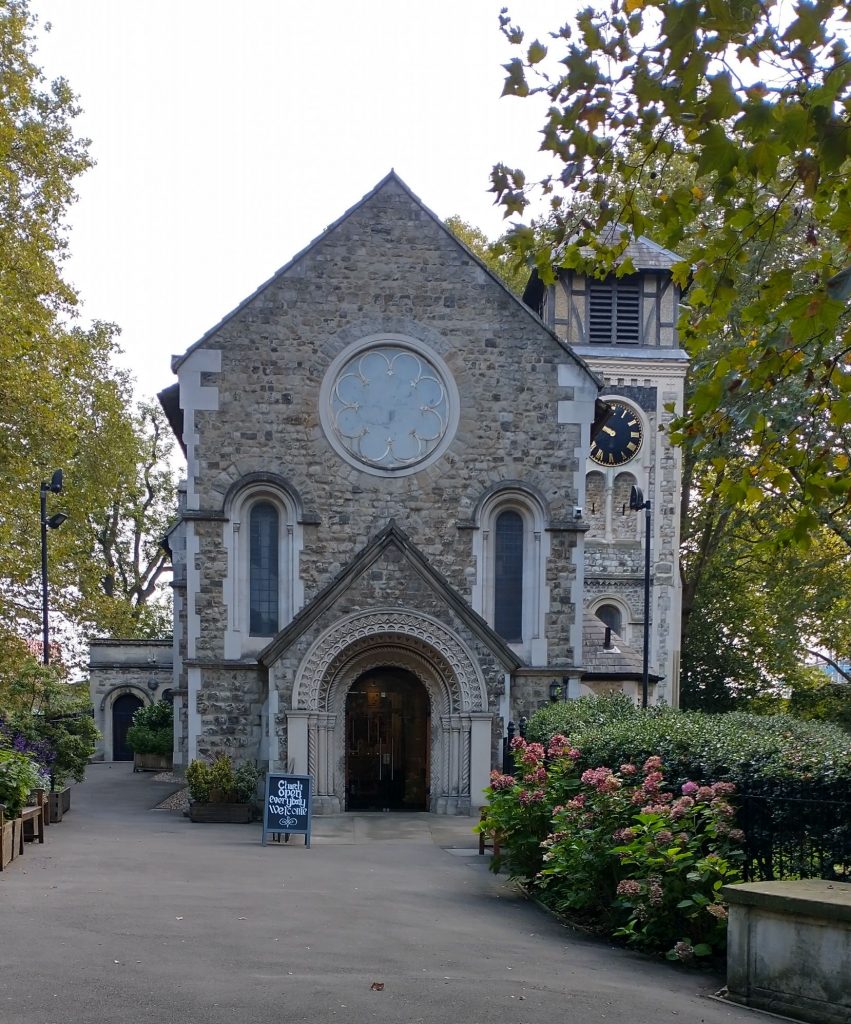
St Pancras, Old Church, London (Photo: Kevin Flude)
Pope Gregory is said to have given St Augustine relics from St Pancras when his mission came to Kent in 597AD. They built a church dedicated to St Pancras. The ruins still survive in the grounds of what is now St Augustine’s, Canterbury (see picture at tope of post).
This story is partly responsible for the claims that St Pancras Old Church, in Camden (pictured above) is a very old foundation. The idea being that there was a late Roman place of worship here. But there is very little solid evidence for this. It is also argued that, if it isn’t late Roman, then it dates to just after 604AD. This is when St Mellitus, sent by St Augustine, established St Pauls Cathedral. It is suggested that he also founded St Pancras Church. St Pancras’ Church was a Prebend of St Pauls Cathedral (a Prebend provides the stipend (pay) to support a Canon of a Cathedral). But this is not evidence it was established as early as the Cathedral was, and there really isn’t any other credible evidence for a 604 date.
When the Church was restored, the architects said it was mostly Tudor work with traces of Norman architecture. However, the suggested finding of a Roman tile or two, reused in the fabric, is used as evidence to keep the legend going.
If you read the Wikipedia page, you will see evidence of two strands to the contributions. One is playing down the legends of its early foundation. The other trying to keep hold of its place as among the ‘earliest sites of Christian worship’. Read the wikipedia page here: https://en.wikipedia.org/wiki/St_Pancras_Old_Church to make up your own mind.
It is a lovely Church, on an impressive site, with links to Thomas Hardy, and Sir John Soane whose tomb is the design inspiration for the iconic Red Telephone Box.
As Patron Saint of Headaches, St Pancras Day is a good day to make worms come out of your head. Or so say the Fairfax Household Book of the 17th/18th Century as quoted in Charles Kightly’s ‘The Perpetual Almanac’:
‘To make a worm come out of the head. Take, in May, the marrow of a bull or cow, and put it warm into the ear, and the worm will come forth for sweetness of the marrow.’
Generally, willowbark was used for headaches. We know this would have worked as the bark contains salicin, which is converted by the body into salicylic acid. This is a precursor to aspirin (acetylsalicylic acid). But it is not as effective.
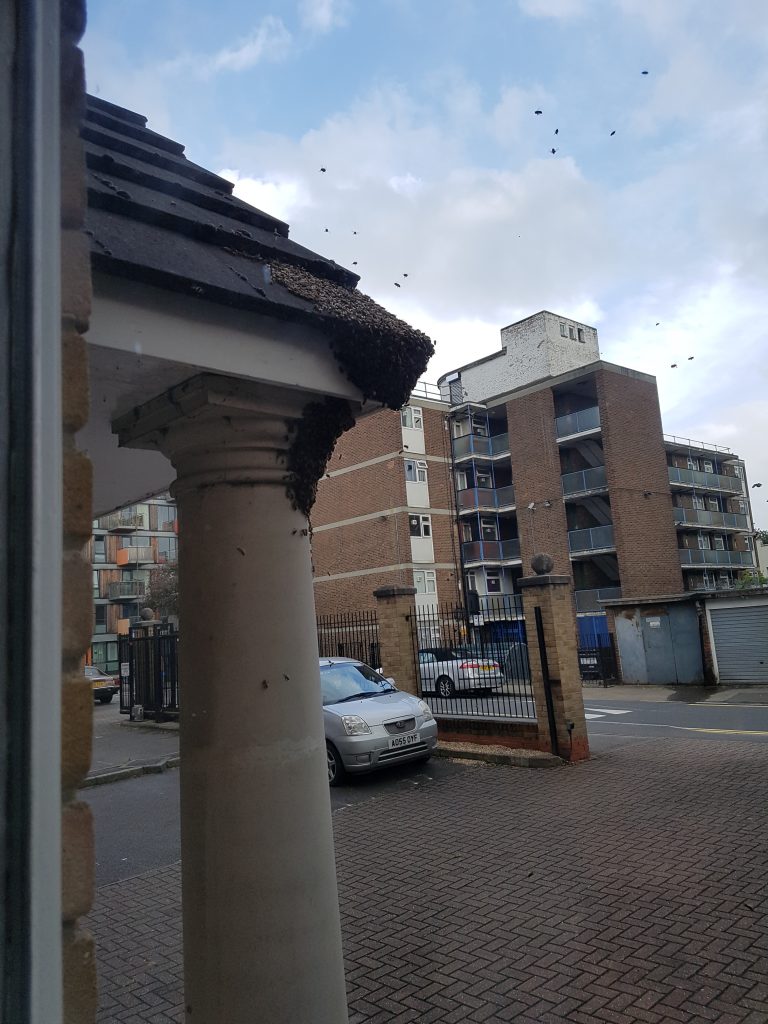
Swarm of Bees, Hackney (Photo Kevin Flude 30th May 2018). The Swarm is at the top of the Column and on the edge of the porch roof.
In 2018, on 30th May, I was perturbed to find a swarm of Bees hanging outside my front door. Frightened of leaving my house, I rang a local beekeeper, who came to take possession of the Bees and take them to a new home. By the time he came, they had moved 20 yards to a Buddleia bush.
Swarm of Bees, having moved 20 yards to a second perch, being ‘rescued’ by a bee keeper. You can see the swarm above his head.
A Swarm of Bees in May
‘Five Hundred Points of Good Husbandry’ published 1573, suggests we should:
‘Take heed to thy Bees, that are ready to swarm, the loss thereof now, is a crown’s worth of harm.’ The loss was particularly hard in May or June as the country verse tells us:
A swarm in May Is worth a load of hay A swarm in June Is worth a silver spoon A swarm in July Is not worth a fly.‘
According to Hillman’s ‘Tusser Redivus’ of 1710, swarming in May produces particularly good honey. He advises following the bees to retrieve them:
‘You are entitled by custom to follow them over anyone’s land and claim them … but only so long as you ‘ting-tang’ as you go, by beating some metal utensil – the sound whereof is also said to make your bees stop.’
Much of the above is quoted from The Perpetual Almanac of Folklore by Charles Kightly.
Queen Bee
Bees swarm when a new Queen Bee takes a proportion of the worker bees to form a new colony. They will latch unto a branch or a shrub, even a car’s wing mirror. Then sending worker bees out searching for a suitable new home, such as a hollow tree. There may be hundreds or even thousands in the new colony. This may be very alarming, as I found, as I could not go out without walking through a cloud of bees. But, at this point, they will not be aggressive as they do not have a hive to protect. Look here for more information on swarming.
Sweet, Long Distance Flyers
An average hive will produce 25 lbs of honey, and the bees will fly 1,375,000 miles to produce it. This is like flying 55 times around the world (according to the British beekeepers Association (and my maths)) https://www.bbka.org.uk/honey
Helping Bees
Bees are still having a hard time as their habitats are diminishing and threats increasing. In July, DEFRA hosts ‘Bees Needs Week’ which aims to increase public awareness of the importance of pollinators.
They suggest we can help by these 5 simple actions
Grow more nectar rich flowers, shrubs and trees. Using window or balcony boxes are good options if you don’t have a garden.
Let patches of garden and land grow wild.
Cut grass less often.
Do not disturb insect nests and hibernation spots.
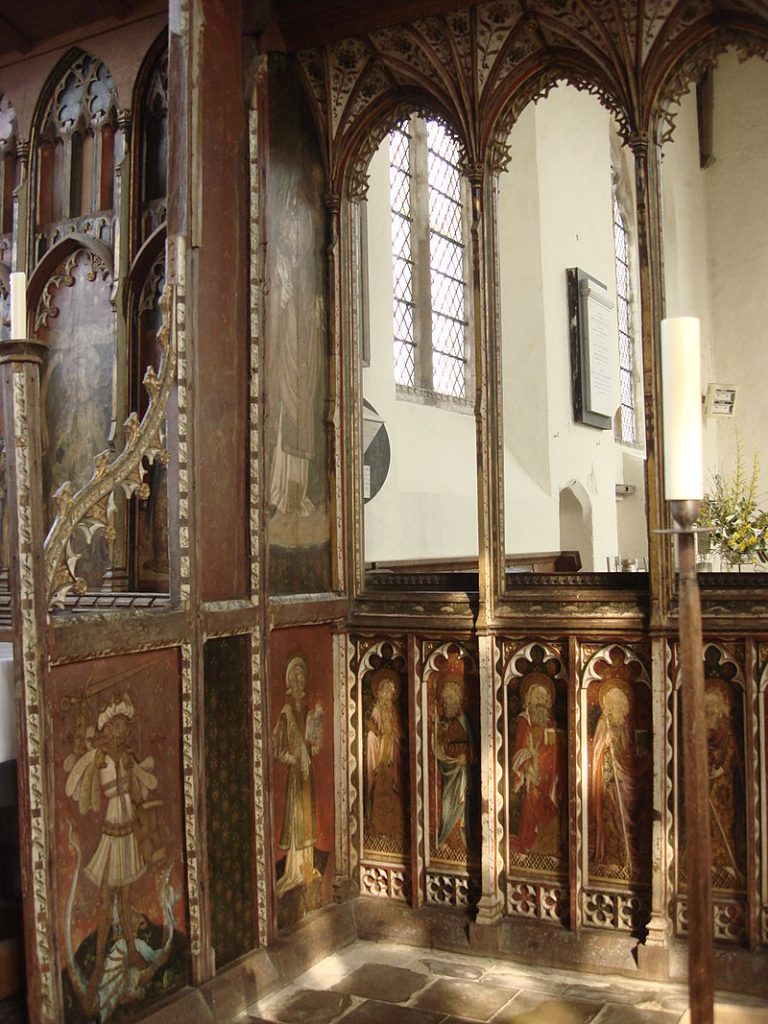
Rodmas – Rood screen in St. Helen’s church, Ranworth, Norfolk by Maria CC BY-SA 3.0
Rood is another word for the Cross. Parish Churches used to have a Rood Screen separating the holy Choir from the more secular Nave. This screen was topped with a statue of the Crucified Jesus nailed to a Rood. So, Roodmas, is the festival of the Holy Cross. Roodmas is celebrated on May 3rd and September 14th, although the Church of England aligned has itself with the Catholic Church’s main celebration on September 14th.
See my post on September 14th here for more on the True Cross.
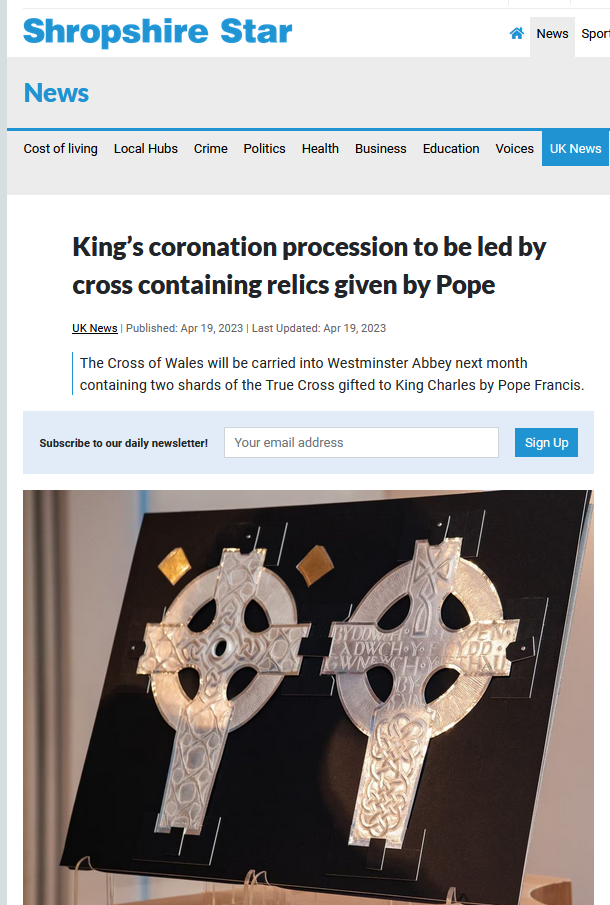
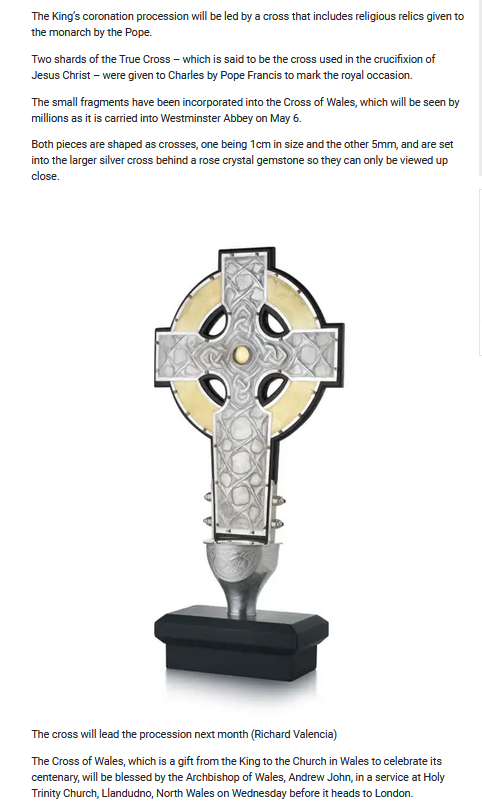
The Shropshire News reported that two pieces of the True Cross were given to Charles III by the Pope! They have been put into a cross called the Welsh Cross. This was part of the Coronation Procession. The King gave the Cross (I assume with the pieces of the Holy Cross) to the Church in Wales. Let the Shropshire News tell the story:
It is a clear reminder that we are subjects not citizens and news, as a nation, we still set store by superstitions.
The Duke of Buckingham and the True Cross
The Duke of Buckingham had a piece in his collection, which he kept at York House in the early 17th Century. How he got it, I don’t know. But I think he must have acquired it from the aftermath of the destruction of the Reformation. John Tradescant, who looked after the Duke’s collection until Buckingham was murdered, had a piece of the True Cross. Tradecant created Britain’s first Museum, Tradescant’s Ark. Again, I suspect (without any evidence) that he got the fragments from Buckingham. Did he acquire it after the murder? Or shiver off a timber fragment hoping no one would notice?
First Written on May 3rd 2023, revised May 3rd 2024, and 2025
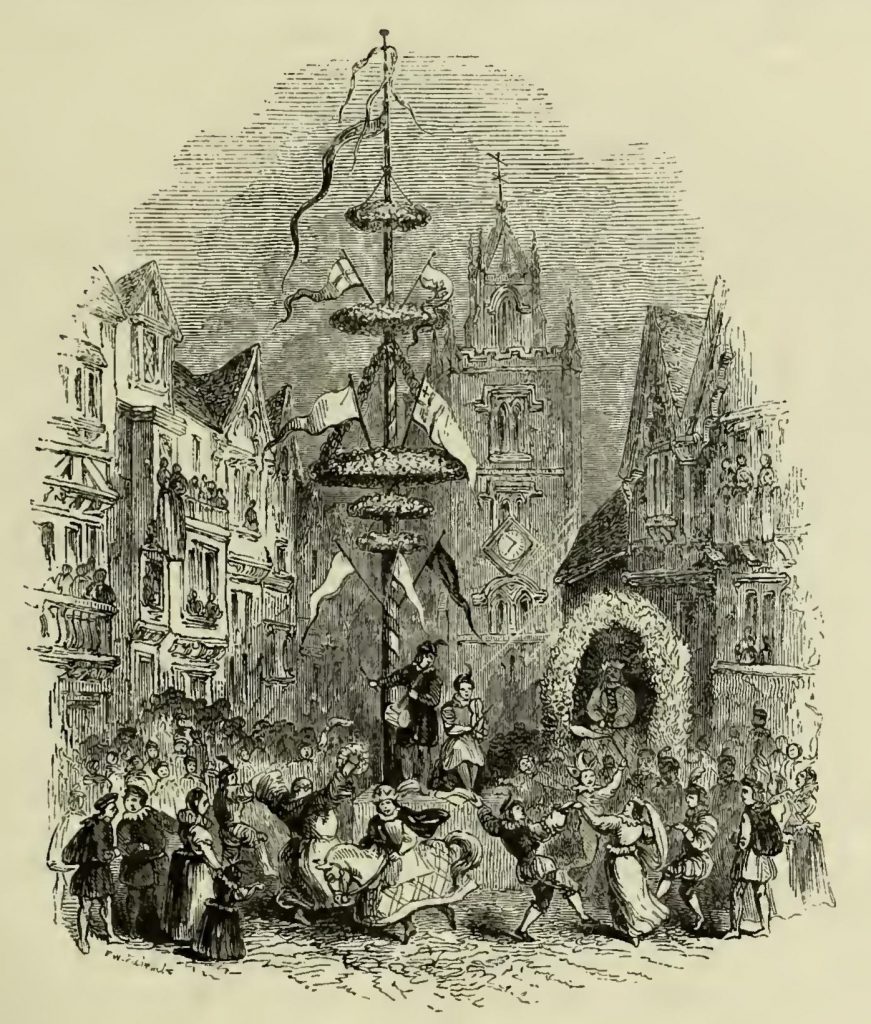
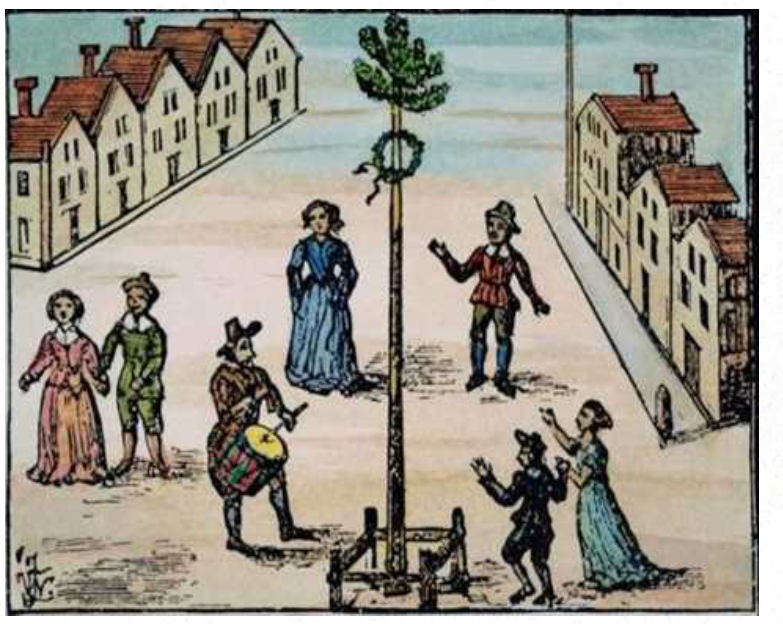
The Stinking Idol : An Imagined Scene at the Maypole at St Andrew Undershaft
Philip Stubbes, wrote a vitriolic attack on pagan practices in his ‘Anatomy of Abuses in 1583’. He fired a broadside at the tradition of dancing around the Maypole. He said they had: ‘as Superintendent and Lord ouer their pastimes and sportes: namely, Sathan Prince of Hell‘ as they erected ‘this stinking Idoll’. By which he meant the Maypole. Stubbes suggested that of the maids that went out to the woods on May Eve less than one-third returned ‘undefiled‘.
Evil May Day Riots
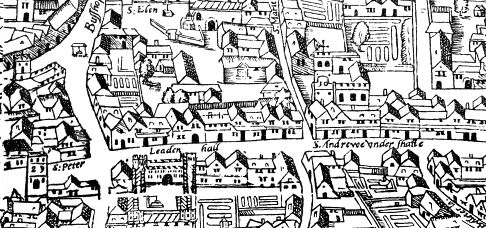
The Maypole was stored at St Andrew Cornhill, which became known as St Andrew Undershaft. In 1517, it was attacked during the ‘Evil May Day riots’. The main focus of the riot was foreign workers. The Under Sheriff of the time, Thomas More, tried to quell it. But 5,000 troops commanded by the Duke of Northfolk was necessary to regain control of the City. 300 rioters were arrested. One hanged, drawn and quartered, 13 hanged and nearly 300 pardoned after the intercession of Woseley and/or Katherine of Aragon. The shaft was returned to its place under the eves of the houses in Shaft Alley. But apparently banned from being raised again.
1549 May Day Riots
But in 1549, the curate of nearby St Katharine Cree Church made an inflammatory speech. This incited a Puritan mob who cut the shaft into pieces and burnt it. I always imagine the Curate’s sermons to be along the same lines as Phillip Stubbes attack on the Maypole.
Maypole: this Stinking Idol, Rather
Here is a longer description of the May Day Celebrations by Stubbes.
‘But their chiefest iewel they bring from thence is the Maie-poale, which they bring home with great veneration, as thus: They haue twentie, or fourtie yoake of Oxen, euery Oxe hauing a sweete Nosegaie of flowers tyed on the tip of his homes, and these Oxen drawe home this Maie-poale (this stinking ldoll rather) which is couered all ouer with Flowers and Hearbes, bound round about with strings from the top to the bottome, and sometimes painted with variable collours, with two or three hundred men, women and children following it, with great deuotion.
And thus being rearedvp, with handkerchiefes and flagges streaming on the top, they strawe the ground round about, bind green boughes about it, set vp Summer Haules, Bowers, and Arbours hard by it. And then fa! they to banquet and feast, to leape and daunce about it, as the a Heathen people did, at the dedication of their ldolles, whereof this is a perfect patteme, or rather the thing it selfe. I haue heard it crediblie reported (and that viua voce) by men of great grauity, credite, and reputation, that of fourtie, threescore, or a hundred Maides, going to the wood ouemight, there haue scarcely the third part of them returned home againe vndefiled.‘
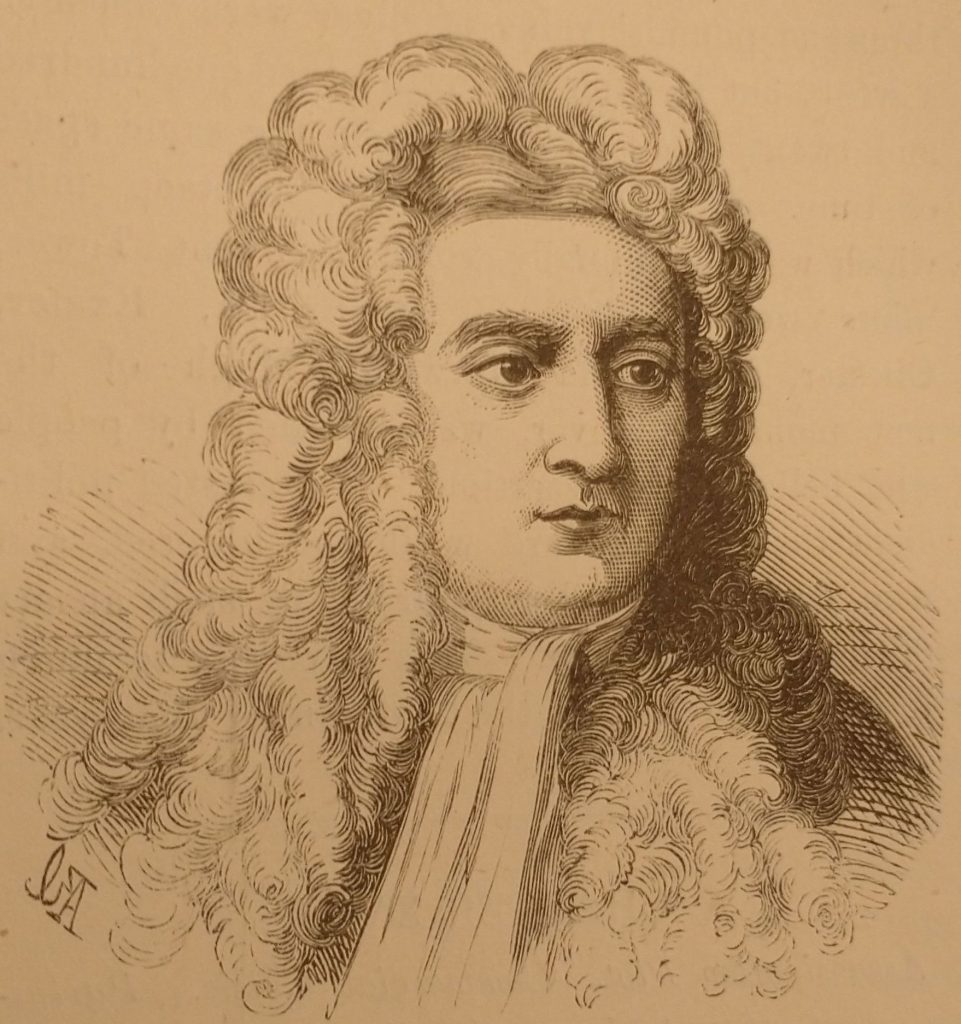
The unraised pole seems to have survived until the beginning of the Civil War, (1644) when it was destroyed. But at the Restoration of Charles II a new and huge Maypole was ordered. It was joyously erected 134 ft high (41 metres) in the Strand. This one was danced around till 1713 when it was replaced. The original was sold to one Isaac Newton. He used it to support the biggest telescope in Europe which was erected in Wanstead by a friend.
And that, my friends, is how you get from Superstition to Science in one easy story.
Old Print of Isaac Newton
Postscript.
I have always told people that the sermon leading to the destruction of the Shaft in 1549 was made at St Paul. I cannot remember where I read this. The suggestion that the Maypole in Cornhill was not used after 1517 seems strange. Why then would an unused maypole rouse a crowd to riot in 1549? Of the sources I have at hand, the London Encyclopedia mentions the riot of 1517 in its entry on St Andrew Undershaft but doesn’t elaborate more. ‘Layers of London‘ says ‘It was last raised in 1517 when ensuing riots led to the celebration being banned.’ which is definitive sounding. But is it? I wonder if it was banned for a year or two, then allowed again, and finally stopped in 1549?
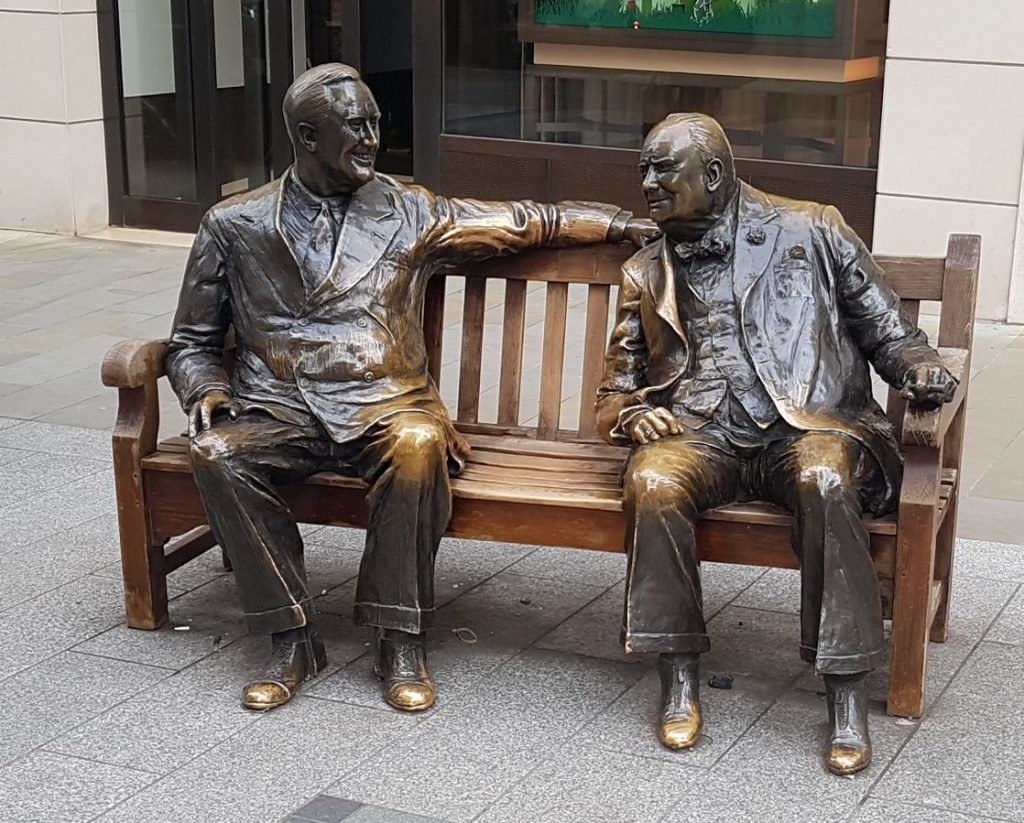
‘Allies’ Roosevelt and Churchill by by Lawrence Holofcener, unveiled on May 2nd 1995 by Princess Margaret and Lord Snowdon
1995 Allies Statue Statue of Churchill and Roosevelt set up to commemorate 50 years of peace. 30 years later what is the state of the Allies relationship? Topical or what? https://www.iwm.org.uk/memorials/item/memorial/11351
First written in 2023 and revised on May 2nd 2024 and 2025.
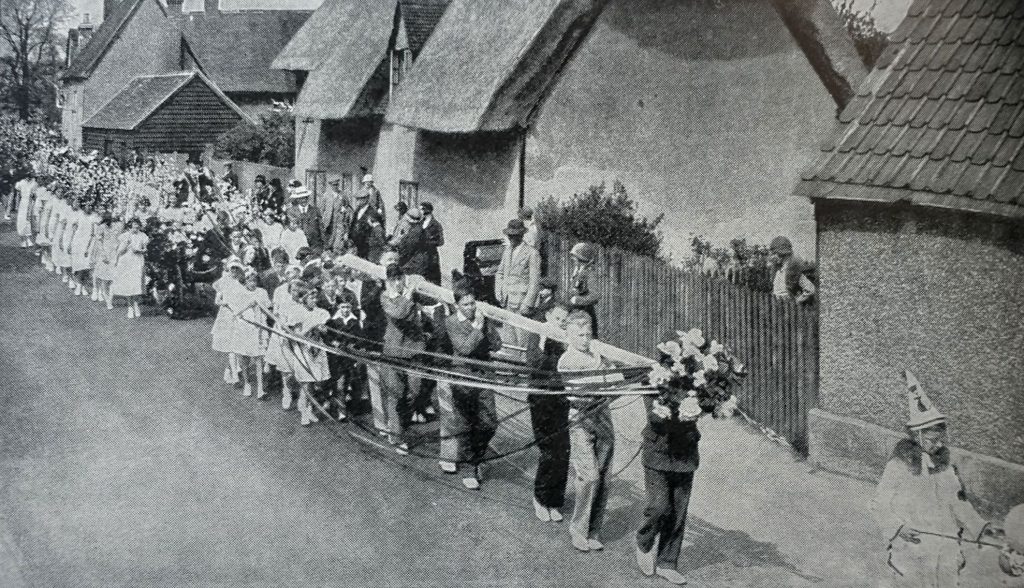
May Day – Bringing the Maypole, Bedfordshire. Image from ‘Romantic Britain’
Maypoles were often stored during the year. A few days before May Day they were repainted, and bedecked with May Garlands – mostly made from Hawthorn. The Maypole used in London in 1660 was 134 feet high. Tall straight trees were used, sometimes of Larch, and they might be spliced together to get the requisite height. John Stow says that each parish in London had their own Maypole, or combined with a neighbouring Parish. The main Maypole was on the top of Cornhill, in Leadenhall Street. It was stored under the eves of St Andrew’s Church, which became known as St Andrew’s Undershaft as a result.
Padstow May Day Festival
Padstow holds, perhaps, the most famous May Day festival on May 1st. It feels feels very ‘pagan’ or do I mean it is fuelled by an enormous amount of drink?
Here is a video, watch until you see the ‘obby ‘orse and the teaser dancing.
Why May Eve?
The celebrations begin on May Eve because the Celtic calendar starts the day at Dusk. This seems strange to us who, perversely, ‘start’ our day at Midnight just after everyone has gone to bed! The other choice, and maybe the most logical is Dawn. But Dawn and Dusk are difficult to fix. Midnight was chosen by Julius Caesar when he created the Julian Calendar. Midnight has the virtue of being a fixed metric, being half way between Dawn and Dusk. From the Celtic point of view. The day ends when the Sun goes down over the western horizon. So the end of the old day, is the beginning of the new day. Makes sense?
Celebrations centred around the Bonfire. The day was sacred to the fire God Belenus (Gaulish: Belenos, Belinos, British Belinus, Bel, or Beli), and May Day was called Beltane. Bonfires continued to be a part of the celebration into the 16th Century, and in places until the 20th Century. According to folklore tradition, the bonfire should be made of nine types of wood. They must be collected by nine teams of married men (or first born men). They must not carry any metal with them. The fire has to be lit by rubbing oak sticks together or a wooden awl twisted in a wooden log.
Participants, have to run sunwise around the fire. Oatcakes are distributed, with one being marked with a black spot. The one who collects it has to jump through the fire three times. Bonfires would have been, by choice on the top of hills. But then they were also held in the streets in London.
May celebrations have a similarity to Halloween. This was also a fire festival and both are uncanny times when sprites and spirits abound. Hawthorn was a favoured wood not only because of its beautiful may flower. It was also said to be the wood the crown of thorns was made from. Hawthorn had the power of resisting supernatural forces. Therefore, it was used to protect doors, cribs, cow sheds and other places from witches. Witches, it was said, got their power to fly from potions made from chopped up infants. The best protection was Christening. The custom was that christening took place as early as possible and normally three days after birth. Shakespeare was baptised on 26th April 1564, so we celebrate his birthday on 23rd April. See my post for more on this subject.
Special May Babies
Cribs would be bedecked with Hawthorn and protection might be augmented by a bible, rowan, and garlic. Babies born between May 1 and 8 were thought to be special. They were destined to have power over man and beast. Weddings were frowned upon in Lent and in May, so April became a popular choice for marriage.
May Dew
After celebrations on May Eve (April 30th), women would go out in the woods to collect May, other flowering plants. They would wash their faces in May Dew preferable from the leaves of Hawthorn. If not from beneath an oak tree, or from a new-made grave. The dew was said to improve their complexion. It was also used for medical conditions such as gout and weak eyes. Thinking of one’s lover on May Day might bring marriage within the year.
May morning would commence with dancing around the Maypole, followed by feasting, and summer games. for more about Maypoles and May Day see my post may-2nd-this-stinking-idol-the-end-of-may-day/
Belenus is a Celtic God of whom very little is clear and unambiguous. He was linked in Gaul with Apollo. The name, some people think, comes from ‘Shining’ but others disagree and think it means ‘Master of Power.’ His association with Irish mythology and the festival of Beltane suggests he was a powerful god in Celtic Europe. Geoffrey of Monmouth has a King called Belinus, and spins a yarn about Belinus and Billingsgate. Linguists prefer the idea that Billingsgate is named after some unknown Saxon called Billings. This may be a little more likely but far less interesting.
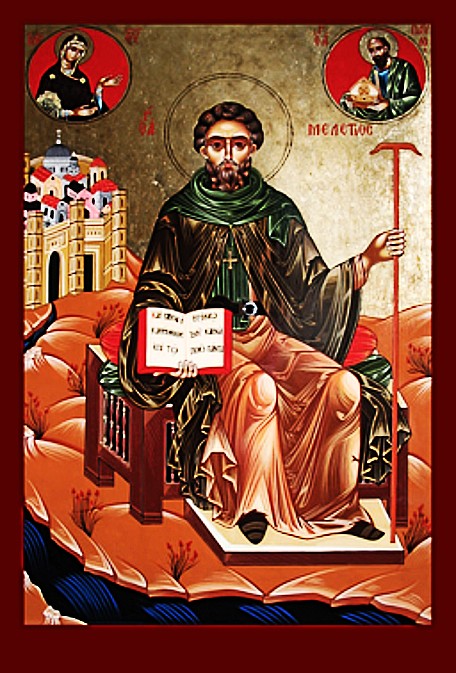
St Mellitus (Source: from saint-mellitus-of-canterbury-died-624
St Mellitus was the first Bishop of London (AD604) and the third Archbishop of Canterbury. But was he really? No, he was the first Bishop of London of the English Church. There were many before him. We know there were bishops of London from Britannia during the Roman period. And, according to John Stow, London’s first history. there were also post-Roman bishops. That line of Bishops ended, in 584 AD, when the 14th Bishop, Theanus, fled London. He headed for Wales to escape the Anglo-Saxon threat. However, even Stow was uncertain whether the list was genuine.
In 314 a Church Council or Synod was called at Arles, in France. Amongst those attending were three bishops from Britain, (and a Deacon and a presbyter) :
Adelfius “de civitate Colonia Londenensium” – that is, from the “colonia of the people of London”.
(Wikipedia)
The fact that two came from London suggests to some a mistake. Adelfus, perhaps, was either from Lincoln or Colchester which were Colonies. The Synod was called by the Emperor Constantine. Amongst its acts were to order that Easter should be held at the same time throughout the Empire. (See also my post on the Synod of Whitby which fixed the date of Easter in Britain as late as 684). They also banned Races, and Games. and excommunicated all actors and charioteers. (Synod_of_Arles). But it gives us our first certain facts about the origins of Christianity in Britain.
The Augustinian Mission and Mellitus
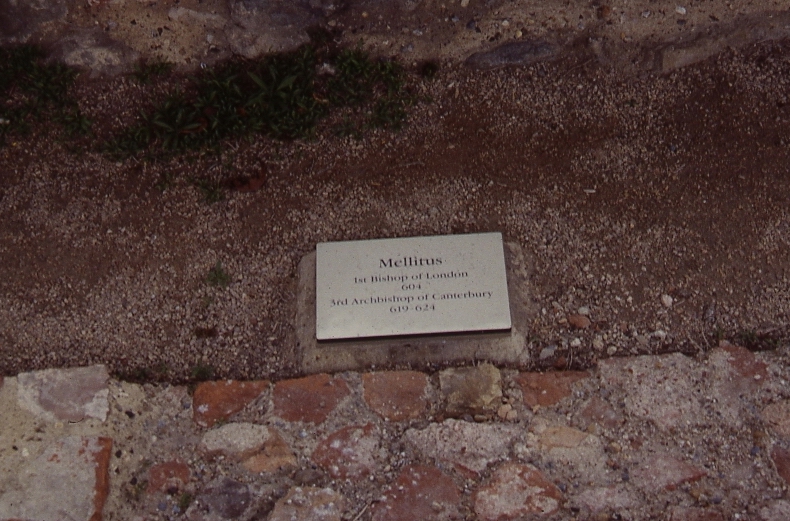
St Mellitus Burial Place, St Augustine’s Abbey, Canterbury. Photo K. Flude
In 597, the Augustinian Mission came to Kent. Mellitus was sent by Pope Gregory to join St Augustine’s mission in 601AD,. He was then sent to London to set up St Pauls and become its bishop (604). But he was kicked out in 618AD when King Sæberht of Essex died and was replaced by a pagan son. Mellitus went into exile in Gaul but came back to become the third Archbishop of Canterbury. He was buried in St Augustine’s Abbey in Canterbury. He is known as St Mellitus of Canterbury. London reverted to paganism until 654AD when St Cedd became its next Bishop.
St Mellitus had gout so is the go-to Saint for sufferers of gout.
Also on this day
1925 – McVitie’s Chocolate Digestive was created. There were made in Stockport and in Harlesden, London. I have moored my narrowboat outside the factory and been kept awake by the churning of chocolate in vast vats. Or so I imagine. News stories suggest that the Digestive was meant to be eaten with the chocolate on the bottom side. This is one of the most ridiculous things I have heard! But you can read this page for the facts. And this one for more on the history of the Chocolate Digestive.
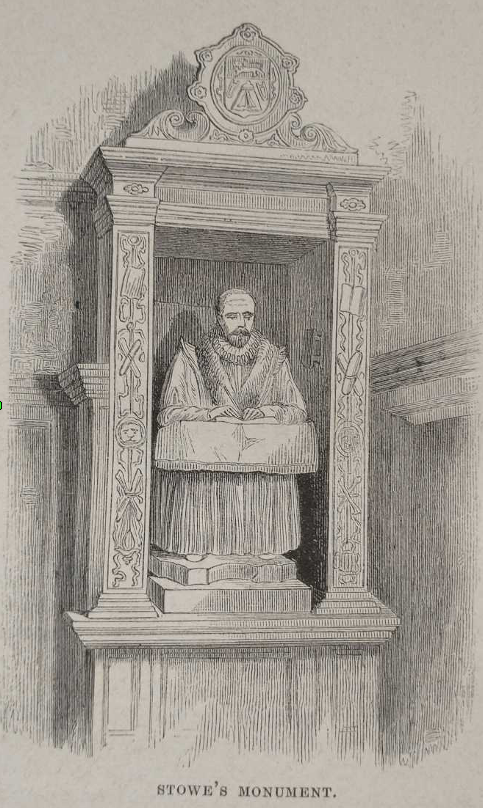
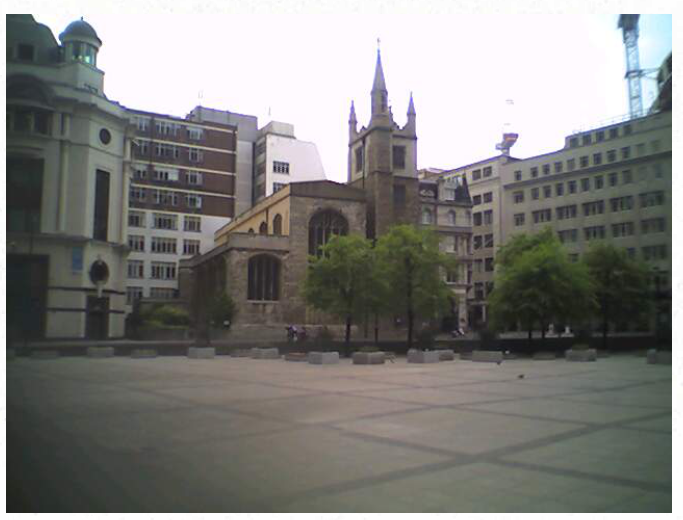
On the corner of Leadenhall Street and St Mary Axe in the City of London is one of the very few medieval Churches that survived the Great Fire of London is 1666. It was sheltered by the firebreak that was the Leadenhall, a big market building made of stone. This is where the great London historian John Stow is buried. His Survey of London is one of the best sources for Medieval and Tudor London. Every three years, there is a commemorative service and his quill is changed. Last year it was on the 22nd April. The Lord Mayor attends and it is organised by Stow’s Guild – the Merchant Taylors.
John Stow records that his father returned to his home at Austin Friars one day to find his house had been moved. He had no warning, nor payment for the loss of land. He had the misfortune to live adjourning the property of Thomas Cromwell.
St Andrew Undershaft
The Church is the Maypole Church as it was here the Maypole or the shaft was stored under the eves of the Church. Hence, St Andrew’s sobriquet of ‘Undershaft’. The May Day riot of 1517 put an end to the dancing around the Maypole but the pole itself survived until 1547. Then, in a Puritan riot, the ‘stynking idol’ was destroyed. (see my May Day blog post here for more more details.)
There is also a plaque to Hans Holbein, but no one knows for sure where he is buried. He died in London in 1543, possibly of plague. The present church was built in 1532, but it is first recorded in the 12th Century.
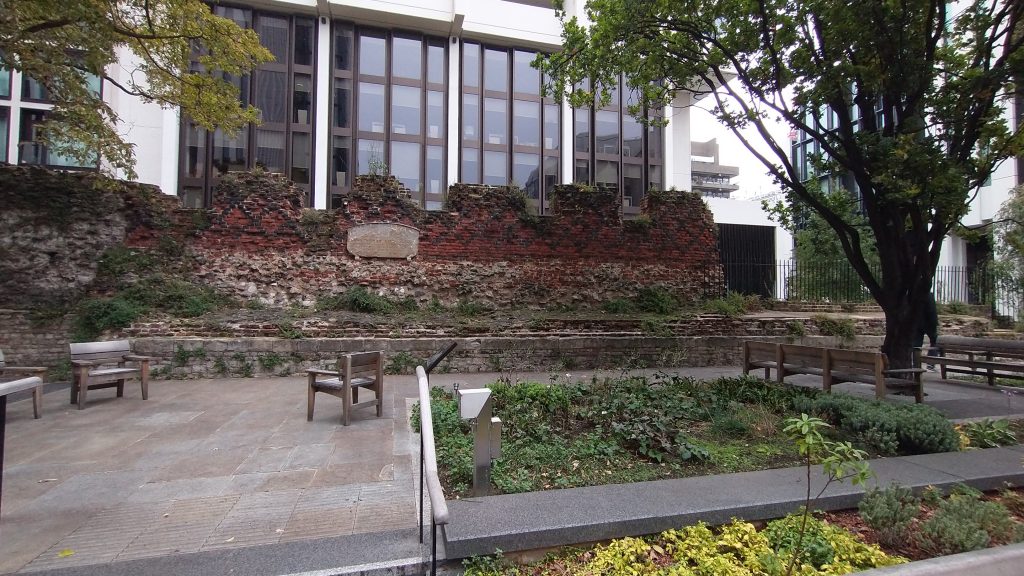
St Alphage. Church Tower on right, City Wall to left. Photo K Flude
I first came across St Alphage when I was working at the Museum of London. The Museum was built on the High Walk at London Wall. The raised Courbusian Walkway looked down on a ruin of a Gothic Church Tower, almost destroyed during the Blitz. This was St Alphage, a Church dedicated to the Saxon Archbishop of Canterbury. (Alphage is also spelt Alphege or Alfege).
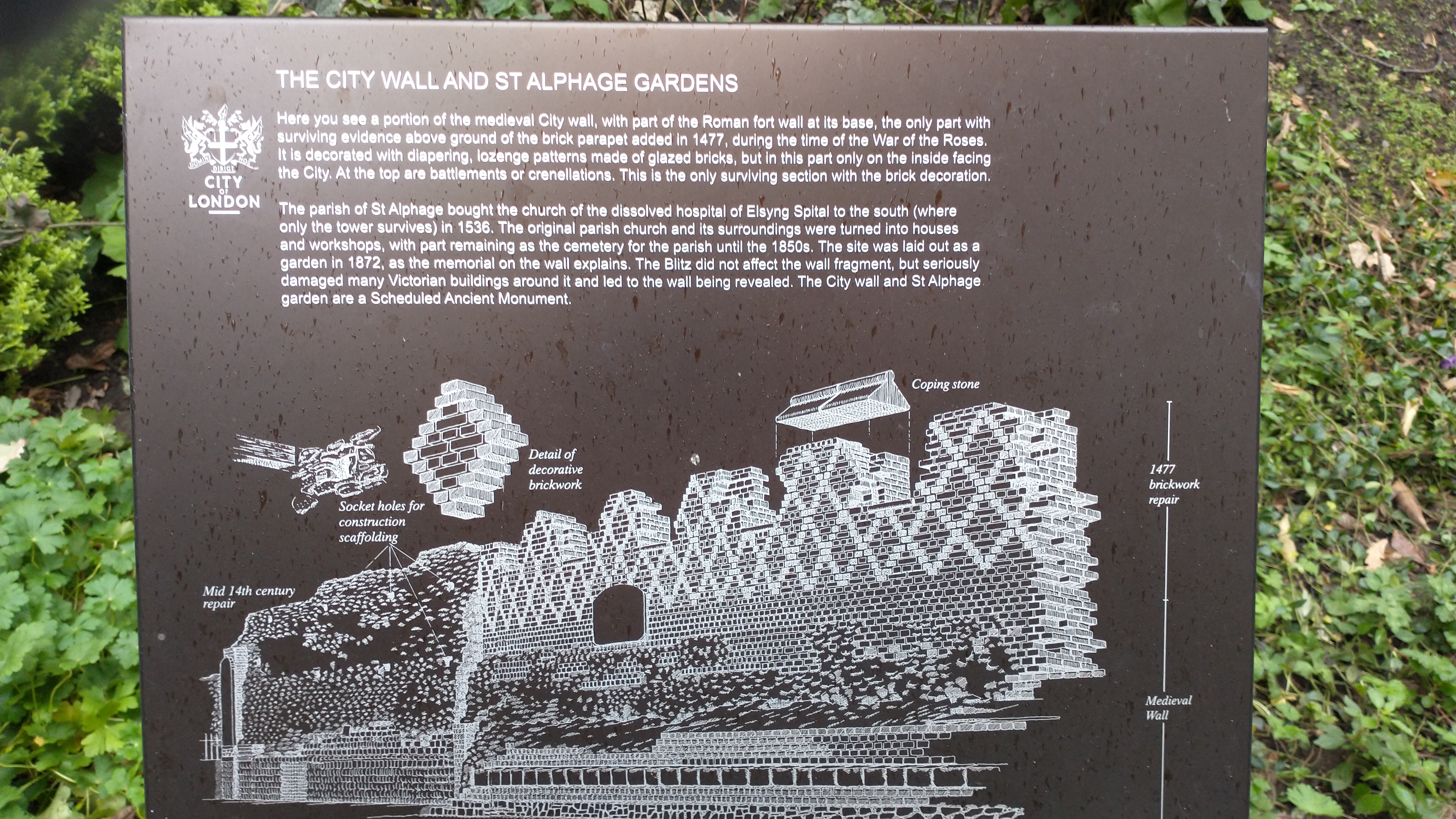
On the other side of the Walkway was the old graveyard of the Church. This preserved one of the very best sections of the old London Wall. Special because on one side its huge height was displayed. On the other, the only crenelated bit of the City Wall. And the only surviving part of the Wall dating to the War of the Roses.
St Alphage Roman and Medieval WallThe Crennelated Red Brick Section dates to 1477, during the War of the RosesSt Alphage Wall explained on an information plaque.
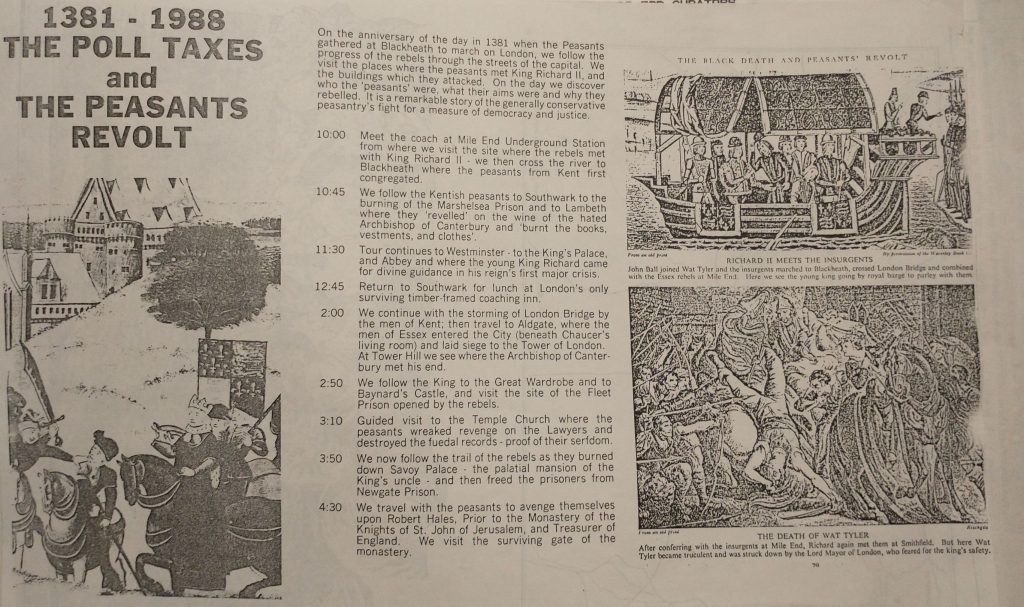
In the 1980’s fellow Museum of London Archaeologist, Paul Herbert and I set up a Guided Walks company (Citisights of London) . Our walks started from outside the Museum of London, and so St Alphage formed a big part of our success. It led to a life giving Guided Walks and tours. So, St Alphage, thank you!
A Citisights Day Tour of the 1980s
St Alphage Elsyng Spittle St Mary ?
The Church was previously a monastic settlement called Elsyng Spittle (aka St Mary within Cripplegate). The Augustinian Canons looked after 100 blind men. It was refounded by Williain Elsing, and dissolved by Henry VIII in 1536. The Church was kept for a Parish Church. But the Puritans were not keen on dedications to St Mary. So, they renamed it after a London based Christian Martyr.
It remained a Parish Church until damaged in an air raid in World War One. (possibly on 8th September 1916 in a Zeppelin Raid – but I am speculating). The Church was partly demolished in 1923, leaving the Tower. The lower part of the Medieval Tower survived bombing in the Blitz. At 12.15 am on 25th Aug 1940, the first bombs on the City of London fell nearby in Fore Street. But the tower was hit in 1940. It was listed Grade 1 in 1950. Kept by the rebuilding of London Wall, and the Barbican area. Then substantially benefitting from a remodelling of the area in an excellent scheme of 2022.
St Ælfheah of Canterbury and Greenwich
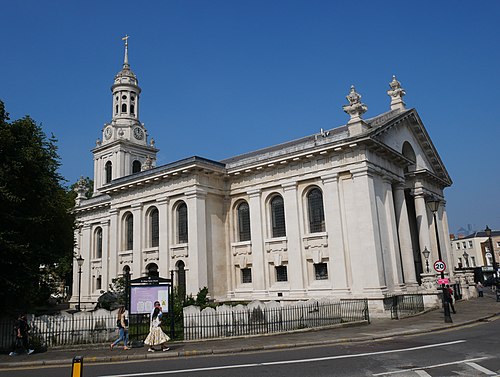
StAlfege Greewich – Doyle own work Wikipedia CC BY-SA 4.0
St Ælfheah was captured during a Viking attack on Canterbury. The Viking hoard relocated to Greenwich where they tried to negotiate a fat ransom for him. He was one of the richest men in the Kingdom. This is what the Anglo Saxon Chronicle says:
.. the raiding-army became much stirred up against the bishop, because he did not want to offer them any money, and forbade that anything might be granted in return for him. Also they were very drunk, because there was wine brought from the south. Then they seized the bishop, led him to their “hustings” on the Saturday in the octave of Easter, and then pelted him there with bones and the heads of cattle; and one of them struck him on the head with the butt of an axe, so that with the blow he sank down and his holy blood fell on the earth, and sent forth his holy soul to God’s kingdom.
St Alfege Greenwich, which is now a lovely Hawksmoor Church is said to be on the site of St Ælfheah‘s death.
St Alphage’s body was taken to St Pauls Cathedral where it was venerated. His remains were removed in suspicious circumstances by soldiers of King Cnut who translated the Saint’s bones to Greenwich. It is suggested King Cnut was punishing London for their opposition to him.
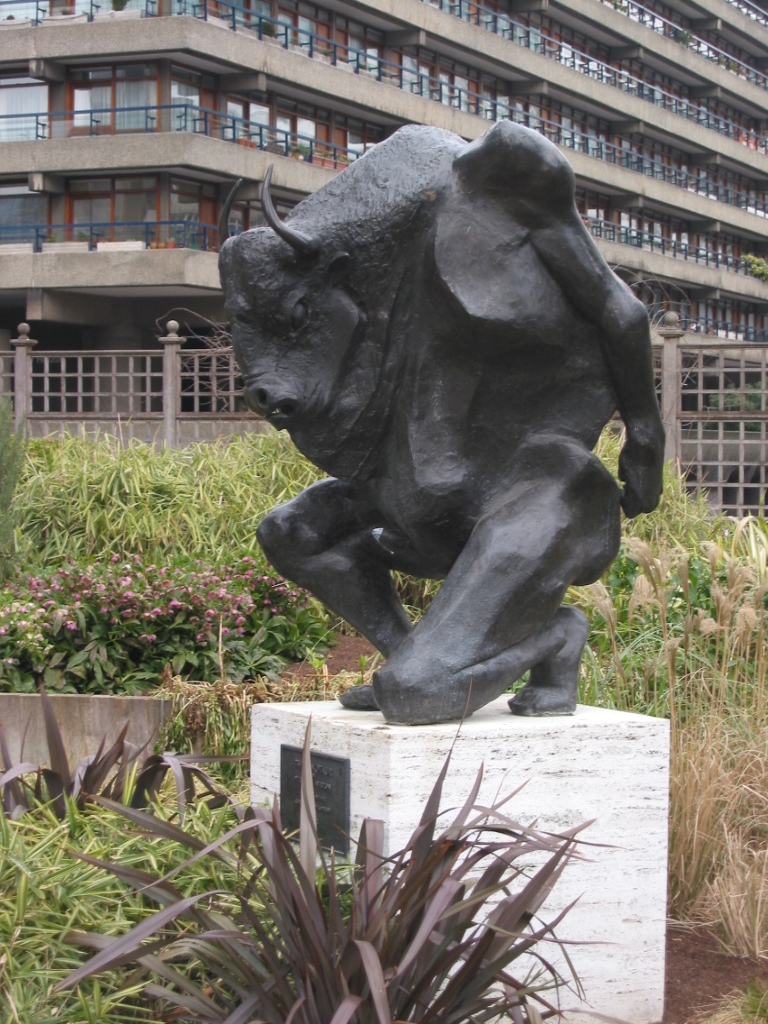
The Minotaur by Michael Ayrton
Also, part of the experience of visiting St Alphage from the High Walk was the statue of the Minotaur. I first came across this phallic Bull in the Postman’s Park and am very fond of it. Then it disappeared and reappeared on the High Walk. Now it is on the ground level near in the garden of St Alphage.
I understand that Michael Ayrton wanted to make a point about the destruction of London. He felt that the developers were more destructive than the Luftwaffe. They were like a Bull in a China Shop! So he created this statue of a very vigorous Bull representing the Minotaur. It is a very unusual work of art in that it sports a fully erect penis. Art History is full of naked women, but the male organ is largely left to pornography. For more about Ayrton follow this link.
The Minotaur in its present positionThe Minotaur on the High Walk
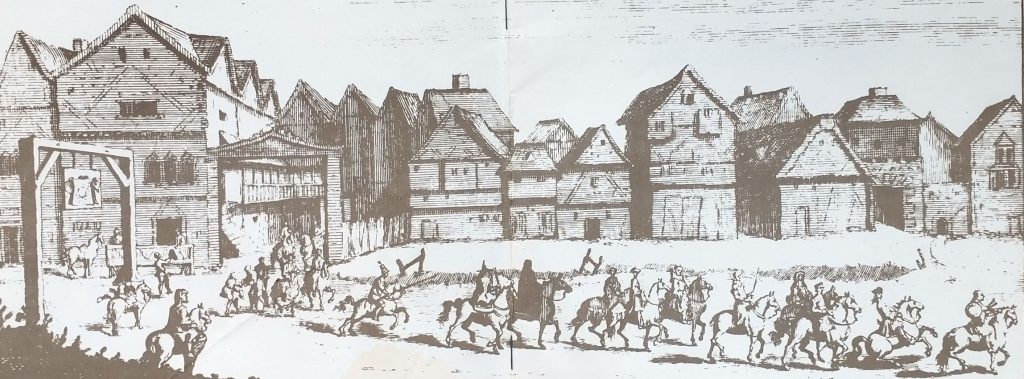
Pilgrims leaving the Tabard for the Canterbury Pilgrimage
Canterbury Pilgrimage
Tonight, I am leading my annual Canterbury Tales Virtual Pilgrimage. This is the day Chaucer’s pilgrims leave London to ride to Canterbury. (For more details or to book look here.)
At the beginning of the prologue, Chaucer gives clues as to the date. They go when April showers and Zephyrus’s wind is causing sap to rise in plants, engendering flowers. It is also when Aries course across the sky is half run.
The pilgrims are accompanied by Harry Bailly who is the landlord of the Tabard Inn in Southwark. He was a real person and a fellow Member of Parliament of Chaucer.
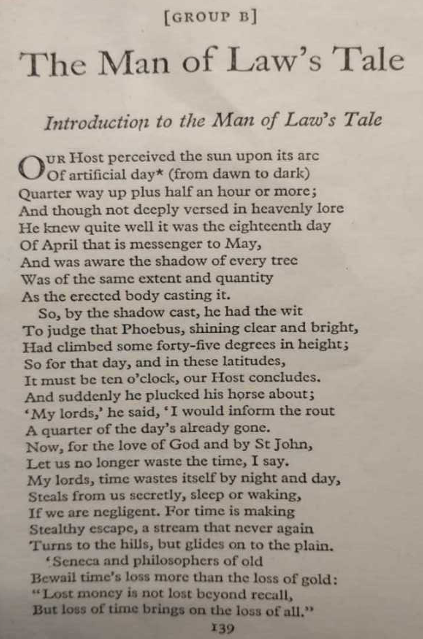
He is jolly and quite knowledgeable. In the Man of Law’s prologue we get a glimpse of Harry time telling in the days before clocks.
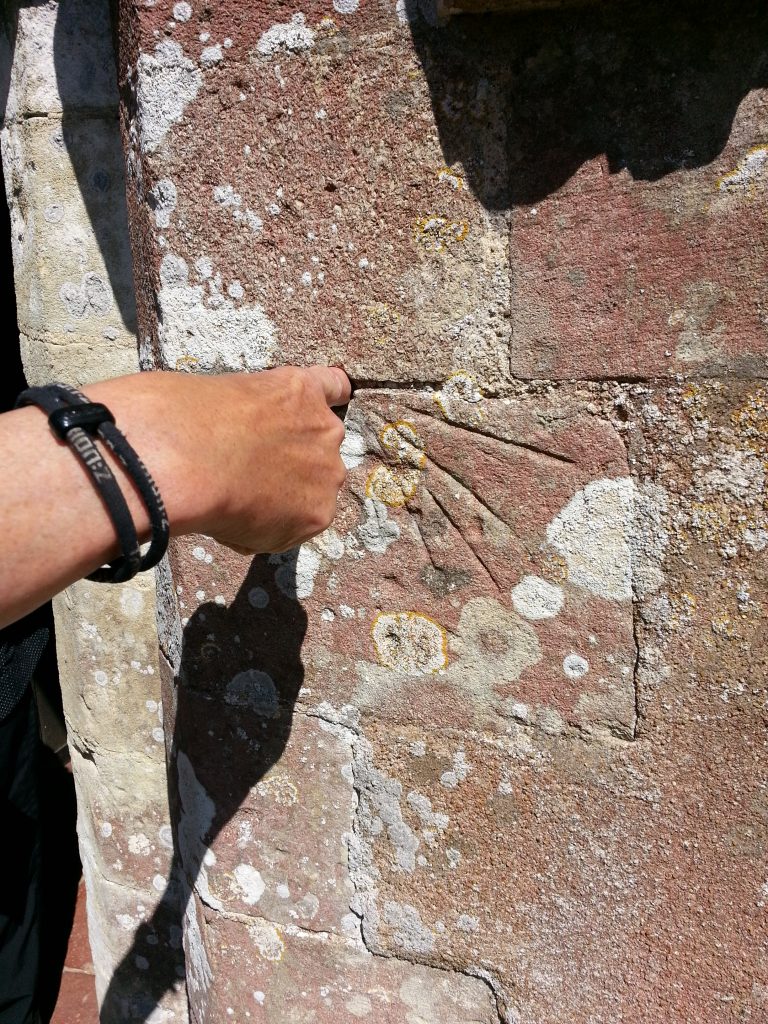
A mass clock at Steventon Church. Hampshire
Telling the Time
Chaucer mentions ‘artificial day’ and this is a reference to the way days were divided into hours. There were twelve hours in the daylight part of the day, and twelve hours in the dark night. So in the winter daylight hours were short, and in the summer long.
Romans used water clocks. King Alfred used candles marked into hours. Harry Bailly knows how to tell the time by the height of the Sun. Harry tells the pilgrims it’s about time they got underway. Here is an extract:
Essentially, he is telling the time by the length of the shadows. The illustration of the mass clock at Jane Austen’s Church at Steventon shows how easy it was to tell the time by the sun.
The first mass clock I noticed was at St James’ Cooling in Kent. Dickens used this in Great Expectations, where Pip’s brothers and sisters were buried. Once you find one mass clock, you suddenly discover them everywhere!
Telling the time, before mechanical clocks, was not complicated. The basic unit is the day and the night, and we can all tell when the dawn has broken. The Moon provides another simple unit of time. The month’s orbit around the Earth is roughly every 29 days. The new, the crescents and full moons provide a quartering of the month. For longer units, the Earth orbits around the Sun on a yearly basic. But it is easily divided into four, the winter solstice; the spring equinox, the summer solstice and the autumn equinox.
Nature’s Way of Time Telling
But there were other ways of marking days in the calendar, with natural time markers marked by, for example, migrating birds, lambing, and any number of budding and flowering plants such as snowdrops, daffodils and elm leaves:
When the Elmen leaf is as big as a mouse’s ear, Then to sow barley never fear; When the Elmen leaf is as big as an ox’s eye, Then says I, ‘Hie, boys” Hie!’ When elm leaves are as big as a shilling, Plant, kidney beans, if to plant ’em you’re willing; When elm leaves are as big as a penny, You must plant kidney beans if you mean to have any.’
In my north-facing garden, I have my very own solar time marker. All through the winter, the sun never shines directly on my garden. Spring comes appreciably later than the front, which is a sun trap facing south. But in early April, just after 12 o’clock the sun peeks over the block of flats to the south of me. It finds a gap between my building and the converted warehouse next door. For a short window of time, a shaft of a sunbeam brings a belated and welcome spring.
New Light on Thomas Becket’s Window at Canterbury
Recent research has revealed the true story behind stained glass windows at Canterbury which had been reassembled wrongly.