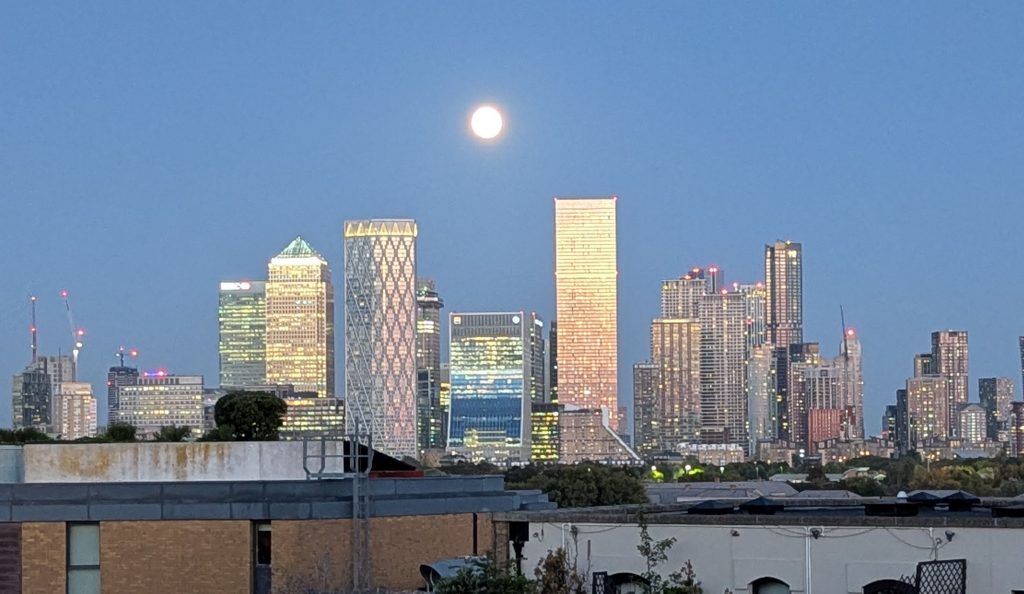
Harvest Moon (Oct 6th 25) over Canary Wharf from Wapping. (Photo K Flude).
The Harvest supermoon will rise at 6.20pm, today on October 7th 2025. It looked pretty full last night from my vantage point in a penthouse flat in Wapping. A supermoon is a full moon that occurs when the distance between the Earth and the Moon are at their minimum. So it is bigger and brighter and even more magical.
This one is known as the Harvest Moon or the Hunter’s moon for fairly obvious reasons.
It is definitely the time to play my favourite song.
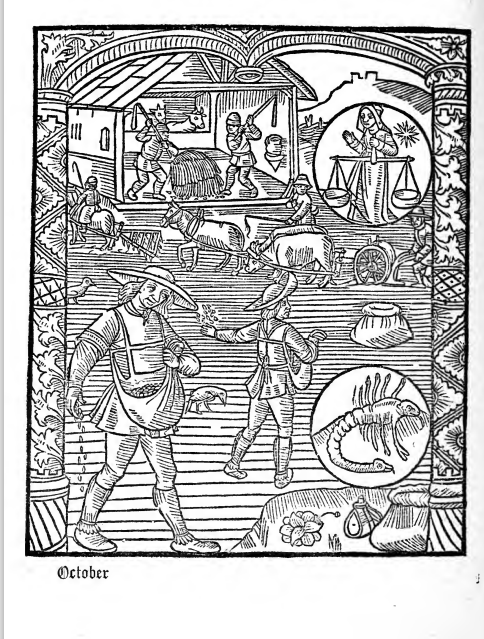
The 15th Century French illustration in the Kalendar of Shepherds shows October as a busy month. It is the time when the cereals are being flailed, the fields ploughed and sown. Perhaps winter wheat or barley or peas and beans?
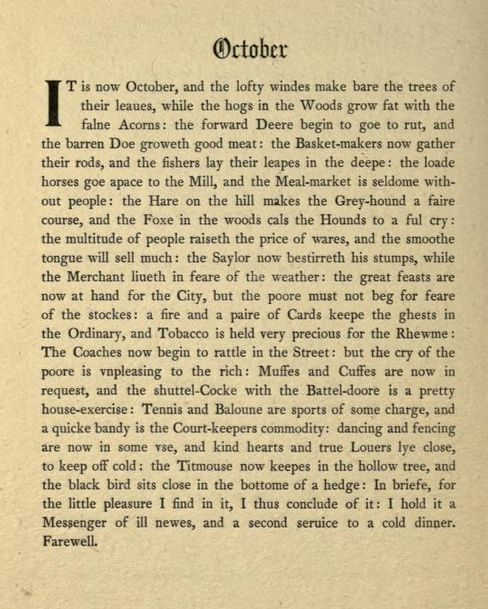
The 16th Century English text of the Kalendar of Shepherds (read the illustration) shows what a busy month it was, but the writer comes down hard against the month as ‘a messenger of ill news’ the harbinger of cold dark nights.
About the Kalendar of Shepherds.
The Kalendar was printed in 1493 in Paris and provided ‘Devices for the 12 Months.’ I’m using a modern (1908) reconstruction of it using wood cuts from the original 15th Century version. It includes various text from 16th and 17th Century sources. (Couplets by Tusser ‘Five Hundred Parts of Good Husbandrie 1599. Text descriptions of the month from Nicholas Breton’s ‘Fantasticks of 1626. This provides an interesting view of what was going on in the countryside every month.
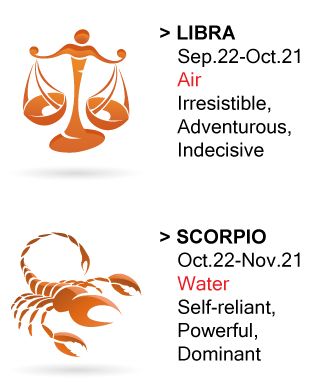
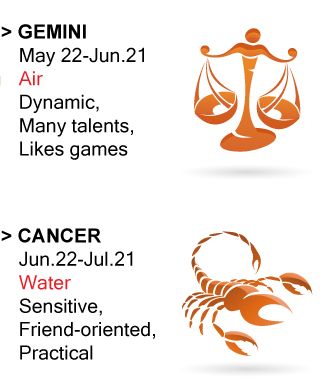
The star signs of October are the Scales of Libra and the Scorpion of Scorpio.
The star signs of October
Angelic October
Michael is the Angel of Autumn, the Angel of Judgement Day, and the Weigher of Souls. Uriel is the Angel of Libra and was sent by God sent to warn Noah. So the protector against, floods, fire and natural disasters. Scorpio’s Angel is Barbiel, he looks over health, genitalia and doubtful things. (‘An Angel Treasury’, Jacky Newcomb).
You might like to look at my post on Michaelmas here.
Roman October
In the Roman world it was, originally, the 8th Month (octo=8) but then they added January and February to the year. So it became the 10th Month. It was their time to celebrate the new wines of the Harvest. In Britain, the wine harvest is late September to October, but in hotter climes can be from July. But the grapes need to be processed, and the Romans thought that new wine was health giving and celebrated it in October.
Rustic October
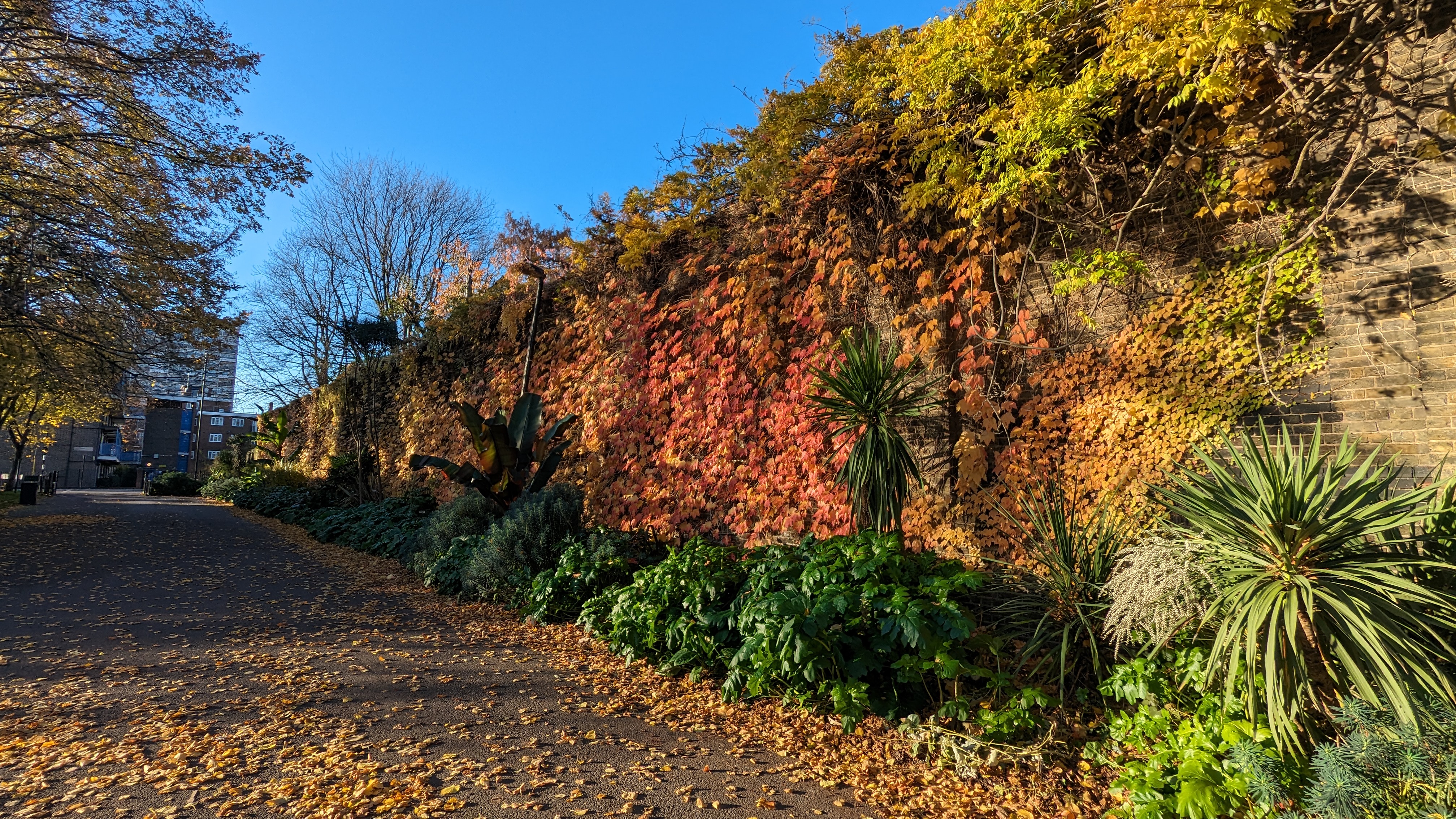
But for many people, October is a beautiful month. The dying leaves bring a sophisticated array of rustic colours, which makes the wooded countryside exceptionally beautiful.
Autumn in Haggerston Park, London (photo Kevin Flude)
It can still be warm enough to go for pleasant walks. And the surfeit of the harvest and the culling of animals meant there was plenty to eat before winter austerity begins.
Anglo-SaxonWinter Fall
The Venerable Bede tells us that the month was called Winterfylleth, in the 8th Century. The English divided the year into Summer and Winter. And Winter began for the Anglo-Saxons on the first full moon of October. This means that this year winter begins on 7th October. This is the Harvest or Hunter’s Moon, which is also a supermoon, the first of 3 ending the year.
Celtic October
In Welsh, it is Hydref, which also means Autumn. For the Welsh it was the last month of Autumn and the last month of the year. The Celtic new year, and winter starts on 1st November. The same is true of the Irish Calendar. Autumn is called Fómhair, and October Deireadh Fómhair which means ‘End of Autumn’.
Astronomical & Meteorological Autumn
Astronomically, autumn ends at the Winter Solstice and meteorologically at the end of November. So the Celtic Autumn ends a whole month or more earlier than the other measures. My very personal view is that Winter begins on November 5th more often than not. This is an evening we often spend outside watching the fireworks displays to celebrate Guy Fawkes’ Night. It always seems to be the first time that you feel cold enough to need hat, gloves, and scarves.
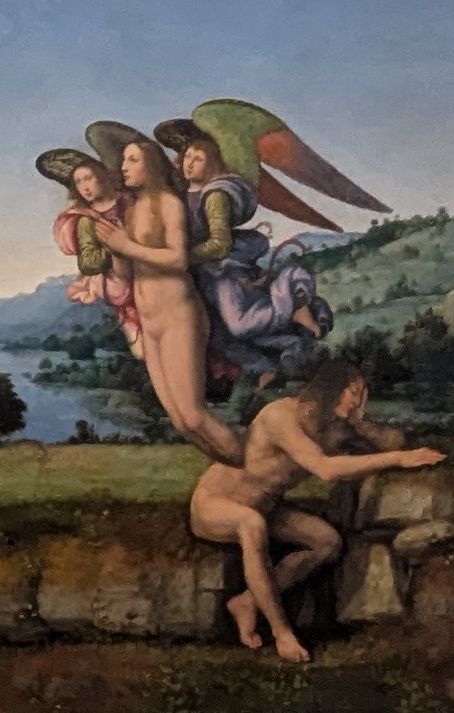
Detail from ‘The Creation and the Fall of Man’ by Mariotta Alberinelli 1513-14 showing Archangels helping in the creation of Eve from Adam’s Rib’
September 29th used to be St Michael’s Day, or Michaelmas. But in the 20th Century, the Catholic Church made it the day to celebrate the three chief Archangels and all Angels. Previously, September 29th was for St Michael, March 24th for St Gabriel, and October 24th for St Raphael.
It was an important day in the medieval civil calendar and was the date on which Oxford, Cambridge and the Legal system started their autumn terms. It is also the date the Lord Mayor of London is elected at Guildhall in the City of London.
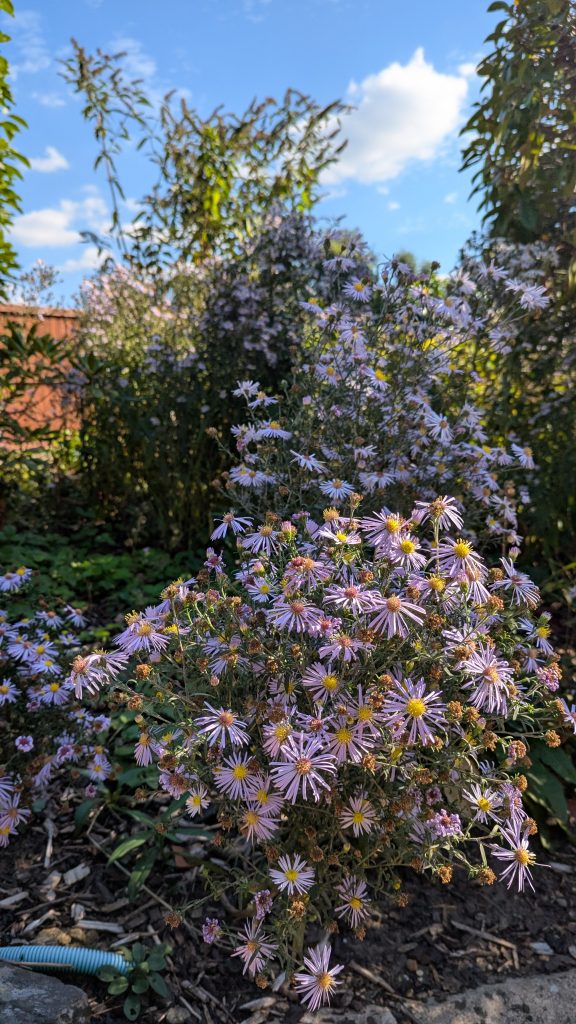
About this time, the Michaelmas Daisy (an Aster) comes out in profusion. They have been out in my Father’s garden since August, but have only been flowering for a few weeks in my own garden. Here is an old rhyme:
“The Michaelmas daisies, among dead weeds, Bloom for St Michael’s valorous deeds …
The Angelic Host
Personally, I don’t understand what Archangels are doing in a monotheistic religion. They seem to be supernatural demigods which seems odd. The Book of Revelations is one of the most important sources, but they are scattered around the Bible. Perhaps the most famous is the visitation of Gabriel to the Virgin Mary, (see my post here)They are 15 Archangels:Adabiel, Azrael, Chamuel, Gabriel, Haniel, Jeremiel, Jophiel, Melatron, Michael, Raguel, Raphael, Raziel, Sandalphon, Uriel, and Zadkiel.
Melatron has to be my favourite, given his name which sounds like something from a kids superheros cartoon! He is made from the human Enoch and Keeper of the Book of Life so perhaps the most powerful of the Archangels. He is good for relationship, career, and parenting advice!
The Book of Enoch mentions 200 Fallen Angels including Satan, but Alphonso di Spina a 15th Century Monk calculated there were 133 million fallen angels, one third of the original Angelic Host.
What are Angels for? Something to give us hope that somewhere, somehow something might be looking out for us? As Sir Antony Gormley says of the Angel of the North ;“People are always asking, why an angel? The only response I can give is that no-one has ever seen one and we need to keep imagining them.”
On This Day
1564 – Lord Dudley Created Earl of Leicester
‘After the service at St James on Michaelmas Day, Lord Robert Dudley was led by the earls of Sussex and Huntingdon into the queen’s presence chamber. He wore a black gown edged with lace with nineteen pairs of gold aglets on the sleeves. Before him, his brother Ambrose, Earl of Warwick bore his sword, Garter bore his patent and Lord Clinton, Lord Admiral, his cap and coronal. All made obeisance to the queen three times. Lord Robert knelt before her.
Garter gave the patent to Cecil, who read it out aloud. The Earl of Warwick presented the sword to the queen, who put it about the neck of her new Earl of Leicester, putting the point under his left arm and then, while putting his cap and coronal on his head, with a mischievous smile, tickled his neck. Solemn-faced, the new earl gave the queen his humble thanks and arose and went to the council chamber to dinner, trumpets sounding before him.’
From The Progresses and Public Processions of Queen Elizabeth by John Nichols (London, John Nichols & Son, 1823) with thanks to Jan Knights for the information.
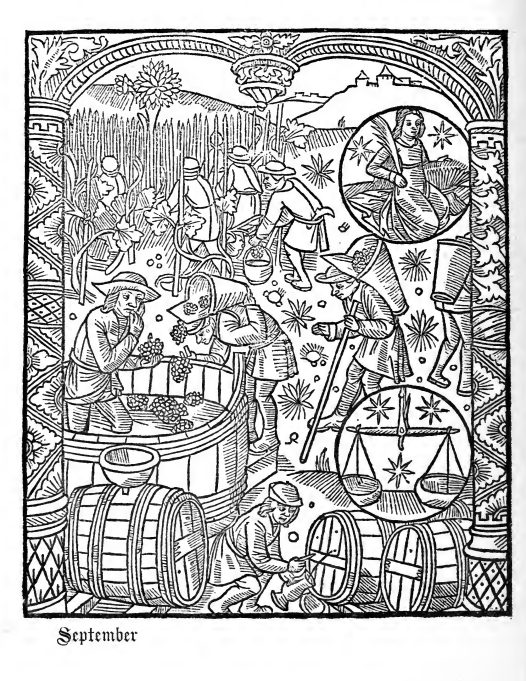
Kalendar of Shepherds illustration of September showing harvesting grapes and the astrological signs for Virgo (August 23 – September 22) and Libra (September 23 – October 22)
It is that time of the year when you say ‘Where has the Summer gone? It can’t be September already?’ But, meteorology, speaking, Autumn starts today. September 1st was chosen on a numerical basis for ease of measuring rather than any profound floral, agricultural or solar reason. So, there are three Gregorian Calendar months for each season, and each season starts on the first of the month. Autumn: September, November and December.
Autumn, Harvest, Fall
Autumn comes from Latin (autumnus) which went into French and then into English. The season was also called Harvest (which went into Dutch herfst, German Herbst, and Scots hairst -Wikipedia) or from the 16th Century: the ‘fall of the year’ or ‘fall of the leaf’ which spread to America as Fall.
Summer’s Ending
It still feels like summer. In England, we often have a glorious September, and what we can an ‘Indian’ Summer, an unexpectedly warm period in mid-September to October.
Solar Autumn
Of course, for the real Autumn, we have to wait for the Equinox, the beginning of Astronomical or Solar Autumn. This year, it is on Monday, September 22nd, 2025, 7:19 pm.
Astrological September
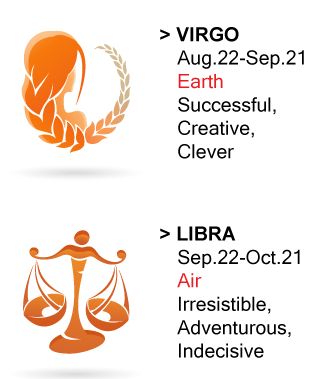
The star signs for astrological September are: Virgo which is linked to Aphrodite (Venus) the Goddess of Love and Libra which is linked to Artemis (Diana), virgin goddess of many things, including hunting, wild animals, children, and birth.
Star signs for September
September
September gets its name from the Romans, for whom it was the 7th Month of the year (septem is Latin for seven). Later, they added two new months so it became our 9th Month. (For more on the Roman year, look at my post here).
It is called Halegmonath in the early English language, or the holy month, named because it is the month of offerings, because of the harvest, and the mellow fruitfulness of September? Medi in Welsh is the month of reaping, and An Sultuine in Gaelic which means the month of plenty.
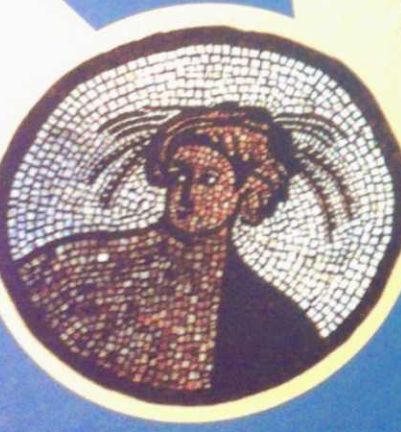
Roman personification of Autumn from Lullingstone mosaic
Early Modern September and the autumn of Life
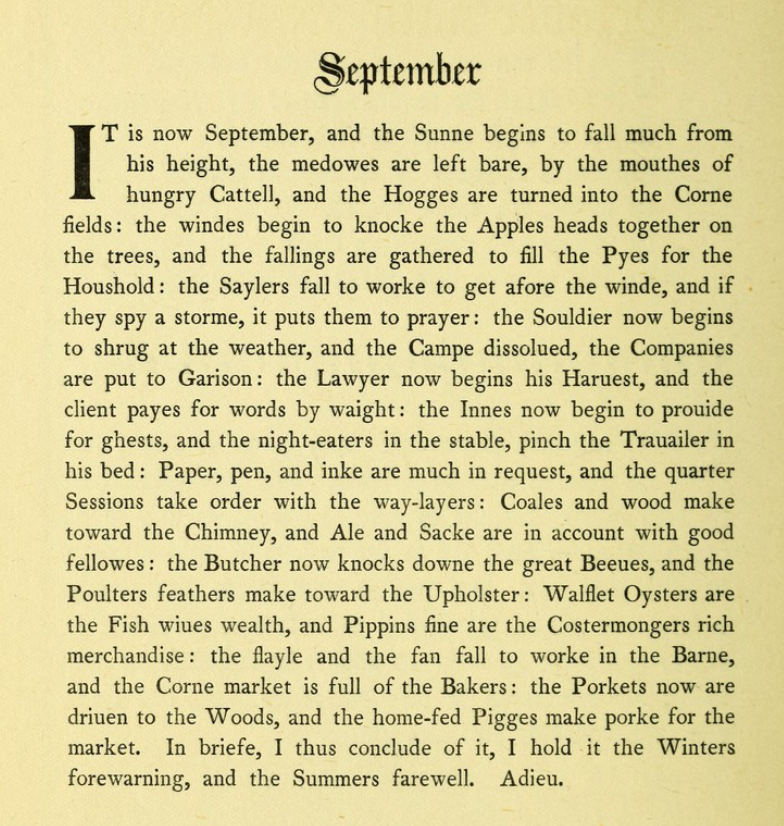
Here is an early 17th Century look at September from the Kalendar of Shepherds – for more on the Kalendar, look at my post here.
From the Kalendar of Shepherds
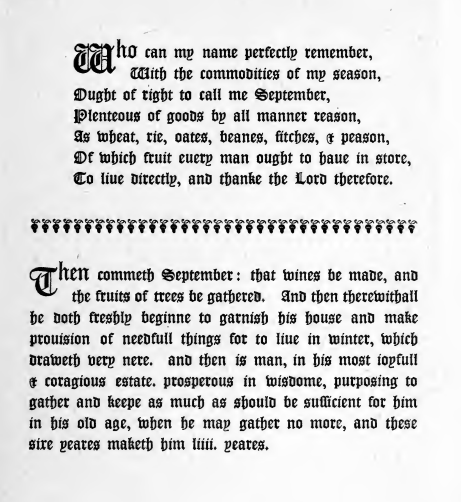
The Kalendar has an additional shorter look at September (see below). And it continues with its theme, linking the 12 months of the year with the lifespan of a man – 6 years for each month. So September is a metaphor for man at 56 years of age, in their prime and preparing for old age.
September from the Kalendar of Shepherds. The last sentence beginning ‘and then is man’ shows the link between September and the beginning of the autumn of life.
Season of ‘mists and mellow fruitfulness‘
John Keats (1795 – 1821) wrote a great poem called ‘To Autumn’:
Season of mists and mellow fruitfulness, Close bosom-friend of the maturing sun; Conspiring with him how to load and bless With fruit the vines that round the thatch-eves run; To bend with apples the moss’d cottage-trees, And fill all fruit with ripeness to the core; To swell the gourd, and plump the hazel shells With a sweet kernel; to set budding more, And still more, later flowers for the bees, Until they think warm days will never cease, For summer has o’er-brimm’d their clammy cells.
Who hath not seen thee oft amid thy store? Sometimes whoever seeks abroad may find Thee sitting careless on a granary floor, Thy hair soft-lifted by the winnowing wind; Or on a half-reap’d furrow sound asleep, Drowsed with the fume of poppies, while thy hook Spares the next swath and all its twined flowers: And sometimes like a gleaner thou dost keep Steady thy laden head across a brook; Or by a cider-press, with patient look, Thou watchest the last oozings, hours by hours.
Where are the songs of Spring? Ay, where are they? Think not of them, thou hast thy music too,— While barred clouds bloom the soft-dying day, And touch the stubble-plains with rosy hue; Then in a wailful choir the small gnats mourn Among the river sallows, borne aloft Or sinking as the light wind lives or dies; And full-grown lambs loud bleat from hilly bourn; Hedge-crickets sing; and now with treble soft The redbreast whistles from a garden-croft, And gathering swallows twitter in the skies.
Written September 19, 1819; first published in 1820. This poem is in the public domain and available here:
August was originally ‘sextilis’ or the 6th Month of the ten-month Roman Calendar. It became the 8th Month when January and February were added to the calendar to make a 12 month year. By tradition, this happened during the reign of King Numa Pompilius. Originally set as a 29-day month but changed to a 31-day month in the reforms of Julius Caesar. It was subsequently renamed August by a sycophantic Senate trying to flatter the divine Octavian, Emperor Augustus. (more of my posts about the Roman Calendar here and here)
The Celtic August
In modern Irish, it is Lúnasa, which means the month of the festival of Lughnasa. It is a harvest festival, celebrating the ripening of wheat, barley, rye, and potatoes. In Ireland, it is the festival of the God Lugh, celebrated with games, fairs, and ceremonies. Lughnasa is 6 months after Imbolc. It marks the ending of lactation of lambs and the beginning of the tupping season. (impregnation of the ewes). It can be celebrated by climbing hills, visiting springs, wells, lakes and eating bilberries. (Myths and Legends of the Celts. James MacKillop).
In Welsh, it is Awst which comes from the Latin. Called Calan Awst in Wales, it is the festival of August. In Gaelic Scotland it is called Lunasuinn, and Laa Luanistyn in the Isle of Man.
Lughnasa is one of the Celtic quarter days,. They are halfway between the Solstices and Equinoxes. They are: Samhain (1 Nov) Imbolc (1 Feb), Beltane (1 May) and Lughnasa (1 Aug). All are, or can be seen to be, a turning point in the farming year.
The Gallic Coligny ‘Celtic’ Calendar records August as a ‘great festival month’. The stone-carved Calendar was found near Lyon, whose Roman name was Lugodunum. The town is named after the Gaulish God Lugos. It is thought he is related to the Irish God, Lugh and the Welsh Llew Llaw Gyffes. He has an unstoppable fiery spear, a sling stone, and a hound called Failinis. The Romans associate Lugos with Mercury, and the Church associated Lugh with St Michael.
Lughnasa was founded by Lugh himself to honour his foster mother Tailtiu at Brega Co. Meath. Tailtiu became one of Ireland’s greatest festivals, springing from the horse races and marital contests set up by Lugh.
Anglo Saxon August
In Anglo-Saxon: the Venerable Bede, writing in the 8th Century, says August is Wēodmōnaþ or the Weed Month. Named because of the proliferation of weeds. Why does that seem such an unsatisfactory name for August? An early Kentish source calls the month Rugern – perhaps the month of the harvest of Rye? (Winters in the World by Eleanor Parker).
Lammas
For the Anglo-Saxons, August brings in the harvest period. This is the most important months of the year. The Harvest brings in the bounty of the earth. It needs to be carefully collected, enjoyed but not wasted. It begins with the festival of Lammas, which derives from the English words for bread and mass. The Bread Mass when bread made from the first fruits of the harvest is blessed.
Kalendar of Shepherds
Kalendar of Shepherds, August
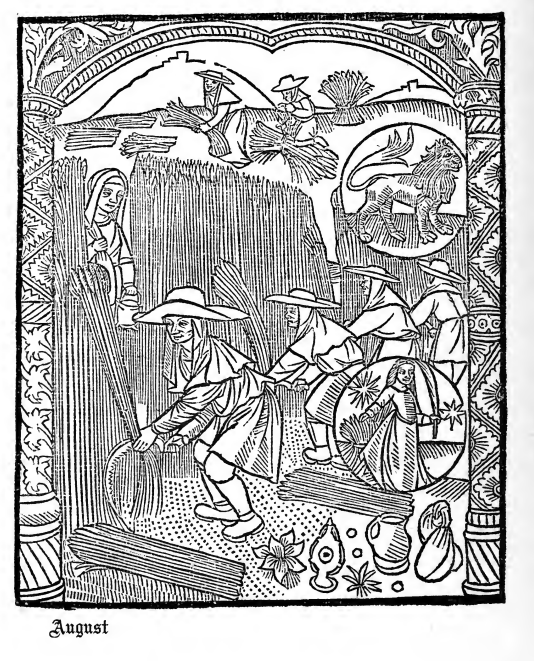
The 15th Century illustration in the Kalendar of Shepherds, above, shows that the Harvest is the main attribute of the Month, and the star signs, Leo and Virgo.
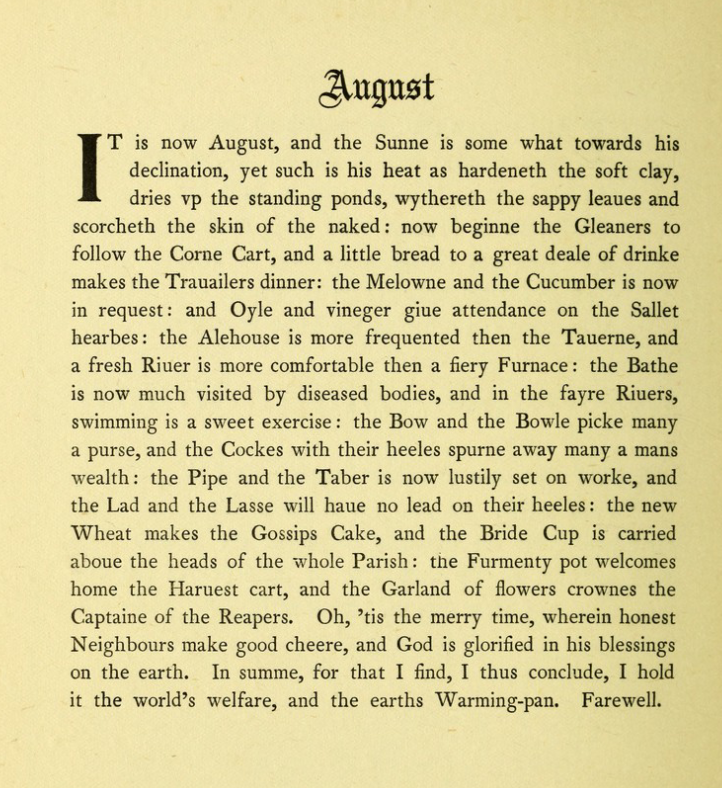
The 16th/17th Century text in the Kalendar of Shepherds gives an evocative insight into the month.
Screenshot of BBC Webpage annoucing the attack on the Stone of Destiny
I just tried to book a visit to see the Stone of Destiny, at Perth Museum. But I was told it was closed until at least the end of August. The reason being that a case had been damaged. A quick search revealed this notice that an Australian had attacked the case containing the Stone with a hammer. They are now repairing the Case, and double checking the condition of the stone, which is thought to be undamaged. The Stone is well protected in a special room of the Museum. But, until now, those booking to see it are not searched. So I imagine that this will become more formal in future.
Below is my post of 2024, updated on March 30th 2025.
New Home for the Stone of Destiny
Old Photograph of the Stone of Destiny beneath the Coronation Chair.
Last year, the Stone of Destiny was set up in its new permanent place. The Stone was unveiled in a room at the centre of the redeveloped Perth Museum, in Scotland. This is near to its ‘original’ home at the Palace of Scone.
‘£27m development project ….funded by £10m UK government investment from the £700m Tay Cities Deal and by Perth & Kinross Council, the museum is a transformation of Perth’s former city hall by architects Mecanoo.’
As well as the Stone of Destiny, the Museum has Bonnie Prince Charlie’s sword and a rare Jacobite wine glass. Both on public display for the first time. This is the first time the sword has been in Scotland since it was made in Perth in 1739. https://perthmuseum.co.uk/the-stone-of-destiny/. Since I first wrote this I have visited about 5 times. Entry is free but needs to be booked. It is held in a separate structure in the open space at the heart of the Perth Museum. There is an excellent-animated introduction, and then the doors open and the Stone is revealed in a glass cabinet. It is very effective.
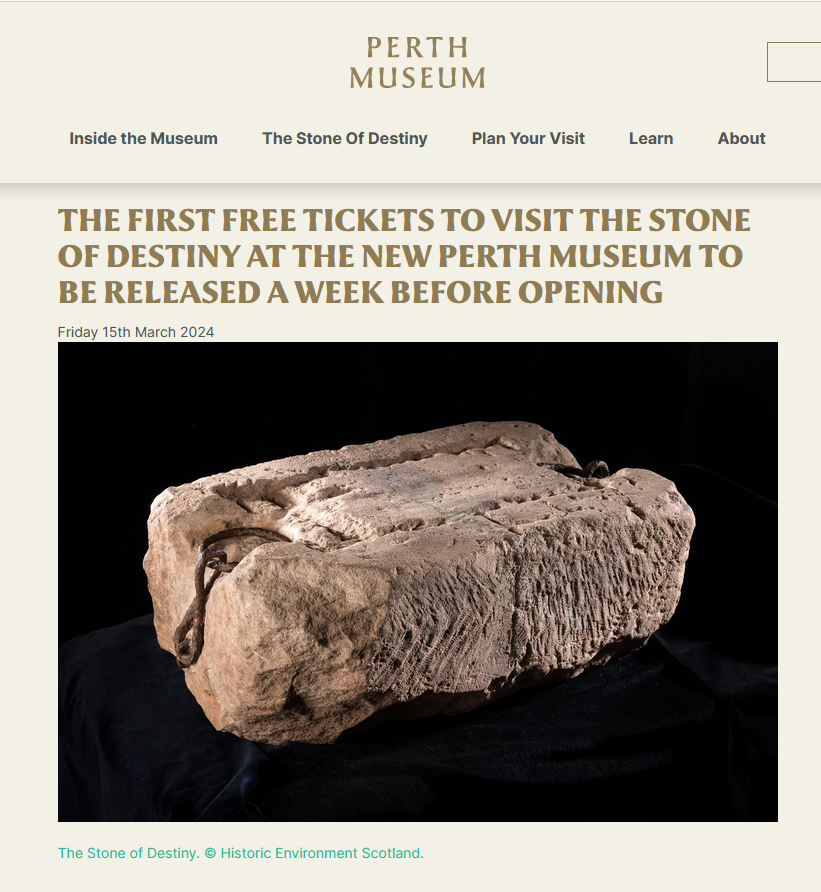
Webpage of the Perth Museum show a photo of the Stone of Destiny
The Stone of Destiny in the Modern Era
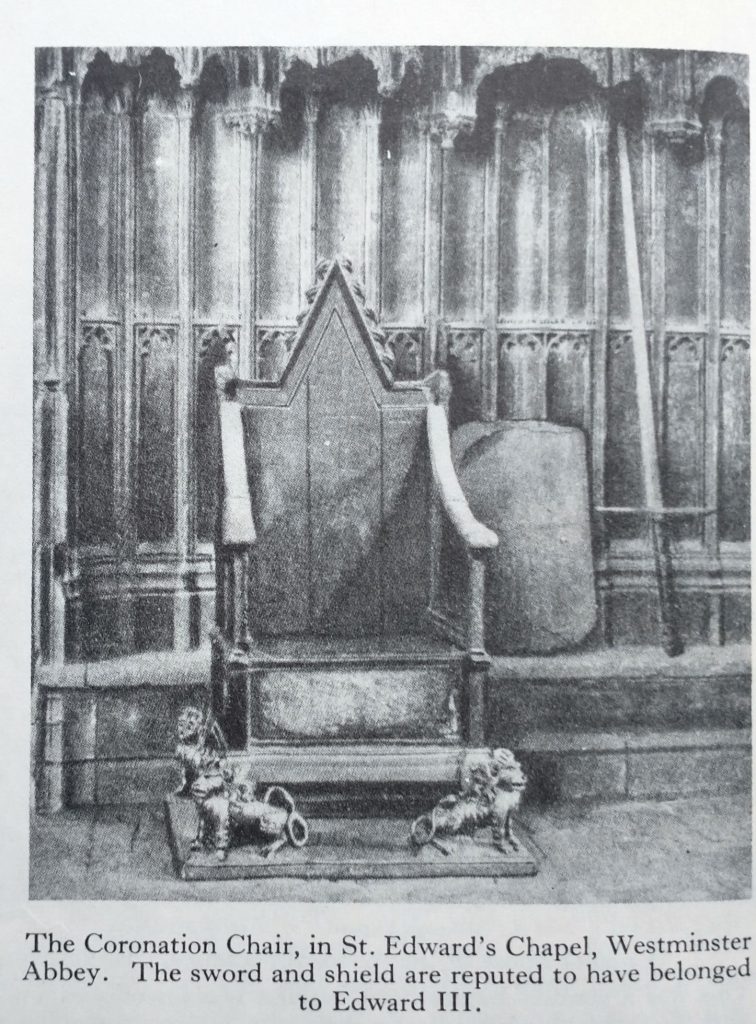
Before Perth, the Stone was in London for a brief visit for the Coronation of King Charles III (6 May 2023) . It was put back, temporarily under the Coronation Chair. Before that it was on display in Edinburgh Castle. Tony Blair’s Labour Government sent it back to Scotland as a symbol of the devolution of power from Westminster. This was on the occasion of the restoration of the Scottish Parliament in Edinburgh in November 1996. Until then the Stone was under the Coronation Chair, where Edward I put it after he stole it (1296) from Scone. Virtually every English and British King has been crowned upon the Stone of Scone.
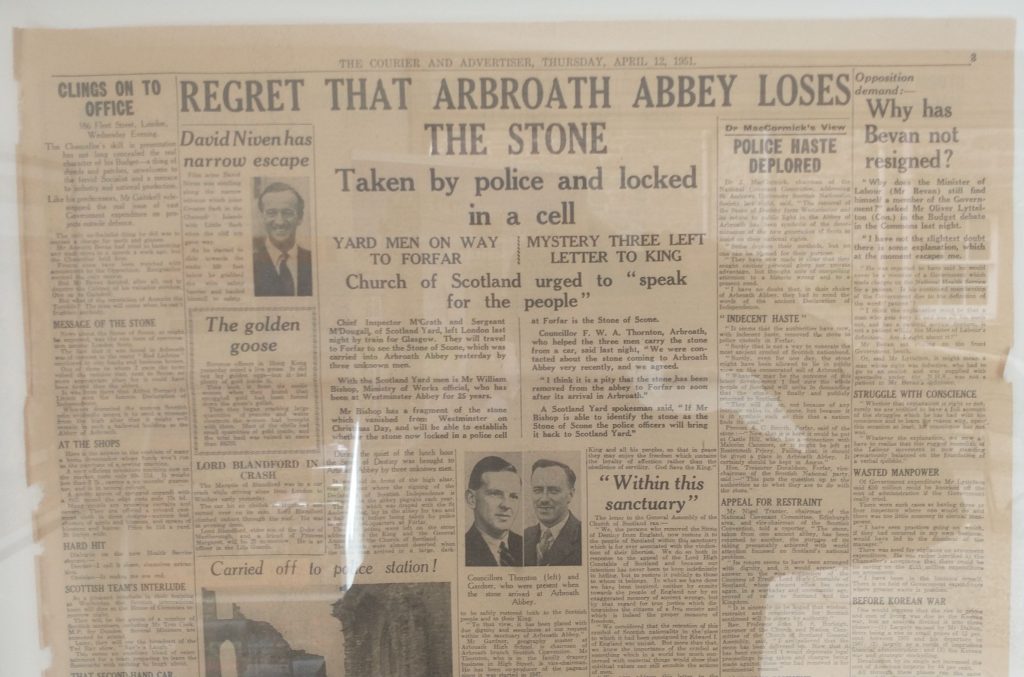
However, the Stone had a brief holiday in Scotland in 1950/51. Four Scottish students removed it from Westminster Abbey on Christmas Day 1950. After three months, it turned up at the high altar of Arbroath Abbey. It was briefly in a Prison Cell, then returned to Westminster for the Coronation of Elizabeth II.
Poor photograph of a press cutting on display at the Palace of Scone (Photo by me!)
Declaration of Arbroath
I’m guessing the-would-be liberators of the Stone, thought Arbroath was the most suitable place to return it. For it was the Declaration of Arbroath which is the supreme declaration of Scottish Independence from England.
Following the Battle of Bannockburn the Scots wrote to the Pope of their commitment to Scotland as an independent nation. They said:
“As long as a hundred of us remain alive, never will we on any conditions be subjected to the lordship of the English. It is in truth not for glory, nor riches, nor honours that we are fighting, but for freedom alone, which no honest man gives up but with life itself”
The Pope agreed and Scotland remained independent until voluntarily joining England in the United Kingdom in 1707.
Before Edward 1 stole the Stone, it was at Scone Palace. Here most of the Kings of Scotland were crowned, including Macbeth (August 14, 1040).
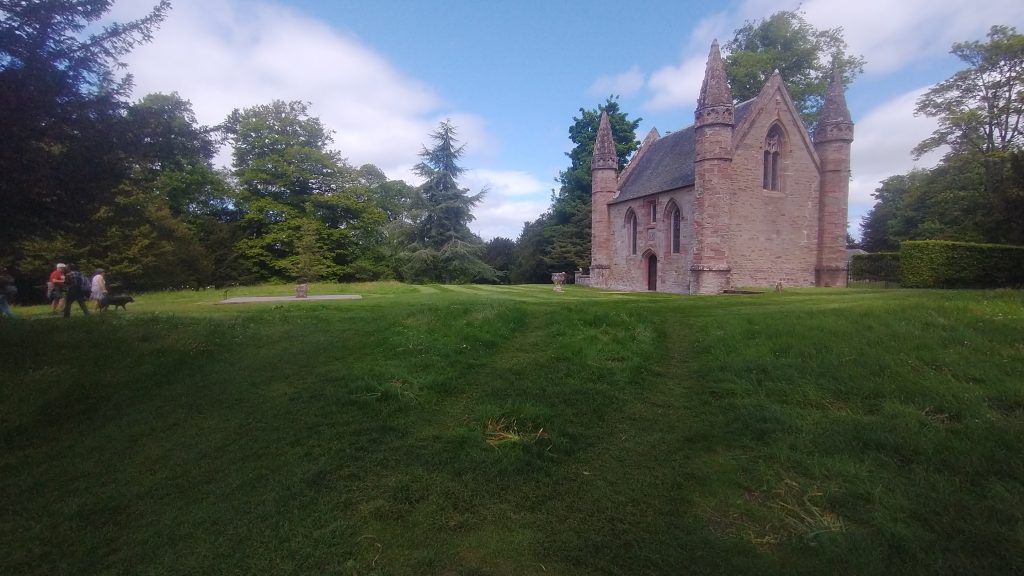
Moot or Boot Hill where Scottish Kings were crowned. Palace of Scone Photo Kevin Flude)
Those who attended the coronation traditionally shook their feet of all the earth they had brought from their homelands. This over the centuries, grew into Boot Hill, aka Moot Hill. So the mound represents the sacred land of Scotland. 42 Kings were crowned upon its soil on its Stone. (but not Mary Queen of Scots she and her son were crowned at the Chapel Royal of Stirling Castle).
Where was the Stone of Destiny before Scone?
Before Scone, it was, possibly, in Argyllshire where the Gaelic Kings were crowned. Their most famous King was Kenneth MacAlpin. He united the Scots, Gaelic people originally from Ireland, the Picts, and the British. And created a new Kingdom which was originally called Alba, but became Scotland.
MacAlpin was the first king to be crowned on the Stone at Scone in 841 or so. He made Scone the capital of his new Kingdom because it was a famous Monastery, associated with the Culdees, an early sect of monks. MacAlpin brought sacred relics from Iona to sanctify the new capital. And Scottish Kings were by tradition crowned at Scone and buried on the holy Island of Iona.
Legend has it that the Scots bought the Stone from Ireland when they began to settle in Western Scotland (c500AD). The Scots, it is said, got the Stone from the Holy Land. Jacob lay his head on the stone to sleep. He had a dream of Angels ascending and descending a ladder to Heaven. Jacob used the stone as a memorial, which was called Jacob’s Pillow (c1652 years BC).
Fake, Copy or Genuine?
But, questions about the Stone remain. Firstly, would the Monks of the Abbey meekly hand over the stone to a raging King Edward I? Sacking the Abbey was one of the last events of Edward’s failed attempt to unite the two countries. Isn’t it more likely that they hide the original and gave him a fake?
Secondly, was the Stone brought to Scone from Western Scotland in the 9th Century? Or was it made in Scone?
These questions of doubt are based on the assumption that the Stone is made of the local Scone sandstone. If it were brought to Scone from somewhere else, it would be in a different type of stone, surely? So, either it was made in Scone, possibly for MacAlpin’s Coronation or the Monks fooled the English into taking a copy. The English would then have been crowning their Monarchs on a forgery.
Ha! Silly English but then the Scots have spent £27m on the same forgery.
Before bringing the stone to Scone, Historic Environment Scotland undertook a new analysis of the stone. This confirmed:
‘the Stone as being indistinguishable from sandstones of the Scone Sandstone Formation, which outcrop in the area around Scone Palace, near Perth‘.
It also found that different stone workers had worked on the stone in the past. It bore traces of a plaster cast being made. It had markings which have not yet been deciphered. There was copper staining suggesting something copper or bronze was put on the top of it at some point in its life.
So it seems the Stone of Destiny was made in Scone. The simplest explanation is that it was made for MacAlpin in the 9th Century. But it does not rule out that it is a copy given to Edward I. But if this is the case it is still an awesome relic of history as so many Kings and Queens, Scottish and English, have been crowned upon it.
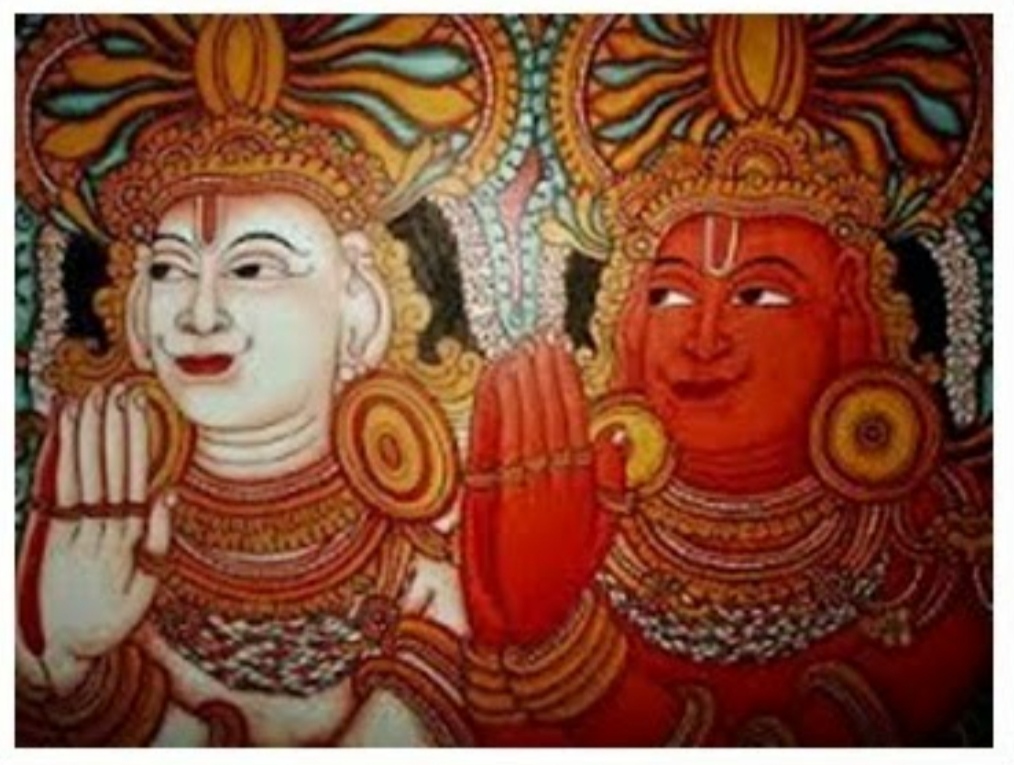
The Ashwini kumaras twins, sons of the sun god Surya. Vedic gods representing the brightness of sunrise and sunset Wikipedia
The Divine Twins, aka the Dioscuri, were horsemen. Patrons of calvary, athletes and sailors, one of many Indo-European twin gods. They had many adventures including sailing with Jason and the Argonauts.
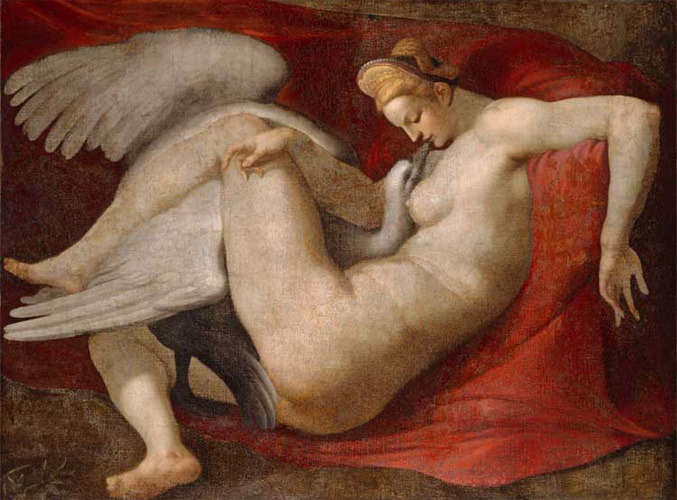
And are they well connected?! Pollux is the son of Zeus His twin brother has a different and mortal father, the King of Sparta. But the boys share the same mother, Leda. She was raped by Zeus in the guise of a swan.
This makes them examples of heteropaternal superfecundation as Mary Poppins didn’t sing. But their different paternity had consequences. The most important is that one was (is?) therefore immortal and the other wasn’t.
According to some version of the story, Castor (the mortal one) was mortally wounded. Zeus gave Pollux the option of letting his brother die while Pollux could spend eternity on Mount Olympus. The alternative was to share his immortality with his brother. Pollux did the good thing. So the twins spend half their year as the Constellation of Gemini and the rest, immortal, on Mount Olympus. Thus, they are the epitome of brotherly love.
Divine Twins or Sisters from Hell?
The Dioscuri’s sisters were no less than Helen of Troy and Clytemnestra. Never mind the Brothers, what Sisters! Helen of Troy you know. And Clytemnestra! They were also twins, Helen the divine daughter of Zeus, husband of Menelaus, lover of Paris. Sister, Clytemnestra, mortal daughter of the King of Sparta, husband of Agamemnon (brother of Menelaus).
It happened like this. The Swan was being pursued by an eagle, so Leda protected the Swan and took it to bed. On the same night she slept with her husband Tyndareus of Sparta. Two eggs were fertilised, each split in two to give two sets of twins.
She was the wife of Agamemnon, the arrogant leader of the Greeks. On the way to retrieve Helen from Troy, the Greek Fleet was becalmed. So, following his seers’ advice, Agamemnon sacrificed his own daughter, Iphigenia, on the island of Aulis. The Gods then set the winds fair to Troy. (Read Iphigenia at Aulis by Aeschylus, a great play which I studied in Classical Studies at University).
Meanwhile, Queen Clytemnestra, abandoned at home, broods on her husband’s heartless fillicide. She takes a lover. After 10 years of war, Agamemnon comes back, in triumph, from the destruction of Troy. He brings with him his prize, the Trojan Princess, Cassandra, sister of Hector.
Cassandra has been gifted with the ability of accurate prophecy. But, as often in the case of prophecy stories, the gift came with a sting in its tale. She was also cursed with the inability to get anyone to believe her! She prophesies disaster and that she too will be a victim.
Strutting with arrogance, Agamemnon demands Clytemnestra prepare him a bath. And, so she runs it for him, and she gives him the hottest bath possible. With the help of her lover, she hacks Agamemnon to pieces with an axe. Cassandra is butchered.
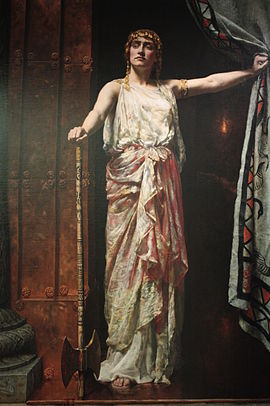
Clytemnestra by John Collier,_1882 (Wikipedia Guildhall Museum)
Attitudes
I visit John Collier’s painting of Clytemnestra at the Guildhall, in London, regularly. I am fascinated by her grim, yet satisfied, expression.
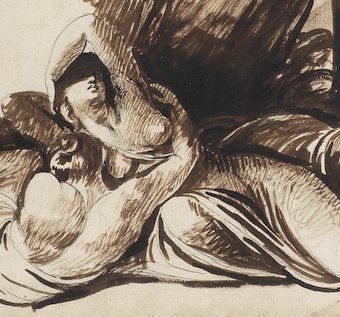
In the 18th/19th Century, rich people were into ‘attitudes’. For example, Emma Hart, later Lady Hamilton, would be invited to present an attitude in front of a dinner party of mostly male aristocrats. She would dress up in a flowing, revealing unstructured classical gown. Then she would stand on a table or pedestal, and present herself as Helen or Andromache or any other classical beauty guests might fancy an eyeful of. She would assume an appropriate facial expression and posture for everyone’s pleasure.
Detail of Emma Hart modelling as Iphigenia by George Romney in ‘Cimon and Iphigenia’
Being Clytemnestra is, surely, the most difficult? I imagine Collier’s model being prompted to look both sad at the loss of the daughter. Outraged at the arrogance of the husband. Horrified at the gore of the murder. But, overall, she has to portray a grim satisfaction that the bastard got exactly what he deserved.
Dorothy Dene
Lord Leighton had a famous model who was exceptionally skilled at adopting poses for his paintings. He determined to help her with an acting career. As part of the plan he helped improve her cockney accent. It is said this inspired Bernard Shaw’s story Pygmalion, which, in turn, inspired My Fair Lady and Eliza Doolittle.
Leighton’s model was Dorothy Dene. She became a famous actress, outstripping the fame of Ellen Terry and Lily Langtry. For more on Leighton and Dene look at my post here.
John Collier
Before we finish, do have a look at John Collier’s Wikipedia because he is the most ridiculously well-connected painter you can imagine! Related to half the Cabinet and married to TWO daughters of Darwin’s Bulldog, T.H. Huxley (grandfather of Aldous Huxley).
For more on Flaming June see my blog post of 12 July 2024
European Twin Gods
It is suggested that twin male gods are a feature of Indo-European religions. The divine Twins are associated with horses/chariots and are responsible for moving the Sun and the Moon. Their use of a horse above the water means that they can rescue people lost at sea.
St Elmo’s fire was said to be the way they manifested their divinity to sailors. Diodorus Siculus records that the Twins were Argonauts with Heracles, Telamon, and Orpheus. Further, he tells us, in the fourth book of Bibliotheca historica, that the Celts who dwelt along the ocean worshipped the Dioscuroi “more than the other gods”.
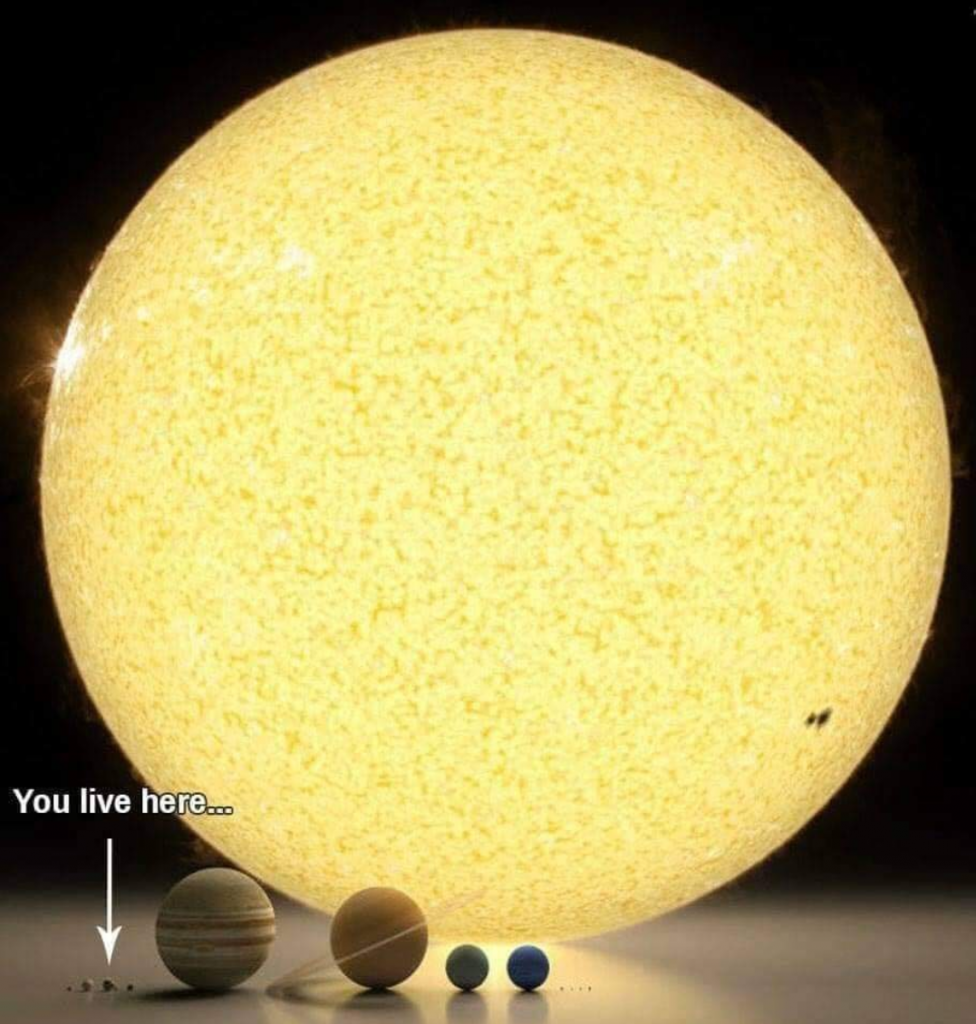
A gentle midsummer reminder of our place in the universe – source Facebook post.
Midsummer Solstice is the 21st of June. The Celtic version begins when the Celtic Day begins. This is at dusk on June 20th, which we would call Midsummer’s Eve. Midsummer, astronomically, begins on 21st June. But, meteorologically speaking, it has been here Summer since the beginning of June.
Midsummer is a fire festival, dedicated to the Celtic Fire God, Belinus. His name might mean Powerful One or Shining One, and he is linked to Apollo, one of the Greco-Roman Sun Gods. His main festival is Beltane, May Day, but many of the attributes of May celebrations and indeed Halloween celebrations are also carried out at Midsummer. (See my post on May Day)
In the early medieval period, the Church hijacked Midsummer’s Day and transferred it to June 24th. St John the Baptist’s Day. John was born 6 months before Jesus. John Aubrey in the 17th Century writes:
‘Still in many places on St John’s Night they make Fires on the Hills: but the Civil Warres coming on have putt all these Rites or customes quite out of fashion.’
The lark at heaven’s gate sings, And Phoebus ‘gins arise, His steeds to water at those springs. On chalic’d flowers that lies; And winking Mary-buds begin To ope their golden eyes; With everything that pretty is, My lady sweet, arise: Arise, arise.
Cloten Scene III Cymberline. William Shakespeare
Or words for a Druid watching the Sun rise?
Arise, O Sun! Let the Darkness of Night Fade before the beams of your glorious Radiance
Uncanny Summer
To prepare for Midsummer, remember that it is, like Halloween, an uncanny period. Hobgoblins, Fairies and Sprites, are, as in Shakespeare’s Play, Midsummer’s Night’s Dream, all abroad making mischief. Like May Fires, Belinus’ fire should be made from wood donated from all farms in the area, and using a range of trees. Ideally, collected by 9 men and from 9 different trees. Blazing branches should be carried sunwise around the fields to bless the crops, and it was good luck to jump over the ashes of the fire.
St John’s Wort
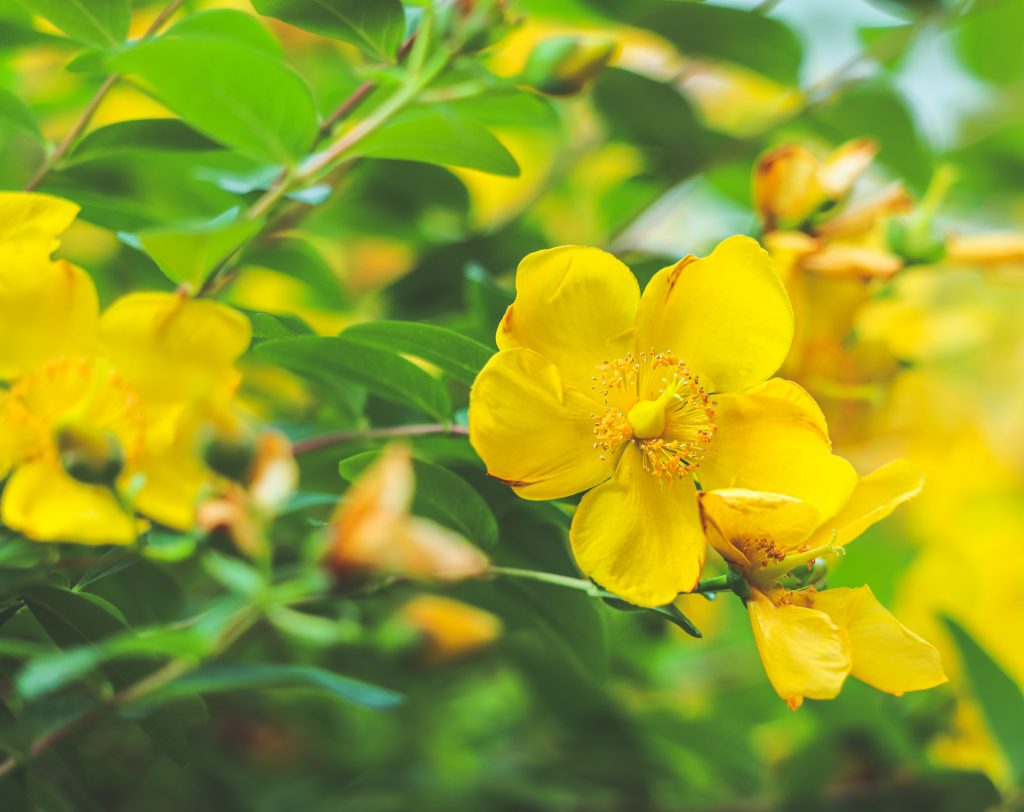
First in the line of defence against the infernal is St John’s Wort, known as Chasse-diable, Demon Chaser, Fuga Daemonum (amongst many other appellations). It was used to keep demons away, and to exorcise haunted houses. John Aubrey in ‘Miscellanies’ talks about a haunted London house which was cured by a Doctor who put St John’s Wort under the pillow of the bed. Bankes Herbel 1525 says:
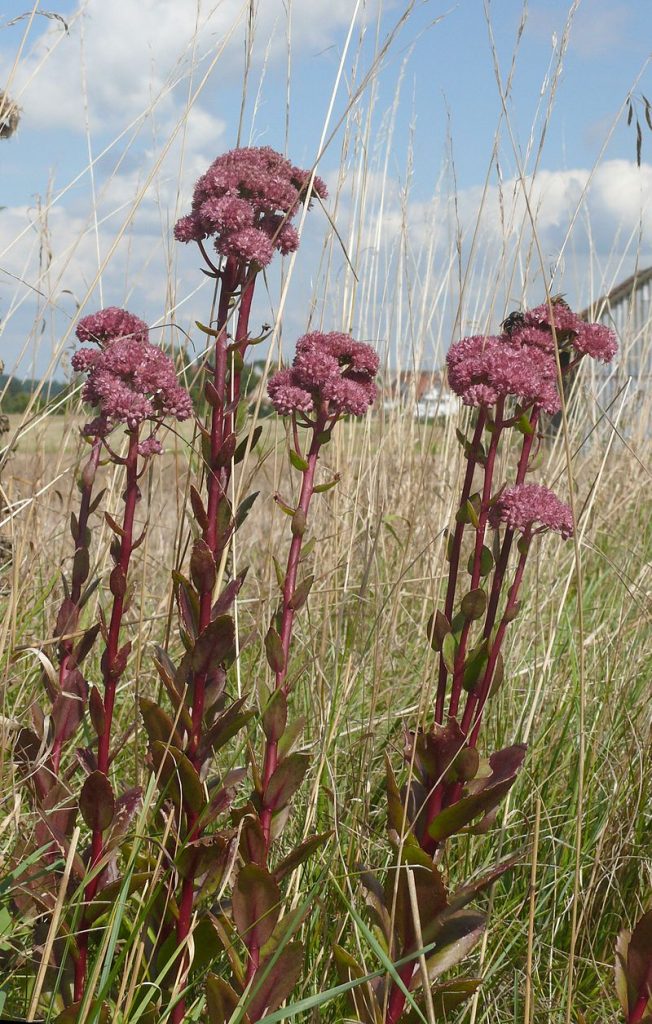
Sedum_telephium by Bernd Haynold wikipedia
‘The virtue of St John’s Wort is thus. If it be put in a man’s house, there shall come no wicked sprite therein.’
Vervain, yarrow, corn marigold, and orpins were also used, often woven into garlands, and hung around the necks of cows, or on door lintels as protection. If the St John’s Wort withered, the picker was to die or at least endure disappointment. If orpins entwined themselves on Midsummer’s Night, marriage would follow. Orpine, (Sedum Telephium) aka Live Long, or Life Everlasting was valued for the length of time it remained fresh after being gathered. Medicinally, it was considered good to use outwardly to cool scaldings, inflammations, and wounds.
St John’s Wort has a reputation for helping with depression, menopausal symptoms, ADHD, anxiety and other conditions.
A girl seeking love should walk around the Church seven or twelve times (accounts vary!) at midnight scattering hempseed, and singing:
Hempseed I sow Hempseed I hoe Let him that is my true love Come after me and mow
In the South West of England, there was a custom to watch the church porch on Midsummer Evening. This was when the spirits of all the living people of the village could be seen entering the church. Those not seen coming out again would surely die, as would any watcher foolish enough to fall asleep.
Thanks to the ‘Customs and Ceremonies of Britain’ by Charles Kightly.
First written in June 2023, and revised and republished in June 2024, and 2025
June is, probably, named after Juno, the leading lady of Olympus, sister and brother to the Great God Jupiter (Jove). In Welsh, it’s ‘Mehefin’ – Midsummer. In Gaelic, ‘An t’Og mhios’ – the Young Month. In Anglo-Saxon, ‘Litha’, the month of the Midsummer Moon.
I am in Ferrara where I worked on a joint UK/Italian excavation in the 1980’s. We are currently at a reunion, in the beautiful UNESCO World Heritage City. The weather is beautiful, and so are the people and the City! One of its gems is the Palazzo Schifanioa, which was the home of the Este Family, Dukes of Ferrara. Borso D’Este in the 15th Century initiated the frescos on the wall of the Hall of the Months. There is one for each month although not all survive in recognisable form. But above is June. The top panels show the Gods of the Month with their chariots or waggons. Below are the star signs for the month, and at the bottom a scene from 15th Century seen from an aristocratic perspective. June has a delightful agricultural scene. You will see more of these in future months. Although I won’t say much today as its difficult to do anything serious without a desk and a decent internet connection.
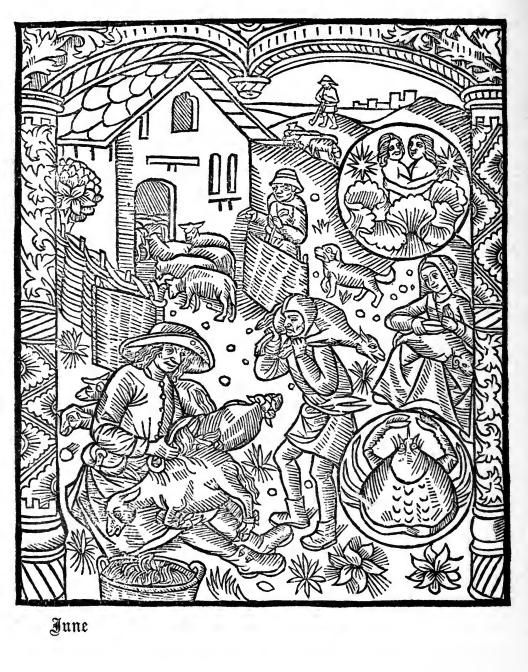
Kalendar of Shepherds. Title page for June
The picture above is from the Kalendar of Shepherds, with its 15th Century French Illustration. It shows shearing as the main occupation for the month but set within a flowery summer scene. In the roundels are the Gemini twins and the Cancer Crab, the star signs of June.
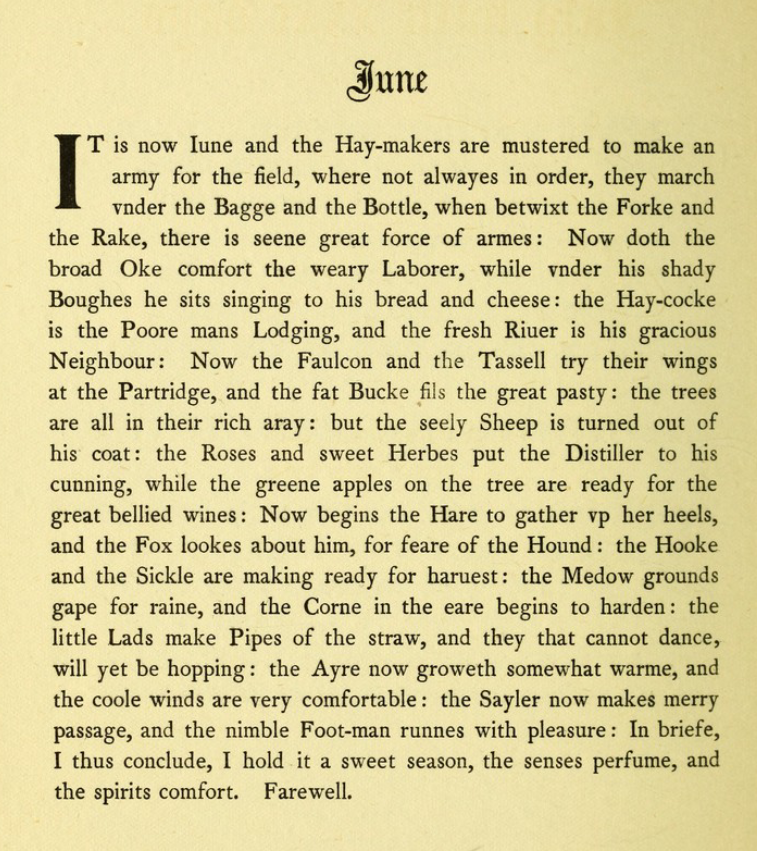
The text of the Kalendar of Shepherds gives a lyrical view of the joys of June:
From Kalendar of Shepherds, 17th Century Text Wellcome Library
June might come, not from Juno’s name, but from an Indo-European word for youth or vital energy. Ovid in Fasti, his poem about the Roman Year, lets Juno make her own case:
‘O poet, singer of the Roman year, Who dares to tell great things in slender measures, You’ve won the right to view a celestial power, By choosing to celebrate the festivals in your verse. But so you’re not ignorant or led astray by error. June in fact takes its name from mine. It’s something to have wed Jove, and to be Jove’s sister: I’m not sure if I’m prouder of brother or husband. If you consider lineage, I was first to call Saturn Father, I was the first child fate granted to him. Rome was once named Saturnia, after my father: This was the first place he came to, exiled from heaven. If the marriage bed counts at all, I’m called the Thunderer’s Wife, and my shrine’s joined to that of Tarpeian Jove. If his mistress could give her name to the month of May, Shall a similar honour be begrudged to me? Or why am I called queen and chief of goddesses? Why did they place a golden sceptre in my hand?’
In the previous Book (on May), Ovid told another story that June was named for young men.
‘So I deduce that the elders gave their own title To the month of May: and looked after their own interests. Numitor too may have said: ‘Romulus, grant this month To the old men’ and his grandson may have yielded. The following month, June, named for young men’ Gives no slight proof of the honour intended.’
The Latin for ‘Young men’ comes from the Latin iuvenis, “youth”)
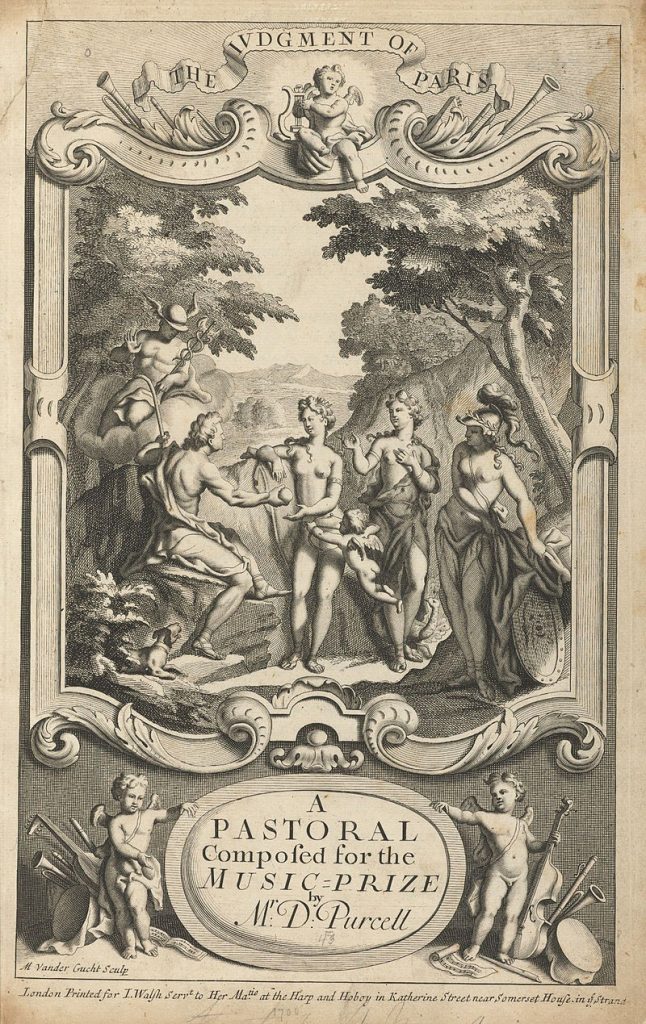
But let’s not go into Indo-European roots, and let’s simply accept the most wonderful month is named after Juno, the Queen of Goddesses, the deity of marriage and women. Probably most famous for hating the Trojans – she had a grudge against Paris, as he ruled against her in that famous divine beauty competition. And more seriously, what other reaction can the Deity of Marriage, have to the man who showed such disregard for the sanctity of marriage that he ran away with the already spoken for Helen?
The Judgment of Paris 1700 by Daniel Purcell. Houghton Museum (Paris, Venus, Juno, Minerva)
‘A sweet season, the senses perfume and the spirits comfort.’
First Written in June 2023 and revised June 2024, 2025