Time for a Tansy!

Tansy: by Georg Buzin (wikipedia)

Spring is time for a tansy, so time to bring out again the many stories behind this awesome plant.  The tansy not flowers display a classical  Fibonacci spiral, which is two counter-rotating  logarithmic spirals.

Mrs Grieve in her Modern Herbal repeats the belief that their name derives from the Greek word for immortality ‘Athanaton’.  This might be because they grow so well that in some areas they are proscribed they are so prolific. But Tansy was supposed to have been given to Ganymede by Zeus to make him immortal. And, they were used for preserving dead bodies from corruption. So, Tansy was placed in coffins and winding sheets and tansy wreaths placed with the dead.

Its toxicity means that it repels many insects, particularly, flies and ants, and so it was used as a medieval and early modern strewing herb. And yet there are other insects that love Tansy – it seems to have a dark side and a light side.

It was collected in August (along with meadowsweet or elder leaves) and strewn on the floors of houses (and the ‘thresh’ was held in by the threshold). But it was also placed between mattresses to keep away bugs. People rubbed meat with Tansy to keep flies off. It is now used as a natural protection for crops from insects to reduce the amount of artificial pesticides.

It was an important medical and culinary herb, said to be a substitute for nutmeg and cinnamon, and the leaves, shredded, as a flavouring for puddings and omelettes. At Easter ball games a Tansy Cake was the reward for the winners. It was symbolic of the bitter herbs eaten by the Israelites at Passover. Tansy was thought to be a very wholesome ingredient to eat after the sparsity of Lent and Winter, and voiding the body of the worms caused by eating too many fish. It was used for expelling worms from the stomachs of children.

Interestingly it contains thujone, which is also in Wormwood, the other main herb for expelling intestinal worms. Thujone can cause convulsions, liver and brain damage if too much is taken.

In the 14th Century it was used for treating wounds. It was thought to be useful both to induce abortions but also to help women conceive and to prevent miscarriages. Culpepper and Gerard suggests the root was a cure for gout.

Here is a recipe from the ‘The Closet of Kenelm Digby Opened‘ 1669. It was essentially a form of omelette. I would not try the recipe! In the BBC documentary “The Supersizers go … Restoration“, Sue Perkins suffered from the effects of the toxic tansy.

A TANSY (Do not try this at home!)

Take three pints of Cream, fourteen New-laid-eggs (seven whites put away)
one pint of juyce of Spinage, six or seven spoonfuls of juyce of Tansy, a
Nutmeg (or two) sliced small, half a pound of Sugar, and a little Salt.
Beat all these well together, then fryit in a pan with no more Butter then
is necessary. When it is enough, serve it up with juyce of Orange or slices
of Limon upon it.

Sir Kenelm Digby was a Catholic and a natural philosopher of some reputation. After his death an employee published his cookery book. His father was executed after the Gunpowder Plot, and he supported Charles 1st but found a way to work with Oliver Cromwell.

He made a great success of his idea of the ‘powder of sympathy’ – 29 editions of his book on the subject were sold. He found the powder in France and it was made with precise ‘astrological’ techniques. The most famous example of a suggested application for the powder was to win the competition for a method of working out longitude (in the 18th Century). Basically, a working method meant knowing the time, normally noon, in two different places. This allowed a triangle to be created between the two points and the Sun which allowed the distance between the two places to be discovered by triangulation. Clocks were not accurate enough (yet) to help so Digby’s famous powder of sympathy was suggested.

This is the method:

A wounded dog would be taken on board a ship, and a bandage from the wound would be left in London. At noon in London it would be sprinkled with the powder of sympathy. The dog on the ship would, perforce, yelp when the powder was administered on the bandage in London and so the Captain would know when it was noon in London! Digby was long dead when the application for the prize money was made and rejected.

‘Longitude’ by Dava Sobel tells the story of the discovery of a clock-based method of calculating longitude.

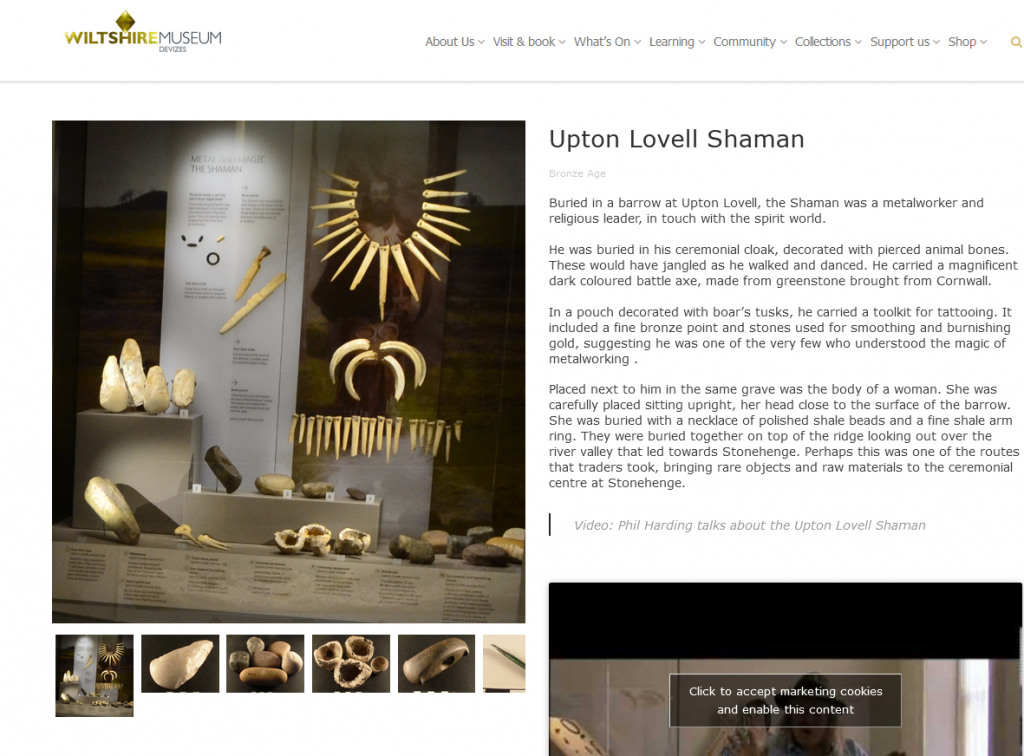
Upton Lovell Shaman becomes a Goldsmith

‘Materials in movement: gold and stone in process in the Upton Lovell G2a burial’

Upton lovell 'shaman' display wiltshire museum
Screenshot from Wiltshire Museum web site

The journal Antiquity reports amazing discoveries in a paper called : Materials in movement: gold and stone in process in the Upton Lovell G2a burial and citing that the paper is

‘advancing a new materialist approach, we identify a goldworking toolkit, linking gold, stone and copper objects within a chaîne opératoire,

Setting aside what ‘new materialism’ and ‘chaîne opératoire’ are for the moment. Briefly, their analysis of the objects found in the Bronze Age burial of two people evidence that the person(s) identified as a ‘shaman’ on the basis of clothing/jewellery was (as well?) a gold worker. What is amazing is that they were using Neolithic axes which would have been hundreds of years old to make gold sheets. There was also evidence interpreted as tattooing instruments. As Upton Lovell is 12 miles from Stonehenge it means this is big news in the archaeological world, making most of the newspapers.

The authors dig deeper into the meaning of ‘New materialism’:

‘This approach advances on traditional technological studies in two ways. First, whereas materials are usually approached as having fixed properties, new materialists argue that these properties emerge relationally; they change through time and in combination with other materials, people and places (cf. Barad Reference Barad2007; Bennett Reference Bennett2010). Second, ‘making’ is seen not as the simple imposition of the will of a maker on an inert material but, instead, materials play an active role in the process.’

Widipedia gives a definition of chaîne opératoire

To put it more simply objects have complicated histories and contexts. You might also like to look at the original article (link below) which is written in a very strange style which gives the objects agency ‘an active role in the process’. Below is the conclusions of the article.

Conclusions

Drawing on microwear, residue analysis and new materialist theory, we have reassessed the Upton Lovell G2a grave assemblage. The empirical techniques attend to the materials, which are reinvigorated by situating them within this emergent theoretical landscape. These approaches reveal how the grave goods disclose an intertwining set of processes. Never static, these objects changed and shifted, requiring modification, repair and reuse. They speak to a complex interweaving of bodies—human and non-human—and their varied histories. There is far more complexity here, in relations, histories, gestures and processes, than could ever be captured under the label ‘shaman’, ‘metalworker’ or ‘goldsmith’. Grave goods are more than representations of a person’s identity. They are more even than critical relations in the construction of identity (cf. Brück Reference Brück2019). What these grave goods stress, when attention is paid to their stories, is quite different. They speak of material journeys, the colour of stone and the texture of gold capturing relations that flow across landscapes. Collectively, as an assemblage, these stone tools reveal a process of goldworking. But this goldworking involves as much the working of stone, in the shaping and upkeep of tools, as it does of metal. Here, we emphasise the repetitive and iterative nature of our chaîne opératoire, each action calling into being further moments of renewal of the polished stone surfaces so essential to the qualities other materials elicited. This goldworking chaîne opératoire is multi-material; it is as much a process in stone working as it is in the working of metal. From this perspective, the similarities in processing and working gold and stone mean that the former emerges as far more like the latter than our modern taxonomies would suggest.’

Materials in movement: gold and stone in process in the Upton Lovell G2a burial

If we analyse this conclusion based on the literary idea of ‘Point of View‘ you will see that the POV of the piece above is just bonkers. There is the ‘we’ of the authors, and the ‘they’ of the objects. ‘They’ are speaking to ‘bodies – human and non-human’. ‘They’ even have the ability to ‘stress’ an issue once ‘attention is paid to their stories’ and to be ‘reinvigorated’.

But its a very interesting find and analysis and does remind us that things are much more complicated than we realise.

I have republished my post of the Chinese New Year which you can see here:

I have republished my post of the Chinese New Year which you can see here:

I have republished my post of the Chinese New Year which you can see here:

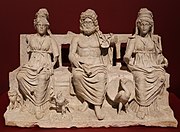
Epulum Jovis – The Capitoline Cult

Capitoline Triad – Museum of Guidonia (Wikipedia)

This was the second festival in the year dedicated to the three most important deities in the Roman pantheon. Jupiter the Sky God, God of Justice, God of Rome. His wife and sister, ‘Queen’ Juno, protector of women. Minerva, Daughter of Jupiter. Goddess of Wisdom and Craft.

The main Temple was in Rome on the Capitoline Hill, known as aedes Iovis Optimi Maximi Capitolini (“Temple of Jupiter Best and Greatest on the Capitoline”). Similar temples spread throughout the Roman world, normally with a triple cella (inner sanctum) to allow separation of worship between the three cults.

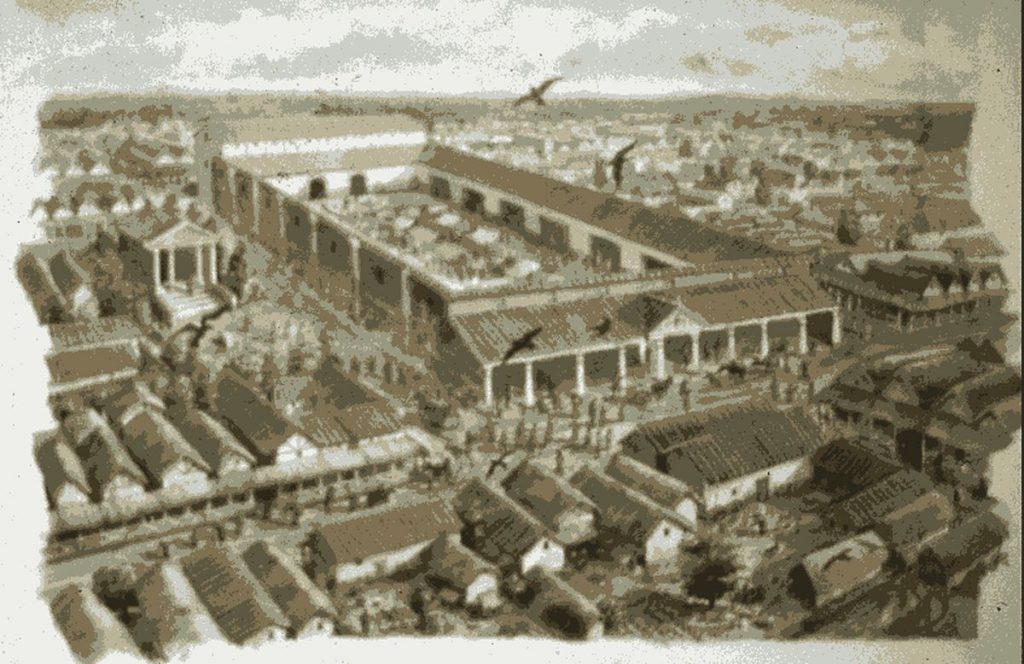
In London, a temple was discovered to the west of the first Forum (built AD 75). There is no clue as to its dedication, but the Capitoline Cult has been suggested as well as for the Cult of the Emperor.

Painting of the Roman Forum of London from the air
Painting of the Roman Forum of London from the air (Note Temple on the left)

Originally posted on November 12th, 2021. Revised November 15, 2023