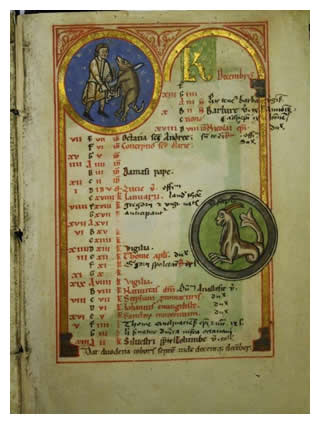
December and Kalendar of Shepherds December 1st

French 15th Century December and the ‘Kalendar of Shepherds’

December comes from the Latin for ten – meaning the tenth month. Of course, it is the twelfth month because the Romans added a couple of extra months especially to confuse us. For a discussion on this, look at an early blog post which explains the Roman Calendar.

In Anglo-Saxon it is ærra gēola which means the month before Yule. In Gaelic it is An Dùbhlachd – the Dark Days which is part of An Geamhrachd, meaning the winter. The word comes from an early Celtic term for cold, from an ‘ancient linguistic source for ‘stiff and rigid’’, which describes the hard frosty earth. (see here for a description of the Gaelic Year). In Welsh, Rhafgyr, the month of preparation (for the shortest day).

For the Christian Church, it’s the period preparing for the arrival of the Messiah into the World. (see my post on Advent Sunday which this year was yesterday November 30th).

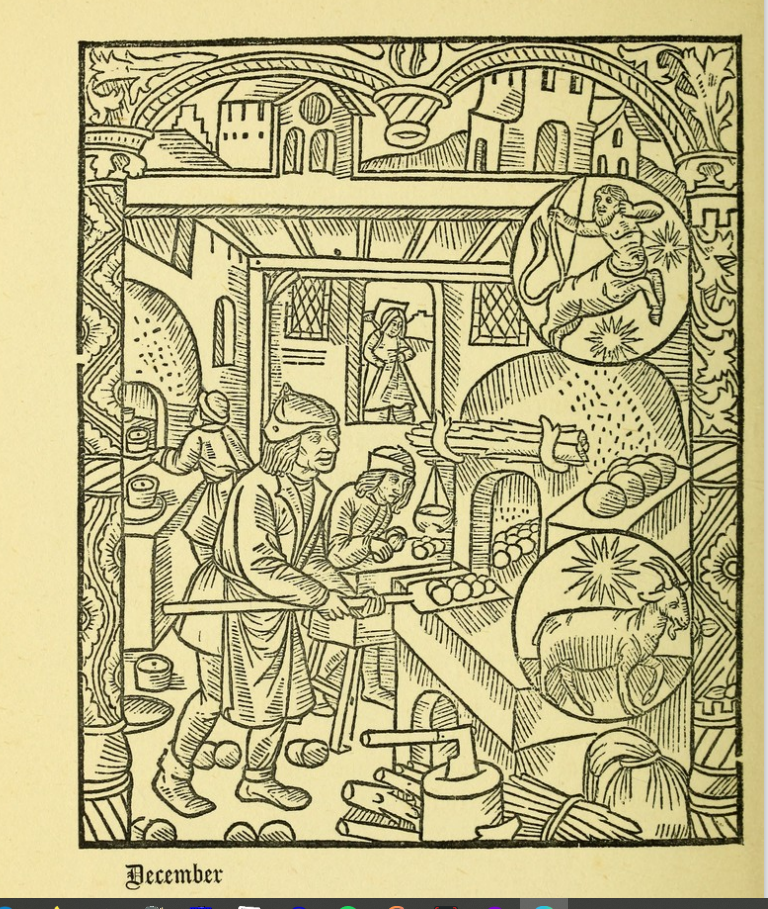
For a closer look at the month, I’m turning to the 15th Century Kalendar of Shepherds. Its illustration (see above) for December shows an indoor scene, and is full of warmth as the bakers bake pies and cakes for Christmas. Firewood has been collected, and the Goodwife is bringing something in from the Garden. The stars signs are Sagittarius and Capricorn.

The Sparrow and the Warm Hall

The Venerable Bede has an interesting story (reported in ‘Winters in the World’ by Eleanor Parker) in which a Pagan, contemplating converting to Christianity, talks about a sparrow flying into a warm, convivial Great Hall, from the bitter cold winter landscape. The sparrow enjoys this warmth, but flies straight out, back into the cold Darkness. Human life, says the Pagan, is like this: a brief period in the light, warm hall, preceded and followed by cold, unknown darkness. If Christianity, he advises, can offer some certainty as to what happens in this darkness, then it’s worth considering.

This contrast between the warm inside and the cold exterior is mirrored in Neve’s Almanack of 1633 who sums up December thus:

This month, keep thy body and head from cold: let thy kitchen be thine Apothecary; warm clothing thy nurse; merry company thy keepers, and good hospitality, thine Exercise.

Quoted in ‘the Perpetual Almanack of Folklore’ by Charles Kightly

December in the ‘Kalendar of Shepherds’

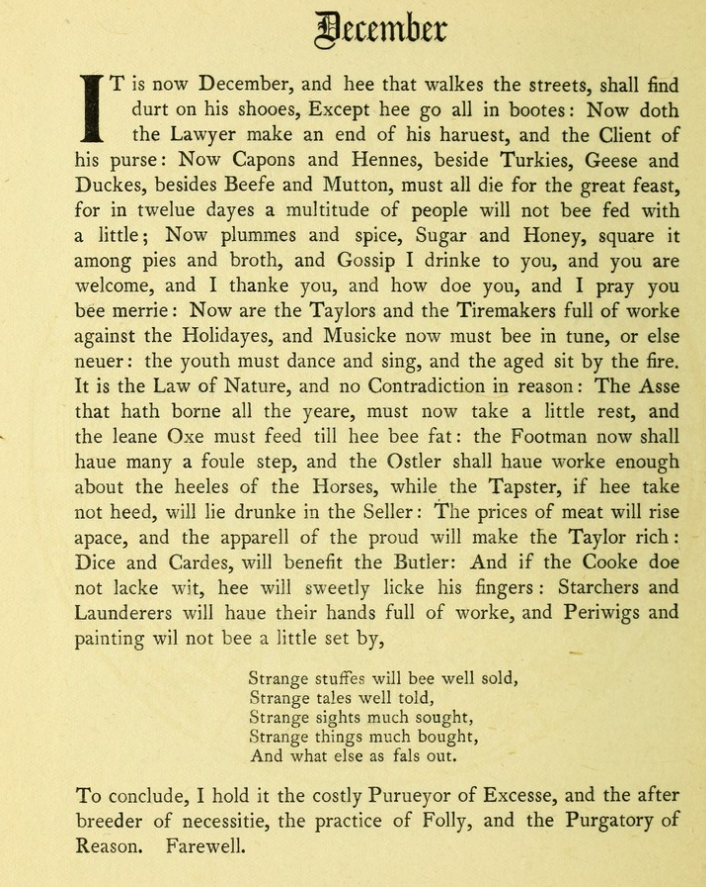
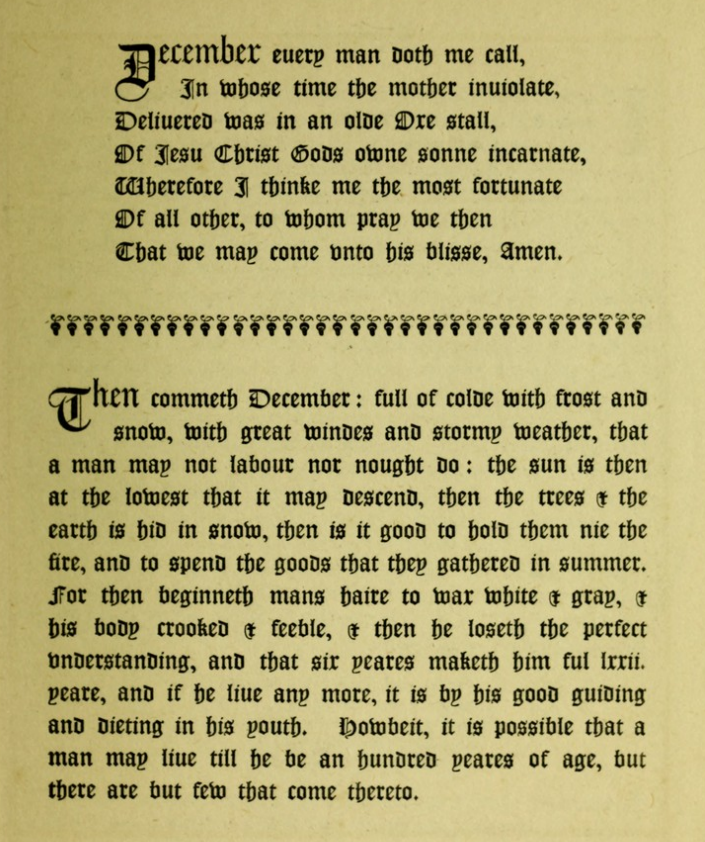
The Kalendar of Shepherds text below gives a vivid description of December weather. Dating from 1626 it gives a detailed look at the excesses of Christmas, which people are on holiday, and who is still working hard. But it concludes it is a costly month.

Nicholas Breton’s ‘Fantasticks of 1626 – December from the Kalendar of Shepherds

Six Dozen Years – a Lifespan

The other section of the Kalendar then elaborates on the last six years of a man’s life, with hair going white, body ‘crooked and feeble’. (from 66 to 72). The conceit here is that there are twelve months of the year, and a man’s lot of ‘Six score years and ten’ is allocated six years to each month. So December is not just about the 12th Month of the Year but also the last six years of a person’s allotted span. The piece allows the option of living beyond 72, ‘and if he lives any more, it is by his good guiding and dieting in his youth.’ Good advice, as we now know. But living to 100 is open to but few.

Kalendar of Shepherds

Interesting from my point of view as I have reached the end of my life span as suggested by the Calendar, and my father is 98 and approaching his hundred!

About the Kalendar of Shepherds.

The Kalendar was printed in 1493 in Paris and provided ‘Devices for the 12 Months.’ The version I’m using is a modern (1908) reconstruction of it. It uses wood cuts from the original 15th Century version and adds various texts from 16th and 17th Century sources. (Couplets by Tusser ‘Five Hundred Parts of Good Husbandrie 1599. Text descriptions of the month from Nicholas Breton’s ‘Fantasticks of 1626.) This provides an interesting view of what was going on in the countryside every month.

For more on the Kalendar look at my post here.

The original Kalendar can be read here: https://wellcomecollection.org/works/f4824s6t

To see the full Kalendar, go here:

On This Day

1981 – Launch of the BBC Micro

1990 The UK was rejoined to Europe for the first time for 8000 years, when the Channel Tunnellers breached the final wall of rock. French and British workers exchanged flags and shook hands. The Tunnel was opened to traffic in 1994 more than 10 years after work started and 200 years since Napoleon proposed the idea. Read what ICE has to say about the (ICE – Institute of Civil Engineers!).

Britain was connected to the Continent until about 6,100BC, the North Sea, the Channel, and the Irish Sea were all dry (or marshy lands). Water levels were rising and ice melting. the Storegga Slides in Norway saw huge cliffs of ice slipped into the sea. This caused a tsunami over 30ft high and penetrating 25 miles inland. Read the BBC here.

Since then, Britain has been an Island. Archaeologists have been exploring the flooded area which is known as Dogger Land, after the Dogger Bank. (for more on Dogger Land.)

First Published in 2024, republished 2025

Thanksgiving Day in the USA (4th Thursday in November)

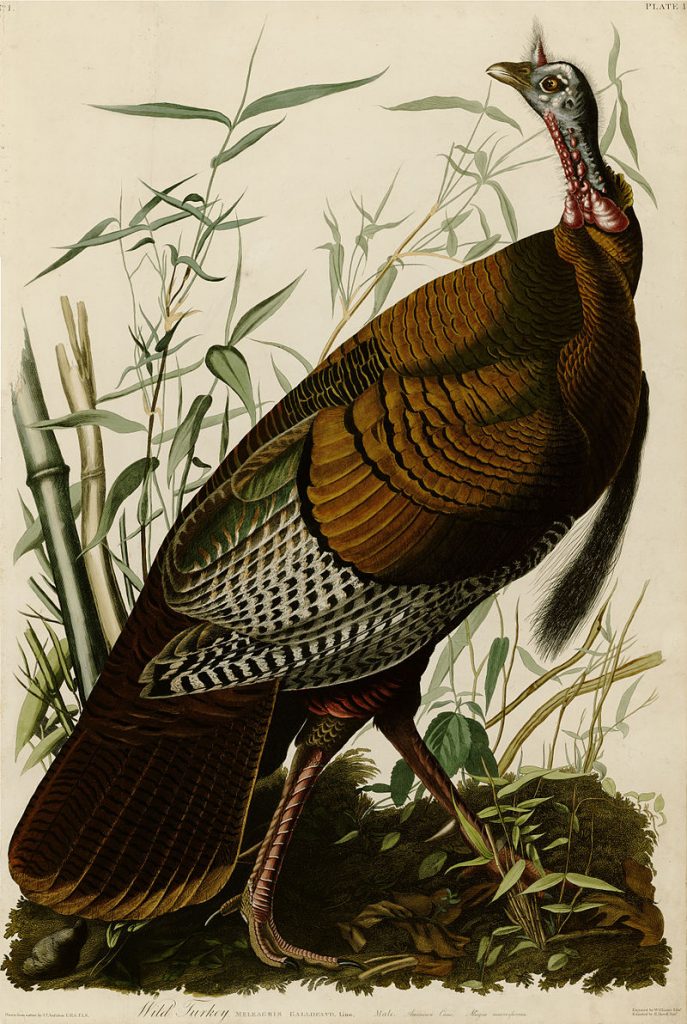
Plate 1 of The Birds of America by John James Audubon, depicting a wild turkey (Wikipedia) eaten for Thanksgiving

Thanksgiving is a festival given over to celebrating God’s Bounty. There are unanswerable debates about which was the ‘First’ Thanksgiving, but the date of the 4th Thursday in November was set by Abraham Lincoln. It is basically a harvest festival, but was adopted by Lincoln as one method to unite a divided nation during the Civil War.

Thanksgiving today is mostly roast turkey with stuffing, cranberry sauce, mashed potatoes and pumpkin pie. But there are many variants and additions such as a first course of soup, and vegetables like Brussels sprouts and broccoli. Very like an English Christmas dinner, but replacing the Christmas Pudding with pumpkin pie.

Food eaten on the first Thanksgiving.

As to what the first Pilgrims would have eaten is not known, but their chronicler Edward Winslow noted:

“Our harvest being gotten in, our governor sent four men on fowling, that so we might after a special manner rejoice together, after we had gathered the fruits of our labours; they four in one day killed as much fowl, as with a little help beside, served the Company almost a week.”

https://www.history.com/topics/thanksgiving/first-thanksgiving-meal

So the birds shot by 4 marksmen would have been wild turkey but also other birds such as ducks, geese, and swans. Seafood; Mussels, lobster, and eel were also available.

As to ‘gathering the fruits of our labors’. This might have included onions, beans, lettuce, spinach, cabbage, carrots, and peas. Stuffing might be seasoned with sage, thyme, parsley, marjoram, fennel, anise or dill, The Pilgrims had plenty of Corn from their first harvest which would have been turned into cornmeal, and eaten as a mush if savoury or sweetened with molasses as a porridge, or made into cornbread, or for stuffing. Perhaps not so different to Frumenty. (see my post on Wife selling and Frumenty.

Native Americans & Thanksgiving

Indigenous Wampanoag Americans might have been present, but only to investigate the shooting of canons in celebration by the Pilgrims. Relationships were tense between the native Americans and the immigrants. Some Indigenous Americans consider it a day of mourning; others use it as a day of gathering for the family, but generally, consider images of the Pilgrims and Indigenous Americans sitting down peacefully celebrating together to be ‘a lie’. (Native Americans and the First Thanksgiving.)

First Published on 24th November 2022, Republished on 23rd November 2023, 27th November 2025

November ‘the month of immolations’

Kalendar of Shepherds November

This post slipped through the editorial net.  So, I need to get it out there before November is a cold memory.

November is the 9th Month of the Roman Calendar. Novem coming from the Latin for nine. But the Romans added two months to the calendar during the time of the Dictator, Julius Caesar (for his reforms click here). So 9th month is now the 11th.

In Welsh it is ‘Tachwedd’ which means the month of slaughtering. Blōtmōnaþ (Blotmonath) in Anglo -Saxon – the month of blood. These reference the fact that this was the month when the surplus animals were slaughtered or as the historian, Venerable Bede has it, ‘the month of immolations’. In Irish the month of November is called sawhain. It is also the name of the festival marking the beginning of winter which starts at dusk on 31st October. We call it Halloween, the celts Sawhain or words similar. (see my post on Halloween).

The image, at the top of the page, from the Kalendar of Shepherds shows some aspects of November – star signs Scorpio and Sagittarius; Pigs are fattening up on the acorns in the forest and then being slaughtered, smoked or dried to preserve them through the hard winter. The text of the Kalendar (read it below) gives a good summary of what early modern life in November was like. In summary, the day when the ‘poore die through want of Charitie’.

Kalendar of Sherherds – November

For more details on the Kalendar of Shepherds see my post here.

Time to see the Pleiades

They can be seen from Autumn to Spring, but they are visible all night in the Northern Hemisphere in November and December.

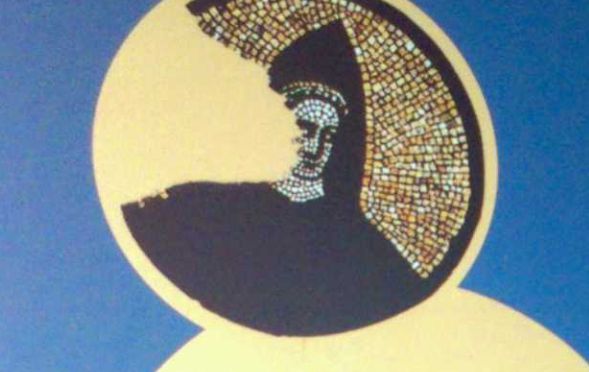
Nebra Sun disc from Stonehenge Exhibition British Museum
Nebra Sun disc from Stonehenge Exhibition British Museum. The Pleiades is thought to be represented by the 7 stars in the cluster above and between the Sun and the Cresent Moon, on this bronze age copper and gold disc

First published in 2024, revised in 2025

Night Fowling November 19th

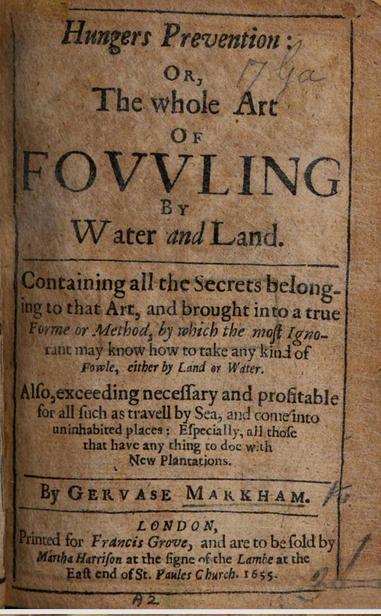
Gervase Markham Hungers Prevention: or, the Whole Art of Fowling by Water and Land. (Printed, London: for Francis Grove, 1655).

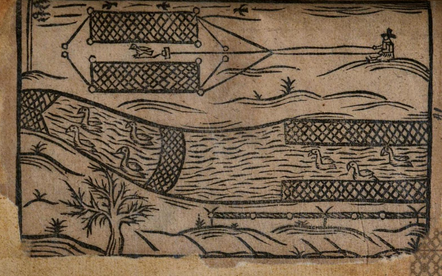
This was the period of the year for ‘Night-fowling’. Gervase Markham wrote a whole book about it in the 17th Century. It was called Hungers Prevention: or, the Whole Art of Fowling by Water and Land. (Printed London: for Francis Grove, 1655).

In it, he tells the reader to go to ‘a stubble field in November when the air is mild and the moon not shining. There take a dolorous low bell, and net. Spread the net over the stubble where there may be fowl, ring the bell, light fires of dry straw, and the fowl will fly and become entangled in the net.

Title illustration from Gervase Markham Hungers Prevention: or, the Whole Art of Fowling by Water and Land. (Printed London: for Francis Grove, 1655).

In Britain today, the Wild fowling season is from 1 September – to 20th February and largely takes place on the marshes and foreshore.

Duck, Geese, waders and other birds are the quarry. Species involved include:
Gadwall goose, Canada goose, Common snipe, Coot, Goldeneye duck, Greylag goose, Golden plover, Moorhen, Mallard, Pink-footed goose, Jack snipe, Pintail, European Woodcock, white-fronted goose, Pochard, Scaup1, Shoveler, Teal, Tufted duck, Wigeon

(from https://basc.org.uk/wildfowling/advice/wildfowling-code-of-practice/)

For more Gervase Markham books see my post here:

On this Day

On this day, in 1660, Charles I was born.

In 1863. President Abraham Lincoln gave the Gettysburg Address.

World Toilet Day

Today is the United Nations’s World Toilet Day. It is ‘Sustainable Development Goal 6 Safe toilets for all by 2030’. It is astonishing that we, as a species, have:

3.5 billion people (who) still live without safely managed sanitation, including 419 million who practise open defecation.’

That is a third of the world’s population if my figures are correct. It also impacts particularly badly on women in those areas where decent hygiene cannot be guaranteed.

These are the ‘Key messages you should know on World Toilet Day’

  1. Toilets are a place for peace. This essential space, at the centre of our lives, should be safe and secure. But for billions of people, sanitation is under threat from conflict, climate change, disasters and neglect.
  2. Toilets are a place for protection. By creating a barrier between us and our waste, sanitation services are essential for public and environmental health. But when toilet systems are inadequate, damaged or broken, pollution spreads and deadly diseases get unleashed.
  3. Toilets are a place for progress. Sanitation is a human right. It protects everyone’s dignity, and especially transforms the lives of women and girls. More investment and better governance of sanitation are critical for a fairer, more peaceful world.

First published Nov 19th 2022. Republished Nov 19th 2023, 2024, 2025

Lay in stocks of fire wood against the Winter November 14th

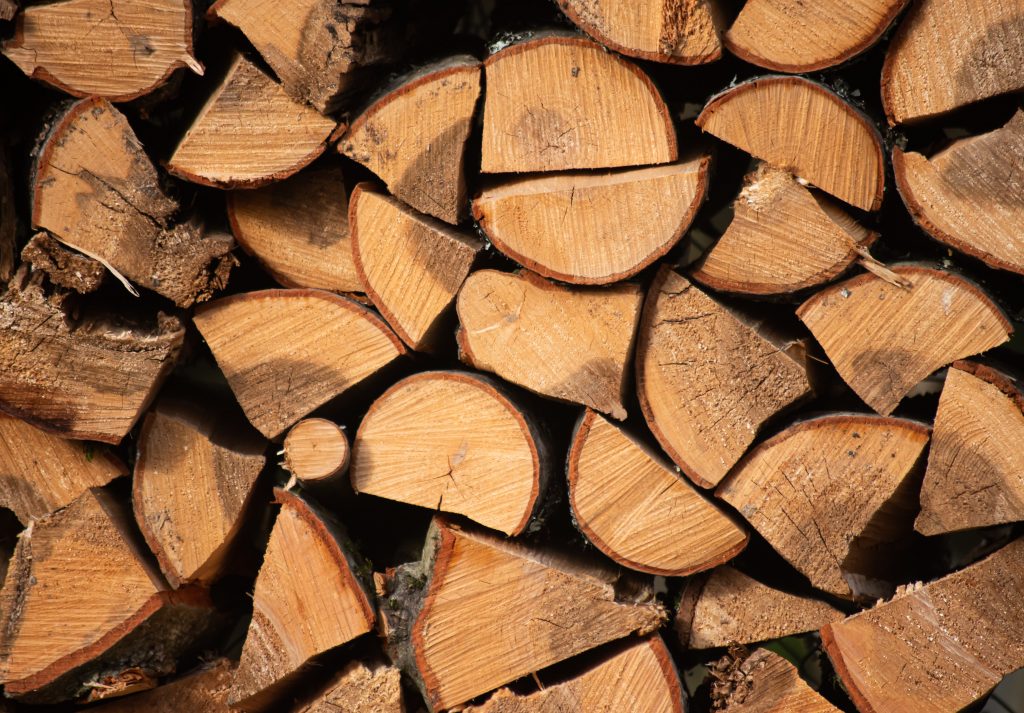
Photo by Sergey Lapunin on Unsplash

As the winter comes nearer and the St Martin’s Summer comes to an end – make sure you have good stocks of firewood. Here, is some ancient advice on the burning of wood:

Beechwood fires burn bright and clear
If the logs be kept a year
Oaken Logs if dry and old
Keep away the winter’s cold
Chestnut’s only good they say
If for years ’tis laid away
But ash-wood green or ash-wood brown
Are fit for a King with a golden Crown
Elm she burns like the churchyard mould
Even the flames are cold
Birch and pine-wood burn too fast
Blaze too bright and do not last
But ash wet or ash dry
A Queen may warm her slippers by.

For more professional modern advice for your wood burning stove, look here, or at this, excellent, although American source. For more on a St Martin’s Summer, see my post here:

IKEA Furniture and Me.

My own very limited experience of firewood is from the very occasional fires I lit during Christmas past. I found a particular joy in burning IKEA furniture which had failed during the year. My kindling of choice was dried Christmas tree, which pops and crackles like a good indoor firework. I suspect burning IKEA furniture, however good for the soul, is appalling for the environment, so please don’t do it! Take a pickaxe to it instead, or even better, upcycle it.

The nightmare that is a flatpack!

A postscript on IKEA. To appreciate the joy this gave me, you have to understand my dislike of shopping in IKEA. And my even greater frustration at putting together the flatpack items. I have a form of flatpraxia which begins with an inability to spot key construction information cryptically hidden in those little drawings. Magically, as you survey the slightly wonky creation in front of you at ‘completion’, my mind finally resolves the importance of tiny details on those little diagrams. Understanding comes with the realisation that I have put it all together in the wrong sequence. This added with a ham-fisted DIY disability means, my IKEA is full of quirks such as drawers that are not the smooth sliders you dream of. So, when an alternative piece of furniture comes to my attention, with more character and, crucially, already put together, the IKEA is ready for its joyous ritual disappearance from my house.

First Published 14th November 2022, revised 14th November 2023, 2024 and 2025

Enjoying a St Martin Summer; a Halloween Summer or an Indian Summer – November 12th

Autumn leavesfor a St Martin Summer

A late warm patch is now often called an ‘Indian Summer’. This term was first used in the United States in the 19th Century. It may refer to a warm period in which Indigenous Americans could continue hunting.

Previously, in England, a warm patch in the Autumn was called a ‘St Martin Summer’. It could also be called ‘a Halloween Summer.’ St Martin’s Day is the 11th November, and is, in a normal year, the day around when the weather turns to feel wintry. See my post on St Martin’s Day.

A Very Warm early November.

The Met Office in the UK has stated that we had a particularly warm October, and a record breaking early November. They explain:

As November began, a flow of warm air from the south swept across the UK. This southerly pattern, combined with cloudy skies, helped trap warmth overnight, leading to unusually high daily minimum temperatures. ‘

They note that the warmest November 5th on record was at Teddington on the Thames in West London, and the average temperature was 14.4 deg C (58F).

But I can’t really call it a St Martin’s Summer because although warm it wasn’t very sunny. We had some sunny but didn’t feel summery.

A warm spell is, in fact beneficial to many plants. The problem comes if it is followed by a quick cold spell. Plants need time to harden off to prepare to face cold weather. A warm winter will also allow many insects to survive and so in the summer plants will be adversely affected by a plague of pests.

For more information on how mild weather affects plants:

Revised and Republished in November 2025

Time to Tup your Sheep – November 7th

City Farm, Hackney. Small flock of Bluefaced Leicester Sheep, the big golden one is the Ram, the others are the ewes he has tupped. Photo K Flude

The old Shepherd’s saw is:

‘In with a bang and out with the fools’.

The bang is Guy Fawkes Day on November 5th, and the fools are a reference to All Fools Day on April 1st. The gestation period of a ewe is 147 days (on average). (sheep-farmers-year). So farmers introduce the Ram into a field of Ewes on or around November 5th. This means the lambs will be born around the beginning of the traditional lambing season.

(see my posts on Guy Fawkes Day and All fools Day)

Tupping Times

The Ewes have been enjoying themselves in the fields, The flocks have been thinned out, with the young ones being sent to market, mostly for meat. The grass has been growing at the end of the summer, with the wetter weather. The ewes will be in excellent condition, and will have been thoroughly checked by the shepherd.

The chosen ram will be dressed with a harness on his chest, which will have a sheep’s crayon on it. The crayon is known as raddle or reddle. The ram, also know as a tup, will mate with whichever of the ewe(s) that catch his eye. Each one he tups (mounts or covers) will be left with a paint mark, from the reddle on his chest, on her back. The farmer will inspect the ewes periodically. A ewe with two or more reddle marks on her back, will be taken out of the field. This will force the ram to spread his attentions to the, as yet, untupped, ewes. He will continue until all ewes have been tupped. And then onto the next field full of ewes. Diggory Veen is the Reddleman in Hardy’s ‘Return of the Native’. I talk about him, lambing and reddle in my post here.

Some of the young ewes will be kept to reinforce the flock. Males will only be kept if they will be sold to another farmer as a tupping ram. They cannot breed on the farm as this will lead to inbreeding. So, a ram will be purchased or swapped from another farm. The farmer will want to choose one that fits into his/her idea of what the ideal sheep is. whether it is grown for meat, or to be hardy, or for its wool etc.

Raddled

To be raddled is to be flushed, red with drink, or over made up. It has a sense of dissipation about it. One might have more sexual encounters than is normal. Just like the ewe with too many raddle marks on her back? Or the Raddle man with a red face and hands from all the raddle he handles?

Bluefaced Leicester Sheep and my Hat!

I was delighted to see my local City Farm had a small herd of Bluefaced Leicester Sheep. I was visiting with my Grandson when I took the photograph at the top of the page. The sherderdess told me the blue-marking in this case was not a result of mating. She thought 2 or more of them were already pregnant, however.

My association with the breed comes from a lovely yarn shop in Conwy (Ewe Felty Thing) which had a rail of clothes marked ‘wearable art’. I bought a woolly beanie which they told me was:

‘Hand-spun, hand knitted from a bluefaced leicester sheep.

Hand-spun, hand knitted Beanie from a Bluefaced Leicester sheep. purchased at (Ewe Felty Thing) Photo K Flude

I still have it. It cost a small fortune, but worth every penny!

A bluefaced Leicester Ram, might cost £1000 if a bought as a lamb, £4,000 if bought as a shearling, or up to £40,000 if a prize lamb. It is one of the biggest lambs with a long back, and longwool with ringlets. There is no wool on the face and neck so you can see its blue-grey skin, below the white hair – hence its name. It is often bred with hill sheep ewes, which combines the prolificacy of the ram with the mothering abilities of the ewes.

Generally, nowadays the wool from a shearing will only be worth about 80p in today’s market. This will not pay for the cost of the shearing, but it is necessary for health and hygiene reasons.

Posted on 7th November 2025

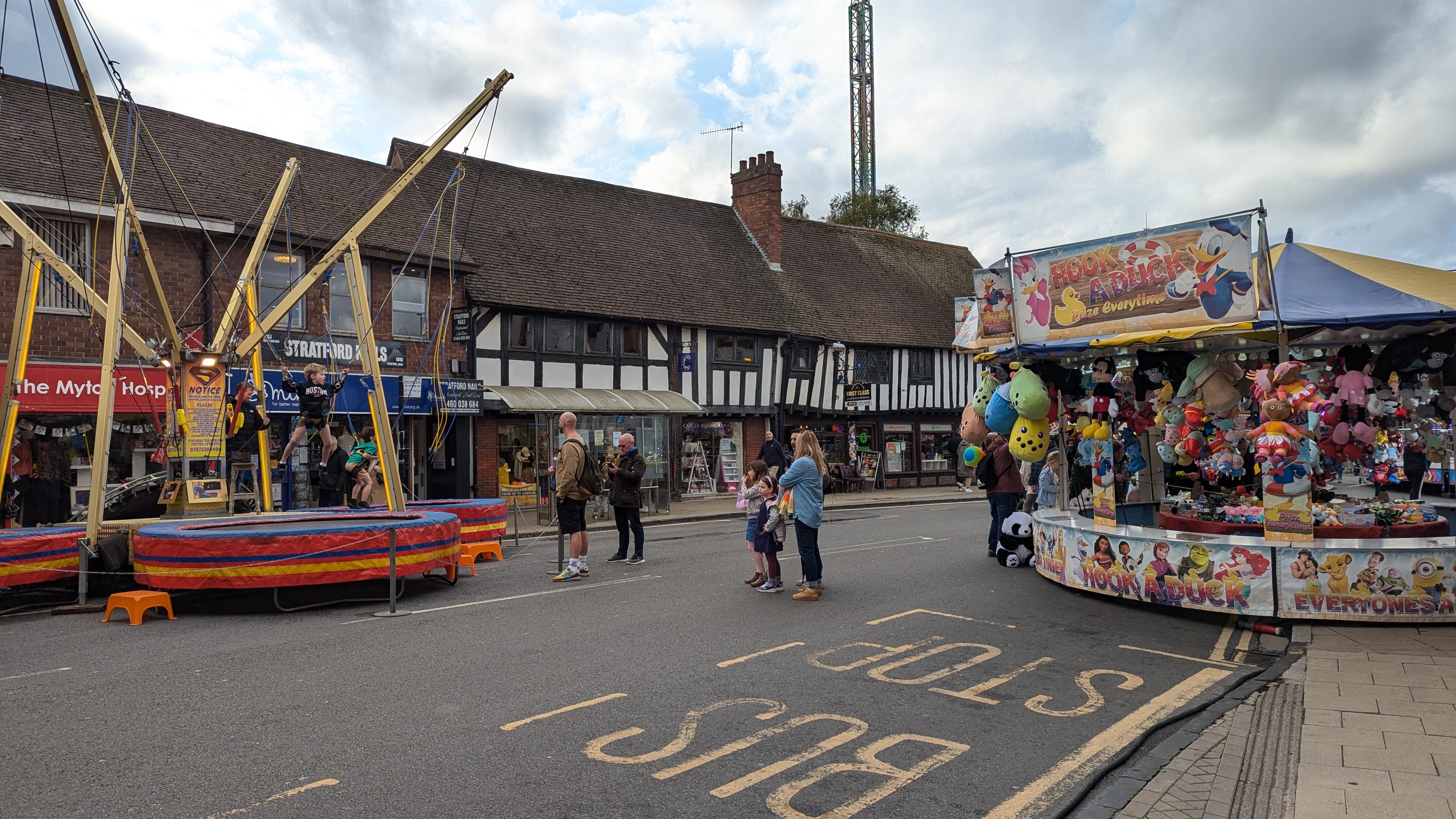
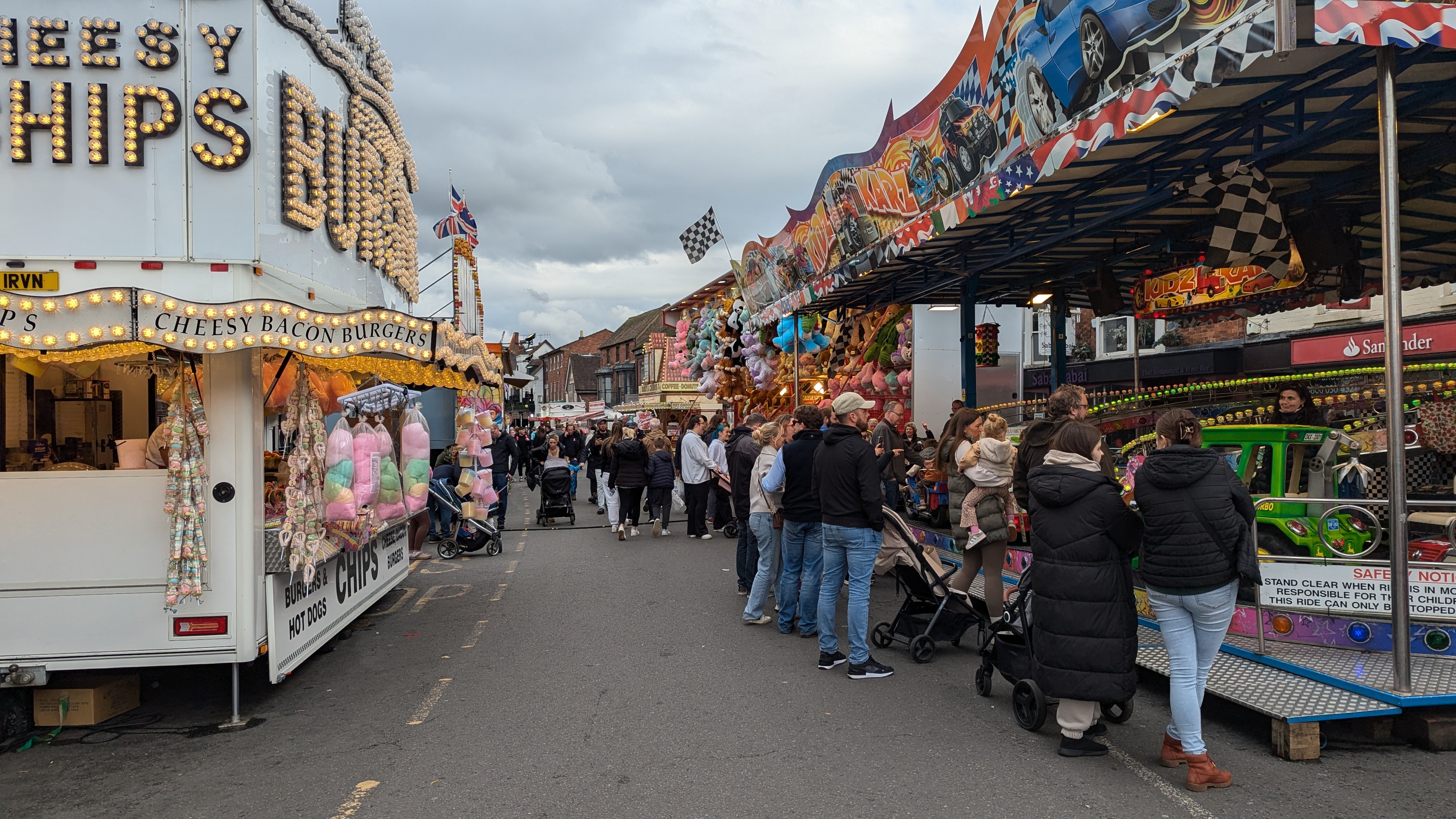
Going to the Mop in Stratford-upon-Avon & Henley-in-Arden 11th & 12th October

The Mop Festival in Stratford-upon-Avon

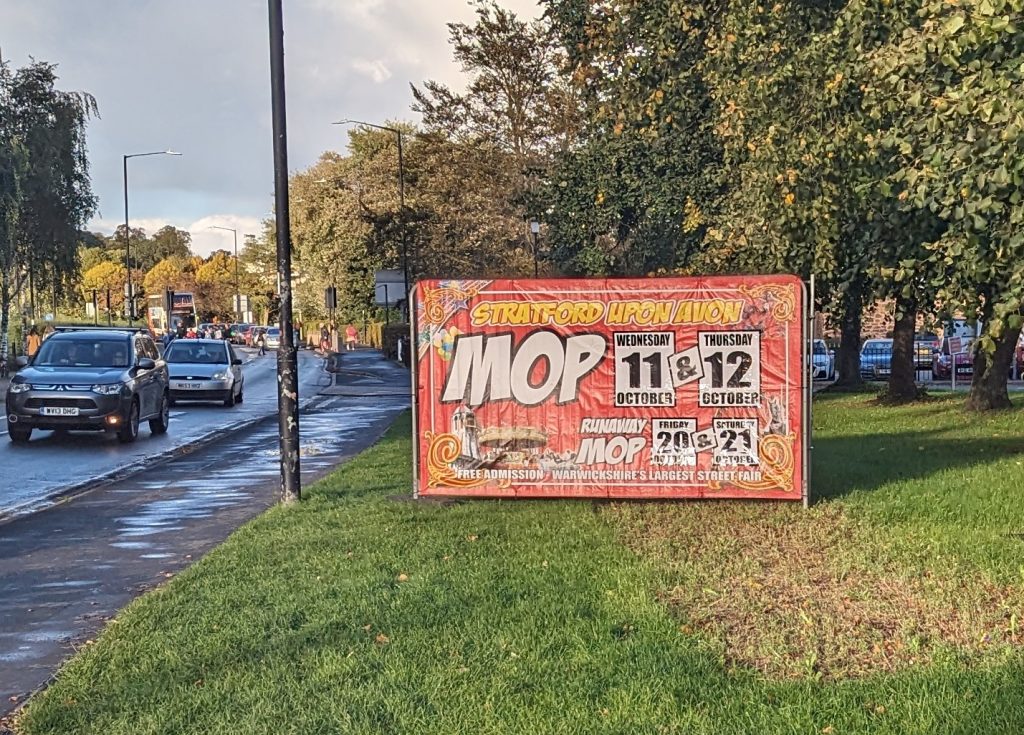
This year the Stratford mop festival was on the 11th and 12th October. I am in Stratford. The the centre of town is a cacophany of shooting galleries, stalls selling toffee apples, candy floss, burgers and all things bad for you. And a fun fair.Nothing at all sophisticated, or literary or dramatic, or folkloric. Just a good old-fashioned fun fair in the middle of the town. Quite raucous, but they leave Henley Street, and Shakespeare’s’ Birthplace, free of it. Below I tell the story of my discovery of the Mop.

In 2023, I was on my way to Stratford-upon-Avon Railway station, I saw the sign at the top of this page, but had no idea what on earth a Mop was. I put it to the back of my mind as I took the train to Henley-in-Arden. My interest in the town was that Shakespeare was born in Henley St. And his mother was called Mary of Arden. So, naturally, I wanted to find out about Henley-in-Arden. To turn curiosity to action, it took our Tour Coach Driver telling me he lived there and that it was a pretty but small town.

Mary Arden doesn’t live here any more!

I had a free afternoon from my duties as Course Director on the ‘Best of England’ Road Scholar trip. I got on the very slow train to Henley-in-Arden. One of the first stops was Wilmcote, where Mary Arden’s House is. I visited two years ago, when I was astonished to find it was a different building to the one I had visited in the 1990s! In 2000, they discovered they had been showing the wrong building to visitors for years! Mary Arden’s House was, in fact, her neighbour Adam Palmer’s. And her house was Glebe Farm.

On that visit, I walked from Stratford-upon-Avon to Anne Hathaway’s Cottage. Then to Mary Arden’s House and back to Stratford along the Stratford Canal. It is a lovely country walk if you are ever in the area.

The Forest of Arden

The train route to Henley is through what remains of the ancient forest of Arden. The forest features in, or inspired, the woody Arcadian idylls which feature in several of Shakespeare’s plays, particularly the Comedies. ‘As You Like It’, for example, is explicitly set in the Forest of Arden, as this quotation from AYL I.i.107 makes clear:

Oliver:  Where will the old Duke live?

Charles. They say he is already in the Forest of Arden, and a many merry men with him; and there they live like the old Robin Hood of England: they say many young gentlemen flock to him every day, and fleet the time carelessly as they did in the golden world.

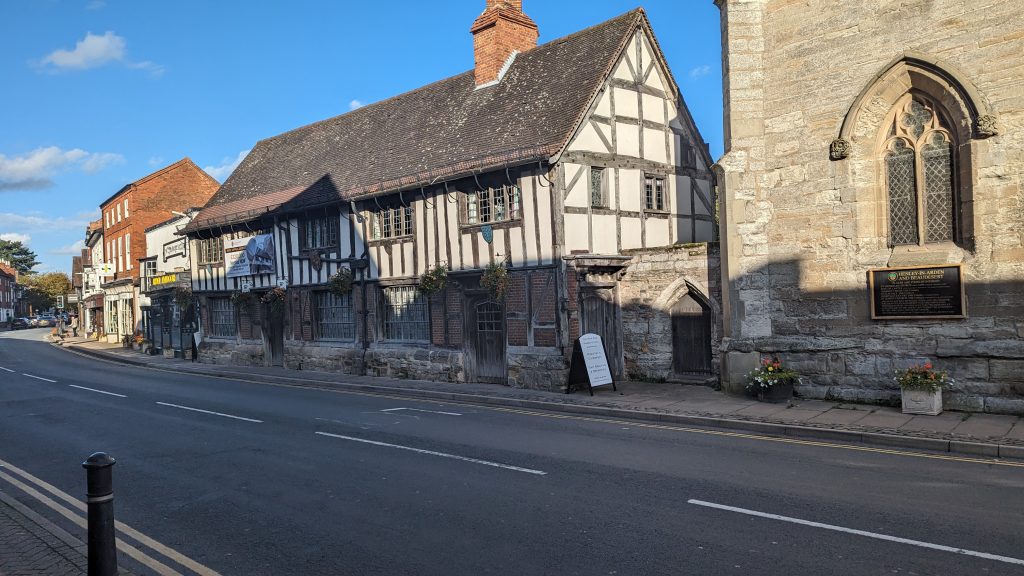
Guildhall, Henley-in-Arden

Henley-in-Arden

Not much remains of the old Forest. It was cut down to make timber-framed buildings and ships for the British Navy – the so-called Wooden Walls. Henley has a beautiful high street. Further down the road is a lovely Heritage Centre full of old-fashioned and DIY Information panels. And that is not a criticism, it provided a very enjoyable visit full of interesting stuff. And gave me a couple of snippets of information I have not seen anywhere else.

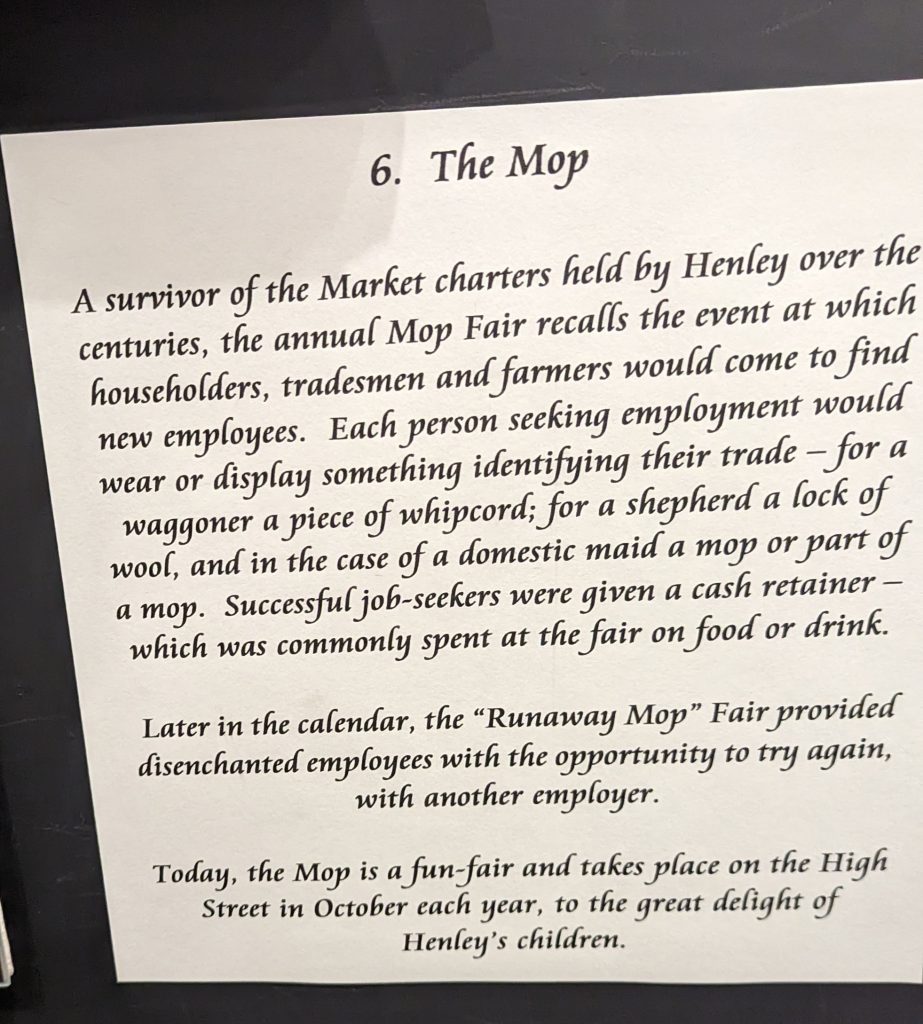
One, was a panel dedicated to the Henley Mop. A mop turns out to be a hiring fair. Think of Gabriel Oak in Hardy’s ‘Far from the Madding Crowd’. His attempt to become an independent farmer destroyed when his sheepdog runs amok. The dog sends his sheep over a cliff to their doom. So he takes his shepherd’s crock to the hiring fair or Mop as they are known in the Midlands. There, potential employers can size up possible employees and strike mutually agreeable terms and conditions. And Gabriel becomes the shepherd for the delightful and wilful Bathsheba Everdene.

So, a shepherd would take his staff, or a loop of wool. A cleaner her mop (hence the name of the fair). A waggoner a piece of whipcord. A shearer their shears etc. Similarly, in the Woodlanders (by Thomas Hardy) the cider-maker, Giles Winterborne, brings an apple tree in a tub to Sherborne, to advertise his wares.

The retainers thus employed would be given an advance and would be engaged, normally, for the year. So there was quite a widespread moving around of working people to new jobs and often new housing. Not quite how we imagine the past?

The perceptive among you will have noted the bottom of the sign in Stratford which advertised the ‘Runaway Mop’. This was held later in the year, so that employers could replace those who ran away from their contracts. And those who ran away could find a better, kinder or more generous boss. See also my post of Gabriel Oak and Pack Rag Day which is another hiring fair which was help on Martinmas Old Style.

Henley Mop – panel from the heritage centre

Court Leets and Barons

Also of interest to me was the panel about Court Leets and Barons. These were the ancient courts which dealt with, respectively, crime and disorder, and property and neighbourhood disputes. Henley still has its ancient manorial systems in use, at least ceremonially. The Centre shows a video of the installation of a new Lord of the Manor at the Guildhall. The title had been purchased by a cigar-smoking Stetson-wearing large rich American.

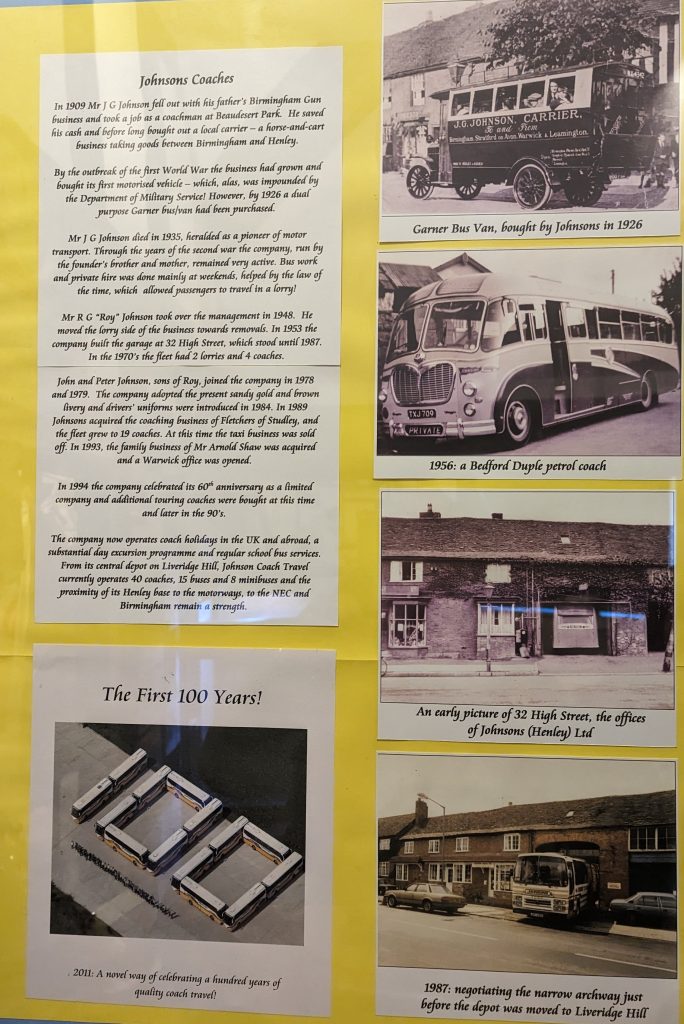
Johnson’s Coaches

Another panel was the story of a Coaching Company. When I lead the Best of England programme we are driven around by Johnson’s Coach Company. It was a delight to discover that it has a history that can be traced back to 1909 in Henley. I conveyed this information to our group on the next day as we toured the Cotswolds. Curtis, our driver, was able to update the panel. He told us that the family were still involved with the firm, which is still operating from the area. He said the two brothers who run the company come in every working day. They do everything they require of their drivers to do; i.e. they drive coaches, clean coaches, sweep the floors and generally treat their staff like part of a big family. I should have asked him whether he got his job at the Mop, while holding a steering wheel in his hands!

Johnson’s Coach Company -Panel from Henley Heritage Centre

Note: It seems that Johnson has now merged with another company. But it keeps its depot in Henley and maintains its connection with the town.

First published in 2023 updated 2024, 2025

Michaelmas Old Style – October 11th

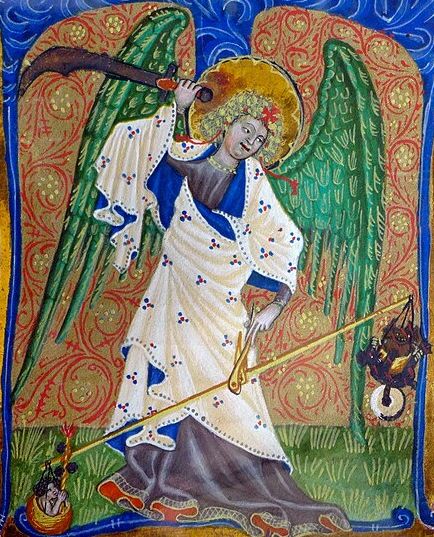
Michaelmas Old Style. St. Michael weighing souls during the Last Judgement, Antiphonale Cisterciense (15th century), Abbey Bibliotheca, Rein Abbey, Austria (Wikimedia by Dnalor_01 license (CC-BY-SA 3.0))

I am catching up as I have been away. So I’m a little behind in my days.

October 11th is the day that the Devil fell out of heaven and landed in a Blackberry Bush. So. you are, therefore, not wise to eat them after October 11th. St Michael’s Day is now celebrated on September 29th (see my post here). But before September 1752, it was celebrated on what is now October 11th, now styled ‘Michaelmas Old Style’. The change of date is due to the introduction in the UK of the Gregorian Calendar.

Saint Michael is the chief of the archangels. Saint Gabriel was celebrated on the eve of the Annunciation on 24 March (see my post here). St Raphael on the 24th October, But more recently the Churches celebrate all the Archangels at Michaelmas. It is now called the celebration of St Michael and All Angels.

Terms. Colleges, Lawyers and Quarterdays

Apart from its religious significance, St Michael’s Mass was an important date on the civic calendar. Terms began, rent fell due, and work contracts ran out. It was the end of the ploughman’s year, and the day when Hiring Festivals or Mop Festivals took place. Look at my post on the Stratford Mop festival

So in Oxford, the autumn term is called Michaelmas. The Spring Term Hilary on St Hilary’s Festival of January 14th. The third term is called Trinity, which takes place on Trinity Sunday the first Sunday after Pentecost. The law courts also have a Michaelmas term.

It is one of the Quarter Day’s of the year, close to the Solstices and the Equinox into which the medieval and early modern world was divided:

(The above list is copied from Wikipedia).

Eat a Goose for Good luck at Michaelmas

It is probably too late to tell you this year. But “if you eat goose on Michaelmas Day you will never lack money all year“. Or as they said in Yorkshire: ‘He’at eateth goose on Michaelmas won’t find his pockets short of brass.’ Jane Austen wrote to Cassandra on Michaelmas 1813 ‘I dined upon goose today, which I hope with secure a good sale of my second edition.’ Pride and Prejudice was published in 1813.

St Michael is one of several archangels. He was protector of the Israel. He has four main roles in heaven. He is the leader of the heavenly host in its defeat of Satan. He is the Angel of Death, the Weigher of Souls, and the Guardian of the Church. For more on archangels, see the second half of my post on Michaelmas here.

On this day

The Romans celebrated ‘meditrinalia’ where they celebrated the new wine and the Gods that made it possible. They toasted the wine chanting:

‘I drink old and new wine to cure old and new disease.’

First Published in 2024, revised in 2025

October – Winterfylleth, Hydref, or Deireadh Fómhair

October from the Kalendar of Shepherds

Kalendar of Shepherds

The 15th Century French illustration in the Kalendar of Shepherds shows October as a busy month. It is the time when the cereals are being flailed, the fields ploughed and sown. Perhaps winter wheat or barley or peas and beans?

The 16th Century English text of the Kalendar of Shepherds (read the illustration) shows what a busy month it was, but the writer comes down hard against the month as ‘a messenger of ill news’ the harbinger of cold dark nights.

About the Kalendar of Shepherds.

The Kalendar was printed in 1493 in Paris and provided ‘Devices for the 12 Months.’ I’m using a modern (1908) reconstruction of it using wood cuts from the original 15th Century version. It includes various text from 16th and 17th Century sources. (Couplets by Tusser ‘Five Hundred Parts of Good Husbandrie 1599. Text descriptions of the month from Nicholas Breton’s ‘Fantasticks of 1626. This provides an interesting view of what was going on in the countryside every month.

https://wellcomecollection.org/works/f4824s6t To see the full Kalendar, go here:

Astrological October

The star signs of October are the Scales of Libra and the Scorpion of Scorpio.

The star signs of October

Angelic October

Michael is the Angel of Autumn, the Angel of Judgement Day, and the Weigher of Souls. Uriel is the Angel of Libra and was sent by God sent to warn Noah. So the protector against, floods, fire and natural disasters. Scorpio’s Angel is Barbiel, he looks over health, genitalia and doubtful things. (‘An Angel Treasury’, Jacky Newcomb).

You might like to look at my post on Michaelmas here.

Roman October

In the Roman world it was, originally, the 8th Month (octo=8) but then they added January and February to the year. So it became the 10th Month. It was their time to celebrate the new wines of the Harvest. In Britain, the wine harvest is late September to October, but in hotter climes can be from July. But the grapes need to be processed, and the Romans thought that new wine was health giving and celebrated it in October.

Rustic October

But for many people, October is a beautiful month. The dying leaves bring a sophisticated array of rustic colours, which makes the wooded countryside exceptionally beautiful.

Autumn in Haggerston Park, London (photo Kevin Flude)

It can still be warm enough to go for pleasant walks. And the surfeit of the harvest and the culling of animals meant there was plenty to eat before winter austerity begins.

Anglo-Saxon Winter Fall

The Venerable Bede tells us that the month was called Winterfylleth, in the 8th Century. The English divided the year into Summer and Winter. And Winter began for the Anglo-Saxons on the first full moon of October. This means that this year winter begins on 7th October. This is the Harvest or Hunter’s Moon, which is also a supermoon, the first of 3 ending the year.

Celtic October

In Welsh, it is Hydref, which also means Autumn. For the Welsh it was the last month of Autumn and the last month of the year. The Celtic new year, and winter starts on 1st November. The same is true of the Irish Calendar. Autumn is called Fómhair, and October Deireadh Fómhair which means ‘End of Autumn’.

Astronomical & Meteorological Autumn

Astronomically, autumn ends at the Winter Solstice and meteorologically at the end of November. So the Celtic Autumn ends a whole month or more earlier than the other measures. My very personal view is that Winter begins on November 5th more often than not. This is an evening we often spend outside watching the fireworks displays to celebrate Guy Fawkes’ Night. It always seems to be the first time that you feel cold enough to need hat, gloves, and scarves.

First Published in Autumn 2024, revised 2025